“Sit on Someone Else’s Face, I’m Busy!”: How Drag Queens Use Language to Perform Camp on RuPaul’s Drag Race
Tabor Allen, Logan Edwards, Grace Phan
Drag queens are often celebrated for their visual artistry, elaborate costumes, and theatrical performances, yet some of their most powerful tools are linguistic. Through quick wit, exaggerated character voices, playful insults, and references to iconic celebrities and pop culture moments, drag performers manipulate language to produce humor, construct elaborate persona, and signal cultural knowledge. This article explores how drag queens use language to produce camp, a queer aesthetic characterized by irony, exaggeration, and the playful subversion of dominant cultural norms.
Focusing on the popular television program RuPaul’s Drag Race, this study examines the show’s iconic Snatch Game challenge, in which contestants impersonate celebrities in a parody game-show format. Because success in Snatch Game depends heavily on improvisational humor and cultural referencing, it provides an extremely rich context for examining the linguistic resources drag queens use to perform camp. By analyzing transcripts from ten iconic Snatch Game performances, this project identifies several recurring linguistic strategies used by contestants to index camp. The findings highlight four major discursive resources: metapragmatic humor, intertextual referencing, sexual innuendo, and character recognition and subversion. Together, these practices demonstrate how camp functions not only as a comedic style but also as a powerful linguistic resource for affirming queer identity and cultural belonging.
Keywords: drag culture, camp discourse, RuPaul’s Drag Race, queer linguistics, intertextuality
[expander_maker id=”1″ more=”Read more” less=”Read less”]
Introduction and Background
Drag queens are widely celebrated for their visual artistry, but here we want to demonstrate that some of their most powerful tools are actually linguistic. Through wit, playful insults, and references to iconic celebrities and pop culture moments, drag performers manipulate language in highly creative and entertaining ways.
Drag performance has long been closely associated with camp, a queer aesthetic and discursive style characterized by irony, exaggeration, theatricality, and the subversion of gender stereotypes and heteronormativity. In an early and pioneering discussion of camp, the theorist Susan Sontag emphasized its stylized appreciation of artifice and exaggeration (Sontag, 1964). While Sontag famously described camp as a sensibility that transforms seriousness into playfulness, later scholars like Jeremy Carl Kelley (2013) have argued that camp should be understood not simply as an aesthetic but as a systematic interactional resource used to construct queer identity and community.
Linguistic anthropologists have also examined the relationship between drag performance and language. Rusty Barrett’s work on gay male subcultures demonstrates how drag queens use stylized speech practices to construct gendered personas and index community membership (Barrett, 1999). Barrett shows that drag performers frequently shift between multiple speech styles, layering voices and identities in ways that challenge conventional assumptions about gender and language.
For any interested readers, a well-known portrayal of earlier drag and ballroom culture can be seen in the documentary Paris Is Burning, which provides historical insight into the performance traditions that shaped contemporary drag culture (see the trailer here: https://www.youtube.com/watch?v=9SqvD1-0odY )
One of the most visible contemporary spaces where these practices occur today though, is the television show RuPaul’s Drag Race. Since its debut in 2009, the show has become one of the most influential platforms for drag culture worldwide. It functions not only as a competition show, but also as a cultural space where drag discourse and the camp aesthetics that shape it are performed, circulated, and reproduced for both queer communities and mainstream audiences.
This project builds on these insights by asking the following question:
How is camp indexed through language in a highly ritualized performance context such as RuPaul’s Drag Race, and how does this linguistic performance affirm queer identity and culture?
Methods
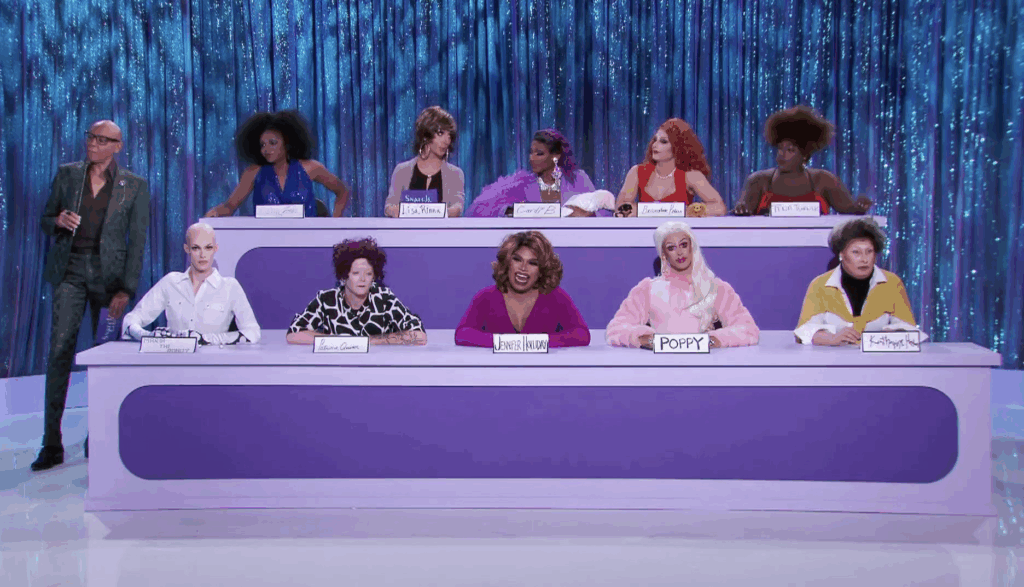
To explore this question, our project focuses on the popular “Snatch Game” challenge from RuPaul’s Drag Race. In Snatch Game, contestants impersonate celebrities within a parody game-show format inspired by the classic television show Match Game. Unlike other challenges on the show, Snatch Game is all about wordplay: success often depends heavily on improvisational humor, quick wit, and creative cultural references.
Because this analysis examines drag discourse within a televised competition, it is important to situate the speech events within their broader communicative context. Linguistic anthropologist Dell Hymes proposed the SPEAKING model as a framework for analyzing speech events within their cultural settings (Hymes, 1974). The model highlights how communicative practices are shaped by elements such as participants, setting, norms of interaction, and genre.
Snatch Game represents a very layered communicative environment. The setting is a parody game show embedded within a reality competition television series. The participants include the queens performing celebrity impersonations, the host RuPaul, fellow competitors, the in-game “contestestants”, and the broader television audience. The genre blends improvisational comedy, celebrity impersonation, and drag performance.
These overlapping contexts create a form of layered artifice, where contestants perform multiple identities simultaneously: they perform their drag queen personas, impersonate celebrity figures, and compete as contestants within a reality television format. This complex performance structure makes Snatch Game an especially productive site for examining how camp is linguistically constructed and interpreted in a mediated performance setting.
For this study, eight iconic Snatch Game performances were selected from across multiple seasons of RuPaul’s Drag Race. These performances were chosen as a representative sample due to their high status within the show’s fan community, illustrating how effectively Ru Paul’s Drag Race disseminates drag performance across the wider culture. Readers unfamiliar with the format can view examples of Snatch Game performances in widely circulated clips online (see this compilation: https://www.youtube.com/watch?v=hRm0WKPyC9M )
The selected performances were transcribed and analyzed for recurring linguistic patterns.
Results
The analysis revealed four linguistic strategies that appeared consistently across the selected Snatch Game performances.
Table 1. Linguistic resources used to index camp in Snatch Game performances
| Linguistic Resource | Description | Function in Camp Performance |
| Metapragmatic Humor | Jokes that comment on the performance, situation, or the interaction itself | Highlights the artificiality of performance, generates humor |
| Intertextual Referencing | References to celebrities, films, music, or cultural icons | Activates shared cultural knowledge and signals queer cultural literacy |
| Sexual Innuendo | Double entendre and playful or absurd references to sexuality | Produces humor through exaggeration and challenges normative expectations |
| Character Recognition and Subversion | Establishing a recognizable celebrity persona and then exaggerating or distorting it | Creates camp through parody, exaggeration, and reinterpretation of cultural figures |
Table 1: Summary of the four linguistic resources identified in the analysis of Snatch Game performances.
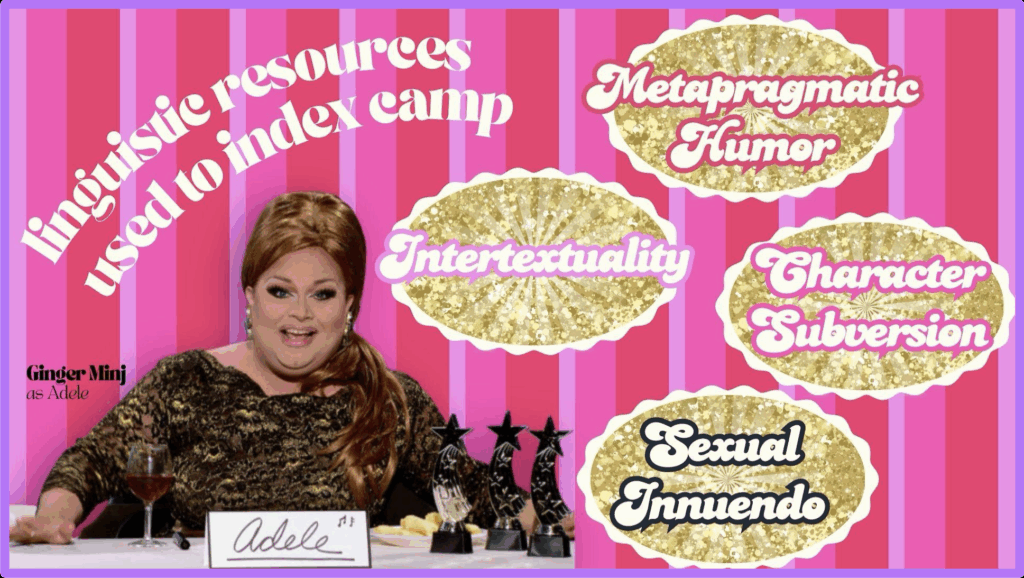
These discursive resources allow drag queens to create camp performances that rely simultaneously on humor, cultural recognition, and exaggerated character portrayal. The following are textual examples drawn from the segments we transcribed.
Metapragmatic Humor: Ginger Minj as Adele, Season 7 Episode 7
Ru Paul: It’s a good answer but not a match darling
Adele: Well could I get a match please, its a fake cigarette
Intertextual Referencing: Gigi Goode as Maria the Robot, Season 12 Episode 6
Ru Paul: Now Maria, do you know Siri and Alexa?
Maria: One second… searching… she’s my sister, bitch
Sexual Innuendo: Bonnie Ann Clyde as “Chair” (Cher), UK Season 4 Episode 7
Ru Paul: Oh yes, and what a solo act you are, I sit on you all the time
Chair: Sit on someone else’s face, I’m busy!
Character Recognition and Subversion: Jimbo as Shirley Temple, All-Stars Season 8, Episode 4
Bowen Yang: Snatchlerette number 4, what song would you say best describes your love life, and why?
Shirley: I would say “The Good Lollipop” cause I’m a sweet trip to the candy shop! I’m all growed up now, I’m one hundred years old!
Discussion and Conclusion
When taken together, these findings suggest that camp in drag performance is not only a visual aesthetic or comedic style. It is also indexed through a complex set of linguistic practices that allows performers to manipulate voice, reference shared cultural knowledge, and exaggerate familiar identities to humorous effect.
Ultimately these linguistic strategies do more than just entertain the audience or advance the queens through the competition. They also function as a way of affirming queer identity and community belonging. In recognizing the references, jokes, and exaggerated performances, the queens draw on a shared cultural repertoire, one that draws on decades of queer history, celebrity iconography, and drag traditions.
In this sense, camp functions as a cultural as well as linguistic resource. Through humor, parody, and exaggeration, drag queens create moments of shared recognition that reinforce a sense of community among audiences and performers alike.
By examining the language of drag performance, this project highlights the important role that linguistic creativity plays in shaping contemporary queer culture. More broadly, it demonstrates how camp continues to function as a vibrant and affirming mode of queer cultural expression.
References
Barrett, R. (1999). From drag queens to leathermen: Language, gender, and gay male subcultures. In M. Bucholtz, A. Liang, & L. Sutton (Eds.), Reinventing identities: The gendered self in discourse (pp. 313–331). Oxford University Press.
Hymes, D. (1974). Foundations in sociolinguistics: An ethnographic approach. University of Pennsylvania Press.
Kelley, J. C. (2013). Queering conversation: An ethnographic exploration of the functional properties of camp-based language use in U.S. gay men’s interactions. UCLA.
Natacha Marjanovic, “Be Proud, and Loud”: Linguistic Markers of Pride in Drag Queens’ Spoken Discourse », Discours [En ligne], 32 | 2023, mis en ligne le 22 juin 2023, consulté le 13 février 2026. URL : http://journals.openedition.org/discours/12425 ; DOI : https://doi.org/10.4000/discours.12425
Sontag, S. (1964). Notes on camp. Partisan Review, 31(4), 515–530.
Natacha Marjanovic, “Be Proud, and Loud”: Linguistic Markers of Pride in Drag Queens’ Spoken Discourse », Discours [En ligne], 32 | 2023, mis en ligne le 22 juin 2023, consulté le 13 février 2026. URL : http://journals.openedition.org/discours/12425 ; DOI : https://doi.org/10.4000/discours.12425
Appendix
Snatch Game, Ru Paul’s Drag Race, Select Transcriptions
Bonnie Ann Clyde as “Chair”, UK Season 4 Episode 7
Ru: Up next (.) <take a seat y’all>it is chair (cheering)
Chair: Hey R::u (.) it’s been so long (.) you might not recognize me since I’ve been reupholstered so many <times>
Ru: [hhh-
Chair: [You wanna know what they’re starting to call it?
Ru: What?
Chair: A [chairlift
Ru: [hhh (.) now chair, do you get along (.) with the other furniture in the living room?
Chair: I d::o, I used to be in a relationship with one of them actually we were called table and chair
Ru: [hhh
Chair: [so
Ru:[hh
Chair: [it didn’t work out so I’m a s::olo act n::ow
Ru: Oh and what a solo act <you are> (.) I sit on you ::all the time
Chair: Sit on someone else’s face I’m busy
Ru:hhh
Ginger Minj as Adele, Season 7 Episode 7
Ru: Last but not least, music superstar Adele is here
Adele: Could I buy a vowel?
Ru: What is that darling?
Adele: No emmys!
Ru: No no no this is the wrong show!
Adele: Okay
Ru Paul: Where in England are you from Adele?
Adele: My house
Ru Paul: Alright, now Dorothy blanks the Tin Man
Adele: Well if it was me, I would say she rips out his heart and then sings a whole album about it, and gets really popular but its not me
Ru Paul: No, no
Adele: So I said, she polishes his chrome
Ru: It’s a good answer but not a match darling
Adele: Well could I get a match please, its a fake cigarette
Gigi Goode as Maria the Robot, Season 12 Episode 6
Ru Paul: Hi Maria
Maria: What’s up, bitch?
Ru Paul: Now, do you know Siri and Alexa?
Maria: One second, searching, she’s my sister, bitch
Jujubee as Eartha Kitt, Season 5 Episode 4
Participant: Contestant number two, I’m originally from Canada, so if we went up there for a winter visit, how would you keep me warm?
Eartha: I would sensually walk to the thermostat, and turn up the thermostat to a sensible seventy four.
Participant: Contestant number two, same question
Eartha: Ribbet, ribbet, I am a lady frog, and you are a sweet prince, and I am convincing you
Jinkx Monsoon as Little Edie (Gray Gardens) Season 5, Episode 5
Ru Paul: Direct fro Grey Gardens its little Edie Beale
Edie: Oh hi Ru
Ru Paul: How is big Edie doing
Edie: She’s always begging for the paté, but the label is faded, I can never tell if its paté or if its jiblets for the cats
Edie: Ru, if I might ask you, why you couldn’t have gotten any real celebrities for this game?
Ru: Well
Edie: I don’t have a single idea who any of these people are, you could’ve gotten Leslie Careoux or Audrey Hepburn or any one of them and instead you got Ketchup?
Kesha: Ketchup?
Edie: And that must be Janice Jickson?
Alexis Michelle as Liza Minelli, Season 9 Episode 6
Ru Paul: Ring them bells, it’s Liza Minelli, or is it Lisa Minulli?
Liza: No Ru, its Liza, with a Z, it has a Z
Ru: Its Liza with a Z
Liza: WIth a Z!
Ru Paul: Liza Minelli
Liza: I said, Ladybunny’s Palace,
Ru Paul: Her palace
Liza: Because, there’s nothing like playing the palace,
Ru Paul:[hhhh
Liza: Mama played the palace, and I sat right in the fourth row
Ru Paul:[wow
Liza:[She sang right to me
Ru Paul:[Oh boy
Liza: And to all the other homosexuals
Ru Paul:[hhhh
Ben De La Creme as Maggie Smith, Season 6 Episode 5
Ru: Alright, Dame Maggie Smith, Cher, completely addicted to social media, even her blank has a twitter account.
Maggie: Well, ruple, Ruple is it? I understand virtually none of the words that left your lips moments ago, but I did hear the term twitter and I assumed that it’s some sort of a songbird?
Ru:[hhh Very close, not a match…
Maggie: Am I to understand that one yanks one’s telephone right out of the wall and carries it with him?
Ru: Yes
Ru (to Nicki): You didn’t write down anything?
Nick: No
Maggie: Perhaps she needs another pot of ink to replenish her quill
Ru: Let’s move on down to Dame Maggie Smith
Maggie:[Well I’m unfamiliar with the work of lady Handler, however I did think that it would be rather amusing if there were libation flavored with…citrus hhh
Ru:[hhhh
Maggie: Can you imagine such a thing
Ru:[hhh that is really newfangled I can’t imagine such a thing
Jimbo as Shirley Temple, All-Stars Season 8, Episode 4
Ru: She’s America’s OG sweetheart, Shirley Temple is here
Shirley: Well hello Ru!
Ru:[hhhh
Shirley: I won the hearts of America and the world
Ru:[hhhh yes you did, are you ready to win the heart of a nice “snatchler”?
Shirley: I don’t know, does he know how to babysit?
Ru:[hhhh
Bowen Yang: Snatchlerette number 4, what song would you say best describes your love life, and why?
Shirley: I would say “the good lollipop” cause I’m a sweet trip to the candy shop
Ru:[hhhhh
Shirley: I’m all growed up now, I’m one hundred years old
Oyna Nurve as Eddie Murphy, Season 17 Episode 7
Ru: Up next, comedy superstar, Eddie Murphy is here
Eddie: I’m so excited for tonight’s episode of the Snatch Game woo
Ru: Eddie, which is your favorite Greek superstar?
Eddie: You know its Hercules, Herecules, Hercules, Hercules, Hercules
Ru:[hhhh
Eddie:[hhh oh my mustache almost fell off
[/expander_maker]