media representation

Media & Reality All at Once: How ‘Everything Everywhere All at Once’ is doing its best to exemplify our code-switched conversations

Jacqueline Aguirre, Josiah Apodaca, Kaitlyn Khoe, Mason Uesugi, Wonjun Kim

Code-switching, or the use of more than one language, dialect, or code in an utterance or conversation, can be a way to signal identity. This study compares two sources of code-switching — conversations from media, specifically Everything Everywhere All at Once (2022), and conversations in real life — by categorizing utterances and types of code-switching. This study investigates the representation of code-switching in bilingual media and the similarities and differences to code-switching in daily life. The real life conversations were conducted with Mandarin-English bilinguals, and the two conversations ran for 8 and 10 minutes. The findings demonstrated that intersentential switching occurred more often in this particular media, while intrasentential switching was preferred by the real-life speakers. The various types and functions of code-switching were present in the media, which was expected given the larger sample size and production resources and timelines. Nonetheless, both case studies demonstrated significant levels and mannerisms of code-switching, aligning with the proposed variables and categories. Further studies could utilize other syntactic properties, pitch contours, and tonal articulations in order to auditorily represent accuracies and behaviors of code-switches as more bilingual media makes its way into the American entertainment landscape.

[expander_maker id=”1″ more=”Read more” less=”Read less”]

Introduction and Background

Code-switching (CS) refers to when a speaker alternates between two or more languages, or language varieties, within a single sentence or interaction. Code-switching is a linguistic function mostly used in bilingual speech communities to convey a mutual “in-group” status between speakers, as the ability to code-switch demonstrates proficiency in both of the utilized languages. Our study seeks to answer these questions: How is code-switching represented in media? What are the differences and similarities to code-switching in everyday life?

Deriving from the studies conducted by Shen, Gahl, and Johnson on English-to-Mandarin code-switches, we compared the types of code-switching between Mandarin and English in media, through the 2022 film Everything Everywhere All at Once (EEAO), versus real life to see how accurately code-switching is being represented. The aforementioned study by the researchers suggest the existence of “switch cost,” as the English-Mandarin bilinguals consistently displayed slower reaction times specific to the code-switches in sentence-medial positions, as highlighted in their eye tracking experiment (Shen et al,. 2020). However, while there are many studies giving structure to code-switching, there are fewer applying them to media. 

Our target population for this project were Mandarin Chinese and English bilingual speakers. Mandarin Chinese belongs to the language family of Sino-Tibetan languages, which is under the Sinitic branch (Odinye 2015). Internationally, about 1.3 billion people use the language, being the official language of China and Taiwan (Odinye 2015).
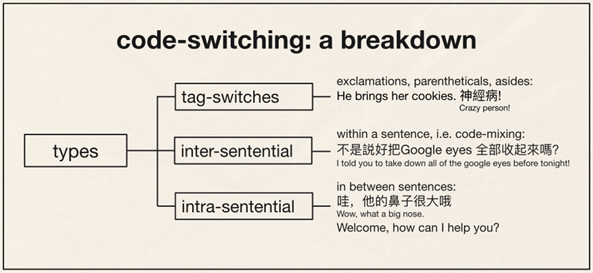
Figure 1. Explanation and examples of code-switching types.

There are three different types of code-switching: tag-switches, which are exclamations, parentheticals or an aside in another language than the rest of the sentence; intrasentential switches, which occur in the middle of the sentence and are typically called code-mixing; and intersentential switches, which occur between sentences (Appel & Muyusken, 2006). We will use these categories in our data analysis to see if some forms of media uphold current code-switching practices.
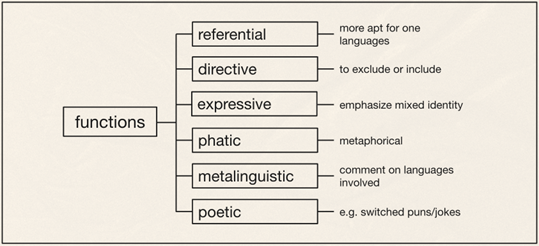
Figure 2. Explanation of code-switching functions.

Code-switching in a sentence can also serve different functions depending on the speaker, topic, and context of the language used. Researchers Appel & Muyuskend determined six categories as follows: (1) referential, where some subjects or words are more apt for one language, perhaps due to a lack of knowledge; (2) directive, to exclude or include the hearer; (3) expressive, emphasizing mixed identity; (4) phatic, or metaphorical switching; (5) metalinguistic, to comment indirectly or directly on the languages involved; and (6) poetic, which are switched puns or jokes (Appel & Muyusken, 2006).

There is going to be a lot left out about the filmmakers here, but in terms of context about the media that is relevant to code-switching, one of the writer/director duo ‘the Daniels,’ Kwan, is a second-generation Chinese-American. Having been in a Chinese Mandarin and English home environment, he is likely comfortable with engaging in code-switching because of his multilingual parents. One of the producers, Jonathan Wang, hopped on this project also because he wanted to tell a story inspired by his own immigrant parents, so he likely had a hand in ensuring language accuracy, like with the Cantonese, alongside with several translators. With this background in mind, we hypothesized that the movie’s representation of code-switching should be fairly accurate to how speakers code switch in real life.

We hypothesize that the participants and the script should have similar examples and amounts of code-switching in type and function within the given environmental parameters, as established earlier. Our research will help determine whether change is needed in how bilingualism is being represented, or if there is already a solid structure in place for new media to follow.

Methods
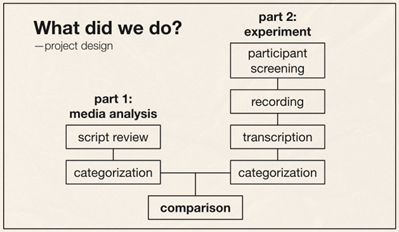
Figure 3. Step-by-step breakdown of our methodology.

Our project design comes in two parts: analyzing the media and analyzing a conversation in real-life. The script had both lines as they were spoken along with translations, so we could categorize them based on type of CS. We applied that same process to two conversations, around 10 minutes each, recorded between two sets of participants. They did know they were being recorded but eventually seemed to forget (over a period of around 10 minutes for each set), so the conversation seemed to flow naturally, with them code-switching subconsciously.
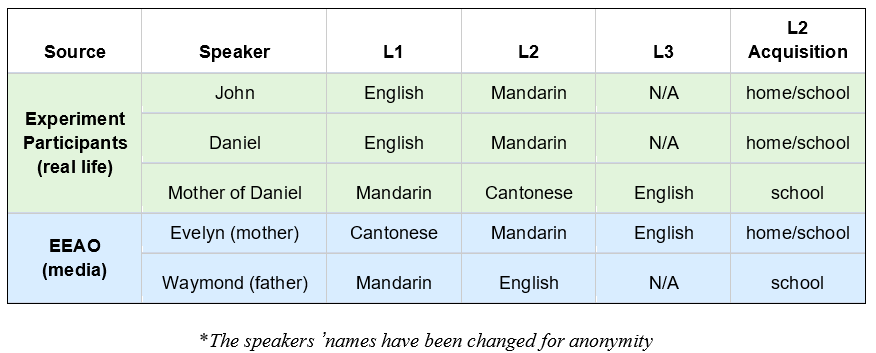
Figure 4. Language background of participants and EEAO characters.

We then analyzed the two sources of code-switching and made comparisons. For the screening process, we found our participants based on a language background survey collecting information, such as their L1, L2, and how they acquired their L2, as shown above. The characters’ method of L2 acquisition and L3 is speculated based on context. It is also likely that Evelyn is a simultaneous bilingual in Cantonese and Mandarin. Only the L2 acquisition method is listed, as it is relevant to our focus on bilingual speakers. Two of the participants (John and Daniel) were close cousins to reflect, while not exactly, the close relationship between Raymond and Evelyn. We also had one of them talk to their own mother to see if there would be a change with the different social dynamic. 

Results and Analysis

The table below shows the tallies for the types of code-switching used in the EEAO script (the blue indicating code-switching in media) and the conversations recorded with our participants (green for real-life code-switching). Since the conversations were not exactly the same amount of time, the proportions for each type of CS were calculated by dividing the total for each conversation by the count. There was insignificant information for tag switching in both the script and recordings, so it was left out of the table.
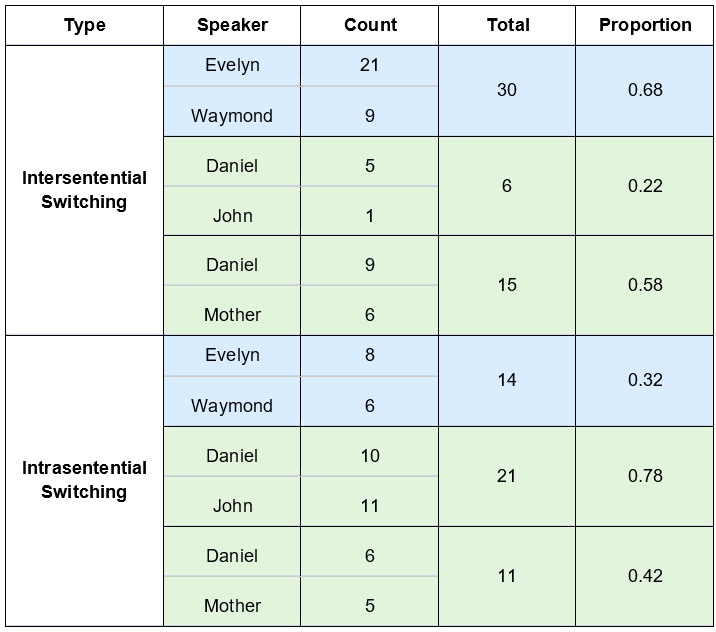
Figure 5. Code-switching frequency in media vs. recorded conversations. Proportion represents type of code-switching used in conversation out of total occurrences of code-switching.

Waymond and Evelyn used intersentential switching more than intrasentential (30 versus 14 times). That pattern is the same for Daniel and his mother (15 versus 11 times), while Daniel and John opted for more intrasentential switching (6 versus 21 times). The type of CS (intrasentential) that is more common for Daniel and his mother, whose language background and fluency matches best with EEAO characters, is the same as in EEAO conversations.

As for functions, each pair (Daniel and John, and Daniel and his mother) were dominant in the referential function, where some words or phrases are more easily expressed in one language. This outcome is likely because of the speakers’ proficiency in their second language — Mandarin. In a self-reported survey, both Daniel and John rated their L2 proficiency as a 3. The expressive and poetic function appear in the recorded conversations (CS was also used to repeat and clarify). The directive function likely does not appear in these conversations because they were recorded in isolated, controlled environments. Had they been in more natural environments, out in public, it is likely that the directive function would appear.

As for the functions present in the EEAO conversation, they were also dominant in the referential function of code-switching, with directive being the second most used. Considering the characters, Waymond and Evelyn, immigrated to America and were likely not exposed to their L2 (English) until later, it makes sense that the referential expression is dominant for them as well. Regarding their use of the directive function, this is most likely due to Waymond and Evelyn being in various environments where there was a third-party to exclude or include (e.g., customers, Gong Gong). Additionally, unlike our speakers, the expressive function does not appear in the movie, but the poetic function does show up once. 

Based on these results, it seems that the code-switching in EEAO supports the theory of the different types and functions of code-switching. When comparing our speakers’ code-switching with the movie, both align in having referential code-switching be primarily used in communication. Though with our speakers, they showed slightly more variety in function, as they covered expressive functions while the movie did not. While the movie significantly used the directive function, our speakers did not. Again, we conclude that this is due to a difference in environments between the speakers.

Discussion and Conclusion

The data promotes the idea that EEAO and its representation of code-switching is accurate. Since Daniel’s code-switching varied based on the hearers (with his cousin versus his mother), the movie’s representation is also accurate in representing how code-switching is employed for differing functions based on environment.

While the conversations and media we analyzed ended up with similarities, affirming our hypothesis of EEAO being an accurate representation of code-switching, further research is needed to extend these results to media in general. After studying natural conversations of English-Mandarin bilinguals, researcher Xitong Zhang found that “the occurrence of code-switching not only depends on the language ability of the speaker, but also the purpose and the environment in which the conversation occurs” (Zhang, 2019, p. 44). One of the ways to expand this study in the future would be to observe participants in more environments and situations over longer periods of time (e.g., recording conversations over the course of a week) because EEAO has more environments. This choice would provide more data for analysis and allow for a richer case study of CS.

It would also help to have participants whose language background better matches the characters even better because Daniel and John did not have the same L1/L2 as Waymond and Evelyn. However, the time constraint of this study provided a limited participant pool to see how identity and linguistic competency affect code-switching.

We could also look into instances of “bad” code-switching in media, likely tied to older media sources, to develop concrete standards of accurate code-switching — including what not to do — for future representations of the bilingual experience. We could just look at more films, maybe in other language pairings, or other sources of media, like TV shows, whether good or bad examples, as well.

In his video essay “English. Language. Movies. Parasite,” Kyle Kallgren studies code-switching in the 2019 film Parasite and the cultural implications of mixing English and Korean in conversation. The Parks, a rich family, often uses English to confide in each other or to establish solidarity with their hired workers. It seems that English is worked into the plot accents, signifying the divide between the poor and rich families. In a similar fashion, language boundaries reinforce relationships in the plot of EEAO, with code-switching being a big part of it.

America tends to fawn over foreign culture without realizing it is their own culture being sold back to them — just accented — which is probably why they find connection to it. There is something to be said about how these two movies employ code-switching as a tool to hint at language hierarchies. Studying the use of language and code-switching in media like this is important for providing a foundation for how to approach appropriate representation in media. There are harmful social implications if one does not consider the influence of how language is used in movies. As language hierarchies exist in reality, noticing and replicating them in media will only reinforce them when they should be dismantled. Understanding how media perpetuates practices in which social classes are tied to certain manners of speaking can help us counteract that.


References

Anindita, K. (2022). An Analysis of Code-Switching in the Movie “Luca”. ELTR Journal, 7(1 23-33. https://doi.org/10.37147/eltr.v7i1.164

Appel, R. & Muysken, P. (2006). Language Contact and Bilingualism. Chicago: University of Chicago Press.

Chen, Z., & Liu, X. (2023). Types and Functions of Code-Switching in the Film Everything Everywhere All at Once. Journal of Education, Humanities and Social Sciences, 13, 171-176. https://doi.org/10.54097/ehss.v13i.7889.

Kwan, D. and Scheinert, D. (Writer). (2022). Everything Everywhere All at Once. A24.

Odinye, S. I. (2015). Phonology of Mandarin Chinese: Pinyin Vs. IPA. Quarterly Journal of Chinese Studies, vol. 4, no. 2, p. 51–58.

Reformadita, A., & Setyaji, A. (2021, October). Code-Switching Analysis on Pixar’s “Coco” Movie. In Undergraduate Conference on Applied Linguistics, Linguistics, and Literature. (Vol. 1, No. 1, pp. 26-37).

Shen, A., Gahl, S., & Johnson, K. (2020). Didn’t hear that coming: Effects of withholding phonetic cues to code-switching. Bilingualism: Language and Cognition, 23(5), 1020-1031.

Zhang, X. (2019). Code-Switching in English-Chinese Ordinary Conversations. TESOL Working Paper Series, 17, 38-45.


Appendix A

PDF Link for EEAO Script

[/expander_maker]

, , , ,

The Persian Identity Crisis

This study delves into the intricate relationship between language practices and the construction of individuals’ sense of belonging and cultural identity, with a specific focus on the Persian language, also known as Farsi. For second-generation Iranians residing in Los Angeles, this linguistic journey takes on a multifaceted nature, as they navigate a complex interplay between Farsi and English. This often leads to the adoption of code-switching, a phenomenon where individuals seamlessly alternate between the two languages, colloquially referred to as ‘Finglish’ or ‘Pinglish.’ Through interviews and observations within Iranian diaspora communities, this research aims to answer the following question: “Have Persians lost their self-identity and how is this reflected in language use? Our results would shed light on explaining how language proficiency, cultural adaptation, and social dynamics intertwine to shape the nuanced ways in which code-switching serves as a mechanism for negotiating and expressing multiple cultural identities, thus shedding light on its implications for Persian identity.

[expander_maker id=”1″ more=”Read more” less=”Read less”]

Introduction

The complex relationship between language practices and the construction of individual identity within diaspora communities is an interesting area to study, particularly in the context of second-generation Iranians residing in Los Angeles. Our project focuses on the Persian language, also known as Farsi, and its role in shaping cultural identity among the demographic. In the hugely diverse and multicultural landscape of Los Angeles, navigating between Farsi and English becomes a complex journey, often manifesting in code-switching or more commonly known as “Finglish”. Through a mix of interviews and observations within the Iranian diaspora, it begs the question: Have Persians lost their identity? Furthermore, what language traditions have changed to reflect that language might be a casualty of this identity crisis? Does a change need to happen to regain a sense of identity within the Fasi-speaking communities? By unraveling the complexities of language proficiency, cultural adaptation, and social dynamics, we seek to illuminate how code-switching serves as a mechanism for negotiating and expressing multiple cultural identities, thereby offering insights into the implications for Persian identity in diaspora settings.

Background

When we examine Iran’s rich history, it becomes evident that Iranians possess a heritage steeped in antiquity, vastly different from the modern Iran that it is today. This historical depth is intricately interwoven with the Persian language, serving as a tangible reflection of Iran’s multifaceted evolution. Among some Iranians, regardless of their location, Persian is revered as a cultural benchmark, embodying resilience and continuity across generations. However, the accessibility of resources pivotal for preserving and nurturing Persian proficiency varies among Iranian Americans. While some benefit from cultural events, media outlets, and language courses, others encounter barriers that impede their linguistic immersion and connection to their community.

Thus, many Iranian Americans resort to “code-switching,” a practice where an individual uses two or more language varieties in the same speech event or exchange, as defined by Woolard (2004). Within the diaspora, instances of code-switching manifest in colloquial phrases such as “is so zesht” to denote something ugly or rude, or expressions like “Kheili cute-eh,” signifying endearment. However, code-switching often elicits skepticism within the diaspora, particularly among native speakers. They perceive it as a departure from correct language usage, thereby exacerbating a disconnect between generations and contributing to the evolving linguistic landscape of Persian.

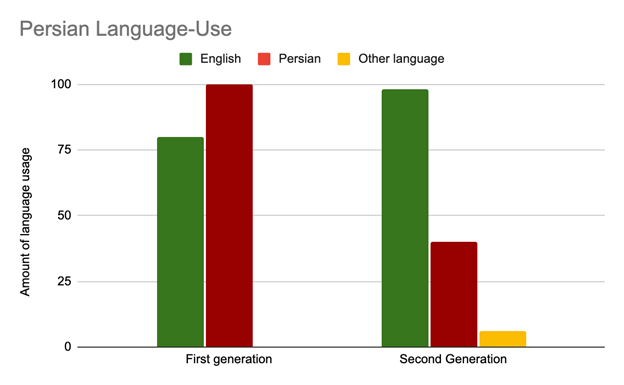
This disconnect is even more evident in the results of the ACS data analysis conducted by Bozorgmehr and Douglas (2011). Their findings reveal a notable linguistic divide within the second-generation Iranian diaspora: while 40% reported proficiency in Persian, a striking 98% acknowledged fluency in English, underscoring the prevalence of English as the dominant language of communication. As second-generation Iranians struggle with the intricacies of their linguistic identity amidst shifting cultural landscapes, this study sheds light on the nuanced dynamics shaping contemporary Persian language usage within the diaspora.

Figure 1: Persian language use among first-generation and second-generation Persians

Furthermore, in the middle of this linguistic mismatch, most of the participants in this survey acknowledge only speaking Persian, while speaking with their group of friends in Farsi alongside English. As a result, diaspora youth unknowingly serve as informal language brokers, facilitating the seamless exchange and merger of both languages in their daily lives. This informal linguistic exchange not only highlights the intricate interplay between cultural adaptation and identity creation but also demonstrates the adaptability of the second-generation Iranian diaspora.

Discussion

The information discussed in this section is a widespread concern among the Persian diaspora. It is a common question of whether Persian is being taught enough, and if not, why parents are not teaching their children Persian. Although the first generation of Iranians overwhelmingly understands Persian and could teach it to their children, they choose not to due to Persian’s position when compared to English. Should a parent teach their child Persian to keep the language alive, and thus risk their child’s ability to speak fluent English, or do they teach their child English first and risk their child’s ability to speak the native tongue well? When framed against the financial success of the Persian diaspora, it makes sense that many would stray away from teaching Persian, even when they could do so.

Survey

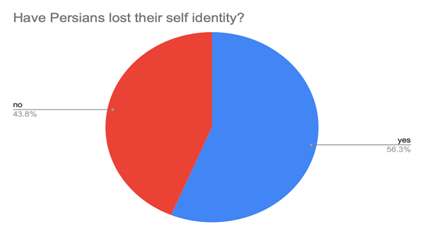
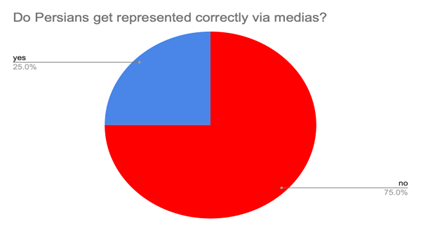
To get a better grasp of Persian Identity, we conducted a brief survey on the UCLA campus and asked participants, mainly of Iranian backgrounds, whether they believe that Persians have lost their self-identity or not. When we gained our participant’s answers and compared them to our original hypothesis, the data shown below was not surprising to us, however, what followed next was:

Figure 2: Have Persians lost their self-identity?
Figure 3: Are Persians represented correctly in the media?

Survey Experiment Conclusion

From the two surveys that we conducted, the data clearly showed us that most Persians do not believe that they have kept their original identity and almost all of them agreed that the media’s coverage of Iranians does not help at all to fix this issue. When we take the findings we gathered from this experiment and combine them with our other data, we constantly see the same trends and conclusions about the Iranian people and their identity which will be discussed in more detail below!

Discussion and Conclusion

When we take a moment to evaluate all of our data and findings that we have stated so far, it is clear to us that the Persian people have lost their identity to some shape or extent. As shown, a lot of our data and participants believe this to be true for the most part and many agreed that for the Persian community to regain their identity and status, something must change with the Iranian Regime (government) representing them back in Iran. Although we do not have public data on this topic many of our participants and even articles universally agree that a direct change to the Iranian regime influences the words views and perceptions of the Iranian people. Overall, we are pleased to report that our original hypothesis of how “Persians have lost their self-identity” is to at least some extent true and the continued destiny of whether it remains true or not simply depends on the actions that the Iranian government and Iranian people continue to take.  

References

Bozorgmehr, M., & Douglas, D. (2011). Success(ion): Second-Generation Iranian Americans. Iranian Studies, 44(1), 3–24. http://www.jstor.org/stable/27919961

Woolard, K. A. (2004). Codeswitching. In A. Durantic (Ed.), A companion to linguistic anthropology. Malden: Blackwell Publishing.

Survey Results

M150 Project Survey

[/expander_maker]

, , ,

Language Ideologies in Animated Films: Why does that character sound like that?

Talla Khattat, Jacob Gutierrez, Edna Tovar, Grace Yang, Al Jackson, Espie Maldonado

Why do all military characters in animation films have Southern accents? Throughout this blog, we aim to understand the world of languages in animated films and take you along with us. Audience members digest the creative choices that are made on screen and unconsciously learn to associate linguistic patterns with certain sociocultural elements. This research paper aims to observe the linguistic elements of accents and dialects to understand the correlating relationship with the language ideologies and cultural attitudes. We observed the films Aristocats (1970), The Secret of NIMH (1982), The Rescuers Down Under (1990), and Zootopia (2016), and categorized the different patterns observed based on several different elements. Our findings show that minority accents can be tokenized to invoke assumptions about a character in order to save screen time. We call on future research to understand how impactful some of these harmful depictions can be and emphasize the importance of respectful representation.

[expander_maker id=”1″ more=”Read more” less=”Read less”]

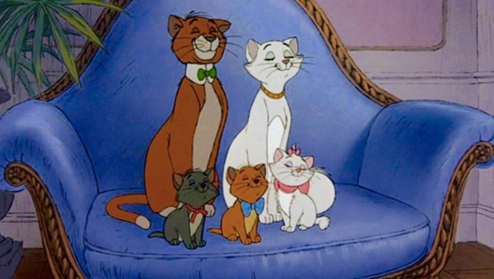
Figure 1: Aristocats end scene

Introduction and Background

Many would agree that animated films are a huge part of one’s childhood. From Disney princes and princesses to a mice version of the United Nations, everyone enjoyed their fair share of animated movies. The beauty of animation is the freedom to shape an entire world from the ground up, where every character is completely designed from scratch, and every choice, from costume, to music, to voice is made intentionally. With this freedom also comes challenges with needing to establish connections from what is seen on screen with the minds of the audience. From the start of the film, the creators need to quickly establish character relations and connections. Here, they use language shorthands that the audience is indirectly familiar with to signal the persona of the character. Our group’s research question aimed to understand throughout a series of animated films what traits or roles are typically associated with certain accents, language varieties, styles, or registers? Within this realm, we also wanted to understand how Standard American English would be treated compared to other accents or dialects. We hypothesized that non-standard varieties of English/Non-English will be associated or invoked when connected to ‘bad’ or side characters, while standard American English will be most often connected to ‘good’ characters or protagonists.

Previous research has indicated that the cultural value of individualism in the United States is reflected in the use of standard English, which often leads to a lack of tolerance towards other languages or English language variations (Wiley, 1996). Although Disney animated films are often translated into standard English, it hinders the complexity of modern language and erases many cultural elements (Bruti, 2009). Moreover, we have also found that language elements can be used to invoke association about certain groups of people in film. Previous work completed by Meek shows how language and race perform character portrayals and as the audience, we witness this work that is being “done”. (Meek, 2006). In other words, accents are often used to not only demonstrate an ethnicity, but also substantiate a portrayal of a certain stereotype associated with a certain group of people.

Methods

To gather data about the language ideologies and characters linked to them, we analyzed four different films; The Aristocats, The Secret of NIMH, The Rescuers: Down Under, and Zootopia. Particularly, we noted what accents and languages were used (or created) in these films and what characters or themes they were associated with. We chose to focus on animated animal characters since we felt that filmmakers could ‘get away with more’ and because language is the main humanizing factor in animal characters, we could better see how language/accents were being used to invoke assumptions about the character.

Watching the movies completely through and inspired by the methodology of a paper written by Janne Sønnesyn, we then categorized our character findings into several categories including their: language/accent, role in the movie, costume, character features, gender, and other distinguishable elements. In sum, we analyzed 66 characters along these 6 categories.

Moreover, by codifying our analyses, we can answer the research question, what traits or roles are associated with certain accents, language varieties, styles, and registers? How do the filmmakers express differentiation amongst characters through the use of language and character design?

Results and Analysis

After empirically analyzing our data, we found several patterns that confirmed part of our hypothesis and refuted others. We looked at our data as an aggregate, combining the findings from all four movies and examining the results in this way.

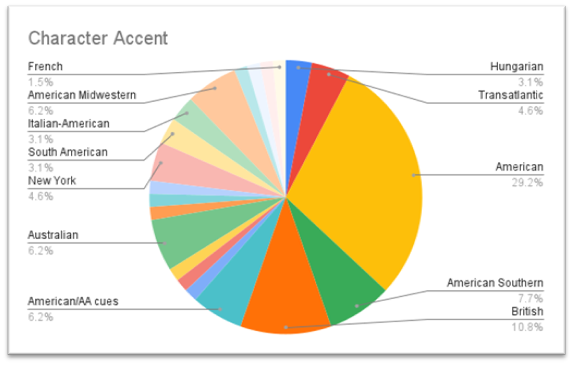
Figure 2: Character accent pie chart by percentage

First Result

Referencing Figure 1 which provides a visual representation of the distribution of the observed character accents, we were able to establish four distinct results. Firstly, we found that the protagonist(s) of the films indeed were associated with the American Standard English accent 54% of the time. Furthermore, 100% of the protagonists had European or American accents — in other words, no minority population accents were represented in the protagonists of these films.

Second Result

This point leads to a second key finding that minority population accents were typically attached to side characters. In fact, 64% of all side characters had a minority accent. Put differently, minority population accents were overrepresented in this character role and underrepresented in others. Heroes did not tend to have minority population accents. Notably however, no antagonist had a minority population accent either — which refuted part of our hypothesis.

Figure 3: Character ‘Duke Weaselton’ from Zootopia

Along the same lines as our minority population accents, non-rhotic accents (accents that ‘drop’ the pronunciation of ‘r’), were commonly used in connection to characters of low socioeconomic status or working class. Some examples of these non-rhotic accents were the New York accent and AAVE (African American Vernacular). We noted 5 characters that used a non-rhotic accent; 3 were associated with petty crime,1 was a working-class shop employee, and 1 was a ‘street’ cat (what we interpreted as houseless for our analysis). Figure 2 depicts one such character from Zootopia, Duke Weaselton, who has a New York accent and is one of the movie’s shady characters — involved in thievery, bootlegging, and evading arrest.

Third Result

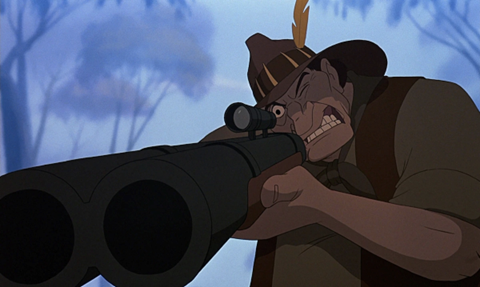
Another pattern that emerged was the use of the American Southern Accent to invoke themes of militarism, violence, and unintelligence. Of all 5 characters observed to have the American Southern Accent, 2 were antagonists, 4 invoked themes of militarism (deduced through plot; such as one of the antagonists, McLeach —figure 4 — having the American Southern Accent and a past in the military), and 3 were displayed as unintelligent (deduced through plot — such as one character with the American Southern Accent calling, as seen in this clip (“It’s In My DNA – Zootopia” ‘DNA’, “dunnuh”). 

Figure 4: The Rescuer’s: Down Under villain, McLeach

Fourth Result

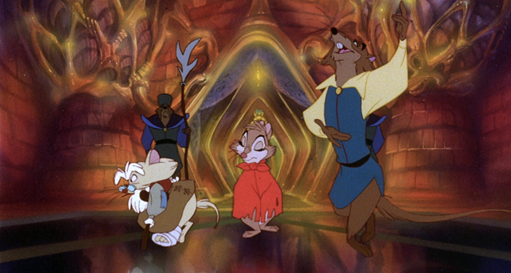
The final pattern that we noticed through our data is that ‘sophisticated’ characters had American and European accents 88% of the time. We coded ‘sophisticated’ as characters that were portrayed as respected, legendary, wise, or graceful, which we deduced through plot and surrounding character reactions. For instance, one character in The Secret of NIMH was sought out in answer to the protagonist’s dilemma, since they were canonically ‘all-knowing’ and powerful. Of the 9 characters we coded as ‘sophisticated’, only one did not have an American or British accent.

Discussion and Conclusions     

This study offers insights into the impact of accent features on stereotypes among animal characters in animation. While we cannot definitively speak on behalf of the filmmakers as to whether these depictions were intentional, we establish these findings as results of our observations. Furthermore, we recognize that these choices could be made subconsciously.

Media is one of the greatest socialization agents. Animated films play a huge role in influencing children’s perceptions of the world and other people. With repeated representation of problematic stereotypes, viewers will believe they are true. Our data spans 46 years, emphasizing that while progress has been made, there is a long way to go. While there are less explicitly harmful linguistic stereotypes being utilized, it is still true that protagonists consistently speak with ASE while side characters are relegated to minority accents. The biggest difference throughout time is a diversification of accents, but their distribution has remained the same. We must also consider the level of authority as a source of knowledge Disney has. For those who do not question the status quo, they are even more likely to believe in stereotypes when they come from a ‘reputable’ source like Disney. For this reason, it is crucial for filmmakers and powerful studios to be responsible and inclusive with the media they produce.

To further broaden our understanding of this phenomenon, it would be worthwhile to extend research to human characters in Disney animated films. According to Brous, this type of linguistic stereotyping occurs in films such as Frozen, Coco, and Moana (2020). It is clear that the negative representation through accents extends further than cartoon animals. Søraa’s work would be useful to explore a film like Brave, where the setting itself contributes to reflecting stereotypes portrayed through linguistic markers (2019). With regards to minority cultures, Towbin et al. would serve as a resource to study how non-dominant cultures are represented negatively, which can be seen in Pinocchio, Alice in Wonderland, Peter Pan, Oliver, and Aladdin (2004).

It is also essential to acknowledge the issue of stigmatization of the female characters in Disney movies, as highlighted by Soares (2017). According to Växjö (2014), Disney princesses exhibit many stereotypical linguistic features, so their characters adhere to the traditional gender roles and expectations. Moreover, it is important to examine the impact of misrecognizing accents and linguistic features in television and how it might affect child viewers, causing them to internalize negative stereotypes portrayed in animated programs. Wenke’s article (1998) can serve as a source for exploring how children’s attitudes towards people and activities can be influenced by the portrayal of linguistic elements in television programs.

In the end, the impacts of animated films and the representations of different peoples, cultures, and identities can have long-lasting impacts on the people, more importantly children who watch animated films. While it’s not a direct issue, the unintended consequences of filmmakers, animators, and writers have an important job in creating media that is representative, respectful, and for audiences of all ages, as many animated forms of media have previously encouraged and helped spread harmful stereotypes of minorities for decades.

Figure 5: The Secret of NIMH scene

References

Accents in children’s animated features as a device for teaching children to ethnocentrically discriminate. (2019). Upenn.edu. https://www.sas.upenn.edu/~haroldfs/popcult/handouts/wenkeric.htm

Bluth, D. (1990). The Secret of Nimh. Sulivan Bluth Studios.

Brous, S. (2020, December). “Frozen” In Time: Dialect and Language Ideology in Disney Films (thesis). Tri College Department of Linguistics. Retrieved from https://scholarship.tricolib.brynmawr.edu/bitstream/handle/10066/23186/Brous_thesis_2020.pdf?sequence=1&isAllowed=y. 

Bruti, Silvia. (2009) From the US to Rome Passing through Paris. InTRAlinea. Online Translation Journal > Special Issues > Special Issue: The Translation of Dialects in Multimedia > From the US to Rome Passing through Paris http://www.intralinea.org/specials/article/From_the_US_to_Rome_passing_through_Paris.

Meek, B. A. (2006). And the Injun Goes “How!”: Representations of American Indian English in White Public Space. Language in Society, 35(1), 93–128. http://www.jstor.org/stable/4169479

Reitherman, W. (1970). The Aristocats. United States; Walt Disney Pictures.

Schumacher, T. (2012). The Rescuers Down Under. United States; Walt Disney Pictures.

Søraa, I. (2019, May). The Sound of Disney (thesis). Master’s thesis in Language Studies with Teacher Education. Retrieved from https://ntnuopen.ntnu.no/ntnu-xmlui/bitstream/handle/11250/2623375/no.ntnu:inspera:2276305.pdf?sequence=1. 

Soares, T. (2017). Animated Films and Linguistic Stereotypes: a Critical Discourse Analysis of Accent Use in Disney Animated Films Part of the Bilingual, Multilingual, and Multicultural Education Commons Recommended Citation Soares, Telma O. (2017). Animated Films and Linguistic Stereotypes: a Critical Discourse Analysis of Accent Use in Disney. https://vc.bridgew.edu/cgi/viewcontent.cgi?referer=&httpsredir=1&article=1053&context=theses

Spencer, C. (2016). Zootopia. United States; Walt Disney Animation Studios.

Towbin, M. A., Haddock, S. A., Zimmerman, T. S., Lund, L. K., & Tanner, L. R. (2004). Images of gender, race, age, and sexual orientation in Disney feature-length animated films. Journal of Feminist Family Therapy, 15(4), 19–44. https://doi.org/10.1300/j086v15n04_02 

Wiley, T. G., & Lukes, M. (1996). English-Only and Standard English Ideologies in the U.S. TESOL Quarterly, 30(3), 511–535. https://doi.org/10.2307/3587696

Växjö, Kalmar (2014). Happily Ever After: A Linguistic Study of the Portrayals of the Female Characters in One Old and One New Disney Princess Film https://www.divaportal.org/smash/get/diva2:795579/FULLTEXT02.pdf

 [/expander_maker]

, , , ,
Scroll to Top