accents

Do Students Hold Their Professors to a Certain Standard?

Madison Atiabi, Araceli Valladares, Sean Freilich, Antoinette Alfaro, Brandon Elkington

Knowledge production in the global context has enabled an unprecedented ability to share information in the modern age. Because of this, International Universities like UCLA serve as a hotbed for intellectual progress over a backdrop of movements for inclusivity and representation in educational institutions. While recognizing elements of language associated with ethnicity such as accents is a sensitive topic, it is an undeniable element that comes into play when analyzing the perceptions that students hold of their professors. Even though we initially invested in how accents affect academic outcomes, this study has instead developed an understanding of subconscious biases and expectations within the academic setting that demonstrate a contradictory notion of judgment versus inclusivity. While clearly expressed to varying degrees of appreciation for different language practices, the individual word choice illustrates an intent to perform academically that is not only a standard to be upheld by professors, but to an extent to students as well.
[expander_maker id=”1″ more=”Read more” less=”Read less”]

Introduction

The development and ability to share information in the modern world is faster than ever and there has been an emphasis on developing scholarship around the diverse perspectives that come together within the global context. While there are undeniable benefits towards the development of scholarship by including international perspectives, there are a number of challenges that arise when centered around communication between speakers with different linguistic backgrounds. In attempts to understand how students perceive different elements of language, a handful of studies and experiments have been conducted as a means to better understand what incites the most favorable repertoire between students and professors. As “language is an important and necessary medium of communication,” (Kuo 2011) differences in pronunciation, intonation, rhythm, and word choice may lead to miscommunications or misinterpretations of information which can have a devastating impact in an academic setting where clear communication is crucial to success. Since how people speak demonstrates many notions of group belonging, elements of language such as accents tend to elicit stereotypical perceptions that can influence the perceptions of professors as less credible (Alexandra 2015). Considering that a student’s perception of their professors as the ambassadors of the university can have an impact on a student’s learning outcomes (Gill 1994), it is important to understand the various ways that accents and language choices such as the use of slang affect students’ perceptions of their professors. Therefore, the University of California, Los Angeles (UCLA), as an international institute provides a diverse cultural background to deepen our understanding of how accents and slang shape communication dynamics, social interactions, and language attitudes between professors and students.

Methods

When initially proposing this study, we intended to collect a variety of qualitative and quantitative data through a series of interviews, observations, and a survey as means to gather in-depth insights into how language affected the relationship between professors and students. Our original hypotheses centered around the notion that a professor’s accent would be recognized as a challenge in a student’s ability to comprehend the course material and build connections with their professors. However, in the process of developing the proposal, we acknowledged the potential for biases in the responses to our questions considering the academic nature of the project. As such, we conducted five 20-minute interviews with other UCLA students (four undergraduate and one graduate) that we had less formal relationships with hopes of receiving more open and honest responses to our lines of questioning considering the sensitivity of acknowledging a difference in language typically associated with difference in culture. As such, the interview questions focused on concerns regarding accents and the use of slang in the classroom setting and how they affect student’s perceptions of their professors and whether or not they have an expectation of a “standard” language for their professors.

 For consideration, below are the questions that were asked during the interview:

  1. Have you ever had a professor with a strong accent?
  2. How do you feel this has affected your ability to comprehend the course materials? Please elaborate.
  3. How do you feel that this has affected your interactions with your professors?
    1.  How has it affected your sense of community in the classroom?
    2. How has it affected your connectedness to the course materials?
  4. What kind of language use do you expect from your professors in a classroom setting? Do you think there is a “standard” for how professors should speak to their students?
  5. How do you feel when a professor uses slang or a younger language?
    1. How does it affect the relationship with the professor?
    2. Do these language choices affect your sense of immediacy with your professor?
    3. Does the use of slang make your professor seem less credible?
  6. Can you think of any other ways your professors build a sense of community or contribute to your education through their language?
    1. Do any other positive or negative effects of a professor’s language choices come to mind?
    2. Do the ways that your professor chooses to convey certain ideas affect your education?
  7. What changes could professors make in their language choices to improve their interactions with students?

Results and Analysis

Accents and Academics

While our respective interviews yielded varied responses due to the intimate nature of the process, there were a few constants that emerged within them. For instance, as predicted, there was an almost universal recognition that accents contributed to certain challenges within the classroom. In some cases, students revealed they had trouble understanding the course material despite efforts of professors to ensure comprehension; one student, Angel, expressed disinterest with sentiments like “I just want this lecture to end faster,” or “I’ll talk to the TA.” This reveals insight beyond our initial hypothesis; the spirit of inclusivity that is present in universities may directly contribute to the disconnect between students and professors to a degree that impacts a student’s willingness to engage with a course. Similarly, despite appreciating the beauty of different cultures coming together, Evan noted in his interview that “it was awkward and a little embarrassing to have to keep asking the same question because their strong accent made it hard for me to understand what they were saying.” Consequently, in response, it was common for students to seek more time with their TA as a solution to address issues with comprehension in lectures.

Slang Use

On the other hand, in discussions about slang use and “standard” language practices of professors, there was a surface-level appreciation for professors’ attempts to connect through slang-use and a general positive reaction. However, what a few of our interviewees argued to be more important was the use of genuine language as opposed to language that caters to a professor’s perception of what students may want to hear. Similar to the study by Martin, Weber, and Burant, the students we interviewed appeared to be able to recognize the subtleties of slang use and distinguish them from the subtexts of their uses (1997). For example, Jessica expressed that it was “cringy” when professors end up “overdoing it while trying to be relatable” because it comes off as inauthentic and pandering. Nonetheless, our interviewees expressed a general support for the use of slang words and “younger” language in the classroom. But in doing so, the words that they used represented a potentially larger concern surrounding language use in academic settings.

Unconscious Biases

When asked about whether she had any expectations for a “standard” language from her professors, Anna responded, “I don’t think slang would come in the way of teaching. Professionalism could be… um… what I’m trying to say is I don’t think language really affects the way the material is taught, and I don’t think slang should be penalized or looked down upon in the classroom setting.” While her response initially shows an understanding and support for less restrictions on language, the expression of the contrary as professionalism followed by a subtle retraction indicates a subconscious level of decorum that is to be expected from professors and the university as a whole. While our interviews only represent a minute sample of students at UCLA, the results indicate a wide range of responses that demonstrate similar notions of underlying pressures to maintain certain values.
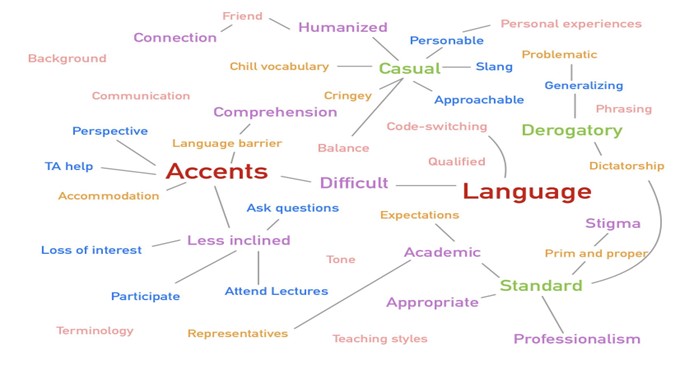
Figure 1: Common and uncommon words found throughout the five interviews

Discussion and Conclusions

Our study and its findings contribute valuable insight into our understanding of students’ perceptions and expectations of their professors within academic settings. By investigating whether students hold their professors to a certain standard and coupling our empirical findings with existing literature, our study allows for researchers to formulate testable predictions or hypotheses on the nature of student-professor relationships in the future.

Our findings not only revealed diversity in linguistic and academic standards amongst students, but also suggested a potential for underlying biases inherent within academic settings. Our research highlights the extensive influence of academic norms and expectations on linguistic practices, suggesting an unconscious pressure on both students and professors to conform to behaviors typically perceived as “professional.” Such findings emphasize the importance of working towards building inclusive learning environments that embrace linguistic diversity while also encouraging authenticity and cultural sensitivity.

This study ultimately enhances our understanding of the complex interplay between language and identity within the academic realm, inviting future discourse and exploration that would enhance student-professor relationships. By acknowledging the dynamic experiences uncovered through our research, students, professors, and institutions alike can begin to strive for an educational environment that yields successful outcomes for individuals from diverse backgrounds.

References

Gill, M. M. (1994). Accent and stereotypes: Their effect on perceptions of teachers and lecture comprehension. Journal of Applied Communication Research, 22(4), 348–361. https://doi.org/10.1080/00909889409365409

Kozlowski, Alexandra (2015). The Influence of Accents on Social Perception. Inkblot, 12-16.

Kuo, Ya-Hui. (2011). Language Challenges Faced by International Graduate Students in the United States. Journal of International Students. 1(2). ISSN: 2162-3104.

Martin, M. M., Weber, K., & Burant, P. A. (1997). Students’ Perceptions of a Teacher’s Use of Slang and Verbal Aggressiveness in a Lecture: An Experiment.

Orelus, P. W. (2020). Other People’s English Accents Matter: Challenging Standard English Accent Hegemony https://files.eric.ed.gov/fulltext/EJ1246799.pdf

 [/expander_maker]
, , , ,

Language Ideologies in Animated Films: Why does that character sound like that?

Talla Khattat, Jacob Gutierrez, Edna Tovar, Grace Yang, Al Jackson, Espie Maldonado

Why do all military characters in animation films have Southern accents? Throughout this blog, we aim to understand the world of languages in animated films and take you along with us. Audience members digest the creative choices that are made on screen and unconsciously learn to associate linguistic patterns with certain sociocultural elements. This research paper aims to observe the linguistic elements of accents and dialects to understand the correlating relationship with the language ideologies and cultural attitudes. We observed the films Aristocats (1970), The Secret of NIMH (1982), The Rescuers Down Under (1990), and Zootopia (2016), and categorized the different patterns observed based on several different elements. Our findings show that minority accents can be tokenized to invoke assumptions about a character in order to save screen time. We call on future research to understand how impactful some of these harmful depictions can be and emphasize the importance of respectful representation.

[expander_maker id=”1″ more=”Read more” less=”Read less”]

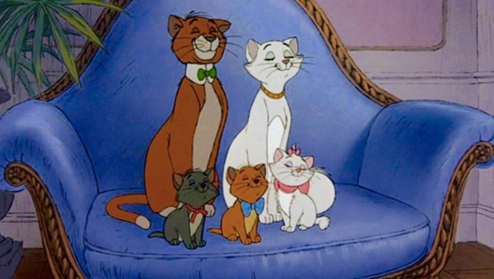
Figure 1: Aristocats end scene

Introduction and Background

Many would agree that animated films are a huge part of one’s childhood. From Disney princes and princesses to a mice version of the United Nations, everyone enjoyed their fair share of animated movies. The beauty of animation is the freedom to shape an entire world from the ground up, where every character is completely designed from scratch, and every choice, from costume, to music, to voice is made intentionally. With this freedom also comes challenges with needing to establish connections from what is seen on screen with the minds of the audience. From the start of the film, the creators need to quickly establish character relations and connections. Here, they use language shorthands that the audience is indirectly familiar with to signal the persona of the character. Our group’s research question aimed to understand throughout a series of animated films what traits or roles are typically associated with certain accents, language varieties, styles, or registers? Within this realm, we also wanted to understand how Standard American English would be treated compared to other accents or dialects. We hypothesized that non-standard varieties of English/Non-English will be associated or invoked when connected to ‘bad’ or side characters, while standard American English will be most often connected to ‘good’ characters or protagonists.

Previous research has indicated that the cultural value of individualism in the United States is reflected in the use of standard English, which often leads to a lack of tolerance towards other languages or English language variations (Wiley, 1996). Although Disney animated films are often translated into standard English, it hinders the complexity of modern language and erases many cultural elements (Bruti, 2009). Moreover, we have also found that language elements can be used to invoke association about certain groups of people in film. Previous work completed by Meek shows how language and race perform character portrayals and as the audience, we witness this work that is being “done”. (Meek, 2006). In other words, accents are often used to not only demonstrate an ethnicity, but also substantiate a portrayal of a certain stereotype associated with a certain group of people.

Methods

To gather data about the language ideologies and characters linked to them, we analyzed four different films; The Aristocats, The Secret of NIMH, The Rescuers: Down Under, and Zootopia. Particularly, we noted what accents and languages were used (or created) in these films and what characters or themes they were associated with. We chose to focus on animated animal characters since we felt that filmmakers could ‘get away with more’ and because language is the main humanizing factor in animal characters, we could better see how language/accents were being used to invoke assumptions about the character.

Watching the movies completely through and inspired by the methodology of a paper written by Janne Sønnesyn, we then categorized our character findings into several categories including their: language/accent, role in the movie, costume, character features, gender, and other distinguishable elements. In sum, we analyzed 66 characters along these 6 categories.

Moreover, by codifying our analyses, we can answer the research question, what traits or roles are associated with certain accents, language varieties, styles, and registers? How do the filmmakers express differentiation amongst characters through the use of language and character design?

Results and Analysis

After empirically analyzing our data, we found several patterns that confirmed part of our hypothesis and refuted others. We looked at our data as an aggregate, combining the findings from all four movies and examining the results in this way.

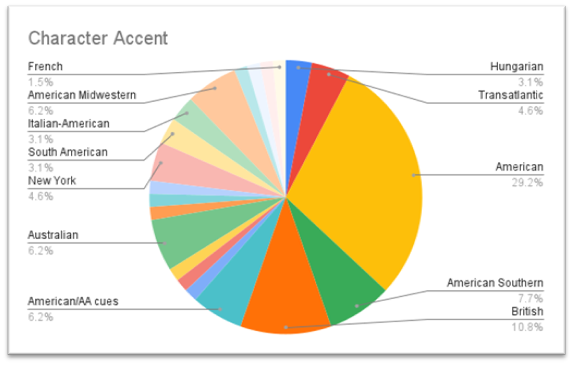
Figure 2: Character accent pie chart by percentage

First Result

Referencing Figure 1 which provides a visual representation of the distribution of the observed character accents, we were able to establish four distinct results. Firstly, we found that the protagonist(s) of the films indeed were associated with the American Standard English accent 54% of the time. Furthermore, 100% of the protagonists had European or American accents — in other words, no minority population accents were represented in the protagonists of these films.

Second Result

This point leads to a second key finding that minority population accents were typically attached to side characters. In fact, 64% of all side characters had a minority accent. Put differently, minority population accents were overrepresented in this character role and underrepresented in others. Heroes did not tend to have minority population accents. Notably however, no antagonist had a minority population accent either — which refuted part of our hypothesis.

Figure 3: Character ‘Duke Weaselton’ from Zootopia

Along the same lines as our minority population accents, non-rhotic accents (accents that ‘drop’ the pronunciation of ‘r’), were commonly used in connection to characters of low socioeconomic status or working class. Some examples of these non-rhotic accents were the New York accent and AAVE (African American Vernacular). We noted 5 characters that used a non-rhotic accent; 3 were associated with petty crime,1 was a working-class shop employee, and 1 was a ‘street’ cat (what we interpreted as houseless for our analysis). Figure 2 depicts one such character from Zootopia, Duke Weaselton, who has a New York accent and is one of the movie’s shady characters — involved in thievery, bootlegging, and evading arrest.

Third Result

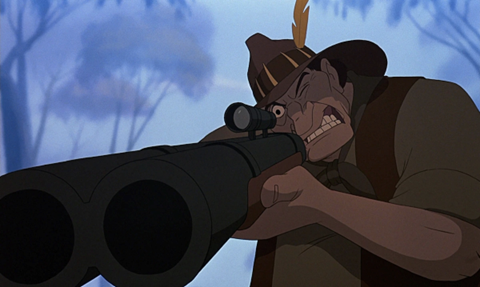
Another pattern that emerged was the use of the American Southern Accent to invoke themes of militarism, violence, and unintelligence. Of all 5 characters observed to have the American Southern Accent, 2 were antagonists, 4 invoked themes of militarism (deduced through plot; such as one of the antagonists, McLeach —figure 4 — having the American Southern Accent and a past in the military), and 3 were displayed as unintelligent (deduced through plot — such as one character with the American Southern Accent calling, as seen in this clip (“It’s In My DNA – Zootopia” ‘DNA’, “dunnuh”). 

Figure 4: The Rescuer’s: Down Under villain, McLeach

Fourth Result

The final pattern that we noticed through our data is that ‘sophisticated’ characters had American and European accents 88% of the time. We coded ‘sophisticated’ as characters that were portrayed as respected, legendary, wise, or graceful, which we deduced through plot and surrounding character reactions. For instance, one character in The Secret of NIMH was sought out in answer to the protagonist’s dilemma, since they were canonically ‘all-knowing’ and powerful. Of the 9 characters we coded as ‘sophisticated’, only one did not have an American or British accent.

Discussion and Conclusions     

This study offers insights into the impact of accent features on stereotypes among animal characters in animation. While we cannot definitively speak on behalf of the filmmakers as to whether these depictions were intentional, we establish these findings as results of our observations. Furthermore, we recognize that these choices could be made subconsciously.

Media is one of the greatest socialization agents. Animated films play a huge role in influencing children’s perceptions of the world and other people. With repeated representation of problematic stereotypes, viewers will believe they are true. Our data spans 46 years, emphasizing that while progress has been made, there is a long way to go. While there are less explicitly harmful linguistic stereotypes being utilized, it is still true that protagonists consistently speak with ASE while side characters are relegated to minority accents. The biggest difference throughout time is a diversification of accents, but their distribution has remained the same. We must also consider the level of authority as a source of knowledge Disney has. For those who do not question the status quo, they are even more likely to believe in stereotypes when they come from a ‘reputable’ source like Disney. For this reason, it is crucial for filmmakers and powerful studios to be responsible and inclusive with the media they produce.

To further broaden our understanding of this phenomenon, it would be worthwhile to extend research to human characters in Disney animated films. According to Brous, this type of linguistic stereotyping occurs in films such as Frozen, Coco, and Moana (2020). It is clear that the negative representation through accents extends further than cartoon animals. Søraa’s work would be useful to explore a film like Brave, where the setting itself contributes to reflecting stereotypes portrayed through linguistic markers (2019). With regards to minority cultures, Towbin et al. would serve as a resource to study how non-dominant cultures are represented negatively, which can be seen in Pinocchio, Alice in Wonderland, Peter Pan, Oliver, and Aladdin (2004).

It is also essential to acknowledge the issue of stigmatization of the female characters in Disney movies, as highlighted by Soares (2017). According to Växjö (2014), Disney princesses exhibit many stereotypical linguistic features, so their characters adhere to the traditional gender roles and expectations. Moreover, it is important to examine the impact of misrecognizing accents and linguistic features in television and how it might affect child viewers, causing them to internalize negative stereotypes portrayed in animated programs. Wenke’s article (1998) can serve as a source for exploring how children’s attitudes towards people and activities can be influenced by the portrayal of linguistic elements in television programs.

In the end, the impacts of animated films and the representations of different peoples, cultures, and identities can have long-lasting impacts on the people, more importantly children who watch animated films. While it’s not a direct issue, the unintended consequences of filmmakers, animators, and writers have an important job in creating media that is representative, respectful, and for audiences of all ages, as many animated forms of media have previously encouraged and helped spread harmful stereotypes of minorities for decades.

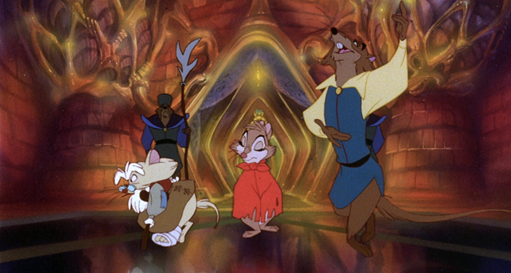
Figure 5: The Secret of NIMH scene

References

Accents in children’s animated features as a device for teaching children to ethnocentrically discriminate. (2019). Upenn.edu. https://www.sas.upenn.edu/~haroldfs/popcult/handouts/wenkeric.htm

Bluth, D. (1990). The Secret of Nimh. Sulivan Bluth Studios.

Brous, S. (2020, December). “Frozen” In Time: Dialect and Language Ideology in Disney Films (thesis). Tri College Department of Linguistics. Retrieved from https://scholarship.tricolib.brynmawr.edu/bitstream/handle/10066/23186/Brous_thesis_2020.pdf?sequence=1&isAllowed=y. 

Bruti, Silvia. (2009) From the US to Rome Passing through Paris. InTRAlinea. Online Translation Journal > Special Issues > Special Issue: The Translation of Dialects in Multimedia > From the US to Rome Passing through Paris http://www.intralinea.org/specials/article/From_the_US_to_Rome_passing_through_Paris.

Meek, B. A. (2006). And the Injun Goes “How!”: Representations of American Indian English in White Public Space. Language in Society, 35(1), 93–128. http://www.jstor.org/stable/4169479

Reitherman, W. (1970). The Aristocats. United States; Walt Disney Pictures.

Schumacher, T. (2012). The Rescuers Down Under. United States; Walt Disney Pictures.

Søraa, I. (2019, May). The Sound of Disney (thesis). Master’s thesis in Language Studies with Teacher Education. Retrieved from https://ntnuopen.ntnu.no/ntnu-xmlui/bitstream/handle/11250/2623375/no.ntnu:inspera:2276305.pdf?sequence=1. 

Soares, T. (2017). Animated Films and Linguistic Stereotypes: a Critical Discourse Analysis of Accent Use in Disney Animated Films Part of the Bilingual, Multilingual, and Multicultural Education Commons Recommended Citation Soares, Telma O. (2017). Animated Films and Linguistic Stereotypes: a Critical Discourse Analysis of Accent Use in Disney. https://vc.bridgew.edu/cgi/viewcontent.cgi?referer=&httpsredir=1&article=1053&context=theses

Spencer, C. (2016). Zootopia. United States; Walt Disney Animation Studios.

Towbin, M. A., Haddock, S. A., Zimmerman, T. S., Lund, L. K., & Tanner, L. R. (2004). Images of gender, race, age, and sexual orientation in Disney feature-length animated films. Journal of Feminist Family Therapy, 15(4), 19–44. https://doi.org/10.1300/j086v15n04_02 

Wiley, T. G., & Lukes, M. (1996). English-Only and Standard English Ideologies in the U.S. TESOL Quarterly, 30(3), 511–535. https://doi.org/10.2307/3587696

Växjö, Kalmar (2014). Happily Ever After: A Linguistic Study of the Portrayals of the Female Characters in One Old and One New Disney Princess Film https://www.divaportal.org/smash/get/diva2:795579/FULLTEXT02.pdf

 [/expander_maker]
, , , ,

Speak of the Devil: How Popular Film Antagonists Use Language

Sarah Belew, Jacques Gueye, Kaley Phan, Boyi Zheng

In this study, we analyze the linguistic behavior of antagonists in psychological thriller movies in order to understand/index the features in their language that make them “creepy”. We chose 4 different films to view: Misery (1990), Silence of the Lamb (1991), The Lovely Bones (2009), and Gone Girl (2004). From these films, we analyze how abnormality is constructed using subtle linguistic behaviors of word choice, intonation, and sociolect. We theorize that abnormality in the character’s linguistic traits is rooted in deviation of their demographic’s language pattern and what is considered appropriate for social interaction, or “creepy.” As a result, we find that the antagonists are aligned in their sociolects, word choice patterns of calling the antagonist’s name with great frequency, and that female antagonists have a “(Rise)-Rise-Fall” pattern in prosody. These marked patterns come together to create vivid, memorable characters that are unmistakably creepy.

[expander_maker id=”1″ more=”Read more” less=”Read less”]

Introduction and Background

What is creepiness? McAndrew and Koehnke identified the study of creepiness as a major gap in the scientific literature (2016). Their study identified creepiness correlates, such as gender identity (“being male”), physical traits (“having greasy hair”), and behavioral patterns (“stood too close to your friend”), concluding that creepiness is detected when people perceive an ambiguity of threat, often interpreted as a sexual threat among female participants.

We are unsatisfied with this approach. By eliciting people’s understanding of creepiness, perhaps we receive nothing more than a “creepiness profiling” mechanism, echoing the findings of Implicit Association Test studies conducted on racial stereotypes (Oswald et al, 2013). Are certain racial groups perceived as possessing more ambiguity of threat? Can women ever be creepy? Since our social life is riddled with implicit biases, this strand of study demands a more experimental approach that challenges our biased perception. Scripted Fictional Content (SFC) has the transformative potential in understanding the depth of this human emotion. The four psychological thriller films that we watched for our studies, including Misery (1990), Silence of the Lamb (1991), The Lovely Bones (2009), and Gone Girl (2004) demonstrated that creepiness does not rely on stereotypes and non-normativity known to our daily life. The mismatch between language stereotypes, creepiness assumptions, and the language performance confirm that actors often combine verbal strategies that run counter to expectations of norms but are not abnormal in a caricatural sense. This confirms the third-wave sociolinguistic assumption of the speaker’s agency (Eckert, 2012, Bell and Gibson, 2011). Overall, we find that actors do not achieve creepiness by piecing together socially neutral elements in the context of the movie plot and the character, which come together to deliver the creep.

Methods

In this study, we use sociophonetic and behavioral patterns to describe the technique of character building. We examined over eight hours of audiovisual media to develop a corpus study, manually coding all the speech of antagonists for marked patterns. We also listen to the other characters to qualitatively compare, so that we may develop a sketch of each antagonist including sociophonetic and rhetorical strategies. For the quantitative analysis, we pick creepiness correlates in their coded context to establish a statistical distribution per film.

In conducting this pilot study, we take the third-wave linguistics assumption that speakers consciously use sociolinguistic elements. Since there is a gap in the literature, we only landed on prosody, register (word choices), and sociolect as our relevant variables after preliminary viewing. Many previous studies demonstrated that affective prosody allows great intra-speaker speech variety, and plays a critical role in emotion expression (Frick 1985). On the other hand, socio-prosody study of inter-speaker variation is a field at its early development (Holliday 2021). Nevertheless, the evidence in our corpus convinced us that creepiness correlates, such as the markedness of the (rise)-rise-fall prosody has both intra-speaker patterns (reserved for narrative manipulation), and inter-speaker patterns (indexing non-standard dialects, feminine speech).

For our most nuanced and productive variable, the (rise)-rise-fall pattern, we have provided an edited video clip for demonstration purposes. Our coding of this pattern has followed the following rule-of-thumb criteria: (1) well-defined rising accent (L+H*) followed by a falling accent (H+L*) and a low boundary tone (L%), often the result of emphasizing the penultimate word (Beckman & Ayers 1997)  (2) exclude rising in questions, unmarked rising in enumeration and long words (3) usually occurs toward the end of an utterance (4) characteristically violating the Strong-Weak alternation in modal rhythm (Kiparsky 2014).

Here is an edited clip from Gone Girl (2004), where Amy Dunne uttered 50 instances of characteristic (rising)-rising-falling speech in the course of a 7-minute monologue.

https://drive.google.com/file/d/1Tcc106ftXEQYeOe08oTVmTule9zlkP40/view?usp=share_link 

Results and Analysis

1. Word Frequency Analysis 

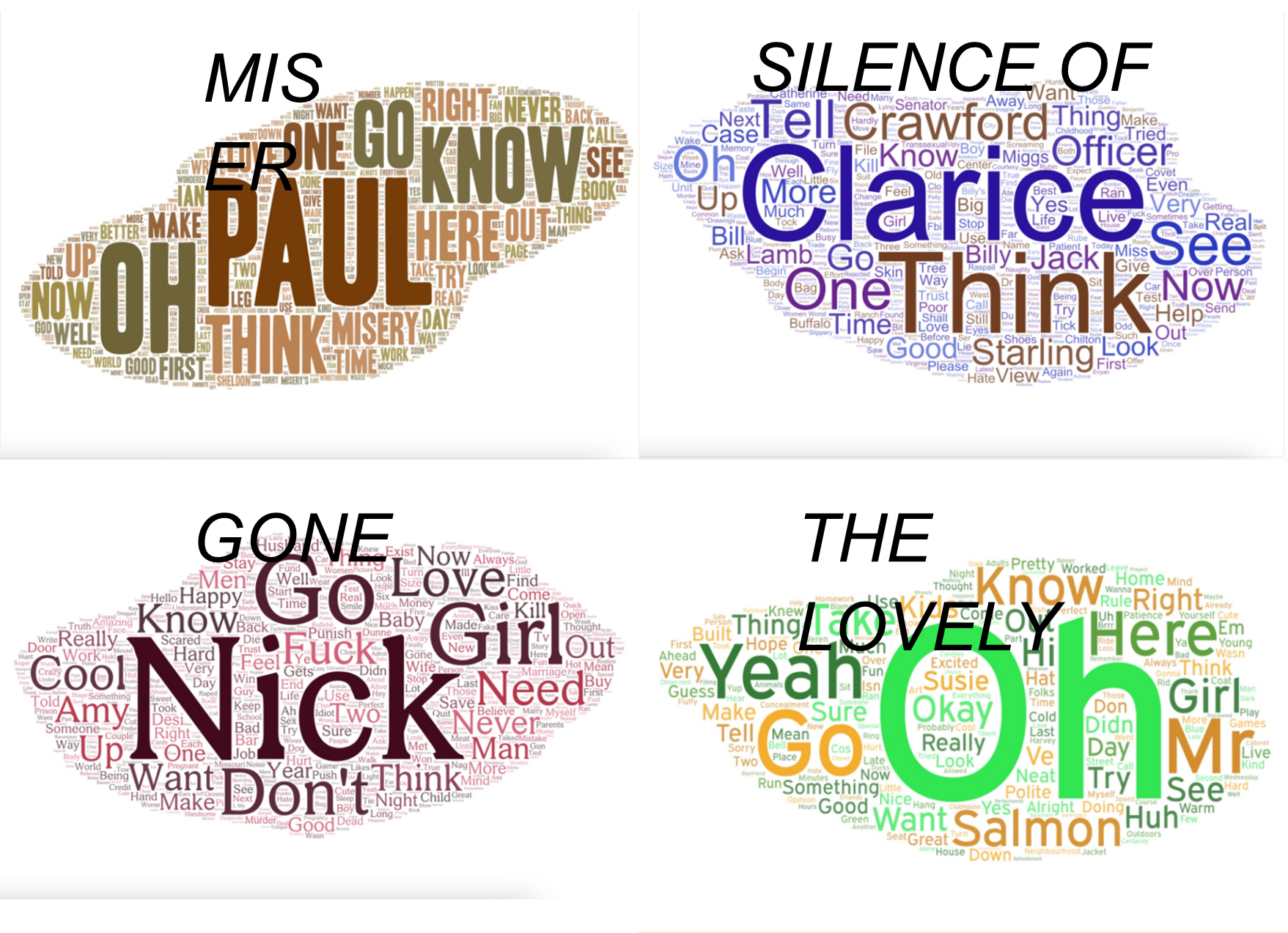
The following word clouds (Figure 1) visualize how antagonists in our corpus exhibited two discourse behaviors that made their interlocutor and the audience uncomfortable. Amy Dunne (Gone Girl), Anne Wilkes (Misery), and Hannibal Lector (Silence of the Lamb) all have the name of the protagonist as their most frequent item, showing their unhealthy obsession with them. They all engaged in extensive manipulation of the protagonists, calling them by name to draw their attention. This article by Michigan State University elaborates on some of the psychology behind using someone’s name, including manipulation. George Harvey (The Lovely Bones) is the only character that does not share this pattern, particularly because of a lack of dialogue between the two (although he does refer to the protagonist by her last name occasionally). The second behavior is the use of words that may appear manipulative. These words include “know”, “think”, “see”, etc. Under different contexts, these words are used in dialogue to guide the protagonist’s thinking and actions. For example, consider the following line in “Misery” by Annie:

ANNIE:  I know you didn’t mean it when you killed her, and now you’ll make it right.

In this context, the antagonist is telling the protagonist what she believes he is thinking, in a way that he has no choice but to accept. With the other high frequency words, it is common that the antagonist used it in the same way: to make controlling statements or pure assumptions. Phrases such as “you know”, “I think you” and “you see”, were very frequent ways that these words were being used.

Figure 1: Word Clouds for each Antagonist

2. Prestigious, Psychopathic Dialects and Rhetorics

In the three antagonist-centered psychological thrillers (excluding The Lovely Bones), we see antagonists being portrayed as highly intelligent, socially prestigious characters, only to be revealed as vile, manipulative psychopaths. They are Harvard-graduate writers, head nurses, and renowned psychologists, all having high social standing. Based on the story setting and the voice acting, we qualitatively judge Amy to have virtually no accent for her background in New York, and Anne Wilkes to leave a Mid-American housewife impression but no recognizable Bakersfield phonetic feature as well. Hannibal Lector, on the other hand, speaks with the highly prestigious Mid-Atlantic English, plus Hollywood Golden Age paralinguistic sound quality: consistent nasal leakage, strong twang (forte consonant articulation), drawl (prolonged vowels), seldomly enunciating rhotics. These patterns are close to Katherine Hepburn, credited as the actor that popularized this accent (Wang 2014). However, this style of speech has been long obsolete, and the decision to act in such an accent, combined with a strange melodic quality resembling Truman Capote, the actor Anthony Hopkins has truly created an uncanny accent.

On the level of rhetoric, all three of these antagonists use elaborate rhetorical strategies. Hannibal is known for his cruel puns (‘having a friend for dinner’, implying cannibalism). As a writer, Amy uses her rhyming puzzles and vulnerable writing style to play the innocent, bubble-headed victim of a domestic murder, leaving the world lamenting her disappearance and his husband being hated by everyone. Even Anne Wilkes, the least articulate of them, uttered rhymed lines in a confession of love for Paul, showing a mastery of poetics:

The rain, sometimes it gives me the blues./ When you first came here, I only loved the writer part of Paul Sheldon. But now I know I love the rest of him, too. / I know you don’t love me. Don’t say you do./…. You’ll never know the fear of losing someone like you… /That’s very kind of you, but I bet it is not altogether true.

George Harvey, the antagonist of The Lovely Bones, has to be analyzed as an exception. Being a protagonist-centered film, the picture showed him as a more marginalized, conventionally creepy character. His speech patterns always sound like an act, given that there is little exposure to the nuances and complexity of his persona. He uses underprivileged elements preferred by men, sometimes exhibiting free in~ing, /s/~/ʃ/ alternation (Hall-Lew et al, 2021, Labov, 1966). Conspicuously, the alternation seems to happen when he is confronted by somebody else and putting on pretension. If we accept this theory and suggest that George does not exhibit his authentic speech pattern, it does not pose a problem to our thesis.

3) Prosody Distributional Analysis in the Sociolect Context

In watching Gone Girl, Lovely Bones, and Misery, we find the distribution of the (Rise)-Rise-Falling pattern to be precisely patterned with three social factors: gender, region of origin, and positions of power.

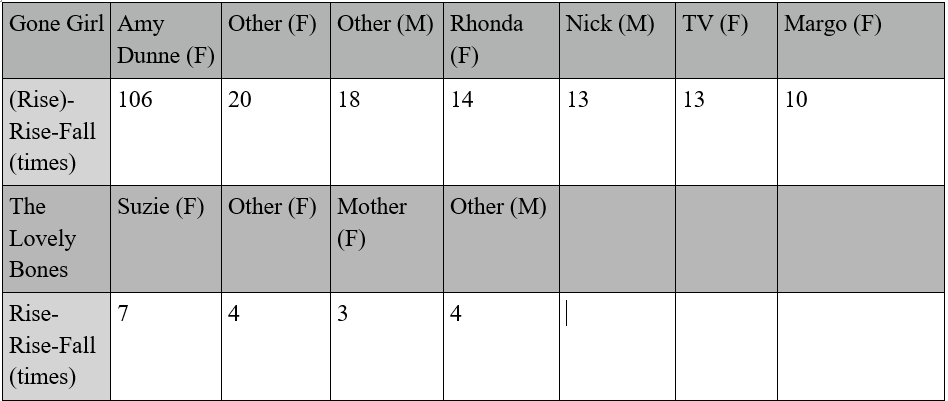
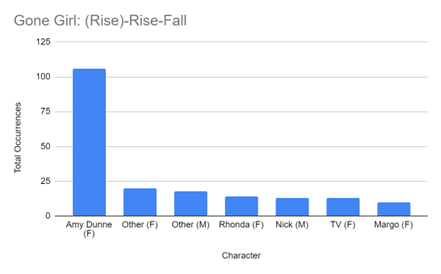
What first drew our attention was the clip played in the method section, in which Amy Dunne displayed an impressive array of the said pattern – contributing fifty out of 194 total occurrences of the pattern in the film within seven minutes. When we look at the setting of Gone Girl, in suburban Missouri, we can make sense of this pattern as a regionalism for most of the occurrences, since most characters, except for Nick, Amy, and Margo, display a non-standard accent. Perhaps due to the cultural marginality of the American Midwest, we do not find the renowned monophthong /o/ instead of /əʊ/ (‘b-oh-t’ for BOAT [boːt]), /æ/ heightened to be /e/ (‘behg’ for BAG [beg]), but instead recognize the vowel chain shift nascent to the American south (/a/ for /aɪ/, /ei/ for /ɪ/, and so on) (Labov et al, 2005). As in the previous analysis, the character Amy is designed as a native New Yorker with high social standing, often showing snobbery and resenting the simple life in the Missouri countryside. The (Rise)-Rise-Fall pattern feels quite out of place in her standard American repertoire of sounds, and we are inspired by the clip to say that the voice actors use this strategy to show a dominance over the narrative – for the first half of the film, she has set herself up as the narrator, but is later to be revealed as a psychopathic liar who is obsessed with manipulating herself and others. This agrees with the common perception of the prosody pattern- salient in TV announcements, radio shows, and advertisements. When the audience saw the run-away Amy put up the facade of a New Orlean housewife, she experienced another spike of (Rise)-Rise-Fall patterns, only that this time it is contextualized by a clear southern accent. This time, her interlocutor speaks with the same southern accent and similar rise-fall patterns. This gives us the final confirmation that the pattern we discovered is indeed marked and regionally conditioned.

The same findings are confirmed in Misery, even though a complete count of the relevant token has not been possible due to copyright reasons, we have an observation that exactly follows the above: Anne Wilkes speaks a normative accent, and only uses the (rise)-rise-fall pattern to fulfill the function of manipulation, infamous scenes such as the iconic “I’m your number one fan”. Otherwise, the same pattern only occurred in the conversation between two southern speakers, Sheriff Buster and his wife. 

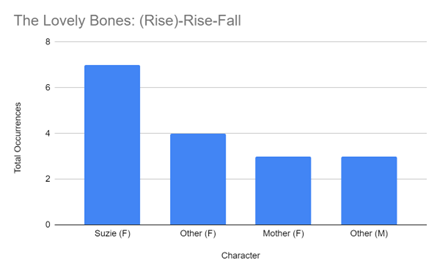
Should this prosody pattern also be found among male antagonists? We do not find this to be the case, but the statistics from the three films we coded (excluding Silence of the Lamb) all speak to the fact that (Rise)-Rise-Fall indexes female identity. In all three films, male utterances of the phrase make up less than 25% of the total tokens, and characters who consistently speak this way are all decidedly Southerners. The Lovely Bones showed the same consistent pattern, with the prosody of Suzie’s mom functioning as a signal for a controlling character who commands her children to follow rules – similar to the manipulative personalities we saw.

Table: Occurrences of the Rise-Rise-Fall pattern in Gone Girl and The Lovely Bones
Figure 2: The chart shows that Amy has the most occurrences of (Rise)-Rise-Fall of any other character by a wide margin.
Figure 3: The chart shows that Suzie has the most occurrences of (Rise)-Rise-Fall of any other character.

Discussion and Conclusion

Our research has yielded a small contribution to the understanding of the interactions between language and media, by providing insights into the intricate ways in which language and presentation can be used to create a sense of creepiness or psychopathy in characters. By exploring the techniques employed by the antagonists in the four films we analyzed, we have uncovered a diverse range of patterns that contribute to the development of creepy characters.

It is important to acknowledge that our study represents a small sample size and may not be generalizable to all media or contexts. However, with our final results, we can contribute to a deeper understanding of this popular media phenomenon. We hope that our research will provide further insights into this topic, as there is much more to be learned about the nature of language in the media and our relationship with both.

At the end of our project’s journey, our findings have uncovered the intricate ways in which language and presentation can be used to create a sense of creepiness or psychopathy in characters. The identification of common patterns in the techniques used in the four films we studied is a crucial step in the advancement of our understanding of this complex phenomenon.      

In conclusion, our research has provided valuable insights into the complex phenomenon of creepiness in the media. Our analysis of language and presentation techniques used to create creepy characters can contribute to a deeper understanding of human psychology and social behavior. Our study also highlights the importance of representation and diversity in media and has practical applications for filmmakers. We hope that our research will inspire further investigations into this fascinating area of study.

References

Bauman, R., & Briggs, C. L. (1990). Poetics and performances as critical perspectives on language and social life. Annual review of Anthropology, 19(1), 59-88.

Beckman, M. E., & Ayers, G. (1997). Guidelines for ToBI labeling. The OSU Research Foundation, 3(30), 255-309.

Bell, A., & Gibson, A. (2011). Staging language: An introduction to the sociolinguistics of performance. Journal of Sociolinguistics, 15(5), 555-572.

Buckland, W. (2021). Feminism, narrative, authorship: (Gone Girl and Orlando). In Narrative and Narration: Analyzing Cinematic Storytelling (pp. 65–80). Columbia University Press. http://www.jstor.org/stable/10.7312/buck18143.9

Cao, H., Beňuš, Š., Gur, R. C., Verma, R., & Nenkova, A. (2014). Prosodic cues for emotion: analysis with discrete characterization of intonation. Speech prosody (Urbana, Ill.), 2014, 130–134. https://doi.org/10.21437/SpeechProsody.2014-14

Clopper, C. G., & Smiljanic, R. (2011). Effects of gender and regional dialect on prosodic patterns in American English. Journal of phonetics, 39(2), 237-245.

Demme, J. (Director). (1991) The silence of the lambs [Film]. Strong Heart Productions.

Fincher, D. (Director). (2014). Gone girl [Film]. Twentieth Century Fox.

Jackson, P. (Director). (2009) The lovely bones [Film]. Dreamworks Pictures.

Jacquemet, M. (1999). Conflict. Journal of Linguistic Anthropology, 9(1/2), 42–45. http://www.jstor.org/stable/43102422

Holliday, N. (2021). Prosody and sociolinguistic variation in American Englishes. Annual review of linguistics, 7, 55-68.

Hall-Lew, L., Moore, E., & Podesva, R. (Eds.). (2021). Social meaning and linguistic variation: Theorizing the third wave. Cambridge: Cambridge University Press. doi:10.1017/9781108578684

Kiparsky, P., & Youmans, G. (2014). Rhythm and meter: Phonetics and phonology, Vol. 1. Academic Press.

Labov, W. (2006) The social stratification of English in New York City—Google Books. (n.d.). Retrieved June 19, 2023, from https://www.google.com/books/edition/The_Social_Stratification_of_English_in/bJdKY0mZWzwC?hl=en&gbpv=1&dq=william+labov+1966+social+stratification&pg=PA3&printsec=frontcover

Labov, W., Ash, S., & Boberg, C. (2008). The atlas of North American English: Phonetics, phonology and sound change. Walter de Gruyter.

Leistedt, S. J., & Linkowski, P. (2014). Psychopathy and the cinema: Fact or fiction? Journal of Forensic Sciences., 59(1), 167–174. https://doi.org/10.1111/1556-4029.12359

Reiner, R. (Director). (1990) Misery [Film]. Castle Rock Entertainment.

Schegloff, E. A., Jefferson, G., & Sacks, H. (1977). The preference for self-correction in the organization of repair in conversation. Language, 53(2), 361. https://doi.org/10.2307/413107

Langlotz, A. (2017). 17. Language and emotion in fiction. In 17. Language and emotion in fiction (pp. 515–552). De Gruyter Mouton. https://doi.org/10.1515/9783110431094-017

McAndrew, F. T., & Koehnke, S. S. (2016). On the nature of creepiness. New Ideas in Psychology, 43, 10–15. https://doi.org/10.1016/j.newideapsych.2016.03.003

Oswald, F. L., Mitchell, G., Blanton, H., Jaccard, J., & Tetlock, P. E. (2013). Predicting ethnic and racial discrimination: A meta-analysis of IAT criterion studies. Journal of Personality and Social Psychology, 105, 171–192. https://doi.org/10.1037/a0032734

Stephenson, V. L., Wickham, B. M., & Capezza, N. M. (2018). Psychological abuse in the context of social media. Violence and Gender, 5(3), 129–134. https://doi.org/10.1089/vio.2017.0061

Wang, C. (2014). A Sociophonetic analysis of American theater speech as exemplified by Katherine Hepburn’s filmography. https://scholarship.tricolib.brynmawr.edu/handle/10066/13761

Werner, V. (2022). Pop cultural linguistics. In Oxford Research Encyclopedia of Linguistics. https://doi.org/10.1093/acrefore/9780199384655.013.999

Wolter, Keely (2022) FULL INTERVIEW: Accent and dialect coach Keely Wolter talks about dat dere “Midwestern accent.”—YouTube. (n.d.). Retrieved June 19, 2023, from https://www.youtube.com/watch?v=vC4gyH4nhIw

[/expander_maker]

, , , ,

Long-Term Implications of Accent Representation in Children’s Media

Roni Grushkevich, Claire Lim, Kendall Vanderwouw, Daniel Zhou

Who is the most memorable villain you remember from your childhood era? We hypothesize that most individuals will remember a villain portrayed with a heavy accent. This is due to the phenomenon of othering and the idea that children will have a hard time connecting with a character that sounds different from them and the standard variety. We will use the childhood show, Phineas and Ferb, to see if this is true. Through the conduction of a survey, analyzing voice recordings in Praat, and doing sound analysis from an episode of Phineas and Ferb we will be able to see the phenomenon of othering. In Praat, we proved this phenomenon by showing that Dr. Doofenshmirtz, the antagonist, has a lower /æ/ F1 formant than Phineas and a native American English speaker. Additionally, analyzing the Hail Doofania episode, we were able to prove that Doofenshmirtz pronounced 6 sounds differently from a native American English speaker. All this proves the idea that villains are portrayed differently with negative attributes on children’s TV shows.

[expander_maker id=”1″ more=”Read more” less=”Read less”]

Introduction/Background

Our group proposes to do research on the effects of villainization in children’s shows, which has possible long-term implications on people’s perceptions of membership in their ingroup. This membership perception can be encapsulated by the phenomenon of othering. Othering is a process in which a more powerful and/or influential group reinforces differences and authority over another (Williams & Korn, 2017). Hence, our project aims to look at whether adoption of othering by children’s shows’ producers for villainous characters influences the audience’s perceptions of who is “good” (ingroup) and who is “bad” (outgroup).

Previous studies conducted by sociolinguists Calvin Gidney and Julie Dobrow (1998) indicated most foreign accented villains in children’s shows were exclusively European such as German, British, and Russian. These accents in particular are often characterized with high arrogance, intelligence, and socioeconomic status while low on friendliness, pleasantness, and honesty (Shah, 2019). These sentiments towards European accents may be reflective of World War II, Revolutionary War, and Cold War hostilities that dominated media/propaganda during the time.

We choose to look at the children’s show Phineas and Ferb, where the main antagonist, Dr. Doofenshmirtz, is portrayed with an exaggerated foreign accent. Heroes typically speak in the standard dialect and embody idealistic standards (Dobrow & Gidney, 1998), which holds true for the show’s protagonists, Phineas and Ferb. Through these differences in speech patterns, nonstandard accents become associated with “otherness” and antagonism (Constable, 2021).

Specifically, we will examine the phonetic production of vowels by accented English-speaking villains. When villains “mispronounce” English vowels, it is an obvious symbol of their communicative differences. That said, Dr. Doofenshmirtz is a great character to analyze as he does not speak the standard variety like most viewers. In addition, we plan to explore another linguistic variable that distinguishes Doofenshmirtz’s speech from the American standard.

Survey

To supplement the studies we will be citing, we also found it important to explore the existence of accented villains within the media we consumed as children and the types of accents they adopt. To do this, we constructed a preliminary survey prompting college-aged students (aged 18 to 24) to name “the most memorable villain from the movies/shows [they] watched as a child (age 2-10).” In the second iteration of the survey, participants were asked if they distinctly recall the villain expressing an accent coupled with any overall impressions they had of the villain. The survey was shared amongst UCLA students and other college friends, as long as all participants fell within the age range.

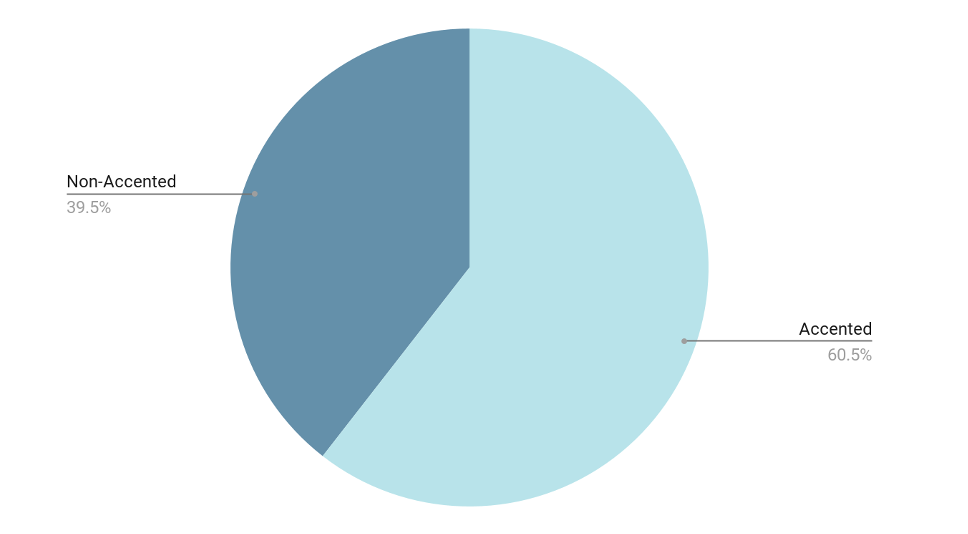
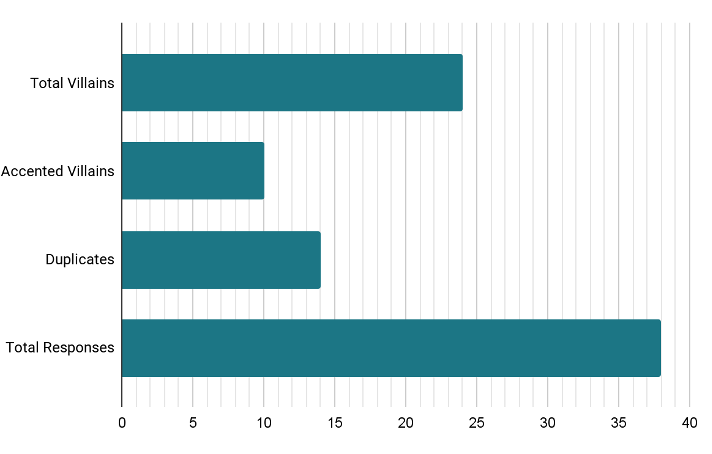
Figure 1

The results of the survey demonstrated a strong prevalence of foreign accents in the villains chosen, evidenced by Figure 1. Out of 38 total responses, 23 responses were accented villains. Not only was a clear statistical significance demonstrated of the trend, but actually a majority of the villain choices were associated with foreign accents. Given the breadth of types of respondents coming from California to Uganda to Singapore accompanied by the complete autonomy of selection of the villain, the survey results highlight the abundance of accented villains in popular media.

Figure 2

In addition, the values from Figure 2 present an interesting observation regarding the variety and uniqueness of villain selections. In total there were only 24 unique villains chosen. Of those 24 villains, only 10 were actually accented. The disparity between the number of accented villains and number of accented responses is explained by the incredibly high number of repeat selections of villains that are accented. For instance, Ursula (who adopts a condescending British accent) from The Little Mermaid was listed five times and Dr. Doofenshmirtz was repeated four times. In fact, of the 14 duplicate responses, 12 contained accented villains. This informs on the consolidation of popular children’s media; most children consume much of the same television shows and movies (Disney).

Another interesting note revolves around the traits that stand out or make the villain memorable. The comments on the impressions of the villain fell into two camps: “scary”/“intimidating” or “cool”/“respectable”. Not a single comment mentioned how the villain sounds or their voice. The “othering” of the villains through accented speech takes an implicit or passive effect on the viewer rather than being the focal point. The viewer then subconsciously categorizes the character in the out group. These observations and key takeaways from the survey helped propel the main research portion of the study and guided the choice of Dr. Heinz Doofenshmirtz as the character to analyze. 

Methods

Our main goal in collecting data was to show that Doofenshmirtz follows German pronunciation patterns when speaking English. His nonstandard speech is meant to “other” him from the protagonists, determining his characterization as “bad.” Therefore, our data took a two-pronged approach: first, we used the spectrogram software Praat to analyze sound files of subjects speaking. This way, we could look at Doofenshmirtz’s articulatory properties and point to which features distinguish him as German-sounding. Then, we sent speakers of English to watch an episode of the show and comment on which non-standard features they heard him using. Between these two methods, we gained an understanding of both how Doofenshmirtz speaks and how English-speakers perceive his speech.

When researching in Praat, we looked at the vowels /i/ and /æ/. /i/ exists in both English and German, so we expected no statistical difference in the articulation of a German versus English speaker. On the other hand, the /æ/ sound exists in English but not German. In English, German-speakers tend to replace this sound with the higher vowel /ɛ/, which is easier to produce based on its presence in the German language.

We used samples from four subjects in Praat, two German-accented speakers and two “standard” American speakers. Our “baseline” German accent came from a 50-year-old native speaker who grew up in Düsseldorf but now lives in California. We were particularly interested to see how his speech compared to the German-accented Doofenshmirtz (who, intriguingly enough, was voiced by an American actor). We also took a sample from an 18-year-old native Californian, who we determined to have “standard” vowel production. Finally, we compared her speech to the pronunciation of the show’s protagonist, Phinneas (who was also voiced by an American actor, but was intended to have “standard” production).  We wanted to ensure that our samples were comparable, so our first three subjects all produced Doofenshmirtz’s catchphrase: “Curse you, Perry the Platypus!” (/i/ is found in the word /ˈperi /, while /æ/ is prominent in /ˈplætəpəs/). Although no samples existed of Phinneas saying this sentence, we located a similar sentence where he still said both words in proximity.

Our other group of data came from observing Doofenshmirtz’s speech throughout an episode. Inherently, the sounds of the German language differ from those of English. Some sounds feel tricky or unnatural to non-native speakers. Speakers often replace an English sound with a similar foreign counterpart they know how to produce, just as how a German speaker might replace /æ/ with the /ɛ/ sound of their native language. Often, it is this sound substitution that creates the phenomenon of an accent. For our project, we wanted to see how American individuals perceived Doofenshmirtz’s so-called accent. We asked two college-aged subjects to watch Season 1, Episode 26 – “Out of Toon / Hail Doofania” and explain how his speech compares to the substitutions we’d expect of a German-speaker.

Results/Analysis

Praat

In Praat, we used the “View & Edit” feature to analyze something called formants (lines on a spectrogram that indicate a concentration of energy). For this project, we were mainly concerned with the first formant (F1), which shows vowel height. We found that all of our subjects had similar F1 formants for the vowel /i/. Since this sound exists in both languages, non-native speakers made no substitutions when speaking English. Our Hz values ranged from 376.7 to 460, meaning there was less than a 100-Hz difference between how the two most differently accented speakers produced the vowel. Therefore, the data showed no trends in production variations for Germans and Americans in /i/.

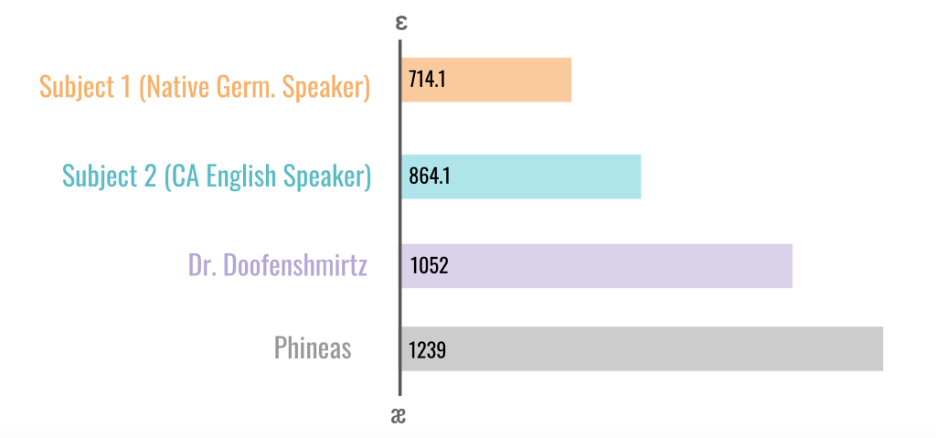
On the other hand, the data showed interesting patterns when it came to /æ/. We predicted that German speakers would have a lower F1 value than English-speakers (due to the fact that /ɛ/ has a lower F1 than /æ/). Overall, we found this to be true. Our authentic German subject had the lowest F1 of the group at 714.1. Likewise, our highest formant value came from “standard” speaker Phineas at 1239. Interestingly, the dubbed voices had a much higher average F1 formant, which we hypothesized had something to do with the nature of the audio files. If we separate our samples by this type of audio file (real speakers vs dubbed speakers), we find that German speakers’ formants are 100-150 Hz lower than those of American speakers. This indicates that they do, in fact, produce ash more similar to /ɛ/.

Figure 3

Sound Analysis

We paid attention to foreign-sounding allophones, compared to a Californian English speaker’s pronunciation, in Hail Doofania. We only analyzed Dr. Doofenshmirtz’s speech and ignored any pronunciation deviations in his song.

In his speech, we identified 6 sounds that were pronounced differently from how a Californian English speaker would pronounce the sounds. The most frequently occurring deviations were his pronunciation of the alveolar approximant ([ɹ]) and voiced postalveolar affricate ([dʒ]). 23 of the 34 deviations were [ɹ] and 6 deviations were [dʒ]. We identified pronunciation deviations just from hearing and our personal judgments given the time and resource constraints of this project.

We looked at the German International Phonetic Alphabet (IPA) sounds to see if the allophones used by Dr. Doofenshmirtz were from the German sound repository. We proposed that his mispronunciation of English allophones was because he was borrowing German sounds to pronounce English sounds. But, the sounds that Dr. Doofenshmirtz used were actually not found in the German IPA

As the allophones used by German speakers for the different analyzed sounds were not what Dr. Doofenshmirtz used, we came up with 2 possible explanations to account for Dr. Doofenshmirtz’s different pronunciations.

First, we suggest that the producers might have wanted to distance Dr. Doofenshmirtz from a German identity. Perhaps they wanted Dr. Doofenshmirtz to have some accent aspects which alluded to a German identity but not have the character be too strongly associated with a German identity. Podesva (2011) posits that the creation of an identity or a “persona” utilizes several linguistic features, and different components of a linguistic feature are adopted depending on the context the speaker is in. This suggests that a bricolage of linguistic features are used to construct an identity. For Dr. Doofenshmirtz, this means that his identity as an individual from Drusselstein (a fictional East European country) was not solely reliant on his accent but on other features too. Hence, it is possible that the show’s producers did not use the German allophones to pronounce the different Californian English sounds to index Dr. Doofenshmirtz’s heritage, but utilized other linguistic and non-linguistic features to do so.

Second, it could be because Dr. Doofenshmirtz is voiced by Dan Povenmire, a native Californian English speaker. Thus, Dr. Doofenshmirtz’s mispronunciation could stem from how a Californian English speaker perceives a German accent to sound like and not how an actual German accent sounds like.

Interestingly, we found that our German speaker pronounced the sounds we studied, in the same way that Californian English speakers do. We attribute this to his exposure to the Californian English accent and was able to distinguish the different allophones and use them according to the context he was in.

Discussion and Conclusions

We looked at the amount of time Dr. Doofenshmirtz spoke in Hail Doofania to gauge the significance of his accent’s contribution to his identity. Dr. Doofenshmirtz had 112 seconds of speech time in the 9 minute and 11 second episode (551 seconds). This equates to about 20% of the episode. As such, Doofenshmirtz has only 20% of the episode to leave an impression on the audience, making it crucial for the producers to adopt several indices to create Doofenshmirtz’s character as an “evil scientist”. The identified indices were: his accent, his clothing (lab coat), the content of his speech (his plans to take over the Tri-state Area) and actions (fighting with Perry the Platypus).

We felt that some younger audience members might be too young to comprehend the sinister nature of Dr. Doofenshmirtz’s plans and might instead rely on auditory and visual cues (his accent and attire & fight scenes, respectively) to index Dr. Doofenshmirtz as a villain. By extension, we think that it is possible for these auditory and visual cues to lay the groundwork for associations that these child audiences make with someone who is “bad” and in an outgroup.

Given that it is more likely for children to come across speakers of different accents than people dressed in lab coats in their everyday lives, we believe that it is possible for them to consequently (because of cartoon villains having accents) associate people with accents as members of an outgroup. This demonstrates how accented villains are part of the phenomenon of othering and can influence children’s perception of “good” and “bad”.

We believe that the results we obtained through Praat were very useful. They supported our findings and proved that accented speakers sound different from the standard. We wish we had more time to obtain and analyze more data. On the other hand, the survey results were not very helpful. We were not able to come to any conclusions through the survey results, but we definitely feel that the survey pushed us in the right direction.

One of the most important takeaways that we believe show producers should know is that they must be mindful of the stereotypes they create or reinforce in their audience. These shows have long term implications that heavily influence individuals.


References

Constable, E. (2021, March 17). Dear Disney, stop teaching kids that foreign accents are evil. LHS Epic. https://lhsepic.com/9602/opinion/dear-disney-stop-teaching-kids-that-foreign-accents-are-evil/

Dobrow, J. R., & Gidney, C. L. (1998). The Good, the Bad, and the Foreign: The Use of Dialect in Children’s Animated Television. The Annals of the American Academy of Political and Social Science, 557, 105-119. JSTOR. https://www.jstor.org/stable/1049446

Flege, J. E., Bohn, O.-S., & Jang, S. (1997). Effects of experience on non-native speakers’ production and perception of English vowels. Journal of Phonetics, 24(4), 437-470. ScienceDirect. https://doi.org/10.1006/jpho.1997.0052

Paquette-Smith, M., Buckler, H., White, K. S., Choi, J., & Johnson, E. K. (2019). The Effect of Accent Exposure on Children’s Sociolinguistic Evaluation of Peers. Developmental Psychology, 5(4), 809-822. American Psychological Association. https://psycnet.apa.org/doi/10.1037/dev0000659

Phineas and Ferb Wiki. (n.d.). Drusselstein | Phineas and Ferb Wiki | Fandom. Phineas and Ferb Wiki. https://phineasandferb.fandom.com/wiki/Drusselstein

Shah, A. P. (2019). Why are Certain Accents Judged the Way they are? Decoding Qualitative Patterns of Accent Bias. Advances in Language and Literary Studies, 10(3), 128-139. Australian International Academic Centre PTY.LTD. https://doi.org/10.7575/aiac.alls.v.10n.3p.128

Sharma, M. (2016). CHAPTER SEVEN: Disney and the Ethnic Other: A Semiotic Analysis of American Identity. In Teaching with Disney (pp. 95-107). Peter Lang AG. Williams, M. G., & Korn, J. (2017). Othering and Fear: Cultural Values and Hiro’s Race in Thomas & Friends’ Hero of the Rails. Journal of Communication Inquiry, 41(1), 22-41. SAGE. 10.1177/0196859916656836

[/expander_maker]

, , ,

The Language of Good and Evil in the Disney Universe

Wendy Barenque, Maria Martignano Cassol, Kelli Sakaguchi, Sophia Siqueiros, Ellis Song

Every year Disney and Pixar release blockbuster hits watched by millions of children. Disney and Pixar characters have a huge impact on how children learn to view people in real life through the use of regional and foreign accents categorizing intrinsic “goodness” or “badness” (Lippi-Green, 2012). Recently, there has been a rising trend in the usage of “switch characters” in the Disney and Pixar cinematic universe. “Switch characters” are characters who are able to fake membership in the “good” character category and later reveal to not belong to this category. In this research, accent along with other linguistic variables such as pitch and creaky voice were tracked to determine if correlations exist between these linguistic variables and “switch characters” portrayals of “goodness” and “badness.” Does a “switch character” use a linguistic variable differently when portraying themselves as good rather than bad? For example, if linguistics changes do occur, do audiences begin to associate a certain pitch, accent, or creaky voice with “good” or “bad” categories of people? Specifically, we examined how the language aspects of “switch characters” changed between pre- and post- revelation scenes in nine Disney and Pixar films such as Frozen and Zootopia. Ultimately, we found a linguistic trend that may affect the audience’s perspective on movie characters. Keep on reading to see the effects these movies may unconsciously have on your associations of “good” and “bad” people!

[expander_maker id=”1″ more=”Read more” less=”Read less”]

In this project, we examined the correlation between linguistic features and a character’s group membership (as good or bad) in Disney and Pixar films. The specific characters we looked into are those we call “switch characters.” “Switch characters” are those that fake membership as one of the “good guys” but are later revealed as villains. The three linguistic features we felt were most important consisted of pitch, creaky voice, and accent.

Some important definitions:

Pitch: how high or low the speaker’s voice is.

Creaky Voice: also known as vocal fry, happens when the speaker drops their voice to their lowest natural register for emphasis.

Accent: pronunciation specific to an individual or location.

We predicted there would be a change in one or more of these features when a “switch character’s” true membership was revealed. For pitch, we compared range (high, medium, low) of the “switch characters” before and after their reveal to determine if there is a trend in pitch change in a certain direction. Similarly, we looked at the presence of creaky voice preceding and following the switch. In analyzing accents, we aimed to identify any kind of change the character’s pronunciation may undergo.

Our analysis studied the use of linguistic profiling (being able to identify social characteristics based on the language used by the speaker) used by movie makers to reinforce the goodness or badness of a character. We presumed speaker agency in pitch, creaky voice, and accent, through the lens of Speaker and Audience Design Models (Bell, 1984, p. 158). This means that we assumed that “switch characters” actively shift their language based on what group they identify with to distance themselves from or bring themselves closer to their audience.

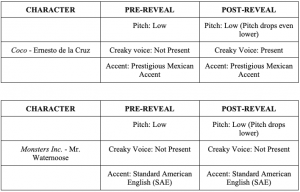
We based our project on Lippi-Green’s (2012) research that revealed a correlation between accents and variations of standard English with villains. We expanded on her project by looking at additional linguistic variables in Disney and Pixar movies made after 1995 which we believe better represent modern society. The nine movies and characters we analyzed are Frozen (Prince Hans), Coco (Ernesto de La Cruz), Big Hero 6 (Professor Callaghan), Toy Story 3 (Lotso), The Incredibles 2 (Evelyn Deavor), Monsters Inc. (Mr. Waternoose), Toy Story 2 (Stinky Pete), Cars 2 (Sir Miles Axlerod), and Zootopia (Dawn Bellweather).

Methodology: A Sneak Peek into Film Analysis   

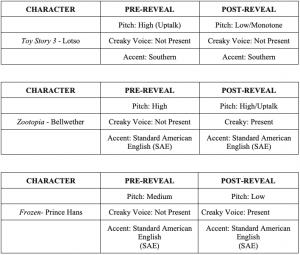
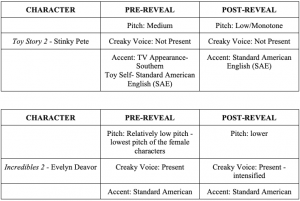
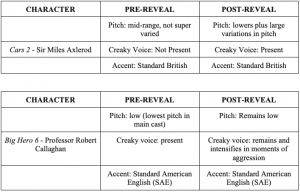
Here is an example from Toy Story 3. This example is representative of the methodology that the group utilized to accurately label all nine “switch characters” – pitch, creaky voice, and accent. For the purpose of data collection, a chart adapted from Soares (2017) was used to organize and uniformize character analysis. We repeated the process with all nine films and compiled the analysis into graphs included below.

This selected scene features an exchange between the hero Buzz and the villain Lotso. At the beginning of this scene, Buzz is unaware that Losto is a villain. We see Buzz requesting a group transfer to the Butterfly playroom. Things take a turn for the worse, however, as Lotso only agrees to let Buzz transfer playrooms. Click on the link to see what happens next!

Focusing on “pitch,” the group found uptalk in phrases such as, “showed initiative” and “we got a keeper.” Uptalk is a manner of speaking with a rising intonation at the end of sentences. The italics represent Lotso’s rising intonation. After Lotso’s villainous nature is revealed, uptalk disappears and we hear a deepening and leveling of pitch. Phrases such as, “family man” and “back in the timeout chair” exemplify this deepening and leveling. Therefore, the group labeled Lotso’s pre-reveal pitch as “high: (uptalk)” and post-reveal as “low/monotone.”

Focusing on “creaky voice,” the group didn’t find any phrases that employed a rough voice quality and a lowered pitch. Therefore, the group labeled Lotso’s pre-reveal and post-reveal “Creaky Voice” as “Not Present.”

Focusing on “accent,” the group agreed that Lotso’s phrases possessed the slurred speech patterns of a Southern American accent. Lotso’s Southern accent was exemplified in words containing “r’s” such as ”caterpillar.” Therefore, the group labeled Lotso’s pre-reveal and post-reveal accent as “Southern.”

Results

We noted that eight characters changed at least one linguistic element (pitch, creaky voice, or accent) after their reveal. Our prediction based on Lippi-Green’s analysis proved true, language aspects in the Disney universe do correlate to a character’s identity as good or bad.

Charts 1-9. Linguistic Analysis of Disney and Pixar “Switch Characters” Comparison of pitch, creaky voice and accent pre-reveal and post-reveal.

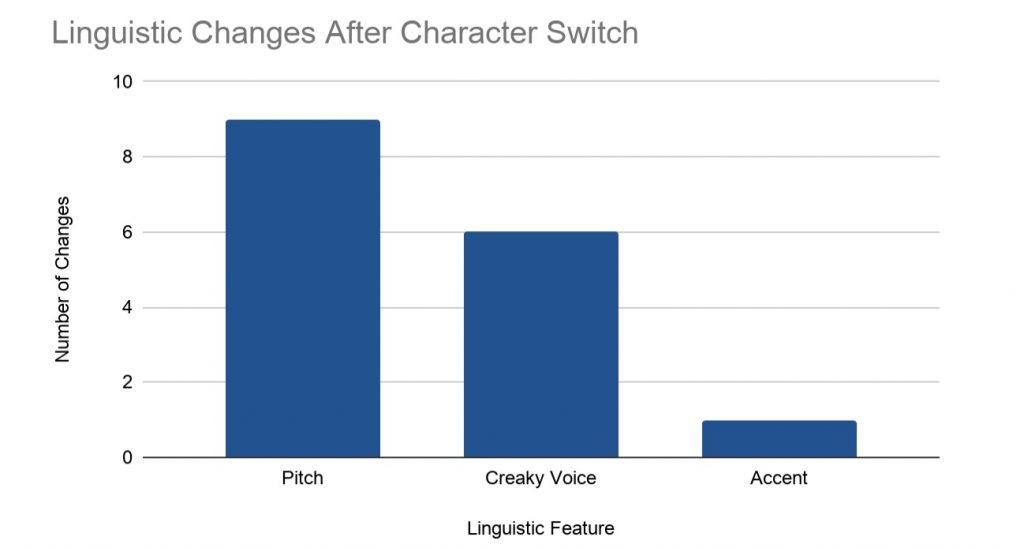
The linguistic aspect that changed most was pitch, followed by creaky voice and accent. Only one character, Stinky Pete, had an accent change, settling completely into Standard American English (SAE) after the reveal as opposed to switching between Southern American and SAE. Considering that Stinky Pete employed SAE before revealing himself as a villain, we decided to view accent as not indexing goodness or badness in his character. This diverges from our initial prediction, since Lippi-Green’s study demonstrated a strong relationship between accent and intrinsic goodness and badness.

Fig 1. Linguistic Changes After Character Switch. Amount of characters that presented change in a certain linguistic after their reveal as villains.

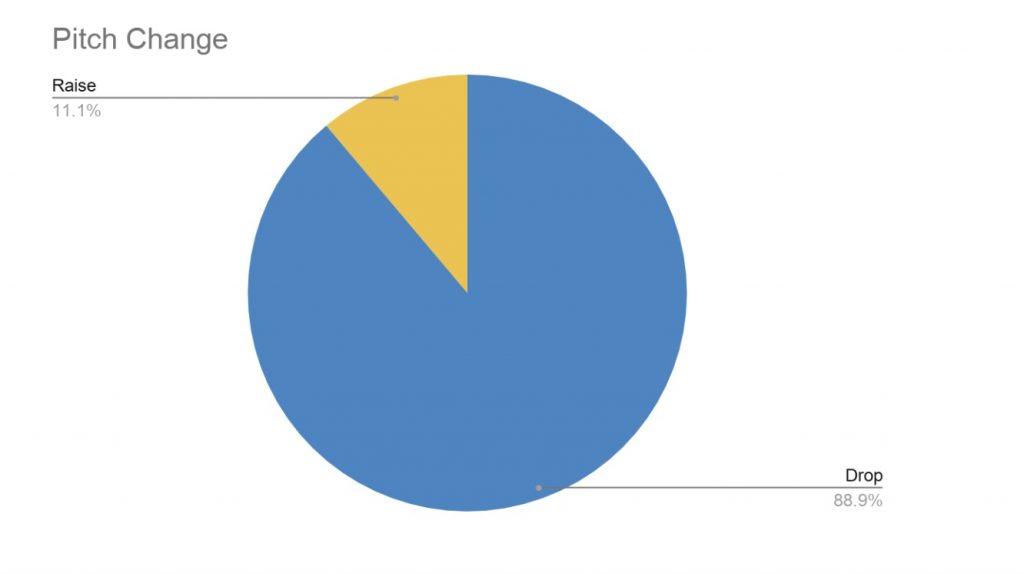
After determining which aspects changed after the reveal (pitch and creaky voice) we analyzed exactly how these aspects changed. For eight of the nine characters, there was a drop in pitch, and only one character had a rise in pitch. It is also worth noting that some of the characters’s pitch dropped when they produced especially aggressive statements or when they mocked their villainous persona. From our data, we conclude that a strong correlation exists between lower pitch and evil personas.

Fig 2. Pitch Change. Percentage of “switch characters” that presented either a rise or drop in pitch.

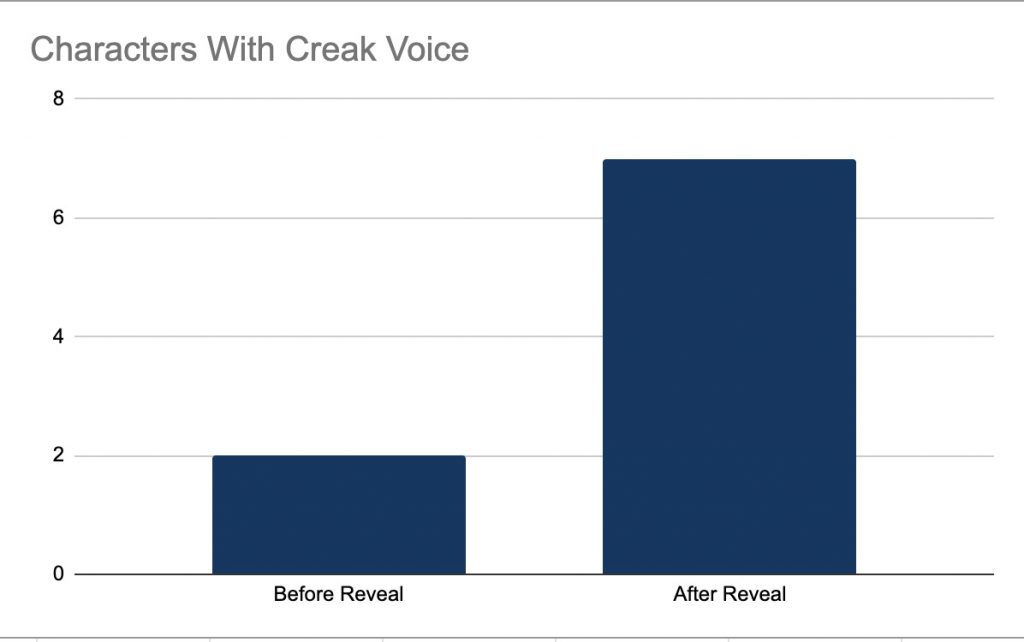
The other linguistic aspect we noticed a change in was creaky voice. Six characters used creaky voice after their reveal. Of the characters that initially presented creaky voice all maintained creaky voice after reveal. One thing to note is that creaky voice is closely related to pitch, therefore a drop in pitch normally meant the addition of creaky voice.

Fig 3. Characters With Creaky Voice. The number of characters that presented creaky voice before their reveal and number of characters that presented creaky voice after their reveal.

Overall, our data supports the hypothesis that certain linguistic aspects correlate with group membership (as good or bad). However, this change seems to be mostly related to pitch and not accents as studied by Lippi-Green (2012). Drop in pitch seems to be the universal linguistic aspect in Disney and Pixar’s universe that signifies a villainous persona and a higher pitch seems to signify and contribute to blending in with good characters.

Discussion

We know that Disney and Pixar movies have helped to socialize children into stereotyping and othering, based on accents in the research done by Lippi-Green (2012) and others. But do “switch characters” also contribute to this categorization in children? Through this study, we conclude that pitch, as well as the presence of creaky voice, are heavily correlated to an evil persona. So do children begin to associate these features with villains after seeing such movies?

Children tend to relate a higher pitch to brightness (Marks, Hammeal, Bornstein, 1987). This association creates a positive attitude towards a higher pitch, as shown by Banaji and Greenwald in “Into the Blindspot.” Therefore a lower pitch may imply a more negative attitude towards the person speaking. This could imply that children are wary of those with lower pitches in their speech and so, when the “switch characters” do this, it only reinforces this association.

There aren’t enough studies on children’s perception of creaky voice to conclude its influence on them. But if lower pitch implies a negative attitude, then the lowest register (creaky voice) will most likely imply one as well.

As a result, we can theorize that children notice and are affected by the changes in pitch and the use of creaky voice. However, our conclusions on the effect of the movies on the audience can only be hypothetical, as our data does not include audience responses.

Conclusion

In our study we analyzed how certain linguistic features (pitch, creaky voice, and accent) changed when a character switched from good to bad. The purpose of our study was to find linguistic trends in these characters.

Our data showed that most “switch characters” dropped pitch and added creaky voice when they revealed to be evil, while their accent remained constant. Looking at Marks, Hammeal and Bornstein (1987), we found that children are likely to view a higher pitch positively and theorized that Disney and Pixar movies might contribute to this phenomenon, or, at the very least, rely on it for indicating a character’s identity as good or bad.

However, we can’t make definite conclusions because our small sample size and lack of data of the audience’s response. So, we can only theorize what kind of impact these “switch characters” have on their audience and what linguistic trends are present in the Disney universe. But linguistic trends in Disney characters remains an important topic to be researched, because of the continued promotion of the dominant ideology presented in Disney and Pixar movies, especially considering the size of their audience.


References

Banaji, M., & Greenwald, A. (2013). Blindspot: Hidden biases of good people. New York: Delacorte Press.

Bell, A. (1984). Language Style as Audience Design. Language in Society, 13 ( 2), 145-204. Retrieved from https://www.jstor.org/stable/4167516?seq=10#metadata_info_tab_contents

Girard, F., Floccia, C., & Goslin, J. (2008). Perception and awareness of accents in young  children. British Journal of Developmental Psychology, 26(3), 409-433.

Lippi-Green, R. (2012). Teaching Children how to discriminate: What we learn from the Big Bad Wolf. English with an Accent: Language, Ideology and Discrimination in the United States, 7, 101-129.

Marks, L. E., Hammeal, R. J., & Bornstein, M. H. (1987). Perceiving Similarity and Comprehending Metaphor. Monographs of the Society for Research in Child Development, 52(1),1-92.

Soares, Telma O. (2017). Animated Films and Linguistic Stereotypes: A Critical Discourse Analysis of Accent Use in Disney Animated Films. Bridgewater State University Master Theses and Projects. 53, 1-53.

[/expander_maker]


, , , ,
Scroll to Top