Norms

The Linguistic Switcheroo: Navigating Style-Shifts in College Discourse
Dead Poets Society (1989)

This blog entry explores the dynamic world of language use among college students at UCLA, focusing on how they adjust their linguistic style in academic environments. We delve into the phenomenon of style-switching, where students navigate between informal conversations with peers and formal interactions with professors. Through careful observation and analysis, our research uncovers the nuances of word choice, tone, and syntax in these differing contexts. We aim to understand how social settings influence language socialization within academic communities. Our findings reveal that students tend to employ a more casual, slang-infused language among peers while adopting a more structured and formal language when engaging with faculty. These findings highlight the adaptability of linguistic practices within differing contexts, as seen in the discrepancy between a languid and relaxed setting versus an academic one, and reveal deeper insight into the social dynamics at play. Join us in exploring the intricate play of language in the college setting, where each conversation reflects the complex interplay of social norms, power dynamics, and cultural identity.

[expander_maker id=”1″ more=”Read more” less=”Read less”]

Introduction

Our research focuses on the intricate ways college students adjust their language in different academic settings, particularly at UCLA. Previous studies, like those by Patricia A. Duff and others, have highlighted language socialization in academic contexts. However, there’s less focus on how students’ language shifts in real-time interactions between diverse groups such as peers and professors. We aim to bridge this gap by analyzing how UCLA students’ word choice, tone, and syntax vary when communicating with peers versus academic staff. Our hypothesis posits that students’ language becomes more informal, slang-heavy, and less complex in peer interactions compared to more formal, carefully structured conversations with faculty, reflecting underlying power dynamics and social norms.

Here’s a link to a video by Cambridge University Press that explains “academic language” to give you an idea of what we’ll be discussing in this blog!

Methods

In our study, we centered our investigation on the linguistic style shifts among UCLA students in academic contexts. Our focus was on two primary interaction scenarios: between students themselves and between students and their professors.

People and Contexts Observed:

  • Student-Student Interactions: Conversations among peers, both within and outside classroom settings, were recorded. These interactions provided insights into the informal communication styles prevalent in peer groups.
  • Student-Professor Interactions: We also observed and recorded interactions between students and faculty members. This setting offered a contrasting view of more formal and structured communication.

What We Analyzed:

  • Word Choice: We paid close attention to the vocabulary used in different social settings. Our analysis focused on identifying the use of informal language and slang among peers, compared to more formal and academic language in interactions with professors.
  • Syntax and Structure: The complexity of sentence construction and use of grammatical structures were analyzed to observe variations in formality and complexity.
  • Tone: The emotional and attitudinal aspects of speech, such as enthusiasm, respect, or hesitation, were observed to understand the relational dynamics in different interactions. Take a look at this video to better understand the importance of how we say things, beyond what we say.

Data Collection Method:

  • A mix of participant observation and ethnographic fieldwork was employed. This involved walking with, talking with, and recording the daily life and conversations of students. Both audio recordings and hand-transcriptions of conversations were utilized.

By focusing on these observable elements in communication, our study aimed to illuminate how linguistic practices are adapted to different social contexts within the academic environment. Technicalities not central to our primary analysis, such as detailed linguistic theories, were omitted for clarity and accessibility to a general audience. This approach ensured that our study remained engaging and understandable, while still maintaining academic rigor.

Results

Here is what some of our data ended up looking like:

Student-Student Conversation

Student 1: Yeah, the bystander effect. It’s like, when there’s a bunch of people, everyone thinks someone else will step up. Ends up with no one helping. Pretty messed up and craaaazy.

Student 2: That’s tea. It makes you wonder, huh? Did you guys then talk about how different countries do things differently?

Student 1: Oh yeah, it’s all about the culture vibe. Like, some places are all “pick me girls,” while others are like “No worry girly.” (laughing)

Student 2: No literallyyyy. Social psych’s got some real “shit” going on.

Student-Professor Conversation

Student: In the lecture, you mentioned the bystander effect. Can you explain more on that?

Professor: Oh yes I can. So, the bystander effect refers to the phenomenon where individuals are less likely to offer help to a victim when other people are present. It’s often due to a fear of responsibility, where the bystander assumes someone else will intervene.

Student: I see. So how does this relate to social responsibility?

Professor: Hmm social responsibility is an individual’s obligation to act for the benefit of society at large. So like in the context of the bystander effect, it challenges the individuals to overcome the fear of responsibility and take action when they witness someone in need of help.

Student: Oh ok I get it. And last question (slight haha) what about the role of culture in social psychology?

Professor: So culture plays a significant role in shaping our social behaviors and attitudes. Different cultures have different norms and values, which could influence how people perceive and interact with each other. Like for example, individualistic cultures might emphasize personal achievements, while collectivist cultures focus on their group harmony.

Student: OK I got that down. Thank you so much for your time, Professor!

So what does this tell us?

These two conversations, both of which cover the “bystander effect” of social psychology, show completely different ways of having very similar conversations. Even though both conversations cover the bystander effect, and in each one the speaker is asking questions while one is answering and explaining, the language used is very different.

The use of slang in the student-student conversation – words like “tea,” “craaaazy,” and “literalyyyy” – are not present in the student-professor conversation. This suggests that students are perfectly capable of discussing academic topics in the way they ‘typically’ speak – with friends and in their social interactions, but they are intentionally censoring themselves and electing for “academic language” when speaking with professors.

The fact that the professor, here, is not speaking with the same total academic language, and still uses phrases such as, “so like” and “hmmm,” suggests that they do not feel the same sense of need to maintain formality in the way the student does. This shows us that despite the absence of reciprocal formality within student-professor interactions, when speaking with a faculty member or professor, the student still understands their position in this conversation as relatively powerless and more subservient.

In analyzing syntax and structure, we found conflicting conclusions in students’ willingness to formalize their speech around professors versus their peers. In conversations with peers, students tended to include longer sentences that more frequently lacked correct grammatical structure and syntax as ruled by academic standards of speech. However, these sentences were more truncated and were often shortened to mere phrases that included only enough to communicate a simple idea. In contrast, students’ interactions with the professor included simpler sentence structure, yet more grammatically correct. Student 1’s use of the phrases, “Ends up with no one helping” and “Pretty messed up and craaaazy” as well as Student 2’s response later in the conversation, “No literallyyyy” highlight this phenomenon. By standards imposed through academia’s use of American Standard English, all of these examples would be considered incorrect grammatically and incomplete in syntax. They all lack subjects and therefore rely on the context surrounding it with the conversation being had in order to correctly interpret their meanings. These examples can be contrasted with the student’s interactions with the professor, in which all sentences are complete and use academically correct syntax structure. The students’ sentences are more concise in their lack of filler words and slang, and yet grammatically more correct. This again, may point to power imbalances within these two interactions – students may feel less willing or comfortable to talk extensively with professors than with peers due to the perceived power imbalance, as well as feel more restricted in their expression, as is reflected in the formality of their structure and syntax.

The last aspect of speech we analyzed was a difference in tone. In comparing the two examples provided, we found that student to student interactions included a more playful tone, similar to banter, while the student to professor interaction held a more professional tone, lacking in comfort and familiarity. When the student talked to their peer, the two indiscriminately contributed to the conversation without self-consciousness, providing multiple affirmations and adding onto the points already stated. However, in the conversation between student and professor, the student’s conversation largely comprised of a quick and simple affirmation that they were listening to the professor’s speech, followed by another quick and concise question. The discrepancy between these two interactions again highlights the students’ need to adjust their manner of speaking due to their social status. As the student interacts with individuals with a wider gap in social standing, their speech reflects that change in the comfort at which they are capable of communicating with their counterparts.

Key and Peele, Comedy Central (2012)

Discussion and Conclusion

Academia is just one locale in which this linguistic phenomenon can be recognized. The same linguistic changes that we noticed between students speaking with fellow students, and students speaking with professors appear elsewhere. There is a palpable power dynamic between professors and students, which is reflected in the changes in word choice, syntax, and tone of students we recorded in each conversation group.

Other relationships with a similar power dynamic – for example, manager-employee or parent-child – would see similar shifts from the ‘lower’ positioned speaker’s standard casual mode of communication, and the way they communicate in these partnerships. Even more pertinent social commentary can be drawn from the linguistic-change patterns detected in our research. Power relations that result from socially constructed hierarchies, like racial differences, gender differences, or more specific circumstances like interactions with police officers, demonstrate similar linguistic changes.

This phenomenon suggests that linguistic patterns and tonal choices are not only reflections of existing social strata and power relations but are simultaneously contributing to the establishment and maintenance of these strata. Our research, therefore, both reflects and contributes to the existing literature on the interactions of linguistics and social power dynamics, via this case study on academic communication.

References

Alkhudair, R. Y. (2019). Professors’ and Undergraduate Students’ Perceptions and Attitudes Toward the Use of Code-Switching and Its Function in Academic Classrooms. International Journal of English Linguistics, 9(6), 160-. https://doi.org/10.5539/ijel.v9n6p160

Costa, J. (2015). Can Schools Dispense with Standard Language? Some Unintended Consequences of Introducing Scots in a Scottish Primary School. Journal of Linguistic Anthropology, 25(1), 25–42. https://doi.org/10.1111/jola.12069

Davydova, J. (2022). The role of social factors in the acquisition of vernacular English: A variationist study with pedagogical implications. International Journal of Applied Linguistics, 32(3), 425–441. https://doi.org/10.1111/ijal.12438

Duff, P. A. (2010). Language Socialization into Academic Discourse Communities. Annual Review of Applied Linguistics, 30(Mar), 169–192. https://doi.org/10.1017/S0267190510000048

Hamre, B. K., Pianta, R. C., Downer, J. T., DeCoster, J., Mashburn, A. J., Jones, S. M., Brown, J. L., Cappella, E., Atkins, M., Rivers, S. E., Brackett, M. A., & Hamagami, A. (2013). Teaching through Interactions: Testing a Developmental Framework of Teacher Effectiveness in over 4,000 Classrooms. The Elementary School Journal, 113(4), 461–487. https://doi.org/10.1086/669616

Hutton, S. (2022). The burden of code-switching: U-M LSA U-M COLLEGE OF LSA. U. https://lsa.umich.edu/lsa/news-events/lsa-magazine/Summer-2022/the-burden-of-code–switching.html

“I’m Retired.” Key and Peele, Keegan-Michael Key and Jordan Peele, season two, episode four, Comedy Central, 2012.

Poola, V. P., Suh, B., Parr, T., Boehler, M., Han, H., & Mellinger, J. (2021). Medical students’ reflections on surgical educators’ professionalism: Contextual nuances in the hidden curriculum. The American Journal of Surgery, 221(2), 270–276. https://doi.org/10.1016/j.amjsurg.2020.09.003

Sicoli, M. A. (2010). Shifting voices with participant roles: Voice qualities and speech registers in Mesoamerica. Language in Society, 39(4), 521–553. https://doi.org/10.1017/S0047404510000436 

Weir, Peter. Dead Poets Society. Buena Vista Pictures Distribution, 1989.

Woodbridge, A. (2021). “If I’d Heard That Earlier, It Would Have Changed My Academic Experience”: Connections Between Language Brokering and Undergraduate Academic Writing  / by Amy Woodbridge. University of California, Los Angeles.

[/expander_maker]

, , , , ,

Laugh Now… Because It Won’t Be Funny Later

Angelena Escobar, Debora Gotta, Lilly Khatirnia, Talia Kazandjian

Comedy and laughter are often viewed as universal languages. It is said that comedians have the capacity to produce discourse about the darkest and most challenging aspects of life, all the while making us laugh. This meant nothing was really off the table for comedians in the 90’s and early 00’s. However, in the last five years especially, with the massive rise of social media and cancel culture, we have seen both celebrities and private citizens being reprimanded or heavily criticized for their current or past actions. Comedians, especially, who were appreciated for their dark and uncensored humor, are now having to rethink their entire routine. Keeping that in mind, is comedy still regarded as it once was or have societal values changed enough to transform the stand up comedy landscape?

[expander_maker id=”1″ more=”Read more” less=”Read less”]

Introduction

Figure 1: Kevin Hart

Stand-up comedy is one of the major sources of entertainment. It began to hit the ground running in the early 50’s and 60’s, in which socially aware comedians made their way into the spotlight (Pulliam,1991, pg 164). However, stand-up comedy did not reach its peak until the 1970’s. The main purpose of comedy was to showcase current events, culture, and the personal lives of comedians (Zoglin, 2009, pg. 3). This essentially meant that a large amount of what was taking place during a certain point of history would be a focal point of comedic routines. Comedians also implemented their personal stories as a part of their jokes. While comedy has obviously been used for comedic purposes, it has been a factor in social change as well. In “Stand-up Comedy as a Tool for Social Change”, Manwell claims it is important to draw attention to negative stereotypes to be socially progressive. He emphasizes how humor that “draws criticism for being offensive and for perpetuating negative stereotypes” is, in actuality, progressive, because it pushes the boundaries of what is socially acceptable (Manwell, 2008, pg. 50). While Manwell piece was published too early to comment on the age of social media and social awareness, the implementation of stereotypes into comedians’ stand-up routines is crucial as it allows the audience to be more socially aware.

Background

Although there has been some research done on the topic of comedians using language, there has not been research done focusing on how comedians use language to create a comedic effect. Stand-up can be succinctly described as an Anglo-American form of comedy where a solo performer aims at repeatedly making her co-present audience laugh, primarily through personal narrative. Comedians manipulate language and use comedic elements to generate humor.

Methods

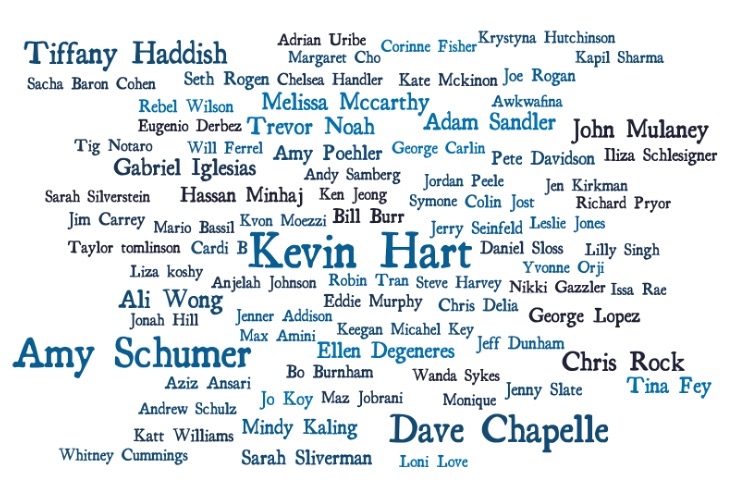
Our project was consistently developing the more information we found; therefore, we continued to tweak and modify our research question. At the beginning of our analysis, we sent out an anonymous survey to our friends and family. We received a total of 62 responses from individuals aged 18-49. There were multiple questions in that survey that were not as helpful as we continued working on our project; however, one was very important. We asked our survey takers to name both male and female stand-up comedians, and as it is seen within the word cloud: Tiffany Haddish, Amy Schumer, Dave Chappelle, and Kevin Hart were the most popular ones. Seeing that Kevin Hart garnered 50% of the responses when asked for male comedians, it was a determinant in deciding which comedian to focus on and what kind of research we can do based on him.

Figure 2: A word cloud containing the names of the comedians named by the participants. The size of the name corresponds to the frequency the comedian was listed.

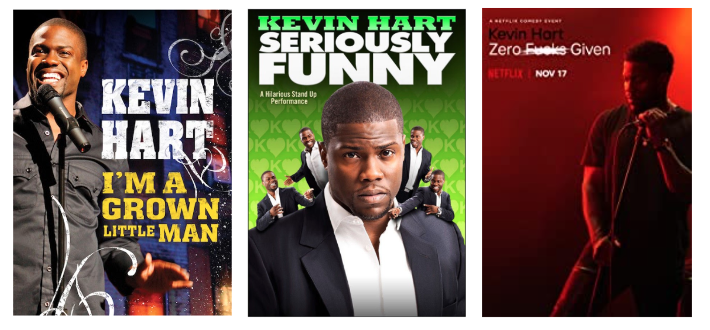
After deciding that we would work on Kevin Hart, we started to explore his past shows and decided to focus mainly on Seriously Funny, I’m a Grown Little Man, and Zero F**ks Given. These shows span a period of eleven years where we are able to observe and analyze the evolution of Kevin Hart and how/if his comedy have been influenced by fast changing social norms and values.

Figure 3: I’m A Grown Little Man (2009), Seriously Funny (2010), Zero F**ks Given (2020)

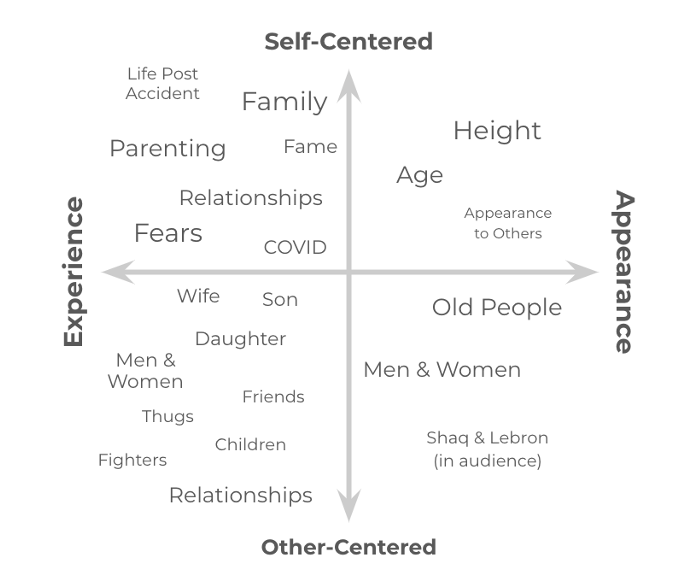
For our work to become more organized, we also decided to divide the jokes we looked at into four categories. It starts with the jokes being self-centered or other-centered, then within that there is a range of it being based on experience or appearance. Self-centered experience jokes are about Kevin Hart’s own personal experiences; Self-centered appearance jokes are about Hart’s appearance or how he is perceived outwardly; Other-centered experience jokes are about other people’s or a group of people’s actions or experiences; Other-centered appearance jokes are about how they look when they behave or are about other outward appearance features. The chart below shows the different topics of jokes Kevin Hart discussed throughout his comedy shows.

Figure 4: A visual representation of the types of jokes analyzed

Results and Analysis

The Use of Other-Centered and Community Based Jokes vs. Self-Centered

In I’m A Grown Little Man, Hart seemed to be more focused on community-based jokes. He used examples of the people he met and recreated scenarios with those individuals to portray how they acted in certain situations. One example is a specific scenario in which Hart imitates rappers and thugs to humor his audience– reflecting back to the theory of other-centered jokes. Hart made little jokes about his personal life because people weren’t as sensitive about certain topics/groups/stereotypes as they are now. Another example is the joke Hart made about a previous girlfriend of his that was White. He talked about her dad and turned it into a racial joke which the audience then took as humorous but would probably offend some people today. Hart acts out his jokes using code-switching and he indexes various communities by using alternate slang. He performs tone & slang differently when making jokes about the Black community compared to language used to connect with the White community.

Kevin Hart – Thug Laugh

Kevin Hart – Rich White Guy Laugh

In past comedy routines, Kevin Hart often used other-centered jokes in which he would use other communities as the primary focus of his jokes. While not all of Hart’s jokes were offensive, there were some that would not currently be socially acceptable. Hart has exhibited change in his most-recent stand-up, Zero F**ks Given, he tends to focus on himself and his family rather than making others the center of his joke. This not only depicts how Hart has evolved, but also showcases how the norms of what’s acceptable in comedy and society has been redefined. Considering the fact that this generation is more aware and sensitive to offensive topics, comedians are often pivoting and reconstructing their comedic routines in order to suit everyone. In the segment posted below, Hart uses intonation when telling the story about his daughter liking different guys every week. His voice rises and falls depending on what part of the story he is sharing. When name calling his daughter or son, he is relatively flat and speaking matter of factly and during other parts, he’s more animated and eccentric. Whereas before, the more offensive statements were other-centered, now the more “risque remarks “ are about him and his family. This is a significant sign of evolution in his routines reflecting social norm changes. The omission of teasing other people can stand as evidence that Hart has transformed his routines and has decided to become more adaptable to the times.

Kevin Hart – My Children


The Delivery of Jokes: No Filter vs. Socially Aware

This section of analysis focuses on Seriously Funny, Hart’s second recorded show in the touring part of his career. In this stage, he had a nonchalant attitude towards his jokes: no prevalent social awareness, no expected repercussions–and seemingly no filter–joking about any topic. Later, he defended these offensive jokes by saying “funny is funny”. To an extent, he’s correct as jokes now deemed offensive were successfully funny back then, in terms of success being measured by the intensity-and-length-of audience laughter. The change in the jokes he said is a great example of how societal norms/values have changed over time. What was accepted then, isn’t accepted now, what was funny then is now offensive. The following video is a segment from Seriously Funny. Hart’s joke is successfully delivered, and he effectively creates comedic effect through his use of intonation (the audible changes in his voice for emphasis), indexicality (personifying other people), and body gestures (for visualization of the story).  When he jokes about his son’s first gay moment, he clearly impersonates his son, the other child, and the woman who intervenes. Though his voice does not change much, unlike other segments he has done, his acting is very clear and he is able to distinctively act like the characters in his story through body motions. When he behaves like his son, he taps into how he described his son earlier in the show. He had claimed his son was, “a dumb kid that doesn’t really know what he’s doing” and shows this by waving his arms in all directions with no real or distinct rhythm. When he talks about the women who interferes, he becomes very calm and speaks in a standard tone of voice suggesting that there was no apparent problem between the two children. Lastly when he indexes his-self in that moment, he returns to an angry defensive tone and body language. Though this joke was comically effective back in 2010, this joke in particular has led to backlash–ultimately leading to Hart stepping down from being the 2019 Oscars Host. 

Watch the video and determine whether or not a joke like this would fly in current times: Kevin Hart – “My Son’s First Gay Moment” Seriously Funny (2010)

Contrastingly, in his latest comedy special, which aired in 2020 after his Oscar scandal, Kevin Hart is much more careful and aware of what he says and the types of jokes that he makes. Whereas before, the jokes were just delivered, now he actually uses self-repair in order to correct what he says or “soften the blow”. In the following video, there is an instance when he is about to make a joke on greeters, he pauses himself and makes a premise that he “… has nothing against greeters…” He makes it clear that he understands that it is an important and useful job, but it is something he does not have to or want to do. By making these comments, he’s able to go on with the joke, having established the foundation that he respects the occupation and does not see it as a bad thing. This can stand as an example of disaligning responses where Hart is able to “… revise or back down from… prior actions in order to permit preferred responses to be produced instead” (Whitehead, 2015, pg 4). In a time where there is heavy criticism to any kind of offensive remarks, making those preemptive comments or jokes about “cancelling” itself may make it so that those viewing the show don’t take it to heart as an offensive statement but rather a simple joke. He is mindful and concerned with how the wider/mainstream audience will interpret his joke. He is more socially aware of potentially offensive comments in his jokes. He is self-censoring which initiates self-repair. He does this by using specifically the use of intonation and indexicality to defer between the times that he is speaking as himself and the “persona” of those that may be after him post this joke. For example, when he impersonates the lady that is filming him as he eats his burger in front of McDonalds, he acts aggressive, angry, and accusatory. His hand is in front of him as if he is holding a phone and filming and his eyes are wide open (kind of as if he were crazy). When he is back to being himself he just describes what he did in a more relaxed tone and continues with the joke.

To further demonstrate what we mean, here are two segments from his latest comedy show attached below, where Kevin Hart makes the extra effort to communicate that he is not being offensive or seriously making a statement.

“Kevin Hart Loves Wal-Mart Greeters” Zero F***ks Given (2020)

“Why Kevin Hart Hates Snitches” Zero F***ks Given (2020)


Discussion/Conclusion

Our research aim was to understand whether societal norms have changed in the past 10 years by investigating one of comedy’s biggest stars, Kevin Hart. Starting from Seriously Funny to Zero F*cks Given, we observed an evolution in Hart’s shows–leading to conclude that societal norms and values have indeed changed. What was once received as humorous and funny may now be unacceptable by the mainstream. This generation is much more vocal about the types of jokes and statements one can make about a community. We came to this conclusion by analyzing the language used by Hart. By using different communication tools, both verbal and nonverbal, (code switching, indexicality, intonation, self-repair) we gained a greater understanding of societal value changes and impacts on systems within society, like entertainment. Despite his controversial past, Kevin Hart remains incredibly popular (as was evidenced by our survey and his record breaking show attendances). As we conclude this post, we wonder: Would you also agree with our conclusion? Where do you think the relationship with comedy and risqué remarks is headed in the future?


References

Manwell, C. F. (2008). STAND-UP COMEDY AS A TOOL FOR SOCIAL CHANGE. https://lsa.umich.edu/content/dam/english-assets/migrated/honors_files/Manwell%20Colleen-Stand-Up%20Comedy%20as%20a%20Tool%20For%20Social%20Change.pdf.

Pulliam, G. (1991). Stock Lines, Boat-Acts, and Dickjokes: A Brief Annotated Glossary of Standup Comedy Jargon. American Speech, 66(2), 164-170. doi:10.2307/455884

Whitehead, K. (2015). Everyday Antiracism in Action: Preference Organization in Responses to Racism. JOURNAL OF LANGUAGE AND SOCIAL PSYCHOLOGY, 34(4), 374-389. http://dx.doi.org/10.1177/0261927X15586433 Retrieved from https://escholarship.org/uc/item/7767x91b

Zoglin, R. (2009). Comedy at the edge: how stand-up in the 1970s changed America. Bloomsbury USA.


[/expander_maker]

, , , ,

I Am Who You Are Not: Insults in Films

Anthony Waller, Avery Robinson, Nicole Rasmussen, Jun Jie Li

Creativity and complexity are not often two factors that are considered when we insult; we typically go to our personal shelf of offensive phrases and let our selections do their damage. When we look at high school oriented films, however, we see that insults are a means of identity negotiation and employ creative and complex techniques that serve to compound the effect and project a strategic process of identity projection and negotiation. In this article, we will be examining how films act as a social mirror by reflecting a description of contemporary teenage culture. Specifically, we will be considering two factors that we believe to have had a significant impact on the motivation of portrayals: gender and time. Looking at several classic selections that spans the decades of the 80’s through the 00’s, we utilized a nexus and inductive approach in isolating specific linguistic elements of insults that appear most salient to our research. We conducted a series of comparative analyses of creativity and complexity parameters and extrapolated a loose correlation between gendered insults and the passage of time. From there, we will be discussing some implications of this correlation and how insulting is a process of identity prioritization and constructivism through self-isolation.

[expander_maker id=”1″ more=”Read more” less=”Read less”]

Introduction: How We Offend

For our research, we will be investigating the depiction of insults in teenagers as portrayed in films of high school settings from the 1980s, 1990s, and 2000s. Specifically, we want to take a look at how the complexity and creativity, as defined below, of insult formation are expressed across gender boundaries, and how the mechanism of that formation has evolved over the decades. Based on our preliminary observations, we are expecting to see depictions of greater structural complexity and communicative creativity in females characters over males. We also believe that there will be an inverse proportional relationship between the integration of elaboration in insult formation and the time period.

Background

Film can often provide valuable insights into how an era sees itself (Kalinak, 2010). Its choices shed light on realities and stereotypes, and insults and derogatory language natural entry points for analysis. Insults and derogatory language have two important, interdependent functions: the attack and distancing of the other and the defense and reassertion of the self. Teenagers are at a critical stage of self-discovery, and these functions offer insight into their views of self (Goffman, 1971). Choices in insult delivery will show the teenager’s prioritization in their identity expression, therefore by analyzing teenagers’ conspicuous insult expression, we can learn a great deal of what adults think of their successors.

The basis of our first hypothesis rests on Lakoff’s features of women’s speech. According to Lakoff, women are expected to use super-polite forms e.g. indirect language or euphemisms, and avoid swear words (Mooney & Evans, 2015). Therefore, if women want to insult someone, they would need to be more creative in order to get their point across while still adhering to the conventions of what is acceptable for women to say.

Our reasoning for predicting a general decline in complexity and creativity as we get closer to the current time is due to the improvement in technology and the emergence of “text speak,” “meme culture,” and the general notion that teenage speech has become more coded and somewhat less markedly intelligent (Brinkley, 2013, Dijk, 2016). Teenagers have found ways to say more with a lot less and to make a greater use of the referential creativity (see below).

Methods: Nexus and Induction

For our research, we will be utilizing a nexus and inductive approach; we will be drawing conclusions based on data and observations that we make in teenage films. Below we have six films, two from each of the three decades of our research parameter, that we believe will be illustrative of the teenage perception:

1980’s: The Breakfast Club, Ferris Bueller’s Day Off

1990’s: Clueless, 10 Things I Hate About You

2000’s: Mean Girls, The Princess Diaries

As we watch these films, we will be observing and taking notes of specific instances of derogatory language use by teenagers, as well as creativity and complexity levels. One way we have found to quantify these measures is to check if an insult actually contains an insult or a derogatory word, or whether it contains a series of words, reliant on references and word plays, constructed to make an insult. Additionally, we will analyze word choices in terms of commonality of use, with the thought in mind that less common words constitute a more creative insult. Once we have our data on creative versus non-creative insults, we will be able to form a ratio. We will compare the ratio between men and women in the movies, between the different decades, and between men and women differences in different decades. Further methods of analysis will include measurements of length, as well as comparisons of the types of references made across our parameters. As we have mentioned previously, we predict that insult use is more creative among women, and that insult use has become less creative since the 1980s.

Definitions / Parameters

Complexity: a function of length, diction, syntax.

Length: number of words in an insult or an insult group

Diction: word choice (common/uncommon)

Syntax: construction; whether the insult is formed in a non-declarative, complex way

Creativity: a measure of tone, reference, and blatant insult word choice

Tone: insults delivered through the use of tone or body language

Reference: use of references that are contextually significant in making the meaning of an insult apparent. This can fall into two main categories:

Cultural: An appeal to cultural, epistemic domains, such as arts and history, that are predominantly apparent to the individuals.

Social: An appeal to social norms, an attempted outing of the individual from the social hierarchy from an identity perspective.

Presence of blatant insult word: whether one insults with a pre-established jab or creates the pointedness themselves.

Results: Correlations

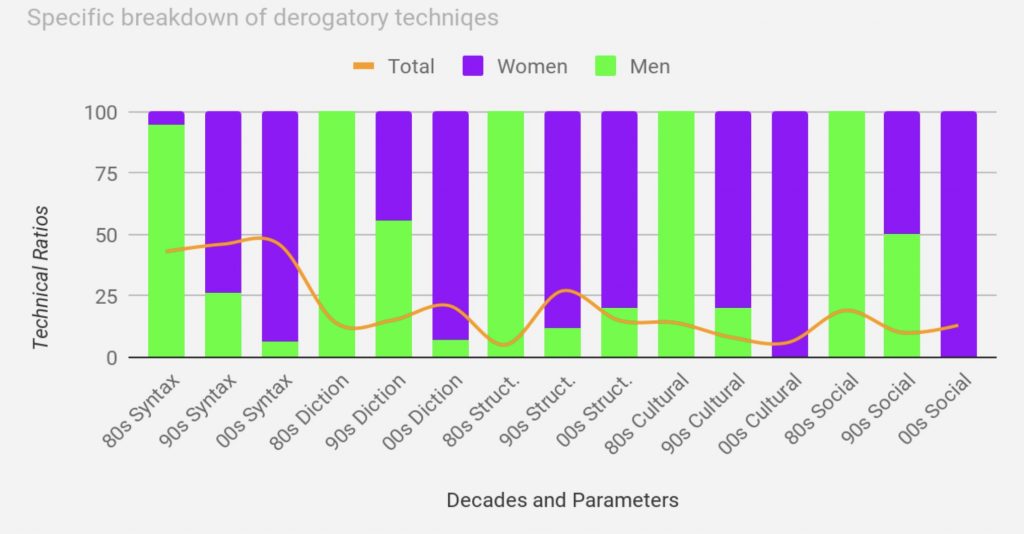
Our data from the 1980s is from Ferris Bueller’s Day Off and The Breakfast Club. The combined data from the two films tells us that the average word length per female insult is 5.71, and for males is 12.54. 46% of the insults were syntactically significant, and only 5.6% of those which were syntactically significant were from females. Social and cultural references were 19% and 14%, respectively, with females contributing 0% to both categories. 14% of the insults included uncommon and notable lexicon, but again with 0% contribution from females. In 5% of the data we saw insults delivered through tone, all attributed to male insults.

Our data from the 1990s films Clueless and 10 Things I Hate About You were 64% female. The average word length for a female-given insult is 8.84 words, and for males it was 8.54 words. 46% of the insults given were syntactically significant, and 78% of these are attributed to females. Only 15% of insulted included uncommon word choice, and about 44% of these were given by women. In regards to references, females made up around 80% of all cultural referenced insults, 50% of socially referenced insults. 27% of the insults were delivered through the use of tone, and 88% of those were female-delivered.

Our data from the 2000s derives from Mean Girls and Princess Diaries. From these films, 94% of the insults were from females. The average female word length was 6.45, and the average male word length is 9. 46% of the total insults were syntactically significant, and 93% of those were from women. In regards to references, 6% of the insults included cultural references and 13% included social references; all of these are attributed to females. 21% of the insults contained uncommon word choice, 93% from females. In regards to insults delivered through tone, 15% of the total insults employed this method and 80% is due to females. Finally, 66% of the insults contained an actual insult word, with 95% of that being from females.

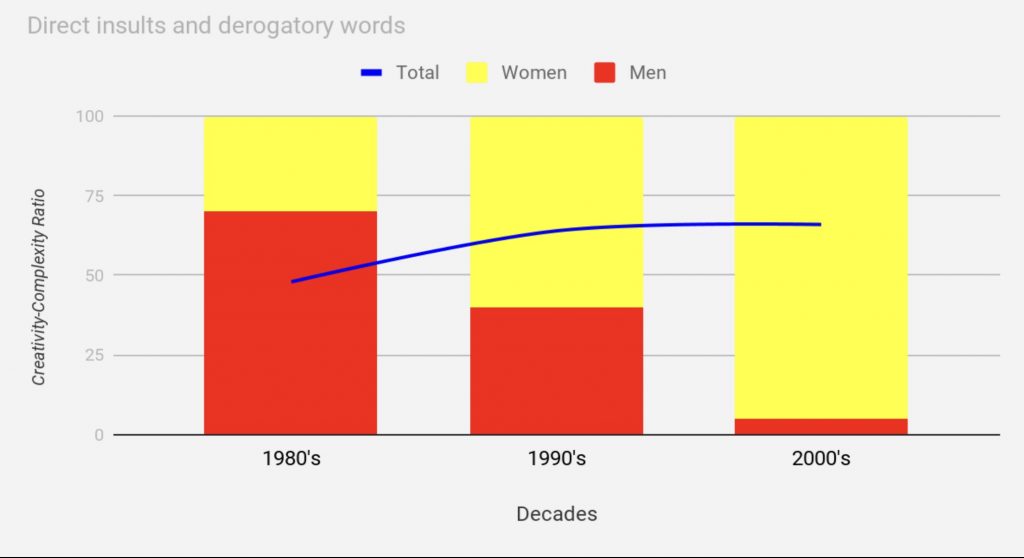
Figure 1: Direct Insults and Derogatory Words Over Time.

Our data from the 80s show us that males employed much more complex and creative insults than females at the time. Going into the 90s, the trend shifts, and the majority of our data point to women being a bit more creative and complex in their insult use than their male counterparts. Finally, in the 2000s, we see a drastic change in our results with women demonstrating much higher levels of insult creativity and complexity than men. We were off from our original predictions.  We see from our data that insults, among females, increased in complexity and creativity. Additionally, we do not see a decrease in general creativity as we moved through the decades.

Figure 2: Breakdown of Derogatory Techniques Across Decades – Syntax, Diction, Structure, Cultural and Social References.

Discussion and conclusions: Why We Offend

First, from a pragmatic perspective, why do teenagers feel the need to beat around the bush in insults? At first glance it seems rather counterintuitive, but as we have seen, they serve important linguistic functions. For one, creative and complex insults can inflict a greater amount of damage by constructing a vehicle in which the insult can be delivered in more deceptive and cognitively disorienting way. It can also be viewed as a “flex” of intellectual superiority, or as a way to make the insult less refutable, as a retort would necessitate an equal level of craftsmanship (Goffman, 1971).

But why do we insult? What do we have to gain in insulting others? From our observations, it appears to be a practice of identity projection, of a more aggressive degree, because it is forceful definition of the self via an equally forceful definition of the other. In other words, along the same line of “who am I if not myself?,” it appears that the teenage response is merely “I am not you.” This seems to suggest that identity is only salient, or more radically, only existent, through expression and a process of negotiation and prioritization with the other. Insults serve as a way to categorize and define oneself against others (Marsden, 2009).


References

Brinkley, A., & McGraw-Hill Education (Firm). (2013). American history : Connecting with the past (Twelve edition, Updated. Updated AP ed.). New York, NY: McGraw-Hill Education.

Dijk, C. V. (2016). The Influence of Texting Language on Grammar and Executive Functions in Primary School Children. Retrieved from https://www.ncbi.nlm.nih.gov/pmc/articles/PMC4816572/

Goffman, E. (1971). Relations in public: Microstudies of the public order. New York: Basic Books.

Kalinak, K. M. (2010). Film music a very short introduction. Oxford: Oxford University Press, USA.

Marsden, E. (2009). What the Fuck? An Analysis of Swearing in Casual Conversation. Retrieved from https://www.academia.edu/3871040/What_the_Fuck_An_Analysis_of_Swearing_in_Casual_Conversation

Mooney & Evans (2015) Language and Gender. In Language, Society and Power (pp. 108-131). London: Routledge.

[/expander_maker]

, , ,
Scroll to Top