direct language

Love Across Cultures: A Comparative Study of Verbal and Nonverbal Communication of Affection in Text Messages Among American and East Asian College Students

Yoonhye Kim, Yuka Tanaka, Asaka Minami, Eugene Jo, Zivana Ongko

Have you ever wondered why a simple text message can be interpreted differently by people from different cultures? We were curious about how cultural differences affect communication in romantic relationships and identify the causes of miscommunication among people from different cultural backgrounds. This study compares how college students from East Asian and American cultures express love through text messages and explores the cultural factors that contribute to these differences. The study surveyed 30 college students between 18-24 years old, consisting of 15 American students and 15 East Asian international students from China, Japan, and South Korea. Participants provided demographic information, self-reported love languages, and text message screenshots, and their language was analyzed as direct or indirect speech. Results showed that American students tend to express love through more direct language, using terms of endearment and direct declarations of love, whereas East Asian students use more indirect and implicit expressions of affection. The study highlights the cultural differences in the understanding of love and expressions of affection, shaped by norms, values, individualism, and collectivism. The findings suggest that cultural factors play a significant role in shaping linguistic expressions of love and the use of nonverbal cues in text messages.

[expander_maker id=”1″ more=”Read more” less=”Read less”]

Introduction

Love comes in many forms, and the means of communicating love vary across countries and cultures. This study aims to compare how college students from East Asian and American cultures express love through linguistic expression, specifically in text messages. The focus is on the directness of verbal expressions of affection and the contextual meaning of indirective expressions. Our research question is: “What are the differences in verbal (text) and nonverbal (emoji) communication in expressing love through text messages between college students in America and East Asian countries who have been in a romantic relationship for more than one month, and what cultural factors contribute to these differences?” We hypothesize that American students tend to express love through a more romantic language characterized by directness and expressiveness in their verbal expressions of love, whereas East Asian students may also be more hesitant to express their feelings directly (e.g., these students tend to respect cultural norms that value modesty and reserve in emotional expression). The use of nonverbal cues like emojis in text messages may be more prevalent in East Asian cultures due to their tendency to utilize an indirect style of language.

Background

Cultural differences in the understanding of love are shaped by norms, values, and expressions of love are influenced by individualism and collectivism (Kline and Zhang, 2008). American cultures are more passionate and erotic, while East Asian cultures tend to be more pragmatic. Individualistic cultures, like those found in America, tend to place a higher value on individual autonomy and self-expression, leading to a more open and expressive approach to love and relationships (Seki et al., 2002). In America, college students often use terms of endearment, pet names (e.g., sweetie, baby, babe, honey), and direct declarations of love in their text messages (e.g., “I love you,” “I miss you,” “Thinking of you,” “Can’t wait to see you,” “You mean everything to me”). In contrast, the collectivist cultures of many Asian countries prioritize interdependence and social harmony, leading to a more reserved and indirect approach. Students from East Asian countries tend to express love through a pragmatic love language, using more indirect and implicit expressions, such as indirect compliments or expressions of concern (e.g., “Did you eat,” “I will pick you up,” “How’s your day”).

East Asians tend to use emojis more frequently as a subtle way to express affection or interest, rather than relying on explicit statements. (Togans et al., 2021). Additionally, East Asians were “more careful in which emojis they used in situations, being more sensitive to show their concerns for others” (Johnson, 2021). Love is represented more directly in Western cultures which emphasize sexual communication and passion, while Eastern Asian cultures emphasize care and pragmatism. Gesselman et al. ‘s (2019) study found that emojis express complex feelings with a single symbol, enhancing successful intimate relationships. Frequent use of emojis is linked to stronger interpersonal connections and facilitates emotional expression in romantic relationships (Gesselman et al., 2019).

Methods

We aim to conduct a study on 30 college students between the ages of 18 and 24, comprising 15 American students and 15 East Asian international students from China, Japan, and South Korea. Our research will examine how these two groups differ in their use of verbal language, with regard to directness, as well as the use of emojis, in expressing affection through text messages. American students tend to express their emotions using direct language like “I love you” or “I miss you,” whereas East Asian students tend to use implicit expressions of affection like “Did you eat?” or “You must be tired today” and more emojis to convey their concern for their partner. Participants will complete a Google Form, providing demographic information and self-reported love languages used in text messages with their partners. They will have the option to submit text message screenshots and participate in a follow-up interview to give more context about their mood and situation when sending specific messages. We will inform participants that their responses will remain anonymous, and they can select the text message segments they wish to share, as well as delete or hide particular segments of their screenshots. For analysis purposes, we’ll sort the Google Form responses into two groups: American and East Asian students, then analyze their language to categorize it as direct or indirect speech. We had difficulty finding previous studies that offer clear-cut criteria for distinguishing between direct and indirect expressions of affection in verbal communication, so we developed our own. We define direct expressions of affection as those that convey affection even when the words are taken as they are, such as “I love you” or “I care about you,” while indirective expressions of affection are those that are less explicit in their phrasing yet manage to convey feelings of love through their tone or context, such as “Are you eating and sleeping well?”

Results and Analysis

Utilizing the data from our survey, we were able to generate the following figures that summarize results to key questions.
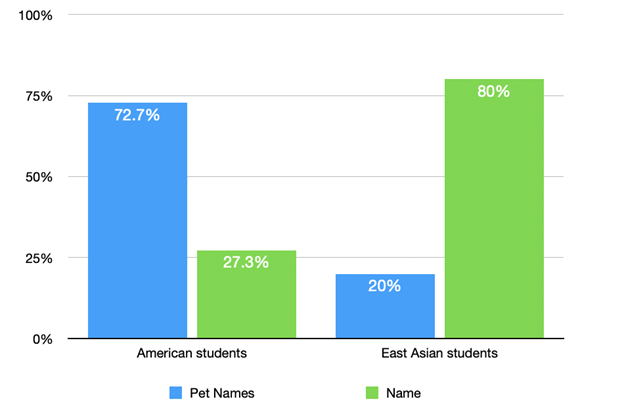
Figure 1: What do you call your partner?

As seen in Figure 1, about 72.7 % of American students tend to use direct language and terms of endearment like “baby” or “sweetie,” while 80% of East Asian students use names to refer to their partners rather than pet names. Cultural differences can be observed in the way people refer to their partners, as evident from the varying practices between American and East Asian students.
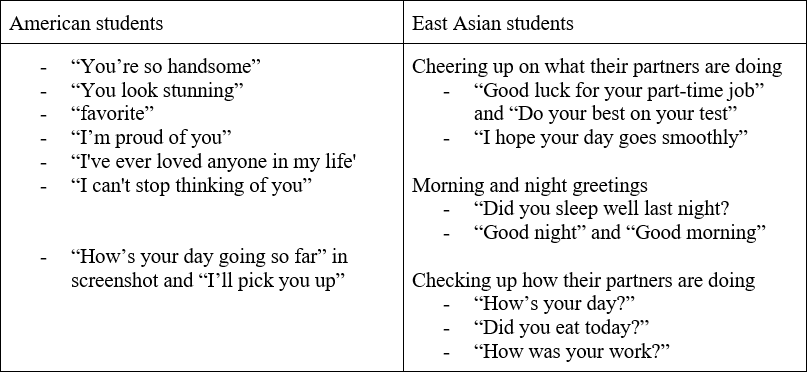
Figure 2: Verbal expressions used by American students vs. East Asian students

Using Figure 2’s data, we analyzed direct and indirect expressions of love in caring for one’s partner, and found that both groups show care and concern, albeit with different approaches. While Americans tend to use more explicit direct language, as we anticipated, such as expressing their love and thoughts toward their partners through direct compliments, Asians tend to use more indirect language, such as offering encouragement, sending morning and night greetings, and checking on their partners’ well-being daily. Interestingly, however, the expressions “I love you” and “I miss you” are frequently present in both American and Asian cultures. Additionally, Americans tend to employ more direct language, such as “looking forward to meeting you soon,” while Asians tend to use more indirect language, such as “I want the weekend to come already.” The use of different subjects in their messages also accentuates the contrast in directness. 
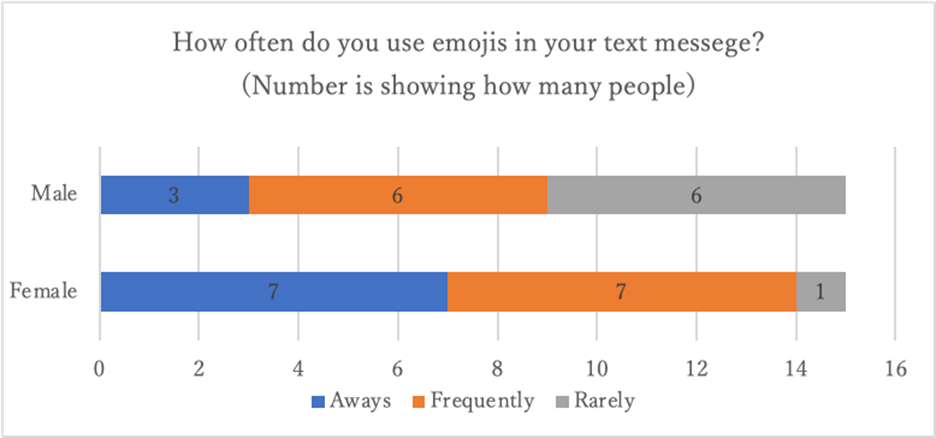
Figure 3: How often do you use emojis in your text message? (The chart displays the numerical values that correspond to the quantity of individuals)

Lastly, we examined the differences in emoji usage between East Asian and American students, and the results were unexpected. Contrary to our initial hypothesis, cultural background had little effect on emoji usage, while gender and personality traits had more dominant factors. Additionally, we analyzed the use of emojis by gender, and Figure 3 illustrates that females used emojis more frequently and explicitly, often with a literal heart, while males used heart emojis combined with other images, such as 😍 and 😘. Interestingly, despite their tendency to use indirect verbal language, Asian students were not hesitant to use direct emojis like ❤️or 🫶to express love.

Discussion and Conclusions

The present study sheds light on the cultural differences in the expression of romantic love between American and East Asian students. Our results confirm that American students tend to use more direct language and pet names when referring to their partners, reflecting the culture’s emphasis on individualism and direct communication. These expressions allow individuals to convey their personal feelings and affection directly. Interestingly, both groups frequently use the expressions “I love you” and “I miss you,” indicating that these phrases hold universal significance in expressing romantic love. We also found that American students tend to employ more explicit direct language, while East Asian students use more indirect language, such as offering encouragement and checking on their partners’ well-being daily. In contrast to our initial hypothesis, we found that cultural background had little effect on emoji usage, while gender and personality traits had a bigger impact on the use of emoji.

Moreover, our study highlights the seeming balance of indirectness with words and more direct emojis used by East Asian students, challenging the common stereotype of East Asians as being overly indirect in communication. While it is challenging to draw a definitive conclusion, we have proposed several possible explanations for this phenomenon based on cultural and linguistic factors. Indirectness is often considered polite in East Asian cultures, while emojis can effectively convey emotions and meanings that are difficult to express in words. Even shy individuals may use emojis to express their affection and maintain a balance of love in text conversations. Understanding the nuances of both direct and indirect expressions of affection can help bridge communication gaps in these situations. The practical implications of this research extend to education and counseling, providing strategies to support students from diverse cultural backgrounds in their relationships.

References

Caldwell-Harris, Kronrod, A., & Yang, J. (2013). Do More, Say Less: Saying “I Love You” in Chinese and American Cultures. Intercultural Pragmatics, 10(1), 41–69. https://doi.org/10.1515/ip-2013-0002

Gesselman, Ta, V. P., & Garcia, J. R. (2019). Worth a thousand interpersonal words: Emoji as affective signals for relationship-oriented digital communication. PLoS ONE, 14(8), e0221297–e0221297. https://doi.org/10.1371/journal.pone.0221297

Johnson, C. (2021, November 2). New research shows that where we come from can influence our use of Emojis. Miami University. Retrieved February 16, 2023, from https://miamioh.edu/news/2021/11/new-research-shows-that-where-we-come-from-can-influence-our-use-of-emojis.html

Kline, Horton, B., & Zhang, S. (2008). Communicating love: Comparisons between American and East Asian university students. International Journal of Intercultural Relations, 32(3), 200–214. https://doi.org/10.1016/j.ijintrel.2008.01.006

Laursen, Furman, W., & Mooney, K. S. (2006). Predicting Interpersonal Competence and Self-Worth From Adolescent Relationships and Relationship Networks: Variable-Centered and Person-Centered Perspectives. Merrill-Palmer Quarterly, 52(3), 572–600. https://doi.org/10.1353/mpq.2006.0030

SEDIKIDES, OLIVER, M. B., & CAMPBELL, W. K. (1994). Perceived benefits and costs of romantic relationships for women and men: Implications for exchange theory. Personal Relationships, 1(1), 5–21. https://doi.org/10.1111/j.1475-6811.1994.tb00052.x

Seki, Matsumoto, D., & Imahori, T. T. (2002). The Conceptualization and Expression of Intimacy in Japan and the United States. Journal of Cross-Cultural Psychology, 33(3), 303–319. https://doi.org/10.1177/0022022102033003006

SPRECHER, & TORO-MORN, M. (2002). A study of men and women from different sides of Earth to determine if men are from Mars and women are from Venus in their beliefs about love and romantic relationships. Sex Roles, 46(5-6), 131–147. https://doi.org/10.1023/A:1019780801500

Togans, Holtgraves, T., Kwon, G., & Morales Zelaya, T. E. (2021). Digitally saving face: An experimental investigation of cross-cultural differences in the use of emoticons and emoji. Journal of Pragmatics, 186, 277–288. https://doi.org/10.1016/j.pragma.2021.09.016

Wilkins, & Gareis, E. (2006). Emotion expression and the locution “I love you”: A cross-cultural study. International Journal of Intercultural Relations, 30(1), 51–75. https://doi.org/10.1016/j.ijintrel.2005.07.003

 [/expander_maker]
, , , , ,

Click, Swipe, Connect: Flirting Directly and Indirectly through Online Mediums and In-Person Interactions

Natasha Motamed, Sasha Bok, Angelica Limoanco, Ashley Lopez

Does the medium in which you flirt with someone change your flirting style? Are you more likely to use direct language such as complimenting when trying to flirt online versus in-person, or are you more likely to use a pick-up line? The following research project will investigate how individuals flirt online via private messaging on dating apps such as Hinge, Bumble, and Tinder, and text messages versus in-person interactions and whether they use direct or indirect language in their flirting practices. Based on previous findings, we hypothesized that flirting on various online mediums will employ greater directness, whereas in-person flirting would consist of more indirect language. To test these hypotheses, we compared screenshots of online flirting interactions with flirting scenes between contestants on The Bachelor and Bachelor in Paradise.

Our main finding was that flirting on online mediums consisted of both direct and indirect communication through the usage of compliments and pick-up lines, respectively. Therefore, our hypothesis was partly true in predicting that online mediums would at least employ direct communication. On the other hand, we were surprised to discover that in-person flirting employed direct communication rather than indirect communication, which was what we had initially predicted.

[expander_maker id=”1″ more=”Read more” less=”Read less”]

Introduction and Background

How exactly do you interpret what flirting is? According to Wade (2018), flirting refers to words or nonverbal actions that include any semblance of romantic and sexual relations between individuals. Moreover, when communicating face-to-face, flirtatious speech is also often used with laughter and animated speech (Whitty, 2016). With flirting, it is prevalent within our society today both in-person as well as on online mediums. Regardless of whether someone uses pick-up lines or compliments to flirt, people tend to communicate differently depending on the modality they are using, i.e. online or in-person.

For our research, we investigated how people flirt differently depending if it is in-person or online. We researched and observed the similarities and differences of flirting indirectly or directly between in-person interactions of The Bachelor and Bachelor in Paradise contestants and online private messages on various dating mediums, direct messages, and texts, which were obtained from 18-29-year-old UCLA students. When looking at the linguistics of flirting, indirect communication can be defined as nonverbal choices such as pauses and bouts of silence, where the recipient must contextualize the situation in order to more accurately discern the speaker’s implied message (Joyce, 2012). Pick-up lines are a perfect example when it comes to indirect flirting since there might be hidden messages beyond what is actually being said. A popular example of this would be the infamous saying “Netflix and Chill,” which requires contextual clues in order to decipher the sexual innuendo being implied.

On the other hand, direct communication means there is no hidden meaning in what is being said, so the speaker will use exact words for their intended meaning (Joyce, 2012). An example of direct communication while flirting is a compliment, such as “I think you are gorgeous.” We had hypothesized that flirting on various online mediums will utilize greater directness, whereas in-person flirting will use more indirect language and word choice. Whether it was a Bachelor franchise contestant flirting in-person or a UCLA student flirting online, they had all found different methods of flirting depending on where they communicated from (see below in Results).

Methods

To investigate these hypotheses, we observed two target populations –– the first consisted of male, female, and non-binary/non-conforming UCLA students, ages 18 to 29, from any ethnic or socioeconomic background. While people of all ages and demographics use the internet, according to Smith (2014), the majority of internet users are actually between the ages of 18 to 29. Additionally, it has also been noted that they utilize technology to start romantic relationships (Meenagh, 2015). Therefore, we analyzed their online communication through various online platforms such as dating apps (Hinge, Bumble, and Tinder) and private text messaging. Our second target population included cisgender male and female contestants, ages 21-35 years old, from any ethnic background and socioeconomic status, on the television shows The Bachelor and Bachelor in Paradise. We observed their in-person communication through their methods of flirting shown on-screen.

The communicative/language aspects our project looked at included directness versus indirectness which is observed through word choice and specifically manifested through pick-up lines versus straightforward phrases and complimenting. These practices are used as a means to flirt in both in-person and online contexts.

We recruited the participants for our first target population and collected their screenshots by posting a Google Form on various platforms that UCLA students use such as GroupMe chats from various classes, Instagram stories, and Slack groups. Participants were asked to submit one or more screenshots where they used flirting on the following platforms: Hinge, Bumble, Tinder, or private messaging.

Our total data set included 33 screenshots of conversations on various online platforms as well as 21 in-person interactions observed from The Bachelor franchise shows. Throughout the analysis process, we highlighted and noted which interactions utilized indirect and direct communication by analyzing word choice in addition to the use of compliments and pick-up lines.

 Results and Analysis

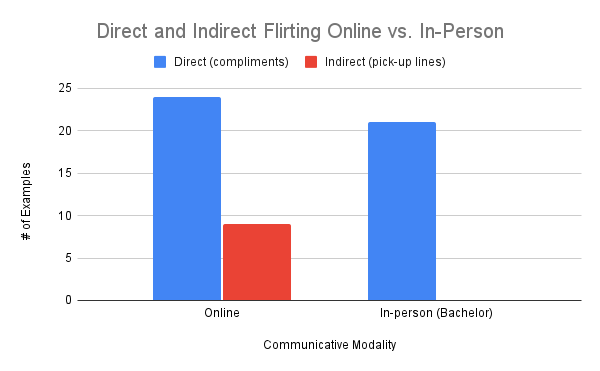
Figure 1: Bar graph comparison of direct and indirect communication in in-person vs online interactions

As a result, in Figure 1 we see a comparison of direct and indirect communication within in-person and online interactions. Direct communication like compliments were seen the most in online mediums as well as in in-person interactions. Indirect communication such as pick-up lines were only seen in online interactions.

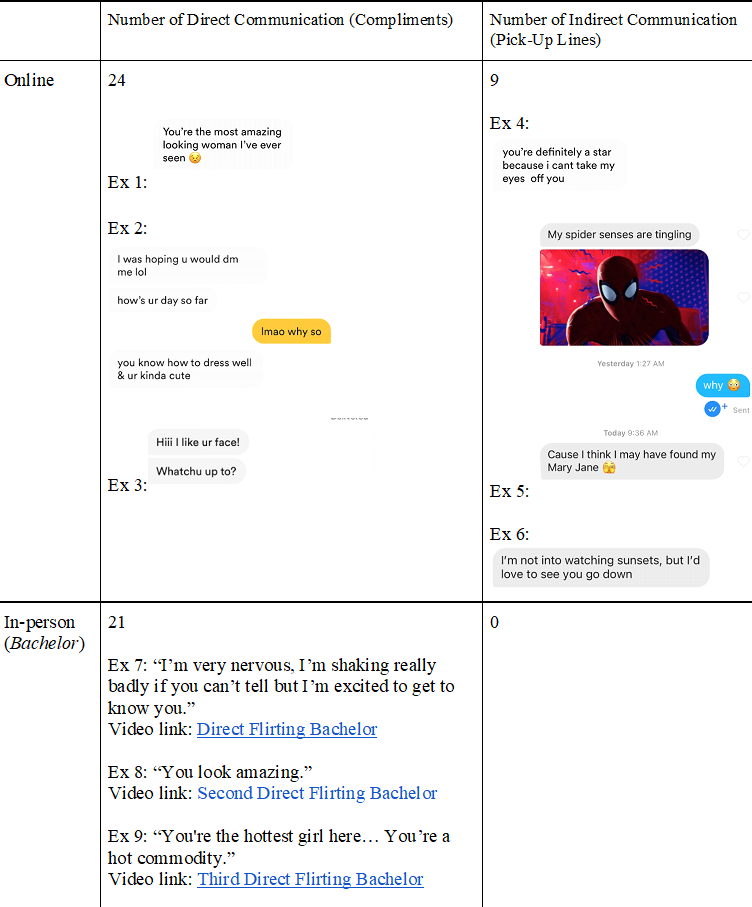
Figure 2: Breakdown of the number of direct and indirect communication within online and in-person interactions and examples of each type of communication.

After collecting our empirical evidence, we observed that out of 33 online flirting interactions, 24 of them contained direct communication manifested through compliments whereas only 9 interactions contained indirect communication through the use of pick-up lines. Examples of direct and indirect communication observed are shown in Figure 2 above. This shows that although both direct and indirect communication are utilized on online platforms, the majority of online interactions use direct communication. In contrast, out of a total of 21 in-person flirting interactions, all of them contained direct communication and none of them contained any indirect communication or the usage of pick-up lines. Examples of direct communication in in-person interactions are linked in Figure 2 above.

After observing 33 screenshots and 21 in-person interactions, we found that pickup lines were very prominent in online mediums and were used indirectly compared to in-person interactions. Participants in The Bachelor franchise were more direct in their conversations while pursuing a romantic relationship. They did not utilize any indirect communication such as through pick-up lines in person. But in both mediums, compliments were utilized. For example, the following compliments were used on online mediums: “you know how to dress well and ur kinda cute”, “I like ur face”, “I think you’re gorgeous”, “you really fine”, and “that smile won me over”. The following compliments were used in in-person interactions: “I’m very nervous, I’m shaking really badly if you can’t tell but I’m excited to get to know you,” “you look amazing,” “you’re the hottest girl here,” and “you’re a hot commodity.” In online mediums, it is much more common to see someone use direct language when they ask if someone is free when compared to in-person interactions. Individuals will use direct language such as “Are you free this Tuesday” or “U free later tn tho?” We found that people online were more indirect through their usage of pickup lines and it was rare to see pickup lines like “you’re definitely a star because I can’t take my eyes off you” used in person. Both online and in-person interactions used direct and explicit word choices in the form of compliments in order to get their meanings across. However, in the in-person interactions, our observations found that the flirting did not result in any individual asking out another person. Overall, we found that flirting online utilizes both direct and indirect communication through the use of complimenting and pick-up lines, respectively, whereas in-person interactions solely use direct communication as a means to show romantic interest.

Discussion and Conclusion

For our Post Data Collection Analysis, we concluded that word choice can result in either direct or indirect communication, for example through compliments or pick-up lines, respectively. We observed both the screenshots and Bachelor scenes through the lens of explicit and implicit word choice, and ultimately placed them into their respective categories, as seen in the chart and graph above.

Based on these findings alone, we could predict that flirting on online mediums could potentially lead to higher or more frequent usage of direct and indirect communication through the employment of pick-up lines and compliments. We attribute this trend possibly to people feeling more confident or comfortable when there is a physical distance between the parties involved and also due to the anonymity veil provided by device screens.

In regards to the validity of our observations and findings, we do acknowledge that there are limitations in having The Bachelor represent in-person flirting practices due to the possibility of it being scripted. Therefore, it’s important to note potential differences between our samples from the reality show and what actually happens within everyday life.

That being said, we believe that our observational results can benefit anyone who communicates online or would like to explore the benefits of talking to and meeting new people online, especially in the romance department. As daily users of technology and online communication yourselves, you can definitely utilize our findings to improve your methods of obtaining the best romantic partner ever! We want you to succeed romantically as much as possible, so take our results into consideration when looking for your future partner in crime!

For future purposes, it’s also important that we research and examine any new and upcoming trends and patterns that arise from our behaviors within these online modalities, especially since we live in this technological age where the majority of society is now heavily reliant on social media as a primary means of communication.

References

Joyce, C. (2012). The impact of direct and indirect communication. Journal of the International Ombudsman Association.

Meenagh, J. (2015). Flirting, dating, and breaking up within new media environments. Sex Education, 15(5), 458–471. https://doi.org/10.1080/14681811.2015.1033516

Smith, J. (2014). The Perceived Impact of Online Versus Offline Flirting on Romantic Relationships [Master’s thesis, University of Dayton]. OhioLINK Electronic Theses and Dissertations Center.

‌Wade J. A. (2018). (I Think) You Are Pretty: a Behavior Analytic Conceptualization of Flirtation. Perspectives on behavior science, 41(2), 615–636. https://doi.org/10.1007/s40614-018-0136-y

Whitty, M. T. (2004). Cyber-flirting: An examination of men’s and women’s flirting behaviour both offline and on the Internet. Behaviour Change, 21(2), 115-126. https://doi.org/10.1375/bech.21.2.115.55423

 [/expander_maker]

, , , , ,

Differences In Sociolinguistics Among Genders In College

Kevin Adelpour, Shaylee Omrani, Ronnen Mizrahi,  Justin Azizian

Studies in sociolinguistics have revealed that there are many ways in which the relationship between language and gender varies, including the relationship between politeness and language style. Without looking deeper into the facts, members of society can draw the conclusion that it is more common for masculine people to express their affection by including their friends in activities and exchanging favors. The way that men often interact is shoulder to shoulder (such as watching television together or playing sports). Women, on the other hand, are more prone to convey weakness and vulnerability. An instance of this is how women cry to one another and confide in their feelings. We are aware of these aspects but rarely completely comprehend their importance or significance. Understanding the rationales underlying these common elements can help us better comprehend the social environment in which we live, while ultimately improving and enhancing our communications with speaking to others in everyday social interactions.

[expander_maker id=”1″ more=”Read more” less=”Read less”]

Introduction and Background

Today we are seeing many differences in communication styles and tones between men and women, especially when it comes to college students. Our goal is to deepen our understanding of the miscommunication of misconstruction of the gender system between men and women. A study by Merchant (2012) has shown that men’s and women’s communication styles have been part of the discrimination inequalities that women have faced, specifically in the workplace, which is also true in an academic setting. So, we investigated 40 male students and 40 female students and tried to confirm that men would use more direct gestures and women would use a more passive and less dominant tone than males. Since language is such an integral part of our face-to-face communication, we want to see how these communication differences would play out in language use among students at UCLA. Our research question is what are the sociolinguistic differences between men and women when communicating in a face-to-face setting at UCLA and how does that create different speech patterns in intersex conversations?

We have found that with a different look from those of males, females’ social interactions and activities would be more communicative and less information-seeking than men (Guadagno 2018). Women would use their communication style as a tool to create friendships and to have social connections, while men would use their communication style to seem dominant and assertive when communicating with people (Merchant 2012). For college students, the main way that they would communicate with each other in face-to-face communication would be based on their appearance and how they would present themselves (Gillen et al., 2006). This would include the types of symbols and body gestures that college students would have while communicating with each other. College women would tend to use more backchanneling the men when communicating, which is the attentiveness of listeners without any interruptive comments (Helweg- Larsen et.al 2004). There is a report on younger males and females especially having more of a difference in use of intensifiers where women would have a change in the sense that they would have a more innovative form more frequently (Fuchs 2017). A study has shown that women would have a less direct way of speaking because they would use directives which would minimize their status by not having so much demand involved (Netshitangani 2008).

Methods

We looked at the interactions between UCLA students with each other on campus and events happening at UCLA. We looked at forty men and forty women that are currently enrolled in UCLA and observed the ways of communication based on speech and symbols in face-to-face communication. Specifically, we looked at tone, articulation, body language, and body movements such as hand gestures and facial expressions. In addition, we also looked at the aggressive and passive ways an individual was within being confrontational, directly forceful, shy, less direct, and so on. Five diverse social contexts, and forty different students from each setting, on the school campus will be used to conduct the research. Setting affects the narrative by adding to the story, character development, mood, and theme. By enabling us, the researchers, to more clearly visualize the events and context of the encounter, it also has an impact on the conversation’s result. It’s also significant since it helps us grasp the storyline and make predictions about what will happen in the interaction.

Character development is presented in the setting of an event as part of creating the mood. In these ways, setting is significant for giving characters a real sense of presence in the real world as well as for communicating what is happening in their lives. Within our research studies, we were able to identify studies that discover gender differences in speech patterns. Men use more abstract language, whereas women focus on the details. The researchers concluded that this tendency is due to power dynamics that can be altered. In addition to having different looks from those of males, female’s social interactions and activities are more communicative and less information-seeking than males (Guadagno, 2018). One may argue that the establishment and maintenance of relationships with others are the most important aspects of female communication. Other feminine communication styles include establishing equality, promoting participation, responsiveness, being personal and disclosing information, and trepidation (Fisher, 2005). Another distinction we were able to identify with their speech, is the commonality of women speaking in clear and complete sentences, while it was more commonly found to see men using words such as “runnin” instead of “running,” and “gonna,” instead of “going to.” All in all, peer relationships are crucial in the development of this concept and have a significant impact on how outsiders perceive the roles of men and women in our society.

Gender biases and stereotypes are always being reinforced in common settings of everyday lives in social interactions. By taking into account how it can enable a person to exhibit rage and related emotions without explicitly communicating these feelings, passive aggression plays a significant role in this. Individuals that exhibit passive aggressiveness frequently maintain the capacity to deny that they meant to act aggressively, which is most frequently observed in the speaking characteristics of men. According to studies, this is because of how individuals are raised starting in their early years, which eventually shapes who they are as a person. In the long run, this fits with how people perceive us and becomes a part of our identity (Gillen 2006). With the gathering of data from college students, peers are precisely examined by their approaches between various encounters and conversations. Approaching Bruin students and monitoring the linguistic distinctions between the two sexes within their expressive dialect help conclude the ultimate understanding of how we express our feelings and needs in order to socialize in common everyday interactions.

Results and Analysis

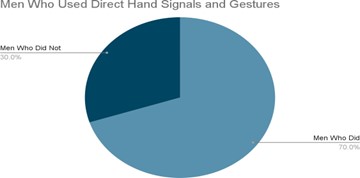
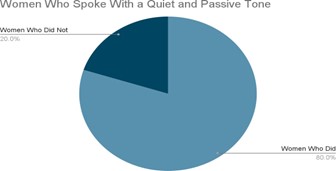
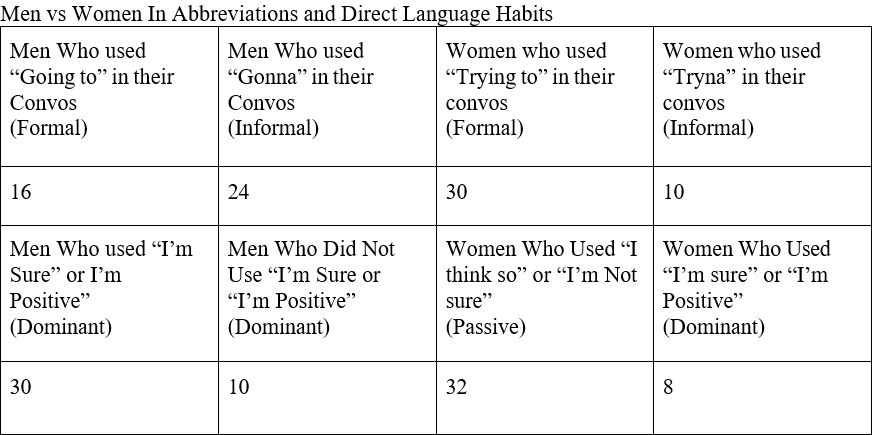
We gathered about 180 minutes of raw hands-on data which came in the form of in-person interactions and language compositions in 80 men and women at UCLA. The interactions observed were in casual social settings and we noticed precise communicative elements down to individual words used by both genders. In our observations, we found that a ratio of 6 in 10 men would often use more slang and abbreviations in their conversations with the opposite sex while disregarding formal interaction habits (table 1). Similarly, we also found that 70 percent of men used direct gestures when speaking to women which included hand signals, head motions, and facial expressions to exemplify the meanings in their conversations (chart 1). On the other hand, we also noticed that a ratio of 8 in 10 women exhibited a more passive and less dominant tone which was evident through their slower dialect and lower tone of voice in comparison to their male counterparts (chart 2). Overall, men on average were more highly likely to show forms of indirect, concise, and dominant forms of language while women showed more formal and passive habits when speaking which is evident in our data and charts below that reflect the differences in gender peer interactions between intersex conversations on campus.

Chart 1: Men’s Usage of Direct Hand Signals and Gestures
Chart 2: Women Speaking With a Quiet and Passive Tone
Table 1: Men vs Women In Abbreviations and Direct Language Habits

Discussion and Conclusions

In our research, we discovered that females communicate in a more implicit, intricate, and sentimental manner that can reflect ambiguity, cautiousness, and a lack of power, while males are perceived to have a direct, concise, and situational communication style, ultimately influencing and impacting how outsiders perceive the roles of men and women in our society. The research highlights that there are gender differences when examining communication styles. We found that females tend to place a greater emphasis on expressing emotions and building relationships through conversation, whereas males tend to focus more on information exchange and problem-solving. Nonverbal cues are also prominent when examining gender differences in communication. Females tend to be more expressive with their facial expressions and body language, while males may be more reserved in their gestures and facial expressions.

The results above underline the need of understanding various communication styles in various settings. For instance, recognizing that females frequently prioritize developing relationships through dialogue helps promote more effective teamwork and workplace communication. Recognizing that males are typically more problem-focused might also help to improve communication during the decision-making process. We may also understand and react to others’ communication more precisely and appropriately if we are aware of how males and females use nonverbal cues differently. The results add to our knowledge of how gender affects communication and can improve our ability to communicate in a variety of settings. Gender dynamics in communication highlight the ways that gender influences the way individuals communicate with one another. It is crucial to shed more light on these dynamics because gender is a vital component of identity that impacts how people interact with each other.

References

Fuchs, Robert. “Do women (still) use more intensifiers than men?: Recent change in the sociolinguistics of intensifiers in British English.” International Journal of Corpus Linguistics 22.3 (2017): 345-374.

Merchant, K. (2012). How men and women differ: Gender differences in communication styles, influence tactics, and leadership styles.

Gillen, Meghan M., and Eva S. Lefkowitz. “Gender role development and body image among male and female first year college students.” Sex roles 55 (2006): 25-37.

Helweg-Larsen, M., Cunningham, S. J., Carrico, A., & Pergram, A. M. (2004). To nod or not to nod: An observational study of nonverbal communication and status in female and male college students. Psychology of Women Quarterly, 28(4), 358-361.

Netshitangani, T. (2008). Gender differences in communication styles: The impact on the managerial work of a woman school principal. In Comunicación presentada en ANZCA08 Conference: Power and Place. Wellington, Nueva Zelanda. Recuperado el (Vol. 20).

[/expander_maker]

, , ,
Scroll to Top