Conversation Analysis

The Language of Love: Gendered Communication Patterns in Conflict

Analisa Sack, Paden Frye, Olivia Simons, Stella Kang, Jeorgette Cuellar

Our study explores the differences in how men and women express emotions in heterosexual relationships, particularly during conflict situations. The research investigates language dynamics among college-aged couples. Hypothetical conflict scenarios were used to elicit natural responses, which we then transcribed and analyzed. The findings reveal that women are more likely to use emotive language, engage in expressive communication, and employ collaborative discourse strategies during conflicts. In contrast, men tend to use direct communication styles, focusing on factual components and solution-oriented language. These results align with existing research on gendered communication patterns, supporting the hypothesis that media portrayals of emotional women and logical men have a basis in reality. This study underscores the importance of understanding gender-specific communication styles, offering insights that can enhance relationship counseling and educational programs. Future research directions include cross-cultural studies and longitudinal analyses to further explore these dynamics. The implications of this research are significant for developing tailored communication strategies in both personal and professional contexts.

[expander_maker id=”1″ more=”Read more” less=”Read less”]

Introduction and Background

We aim to investigate language dynamics and patterns within college-aged heterosexual relationships. With a specific focus on conversation, conflict, and conflict resolution. Communication styles in relationships affect conflict resolution and relational satisfaction. Prior studies have shown differences in male and female communication styles, but specific lexical patterns and their impact on conflict resolution are underexplored. We chose college-aged heterosexual relationships because this age group is shown to be especially important as shown in a study done by Sprecher (1993); typically, we see this age undergoing key developmental transitions and experiencing many situations that may be emotionally or relationally challenging. This study will analyze lexical patterns in conversations to understand gender dynamics in conflict resolution. We hypothesize that during conflict in heterosexual relationships, women are more likely than men to use emotive language, engage in expressive communication, and employ collaborative discourse strategies during conflict resolution, whereas men are more likely to use direct and assertive communication styles, focusing more on factual components of the situation and solution-oriented terms of speech.

Regarding social structures within college-aged relationships, previous research has suggested women are more emotionally active in relationships, but little applicable research has actually shown this. While women have expressed the consistency in emotions experienced being high, their expression of these emotions isn’t necessarily higher than that of men. Our study aimed to understand how men and women approach conflict resolution by looking at word choice and language use in particular (conversation analysis), evaluating how men and women use language differently to approach conflict. The language aspect we are examining is word choice (lexicon) and interaction patterns (conversation analysis) – more specifically, the use or lack of emotive language and expressive communication (Rogers, Ha, Byon, & Thomas, 2020, p. 112).

Methods

In order to collect relevant results, we thought it would be best to observe couples resolving a “natural” conflict. Since it would be nearly impossible to follow a couple around and wait for them to have a fight, we thought our best option would be to simulate a conflict and ask the couple to react to each other the way they would in real life. We understand and acknowledge that this might present flaws in our data due to self-reporting bias, where people tend to try making themselves seem “better” than they are in reality. Nevertheless, these are the hypothetical situations we presented:

  1. The first hypothetical (where the female partner is upset) is the following: “You are upset because last night you were trying to get ready for scheduled plans, but you felt rushed by the tasks that needed to be done before you left (go grocery shopping, cook dinner, wash dishes, etc..). You did several tasks alone while your partner sat on the couch and watched TV; he was aware that you were working hard and rushing because you needed to be somewhere, yet he didn’t help. You are trying to express that you feel abandoned because he wasn’t trying to help you.”
  2. The second hypothetical (where the male partner is upset) is the following: “You are upset because your partner was out late at a girls’ night and was being unresponsive to you. You knew that she would be out late; however, she didn’t text you the entire night, ignored your phone calls, and didn’t call back until she finally got home. She apologized, but made excuses about just ‘forgetting.’ You are trying to express that you feel ignored and hurt because she didn’t consider how you would feel about her silence.”

After we conducted the interviews, we analyzed the transcripts by deciding on five categories that best summed up the strategies the two participants used. These categories included justifications, connecting the argument to larger issues in the relationship, involving emotions, using logical approaches, and apologizing. We decided on a standardized way to tag parts of the dialogue with each strategy and then counted each instance of each strategy for both partners in both hypotheticals. We then created pie charts to visualize our data for both partners in both hypotheticals.

Results and Analysis

The most common strategy used by the female partner was connecting the argument to larger issues in the relationship, followed by justifications and involving emotions. For the male partner, justifications came first, followed by using a logical approach and apologizing.

After conducting controlled experiments with the implementation of two separate hypothetical situations to heterosexual college couples, it was observed that male partners exercise direct response tactics more often than females and utilize logical reasoning along with factual references in order to strengthen their argument, while also digressing at moments in order to avoid further conflict or off-track arguments. Previous studies have hypothesized that a woman’s willingness to exceed only factual comments in arguments is due to their lack of power or control in the outside world and their desire to hold more control in intimate spaces.
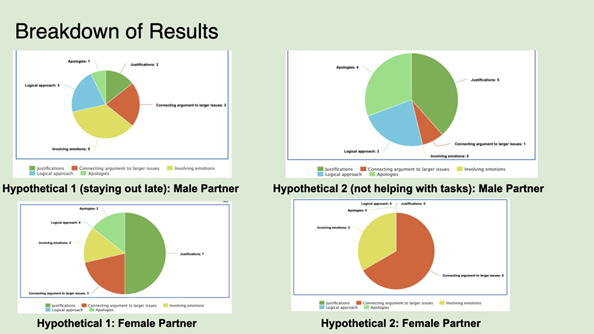
Figure 1. Results from each hypothetical separated by strategy category.

Female partners tended to use open questions and emotive language very often, expressing their feelings. Although initial questions were presented when initiating conflict resolution strategies, there were never any direct solutions posed by the female partner. Female participants also expressed a wider range of emotions, including anger, sadness, confusion, and disbelief during the conversation. Vocally, our female participant also had more shifts in tone – explicitly in words used – and differences in pitch depending on the emotions she felt at the moment. The female participant also related current conflict with previous situations where her feelings and overall well-being were disregarded, and she was forced into performing more emotionally/physically labor to make up for her partner’s negligence.

Our findings were in line with the article “Gender Differences in Perceptions of Emotionality” by Susan Sprecher used as background for the study, specifically with the idea that men will not argue as emotionally or as long as women do and tend to discuss conflicting topics without extreme emotion. We hypothesized these would be our result but ultimately gained a better understanding of the psychodynamic difference of the male versus female resolution strategy through the article’s in-depth observations.

Discussion and Conclusions

In conclusion, our hypothesis was supported by the findings of our study. We observed differences in communication during conflict resolution within heterosexual relationships. Women were more inclined to use more emotive language, characterized by a higher frequency of elements such as tag questions. This aligns with Robin Lakoff’s observations in “Language and Woman’s Place,” where tag questions – phrases like “isn’t it?” or “right?” added to the end of statements – serve to invite confirmation or agreement, thereby fostering a more inclusive and collaborative dialogue (Lakoff 54). In our research, women used tag questions seven times compared to men’s two instances. For example, in Hypothetical 1, a woman asked, “Do you trust me or my friend’s stories?” (F, 02:18), illustrating the use of tag questions to engage the listener. Conversely, men demonstrated a tendency toward a more direct communication style, often employing justifications. This logical approach focuses on explaining actions or decisions assertively. For instance, in Hypothetical 2, a man stated: “You usually just want to do stuff your own way because if I do something my way, you don’t like the way it’s done” (M, 00:49). This directness reflects a more frequent use of logical elements in his communication, aimed at justifying perspectives or actions.

Further, our results are in alignment with studies done about typical communication style differences in gender. In the article “Gender Issues: Communication Differences in Interpersonal Relationships” from Ohio State University, we learn that society has a general understanding of women having to ‘read between the lines’ in relationships: “Studies indicate that women, to a greater extent than men, are sensitive to the interpersonal meanings that lie ‘between the lines’ in the messages they exchange with their mates. That is, societal expectations often make women responsible for regulating intimacy, or how close they allow others to come” (Torppa). As we concluded from our own research, it appears that women are more inclined to connect a specific argument to the larger scope of the relationship. When something brought up in conflict triggers a larger, recurring issue, the female partner is likely to open up the conversation to what she can see by ‘reading between the lines.’

According to research done by Jessica Cindaro regarding male and female differences in communicating conflict, prior literature suggests a tendency for women to be more emotive in their communication styles, while men tend to be more direct and assertive, using emotions less. Cindaro explains that this is in part because of gender stereotypes and the environment in which men and women are raised in and the messages they receive growing up about how best to communicate (Cindaro). We see in our results that there is an even distribution involving emotions, but that the male partner takes more of a logical approach more often than the female partner.

These findings underscore the distinct communication styles of men and women, and such insights can be valuable in enhancing communication strategies across various contexts, from personal relationships to professional interactions. Also, by providing deeper insights into how communication styles differ between genders, our findings can inform relationship counseling and therapy practices, allowing therapists to develop more effective strategies that are tailored to each gender. This improved understanding can contribute to better communication and conflict resolution within relationships, ultimately supporting potentially healthier interpersonal dynamics.

In the future, our research aims to open avenues for expanding the scope of study. One possible direction is conducting cross-cultural studies to investigate whether the communication patterns we observed are consistent across different cultural contexts or if they vary significantly. This would provide a broader understanding of how cultural influences shape gender communication styles. Additionally, we could undertake longitudinal studies to track how communication styles and conflict resolution strategies evolve over time within relationships. These long-term studies can offer deeper insights into the dynamics of long-term relationships, shedding light on how communication evolves and how couples adapt their conflict resolution strategies over the years.

Another question that might be brought up in relation to our study is one of media’s influence on a person’s gender identity. In the TED Talk “Secrets of Children’s Media: Effects of Gender Stereotypes,” Rifa Momin reveals that children are influenced by the stereotypes they continuously hear as they grow up. From children’s television to storybooks, the power of media influence contributes to “children developing a sense of maleness and femaleness based off of these stereotypes and organiz[ing] their behaviors around them” (Momin). This presents a bigger question about our research: Do the stereotypes we perceive men and women to inhabit originate from their media intake? If children were not exposed to media that perpetuates gender stereotypes, would they grow up to act differently than the way society has led us to believe we’re ‘inclined’ to act?

Overall, the study we have conducted opens a wide variety of discussion topics regarding gender stereotypes, communication styles, and conflict within heterosexual college-aged relationships. While our study is not reflective of every single relationship out there, we hope we accomplished our goal of sparking conversation to further understanding about why men and women communicate differently.


References    

Cinardo, J,  (2011) Male and Female Differences in Communicating Conflict. Honors Theses. 88. https://digitalcommons.coastal.edu/honors-theses/88.

Lakoff, R. (1973). Stanford. Language and Woman’s Place. https://web.stanford.edu/class/linguist156/Lakoff_1973.pdf.

Momin, R. (2022, March). Secrets of children’s media: Effects of gender stereotypes. Rifa Momin: Secrets of Children’s Media: Effects of Gender Stereotypes | TED Talk. https://www.ted.com/talks/rifa_momin_secrets_of_children_s_media_effects_of_gender_stereotypes?language=en.

Rogers, A. A., Ha, T., Byon, J., & Thomas, C. (2020). Masculine gender‐role adherence indicates conflict resolution patterns in heterosexual adolescent couples: A dyadic, observational study. Journal of Adolescence, 79(1), 112–121. https://doi.org/10.1016/j.adolescence.2020.01.004.

Sprecher, Susan. Sexuality. SAGE Publications Inc., 1993.

Sprecher, S., & Sedikides, C. (2019, August 14). Gender differences in perceptions of emotionality: The case of close heterosexual relationships – sex roles. SpringerLink. https://link.springer.com/article/10.1007/BF00289678.

Torppa, C. B. (2010, February 25). Gender issues: Communication differences in interpersonal relationships. Ohioline. https://ohioline.osu.edu/factsheet/FLM-FS-4-02-R10.

[/expander_maker]
, , , , ,

Real Talk: Colloquialism in TV Dialogue vs. Natural Conversations

Namrata Deepak, Renee Rubanowitz, Kylie Shults, Alik Shehadeh, George Faville

Iconic TV catchphrases like “Yada-yada-yada,” “D’oh,” That’s what she said,” and “Bazinga!” have been seamlessly integrated into our everyday conversations. Such a phenomenon prompts amusing discussions and questions surrounding the relationship between real-world conversation and on-screen dialogue. While some aspects of on-screen language, like exaggerated accents or absurd dialogue, are accepted as fictional, others are more representative of natural everyday speech. This study delves into the linguistic choices made by sitcom writers to make fictitious situations more comedic and relatable, contrasting our findings with real-world conversations that lack such agendas. In examining the intentional use of linguistic choices by screenwriters to enhance comedic effects in television sitcoms, we hypothesize that scripted language possesses observably fewer contractions, first-person pronouns, second-person pronouns, present tense verbs, more prepositions, and increased word length when compared directly to natural conversation.

Expanding on Biber’s Theory of Multidimensional Analysis (1992) and Quaglio’s analysis of Friends (2009), our research deconstructs and compares the dialogues from The Office (U.S.), Modern Family, and Community with comparable, real-world conversational data obtained from the Santa Barbara Corpus of Spoken American English (Du Bois, 2000-2005). Using Biber’s Factor 1 as a measuring tool that focuses on colloquial language, we selected specific linguistic features to measure their frequency in sitcom clips versus comparable real-life conversations to obtain evidence to explore our hypothesis further.

While our findings generally align with existing evidence for our identified linguistic features, the extent of differences between scripted and natural language could have been more pronounced. Consequently, further research may also be warranted, as our hypothesis was disproved for word length and prepositions, indicating a more remarkable similarity between TV dialogue and natural conversation than expected. Nevertheless, our study contributes to ongoing discourse on the relationship between on- and off-screen language, offering valuable insights into the linguistic choices that shape perceptions of comedic situations and beloved characters.

[expander_maker id=”1″ more=”Read more” less=”Read less”]

Introduction and Background

Situational comedies, or sitcoms, tend to put relatable yet exaggerated characters in outlandish situations to prompt entertainment and humor in audiences (Simply Sitcoms; The situations that precede the comedy). Think about shows like Modern Family, where miscommunications are key to every episode, or The Office (U.S.), where the seemingly ordinary workplace is exaggerated by eccentric characters like Michael Scott. As sitcoms become more intertwined with American popular culture, a fascinating question arises: Do they accurately capture the subtleties of natural conversation?

Further inquiry into scripted banter reveals a core sociolinguistic component – screenwriters make deliberate choices about language that have implications for language learning, language evolution, and more. This study aims to analyze the linguistic differences between dialogue in U.S. sitcoms and natural conversations, focusing on specific linguistic choices that signal colloquialism.

Guided by the question – “To what extent does scripted language represent actual language in depictions of humor?” – our team hypothesizes that the screenwriters for Modern Family, The Office, and Community intentionally use linguistic choices and manipulation to augment comedic effects, resulting in dialogue dissimilar from natural conversation. Specifically, we predict that scripted language has fewer contractions, first-person pronouns, second-person pronouns, more prepositions, and shorter word lengths.

Our target population consists of the participants in the selected conversations: the characters in Modern Family, The Office, and Community, as well as the actual family members, coworkers, and friends in the recordings we used. Together, these participants form a sample of sitcom characters and a sample of the general American population, which we will contrast to test our hypothesis.

To further analyze and gather more resources to support our investigation, we turned to previous case studies exploring scripted language’s limitations compared to organic speech, including a study on the sitcom Friends (Quaglio, 2009). Additionally, we referenced Bednarek’s study on Gilmore Girls (2011), which analyzes how a show’s dialogue contributes to creating a specific kind of dialogue unique to itself and defining the genre it is a part of. Though we are expanding on past theories, we acknowledge the need for extended research on more contemporary and diverse sitcoms for the most comprehensive overview of these rich hypotheses.

Methods

Our research question led to three critical questions when designing our study: what data are we using, what linguistic features are we focusing on, and how will we collect data?

What data are we using?

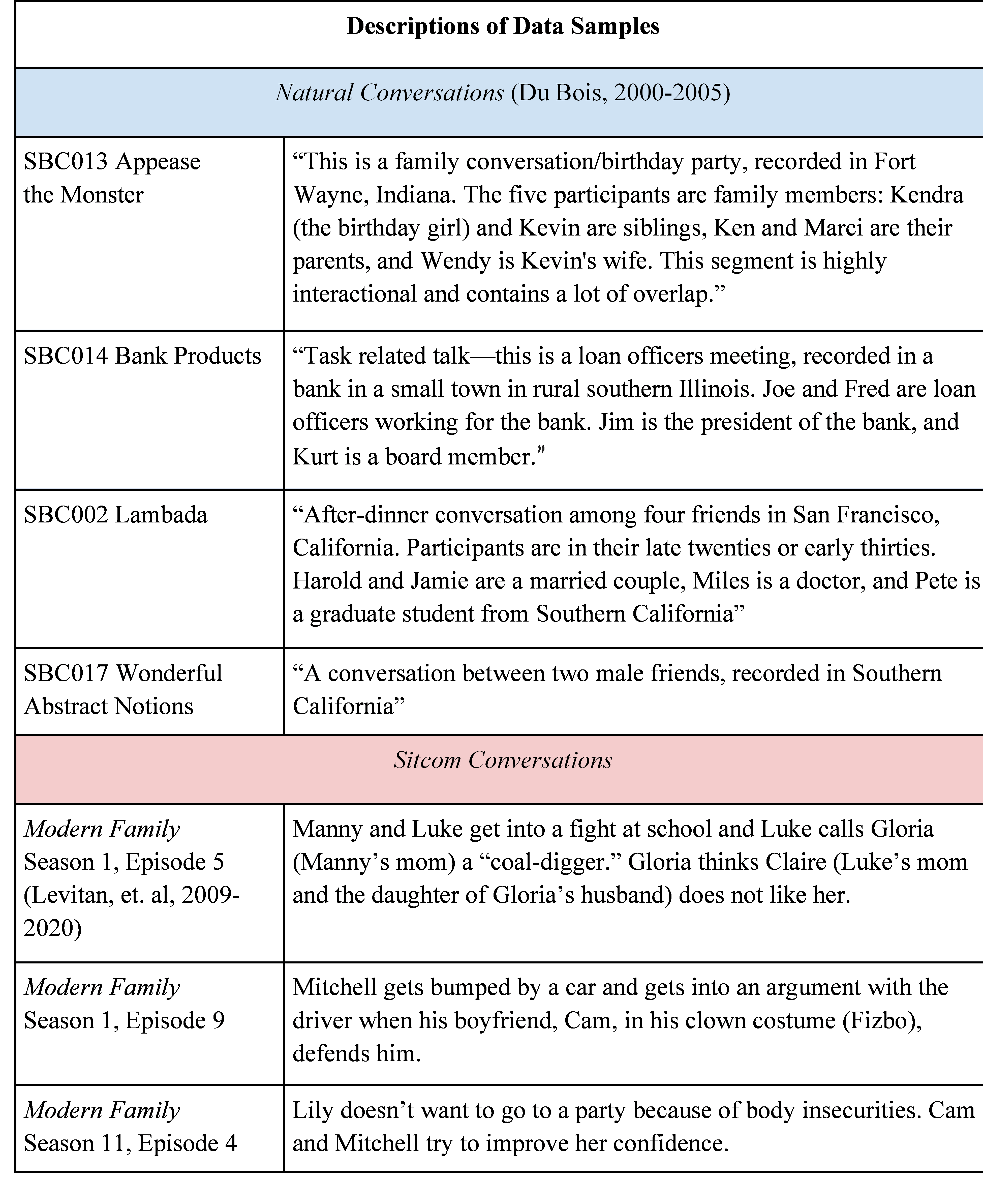
For data, we chose to look at situational comedies since they tend to mirror (and potentially exaggerate) everyday situations. We transcribed 2-3 minute conversations from the first and last seasons of Modern Family, The Office, and Community, constituting our scripted dialogue corpus. We then found contextually similar real-life conversations to each show (between family members, coworkers, and friends, respectively) from the Santa Barbara Corpus of Spoken American English and chose three 2-minute segments from each one to transcribe.

Figure 1. Descriptions of the data samples used.

What linguistic features are we focusing on?

When selecting our linguistic features, we used Factor 1 of Biber’s Multidimensional Analysis as a starting point since it was theorized to show the most significant difference between humor and natural conversation (Eberhardt, 1988). We believe a crucial reason for this difference is because of colloquialism, which is what Factor 1 measures – in real life, we are likely to be more colloquial and use less intentional language, unlike TV, where dialogue is meant to produce entertainment. We focused on contractions, first-person pronouns, second-person pronouns, present tense verbs, prepositions, and word length.

How did we collect the data?

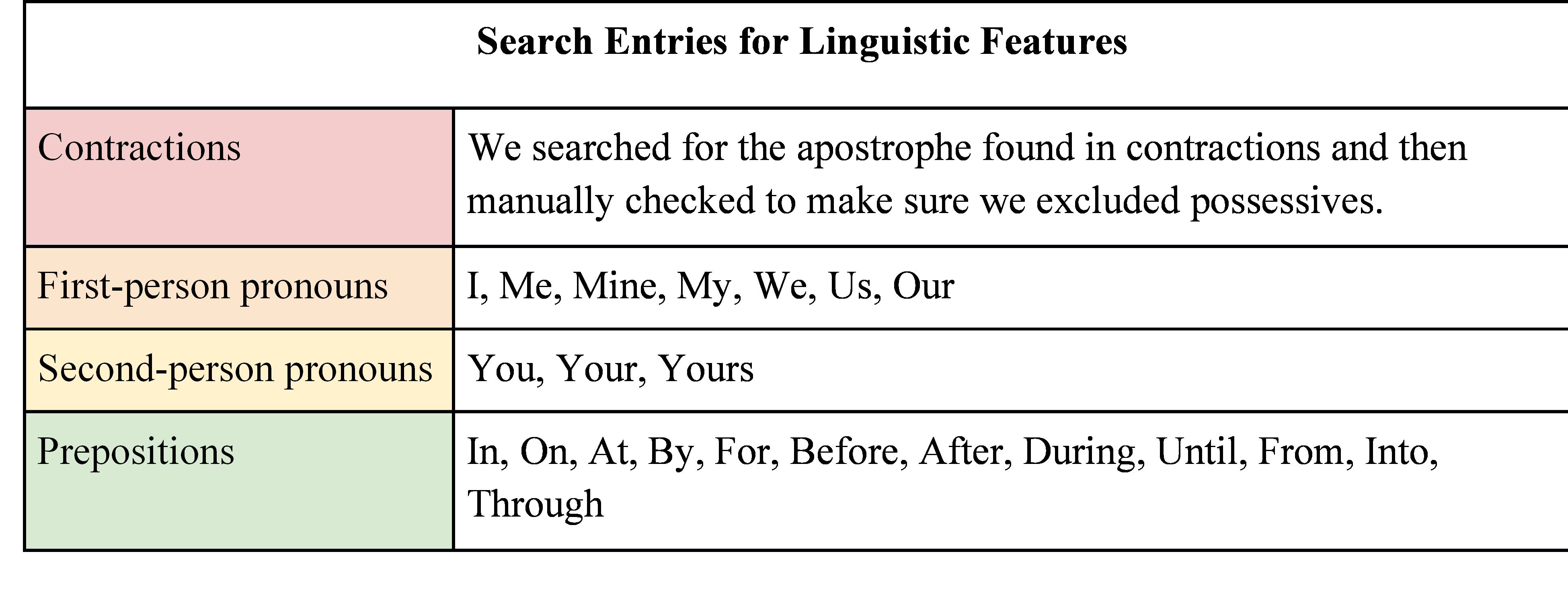
For contractions, first-person pronouns, second-person pronouns, and prepositions, we used a software called AntConc to measure the frequency of each variable within each conversation (see the figure below for the specific terms we used). We counted present tense verbs manually. For word length, we took the total number of characters within the dialogue and divided it by the number of words to produce an average character length for each word.

Figure 2. Search entries used in AntConc.

Results and Analysis

After we collected our data, we mapped it visually, with “Words Per Minute” as the y-axis and “Linguistic Features Analyzed” as the x-axis, including columns for each scenario. When analyzing and interpreting the data, we focused on the most significant disparities between linguistic features in the sitcoms and the in-person interactions. We also calculated the average number of differences across all linguistic features compared to natural conversations.

Modern Family

Below are excerpts and transcripts from a Modern Family (Levitan, et. al, 2009-2020) episode and the “Appease the Monster” family conversation from the Santa Barbara Corpus of Spoken American English (Du Bois, 2000-2005). The most apparent difference between the two sources is the degree of interruption – the natural conversation shows much more overlap. At the same time, the sitcom mostly has one line occurring at a time. This variation can mainly be attributed to the practical demands of filming a TV show, so we focused on more specific word choices to see if the actual language (rather than its delivery) also differs.

We assessed 1:45-2:30 of the Modern Family clip below:

Figure 3. Transcript of Modern Family ”Coal-Digger” conversation.

We assessed 0:00-1:00 of the “Appease the Monster” conversation here: Audio Recording of the “Appease the Monster” Conversation (0:00-1:00)

Figure 4. Transcript of the “Appease the Monster” conversation.
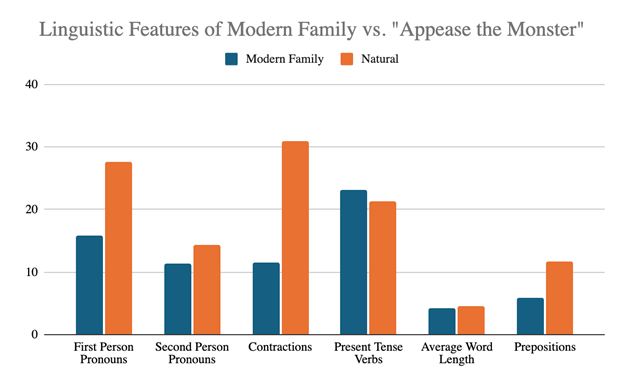
Figure 5. Linguistic comparison of Modern Family clip vs. “Appease the Monster” conversation.

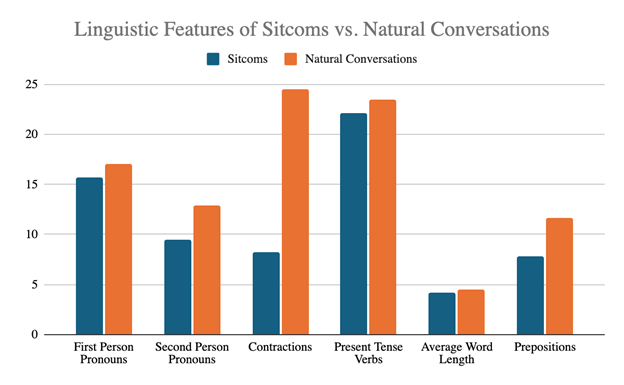
After measuring our selected linguistic features within the Modern Family and “Appease the Monster” conversations, we can see in Figure 5, illustrating linguistic features on the x-axis and frequency on the y-axis, that natural conversations have more first-person pronouns, second-person pronouns, and contractions – all supporting our hypothesis. However, the remaining categories – present tense verbs, average word length, and prepositions – all display a relationship that is inverse to the predictions of our hypothesis.

The Office

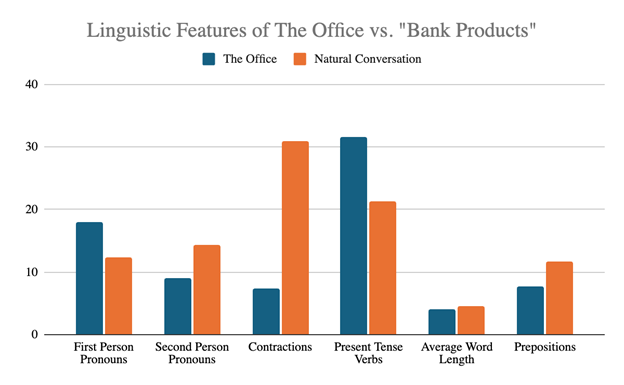
Figure 6. Linguistic comparison of The Office vs. “Bank Products” conversation.

As we hypothesized, The Office comparison chart above shows that natural conversations use more first-person pronouns, second-person pronouns, and contractions. However, the data in Figure 6 does not substantiate predictions that natural conversations would use more present tense verbs, shorter word lengths, and fewer prepositions.

Community

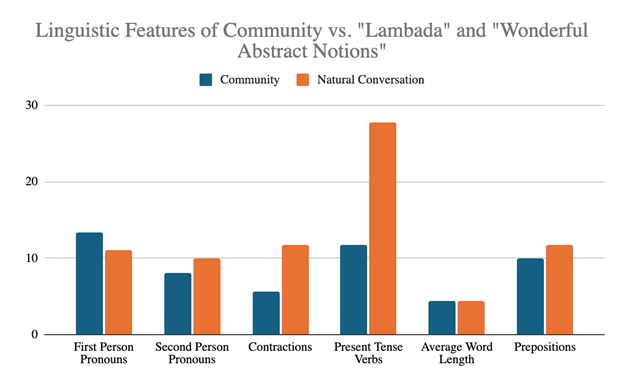
Figure 7. Linguistic comparison of Community vs. “Lambada” and “Wonderful Abstract Notions” conversations.

We can see in the Community comparison chart above that while natural conversations have more second-person pronouns and contractions, the rest of the linguistic categories display an inverse relationship to what was predicted, subsequently disproving our hypothesis. 

Synthesis

Figure 8. Average number of each linguistic feature in TV dialogues vs. in natural conversations.

Thus, Figure 8, which illustrates the average difference between all of our observed television programs and real-life conversations, demonstrates that sitcoms followed our hypothesized patterns for first-person pronouns, second-person pronouns, contractions, and present-tense verbs. However, when looking at average word length and preposition frequency, the sitcoms showed results that were opposite to what was expected, with shorter words and fewer prepositions. An important note is that, except for contractions, the differences seen are very slight.

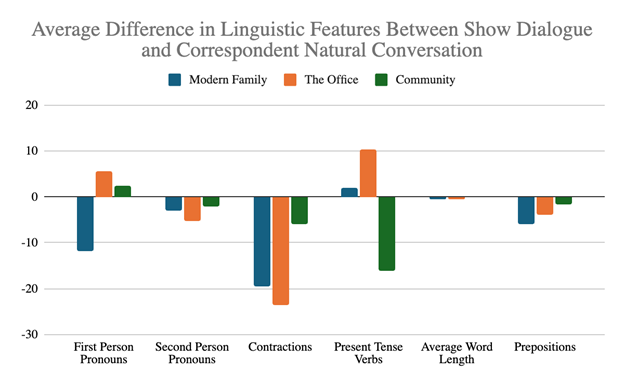
Figure 9. Average difference in number of each linguistic feature between each show and the corresponding natural conversation(s).

To zoom in a little further, Figure 9 complicates our results as we look at the specifics of each show. Modern Family is the only show that demonstrated fewer first-person pronouns than the corresponding natural conversation. Community is the only show with fewer present tense verbs than its corresponding natural conversation, per our hypothesis. The Office appears the most natural, disobeying our hypothesis for the linguistic features of word length and prepositions. As mentioned, all three shows did not follow our hypothesized difference in average word length or prepositions, suggesting that our sitcom data is considerably closer to natural conversation than expected.

Discussion and Conclusion

From the data analysis we conducted, we concluded that while there is a slight difference between TV and natural conversations (especially for first-person pronouns, second-person pronouns, contractions, and present tense verbs), the differences are insignificant and do not indicate much deviation. Additionally, the data disproved our hypotheses around word length and prepositions; regarding these features, sitcoms were more “natural” than actual natural conversations. However, we acknowledge the fact that our investigation had limitations. Due to the narrow timeline of our project this quarter, we did not collect and analyze as much data as we would have hoped in order to find more substantial differences between scripted and non-scripted language.

Revisiting our initial research question: To what extent does scripted language represent actual language in depictions of humor?

Initially, our data may seem surprising since we found fewer differences than expected, but there might be a reason why these sitcoms tend to lean more toward natural-sounding conversations. The craft of screenwriting tiptoes on a delicate balance between accurately portraying real-life scenarios and creating humorous and engaging dialogues meant to captivate audiences. Our three Emmy Award-winning shows have achieved widespread acclaim and popularity, and part of this success can be attributed to linguistics, as their language choices play a crucial role in effectively resonating across various audiences and demographics.

TV dialogue has far-reaching linguistic influence, especially in the language learning classroom, where teachers often encourage students to use sitcoms (and other scripted content) to practice English and attain competency. The nuances of our data suggest that while the language English learners are studying has a certain degree of difference from conversational English, it still shares similarities to natural language and, thus, may serve as a helpful tool. Taking our research in conjunction with Quaglio’s study on Friends (which did find a significant difference) suggests that more research is needed to see how this could affect the language learning process and whether sitcoms are practical language learning tools (Quaglio, 2009).

Additionally, Quaglio’s findings suggest that TV dialogue is its own register of English, different from the spontaneous and natural conversation it hopes to (and is assumed to) emulate. Our data complicates this theory, indicating that this register is becoming closer and closer to standard/conversational English with our three sitcoms or that more research is needed to ferment a pattern. To read more about the role of TV in social development and cultural unity, read this blog post: “Role of Television in Sociocultural Development of a Society.” To see more concrete examples of the linguistic reach of TV, read this article about words and practices that natural conversation has borrowed from TV dialogue: 10 Ways Television Has Changed the Way We Talk.

To expand on this topic further, it would be important to attain cross-linguistic data. How do these patterns of difference occur in other languages? Due to the importance of media to culture, this would help clarify whether TV dialogue is simply a register of English or a cross-cultural phenomenon.


References

Biber, D. (1992). On the complexity of discourse complexity: A multidimensional analysis. Discourse Processes, 15(2), 133–163. https://doi.org/10.1080/01638539209544806.

Bunniefuu. (2013, May 17). 09X24/25 – finale. The Office Transcripts. https://transcripts.foreverdreaming.org/viewtopic.php?t=25498#google_vignette.  

Du Bois, J. W, et. al (2000-2005). Santa Barbara Corpus of Spoken American English | Department of Linguistics – UC Santa Barbara. UCSB Linguists. Retrieved May 20, 2024, from https://www.linguistics.ucsb.edu/research/santa-barbara-corpus.

Eberhardt, S. (1988). Identifying_Multidimensional_Patterns_across_Register_Variation. Retrieved May 6, 2024, from https://www.unibamberg.de/fileadmin/engling/fs/Chapter_21/Index.html?23DimensionsofEnglish.html.

Gervais, Merchant, et. al (Executive Producers). (2005-2013). The Office [TV Series]. Deedle-Dee Productions; 3 Arts Entertainment; Shine America; Universal Television.

Hoey, E. (2018). Conversation analysis. https://pure.mpg.de/rest/items/item_2328034_3/component/file_2328033/content.

Levitan, Lloyd, et. al (Executive Producers). (2009-2020). Modern Family [TV Series]. Steven Levitan Productions; Picador Productions; 20th Century Fox Television.

Nini, A. (2019). The Multi-Dimensional Analysis Tagger. In Berber Sardinha, T. & Veirano Pinto M. (eds), Multi-Dimensional Analysis: Research Methods and Current Issues, 67-94, London; New York: Bloomsbury Academic.

Quaglio, P. (2009). Television Dialogue and Natural Conversation: Linguistic Similarities and Functional Differences. Corpora and Discourse, 189-210. https://aogaku-daku.org/wp-content/uploads/2018/04/Television-dialog-corpora-and-discourse.pdf.

Russo, Russo, Harmon, et. al (Executive Producers). (2009-2015). Community [TV Series]. Krasnoff/Foster Entertainment; Russo Brothers Films; Harmonious Claptrap; Universal Televsion; Sony Pictures Television; Yahoo! Studios.

The Office (USA) – season 1 episode 1: “pilot. Genius. (2005). https://genius.com/The-office-usa-season-1-episode-1-pilot-annotated.  

Zago, R. (2017). English in the Traditional Media: The Case of Colloquialisation Between Original Films and Remakes. Transnational Subjects Linguistic Encounters: Selected papers from XXVII AIA Conference, 2, 91-104. https://unora.unior.it/bitstream/11574/176955/1/Atti%20AIA%20curatela.pdf#page=119.

[/expander_maker]
, , ,

Sociolinguistic Activism and White Fragility

Jamie Seals, Makena Larson, Betsy Benavides, Faith McCormick

When looking at the work previously done on the intersection of white fragility and sociolinguistics, we noticed a gap in research that we wanted to fill. We conducted interviews between two white peers, the topic of conversation being sensitive topics such as race and racism. We hypothesized that the interviewees would take a neutral stance when speaking on the subject of race. We looked specifically at word choice, stance, and circumlocution. Using conversation analysis on all three interviews conducted, we were able to look at these linguistic elements and draw conclusions. It was found that interviewees used circumlocution, hedged and hummed, and all held a very particular stance. In our article, we delve more deeply into what we found, the examples of conversation analysis, and what the most significant takeaways were.

[expander_maker id=”1″ more=”Read more” less=”Read less”]

Introduction

For our project, we wanted to take a sociolinguistic approach to look at white fragility and discussions pertaining to sensitive topics. We looked specifically at how white people respond to questions regarding race and racism. When looking at previous work examining the intersection of white fragility and sociolinguistics, we found a lack of research that we wanted to supplement and deepen. We wanted to look at white fragility by conducting interviews with two white peers regarding race, which we could not find had ever been done. Previous research done by Robert DiAngelo, highlighted a discomfort that white people had when dealing with issues of race, “a single required multicultural education course taken in college, or required “cultural competency training” in their workplace, is the only time they may encounter a direct and sustained challenge to their racial understandings.” (DiAngelo, 2011). DiAngelo’s, along with others’ work done on white fragility, led us to our final decision on the aspects of our interviews. We conducted interviews between two white peers, both of which were twenty to twenty-two years old. We wanted to analyze these interviews specifically through a sociolinguistic lens, which makes our research unique. Our research is necessary because, by better understanding how white people feel regarding race and discussions about it, we can start to break down walls between one another and have more open conversations. These discussions allow for transparency and a sense of stronger community values within the UCLA culture and in our greater society. Furthermore, we believe that conversation is very important which is why we looked at it in depth. We did conversation analysis on our three interviews and examined them by looking at circumlocution, word choice, and stance. We hypothesized that all the participants would take a neutral stance, and we found this to be accurate but much more nuanced than we had expected. 

Methodology and Results

After careful thought and consideration throughout our experiment, we found that within our three interviews it was vital to keep in mind what key linguistic features we were searching for when conducting the research portion of our project. Having both the interviewer and the interviewee identifying as white, we hoped this environment would create a sense of comfort within the conversation. We also reassured the individuals that this was a safe space to speak freely and reflect on what they have personally experienced here at UCLA. After analyzing the recordings of each interview and uploading the conversations through Trint, a transcription processing application, we were able to effectively observe the outcome of our data and look at the speech and language patterns between the two speakers. Our first finding from the interviews was how there was still an obvious level of uncomfortability between the interviewer and interviewee when asking the questions. For example, in the second interview, the interviewee is asked the question, “do you think racism exists in UCLA culture or on campus?” The interviewee responds by saying, “yes, but it’s not like I’ve seen it directly.” This response is important to our study because it proves how students here are aware that here on campus there are individuals experiencing racism. However, they quickly reassure us that they are not involved or a part of the problem at hand. Throughout the interviews, we also noticed how, when asking the question, “Do you think UCLA is inclusive to all students?” The individuals were swift to respond and say no. However when asked if they believe racism exists on campus or in the culture here at UCLA, they take more time and reply hesitantly with “yes, Uhm, probably” (Interview 2). This longer pause can signal that the interviewee could be slightly caught off guard or uncomfortable answering the question, in fear of giving the wrong response. Secondly, we found that in our third interview, when the individual was asked about racism at UCLA, they responded with, “I heard from the grapevine that….” This immediately personifies to the interviewer that the individual wants to be excluded from the information they are about to share. The interviewer does this in a way to agree that, yes, there is exclusion here on campus happening but wants to ensure she is not accounted for in that statement. This is critical for our study because it helps us reveal how quick students are to agree there is blatant inequality here at UCLA, but in a way, they would like to acknowledge it is problematic but are quick to cover themselves before even pressing more into the issue. The second interviewee, at the opening of the conversation, also expressed their feelings on how they felt about these questions. When asked if they think UCLA is inclusive to all students, they respond with, “uh, this is not a fun topic to talk about” in the recording, the student pauses and then nervously laughs while saying this is not a fun topic to talk about. The nervous laugh along with them voicing how this is not a fun topic to talk about, are both powerful indicators the individual was hesitant to talk on this subject without feeling uncomfortable. We must circle back to our hypothesis stating these students would take a neutral stance. It is clear from our findings that our pool of participants remained completely neutral throughout the interview. All three students agreed they benefited from white privilege at UCLA, however when being asked these questions about race, we found they all displayed levels of discomfort and attempted to sever themselves from any racist or discriminatory acts people might be experiencing or hearing about in UCLA culture or campus.

Discussion

Although all three interviewees had different responses to the questions, we found a few patterns across the three. Upon answering each question, interviewees would often find ways to distance themselves from the issue. From saying things like “I’ve heard”, “Actually, I can’t really think of an example, so maybe not” or “Yes, but it’s not like I’ve seen it directly.” This is what sociologist Caprice Hollins describes as the individual approach White individuals often use when speaking about race. Individuals may find ways to maintain a positive self-image by pushing away their closeness to these issues or moving around the topic of conversation (2020, Hollis). To add onto this, something we picked up on was the interviewees avoidance using racialized language, instead opting for terms like “minorities” or “different race” instead. This is what is described as aversive racism, or racism that is manifested in subtle ways (Diangelo, 2018, p.59). Furthermore, they never directly state their opinion on some of the questions, often finding a sort of a neutral position or a middle ground. This type of stance is known as a form of White solidarity, where individuals in conversation will often build on this idea of a “common stance” regarding race-related issues. These stances rely on both silence on racial matters and a subconscious implied unity between parties to uphold this solidarity (DiAngelo, 2018, p.72). When all three of the interviewees used this back and forth, yes and no response, it is possible that they are not able to navigate that common ground which could lead to some of the discomfort demonstrated.

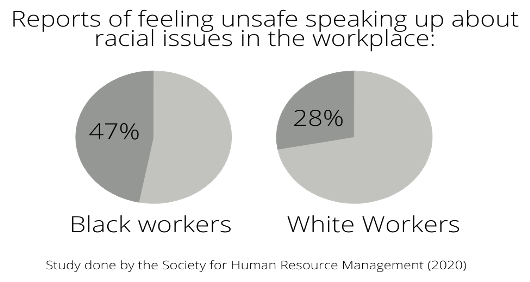
After conducting our study, most of what we saw fell in line with what sociologists are saying about conversations on race, however it does not match some of the quantitative data we found. The stances we picked up on during the interview were things we expected but did not expect to find clear discomfort. This is what prompted us to look into other research where we found that White individuals feel significantly less discomfort speaking about these topics compared to Black individuals. The following Figure 1 is demonstrative of a 2020 study done by the Society for Human Resource Management which collected data from 1,275 participants about their workplace environment. While our study focuses on universities, we feel that the study on the workplace environment is still relevant to our topic. The study found that 47% of Black respondents do not feel safe speaking out about issues of racial justice compared to 28% of White respondents who said they do not feel safe for the same reason (2020, p.11). There can be many reasons for this discrepancy. While this data could indicate that our 3 interviewees happened to be a part of the 28% of people who feel uncomfortable, it’s also possible that the perception of themselves is different than the way others (us interviewers) perceive them. If given the opportunity, we would have a second round of interviews where we would ask not only about racial issues but also how individuals feel about speaking on racial issues.

Figure 1

Observing our results and how they fit into a broader context, racial issues and racial justice has always been prevalent, deeply and radically well-established, and formed in society. UCLA represents its own subcategory of society, as a community. By theoretical implications, these findings we provided show to be significant in spaces of policy, practice, and further research. Additions are also made to the existing discussion of race and social inequalities related to. By practical applications, it presents how we can better self-reflect and ask ourselves: if certain conditions were fulfilled, not only for the student body but beyond that. Our findings can be extended to other situations, such as friend groups, educational spaces, relatives, and workplaces. Anywhere we find a place of interaction and community, this study could be applicable. Our findings help us understand a broader topic of the foundations of human interaction. With continued conversations regarding social injustice, we are better equipped to integrate our worldviews, as well as comprehend and be attentive to that of others. We can improve and create equitability for all, resulting in better representation, accountability, uplifting underrepresented groups, and improving the overall well-being of one another.

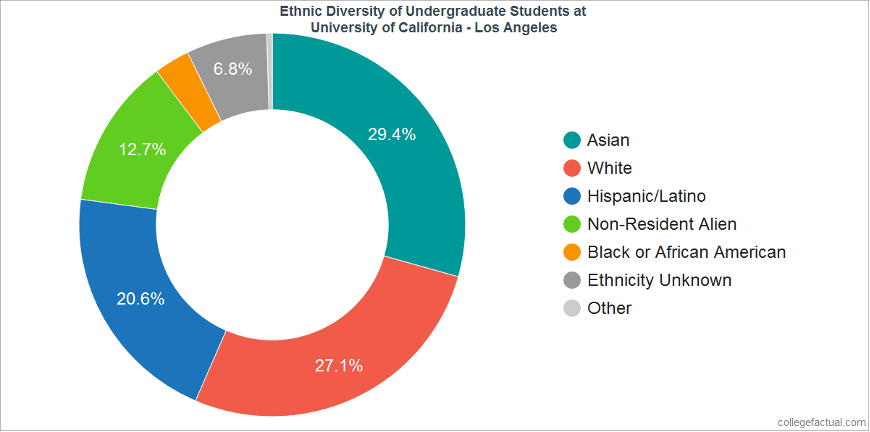
As seen below, a chart of the ethnic diversity of undergraduate students at UCLA. An article was written at Penn State in 2018 by the Diversity group in response to College Factual’s ranking of UCLA’s diversity and ethnicity. The article aimed at identifying and examining how diverse of an institution UCLA is. We found this article written at Penn State to be extremely critical and relevant to our work because it perfectly analyzes the exact breakdown of each ethnicity present on campus at UCLA. From this data in the chart, we are allowed the opportunity to more effectively determine the disproportions or inequalities that may be prevalent based just on the percentages of various ethnicities here at UCLA As seen in the chart, carefully note how the orange percentage of the chart is not even listed and exact percentage. In this chart the color that represents individuals of black or African American ethnicity accounts for less than 4% or the entire student body. This statistic is crucial to the argument we pose in our experiment because the percentage of African American and black individuals is disproportionately represented on campus here at UCLA, while the percentage of white or Caucasian presence on campus stands at 27.1% the second to highest percentage of all ethnicities listed.

Figure 2- UCLA Student Demographics Chart, 2018


References

DiAngelo, Robin (2011). White fragility. International Journal of Critical Pedagogy 3(3):54–70.

DiAngelo, D. R. (2018). White Fragility: Why It’s So Hard for White People to Talk About Racism. Beacon Press.

Diversity at UCLA – Diversity. (2018, March 8). Sites at Penn State. Retrieved June 8, 2022, from https://sites.psu.edu/pasternakcivic/2018/03/08/diversity-at-ucla/

Hollis, C. (2020). What white people can do to move race conversations forward. Youtube.com. Retrieved 6 7, 2022, from https://youtu.be/7iknxhxEn1o

Society for Human Resource Management. (2020). Together Forward. The Journey to Equity and Inclusion. Retrieved 6 5, 2022, from https://shrmtogether.wpengine.com/wp-content/uploads/2020/08/20-1412_TFAW_Report_RND7_Pages.pdf

[/expander_maker]
, , , , ,

THE GAY PONDER: Closeted Sapphic Celebrities Deciding How To Talk About Their Private Lives

Kayla Cardoso, Van Hofmaister, Jamie Jiang, Clarissa Sie, Rainey Williams

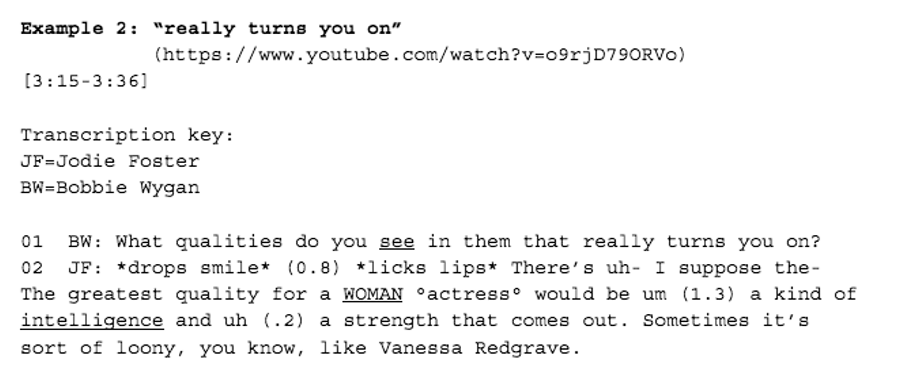
In 2016 a 1979 interview with Jodie Foster resurfaced on the internet and instantly took hold in the meme community. When asked about a potential boyfriend, Jodie smirks, licks her lips, and raises her eyebrows in a manner that gives the impression she knows something that her interviewer does not. The label [gay silence] was given to this instance and it has become a part of gay culture and  the LGBT community as an identifying feature of closeted individuals. With this in mind, our study takes a sociolinguistic approach to analyzing and examining the idea of a sapphic/lesbian code. Coded sapphic speech is not well studied in sociolinguistics, and while the community itself is able to identify markers of such, there has been little to no substantial research on identifying features present in sapphic language. In analyzing the speech and body language of sapphic celebrities, we seek to provide evidence and tools to identify linguistic markers.

[expander_maker id=”1″ more=”Read more” less=”Read less”]

Introduction and Background

If you’re a particularly online or memelord-y queer person, you might have seen the “gay silence” meme by now. A young Jodie Foster, who now publicly identifies as lesbian, stares off-camera at her interviewer with a slight knowing smile and a strained look in her eyes. The subtitles characterize her contribution to the conversation as “gay silence.”

The image comes from a 1979 interview with 17-year-old Jodie Foster on the Macneil/Lehrer Report. Clips of the interview resurfaced a couple years ago and caught the attention of the sapphic community (“sapphic” is an inclusive term referring to any person, woman or otherwise, who identifies as lesbian). In the clip, Foster answers awkward questions about the kind of boyfriend she would like and the qualities in actresses that “turns” her on.

Foster is generally seen as early lesbian “icon”. One YouTube comment about the interview jokes: “Jodie Foster founded Lesbianism. She’s like the final boss”. Another viewer writes: “the gay energy in this is immaculate.” Most viewers point out Foster’s subtle subversion of the heternormative questions. Another commenter points out how young Foster’s mannerisms match contemporary codes of lesbianism – “Every mannerism she has is now lesbian code. Funny, right? (Way of sitting, way of taking the cup of tea, way of talking).”

Coded sapphic speech is not well studied in sociolinguistics. While the community itself is able to identify lesbian markers, as demonstrated by the commenters above, there has been very little empirical research on those markers in language. One commentary by April Jackson published in a feminist journal called “Bringing Lesbian Language Out of the Closet” claims lesbians do not have a collective public language. Nothing in the literature we found could support this claim, but the literature pool is already small. Most studies on sapphic speech are conducted on lesbian acoustic features under the stereotype-driven fallacy that gay women are the acoustic mirror of gay men, otherwise known as “Gender Inversion Theory” (Kachel 2017).

Our study aims to fill this gap with a thorough study of “out” sapphic speech. Specifically, we provide two case studies, lesbian and sapphic icons Jodie Foster and Kristen Stewart, characterizing the way sapphic celebrities speak about love, family, and sexuality before and after coming out.

Methods and Transcription Notation

Our hypothesis was that these women will behave differently depending on if they know the interviewer – and by extension, the greater audience – is aware of their identity or not.

With particular interest given to observing lesbian speech in environments where responses are elicited by another individual in regard to matters of romance, personality, and private life, we performed conversation analysis on queer women Jodie Foster and Kristen Stewart from the existing canon of interviews in the public record. We analyzed interviews on a scale of “outness” – before publicly coming out, in more “out” settings, and after publicly coming out – in order to draw comparisons and see if different aspects of their employed speech changed after they perceived members of their audience as aware of their identity.

Using conversation analytic methods, that data was examined for prosodic changes, i.e. hesitations, silences, breathiness, emphasis, and volume fluctuations. Particular attention was paid to: potential pauses[1] between utterances (the question and the intended response), employment of gendered versus gender-neutral words, and perhaps instances where the subject avoids the topic altogether. Furthermore, although more paralinguistic than overtly linguistic in nature, physical movements and posturing of the body in response to different questions allowed further insight into an interviewee’s response. Comparing this with later interviews where a given celebrity’s identity is public knowledge gave us an idea of whether or not these linguistic and paralinguistic choices were simply personality quirks. 

[1] In conversational analysis, a pause conveys meaning. The amount of time after an utterance is spoken may reflect different attitudes in a speaker. Such length after a pause can be interpreted as a few things, including hesitancy, disagreement, lack of interest, or that the speaker is having a hard time thinking of how to respond. We will be actively taking note of the length of any pauses within interviews in order to gauge how the speaker might be feeling in response to some interview questions.

Special attention was given to the interviewer’s demeanor, attitude, and in what context the celebrity was being asked these questions, as well as the content of the questions being asked, and whether those questions became more invasive once an interviewer knows they are asking someone who is lesbian. We tested for the possibility that our subjects were simply exhibiting discomfort while answering personal romantic questions, no matter their sexuality. As a method of control, the study includes conversation analysis on Brooke Shields and Amanda Seyfried; two heterosexual women who are contemporaries with Jodie Foster and Kristen Stewart respectively.

Transcription Notation:

  • [Overlap Bracket: Left brackets mark the point at which the current talk is overlapped by other talk.
  • Stressed Syllables: Underlined letters are used to indicate an emphasis on a word.
  • ° Low Volume: A degree sign indicates that talk it precedes is low in volume
  • Silence: Numbers in parentheses mark silences in seconds and tenths of seconds
  • Increased Volume: Upper case indicates increased volume.
  • Breathiness: An (h) indicates plosive aspiration, which could result from events such as breathiness, laugher, or crying
  • Noticeable Pauses: A period between two parentheses is used to indicate (short) pauses.

Results and Analysis

Brooke Shields

In order to have a point of comparison to Jodie Foster (one might say, hetero to Jodi’s homo), we chose to do conversational analysis on acclaimed actor and model Brooke Sheilds. Shields has been in the public eye as a famous figure her entire life, given her assimilation into the acting and model industry from a very young age (Shields was doing model jobs as an infant). Shields was also considered a very attractive individual, and given the subject matter she starred in (one example being the controversial–and in this writer’s opinion, very gross–film “Pretty Baby”) became a “sex symbol” in her teenage years.

This mindset of the public in regard to Shields led to her interviews being riddled with topics circulating towards: sex, men, crushes, boys, and other sexually or romantically charged vocabulary.

Given the frequency of such words as well, it provides viewers a good point of reference to how Shields would respond to questions that were deemed more harmless (crushes) to those that are more inappropriate (sex). For our study in particular, having interviews where the interviewer had the pre-existing mindset that Shields is someone her fans “desired” is a good control for Foster’s behavior. This way, we  can look into similarities and differences with regards to how invasive a question is without any distinction made between sexuality. Sometimes the things people are asked, point blank, make them uncomfortable.

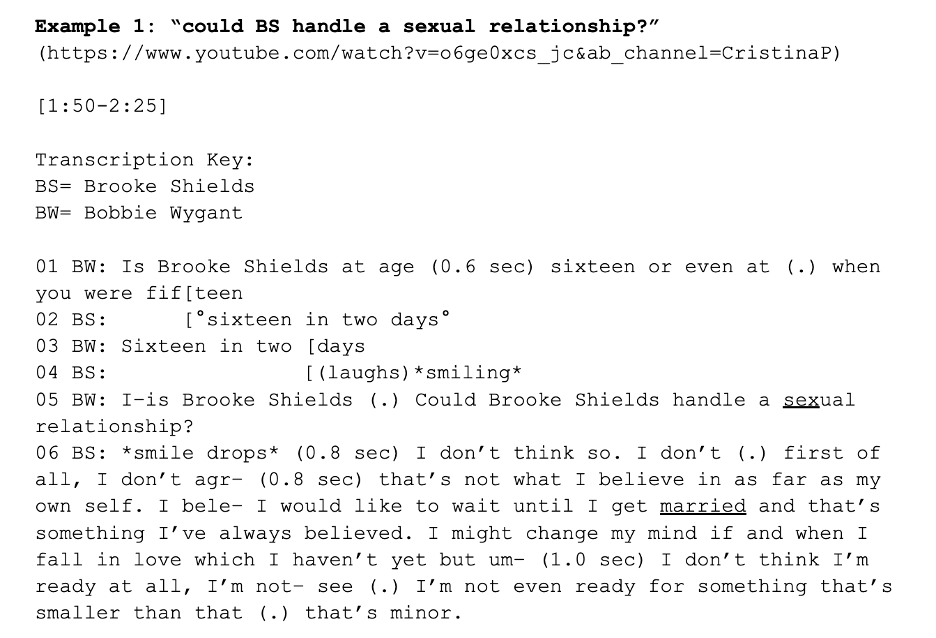
The first conversational analysis performed was on an interview in 1981 by the interviewer Bobbie Wygant (who also interviewed Foster two years prior). In the interview Wygant asked Shields many questions about sex, rather than the plot of the film she was in at the time. Wygant  asked things like whether or not she thought that young girls are able to have sexual relationships, later leading to her question to Sheilds, herself, about whether she could handle a sexual relationship or not. Shields at the time was 15 and seated between two of her adult male co-stars in the film “Endless Love”.

Some of the aspects of Shields’ response that were particularly noteworthy was her use of laughter towards the beginning of the interview, as well as the significant pauses she evokes after Wygant asks her the invasive question. Shields also stutters slightly, and has more pauses as she gathers her thoughts together in order to construct what people in the comments of the interview called “classy” or “graceful” despite the question’s probing content . Overall, the biggest instance of perceived discomfort for Shields’ responses to questions was found in this interview where the topic itself was something deeply personal and invasive to ask anyone.

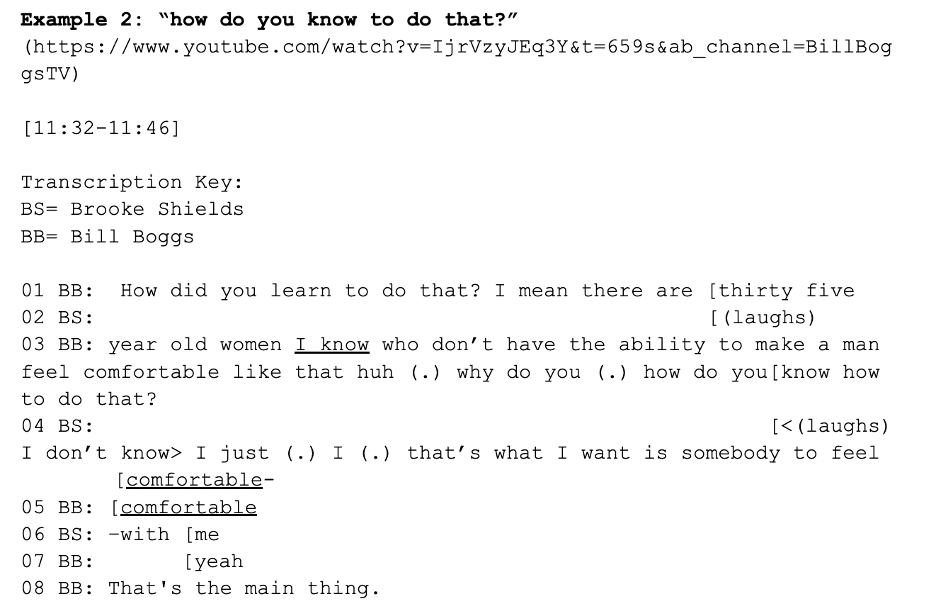
The second interview of import was conducted by Bill Boggs around a similar time in Shields’ life. Contrary to the Wygant interview, Boggs interview doesn’t explicitly ask Shields about sexual relationships, some of it is implied however. At one point in the interview Boggs asks Shields about her ability to make men feel “comfortable” with her. He even compares her ability to “thirty five year old women” he knows who aren’t capable of the same thing. Such a question, to an observer, seems off, especially considering the comparison between fully grown adult women and Shields, who was only a teenager at the time.

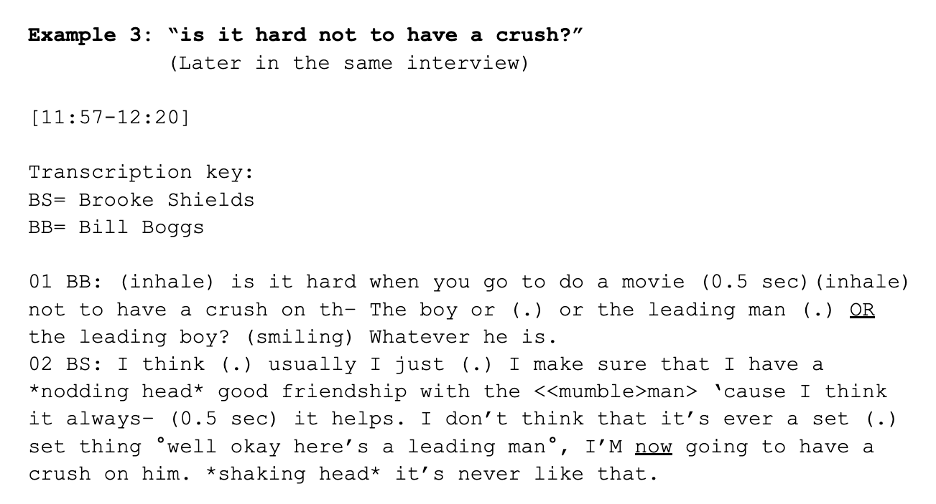
Similar to the previous interview there is evidence that Shields uses laughter as a response to a question that has some degree of romantically charged backing. In the later part of the interview Boggs asks Shields about the difficulty of not getting a crush on her male counterpart in a film.

Shields doesn’t hesitate to use masculine pronouns to refer to the recipient of her hypothetical crush, and although she does include a pause, it is more similar to her gathering her thoughts than being read as uncomfortable as it was in the first interview example (comparing a 0.5 second pause to the 0.8 or solid 1.0 seconds in the interview with Wygant). The only instance in which there is some aspect of her response that could portray uncomfort is when she mumbles the word “man,” however this is much more likely to be attributed to the fact that she was still a teenager at the time and her co-stars were more often than not older than her by a decently large margin.

Shields also has open body language in her interviews, where she smiles back at the interviewer, nods or shakes her head, and most noticeably laughs as a response to various questions.

Jodie Foster

Results from conversational analysis on Jodie Foster stood out from conclusions we drew on her heterosexual contemporary, Brooke Shields, in four ways:

(1) Foster used “the gay silence” when closeted;

(2) Foster used gender-nonspecific terms when closeted;

(3) Foster played with gender roles more often in a more “out” setting than in a closeted one;

(4) Foster was a more supportive and intimate conversation partner in an “out” setting.

In the interviews we analyzed discussing romance and sexuality, Shields responds to interviewers using laughter 50% of the time. By contrast, Foster used “the gay silence”. In a 1979 interview with Bobbie Wygan, Foster responded to heteronormative questions about her love life with several pregnant pauses.

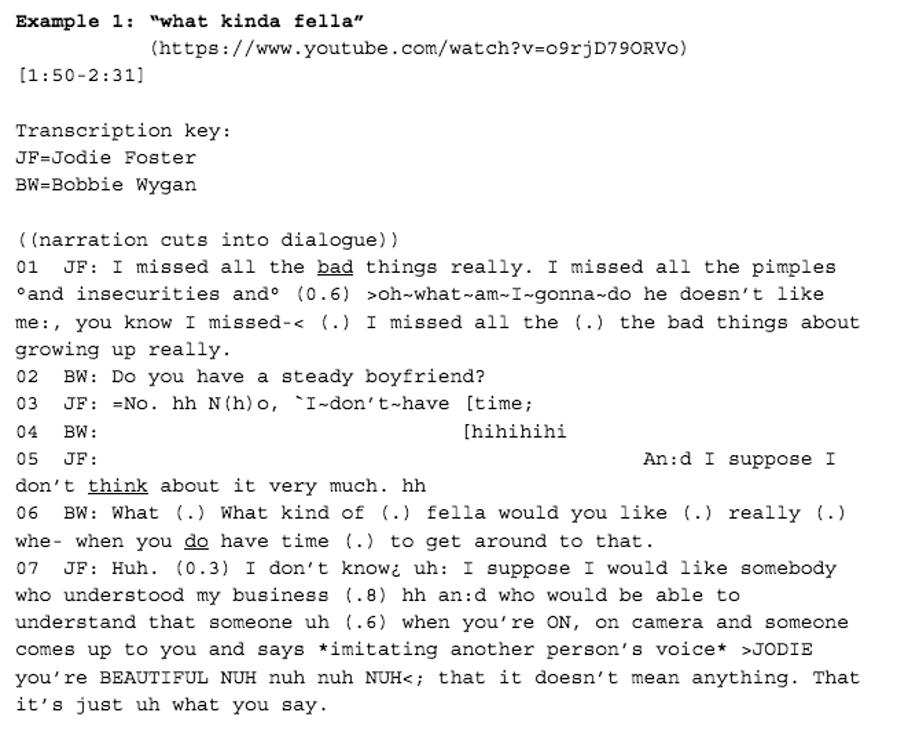
Foster’s silences came to an average of 0.49 seconds overall, twice using a 0.8-second silence during clips from the 1979 interview. Her longest silence occurred after the interviewer asked an awkwardly phrased question – what qualities in a female actress “turns” Foster “on” – a total of 1.3 seconds. This is the longest silence of any interviewed subject in our research.

Foster also used gender non-specific terms when closeted and avoided giving pronouns to potential romantic partners. In Example 1, Foster expresses a desire to date “somebody who understood my business” when the interviewer specifically asked about a “fella.”

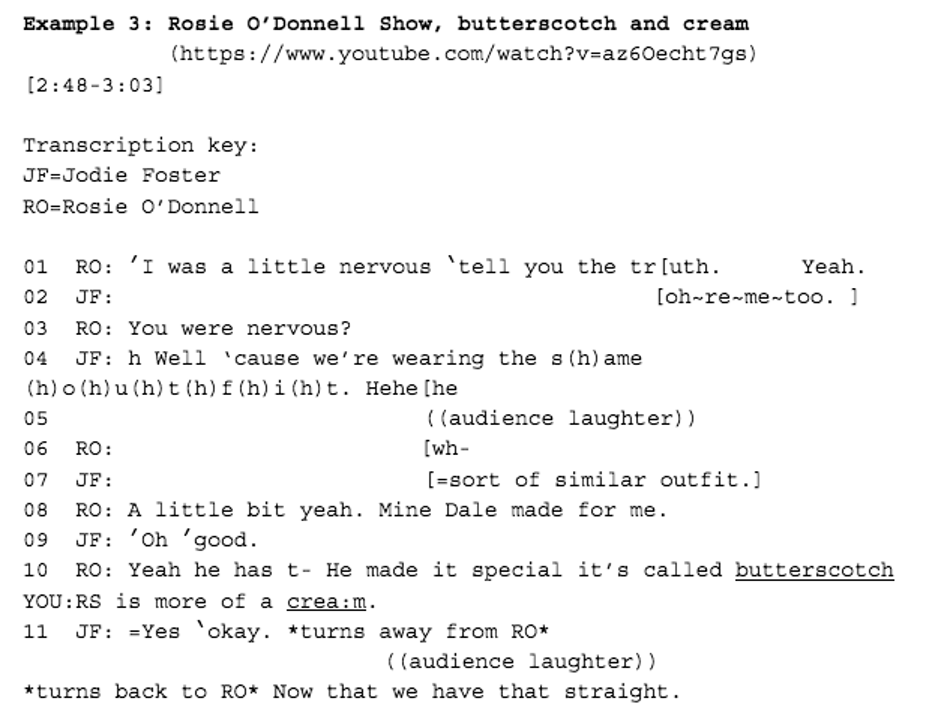
We classified an interview with fellow closeted lesbian Rosie O’Donnell as a slightly more “out” setting than other interviews, even though the public was still largely unaware of her sexuality. The brash show host with a deliberately comedic style, O’Donnell played with gendered language and perceived gender roles during her conversation with Foster, prompting the same subversive gendered language in Foster.

Robin Lakoff (1973) hypothesized that “women’s language” (WL) incorporated more color vocabulary than non-WL. The performance and nonperformance of WL in this interview highlights how queer women subvert gender in liminal “out” spaces. In Example 3, O’Donnell prompts audience laughter by drawing an exaggerated distinction between “butterscotch” and “cream” clothing. She appropriates highly feminine language (pointing out shades of difference in clothing colors) while highlighting her less prestigious New York accent (perceived as “rough” and “lower class” and therefore masculine). The joke results in a clash between feminine language and masculine presentation.

Foster responds by rejecting the feminine language and instead adopting a masculine disinterest in the color difference. She turns away from O’Donnell to look at the audience before ironically saying, “now that we have that straight.” This presents another clash in gender presentation and therefore subversion of gendered language.

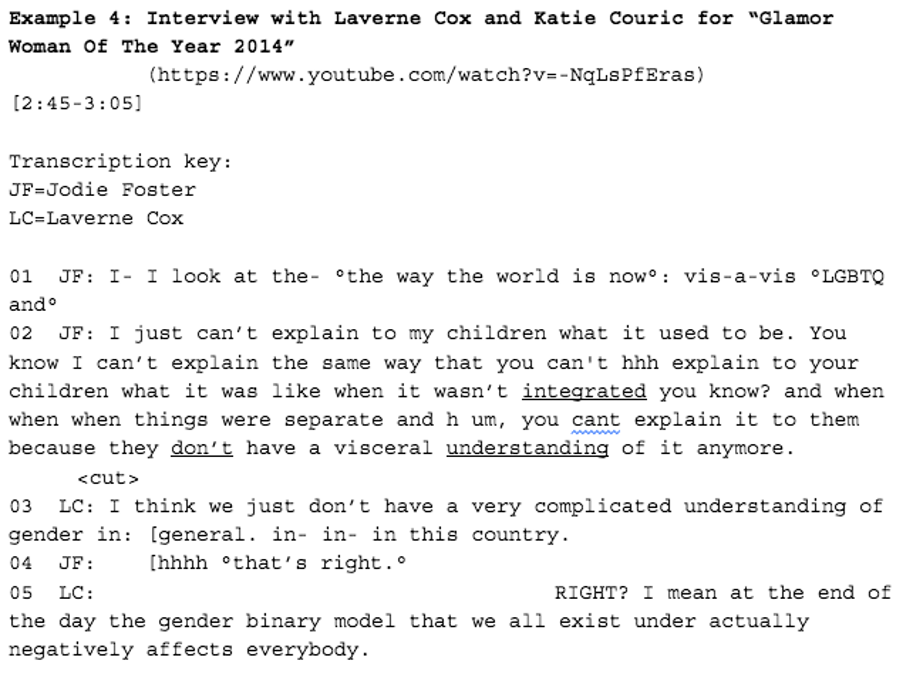
We analyzed another “out” setting in which Foster comfortably indexed her queer identity in an interview. In 2014, Foster presented the “Glamour Woman Of The Year” prize to transgender icon and friend Laverne Cox. This was only a year after Foster publicly “came out” in the public sphere. Foster and Cox’s interview with Katie Couric after the awards ceremony displays Foster’s intimacy and vulnerability while speaking about her family and the state of queer liberation in 2014.

Foster speaks quietly and slowly, with heavy and personal emphasis, while speaking about the progression of LGBTQIA+ liberation. In the next cut, Foster indexes her intimate friendship with Cox as well as her solidarity with Cox’s experiences through supportive interruption (Tannen, 1993). Foster cuts in with a positive response (chuckling in line 04) and affirms Cox’s experiences. Cox, in turn, acknowledges the support in line 05.

Contrast this interaction with a far more disastrous interview from 2007 in which a straight male interviewer made an inappropriate joke about Foster’s lesbianism. In that interview, we found Foster speaking in extremely high pitch, laughing, stuttering, and backing away from engaging with her interviewer on several topics of conversation. In the next appearance Foster made on the show, the interviewer joked that Foster didn’t like him; perhaps alluding to her uncomfortable retreat from their last interview. 

Amanda Seyfried

Amanda Seyfried was chosen as Kristen Stewart’s heterosexual counterpart because of her similar exposure to fame. Amanda’s breakout roles in Mean Girls (2004) and Mama Mia (2008) lead to a surge of interviews in the young actress’s life, just as Stewart’s breakout role in Twilight (2008) spawned a plethora of interviews. Seyfried’s dating activity has always been accessible to the public, whether that be through social media posts from the actress herself or public interviews. In our chosen interview Seyfried is being interviewed by Ellen on daytime television, with the topic of conversation being Seyfried’s recent vacation with then boyfriend Justin.

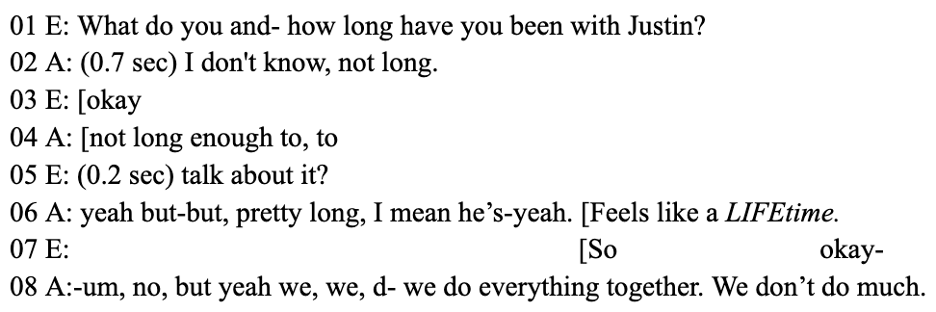
After Ellen’s initial question of how long she has been with Justin, Seyfried pauses and is unsure of her answer. She continues to build on her thoughts and answers Ellen’s question fully with sincerity across lines 04-08. When Seyfried says in line 06 that it feels like a LIFEtime, she make a contrast between the short time they’ve been together and the potential romantic exaggeration of saying “lifetime,” making the line come out as almost a mocking joke, but her follow-up with sincerity, saying they “do everything together” in line 08 confirms the truthful tone of her latter statement.

Kristen Stewart

Kristen Stewart is an actress who has stated that she has never felt truly “closeted” – in the sense that she never attempted to hide her attraction to women, and even before any official statements about her sexuality, or public appearances with female/nonbinary partners, she has shown obvious interest in women. When analyzing her speech, it’s important to keep this in mind, because it may inform interpretations of her answers to certain questions.

Stewart is an interesting subject to study, particularly because of her strong presence in the public eye as a romantic lead in Twilight. Conveniently, during filming of the Twilight series, she also appears as Joan Jett in The Runaways, where she has an on-screen romance with female co-star, Dakota Fanning. Comparing her reactions to prying questions in context of both Twilight and The Runaways gives us a way of judging her comfort level without confounding variables such as age or level of fame, since they take place in the same timeframe.

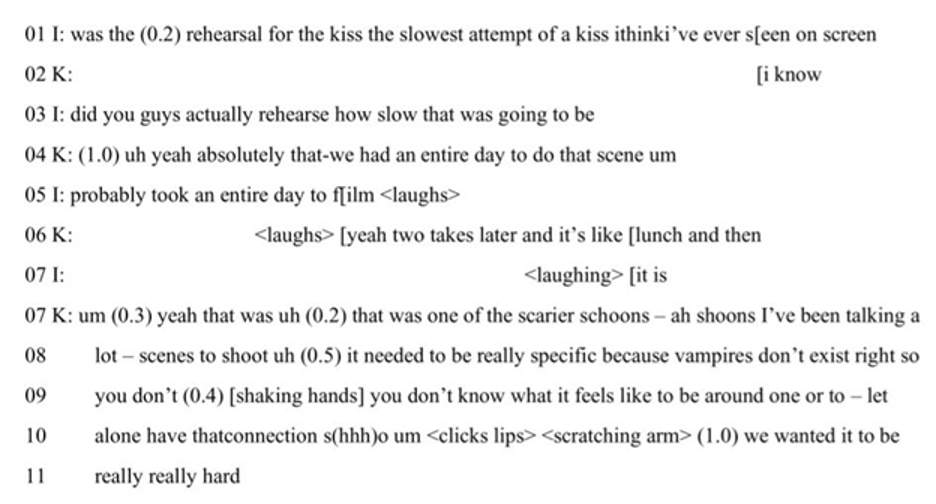
Stewart is a person who has been classified as shy, guarded, or introverted, mostly in response to questions about her romantic life, and such discomfort can be seen in several interviews where an interviewer will ask her about her relationship with Twilight co-star, Robert Pattinson. In one interview, an interviewer questions Kristen on filming a particular kissing scene with Pattinson.

Previously fluid and casual, Stewart begins to stutter, use filler words, and make speech errors, as well as take significant pauses in her speech. Most notably, she also avoids the question entirely, choosing instead to mark on the filming process and vampirism as a concept, rather than her chemistry with Pattinson. Similar reactions can be found in several other interviews on the same subject, where solicitations of romantic involvement with Pattinson are met with stuttering and subject avoidance. In one interview with Oprah, the host even remarks on Stewart’s publicly-known coyness on the subject, directing the question to Pattinson himself only for him to similarly dodge the question, albeit in a more humorous and comfortable way.

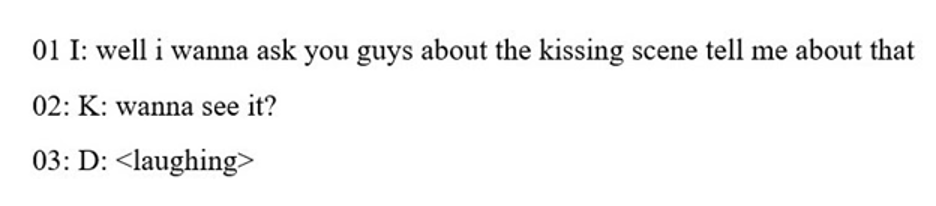
Alternatively, Stewart’s shyness did not seem to extend with her onscreen romance with Fanning, and in interviews with similar questioning, responded with confidence, humor, and ease.

Rather than avoid the subject, she leans into it and encourages more conversation. When questioned about the “best kisser” in the context of her Twilight love triangle, she responds with “Dakota” in several different instances. This lack of trepidation is consistent among a number of interviews, with and without Fanning next to her.

Later in her life, Stewart began making her romantic involvement with women more public, and announced an engagement with her fiancée, Dylan Meyer. The same ease, confidence, and positive language can be observed when she talks about Meyer in an interview with Jimmy Fallon.

She no longer stutters, she uses objectively positive language discussing her partner, and has an open and relaxed posture. Additionally, Kristen in line 02 begins to laugh as she says “thanks” causing a break in her voice. This is her first observed initiation of laughter, possibly displaying increased confidence (compared to previous interviews where she only mimics laughter after someone else has initiated it).

Discussion + Conclusions 

This study rebukes previous literature that claims sapphic people do not index their identities in their speech or that sapphic mannerisms should be mirrored counterparts of gay mannerisms. Our study of famous sapphic celebrities and “icons”, juxtaposed with their heterosexual contemporaries, show us that those sapphic individuals speak very differently in “out” settings than in “closeted” settings (whether they are completely closeted, in the presence of other sapphic people without being out to a larger audience, or completely out and discussing matters of love and sexuality). They exhibited a marked difference in comfort level, gender role performance or subversion, and positive or more intimate interlocutory behaviors.

Our results show that Foster in “out” settings, unlike her contemporary Shields, tends to subvert gender roles more often in interviews. Additionally, “out” Foster acts more supportive towards LGBTQIA+ interlocutors than towards heterosexual interlocutors. “Out” Foster speaks personally and intimately about matters of queer liberation, whereas closeted Foster becomes greatly uncomfortable and withdrawn when confronted with the question of her sexuality.

Additionally, unlike Shields (who used laughter as a frequent form of response), closeted Foster tends to display discomfort about probing personal questions with the “gay silence,” a knowing silence that avoids an admission of homosexuality but also tends not to display overt heterosexual enthusiasm.

Amanda Seyfried’s playful but overall sincere comments on her current partner can be compared to a closeted Kristen Stewart’s reaction to questions about heterosexual romantic scenes with long silences and avoidant interlocutory behaviors. Contrasting these behaviors with “out” Kristen Stewart’s speech, we find a marked positivity and confidence, given her newfound laughter initiation and active gesturing (“knocking” it out of the park) when speaking on subjects engaging in her sexuality.

Our research adds to Kachel 2017’s work by further providing evidence that Sapphic speech cannot be indexed in the binary of heterosexual women vs. homosexual women. Rather, our results show that the psychological states and conscious identifications of these individuals (awareness of interlocutors’ sexuality, awareness of audience’s knowledge about their sexuality, comfort level with indexing non-normative gender or sexuality identities) are much more important factors in whether or not sapphic speech surfaces.

This research also marks one of the first uses of CA in individual case studies to examine the use of Sapphic speech. We recommend that further research follow our direction of case studies and examine larger corpuses of data from one Sapphic subject in “out” and closeted settings to corroborate our findings about gender performance, “gay silence”, and comfort level. Additionally, we recommend further conversation analysis studies performed on sapphic individuals’ conversations within the sapphic community and compare those results with sapphic-heterosexual conversations. Finally, we recommend more robust research into the sapphic community’s online language to better understand how sapphic speech may have developed in recent years.

Additional References 

We have included an assortment of different links below used to draw conclusions and make connections between our research topic and other sources. The type of links vary from articles from pop culture media, to youtube links of different interviews conducted with celebrities.

Vice – Lesbian Culture Has Had a Major Update

(an article briefing “additions” to lesbian culture form the year 2018)


Interviews (including the interviews where conversational analysis was done and those where it wasn’t)

Jodie Foster

Famous Jodie interviews

https://www.youtube.com/watch?v=mqxkA46eIOI

https://www.youtube.com/watch?v=DiCwI4Xdvrk- https://www.youtube.com/watch?v=ct3UPiWPKS8


Jodie and gender

https://www.youtube.com/watch?v=X7p25iyvmsg&t=298s

https://www.youtube.com/watch?v=aTmjZf2NH3c

https://www.youtube.com/watch?v=ity8XVVSdI0

https://www.youtube.com/watch?v=kQQrlGjeHIM


Jodie and sexuality

https://www.youtube.com/watch?v=-NqLsPfEras

https://youtu.be/243NYLOn6WE?t=122


Kristen Stewart

Heterosexual Interactions and “Chemistry”

https://www.youtube.com/watch?v=sE0fPDIKGD8

https://www.youtube.com/watch?v=NhlS_TikKXE

https://www.youtube.com/watch?v=fREjpeShur0


On Sexuality

https://www.youtube.com/watch?v=GUMHSDzLBy4


Discussing Engagement

https://youtu.be/P7jsmfpF82M

https://www.youtube.com/watch?v=ItTWGCJGTeA


Homosexual Indications

https://www.youtube.com/watch?v=ZxvrV5UH2NE

https://www.youtube.com/watch?v=nU6gCC3DTCc


Amanda Seyfried

About her boyfriend

https://www.youtube.com/watch?v=-GSou1Dk0hc


On her Marriage and Homelife

https://www.youtube.com/watch?v=TbRtVJYUADs


Brooke Shields

On matters of sex and sexuality

https://www.youtube.com/watch?v=J31pcI3ZgN4&ab_channel=MervGriffinShow

https://www.youtube.com/watch?v=o6ge0xcs_jc&ab_channel=CristinaP

https://www.youtube.com/watch?v=aTSSBJ6xyi4&ab_channel=TheDianeRehmShow


Romance

https://youtu.be/IjrVzyJEq3Y?t=659

https://www.youtube.com/watch?v=3QWQ4gN3j4E&ab_channel=WatchWhatHappensLivewithAndyCohen

https://www.youtube.com/watch?v=htnMcHxr-Dw&ab_channel=MichaelMYoung


On Motherhood

https://www.youtube.com/watch?v=A9j2ZPcSCR4&ab_channel=BobbleheadConan


References

Clayman, Steven and Virginia Gill  (2012).  “Conversation Analysis.”  In James P. Gee and Michael Handford, (Eds.)  The Routledge Handbook of Discourse Analysis. London, Routledge: 120-134.

jackson, april. (1994). Semantic Space: Bringing Lesbian Language Out of the Closet. Off Our Backs, 24(10), 13–13.

Jacobs, G. (1996). Lesbian and Gay Male Language Use: A Critical Review of the Literature. American Speech, 71(1), 49. doi:10.2307/455469

Jones, L. (2018). ‘I’m not proud, I’m just gay’: Lesbian and gay youths’ discursive negotiation of otherness. Journal of Sociolinguistics, 22(1), 55-76. doi:10.1111/josl.12271

Kachel, S., Simpson, A. P., & Steffens, M. C. (2017). Acoustic correlates of sexual orientation and gender-role self-concept in women’s speech. The Journal of the Acoustical Society of America, 141(6), 4793-4809. doi:10.1121/1.4988684

Kulick, D. (2000). Gay and Lesbian Language. Annual Review of Anthropology, 29(1), 243-285. doi:10.1146/annurev.anthro.29.1.243

Lakoff, R. (1973). Language and women’s place.Language in Society, 2, 45–80.

Shrikant, N. (2014). “It’s like, ‘I’ve never met a lesbian before!’”. Pragmatics. Quarterly Publication of the International Pragmatics Association (IPrA) Pragmatics / Quarterly Publication of the International Pragmatics Association (IPrA) Pragmatics, 24(4), 799-818. doi:10.1075/prag.24.4.06shr

Sidnell, Jack (2013). “Basic Conversation Analytic Methods.” In Sidnell and Stivers, Handbook of Conversation Analysis, pp. 77-99.

Tannen, D. (Ed.). (1993). Gender and conversational interaction. Oxford University Press.

[/expander_maker]
, , ,

A Linguistic Analysis of Gender Differences in Lying Behaviors Among Politicians

Joe Pei

What constitutes an authentic lie? Do males and females lie differently, especially when they are purposeful? Lying has always been a mysterious part of people’s everyday social lives, as it varies from individual to individual. This study aims at uncovering patterns embedded in deceptions among different genders. Politicians are naturally perfect subjects with which to study deception strategies, as they often need to lie to achieve various goals — covering a bad habit in the past, hiding a contrary political stance, or making an empty promise to gain ballots. They are usually also the most deliberate, as sometimes a lie being exposed might lead to the end of their career. This study looks at the different language patterns in House of Cards, a famous American political drama that closely resembles a true officialdom. Upon reading this article, you will be fascinated by the unconventional gender differences the study discerns in forming and delivering deceptions.

[expander_maker id=”1″ more=”Read more” less=”Read less”]

Background

Whether admitted or not, much of our social behavior is controlled for the purpose of interpersonal presentation (DePaulo, 1992), and lying constitutes a considerable portion of our social behavior. On the one hand, much research has been conducted around the topic, and past research and studies have found many strategies self-reported by good liars. On the other hand, a heterogeneous sample of written and spoken text reveals consistent gender differences in language use (Newman et al. 2008). This paper combines former studies on gender differences and lying behaviors and takes it one step further to study how men and women tell lies differently and especially whether, in addition to common strategies implemented by good liars of both genders, some strategies are more evident in successful male deceptions, while others are more evident in female deceptions.

Through analyzing selected language features with conversation analysis, as well as looking at the presence of politeness patterns, the study finds various unconventional gender differences in forming and delivering deceptions, which gives novel insights on how men and women set up different images in their environments and thus survive and move up differently.

Methods

In this research, data was collected from House of Cards. The main focus was on Francis and Claire Underwood, a couple who worked their way up the officialdom and later became the 46th and the 47th president of the United States. In this analysis, four instances of deceptions, two successful ones and two unsuccessful ones, were collected for each gender and are analyzed and compared from word choices to deliveries. Successfulness was defined as whether the other interlocutor believed in the deception.

In the conversations collected, several aspects of the speech were analyzed in depth. On a macro level, the main focus was on whether a kind image was set up with compliments and politeness strategies. On a micro level, the focus was on rising and falling intonation, length and frequency of pauses, and latching (meaning there is no gap between the end of a prior turn and the start of a new turn).

Results and Analysis

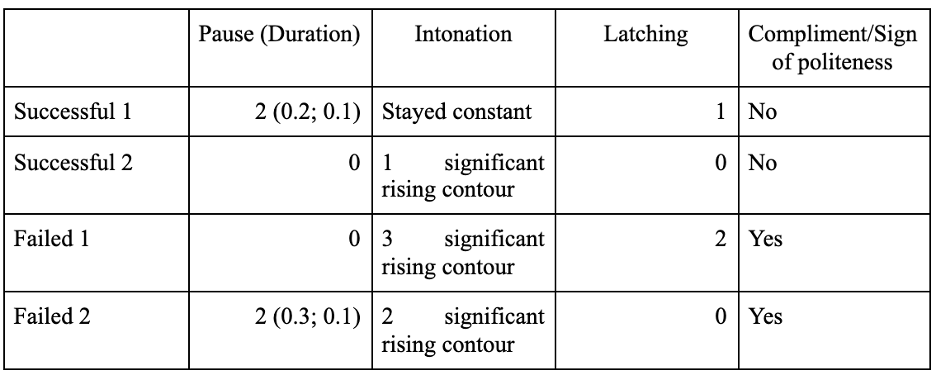
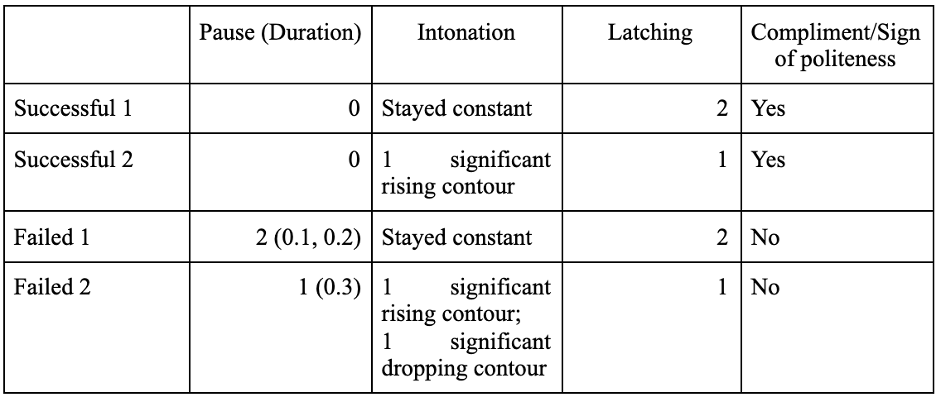
In the tables below, information regarding the number and lengths (in parentheses) of pauses, the changes in intonation, the number of latching, and usage of compliments and other politeness strategies was collected for each conversation and each gender:

Table 1: Collected patterns of selected features among female deceptions.

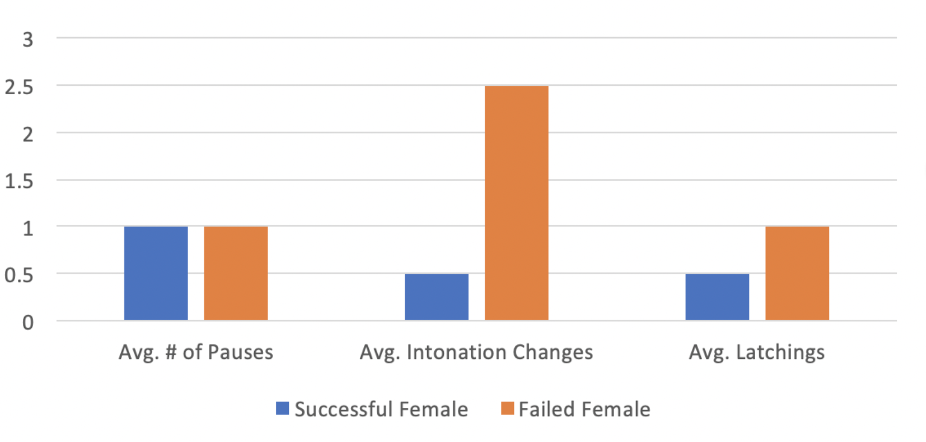
Figure 1: Comparison between selected features among female deceptions.

The conversation analysis of selected features showed different patterns between successful and failed deceptions for males and females. For females, the figure reveals to us that the differences were mainly in changes in the intonation patterns. Pauses were sometimes present and sometimes absent, and so were latching, but there were significantly more rising intonations in failed deceptions.

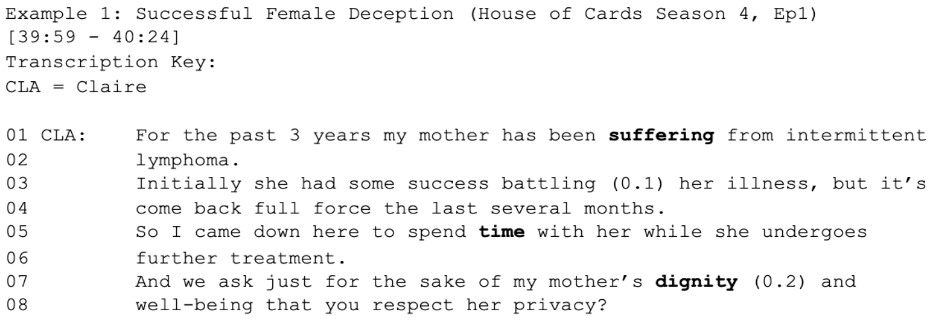
Figure 2 is an example of a successful female deception:

Figure 2: Transcript of a successful female deception.

The speech took place when Francis and Claire were having disputes on their political beliefs, so Claire went back to her hometown. Annoyed by the rumors of their marital problems, Francis and Claire decided to lie to the public that Claire’s trip was to visit her mother who got sick. Claire’s intonation was notably flat throughout her speech, except for a slight rising intonation in the last sentence. There were two pauses in the speech, one after the word ‘battling’ and another after ‘dignity,’ possibly to strengthen these words. Most notably, Claire did not use any compliment or show any sign of politeness. She purely stated the made-up reason behind her coming back to her hometown and requested for the media to respect their privacy and nothing more. The finding contradicted the standard model of women’s language according to Lakoff (Lakoff, 1973), which stated that women use more rising intonations and polite forms.

Table 2: Collected patterns of selected features among male deceptions.

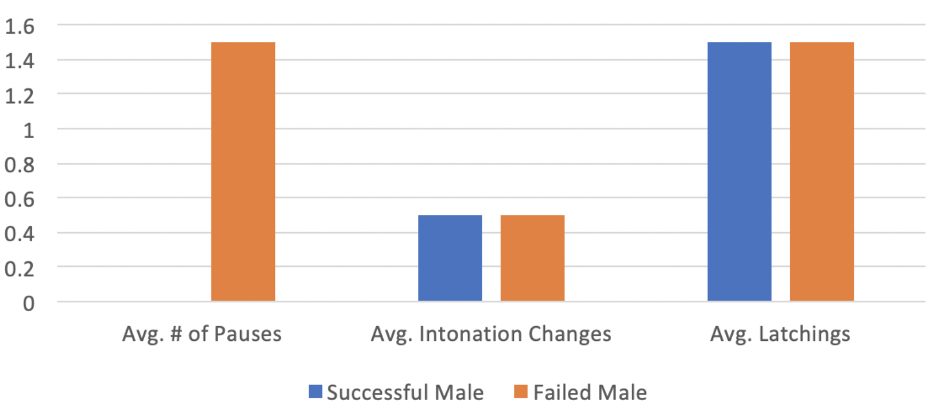
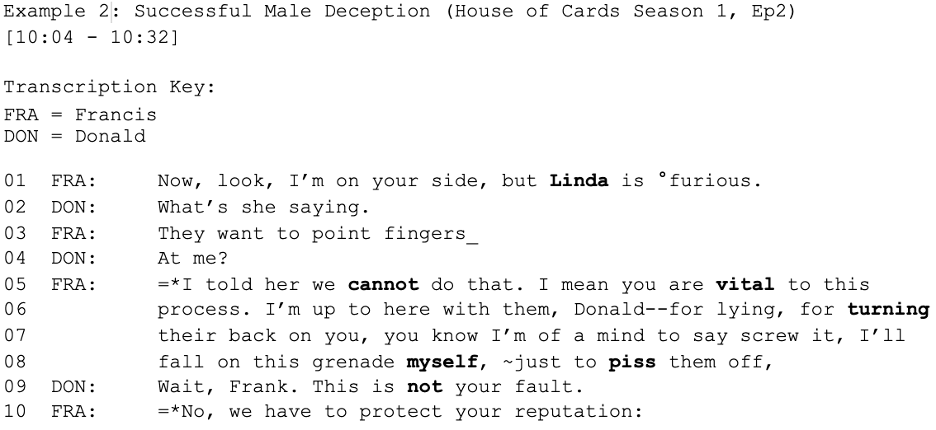
Figure 3: Comparison between selected features among male deceptions.

For males, there were also varying patterns of successful and failed deceptions. Intonation patterns and latchings were somewhat random, unlike in the female deceptions. More pauses were present in failed deceptions, while there was no pause in successful ones.

Figure 4 presents an example of a successful male deception:

Figure 4: Transcript of a successful male deception.

The conversation took place when Francis was blamed for a mistake when he and Donald Blithe (a member of the House of Representatives) were responsible for reforming an education act. He tried to make Donald believe it was his fault so he could resign and hand his power entirely to Francis. He used two latchings in lines 5 and 10, possibly expressing that he was quick and firm in his response, thus showing he was recalling rather than making up a story. There were not many changes in intonation patterns except for a slight falling contour in line 3, and this was common in male speeches as men used less rising intonations, and frequently the speeches stayed constant in terms of intonation. There were many strengthenings of words in Francis’ response in between lines 5 and 8. His voice was raised in pitch. The emphasis was mainly on words that complemented Donald — words like ‘vital,’ and words that showed Francis’ hatred towards the made-up “betrayal” against Donald. With those emphases, Francis was likely to convey pathos to Donald and quickly gained his trust.

The two genders also displayed opposite results in their usage of politeness. The successful female deceptions displayed no compliments, while the failed deceptions showed signs of compliments and politeness. For males in a successful deception, the lie teller always showed signs of politeness and even gave compliments, while in unsuccessful ones, these features were not present.

Discussion and Conclusion

In this research, analysis showed that male and female successful lie tellers differ not only in their delivery but most surprisingly, in the different attitudes they displayed towards the other interlocutor. It was more or less understandable that for males in an officialdom, they needed to make nice to let the other interlocutors feel respected and in turn, make a good impression in front of them and appear convincing. However, for females, successful lie tellers actually abandoned the use of compliments and politeness strategies and appeared more assertive and competent. The finding presented in the paper coincides with William Labov’s famous gender paradox theorem, which states that “women conform more closely than men to sociolinguistic norms that are overtly prescribed, but conform less than men when they are not” (Labov, 2001). Officialdom is undoubtedly a new environment for women, and there are not many “overtly prescribed” norms for them to conform to. It might be because of this that women tend to utilize new and unexpected strategies, which in turn helps them survive and move up in officialdom differently from males. In the future, more studies can be done to further explore other environments and positions to which women were traditionally less exposed.


References

DePaulo, B. M. (1992). Nonverbal behavior and self-presentation. Psychological bulletin, 111(2), 203.

Labov, W. (2001). Principles of linguistic change Volume 2: Social factors. Language in Society. Oxford University Press.

Lakoff, R. (1973). Language and woman’s place. Language in society, 2(1).

Newman, M. L., Groom, C. J., Handelman, L. D., & Pennebaker, J. W. (2008). Gender differences in language use: An analysis of 14,000 text samples. Discourse Processes, 45(3).

[/expander_maker]
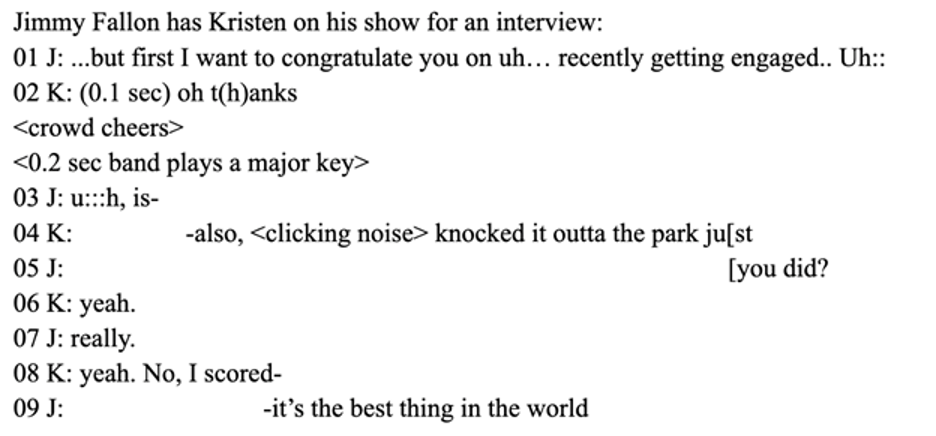
, , , ,
Scroll to Top