Emma Howlett, Isabelle Kang, Paige Lee, Taposi Nila, Natalie Sellers
Imagine receiving an email from an employee that reads: “Hey! Thanks so much!! 😊”. Would you interpret this as friendly or unprofessional? As Gen Z enters the workforce, these kinds of messages are becoming more common, raising questions about whether workplace communication norms are shifting. As the first generation raised with social media and instant messaging, Gen Z has developed communication styles shaped by digital environments, which may influence how they interact in professional settings. While informal linguistic features such as emojis and casual tone are often criticized, research suggests they can also convey warmth and emotional nuance in digital communication (Glikson et al., 2024). This study examines how Gen Z employees perceive the appropriateness of informal linguistic features and whether these perceptions are reflected in their email writing. Using a mixed-method approach, we surveyed 18 Gen Z participants and asked them to complete three workplace email scenarios. Results show that participants distinguish between types of informal language: emojis and exclamation points were often viewed as appropriate depending on context, while slang and abbreviations were largely seen as unprofessional. These findings suggest that Gen Z is not abandoning professionalism, but rather reshaping how it is expressed in digital communication.
Keywords: Gen Z, workplace communication, digital language, professionalism, email discourse
[expander_maker id=”1″ more=”Read more” less=”Read less”]
Introduction
Generation Z, born between 1997 and 2012, has grown up fully immersed in digital technology. As one of the first generations to be considered “digital natives,” they have developed communication styles shaped by social media and instant messaging apps (Manzoor, Sultan, & Siddique, 2026). These linguistic styles carry over into professional settings as Gen Z enters the workforce, potentially reshaping workplace communication and expectations around professionalism. A greater emphasis on short, efficient communication may lead to an increase in casual linguistic features such as greetings, emojis, slang, and abbreviations, rather than traditional emails characterized by rigidity and formality. For instance, interviews with Gen Z managers emphasize the importance of being “clear, concise, and kind—even if that includes a meme or emoji” rather than writing dense, highly formal emails (Manzoor et al., 2026). Politeness norms are also evolving, influenced by platforms such as TikTok and Instagram (https://www.tiktok.com), which shape trends in tone, humor, and informal expression and may contribute to intergenerational miscommunication (Jones, 2025). These shifts can reinforce misconceptions that Gen Z employees are lazy, overly informal, or unprofessional, a perspective that is frequently debated in professional spaces such as LinkedIn, where users discuss workplace tone and communication norms (https://www.linkedin.com).
Despite growing research on Gen Z in the workplace (Zahra et al., 2025), there remains a gap in understanding how college-aged individuals apply these digitally influenced communication styles in professional emails and how they perceive professionalism. This study investigates the degree of formality Gen Z uses with workplace superiors, focusing on informal markers such as slang, contractions, emojis, abbreviations, tone, and directness. We hypothesize that Gen Z employees will generally rate informal linguistic features as appropriate and will incorporate them into their email responses, particularly in lower-stakes contexts
Methods
The study included 18 Gen Z participants between the ages of 18 and 30 who were undergraduate or graduate students with current or prior work experience. Data were collected through an online survey distributed via platforms such as GroupMe and Slack. Participants first rated the perceived professionalism of various linguistic features—including emojis, exclamation points, slang, abbreviations, and casual greetings—using a 5-point Likert scale. Participants then completed three situational prompts requiring them to write mock email responses to a supervisor. These scenarios included requesting time off, responding to criticism regarding time management, and replying to a holiday party invitation. Responses were analyzed for linguistic features such as greetings, closings, tone, contractions, slang, and emoji usage. Drawing on previous research suggesting increased informality in digital communication among Gen Z (Rotich & Mary, 2025), we examined how participants adjusted their language across different contexts. This approach allowed us to assess patterns of code-switching between formal and informal communication depending on situational demand
Results
To better understand these patterns, we first examined participant demographics. A total of 18 participants completed the survey, with ages ranging from 18 to 29. The majority were undergraduate students (66%), followed by individuals who had completed graduate school (16%), were currently in graduate school (5%), held a high school diploma (5%), or held a bachelor’s degree (1%). Approximately 70% of participants were currently employed, and all
reported prior work experience across a range of settings, including corporate (29%), retail or food service (23%), education (18%), nonprofit (12%), healthcare (11%), and childcare (6%).
Figure 1
Number of Participants by Age Range
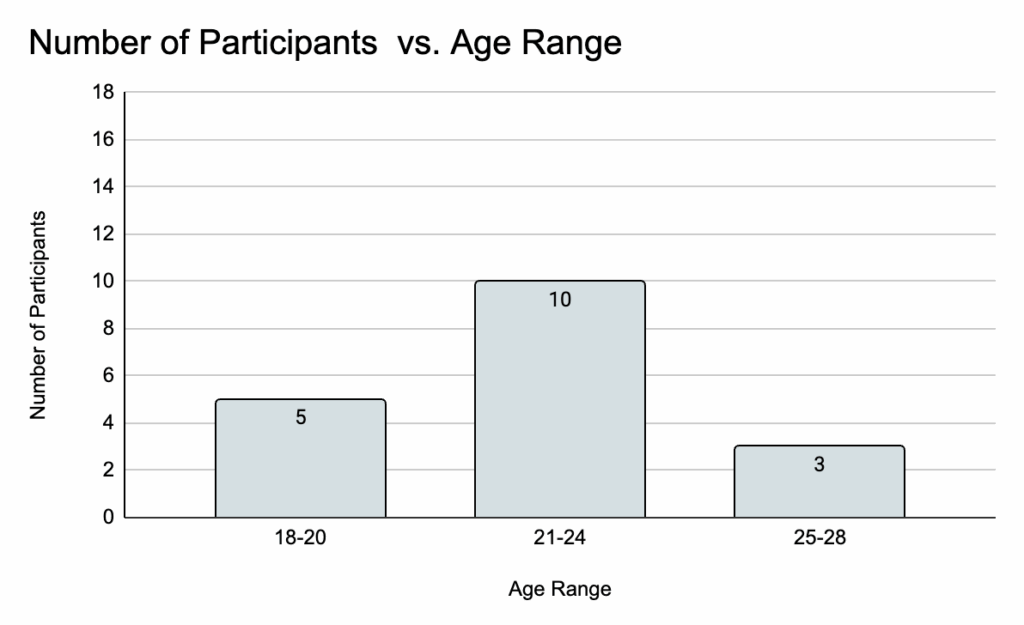
Note. This bar graph displays the distribution of participants across age groups, with the majority of respondents falling between ages 21 and 24.
Firgure 2
Distribution of participants by workplace setting.
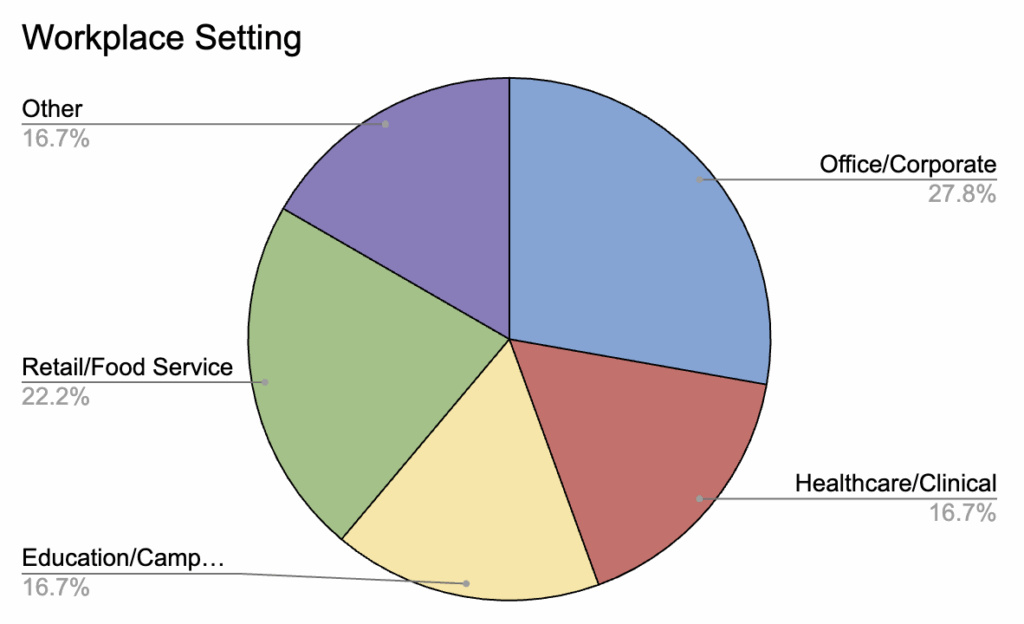
Note. This pie chart illustrates the variety of work environments represented in the sample, including corporate, retail/food service, education, healthcare, nonprofit, and other sectors.
Participants showed mixed opinions about what counts as professional communication. Emojis were viewed as highly context-dependent, with 47% rating them as neutral and 41% as somewhat professional. Exclamation points were more positively perceived, with 53% rating them as very professional and 41% as somewhat professional. Casual greetings such as “hi” or “hey” were generally viewed as somewhat professional. In contrast, abbreviations (e.g., “lol,” “btw”) were widely considered unprofessional, with 41% rating them as very unprofessional and 35% as somewhat unprofessional. Slang showed similar patterns, with responses ranging from neutral to very unprofessional. Short messages produced mixed responses, indicating no clear
consensus.
Figure 3
Average perceived professionalism of informal linguistic features.
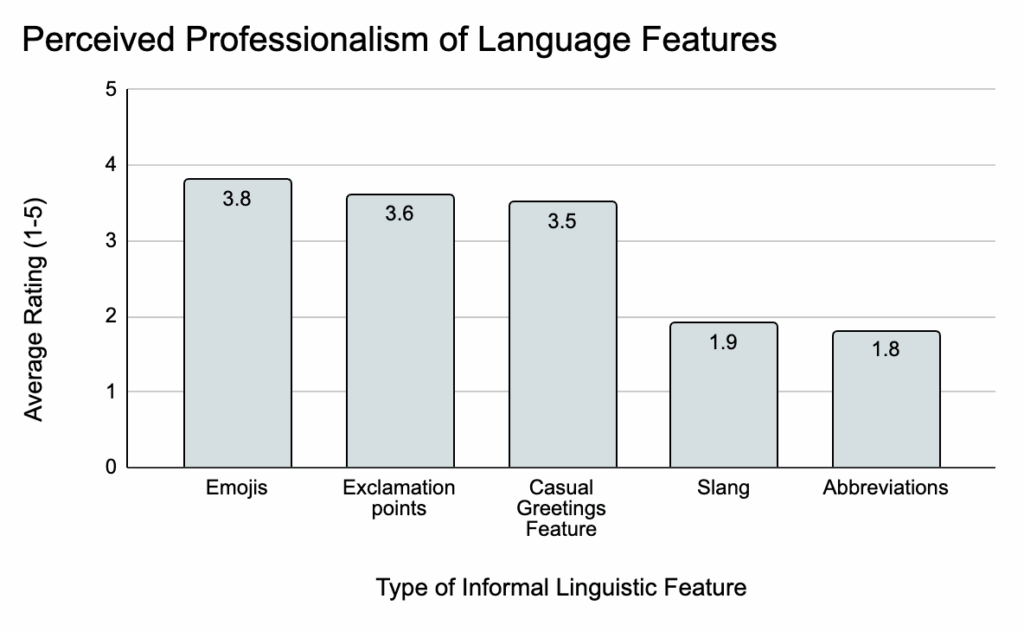
Note. This figure shows that emojis and exclamation points were rated more positively, while slang and abbreviations were consistently viewed as less professional.
Analysis of the email responses revealed that linguistic choices varied by context. In high-stakes situations, such as responding to criticism, participants used minimal informal features. In contrast, lower-stakes contexts, such as responding to a holiday party invitation, showed higher use of informal markers. The time-off request scenario reflected a balance between formal and informal language. Overall, these findings suggest that the use of informal linguistic features is context-dependent, with more formal situations discouraging informality and less formal contexts allowing for greater flexibility.
Conclusion
So what does this actually mean in a real workplace? Our findings suggest that Gen Z employees have a nuanced and context-dependent understanding of professionalism in digital communication. While media portrayals often depict Gen Z as overly informal, our results indicate that participants seem aware of professional expectations and adjust their communication accordingly. More formal situations, such as responding to criticism, prompted more structured and professional language, while lower-stakes contexts allowed for more relaxed and expressive communication.
Although features such as emojis, exclamation points, and casual greetings were generally viewed as acceptable in moderation, slang and abbreviations were widely considered unprofessional. Interestingly, many participants still incorporated informal features into their emails despite recognizing these boundaries, suggesting a potential gap between perception and practice. Additionally, consistently high self-ratings of professionalism indicate that participants may perceive their communication as more formal than it appears.
Ultimately, these findings suggest that Gen Z is not abandoning professionalism but is actively redefining it to include more flexible and expressive forms of communication, shaped by digital culture and contextual expectations, an evolution also reflected in broader discussions of language and communication in public-facing platforms and resources such as the Lingthusiasm podcast (https://lingthusiasm.com). In this way, professionalism is not disappearing, it is evolving. Gen Z is not breaking the rules of workplace communication, but rewriting them for a digital age.
References
Glikson, E., et al. (2024). Emotional leader communication in the digital age: An experimental investigation on the role of emoji. Computers in Human Behavior, 154, 108148. https://doi.org/10.1016/j.chb.2024.108148
Jones, R. D. (2025). The complexities of impoliteness in digital workspaces: A politeness theory analysis of Gen Z workplace communication (Publication No. 7760) [Doctoral dissertation, Liberty University].
Manzoor, A., Sultan, S. A., & Siddique, M. U. (2026). From emails to emojis: How Gen Z is redefining managerial communication through digital media. https://doi.org/10.5281/ZENODO.18345890
Zahra, Y., Handoyo, S., & Fajrianthi, F. (2025). A comprehensive overview of Generation Z in the workplace: Insights from a scoping review. SA Journal of Industrial Psychology, 51, 1–11. https://doi.org/10.4102/sajip.v51i0.2263
[/expander_maker]