hedges

Uncovering Gendered Dynamics: A Comparative Analysis of Interactions Between Customers and Service Industry Workers

Elizabeth Truong, Naomi Crandall, Zoe Jespersgaard, Jennifer Ma, Victoria Yu

In contemporary society, coffee shops act as significant social hubs, facilitating interactions between service workers and customers that reflect broader gender dynamics. This research investigates the nuances of gendered interactions within coffee shops, focusing on American college students in the Westwood neighborhood of Los Angeles. The study aims to understand how gender influences various aspects of service worker-customer interactions, including word choice, politeness, and conversational patterns. Based on the hypothesis posited, which suggests that female-presenting customers are more likely to exhibit politeness towards service workers compared to their male-presenting counterparts, the research examines data collected through non-participant covert observation and conversation analysis. The findings reveal significant gender differences, with female-presenting individuals demonstrating more polite behaviors such as hedging and the use of politeness markers compared to their male-presenting counterparts. Female-female interactions were characterized by longer discussions and more pleasantries, while male-male interactions tended to be more direct. Overall, the study contributes to our understanding of gender dynamics in public spaces and underscores the importance of recognizing and addressing these dynamics for fostering inclusive environments.

[expander_maker id=”1″ more=”Read more” less=”Read less”]

Introduction

Within modern society, coffee shops serve as social hubs, offering an ideal setting for individuals looking for a quick respite as well as providing us with critical information regarding the nuances of gendered interactions between service workers and customers. Interactions between service industry workers and customers play a key role in shaping the experiences within public spaces, revealing broader societal norms and dynamics. In this research paper, we investigate how the dynamics of service worker-customer interactions in coffee shops are impacted by gender, specifically focusing on various aspects such as word choice, personability, and politeness. This paper is focused on studying these interactions between the demographic of American college students, with data collection taking place in coffee shops in Westwood Village, close to the campus of the University of California Los Angeles. By analyzing these factors, we aim to contribute to the understanding of gender dynamics within service interactions, uncovering any patterns or disparities present. Our hypothesis posits that female-presenting customers are more likely to exhibit politeness towards service workers compared to their male-presenting counterparts. Additionally, we anticipate greater deviations from the conventional ordering process when the gender presentation of the customer aligns with that of the service worker.

Background

In observing service encounters, we see various linguistic properties which are present in communicative patterns, contributing to the dynamics of interaction. Some specific examples include politeness strategies, turn-taking patterns, gestures, and lexical choices. Politeness theory, developed by linguists Brown and Levinson is quite in-depth, and the following video made by the University of Vienna does a great job of simplifying some of its more complex aspects: https://youtu.be/e-B-kJi0Rek. Speakers often use politeness strategies to maintain positive social relations. The desire to be perceived as kind or polite is an example of a term known as positive face (Brown and Levinson 2006). As many people wish to be accepted and liked by others, we expect most customers to utilize positive face techniques such as smiling or engaging with the server in conversation outside of their order. This can involve using polite language, such as “please” and “thank you,” or softening directives and requests. In addition, conversations typically follow turn-taking patterns, where speakers take turns to contribute to the interaction. Signals such as pauses, intonation, or body language help regulate conversation flow and indicate when it is appropriate to speak. Moreover, nonverbal cues like facial expressions, gestures, and body language are also important. They complement verbal communication and may convey sincerity, friendliness, or authority. Lastly, the selection of words and phrases reflects cultural norms, social roles, and individual identities. Lexical choices can influence identity, social status, or group membership, contributing to the overall tone and meaning of the interaction.

Similarly, the data samples we have gathered closely align with these linguistic properties and patterns seen in other service encounters. A previous study, which looked at female politeness towards other females versus towards males, found that gender played a pivotal role in the presence of politeness. The authors found that females were more likely than males to speak politely to others, especially when speaking with other females (Keikhaie and Mozaffari 2015). Across the interactions in our research, both baristas and customers use polite greetings, express gratitude, and use personalized terms to address each party, fostering a friendly and welcoming atmosphere. Turn-taking patterns were also observed, with participants getting a chance to speak and respond. Additionally, positive body language, such as smiling and maintaining eye contact, contributes to a positive customer experience by maintaining an informal and relaxed environment. Overall, the data illustrates the importance of these linguistic elements in effective communication during service encounters.

Methods

The methods we used for data collection were non-participant covert observation and conversation analysis. We opted for non-participant covert observation of the interactions between the customer and barista in order to understand the social reality and implicit features of the interactions. With the participants not knowing that they are being observed, it ensures that the data is the most accurate and unbiased as it can be. We will also be analyzing the conversations we observe to investigate and gain more insight into the deeper meaning of the words and actions throughout the interactions.

To guide this research, our general research question is, do levels of politeness differ in server-customer interactions based on gender? Within this question, we also have some more specific focuses. They are as follows: How do different genders express and navigate face-saving and face-affirming behaviors through mechanisms such as hedging and politeness markers?; Do levels of intimacy and politeness differ in same-gender interactions as compared to different-gender interactions?; Are male or female-identifying people treated with more politeness?; Do male or female-identifying people use more politeness markers? Our general hypothesis is that females will use more face-saving behaviors and be less direct when ordering and interacting with customers.

Results

In order to gain a more complete understanding of the gendered relationships between customers and service workers, we collected data from different coffee shops in the Westwood neighborhood of Los Angeles, California. The coffee shops that we collected data from include Alfred Coffee, Starbucks, Ministry of Coffee, and Stereoscope in Hollywood. Our general hypothesis for our research was that females would use more face-saving behaviors and be less direct when ordering and interacting with customers. Based on our data samples taken from various coffee shops, it can be seen that females are more likely to initiate an interaction and use pleasantries during a service encounter. After analyzing the 17 conversational samples that we have collected thus far, we were able to group some behaviors that we felt applied to our hypothesis. The following categories are presented below, accompanied by examples derived from the dataset.

Hedging

The data revealed distinct gendered differences in the interactions between customers and service industry workers. Our observations consistently indicated hedging behavior among female customers, evidenced by the frequent use of words such as “um” and employing indirect language when placing orders. Female customers had the tendency to substitute “could” for “can” during these brief interactions. Additionally, the hedging term “just” was more prevalent in the speech of female customers within the dataset. Furthermore, female customers exhibited greater pauses or displayed hesitance while placing their orders.

Introductory Greetings

Across all data sets, we found that female service industry workers were more likely to ask the customer how they were doing in addition to giving a standard greeting. Additionally, the data show that although both male and female baristas will initiate the interaction between them and their customers, females are more likely to ask about a customer’s well-being as part of the introductory greeting.

Politeness Markers

The data show that the majority of the time, female customers were significantly more likely to say “please” while making their requests. Additionally, we found that across all the data sets, there was less smiling involved in male-to-male interactions. One data set found that the male barista solely smiled at female customers, maintaining a neutral expression for male customers.

We found that female customers are more likely to respond politely and provide detailed information about their order, contrasting with the male customer’s direct and concise style.

Volume

Based on the observed data, both the customers and service industry workers maintained a consistent volume level throughout the majority of their interactions, with subtle variations in assertiveness, such as a female barista taking a slightly more assertive tone during certain interactions. Across all data sets, we found that the volume of female speakers in both roles was lower than that of their male counterparts. We also found that female customers tended to end their sentences with a higher pitch, while male customers kept their tone and volume consistent throughout the entire interaction.

Length of Discussion

Across all data sets, the longest discussions that took place were in female-female interactions while the shortest interactions tended to be in male-male interactions, with very few pleasantries.

We observed a consistent pattern between these interactions with the deviations occurring primarily in female-female interactions. One deviation that we recorded was a female barista complimenting a female customer’s sweater. Additionally, we recorded a sense of friendliness and camaraderie when a female barista made a mistake when taking an order from a female customer and the two laughed together. Across all the interactions, the male-male interactions required significantly less clarification of their orders. We were able to conclude that longer interactions are likely characterized by the female customer providing detailed information about their order. Male customers usually order without much elaboration, thus leading to shorter and more direct interactions.

Discussion

The data show that there are significant gender differences in the interactions between service industry workers and customers. The results of this study show that there were gendered differences in hedging, introductory greetings, politeness markers, volume, and discussion length. Female customers were significantly more likely to exhibit hedging behaviors than their male counterparts, demonstrating hesitation and less confidence in the interaction overall. While male customers rarely demonstrated hedging behavior and tended to have a more dominant approach to the conversation, especially when speaking to a female barista. Additionally, the data show that although both gendered service industry employees provided some sort of greeting, female service industry workers were significantly more likely to ask the customer about their well-being in addition to providing a standard greeting.

While surveying politeness markers, the data show that female-presenting customers were more likely to utilize polite terms such as “please” and “thank you” than male-presenting customers. Additionally, our study found that female-presenting customers were more likely to respond politely and provide more detailed information regarding their order while male-presenting customers tended to adopt a more concise and direct approach. Across all data sets, we found that there were fewer non-verbal politeness cues such as smiling in male-male interactions. Previous studies have produced similar results that show females interacting with other females will utilize polite behavior more often than their male counterparts. The authors explain that this may be because women are more conscious of rejection and stigma and therefore put in more effort to be perceived in a positive way (Keikhaie and Mozaffari 2015). In our research, the male-presenting customers had the tendency to adopt a more dominant and less friendly approach to these interactions, highlighting their perception of their importance and role within this particular community.

In terms of volume, our data show very little variation. Both gender identities maintained a consistent volume throughout their interactions, however, female-presenting customers and service workers utilized a lower volume overall, ending their sentences with a higher pitch. Alternatively, while studying conversation length, we found that female-female interactions were significantly longer than male-male interactions. This variation is due to the use of more pleasantries in female-female interactions as well as the absence of these pleasantries and the more direct tone used in male-male interactions.

While our study is able to successfully identify gender differences in hedging, the presence of introductory greetings, politeness markers, volume, and discussion length, it is important to note that our research is primarily focused on the Los Angeles neighborhood of Westwood. Although the individuals who visit local Westwood establishments possess very diverse backgrounds and gender identities, this is not the case in all communities across the United States. Different communities may have differing opinions on gender identities and thus have drastically different interactions based on their community’s view on gender identities. In order to gain a more complete understanding of how these interactions between service industry workers and customers vary by gender, more research must be done examining broader geographical areas. By expanding the geographic range of this study, we will be able to come to a more concrete understanding of the different practices and patterns utilized between different genders in service industry interactions.

Conclusion

After conducting a thorough literature review as well as completing data collection such as observations and conversation analyses, we found that female-presenting customers and service industry workers were significantly more likely to utilize polite behaviors than their male-presenting counterparts. The data show clear patterned differences between these service industry interactions in the categories of hedging, the presence of introductory greetings, politeness markers, volume, and the length of the interaction. In each of these categories, the female-presenting customers and service industry workers utilize more polite approaches when addressing each other and members of the opposite gender. These results provide valuable information regarding not only the gender roles within service industry interactions but also the underlying social norms and dynamics within a public sphere.

References

Brown, P., & Levinson, S. C. (2006.). Politeness: Some Universals in Language Usage. In The Discourse Reader (2nd ed., pp. 311–323). Routledge: Taylor & Francis Group.

Forseth, U. (2005). Gender matters? Exploring how gender is negotiated in service encounters. Gender, Work & Organization, 12(5), 440–459. https://doi.org/10.1111/j.1468-0432.2005.00283.x

Gibson, E. K. (2014, May 27). Would you like manners with that? A study of gender, polite questions, and the fast‐food industry. Academia.edu. https://www.academia.edu/4031180/E._K._GIBSON_-_A_study_of_gender_polite_questions_and_the_fast_food_industry

Hultgren, A. K. (2017). New perspectives on language and gender: Linguistic prescription and compliance in Call Centres. Language in Society, 46(5), 671–695. https://doi.org/10.1017/s0047404517000574

Keikhaie, Y., & Mozaffari, Z. (2015). A Socio-linguistic Survey on Females’ Politeness Strategies in the Same Gender and in the Cross-Gender Relationship. Iranian Journal of Applied Language Studies, 5(2), 51-82. doi: 10.22111/ijals.2015.1877

Schnabel, Lukas. “Politeness in Linguistics: An Overview.” YouTube, uploaded by Lukas Schnabel, 23 June 2019, https://youtu.be/e-B-kJi0Rek

Taylor, J. L. (n.d.). I Need a Coffee: Pragmalinguistic Variation of Starbucks Service Encounter Requests According to Interaction Modality. Indiana University. https://scholarworks.iu.edu/journals/index.php/iulcwp/article/download/26219/31840/61913

West, C. (1993). Reconceptualizing gender in physician-patient relationships. Social Science & Medicine, 36(1), 57–66. https://doi.org/10.1016/0277-9536(93)90305-n

 [/expander_maker]
, , , ,

“Speaking of women’s comedy…”: An Analysis of Linguistic Traits by Male and Female Standup Comedians

Samuel Alsup, Eden Moyal, Jinwen (Wiwi) Shi, Yitian (Riley) Shi

The question of whether women can be funny is long outdated and has, thankfully, been answered in the affirmative. This project investigates how funny people – namely, stand-up comedians – perform (or don’t perform) their womanhood in speech. Studies conducted by 20th-century scholars highlighted multiple facets of language that are characteristic of women’s conversation, such as tag questions, hedges, and excessively specific use of color terms. This study attempts to answer the question: do 20th-century conclusions regarding “women’s language” in conversation hold up in the context of contemporary stand-up comedy (Lakoff 1998)? Transcriptions of live stand-up acts by White North American men and women indicated that certain features associated with women are indeed more salient in women’s standup, while others seem to be equally used by men and women. This points to a decreased divide over recent decades in what is traditionally seen as acceptable ways of being a man or a woman, and a trend toward accepting the vast spectra of gender identity and gender performance.

[expander_maker id=”1″ more=”Read more” less=”Read less”]

Introduction and Background

Research into “women’s language” in the 1970s and 1980s pointed to proposed differences in speech between men and women (Men, women and language — a story of human speech), including certain features of conversational speech that are more salient among, and characteristic of, women. Researchers such as Lakoff (1998), Tannen (1990), and Cameron (1997) codified these differences, noting the response to a society that taught women to be polite and therefore unimposing. A few of the features of “women’s language” include hedging, tag questions, and filler words. On the other hand, men use more expletives and are more likely to drop the “g” sound at the end of a word (Bailey and Timm, 1976, cited in Guvendir 2015; Fischer 1958).

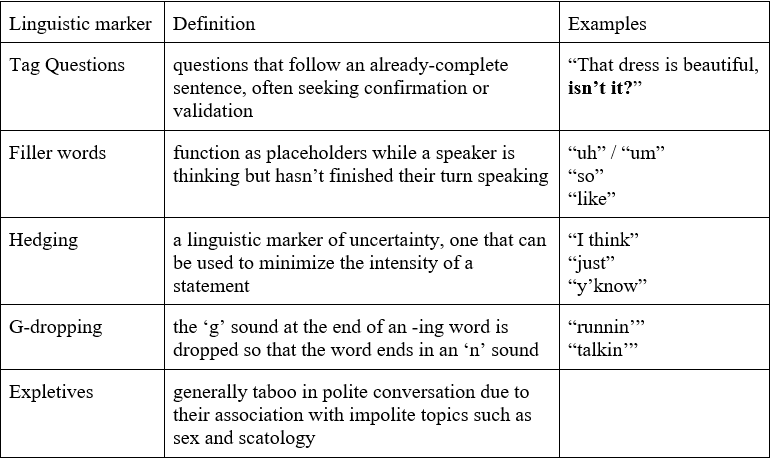
We examined the following phenomena: tag questions, filler words, hedging, g-dropping, and expletives. Definitions and examples of each can be found in the below table.

Table 1: Explanation and examples of linguistic features examined

Since these observations were made last century, we examined whether they would hold up in contemporary times. In recent years, society has witnessed a trend of greater gender equality, including breaking down traditional gender expectations (Solbes-Canales, Valverde-Montesino, & Herranz-Hernández, 2020). Therefore, it occurred to us that it might be necessary to re-examine gender-associated language. If men and women are slowly creeping closer to each other in fields like business, sports, politics, and more, could language be among those fields as well?

Our initial hypothesis was that established linguistic gender differences would hold up over time, since we expected that linguistic norms shift more slowly than political trends and social issues.

We looked at stand-up comedy in particular for a number of reasons:

  1. Stand-up is one of those historically-male careers, where women are considered the outlier. With women making inroads in this field, we thought to examine if language has shifted also.
  2. Comedy, like gender and language, is a performance. Because comedy is explicit in its performance, it allows for sensitive topics to come to light in a humorous, non-threatening way.
  3. Stand-up comedy is a version of communication in which the speaker does not end their turn or wait for a response. Because there is no verbal interaction from the audience for both men and women, we can surmise that the playing field is relatively level and the only changing factor would be the comedian’s performance.

Methods

We theorize that when speaking about gender, it seems likely that the speaker would indicate a particular stance, either in solidarity with or opposition to the demographic they’re talking about. A total of ten White, North American comedians were analyzed, each in the context of stand-up comedy. We examined sets/parts of sets where the comedian was speaking on the topic of gender or feminism, for a total of eleven minutes (639 seconds) for all comics combined. We counted instances of tag questions, filler words and phrases, hedging, g-dropping, and expletives.

 To help minimize variability, we ensured that the data was from stand-up comedy performances from the past five years. We noted each time that each linguistic feature was used in each act and kept a tally per comedian. We also recorded a general topic for each clip, so as to give slightly more specific context as to the content of the act. We then quantitatively analyzed the number of various gender-associated markers that were used in the clips, which ranged from thirty seconds to two minutes, using an average use of each feature per gender alongside the totals of each performer. We compared the five masculine-presenting comedians to the five feminine-presenting comedians to see if either of the genders we examined fit the conclusions discussed in the existing literature. In order to make sure that longer clips wouldn’t hold more weight, we set our evaluation to a per-30-second rate.

Results & Analysis

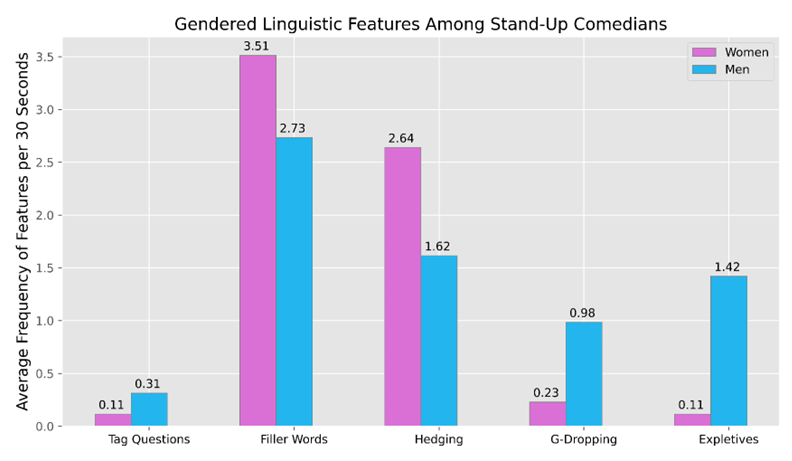
We found that the average usage of the relevant linguistic features per 30 seconds for males in our data set was: 0.31 tag questions, 2.73 filler words, 1.62 hedges, 0.98 g-drops, and 1.42 expletives. In contrast, the average usage per 30 seconds for females was: 0.11 tag questions, 3.51 filler words, 2.64 hedges, 0.23 g-drops, and 0.11 expletives. The figures below show a comparison between male and female comedians for the linguistic features mentioned.

Fig. 1: Bar graph showing average feature use for men and women comedians

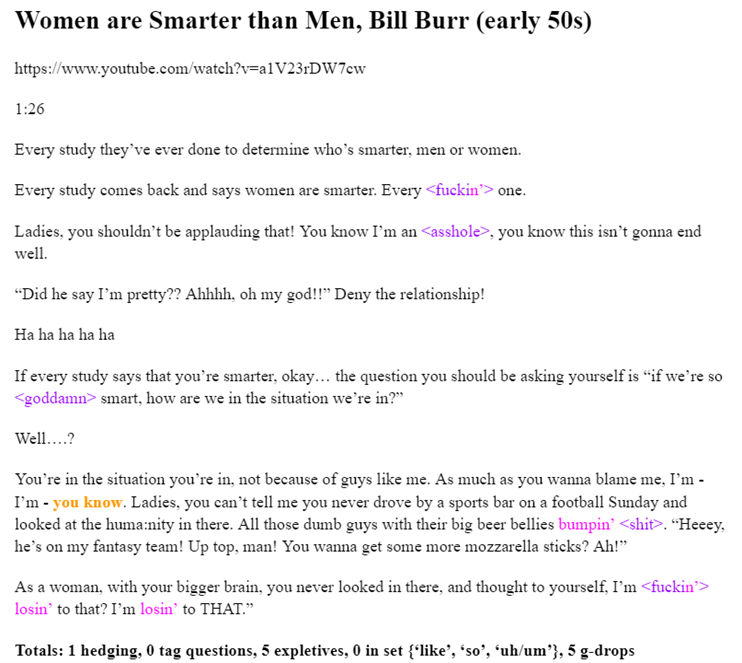
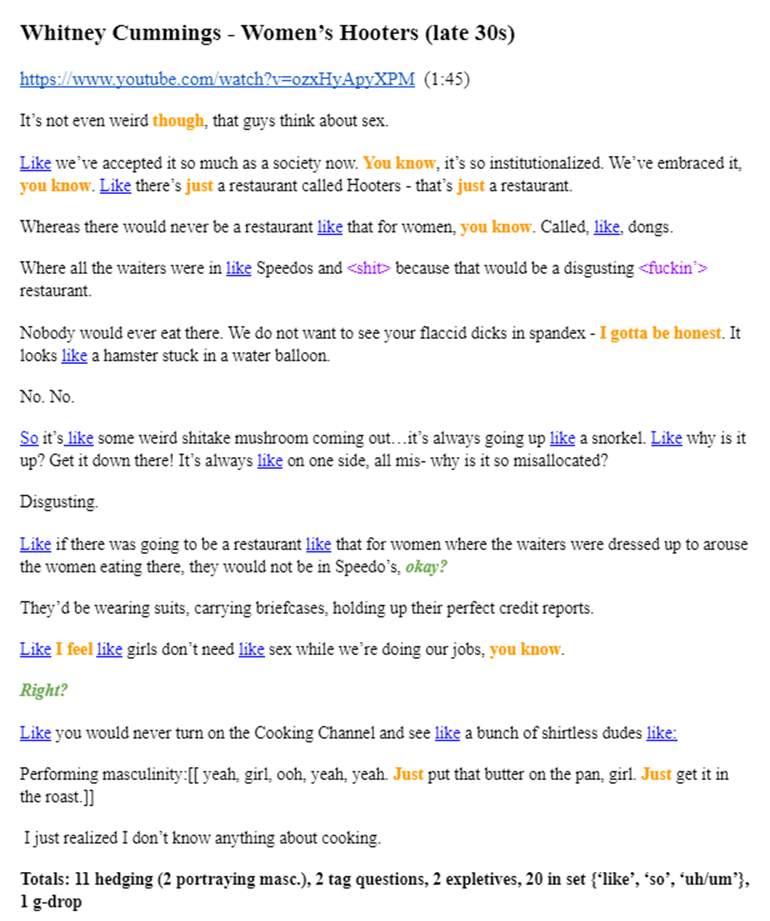
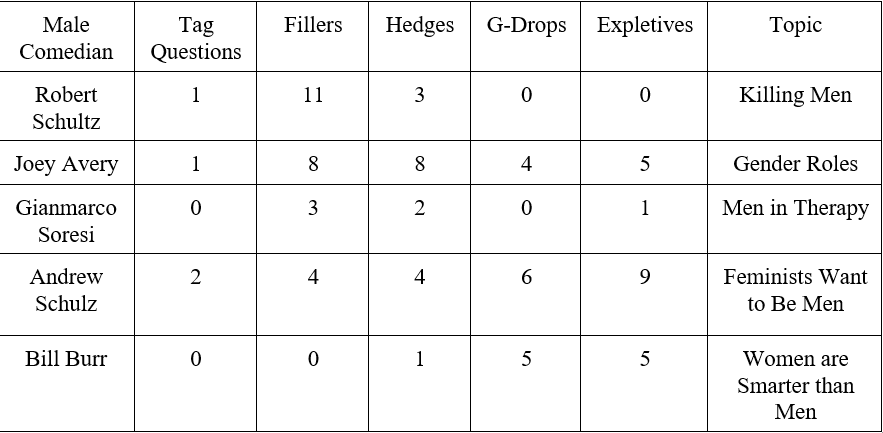
Our most “classic” exemplifiers of masculine and feminine speech were Bill Burr and Whitney Cummings, respectively. Bill Burr used many expletives and g-drops, and very few hedges and fillers. In contrast, Whitney Cummings used many hedges and fillers, and very few g-drops and expletives. We will relate each linguistic feature to them for context but note that they are the extreme ends of the spectrum. Transcripts from each comic’s set, as well as our summarized dataset, can be found below.

Fig. 2: Transcript of Clip by Bill Burr
Fig. 3: Transcript of Clip by Whitney Cummings
Table 2 Breakdown of Linguistic Features in Men’s Sets
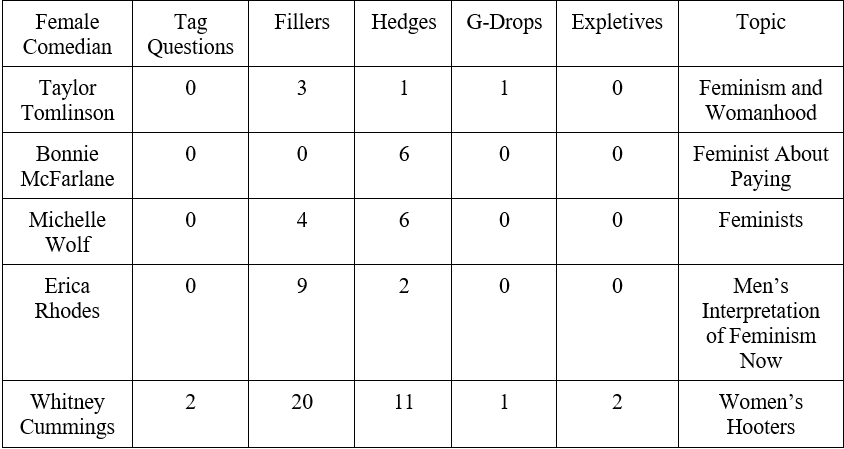
Table 3: Breakdown of Linguistic Features in Women’s Sets

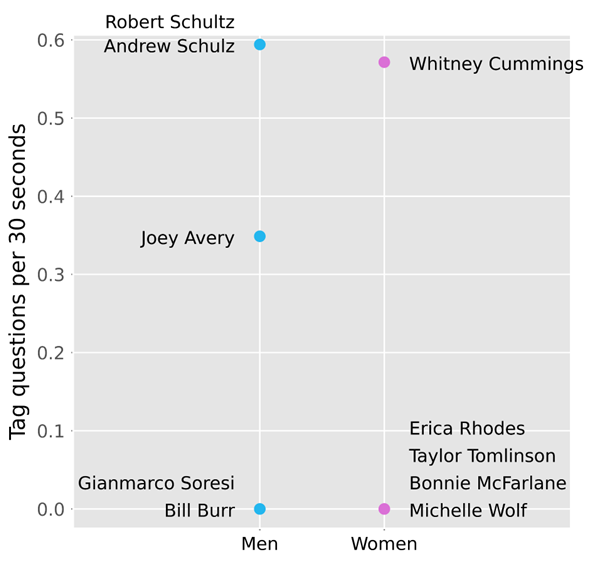
First, we found that there wasn’t a big difference in the usage of tag questions between male and female comedians. Tag questions weren’t used very frequently regardless of gender; less than one time per minute on average, with half of our comedians not using any at all.

Fig. 4: Scatter Plot of Men and Women’s Tag Question Use

Bill Burr didn’t use any tag questions, while Whitney Cummings utilized tag questions twice. This difference does not appear significant across the rest of our comedians.

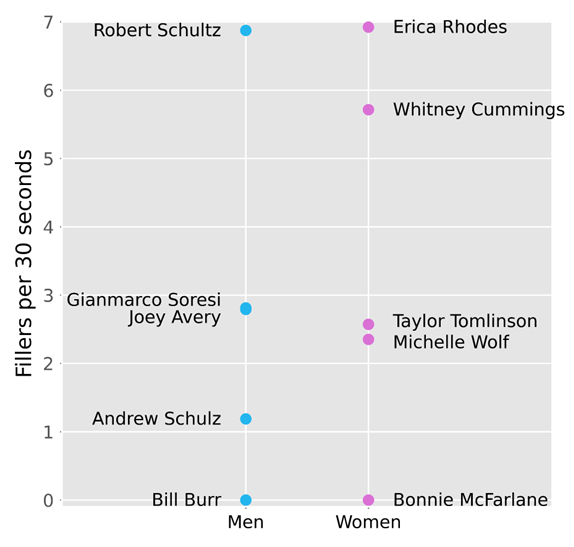
We saw that our female comedians used fillers more often than their male counterparts, by about one or two every 30 seconds. The graph below does show one male outlier, who was one of the younger men on stage. This will be touched on in the discussion.

Fig. 5: Scatter Plot of Men and Women’s Filler Use

Bill Burr didn’t use any fillers, whereas Whitney Cummings used an average of six filler words per thirty seconds. However, the results were more marginal over the full dataset, with an average difference of just one filler per minute between men and women.

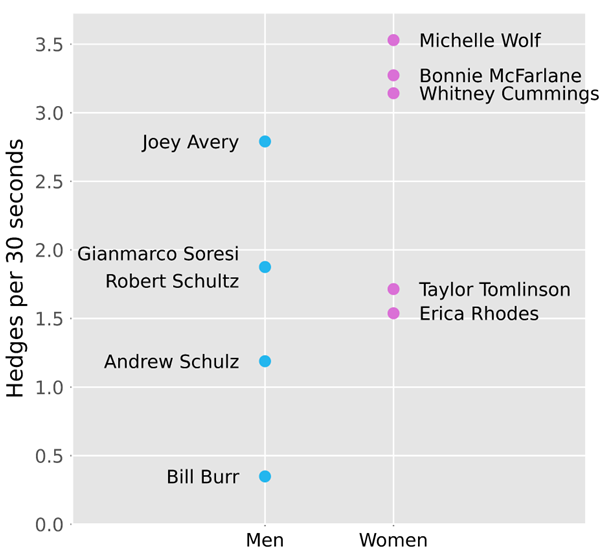
Our female comedians tended to hedge at least once more per 30 seconds than our male comedians. The figure below shows that three out of five female comedians hedged more than the top-hedging male.

Fig. 6: Scatter Plot of Men and Women’s Hedge Use

Bill Burr accordingly hedged one time, whereas Whitney Cummings utilized hedging eleven times in a similar timeframe. While there appears to be a correlation between hedging and feminine speech in our dataset, it’s not conclusive according to our statistical analysis.

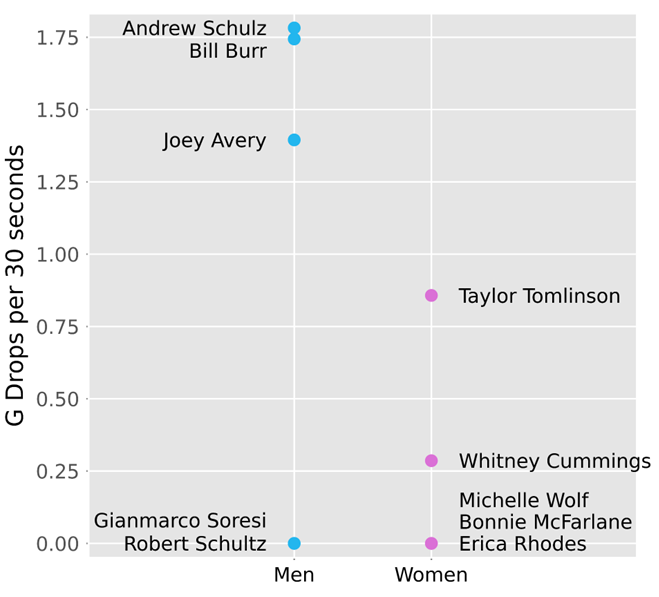
G-dropping results appeared to be much more correlated to gender than any previous linguistic feature we measured: the average female used it four times less than the average male comedian. While three female comedians and two male comedians didn’t use any g-dropping, among those who used it, the men did so much more frequently, as seen in the graph below.

Fig. 7: Scatter Plot of Men and Women’s G-Drop Use

Bill Burr and Whitney Cumming utilized g-dropping five times and one time, respectively. Though there appeared to be a correlation, with a 124% difference between the average usage of g-dropping between males and females, there wasn’t statistical significance in our small dataset.

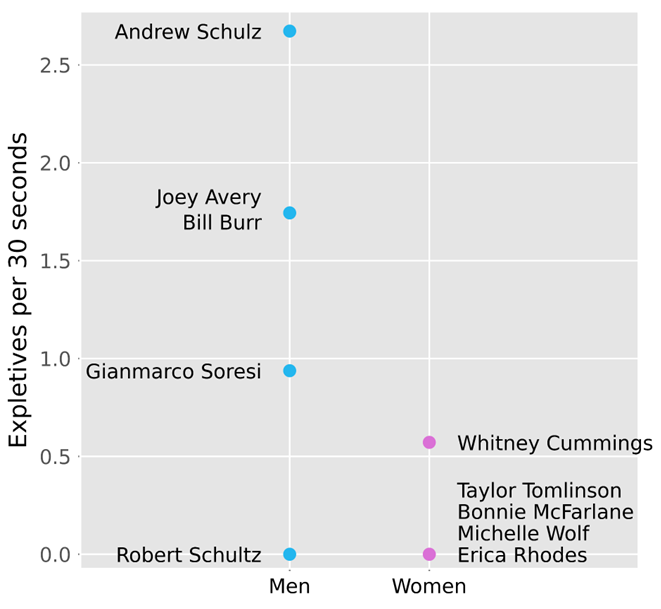
One linguistic feature that proved to have statistical significance was the usage of expletives. Four out of five female comedians didn’t use expletives at all, while only one male comedian didn’t use them. The males that used them did so at a rate ranging from two per minute to more than five per minute, as seen in the graph below.

Fig. 8: Scatter Plot of Men and Women’s Expletive Use

Bill Burr used expletives five times compared to Whitney Cummings’ two uses. Interestingly enough, Whitney Cummings was the only female comedian who used any expletives at all, even though she tended to (otherwise) stick to what previous research deemed feminine speech.

Overall, the biggest differences between males and females in our data are in hedging (47.9%), which was slightly more common in females, g-drops (124.0%), and expletives (171.2%), which were both more common in males. Tag questions were rarely used by any of the comedians, so even the 95% differential between the sexes is statistically meaningless. Filler phrases had a slight correlation with being more common in feminine speech, but not a very significant one (25.0% differential).

Discussion

An overall examination of the results of our data shows several things.

First, some linguistic features thought to be more characteristic of women have indeed held up in a stand-up context as well as over several decades. For example, we saw that women did indeed hedge more frequently, and used much fewer expletives and g-drops than men on stage. It’s important to note that the difference between men and women for hedging wasn’t large enough to be significant. However, we can say that there might be some correlation between gender and frequency of hedge use. The results were similar for g-dropping and fillers, as they both appeared to have a correlation in our data, however, not enough to be statistically significant. As an example, female comic Taylor Tomlinson hedged twice with one g-drop and three fillers in a 35-second clip, while male comic Gianmarco Soresi hedged twice as well, with no g-drops and three fillers, in a 32-second clip. This comparison shows very little difference between them, pointing to placement somewhere in the middle of the spectrum of gender performance.

For expletive use, though, the difference between men and women was statistically significant – that is, large enough to make generalizations. This conclusion does stem from research showing that men are more casual in conversation than women, allowing for less formal speech.

However, plenty of linguistic features thought to be more characteristic of men or women in the past don’t hold up as well anymore. This could be due to simply the passage of time, the shift to allowing for more fluid gender identities in contemporary times, or potentially because of standup being a different kind of linguistic environment in that it is non-conversational. While we expected to find a more significant gap between men and women in their use of linguistic features, in reality, speech was a lot more ambiguous and closer rather than disparate.

We can look at the use of filler words for an example of this ambiguity. Though there can be exemplified differences between male and female performance, such as what we see between Whitney Cummings and Bill Burr, in today’s age it is much less common to exert these drastically different performances. Instead, we see more use of fillers somewhere in the middle of the spectrum, with most comedians closer to the center than to either traditionally gendered pattern. Thus, we end up with our dataset showing a very marginal difference.

Some other observations that we made revolved around the differences within the group of male comedians. The two male comedians who displayed the most classically ‘male’ use of the features we examined were the two oldest, being born in the 1980s or earlier. The younger ones, born in the early 1990s or later, were much more likely to use features traditionally associated with women. That is, younger men were more comfortable using hedges and filler words especially. This observation might indicate that younger men are becoming more comfortable with performing certain aspects of femininity, which reflects a greater trend in playing with gender in the last few years. Alternatively, it could reflect the increasing acceptance of traditionally female features of speech – its dissociation from femininity and increased generality.

Conclusion

An analysis of contemporary stand-up comics for features of speech marked feminine or masculine showed that conclusions made in 20th-century literature no longer hold up. Features that were characteristic of ‘women’s language’ in 1990 are, thirty years later, more general and practiced by male speakers as well as females – especially by younger men who grew up in less rigid society than their older counterparts. This difference between younger and older men may indicate that younger men are becoming more comfortable performing certain aspects of femininity. This perhaps reflects a greater trend towards playing with gender and comfort in gender-expansiveness or perhaps reflects women’s speech becoming less associated with women and more acceptable in general society as time passes.

It is important also to recognize that stand-up comedy is unique among linguistic discourse contexts, as there is no back-and-forth. Since stand-up language is monologuing rather than conversational, this may factor into how speakers perform gender, and it sets this study apart from earlier studies like Lakoff’s.

Looking forward, there are multiple ways to expand this study to include a more diverse group of comedians. One way to do this would be to examine how supposed ‘gender’ differences look when race is accounted for. Lakoff and other researchers focused their observations on white women – therefore, women (and men) who aren’t white may actually display very different expressions of language, with different characteristics and perhaps at different frequencies.

Another forward-looking study could include comedians of a gender-expansive experience. Comedians who are not locked to an identity as either ‘man’ or ‘woman’ may display yet even more different expressions of gender in their language. It’s important to include not just individuals who fit a binary definition of gender. Though this concept was much less spoken about during the original studies conducted in the 1970s-1990s, society more willingly recognizes the expansive nature of gender and performance now, and linguistic study should not only reflect that sentiment but set out to describe how it fits in with language and linguistic study.

With ever-persistent debates about whether language will ever really be as egalitarian, as gender-neutral, as inclusive as we want it to be (“Women are witches, men are studs”), it is our job as linguists to catalog, describe, and advocate for change on the linguistic level so that it can influence and be influenced by the social level.

References

Cameron, D. (1997). Performing gender identity: Young men’s talk and the construction of heterosexual masculinity. In On Language and Sexual Politics (1st ed., pp. 47-64). Taylor & Francis Group.

Fischer, J. L. (1958). Social influences on the choice of a linguistic variant, WORD, 14:1, pp. 47-56, DOI: 10.1080/00437956.1958.11659655

Gordon, Mo. (2023, April 13). ‘Women are witches, men are studs.’ Universiteit Leiden, www.leidenlanguageblog.nl/articles/women-are-witches-men-are-studs-blog-mo-gordon.

Güvendir, E. (2015). Why are males inclined to use strong swear words more than females? An evolutionary explanation based on male intergroup aggressiveness. Language Sciences, vol. 50, pp. 133-139. https://doi.org/10.1016/j.langsci.2015.02.003

Lakoff, R. (1998). Extract from Language and woman’s place. In D. Cameron (Ed.), The Feminist critique of language: A reader (2nd ed.) (pp. 242-252). London, England: Routledge, Taylor and Francis Group.

Solbes-Canales, I., S. Valverde-Montesino, & P. Herranz-Hernández. (2020). Socialization of gender stereotypes related to attributes and professions among young Spanish school-aged children. Frontiers, www.frontiersin.org/articles/10.3389/fpsyg.2020.00609/full.

Tannen, D. (1990). You just don’t understand: Women and men in conversation. Ballantine Publishing Group.

TED. (2014, July 31). Men, women and language — a story of human speech | Sophie Scott | TEDxUCLWomen.  YouTube. https://www.youtube.com/watch?v=iteK4P0nDO8

Appendix

Video Links:

Men in Therapy – Gianmarco Soresi

Women are Smarter than Men – Bill Burr

Feminists Want to be Men – Andrew Schulz

Gender Roles – Joey Avery

Feminism and Womanhood – Taylor Tomlinson

Men’s Interpretation of Feminism Now – Erica Rhodes

Women’s Hooters – Whitney Cummings

Feminists – Michelle Wolf

Feminist About Paying – Bonnie McFarlane

Killing Men – Robert Schultz

Transcripts:

Transcripts Repository

[/expander_maker]

, , , , , ,

How Polite is Your Professor? A Gendered Analysis of Hedging as a Tool for Student Engagement at UCLA

Layla Hernandez, Yasleen Robinson, Charlotte Norris

Throughout their lectures, professors typically engage with their students. This process often requires the professors to implement certain linguistic devices in their speech that allow for them to sound less aggressive and threatening. These linguistic features include forms of hedging. Both male and female professors rely on hedges to further display politeness when interacting with their students. In this study, we focused on how professors utilize these hedge words in ways that promote themselves in ways that are more approachable and less authoritative. We hypothesized that female professors would utilize hedges more than their male professor counterparts. Specifically focusing on the frequency of the usage of hedge words, we analyzed four sociology professors from UCLA through recordings after attending their lectures. We carefully listened to each audio and transcribed them through Conversational Analysis (CA) to further allocate the number of hedges they used when speaking with their students. A detailed analysis revealed that male and female professors do not yield significant patterns in their uses of hedges. In fact, they used them very similarly in terms of frequency and style.

[expander_maker id=”1″ more=”Read more” less=”Read less”]

Introduction

For our project, we investigated the hedges that are used by both women and men professors during their interactions with their students during their lectures. More specifically, we aimed to highlight how the usage of these linguistic markers help to ease the declarative statements they share with their students. We hypothesize that the women professors will hedge more frequently throughout their discussions with their students because hedging is unequivocally involved and ingrained in women’s speech (Lakoff, 1972). We also hypothesize that both male and female professors will utilize hedging as a means to soften their assertive/strong statements to further promote interpersonal interaction and more inclusivity within the classroom.

Background

Professors and their approaches hold great influence over the success of their students. In this way, they consciously work to provide interpersonal interactions with their students while also actively working to supply a learning environment that is inclusive and welcoming (Van Petegem et al., 2005). This process typically requires the professors to employ linguistic strategies that portray them to be less threatening and aggressive through their choice of words (hedging). Hedges are words or utterances that serve to “reduce the force of a statement” (Wright & Hosman, 2009, p. 143). The professor’s reliance on hedge words prevents them from sounding or behaving like they know everything, rather it serves as a buffer that allows for a response or objection. In this way, professors create an open forum in which students feel comfortable probing or questioning the content they are teaching without fear of judgment. Our focus will also turn to the gendered patterns of hedging among men and women professors, specifically focusing on who uses hedges more frequently.

Methods

Our main focus included examining instances of hedging and their role in yielding the authority of professors in student-teacher interactions. We focused specifically on UCLA professors in the Sociology department to avoid linguistic variation that could occur due to variations in lecture content. We collected recordings from 4 different Sociology professors at UCLA which will include three males and 1 female. We collected our data through audio recordings after attending 4 different lectures, where we keyed in on student and professor interactions. We extracted our data from two interactions from each lecture. Where we then transcribed each exchange through Conversational Analysis (CA). Through this form of analysis, we highlighted the different hedges that both female and male professors use to soften their strong statements when speaking to their students. To achieve this, we looked at each transcript individually to identify patterns specific to each professor followed by a comparison between professors of the same gender and then across genders to look for any similarities or differences that are connected to larger gendered-language patterns. We also wanted to measure the frequency of how many times each hedge word was used by each professor. Thus, after transcribing we allocated the number of hedge words they included in their interactions.

Results and Analysis

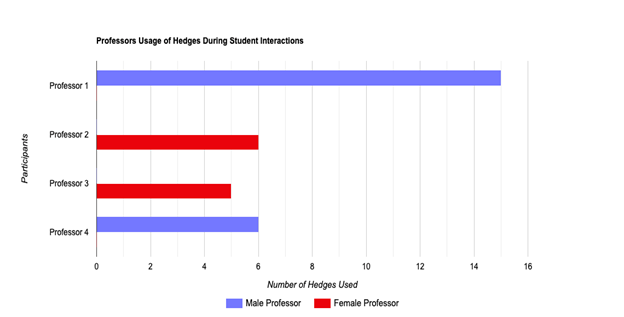
Interestingly, our results indicated that there was not a significant pattern when comparing hedge use between female and male professors. Our initial hypothesis that women would produce more instances of hedging when interacting when students in comparison to male professors was completely in misalignment with our results. In contrast, we found that both genders utilize hedges in similar ways that would further elevate their statements from sounding too forceful or impolite. We also found that in terms of frequency, male and female professors depend on the practice of hedging similarly. There wasn’t a significant pattern that demonstrated that one gender utilized the linguistic device more than the other. If anything, it dispels the common notion that women rely on hedging more than men because we see that is not the case here, both genders rely on hedges almost equally. 

Figure 1: Professors’ Usage of Hedges During Student Interactions

Our first participant, professor 1, was unique because he was the only male as well as the only professor to demonstrate a wide and dependent use of hedging when interacting with his students. The bar graph above illustrates how professor 1 drastically differs from the other professors when examining their reliance on hedges during their interactions with their students. After completing professor 1’s (CA), we found that he accounted for a total number of 15 different instances of hedging. Each professor yielded some form of hedging, however, it seems that professor 1 superseded every other professor in terms of hedge use. After comparing him to the other professors that did not align with this pattern, we connected his use of hedging to his linguistic style and postulated that hedging may be a central linguistic feature in his everyday speech.

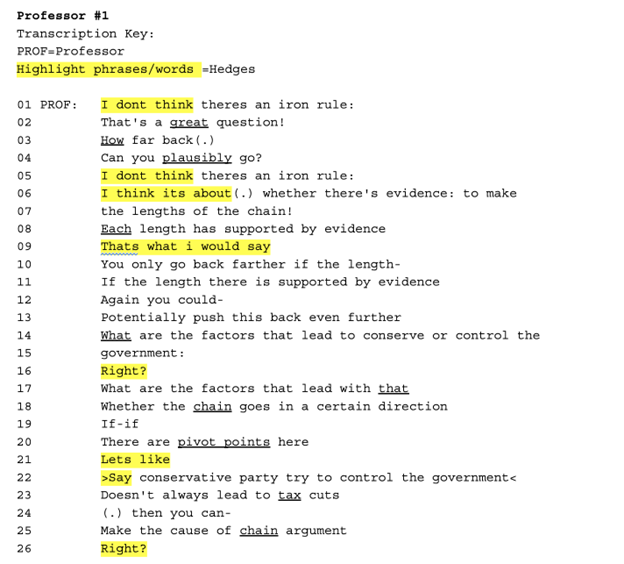
Figure 2: Transcription excerpt of Professor 1’s use of hedging

In the (CA) extracted from Professor 1’s (male) lecture, you can see a handful of the hedge words he used while engaging with his students. We classified his frequent use of the word “right” as a hedge word because we noticed that he would insert them right after finishing his strong and declarative statements. It was apparent that he depended on “right” as a means to establish an open forum that allowed for the student to respond or interject. We also interpreted his usage of “right” as a way to provoke silent agreement. This hedge word was especially important when interacting with other students as the professor relied on it with each interaction he made with his students. We also highlighted that the professor used the hedging phrase “I don’t think” several times as well. It was very clear to us that he depended on this phrase as a means of expressing uncertainty. This is an important practice because professors work to avoid behaving or sounding like they know everything because it leaves room for students to object, gauge, or comment on their statements.

In contrast, Professor 2, 3, and 4 all displayed significantly less instances of hedge use during their interactions in comparison to Professor 1. In contrast, professor 2 (female) and professor 3 (male) included hedge words 6 times whereas professor 3 (female) only displayed 5 instances of hedges when engaging with her student. Our findings indicated that both genders relied on hedges similarly, in terms of numbers and surrounding context. Each professor integrated some sort of hedge word in ways that lessened the force of their statement, signaled agreement, or expressed cautious uncertainty.

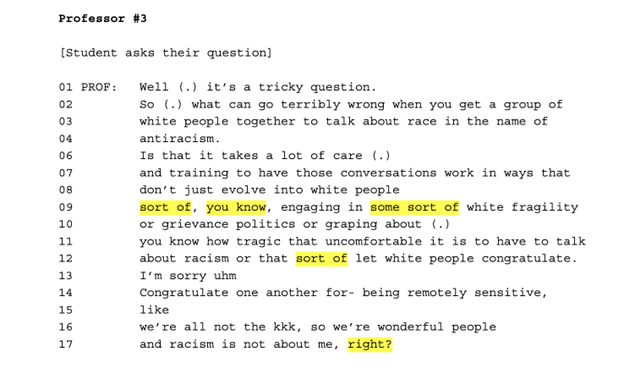
Figure 3: Transcription excerpt of Professor 3’s use of hedging

For instance, as depicted in the conversational analysis above professor 3 (female) sporadically included hedges like “sort of” and “you know” to soften her claims and statements. We concluded that she turned to this linguistic variable to display politeness and avoid authoritative brute force that would make her sound less approachable and more aggressive. This approach allowed for a fluid and authentic interaction when replying to an inquiry made by her student, one that didn’t involve the professor imploding information on the student but rather one that left room for doubt and allowed room for responses, objections, and even interjections.

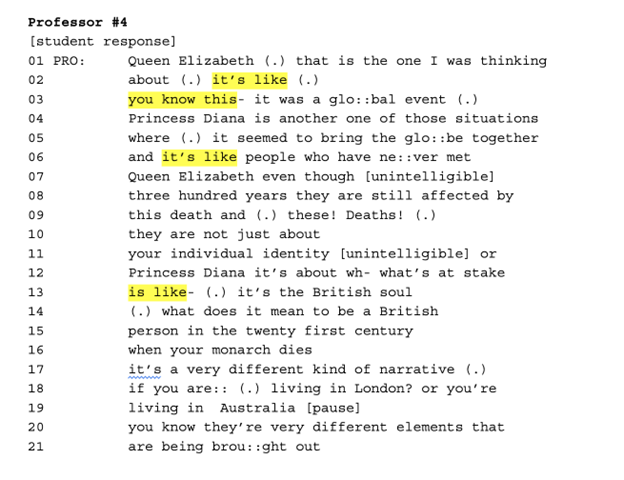
Figure 4: Transcription excerpt of Professor 4’s use of hedging

Similarly, Professor 4 (male) employs the linguistic device to lessen the magnitude of his assertions. The (CA) above shows that he utilized the phrase “it’s like” on three different occasions to display some sort of indirectness. We deemed the phrase as an instance of hedging because he used it to ease his claims so that he didn’t sound overly forceful or assertive. We also derived the conclusion that he could be employing this device as a way to create an inviting forum for further commentary or inquiries. After gathering our observations, we found that each professor depended on hedges in ways that further display themselves along with their statements as more polite to steer clear from sounding rude or unapproachable. Some obviously more than others but regardless this linguistic variable enabled them to engage with their students in an authentic and less authoritative manner.        

Discussion and Conclusion

To conclude, our results revealed that both male and female professors utilize hedging to soften their statements. We found that professors exhibited hedging as a means to soften their statements to some degree in their speech. Professors 2, 3, and 4 used hedging in similar amounts and Professor 1 stood out as an outlier in his much more frequent use of hedging. This finding contradicts our hypothesis that female professors would hedge more frequently than men. It also contradicts Lakoff’s (1972) findings and his claim that hedging is an integral part of women’s speech, so much so that women hedge more frequently than men. If our findings had been in alignment with Lakoff (1972), we would have seen female professors hedge more frequently than male professors but that was not the case.

While we did not find noticeable differences in use of hedging on the basis of gender, further analysis of our data with a less specific focus on a particular linguistic variable could reveal patterns that are not visible when the scope is narrowed on one variable. Our study was faced with multiple limitations that may have affected the outcome. With a larger sample of professors and more time to analyze the data, patterns that couldn’t be found or generalized with such a small sample could emerge. Our teaching population was also limited to one subject (sociology) and one educational setting (large university). An analysis across subjects or in different educational settings that have different goals for students might have led to different results.

There are a few other explanations for our findings and directions that our study could be taken in. Perhaps there were no noticeable patterns across male and female professors because professors have different styles of engaging students during interactions. Professor 1 (male), who hedged noticeably more than his colleagues, may choose to engage his students in direct interaction through hedging while the other professors may choose other linguistic tools to achieve the same goal. It is also possible that these professors are not focused on creating an inclusive lecture through student interaction and instead attempt to foster engagement through other parts of their lecture, resulting in a lack of hedging in their speech. Maybe their focus is not on creating an inclusive environment and rather each professor has a unique goal in the classroom that further influences their style of communication.

Furthermore, our findings raise some important questions concerning gender dynamics in teaching and in other social contexts. The Lakoff (1972) study demonstrated that gendered linguistic patterns do exist in some social contexts, but our research did not find this pattern in one particular context of university teaching. Perhaps, our findings could influence or lead to further research that could investigate how gendered speech patterns that have been documented in some contexts (e.g. hedging) appear in other social contexts such as other professional environments, in conversations between established friends, or conversations between strangers.

References

Lakoff, Robin. (1972). Language and Woman’s Place. Language in Society, 2(1), pp. 45-80. http://www.jstor.org/stable/4166707?origin=JSTOR-pdf

Oliveira, A.W., Sadler, T.D., Suslak, D.F. (2007). The linguistic construction of expert identity in professor–student discussions of science. Cultural Studies of Science Education, 2, pp. 119-150. https://doi.org/10.1007/s11422-006-9039-4

Van Petegem, K., Creemers, B. P. M., Rossel, Y., & Aelterman, A. (2005). Relationships Between Teacher Characteristics, Interpersonal Teacher Behaviour and Teacher Wellbeing. The Journal of Classroom Interaction, 40(2), pp. 34–43. http://www.jstor.org/stable/23870662

John W. Wright II & Lawrence A. Hosman (1983). Language style and sex bias in the courtroom: The effects of male and female use of hedges and intensifiers on impression information. Southern Journal of Communication, 48(2), pp. 137-152. https://doi.org/10.1080/10417948309372559

Zakia, Anisa (2018) Pragmatic study on hedging as politeness strategy in online newspaper. Universitas Islam Negeri, pp. 13. https://repository.uinjkt.ac.id/dspace/handle/123456789/45815

[/expander_maker]

, ,
Scroll to Top