celebrities

Dialogues of Fame: Unveiling Gender Dynamics in Celebrity Interviews

Elizabeth Escamilla, Penelope Hernandez, Kenzie MacDougal, Jason Ye

Human interaction is complex and, at a sociolinguistic level, can be challenging to parse. With that in mind, we chose to analyze celebrity interviews — definite and structured slices of conversation whose participants were conscious of the invisible future viewer. Informed and inspired by studies such as Julia T. Wood’s “Gendered Media: The Influence of Media on View of Gender,” Rossi and Stiver’s “Category-Sensitive Actions in Interaction,” and Tavitz and Perez’s “Language influences mass opinion toward gender and LGBT equality,” we investigate patterns of interaction and indexical shifts as they may be affected by the genders of the involved parties. Taking two-minute segments from each interview, we classified questions as personal or professional and invasive or appropriate. Anything deviating from expected interview etiquette was noted, whether that be word choice or tone of voice, as well as the reactions of any third parties. Most importantly, we classified the ways in which interviewees responded to invasive lines of questioning, specifically as one of the following: retaliatory questioning, a passive aggressive remark, a humorous deflection, a partial answer, or a direct answer. A significant trend of women receiving more invasive and personal questions quickly appeared, though our investigation suffers from a possible selection bias. Therefore, future investigations should pull from a much larger and more varied sample of interviews.

[expander_maker id=”1″ more=”Read more” less=”Read less”]

Introduction and Background

Celebrity interviews aren’t conversations that take place in a vacuum; they may be viewed by hundreds, if not thousands, of people. Additionally, the predefined question-answer format of an interview makes it easier to parse for sociolinguistic analysis. Needless to say, we found celebrity interviews to be generous data points for analyzing patterns informed by the gender identities of the involved parties.

Studies like Julia T. Wood’s “Gendered Media: The Influence of Media on View of Gender” show us how the media’s representation of men, women, and queer people may affect a viewer’s understanding of gender roles. Problematic patterns are uncovered: “men and women are portrayed in stereotypical ways that reflect and sustain socially endorsed views of gender… depictions of relationships between men and women emphasize traditional roles and normalize violence against women” (Wood, 2013). Unlike fictional movies and television shows, the interactions recorded in celebrity interviews involve real people, or at least believable personas designed with the public eye in mind. It follows that interviews with respected, famous individuals play a greater role in influencing what people deem socially acceptable behavior. Thus, when audiences watch mistreatment of women play out with little to no consequence, they may feel validated in their own experiences with misogyny, as either a perpetrator or victim.

Media is both what its creator produces and what the viewer brings to their experience with it. The manners in which interviewers and interviewees carry themselves both reflects and defines current standards for human sociolinguistic communication. Inspired by “Category-Sensitive Actions in Interaction,” we hope to identify patterns in lines of questioning and the manner in which these questions are handled. That study outlines how boundaries of social membership are exposed in ordinary interactions — “the distribution of rights and constraints to perform certain actions creates boundaries in people’s activity space, which are typically respected but sometimes exposed or even crossed” (Rossi and Stivers, 2020). As it pertains to our investigation, when an interviewee is asked an invasive question, this may be classified as a transgression of these silent boundaries.

So, we aim to contribute to a growing body of work suggesting that different behaviors and patterns of interaction vary based on the gender of the interviewee, unfortunately often at the expense of women and queer individuals.

Methodology

We chose to study a variety of variables for this project, including the frequency of personal versus professional questions, word choice and tone of voice used by the interviewer, and the methods interviewees used to navigate controversial questioning.

Upon examining an interview, we followed a set of steps to extract and prepare the data for analysis moving forward. First, it’s important to classify any questions as being professional, personal, appropriate, or invasive.  Professional questions relate strictly to the interviewee’s work, while personal questions deviate from this. Similarly, appropriate questions are given to those that are deemed socially acceptable, such as topics commonly discussed with acquaintances, while invasive questions are not. Next, we take note of any speech or tone used by either interviewer or interviewee that may deviate from the expected etiquette of interviews. From here, we classify methods used by interviewees to ease out of or address uncomfortable questioning. We chose to classify these among the following: direct answer, partial answer, humorous deflection, passive aggressive remark, or retaliatory questioning. Humorous deflection involves the use of humor in an effort to avoid responding to the question. A passive aggressive remark includes any form of snarky or sarcastic response, including those done purposefully to attack the interviewer. Retaliatory questioning is the act of answering the original question with a question of one’s own. Finally, if the selected interview happens to involve more than one interviewee, it is important to also take note of any third party reactions or interactions to awkward questioning. 

To demonstrate our methodology, we will examine an interview with Scarlett Johansson and Jeremy Renner for their film The Avengers (2012). The first question, directed at Johansson, was: “Were you able to wear undergarments [with your costume]?” This question was labeled personal and invasive. Johansson responded with a passive aggressive remark and retaliatory questioning: “I’ll leave it up to your imagination, okay, whatever you feel like I should be wearing or not wearing under that costume” (Passive Aggressive Remark) and “What is going on? What? Since when did people start asking each other about- in interviews about their underwear?” (Retaliatory Questioning). Later on in the interview, Jeremy Renner is asked a question about an injury: “I understand you got hurt pretty badly though. How’d you do that?” This was labeled as professional and appropriate, and no other notes were taken as there was no unique use of tone, word choice, or navigation methods.

Results & Analysis

In this section, we will break down the details of our results and perform analysis on each individual dataset table (interviews); let’s start with some visuals demonstrating the overall statistics.

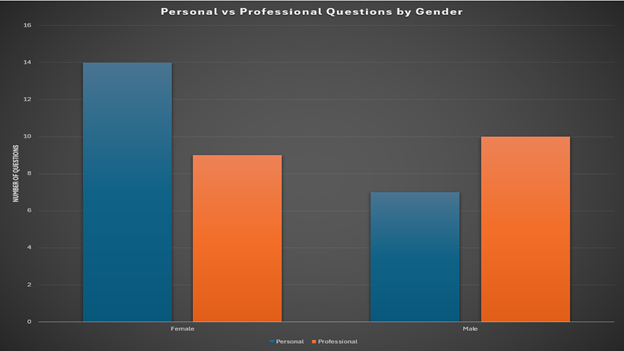
Table 1. This table shows the totaled data from individual datasets (interviews) into one table.


Figure 1. This graph shows the number of personal vs. professional questions the interviewees received based on their respective gender.


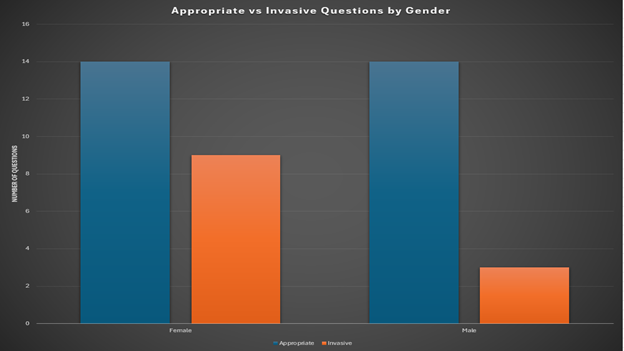
Figure 2. This graph shows the number of appropriate vs. invasive questions the interviewees received based on their respective gender.

Just from these few charts, we can already gauge a sense of skewedness, one that seems to confirm our hypothesis: female interviewees, regardless of the gender of the interviewer, are likely to encounter more personal questions compared to male interviewees. Indeed, we can see that 61% of the questions asked to female interviewees were personal, as opposed to 41% of the questions posed to their male counterparts (49% increase). On top of that, we found 39% of the questions asked to female interviewees were also invasive in nature, while only 17% were invasive for male interviewees, which is a 129% increase, more than twice as many invasive questions. This disparity in question types based on the interviewees’ gender is alarming.

To navigate these invasive lines of questioning, we found that male and female celebrities tend to employ different methods. Female celebrities mostly used retaliatory questioning, humorous deflection, and direct answers — the first two methods being more indirect ways of signaling to the interviewer that the line of questioning was inappropriate. Male celebrities, on the other hand, mostly used direct answers and passive-aggressive remarks, which we speculate is due to men feeling more comfortable asserting themselves in these socially invasive situations.

Now, having discussed the key points of our results, we will provide additional analysis on each individual dataset (interview) separately.


Table 2. Data for The Avengers interview with Scarlet Johansson and Jeremy Renner (Male Interviewer).

This first dataset/interview was already touched on in the previous section on methodology, it suggested the same disparity in question types between the female and male interviewees. Scarlet Johansson received a disproportionate amount of personal and invasive questions and had to defend herself using mainly retaliatory questioning, while Jeremy Renner received only appropriate or professional questions.
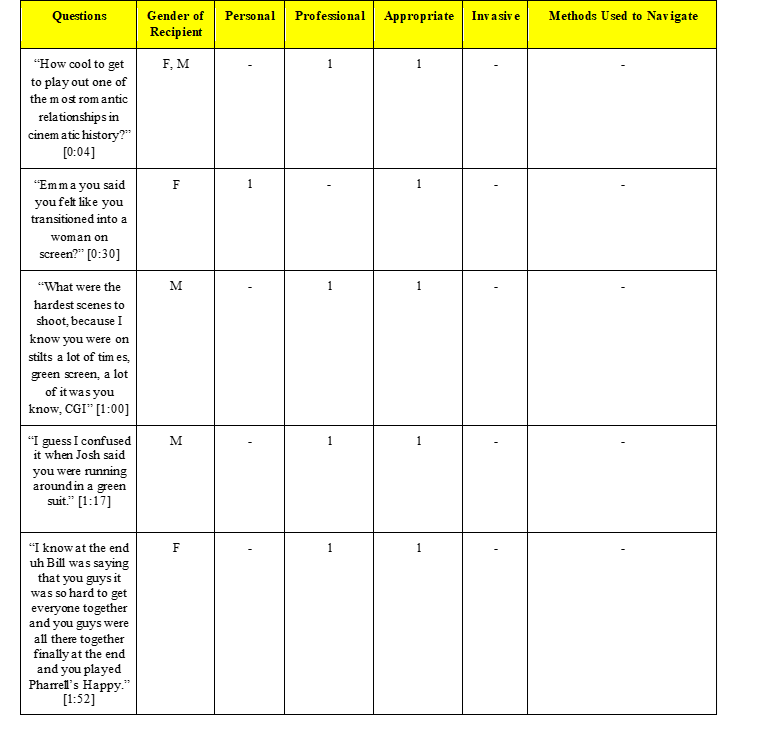
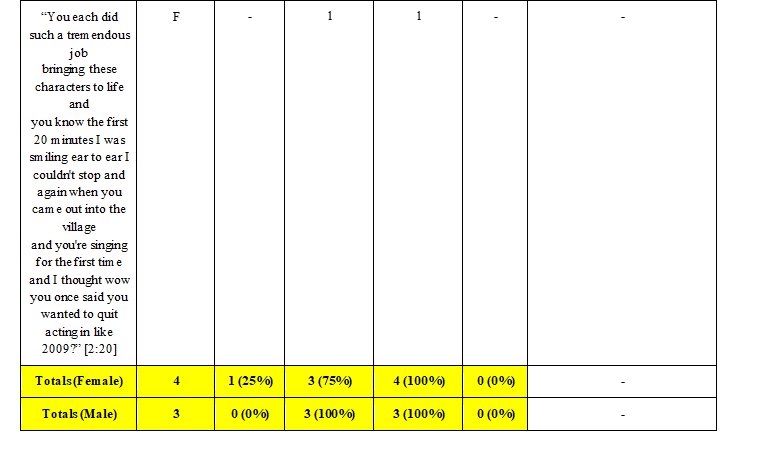
Table 3. Data for Dan Stevens and Emma Watson interview for Beauty and the Beast (Female Interviewer).

This dataset/interview is an outlier amongst all the other datasets. First thing we noticed is the empty “Methods Used to Navigate” column; we didn’t need to fill in any. All the questions were appropriate and professional with only one personal (but appropriate still) question directed at Emma Watson. Interestingly, this is also the only interview in our entire dataset pool with a female interviewer; more evidence and data would be needed to come to any meaningful conclusions about whether the gender of the interviewer correlated with the fact there were no invasive questions.

Table 4. Data for interview with Zendaya, Mike Faist, and Josh O’Connor for Challengers (Male Interviewer).

There are two invasive questions, and both were directed at Zendaya. The note-worthy takeaway here is the fact that both her co-stars Josh and Mike came to her support/rescue with direct answers trying to further alleviate the awkward situation after Zendaya responded initially with a retaliatory question.
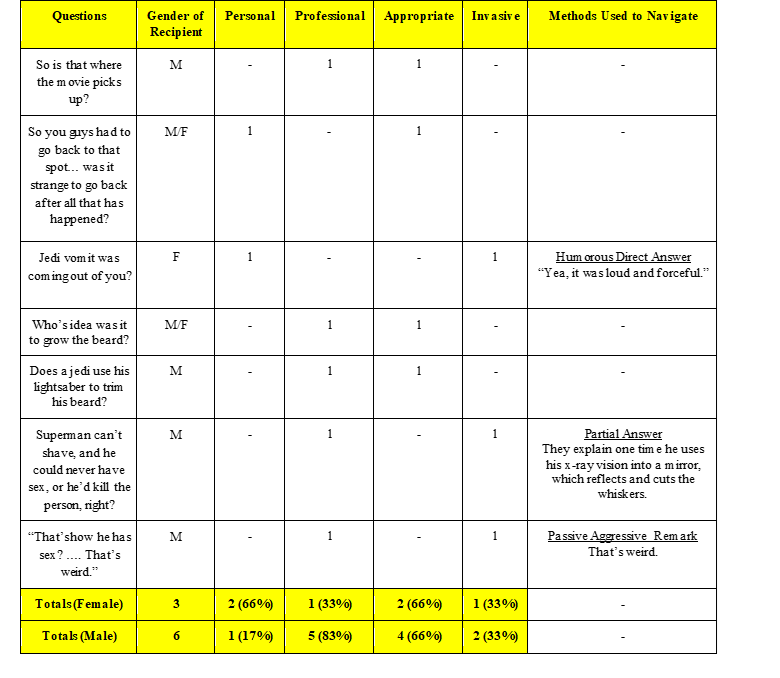
Table 5. Data for interview with the cast of Star Wars: The Last Jedi (Male Interviewer).

Out of the three invasive questions in this dataset/interview, two were directed at a male interviewee (certainly an outlier too in and of itself). Here, we see the use of a passive aggressive remark employed by the male celebrity and a partial answer instead of a more direct one, though the tone does not detract too much from a direct one. The female interviewee employed a humorous direct answer; though a direct answer, the tone is more of just a humorous answer without the impact of a completely direct response.
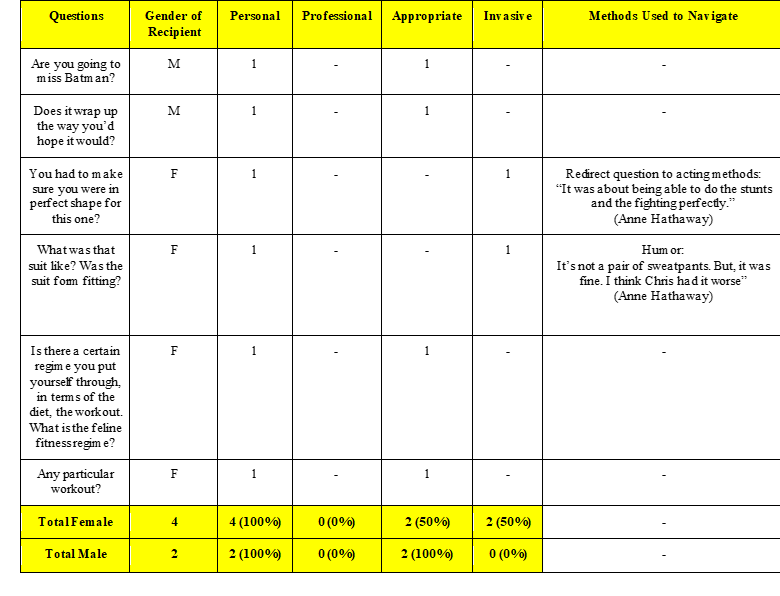
Table 6. Data for interview with Christian Bale and Anne Hathaway for The Dark Knight Rises (Male Interviewer).

Both invasive questions were directed at Anne Hathaway, and humor and deflection were used to navigate the situation. All four of the questions directed at her were personal. While the male interviewee also received only personal questions, none of them were invasive.

Circling back to our hypothesis one more time after the more detailed look into each dataset, we can establish the clear gender bias in type and appropriateness of questions posed to celebrities in interviews, with female celebrities disproportionately subjected to more personal and invasive questions — confirming our suspicions and reflecting societal attitudes and expectations around gender.

Discussion and Conclusions

Based on our findings, we can conclude that there needs to be more discussions about indexicality and societal attitudes towards celebrity culture. Our study found that female interviewees are more likely to receive personal and invasive questions compared to their male coworkers. We observed that interviewees have various strategies to navigate these invasive questions, such as using humor or redirecting the conversation. This finding aligns with our hypothesis and suggests that gender does play a significant role in the nature of questions asked in celebrity interviews.

When comparing our own study with previous research, we can view consistent results with Rossi and Stivers, Tavits and Perez, and Wood. They show that female celebrities often face questions that cross personal boundaries, contributing to the systemic stereotyping and underrepresentation of women in the media. Interestingly, in the Tavits and Perez article, they found that “the effects of feminine pronouns parallel those of gender-neutral pronouns: both heighten the salience of non-males in memory, which is then associated with people expressing more liberal opinions toward women and LGBT groups in politics” (Tavits and Perez, 2019). This article informs us of variables that affect how a viewer might perceive the interactions captured in celebrity interviews. To continue, Wood’s article on gendered media can help us to better see the media’s representation of men, women, and queer people and how that may affect a viewer’s understanding of gender roles (Julia T. Woods, 2013). Interviews play a greater role in what is acceptable and what is normalized amongst gender groups.

Our study suggests that the media continues to reinforce traditional gender roles by subjecting female celebs to more personal scrutiny. Wood did a great job at explaining this. She stated how “depictions of relationships between men and women emphasize roles and normalize violence against women” (Wood, 2013). This not only affects the celebrities themselves but also influences public perceptions of acceptable behavior towards different genders. Everything we do in the media gets translated and put into practice outside of the media. So, whatever we allow to happen online will be manifested in real life interactions.

We focused on American celebrities, but if we were to dive into other environments, we would have more evidence to contribute and offer more indications to analyze gender dynamics in media interactions. For the future, we could expand on our study by examining a more diverse range of celebrities, locations, and interview formats.

When we look at our findings holistically, we can understand how the media plays a huge role in shaping public discourse around gender. When we examine the patterns within celebrity interviews, we can see there is a large need for more equitable and respectful media strategies. In our findings, we want to emphasize and analyze these dynamics because they are crucial for social change. It is important to challenge changing media practices so they can better promote gender equality and respect for all individuals in any field of work.

In conclusion, our study not only contributes to understanding media and gender but also calls for a more conscientious and equitable approach to media representation. The media we consume online does not exist in isolation. It shapes our perceptions and behaviors in several tangible ways. Gender biases and stereotypes reinforced in digital content can manifest in real-life interactions. By promoting respectful and equitable interactions online and through interviews, we can adopt more inclusive and respectful behavior towards all genders in our everyday lives, professional or not.

References

Montiel, A. V. (2014). Media and gender a scholarly agenda for the Global Alliance on Media and gender. United Nations Educational, Scientific, and Cultural Organization.

Pewsey, G. (2021, July 13). The world owes Megan Fox an apology. Grazia. https://graziadaily.co.uk/celebrity/news/megan-fox-michael-bay/.

Rossi, G., & Stivers, T. (2020). Category-sensitive actions in interaction. Social Psychology Quarterly, 84(1), 49–74. https://doi.org/10.1177/0190272520944595.

Tavits, M., & Pérez, E. O. (2019). Language influences mass opinion toward gender and LGBT equality. Proceedings of the National Academy of Sciences, 116(34), 16781–16786. https://doi.org/10.1073/pnas.1908156116.

Wood, J. T. (2013). Gendered Media: The Influence of Media on Views of Gender. Chapel Hill, NC; Department of Communication, University of North Carolina at Chapel Hill.

[/expander_maker]
, , , ,

Gender Bias in Celebrity Interview Questions: Topic Study at the Oscars 2023

Sofia Duffy, Lauren Nemeh, Audrey Tseng, Venus Vu

Red carpet interviews at award shows are often a hot topic that circulates on the internet and are viewed by millions of people. This being said, the quality and nature of what is said in the interviews can wildly influence the viewers. Previous research and social movements have shown that female celebrities who participate in these interviews are more likely to receive questions and comments related to their appearance compared to their male counterparts. With this in mind, we aimed to investigate gender bias in celebrity interviews through analyzing interview clips of the 2023 Oscars red carpet interviews. Specifically, we examined if there were differences in the theme of questions asked (word choice) and the quality of interviewers’ voice (tone) when interviewing male celebrities versus female celebrities.

[expander_maker id=”1″ more=”Read more” less=”Read less”]

Introduction

Celebrity interviews on the red carpet hold a prominent position within the fabric of award shows, captivating global audiences as they eagerly seek glimpses into the lives of their beloved stars. However, within this realm, a disconcerting disparity often emerges in the nature of questions posed to male and female celebrities, serving as a reflection of deep-seated gender biases and the perpetuation of societal expectations. In our study, we set our sights on the precise queries directed at celebrities during the 2023 Oscars, embarking on an investigation to unravel the discrepancies in how interviewers engage with male and female celebrity interviewees. Through a meticulous analysis of interviewers’ word choice and tone, our objective is to cultivate a comprehensive understanding of the pervasive gender biases that permeate these high-profile interactions. In doing so, we aim to unearth patterns that mirror societal gender biases and shed light on the implicit biases harbored by the interviewers themselves. By undertaking this critical exploration of language use in celebrity interviews, we contribute to the ongoing discourse surrounding gender equality in the realm of entertainment and challenge the perpetuation of gender stereotypes on the illustrious red carpet.

Background

Celebrities hold a unique position in society due to their high-profile status and influence. The media coverage they receive significantly shapes public perceptions, particularly among impressionable children and teenagers who often look up to their favorite stars. Red carpet events are particularly important because they are televised occasions with substantial social significance. Among these events, the red carpet at the Oscars stands out as the most prestigious. Celebrities are asked a series of questions, and these interactions are recorded and broadcasted worldwide. 

A study from 1956, “Age and Sex in the Interview” by Benny et al., offers valuable insights into the intersectional relationship between age and sex. Their analysis focuses on responses and utilizes post-interview surveys to gauge participants’ perspectives. Their research reveals a consistent pattern of communication inhibitions between individuals of the same age but different sexes, particularly among young men and young women. These findings underscore the complexity of interview interactions and the influence of societal expectations. 

The Oscars red-carpet pre-show in question, with its apparent glamor and spontaneity, hides a reality that is heavily scripted and choreographed, where questions and reporters are carefully selected to meet industry demands and viewer expectations. Beneath the glamor of red-carpet lies a troubling tradition of objectifying the female body as a spectacle. Over the years, women have been typecast as the sole consumers of topics involving beauty and fashion, influenced by the rise of the beauty industry and photography (Lundén, 2021, p. 212). This has perpetuated a questionable tradition of objectification, reinforcing societal beliefs about gender roles. The red carpet has become a platform where women’s appearances are harshly criticized, focusing on mean-spirited evaluations of their bodies rather than celebrating their talent and accomplishments. Additionally, while women often bear the brunt of fashion-related questions, this does not exempt men from scrutiny. Fashion discourse has expanded to include men, but the discernible imbalance in how men and women are judged persists. 

However, the emergence of the #askhermore movement in 2015 reflects a growing resistance to the recurring practice of asking women the superficial “what are you wearing” question on the red carpet. The movement encourages reporters to delve deeper and ask female celebrities more substantial questions beyond their clothing choices. In our research, we will concentrate on the questions asked to both male and female celebrities, shedding light on patterns that mirror societal gender biases and expected gender performance.

In the context of award shows, red carpet celebrity interviews hold great significance as they attract thousands of viewers seeking insights into the inner lives of these celebrities. However, the quality of questions posed to male and female celebrities differs significantly, with women often subjected to shallower inquiries about their appearance rather than their careers. The central focus of our research is to investigate the disparities in the treatment of male and female celebrity interviewees during the 2023 Oscars. Specifically, we aim to analyze the word choice and tone utilized by interviewers in their interactions with these individuals. By examining these linguistic aspects, we seek to gain a deeper understanding of the gender biases that manifest in celebrity interviews. Our research question revolves around whether interviewers hold implicit gender biases, leading to a tendency to ask female celebrities more superficial questions compared to their male counterparts. Through this inquiry, we aim to contribute to the broader conversation on gender equality within the entertainment industry and challenge the perpetuation of gender stereotypes on the red carpet.  

Project Design

For our data sample, we selected 16 video clips from the 2023 Oscars red carpet. Since we are focusing on the gender difference of the celebrity, we selected 8 interview clips where the interviewee is a male celebrity and 8 interview clips where the interviewee is a female celebrity. To reach our sample size, we gathered video clips from three media sources: Extra TV, Vanity Fair, and E! News.  In total, we analyzed 49 minutes and 53 seconds of interviews. The time varied from interview to interview, from an interview that was 41 seconds long to one that was 4 minutes and 49 seconds. We aimed to analyze whether there are differences in the interviewer’s tone and word choice based on the gender of the celebrities being interviewed. To do so, we first transcribed everything that was said by the interviewers. We omitted what the celebrities said to better focus on the style of the questions and comments and color coded the content according to these following categories:

  • Word Choice (categorizing questions/comments according to theme)
    • Red: career related questions/comments (e.g. film projects, experience working with co-stars)
    • Blue: personal related questions/comments (e.g. family, love life)
    • Green: fashion related questions/comments (e.g. outfit, makeup)
  • Tone (categorizing questions/comments according to quality of interviewer’s speech)
    • Yellow: serious tone
    • Purple: playful tone

For the purpose of our study, we treated each categorization as mutually exclusive. Next, we counted how many instances each category was used in each interview and added them up according to the gender of the celebrity. We compared the number of instances between the two genders to see if there was any relationship between them. We also placed our transcripts into a word counter in an attempt to see if any significant words were used more or less in one gender over the other. In our collection and analysis of the data, we disregarded the gender of the interviewer as we solely wanted to focus on the gender of the celebrity in relation to the type of question asked.

Based on previous knowledge, we hypothesized that:

  1. Female celebrities will be asked more questions related to their personal life and fashion.
  2. Male celebrities will be asked more questions related to their career.
  3. Interviewers will use a more playful tone when interviewing female celebrities.
  4. Interviewers will use a more serious tone when interviewing male celebrities.

Data and Results

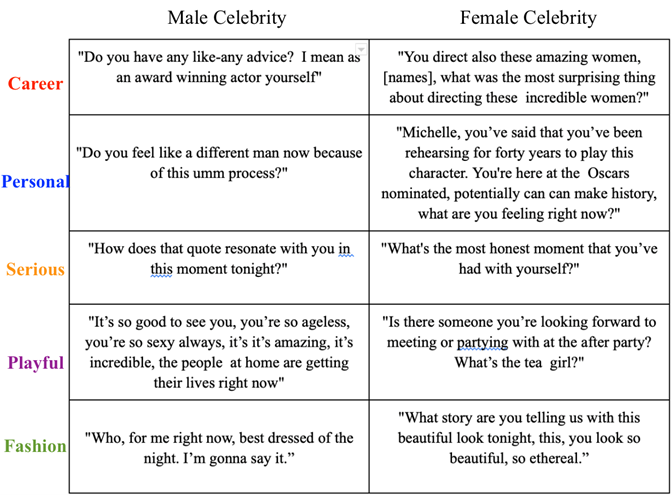
Before discussing the findings of our study, here are some examples of the types of questions/comments interviewers asked and how we categorized them. Each example is pulled from a different celebrity interview.

Figure 1: Examples of questions/comments asked to celebrity interviewees, categorized based on both gender and tone and word choice. Each question/comment is pulled from a different celebrity interview.

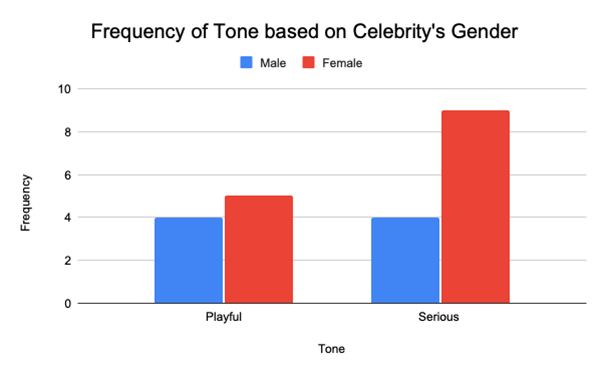
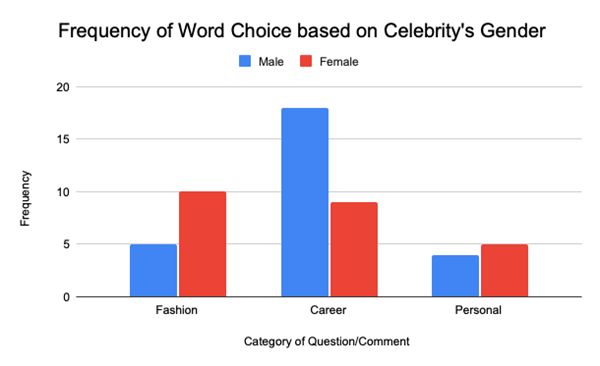
Here are our findings, separated into two bar charts. One chart is organized based on questions/comments that were categorized for tone, and the other is organized based on questions/comments that were categorized for word choice.

Figure 2: Bar chart representing data, with interviewer’s tone on the x-axis and total frequency in 16 interviews on the y-axis. Categorized based on celebrity’s gender.

Figure 3: Bar chart representing data, with interviewer’s word choice on the x-axis and total frequency in 16 interviews on the y-axis. Categorized based on celebrity’s gender.

In terms of word choice categorization, female celebrities were asked twice as much about fashion compared to men, as we recorded 10 instances for women compared to 5 for men. Male celebrities were asked career related questions twice as much as women, as we recorded 18 instances for men compared to 9 for women. We originally predicted that female celebrities would be asked more questions related to their personal life, which was proven to be incorrect as the results were roughly equivalent. Women were asked five personal questions compared to four for men.

In terms of tone, we found that women were asked twice as many questions in a serious tone compared to men (9 vs 4). However, we originally predicted that interviewers would use a more serious tone when interviewing male celebrities. We also found that male and female celebrities were spoken to in a playful tone at roughly the same frequency, with 20 instances for men compared to 18 for women.

When we put the data into a word counter, which we separated by the gender of the celebrity, we did not find any significance in the density of words used for male versus female celebrities.

Discussion and Conclusion

As we previously discussed, while we did find slight differences in the types of questions that were asked to the male versus female celebrities in our data recording, our data was not all-revealing nor conclusive. While we did find that men were asked more career-related questions whereas women were asked more fashion-related questions, we are not able to use our data to conclude that this is true for red carpet interview events in general. Our data consisted of 8 male celebrity interviews and 8 female celebrity interviews, which is not a complete representative of red carpet interviews as a whole. Further research could be done looking at a variety of different events. It would be interesting to see how/ if the results change depending on if it is a music awards event, premiere event, awards event, small event, etc. Each red carpet could be researched as an independent study, to then later compare the data. This comparison would offer insight into how the different events influence the types of questions being asked to male versus female celebrities. Alternatively, a study could be done by taking a set amount of interviews from each red carpet in order to have an accurate data sample of red carpets as a whole. This would offer insight into the trends of the questions male celebrities versus female celebrities are being asked on red carpets as a whole. Moreover, in our study we only analyzed the questions that were asked to the celebrities and did not take into account their responses. Future studies could benefit from also analyzing the responses.

It is also important to note that for the purpose of our study, we approached gender in a binary way through only analyzing the interviews of female and male celebrities. However, gender is not binary, and there is plentiful research that could be done on how transgender, non-binary, and other identifying celebrities are approached by interviewers on red carpets. In particular, we believe that it would be insightful to research and analyze the red-carpet interviews of transgender celebrities before and after transitioning to see if there are any differences in the questions that the same individual is asked. One of our male celebrities, Austin Butler had an interesting response to being asked a fashion question about his tuxedo. He responded with “What story am I telling you? I mean this Saint Laurent and I don’t know what story I’m telling you,” (Butler, 2023). This response, and others, offer insight into the history and the “why” matters of the questions that are asked on red carpets and therefore would be a useful data addition to a project like ours.

In addition to what we have already mentioned, in reflecting back on our project we have identified some factors that could improve our research. First, we did not account for the length of the interviews we were analyzing. Therefore, if there are three career-related questions in a 2 minute video, and none in a 30 second interview, it would be an inaccurate comparison. In future studies, we would better control the interview lengths. Additionally, we did not control who the interviewer was. Reflecting back, we realize that the motive and employer of the interviewer could play a large role in the types of questions that are asked. In future studies, we would definitely control who the interviewer is. Doing so would also open up an opportunity for more research through analyzing and comparing the types of questions that interviewers from different companies and magazines ask. It is evident that our research serves as a good starting point and reference for future studies.

References

Benney, M., Riesman, D., & Star, S. A. (1956). Age and Sex in the Interview. American Journal of Sociology, 62(2), 143–152. http://www.jstor.org/stable/2773344

Brownlow, S., Rosamond, J.A. & Parker, J.A. (2003). Gender-Linked Linguistic Behavior in Television Interviews. Sex Roles, 49, 121-132.  https://doi.org/10.1023/A:1024404812972

ExtraTV. (2023, March 12). Angela Bassett’s Kids Say Mom DESERVES Oscar Win (Exclusive). Youtube [Video]. https://www.youtube.com/watch?v=iM_bBHk-1HM

ExtraTV. (2023, March 12) Oscars 2023: Brendan Fraser Brings His Sons to the Red Carpet (Exclusive). Youtube [Video]. https://www.youtube.com/watch?v=dad48BVyR2A&ab_channel=extratv

ExtraTV. (2023, March 12) Oscars 2023: Colin Farrell’s Son Henry Says He’s a NICE Dad (Exclusive). Youtube [Video]. https://www.youtube.com/watch?v=WZRN4i0mIoo&ab_channel=extratv

ExtraTV. (2023, March 12) Oscars 2023: Miles Teller on Possibility of MORE ‘Top Gun’ Movies (Exclusive). Youtube [Video]. https://www.youtube.com/watch?v=BJMNzyb5Jtk&ab_channel=extratv

E! News. (2023, March 12). Oscars 2023: MUST-SEE Read Carpet Moments | E! News. Youtube [Video]. https://www.youtube.com/watch?v=-bu4OPD1PCM

Lawson, C. E., & Draper, J. (2021). Working the red carpet: a framework for analysing celebrities’ red carpet labour. Celebrity Studies, 12(4), 635-648. https://doi.org/10.1080/19392397.2020.1750969

Lundén, E. C. (2021). Twilight of the Idols. In Fashion on the Red Carpet: A History of the Oscars, Fashion and Globalization, 207–226. Edinburgh University Press. http://www.jstor.org/stable/10.3366/j.ctv1vtz84g.15

Mohammed, M. M., & Kadum, S. A. (2016). A Discoursal Analysis of Gender Differences in Selected English TV Interviews. Journal of the College of Languages (JCL), (34), 1-14. https://jcolang.uobaghdad.edu.iq/index.php/JCL/article/view/19

Nathanson, E. (2021). Aging on and off the red carpet: Joan Rivers, celebrity culture and postfeminist television. Celebrity Studies, 12(1), 51-66.  https://doi.org/10.1080/19392397.2019.1608839

Vanity Fair. (2023, March 12). After the Awards with Vanity Fair. Youtube [Video].  https://www.youtube.com/watch?v=ncn7h59Ko-U

Wang, H. C. (2009). Language and ideology: gender stereotypes of female and male artists in Taiwanese tabloids. Discourse & Society 20 (6), 747-774. https://www.jstor.org/stable/42889296

[/expander_maker]
, , , , ,

アンチ vs. Haters: How do Individualist Americans and Collectivist Japanese Net 民 Express Hate Online?

Kayenat Barak, Emily Moreira, Sae Tsunawaki, Karin Yamaoka

While social media has been a revolutionary tool for facilitating access to resources and information and connecting people globally, the power to hide behind anonymous platforms has also equipped many with the ability to spread hate online. Our project analyzes such hate comments written by Japanese and American audiences to gain insights into the sociocultural factors that shape the nature of online hostility. We chose four celebrities: one American female, one American male, one Japanese female, and one Japanese male, and used multiple social media platforms to collect a total of 120 comments. Upon categorizing these comments by type, tone, and directness, we found that there are no significant differences between comments targeted towards Japanese celebrities and American celebrities. This conclusion is fascinating, as it shows that values that characterize a certain culture, such as politeness and collectivism, and the linguistic barriers they may pose were not scientifically sound when it comes to the online world.

[expander_maker id=”1″ more=”Read more” less=”Read less”]

Introduction and Background

In today’s highly technological and globalized society, social media has quickly made itself a necessity in social relationships around the world, but the power to hide behind anonymous platforms has also equipped many with the ability to spread hate online. Ranging from cancel culture to haters, online hate culture has become so integrated to our society that it has manifested itself as an interesting sociolinguistic phenomenon. It is this precise overlap between sociolinguistics and online speech around that world that we wanted to research.

Our project compares hate comments targeted towards Japanese and American celebrities as a way to gain insight into the distinct sociocultural contexts and linguistic patterns that shape the expression of online hostility. Understanding the complexities of hate speech requires an exploration of its linguistic, cultural, and sociological dimensions. By comparing hate comments written by Japanese and American audiences, we can begin to understand the variations and similarities in the ever complex issue of online hostility. Given this context, our research question then is: How are written negative comments online directed towards popular entertainment public figures similar or different between Japanese and American speakers?

Defining hate comments becomes more intricate when we consider the linguistic, cultural, and sociological differences between Japanese and Standard American English.  Negative comments are extreme forms of “online incivility”, and they can be recognized and understood differently depending on various normative concepts and cultural backgrounds (Schmid et al., 2022). To establish a comprehensive framework of what is considered a “hate comment”, we will adopt the definition proposed by Alzarouni who writes, “those (online hate) directed to a person or a particular group to express intolerance for the individual or their ideology” (2022, p. 5). Japan’s culture emphasizes hierarchy, group harmony, and politeness which translates into a high language positionality and indirect speaking style. However, American culture promotes individualism which is expressed in the way Americans speak, such as the lack of structured high language and freedom to discuss social taboos. Additionally, resistance towards progressive ideas may be observed due to Japan’s more conservative socio-political structure (Feldman, 2023). Given the contrast in these two societies, we hypothesized that Japanese hate comments would center around comments that came as a result of maintaining the national status quo, such as promoting standardized beauty norms and criticizing mannerisms, whereas American hate comments would directly criticize celebrities based on the hater’s individual moral code rather than as a result of social constraints.

Methods

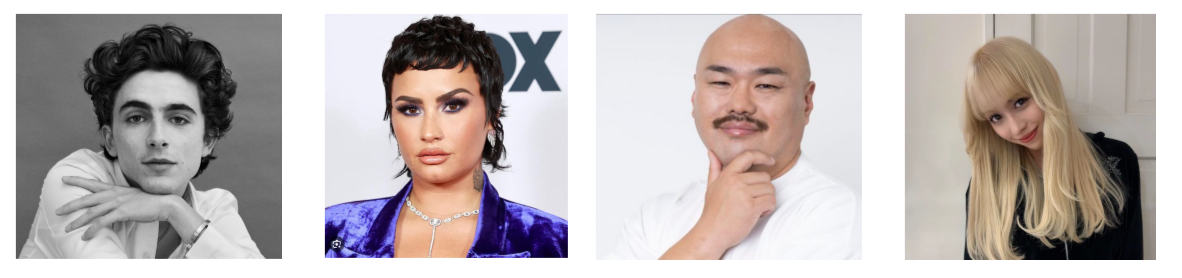
Establishing a way to test this hypothesis meant that we needed to test the frequency of our linguistic variables within a controlled environment. That being said, we collected 120 hate comments on Twitter, TikTok, and Instagram directed towards Japanese and American celebrities across 4 categories. These four categories test the correlation and frequency of hate between gender and race: Japanese male, Japanese female, American male, and American female. In order to find hate comments for these 4 categories, we collected online hate directed to our representative celebrities, Kuro-chan, Ryuchell, Timothée Chalamet, and Demi Lovato.

From left to right: Timothée Chalamet, Demi Lovato (American celebrities), Kuro-chan, and Ryuchell (Japanese celebrities)

We collected this data by choosing the 30 most interacted hate comments made in 2023 under social media posts made in the same year from the celebrities’ personal social accounts. Only comments written in Japanese and made by Japanese speakers were analyzed for our Japanese celebrities; conversely, only comments written in American English were analyzed for our American celebrities. From these 120 comments, we then analyzed frequency across three linguistic variables: type of identifiable hate, tonality, and toxicity. By identifiable hate, we wanted to categorize the hate comment in regards to what it directly criticized which we classified into 6 groups: appearance, gender identity/sexuality, private affairs, personal hatred, mockery, and violence. It is important to note that hate comments were not restricted to one category, rather they could be categorized under multiple if they fit the requirements. An example of this would be a comment made to Demi Lovato, “It’s the chin for me. 🤪” which was classified as both mockery and an appearance hating comment. In order to analyze tonality, comments could also be categorized into 4 major tonal groups: serious, comedic, pitiful, or neutral. Lastly, the variable of ‘toxicity’ stems from existing previous research conducted by Won Ik Cho and Jihyun Moon on Korean online hate comments. Cho and Moon define toxicity as 1) dependent on how hateful the speech is, and 2) its ability to influence either the victim or other commenters (2021, p. 4-5). In order to gauge toxicity, we adapted this concept to instead analyze the “directness/indirectness” of the hate comments. An example of an indirect comment would be, “lowk basic but ok” which was directed to Timothée Chalamet vs. a direct comment “気持ち悪いから目覚めんな🤢🤢🤢” (“I hope you never wake up because you are disgusting”) directed towards Kuro-chan. Through this methodology, our main goal was to count and compare the frequency of these different linguistic markers and see if there were any differences, similarities, or correlations across Japanese and American hate comments, and subsequently, global hate culture.

As a disclaimer, we wanted to acknowledge some expected fluctuations in types of online hate for each of our categories. At first, we aimed to pick noncontroversial, nationally, but not internationally, acclaimed celebrities of each country with approximately similar fame in each nation in order to minimize data alteration of any kind. However, this proved to be difficult as we were unable to find hate comments directed to popular Japanese male and female celebrities. The only hate comments we could find were made to already “controversial” Japanese celebrities. Kuro-chan is problematic for his online comedic persona which is perverted, misogynistic, and violent in nature. Ryuchell is scrutinized by the Japanese public for being a transgender woman. Given these factors, we assumed our data would be skewed and expected higher rates of violent comments directed towards Kuro-chan and more hate comments regarding gender identity directed towards Ryuchell. We also expected a higher rate of gender and sexuality hate comments directed towards Demi Lovato as well, as they are bisexual and nonbinary (she/they pronouns). Our predictions were proved partly true as our data reflects that only Ryuchell and Demi received comments in regards to their sexuality or gender identity, while neither Kuro-chan and Timothée received comments of that nature. However, the hate comments were still dispersed across several different categories.

Findings

Context

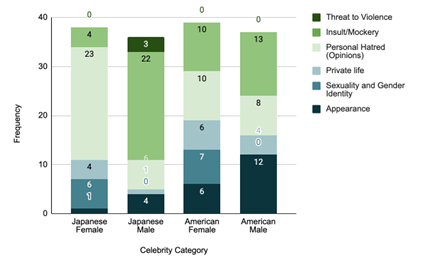
Figure 1: Aggregate counts of corresponding content categories for each comment

The data obtained from the context categories revealed both cross-cultural and cross-gender differences among the four celebrities. There were a few distinct findings we did not anticipate prior to the data collection, such as the high count of personal hatred comments toward the Japanese female celebrity as seen in Figure 1. This may come as a result of a widely disputed scandal Ryuchell was involved in last year. Yet, the discrepancy between Ryuchell and the Japanese male celebrity is still extremely wide. Timothée similarly was involved in controversy due to his dating rumors[1], but the comparable count of personal hatred comments to the American female celebrity may indicate that Japanese commenters are more harsh than Americans to controversial celebrities.

Other data that stands out in Figure 1 is the large count of insult/mockery comments targeted at the Japanese male celebrity. Again, we see a similar trend where there is a significant discrepancy between genders, rather than cross-culturally, in Japan and America. This can be explained by the general social media culture in Japan where trolling is considered a common and entertaining form of online conversation (Kaigo, 2017). Although internet trolling is seen in American online platforms as well, Japanese entertainment and comedy often involve dark humour. Another aspect of Japanese humor we see in comments and in many social conversations is “ohghiri” (大喜利), which are unique jokes that involved comedic takes on seemingly neutral or one-dimensional topics. Therefore, the combination of dark humor and ohghiri are commonly seen as a tactic of online trolling in Japan; especially when taking into account that the chosen Japanese male celebrity is a comedian, his haters may be influenced to convey their sentiments in a similar manner, perhaps as a way to mock his occupation.

Contrary to our initial hypothesis, our data showed that American celebrities received more appearance-related comments compared to their Japanese counterparts, with the aggregate count being 18 and 5, respectively. Additionally, appearance-related comments were more common for male celebrities compared to their female counterparts – almost 4 times as much for Japan, and twice as much for America. The discrepancy between genders may be attributed to the notion that commenting on a man’s appearance is less of a social taboo than commenting on a woman’s appearance. Since oftentimes women are subjects of strict beauty standards, perhaps this discourages individuals from criticizing women based on their appearance. Particularly for Timothée Chalamet, his occupation as an actor increases the frequency of hate comments regarding this appearance as attractiveness plays a significant role in his promotional activities.

Another finding that defied our hypothesis was that there were an equal number of hate comments targeting sexuality and gender identity for both Japanese celebrities and American celebrities. As we anticipated, such hate comments were exclusively directed at the female celebrities who were both members of the LGBTQ+ community. However, we assumed that a conservative society like Japan would avoid discussing topics relating to sexuality, while American progressivism meant that we expected Demi Lovato’s hate comments to be primarily about her sexuality. Surprisingly, we saw almost equal amounts of hate comments about sexuality and gender identity, where a Japanese female celebrity received 6 and the American counterpart received 7. This may be because social media permits anonymity which in turn allows commenters to code-switch and not adhere to their expected linguistic social restrictions. Japanese commenters, therefore, may feel less obligated to uphold social harmony online and express underlying opinions they would not say otherwise. Additionally, the nature of online platforms transcends cultural boundaries. The “international” online community lacks rigid cultural norms or taboos that regulate how certain topics should be treated or discussed. Therefore, Japanese commenters may be code-switching into the ‘online language’ or culture that allows them to engage in conversations that might be considered taboo in Japan.

Tone

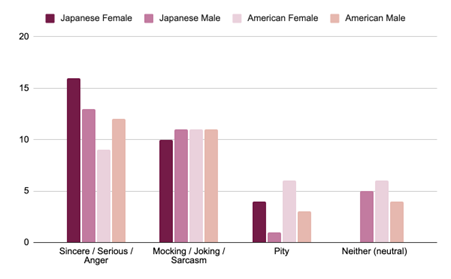
Figure 2: Each comment attributed to the style of tone by celebrities

When looking at tonality, our results show that Japanese female celebrities received the most ‘serious’ tone comments. There were no drastic differences between Japan and America when looking at tonality, excluding the pity tonality. We expected for there to be a higher rate of pity-toned comments for Japanese celebrities than for American celebrities due to Japanese culture which emphasizes politeness and humility. However, contrary to our predictions, there were more pity-toned comments for Americans overall. This may be due to the ability to be vulnerable in America, where influencers and celebrities are often encouraged to be transparent to their audience. As American celebrities tend to appeal to the masses by relating to their humanity, when celebrities face setbacks they are in turn treated with the same humanity and pity.

Another explanation for the pity tonality could be the presence of negative politeness in American online culture, as many of the pity comments we counted displayed negative politeness. Commenters at times used indirect speech to display their discontent. By framing it as a suggestion rather than a comment, the hater aimed to preserve the other person’s autonomy and avoid sounding too forceful. We think individuals in America rely on negative politeness strategies to express their criticism and avoid confrontation due to “cancel culture”.

Toxicity/Directness

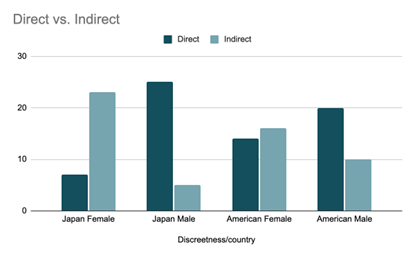
Figure 3: Comments for each celebrity separated into direct or indirect

In regards to toxicity, or directness as we refer to it in our study, we originally expected Japanese comments to be primarily indirect whereas American comments to be direct. This is based upon Japan’s high language and how it tends to place a greater emphasis on respect, politeness, and conformity, which in turn discourages individuals from expressing explicit or controversial opinions openly. In contrast, American culture generally emphasizes freedom of expression and individualism, which may lead to more direct comments being shared online. However, our results show that there was no particular pattern cross-culturally, but that a correlation did exist between genders. Overall, male celebrities tended to receive more direct comments than their female counterparts as displayed by our data.

We think that due to gender roles in both countries and views on women in Japan as submissive, they had more implicit comments. Also, it could be considered taboo to comment on a woman’s appearance directly since it can contribute to this objectification and reinforce harmful gender stereotypes. Society holds women to different standards than men when it comes to appearance and behavior and implicit comments could be used to imply those notions. Regarding the more explicit comments for Japanese male celebrities, Japanese fan culture could cause a certain devotion and obsession that can sometimes lead to more explicit or possessive comments being directed towards male celebrities.

Future Research

Due to this study’s time constraints, we cannot be certain of this idea, but a proposal for future research to test this would be to increase the sample size by collecting thousands of hate comments made to multiple celebrities within our four categories. Frequency of hate comments and their types should then be categorized and compared between not only Japan and America, but other countries around the world as well. Additionally, our findings showed that there was a stronger correlation between hate comments and gender vs. hate comments and race; thus, analyzing hate comments in accordance to both the gender of the commenter and the gender of the celebrity would also be interesting. Applying the concept of toxicity will provide insight as to whether or not speech tends to be harsher or softer when criticizing individuals of the same gender identity.

Conclusion

Ultimately, our findings showed that when categorized into types of identifiable hate, tonality, and toxicity, hate comments made by Japanese and American English speakers did not differ significantly from each other. This conclusion in particular is fascinating as it shows that the preconceived notions we had about polite vs. impolite society and linguistic barriers they may pose were not scientifically sound. In fact, it instead points that perhaps the online world may be a liminal space where culture, language, age, gender, and other sociolinguistic factors are broken down, creating instead a universal shared language and culture.

References

Alzarouni, E. (2022). Detection of Hateful Comments on Social Media Detection of Hateful Comments on Social Media. Rochester Institute of Technology. https://scholarworks.rit.edu/cgi/viewcontent.cgi?article=12308&context=theses

Cho, W. I., & Moon, J. (2021). How does the hate speech corpus concern sociolinguistic discussions? A case study on Korean online news comments. ACL Anthology. https://aclanthology.org/2021.nlp4dh-1.3/

Feldman, O. (2023). Challenging Etiquette: Insults, Sarcasm, and Irony in Japanese Politicians’ Discourse. 93–116. https://doi.org/10.1007/978-981-99-0467-9_5

Kaigo, M. (2017). The Japanese Internet Environment. Social Media and Civil Society in Japan, 1–35. https://doi.org/10.1007/978-981-10-5095-4_1

Schmid, U. K., Kümpel, A. S., & Rieger, D. (2022). How social media users perceive different forms of online hate speech: A qualitative multi-method study. New Media & Society, 146144482210911. https://doi.org/10.1177/14614448221091185

[/expander_maker]
, , , , ,

“Like…my whole face is just crooked!”: Self-Deprecation in Actors and Actresses

Sapna Ramappa

Why and how do people use self-deprecation? Do people use it to “fish for compliments” or just seem more relatable? This article highlights the prevalence and utilization of self-deprecating language among actors and actresses in interviews on late-night talk shows. Interviews with four female celebrities and four male celebrities on The Ellen Degeneres Show and The Tonight Show Starring Jimmy Fallon were analyzed in order to discern any potential gender differences in the intentions and execution of self-deprecation that celebrities employ. Accounts of self-deprecation were sorted into categories of self-deprecation (physical appearance, professional/intellectual competence, personality traits, and behavior) and pitch alterations (higher or lower pitches). Ultimately, this study found that the use of self-deprecation is not as gendered as previously thought, which could illuminate how being a public figure in an industry that is quick to scrutinize one’s physical appearance and performance can influence the ways in which people perceive themselves and speak about themselves.

[expander_maker id=”1″ more=”Read more” less=”Read less”]

Introduction and Background:

Just as self-affirmation can inspire individuals to strive for healthy and positive behaviors, self-deprecating language can potentially also affect the ways that we perceive ourselves and others (Epton & Harris, 2008). Self-deprecating humor is a valuable tool employed by comedians to show humility and lightheartedness (Speer, 2019). But who tends to use this form of humor more often and for what purpose? 

In previous studies, female comedians have been found to use self-satire more often than their male peers (Russell, 2002). This humor serves as a non-threatening way to make the comedian more “acceptable” and “appropriate” by placing herself as the joke itself. However, self-deprecation is not just limited to making fun of one’s physical appearance. People use self-deprecating humor directed at their behaviors, personality traits, intellectual/professional abilities, social status, success, or physical appearance (Greengross & Miller, 2008). However, there are no existing studies that reveal gender differences in the categories of self-deprecation use. The findings of this project can provide more insight on how men and women are socialized to behave and view aspects of their own identity. 

Men and women may also differ in the ways that they use self-deprecating humor; male speakers have been found to use a higher pitched voice when using humor and female speakers have been found to use a lower pitched voice when compared to their normal voices (Purandare & Litman, 2006). This study, which analyzed the use of self-deprecation in male and female celebrities on late-night television interviews, suggests that there are no significant gender differences in how often celebrities use self-deprecation and the “professional/intellectual competencies” and “physical attractiveness” categories. However, there are gender differences in the “behaviors” and “personality traits” categories and the ways the celebrities use pitch changes.

Methods:

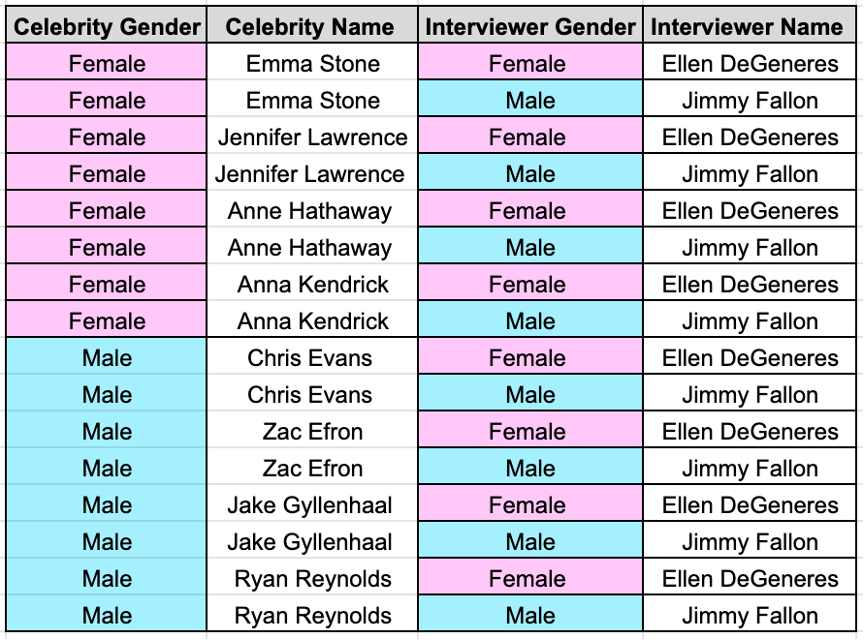
This study analyzed interviews with male and female celebrities on two late-night talk shows, The Ellen DeGeneres Show and The Tonight Show Starring Jimmy Fallon. The female actresses analyzed were Jennifer Lawrence, Emma Stone, Anne Hathaway, and Anna Kendrick, and the male actors analyzed were Chris Evans, Zac Efron, Jake Gyllenhaal, and Ryan Reynolds, for a total of 16 interviews. The study looked at celebrity gender, interviewer gender, the count of self-deprecating humor used, the category of self-deprecation, and the presence and/or type of pitch change used in self-deprecating humor. Self-deprecation accounts were identified and categorized if the celebrities used any negative statements towards themselves with regards to the four categories: “behaviors”, “personality traits”, “professional/intellectual competencies”, or “physical attractiveness”. Pitch changes were identified if the celebrities used a drastic and extremely noticeable higher or lower pitch while using self-deprecating language. Frequencies of self-deprecation were then calculated to compare self-deprecation in relation to celebrity interviewee gender, categories of self-deprecation, and pitch changes.

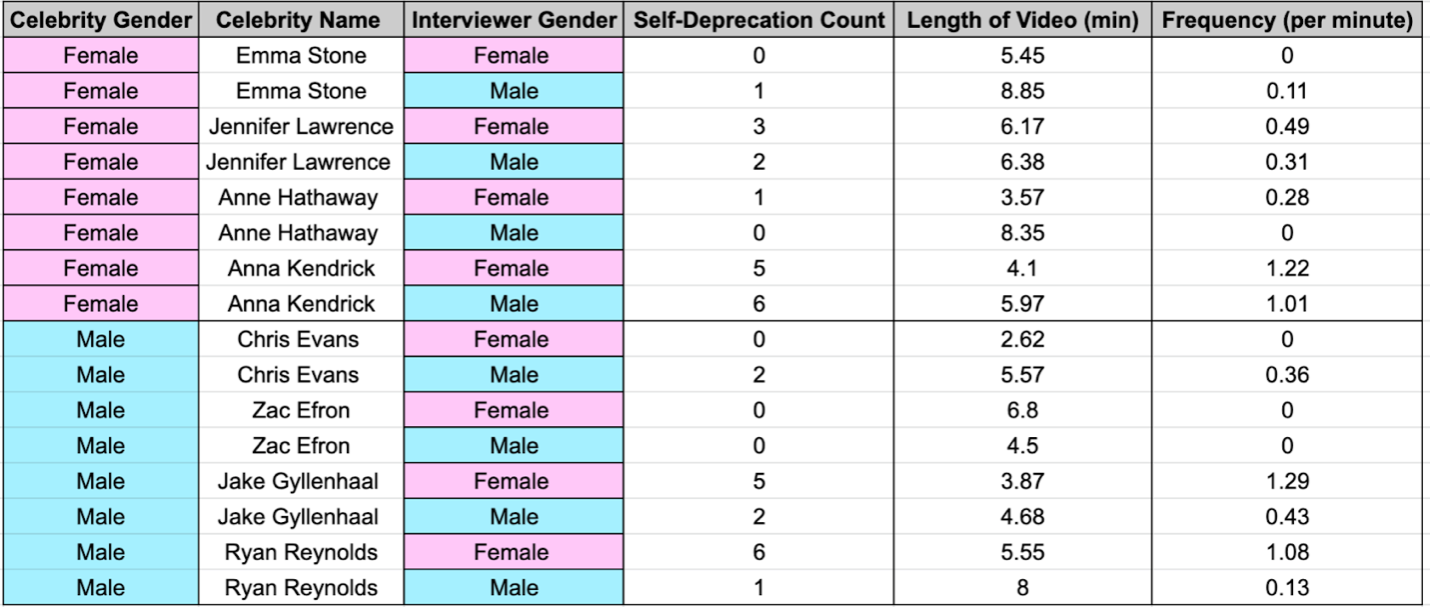
Table 1: The different combinations of variables looked at in 16 interviews.

Results and Analysis:

Frequencies/Counts of Self-Deprecating Humor: 

Table 2: The count of self-deprecation used in each interview, the length of each interview, and the calculated frequency in self-deprecation count per minute.

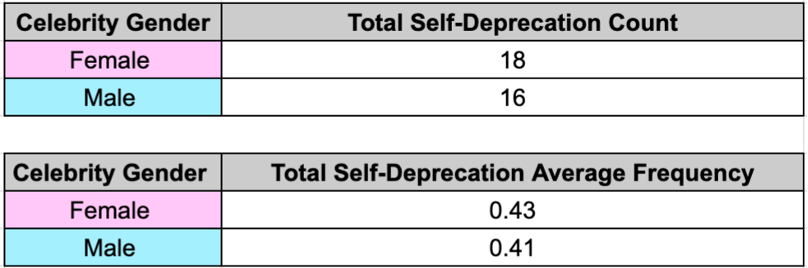
Table 3: The total count and average frequency of self-deprecation in male and female celebrities.

Throughout all interviews, female celebrities used 18 accounts of self-deprecation with an average frequency of 0.43/minute and male celebrities used 16 accounts with an average frequency of 0.41/minute. The frequency difference between female and male celebrities was 0.02, which indicates that there is no significant gender difference here. 

Categorizations of Self-Deprecating Humor: 

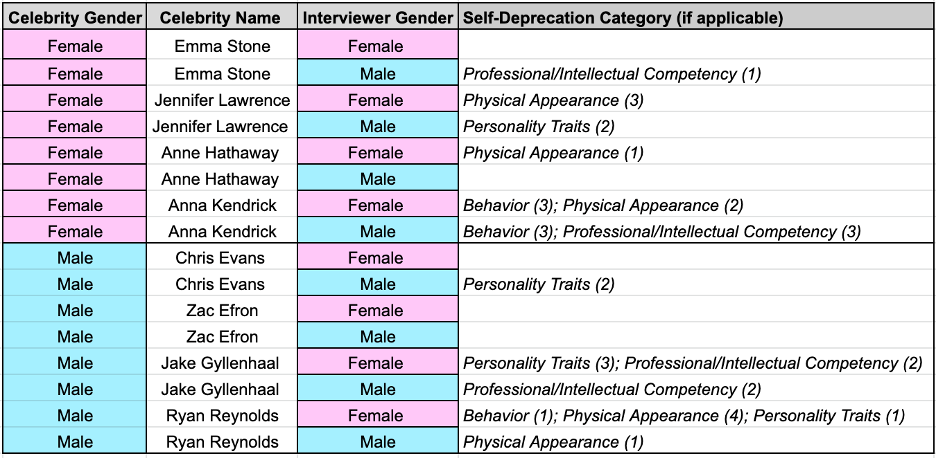
Table 4: The count and category of self-deprecation used in each interview.

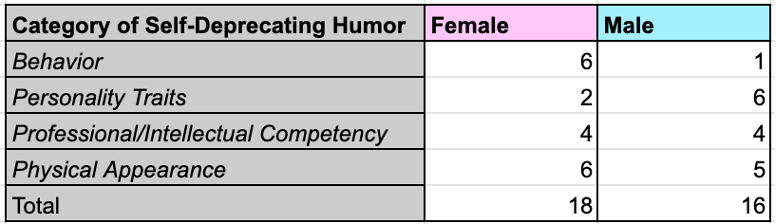
Table 5: The breakdown of self-deprecation categories in all male and female celebrity interviews.

The evidence shows that there is no significant gender difference in the “professional/intellectual competence” and “physical appearance” categories, but there are gender differences in the “behavior” and “personality traits” categories. Women use more self-deprecation about their behaviors and men use more self-deprecation for their personality traits. 

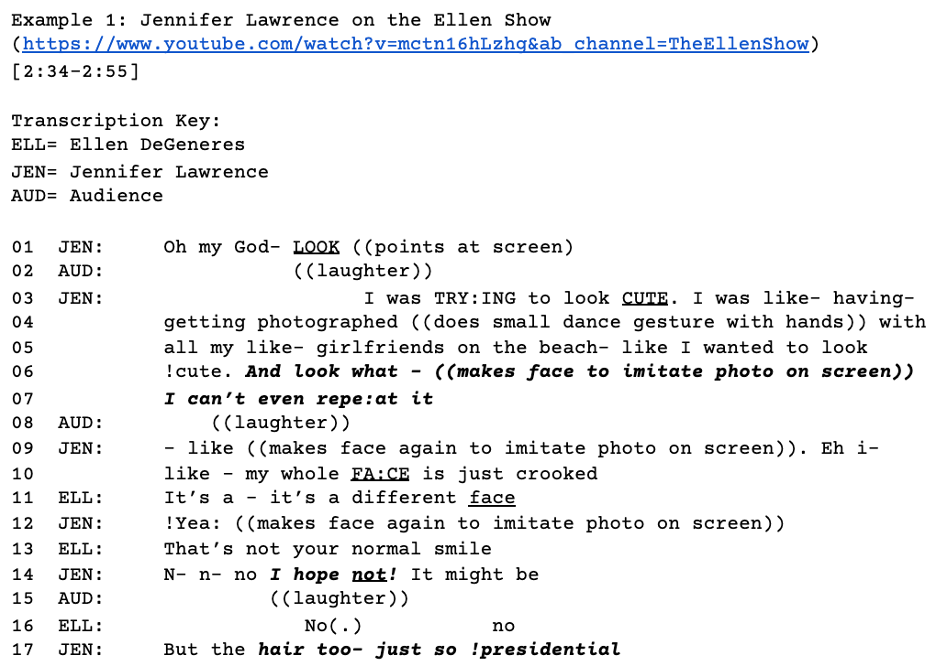
Example 1: Jennifer Lawrence with Ellen DeGeneres (Category: Physical Appearance)

This is a clear example of self-deprecation in the “physical appearance” category: Jennifer Lawrence makes fun of her appearance (specifically her face, her smile, and her hair) on a specific photo in Lines 6-7, Line 14, and Line 17.

Pitch Change Used for Self-Deprecating Humor: 

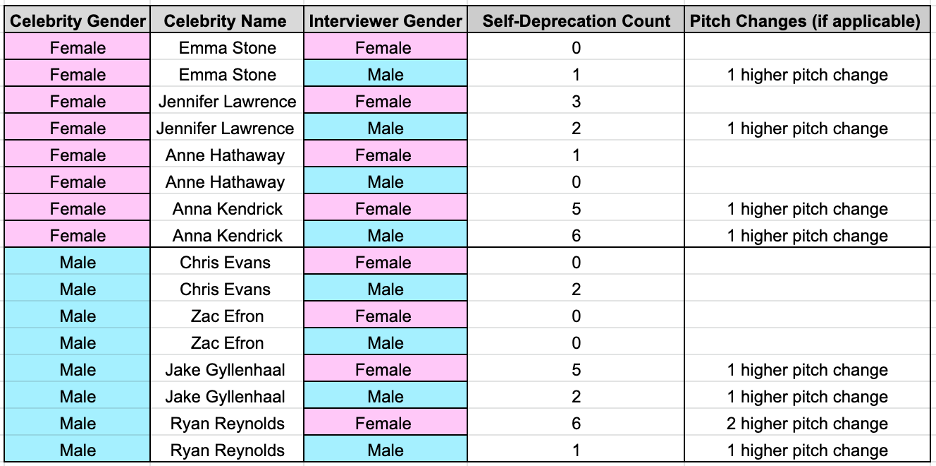
Table 6: The count and pitch change (either higher or lower) used in each interview.

Both female and male interviewees only utilized higher pitch changes when evoking self-deprecating humor.

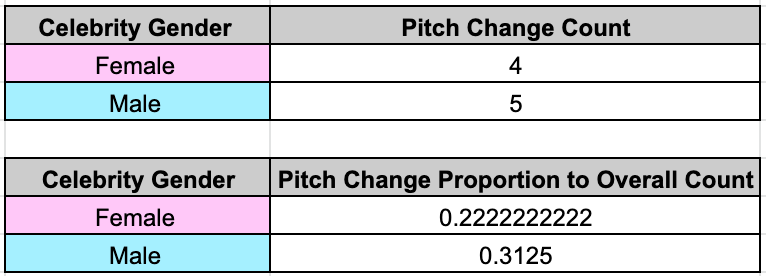
Table 7: The count of pitch changes and the proportion of pitch changes out of the overall self-deprecation count.

Though the pitch change count looks similar in female (4) and male interviewees (5), male celebrities used higher pitch changes in 31% of self-deprecation accounts whereas female celebrities only used higher pitch changes in 22% of the time.

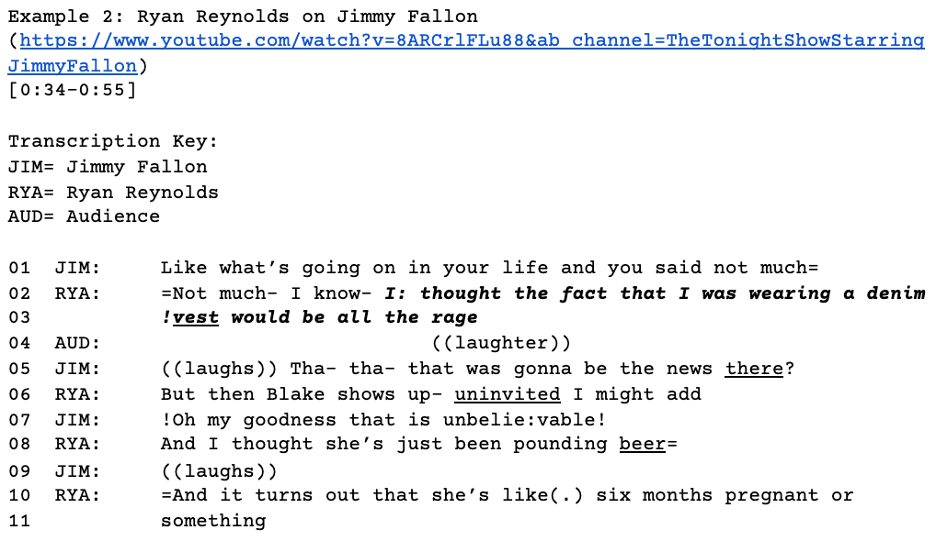
Example 2: Ryan Reynolds and Jimmy Fallon (higher pitch change, Line 2-3)

In this example, Ryan Reynolds uses an animated voice and higher pitch when saying the word “vest”, to make fun of what he was wearing.

Discussion and Conclusions:

The study did not find significant gender differences in the frequency of self-deprecation used in this sample of actors and actresses. Additionally, men and women both used similar amounts of self-deprecation when speaking about their professional/intellectual success and their physical appearance. There are several reasons why this may be. 

This study solely analyzed self-deprecation used by actors and actresses, so their career path (given the cut-throat nature of Hollywood) may create an environment where they place a lot of value in how they look and how they perform, thus impacting how they speak about themselves. Celebrities are placed to a near superhuman standard of beauty and their physical appearance is often on display for the public to openly criticize, so celebrities may be more inclined to point out their own flaws before the public does so. The use of self-deprecation in the “professional/intellectual” category may be more gender-neutral, considering that all celebrities want to achieve success. Additionally, because these interviews are used to humanize celebrities, self-deprecation may be used to help establish rapport between the guests, interviewers, and celebrities; this tool can help them come across as relatable, humble, and likeable. Though there were gender differences in the “personality traits” and “behavior” categories, it is unclear whether these categories are too similar to be separated or if there are actual gender differences in the use of “behavior” as a constructed aspect of identity and “personality traits” as an essential aspect of identity. Due to potential differences in the topics of the interviews themselves, it must be noted that certain interviewees may have had more opportunities to use self-deprecating humor, which could skew the results.

When assessing pitch changes, the study found that they were used quite sparingly among men and women (the proportion of pitch changes used in all accounts of self-deprecation was 22% in women and 31% in men). However, all of the pitch changes across genders were higher pitch changes, which contradicts earlier findings that showed that women switch to a lower pitch when using humor (Purandare & Litman, 2006). Because the subjects studied are professional actors and actresses, they may not be modulating their pitch as much in an interview setting when compared to their normal discussions or while acting.

Ultimately, the similarities between male and female celebrities in the frequency and in the “physical appearance” and “professional/intellectual competency” categories of self-deprecation indicate that male and female celebrities have similar aspects of their identities that they choose to self-criticize. These analyses can provide greater insight on what it means to be a public figure in an industry that places enormous importance on success and physical appearance.


References:

[/expander_maker]
 

, , , ,

K-Netizen: Examining Possessive Behavior in K-pop Social Media Discourse

Matthew Lee, Sam Lin, Huimin Liu, Francisco Morales, Annika Park

In recent years, Korean popular music, or K-pop, has led the way for a meteoric rise in global popularity of Korean culture. According to Sue Jin Lee’s study, “The Korean Wave: The Seoul of Asia,” this Korean wave—hallyu in Korean—has garnered a worldwide fanbase whose members create communities online centered around their favorite groups and idols. These K-pop fans primarily interact with their favorite artists and each other via social media posts and comments, creating online communities of internet citizens (netizens) that are each focused around certain idols. There is, however, a negative perception of Korean netizens who are seen by international fans as overly critical of K-pop groups and labels, possessive of idols, and having a sense of entitlement to celebrities. This study examines the question: does this perception of possessive Korean K-pop fans hold true? If so, what is the reason for this behavior? To find answers, the use of personal possessive pronouns in social media comments is examined to gauge possessiveness in Korean and international fans, informing a further discussion about Korean nationalism at play in K-pop social media interactions.

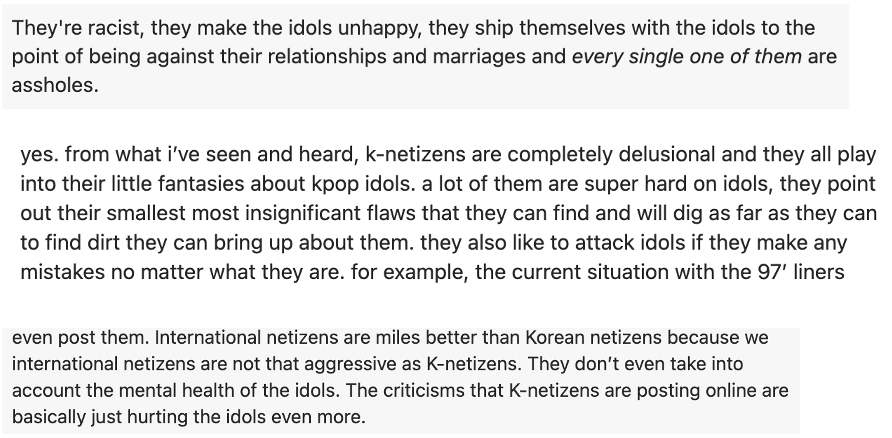
Figure 1: Social media backlash towards Korean K-pop fans from international fans

[expander_maker id=”1″ more=”Read more” less=”Read less”]

Introduction and Background

With the growing accessibility of online platforms like Facebook, Twitter, and Instagram, Korean and English-speaking social media users can react in real time to K-pop events and news. In typing up posts and leaving comments, fans create an online persona for themselves based solely around their love for certain music groups; the most devoted of these fans have been dubbed “K-pop stans.” We assert that with the growth of the Korean wave comes a sense of entitlement or possessiveness from specifically Korean fans towards their favorite idols. Our research aims to find patterns of these possessiveness or entitled tendencies in Korean social media users, and we believe that Korean fans will demonstrate these themes much more strongly than international fans of K-pop.

The idea of a netizen, or an “internet citizen,” originated in the 1990s and served as a descriptor for engineers and early Internet users who “participate in the affairs of governing and making decisions about the internet and about how the internet can impact offline society,” according to scholar Ronda Hauben’s Amateur Computerist. Over time, the term has evolved to become a broader description of anyone actively engaged in online communities. Within the past five years, Korean social media circles have especially embraced the word to the point where there is a specific word for Korean internet users: the “K-netizen,” which has the reputation of being extremely assertive and opinionated as a result of the strong sense of community they have created online. This membership may promote a sense of belonging and perhaps nationalism as an extension of their Korean citizenship, sentiment that may also extend to how K-netizens view K-pop idols. Since the K-pop industry is a major part of the South Korean culture and economy, K-netizens could feel that they are entitled to ownership over idols as a result of this interesting intersection of internet subculture with nationalism. We later explore this concept as an explanation for possessiveness in Korean fans.

Methods

In order to quantify the possessiveness of fans towards K-pop idols, we gathered instances of pronoun use by Korean and international commenters when referring to their favorite artists in social media discourse. Examples of these uses include phrases such as “your idol,” “my idol,” “our idol,” “mine,” etc. To narrow the scope of our search, research members strictly look at comments on Facebook responding to posts about three controversial breaking-news stories in regards to K-pop celebrities outlined below:

  1. HyunA and Dawn’s announcement of dating: HyunA, a singer and former member of the group Wonder Girls, and Dawn, a member of the group Pentagon, were dropped from their agency once they announced they were dating.
  2. G-Dragon and Kiko Mizuhara’s announcement of breaking up: G-Dragon is a singer who is part of boy’s group the BIGBANG, and Kiko Mizuhara is a Japanese celebrity. They were rumored to be in a relationship for years, but nothing was confirmed until it was announced that they had broken up in 2015.
  3. The Burning Sun scandal: this was a large-scale entertainment and prostitution exposé that involved multiple prominent celebrities in the K-POP entertainment industry.

[Researchers had originally initiated the project with four cases, an additional scandal involving high school bullying, but decided to omit it because they could not find enough substantial data for the case and the data gathered for other three cases was sufficient.]

Each controversy will be analyzed through two different posts announcing the news—one in English and one in Korean—in order to compare the initial reactions of Korean and international fans.

Results and Analysis

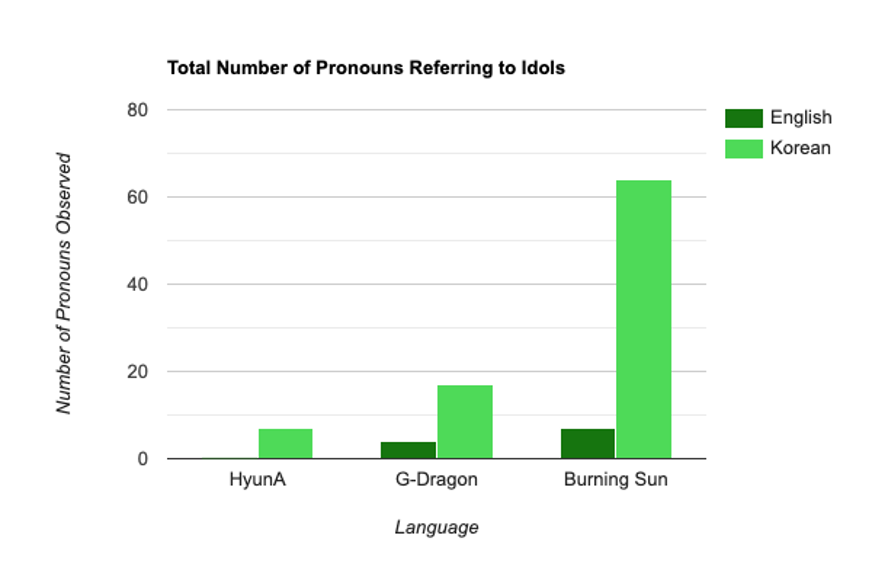
Figure 2. Total Number of Pronouns Referring to Idols

This graph visually illustrates the clear difference between how K-netizens and international fans view and react to idols. For each case, the number of Korean pronouns used at least doubled the number of English pronouns used.

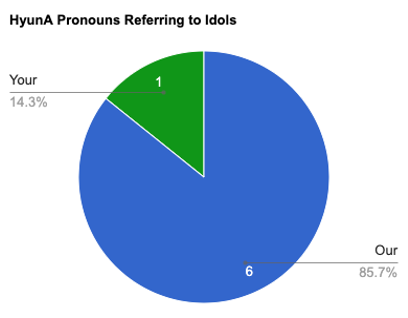
Figure 3. Types of Pronouns Used in Reference to Idols: HyunA


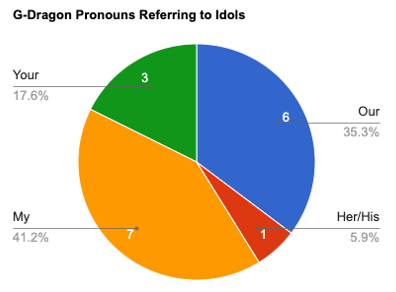
Figure 4. Types of Pronouns Used in Reference to Idols: G-Dragon


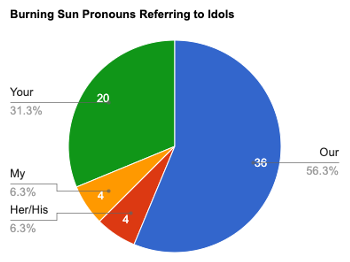
Figure 5. Types of Pronouns Used in Reference to Idols: Burning Sun

The three graphs above show the breakdown in types of pronouns used by idols in each of the three scandals. In the HyunA and Burning Sun case, the use of “our” was most prominent. However, for the G-Dragon case, the use of “my” was most common. This finding can be explained through the nature of the scandals being examined—the G-Dragon scandal was a break-up announcement and many comments expressed relief and excitement that he could be “theirs” once again. The HyunA case garnered more reaction to the fact that her and her boyfriend were dropped by their label, so a lot of people expressed sympathy (thus a communal “our” would be more common); the Burning Sun case evoked a more national response due to the scale of the scandal.

Discussion

After compiling data from Facebook posts, we find evidence consistent with our claim that K-netizens use possessive nouns when referring to idols more frequently than international, English-speaking fans. Though the total number of pronouns used in general was similar for both the Korean and English comments, our results show “possessive pronouns”—those used in contexts such as “that’s my girl” or “he’s all yours”—to be up to nine times more frequent in the Korean posts. International fans displayed uses of terms such as “idols” and “biases” to demonstrate devotion and obsession, but not necessarily a sense of “ownership” of the K-pop stars as the Korean commenters did. Given these results, it seems that the popular perception of K-netizens as being overly possessive of their favorite idols holds some level of truth.

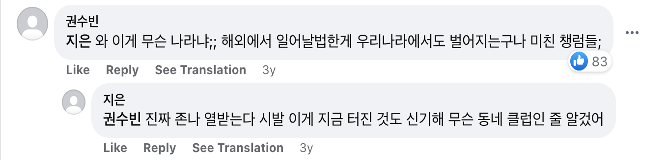
There may be many small factors affecting the observed usage of possessive pronouns, but we believe that the primary cause for possessive behavior from Korean fans stems from a deep-seeded nationalism within K-netizens that can be observed through K-pop social media interactions. The possessive pronoun “our” was used especially frequently in the Burning Sun scandal, most often in contexts referring to “our nation” (Korea). While the HyunA and G-Dragon scandals deal with dating and are mostly only scandals in the eye of the public, the Burning Sun case involved much more serious allegations of prostitution, sexual coercion, and possible police corruption. This seems to lead to more extreme responses in Korean comments, where K-netizens express shock that their country would be involved in such behavior.

Here are some examples of the comments from the Burning Scandal post:

Translation: @Jieun Wow, what country is this? What’s happening overseas is happening in our country too; those crazy people.


Translation: Why do people live so stupidly that they blindly trust money? Our country’s people are so scary that they even made the president step down.

As stated earlier, the hallyu wave of Korean culture has been driven by K-pop through the last decade, leading Korean citizens and government to hold K-pop to an extremely high standard. Korean nationalism is founded on pride in successes that can be seen internationally, so K-pop’s dominance of global charts makes it a cultural focus across the country (Koo 2020). Another example of this type of nationalism includes the nationwide buzz over Korean athletes that experience success overseas; this is seen most recently with soccer star Son Heung-Min headlining Korean news and covered at great length for becoming a prominent figure in the European football scene. While this and many other instances demonstrate Korean nationalism to be celebratory and uplifting, the problem arises when these globally successful entertainers involve themselves in “scandalous” events in the eyes of the international or Korean public. Because K-pop idols are seen as representatives of Korea and Korean culture, K-netizens are quick and harsh in their criticism of any action that could be seen as harmful to the image they want to portray to the global audiences. This explains the “bringing shame to our nation” type of comments observed in the Burning Sun scandal; though perhaps justified in this situation, the Korean comments criticizing K-pop celebrities for dating exemplifies a level of  “ownership” or authority akin to that of parents toward their children. This possessiveness leads to the international perception of Korean fans as sharing the same negative or toxic traits that they would associate with a “tiger” or “helicopter” parent.

The very concept of a “K-netizen” may also play a part in perpetuating nationalistic, possessive tendencies in Korean fans. If “netizen” gives a label to avid users of the Internet, K-netizen defines a space specific to Koreans which allows them to be closed off to the rest of the wide-open Internet. By giving themselves this label, K-netizens engage only in interactions within their own language and culture, opposite to how international fans utilize the Internet to interact with others across the globe. According to the article “Online Language: The Role of Culture in Self-Expression and Self-Construal on Facebook,” collectivism is significantly higher among Asian Americans than Caucasian Americans (De Andrea 2010). While this finding doesn’t have a one-to-one relation to the focus of our study, we assume a similar truth given the homogeneity of Korea and implications of the term K-netizen. This collectivism leads to a cycle within Korean K-pop social media where new users are introduced to the idea that they have power over or possession of the celebrities that they follow, eventually adopting linguistic traits exemplifying these behaviors much like they would in traditional Communities of Practice.

Conclusion

The nationalistic tendencies and resulting toxic comments of K-netizens isn’t a problem that we feel we can or should fix; rather, it is one that provides insight into the role that nationalism plays in social media interactions between users around the world and within their own language groups or countries. Further research into operations behind Korean social media may reveal the importance of these comments in forming the best possible product to be seen by the rest of the world. On a larger scale, we would like to see this study performed with the international entertainment exports of other countries; perhaps social media comments about artists from the United Kingdom or actors from France can reveal aspects of those countries’ nationalism and how they display these traits online.

Our data was mostly limited by sample size and platform. Though we focused on Facebook comments due to the site’s popularity among Korean social media users and its ease of access to centralized posts, we recognize that much of the international discourse about K-pop happens on newer sites like Twitter and Instagram. A more comprehensive study would compile comments from all of these sites to get a more accurate representation of linguistic features displayed. Additionally, we cannot guarantee that all of the Korean comments on Facebook were written by Korean citizens, but we assume that most of them were given that the posts were made by news sites based in Korea. Despite these shortcomings, we believe that our results show an accurate representation of the differences between Korean and international commenters when it comes to K-pop discourse. This topic has yet to be explored in depth from a sociolinguistics perspective, but the continual growth of social media makes it an issue worth researching and examining in greater detail.


References

DeAndrea, D.C. et al. “Online Language: The Role of Culture in Self-Expression and Self-Construal on Facebook.” Journal of Language and Social Psychology, Vol. 29, No. 4, Dec. 2010, pp.425-442, doi: 10.1177/0261927X10377989

Goi, C. L. (n.d.). Cyberculture: Impacts on Netizen. Retrieved April 30, 2022, from https://citeseerx.ist.psu.edu/viewdoc/download?doi=10.1.1.674.3277&rep=rep1&type=pdf

Hauben, R. Amateur Computerist Newsletter – Ais.org. 2021, http://www.ais.org/~jrh/acn/ACn34-2_one_column.pdf#page=2

Jung, S. (n.d.). Fan activism, cybervigilantism, and Othering mechanisms in K-pop fandom. Transformative Works and Cultures. Retrieved April 29, 2022, from https://journal.transformativeworks.org/index.php/twc/article/download/300/287?inline=1

Koo, Jeung Mo. “K-pop from Local to Global: A Study on Cultural Nationalism in Korean Pop Culture.” The Columbia Journal of Asia, 2022, from https://journals.library.columbia.edu/index.php/cja/article/view/9355.

Lee, S. J. Elon Journal of Undergraduate Research in Communications. Elon University, 2011, https://eloncdn.blob.core.windows.net/eu3/sites/153/2017/06/EJSpring12_Full.p

[/expander_maker]
, , , ,
Scroll to Top