Tyler Johansen, Audrey Kernick, Oliver McCormack, Adriana Monroy, Danna Padua
In only a few minutes of scrolling through TikTok, the politicization of social media through the use of short captions, hashtags, and repeated phrases that travel quickly across virtual communities quickly becomes evident. While these small pieces of language can come across harmless or humorous, they often carry a much deeper ideological meaning. In right-wing spaces on TikTok, specific hashtags and phrases are repeated to frame immigration as a threat, while reinforcing American nationalism. This raises an important question: What hashtags and phrases are used to represent the American right-wing in anti-immigration content? How does this language function in forming a political identity for this speech community?
By using TikTok to create right-wing focused “For You Pages”, patterns in the language used in right-wing TikTok posts related to immigration were examined. Results included language, including short statements, exclamation points, sarcasm, rhetorical questioning, language signifying ownership, and hashtags like #ICE, #fyp, and #MAGA. Analysis of this language determined three characterizations of right-wing identity regarding anti-immigration sentiment: obedience to authority, intellectual self-righteousness, and creation and/or antagonization of the other. These aid in understanding how right-wing values and beliefs are perpetuated on TikTok through the “For You Page” and can give future insight into whether online language trends for this group translate into its daily environment.
Keywords: TikTok, Right-Wing, Language, Anti-Immigration, Political Identity
[expander_maker id=”1″ more=”Read more” less=”Read less”]
TikTok and Politics
Researchers increasingly argue that language on social media does not simply communicate ideas but actively shapes online communities and identities (Nani, 2024). Hashtags, phrases, and repeated expressions function as signals that help users recognize others who share similar beliefs, while also amplifying certain narratives through platform algorithms (Adriaansen, 2024). Studies of digital discourse show that political groups frequently use coded language, humor, and meme culture to make ideological messages appear casual or entertaining while still reinforcing political positions (Anderau & Barbarrusa, 2024).
In immigration debates, this often involves framing immigration as a cultural, economic, or national threat (Ahmed et al., 2024). Understanding how these linguistic patterns circulate online gives us insight into how repeated exposure to these narratives can normalize certain viewpoints and character traits while strengthening group identity within digital communities.
What We Looked At
To investigate how right-wing TikTok creators use language to express anti-immigration sentiment, we conducted a qualitative analysis of posts collected from TikTok. We began this process by creating five anonymous accounts using randomly generated emails, the same age, 22, and skipping questions about personal interests. This was done to ensure that the data provided to the TikTok algorithm was identical across the five accounts and would only be influenced by future interactions with right-wing content. The first two scroll sessions were used to begin interacting with right-wing content to establish a more genuine right-wing online speech community to pull data from. During these two scroll sessions, the terms “right-wing” and “anti-immigration” were searched, and posts with traditional right-wing ideological standards relating to anti-immigration were liked. Over the following eight weeks, data were collected from the resulting “For You Page” by consuming content for 30 minutes per week and logging data that met the same qualification: traditional right-wing ideological standards. Then we filtered our initial data to identify samples that specifically hold anti-immigration sentiment. This data included captions and hashtags that were written both on the videos themselves and in the caption area. Finally, this data was analyzed to identify patterns within these captions and hashtags used by this group to determine how they signal, affirm, and shape right-wing characteristics.
What We Found
Our analysis of 33 TikToks revealed several recurring linguistic patterns within this right-wing TikTok population. Many videos framed immigration as a threat to national identity or population demographic stability. For example, one post stated, “If being far right means I don’t want to be demographically replaced in my own country, then yes, I’m far right,” directly linking immigration to fears of demographic replacement and positioning immigration as a threat to the fabric of the nation.
Creators also regularly used humor, sarcasm, and rhetorical questions to present political arguments. One video sarcastically responded to criticism of immigration enforcement by asking, “Wait, so it’s illegal to enter someplace without proper documentation?” and labeled the post with hashtags such as “#comedy” and “#ironic”. This style allows political messages to appear casual or entertaining while still reinforcing ideological viewpoints.
Across many of the posts, the language also reflected broader themes visible in our analysis. Some content emphasized obedience to authority, particularly through support of enforcement institutions such as the United States Immigration and Customs Enforcement, referenced online as ICE. Other posts expressed a strong sense of intellectual self-righteousness, presenting the speaker’s view as simple “common sense.” At the same time, many posts constructed an antagonistic distinction between “us” and “them,” portraying immigrants as an opposing or threatening group.
These qualities are summarized as three characterizations: obedience to authority, intellectual self-righteousness, and creation and/or antagonization of the other. Each characteristic is non-exclusive, and overlap exists among each of them. These three qualities are detailed more in the chart below:
| Characterization | Description |
| Obedience to Authority | uncritical submission to the rule of law, characterized by the suspension of one’s own moral judgment and personal responsibility |
| Intellectual Self-righteousness | conviction that one’s own beliefs, knowledge, or worldviews are inherently superior to those of others |
| Creation and/or Antagonization of the Other | image of self as a victim and the other as an abuser |
1. Obedience to authority illustrates the uncritical or blind submission to the rule of law by suspending one’s own moral judgment and personal responsibility:
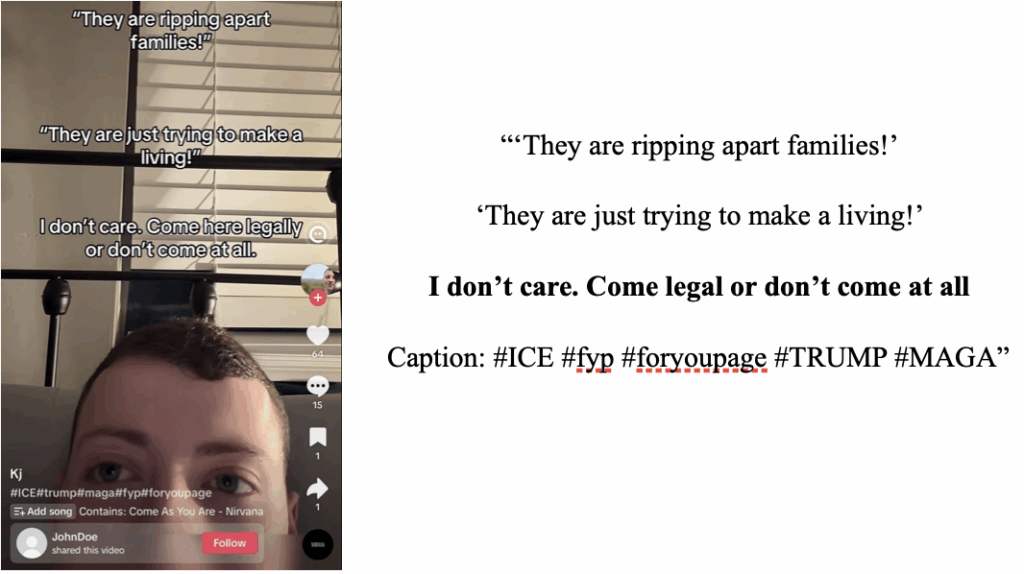
Figure 1: The language in this TikTok post features multiple short statements followed by exclamation points. These demonstrate obedience to authority as valued by the right wing on TikTok. The post positions are abiding by the law as necessary to personal safety and are being treated with basic human respect. This language demonstrates the shared idea that to break the law is to surrender any expectations or rights to basic human rights and equality. https://www.tiktok.com/t/ZP8Q9bBtM/
2. Intellectual self-righteousness exemplifies the conviction that one’s own beliefs, knowledge, or worldviews are inherently superior to others’, often accompanied by a dismissive or condescending attitude toward opposing perspectives:
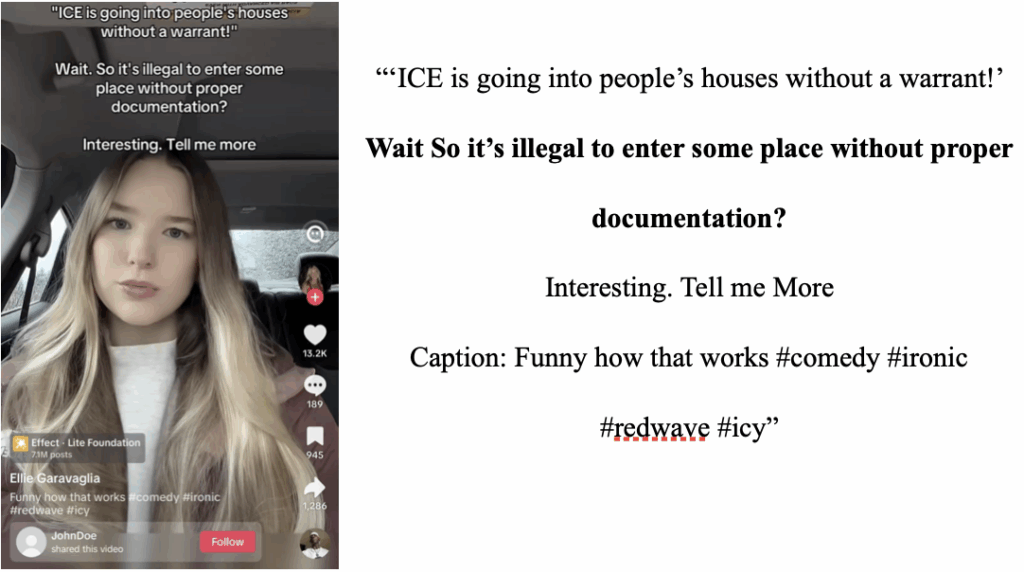
Figure 2: The language in this TikTok post features semantics centered around sarcasm and rhetorical questioning. These qualities function to mock minorities while aligning right-wing values against the minority groups in America. https://www.tiktok.com/t/ZP8Q97EhH/
3. Creation and/or Antagonization of the Other exemplifies the dominant group defining itself by constructing an outside group (the “Other”) as fundamentally different, inferior, or threatening to their dominance.
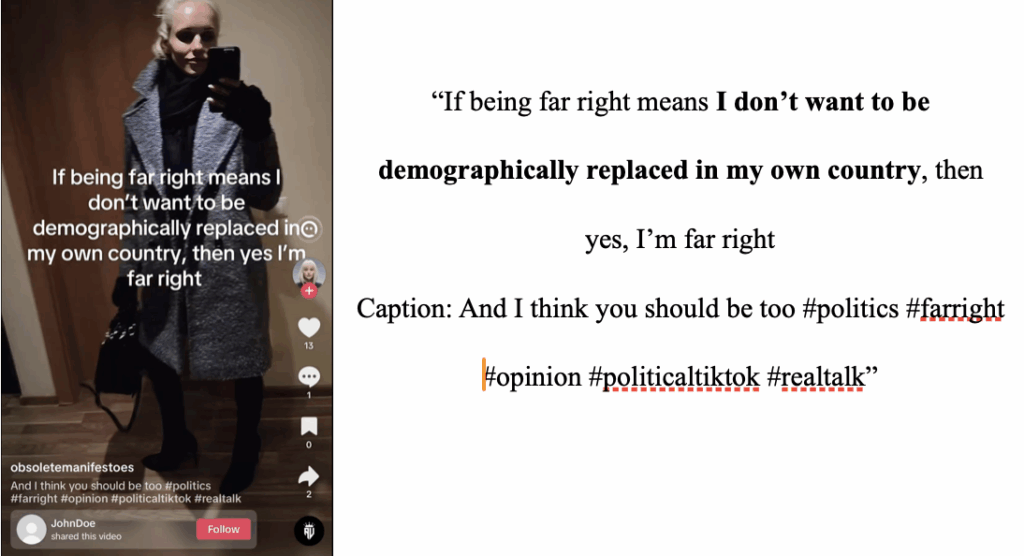
Figure 3: The language in this TikTok post features verbiage that signifies ownership, like “my own”, that restricts non-right-wing individuals from claiming ownership of the same object. This restricts “the other” non-right-wing from their inability to share land and raises conflict. https://www.tiktok.com/t/ZP8Qxcjr4/
What It Means and Why It Matters
Our findings show that language on social media plays a powerful role in shaping online communities and political discourse. Even short captions or repeated phrases can signal ideological belonging and help circulate narratives across virtual networks. We see that the exaggeration of intellectual self-righteousness, obedience to authority, and creation of the other that characterize right-wing language, especially concerning immigration in the U.S., is perpetuated on TikTok. Simple language that is amplified becomes normalized and encourages the expression of similar sentiments online.
In this way, language does not simply communicate an individual’s stance against immigration, but it essentially functions to affirm political identity and reinforce shared values and beliefs, particularly of right-wing beliefs within online communities. Humor, sarcasm, and hashtags make these messages appear casual and shareable, allowing them to spread quickly and connect users to a wider political milieu. This contributes to echo chambers within social media platforms where language repetition in forms of hashtags and phrases amplifies narratives through affirmation of one’s beliefs and political identity online, further empowering even skewed ideologies and reasoning. By having this understanding, our work informs how platforms can more effectively and ethically moderate political discourse, especially harmful and biased ones.
Furthermore, we acknowledge that simply observing these posts alone does not capture the nuances of sentiments and identity of right-wing groups beyond the online platform. Data and analysis could be improved by an in-depth examination of how these linguistic practices converge with offline lifestyle, social networks, and political behaviors, such as whether the language trends seen online translate into everyday offline practices. It could also be beneficial to determine the directionality of these factors. Are these posted sentiments a reflection of a formed political identity outside of social media? Does TikTok help form right-wing identity, or do they reinforce each other? Perhaps we should also consider whether these users are paid for their content, incentivizing high engagement and view counts.
At the end of the day, we can’t judge a language in online posts based on their initial appearance. Through this study, we understand that linguistic patterns are important for recognizing how political messages spread and become normalized within online spaces.
While our study focuses on the language used in human generated anti-immigration content, TikTok has seen a surge of anti-immigration content produced using artificial intelligence (https://www.theguardian.com/technology/2025/dec/03/anti-immigrant-material-among-ai-generated-content-getting-billions-of-views-on-tiktok). Boasting billions of views, this content is ample ground for further research into the functions of language in right-wing TikToks, expanding the question into how AI algorithms learn right-wing language and utilize it in these posts. How do users receive this content and its credibility? How do these posts work in tandem with the human generated content observed in our research? The mass amounts of views these posts rack up could also be signs of a potentially imminent site-wide conservative shift following TikTok’s new ownership in the United States (https://www.kqed.org/news/12028629). What are the implications of the relationship between Trump and TikTok on language use, political ideology, and censorship on TikTok in the near future? How might this relationship impact political content online and associated language in the long term?
Bibliography
Adriaansen, R.-J. (2024). Latent and explicit mnemonic communities on social media: studying digital memory formation through hashtag co-occurrence analysis. Memory, Mind & Media, 3. https://doi.org/10.1017/mem.2024.7
Ahmed, S., Jaidka, K., Chen, V. H. H., Cai, M., Chen, A., Emes, C. S., Yu, V., & Chib, A. (2024). Social media and anti-immigrant prejudice: a multi-method analysis of the role of social media use, threat perceptions, and cognitive ability. Frontiers in Psychology, 15. https://doi.org/10.3389/fpsyg.2024.1280366
Anderau, G., & Barbarrusa, D. (2024). The Function of Memes in Political Discourse. Topoi, 43(5), 1529–1546. https://doi.org/10.1007/s11245-024-10112-0
Ellie Garavaglia [@artofinfluence]. (2026, January 31). Funny how that works #comedy #ironic #redwave #icy [Video]. TikTok. https://www.tiktok.com/t/ZP8Q97EhH/
KJ [@rncnews4]. (2026, February 7). #ICE #trump #maga #fyp #foryoupage [Video]. TikTok. https://www.tiktok.com/t/ZP8Q9bBtM/
Milmo, D. (2025, December 3). Anti-immigrant material among AI-generated content getting billions of views on TikTok. The Guardian. https://www.theguardian.com/technology/2025/dec/03/anti-immigrant-material-among-ai-generated-content-getting-billions-of-views-on-tiktok
Nani, N. N. (2024). The Influence of Language on Interaction and Communication Within Social Media Platforms. Deleted Journal, 2(2). https://doi.org/10.62795/fjlg.v2i2.295
obsoletemanifestoes [@obsoletemanifestoes]. (2025, December 24). And I think you should be too #politics #farright #opinion #politicaltiktok #realtalk [Video]. TikTok. https://www.tiktok.com/t/ZP8Qxcjr4/
Sung, M., Cueva, M., & Egusa, C. (2025, February 26). Tiktok’s vibe shift. KQED. https://www.kqed.org/news/12028629
[/expander_maker]