second-generation

Cultural Identity Maintained Through Code-switching among Immigrant Generations in a Dominant English Country

The United States is often hailed as a country of immigrants, but in reality there are complex social and cultural factors which play a role in the U.S. immigrant experience, one of the greatest being language. While the U.S. has no official language, English is the predominant means of communication, and plays a large role in multi-generational communications of immigrant communities. Our research seeks to answer: how does code-switching between English and native languages influence identity formation and social interactions among different generations within immigrant communities? Through participant observation and interviews at Los Angeles Latino and Chinese American church communities, we found that first-generation immigrants code-switch more often in work and public environments, whereas second-generation immigrants code-switch for the sake of multi-generation communication. Overall, we demonstrate that through code-switching, immigrant families and subsequent generations struggle to balance assimilation into American culture and the ability to preserve their cultural identity.

[expander_maker id=”1″ more=”Read more” less=”Read less”]

Introduction and Background

According to Pew Research (2020), “more than 1 million immigrants arrive in the U.S. each year.” With the arrival of various ethnic groups to the United States, and integrating themselves into American culture, new cultural exchanges emerge. Nevertheless, discrimination against migrants persists, hindering their integration and sense of belonging. Consequently, migrants often assimilate into the dominant hegemonic groups’ culture – rejecting their own.

Because of the ongoing presence of discrimination, it is crucial to understand the impact of dominant ideologies on both first-generation migrant communities and subsequent generations.

Language plays a key role in identity formation, with immigrants often teaching their children their native languages to maintain cultural ties. However, pressures to adapt to the dominant culture often lead parents to prioritize English as a first language. So how does learning your native language influence your identity and that of your children amidst a society that prioritizes English as the official language? Multiple studies have focused on code-switching as a form of expressing cultural identity (Bosire 2006). According to Myers-Scotton (1993), code-switching is defined as the mixing of different codes (or languages) by speakers in the same conversation (video explanation on code-switching). Moreover, scholars have also highlighted code-switching as a form of learning (Kremin et al. 2022) and socializing (Wei 1995; Lee 2019). Yet, Rangel et al. (2015) have critically emphasized the amount of stigmatization code-switching continues to receive. For this reason, our research focused on code-switching among immigrant communities in the United States, particularly focusing on the contrasts and similarities between first-generation and subsequent generations of immigrants. This study contributes to the wider discussion of code-switching as we explain from a sociolinguistic perspective how migrants and subsequent generations express their identity in a country where non-standard languages are viewed as inferior to standard English. Through qualitative methods, this research answers the following questions: how does code-switching between English and native languages influence identity formation and social interactions among different generations within immigrant communities? Our findings show that through code-switching, immigrant families and subsequent generations struggle to balance assimilation into American culture and the ability to preserve their cultural identity.

Methods

We collected data from two different churches in the Los Angeles area, with participants from Chinese and Latino/a descent communities. We used both participant-observation and semi-structured interview methods. The former was to note how speakers interacted in public spaces, specifically those that are similar in purpose. The latter was to hear the opinions of our participants about their language use.

Our observations took place in group settings, during which we took notes on verbal and non-verbal interactions between three groups: first-generation, second-generation, and a mixed group of both. We chose to limit the time of our observations to 15-25 minutes (due to assignment and situational constraints). In interviews, we spoke to two first-generation parents from each ethnic demographic (Latino or Chinese), ranging from middle-aged to older adults, and with one of each of their (second-generation) children, ranging from young to regular adults.

After data collection, we first compared answers within the most specific group, for example, responses from first-generation Latinos or from second-generation Chinese Americans. Then, we compared the data between generations within the same immigrant group (e.g. responses from Latinos), and the same generation between immigrant groups (e.g. second-generation responses). These were chosen as the methods for analysis because they forced us to consider all possible nuances between the various groups and once we had data for a set of the smaller groups (same generation & ethnicity) we could accurately compare the data for the larger groups (ethnic vs generational).

Results
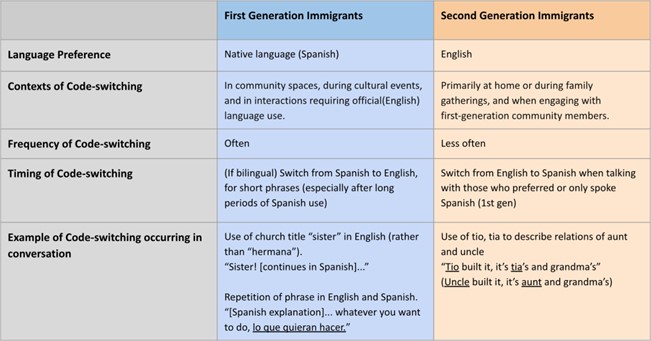
Figure 1: Comparing code-switching experiences between first-generation immigrants and second-generation immigrants

The table illustrates the comparison between first-generation immigrants and second-generation immigrants. We observed various factors of code-switching between both generations and discovered that there is a major difference in the context of code-switching. First-gen has been found to code-switch more often and will code-switch in the context of their root community’s events or situations that require using English. On the other hand, second-gen has been found to code-switch less in general. Code-switching behavior only occurs when they are speaking to people whose first choice of language is Spanish or native Spanish speakers.

Discussion and Conclusions

In conclusion, our findings touch on the importance of language use and perspectives from the first and second generations, particularly with an emphasis on the role played by code-switching among the groups. This research seeks to delve into the effect that code-switching brings in the process of identity formation and socialization of immigrant families and the generations. Therefore, it looks deeper into individual experiences and perspectives to understand the complex position this language takes in this domain. However, language behaviors observed among first and second-generation immigrants more than confirm that code-switching is the most effective tool through which to fully understand the subtleties of bilingualism and acculturation.

First-generation immigrants are struggling to learn and use English in respect to their native languages, and this shows a conscious choice to balance between assimilation and retention of culture. This has been seen in situations where some people never saw English as very important compared to their mother tongue; and that has also seemed to be the area of difficulty in integration, but to them, it’s an area of great importance. For code-switching of second-generation immigrants, it shows some ways that language influences identity and integration with society. These show movement away from an identification with American culture and toward the linguistic assimilation of their parent-native languages. Others maintain strong ties to their cultural heritage by being bilingual. They illustrate perfectly how family and personal language attitudes condition one’s approach to code-switching as a means of bicultural identity navigation. This approach further infiltrates the appreciation of code-switching as a changing and context-bound practice that reflects the challenges and opportunities presented to immigrant communities in maintaining their linguistic heritage in another environment. In this dimension, it calls for comprehensive recognition of multifarious language roles within the experience of migration. We also must observe the aspect of functionality and symbolism, and ultimately, consider the wider implications for the number of cultural identity, social integration, and intergenerational shifts.

While the researchers question the negative stamp of code-switching and non-standard language use, rather, it encourages a broader acceptance of bilingualism, or on a higher level, even of multilingualism, that respects the differences in the use of languages. This work was undertaken in order to remove the stigma from practicing code-switching, keeping in view the positive aspects of bilingualism, which pertains to strengthened cultural ties and increased flexibility of personalities. Overall, our research offers new and interesting data, bringing relevant insights and contributions to research in sociolinguistics on code-switching among immigrants. Through empirical evidence we have shown how practices of identity, cultural preservation, and adaptation intertwine with language practices. This highlights how complex the nature of language used among immigrant communities is and does provide a window into socio-cultural forces which are at play on code-switching and bilingualism. This serves to open further investigations into the complexity of the relations between language, identity, and community in diverse sociolinguistic contexts.

References

Bosire, M. (2006). Immigrant Identity: Code Switching among Kenyans in Upstate New York. In Selected Proceedings of the 35th Annual Conference on African Linguistics, ed. John Mugane et al., 44-52. Somerville, MA: Cascadilla Proceedings Project.

Budiman, A. (2020, August 20). Key findings about U.S. immigrants. Pew Research Center. https://www.pewresearch.org/short-reads/2020/08/20/key-findings-about-u-s-immigrants/.

Cher. L. L., (2019). Filling gaps or code choice? Code-switching across generations in colloquial Singapore Mandarin. Global Chinese 2019; 5(1): 1–24. https://doi.org/10.1515/glochi-2019-0001

Kremin, L. V., Alves, J., Orena, A. J., Polka, L., & Byers-Heinlein, K. (2022). Code-switching in parents’ everyday speech to bilingual infants. Journal of Child Language, 49(4), 714–740. doi:10.1017/S0305000921000118

Rangel, Natalie., Loureiro-Rodriguez, Veronica., & Moyona, Maria Irene. (2015). “Is that what I sound like when I speak?”: Attitudes towards Spanish, English, and code-switching in two Texas border towns. Spanish in Context, 12(2), 177-198. https://doi.org/10.1075/sic.12.2.01ran

Wei, Li. (1995). Code‐switching, preference marking and politeness in bilingual cross‐generational talk: Examples from a Chinese community in Britain. Journal of Multilingual and Multicultural Development,16(3), 197-214, https://doi.org/10.1080/01434632.1995.9994600

 [/expander_maker]
, , , , ,

The Persian Identity Crisis

This study delves into the intricate relationship between language practices and the construction of individuals’ sense of belonging and cultural identity, with a specific focus on the Persian language, also known as Farsi. For second-generation Iranians residing in Los Angeles, this linguistic journey takes on a multifaceted nature, as they navigate a complex interplay between Farsi and English. This often leads to the adoption of code-switching, a phenomenon where individuals seamlessly alternate between the two languages, colloquially referred to as ‘Finglish’ or ‘Pinglish.’ Through interviews and observations within Iranian diaspora communities, this research aims to answer the following question: “Have Persians lost their self-identity and how is this reflected in language use? Our results would shed light on explaining how language proficiency, cultural adaptation, and social dynamics intertwine to shape the nuanced ways in which code-switching serves as a mechanism for negotiating and expressing multiple cultural identities, thus shedding light on its implications for Persian identity.

[expander_maker id=”1″ more=”Read more” less=”Read less”]

Introduction

The complex relationship between language practices and the construction of individual identity within diaspora communities is an interesting area to study, particularly in the context of second-generation Iranians residing in Los Angeles. Our project focuses on the Persian language, also known as Farsi, and its role in shaping cultural identity among the demographic. In the hugely diverse and multicultural landscape of Los Angeles, navigating between Farsi and English becomes a complex journey, often manifesting in code-switching or more commonly known as “Finglish”. Through a mix of interviews and observations within the Iranian diaspora, it begs the question: Have Persians lost their identity? Furthermore, what language traditions have changed to reflect that language might be a casualty of this identity crisis? Does a change need to happen to regain a sense of identity within the Fasi-speaking communities? By unraveling the complexities of language proficiency, cultural adaptation, and social dynamics, we seek to illuminate how code-switching serves as a mechanism for negotiating and expressing multiple cultural identities, thereby offering insights into the implications for Persian identity in diaspora settings.

Background

When we examine Iran’s rich history, it becomes evident that Iranians possess a heritage steeped in antiquity, vastly different from the modern Iran that it is today. This historical depth is intricately interwoven with the Persian language, serving as a tangible reflection of Iran’s multifaceted evolution. Among some Iranians, regardless of their location, Persian is revered as a cultural benchmark, embodying resilience and continuity across generations. However, the accessibility of resources pivotal for preserving and nurturing Persian proficiency varies among Iranian Americans. While some benefit from cultural events, media outlets, and language courses, others encounter barriers that impede their linguistic immersion and connection to their community.

Thus, many Iranian Americans resort to “code-switching,” a practice where an individual uses two or more language varieties in the same speech event or exchange, as defined by Woolard (2004). Within the diaspora, instances of code-switching manifest in colloquial phrases such as “is so zesht” to denote something ugly or rude, or expressions like “Kheili cute-eh,” signifying endearment. However, code-switching often elicits skepticism within the diaspora, particularly among native speakers. They perceive it as a departure from correct language usage, thereby exacerbating a disconnect between generations and contributing to the evolving linguistic landscape of Persian.

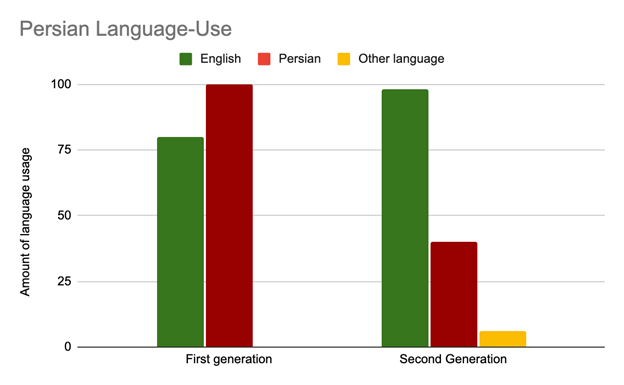
This disconnect is even more evident in the results of the ACS data analysis conducted by Bozorgmehr and Douglas (2011). Their findings reveal a notable linguistic divide within the second-generation Iranian diaspora: while 40% reported proficiency in Persian, a striking 98% acknowledged fluency in English, underscoring the prevalence of English as the dominant language of communication. As second-generation Iranians struggle with the intricacies of their linguistic identity amidst shifting cultural landscapes, this study sheds light on the nuanced dynamics shaping contemporary Persian language usage within the diaspora.

Figure 1: Persian language use among first-generation and second-generation Persians

Furthermore, in the middle of this linguistic mismatch, most of the participants in this survey acknowledge only speaking Persian, while speaking with their group of friends in Farsi alongside English. As a result, diaspora youth unknowingly serve as informal language brokers, facilitating the seamless exchange and merger of both languages in their daily lives. This informal linguistic exchange not only highlights the intricate interplay between cultural adaptation and identity creation but also demonstrates the adaptability of the second-generation Iranian diaspora.

Discussion

The information discussed in this section is a widespread concern among the Persian diaspora. It is a common question of whether Persian is being taught enough, and if not, why parents are not teaching their children Persian. Although the first generation of Iranians overwhelmingly understands Persian and could teach it to their children, they choose not to due to Persian’s position when compared to English. Should a parent teach their child Persian to keep the language alive, and thus risk their child’s ability to speak fluent English, or do they teach their child English first and risk their child’s ability to speak the native tongue well? When framed against the financial success of the Persian diaspora, it makes sense that many would stray away from teaching Persian, even when they could do so.

Survey

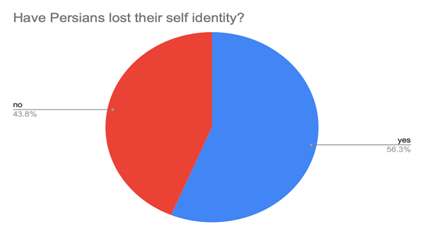
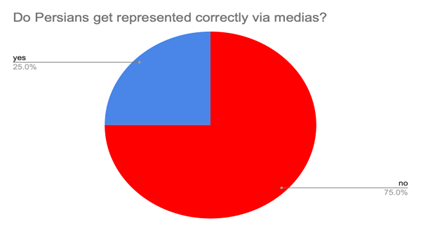
To get a better grasp of Persian Identity, we conducted a brief survey on the UCLA campus and asked participants, mainly of Iranian backgrounds, whether they believe that Persians have lost their self-identity or not. When we gained our participant’s answers and compared them to our original hypothesis, the data shown below was not surprising to us, however, what followed next was:

Figure 2: Have Persians lost their self-identity?
Figure 3: Are Persians represented correctly in the media?

Survey Experiment Conclusion

From the two surveys that we conducted, the data clearly showed us that most Persians do not believe that they have kept their original identity and almost all of them agreed that the media’s coverage of Iranians does not help at all to fix this issue. When we take the findings we gathered from this experiment and combine them with our other data, we constantly see the same trends and conclusions about the Iranian people and their identity which will be discussed in more detail below!

Discussion and Conclusion

When we take a moment to evaluate all of our data and findings that we have stated so far, it is clear to us that the Persian people have lost their identity to some shape or extent. As shown, a lot of our data and participants believe this to be true for the most part and many agreed that for the Persian community to regain their identity and status, something must change with the Iranian Regime (government) representing them back in Iran. Although we do not have public data on this topic many of our participants and even articles universally agree that a direct change to the Iranian regime influences the words views and perceptions of the Iranian people. Overall, we are pleased to report that our original hypothesis of how “Persians have lost their self-identity” is to at least some extent true and the continued destiny of whether it remains true or not simply depends on the actions that the Iranian government and Iranian people continue to take.  

References

Bozorgmehr, M., & Douglas, D. (2011). Success(ion): Second-Generation Iranian Americans. Iranian Studies, 44(1), 3–24. http://www.jstor.org/stable/27919961

Woolard, K. A. (2004). Codeswitching. In A. Durantic (Ed.), A companion to linguistic anthropology. Malden: Blackwell Publishing.

Survey Results

M150 Project Survey

[/expander_maker]

, , ,

Parent & Child Communication Dynamics in Heritage Language Speakers

Jessica Nepomnyshy, Andrew Gerbs, Christabel Odoi

Language is often considered a window into a culture, but what happens when that window starts to close? In many families, heritage language communication can be a complex and nuanced issue, especially when it comes to older and younger siblings. While the older generation may have grown up speaking the language fluently, their younger siblings may struggle to maintain their proficiency. Data was collected and analyzed, showing the trend that older siblings were more proficient than their younger siblings when communicating with their parents in their heritage language. This correlates with our background research which discusses sibling language proficiency and code-switching within bilingual families. We explore the communicative differences between parents and their children, and how confidence when speaking, code-switching, and understanding of the heritage language all play small roles in the relationship children have with their parents. Our main findings indicated that the younger siblings had less proficiency and that parents were more likely to support heritage language use with their older child, which could create a closer relationship between them.

[expander_maker id=”1″ more=”Read more” less=”Read less”]

Introduction and Background

A few questions we aimed to understand were: When examining heritage language communication between a parent and their second-generation children, is one sibling more proficient than the other when corresponding with the parent? Are communication dynamics and abilities differing between siblings, and? How is the confidence and language style of one sibling different from the other sibling when in communication with the parent? We hypothesized that if the older sibling is more proficient in the heritage language than the younger sibling, then the parent often will encourage the less proficient sibling to communicate more in the heritage language as one may avoid using the language due to difficulty.

Siblings play an important role in shaping the overall language environment within immigrant families, and their language choices influence the family language policy. Older siblings often act as language experts and help younger siblings develop their language skills (Kheirkhah & Cekaite, 2017). However, younger siblings may find it easier to use English over their heritage language, leading to more code-switching, which is defined as the alternation between two or more languages in the context of a conversation or situation.

Heritage language ties how siblings communicate with their parents as data has shown that bilingual Chinese language speakers strived to maintain their language due to their parents’ wish for them to know Chinese strongly. Language is the factor that facilitates communication between family, siblings, and spouses (Budiyana, 2017). Heritage language is important as it strengthens and reinforces bonds with the heritage community and leads to greater overall connectedness with family and friends who also speak the language (Vallance 2015).

Methods

We explored data from five bilingual families: one parent and two children with varying proficiencies in a heritage language. All participants signed a consent agreement (parents signed for their adolescent children under 18) and completed a survey that functioned both as a pre-selection tool and a way to gather relevant socio-demographic info, where asked age of all participants, all languages spoken, and amount of years the language has been spoken. Names and any identifiable information were removed to maintain participants’ anonymity.

Parents were asked to sit down with each sibling and audio-record a conversation in the heritage language to the best of their abilities, asking for up to ten minutes of audio recording. The parent was asked to maintain the flow of the conversation by asking follow-up questions when their child responded to the question posed to observe a more natural conversation. We tasked each parent and sibling to answer three conversational questions: “Tell me about your favorite part of your day today,” “Let’s discuss a movie TV show that you recently watched that you enjoyed,” and “What is your favorite thing to do on the weekend?” By gathering audio recordings, we were able to notice differences between the pairs of siblings in comparing the number of times each sibling code-switched, their confidence levels, and whether a sibling self-corrected or if a parent was inclined to correct their child when errors were made. Through observing these three key features in heritage language-speaking siblings and their conversations with a parent, we can better understand the role language holds in maintaining a relationship between siblings and parents.

Results and Analysis

From our five sets of participants, one parent and two siblings per set, we transcribed, counted, and observed the frequency of each sibling’s code-switching from their heritage language to English. From this data, we counted the number of code-switches that younger siblings produced and calculated that on average they would switch to English twelve times in ten minutes, which is around 83% of the time. When the same method was used to count and calculate for the older siblings, we concluded that they code-switched on average seven times within their ten-minute conversations, equaling 70% of the time.

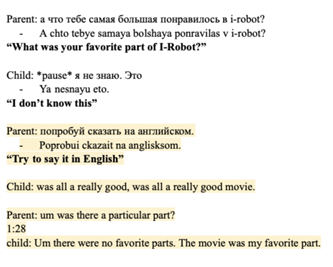
Through observing code-switching patterns, we noticed that parents were more likely to correct their older children when they made errors or code-switched from their heritage language to English. When it came to younger siblings, parents were more lenient in allowing their children to continue speaking in English as shown in an example in Figure 1.

Figure 1- Conversation between parent and younger child- parent allows for English language use

The younger sibling in this example is asked by the parent to respond in Russian, and when the sibling responds in English, the parent continues to follow up in the non-heritage language. One can also observe that earlier in the transcript the younger sibling can say that they don’t know how to say something using their heritage language, right before code-switching to English. The younger sibling also seems to avoid giving many details when speaking, as they are less confident in using the heritage language throughout their speech. One can observe this when the sibling uses a filler word before reiterating the same two responses to their parent.

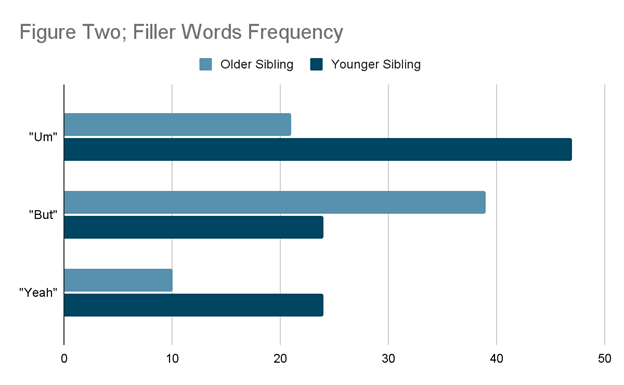
We observed noticeable differences in confidence levels between siblings when conversing with parents in the audio recording. Siblings used filler words like, “um” “but” and “yeah” which indicated how sure one was when answering a question. This analysis revealed that higher usage of filler words showed that a sibling was less confident in using their heritage language when answering questions. We counted the number of filler words used throughout all interviews and showed them in Figure 2.

Figure 2- Amount of times siblings use filler words in speech

This data was collected to validate our results as we compared the number of filler words used to the level of confidence siblings showed in their language use. “Um” was used significantly more than “But” and “Yeah” as it was used as a break when one was thinking of more dialogue. “But” was used significantly more by the older sibling and was observed to occur before or after they code-switched to transition back to the other language. “Yeah” was used less often, but was an indicator used when one was finishing a train of thought. Many siblings had limited vocabulary when speaking, so it was imperative to our study to track the number of filler words.

Discussion and Conclusions

Researching heritage language maintenance within families opens one’s eyes to the efforts parents make to preserve and pass on their language to their children. Many aspects play into siblings’ understanding, communication, and confidence when using a heritage language, and we as researchers were able to uncover differences between how older and younger siblings communicate with their parents. The hypothesis we explored was that older siblings are more proficient in the heritage language as compared to the younger siblings, and because of this, the parents would encourage the less proficient sibling to communicate more in the heritage language as a way to improve their language skills. After observing a variety of communication aspects between siblings and parents, we were able to conclude that our hypothesis was partially true. We found that out of all our sibling pairs, every younger sibling was less proficient in speaking their heritage language, as they code-switched more often and exhibited less confidence through using filler words, in comparison to the older siblings who demonstrated a stronger grasp of the language. As researchers, we hypothesized that the less proficient sibling, within our data being the younger one, would be more likely to get corrected by their parents when making grammatical mistakes, or code-switching, but we were wrong. It was more likely that a parent would correct the older sibling’s heritage language use and allow the younger and less proficient sibling to speak English. We can consider the idea that parents are more likely to correct their older children as a way to preserve and maintain their proficiency, knowing that the younger sibling holds less strength in the language.

If we had more time to further this study, we would most likely broaden the number of subjects we had, provide deeper questions, and use surveys to gauge more attitudes on language use, and the impact it has on parent and child relationships. A few limitations that we did not consider were whether the genders of siblings played a role in their proficiency, if parents being immigrants played a role in proficiency, and whether the age at which the language was learned played a factor in subject experiences. We were able to conclude that older siblings were much more likely to be the stronger speakers when it came to using the heritage language, in comparison to their younger siblings. Unfortunately, we could not fully determine if parents had a closer bond with the more proficient children, but we can assume that they can connect more through bilingual communication.

References

Altman, C., Burstein Feldman, Z., Yitzhaki, D., Armon Lotem, S., & Walters, J. (2013). Family language policies, reported language use and proficiency in Russian – Hebrew bilingual children in Israel. Journal of Multilingual and Multicultural Development, 35(3), 216-234. doi:10.1080/01434632.2013.852561

Budiyana, Y. E. (2017). Students’ parents’ attitudes toward Chinese heritage language maintenance. Theory and Practice in Language Studies, 7(3), 195. doi:10.17507/tpls.0703.05

Kheirkhah, M., & Cekaite, A. (2017). Siblings as language socialization agents in bilingual families. International Multilingual Research Journal, 12(4), 255-272. doi:10.1080/19313152.2016.1273738

Nitta, F. (1996). Socialization of “International children”. Kazoku Syakaigaku Kenkyu, 8(8). doi:10.4234/jjoffamilysociology.8.97

SORENSON DUNCAN, T., & PARADIS, J. (2020). Home language environment and children’s second language acquisition: The special status of input from older siblings. Journal of Child Language, 47(5), 982-1005. doi:10.1017/s0305000919000977

Vallance, A. (2015, 12 21). The Importance of Maintaining a Heritage Language while Acquiring the Host Language. https://digitalcommons.wayne.edu/cgi/viewcontent.cgi?article=1021&context=honorstheses#:~:text=Maintaining%20the%20heritage%20language%20strengthens,who%20also%20speak%20the%20language

 [/expander_maker]

, , , , ,

Nature vs. Nurture: Do Our Cultural Backgrounds or Personal Preferences More Heavily Affect the Way We Verbally Affirm Our Romantic Partners?

Tina Festekdjian, Krunali Mehta, Mark Keosian, Tatiana Akopyan

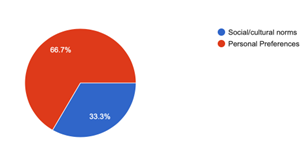
Do you ever wonder why people belonging to different cultures express love differently in their romantic relationships? Are they accustomed to verbal or nonverbal forms of affirmation, and does this carry on throughout generations? This study explores why and how second-generation college students living in Los Angeles who identify as Latin American, Asian American, or American verbally affirm their partners, as we were curious to see if culture may cause communicative differences in relationships. Whether words of affirmation can be attributed to the way people were raised, their cultural habits, or their personal preferences, the population we studied displayed an interesting trend: individuals are less heavily influenced by their culture, and the majority (66.7%) are more likely to follow their personal preferences when expressing love. While the minority (33.3%) displayed cultural allegiance, we generally noticed that one’s culture is not the leading contributor to how they express love – possibly due to the generational shift that embodies independence, socialization, and even Americanization. We can conclude that our target population is perhaps more open-minded, individualistic, and willing to break cultural barriers for love to embody their own preferences. Breaking barriers can make students more comfortable to approach others, adapt to new love languages, and better learn how to express love verbally.

[expander_maker id=”1″ more=”Read more” less=”Read less”]

Introduction and Background

 Do second-generation college students living in Los Angeles prefer to follow cultural guidelines or personal preferences when expressing verbal love in romantic relationships?

We hypothesize that particular people will be influenced by their culture if they abide by cultural norms, but that this most likely does not separate people – especially in a younger generation of college students who may be more willing to branch out. The motivation for our research was to explore what role culture plays in verbal affirmation in romantic relationships for second-generation college students, and whether social norms, family life, or personal feelings are the leading contributors. The problem is, based on the way we were raised, or based on our own preferences, we show love differently, which can cause miscommunication. By investigating different forms of linguistic communication among Latin American, Asian American, and American college students in Los Angeles, we can deduce how intimacy is present through verbal communication in their relationships. Some specific aspects of communication that we will look at include words of affirmation, romanticism in conversations, tone, and context of affection. For example, in a cross-cultural context, this means: the specific words people use to address their partner and whether it comes from their own language/culture, if someone is more expressive verbally or uses nonverbal communication, and in what situations they will be verbally affectionate. Virtual communication like text-messaging will also be studied to develop a deeper understanding of day-to-day interactions and what exactly is said in these relationships. Above personal experience, relevant literature tells us what we know so far. Brinton (1886) displays how many tribal and modern languages of Latin America tie the sentiments of love to verbal expression. The Nauahtl and Aztec tongue, for example, indicate higher levels of emotional strength with words of origin that hold deeper meanings and cultural values. These lexical attributes can provide evidence as to why Latin America is the home to many “romance languages”. Lindholm (2006) explores the Western (American) vs. Eastern scope of view, delineating how Western linguistic expression is often romanticized in the media and verbal expression of gratitude and admiration is common. On the other hand, Bello et. al. (2010) provides evidence for how in some Asian cultures, communicative patterns like verbal affirmation are less likely to be expressed. Allendorf (2013) provides context on how romantic relationships have evolved from arranged marriages to love marriages in many parts of Asia. Ultimately, we were able to bridge this gap by bringing generational evolution to the table. Because our population is second-generation college students, and most of our literature is broadly culturally based, we were able to understand that the evidence for our trend generally lay in the people, rather than what cultural group they belong to. Being in college in Los Angeles leads to Americanization, socialization, and the added element of independence that our literature did not address.

Methods

Through the use of a clear and straightforward 4 question questionnaire and student-submitted text message screenshots, we gathered responses from 27 second-generation college students about which form of love expression they prefer to use when expressing love to a romantic partner, along with the social and cultural norms of love expression they are familiar with. Finally, we had the students answer whether they prefer to use their chosen personal preferences or the social and cultural norms they are familiar with when expressing love and affection to a romantic partner in order to see which influences students’ communication and verbal affirmation to a greater degree. These methods allowed us to analyze the specific words and tones being used by students to express affection to a partner, along with the conversational structures and atmosphere. We compared these results with the social and cultural norms of love expression the students responded they were familiar with in order to see if their personal preferences were or were not being influenced by social or cultural norms. While a student’s personal preference for verbal affirmation or love expression and the social and cultural norms they are familiar with may overlap, this may be attributed to strong cultural roots or identity. By looking at which words, verbal affirmations, and other forms of love expression second-generation college students preferred to use when expressing love or affection to their romantic partners, we hoped to find whether culture played a significant role in the specific words, affirmations, or actions being used by these students or whether the personal preferences these students have just simply outweigh the social and cultural norms in their lives.

Results and Analysis

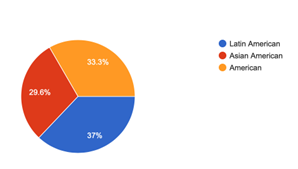
In regards to our results from Table 1: Culture, we collected information from 3 different cultural groups: 37% being Latin American college students, 33.3% American college students and 29.6% Asian American.  We collected a fairly good range of responses from our intended cultural groups to get a fair representation of second-generation college students.

Table 1: Cultures of Respondents

When asked about their preference on personal preferences or social/cultural norms shown in Table 2: Norms, 66.7% chose personal preferences while 33.3% chose social/cultural norms. 

Table 2: Preference for sociocultural norms or personal preferences in a relationship

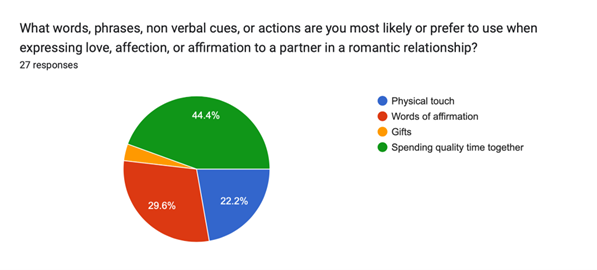
These students were then asked what words/actions were their preference in romantic relationships shown in Table 3: Preferences, from choices of spending quality time together (44.4%), words of affirmation (29.6%),  physical touch (22.2%), and gifts (3.7%). 

Table 3: Preference for words/actions in romantic relationships

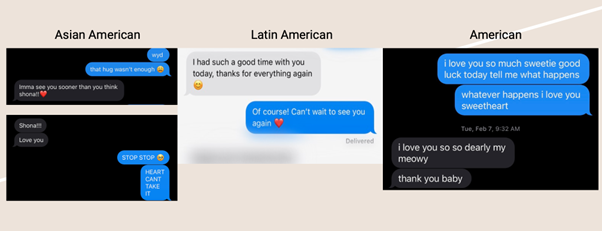
We were able to collect examples of text messages in Table 4: Cross Cultural Text Messages from each cultural group. We found Asian American college students to be showing love through using words like “shona” that embodies their cultural background where Latin American college students show love by saying thank you and words of appreciation. The difference we found in American college students shows love through constant repetition of words of affection and reassurance.

Table 4: Cross-Cultural Text Messages

Discussion, Conclusion, and Contributions

Through conducting our research, we concluded that our findings are truly impactful as we found that college students are more likely to use their own personal preferences during verbal affirmation in a romantic relationship rather than their known social and cultural norms. This is important to recognize because it highlights that students aren’t restricted or limited by their cultural upbringing and actually care more about their own personal preferences when expressing verbal affirmation to a romantic partner. Another finding to recognize is the bias when students are asked if they follow social norms or their own personal preferences. They might not answer truthfully or not even realize that social norms have become their personal preference overtime.  For generations to come, we may find that students have become more approachable or sociable as culture may not play as big of a role in verbal affirmation and love expression as we may thought. Ultimately, our findings could definitely benefit students who are in existing romantic relationships or are interested in finding a romantic partner as it can help break social barriers and make students more comfortable when communicating romantically and approaching those of different cultures. We were able to analyze various findings through code-switching from Hindi to English in the Asian American text message and how emotions/feelings are shown through the usage of emojis in online communication to further understand how society and cultural factors have contributed to various forms of communication.  Although some students still prefer to follow their known social and cultural norms in verbal affirmation with a partner, our findings show that students are more open minded to adapting to one another’s love languages and potentially learning how to better communicate and express love verbally, as they are not being tightly confined by social and cultural norms.

References

Allendorf, K. (2013). Schemas of Marital Change: From Arranged Marriages to Eloping for Love. Journall of Marriage and Family, 75(2), 453–469. http://www.jstor.org/stable/23440792  

Bello, Brandau-Brown, F. E., Zhang, S., & Ragsdale, J. D. (2010). Verbal and nonverbal methods for expressing appreciation in friendships and romantic relationships: A cross-cultural comparison. International Journal of Intercultural Relations, 34(3), 294–302. https://www.sciencedirect.com/science/article/abs/pii/S0147176710000118?via%3Dihub

Brinton, D. G. (1886). The Conception of Love in Some American Languages. Proceedings of the American Philosophical Society, 23(124), 546–561. http://www.jstor.org/stable/983335

Gumperz, J. J. (1962). Types of Linguistic Communities. Anthropological Linguistics, 4(1), 28–40. http://www.jstor.org/stable/30022343

Lindholm, C. (2006). Romantic Love and Anthropology. Etnofoor, 19(1). 5–21. http://www.jstor.org/stable/25758107

Sergeyevna Kim. (2021). EXPRESSION OF LOVE AS LINGVOCULTURAL AND GENDER LINGUISTIC CONCEPT AND ITS REFLECTION IN DIFFERENT CULTURES. CURRENT RESEARCH JOURNAL OF PHILOLOGICAL SCIENCES, 2(5), 48–54. https://masterjournals.com/index.php/crjps/article/view/89/77

[/expander_maker]

, , , ,
Scroll to Top