internet language

this is our linguistics project…lol

Max Orroth, Arielle Gordon, Jillian Litke

We’ve all heard of the acronym lol, short for “laugh out loud”, and have used it in more than one context. Lol differs from other internet-born acronyms, like ROTFL, as it has become widespread across social platforms all over the world and has maintained a role in American English vernacular to this day. Some use it to “soften the blow” of a harsh statement. For others, it is tacked onto the end of a sentence to convey sarcasm or passive-aggressiveness, but does that mean its meaning has changed over time? Our study analyzed a series of tweets from Twitter to determine if the use of lol has increased in passive-aggressive contexts from 2008-2022. We also categorized where lol appeared in the tweet, such as the beginning of it, the middle, or the end to help determine the true meaning or intent of the tweet.

[expander_maker id=”1″ more=”Read more” less=”Read less”]

Introduction

How does the three-letter acronym lol manage to make its way into so many of our online conversations, even those that aren’t inherently funny? Lol is one of the first internet terms to become popularized and has been in use for a while, thus the acronym finds itself in a myriad of situations, each with an abundance of meanings, making it somewhat of a linguistic chameleon. Is lol being used more commonly in a passive-aggressive sense than its original meaning? How does this .com-era defining acronym persist through the years, picking up new meanings and uses as it travels around the globe via our interconnected home, the internet? This is what we wanted to investigate– whether passive-aggressive uses of lol have risen in popularity in the past 15 years. Prior to our research, lol’s role as a lexical item has been studied from many different angles. Authors Tagliamonte and Denis (2008) identify the acronym as an interlocutor involvement signal, playing a similar role as “mmhmm” does in face-to-face conversation; denoting that the utterer is engaged in an exchange. Similarly, Varnhagen et al. (2010) found that lol is the pioneer of a new acronym-based lexicon arising from the internet. Markman (2017) also found lol to be a discourse marker, a lexical item that lets a conversation partner know when a statement is done over text. Schneebeli (2020) identifies how the acronym’s placement in a clause can shift its meaning and give statements a new meaning or mood when added. This prior research gives insight to the role lol plays in the syntax and flow of conversations, but, to our knowledge, no studies have chronicled the term’s evolution and shift in use over time. Given that both the internet and the acronym have evolved since its first use in 1989, we feel a current examination is missing from the literature on internet language. Looking at English speaking Twitter from 2008-2022, the salience of lol’s usage as a marker for passive aggression has increased, revealing a broader ability for internet slang to evolve much faster than in-person language due to an abundance of use, communication, the internet’s own growth, and humans finding more of a home online every day.

Methods

To test our hypothesis, we searched Twitter from 2008 to 2022 for tweets that used lol. We gathered 20 random tweets per year for a total of 300. To account for virality as a potential confounding variable, we grouped tweets by how many likes they received and made sure to select 5 tweets per group, per year. We had four engagement groups: Low (0-50 likes), Medium (50-300 likes), High (300-1000 likes), and Ultra-high (1000+ likes). After collecting data from Twitter, we then decided whether each tweet was passive-aggressive and whether lol was positioned clause-final, clause-initial, or somewhere else. To determine whether a tweet used lol to be passive-aggressive we looked at multiple criteria, including lol not signifying its original meaning (“laugh out loud”), whether the tweet conveyed a rude or negative sentiment, whether it targeted a person or situation, or if removing lol lessened the tweet’s attack. Sometimes, we could also look at replies or quote tweets to get more information about the context of each tweet to solidify our decision. 

Results

We found that since 2008, English speaking Twitter users have been steadily increasing their use of lol to be passive-aggressive (Figure 1). Using Google-Sheets built-in capabilities, we calculated a Pearson’s r of 0.767, indicating a moderate-strong positive correlation between the frequency of passive-aggressive lols and the year it was tweeted. Our data showed that passive-aggressive lols peaked in 2016 (50%) and 2021 (55%).  
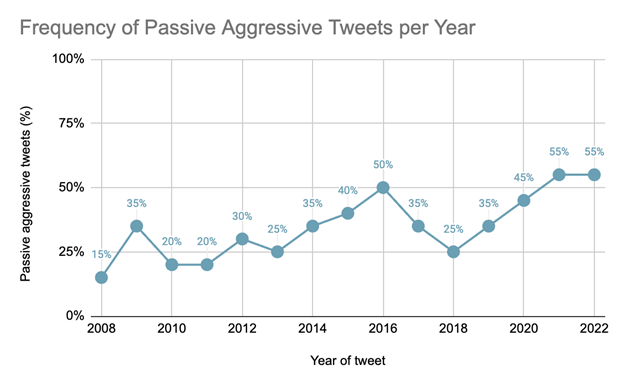
Figure 1: Frequency of passive-aggressive tweets across each year studied (2008-2022)

On clause placement, we found that slightly more tweets had lol at clause-final (~41%) than clause-initial (~34%), with about 25% of tweets placing lol in a location indeterminable as final or initial (Figure 2). 
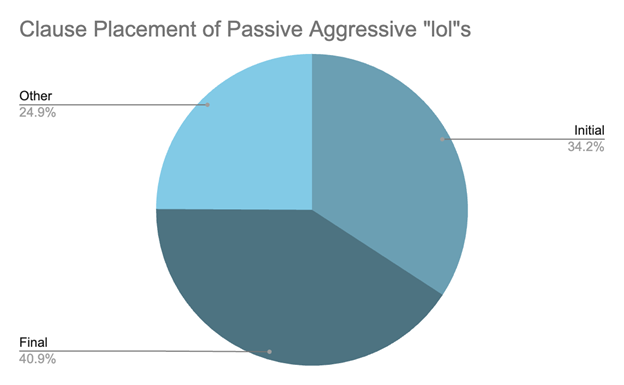
Figure 2: Breakdown of clause placement of lol across all tweets gathered

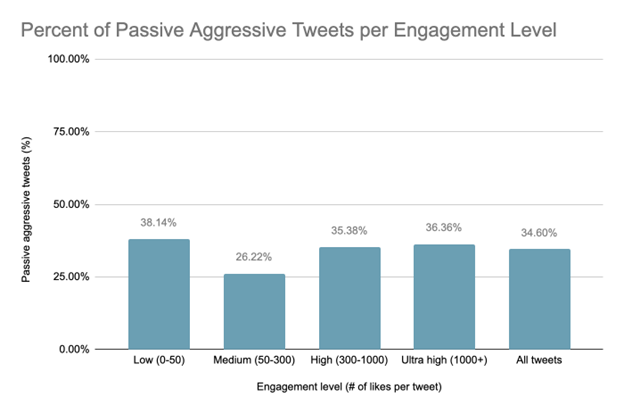
Overall, out of the 300 tweets analyzed, 34.6% were determined to be passive-aggressive uses of lol (Figure 3). For all but one group, we did not find any significant deviation from this number when tweets were grouped in their engagement groups across all years. Among tweets in the Medium group (50-100 likes), 28.6% were determined to be passive-aggressive uses of lol

Figure 3: Frequency of passive-aggressive tweets among engagement groups and all tweets

Discussion and Conclusion

Due to our data displaying a moderate-strong positive correlation, we concluded that the use of lol to convey passive-aggressiveness increased from 2008-2022. We observed peaks of passive-aggressive tweets during 2016 and 2021. While we are unsure why those peaks occurred during those years, we hypothesize that it was due to political and social turmoil in America. 2016 was when Donald Trump was elected president, and that divided our nation. 2021 was also when COVID evolved into Omicron, and America was again divided on whether wearing a mask was an infringement of our rights. Such factors could influence the use of passive-aggressive lols, and this trend might be an area for future research. We also analyzed the clause placement of passive-aggressive lols and found that the majority appeared clause-finally at 40.9%. Clause-initial lols appeared at 34.2%, and the rest were considered in the ‘other’ category in which the acronym was embedded in the clause. This supports previous research in which clause-initial lol tends to serve as a discourse structuring lexical item such as an immediate reaction whereas clause-finally typically suggests a more aggressive demeanor (Schneebeli, 2020). Finally, we analyzed the passive-aggressive lols per engagement level of the tweet to determine if one engagement group had significantly more or less passive-aggressive tweets, and we observed that there were significantly less tweets in the medium group. However, we do believe that that is an outlier since the rest of the cohorts are in the mid-30 % in regard to passive-aggressive tweets.

There were certainly limitations that should be considered alongside our findings. Due to the time constraints within which the research was conducted, only 20 tweets were found per year studied. Ideally, our findings would be derived from a broader sample, and even include other languages aside from English. Constraining the time frame even more, the advanced search feature on Twitter would only display tweets from September to December of each year, potentially creating a bias towards tensions and events during the Fall and Winter months such as elections, holidays, and harsh weather. Additionally, Twitter search would not allow us to filter tweets by the country of origin, only language. Though the site is most popular amongst American users, there is no way to know if the tweet authors were from the United States, the United Kingdom, Australia, or some other English-speaking individual. Lastly, our study was looking at passive aggression; though one can typically read tension through a screen, since we were not present for all the interactions or posts, we cannot say for certain if the tweet was delivered in an aggressive way. Despite our systematic approach to determining whether a tweet was aggressive, it is impossible to know the tweet authors’ true intentions behind their posts. We cannot say how these limitations affected our data and results but would be curious to have the study done on a larger scale, including multiple languages, and over a larger period. 

Nevertheless, lol’s modality is an example of how the internet can accelerate language evolution. Since the term’s creation with the rest of Instant Messaging language, it’s since taken on countless other meanings in addition to signaling passive aggression. This process, which might normally take decades to accomplish, is now achieved in 20 years. This is partly due to the unprecedented availability of other people’s discourse on the internet and online platforms like Twitter. One could read hundreds of tweets every day and the same tweet could be seen by hundreds of thousands of people. This level of contact between speakers catalyzes the creation of slang words and evolution of other terms like lol. Additionally, Twitter’s characteristics as a social media platform encourages widespread adoption of new language forms. Given that it’s mainly discourse-based, users look to the language of other tweets to inform how they should adapt their own language. This emulation of linguistic behaviors can drive language evolution, like we’ve seen with passive-aggressive lols. Although we did not study other internet language acronyms (ROTFL, lmao, etc.), we noticed anecdotally that lol seems particularly susceptible to being adopted for other uses beyond its literal meaning. Perhaps the term’s shortness, broad meaning, and ease to type into a phone screen have allowed it to garner such an expedited evolution. Future research might investigate what makes lol such a linguistic chameleon and why it has remained relevant in cultural discourse to a greater extent than many other IM language creations that evolved at the same time. 

Aside from the explicit findings, our study offers broader implications to the field of sociolinguistics. We were able to identify a few studies on lol, but not nearly as many as expected considering the popularity of the term. This study contributes to this burgeoning sector of the field. Lol’s breadth of uses offer a plethora of research topics — we could conduct this study with an entirely different meaning of the term and find something new and relevant to report. In general, there is a deficit in studies of online language use. Nowadays, a message can be sent from Japan to Canada in a matter of seconds, and on Twitter you can see hundreds of tweets from all around the world with a simple scroll of your thumb. As the world grows more dependent on the internet and humans increasingly engage in online communication, studies of this nature are of the utmost importance for the future of sociolinguistics. Lastly, this research topic came from phenomena we have noticed in our day to daytime spent on social media and engaging in digitally based conversations. Sociolinguistics as a field studies language use and the social implications behind it; this study gives validity to anecdotal experiences as a legitimate course of study and provides a deeper understanding of the terms we use daily.

References

Markman, K. M. (2017, October 30). Exploring the Pragmatic Functions of the Acronym LOL in Instant Messenger Conversations, doi: https://doi.org/10.31235/osf.io/3du86.

Sloan, L., Morgan, J., Burnap, P., & Williams, M. (2015). Who tweets? Deriving the demographic characteristics of age, occupation and social class from Twitter user meta-data. PLoS One, 10(3), doi: https://doi.org/10.1371/journal.pone.0115545.

Schneebeli, C. (2020). Where lol is: function and position of lol used as a discourse marker in YouTube comments. Discours. Revue de linguistique, psycholinguistique et informatique. A journal of linguistics, psycholinguistics and computational linguistics, 27.

Tagliamonte, S. A. & Denis, D. (2008). Linguistic Ruin? LOL! Instant Messaging and Teen Language. American Speech, 83(1), 3-34.

Varnhagen, C.K., McFall, G.P., Pugh, N., Routledge, L., Sumida-MacDonald, H. & Kwong, T.E. (2010). lol: new language and spelling in instant messaging. Reading and Writing 23, 719–733.

[/expander_maker]
, , ,

“I scared he eat, then the stomach explode!”: Missing Tense and the Standardization of Singlish

Hannah Chu, Trevor Htoon, Youchuan (Aaron) Hu, Ann Mayor, Grace Yao

Can we detect language change right as it’s happening? As a result of nearly a century of colonial handoffs, the Southeast Asian Island of Singapore developed its own, unique variety of English: Singapore Colloquial English, more commonly known as Singlish. There is reason to hypothesize, though, that Singlish may be progressively becoming closer to standard English and losing some of its distinctive linguistic features. The following article attempts to identify whether an assimilation to standard English is currently taking place among Singlish speakers, and if so, which categories of speakers are leading the change. The study focuses on one particular feature of Singlish: missing (or “dropped”) tense words, including copular verbs and tense auxiliaries. In order to collect data on this phenomenon, a survey and subsequent transcript analysis of eight YouTube videos from four young Singaporean content creators was conducted to identify tense word dropping rates for various Singlish speakers over time.

[expander_maker id=”1″ more=”Read more” less=”Read less”]

Introduction and Background

Singapore has long been the converging point of various languages and cultures, having spent the better part of 100 years shifting from British to Japanese to Malaysian control before gaining its independence in 1965. With four official languages—English (which serves as a lingua franca and facilitates cross-ethnolinguistic interaction), Malay, Mandarin, and Tamil—it’s no surprise that Singapore eventually developed a unique variety of English that pulls features from the three other languages. Today, Singapore Colloquial English (commonly known as Singlish) has “a distinctive phonology, syntax and lexicon” (Lim, 2004) that were created at the hands of the city-state’s bustling multilingual population. 

One recognizable aspect of Singlish, for instance, is the absence of tense marking in a sentence. Missing tense words are a replication of Mandarin Chinese syntax, in which elements like copular verbs are optional and often dropped (Tan, 2017). The Eton Institute demonstrates how tense is dropped in the sentence She is scared, instead giving She scared in Singlish (5 Unique Features of Singlish, 2021).

The usage of Singlish has not always, however, been without controversy on the Southeast Asian Island. In 2000, the Singaporean government launched the Speak Good English Movement (SGEM) “in a bid to delegitimize and eliminate Singlish” (Tan, 2017). The campaign, ongoing as recently as 2019, “often [featured] Singlish as an example of ‘bad English’,” (Tan, 2017) and has started a push for Singlish speakers to adopt standard English speech features. Along with the recent expansion of global platforms like YouTube that expose Singlish speakers to broader audiences of standard English speakers, this raises the question of whether Singlish may actually be in the process of becoming closer to standard English and losing some of its distinctive linguistic features.

The following research focused on missing (or “dropped”) tense words in Singlish syntax, attempting to detect whether this Singlish feature is becoming less frequent in favor of tense word inclusion, which is typical in standard English. Through investigating the speech of millennial and Gen Z (20- to 30-year-old) Singlish speakers of varying registers, the study hoped to identify whether Singlish appears to be assimilating to standard English and which groups of Singaporeans (within what sociolinguistic context and/or from what social category) are at the center of the change.

 Study Design

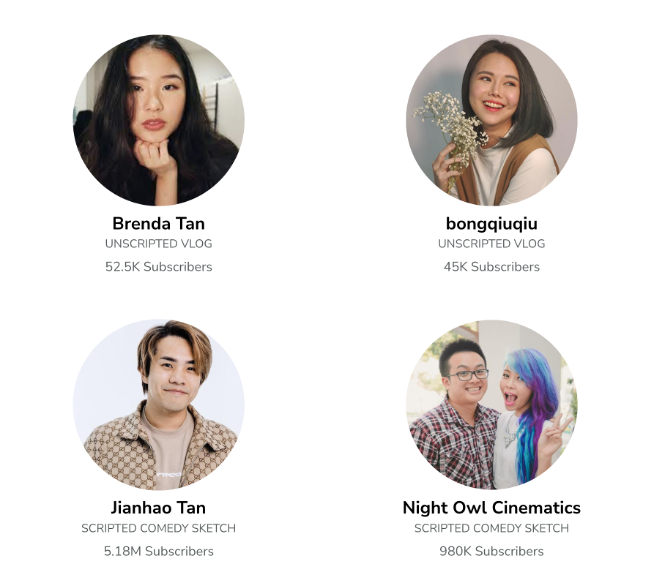
To collect data on missing tense words—specifically, copular ‘be’ and tense auxiliaries ‘be’, ‘do’, and ‘have’—we conducted an analysis of recorded Singlish speech from the videos of four popular Singaporean YouTube channels: Jianhao Tan, bongqiuqiu, Brenda Tan, and Night Owl Cinematics. Each of the creators falls in the 20’s to 30’s age range, consistent with the hypothesis that any potential language change is happening currently and as a result of recent developments in the past two decades, such as the SGEM.

Image 1: Our subject pool consisted of four popular YouTube channels, run by young Singaporean content creators. Half of the channels were styled as unscripted vlogs, while the other half produced scripted comedy sketch videos.

Two potential motivating factors of language change were considered in the study’s design: speaker agency and recency.

First, we divided our four YouTube channels into two categories that represent two registers of speech, which we called “Scripted” and “Unscripted.” Jianhao Tan and Night Owl Cinematics, who produce comedy content like skits and sketches, fell into the Scripted category. Meanwhile, bongqiuqiu and Brenda Tan, who produce lifestyle and vlog-type content, were chosen for the Unscripted category. By watching videos from channels with opposing content styles, we hoped to compare tense word dropping across differing language contexts.

Additionally, we wanted to capture potential language shifts over time, independent of Scripted and Unscripted categorizations. We chose two videos to analyze from each of the four YouTube channels (for a total of eight videos): one from 2021 (the year of the study) and one from five or more years ago.

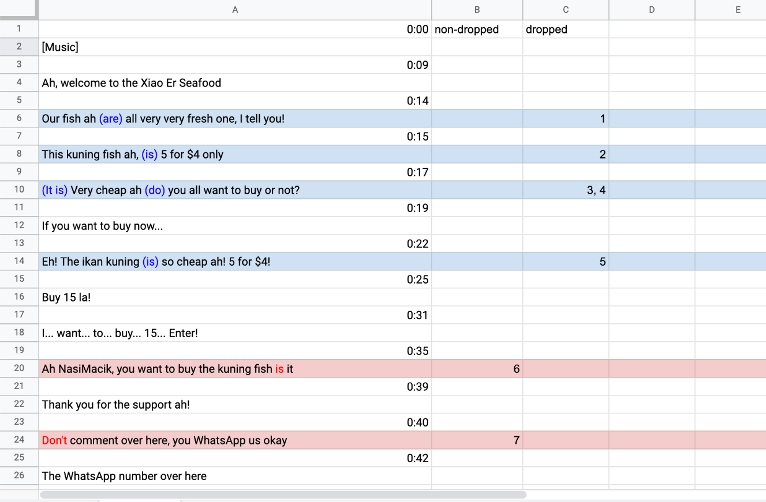
For each video, we edited and annotated auto-generated or provided speech transcripts. Relying on our intuition as native speakers of a standard variety of English, we marked each instance of tense word dropping or inclusion on the transcripts. We then reported the number of clauses with tense word droppings as a percentage of the total spoken clauses that would require tense word inclusions in standard English. More tense droppings would indicate a closer association with Singlish features, while fewer would indicate a closer association with standard English.

Image 2: An example spreadsheet of how we collected data for a video. Dropped tense words were added to the transcript in blue parentheses where we deemed them necessary, while pronounced tense words were highlighted in red.

As we began collecting data, we expected to see that our Scripted YouTubers would show lower tense word dropping rates than our Unscripted ones. With the ability to pre-plan dialogue, we thought that they would be more conscious of their language use and exercise larger agency over their speech. We also expected that recent videos from the past year would show lower rates of tense word dropping than older examples, demonstrating an ongoing progression of Singlish adopting standard English features.

Results and Analysis

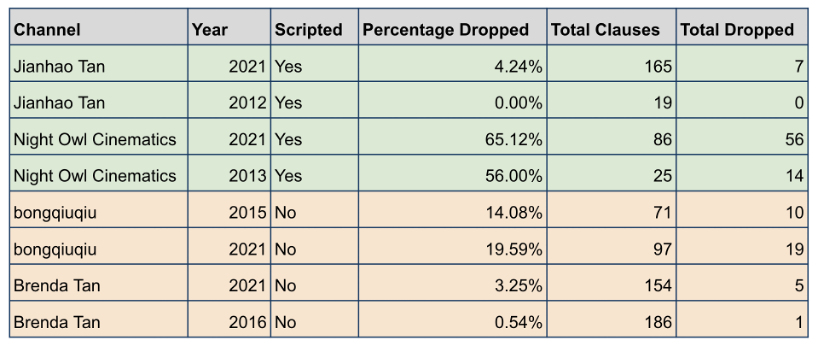
Out of four YouTube channels and eight videos, we found Night Owl Cinematics—a Scripted channel—to consistently show the highest rates of tense dropping (Figure 1), with over 50% of applicable clauses missing tense words. Brenda Tan—an Unscripted channel—showed the lowest rates, consistently having a less than 4% tense word drop rate.

Figure 1: Table of data on the percentage of dropped tense words per video, as well as raw data on the number of dropped tense words and total applicable clauses.

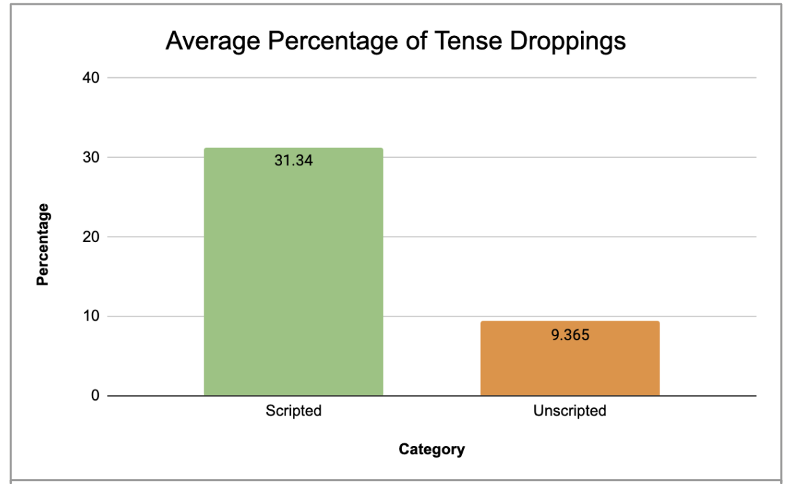
A closer look at our data revealed unexpected results. For instance, the average tense word dropping rate observed in Scripted videos ended up over three times higher than that in Unscripted videos (Figure 2). In other words, the content creators who we thought would make the most use of speaker agency to hide a Singlish feature like missing tense actually exhibited the feature much more frequently, on average.

Figure 2: Average percentage of tense word droppings in videos by category of register (Scripted vs. Unscripted).

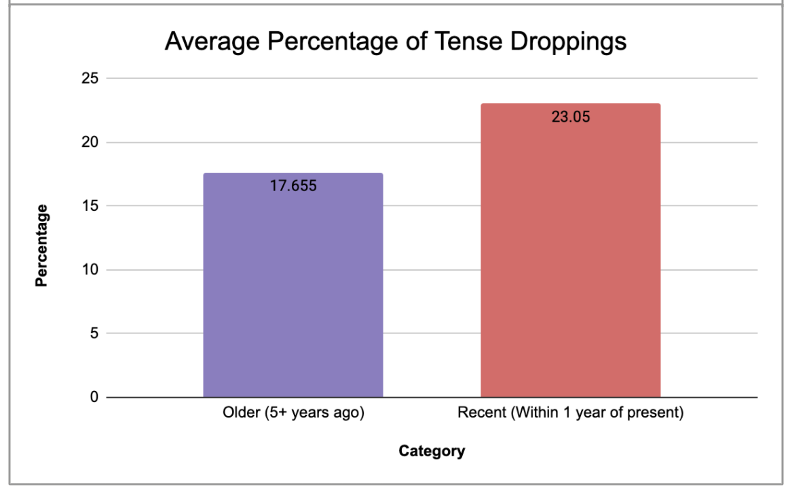
There also seemed to be a slight difference when we compared tense word dropping rates in recent and older videos. Tense word dropping occurred more frequently by roughly 5 percentage points in recent videos, contrary to our hypothesis that the Singlish feature of missing tense would be fading as time went on.

Figure 3: Average percentage of tense word droppings in videos by category of time (older vs. recent videos).

However, we noted that since our data came from a small sample size of just four YouTube channels, it wasn’t immediately obvious whether this increase was particularly significant. We decided to take another qualitative look at our data.

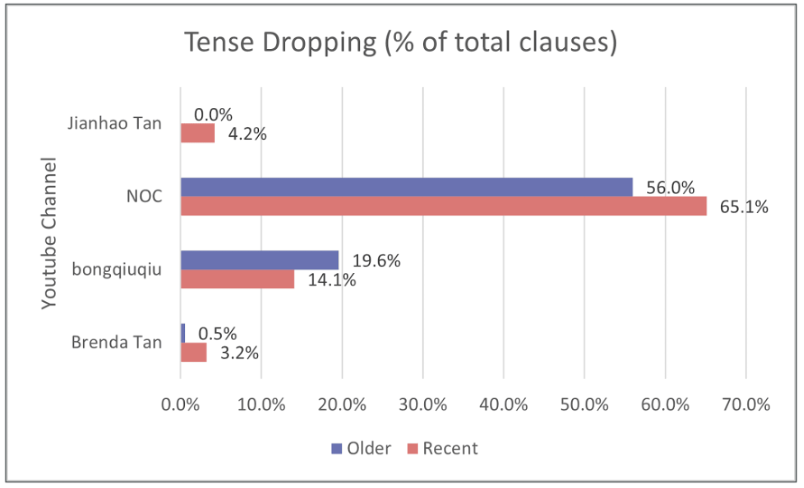
First, we noticed that within the categories of speech register that we chose (Scripted and Unscripted), the percentage of tense word dropping was highly varied. For instance, Night Owl Cinematics and Jianhao Tan both represented our Scripted category; while Night Owl Cinematics’ videos showed missing tense in over half of all applicable clauses, Jianhao Tan essentially did not drop tense words at all (Figure 4). This suggested to us that there was little to no pure correlation between the Scripted factor alone and tense word dropping.

Interestingly, the tense word dropping rates did not vary significantly within a YouTube channel’s own content. The frequency of missing tense did show a relative increase in the more recent videos for three out of the four channels (Figure 4), which was possibly indicative of a more general trend in Singlish. However, the small sample size of our study made it unrealistic to definitively conclude whether time was a significant influencer of tense word dropping rates and whether missing tense is actually becoming more frequent in Singlish as time goes on.

Figure 4: Percentage of tense word droppings for each video analyzed, by YouTube content creator and by category of time (older vs. recent).

These results led us to formulate a few possible explanations for what we observed. For instance, tense word dropping rates may be more closely correlated overall with the language background you came from (perhaps where in Singapore you grew up or in which language or ethnic community) or personal linguistic style. This would explain why each individual speaker’s missing tense rates were relatively consistent all in all, while comparing two different speakers (even across the same Scripted or Unscripted category) showed larger variation. These seem to be more plausible factors than year or speaker agency, as we originally thought.

We also noted, for example, that Night Owl Cinematics specifically brands themselves as a “Singaporean humour” channel—their content specifically hopes to showcase Singaporean culture and life. This might explain why, though they have strong agency over and can pre-plan dialogue, Night Owl Cinematics showed prominent tense word dropping: they have a motivated interest in sharing the unique characteristics of Singaporean language use.

Discussion, Conclusion, and Expansion

Ultimately, there is not enough evidence in our data to claim that Singlish is becoming closer to standard English and adopting its features. In fact, many of our results appeared to suggest otherwise.

There are a few points in our research that, if modified, could lead to more conclusive descriptions of the current landscape of Singlish’s evolution. It should be kept in mind, for instance, that we surveyed a limited subject pool of four content creators and a small sample size of two videos for each creator. We also looked only at online personalities with large audiences not just from Singapore, but elsewhere around the globe. This may, consequently, have resulted in the Hawthorne effect, where speakers alter their usual speech when under the conscious observation of an audience.

Further research into this topic could be focused on looking at potential influences of Singlish on Singaporeans who are attempting to learn or speak a more standard variety of English, such as Singaporean international students or Singaporean nationals living and working in the United States. Additionally, investigating the speech of local Singaporeans rather than just that of online and public figures would provide a more holistic picture of how Singlish is adopting (or not adopting) standard English features. Surveying a larger sample size of videos that span a more extended time scale would give better insight on Singlish languages changes over time. Studying other features, beyond missing tense or even beyond syntax, could also provide a more well-rounded idea of how Singlish is shifting over time.

Finally, although our findings did not line up with our hypothesis, we were able to make other interesting observations based on the data collected.

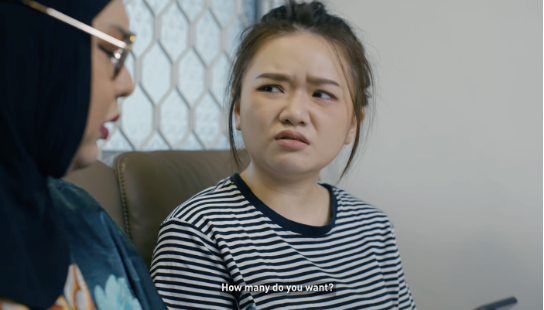
It appears, first of all, that our speakers showed a clear awareness of the difference between standard and Singlish English features at times. For instance, take the following Night Owl Cinematics video from 2021, “Types of Online Shoppers”. While the written subtitle reads, “How many do you want?” (Image 3), the speaker actually pronounces the following utterance: “How many you want?” This seems to show a conscious acknowledgement of what is typical in standard English syntax, in striking juxtaposition to what was natural to the Singlish speaker.

Image 3: A screenshot from Night Owl Cinematics’ 2021 video, “Types of Online Shoppers”.

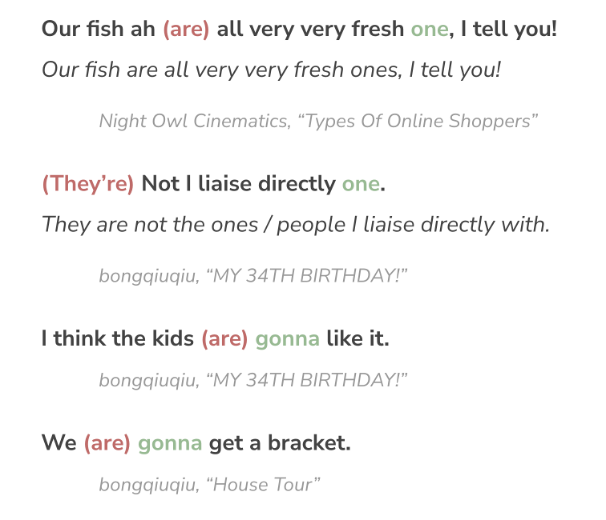
Moreover, we were able to confirm from our data that tense word dropping appears to be not random but systematic and motivated (part of Singlish grammar; not randomly distributed) in Singlish, as Lim (2004) had suggested was the case with phonological, syntactical, and lexical features of the variety. We can review a few examples (Image 4), which show two systematic instances of tense word dropping. We firstly see that the feature of missing tense seems to appear in conjunction with the Singlish particle ‘one’; in both a Night Owl Cinematics and a bongqiuqiu video, the speakers use the particle at the end of the clause and drop that same clause’s earlier copular verb. In a similar phenomenon, the missing of the tense auxiliary ‘are’ appears in conjunction multiple times with the auxiliary ‘gonna’, where the utterance of the latter seems to trigger the dropping of the tense auxiliary immediately before it.

Image 4: Evidence for systematic tense word dropping in Singlish, taken from three analyzed videos. Posited tense dropping “triggers” are marked in green; dropped tense words are marked in red parentheses.

So, is Singlish becoming more and more like standard English? It’s hard to say. What seems to hold is that Singlish has unique and systematic features, of which the distribution varies among its diverse speakers. The tangible influence that campaigns like the Speak Good English Movement have on non-standard varieties and their assimilation to standard forms of a language remains to be seen.


References

5 Unique Features of Singlish. Eton Institute. (2021, May 24). Retrieved October 15, 2021, from https://www.etoninstitute.com/wp/2021/05/24/5-unique-features-singlish/.

Gopinathan, S. (1979). Singapore’s Language Policies: Strategies for a Plural Society. Southeast Asian Affairs, 280-295.

Leimgruber, J. R. E. (2013). Singapore english: Structure, variation and usage. Cambridge University Press. https://www.jstor.org/stable/27908382.

Lim, L. (Ed.). (2004). Singapore English: A grammatical description (Vol. G33). John Benjamins.

Tan, Y. (2017). Singlish: An Illegitimate Conception in Singapore’s Language Policies? European Journal of Language Policy 9(1), 85-104. https://www.muse.jhu.edu/article/657324.

[/expander_maker]

, , ,
Scroll to Top