language change

No Güey, Spanish Social Media is a Language Unto Itself

Social media is the vehicle that carries much of our communication and culture across the internet nowadays. Unquestionably, its relevance to today’s society is irrefutable and its ability to be used across multiple languages is something to be studied. The focus of this article looks into whether social media influences Spanish speakers in their everyday use of Spanish like how popular trends across English social media does. This study observed popular trends in Spanish social media and slang often included in posts across popular platforms like Facebook, YouTube, Twitter (X), and Instagram. Then, surveyed UCLA students and high school students discussed their use of social media and whether they use slang learned from social media in their everyday interactions. Respondents showed that while the slang and language they pick up does match what is often seen in social media, they instead stated that they primarily picked up new words from people they talk to often, like friends and family, not social media. Our findings suggest that while social media is a strongly influential phenomenon on individuals, for the Spanish speaker it is more so a reflection of changes in their language rather than being the influencer.

[expander_maker id=”1″ more=”Read more” less=”Read less”]

Introduction and Background

Our research examined the dynamic interactions that occur between Spanish-speaking people and the constantly changing social media environment. Our main goal was to investigate the complex linguistic trends and shifts in Spanish that are made possible by Internet communication. We aimed to investigate how Spanish-speaking users’ word choices and phrases have changed as a result of digital communication platforms by closely examining the impact of social media culture on language use.

Social media platforms are vibrant centers of language exchange in today’s digitally connected world, where users participate in a variety of communication activities, from chats to formal discourse. Our goal in conducting this research was to clarify how this digital world has affected the development of Spanish language usage. Determining if linguistic patterns seen in online encounters result in changes to people’s face-to-face conversational styles was one of the main goals of our research.

The various ways that social media culture affects language use in Spanish-speaking populations are clarified by our findings. As people crossed the digital environment using a combination of traditional language rules and modern terms, we saw fascinating patterns of language creation and adaptation. Additionally, our research demonstrated the close connection between language use in online contexts and physical communication styles, emphasizing the interdependence of virtual and real-world interactions.

Recognizing the subtle aspects of language change on social media platforms is essential for understanding bigger societal transformations and cultural dynamics in today’s digital world. Our research sheds light on the constantly changing nature of language and communication in modern society by exploring the linguistic changes caused by online engagement.

Methods

Our research project embarked on an in-depth exploration, delving into the dynamic evolution of the Spanish language facilitated by the pervasive influence of social media platforms. Targeting Spanish-speaking users, particularly high school and college students, our study aimed to comprehensively understand linguistic trends and shifts induced by internet culture. Specifically, we sought to discern whether users’ word choice on social media platforms diverged from their conversational language usage. Our methodology encompassed two primary approaches: social media analysis and surveys conducted among high school and college-aged Spanish speakers.

To dissect linguistic patterns prevalent on social media, we undertook a meticulous examination of word choice employed by Spanish-speaking users across platforms such as TikTok, X, and Instagram. This process involved deploying conversational analysis techniques to scrutinize the content and language structure evident in user-generated posts, comments, and interactions. Through this methodological approach, our aim was to unearth prevailing trends in language use, encompassing the prevalence of slang and informal speech styles within these digital spaces. Simultaneously, we administered surveys to high school and college students who self-identified as Spanish speakers. These surveys were thoughtfully designed to ascertain the vocabulary and language preferences of students in their online interactions. By comparing the linguistic behaviors observed on social media with those reported in the surveys, we sought to elucidate any disparities or consistencies across different communication mediums. Furthermore, qualitative interviews conducted with a subset of participants provided additional insights into how social media platforms influence language use among Spanish-speaking youth, thereby shedding light on potential shifts towards either more informal or formal speech patterns.

Overall, our research endeavors were dedicated to unraveling the intricate relationship between social media culture and language evolution within the Spanish-speaking community, with a particular focus on high school students as a pivotal demographic in this evolving digital landscape.

Results and Analysis

Our observational data showed that Spanish-speaking online users, such as influencers from top-liked posts, frequently used slang or informal words in Spanish when recording a video. The most common words throughout the posts were the following: “no mames” (no way), “bichota” (a female drug lord or female empowerment), and “de veras” (really). For example, this line with “no mames” from a YouTube video with over a million views, has become a voiceover used by other influencers across social media platforms.

However, only 8 out of 22 participants from our survey data reported learning about “no mames” and “deveras” from social media, while more than half explained learning these and other Spanish words from their family and friends. No one reported learning about “bichota” and 3 participants reported learning about abbreviations, such as “que,” “porque,” and “te quiero mucho” from social media, which contrasted from our observational data.

Additionally, Figure 1 shows that about 60 % of participants reported “not at all” or “rarely” using Spanish words learned through social media compared to the 40 % who “sometimes” or “very often” use these Spanish words in everyday conversation.
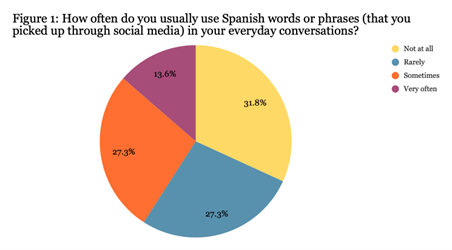
Figure 1: Participants’ frequency of Spanish words or phrases (picked up through social media) in everyday conversations

Figure 2 illustrates the Spanish language proficiency of the participants to confirm that they were from Spanish-speaking communities when making our analysis. 
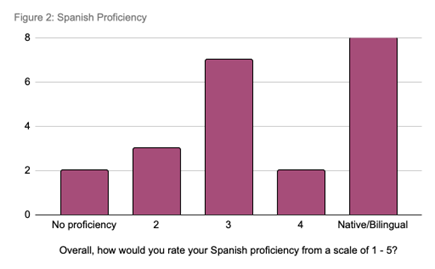
Figure 2: Survey participants’ self-evaluated Spanish proficiency

Figure 3 summarizes the participants’ reasoning for using Spanish words from social media as “trendy/cool,” “funny,” and helpful when communicating with other Spanish speakers.
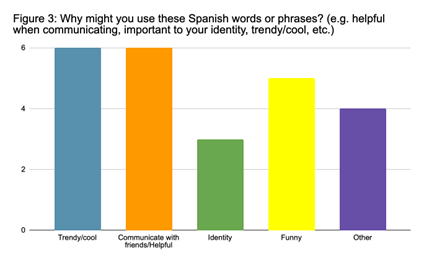
Figure 3: Reasons participants use Spanish words from social media

So, while an individual can use slang in social media and in everyday conversation, they will actively choose based on who they are talking to, which may not match what they encounter or see on social media.

Discussion and Conclusions

Our research ventured into the vibrant intersection of social media and the Spanish language, revealing intriguing insights about linguistic evolution in digital spaces. Despite the prevalent use of slang and informal expressions by Spanish-speaking influencers on platforms like TikTok, X, and Instagram, our findings suggest a nuanced relationship between online language trends and everyday speech. Contrary to our initial hypothesis, the majority of surveyed Spanish speakers did not attribute their linguistic repertoire to social media influences. Instead, personal interactions with friends and family emerged as the primary sources for acquiring new slang and expressions. This indicates a significant degree of linguistic autonomy among Spanish speakers, who navigate between the informal lexicon of digital spaces and the colloquial language of real-life conversations.

While social media undoubtedly shapes contemporary discourse, its role in directly influencing everyday Spanish language use appears limited. Our participants demonstrated a discerning approach to language adoption, selectively integrating social media slang into their conversations based on context and audience. This selective assimilation underscores the adaptive nature of language use, where individuals tailor their speech to suit specific social settings and relationships.

Our study sheds light on the complex dynamics of language evolution among Spanish speakers in the age of social media. While digital platforms offer a rich tapestry of linguistic innovation, the essence of language change remains deeply rooted in human interaction and social networks. Social media, therefore, serves more as a mirror reflecting ongoing linguistic shifts rather than the primary catalyst for change.

References

Alim, H. S. (2005). Hearing What’s Not Said and Missing What Is: Black Language in White Public Space

Cycyk, L. M., & De Anda, S. (2021). Media exposure and language experience: Examining associations from home observations in Mexican immigrant families in the US. Infant Behavior & Development, 63, 101554. https://doi.org/10.1016/j.infbeh.2021.101554

Gonçalves, B., & Sánchez, D. (2016). Learning about Spanish dialects through Twitter. Revista Internacional de Lingüística Iberoamericana, 14(2 (28)), 65–75. http://www.jstor.org/stable/26379776

Gottfried, J. (2024, January 31). Americans’ Social Media Use. Pew Research Center: Internet, Science & Tech. https://www.pewresearch.org/internet/2024/01/31/americans-social-media-use/

Kircher, Ruth, and Ethan Kutlu. “Multilingual Realities, Monolingual Ideologies: Social Media Representations of Spanish as a Heritage Language in the United States.” Applied Linguistics, vol. 44, no. 6, Jan. 2023, pp. 1077–99. https://doi.org/10.1093/applin/amac076.

Li, C., & Liu, J. (2017). Effects of using social networking sites in different languages: Does Spanish or English make a difference? Computers in Human Behavior, 74, 257–264. https://doi.org/10.1016/j.chb.2017.04.031

Majors, A. L. (2017) Social Media and Discourse: A Comparative Study of English and Spanish Apologies. LSU Master’s Theses. 4425.

Ramirez, N. J., Hippe, D. S., & Lindekugel, K. (2022). Electronic media and social features of language input in bilingually-raised Latinx infants. Infant Behavior and Development, 68, 101740, ISSN 0163-6383. https://doi.org/10.1016/j.infbeh.2022.101740.

[/expander_maker]
, ,

“I scared he eat, then the stomach explode!”: Missing Tense and the Standardization of Singlish

Hannah Chu, Trevor Htoon, Youchuan (Aaron) Hu, Ann Mayor, Grace Yao

Can we detect language change right as it’s happening? As a result of nearly a century of colonial handoffs, the Southeast Asian Island of Singapore developed its own, unique variety of English: Singapore Colloquial English, more commonly known as Singlish. There is reason to hypothesize, though, that Singlish may be progressively becoming closer to standard English and losing some of its distinctive linguistic features. The following article attempts to identify whether an assimilation to standard English is currently taking place among Singlish speakers, and if so, which categories of speakers are leading the change. The study focuses on one particular feature of Singlish: missing (or “dropped”) tense words, including copular verbs and tense auxiliaries. In order to collect data on this phenomenon, a survey and subsequent transcript analysis of eight YouTube videos from four young Singaporean content creators was conducted to identify tense word dropping rates for various Singlish speakers over time.

[expander_maker id=”1″ more=”Read more” less=”Read less”]

Introduction and Background

Singapore has long been the converging point of various languages and cultures, having spent the better part of 100 years shifting from British to Japanese to Malaysian control before gaining its independence in 1965. With four official languages—English (which serves as a lingua franca and facilitates cross-ethnolinguistic interaction), Malay, Mandarin, and Tamil—it’s no surprise that Singapore eventually developed a unique variety of English that pulls features from the three other languages. Today, Singapore Colloquial English (commonly known as Singlish) has “a distinctive phonology, syntax and lexicon” (Lim, 2004) that were created at the hands of the city-state’s bustling multilingual population. 

One recognizable aspect of Singlish, for instance, is the absence of tense marking in a sentence. Missing tense words are a replication of Mandarin Chinese syntax, in which elements like copular verbs are optional and often dropped (Tan, 2017). The Eton Institute demonstrates how tense is dropped in the sentence She is scared, instead giving She scared in Singlish (5 Unique Features of Singlish, 2021).

The usage of Singlish has not always, however, been without controversy on the Southeast Asian Island. In 2000, the Singaporean government launched the Speak Good English Movement (SGEM) “in a bid to delegitimize and eliminate Singlish” (Tan, 2017). The campaign, ongoing as recently as 2019, “often [featured] Singlish as an example of ‘bad English’,” (Tan, 2017) and has started a push for Singlish speakers to adopt standard English speech features. Along with the recent expansion of global platforms like YouTube that expose Singlish speakers to broader audiences of standard English speakers, this raises the question of whether Singlish may actually be in the process of becoming closer to standard English and losing some of its distinctive linguistic features.

The following research focused on missing (or “dropped”) tense words in Singlish syntax, attempting to detect whether this Singlish feature is becoming less frequent in favor of tense word inclusion, which is typical in standard English. Through investigating the speech of millennial and Gen Z (20- to 30-year-old) Singlish speakers of varying registers, the study hoped to identify whether Singlish appears to be assimilating to standard English and which groups of Singaporeans (within what sociolinguistic context and/or from what social category) are at the center of the change.

 Study Design

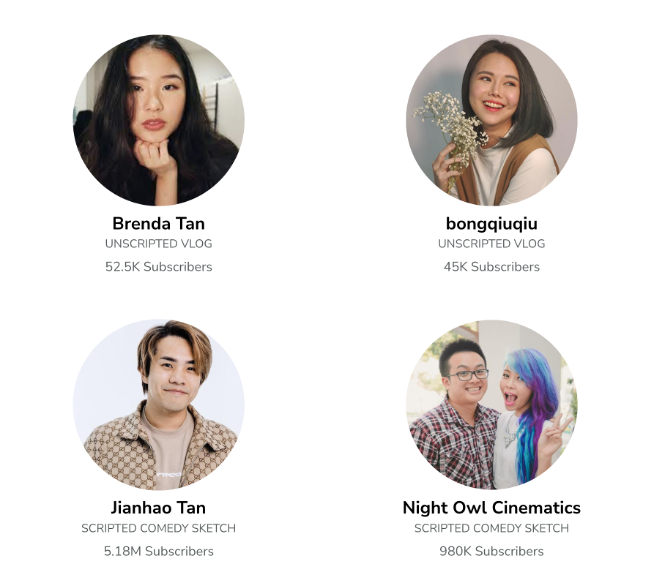
To collect data on missing tense words—specifically, copular ‘be’ and tense auxiliaries ‘be’, ‘do’, and ‘have’—we conducted an analysis of recorded Singlish speech from the videos of four popular Singaporean YouTube channels: Jianhao Tan, bongqiuqiu, Brenda Tan, and Night Owl Cinematics. Each of the creators falls in the 20’s to 30’s age range, consistent with the hypothesis that any potential language change is happening currently and as a result of recent developments in the past two decades, such as the SGEM.

Image 1: Our subject pool consisted of four popular YouTube channels, run by young Singaporean content creators. Half of the channels were styled as unscripted vlogs, while the other half produced scripted comedy sketch videos.

Two potential motivating factors of language change were considered in the study’s design: speaker agency and recency.

First, we divided our four YouTube channels into two categories that represent two registers of speech, which we called “Scripted” and “Unscripted.” Jianhao Tan and Night Owl Cinematics, who produce comedy content like skits and sketches, fell into the Scripted category. Meanwhile, bongqiuqiu and Brenda Tan, who produce lifestyle and vlog-type content, were chosen for the Unscripted category. By watching videos from channels with opposing content styles, we hoped to compare tense word dropping across differing language contexts.

Additionally, we wanted to capture potential language shifts over time, independent of Scripted and Unscripted categorizations. We chose two videos to analyze from each of the four YouTube channels (for a total of eight videos): one from 2021 (the year of the study) and one from five or more years ago.

For each video, we edited and annotated auto-generated or provided speech transcripts. Relying on our intuition as native speakers of a standard variety of English, we marked each instance of tense word dropping or inclusion on the transcripts. We then reported the number of clauses with tense word droppings as a percentage of the total spoken clauses that would require tense word inclusions in standard English. More tense droppings would indicate a closer association with Singlish features, while fewer would indicate a closer association with standard English.

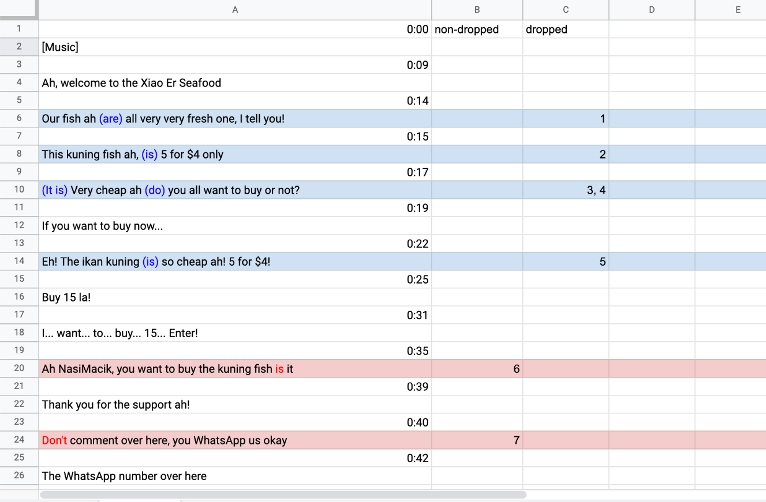
Image 2: An example spreadsheet of how we collected data for a video. Dropped tense words were added to the transcript in blue parentheses where we deemed them necessary, while pronounced tense words were highlighted in red.

As we began collecting data, we expected to see that our Scripted YouTubers would show lower tense word dropping rates than our Unscripted ones. With the ability to pre-plan dialogue, we thought that they would be more conscious of their language use and exercise larger agency over their speech. We also expected that recent videos from the past year would show lower rates of tense word dropping than older examples, demonstrating an ongoing progression of Singlish adopting standard English features.

Results and Analysis

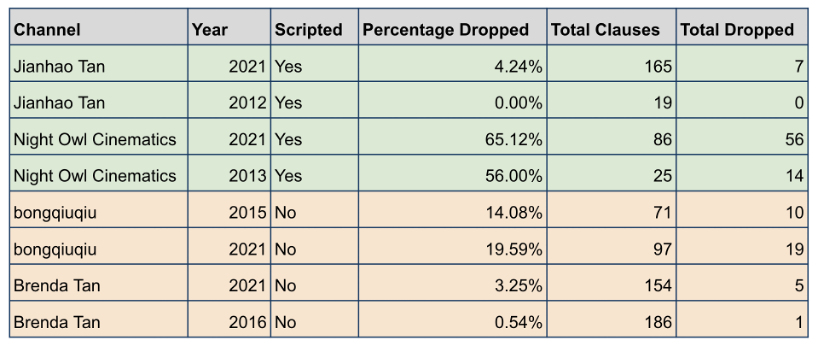
Out of four YouTube channels and eight videos, we found Night Owl Cinematics—a Scripted channel—to consistently show the highest rates of tense dropping (Figure 1), with over 50% of applicable clauses missing tense words. Brenda Tan—an Unscripted channel—showed the lowest rates, consistently having a less than 4% tense word drop rate.

Figure 1: Table of data on the percentage of dropped tense words per video, as well as raw data on the number of dropped tense words and total applicable clauses.

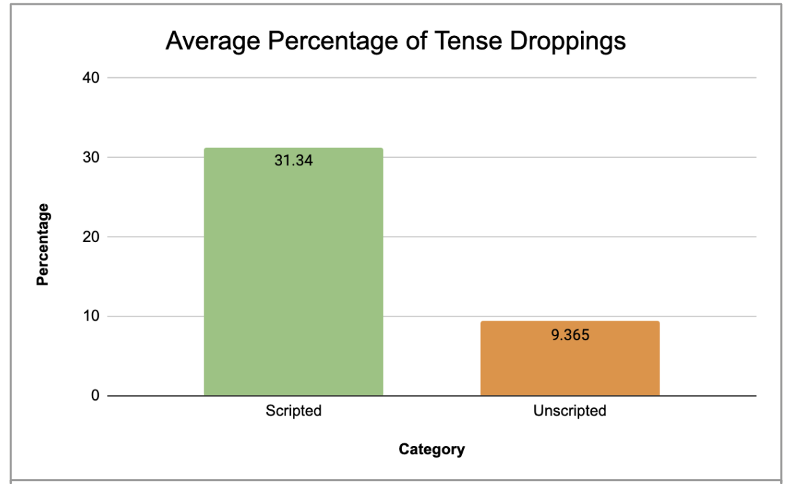
A closer look at our data revealed unexpected results. For instance, the average tense word dropping rate observed in Scripted videos ended up over three times higher than that in Unscripted videos (Figure 2). In other words, the content creators who we thought would make the most use of speaker agency to hide a Singlish feature like missing tense actually exhibited the feature much more frequently, on average.

Figure 2: Average percentage of tense word droppings in videos by category of register (Scripted vs. Unscripted).

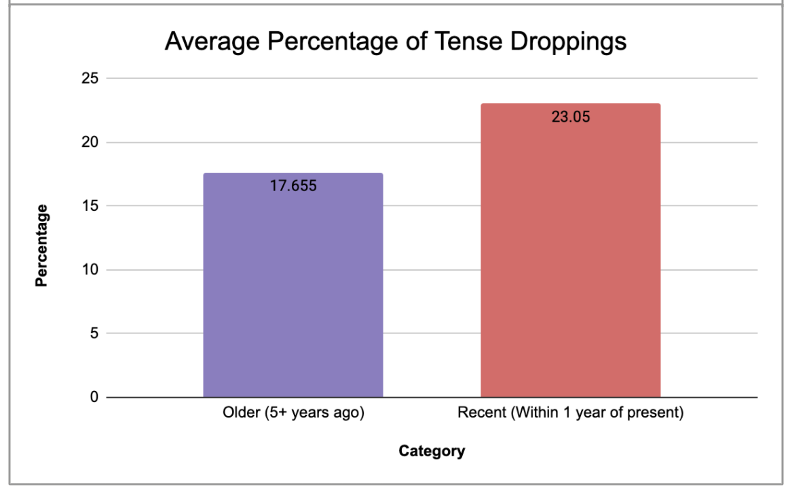
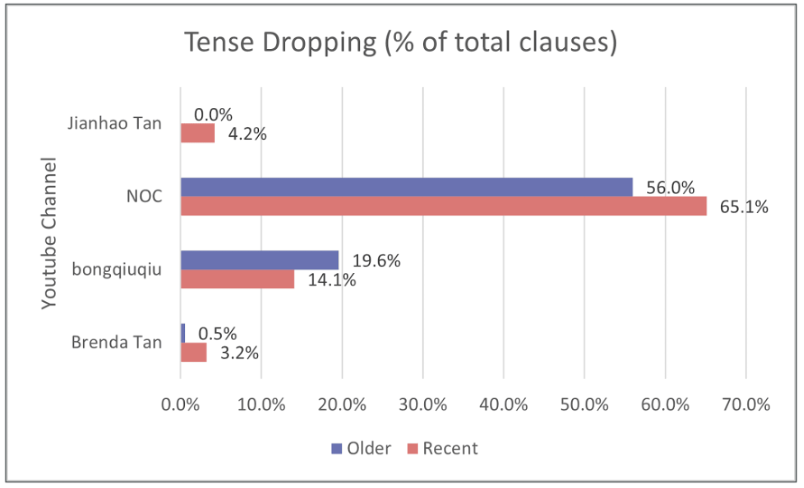
There also seemed to be a slight difference when we compared tense word dropping rates in recent and older videos. Tense word dropping occurred more frequently by roughly 5 percentage points in recent videos, contrary to our hypothesis that the Singlish feature of missing tense would be fading as time went on.

Figure 3: Average percentage of tense word droppings in videos by category of time (older vs. recent videos).

However, we noted that since our data came from a small sample size of just four YouTube channels, it wasn’t immediately obvious whether this increase was particularly significant. We decided to take another qualitative look at our data.

First, we noticed that within the categories of speech register that we chose (Scripted and Unscripted), the percentage of tense word dropping was highly varied. For instance, Night Owl Cinematics and Jianhao Tan both represented our Scripted category; while Night Owl Cinematics’ videos showed missing tense in over half of all applicable clauses, Jianhao Tan essentially did not drop tense words at all (Figure 4). This suggested to us that there was little to no pure correlation between the Scripted factor alone and tense word dropping.

Interestingly, the tense word dropping rates did not vary significantly within a YouTube channel’s own content. The frequency of missing tense did show a relative increase in the more recent videos for three out of the four channels (Figure 4), which was possibly indicative of a more general trend in Singlish. However, the small sample size of our study made it unrealistic to definitively conclude whether time was a significant influencer of tense word dropping rates and whether missing tense is actually becoming more frequent in Singlish as time goes on.

Figure 4: Percentage of tense word droppings for each video analyzed, by YouTube content creator and by category of time (older vs. recent).

These results led us to formulate a few possible explanations for what we observed. For instance, tense word dropping rates may be more closely correlated overall with the language background you came from (perhaps where in Singapore you grew up or in which language or ethnic community) or personal linguistic style. This would explain why each individual speaker’s missing tense rates were relatively consistent all in all, while comparing two different speakers (even across the same Scripted or Unscripted category) showed larger variation. These seem to be more plausible factors than year or speaker agency, as we originally thought.

We also noted, for example, that Night Owl Cinematics specifically brands themselves as a “Singaporean humour” channel—their content specifically hopes to showcase Singaporean culture and life. This might explain why, though they have strong agency over and can pre-plan dialogue, Night Owl Cinematics showed prominent tense word dropping: they have a motivated interest in sharing the unique characteristics of Singaporean language use.

Discussion, Conclusion, and Expansion

Ultimately, there is not enough evidence in our data to claim that Singlish is becoming closer to standard English and adopting its features. In fact, many of our results appeared to suggest otherwise.

There are a few points in our research that, if modified, could lead to more conclusive descriptions of the current landscape of Singlish’s evolution. It should be kept in mind, for instance, that we surveyed a limited subject pool of four content creators and a small sample size of two videos for each creator. We also looked only at online personalities with large audiences not just from Singapore, but elsewhere around the globe. This may, consequently, have resulted in the Hawthorne effect, where speakers alter their usual speech when under the conscious observation of an audience.

Further research into this topic could be focused on looking at potential influences of Singlish on Singaporeans who are attempting to learn or speak a more standard variety of English, such as Singaporean international students or Singaporean nationals living and working in the United States. Additionally, investigating the speech of local Singaporeans rather than just that of online and public figures would provide a more holistic picture of how Singlish is adopting (or not adopting) standard English features. Surveying a larger sample size of videos that span a more extended time scale would give better insight on Singlish languages changes over time. Studying other features, beyond missing tense or even beyond syntax, could also provide a more well-rounded idea of how Singlish is shifting over time.

Finally, although our findings did not line up with our hypothesis, we were able to make other interesting observations based on the data collected.

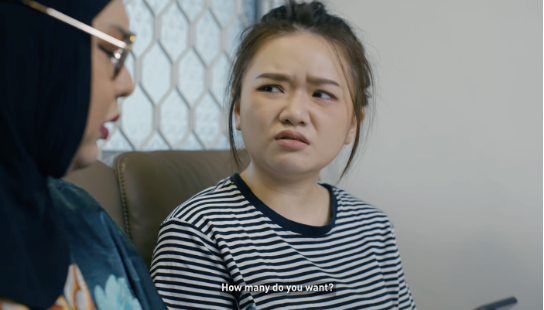
It appears, first of all, that our speakers showed a clear awareness of the difference between standard and Singlish English features at times. For instance, take the following Night Owl Cinematics video from 2021, “Types of Online Shoppers”. While the written subtitle reads, “How many do you want?” (Image 3), the speaker actually pronounces the following utterance: “How many you want?” This seems to show a conscious acknowledgement of what is typical in standard English syntax, in striking juxtaposition to what was natural to the Singlish speaker.

Image 3: A screenshot from Night Owl Cinematics’ 2021 video, “Types of Online Shoppers”.

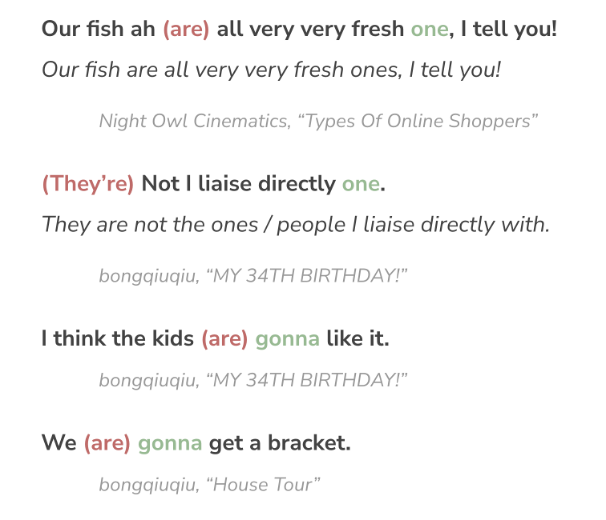
Moreover, we were able to confirm from our data that tense word dropping appears to be not random but systematic and motivated (part of Singlish grammar; not randomly distributed) in Singlish, as Lim (2004) had suggested was the case with phonological, syntactical, and lexical features of the variety. We can review a few examples (Image 4), which show two systematic instances of tense word dropping. We firstly see that the feature of missing tense seems to appear in conjunction with the Singlish particle ‘one’; in both a Night Owl Cinematics and a bongqiuqiu video, the speakers use the particle at the end of the clause and drop that same clause’s earlier copular verb. In a similar phenomenon, the missing of the tense auxiliary ‘are’ appears in conjunction multiple times with the auxiliary ‘gonna’, where the utterance of the latter seems to trigger the dropping of the tense auxiliary immediately before it.

Image 4: Evidence for systematic tense word dropping in Singlish, taken from three analyzed videos. Posited tense dropping “triggers” are marked in green; dropped tense words are marked in red parentheses.

So, is Singlish becoming more and more like standard English? It’s hard to say. What seems to hold is that Singlish has unique and systematic features, of which the distribution varies among its diverse speakers. The tangible influence that campaigns like the Speak Good English Movement have on non-standard varieties and their assimilation to standard forms of a language remains to be seen.


References

5 Unique Features of Singlish. Eton Institute. (2021, May 24). Retrieved October 15, 2021, from https://www.etoninstitute.com/wp/2021/05/24/5-unique-features-singlish/.

Gopinathan, S. (1979). Singapore’s Language Policies: Strategies for a Plural Society. Southeast Asian Affairs, 280-295.

Leimgruber, J. R. E. (2013). Singapore english: Structure, variation and usage. Cambridge University Press. https://www.jstor.org/stable/27908382.

Lim, L. (Ed.). (2004). Singapore English: A grammatical description (Vol. G33). John Benjamins.

Tan, Y. (2017). Singlish: An Illegitimate Conception in Singapore’s Language Policies? European Journal of Language Policy 9(1), 85-104. https://www.muse.jhu.edu/article/657324.

[/expander_maker]

, , ,
Scroll to Top