movies

“Swag Toh Dekho:” Hindi-English Code-Switching in Bollywood Movies of the Last 30 Years

Krithi de Souza, Kara Bryant, Sophia Adams, Medha Kini

Bollywood! We know (and love) the films for their grand and magnificent dance sequences, epic love stories, and extra long running times. Bollywood is often referred to as the “Indian Hollywood,” and this Hindi cinema industry has a large fanbase of its own. But how much overlap is there between Bollywood and Hollywood? Is there a strong language barrier that separates them? If you’ve watched a modern Bollywood movie, you would know that English words are often scattered throughout the script or used for funny catch phrases and apologetic remarks. But has that always been the case? In our project, we analyze the code-switching in three different Bollywood movies — Kuch Kuch Hota Hai, Student of the Year, and Rocky aur Rani Kii Prem Kahaani — all made by the famous filmmaker, Karan Johar. Each movie was released in a different decade, and we wanted to know how code-switching in Bollywood movies has changed as time passed. Read more to find out about the patterns we observed as the movies became more recent!

[expander_maker id=”1″ more=”Read more” less=”Read less”]

Introduction and Background

In this project, we decided to focus on changes in code-switching from the 1990s onward in order to analyze how globalization and other factors have impacted screenwriting in Bollywood. Hindi-English code-switching has been a part of Indians’ vernaculars for over a century. Far before the advent of the internet age, British colonial rule led to English being incorporated into Hindi to indicate prestige and education (Rai, 2009). Then, as globalization increased over the last 30 years, particularly through the development of the internet as a global resource, more and more Indians gained access to English content through online means. In addition to formalized English education, the population increasingly consumed media produced in English. This came in the form of professionally developed productions such as English-language movies and television, as well as informal, interpersonal content such as social media videos coming from YouTube, Tiktok, and more. Moreover, the Indian economy liberalizing in 1991 brought more access to things such as satellite TV, social media, and other global market products (Kumar, 2013). All this likely affected how often characters code-switched in Bollywood movies.

Our hypothesis is that code-switching will increase overall as the year of release for the films progresses. In other words, as time passes, code-switching will occur more often and become more prevalent in the films as a result of increasing globalization and access to English media. To measure this, we have chosen three Bollywood movies that were produced across three decades — Kuch Kuch Hota Hai (KKHH) (1998), Student of the Year (2012), and Rocky aur Rani Kii Prem Kahaani (Rocky aur Rani) (2023) — to analyze. They are all written by the same screenwriter, Karan Johar, in an attempt to eliminate variables across different filmmakers’ tastes. They all also come from roughly the same genre, romantic comedies, for the same reason. We will use this data to draw conclusions about how much exposure the effects of globalization had on the Bollywood industry. Furthermore, we will be able to say how English use in Bollywood films reflects English use in different populations within India in real life.
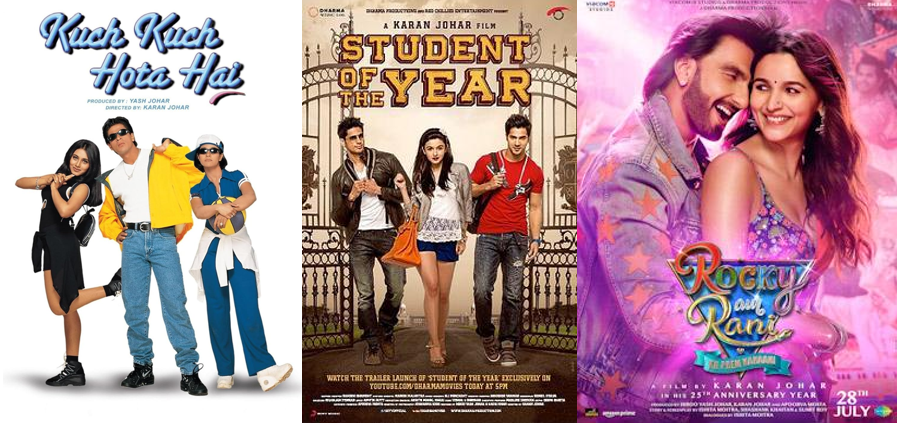
Figure 1. Movie posters from KKHH, Student of the Year, and Rocky aur Rani.

Methodology

Based on existing research, we found many different ways to categorize code switches in movies. Our data collection was modeled after a study done on code-switching in three Bollywood movies from three different decades (Anttila, 2015). We categorized the code-switching into two different types: proper code-switching and loanwords. Loanwords are what we define as phrases that were otherwise incorporated into a Hindi matrix sentence, such as the sentence “तु नहिइ  educated है” or “tuu nahiiN educated hai” (Translation: “You are not educated”). “Proper” code-switching as we are defining it for this research project occurred when characters included full phrases or sentences in English, such as “How are you?” (Bali et. al, 2014).

Watch this short clip to see an example of code-switching in Rocky aur Rani.

Each film was watched by at least two members of our team to minimize errors. While watching the movie, every instance of code-switching by the main characters was tallied into one of these two categories. When multiple instances of English words were uttered in a phrase, we used our best judgment to determine its categorization. We only tallied the code-switching of two to three main characters per movie to minimize variables across character type (age, class, education) and maintain a reasonable scope for project.

Results and Analysis

The oldest movie, KKHH, focuses on a best friend duo. Between those two main characters, they produced 13 loanwords and 58 proper code switches, for a total of 71 code switches overall. The next movie, Student of the Year, was released 14 years later. We counted 193 loanwords and 135 proper code switches across three main characters, or 328 code switches overall. Lastly, Rocky aur Rani came out 12 years after that and had 328 loanwords and 290 proper code switches between two main characters, totaling 618 overall code switches. The total number of code switches across the three movies can be visualized in the bar graph below:
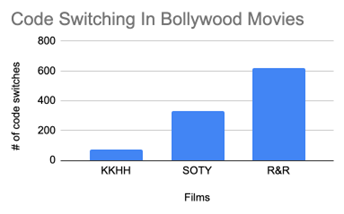
Figure 2. Total number of code switches.

Given the data, our hypothesis was correct. The amount of code switches steadily increased across all three movies. Notably, we focused on one fewer protagonists in Rocky aur Rani, yet it still almost doubled the number of total code switches. Thus, we see that over the last 30 years, English usage in Bollywood movies has gone up considerably.

There were several patterns we noticed while analyzing the code switches. Many of the most common instances of code-switching came from characters using popular English phrases, such as “thank you,” “I’m sorry,” or “you’re welcome.” All of these were considered proper code switches for the purposes of our study, although there was some debate of whether they should be considered a single loanword unit because of how they were tied to one meaning. For example, we never saw a code switch like “thank आप,” or “thank aap” (Translation: “thank you”).

One of the biggest changes we noticed over the years was the use of Hindi-English code-switching in songs. Most Bollywood movies are musicals regardless of genre. Music is inherent to the industry, and we counted code-switching in the lyrics of songs the same way we counted spoken lines of dialogue. KKHH has eight songs, Student of the Year has seven, and Rocky aur Rani has eleven. KKHH had no code-switching in the songs. Every song was sung exclusively in Hindi. Student of the Year had slightly more code-switching in the songs, particularly in Shanaya’s entrance song, “Gulabi Ankhen,” which included many brand names. Additionally, there was one song titled in English, “The Disco Song.” Although the title is not an exclusive indicator of English use in the song itself, it does reveal a trend that English was becoming more accepted in the music side of Bollywood. This pattern continued with Rocky aur Rani, which had two songs with some English in the title: “What Jhumka?” and “Heart Throb.” More importantly, the content of the songs throughout the movie had regular code switches. It appears that songs are more resistant to incorporating English, since KKHH had code-switching in dialogue but not songs. However, by 2024, English was heavily included in Bollywood song lyrics. code This may be related to Shet (2022)’s findings that code-switching in film songs signifies purpose in discourse rather than for “aesthetic” purposes like in dialogue.

Another pattern was the use of brand names as a form of code-switching. Given that English can be a signifier of prestige, this effect is heightened when the code-switching indexes luxury items. Characters in Student of the Year and Rocky aur Rani regularly referenced brands such as Louis Vuitton, Ferrari, Jimmy Choo, and Versace. The character Rocky in Rocky aur Rani did this the most consistently. His character is upper class and frequently mentions his possessions by brand name. Interestingly, his code-switching often indexes a superficial, vapid personality as a result. This counters what Antilla (2015) found in her assessment, that English had become a language of professionalism and accomplishment. Rocky frequently uses English slang, but since he uses it haphazardly and without formal education, he is sometimes considered an idiot by those around him. Therefore, we can surmise that not only is the amount of English code-switching changing, but that its meaning in Bollywood is changing too.

Both code-switching in songs and use of brand names can be seen in the example below, which shows three lines from the verse of the song “Heart Throb” in Rocky aur Rani.
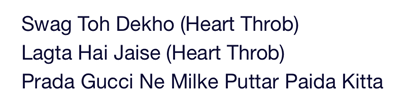
Figure 3. Lyrics from “Heart Throb”

In just this excerpt, lasting six seconds in the song, there are five loanwords: “swag,” “heart throb” twice, “Prada,” and “Gucci.” The line roughly translates to “Look at the swag, it’s like Prada and Gucci gave birth to a son.” Thus, we see Rocky using English slang (“swag,” “heart throb”) and brand names (Prada, Gucci) to signify coolness and style.

Discussion and Conclusion

Our analysis of our three films — Kuch Kuch Hota Hai, Student of the Year, and Rocky aur Rani Kii Prem Kahaani — show a clear trend of increasing code-switching. Since these three films came out in sequential decades following the explosion of the internet age and social media usage, the data supports our hypothesis that globalization and media exposure are driving forces behind these changes. Each film demonstrates a greater frequency of English phrases and loanwords, suggesting that modern day Bollywood films are catering to an audience that is more familiar with an inclusion of English.

However, there are several limitations to our study. In future research, it would be helpful to have access to the scripts, so we can accurately count the number of code-switches used in the films. Our method of manually tallying code-switching instances while watching the movies might not have captured every instance accurately. Having access to scripts that we could read would provide a more precise count and better context for each instance of code-switching. Additionally, we focused on three films from a single filmmaker, which might not fully represent broader trends across the industry.

Future research could address these limitations by expanding our method to include films from various filmmakers and genres and collect data from multiple characters, not just the protagonists. Furthermore, it would be beneficial to perform research confirming the correlation between code-switching in Bollywood and English usage in real life. We could do this by exploring the perception of English among viewers who recently finished watching Bollywood movies. Researchers can also analyze if non-English speakers’ perception of English changes after watching a Bollywood film due to the presence of code-switching between Hindi and English. Another possibility would be to compare native Hindi speakers’ code-switching with that of the fictional characters to see if the frequency is comparable. This would be one way to determine whether Hindi-English code-switching changes when it is scripted versus non-scripted. Therefore, due to this research, researchers can discover the impact code-switching has on society.

Since our research project effectively replicated Anttila (2015)’s project studying three movies from 1988, 1996, and 2005, it will be interesting to see if the use of Hindi-English code-switching will continue to trend upward. Anttila found that code-switching increased over time across her three movies, just like we did. But if this study were performed again another ten years from now, will English in Bollywood movies continue to increase or will it eventually stagnate? Is there a “saturation point” for English usage? At a certain point, the question becomes when is the movie itself “bilingual” rather than the characters?

In conclusion, analyzing Bollywood movies can help assess how English is perceived and used in India. The findings suggest that English is steadily increasing across Bollywood. Since media is a reflection of its society, we can conclude that English access is increasing overall in India, thus reflecting trends of a globalized society and proliferation of digital media. This increase in code-switching suggests that English is becoming more ingrained in everyday society in India, not just as a symbol of prestige but also as a tool for communication. Due to the creation of the Internet and the rise in social media, there is now greater access to English across India. These platforms provided greater access to English content in the media. This creates a positive feedback loop because as more people use the Internet, their exposure to English increases, encouraging them to adopt English in their vernaculars, which in turn exposes more people to English. Our research project highlights the increasing presence of English in Bollywood films, reflecting broader societal changes driven by globalization and digital media.

References

Anttila, H. (2015). You come-come, memsaabCode-switching in Sherni (1988), Raja Hindustani (1996) and Dus (2005) (Publication No. 6357) [Master’s Thesis, University of Vaasa]. OSUVA Open Science.

Bali, K., Sharma, J., Choudhury, M., & Vyas, Y. (2014). “I am borrowing ya mixing?” An analysis of English-Hindi code mixing in Facebook. Proceedings of The First Workshop on Computational Approaches to Code Switching, 116-126. https://aclanthology.org/W14-3914.pdf.

Kumar, A. (2013). Globalization and Changing Patterns in the Hindi Cinema Industry. Journal of South Asian Studies, 29(2), 433-448

Rai, A. (2009). English in Postcolonial India: History, Politics, and Cultures. Oxford University Press.

Shet, J. P., & Premkumar G. (2022). To switch and mix or not to: Code switching and code mixing in Indian film songs. Journal of Positive School Psychology, 6(3), 1417-1430. https://www.journalppw.com/index.php/jpsp/article/view/1672.

[/expander_maker]
, , , , ,

Media & Reality All at Once: How ‘Everything Everywhere All at Once’ is doing its best to exemplify our code-switched conversations

Jacqueline Aguirre, Josiah Apodaca, Kaitlyn Khoe, Mason Uesugi, Wonjun Kim

Code-switching, or the use of more than one language, dialect, or code in an utterance or conversation, can be a way to signal identity. This study compares two sources of code-switching — conversations from media, specifically Everything Everywhere All at Once (2022), and conversations in real life — by categorizing utterances and types of code-switching. This study investigates the representation of code-switching in bilingual media and the similarities and differences to code-switching in daily life. The real life conversations were conducted with Mandarin-English bilinguals, and the two conversations ran for 8 and 10 minutes. The findings demonstrated that intersentential switching occurred more often in this particular media, while intrasentential switching was preferred by the real-life speakers. The various types and functions of code-switching were present in the media, which was expected given the larger sample size and production resources and timelines. Nonetheless, both case studies demonstrated significant levels and mannerisms of code-switching, aligning with the proposed variables and categories. Further studies could utilize other syntactic properties, pitch contours, and tonal articulations in order to auditorily represent accuracies and behaviors of code-switches as more bilingual media makes its way into the American entertainment landscape.

[expander_maker id=”1″ more=”Read more” less=”Read less”]

Introduction and Background

Code-switching (CS) refers to when a speaker alternates between two or more languages, or language varieties, within a single sentence or interaction. Code-switching is a linguistic function mostly used in bilingual speech communities to convey a mutual “in-group” status between speakers, as the ability to code-switch demonstrates proficiency in both of the utilized languages. Our study seeks to answer these questions: How is code-switching represented in media? What are the differences and similarities to code-switching in everyday life?

Deriving from the studies conducted by Shen, Gahl, and Johnson on English-to-Mandarin code-switches, we compared the types of code-switching between Mandarin and English in media, through the 2022 film Everything Everywhere All at Once (EEAO), versus real life to see how accurately code-switching is being represented. The aforementioned study by the researchers suggest the existence of “switch cost,” as the English-Mandarin bilinguals consistently displayed slower reaction times specific to the code-switches in sentence-medial positions, as highlighted in their eye tracking experiment (Shen et al,. 2020). However, while there are many studies giving structure to code-switching, there are fewer applying them to media. 

Our target population for this project were Mandarin Chinese and English bilingual speakers. Mandarin Chinese belongs to the language family of Sino-Tibetan languages, which is under the Sinitic branch (Odinye 2015). Internationally, about 1.3 billion people use the language, being the official language of China and Taiwan (Odinye 2015).

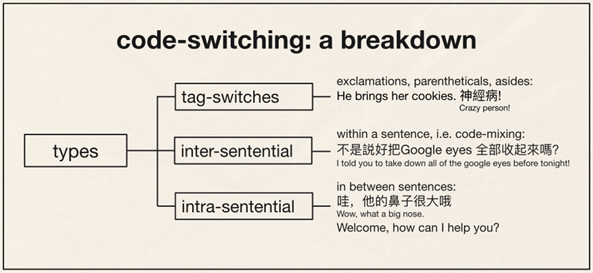
Figure 1. Explanation and examples of code-switching types.

There are three different types of code-switching: tag-switches, which are exclamations, parentheticals or an aside in another language than the rest of the sentence; intrasentential switches, which occur in the middle of the sentence and are typically called code-mixing; and intersentential switches, which occur between sentences (Appel & Muyusken, 2006). We will use these categories in our data analysis to see if some forms of media uphold current code-switching practices.

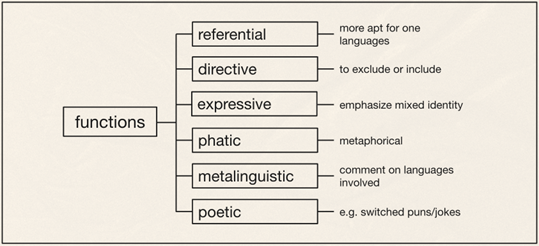
Figure 2. Explanation of code-switching functions.

Code-switching in a sentence can also serve different functions depending on the speaker, topic, and context of the language used. Researchers Appel & Muyuskend determined six categories as follows: (1) referential, where some subjects or words are more apt for one language, perhaps due to a lack of knowledge; (2) directive, to exclude or include the hearer; (3) expressive, emphasizing mixed identity; (4) phatic, or metaphorical switching; (5) metalinguistic, to comment indirectly or directly on the languages involved; and (6) poetic, which are switched puns or jokes (Appel & Muyusken, 2006).

There is going to be a lot left out about the filmmakers here, but in terms of context about the media that is relevant to code-switching, one of the writer/director duo ‘the Daniels,’ Kwan, is a second-generation Chinese-American. Having been in a Chinese Mandarin and English home environment, he is likely comfortable with engaging in code-switching because of his multilingual parents. One of the producers, Jonathan Wang, hopped on this project also because he wanted to tell a story inspired by his own immigrant parents, so he likely had a hand in ensuring language accuracy, like with the Cantonese, alongside with several translators. With this background in mind, we hypothesized that the movie’s representation of code-switching should be fairly accurate to how speakers code switch in real life.

We hypothesize that the participants and the script should have similar examples and amounts of code-switching in type and function within the given environmental parameters, as established earlier. Our research will help determine whether change is needed in how bilingualism is being represented, or if there is already a solid structure in place for new media to follow.

Methods

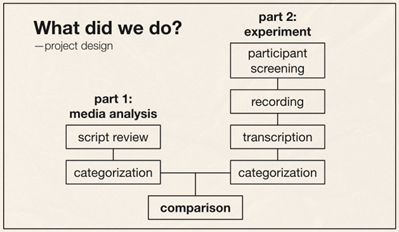
Figure 3. Step-by-step breakdown of our methodology.

Our project design comes in two parts: analyzing the media and analyzing a conversation in real-life. The script had both lines as they were spoken along with translations, so we could categorize them based on type of CS. We applied that same process to two conversations, around 10 minutes each, recorded between two sets of participants. They did know they were being recorded but eventually seemed to forget (over a period of around 10 minutes for each set), so the conversation seemed to flow naturally, with them code-switching subconsciously.

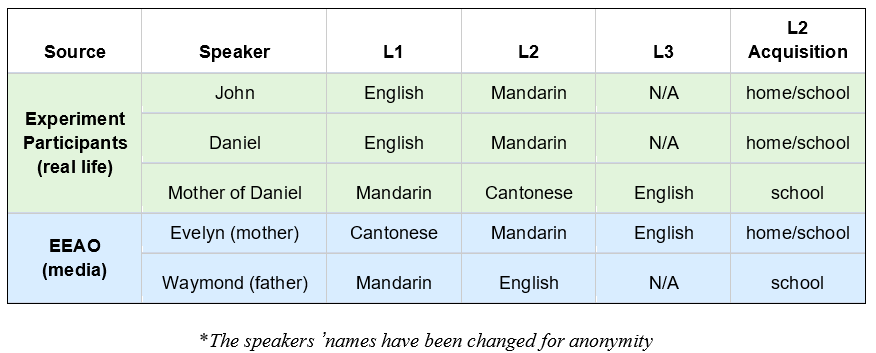
Figure 4. Language background of participants and EEAO characters.

We then analyzed the two sources of code-switching and made comparisons. For the screening process, we found our participants based on a language background survey collecting information, such as their L1, L2, and how they acquired their L2, as shown above. The characters’ method of L2 acquisition and L3 is speculated based on context. It is also likely that Evelyn is a simultaneous bilingual in Cantonese and Mandarin. Only the L2 acquisition method is listed, as it is relevant to our focus on bilingual speakers. Two of the participants (John and Daniel) were close cousins to reflect, while not exactly, the close relationship between Raymond and Evelyn. We also had one of them talk to their own mother to see if there would be a change with the different social dynamic. 

Results and Analysis

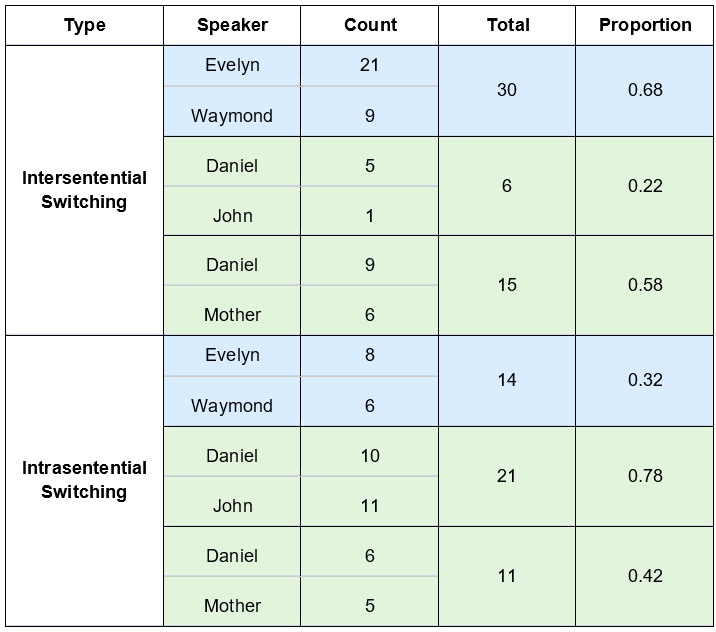
The table below shows the tallies for the types of code-switching used in the EEAO script (the blue indicating code-switching in media) and the conversations recorded with our participants (green for real-life code-switching). Since the conversations were not exactly the same amount of time, the proportions for each type of CS were calculated by dividing the total for each conversation by the count. There was insignificant information for tag switching in both the script and recordings, so it was left out of the table.

Figure 5. Code-switching frequency in media vs. recorded conversations. Proportion represents type of code-switching used in conversation out of total occurrences of code-switching.

Waymond and Evelyn used intersentential switching more than intrasentential (30 versus 14 times). That pattern is the same for Daniel and his mother (15 versus 11 times), while Daniel and John opted for more intrasentential switching (6 versus 21 times). The type of CS (intrasentential) that is more common for Daniel and his mother, whose language background and fluency matches best with EEAO characters, is the same as in EEAO conversations.

As for functions, each pair (Daniel and John, and Daniel and his mother) were dominant in the referential function, where some words or phrases are more easily expressed in one language. This outcome is likely because of the speakers’ proficiency in their second language — Mandarin. In a self-reported survey, both Daniel and John rated their L2 proficiency as a 3. The expressive and poetic function appear in the recorded conversations (CS was also used to repeat and clarify). The directive function likely does not appear in these conversations because they were recorded in isolated, controlled environments. Had they been in more natural environments, out in public, it is likely that the directive function would appear.

As for the functions present in the EEAO conversation, they were also dominant in the referential function of code-switching, with directive being the second most used. Considering the characters, Waymond and Evelyn, immigrated to America and were likely not exposed to their L2 (English) until later, it makes sense that the referential expression is dominant for them as well. Regarding their use of the directive function, this is most likely due to Waymond and Evelyn being in various environments where there was a third-party to exclude or include (e.g., customers, Gong Gong). Additionally, unlike our speakers, the expressive function does not appear in the movie, but the poetic function does show up once. 

Based on these results, it seems that the code-switching in EEAO supports the theory of the different types and functions of code-switching. When comparing our speakers’ code-switching with the movie, both align in having referential code-switching be primarily used in communication. Though with our speakers, they showed slightly more variety in function, as they covered expressive functions while the movie did not. While the movie significantly used the directive function, our speakers did not. Again, we conclude that this is due to a difference in environments between the speakers.

Discussion and Conclusion

The data promotes the idea that EEAO and its representation of code-switching is accurate. Since Daniel’s code-switching varied based on the hearers (with his cousin versus his mother), the movie’s representation is also accurate in representing how code-switching is employed for differing functions based on environment.

While the conversations and media we analyzed ended up with similarities, affirming our hypothesis of EEAO being an accurate representation of code-switching, further research is needed to extend these results to media in general. After studying natural conversations of English-Mandarin bilinguals, researcher Xitong Zhang found that “the occurrence of code-switching not only depends on the language ability of the speaker, but also the purpose and the environment in which the conversation occurs” (Zhang, 2019, p. 44). One of the ways to expand this study in the future would be to observe participants in more environments and situations over longer periods of time (e.g., recording conversations over the course of a week) because EEAO has more environments. This choice would provide more data for analysis and allow for a richer case study of CS.

It would also help to have participants whose language background better matches the characters even better because Daniel and John did not have the same L1/L2 as Waymond and Evelyn. However, the time constraint of this study provided a limited participant pool to see how identity and linguistic competency affect code-switching.

We could also look into instances of “bad” code-switching in media, likely tied to older media sources, to develop concrete standards of accurate code-switching — including what not to do — for future representations of the bilingual experience. We could just look at more films, maybe in other language pairings, or other sources of media, like TV shows, whether good or bad examples, as well.

In his video essay “English. Language. Movies. Parasite,” Kyle Kallgren studies code-switching in the 2019 film Parasite and the cultural implications of mixing English and Korean in conversation. The Parks, a rich family, often uses English to confide in each other or to establish solidarity with their hired workers. It seems that English is worked into the plot accents, signifying the divide between the poor and rich families. In a similar fashion, language boundaries reinforce relationships in the plot of EEAO, with code-switching being a big part of it.

America tends to fawn over foreign culture without realizing it is their own culture being sold back to them — just accented — which is probably why they find connection to it. There is something to be said about how these two movies employ code-switching as a tool to hint at language hierarchies. Studying the use of language and code-switching in media like this is important for providing a foundation for how to approach appropriate representation in media. There are harmful social implications if one does not consider the influence of how language is used in movies. As language hierarchies exist in reality, noticing and replicating them in media will only reinforce them when they should be dismantled. Understanding how media perpetuates practices in which social classes are tied to certain manners of speaking can help us counteract that.


References

Anindita, K. (2022). An Analysis of Code-Switching in the Movie “Luca”. ELTR Journal, 7(1 23-33. https://doi.org/10.37147/eltr.v7i1.164

Appel, R. & Muysken, P. (2006). Language Contact and Bilingualism. Chicago: University of Chicago Press.

Chen, Z., & Liu, X. (2023). Types and Functions of Code-Switching in the Film Everything Everywhere All at Once. Journal of Education, Humanities and Social Sciences, 13, 171-176. https://doi.org/10.54097/ehss.v13i.7889.

Kwan, D. and Scheinert, D. (Writer). (2022). Everything Everywhere All at Once. A24.

Odinye, S. I. (2015). Phonology of Mandarin Chinese: Pinyin Vs. IPA. Quarterly Journal of Chinese Studies, vol. 4, no. 2, p. 51–58.

Reformadita, A., & Setyaji, A. (2021, October). Code-Switching Analysis on Pixar’s “Coco” Movie. In Undergraduate Conference on Applied Linguistics, Linguistics, and Literature. (Vol. 1, No. 1, pp. 26-37).

Shen, A., Gahl, S., & Johnson, K. (2020). Didn’t hear that coming: Effects of withholding phonetic cues to code-switching. Bilingualism: Language and Cognition, 23(5), 1020-1031.

Zhang, X. (2019). Code-Switching in English-Chinese Ordinary Conversations. TESOL Working Paper Series, 17, 38-45.


Appendix A

PDF Link for EEAO Script

[/expander_maker]

, , , ,

The Linguistic Portrayal of Social Mobility in Bollywood Cinema through Hinglish

Hashim Baig, Siuzanna Shaanian, Georgia Lewis, Jacob Cook, Christian Atud

The rise of English as the global lingua franca has had profound effects on multiple cultures worldwide. One such spot is the Indian subcontinent, especially with the emergence of India from centuries of colonial rule. This paper looks at how Hindi-English code-switching (popularly called Hinglish) in Bollywood films post-2000 both reflects and constructs social identities. It analyzes five contemporary Bollywood films and argues that the increase in Hinglish usage corresponds with characters’ social mobility, still signifying English as a potent symbol of prestige. This research aims to unearth the interplay of dynamics between language usage and perceived social standing in contemporary Indian cinema.

[expander_maker id=”1″ more=”Read more” less=”Read less”]

Introduction

English, being a global language, has influenced many cultures worldwide. One of the most impacted cultures was that of India, a former British colony. One of the most exciting consequences of this influence is the rise of Hinglish — a mixture of Hindi and English — primarily in the context of Bollywood films. Our project will investigate how Bollywood movies use Hinglish as a means of social change by depicting a character as having a higher social status through excessive code-switching into English.

Background

Bollywood is the leading film industry in India, providing fertile ground for the use and experimentation of different languages and linguistic expressions. The most salient is the integration of English into Hindi dialogues, often called Hinglish. This is relevant since some of the more recent films with this thematic feature in the foreground also depict the interaction between the English and Hindi languages as facilitators of social mobility. The fact that English is the prestigious code in Indian society and Bollywood is very influential in molding cultural trends, thus marking these films as good starting points for studying linguistic portrayals of social mobility.

Literature Review and Context

The Colonial Hangover

The continuing popularity of English in India began during the British colonial era, when the English language was used in administration and education. Within this context, the English language symbolized both sophistication and higher social status. Chandra (2014) says that in recent times, English has become a fashionable aspect of filmmaking in India, “associated with modernity and prestige.” Chakraborty (2022) also mentions what he refers to as the ‘Colonial Hangover.’ Knowledge of English, he says, is equated with higher social status and respect.

Bollywood’s Linguistic Landscape

Even in their language use, Bollywood films reflect changes in society. According to Rao (2010), English is identified with modernity and prestige; Hindi, however, is an intimate language of traditional values. Furthermore, this dichotomy has been depicted using code-switching. Context and social aspirations govern the switch between Hindi and English.

Code-Switching as a Tool of the Narrative

Si (2011) holds that code-switching is not random but rather a narrative device in Bollywood movies. English words or phrases are inserted into Hindi dialogues to portray a character’s social mobility, education, or cosmopolitanism. The present paper seeks to understand how, drawing from these studies, such linguistic choices could potentially stand synecdochally for social mobility in contemporary Bollywood films.

Project Design

This paper endeavors to examine and find evidence of any relationship that may exist between patterns of code-switching and the rise and fall of the characters’ social status in five films: Thank You for Coming (2023), Sukhee (2023), Laapataa Ladies (2023), Mission Raniganj: The Great Bharat Rescue (2023), and 3 Idiots (2009). The reason these movies have been selected for this purpose is that they essentially belong to a genre of ‘rags-to-riches’ stories and because they have been widely viewed.

Methodology

Collectively, we utilized a mixed-methods approach; qualitative content analysis was combined with quantitative frequency measures. We analyzed under what context code-switching occurs. That is, for particular scenes, social interaction and visual information related to socioeconomic status. We also counted the frequency of code-switching. We grouped each instance of code-switching into one of two categories: light and heavy. Light code-switching refers to sporadic insertions and alternations of English into Hindi, as well as forms borrowed from English. Heavy code-switching would refer to the use of extended English expressions, sentences, and rapid switching between English and Hindi. Each instance was counted across different narrative stages: exposition, rising action, climax, and falling action. Hopefully, through such an examination, we may develop insight into how Hinglish use is representative of social identities and how code switching shapes them in Bollywood films.

Results and Analysis

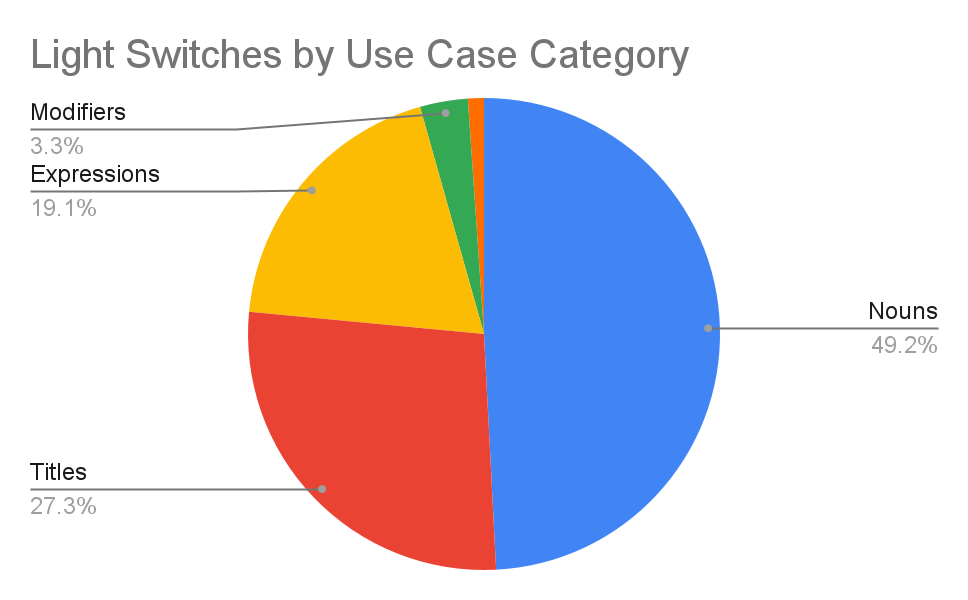
In this research, we found that there was a moderate use of light phrases in middle socioeconomic environments, with much more frequent usage towards and between people in high social positions. Light phrases are pervasively used in these environments and are almost entirely used for referring to specific items such as “boreholes” or “walls,” as well as specific titles such as “Sir” or “Doctor.”

Figure 1. Relative Distribution of Light-Switching: Categories. This pie chart summarizes the relative distribution of the types of light switching observed in this study. A majority of the switches were used to refer to nouns or specific nouns. Each category is defined by its context and use case. Discrimination was made between titles and nouns, as their use cases were notably distinct.

In this study, the average amount of light utterances per movie totals to around 400 phrases. Of those 400 phrases, about 25%, on average, include non-noun switching. This subset mostly consists of expressions/sayings (e.g., ‘Thank you,’ ‘I’m sorry’) and modifiers (insertion of adjectives, adverbs, etc.). Of the nouns, it is worth noting that a majority of these utterances are a form of borrowing from western culture. These include scientific/official names (e.g., ‘Carbon Dioxide,’ ‘Instagram’) and specific titles (e.g., ‘Doctor,’ ‘Sir,’ ‘Upper Management’). In especially institutionalized contexts, such as in educational or professional settings, this tendency is much more pronounced, as it would correlate with intelligence and competency. It is akin to using proper jargon when in an official discussion between peers or co-workers. Although nouns and titles share similar linguistic qualities, a distinction must be made between the two in order to account for their differing use cases. Titles, in particular, were commonly used towards individuals of high standing as a form of politeness and respect in a professional setting. One of the most common examples of this would be the usage of the word ‘Sir’ towards high ranking individuals. It is also worth noting that verbs were more commonly used in heavy switches and see little to no usage in light switches. This is largely due to the usage of English verbs in command/directive phrases rather than as a simple insertion/alternation. Most commands would be issued by an individual with authority and power. This would lead to the switching of the entire sentence to English, which would give the order a more serious/official connotation and allow the individual to leverage their position.

In regards to heavy code-switching, we observed 40-70 instances of heavy switching per movie, on average. This number would fluctuate depending on the overall setting of the movie. Movies set in professional settings, such as Mission Raniganj, would see a higher usage of heavy code-switching as a marker for ‘officiality.’ This trend exists because a much larger cast of characters are depicted as ‘intelligent’ and ‘powerful’ enough to use these forms. Heavy-switching forms can also be split into several categories: extended sayings/proverbs, official conduct, and narrative effect. The frequency of each category would also depend on the movie genre, with action movies opting for more instances of official conduct. Official conduct, in this study, would be a character’s tendency to use English as a medium to denote seriousness, power, and hierarchical respect. Medal ceremonies, press conferences, and board discussions would include many instances of ‘official’ code switching. Usage of English for narrative effect would mostly be tied to specific characters as part of one’s personality and could be used to highlight/exaggerate a powerful point during the movie. Such instances include the usage of English to look cool, smart, or funny. On the topic of sayings and proverbs, scriptwriters would use large English expressions to flesh out a specific character’s identity. One character, for example, would use the expression “I know this place like the back of my hand” as a catchphrase to denote professionalism, while also being entertaining for the audience.

Another interesting finding includes intentionality when switching between English and Hindi. We found several instances where rapid switching between English and Hindi would depend on the context and emotion behind each utterance. Some pivotal scenes would hinge on the differentiation between officiality and intimacy. Moments where a character must command/exert one’s authority in an official manner would invite the use of English. In moments of weakness, intimacy, and affection, characters would often switch back to Hindi. This finding runs similar to Rao (2010)’s findings, where he would describe this tendency as a “preservation of Indian values.”

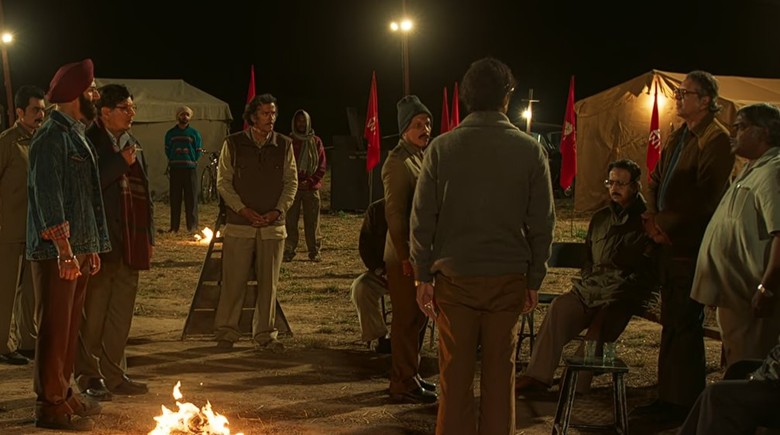
To demonstrate this, we can take a look at an example from the movie Mission Raniganj.

Figure 2. Mission Raniganj. Protagonist Rescue Officer Gill (Left) confronts main antagonist Director Technical Dayal (Right) in front of a board of managers (Mission Raniganj: The Great Bharat Rescue, 2023, 1:40:32). Gill and Dayal each appeal to the managerial board using both English and Hindi. When appealing to status, they switch to English. Conversely, they switch to Hindi when appealing to emotion.

In this scene, the main character, Gill, is the main rescue officer in charge of rescuing 70 miners who were trapped in the Raniganj Colliery. Gill is rich and depicted as intelligent, calm, and heroic in a majority of the scenes he appears in. The other characters in this scene, such as Director Ujwall and Director Dayal, are all well-dressed and depicted as intelligent, powerful people. In this scene, the managing board is picking out an individual to head into the mines through a borehole to help manage the manual rescue of the miners. CO2 gas is forming, making the operation potentially lethal. Director Dayal, in an attempt to steal the credit, says: “No, we can’t be so selfish; [Gill has a bright future]; we can’t send a talented officer [down to sacrifice his life].” Gill responds: “Thank you for your concern sir, but I promise you, [I will have my morning tea with you].” The blue words that are within brackets represent phrases in Hindi, whereas all other words are mentioned in English.

This scene demonstrates the intentional switching between English and Hindi in an official setting. Here, we see both individuals speak in English when formulating an official response, such as Gill’s appreciation and Dayal’s request. They both, however, intentionally switch to Hindi when appealing to emotion and intimacy. This scene is powerful and successfully depicts Gill as not only intelligent but magnanimous in a way that parallels Indian values.

Film Analysis Examples (Excluding the already discussed Mission Raniganj)

  • Thank You for Coming
    • Brief Summary: Kanika Kapoor is the lead character. This 32-year-old unmarried girl lives with her mom and grandmother. Kanika goes on a journey searching for love and sexual satisfaction for herself, getting intertwined along the way with her college friend, a professor, and much later with some guy called Rahul. Nothing seems to satisfy her enough for her to reach that satisfaction. She learns that during depression, particularly after breakups or on her birthdays, Kanika finds support from her best friends, Pallavi and Tina.
    • Scene Example: In the first five minutes of the film, a young elementary school Kanika gets in trouble with her principal and asks to leave because she announces during a school play that their presentation of “conception” is incorrect and not how babies are made, but rather men and women “must have sex.” Following this formative memory and pivotal scene, the film cuts to Kanika’s mother speaking to the principal in Hinglish: “I don’t want to confuse my child, Miss Kukreja. Main ek clinic chalata hoon aur mareez aate hain-” (Translation: “I don’t want to confuse my child, Miss Kukreja. I run a clinic and patients come-”).
    • Visual Cue: Kanika’s mother is dressed in a floral suit jacket and pants as she communicates with the principal, who is much older than her mom. The principal is noticeably older and dressed in a sari. Her hair is perfectly curled, and she wears mid-sized purple hoop earrings.
    • Analysis: In Thank You for Coming, the mother of the protagonist repeats what her daughter has been telling her regarding how serious she is in going back to school, which she finds professional, in Hinglish. In the real sense, her daughter discusses with her classmates about sexual intercourse, which is not appropriate to her. Her use of the word “clinic” in English shows the pride she wants to pass on to the principal, implying that her work is medical. She then further reiterates that with English, saying “I do not want to confuse my child,” and stressing the gravity and formality of the issue at hand. This again pushes home the fact that she is a medical professional, hence her daughter’s excellent knowledge of sex.
  • Sukhee
    • Brief Summary: This light-hearted film narrates how Sukhee, an exuberant 38-year-old Punjabi housewife, gets tired of living a monotonous life and books herself a flight to Delhi for her high school reunion. Over that week, Sukhee rediscovers her teenage self and more; she got to experience new things for the first time in her life that brought back a zest for living. Through this journey, she undergoes a dramatic transformation from her housewife-mother duo role to rediscovering and asserting the woman within.
    • Scene Example: Towards the end of the film, after the crazy ups and downs of a reunion adventure, Sukhee and her three girlfriends are shown to have reunited and are sharing lessons learned and goals set for themselves. This emotional ending has the women sharing their plans for growth and evolution. One of the friends, Mansi Parekh, shares her goal-cum-intention, which contains a heavy amount of code-switching: “Central sunishchit karunga ki meri agli naukri mein mujhe respect, promotion, aur equal opportunities milein.” (Translation: “In my next job, I’ll assure respect, promotion, and equal opportunities.”)
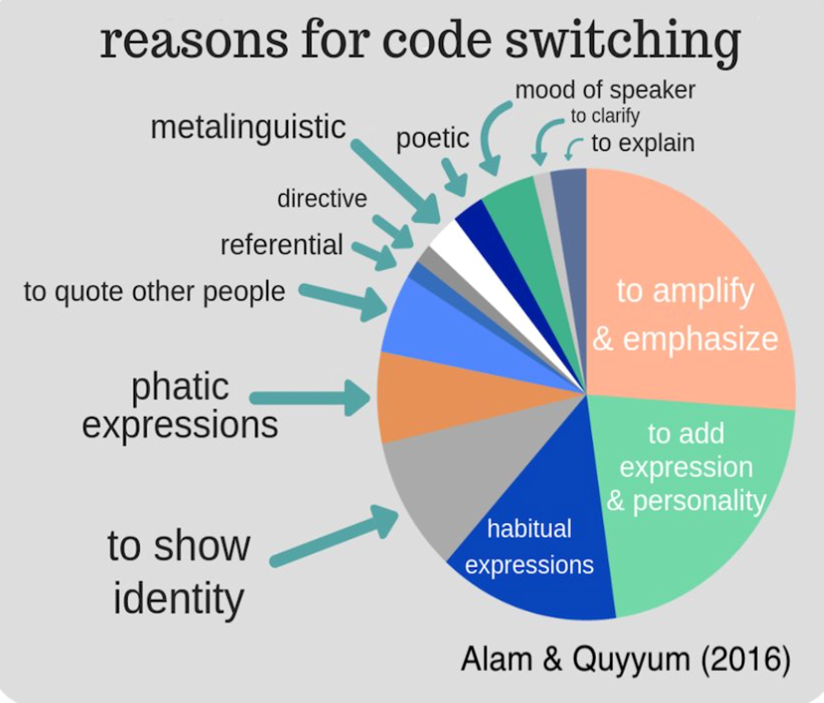
    • Visual Cue: The frame contains the four ladies dressed in relatively executive but casual clothes. Mansi, for instance, is dressed in a traditional blouse and denim. As all four pose in the camera frame, they demonstrate the increasing connotation of relative wealth and distance from the ideas of poverty, while maintaining the idea of closeness in their talk about future aspirations and promises to each other. Here, at the outset, Mansi is shown code-switching to express her goals and to “exaggerate and intensify” the need to achieve them (Alam & Quyyum 2016). The words “respect,” “promotion,” and “equal opportunities” are translated into English to show what makes them so vital and imperative. This also automatically infers an acknowledgment of the prestige factor because she fights for something that is her right, and by using English, she demonstrates her achievement of some type of social status.
    • Analysis: Here, Mansi is employing code-switching for the portrayal and “amplification as well as emphasis” of the desire that her demands be fulfilled sequentially. As Alam & Quyyum (2016) states: “respect,” “promotion, and “equal opportunities” are in English so that she lays stress on the importance and necessity of it. It automatically carries with it respectability as well because she is struggling for something she has to get. The use of English emphasizes the achievement of a particular social status.
Figure 3. Alam & Quyyum’s Functions of Code-Switching (2016). Alam & Quyyum (2016) describe the functions of code-Switching in conversational language. In relation to this study, several of Alam et al.’s findings provide reasons as to why characters code-switch regardless of the ‘weight’ of the code-switch. In this instance, the scriptwriters of Sukhee use English as a means to ‘amplify & emphasize’ Mansi’s desire for positional power. This is further exaggerated by India’s perception of English as a formal, powerful language.
  • Laapataa Ladies
    • Brief Summary: This is a story of two newlywed brides who get mixed up in a crowded train shortly after their weddings. One bride ends up with the wrong husband, Manohar, after landing at their destination, and they stay together until their situation can be resolved. It turns out that this bride is being abused by her just-married husband. When the two reunite, he slaps her, and therefore, she happens to be freed. They later find Manohar’s wife and reunite. The mixed-up, now-free bride is sent back to school to pursue her dreams.
    • Scene Example: In the following example, a character employs code-switching for just one word: “Kaise be? Hum to bahut saal se try kar rahe hain, kho hi nahi rahi sasuri…” (Translation: “How? I’ve been trying for many years, the damned thing is not going away…”)
    • Analysis: In contrast to examples of intra-sentential code-switching, this sentence only uses a singular English word: ‘try.’ It’s important to mention that an equivalent word for ‘try’ exists in Hindustani, so this is not merely an example of borrowing. Since no connotative meaning would be foregone if the native word were used, the reasons for employing this word would be social or linguistic. This word happens to be one syllable, as opposed to the Hindi word for ‘try.’ A quicker onset or lexical retrieval may be another reason for code switching in instances like this.
  • 3 Idiots
    • Brief Summary: This was a story about the friendship of three engineering students, and a satirical take on the societal pressures of the Indian education system.
    • Scene Example: During a classroom scene, one character uses Hinglish to make a point: “Sir, yeh formula toh practically impossible hai apply karna.” (Translation: “Sir, this formula is practically impossible to apply.”)
    • Visual Cue: He is shown in a prestigious engineering college, reflecting his academic aspirations.
    • Analysis: This student provides the most compelling example of using Hinglish during classroom discussion while he shows his learning journey through the use of 3 Idiots. Such switching tells that this character feels comfortable in both Hindi and English. It is a widespread phenomenon found in most urban educational institutes in India where the language of instruction is English. Hinglish allows the character to put his ideas across much better since the technicality of English is complemented by the conversational ease of Hindi. The same selection also exemplifies the pressure and tensions that an Indian student experiences in such an extremely stressful learning environment, where proficiency in English is equated with academic and professional success. The use of English terms such as “practically impossible” emphasizes the technicality of the discussion and how well the character is acquainted with academic vocabulary pertinent to the discussion, which is also an example of the fusion of cultures and languages common to modern Indian writing.
  1.  
  •  
  •  

Discussion and Conclusions
Our results elucidate the social mobility aspect of English usage and code switching in Indian cinema. In the films we analyzed, those who used more English were depicted as having a higher social status, better education, and better job prospects than those who used mostly or exclusively Hindi. The lexical decisions of Bollywood script writers is pertinent in this context, as well as Indian society as a whole, given the oversized impact that these movies have on the culture of South Asia. As such, code-switching in Indian cinema is reflective of broader social perceptions of English and its associations with coolness, erudition, etc.

India has more than a billion people. Given our small sample size of five movies, we are not able to make sweeping generalizations about code-switching in Indian society outside the context of its cinema. If we look at code-switching as a plot device used by Indian moviemakers, we are able to better understand the implicit interpretations of such language usage and thus, how it correlates with class and other socioeconomic indicators. This paper focused on several linguistic aspects of code-switching, including the syntactic category of the English words used. Overall, our statistical analysis is in line with previous findings on this topic, that is to say, that mostly nouns and titles are used in intra-sentential code-switching.


References

Balabantaray, S. R. (2020). Impact of Indian cinema on culture and creation of world view among youth: A sociological analysis of Bollywood movies. Journal of Public Affairs. https://doi.org/10.1002/pa.2405.

Chakraborty, O. (2022). Prevalence of Colonial Hangover in Bollywood Movies with Primary Focus on Queen and English Vinglish. https://www.questjournals.org/jrhss/papers/vol10-issue5/Ser-1/G10053338.pdf.

Chandra, S. (2014). Main ho gaya single I wanna mingle…: An evidence of English code-mixing in Bollywood Song Lyrics Corpora. 16(1). https://www.researchgate.net.

Mahbub-ul-Alam, A., & Quyyum, S. (2016). A Sociolinguistic Survey on Code Switching & Code Mixing by the Native Speakers of Bangladesh. Manarat International University Studies, 6(1). https://www.researchgate.net.

Rao, S. (2010). “I Need an Indian Touch”: Glocalization and Bollywood films. Journal of International and Intercultural Communication, 3(1), 1–19. https://doi.org/10.1080/17513050903428117.

Si, A. (2011). A Diachronic Investigation of Hindi–English Code-Switching, Using Bollywood Film Scripts. International Journal of Bilingualism, 15(4), 388–407. https://doi.org/10.1177/1367006910379300.

[/expander_maker]

, , , , , ,

Who’s In Charge Here?

Simon Kabateck, Ethan Therieau, Naima Bukhari, Jocelyn Ramos

We wanted to look at how films portrayed gendered communication between men and women through the focus on business interactions. We believe that movies and television interpretations of business and how genders are displayed carry some underlying truth despite them being just fiction. For our study, we watched a list of fictional media, specifically television, and movies, that portrayed men and women in different business roles to observe assertive communication styles. We were curious to see if business roles or gender were more impactful in interpreting if one’s communication style would be assertive in business interactions. Our findings were that individual business roles were more significant determinants of one’s assertive patterns in communication than gender variation. The research we did was impactful for understanding how society has portrayed gendered communication across films when analyzing the roles within the business and what that possibly means for society’s interpretations of genders in a specific role in business. Further research we hope is done on real-life business observations versus fictional television so that we may get a better understanding of whether our findings show some accuracy or not when analyzing real-life interactions in business between men and women in different business positions.

[expander_maker id=”1″ more=”Read more” less=”Read less”]

Background

In the last movie you saw, can you remember how men and women were shown to interact with each other? Try connecting that thought with other movies you’ve seen in your head before continuing this article. We found interest in analyzing how gendered communication has been interpreted within films, specifically, business interactions between men and women. It is the stereotypical idea that men command business interactions in films much more than women simply because of gender stereotypes. Research by Paula Pomerenke analyzed how business conversations between men and women saw men utilize more assertive behavior than women in communication (Pomerenke,1996). Another article we explored by J.K Harter argued that one’s role in business actually dictates if an individual utilizes assertion in business conversations (Harter 2022). When comparing these two lines of research, we were faced with some gaps when we overlapped the two sets of data. What happens when we are given a woman in a dominant position or a man in a subordinate position? This led us to our main question: is assertiveness in business communication in film patterned more with the role one pertains to in business or their underlying gender?

Methods

For our study, we looked at an array of twelve different movies/television series focusing on men and women working together in business. We selected these movies that focused on the one-on-one business relationships between either a boss being a male or female and a subordinate working with them that was the opposite gender. Some of the films we watched are shown above: this includes Up In the Air, The Proposal, Suits, and The Intern. The films we looked at were from between 2000 to 2023 in release dates. We viewed six movies with men in dominant roles and women in subordinate roles and six films with women in dominant roles and men in subordinate roles.  We had each individual in our group watch each movie to observe the assertive behaviors to avoid possible gender bias of, for example, watching our own gender in a way we did not personally agree with. When we refer to business interactions that we observe, we refer to the two individuals communicating about the business they both work for, in terms of discussing problems, goals, motivations, or plans for that business. One of the movies we watched, for example, was The Proposal, starring Sandra Bullock as the head of a publishing company and Ryan Reynolds as her assistant. We would monitor each individual if they utilized the assertive behavior we found from the articles whenever we believed they engaged in communications related to the publishing company they both worked for. This process occurred for each movie, where we had everyone in our group watch the same movies so the boys and girls in our group would not create possible gender bias by watching their own gender in specific roles. While observing these films, we would look towards articles we found from our research to see if certain assertive behaviors we found in our studies of communication in business would occur. Two of the four features involved behavior, where individuals that were described to be assertive in communication would express language that contained more profanity words and would emphasize pronunciation in their words to signify meaning (Dasgupta 2012). The other two features involved nonverbal assertive behavior, which was individuals that were assertive in business communication having the tendency to keep their head still during conversation and initiate touch more frequently when conversing with other individuals (Furumo 2007). While observing these behaviors as we watched films, we would look for frequency, the context of use, possible combinations of behaviors, and other possible assertive behaviors utilized frequently across the films we watched. Our hypothesis was that we believed that business roles would be more of an obvious factor for assertive communication to occur versus one’s underlying gender. This would occur based on if the films we saw of both males and females in dominant business roles would utilize assertive behavior more than subordinate positions.

Results

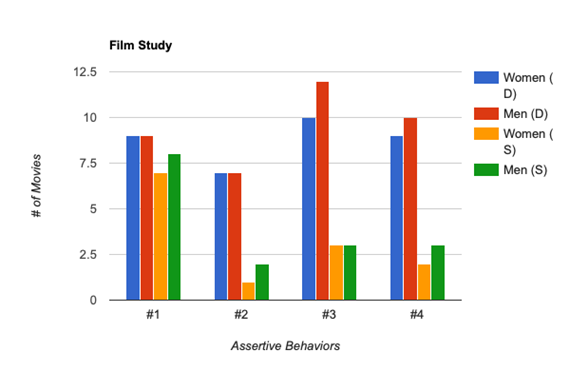
Our findings portrayed that individuals in superior positions in business were more likely to express assertive patterns of communication. We were happy to see that our hypothesis on this study was proven actually right. If you look at Figure 1, you can see that we measured how many movies we saw utilized each of the assertive behavior and placed our observations of women and men in dominant positions (red and blue) and men and women in subordinate positions (orange and green). When looking at the graph, you can see men and women in dominant positions used each of the four behaviors much more in the setting of business communication than those in subordinates. Since we can see men and women both varied for each behavior depending on position, we can see that business roles played a more crucial role in interpreting when assertive behavior was more likely to be seen. Another interesting finding was that men were seen to utilize these assertive behaviors much more than women, whereas, for both dominant and subordinate positions combined, women only expressed more in one assertive trait that we looked for. Men only saw slightly more usage in dominant positions for only two of the assertive behaviors we monitored.

Figure 1: Occurrences of assertive behaviors in movies, categorized by gender,  job position, and types of assertive behavior

Conclusion

Our findings leave an impact on men and women that both perform in the business world. A highly competitive, creative, and honestly frightening place in today’s society. Men and women are past the sexist standpoint that one gender rules over the other as we see both men and women entrepreneurs, CEOS, lawyers, etc. We believe our findings impact both genders in business in the sense of communication. Anyone can establish good ideas, but delivering them and presenting them in conversation requires a level of assertiveness. The level of assertiveness controls the conversation and allows the other person to be heard. That is what our study hopes to help bring to the table toward aiding society. We do not believe that business titles one carries give one a sense of confidence and entitlement. Our hope is that our findings can carry over to perhaps the unconfident women carrying a high-end role in a business or a male intimidated by his female boss. We hope that our findings help devote confidence toward any individual in business to possibly use assertion towards presenting important information or an idea of theirs. The business world can be an intimidating place for anyone, but there is bravery in taking command in a conversation and taking the leap towards presenting your ideas and being confident within them. That is what we hope our study does the most: establishing confidence within readers to be comfortable with communicating their thoughts toward aiding a business that they work for and are passionate about.

References

Dasgupta, S. A., Suar, D., & Singh, S. (2012). Impact of managerial communication styles on employees’ attitudes and behaviors. Employee Relations, 35(2), 173–199. https://doi.org/10.1108/01425451311287862

Furumo, K., & Michael Pearson, J. (2007). Gender-based communication styles, trust, and satisfaction in virtual teams. Journal of Information, Information Technology, and Organizations (Years 1-3), 2, 047–060. https://doi.org/10.28945/138

Harter, J. K., Schmidt, F. L., & Hayes, T. L. (2022). Business-Unit-level relationship between employee satisfaction, employee engagement, and Business Outcomes: A meta-analysis. Journal of Applied Psychology, 87(2), 268–279. https://doi.org/10.1037/0021-9010.87.2.268

Pomerenke, P., Varner, I. I., & Mallar, S. (1996). The depiction of female and male professionals in business communication. Business Communication Quarterly, 59(4), 36–46. https://doi.org/10.1177/108056999605900404

 [/expander_maker]

, , , ,

Unraveling Mean Length Utterances in Romantic Scenes: Action Versus Romance Films

Britney Lam, Iris Lin, Alice Wang, Julia Zhou

Romance is a common element across all genres of film. Whether it is an action movie, a comedy, adventure, or drama, romance is often included within the main plot. Films are created with a target audience, such as age or gender. Our research question emerged: how is romance portrayed differently in movies that are intended to cater to different audiences? Specifically, what linguistic differences can be observed between the romantic scenes? Through the analysis of 10 total films, we found that MLUs in action and romance movies did not significantly differ from each other, though MLU in dialogue succeeding romantic scenes are indeed longer in romance movies.

[expander_maker id=”1″ more=”Read more” less=”Read less”]

Introduction and Background

Stereotypically, romantic and action movies are catered towards the female and male genders, respectively. Although a lot of people, regardless of their gender identification, watch both action and romance movies, such gendered catering may still continue to exist, and characters may still exhibit different behavioral and linguistic patterns across the two genres. One specific type of scene may be the most affected by the genre of the movie — romantic scenes. If the language of romance scenes is indeed different between action and romance films, these stereotypes may affect the audience’s perception of different genres of movies, which in turn intensifies the stereotypical association between certain behaviors with one specific gender. Consequently, our research intends to observe whether the language used in romantic scenes is indeed different between romantic and action movies.

 Previous literature had tackled language style and non-linguistic elements (eye contact, body language) in romance and action movies respectively, but none had compared romance to action films in terms of dialogue length (Dewi et al., 2020; Burns et al., 2009). In a study done by Dewi et al. (2020), the word choice of characters in action films was examined to identify linguistic style patterns; their methods largely inspired our research design to study character dialogue. In research done by Burns et al. (2009), action movies were found to significantly differ from other genres in terms of actors’ behavior (e.g. fewer smiling); this made us wonder how linguistic elements may differ as well.

Thus, we chose to focus on the romance and action genres given that, stereotypically, action movies are catered more to the male audience and romance movies are catered more to the female audience (Brandenburg et al., 2004). Furthermore, building off of research done by Grant et al. (2001) that found males and females are portrayed to behave stereotypically in films, we sought to address the gap among these individual research studies by examining the linguistic features of both romance and action films, then comparing the two to identify differences between the dialogue in romantic scenes catered to different audiences, and whether or not they align with male and female stereotypes.

We set out to answer this by examining how Mean Length Utterance (MLU), a tool used to judge meaningful dialogue length, would differ before, after, and during romantic scenes between action and romance films. MLU is mainly utilized in previous research to study toddlers’ speech, but our research decided to utilize this novel measurement for our linguistic analysis, as it provides insight into the amount of information-rich utterances (Brown, 1973).

We hypothesized that romantic scenes in action films will have shorter MLUs that precede, succeed, or occur during intimate behavior, while romantic scenes in romance films will have longer MLUs that precede, succeed, or occur during intimate behavior. By examining linguistic differences between films catered to males versus females, we hoped to identify and address the stereotypical use of language in movies of action and romance genres, and subsequently propose changes to filmmaking that discourage reinforcing such stereotypes.

Methods Design

We analyzed the dialogue between heterosexual couples in 10 English-language films released between 1980 and the present (see Table 1). These films were chosen because they were high-grossing films that have accessible scripts. In our chosen romance and action films, we investigated romantic scenes that included direct or indirect displays of affection between two characters.

Direct examples included verbal confessional acts of love, including the explicit usage of the words “love” or “like.” 

Indirect examples included verbal acts without “love” or “like” and behavioral displays of intimacy, which included sharing personal thoughts and emotions, as well as hugging, holding hands, and kissing. For example, in this scene in Avatar (2009), the main characters indirectly stated their affections towards each other:

Neytiri: You are Omaticaya now. You may make your own bow from the wood of Hometree. (she looks away) And you may choose a woman.

The Amazon warrior trying so hard to sound casual. Jake suppresses a smile.

Neytiri: We have many fine women. Ninat is the best singer —

Jake: I don’t want Ninat.

Neytiri: There is Beyral — she is a good hunter —

Jake puts his fingers on her lips to stop her.

Jake: I’ve already chosen. But this woman must also choose me.

She takes his hands and their fingers intertwine, moving gently over each other.

Neytiri: She already has.

Three variables, dialogue preceding the romantic scene (“MLU Preceding”), during the romantic scene (“MLU Love”), and succeeding the romantic scene (“MLU Succeeding”), were taken from film transcripts and analyzed for their MLUs. In our research, we calculated MLU by the number of morphemes divided by the number of utterances in speech.

For example, we took this preceding statement before the romantic scene from Crazy Rich Asians. This was the dialogue before the intimate behavior of a marriage proposal.

Nick: Rachel Chu. Will you marry me and make me the happiest man in this world?

(16 morphemes and 2 utterances)

16/2 = 8 MLU

We defined utterance as speech without pause. For example, Nick speaks, pauses, and then speaks again after saying Rachel’s name – this would be considered two utterances. The word “happiest” would be counted as two morphemes, split between “happy” and the suffix “-est.” Consequently, there are 2 utterances in total, with 16 morphemes, resulting in a MLU of 8.

Additionally, another variable, “Love Presence”, was recorded for every scene we analyzed, which indicated whether a direct display of affection was present in the scene.

We repeated this process for all 10 of our films (5 romantic, 5 action) by examining the transcripts and counting the number of occurrences the words “like” and “love” were explicitly used.

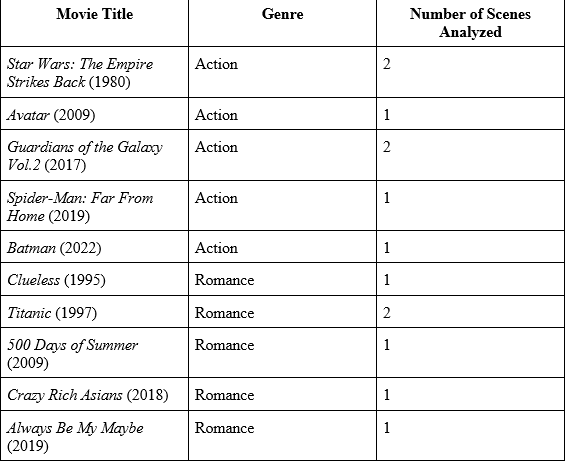
Table 1: List of movies included in our analyses, with their genres and number of scenes listed.

Results and Analysis

Firstly, we can look at the descriptives of our data (see Table 2) — The average number of MLU Preceding, MLU Love, MLU Succeeding, and Love Presence in both action and romance movies.

Table 2: Descriptives of our data.

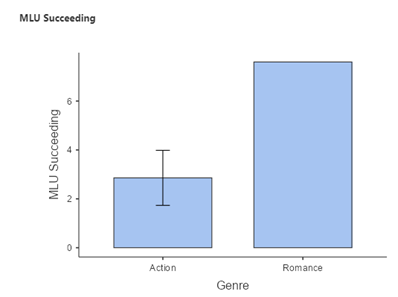
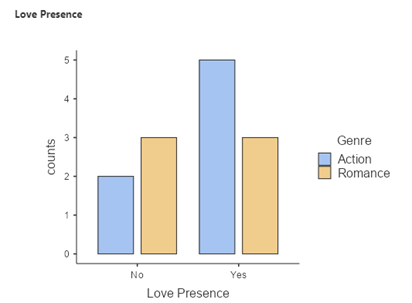
As can be seen in Table 2, notable variables that show a difference are MLU Succeeding and Love Presence. Romance movies seem to have more MLU Succeeding than action movies, which means that after the main characters confess their love for each other, romance movies seem to have longer and more meaningful utterances. Moreover, action movies seem to have a higher frequency of Love Presence than romance movies, meaning that characters in action movies may more often state their love directly.

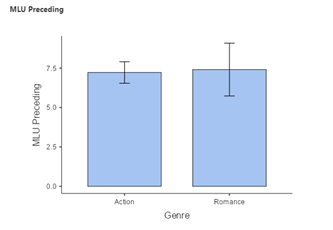
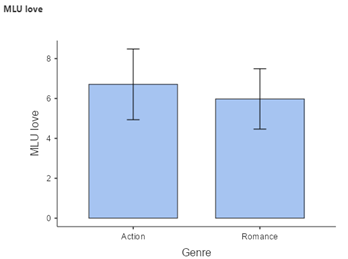
Subsequently, four separate independent samples t-tests, with a 95% confidence interval for the mean difference, were conducted to compare if the two genres significantly differ from each other in their MLUs. All four tests revealed non-significant results, showing that in romance and action movies, MLU Preceding (t(9) = -.11, p = .915), MLU Love (t(5) = .30, p = .777), MLU Succeeding (t(4) = -1.72, p = .161), and Love Presence (t(11) = .75, p = .471) all do not significantly differ from each other. Figures 1-4 below visualize the results of the four t-tests.

Fig 1. MLU Preceding for action and romance movies.

Fig 2. MLU Love for action and romance movies.

Fig 3. MLU Succeeding for action and romance movies.

Fig 4. Love Presence for action and romance movies.

Discussion

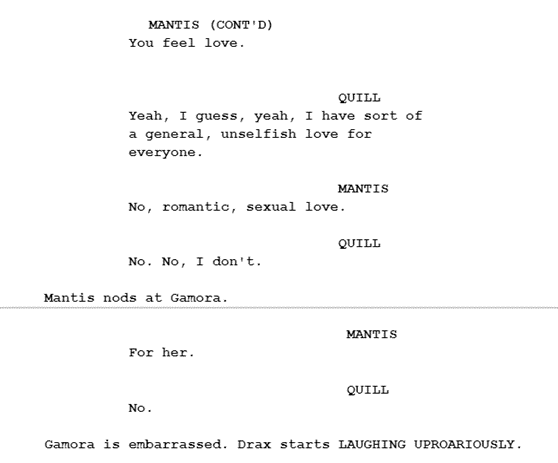
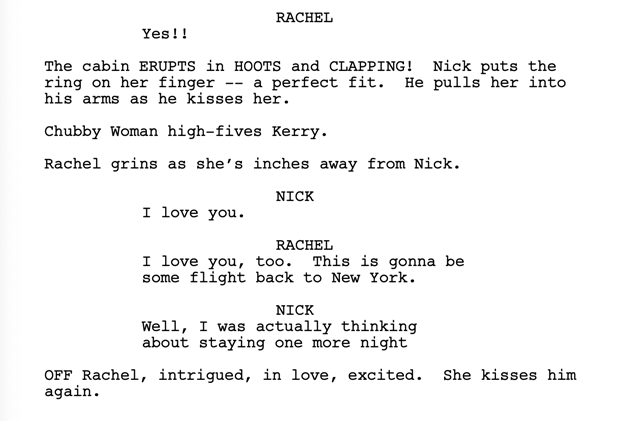
Contrary to our hypotheses, our results showed that romance and action movies did not differ significantly in their lengths of utterances. There is a trend towards significance for MLU Succeeding, which indicates that romance movies may contain more information after the confession of love. As for the reason why there may be such a trend, maybe romance movies tend to describe what happens after the characters state their affections towards each other, while action movies tend to view the confession of love as an ending for the romance elements and focus on the “main plot” afterwards. For example, in the action movie Guardians of the Galaxy Vol. 2 (2017), one romantic scene ended as soon as the main character Quill’s affection towards the other character, Gamora, was revealed by another character, causing that the scene did not have any morphemes for MLU Succeeding (see Fig.5). This specific absence of any utterances after the MLU Love might be due to that a) the focus of the movie was not on the romance, but rather the main characters defeating the villains; b) Quill tries to deny his affections, and the scene quickly ended to express his embarrassment. In contrast, in the romance movie Crazy Rich Asians (2018), the main characters continued to express their excitement and happiness after accepting the marriage proposal, causing the MLU Succeeding to be particularly long (see Figure 6). Still, this trend can only be applied to our sample, and cannot be generalized to all the romance and action movies in general because of our limited sample size.

Fig 5. Script for Guardians of the Galaxy Vol.2, after the main character Quill’s affection is revealed.

Fig. 6 Script for Crazy Rich Asians, after the main character Rachel accepts the marriage proposal.

Because of time and resource constraints, our study has several limitations. Firstly, our sample size (10 movies and 13 scenes in total) may have limited the power of our data, having more scenes and more movies may have yielded more statistically significant results. Secondly, because we selected romantic scenes where the main characters’ affections were revealed, the linguistic variables were sometimes missing. For example, the scene from Guardians of the Galaxy Vol.2, as we mentioned before, did not contain any MLU Succeeding. These partially incomplete datasets may have further limited our statistical power. To solve this flaw in data collection, we would recommend future studies to collect more data to remedy the fact that some romantic scenes do not contain any utterances for succeeding statements of love. Alternatively, future studies can define and select romantic scenes differently, so they can control and ensure every scene will contain utterances for all three variables. Despite these limitations, our methods of investigating the MLUs of scenes are novel, as no previous research directly compared romantic scenes in romance and action movies, and little, if any, research on linguistic analyses of movies selected MLU as their method.

Given that our results showed no significant difference between how romance and action movies depicted romance, it will be interesting to look at how the two genres may have converged and become more similar over time. Comparing romance and action movies chronologically based on their release date may reveal a pattern or trend of change. In fact, our results may hint such chronological changes, as newer action movies (Guardians of the Galaxy Vol. 2 (2017) and Spiderman: Far From Home (2019)) contained more statements of love than compared to older action movies (Star Wars: The Empire Strikes Back (1980)). This difference we observed can be further explored by creating a study focused on collecting love statements from romance and action movies across time, and then comparing word choice or MLU.

Additionally, MLU is only one way of investigating the length of utterances. Future studies can use different methods. For example, linguistically, future studies can look deeper into a) how main characters explain their reasons for loving the other character; b) if main characters express their hopes of moving forward in their relationship; (c phonetically, their intonation when confessing their love. Non-linguistically, future studies can look into the main characters’ body language and eye movements when they are confessing their love. Behavior before, after, and during romantic scenes can be analyzed, as well as the setting and time of day.

Finally, recent literature has observed recent efforts by films to depict less stereotypical portrayals of romance (Brandenburg et al., 2014). There may be an emerging trend of combatting traditional narratives, which would be an interesting area of study to explore. In line with the idea of studying films chronologically across time, future research can aim to examine differences between romance and action films released in recent years and compare them to one another or to older films. If romance and action films are stereotypically catered towards female and male audiences, then it is entirely possible that films have changed over time to cater to changing societal standards. For example, if there is more demand for a female lead that is portrayed as independent and strong-willed, movies with romantic scenes may adapt linguistically to that. It will be an interesting field of study to identify these emerging patterns and trends.

References

Brandenburg, J. D., Dodds, L. A., Harris, R. J., Hoekstra, S. J., Sanborn, F. W., & Scott, C. L. (2004). Autobiographical memories for seeing romantic movies on a date: romance is not just for women. Media Psychology, 6 (3), 257-284.

Brown, R. (1973). Development of the first language in the human species. American Psychologist, 28(2), 97-106. https://doi.org/10.1037/h0034209

Burns, A. C. (2009). Action, romance, or science fiction: your favorite movie genre may affect your communication. American Communication Journal, 11(4), 1-17.

Cameron, J. (1997). (Director). (1997). Titanic [Film]. 20th Century Fox; Lightstorm Entertainment; Paramount Pictures.

Chu, John. M. (Director). (2018). Crazy Rich Asians [Film]. Color Force; Electric Somewhere; Ivanhoe Pictures; SK Global; Starlight Culture; Warner Bros. Pictures.

Dewi, N. M. A. J., Ediwan, I. N. T., & Suastra, I. M. (2020). Language style in romantic movies. Humanis: Journal of Arts and Humanities, 24(2), 109-117.

Grant, B. K. (2001). Strange days: gender and ideology in new genre film. In M. Pomerance (Ed.), Ladies and gentlemen, boys and girls: Gender in film at the end of the twentieth century (pp. 184-199). State University of New York Press.

Gunn, J. (2017). Guardians of the Galaxy Vol. 2 [Film]. Marvel Studios.

Kershner, I. (1980). Star Wars: The Empire Strikes Back [Film]. Lucasfilm Ltd.

[/expander_maker]

, ,
Scroll to Top