Slang

Linguistic Features between University Students in California and New York: Reddit Version

Clyde Villacrusis, Sydnie Yu, Monique Tunnell, Michelle Kim

How often do you find yourself saying “hella” or “bet?” How does this differ for people across different regions? The research project discussed in this blog article compares linguistic markers, particularly slang, in Reddit communities of universities in New York and California. Using basic forms of natural language processing, we analyzed posts from multiple university-specific Reddit pages to identify regional slang differences. Results show distinct slang patterns reflecting local cultures — New York slang influenced by its diverse linguistic environment, and California slang shaped by surf and tech cultures. In addition, New York university students have shown that they are less susceptible to slang and jargon, as most of them are out-of-state students and therefore, grew up in a community where it is harder for them to immerse in NY culture and its language. For California students, it is easier for them to immerse in the language culture because most are in-state students. These findings highlight the role of language in forming regional identities in digital spaces, offering insights for sociolinguistic research and digital communication strategies.

[expander_maker id=”1″ more=”Read more” less=”Read less”]

Introduction and Background

As aspiring sociolinguists, we want to learn more about how different cultures can affect slang within our own communities and thus, affect their way of speech. More specifically, how do students at different universities use slang, and what are the implications of this language?

University culture is unique and cultivates an environment of relatability and unity. Language and communication play a big role in this culture, and with the rise of social media platforms, we decided to dive into a platform largely used by university students in order to analyze raw conversations between college students within a university. More specifically, we analyzed California university slang versus New York university slang. Reddit is a great place to analyze linguistic features and speech of people across the United States and how each geographical place affects their slang. Reddit is a social networking platform that was established in 2005 (Semrush, 2024). In addition, Reddit is divided into communities called “subreddits,” where people can interact and contribute with each other comfortably in their respective community. These subreddits generally consist of people with the same interests. In this case, we examined Reddit communities for universities, meaning most users go to the same college or university. Within these subreddits, users relate to one another using university- and state-specific slang.

New Yorkers have a diverse immigrant population and fast-paced urban lifestyle. They also tend to partake less in small talk and more in longer, conversational speeches (Allen 2023). In those conversations, there are a couple of common terms, such as “real talk” (attention grabber), “the city” (refers to Manhattan), and “Stoop” (steps outside of an apartment). Conversely, Californian slang and language reflect tech and entertainment culture, primarily because of the Los Angeles area or most of the tech companies that reside in San Francisco. In addition, Californians tend to use relaxed jargon and more informal speech patterns (Bucholtz, n.d). Some of the common terms they used are: “hella” (very much), “like” (mostly as a filler word), and “dank” (excellent). Based on these backgrounds we posed the questions: How do linguistic markers, especially slang, differ in New York vs. California universities on Reddit? How do regional, cultural, and social influences affect language? Do in-state versus out-of-state student populations affect the use of slang within university subreddits?

Overall, this research study examines the different linguistic features of the California and New York universities. We aim to show that these variations reflect the unique social and cultural aspects of each region, highlighting how language usage serves as a marker of regional identity in digital communication.

Methods

Earlier this year, a Reddit user named u/Watchful1 compiled data collected by other users, u/pushshift and u/raiderbdev, on posts and comments from Reddit between 2005 and 2023. We isolated six subreddits relevant to our study. We used scripts from Watchful1’s PushshiftDumps Github repository to count the occurrences of specific keywords in each subreddit from January 1, 2021 to December 31, 2023.

For web scraping, we used Python libraries like BeautifulSoup and PRAW to extract data from Reddit communities associated with universities in New York and California. We selected subreddits based on criteria such as member count, post frequency, and relevance to student life, focusing on threads that accurately represented each region’s schools.

We aimed to collect a diverse sample of posts and comments from each selected subreddit, ensuring representation across various topics, time periods, and user demographics. In cases where automated methods might miss nuances, human annotators manually reviewed and supplemented the analysis. We also prioritized ethical considerations by anonymizing or aggregating data to protect user confidentiality, ensuring compliance with Reddit’s terms of service and data usage guidelines. We also conducted thorough reliability checks to ensure the quality and accuracy of our data and analysis results.

In addition and most importantly, we intended to select a few universities because it would be time consuming and difficult to do all of the subreddits for California and New York universities. Thus, we chose to focus on a few universities in each state with the most active subreddits and number of reddit community members.

Finally, we maintained detailed internal documentation of our data collection process, including sources, sampling methods, and any preprocessing steps applied to the data.

Results and Analysis

First, it is important to note the distribution of in-state versus out-of-state students. We collected this data from the universities, and the distribution is shown below.
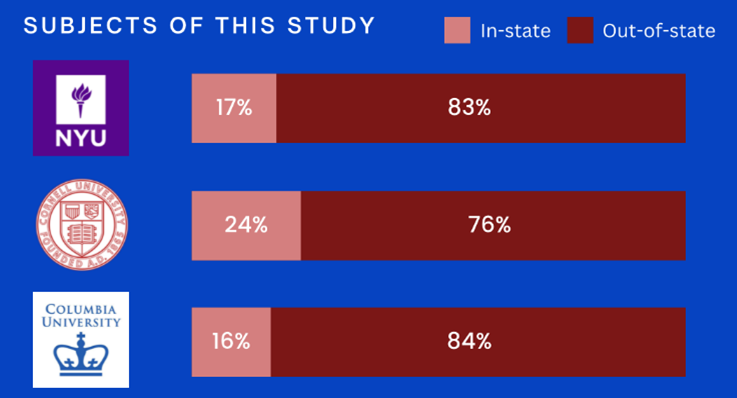
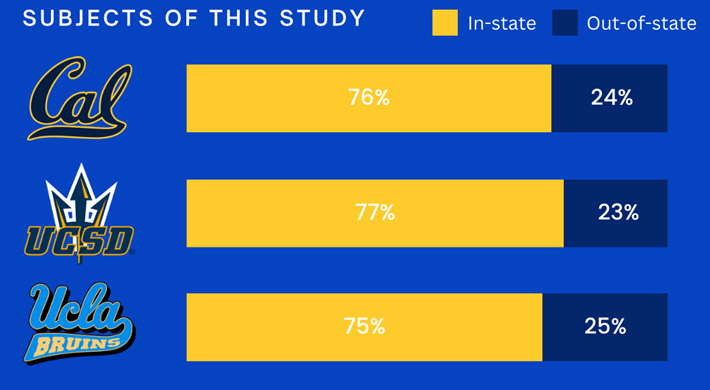
Figure 1. Number of subjects per New York university subreddit and whether they are in-state or out-of-state students.


Figure 2. Number of subjects per Californian university subreddit and whether they are in-state or out-of-state.

After using our methods of analyzing Californian and New York universities’ slang, we found that college students in California use the word “hella” the most at UCLA, even more than in UCSD and UCB, although it is still very prevalent in all three California schools. “Hella” means “there’s a lot of __.” The reasoning for the frequency is due to the recency of each university subreddits; the longer the comments were posted would not be helpful in determining today’s society’s slang. For instance, most of UCLA comments were from 3 to 6 months ago while UCSD and UCB’s comments were from 2-4 years ago, which is a significantly longer time. In addition, “hella” is “highly expressive [and] often” will destroy the gravity of a formal statement (Hummon 1994).

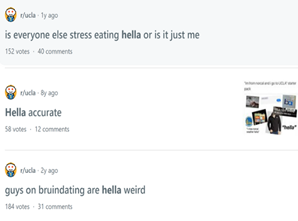
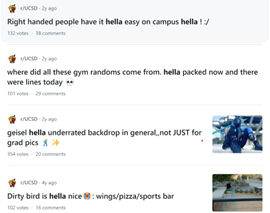
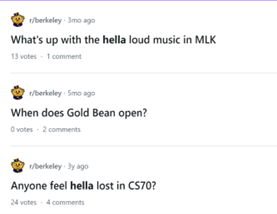
Common examples of the use of “hella” are shown below:
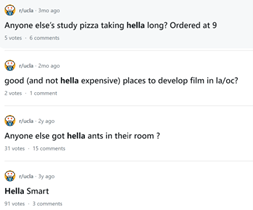
Figures 3 & 4. Instances of “hella” in r/ucla.


Figure 5. Instances of “hella” in r/UCSD.


Figure 6. Instances of “hella” in r/berkeley.

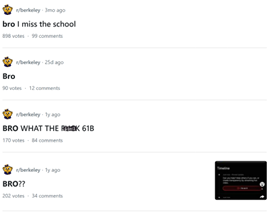
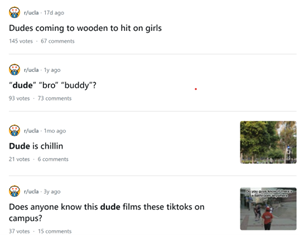
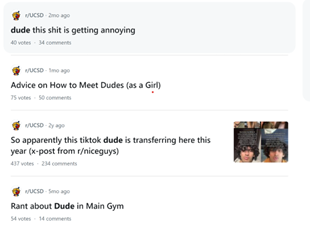
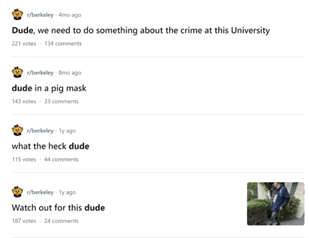
Secondly, we also found that college students among UCLA, UCB, and UCSD primarily frequent the slang “bro.” The comments we have found were not from too long ago, ranging from 4-9 months. Since these comments were recent, we can say that the accuracy of California universities students saying “bro” is likely. Moreover, we can also say the same for “dudes” because of how recent it is. Students say “bro” and “dudes” because omitting large chunks of a particular sentence or word helps the speaker say what they mean. In other words, it might be difficult for the speaker to say “brother,” a longer version of “bro.” Including the second half of the word loses the surrounding, cultural meaning of the sentence, i.e, “bro was not cooking” is not the same as “brother was not cooking” in terms of today’s societal norms. This shows how even slang has its own set of unspoken “rules” that must be followed to maintain a level of informality befitting more casual contexts. Shortening words seems to be a trend for making phrases more casual, and this could perhaps be due to how it allows a speaker to convey more in a shorter amount of time, as well as an implied mutual understanding between the speaker and listener that they understand the true meaning despite it being shortened, similar to a secret code. This could also be why slang usage is so prevalent nowadays, as everyone sees it as cool or modern to be part of a community that understands this secret code, the language of slang. Eventually, slang will become “accepted as equivalent to their unabbreviated and original forms” (Gordon 2020). Even though some slang words like “hella” are not widely spoken in other universities, it will be useful in the near future for linguistic research.

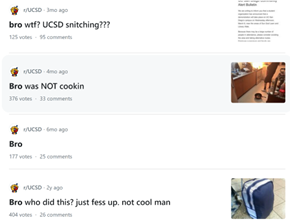
More examples of “bro” and “dudes” shown below:
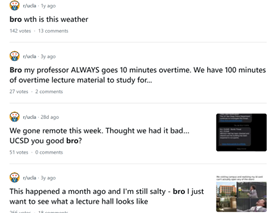
Figure 7. Instances of “bro” in r/ucla.


Figure 8. Instances of “bro” in r/UCSD.


Figure 9. Instances of “bro” in r/berkeley.


Figure 10. Instances of “dude” in r/ucla.


Figure 11. Instances of “dude” in r/UCSD.


Figure 12. Instances of “dude” in r/berkeley.

Moving on to the New York universities, we found that “the city” is used more frequently at NYU and Columbia than in Cornell. “The city” means Manhattan, and college students from NYU and Columbia use it more because they are closer to Manhattan than Cornell. However, another slang term, “real talk” (used as an attention grabber), is more common in Cornell than the two other universities. In addition, the most common frequency slang in Cornell is “bet,” meaning you are either asking the person to put money on your statement or an affirmative ‘yes.’ This is also slightly common in NYU and Columbia. Moreover, what we found interesting is that the subreddit comments of these NY slangs are from 3-4 years ago. However, when we tried to fact-check this with our current methodology using a Python script, we found that the slang “bet” is used by all universities from the west to east coast. For example, there are roughly 21,348 “bet” usages at UC Berkeley, followed by UCSD, while there are 9,452 slang “bro” at UCB. We also found that “real talk” is less common in all universities.

Here is the common occurrence table including data analyzed by the Python script between January 1, 2021 and December 31, 2023:
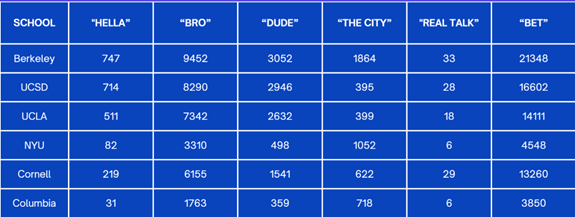
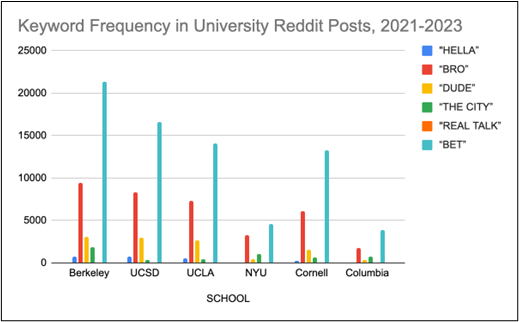
Figure 13. Table showing “bet” as the most common slang, followed by “bro” and “dude.”


Figure 14. Chart version of data appearing in Figure 13. The axes compare the 6 schools to the number of times their respective subreddits have said 6 different keywords from 2021 to 2023. “Bet” and “bro” dominate slang usage across all schools included in this study.

Discussion

After analyzing the linguistic features of California and New York, especially slang, we can safely say that slang words that would be considered be California slang are used heavily within Californian universities’ subreddits. This seems to have a direct correlation to the number of in-state students, unlike New York universities. We also observed several frequent uses of the same terms — “hella,” “bro,” and “bet” — across the Californian universities. In addition, we can say that college students who mainly grew up in an active social culture will most likely be accustomed to the slang and jargon around them.

Moreover, as for New York universities in their own respective subreddits, they use less frequent jargon and slang. Although still present, this seems to have a direct correlation with the amount of out-of-state students in each NY university, as fewer students grew up immersed in the New York culture and thus, are less likely to be accustomed to the city language influenced by the city’s culture.

Our research study contributes to a larger phenomenon in different ways. Firstly, by analyzing linguistic patterns in Reddit communities, the study sheds light on the social dynamics and communication styles within university-affiliated online spaces. This understanding can inform community management strategies and facilitate more effective online interactions. Secondly, our findings contribute to educational research by highlighting the role of language in shaping online discourse within academic communities. Sociolinguistic studies can benefit from a deeper understanding of how language reflects societal norms and values in digital environments.

Lastly, we can leverage insights from this research to develop more targeted and engaging digital communication strategies tailored to specific regional audiences. Understanding linguistic preferences and cultural references can enhance the effectiveness of online marketing and outreach efforts. For example, we can use common slang and jargon, such as using a lot of “bros” or “dudes,” in a men’s marketing campaign and planning how it will raise awareness.

Conclusion

Ultimately, each university and its own subreddit cultivates a community that is centered around shared and common experiences. These experiences can create and preserve slang and jargon that students feel comfortable using to express themselves. There is also a prevalent influence of regional culture on language and slang used by Redditors across the country, as shown by the different terms most used in California and New York. Even though students may move out of state to attend college, they will bring their own slang used by their hometown communities with them, rather than immediately assimilating into the language used in their new community. Overall, language stands as a symbol of hope and it is used so that other students accept and recognize one another as part of the same community.


References

Allen, I. L. (2023). The city in slang: New York Life and popular speech. Oxford University Press.

Bucholtz, M. (n.d.). Chapter 29- Word Up: Social Meanings of Slang in California Youth Culture. In A Cultural Approach to Interpersonal Communication: Essential Readings. essay.

Haas, C., Takayoshi, P., Carr, B., Hudson, K., & Pollock, R. (2011). Young People’s Everyday Literacies: The Language Features of Instant Messaging. Research in the Teaching of English, 45(4), 378–404. http://www.jstor.org/stable/23050580.

Hummon, D. M. (1994). College Slang Revisited: Language, Culture, and Undergraduate Life. The Journal of Higher Education, 65(1), 75–98. https://doi.org/10.2307/2943878.

Labov, T. (1992). Social and Language Boundaries among Adolescents. American Speech, 67(4), 339–366. https://doi.org/10.2307/455845.

Roth‐Gordon, J. (2020). Language and creativity: Slang. The International Encyclopedia of Linguistic Anthropology, 1–8. https://doi.org/10.1002/9781118786093.iela0192.

Saha, Koustuv & Choudhury, Munmun. (2021). Assessing the mental health of college students by leveraging social media data. XRDS: Crossroads, The ACM Magazine for Students. 28. 54-58. 10.1145/3481834.

“Top Websites in Worldwide (All Industries).” Semrush, www.semrush.com/trending-websites/global/all. Accessed 20 May 2024.

[/expander_maker]
, , , ,

Tech Bros and Tech Woes: A Perspective on Gendered Sociolinguistics in the Tech Industry

Jenny Wang, Madhavi Vivek, Rajana Chhin, Audrey Chung

In the expanding realm of technology, language serves as more than just a communication tool — it is a powerful marker of identity and belonging. Our study delves into gendered linguistic practices within the tech industry, focusing on “tech bro” culture and its impact on female experience and career advancement in this male-dominated field. Through interviews with male and female tech students and analysis on social media content, podcasts, and scholarly articles, we uncovered lexical variations and interactional patterns unique to the tech community. Utilizing a blend of qualitative and quantitative methods, we observed terms like “tech debt,” distinct pitch variations, and exaggerated “urban” accents during conversation. Our findings reveal that females in tech often adapt their language to conform to the hyper-masculine expectations of the tech workplace, further reinforcing clear gender biases and stereotypes within the industry. By highlighting these subtle linguistic barriers that perpetuate gender biases, we aim to emphasize the need for a more inclusive and supportive tech environment for all individuals.

[expander_maker id=”1″ more=”Read more” less=”Read less”]

Introduction and Background

The technology industry has long been known for its clear gender gap, given its predominantly male sector enforcing stereotypes and biases against women in the workplace. Despite advancements over the years, the tech industry still exhibits pervasive gender bias, often manifested through language. Recently, the term “tech bro” has been used to characterize the toxic masculinity prevalent in the workplace (Jones 2022). Our research aims to explore the unique lexicon and interactional patterns of this group, observing how they reinforce gender stereotypes and impact female experience in tech. In other words, how does the dense network of “tech bros” correlate to their use of vernacular variables? Does gender bias exist within language commonly used by “tech bros?”

Existing literature highlights the significant role of gendered language — the words and phrases that inherently carry gender bias—in shaping workplace dynamics. For instance, terms like “chairman” and “assertive” often assume a male subject, whereas words like “bossy” and “hysterical” are typically applied to females in leadership roles (Holmes 2008). Holmes’ study suggests that women in tech adopt more masculine speech patterns to gain respect and authority, such as using direct imperatives when commanding subordinates or purposefully disengaging from workplace arguments. Despite the growing awareness of these issues, there remains a gap in understanding the specific linguistic behaviors of “tech bros” and their effects on female colleagues.

Our hypothesis claims that the linguistic practices of “tech bros” do contribute to the exclusion of women from the tech sector. This exclusion manifests in daily communication, feedback, perception of qualifications, and performance evaluations. Our research aims to find out whether the male-dominated environment serves as a barrier to community entry and inclusion for women. Additionally, we aim to study the speech variation between genders within the community and its role in building professional relationships. By analyzing tech jargon and interactional patterns, we hope to uncover the subtle and pervasive barriers that gendered language creates in promoting workplace gender equality and diversity.

Methods

In order to conduct our research, our team relied on three main methods for data collection:

  1. Media: We collected quotes from social media portrayals of the stereotypical “tech bro”.
  2. Online Tech Hubs: We gathered data from popular tech communities on platforms like Discord and cross-referenced jargon with scholarly articles.
  3. Interviews: We conducted a total of three sets of interviews with male and female identifying students in the tech industry in order to evaluate of indexical shift as well as gendered language.

Going in order, we consistently evaluated new information against previous data. Further analysis included examining the spectrograms of interview snippets for distinct phonological features.

Results and Analysis

The following section will focus on the results of our study.

1. Media

As per our methodology, one of our primary sources of information was through the portrayal of stereotypical “tech bros” on social media. While this type of content is not the most scientific, it does provide context on societal expectations placed on the average “tech bro.” The comedic video linked here demonstrates several “tech bro” characteristics while mocking common stereotypes, such as remote work culture, cost-of-living in the Bay Area, and popular hobbies and vacation spots within tech communities. Additionally, we observed that the creator of the video speaks with an exaggerated coastal urban accent, similar to those of surfers or “frat bros.” This hyper-masculine accent underscores the inherently masculine nature of “tech bro” culture and serves as a starting point for developing a hypothesis surrounding the existence of a gender gap reflected in language.

2. Online Tech Hubs

Our team visited popular internet communities within the tech industry. The following quotes were taken from a popular Discord server called cscareers.dev, which is a community for student developers seeking internship and new grad opportunities in tech with over 8000 members.

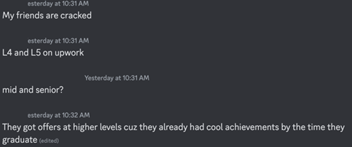
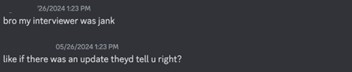
Figure 1. Pictures from a conversation on Discord server cscareers.dev.

From these quotes in Figure 1, we gather that there is a linguistic overlap between tech communities and gamer communities. This would make sense as demographically, they are both male dominated, and technology and gaming share many similarities as fields and industries. Specific jargon like “jank” to describe an interviewer of poor quality and “cracked” to describe extremely accomplished people are two examples of somewhat-expected buzzwords. According to Wiktionary, the term “jank” exists as both computing slang and video game slang, though it is rarely used in technical contexts. The usage of this term colloquially shows the adoption of computing and gamer slang in broader environments. In the same vein, “cracked,” which usually carries video gaming implications, being used to express skill levels outside of gaming also shows the adaptive nature of the jargon.

3. Interview: Indexical Shift

Our first interview was conducted with Brandon and Brian, both third-year cognitive science students at UCLA. Brandon is a product manager intern, and Brian is a software engineering intern. Because the two have an established friendship, I conducted the interview with both participants present to simulate as natural of a conversation as possible. The interview was split into first, a professional chat, and second, a casual conversation in order to evaluate for indexical shifts. Throughout the professional chat, I asked Brian and Brandon questions about their experiences in tech through their professional organizations at UCLA. The following is a transcription of a snippet of the conversation:

Brian: Ensuring like, there’s not a lot of tech debt, I think is like super important across all the projects within DevX as a whole makes everything run very smoothly and there’s no churn.

Brandon: Yeah yeah, for sure. I think that’s a huge thing too, for a lot of projects, is because people are bouncing. Um, people bounce from projects all the time, um having tech debt is just like absolutely horrendous because like people who don’t know anything about the project, for lack of a better term, like a shitload of…

For the casual conversation, I asked the participants to describe updates in their lives, as well as share gossip, as if we were catching up. This is in order to establish the most natural and comfortable environment.

Brandon: ‘Cause I remember, I had- there was something about- but anyway, I saw them together, like they were like, like homies, like they were like, headed to a party together. I was like “oh, like birds of a feather” you know? Shit, like that tracks, that hella tracks, you know? Like I’m not surprised.

Brian: That’s wild.

Generally, I noticed that participants, especially Brandon, deliberately talked slower during the professional chat. During the casual conversation, I found that Brandon tended to stutter more, as well as exhibit doubling in order to emphasize certain phrases. In the professional chat, instead of doubling phrases, he slowed down and replaced those instances with filler words.

Tech jargon was noticeably present during the professional chat, including words like:

  • Tech debt: shortcuts in code that achieve the goal faster, but at the cost of uglier, harder-to-maintain code.
  • Churn: the frequent change of resources or team members within a project.
  • Bounce (rate): the rate at which people leave or exit, typically used in the context of webpage visits.

The following spectrograms closely examine Brandon’s use of the word “shit” in both the casual and professional context.

Figure 2. Spectrogram of Brandon’s use of “shit” in a casual conversation.
Figure 3. Spectrogram of Brandon’s use of the word “shit” in a professional conversation.

Here, we can see that during the casual conversation, there is a significant increase in pitch towards the end of the word, indicating a high rising terminal, which can be especially common amongst young people. In the spectrogram for the same word used in a professional context, Brandon maintains the same pitch. This is likely because a high rising terminal is not situationally acceptable in all professional settings. For example, it is usually not encouraged during job interviews. We can gather that a “tech bro” like Brandon understands this and subconsciously omits high rising terminal in professional contexts.

4. Interview: Gender and Culture

Our second interview was conducted with Jiin Kim, a fourth year Linguistics and Computer Science major who has experience as a software engineer through her internship at Microsoft. As she explained tech-specific language throughout the interview, she defined them in layman’s terms, constantly checking to assure my comprehension of the terms as an outsider to the tech sector. She mentioned how it can be hard to feel included entirely when there is a linguistic barrier made of tech jargon and expressions that often feel very exclusive and not easily accessible to be understood. She herself felt intimidated as an incomer into an established tech workspace. Linguistically, she found herself assimilating into the culture by reflecting speech patterns of those around her—particularly those superior to her. If she finds them to speak more directly, using imperatives, she herself would do the same. Even through a digital space, if she noticed someone using more emoticons in their messages, she would reflect that frequency. As a woman in the tech space, she attributes her not having much experience with discrimination or feeling out of place with the changing ages. As a young college student in an internship program seeking to give more opportunities to a diverse group of tech-workers, she felt well-supported by her company and her peers.

Our last interview was conducted with Matt Nieva, a fourth year Computer Science and Engineering major with experience as the Development Team Director for ACM (Association for Computing Machinery) at UCLA and as a software engineering intern at Cisco. Throughout his interview, he went deep into tech jargon, throwing out multiple technical words while describing tech projects in–depth. When asked about why tech-bro culture revolves so heavily around a specific tech lexicon, he responded saying that tech-jargon is perceived as proof of expertise.  There is a certain linguistic exclusivity that makes those who use it hold more authority and credibility. These common words in tech-space also seep into his daily vocabulary as well, signifying to others that he is a member of this tech-bro community.

These are words such as:

  • Bandwidth: the energy or mental capacity required to deal with a situation
  • Parallelize: a programming term to adapt a program for running on a parallel processing term
    • This however can be used in daily life as setting two thing simultaneously in motion
  • Velocity: rate of progress; a metric for work that has been done

In efforts to assimilate, he, like Jiin, would mimic the linguistic patterns of those around him. He discovered the concept of downtalking versus uptalking—downtalking being lower in pitch and making a speaker sound more assertive, and uptalking being higher in pitch and making a speaker sound less credible. One reason why downtalking could be perceived as more respectable might be that it is, based on pitch, masculine indexing, while the other is more feminine indexing.

Discussion and Conclusion

As mentioned in the background, tech-bro culture is characterized by an informal, male-centric atmosphere that often perpetuates gender discriminatory behavior and aids in maintaining the gender gap in the tech industry. The establishment of Title IX in 1972 was a turning point for the number of women in STEM, but women still face the leftover effects of this gender power dynamic now in more covert ways. This inequality is visible in how more masculine indexing ways of leadership such as authoritative/assertive styles that assert hierarchical status difference is perceived as more valid of leadership than leading in what is considered more feminine indexing ways such as facilitating group discussion.

Beyond perceived leadership and professionalism, research has found that gender comes to play even within the informal discourse at the workplace. Small talk is a core strategy to foster team and build rapport; however it is culturally coded as feminine specifically when it is not about anything that is work related or distinctly masculine. Research showed that at a female workplace, these pre-meeting talks would last longer and delve into topics such as family, beauty, healthcare, while when studying three different New Zealand IT organizations, small talk was either non-agenda work related or about sports. This may sound trivial but interpersonal discourse is key in fostering work relationships and an overall culture. This difference is visible in humor as well, where a female boss might make a self-deprecating joke to reestablish good relations with her subordinates, workplaces that were more masculine in one meeting  consisted of humor that 90% of was sarcastic or negative jibes intended to deflate the addresses. Gender hierarchy in the workplace, particularly within the linguistic space, is covert and embedded subtly into the ways we talk, the ways we perceive authority, etc.

Our findings indicate that the sociolinguistics of the tech industry have unique qualities, including those of which have an effect on the perception of male and female individuals that work in tech. As a male-dominated field, gender bias is highly prevalent in the industry. Our aim was to strengthen this claim in which this bias is confirmed and correlated to female “success” (defined as experience and career advancement), via the exploration of the pattern of language adaptation by females to male tech industry speech. Through this study, we found that the perpetuation of this gender bias is tied to the inherent gender gap that this industry creates in that a male-dominated environment contributes to female exclusion and strict gender-based hierarchy. Our research indicates that this exclusion and hierarchy contributes to the barrier against female success in male-dominated fields such as the tech industry. The continued observation of male-dominated power structures can aid in the effort for people of all genders in high-earning fields. There is thus a need for collective action toward increasingly inclusive, supportive, and sustainable workplace environments, especially the tech industry, for female-identifying people and other minority individuals.


References

Duchene, A., & Heller, M. (2012). Language in late capitalism: Pride and profit. Routledge.

Gleeson, P. (2017). Working with Coders. https://doi.org/10.1007/978-1-4842-2701-5.

Holmes, Janet. Gendered Discourse at Work , 2 Apr. 2008, onlinelibrary.wiley.com/doi/10.1111/j.1749-818X.2008.00063.x/abstract.

Ignatow, G. (2003). “Idea hamsters” on the “Bleeding edge.” Poetics, 31(1), 1–22. https://doi.org/10.1016/s0304-422x(02)00042-6.

Jones, H., & Sudlow, B. (2022). A contemporary history of Silicon Valley as global heterotopia: Silicon Valley metaphors in the French news media. Globalizations, 19(7), 1122–1136.

Moldovan, Andrei. “Technical Language as Evidence of Expertise.” MDPI, Multidisciplinary Digital Publishing Institute, 21 Feb. 2022, www.mdpi.com/2226-471X/7/1/41.

https://www.ucats.org/a-closer-look-at-gender-diversity-in-tech-departments-across-the-usa.html

miinii (@officialmiinii). (2024) “women in computer science stand up!” https://www.tiktok.com/@officialmiinii/video/7342179255356230955.

Tripathi, Pooja (@winnie_thepooj). (2024) “POV: date with a tech bro” https://www.tiktok.com/@winnie_thepooj/video/6962561340086996230?is_from_webapp=1&sender_device=pc&web_id=7279640957828630062.

Nasso, Austin (@austinnasso). (2024) “POV: you’re talking to a tech bro” https://youtube.com/shorts/qmGL0-U2Z58?si=DAulz7gNkYjYpRVH.

https://en.wiktionary.org/wiki/jank#Etymology.

https://en.wiktionary.org/wiki/cracked

[/expander_maker]

, , , , ,

Unveiling Linguistic Appropriation: A Dive into Slang Usage on Twitter

Asfa Khan and Ayub Abdul-Cader

A world where words wield power and every hashtag tells a story—welcome to the exploration of slang on Twitter.

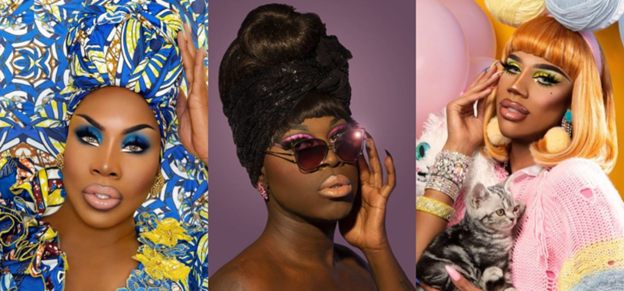
Exploring the intricate dance between language, identity, and culture, this study delves into the phenomenon of linguistic appropriation on Twitter. Focusing on the adoption of African American Vernacular English (AAVE) by non-Black individuals, particularly white working-class Twitter users, we uncover patterns that illuminate the dynamics of identity formation in digital spaces. Through analysis of tweets from Black Drag Queens and white Twitter users, we dissect linguistic elements such as phonetics, word choice, syntax, semantics, and pragmatics. Our findings reveal a nuanced picture of language use, shedding light on the motivations behind linguistic appropriation and its implications for cultural dynamics and societal norms.

[expander_maker id=”1″ more=”Read more” less=”Read less”]

Introduction

African American Vernacular English (AAVE): The Dialect We Call Our Own – Because of Them We Can

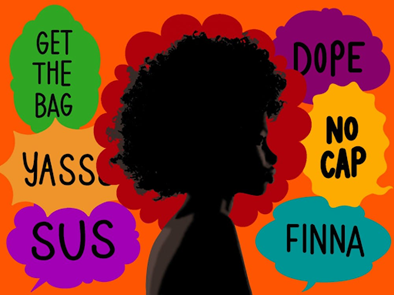
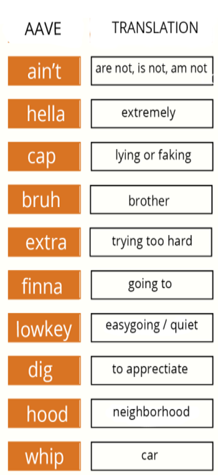
In today’s digital age, social media platforms like Twitter serve as microcosms of linguistic diversity, offering insights into how language is used and appropriated across different communities. Our study zooms in on the use of slang, particularly AAVE, among Black Drag Queens and white working-class Twitter users. The origin of these slangs has been falsified for many years, as many in the linguistic community believed working-class men were the main group who created/implemented AAVE. As seen by the UMASS research group, “early work on AAE perpetuated myths that the language variety was uniform across regions and that it was spoken primarily by working-class men, due to being conducted in inner city areas and examining a specific set of linguistic features” (Masis 2023). These myths have only further fueled the fire that is cultural appropriation, specifically in regards to AAVE slang which are primarily used and created by the Black Drag Queen Community.  By examining linguistic patterns, we aim to address the appropriation and misuse of AAVE by non-Black individuals, highlighting its impact on cultural dynamics and identity formation. This research builds upon existing literature in linguistic anthropology, which underscores the need to recognize and honor the origins of linguistic expressions while promoting mindfulness regarding their impact on marginalized communities.


Methods

We employed two primary methods for data collection: identifying key accounts and leveraging hashtags and trends related to drag culture and AAVE. By focusing on tweets from Black Drag Queens and white Twitter users, we analyzed linguistic elements such as phonetics, word choice, syntax, semantics, and pragmatics. Our analysis aimed to uncover patterns of linguistic appropriation and identity formation within digital environments.

Results

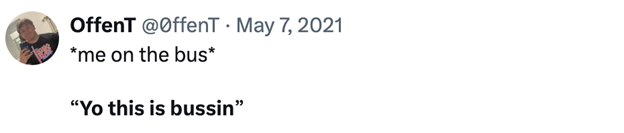
Our analysis revealed a discernible trend wherein white Twitter users demonstrate a propensity to adopt and replicate the linguistic style characteristic of Black Drag Queen Twitter users. Analyzing Tweets by white, middle-class men and Black Drag Queens helped us understand the misuses of AAVE efficiently. A white man used the words “Yo this is bussin” in a tweet and a famous phrase that originates in African communities non-individuals from communities using AAVE is cultural appropriation. Linguistic analysis allows us to understand when words are being used as cultural appropriation.

Discussion

While Black Drag Queens employ AAVE as an intrinsic component of their everyday discourse, white users often utilize it as a means to cultivate an alternative dimension of their identity primarily manifesting within the online realm of Twitter. Examples such as the use of “ass” as a postpositive particle and the alteration of “with” to “wit” exemplify this linguistic appropriation.

Bob the Drag Queen Teaches You Drag Slang | Vanity Fair

Our findings contribute to a deeper understanding of the complex interplay between language, identity, and culture in digital spaces. By uncovering patterns of linguistic appropriation, we shed light on the motivations behind the adoption of AAVE by non-Black individuals and its implications for cultural dynamics. This research underscores the need for individuals to be mindful of the impact of their language on marginalized communities and to respect cultural heritage and contributions. Furthermore, it highlights the importance of recognizing and honoring the origins of linguistic expressions while promoting inclusive and respectful communication practices.

This study draws inspiration from literature in linguistic anthropology, which emphasizes the role of language in shaping cultural dynamics and identity formation. Scholars have long discussed the appropriation and misuse of AAVE by non-Black individuals, highlighting its perpetuation of harmful stereotypes and inequalities. According to the UMASS research group, led by Tessa Masis, “Our results show that, contrary to sociolinguistic myths of uniformity, there is clear variation in AAE across both geographic and social dimensions (Masis 2023).”

 By building upon this literature, our research offers a nuanced analysis of linguistic appropriation on Twitter, providing insights into the motivations and implications of language use in digital environments. In the ever-evolving landscape of digital communication, the exploration of slang on Twitter serves as a window into the complexities of language, identity, and culture. Through our research, we invite readers to delve deeper into the nuances of linguistic appropriation, fostering a deeper understanding of the power dynamics at play in online discourse. As we navigate the digital labyrinth of Twitter, let us remain vigilant in our pursuit of inclusive and respectful communication practices, honoring the rich tapestry of linguistic diversity that defines our digital landscape.

 Conclusion

In the dynamic world of digital communication, where language shapes identities and cultures, our study serves as a springboard for future research endeavors exploring linguistic appropriation and digital discourse. Our research methodology lays a sturdy groundwork for data collection and analysis. By integrating the identification of key accounts with the exploration of relevant hashtags and trends, researchers can cast a wide net to gather a diverse dataset reflecting various linguistic communities on Twitter.  Our focus on analyzing linguistic elements such as phonetics, word choice, syntax, semantics, and pragmatics offers researchers a multifaceted lens through which to examine patterns of linguistic appropriation. Potential analysis tools such as the BERT machine learning tool, used by the UMASS research group in order to narrow down research methods.  These methods provide a more efficient way of analyzing tweets in specific, due to there being hundreds of millions of tweets throughout the history of the social media app. “Many feature-based studies of large corpora use keyword searches or regular expressions to detect features; however, keyword searches are limited by orthographic variation in tweets and regular expressions cannot be made for all features. To circumvent these obstacles, we use the BERT-based machine learning method used in Masis et al” (Masis, 2023).

 By employing similar analytical techniques, researchers can uncover subtle nuances in language use and identity formation within digital environments. This approach fosters a deeper understanding of the intricate interplay between language, culture, and identity in online spaces. Researchers can expand on this theme by exploring the implications of linguistic appropriation for marginalized communities and investigating strategies for promoting respectful and equitable language use in online spaces.

References

Ilbury, C. (2019). “Sassy Queens”: Stylistic orthographic variation in Twitter and the enregisterment of AAVE. Journal of Sociolinguistics. 24. 10.1111/josl.12366.

Magazine, Smithsonian. “The First Self-Proclaimed Drag Queen Was a Formerly Enslaved Man.” Smithsonian.Com, Smithsonian Institution, 9 June 2023, www.smithsonianmag.com/history/the-first-self-proclaimed-drag-queen-was-a-formerly-enslaved-man-180982311/.

Masis, Tessa; Eggleston, Chloe; Green, Lisa J.; Jones, Taylor; Armstrong, Meghan; and O’Connor, Brendan (2023) “Investigating Morphosyntactic Variation in African American English on Twitter,” Proceedings of the Society for Computation in Linguistics: Vol. 6, Article 41.DOI: https://doi.org/10.7275/zdg0-0914

[/expander_maker]

, , , , ,

The Role of Phatic Expressions in Group Identity

“How are you today?” Wait- Before you answer this, consider that this innocuous question in fact is compelling you to respond in a certain way. This phatic expression is a social tool aimed at maintaining communication channels. But these expressions also contain packets of information intended to guide the recipient’s behavior. This project aims to recognize the significance of phatic expressions in communication dynamics and how they intertwine with identity development. Our study will aim to go deep into the intricate relationship between language similarities and identity formation within the context of a vibrant Latina community. We will focus on undergraduate Latina students affiliated with UCLA’s Hermanas Unidas organization. We also gathered data on how people in the Latina community often used slang to communicate with their peers. The use of slang made their communication more personal and easier. We examined informal speech and phatic expressions in English-Spanish dialogue within the Latina community. By observing the way they spoke their language and communicated with slang, we gathered that language truly shapes relationships and reveals the complex layers of language, identity, and communication dynamics. This study will allow us to observe how language forms relationships and unravel the various layers of language, identity, and communication.

[expander_maker id=”1″ more=”Read more” less=”Read less”]

Introduction & Background

Within Jakobson’s six language functions, the emotive and conative functions are specifically those which convey information about the speaker and recipient. The latter function is generally considered to contain imperatives in the form of information about the recipient. However, certain other language functions also index facets of the identities of participants in this way or feature similar containerization. Among these are phatic expressions, those which are concerned primarily with the communication channel (Žegarac and Clark, 2024).

A commonly recognized form of phatic expression is a greeting such as, “How was your day?” Chances are, the questioner would find it frustrating if they were met with every detail of the respondent’s day. So, by asking “How are you?” The questioner is compelling the listener to respond only in a certain way. Therefore, this expression might be considered to have an imperative component. That’s not necessarily a bad thing– it provides the recipient with a quick and easy path to the locus of the conversation. But this additional capability for encoding the intentions and attitudes of the speaker can obviously be exploited for certain ends. Therefore, we were curious about whether or not phatic expressions are actually used by speakers to transmit information this way. We at first wondered about the exclusionary purposes of these expressions; for example, in the aforementioned example, the speaker is attempting to exclude a certain unwanted response. We realized that this exclusionary purpose may serve to delineate inter-group and intra-group identities. Therefore, we also asked to what extent phatic expressions index group identities in general. In fact, could phatic expressions also help to establish and maintain notions of identity by these mechanisms?

Methods

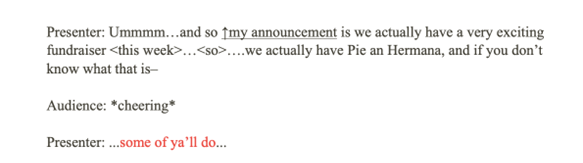
Figure 1: An instance of a phatic expression that indexes shared group knowledge

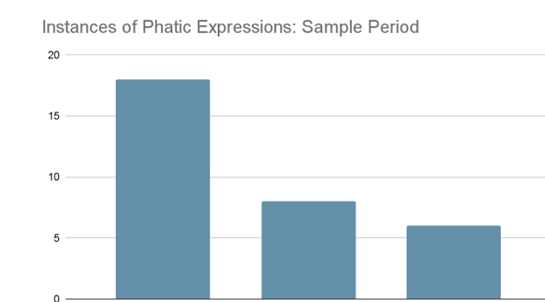
Figure 2: Use of phatic expressions during a representative 3-minute sample of presentations at a Hermanas Unidas club meeting. Instances featuring implicit imperative components, as well as instances that index specific aspects of the shared club and/or linguistic identity are indicated

Our research was conducted on two meetings for the club Hermanas Unidas de UCLA, the first being a general body meeting where group members welcome both past members and new members to meet on a weekly basis to discuss different topics and act as a debrief circle, and the second meeting being an event where past members,  also open to new members as well, meet to complete activities and talk in a more intimate space in comparison to the general body meeting. The general body meeting consisted of around 30 members, while the second event only had about 15. In both settings, members were prompted to both speak in the large setting to the entire group, and were also split into smaller groups. In these settings, we were able to analyze the communication between the members and how it shifted when there either was use of phatic expressions, or was not. This club primarily consists of Latina undergraduate members, so we were able to observe the use of phatic expressions in both Spanish and English, as well as both languages used together. When members spoke in the larger settings during the general body meetings, it was noted that the main speaker was often using words such as “y’all” and “um”, which made the speaker sound more natural when addressing the crowd, as well as the crowd being more engaging.

For this reason, we decided to analyze the presentation section of the general body meeting in order to establish a reliable baseline of phatic expression use relative to our specific areas of interest. We isolated a 3-minute segment of audio in which there were multiple presenters who would generally introduce themselves and their announcements, allowing for significant use of phatic expressions during the analyzed time period. The results are indicated in Figure 2: a significant fraction of the phatic expressions observed contain the imperative elements, index aspects of group identity, or both. During the second meeting, where members were split into groups of about 4-5 and were prompted with more personal questions. While the members were tasked to complete the activity they were given and answer these ice breaker kinds of questions, there was an instant switch in how communication was being made. We were able to hear phrases such as “I could’ve easily done Superman bro”, the word “like” and “literally”, “aw hell nah bruh” and using Spanish words when communicating (Araceli, 2010). The use of phatic expressions here also caused a more natural flow of conversation, more engaging body movement, and overall more emotion, such as laughing and smiling.      

Results and Analysis

Upon thorough analysis of our data, particularly within a 3-minute segment of the general body meeting where a club member addressed the audience with an announcement, we observed the utilization patterns of “um” and “y’all.” The incorporation of phatic expressions notably enhanced the crowd’s engagement, leading to cheers from the rest of the club members. During this significant moment, the speaker effectively conveyed information that resonated with each audience member, fostering a collective connection. The evident impact of the speaker’s language in captivating the crowd underscores the influential role of phatic expressions in communication. Moreover, we encountered similar findings in the second dataset collected during a smaller meeting. Despite the smaller group dynamics, participants’ use of phatic expressions facilitated deeper engagement among individuals, rendering conversations more meaningful. This highlights the universal efficacy of phatic expressions in fostering interpersonal connections, irrespective of the setting or audience size.

Discussion and Conclusions

In relation to language, culture, and the course content overall, analyzing the use of phatic expressions through an anthropological lens provided us with a nuanced perspective of the use of phatic expressions within interpersonal communication and interethnic encounters. Examining the usage of language functions among Latina students on campus offered us insights into their communication dynamics and social comfort levels in these settings. This also uncovered unique communication patterns and preferences and provided an intimate look into the interplay between language and social interaction. In the overall aim of our project, we planned to identify specific language functions as they appeared in conversation, specifically at the Hermanas Unidas club meetings, and analyze how expressions that serve specific functions are used to accommodate differing identities (including linguistic and club identity). One of our research questions we want to answer is “In which cases do phatic expressions serve an exclusionary purpose?”, and we identified that _these uses of exclusionary language with words like ‘bruh’, ‘like’, or ‘literally’ did not serve an intentional purpose but rather a means of reinforcing cohesion and camaraderie amongst the group of students in the campus-organization Hermanas Unidas. Additionally, we captured how these interactions and use of expressions help to shape these students’ cultural identity in various sociocultural environments whether on campus or elsewhere.

References

De Katzew, L. (2004). Interlingualism: T]he language of Chicanos/as.

Nordquist, R. (2019, March 11). Making small talk: Phatic Communication. ThoughtCo. https://www.thoughtco.com/phatic-communication-1691619

Osorio, Araceli, “The role of Spanglish in the social and academic lives of second generation Latino students: students’ and parents’ perspectives” (2010). Doctoral Dissertations. 366. https://repository.usfca.edu/diss/366

Otto Santa Ana, A. (1993). Chicano English and the nature of the Chicano language setting. Hispanic Journal of Behavioral Sciences, 15, 3-3.

Vlad Žegarac, and Billy Clark. “Phatic Interpretations and Phatic Communication.” Journal of Linguistics, vol. 35, no. 2, 1999, pp. 321–46. JSTOR, http://www.jstor.org/stable/4176528. Accessed 1 Feb. 2024

, , ,

No Güey, Spanish Social Media is a Language Unto Itself

Social media is the vehicle that carries much of our communication and culture across the internet nowadays. Unquestionably, its relevance to today’s society is irrefutable and its ability to be used across multiple languages is something to be studied. The focus of this article looks into whether social media influences Spanish speakers in their everyday use of Spanish like how popular trends across English social media does. This study observed popular trends in Spanish social media and slang often included in posts across popular platforms like Facebook, YouTube, Twitter (X), and Instagram. Then, surveyed UCLA students and high school students discussed their use of social media and whether they use slang learned from social media in their everyday interactions. Respondents showed that while the slang and language they pick up does match what is often seen in social media, they instead stated that they primarily picked up new words from people they talk to often, like friends and family, not social media. Our findings suggest that while social media is a strongly influential phenomenon on individuals, for the Spanish speaker it is more so a reflection of changes in their language rather than being the influencer.

[expander_maker id=”1″ more=”Read more” less=”Read less”]

Introduction and Background

Our research examined the dynamic interactions that occur between Spanish-speaking people and the constantly changing social media environment. Our main goal was to investigate the complex linguistic trends and shifts in Spanish that are made possible by Internet communication. We aimed to investigate how Spanish-speaking users’ word choices and phrases have changed as a result of digital communication platforms by closely examining the impact of social media culture on language use.

Social media platforms are vibrant centers of language exchange in today’s digitally connected world, where users participate in a variety of communication activities, from chats to formal discourse. Our goal in conducting this research was to clarify how this digital world has affected the development of Spanish language usage. Determining if linguistic patterns seen in online encounters result in changes to people’s face-to-face conversational styles was one of the main goals of our research.

The various ways that social media culture affects language use in Spanish-speaking populations are clarified by our findings. As people crossed the digital environment using a combination of traditional language rules and modern terms, we saw fascinating patterns of language creation and adaptation. Additionally, our research demonstrated the close connection between language use in online contexts and physical communication styles, emphasizing the interdependence of virtual and real-world interactions.

Recognizing the subtle aspects of language change on social media platforms is essential for understanding bigger societal transformations and cultural dynamics in today’s digital world. Our research sheds light on the constantly changing nature of language and communication in modern society by exploring the linguistic changes caused by online engagement.

Methods

Our research project embarked on an in-depth exploration, delving into the dynamic evolution of the Spanish language facilitated by the pervasive influence of social media platforms. Targeting Spanish-speaking users, particularly high school and college students, our study aimed to comprehensively understand linguistic trends and shifts induced by internet culture. Specifically, we sought to discern whether users’ word choice on social media platforms diverged from their conversational language usage. Our methodology encompassed two primary approaches: social media analysis and surveys conducted among high school and college-aged Spanish speakers.

To dissect linguistic patterns prevalent on social media, we undertook a meticulous examination of word choice employed by Spanish-speaking users across platforms such as TikTok, X, and Instagram. This process involved deploying conversational analysis techniques to scrutinize the content and language structure evident in user-generated posts, comments, and interactions. Through this methodological approach, our aim was to unearth prevailing trends in language use, encompassing the prevalence of slang and informal speech styles within these digital spaces. Simultaneously, we administered surveys to high school and college students who self-identified as Spanish speakers. These surveys were thoughtfully designed to ascertain the vocabulary and language preferences of students in their online interactions. By comparing the linguistic behaviors observed on social media with those reported in the surveys, we sought to elucidate any disparities or consistencies across different communication mediums. Furthermore, qualitative interviews conducted with a subset of participants provided additional insights into how social media platforms influence language use among Spanish-speaking youth, thereby shedding light on potential shifts towards either more informal or formal speech patterns.

Overall, our research endeavors were dedicated to unraveling the intricate relationship between social media culture and language evolution within the Spanish-speaking community, with a particular focus on high school students as a pivotal demographic in this evolving digital landscape.

Results and Analysis

Our observational data showed that Spanish-speaking online users, such as influencers from top-liked posts, frequently used slang or informal words in Spanish when recording a video. The most common words throughout the posts were the following: “no mames” (no way), “bichota” (a female drug lord or female empowerment), and “de veras” (really). For example, this line with “no mames” from a YouTube video with over a million views, has become a voiceover used by other influencers across social media platforms.

However, only 8 out of 22 participants from our survey data reported learning about “no mames” and “deveras” from social media, while more than half explained learning these and other Spanish words from their family and friends. No one reported learning about “bichota” and 3 participants reported learning about abbreviations, such as “que,” “porque,” and “te quiero mucho” from social media, which contrasted from our observational data.

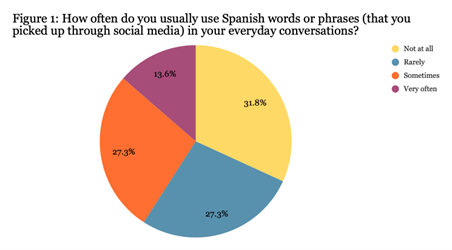
Additionally, Figure 1 shows that about 60 % of participants reported “not at all” or “rarely” using Spanish words learned through social media compared to the 40 % who “sometimes” or “very often” use these Spanish words in everyday conversation.

Figure 1: Participants’ frequency of Spanish words or phrases (picked up through social media) in everyday conversations

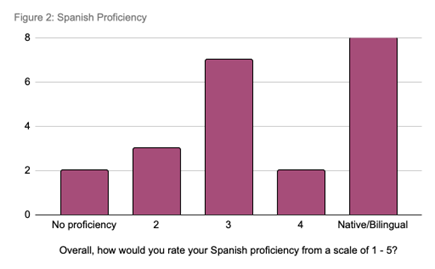
Figure 2 illustrates the Spanish language proficiency of the participants to confirm that they were from Spanish-speaking communities when making our analysis. 

Figure 2: Survey participants’ self-evaluated Spanish proficiency

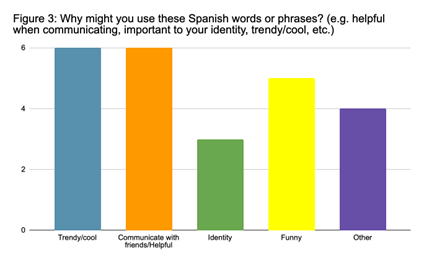
Figure 3 summarizes the participants’ reasoning for using Spanish words from social media as “trendy/cool,” “funny,” and helpful when communicating with other Spanish speakers.

Figure 3: Reasons participants use Spanish words from social media

So, while an individual can use slang in social media and in everyday conversation, they will actively choose based on who they are talking to, which may not match what they encounter or see on social media.

Discussion and Conclusions

Our research ventured into the vibrant intersection of social media and the Spanish language, revealing intriguing insights about linguistic evolution in digital spaces. Despite the prevalent use of slang and informal expressions by Spanish-speaking influencers on platforms like TikTok, X, and Instagram, our findings suggest a nuanced relationship between online language trends and everyday speech. Contrary to our initial hypothesis, the majority of surveyed Spanish speakers did not attribute their linguistic repertoire to social media influences. Instead, personal interactions with friends and family emerged as the primary sources for acquiring new slang and expressions. This indicates a significant degree of linguistic autonomy among Spanish speakers, who navigate between the informal lexicon of digital spaces and the colloquial language of real-life conversations.

While social media undoubtedly shapes contemporary discourse, its role in directly influencing everyday Spanish language use appears limited. Our participants demonstrated a discerning approach to language adoption, selectively integrating social media slang into their conversations based on context and audience. This selective assimilation underscores the adaptive nature of language use, where individuals tailor their speech to suit specific social settings and relationships.

Our study sheds light on the complex dynamics of language evolution among Spanish speakers in the age of social media. While digital platforms offer a rich tapestry of linguistic innovation, the essence of language change remains deeply rooted in human interaction and social networks. Social media, therefore, serves more as a mirror reflecting ongoing linguistic shifts rather than the primary catalyst for change.

References

Alim, H. S. (2005). Hearing What’s Not Said and Missing What Is: Black Language in White Public Space

Cycyk, L. M., & De Anda, S. (2021). Media exposure and language experience: Examining associations from home observations in Mexican immigrant families in the US. Infant Behavior & Development, 63, 101554. https://doi.org/10.1016/j.infbeh.2021.101554

Gonçalves, B., & Sánchez, D. (2016). Learning about Spanish dialects through Twitter. Revista Internacional de Lingüística Iberoamericana, 14(2 (28)), 65–75. http://www.jstor.org/stable/26379776

Gottfried, J. (2024, January 31). Americans’ Social Media Use. Pew Research Center: Internet, Science & Tech. https://www.pewresearch.org/internet/2024/01/31/americans-social-media-use/

Kircher, Ruth, and Ethan Kutlu. “Multilingual Realities, Monolingual Ideologies: Social Media Representations of Spanish as a Heritage Language in the United States.” Applied Linguistics, vol. 44, no. 6, Jan. 2023, pp. 1077–99. https://doi.org/10.1093/applin/amac076.

Li, C., & Liu, J. (2017). Effects of using social networking sites in different languages: Does Spanish or English make a difference? Computers in Human Behavior, 74, 257–264. https://doi.org/10.1016/j.chb.2017.04.031

Majors, A. L. (2017) Social Media and Discourse: A Comparative Study of English and Spanish Apologies. LSU Master’s Theses. 4425.

Ramirez, N. J., Hippe, D. S., & Lindekugel, K. (2022). Electronic media and social features of language input in bilingually-raised Latinx infants. Infant Behavior and Development, 68, 101740, ISSN 0163-6383. https://doi.org/10.1016/j.infbeh.2022.101740.

[/expander_maker]

, ,

Going Greek?

Jasmin Lopez, Samantha Solowitz, Max Orroth, Esther Lin, anonymous author

Collegiate Greek life has been around for centuries, fraternities first being established in 1775 followed by sororities in 1851, giving both men and women the opportunity to become a member of an exclusive association promising brotherhood and sisterhood to all who join. The mysterious and vague identity of these fraternities and sororities became a tradition, with members specifically using terms and/or slang that make sense only to those involved. The purpose of our blog is to recognize the meaning behind Greek life slang, and how this particular lexicon represents a departure from formal language. We delve into the nuances of Greek life, from its rich history and recruitment process to understanding its cultural shift in linguistic trends and social dynamics. Through the use of online videos and fieldwork, we explored how Greek life slang terms develop a strong sense of social acquisition for those directly involved while simultaneously maintaining a form of mystery for those who are not.

[expander_maker id=”1″ more=”Read more” less=”Read less”]

Background

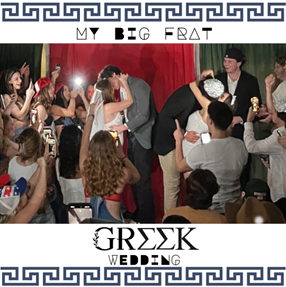
Pictured: A faux wedding, strangers kissing, the crowd going crazy. Credit: Max Orroth

As I (Max) walked into the Phi Kappa Psi house on a Tuesday night for a frat wedding (a faux wedding, two fraternities/sororities come together to host their chosen couple), a brother greeted me: “Hey welcome bro, tonights gonna be so ferda.” I didn’t understand what he meant by this at all, specifically ferda,  and when I asked what the word meant I never got a straight answer. It was clear at this moment, to me and the brothers of Phi Psi, that I was an outsider. I did not understand their secret slang, and for the rest of the night, I felt like a toddler asking what words everyone seemed to know meant.

The example above showcases an ingroup outgroup dynamic. Through this experience, we sought to understand the slang evoked in the Greek life college setting, towards a cultural shift in linguistic and social status. Through the use of online videos and fieldwork, we explored how Greek life slang acquisition is used to communicate valuable insight into fraternities and sororities. This project draws on two main questions; How does Greek slang separate members of Greek life from the broader collegiate community? And, How do Greek organizations undergo a socialization process through linguistic genres?

Introduction to Greek Life

The origins of Greek culture can be identified in the late 18th century when the initial Greek-letter societies were founded (Harding, 1972). Greek life is a conduit for lifelong friendships, countless parties to attend, and the opportunity to live in a mansion with 20-50 peers (Jones, 1976). However, the daily lives of some “brothers” and “sisters” are widely known to be exclusionary, insular, and with roots in the secretive masonic lodges (Dymchuk, 2020). The groups are segmented into fraternities for men and sororities for women. Like most groups, Greek life holds its own set of slang terms, and priori language is only understood within the community. Slang is not an official language, but is characterized by familiar coloring (Izmaylova et al., 2017). Familiar coloring refers to certain words being associated with a specific group, used to linguistically signal identity and ingroup status. More specific to the linguistic environment we studied, college slang amongst undergraduates pulls from both broad lexicons as well as university and context-specific slang (Hummon, 1994). We hypothesize that at its core, greek life slang represents a departure from formal language, often characterized by its genre. This departure of informality is developed through sociocultural language acquisition (Ochs & Schieffelin, 1984). The social functions of slang are manifold. Firstly, it serves as a marker of group identity, fostering a sense of camaraderie among those who share a common slang lexicon (Bucholtz, 2012). The slang lexicons used by sorority members and fraternities alike use phrases, symbols, and handshakes only known to collegiate Greek members, differing from the common use of slang found by nonmembers.

Ready to embark on a Greek life journey?

We were not! This is why our methods are participant observation and visual anthropology. We examined how the words and phrases are used in context and how they deviate from mainstream slang through visual anthropology (Abasi & Taylor, 2007).

Methods

For our methods, we used TikTok and YouTube videos; which involve heavy use of acronyms, Greek letter symbols, and code language. 

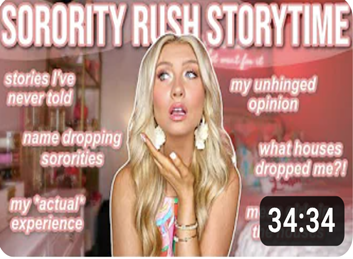
Picture is Lauren Norris via YouTube, 2023

Some popular accounts on TikTok were @makeupbymckenna and @emmaortiz24.

@makeupbymckenna’s TikTok videos titled “GRWM” (get ready with me) displayed a full day of the “Last rush week ever.” While @emmaortiz24 showcases a “GRWM” with Penn State recruitment trips. “Day in the Life” were mostly made by women in sororities representing “PNM”, “PIE PIE”, “DLAM”, “Olemiss”, etc. In the introduction to one of the TikTok videos, a girl is doing her makeup to get ready for sorority recruitment as a “TriDelt” and talking about the amount of “PNMs” that are going to be at their “house.” She advises those who will be participating in the recruitment process to make intentional relationships with other “PNMs” from their “pledge class” or “active number.” In a similar video, a girl advises her audience to let their “Pie Pie” know if they are going to be late to an event.

The YouTube videos we looked at were videos about “rushing” which is the recruitment process for joining a sorority. The picture above is Lauren Norris, talking extensively about her experience of being “dropped” from sorority Pi Beta Phi. This was a contrast from the TikTok videos which seem to be an audience for sisters “in” the sorority. Whereas, Lauren talks about her experience of being “out” of the organization.

Although the videos were meant to be informative, the slang used in the videos made it difficult to understand the symbolic meaning of words such as rush, dropped, sisters, and acronyms. Our research results in a complex web of terminology that defines, unites, and separates members of Greek life from the broader collegiate community.

Results

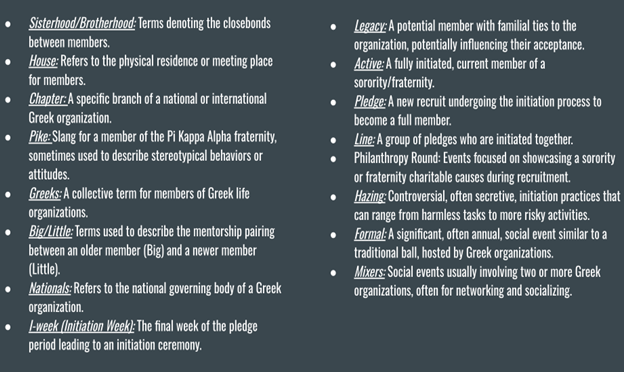
Here is a compiled list of the common slang terms used in Greek culture:

Additional Resource: Greek Life Glossary – Montclair University

Analysis

New members of Greek organizations seem to undergo a rapid socialization process to become competent members of their respective communities. In videos such as “GRMW(Get Ready with me)” or “Day in the life,” the general public may recognize the language used within the videos but certain keywords would not be understood unless one had previous knowledge of them. These videos demonstrate that a majority of the slang used are English words or acronyms that may seem out of context to those unfamiliar with Greek life and possibly even completely change their meaning (Nardyuzhev et al, 2017), solidifying the barrier between those within the community and those outside it. Our analysis of Greek life slang reveals a rich and complex language system that serves multiple functions: it cements the bonds between members, upholds traditions, and sets the community apart from the broader campus, and society.

Conclusion

Throughout this study, we analyzed Greek life culture through their unique sociolinguistic and cultural acquisition. This research has provided a comprehensive exploration of the multifaceted dynamics within Greek life, encompassing indexical slang, language social acquisition, online communities, and symbolic vocabulary. Through an interdisciplinary approach, the group was able to integrate sociolinguistics, visual anthropology, and analysis, to uncover the intricate interplay between language, identity, and rituals within Greek organizations. Through research into archetypes and codes that generate sense, our findings determine that symbols did not hold the ultimate meaning, but rather offered a vast array of interpretation possibilities; they served as a gnoseological key, a means of self-learning and learning about “philosophical knowledge,” and a medium for the development of the adept’s gnoseological qualities. To an outgroup member, this translates into a form of social acquisition during the initiation process, a crest or secret message is revealed as a rite of passage, only to be mentioned among the membership for exclusive purposes. Greek organizations separate ideology from each other by ascribing symbolic meaning to their group organization. Hence the various phrases, symbols, and handshakes are showcased in varied TikToks, YouTube, and the Greek wedding ritual. This socialization process is enacted by active members, who are assigned the task of formal recruitment. This process entails acts of initiation that signal the acquisition of the group’s values, pledges, and ultimately the group’s acceptance.

References

Bucholtz, M. (2012). Word Up: Social Meanings of Slang in California Youth Culture. eScholarship, University of California.

Dymchuk, A. (2020). Masonic symbolism in the context of philosophical anthropology searches. Skhid, 1(165), 60–66. https://doi.org/10.21847/1728-9343.2020.1(165).197068

Harding, Thomas S. (1972), College Literary Societies: Their Contribution to Higher Education in the United States, 1815–1876, New York, New York: privately published

Hummon, D. M. (1994). College Slang Revisited: Language, Culture, and Undergraduate Life. The Journal of Higher Education, 65(1), 75–98. https://doi.org/10.2307/2943878doi.org/10.2307/2943878

Izmaylova, G.R., Zamaletdinova, G.R., & Zholshayeva, M.S. (2017). Linguistic and social features of slang. International Journal of Scientific Study, 5(6), 75-78.

Jones, B. M. (1976). The American fraternity. In Paper presented at the meeting of the National Interfraternity Conference, Williamsburg, VA.

Ochs, E., & Schieffelin, B. B. (1984). Language acquisition and socialization: Three developmental stories and their implications. In R. A. Shweder & R.A. LeVine (Eds.), Culture Theory: Essays on Mind, Self, and Emotion. CUP, pp. 276-320.

Nardyuzhev, V. I., Nardyuzhev, I. V., Marfina, V. E., & Kurinin, I. N. (2017). AMERICAN SLANG: DIACHRONIC ANALYSIS. RUDN Journal Of Informatization In Education, 14(4), 399-405. doi: 10.22363/2312-8631-2017-14-4-399-405

[/expander_maker]

, , , , ,

Do Students Hold Their Professors to a Certain Standard?

Madison Atiabi, Araceli Valladares, Sean Freilich, Antoinette Alfaro, Brandon Elkington

Knowledge production in the global context has enabled an unprecedented ability to share information in the modern age. Because of this, International Universities like UCLA serve as a hotbed for intellectual progress over a backdrop of movements for inclusivity and representation in educational institutions. While recognizing elements of language associated with ethnicity such as accents is a sensitive topic, it is an undeniable element that comes into play when analyzing the perceptions that students hold of their professors. Even though we initially invested in how accents affect academic outcomes, this study has instead developed an understanding of subconscious biases and expectations within the academic setting that demonstrate a contradictory notion of judgment versus inclusivity. While clearly expressed to varying degrees of appreciation for different language practices, the individual word choice illustrates an intent to perform academically that is not only a standard to be upheld by professors, but to an extent to students as well.

[expander_maker id=”1″ more=”Read more” less=”Read less”]

Introduction

The development and ability to share information in the modern world is faster than ever and there has been an emphasis on developing scholarship around the diverse perspectives that come together within the global context. While there are undeniable benefits towards the development of scholarship by including international perspectives, there are a number of challenges that arise when centered around communication between speakers with different linguistic backgrounds. In attempts to understand how students perceive different elements of language, a handful of studies and experiments have been conducted as a means to better understand what incites the most favorable repertoire between students and professors. As “language is an important and necessary medium of communication,” (Kuo 2011) differences in pronunciation, intonation, rhythm, and word choice may lead to miscommunications or misinterpretations of information which can have a devastating impact in an academic setting where clear communication is crucial to success. Since how people speak demonstrates many notions of group belonging, elements of language such as accents tend to elicit stereotypical perceptions that can influence the perceptions of professors as less credible (Alexandra 2015). Considering that a student’s perception of their professors as the ambassadors of the university can have an impact on a student’s learning outcomes (Gill 1994), it is important to understand the various ways that accents and language choices such as the use of slang affect students’ perceptions of their professors. Therefore, the University of California, Los Angeles (UCLA), as an international institute provides a diverse cultural background to deepen our understanding of how accents and slang shape communication dynamics, social interactions, and language attitudes between professors and students.

Methods

When initially proposing this study, we intended to collect a variety of qualitative and quantitative data through a series of interviews, observations, and a survey as means to gather in-depth insights into how language affected the relationship between professors and students. Our original hypotheses centered around the notion that a professor’s accent would be recognized as a challenge in a student’s ability to comprehend the course material and build connections with their professors. However, in the process of developing the proposal, we acknowledged the potential for biases in the responses to our questions considering the academic nature of the project. As such, we conducted five 20-minute interviews with other UCLA students (four undergraduate and one graduate) that we had less formal relationships with hopes of receiving more open and honest responses to our lines of questioning considering the sensitivity of acknowledging a difference in language typically associated with difference in culture. As such, the interview questions focused on concerns regarding accents and the use of slang in the classroom setting and how they affect student’s perceptions of their professors and whether or not they have an expectation of a “standard” language for their professors.

 For consideration, below are the questions that were asked during the interview:

  1. Have you ever had a professor with a strong accent?
  2. How do you feel this has affected your ability to comprehend the course materials? Please elaborate.
  3. How do you feel that this has affected your interactions with your professors?
    1.  How has it affected your sense of community in the classroom?
    2. How has it affected your connectedness to the course materials?
  4. What kind of language use do you expect from your professors in a classroom setting? Do you think there is a “standard” for how professors should speak to their students?
  5. How do you feel when a professor uses slang or a younger language?
    1. How does it affect the relationship with the professor?
    2. Do these language choices affect your sense of immediacy with your professor?
    3. Does the use of slang make your professor seem less credible?
  6. Can you think of any other ways your professors build a sense of community or contribute to your education through their language?
    1. Do any other positive or negative effects of a professor’s language choices come to mind?
    2. Do the ways that your professor chooses to convey certain ideas affect your education?
  7. What changes could professors make in their language choices to improve their interactions with students?

Results and Analysis

Accents and Academics

While our respective interviews yielded varied responses due to the intimate nature of the process, there were a few constants that emerged within them. For instance, as predicted, there was an almost universal recognition that accents contributed to certain challenges within the classroom. In some cases, students revealed they had trouble understanding the course material despite efforts of professors to ensure comprehension; one student, Angel, expressed disinterest with sentiments like “I just want this lecture to end faster,” or “I’ll talk to the TA.” This reveals insight beyond our initial hypothesis; the spirit of inclusivity that is present in universities may directly contribute to the disconnect between students and professors to a degree that impacts a student’s willingness to engage with a course. Similarly, despite appreciating the beauty of different cultures coming together, Evan noted in his interview that “it was awkward and a little embarrassing to have to keep asking the same question because their strong accent made it hard for me to understand what they were saying.” Consequently, in response, it was common for students to seek more time with their TA as a solution to address issues with comprehension in lectures.

Slang Use

On the other hand, in discussions about slang use and “standard” language practices of professors, there was a surface-level appreciation for professors’ attempts to connect through slang-use and a general positive reaction. However, what a few of our interviewees argued to be more important was the use of genuine language as opposed to language that caters to a professor’s perception of what students may want to hear. Similar to the study by Martin, Weber, and Burant, the students we interviewed appeared to be able to recognize the subtleties of slang use and distinguish them from the subtexts of their uses (1997). For example, Jessica expressed that it was “cringy” when professors end up “overdoing it while trying to be relatable” because it comes off as inauthentic and pandering. Nonetheless, our interviewees expressed a general support for the use of slang words and “younger” language in the classroom. But in doing so, the words that they used represented a potentially larger concern surrounding language use in academic settings.

Unconscious Biases

When asked about whether she had any expectations for a “standard” language from her professors, Anna responded, “I don’t think slang would come in the way of teaching. Professionalism could be… um… what I’m trying to say is I don’t think language really affects the way the material is taught, and I don’t think slang should be penalized or looked down upon in the classroom setting.” While her response initially shows an understanding and support for less restrictions on language, the expression of the contrary as professionalism followed by a subtle retraction indicates a subconscious level of decorum that is to be expected from professors and the university as a whole. While our interviews only represent a minute sample of students at UCLA, the results indicate a wide range of responses that demonstrate similar notions of underlying pressures to maintain certain values.

Figure 1: Common and uncommon words found throughout the five interviews

Discussion and Conclusions

Our study and its findings contribute valuable insight into our understanding of students’ perceptions and expectations of their professors within academic settings. By investigating whether students hold their professors to a certain standard and coupling our empirical findings with existing literature, our study allows for researchers to formulate testable predictions or hypotheses on the nature of student-professor relationships in the future.

Our findings not only revealed diversity in linguistic and academic standards amongst students, but also suggested a potential for underlying biases inherent within academic settings. Our research highlights the extensive influence of academic norms and expectations on linguistic practices, suggesting an unconscious pressure on both students and professors to conform to behaviors typically perceived as “professional.” Such findings emphasize the importance of working towards building inclusive learning environments that embrace linguistic diversity while also encouraging authenticity and cultural sensitivity.

This study ultimately enhances our understanding of the complex interplay between language and identity within the academic realm, inviting future discourse and exploration that would enhance student-professor relationships. By acknowledging the dynamic experiences uncovered through our research, students, professors, and institutions alike can begin to strive for an educational environment that yields successful outcomes for individuals from diverse backgrounds.

References

Gill, M. M. (1994). Accent and stereotypes: Their effect on perceptions of teachers and lecture comprehension. Journal of Applied Communication Research, 22(4), 348–361. https://doi.org/10.1080/00909889409365409

Kozlowski, Alexandra (2015). The Influence of Accents on Social Perception. Inkblot, 12-16.

Kuo, Ya-Hui. (2011). Language Challenges Faced by International Graduate Students in the United States. Journal of International Students. 1(2). ISSN: 2162-3104.

Martin, M. M., Weber, K., & Burant, P. A. (1997). Students’ Perceptions of a Teacher’s Use of Slang and Verbal Aggressiveness in a Lecture: An Experiment.

Orelus, P. W. (2020). Other People’s English Accents Matter: Challenging Standard English Accent Hegemony https://files.eric.ed.gov/fulltext/EJ1246799.pdf

 [/expander_maker]

, , , ,

Why it’s Really Not You, It’s Them. Hook Up Culture, Explained

Have you ever wondered why participants of hook-up culture have a hard time communicating with one another? Whether it’s differences in intentions or the usage of different communication styles, it’s likely that they’re not on the same page. As a result of our extensive research, this paper will highlight the reality of hook-up culture and the big question that haunts the community: How do participants of hook-up culture communicate differently than the ingrained standards we see within long-term relationships? Our hypothesis specifically focused on the idea that communication within hook-up culture will differ between genders and communication styles, ultimately creating a larger gap between methods of communication in short-term and long-term relationships. With the help of our studies, we were able to identify the use of code-switching through emojis and slang, common communication themes (vernaculars and communicative traits), and overall motivations! Overall, we hope to help many be able to overcome communication barriers within hook-up culture in order to see some healthy change within our social dynamics and communication!

[expander_maker id=”1″ more=”Read more” less=”Read less”]

Introduction and Background

The goal of our paper was to research the intricacies of a prevalent communication topic in our generation: “hook-up culture”. More specifically, we chose to focus on the motivations behind each gender’s experiences or participation in hook-up culture, ultimately allowing us to analyze the different communication patterns exhibited as well. Hook-ups within “hook-up culture” are defined as, “… activities [that] may include a wide range of sexual behaviors, such as kissing, oral sex, and penetrative intercourse …. these encounters often transpire without any promise of, or desire for, a more traditional romantic relationship…” (Garcia/Merriwether, 2012).  With this definition, the rise of hookup culture is then marked by the phenomenon of, “…increasingly normative among adolescents in North America, representing a marked shift in openness and uncommitted sex…” (Garcia/Merriwether, 2012). As a result, our research was conducted on the basis that hook-up culture is prevalent within our society. However, given the constraints of our research project, we had research gaps that prevented us from reaching further conclusions, including the short amount of time we had to conduct our research (given more time we would research a larger group). Another limitation was due to the lack of empirical research on hook-up culture due to the prominence of the topic only flourishing within this past decade.

Our last limitation came as a result of the demographic in which we focused on. Obviously, our demographic was catered to college students, but there may be different results if our demographic was different– so that most definitely should be noted. However, our research, as shown throughout this blog post, will illustrate that our hypothesis is mostly supported by our conducted research. Our research highlights different modes of communication, varying personal intentions, and the popularity of hook-up culture amongst college-aged students.

Methods

Within our method, we looked at different sources of information such as scholarly articles, scholarly speeches (TedTalk), and our own research conducted through the usage of Google Forms. Our scholarly references ranged from communicating commitment in a romantic relationship to communication in the modern hook-up culture, but we made sure to organize an array of valuable sources that would not only prove our hypothesis but also explain our results within our conducted survey. We distributed a survey (through GroupMe chats, Instagram stories, and professors showcasing it at the beginning of class) to our wide demographic of students at UCLA who have knowledge or a basic understanding of hook-up culture, ultimately granting us valuable responses that could help us with our research on how communication differs within hook-up culture through studying gender imbalances/differences in viewpoints and styles. Through our survey, we politely asked our respondents to share their experiences with hook-up culture and answer our specific questions to the best of their abilities. Additionally, there were no incentives and we made sure to inform them that their responses would be anonymous and removable at any point in time. We asked 10 specific questions in connection to our research and our own personal wonderings alongside an entry method for attachments of physical experiences with hook-up culture. Some examples of our questions were: check off boxes of emojis you’ve used when communicating with a prospective partner or how to communicate your intentions to a prospective partner, therefore giving us a deep understanding and a specific answer to the ideas that our research would mention but not specifically answer for us. Within our research, we analyzed communication styles such as emojis or slang, collective gender differences within communication patterns and beliefs, and overall values within personal communication styles and methods such as direct vs. passive communication. For more information on our exact survey, here is a direct link to it: https://forms.gle/cGUqi9sAmSsGQoNX8.   

Results and Analysis

In summary, our hypothesis focused on how romantic communication differs between types of connections/relationships (hook-up partners vs long-term relationships), and how each gender engaged with each category differently. Through our extensive research methods, we found that there were factual differences between male and female ideologies. For example, there were similarities within our target audience such as age, education status, and lifestyles – which played a role in the situations these individuals would imagine and partake in throughout their experiences with or without hook-up culture. Our respondents were 50% male and 50% female, mostly aged at 21 to 23 years old by 87.5%. Now, the differences range from gender perceptions/mindset, communication styles, and personal values/needs.

Our survey questions were able to support our hypothesis. For further context, here are some of the most important pieces of information gained from our studies. When asked about hook-up culture in our generation and if they (respondents) participate in hook-up culture, 87.5% answered yes (Figures 1 and 2). 

Figure 1: Do you believe hook-up culture is prevalent within this generation?

Figure 2: Do you believe you participate in hookup culture?

With most of our respondents knowing about or experiencing hook-up culture, the results of our survey would most definitely help us understand the reality of hookup-culture whether it proved or disproved our hypothesis. Now, our questions became more specific in order to curate a representative sample of patterns within hook-up culture. Furthermore, these two questions below provided the most valuable information within our survey research.

Within our hypothesis, we predicted that there would be a difference between communication styles and methods. So, with our own experience with hook-up culture, and our learnings from Amanda N. Gesselmen’s research article on “Emoji as affective signals for relationship-oriented digital communication”, we were able to create our question about the influence of emojis on romantic communication and how different ones convey different meanings (casual hook-up vs long-term love). As can be seen, a majority of respondents affiliated with emojis were deemed to be used for “sexting” within hook-up culture communication (Figure 3). For further support, on our side, we can see that most of our respondents that used those emojis are also the same individuals who announced their participation in hook-up culture as well. Next, Figure 4 provided us with the different communication styles we noted through romantic communication in general, but we mentally sorted them into different categories that would analyze different perspectives. For example, those who answered that their communication style was direct and dishonest were usually men (remember: one can be directly dishonest– they are not mutually exclusive). On the other hand, those who answered that their communication style was more honest, considerate, and passive were women. Through these results, we were able to see that there IS a difference of communication styles between genders AND relationship/partner status (hook-up vs long-term). Furthermore, we were able to conclude that men’s expectations are more short-term and casual while female expectations are more long-term and exclusive, ultimately impacting their different communication styles that portray most men as direct, dishonest, dominant, selfish, and confident while portraying most women as passive, considerate, committed, and honest.

Figure 3: Emojis used when communicating with a prospective partner

Figure 4: Communication styles of survey respondents

Discussion and Conclusions

As discussed at the beginning of the paper, ‘hook-up culture’ has gained high levels of popularity, and more recently amongst younger generations. With influential communication-based platforms and media, such as TikTok, “…. popular culture is simultaneously representing aspects of actual contemporary sexual behavior and providing sexual scripts for emerging adults…”, which has potentially played a role in why we concluded the results from our research as we did (Garcia / Merriwether, 2012). Our results suggest a few common themes within the communication patterns of ‘hookup culture’. As seen in the data above, our results suggest that there is a correlation between men’s motivations for just wanting to participate in casual sexual intercourse, whereas women want to participate in sexual intercourse more so in the pursuit of a serious partner, thus suggesting genders do in fact have different motivations when participating in hookup culture. Additionally, our results show a form of ‘code-switching’ that occurs when individuals use emojis and slang to communicate within hook-up culture. Furthermore, code-switching is defined as, “…the practice of selecting or altering linguistic elements so as to contextualize talk in interaction…”, which we see has occurred when individuals interchanged emoji’s arbitrary meanings with more sexual notions only in the context of hook-up culture communication (Nilep, 2006).  Additionally, we saw that the most popular ages amongst participants who take part in hookup culture range from 21-23. Given these results, and the inferences we’ve made from our research, our paper concludes that communication with hookup culture has a unique nature to it that involves various tactics in order to achieve that ‘hook-up goal’, and that there are many mechanical and analytical parts involved in the motivations behind hook up culture. However, depending on who you are, it’s highly likely that if you aren’t achieving that dream ‘hook up’ it really isn’t you, it’s them.

References

Ackerman, J. M., Griskevicius, V., & Li, N. P. (2009). Let’s get serious: Communicating commitment in romantic relationships. PsycEXTRA Dataset. https://doi.org/10.1037/e615882011-144

Garcia, J. R., Reiber, C., Massey, S. G., & Merriwether, A. M. (2012). Sexual Hookup Culture: A Review. Review of General Psychology, 16(2), 161–176. https://doi.org/10.1037/a0027911

Gesselman, A. N., Ta, V. P., & Garcia, J. R. (2019). Worth a thousand interpersonal words: Emoji as affective signals for relationship-oriented digital communication. PLOS ONE, 14(8). https://doi.org/10.1371/journal.pone.0221297

Klinger, L. (n.d.). Hookup Culture on College Campuses: Centering College Women, Communication Barriers, and Negative Outcomes. https://doi.org/https://scholarworks.gvsu.edu/csal/vol3/iss2/5/

Lundquist, J. H., & Curington, C. V. (2019). Love me Tinder, love me sweet. Contexts, 18(4), 22–27. https://doi.org/10.1177/1536504219883848

Nilep, C. (2006). “Code Switching” in Sociocultural Linguistics. Colorado Research in Linguistics, 19. https://doi.org/10.25810/hnq4-jv62

Pham, J. M. (2017). Beyond hookup culture: Current trends in the study of college student sex and where to next. Sociology Compass, 11(8). https://doi.org/10.1111/soc4.12499

Tom Tong, S., & Walther, J. B. (2010). Just say ‘‘no thanks’’: Romantic rejection in computer-mediated communication. Journal of Social and Personal Relationships, 28(4), 488–506. https://doi.org/10.1177/0265407510384895

Webb, S. (n.d.). Communication in the Modern Hookup Culture: A Literature Review. https://doi.org/https://commons.lib.jmu.edu/lexia/vol4/iss1/3/

Wood, M. (n.d.). Addressing Context with Hymes’s SPEAKING Model. https://doi.org/https://the-ofla-cardinal.org/2018/01/14/addressing-context-with-hymess-speaking-model/

Appendix

NPR Podcast – Hook-up Culture: The Unspoken Rules of Sex on College Campuses https://www.npr.org/transcripts/552582404

TedTalk – Stripping Down the Hook-up Culture: The Need for Emotional Visibility https://youtu.be/EhzOohyAZjs

 [/expander_maker]

, , , , ,

“Get Ready With Me: Blog Post Edition”: How Influencers Self-Brand on TikTok

Emerson Howard, Kaira Edwards, Kat Balchunas, Kylee Bourbon, Nicole Hernandez

“Ok storytime.” “Get ready with me to go to class.” “Doing my makeup for literally no reason.” We can’t get enough.

Why are “get ready with me” videos so captivating? Are the communicative methods used what contributes to flop or fame…. a like or dislike…a slay or a nay?

In recent years, a new wave of social media “influencing” has emerged. The phenomenon of self-branding, the continuous action of establishing an image or identity of oneself, is most relevant in such an industry. We sought to investigate how influencers’ slang and body language used in “Get Ready With Me (GRWM)” videos conveys or does not convey a sense of perceived authenticity from followers. Our study focuses on three popular lifestyle influencers and their GRWM videos on the platform TikTok. We sought to identify patterns of body language, speech, and audience perception within GRWM videos that allow our subjects to establish and maintain an authentic relationship with their audiences. We hypothesized the intimate and casual nature of GRWM videos allow creators to establish a more personal connection with their audience if accompanied by a positive tone of voice, use of inside slang, as well as high levels of engagement.

[expander_maker id=”1″ more=”Read more” less=”Read less”]

Introduction and Background

TikTok is a rapidly growing social media platform which revolves around the creation and sharing of short, user-generated videos (Montag et. al, 2021). The app launched in 2016 and since then has provided an outlet for social media influencers, who are users that obtain a large following through posts, engagement, and advertising (Abidin, 2015). Our study looks specifically at white, female lifestyle influencers aged 18-30 who are recognized for documenting seemingly inconsequential and mundane elements of everyday life such as putting on makeup, getting dressed, etc. These influencers communicate personal information about themselves to create a sense of intimacy between them and their followers, emphasizing their realness and relatability (Abidin, 2015). Like any other social media influencer, lifestyle influencers create a “brand” for themselves by developing a consistent theme and style for their account through patterns of language, images, and content in order to create a certain expectation for how people should perceive them (Marshall).

To provide a basis for our understanding of how TikTok influencers create a ‘brand’ for themselves, we apply Erving Goffman’s dramaturgical approach to the digital media space to explain how influencers put on a performance through self-branding. Goffman’s dramaturgical theory proposes that everyday interactions are like a play in which humans put on a performance. This phenomenon is often displayed on social media in which influencers curate their posts and profiles to express an idealized presentation of self. Influencers employ impression management by being selective with what to post publicly, in order to preserve the identity they have curated for themselves—their “brand.” We feel that GRWM videos uniquely blur the line between Goffman’s concepts of backstage and frontstage, since these videos are predicated on providing followers with a sense of intimacy, seeing the ‘backstage’ of an influencer’s daily life. These videos commodify intimacy by providing the audience with the impression they are privy to intimate and generally inaccessible aspects of the influencer’s lives—this is what makes lifestyle influencer branding successful (Abidin, 2015).

Methods

For our data, we gathered and analyzed the three most recent “GRWM” videos from February 17th to March 1st, from the selected lifestyle influencers: Alix Earle, Darcy McQueeny, and Mikyla Nogueira, to investigate how they create a persona through language and behavior patterns. We gathered our data via the TikTok social media platform and the data was collected in two separate categories: video content and audience response. To observe video content, we looked at their patterns of communication including their body language, as well as their use of “inside slang.” We then observed audience response by focusing on the top seven comments to investigate whether there was a more positive or negative reception, as well as the number of likes per comment. This allowed us to measure each influencer’s level of audience engagement, level of influencer engagement, and engagement sentiment. We then took into account any differences and similarities that may exist amongst the influencers and how those aspects account for the way they’re perceived.

Screenshots of TikTok comments on influencer Alix Earle’s posts

Results and Analysis

Our research both confirmed and rejected aspects of our hypothesis that GRWM videos allow creators to establish a more personal connection with their audience if accompanied by a positive tone of voice, use of inside slang, as well as high levels of engagement. After measuring the creator response rates within their comment sections, we noticed that Mikayla Nogueira had the highest level of engagement with viewers (see Figure 6).

Figure 6: Number of Responses to Top 7 Comments

She not only responded to comments more frequently than other creators but also in a variety of ways: liking, messaging, and video responding. However, Alix appeared to have more audience engagement (see Figures 3 and 5) of all influencers we investigated despite her not interacting with them as much as Mikayla.

Despite having greater creator engagement, followers (see Figures 1 and 2) and the most positive engagement sentiments (see Figure 4), Mikayla Nogueira received less likes per GRWM video (see Figure 5) and likes on the top 7 comments (see Figure 3) per GRWM video (236.4k / 1,506), than Alix Earle (400.9k / 3,996). Darcy McQueeny received the least likes per video and comments (61.8k / 227).

Figure 1: Follower Count (in Millions)

Figure 2: Total Likes on All Videos (in Millions)

Figure 3: Average Likes on Top 7 Comments (in Thousands)

Figure 4: Connotations of Top 7 Comments on 3 Observed Videos

Figure 5: Average Likes on 3 Observed Videos (in Thousands)

Through our analysis of this data we established that, as opposed to our hypothesis, it is a “laid-back” neutral tone of voice, use of inside slang, and moderate levels of engagement that is most popular within GRWM videos and most effective in garnering audience engagement.

We observed that Alix is a very good storyteller, creating a more laid-back demeanor and anecdotal style of GRWM videos that is more relatable amongst audiences. Mikayla can seem too enthusiastic, as if she is trying too hard to be liked and seen as a positive person (i.e. “Thank you!!! [exuding love face emoji]”); while Alix interacts just like a friend would on Facetime and responds to comments similar to how friends respond to texts; in a more neutral and moderate manner (i.e. “Hahahahah,” “No”). Mikayla expresses herself very openly and her outgoing personality may be a bit overwhelming for some. Additionally, her high level of engagement with her comment section may appear to some as trying too hard. Contrastingly, Alix exudes a more relaxed persona, talking about her friends as if the audience knows them personally, to solidify this ‘friend-like’ relationship, and utilizing slang such as “it’s not giving” throughout various videos and “losers,” which she notes is used by her own friend group, allowing the audience to feel included. We found that Darcy McQueeny utilizes a monotone/unengaging tone of voice and scarcely engages with comments, resulting in her low levels of likes, audience engagement, and negative engagement sentiments.

Discussion and Conclusions

In relevance to class, this course is centered around social communication and how our everyday speech and interactions are revealing of identity and character. We are able to better understand tone in internet gestures the more we partake in them. Additionally, verbal variation, in that influencers are distinguished on TikTok by speech variation. We also suspect that the successful influencers don’t switch from their normal and internet personality. If we had more time, we would be interested in conducting more research about this.

With self-branding on social media having an ever-growing prominence in modern social communication, especially among our age group, we thought this topic was relevant and crucial to study. Now when we navigate our social media presence, we are keener on how the language and the level of formality we use affects those viewing us.

The limitations in our research included the use of interpretive/qualitative data, restricted data (3 videos, 3 creators), and a narrow demographic (young, white, girls).

References

Abidin, C., (2015). Communicative Intimacies: Influencers and Perceived Interconnectedness. Ada: A Journal of Gender, New Media, & Technology, 8, 1-16: http://adanewmedia.org/2015/11/issue8-abidin/

BBC Radio 4. (2015, April 15). Erving Goffman and the Performed Self [Video]. YouTube. https://youtu.be/6Z0XS-QLDWM

Goffman, E. (1959). The Presentation of Self in Everyday Life. New York: Anchor Books.

Hogan, B. (2010). The Presentation of Self in the Age of Social Media: Distinguishing Performances and Exhibitions Online. Bulletin of Science, Technology & Society, 30(6), 377–386. https://doi.org/10.1177/0270467610385893

Jennings, R. (2018). What Is TikTok? The App That Used to Be Musical.ly, Explained. Vox, www.vox.com/culture/2018/12/10/18129126/tiktok-app-musically-meme-cringe.

Marshall, S. (n.d.). An introduction to brand building through social media – learn. Canva. https://www.canva.com/learn/introduction-brand-building-social-media/

Montag, C., Yang, H., & Elhai, J. D. (2021). On the psychology of TikTok use: A first glimpse from empirical findings. Frontiers in Public Health, 9, https://doi.org/10.3389/fpubh.2021.641673

Pulse Advertising. (2021, September 1). What Is an Influencer? | Influencer Marketing Explained [Video]. YouTube. https://youtu.be/JLiKXW82tjE

TikTok Videos

[/expander_maker]

, , , ,

From Slay to On Fleek: Linguistic Features of Millennial and Gen Z Internet Communication

Aileen Dieu, Makenna Kumlue, Nicholas Litt, Jazmine Pineda, Rafael Santos

The social media community is truly that, a community. Groups of people gather based on common interests to share ideas, offer support, and even criticize opposing views, for better or worse. Millennials were the first generation to create an online community, and through that, a whole new array of lingo, trends, and even celebrities arose. Then, Gen Z entered social media and created their online community filled with their interpretations of millennial slang, as well as bringing a whole new batch of slang to the mix. However, the interactions between both groups yield confusion, amusement towards popular trends in either community, and even irritation due to a lack of comprehension of new terms. In our research, we observed the specific tokens and behavior displayed by both groups individually and in interactions with one another across varying social media platforms. We found varied sentence structure, emoji use, and critical attitudes of Millennials towards Gen Z slang. Yet, for the most part, Millennials and Gen Z communities interact fairly effectively across some parts of the internet.

[expander_maker id=”1″ more=”Read more” less=”Read less”]

Background

Digital communication plays a crucial role daily. Regardless of occupation, race, gender, or class, social media is a form of communication with others and provides a place to express opinions to a targeted audience. Social media usage began around 1997 with a website called “Six Degrees” where people could communicate with close contacts. This was popular among the Millennial generation (1981-1996), and the emergence of another application called “MySpace” in 2004 was another big hit (Ortiz-Ospina, 2019). Fast forward a decade later, Generation Z (1997-2012) has evolved to also use multiple social media platforms at once (not as much as Millennials). Recent studies showed that Millennials use 5 to 6 social media platforms at once while Generation Z use around 2 to 3 social media platforms (Vacalares et al., 2023). The advancement of technology along with the comfort of being more expressive in an online setting was appealing to Generation Z, as we see them use more current social media apps than millennials today. As a result, they have created their forms of communication and language styles that are derived from digital trends (Jeresano et al., 2022).

The types of slang used are also motivated by a sense of social conformity. Depending on the app, the social norms differ greatly based on the demographics of users as well as the app’s intended purpose. If anyone were to talk outside the “social norms” of the app, it would lead to negative feedback, loss of followers, and a negative social media presence (Taber et al., 2023). Generation Z also utilizes social media apps for various purposes such as education, shopping, entertainment, and socializing (Mude, 2023). We hope to explore more on the types of linguistic features seen across various apps like TikTok, Instagram, X, and Facebook among Millennials and Generation Z individuals. How would these differences reflect evolving cultural and technological influences?

Methods

Data for this article was acquired through observation and analysis of different word usage on various social media platforms such as TikTok, Instagram, X, and Facebook, based on usage and popularity. Observations were then assigned to team members by platform and instances of slang were captured as screenshots (See Figure 1) and then analyzed by individuals. Instances of slang, word choice, tone, and sentence structure were assigned a rating of Gen Z or Millennial based on prior perception and/or investigation of user age. Perceptions of Gen Z versus Millennial word usage and choice were based on a consensus around Gen Z’s abbreviation usage and knowledge of contemporary media culture (Jeresano et al., 2022), in comparison to the Millennial generation’s lower intelligibility for newer slang (Taber et al., 2023). The team then convened and analyzed for further patterns of linguistic choice and feature. Lack of or inaccurate user information was addressed to the best of our ability.

Figure 1. Sample posts with instances of slang usage.

Results and Analysis

There were some semantic communication barriers between those we identified as Millennials and Generation Z. Both generations demonstrated similar morphological features within their slang, namely, acronyms and euphemisms (Which may be due to the platform’s format, like character limits and censorship). However, the resemblances begin to deviate when examining specific slang words and phrases. Our data exhibits the referential and ironic nature of Generation Z’s coined words and phrases rapidly generated and circulated across each platform. These coined words and phrases, derived from internet culture and AAVE (African American Vernacular English), contain a level of specificity within them that, to use properly, one must know the original to some extent. Accordingly, our collected data suggests that Millennials tend to use outdated or misused slang or are entirely oblivious to the terms.

Therefore, there appears to be frustration and confusion between Millennial and Generation Z interactions, primarily exhibited on the Millennial side. In Generation Z-dominated media, like TikTok, the cross-generational interactions are question-oriented. Our data includes numerous accounts of deemed Millennials seeking meaning and context behind creators’ and commenters’ posts to better understand the jokes and discourse occurring (See Figure 2). However, apps containing older demographics tend to display rejection, ridicule, or misunderstanding of Generation Z’s communication style. Additionally, these apps depict Millennials attempting to increase their engagement and flaunt their relevance through overcompensation, i.e., frequently using slang and emojis. Thus, generating derision from members of Generation Z who come across their content. 

Figure 2. A Millennial TikTok user obtaining an understanding of a popular culture reference from the video content and learning Generation Z coined slang through user-to-user engagement within the comment section.

However, it is essential to note that the gap between generational differences in slang is shortening due to high social media exposure and interactions across generations. With the growing demographics of Generation Z-dominated apps, there tends to be more exposure to viral content from which these terms are derived. Additionally, personal interactions between each generation further the understanding and adoption of coined words and phrases. While our data exhibits the semantic communication barriers between Millennials and Generation Z, we question whether this issue will remain prevalent in the foreseeable future.

Discussion

Our results provide insights into the linguistic differences and communication trends between Millennials and Generation Z individuals in social media. Through observation of various social media platforms such as TikTok, Instagram, X (formerly Twitter), and Facebook, our research highlights distinct linguistic features and communication practices exhibited by each generation.​ Millennials tend to use “outdated” slang words and phrases, while Gen Z incorporates slang derived from abbreviations and references to other viral trends. ​This reflects the evolving cultural and technological influences on language use, with Gen Z being more influenced by internet culture and current trends. The demographics of each social media platform also play a role in the linguistic practices observed, which suggests that the linguistic features seen on these platforms may be influenced by the dominant generation using them. ​

TikTok demonstrates semantic barriers in communication between Millennials and Gen Z. Gen Z individuals on TikTok use coined words and phrases derived from internet culture and AAVE (African American Vernacular English), heavy acronym usage, and euphemisms. On Instagram, Gen Z users use informal slang with abbreviations and unique vocabulary from internet culture. At the same time, Millennials exhibit a more formal writing style with complete sentences, positive affirmations, and subtle humor. ​Both Millennials and Gen Z individuals use X, but there are some differences in their linguistic practices. ​Gen Z shows strong use of irony, informality, and word choice derived from current internet culture and technology. ​Millennials, on the other hand, use outdated terms and references, specific to their periodical upbringing, and have a more formal sentence structure.

Conclusion

In conclusion, the linguistic differences and communication trends observed between Millennials and Generation Z in social media reflect the evolving cultural and technological influences on language use. ​ Each generation exhibits distinct linguistic features and practices, influenced by their respective demographics and exposure to internet culture. ​ The interactions between Millennials and Gen Z online highlight both generational differences and a willingness to engage in a compromised social bubble. ​ Further research in this area can provide a deeper understanding of how language evolves in the digital age and its impact on intergenerational communication.

References

Taber, L., Dominguez, S., & Whittaker, S. (2023). Ignore the Affordances; It’s the Social Norms: How Millennials and Gen-Z Think About Where to Make a Post on Social Media. Proceedings of the ACM on Human-Computer Interaction, 7(CSCW2), 1–26. doi.org/10.1145/3610102

Jeresano, E. M., & Carretero, M. D. (2022). Digital Culture and Social Media Slang of Gen Z. United International Journal for Research & Technology, 3(4), 11-25. 

Vacalares, S. T., Salas, A. F. R., Babac, B. J. S., Cagalawan, A. L., & Calimpong, C. D. (2023, June 11). The Intelligibility of Internet Slangs Between Millennials and Gen Zers: A Comparative Study. International Journal of Science and Research Archive. doi.org/10.30574/ijsra.2023.9.1.0456

Mude, G., & Undale, S. (2023). Social Media Usage: A Comparison Between Generation Y and Generation Z in India. International Journal of E-Business Research, 19(1), 1–20. doi.org/10.4018/ijebr.317889

Ortiz-Ospina, E. (2019) “The Rise of Social Media” Our World In Data ourworldindata.org/rise-of-social-media. [/expander_maker]

, , ,
Scroll to Top