Corona Smith, Fehma Zahid, Tadeh Amirkhanian, and Taleen Amirkhanian
In today’s rapidly changing society, the language we choose to use not only reflects our future aspirations but also has the ability to guide and change them. This study delves into the nuanced interplay between language and gender. Also, it examines how linguistic differences in word choice, tone, and body language shape career aspirations among a wide range of UCLA undergraduate students with diverse backgrounds. Key takeaways from the study indicate that men are indeed more likely to use, ‘stronger,’ language when discussing their futures as compared to their female counterparts. In doing so, the study aims to understand these linguistic patterns to promote an inclusive environment that empowers individuals in pursuing their aspirations – with confidence and determination – regardless of their gender.
Boss or bossy? Assertive or aggressive? These seemingly innocent adjectives are often thrown around the workplace to describe one’s peers and colleagues. However, within the realm of communication, the choice of words carries immense weight, reflecting and perpetuating societal norms and expectations. The dichotomy between being perceived as assertive versus aggressive, or bosslike versus bossy, highlights the distinct linguistic double standards that often characterize interactions between genders.
Catherine Neiner’s “Bossy, Bitchy, Brazen” is a great Ted Talk in which she discusses the way that women are perceived in work environments.
Thus, for our research project, we wanted to delve a little deeper into how men and women think about their careers. Our official research question was: Do college-aged women and men use different word choices and tones when speaking about their future career paths? In order to understand this question, let’s explore some past literature.
In previous studies of speech patterns among men and women, researchers found some evidence that women more often made use of cooperative feedback, supportive interruption, questions, accommodating behaviors, compliments, and hedging (Plug et al. 2021). They also found that, when gender identity was made salient to women in the experiment, these women used more tentative language (Plug et al. 2021).
Not only that, but further research also suggests that gender-based differences in language patterns are very common in the workplace. Kristen M. Getchell and Lauren Skinner Beitelspacher conducted research on language that was used to describe male and female CMOs through a Forbes article published in 2020.
They found that female leaders are often described in highly gendered ways that play up their nurturing or communal skills and downplay their agentic or leadership skills (Getchell & Beitelspacher 2020). Women were more commonly described as, “emotional,” “humanizing,” and “compassionate,” while men were more often described with words like, “powerful,” “confident,” and, “bold” (Getchell & Beitelspacher 2020). Because women are spoken about so differently from men in professional settings, we hypothesized that bringing up their careers would make this gendered difference more salient to female participants, which might cause them to speak about their future in a more traditionally “female” way. We hypothesized that these differences would emerge in our research as women use more fillers, hand gestures, and adjectives emphasizing interpersonal skills as compared to their male counterparts.
Methods
In order to investigate this hypothesis, we conducted semi-structured interviews with sixteen college students at UCLA (eight male and eight female). Our participants were selected using convenience sampling. It is important to note that this sampling method could make our results less generalizable. However, since each group member found participants from their own community at UCLA, we feel that we were still able to get a relatively diverse sample, ranging across many different majors and social backgrounds. Since these interviews were semi-structured, we went in with a set of questions but also allowed participants to talk about what they found interesting or important to them. Our questions related to what our interviewees hope to do after college, how confident they are in that path, why they’ve chosen that route, and more (see appendix for a full list of questions). We recorded the interviews so that we could truly analyze the body language and tone after all of the data was collected.
In order to analyze the interview data, we created a spreadsheet that listed different patterns and elements of speech that we expected to see, such as filler words or hedging. We then counted up each time we saw or heard one of these things in order to see if men or women would differ. We also paid special attention to which verbs and adjectives we heard the most from each group. We then looked at all of this data together and came up with our results.
Results and Discussion
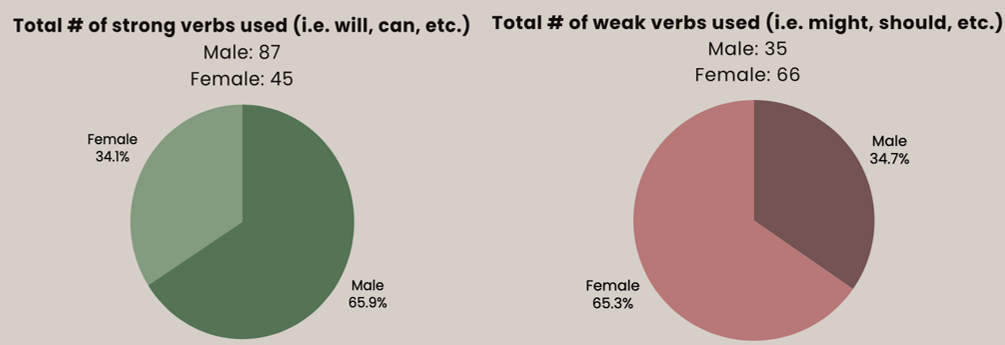
Based on our preliminary research, we hypothesized that college-aged women would speak with less certainty and use fewer words that emphasize power and more words that relate to compassion and emotion. And our findings showed just that. Our research showed that males were almost twice as likely to use ‘assertive’ verbs when speaking about their futures, with almost 66% making statements like: “I will be a doctor in five years”, as compared to only 34% of our female participants. Female participants generally used more modal verbs with approximately 66% of sentences using verbs like might, should, and could (i.e. “I might try to become a lawyer once I graduate”).
Here we can see the breakdown of strong and weak verbs used by our male and female interviewees.
Our research also took note of participants’ body language as they were being interviewed. Most notably, female participants were on average almost 2x more likely to use filler words (i.e. um, like, uh) when speaking about their futures, with approximately 70 instances recorded across eight participants (as compared to 37 in males). Our researchers also qualitatively noted that their female participants used more hand gestures, facial expressions, and movements when speaking and that male participants made more continuous eye contact across interviews.
Further, our analysis extended beyond verb usage to explore the skills participants took pride in, revealing further disparities based on gender. While male participants often listed tangible, technical workplace skills such as proficiency in Python and Microsoft, females were more inclined to highlight intrapersonal competencies like creativity, organization, and communication.
Among other things, these findings suggest that gendered socialization processes may influence individuals’ perceptions of their strengths, with males more likely to prioritize technical skills and females valuing interpersonal abilities. These findings offer valuable insights into the underlying societal expectations that shape individuals’ career aspirations. The use of assertive language among males and tentative language among females highlights the existence of linguistic double standards, which may contribute to disparities in career advancement and achievement.
These findings offer valuable insights into the complex interplay between language, gender, and societal expectations, illuminating the subtle ways in which linguistic cues perpetuate gender disparities in career advancement and achievement. By addressing these biases at an early stage, we can foster an inclusive environment that empowers individuals to pursue their aspirations with confidence and determination, regardless of gender.
References
Getchell, K. M., & Beitelspacher, L. S. (2020). Better marketing for female marketers: Gendered language in the Forbes CMO list. Business horizons, 63(5), 607–617.
Plug, I., Radboud University, NL, Stommel, W., Radboud University, NL, Lucassen, P. L. B. J., Radboud Univ. Medical Centre, NL, olde Hartman, T. C., et al. (2021). Do women and men use language differently in spoken face-to-face interaction? A scoping review. Review of Communication Research, 9, 43–79.
The study aimed to investigate the differences in leadership styles between male and female undergraduate students in group discussions. Previous research had shown that men are often perceived as more dominant and directive, while women prioritize building connections and understanding. The study focused on an academic setting, with researchers observing 36 UCLA undergraduate students discussing a topic for 10 minutes. Observations were made of both verbal and gestural communication features of each individual, and an observational checklist was used to categorize behaviors into six main traits of authoritative or collaborative leadership style. Results supported the hypothesis that male students displayed more authoritative traits, such as confidence and dominance, while female students displayed more collaborative traits, such as empathy and supportiveness. Interestingly, female participants also displayed the authoritative trait of “clarity” more than their male counterparts. The findings of this study suggest that traditional gender roles continue to influence communication patterns and highlight the importance of advocating for a more inclusive society where all genders have equal opportunities to succeed in leadership roles.
Although gender roles are constantly changing and the concept of gender is becoming more fluid, traditional gender roles continue to influence our communication patterns. Starting from childhood, individuals socialized to conform to gender norms, which specifically have a substantial power over decision making and leadership styles in group settings. (Carter et al., 2019) While women prioritize building connections and understanding in their interpersonal relationships, men aim to establish their identity and status through demonstrating independence and control over the conversation.
Such gender differences stemmed our interest in investigating how male and female leadership styles may differ within a group setting. Previous research had investigated different styles of management communication between males and females under a professional setting, suggesting that while females are generally perceived to be more concerned and attentive than males as leaders, male were perceived to be more dominant and directive. (Baird & Bradley, 1979)
Instead of observing different leadership styles within a professional setting, we intended to focus on an academic setting, more specifically we narrowed down our target population to UCLA undergraduate students. We intend to study the differences between male and female leadership styles by observing their gestural and verbal communication features. Specifically, a previous finding shows that men often spread their arms over a chair or lean over the table during discussion to expand their personal space as a symbol of confidence (Greenwood 2017). Conversely, women are more likely to act conservatively in their own personal space, which could be stereotypically viewed as less assertive or less successful than men in group discussions. Therefore, we hypothesized that male students are more likely to be the authoritative leader while female students are more likely to be the collaborative leader in a group discussion in college classrooms. We aim to test this gendered difference in leadership style and advocate for a more inclusive society where all genders have equal opportunities to succeed in leadership roles.
Methods
Our study was conducted at the University of California, Los Angeles (UCLA). We observed 36 UCLA undergraduate junior and senior students to analyze if their behaviors qualify for authoritative or collaborative leadership styles in discussions. Regarding the experiment, we randomly selected 36 students and divided them into 6 groups that each contained 3 females and 3 males. By giving each group the same topic, which was “What is your view on ChatGPT and AI control, we asked each group to discuss and share their thoughts about this question in 10 minutes. During the discussion, each of us researchers observed one group and focused specifically on gestures and verbal expressions of each individual and recorded our observation on an observational list, which allowed us to have a unified interpretation of authoritative and collaborative leadership styles. In this case, we asked 12 questions and categorized them into six main traits with dominance, confidence, and clarity being traits of authoritative style and sympathy, consideration, and supportiveness being traits of collaborative style. For example, we included questions like “Did anyone expand their gestures?” in order to remind ourselves to look for these specific behaviors. After the discussion, each participant also filled out the same observational checklist to evaluate the behaviors of their peers. By collecting 36 responses from the sample and 6 checklists from researchers, we constructed two figures to compare and contrast the variation between different genders regarding their leadership styles in group discussions.
Results and Analysis
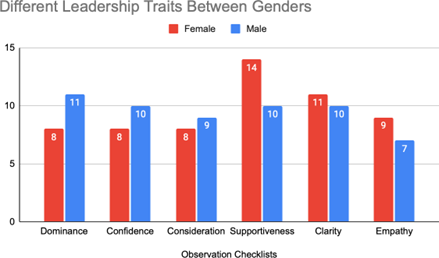
According to Figure 1, the results from our study supported our hypothesis that male students are more likely to be the authoritative leader while female students are more likely to be the collaborative leader in a group discussion in college classrooms. Based on 36 responses, we found that in a class discussion setting, more male students display traits of authoritative style such as confidence and dominance, while more female students display traits of collaborative leadership styles like empathy and supportiveness. An interesting finding was that female participants also illustrated a high amount of authoritative leadership style, females even displayed the authoritative trait “clarity” more than their male participants. Figure 2 shows the specific leadership traits performed by male and female participants:
Figure 1 Shows Different Leadership Traits Between Genders
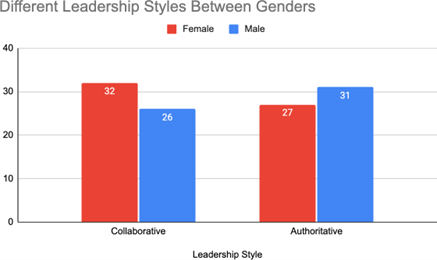
After we obtained the different traits that our female and male participants showed, we summarized these traits into the two big categories: collaborative and authoritative as shown in Figure 2. The authoritative traits are dominance, confidence, and clarity. The collaborative traits are supportiveness, empathy, and consideration. After calculation, we found that 32 female participants portrayed collaborative leadership traits while 26 male participants showed collaborative leadership. On the other hand, 27 female participants showed authoritative leadership style and 31 male participants showed authoritative leadership styles. Looking at this summarized chart, we can see a clearer distinction of the authoritative and collaborative traits females and males utilize as in their leadership.
Figure 2 Shows Different Leadership Styles Between Genders
One limiting aspect of the result is the study’s sampling population. Our study participant population only consisted of full-time UCLA undergraduate students. This is limiting to the external validity of the study’s results, as full-time UCLA undergraduate students are not a good representation of the general population. The study should keep in mind the education level and environment of UCLA students in comparison to the average population in our society.
Discussion and Conclusion
In this study, we have examined the relationship between gender and leadership styles among college students. Our findings support the traditional gender stereotype that males tend to exhibit more authoritative behaviors, while females tend to display more collaborative behaviors. This is likely due to the societal expectations and gender roles that shape individuals’ approach to leadership roles later in life. Our study has revealed that socialization plays a critical role in shaping gender roles and expectations, which in turn influences leadership styles.
However, we also found that our results are not entirely consistent with the traditional gender stereotype. Despite male students exhibiting more authoritative behaviors overall, female students exhibited a higher frequency of “clarity” traits, an authoritative leadership style, than their male counterparts. This could be attributed to the increasing gender equality and social status, which have enabled more women to develop and display leadership qualities, including more assertive and authoritative styles.
Our study’s broader impact lies in its contribution to creating more inclusive classroom environments that value and recognize diverse leadership styles. Educational institutions can use our findings to design more inclusive classroom settings and curriculum and create a more supportive and inclusive learning environment for all students. Furthermore, our study can help students recognize the disparities in leadership styles and work effectively together.
In conclusion, our study highlights the role of socialization in shaping gender roles and expectations and how they influence leadership styles. It also suggests that the increasing gender equality and social status have allowed more females to develop and display authoritative leadership styles. However, effective leadership depends on the context, and both leadership styles can be successful.
In conclusion, our study highlights the role of socialization in shaping gender roles and expectations and how they influence leadership styles. It also suggests that the increasing gender equality and social status have allowed more females to develop and display authoritative leadership styles. However, effective leadership depends on the context, and both leadership styles can be successful.
References
Carter, M. F., Franz, T. M., Gruschow, J. L., & VanRyne, A. M. (2019). The gender conformity conundrum: The effects of irrelevant gender norms on public conformity. The Journal of Social Psychology, 159(6), 761–765. https://doi.org/10.1080/00224545.2019.1586636
Baird, J. E., & Bradley, P. H. (1979). Styles of Management and Communication: A Comparative Study of men and women. Communication Monographs, 46(2), 101–111. https://doi.org/10.1080/03637757909375995
The idea of femininity is often grounded to common elements such as being tender, sweet, and obedient (Lee et al., 2002). This study aimed to test the relationship between one’s level of pitch and the aforementioned characteristics– specifically the role of East Asian media in promoting gender stereotypes through the implementation of various pitch levels. In order to address this question, we conducted a pitch analysis of female fictional characters in popular East Asian shows by obtaining the average fundamental frequency of a speech string through Praat (Boersma & Weenink, 2023). Unlike the hypothesis that higher pitch would correlate with the character’s degree of femininity, we found no significant difference in the average F0 value of stereotypically “feminine” and stereotypically “masculine” female characters. This finding suggests that pitch level alone does not override other non-linguistic and linguistic factors that altogether contribute to the perception of a “feminine” persona.
One’s style of speech serves as a unique indicator of their personality, gender, mood, age, and perhaps even their occupation. Even if we were to talk to someone over the phone, we would be able to learn a lot about the speaker’s identity due to this tight connection between speech and persona. This made us ask the question of: to what extent does one’s pitch level correspond to the speaker’s personality and perceived femininity? By analyzing fictional female characters in East Asian media, we attempted to identify the role that pitch level plays in reinforcing or rejecting gender stereotypes.
It is important to note that the average pitch level of East Asian females tends to differ from Western populations— hence the reason why we made within-group speech comparisons. For instance, Japanese women have higher pitches than Dutch women due to “the association of high pitch with attributes of physical and psychological powerlessness in the Dutch and Japanese cultures” (Van, 1995, p. 253). Additionally, Van (1995) reported that women with higher pitch are idealized and preferred by the general public in Japan, as high pitch level is correlated with many favorable social characteristics (Klofstad et al., 2012).
In East Asian culture, femininity is often associated with characteristics such as: being tender, sweet, obedient, and careful, while masculinity is described as having leadership, being confident, brave, ambitious, independent, and physically strong (Lee et al., 2002). For instance, characters designed to be “traditionally feminine” will exhibit submissive qualities as mentioned above, and pitch level may be adjusted to highlight their identities (Collins, 2011). We therefore hypothesized that female characters with a stereotypic “feminine” personality would produce higher pitch speech sounds on average than female characters who are depicted to be less “feminine.”
Although previous studies have revealed that sociocultural factors lead to a discrepancy between the speech of East Asian women and Western women, and a preference for high pitch in general, not many studies specifically investigate the role of East Asian media —specifically with regards to the use of specific linguistic styles in character portrayal— in perpetuating corresponding gender stereotypes. That is why our study aimed to address the significance of a female character’s speech style in East Asian media.
Methodology
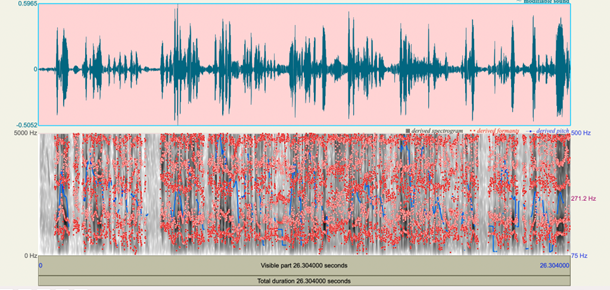
To examine the variations of pitch levels among female characters in East Asian media, we conducted a quantitative analysis on the data obtained from audio clips, with the help of Praat. Specifically, two polarizing female characters were chosen from each of the following shows from different East Asian countries: iPartment (Chinese), Shitsuren Chocolatier (Japanese), and Secret Garden (Korean), leading to a total sample of 6 characters. Comparatively “feminine” and “masculine” characters were selected based on the aforementioned characteristics of masculinity and femininity (Lee et al., 2002). For each character, we obtained a 30-second continuous speech sample during a neutral conversation to avoid any highly emotional conversations, such as arguments and crying scenes. We utilized Praat (Boersma & Weenink, 2023) to measure the average, maximum, and minimum F0 levels of each character’s speech samples (Figure 1). We then compared our data and conducted an independent t-test (Table 2) to examine if the results of the comparison of average pitch levels for “feminine” vs “masculine” female characters were significantly different– indicated by a p-value of 0.05 or lower.
Figure 1: Example of character spectrogram through Praat (Gil Ra Im)
Results and Analysis
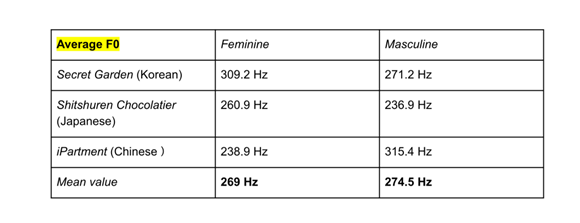
With respect to within-group comparisons, the Korean TV show Secret Garden showed results consistent with our hypothesis. The traditionally “feminine” character Ah-Young had an average F0 of 309.2 hertz, while the “masculine” character had an average F0 value of 271.2 hertz. Thus, the average F0 values obtained from this TV show provided positive evidence for our initial hypothesis that high pitch largely contributes to formulating a traditionally feminine persona. It is also important to note that the maximum and minimum F0 values possessed by the Korean feminine characters were highly similar, with the numerical difference between their maximum F0 values only being 19.8 Hz, and their minimum F0 values only differing by 4.5 Hz.
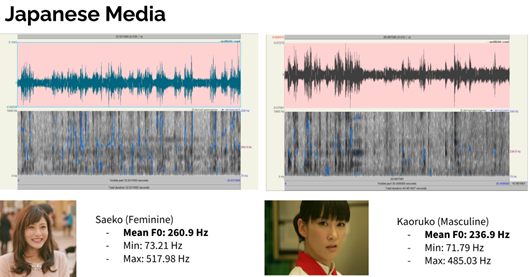
For the Japanese TV show, the stereotypically “feminine” character also had a higher average pitch than the “masculine” counterpart. Saeko, the traditionally “girly” female lead, had a mean F0 of 260.9 Hz while Kaoruko had an average pitch of 236.9 Hz. The two characters’ minimum and maximum pitch values highly aligned with one another as well, with the difference between their maximum values being 32.95 Hz and the difference between their minimum values being only 1.42 Hz. Such closely overlapping values in the minimum and maximum pitch range throughout the speech sample indicate that despite differences in average pitch level, people utilize their whole vocal range during regular day-to-day speech.
Although the data from the Korean and Japanese shows were in favor of our hypothesis, the Chinese show, iPartment, demonstrates results that suggested otherwise. The masculine character surprisingly exhibited a higher average pitch throughout her speech; specifically, the mean F0 value for the masculine character YiFei was 315.4 Hz, which is considered to be conventionally high. In comparison, the feminine character, Nuolan, had a lower average F0 of 236.9 Hz, which was significantly lower than the F0 of YiFei.
Table 1: Comparison of Average Pitch Levels
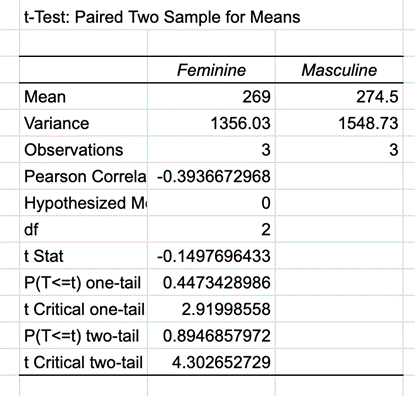
Lastly, in order to test for the statistical significance for any observed pitch differences, we conducted an independent t-test of the average value of the feminine and masculine characters’ pitch levels. The average pitch level of all stereotypically “feminine” characters was 269 Hz, while the average pitch level for the stereotypically “masculine” characters came out to 274.5 Hz. The t-test suggested that there was no statistically significant difference between these two values, as the p-value came out to p= 0.45. These findings, therefore, were insufficient in leading us to accept the initial hypothesis that the average pitch level of female characters plays a critical role in portraying a stereotypically feminine, girly persona in East Asian media.
Table 2: Independent T-Test (Feminine vs. Masculine)
Discussion and Conclusion
The sample as a whole did not support the hypothesis, as the average pitch level did not significantly differ between feminine and masculine female characters. Although we were able to observe within-group differences for the South Korean and Japanese media, we were unable to identify the predicted pattern of higher pitch in feminine characters within the Chinese drama. This suggests that pitch isn’t the only factor that contributes to one’s feminine persona– there are possible non-linguistic factors, such as appearance (ex. short hair, fashion), occupation, etc. in play that interact to achieve specific characteristics in the media. For instance, other non-linguistic similarities found within the feminine characters was their similar sense of fashion. They dressed themselves in softer colors, more feminine accessories, and wore more skirts and dresses compared to the masculine characters who had a more gender-neutral haircut, dressed in darker clothing, and largely wore pants. It is also important to note that the “masculine” female character in Secret Garden had a nontraditional occupation as a stuntwoman. Her role as a stuntwoman displayed characteristics that were previously identified as being primarily masculine: brave, ambitious, independent, and physically strong (Lee et al., 2002), which could have been a more salient factor in the portrayal of gender norms.
Additionally, it is highly likely that the impressions of masculinity and femininity differ between the three East Asian countries. Although East Asian countries may share common values and practices, there are several invariants: one of them is the link between gender norms and education level. In particular, Chinese culture often correlates masculinity with the possession of a PhD degree (Shanghai Star, 2005). In China, even a third gender type besides men and women has been proposed specifically for females with a PhD degree– this is due to the traditional belief that women are physically and mentally weaker than men, which results in unequal perceptions behind the cognitive capabilities of men and women. In comparison, such prejudiced thoughts regarding gender stereotypes and education are not as prominent in Japan and Korea. This finding above suggests that there are subtle differences in gender beliefs within East Asian culture, which might contribute to why we were not able to observe a static trend in the linguistic style of feminine female characters in media.
Figure 2: Characters from Shitsuren Chocolatier and their corresponding pitch analysis
Other linguistic factors that contribute to one’s persona could be the speaker’s word-choice, pitch contour, etc.– specifically in the Korean drama Secret Garden, the feminine female lead Ah-Young would often include a word-final nasal sound “ㅇ” that is associated with a playful, cute tone in Korean culture. For instance, she would add the “ㅇ” sound to the end of a neutral phrase “그랬어?” [kɨlɛs͈ʌ], creating an ungrammatical yet stylistic production “그랬엉?” [kɨlɛs͈ʌŋ]. Comparatively, the masculine female lead Ra-Im spoke in a more strict, direct, blunt tone throughout the drama, with the absence of a word-final nasal sound.
Some limitations of this study include the possibility of interference from background noise and thus an inconsistency in speech sample quality. Also, the speech samples were rather short, which might be insufficient in catering to all the variations in the stories’ settings and changes in characters’ personalities and corresponding degrees of femininity (if any occurred). In the future, the research could be improved by including an analysis of several media sources within one culture, instead of one representative film. Additionally, a longer speech sample that encodes the pitch variance throughout the entirety of the drama would lead to a more accurate analysis. Lastly, the speech sample could be cleaned up to minimize “noise.” This could be achieved by feeding the audio clip through a software that isolates linguistic sounds (aka speech sounds) with nonlinguistic ones, or by adjusting the level of the background noise on a higher-quality audio file.
Throughout this research, we heavily emphasized how the use of pitch levels is relevant in Chinese, Japanese, and Korean media to portray both feminine and masculine characteristics. However, it is important to note that a particular language is spoken differently depending on which linguistic community the speaker belongs to within a single country as well. For instance, an existing article regarding the pitch levels of female speech in two different Chinese villages — Jiuying Village and Taoyuan Village — explores how a specific language can be utilized and spoken differently depending on which linguistic community the speaker belongs to (Deutsch et al., 2009). Moreover, it was concluded by the authors that “the overall pitch level of a speaker’s voice is influenced by a mental representation that is acquired through exposure to the speech of others” (Deutsch et al., 2009), indicating that the speaker’s experience and lifestyle in a specific linguistic community affects their tones and pitches in the long run. For future research, focusing on a specific language and comparing how that language is spoken differently in various linguistic communities (hence the emergence and progression of regional dialects) may be beneficial for in depth analysis of a specific language.
It is also plausible that women’s voices are gradually getting deeper overall. The article published by BBC explores how social transformation is mirrored to our speech style, “women today speak at a deeper pitch than their mothers or grandmothers would have done, thanks to changing power dynamics between men and women.” (Robson, 2022). Since the expectations and social norms are changing over time, it is reasonable that our speech style is adjusting to them. To extend upon this research, we could investigate recent shows (past 5 years) from East Asian countries, as our focused media was relatively old and failed to capture the social norms in today’s society.
Altogether, this study revealed that our speech style and persona potentially have a bi-directional relationship, especially with the strong presence of the media in our day to day lives. It allowed us to consider the broad questions of: “What makes us perceive a certain character as feminine versus masculine? Could this factor potentially be linguistic in nature?” Despite not obtaining significant cross-cultural findings, the research uncovered a possibility of Korean and Japanese media implementing high pitch to portray femininity, and the potential for future research that reflect each country’s distinct position surrounding the notion of gender and in-depth analysis of the role of regional dialects in shaping persona.
References
Boersma, P., & Weenink, D. (2023). Praat: doing phonetics by computer [Computer program]. Version 6.3.10, retrieved 3 May 2023 from http://www.praat.org/
Collins, R. L. (2011). Content analysis of gender roles in media: Where are we now and where should we go? Sex Roles, 64(3-4), 290–298. https://doi.org/10.1007/s11199-010-9929-5
Deutsch, D., Le, J., Shen, J., & Henthorn, T. (2009). The pitch levels of female speech in two Chinese villages. The Journal of the Acoustical Society of America, 125(5). https://doi.org/10.1121/1.3113892
Klofstad, C. A., Anderson, R. C., & Peters, S. (2012). Sounds like a winner: Voice pitch influences perception of leadership capacity in both men and women. Proceedings of the Royal Society B: Biological Sciences, 279(1738), 2698–2704. https://doi.org/10.1098/rspb.2012.0311
Krahé, B., & Papakonstantinou, L. (2019). Speaking like a man: Women’s pitch as a cue for gender stereotyping. Sex Roles, 82(1-2), 94–101. https://doi.org/10.1007/s11199-019-01041-z
Lee, B. S., Kim, M. A., & Koh, H. J. (2002). Development of Korean gender role identity inventory. Journal of Korean Academy of Nursing, 32(3), 373-383. https://doi.org/10.4040/jkan.2002.32.3.373
van Bezooijen, R. (1995). Sociocultural aspects of pitch differences between Japanese and Dutch women. Language and Speech, 38(3), 253–265. https://doi.org/10.1177/002383099503800303
Griffin Gamble, Shayan Karmaly, Rahul Reddy, and Michael Zhan
Our team was interested in looking at some speech features that were found primarily in women’s speech in a famous study by Robin Lakoff in 1973. We wanted to see if Lakoff’s findings were still prevalent in today’s media. In our study, we followed two characters, Robin Scherbatsky and Barney Stinson, in the TV show How I Met Your Mother. When analyzing their various conversations with friends throughout the show, we focused on two of the many speech features that Lakoff initially identified – tag questions and intensifiers. We separated their conversations into two social contexts – single-gender and mixed-gender conversations. We were curious to see if the frequency of the speech features would increase or decrease depending on the type of social situation that Robin and Barney were in. In addition, we were interested in the overall frequency of tag questions and intensifiers in Robin’s speech versus Barney’s speech because, according to Lakoff, these speech features should be more prominent in female speech (1973). We found that Barney had more tag questions and intensifiers per line than Robin, but in single-gender situations, Robin had significantly more intensifiers per line.
Our research hoped to answer the following questions: Are tag questions and intensifiers still predominantly found in women’s speech more than in men’s speech? Does the gender of the speaker’s conversation partners play a role in how often speakers will use tag questions and intensifiers? One of the reasons that we are interested in both these questions and revisiting Lakoff’s findings is that since 1973, there have been many changes to gender norms as well as the ways that people represent themselves. In general, people are a lot more tolerant and accepting of differences, so we predict it could be the case that the gender stereotypes in language have changed as well.
While we initially planned on getting live recordings of UCLA students in different social contexts, we quickly realized that this would be difficult to accomplish within the ten weeks allotted for this study. It would also be placing a large burden on the participant as they would need to record themselves as they went about their already busy day. Because of this difficulty, we shifted gears toward analyzing TV show characters. It ended up working out because one of the research methods that Lakoff (1973) used in her initial study was observing the media, so we decided to do the same with the show How I Met Your Mother.
From left to right: Barney Stinson (Neil Patrick Harris), Robin Scherbatsky (Cobie Smulders), Ted Mosby (Bob Saget), Lily Aldrin (Alyson Hannigan), Marshall Eriksen (Jason Segel)
The show is a rom-com about five friends who live their lives and navigate the social setting of New York. We chose this show because it’s only been eight years since the show finished and the main cast all exhibit male and female gender stereotypes. Specifically, the two characters we followed are Robin and Barney because while they both exhibit typical stereotypes for their gender, they also often portray stereotypical gender norms of the opposite gender.
Methods
We analyzed six episodes of How I Met Your Mother which totaled two hours of footage and 559 lines from our two characters combined. We specifically picked episodes that Robin and Barney were featured in so they would have more lines and we could collect more data from them. When watching the episodes and reading the transcripts, we noted each time Robin or Barney used either of the two speech features. We wrote down the speech feature that was used, the character that said it, and whether it was a single-gender or mixed-gender situation. For each episode, we created a separate section on our spreadsheet for inputting the data and an area sectioned off for calculating the total counts.
It is important to note that not all tag questions are equal and they may not share the same function to portray the speaker as having less authority or power (Cameron 76). While you can use a tag question as a self-lowering device by giving your interlocutor the floor to respond to your statement, you can also use a tag question as an aggressive tool. For example, “You aren’t all that great, are you?” That said, all the tag questions in our data were of the hedging type. Here is an example from Robin, “If you’re going to be this disgusting, we’re not watching this, okay?”
Robin Scherbatsky (Cobie Smulders), looking shocked
Results/Analysis
So what exactly were our findings? Overall, we analyzed six episodes totaling two hours of footage and our findings were different from what we expected to find based on existing research. In (Seigler & Seigler, 1976, p. 169) and (Kramer, 1977, p. 159) both studies found that gender stereotypes in speech aligned with Lakoff’s theory. Keep in mind, these studies were focused on the perceptions of speech, not what each gender actually says in real life. We expected to find that the speech characteristics that were once associated primarily with women’s speech can now be found equally in both male and female speech, and are no longer strong indicators of the gender of the speaker. This was our hypothesis. Below, I will go into details including visualizations that display what we ended up analyzing.
Our data consisted of two different social contexts for analysis. Specifically, we looked at mixed-gender situations (where there was at least one male and one female in a social setting) and at single-gender situations (where there was only one gender in a social setting). For the purposes of the experiment, the genders will refer to non-trans males and females who identify as the gender that they were born with. Now, let’s look at the data:
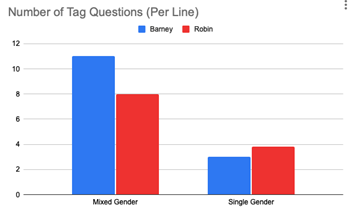
Table 1 – Number of Tag Questions
As we can see in Table 1, we examined situations in which Robin and Barney are in mixed-gender and single-gender lines for the purposes of the tag questions. For this, we tried to choose episodes where we thought the two characters would have an equal number of lines in this context and to our convenience, they did for the mixed-gender situations, but NOT for the single-gender ones. So, while Robin and Barney have nearly the same number of total mixed-gender lines, Barney had 31.5% more tag questions. On the other hand, Robin led this category in single-gender situations!
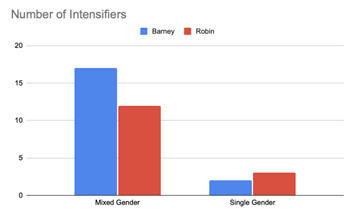
Table 2 – Number of Intensifiers (Per Line)
Similarly, when looking at Table 2, we can see that Barney had 34.5% more intensifiers and from the raw data, it would actually seem as if Barney is the winner in both categories, however, when we equalize the data (as shown in the graph), Robin has more intensifiers per line in the single-gender situations. The tricky part of this table is that it shows the analysis per line rather than the total amount. We decided not to go with raw numbers so that it is not confusing to look at the total speaking time, but rather easier to look at the date per line. This average is more precise since it allows us to equalize the data for both Barney and Robin. And if we look more specifically at the single-gender situations, Robin actually has roughly half of Barney’s lines. Overall though, the single-gender data is pretty sparse; therefore, we can conclude that it’s not super conclusive of anything.
Discussion and Conclusions
The conclusion that can be drawn from our analysis and findings is that Lakoff’s speech features that were stereotypically and data-backed as either higher for men or women no longer hold true in modern times. We can see from our data that speech features that were shown in Lakoff’s research as higher for women such as tag questions and intensifiers were actually around the same for Barney and Robin. In some cases, they were even higher for the male focus of the study, Barney. Although we were not able to find much data for single-gender situations, from the evidence that we do have we can conclude that modern-day society has moved into a third-wave sociolinguistics lens that puts much more emphasis on the individual when compared to the past. After taking into consideration the time gap between the gender stereotypes of 1973 and the stereotypes of today in 2022, we can see that our hypothesis did indeed hold true where these outdated assumptions on stereotypical speech features can no longer be linked to a single gender. This makes sense as we now live in a much more gender-fluid and accepting society than in the past where everyone was strictly grouped as masculine and feminine and deviating from the norm was shunned by most. Some high-quality TED talks that reinforce these ideas are “Language around Gender and Identity Evolves” presented by Archie Crowley and “How Language Shapes the Way We Think” presented by Lera Boroditsky. The first TED talk by Archie delves into how language is ever-changing and a powerful tool to allow people to identify themselves and find something that makes them feel comfortable. In the second TED talk, Lera uses scientifically backed data to prove that language does indeed shape the way we think and how we have over 7,000 cognitive universes, each linked with a language as each language gives the user a unique way of viewing the world and is very impactful in shaping the way we view the things around us without us even knowing. Both presentations talk about language being a powerful tool for self-expression and tie into our appeal that language should not be confined to preconceived notions of gender schema as it might have been in the past. Language should be something that brings people closer together instead of a weapon that further alienates people. If there were more time, we would have liked to expand upon our research by analyzing real people instead of just fictional TV characters and comparing the results. We also realize that analyzing real people would mean we would also need to account for external influencing factors such as race, occupation, geographical origin, etc.
While we began looking at how speaker agency can play a role in changing one’s speech through single and mixed-gender situations, it would be valuable in a future study to analyze different types of conversations. For example, an argumentative conversation may have significantly fewer self-lowering tag questions while it might have more intensifiers to help get the point across. Podesva’s (2011) study could be used as inspiration for a framework for how to conduct a study involving participants that move through discrete social contexts.
References
Cameron, D., McAlinden, F., & O’Leary, K. (1988). Lakoff in context: The social and linguistic functions of tag questions. Women in their speech communities, 74, 93.
Siegler, D. M., & Siegler, R. S. (1976). Stereotypes of Males’ and Females’ Speech. Psychological Reports, 39(1), 167–170. https://doi.org/10.2466/pr0.1976.39.1.167
Clements, R., Musker, J., Williams, C., & Hall, D. (2016). Moana. Walt Disney Studios Motion Pictures.
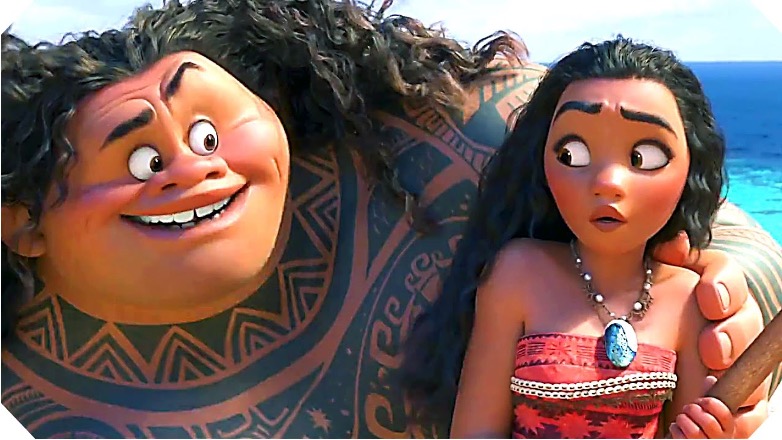
Set on the mythical Polynesian island of Montinuti, the critically acclaimed movie, Moana (2016) is one of the most successful movies to date (Robinson, 2016). Moana has been portrayed as a strong female character that defies gender stereotypes. However, a closer look at the film reveals that Moana conforms to many stereotypical feminine linguistic features regarding interruption, pitch, and word choice. The conversations between Moana and her male adventure partner reveals that he interrupts her at high rates. Thus, this preserves the gender stereotypes that many Disney films are known for. Maui’s character serves the purpose of representing the stereotypical dominant roles of men in society through his muscular and supernatural abilities. This paper criticizes the consensus and instead argues that this film perpetuates gender stereotypes. To support this claim, selected conversations between the male and female protagonists that include specific instances of interruption, pitch, and word choice are examined.
Movie critics have claimed that Moana is quite revolutionary in its approach to break gender barriers as a result of being an unapologetic feminist film (Schiele et al., 2020). Throughout the film, the sixteen-year-old character is shown as a strong female lead, who is considered headstrong. However, is there more to the surface of this coming to age story? Throughout history, many Disney princess films have followed a trope of conforming to gender stereotypes, whether it is a princess waiting on their prince charming to come to save them or another version of a damsel in distress. Needless to say, Moana doesn’t fall too short from the tree of conforming to the common trait of gender stereotypes that many Disney films are known for. This study explores ways of how some linguistic features such as interruptions, pitch and word choice between the verbal conversations of Moana and her travel partner, Maui supports the idea that Disney films still present gender stereotypes.
Schiele et al. (2020) make an appealing point that Moana is a fiercely independent lead female character who does not participate in the typical storyline of a damsel in distress in movies such as Cinderella. Yet the author fails to bring up that Maui may be seen as the stereotypical masculine man that illustrates some of the ideologies of men abusing their power to exercise male power and entitlement. In their article, (Schiele et. al, 2020) state, “The theme is crystallized in movies set in premodern societies, such as Moana, where male power and patriarchal expectations have unrivaled authority.” However, there is not enough background in the article to support this claim, because there is more than one protagonist in the film that can symbolize and engage in gender stereotypes. Furthermore, it is important to note that the bare minimum should not be praised. Another author (Hays, 2019) agrees with the sentiments, as they suggest, “With the progression of how women are portrayed in Disney’s princess films, the opportunity to become more diverse and inclusive exists.” There is still much progress to be made in Disney Princess films overall as they continue to sustain different forms of gender stereotypes.
Methods
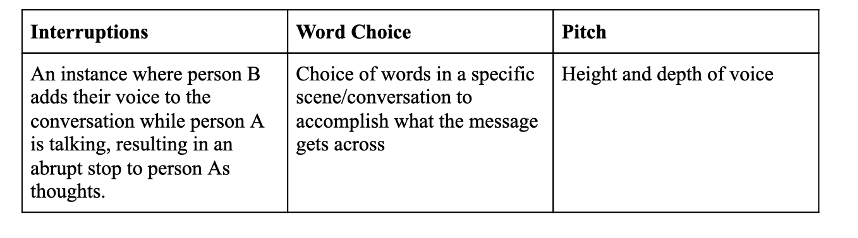
This research paper analyzed three linguistic features in the film: Interruption, Word Choice and Pitch. Selected conversations between Moana and Maui were transcribed to highlight these key features – they are defined below.
The purpose of analyzing these features in the film was to gauge how effective they would be in supporting the argument that Moana perpetuates gender stereotypes. During the first viewing of the film, it served as a refresher of the film. The interruption was defined as a moment where Moana’s words came to an abrupt end as a result of Maui simultaneously adding in his thoughts. Interruptions from Maui were tallied during the second viewing of the film to keep track of the power dynamics between him and Moana. Adding on, tallying was useful in terms of picking which scene represented Interruptions the most. The transcription that represented word choice was picked to show words from the conversation of Maui and Moana that stood out the most. The feature of Pitch was a bit more subtle to catch and required active listening and engagement in a reserved room to choose the most relevant data that could be applied and supported with the claims in this research paper. The specific scenes were typed in a separate Google document and converted to an image after it was transcribed.
Results & Analysis
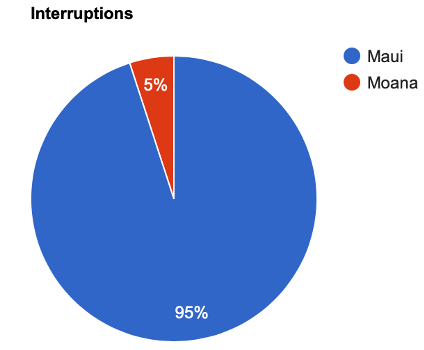
As a result of the tallying method, this indicated that Maui interrupted Moana at higher rates throughout the film. The results were converted to a pie chart as depicted in Figure 1.
Figure 1: Amount of interruptions from Maui and Moana throughout the film.
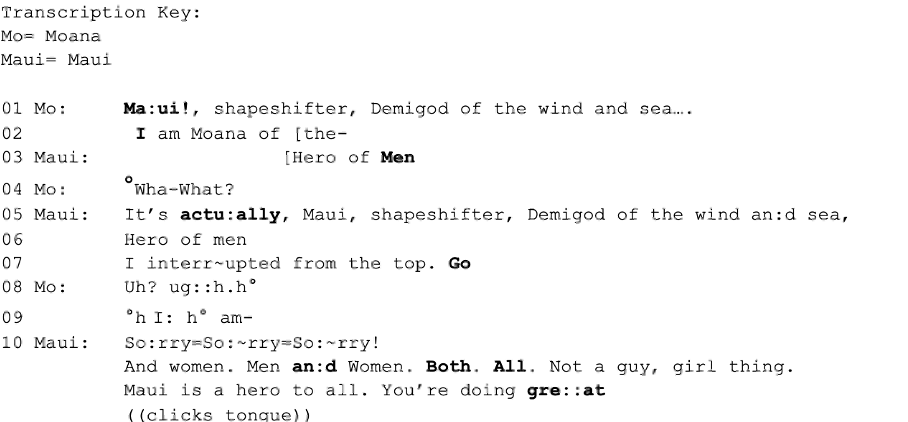
A research study conducted in 2014 indicated that 33% of women are interrupted more often when conversing with men (Hancock, 2015). Maui establishes his desire for dominance when he interrupts Moana several times in Figure 1. (James & Clark, 1993) interpret interruptions in conversations as violating normal conversational rules, which can also be interpreted as an attempt to overpower and control the floor of the topic of the conversation. Maui’s interruption in Figure 2 emphasizes that not only was he insufficient in waiting till she finished her sentence, but also had no intention of hearing her self-introduction once he proceeded to interrupt her for the second time.
Figure 2: Maui and Moana meet for the first time.
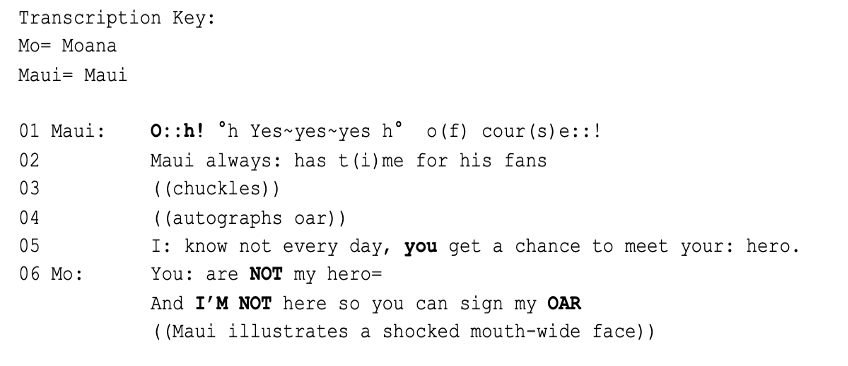
Gender stereotypes in language may often be perceived as socialized differences and norms after a while as a result of Disney films. In the second example (Figure 3), the concept of word choice is introduced when Moana makes it clear from her words, “you are not my hero” that she is not a fan and does not look up to him as he suspected. Maui presents a stereotypical “traditional masculinity” which is defined as traditional masculinity as traits that are respectively more typical of men and women (Kachel, Steffens, Niedlich, 2016). Thus, Maui’s initial lack of understanding of the purpose of their conversation reiterates that he was focused on talking rather than listening, this further supports the claim that he yearned to dominate the conversation.
Figure 3: Continuation of the first conversation between Moana and Maui
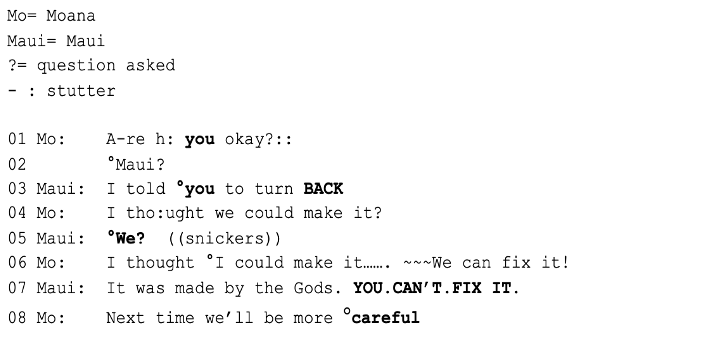
In Figure 4, the indication of pitch is introduced when it is apparent that Mana’s voice gets low as she is caught off guard by Maui’s exasperation. The pitch in this scene illustrates Moana’s genuine concern for Maui and his fishhook, yet Maui failed to reciprocate the same concern as he was focused on releasing his anger at the wrong person. This insight suggests that men fail to explicitly observe women’s pitch and tone, as this can reveal many emotions. Similarly, this may trace back to the idea that men were not raised to focus on these features, since they participate in more of the talking while women play the role of the listener. (McConnell-Ginet, 1978) recognizes this as she states that, “… the pitch is particularly important for understanding sex differences in speech strategies…” McConnell’s insights support the suggestion that men lack the routine of analyzing women’s speech based on the pitch because of the male-dominated ideas that are ingrained in society. The multiple exchanges between Maui and Moana emphasize the idea that there are gender stereotypes that other Disney princess movies preserve, and in this instance, where the film is centered around male-domination that may go beyond the scope of the film.
Figure 4: Maui and Moana’s first failed attempt to restore Te Fiti.
Discussion and Conclusions
Although Moana is one of the most popular animated Disney films, it still upholds some of the traditional gender stereotypes that Disney films are known for. The character Moana was a well-thought-out and progressive Disney princess — in comparison to those that currently exist as she upholds assertive traits that present as masculine and feminine throughout the film — the three features of interruptions, word choice, and pitch illustrates that gender stereotypes are still a long going issue in Disney films. The claims presented in this paper reveal that the linguistic features play a role in the image they may present on the stereotypes of both men and women. Future research based on this film can look into the concept of which age and age gap amongst the characters may play a role in some of the gender stereotypes of male’s desire to dominate every aspect of their life and where that stems from with a physiological perspective.
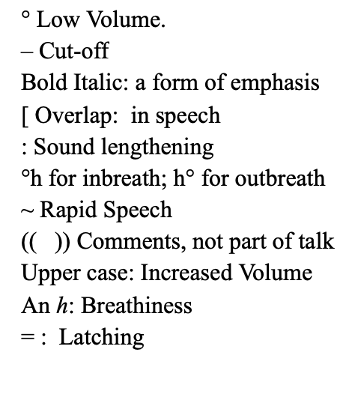
Full Transcription Key
References
Hancock, A. B., & Rubin, B. A. (2015). Influence of communication partner’s gender on language. Journal of Language and Social Psychology, 34(1), 46-64.
Hays, C. (2019). From Snow White to Moana: how Disney’s leading ladies became more than just a pretty face.
James, D., & Clarke, S. (1993). Women, men, and interruptions. Gender and conversational interaction, 231-280
McConnell-Ginet, S. (1978). Intonation in a man’s world. Signs: Journal of Women in Culture and Society, 3(3), 541-559.
Kachel, S., Steffens, M. C., & Niedlich, C. (2016). Traditional masculinity and femininity: Validation of a new scale assessing gender roles. Frontiers in psychology, 7, 956.
Robinson, T. (2016). Moana Review: After 80 Years of Experiments, Disney Has Made the Perfect Movie. The Verge.
Schiele, K., Louie, L., & Chen, S. (2020). Marketing feminism in youth media: A study of Disney and Pixar animation. Business Horizons, 63(5), 659-669.