International Students

The Experiences of Non-Native English Speakers at UCLA

Christina Oghlian, Cia Evangelio, Nina Esteghlal, Rikuto Kawada, Yuka Tanaka

As a native speaker of a language, we never really stop to think about the experiences and challenges of those who are not native speakers. It is especially difficult for those who are studying in a foreign country where almost everyone is fluent in a different language than them. We decided to research what challenges international students face in order to gain a greater understanding of their experiences as non-native English speakers at an American university. In addition, we want to use the results of our findings to understand what resources are available for international students who are not English-proficient.

We conducted our research by interviewing 10 international students attending UCLA, 5 of which were male and 5 of which were female, about their English academic proficiency levels and their experiences in various social settings as non-native speakers. By creating more spaces where international students can meet one another or consult with fluent English speakers about difficulties they might have with the language, educational institutions can help their international students feel more safe and comfortable in both academic and social settings.

[expander_maker id=”1″ more=”Read more” less=”Read less”]

Introduction

Think about yourself living in other countries where people do not speak your native language. What would you feel, and what difficulties would you face? This curiosity makes us want to study how each international student struggles to live in other countries. We focus on the linguistic, social, and mental challenges that international students face during their study abroad experiences. Our research question is: “How does international students’ English proficiency affect their personal life to be fulfilling while they are studying abroad, and what are the difficulties for international students to achieve their ideal life in new countries?” We hypothesize that international students with higher proficiency in speaking English have more opportunities to socialize in groups. On the other hand, international students who have lower English proficiency will face more difficulties in socialization and having an awareness of their speaking English, increasing their anxieties while they are speaking English to native speakers.

Background

International students face new challenges in a new country. There can be many reasons and situations, such as the language barrier, socialization, and mental condition. Those challenges have a huge negative impact on international students in terms of their studying or speaking English. Many international students are willing to enhance their speaking skills and engage in new social interactions, such as engaging in conversation, making new friends, and so on, in the new countries they go to (Bernhard and Gregory, 2017). Depending on the individual international students, there are differences in these achievements to be different because their English proficiency will be affected.

The linguistic barrier can make people feel they are not in the conversation while people are speaking English because they cannot understand and speak out while people are using English. This can make international students feel socially excluded because of the differences in their English ability (Hilt, 2016). In addition, linguistic barriers are affecting not only the social life of international students but also their mental awareness of their English ability in many ways. While international students feel they are not good enough at speaking English, it can affect their feelings of anxiety (Idrissi, 2022). Moreover, the linguistic barrier can also affect international students’ confidence in speaking (Iris and Lopez, 2014). Therefore, English proficiency has a huge impact on the interactions with international students, their social lives, and their awareness of anxiety.

Methods

For our research study, we aim to interview 10 international UCLA students between the ages of 18-25. Out of the 10 international students, we will specifically interview 5 males and 5 females. Our research will examine how these international students face difficulties when they are speaking English to a native English speaker. Before the interview, the students will complete a Google form asking a couple of questions about their demographics, including identity, where they are from, previous schools they have attended, and for how long they have been attending UCLA. After completing the Google form, each participant will be notified with a follow-up interview and be asked questions based on their familiarity with English. The interviews will take approximately 30 minutes, and we will ask questions related to their knowledge of English, such as, “How comfortable are you speaking English”, “What is the most complicated part about speaking the English language”, “ How comfortable are you when slang is being used in conversation”, and “What linguistic features do you pay attention to when speaking with native speakers”. Based on the interview answers, we will analyze them to see what international students struggle with and which areas of linguistics they have difficulty understanding the most. We especially want to understand how international students have a difficult time with their English ability in social situations and mental interaction.

Results and Analysis

The results that we have found are quite intriguing. We conducted a total of nine interviews and created graphs to represent our findings.  As represented on the charts, the demographic of our participants is a majority of Japanese participants followed by Indian, South Korean, and Armenian, as shown in Figure 1.
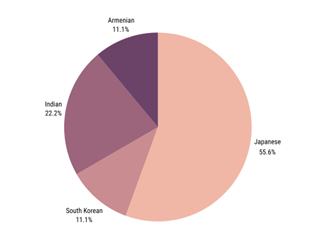
Figure 1: Demographics of Participants within the Study

A large majority of the participants were exposed to English in high school– whether that be that they went to an international school or they had an integrative English course as represented through Figure 2.
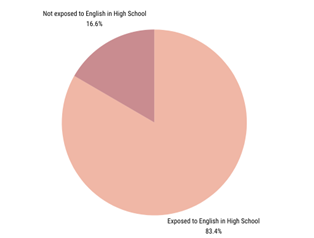
Figure 2: Percentage of Participants who were exposed to English in High School

While conducting our research, we realized it was only fair that we separate international students from what was shown in Figure 2. Out of those international students that were exposed to English in high school, Figure 3 represents what they found the most difficult when participating in conversation with native English speakers.
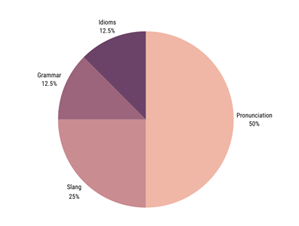
Figure 3: What International Students with strong English proficiency struggle with

On the other hand, Figure 4 shows what international students that have lesser English proficiency struggle with. Interestingly, both international students with strong English proficiency and students with lower English proficiency are most conscious about pronunciation.
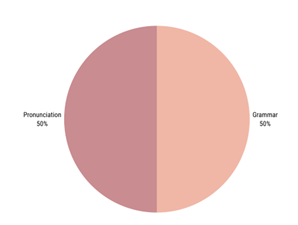
Figure 4: What International Students with lesser English proficiency struggle with

The results show that the international students that have a strong English-speaking background are most likely to feel comfortable speaking English to individuals, and group settings however, international students with no English background feel less comfortable. International students have more difficulty grasping English morphological and syntactic structures due to the complicated grammatical structures that are used in academic settings. The use of slang terms and pop culture usually in social and school settings often would give international students confusion. Most international students mentioned how they struggled understanding slang terms and pop culture and that they are still learning.

Discussion and Conclusions

Previous studies have shown that the ability to speak English is highly related to one’s involvement with the surrounding environment in which he or she grew up. The results show that international students who received an academic English education before entering university are almost as confident and comfortable with their English skills as native English speakers, whereas international students who did not receive much English education before entering university are a little more hesitant to speak English. As our research indicates, they may feel anxious or difficult to speak depending on their proficiency in English and may feel that they do not belong in that group.

Moreover, our study allows us to speculate that difficulties in grasping specific and unique syntactic structures, such as pop culture references, may have an impact on the minds and bodies of international students. While it is difficult to draw conclusions, this phenomenon may be true for many international students who did not receive much English education before college. Proficiency in English is a necessary skill for international students to adapt to social life, but confusion often arises when slang and pop culture references are mixed in. Therefore, it could be argued that international students hang out with other international students to avoid being excluded because of differences in fluency or proficiency that they do not possess compared to native English speakers. This research can be applied to various university communication settings to help understand how to properly engage with international students and what type of environment is most effective for language learning.

References

Alkhammash, R. (2022). Processing figurative language: Evidence from native and non-native speakers of English. Frontiers in Psychology, 13, 1057662–1057662. https://doi.org/10.3389/fpsyg.2022.105766

Drljaca Margic, B. (2017). Communication courtesy or condescension? Linguistic accommodation of native to non-native speakers of English. Journal of English as a Lingua Franca, 6(1), 29–55. https://doi.org/10.1515/jelf-2017-0006

Halic, O., Greenberg, K. H., & Paulus, T. M. (2009). Language and Academic Identity: A study of the experiences of Non-Native English speaking international students. International Education, 38(2), 73–93.

Hilt, L. T. (2016). Education without a shared language: Dynamics of inclusion and exclusion in Norwegian introductory classes for newly arrived minority language students. International Journal of Inclusive Education, 21(6), 585–601. https://doi.org/10.1080/13603116.2016.1223179

Idrissi, O. (2022). Anxiety as a psychological barrier to students’ speaking fluency: IELTS as a case study. International Journal of Linguistics, Literature and Translation, 5(12), 111–120. https://doi.org/10.32996/ijllt.2022.5.12.14

Jessen, A., Festman, J., Boxell, O., & Felser, C. (2017). Native and Non-native Speakers’ Brain Responses to Filled Indirect Object Gaps. Journal of Psycholinguistic Research, 46(5), 1319–1338. https://doi.org/10.1007/s10936-017-9496-9

Lopez, I. Y., & Bui, N. H. (2014). Acculturation and linguistic factors on international students’ self-esteem and language confidence. Journal of International Students, 4(4), 314–329. https://doi.org/10.32674/jis.v4i4.451

Streitwieser, B. T., & Light, G. J. (2017). Student conceptions of international experience in the study abroad context. Higher Education, 75(3), 471–487. https://doi.org/10.1007/s10734-017-0150-0

Yu, X., & Peters, B. (2019). Let All Voices Be Heard!: Exploring International Students’ Communication Challenges in the Internationalized Classroom. Journal of Interdisciplinary Studies in Education, 8(1), 107–116. https://doi.org/10.32674/jise.v8i1.1080

Cross-referencing relevant info: https://www.youtube.com/watch?v=na04NxGZuKU

[/expander_maker]
, , , ,

Navigating New Worlds: The Role of English Proficiency in the Social Integration of Chinese International Students at UCLA

Rista White, Yue Yu (Elena), Nadia Ruiz, Brianna Sobrero, Ruby Jimenez

The present study investigated whether Chinese international students (CIS) attending the University of California, Los Angeles, with high self-reported English proficiency, experience easier social integration and comfortably form more friendships with domestic students. CISs comprise the largest group of international students at UCLA, and this considerable demographic experiences various unique sociolinguistic challenges while adjusting to American university life. To answer this question, we analyzed 13 questionnaire responses that we received from individuals who identified as CISs attending UCLA. Subsequently, four respondents agreed to interviews where we learned more about their personal experiences. The findings show that greater self-reported English competence among UCLA CISs positively correlates with easier social integration and a wider variety of friendships. Given the growing population and trend of international study, these findings are helpful for the university and student organizations to consider when creating programs to improve the experience of CISs attending UCLA.

[expander_maker id=”1″ more=”Read more” less=”Read less”]

Introduction and Background

Recognizing that international students may face more struggles than ordinary American university students is important. International students come to a foreign country on a student visa or permit to pursue education, and the US has many such students (Sin et al., 2021). Our research investigates the relationship between English proficiency and social interactions and the impact of language barriers on CIS’s ability to communicate effectively with peers at UCLA. By understanding these aspects, we hope to shed light on the diverse struggles of CISs and provide insights into how English proficiency can affect their sense of culture and belonging in a foreign country.

Each year, the number of CISs in the United States increases as more students from China come to the U.S. to pursue higher education. These students often find themselves encountering a common barrier: English proficiency. Despite the significant role of English proficiency in social integration, this correlation is often overlooked. Several studies have researched second-language acquisition among international students and how it affects their academic and personal lives in the United States. However, few studies specifically study the direct correlation between proficiency in English as a second language and socialization in American universities, despite its significant influence on academic performance and social integration. Limited proficiency in the host language diminishes students’ satisfaction by impeding their ability to communicate, socialize, and comprehend lectures in academic settings (Campbell & Li, 2008, as cited in Wilczewski & Alon, 2023).

Studies also emphasize that international students are frequently prevented from mingling with American peers because of their limited exposure to American culture and language, leading them to primarily socialize with fellow international students (Liu & Dong, 2019; Moglen, 2017, as cited in Garrison & Chang-Tran, 2023). International students tend to predominantly socialize with peers from their own cultural backgrounds while rarely engaging with domestic individuals or students from different cultural backgrounds, largely due to language barriers (Wang & Zhou, 2021).

 In his TedTalk, Miga Xie (2020), recounted that he was told by his mother to stay away from other Chinese children. She believed that the way to get the most out of American education and improve spoken English was by minimizing contact with those of similar backgrounds. Miga explains that he eventually overcame the feeling of assimilating into American student culture and avoiding his culture. Xie understands that most CIS feel more comfortable around people with the same background. Still, because of the unique guidance received from his mother, he suggests that CISs should value their diversity and use it to engage in cross-cultural conversations rather than feeling obligated to socialize exclusively with people who look like them or fully assimilate into American culture.

 These studies and stories collectively demonstrate the importance of second-language proficiency in facilitating social interaction with domestic students, as insufficient proficiency often leads international students to socialize within their own international student community. Higher levels of second-language proficiency facilitate more extensive and smoother socialization experiences. While the body of existing studies reinforces our hypothesis, our research narrows its focus to UCLA as the setting and English as the specific second language, with a particular emphasis on CIS. Our study addresses a significant gap in the literature by examining the relationship between English proficiency levels and socialization in American universities.

Methods

We followed a mixed-method research design. Specifically, we utilized the facilitation approach, a process involving two research methods, using one strategy to expand on the results of another strategy (Young, 2015). Beginning with a quantitative method, we created a questionnaire on Google Forms with four sections, two of which were close-ended, to acquire data concerning CIS’s self-reported English proficiency and social connections relating to a sense of belonging. We shared the questionnaire in a group chat for CIS attending UCLA on WeChat, a dominant Chinese messaging application. After receiving 13 responses, we emailed all respondents to schedule an interview, and only four agreed. So, to take a more engaging approach, we followed up with the four people to perform semi-structured interviews. We divided our twelve open-ended interview questions into four sections: Experiences with English and Social Integration, Challenges and Strategies, Social Networks and Sense of Belonging, and Institutional Support and Suggestions.

Data Analysis and Results

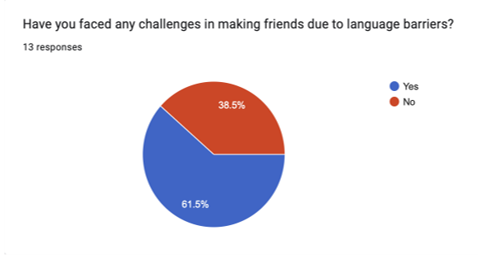
Through our close-ended survey responses, the results of one of our questions stood out to us (Figure 1). Most respondents, eight to be exact, said yes to having faced challenges making friends due to language barriers. The eight responses add value to our research, confirming the plausibility of a correlation between English language proficiency and social integration.

Fig. 1: Question 11 of Section 4, Social Connections and Sense of Belonging in our Google Form questionnaire

Interviews were recorded with participant consent. The interview transcripts were then analyzed using an interpretive analysis approach. This style of interview deconstruction consists of multiple read-throughs of interview transcripts (Hatch, 2002). The first read-throughs emphasized looking for major themes and were carried out individually. We searched for patterns and relationships within these themes on the second read-through. Then, insights were shared with other research group members, and a comparative approach was adopted. Finally, we describe emerging patterns across interviews in short sentences and connect them to supportive excerpts. This left us with bite-sized takeaways supported by evidence that we can easily connect to the preexisting sociolinguistic literature on international students.

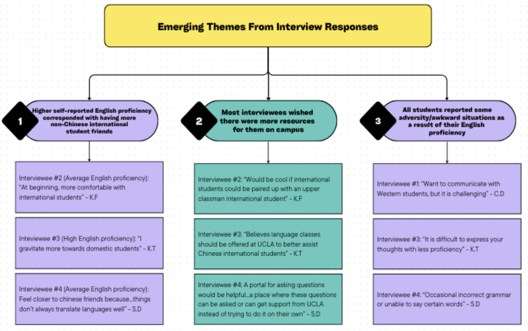
The three emerging themes are shown in Figure 2. Theme 1: higher self-reported English proficiency corresponded with having more non-Chinese international student friends. Theme 2: most interviewees wished they had more resources on campus. Lastly, in theme 3, students reported some adversity/awkward situations due to their English proficiency.

Fig. 2: Flow chart created to organize themes

Discussion and Conclusions

Three main themes emerged after evaluating the data collected by the survey and interviews. The first theme was that participants with a higher self-reported English proficiency tended to correspond with their response to having more non-Chinese international student friends. Implying that the participants felt that having a more proficient level of English helped them establish connections with non-Chinese individuals. Secondly, most, if not all, interviewees explained they wished there were more resources for them on campus. Some of these resources included the possibility of a mentor or a CIS club. This suggests that there is ample opportunity for UCLA to offer greater support to its international Chinese students and help international students create their own programs based on their needs. The final theme was that all the students reported some adversity or awkward situations resulting from their English proficiency.

While analyzing the data gathered from this study, we kept some important details in mind to help us understand our collection and conclusions. Our survey and interviews were based on self-reported proficiency levels rather than an actual language test, meaning the results are based more on a self-reported confidence level in their proficiency.

While attempting to conduct our interviews to gather more data, we found ourselves with a few limitations. One limitation was the lack of preliminary survey respondents who were willing to participate in a secondary interview. Our goal was to conduct five interviews. We secured three easily, but the other two were more difficult. Another limitation was the time available to explore our research question. With greater time, we could have spent more time collecting and examining more data.

In closing, after we analyzed the personal experiences of CIS at UCLA, we have been able to gather a better understanding of the relationship between English proficiency and the ease of social integration. We completed our research with the takeaway that there is a connection between language proficiency and socialization. Slang and cultural references are common difficulties, even with high fluency, and most people have created ideas on how to improve the international student experience. With future research, larger data samples could reveal more about these connections and other insights. Through the lens of these personal stories, we are not just uncovering challenges but also paving the way for a future where every student’s voice is heard. 

References

Garrison, Y., Park, S., Yeung, C. W., Li, Z., Ho, Y. C. S., & Chang-Tran, J. (2023). The social class worldviews of Chinese international students in the United States. Journal of International Students, 13(1), 40-58.

Hatch, J. A. (2002). Doing Qualitative Research in Education Settings: Analyzing Qualitative
Data
. (pp, 185-224). State University of New York Press.

Sin, C., Tavares, O., Aguiar, J., Biscaia, R., & Amaral, A. (2021). International students in Portuguese higher education: who are they and what are their choices? Studies in Higher Education, 47(7), 1–14. https://doi.org/10.1080/03075079.2021.1916907

Wang, P. & Zhou, G. (2021). A Study Of Chinese International Student Dropout: Acculturation Experiences And Challenges In A Pre-University English Language Improvement Program. McGill Journal of Education / Revue des sciences de l’éducation de McGill, 56(1), 52–70. https://doi.org/10.7202/1087048ar

Wilczewski, M., & Alon, I. (2023). Language and communication in international students’ adaptation: a bibliometric and content analysis review. Higher Education, 85(6), 1235–1256. https://doi.org/10.1007/s10734-022-00888-8

Xie, M. (2020, February). (Don’t) Talk to the Chinese Kids: My Journey with Diversity. and Inclusion [Video]. TEDxEmory. https://www.ted.com/talks/miga_xie_don_t_talk_to_the_chinese_kids_my_journey_with_diversity_and_inclusion?utm_campaign=tedspread&utm_medium=referral&utm_source=tedcomshare

Young, T. J. (2015). Questionnaires and Surveys. Research Methods in Intercultural Communication, 163–180. https://doi.org/10.1002/9781119166283.ch11

[/expander_maker]
, , ,

Fluency Ideologies Amongst Undergraduate Bi- and Multilinguals

Kendall Vanderwouw, Rachel Liu, Julia Tran, Nessa Laxamana, Thalia Rothman

UCLA is an incredibly diverse institution, with over 5,000 international students and 100 nations being represented. It is no surprise, then, that they boast a variety of cultural and linguistic backgrounds. From this wealth of information, we sought to explore fluency ideologies amongst bi- and multilingual undergraduates, aged 18 to 22. Through this course and personal experiences, it’s become evident that the definition of fluency is in constant flux. A largely self-defined term, fluency could encompass everything from native-level repertoire to conversational proficiency. Thus, we aimed to investigate whether linguistic background impacted self-perception of fluency.

We engaged in semi-structured interviews with 30 undergraduates to explore this phenomenon and its implications amongst different languages. As we dove deeper, however, we observed little variation in how different languages defined fluency. Rather, most participants revealed similar definitions, centering around, “the ability to express feelings and complex ideas.” Instead, participants expressed a positive relationship between self-perceived fluency and a sense of familial or cultural connection. This finding and others ultimately led us to a new research question that targeted whether an individual’s fluency in a language, upbringing, environment, and cultural background can influence linguistic identity.

[expander_maker id=”1″ more=”Read more” less=”Read less”]

Introduction and Background

Our research began with questions regarding linguistic identity and fluency. Why do definitions of fluency fluctuate? Are definitions of fluency influenced by our linguistic backgrounds? What is the role of fluency in our cultural lives? Our participant pool represented a variety of cultural and linguistic backgrounds with which to answer these questions. This unique context provided a near-direct perspective into the context of language acquisition since many students had recently left backgrounds of language learning or were still in proximity to them, such as high school and familial environments.

We examined these curiosities through a series of interviews, taking an ethnographic approach to gain a more holistic understanding of the perspectives of our participants. After consolidating interview data, our research focus pivoted in a slightly different direction, one that looked at how a variety of factors—including fluency—can influence one’s linguistic identity. Our central research question was finalized as such:

Does an individual’s fluency in a language, upbringing, environment, and cultural background influence their linguistic identity?

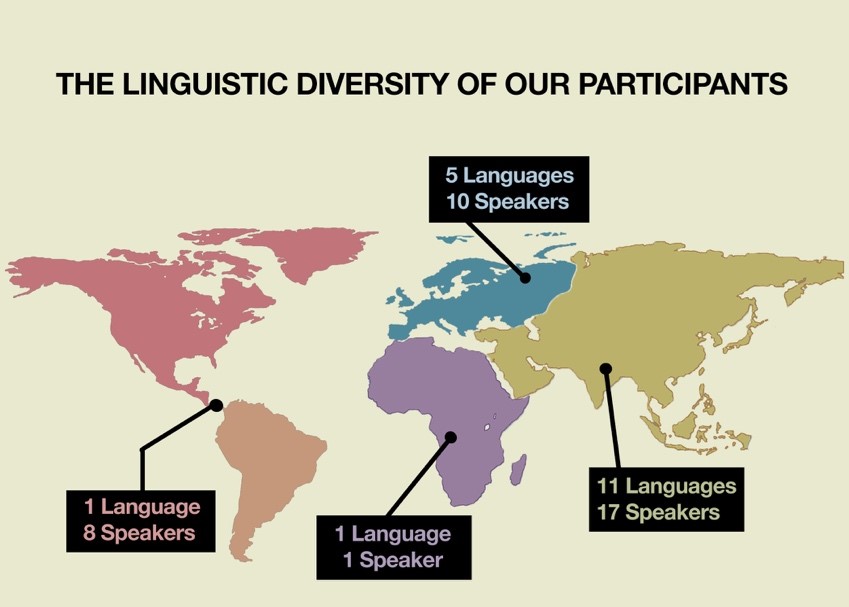
Overall, our project ultimately represented a variety of linguistic backgrounds and cultural identities, with 18 languages spoken by 30 different speakers. This is visually represented in Figure 1, created by one of our group members to illustrate the linguistic diversity of our participants.

Figure 1: Tran, J. (2024). A map illustrating the linguistic and cultural spread of our participants

 To garner a more in-depth understanding of our topic and to examine the current state of research, we engaged with readings regarding fluency ideologies as well as bi- and multi-lingual experiences. Such research provided context that informed our later analyses and conclusions.

For example, we found in several articles (Zubrzycki 2019; King 2013) that self-perceived fluency had the potential to give rise to shame or embarrassment in being unable to match the proficiency of others who may be exhibiting native-level fluency. Such ideologies create the daunting expectation that fluency necessitates a native-level mastery of a language. In addition to these academic sources, we found similar ideologies being proliferated through less formal means, such as YouTube videos. One video from Ted-Ed discussed the benefits of bilingualism to our brains, and in doing so put forth the concept of a “balanced bilingual,” which they describe as an individual who has equal proficiency in their languages. The video puts this idea forth, however, in order to make the point that the majority of bi- and multi-lingual speakers use their languages in different proportions and in varying scenarios. We found that videos such as this help to contribute towards a less stringent narrative of fluency that could lessen the shame caused by self-comparison to native speakers. 

Figure 2; Ted-Ed. (2015). A screenshot from the Ted-Ed video discussing bilingualism and how it may affect an individual’s brain.

This left our group wondering whether such ideologies would be found amongst our participants, and what factors would lead to the formation of the expectation to be natively fluent. Overall, these initial investigations revealed to us that there are certainly links between linguistic identity and fluency self-perception. Our goal through this project was to contribute to this existing pool of knowledge and to provide a voice for our participants to express their unique ideologies.

Methods

Using semi-structured interviews, comprising of 12 standardized questions, we decided to take an ethnographic approach to our data collection. Through this process, we searched for self-perceptions of fluency, past language acquisition environments, as well as any current language ideologies regarding themselves. This methodology was deliberately chosen in order to produce consistent, qualitative data while also providing room for our participants to elaborate upon concepts and topics of their choosing. When permission was granted, we recorded the interviews for the purpose of deeper analysis as well as direct quoting in our project. Our participant pool were undergraduate college students, aged 18 to 22 years old.

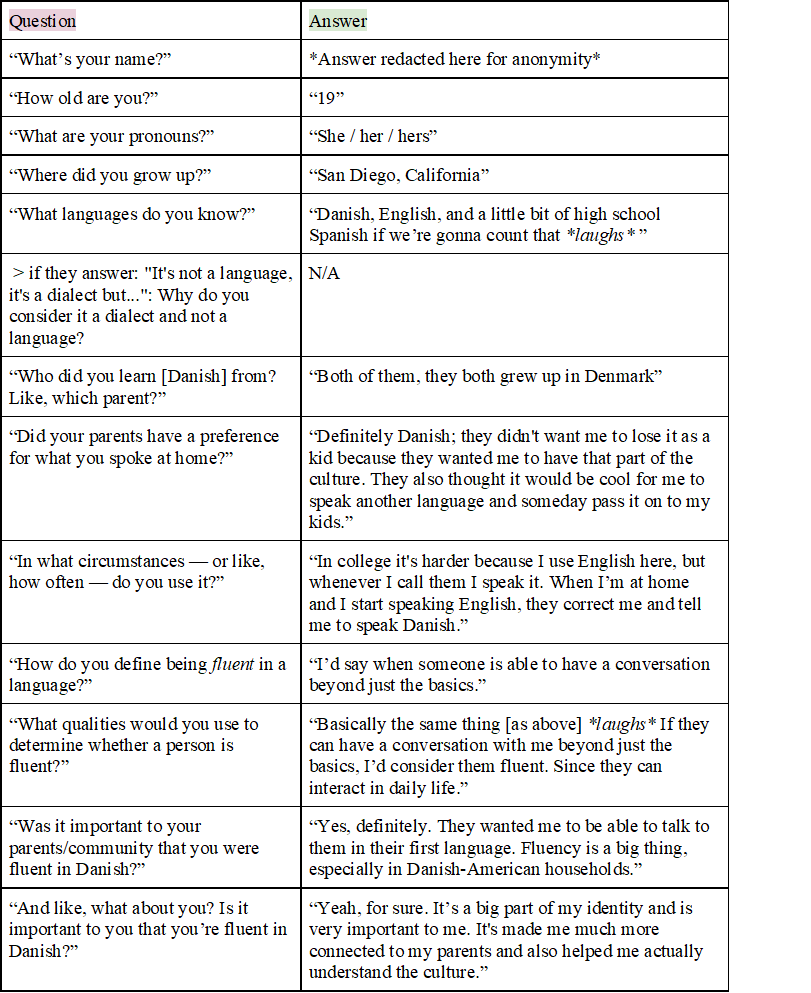
Some of the questions that we asked were as follows: “In what circumstances / how often do you use this (these) language(s)?”, “How do you define being “fluent” in a language?”, and “Was it important to your parents/community that you were fluent in this language? What about you?”

Results and Analysis

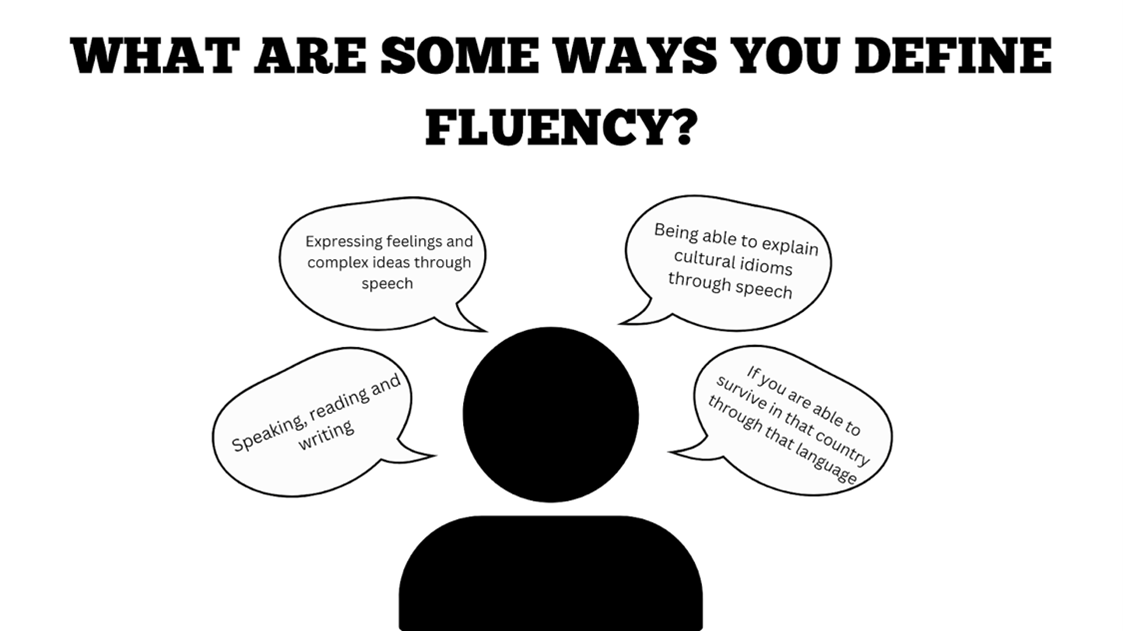
Our data provided us with different viewpoints and ideologies regarding bilingualism and multilingualism. However, 60% of our participants defined fluency as the ability to express feelings and complex ideas, beyond the introductory phase in the language they speak. Some participants were more descriptive, stating that the ability to speak about specific things, such as the country’s government system, or even cultural idioms or slang. Some were less specific, stating that if you can get by in daily scenarios, you are fluent. 

Figure 3; Laxamana, Nessa. (2024). A graphic showcasing how our participants defined fluency.

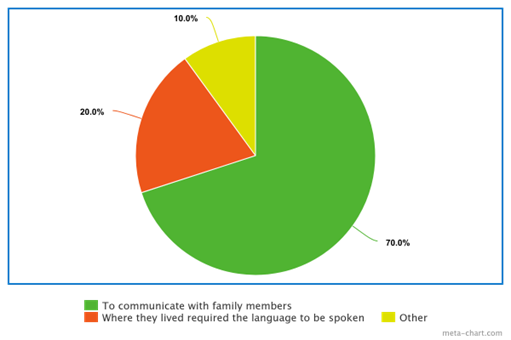
We also were able to discover different values that our participants held knowing their other language(s). 77% of our participants stated that they used their language to communicate with their family members, which is why they were able to become fluent in their language. This shows that language serves as a communication between different generations of people, for example between grandkids and grandparents.

Figure 4; Laxamana, Nessa. (2024). A pie chart illustrating when and where our participants use their non-dominant languages.

We interviewed those born in and outside the U.S., and one interviewee stated that being fluent in that language makes them feel more connected to their culture as seen in EX. 1. However, the variation in answers slightly differed between those born in different countries and those born in the U.S. For those born outside the U.S., they stated that their fluency in the language was a way to connect them back home. For those born in the U.S., they stated that fluency in the language was influential in how connected to their culture/mother tongue.

EX. 1

Discussion and Conclusion

At the center of our research was an investigation into the factors that make up and influence linguistic identity. We ultimately align our definition of linguistic identity with a reading from our initial research (Dressler 2014, p. 43), which argues that “linguistic identity can be expressed in terms of expertise (i.e. linguistic competence), affiliation (formal or informal connections), or inheritance (familial connections).” None of these factors were considered to be mutually exclusive in our research. As previously exemplified, the linguistic identities of our participants were commonly observed to be in line with more than one of the pathways mentioned above. Most importantly, our research brought about more understanding of how people’s various reasons for their language fluency are intertwined largely with their understanding of culture and belonging. Language and communication with others are important to keeping cultures and traditions alive, it serves as a sense of cultural connection for most. With our findings, we discovered an insight into how language fluency, ideology, and culture intertwine with one another.

References

Dressler, R. (2015). Exploring Linguistic Identity in Young Multilingual Learners. TESL Canada Journal32 (1), 42. https://doi.org/10.18806/tesl.v32i1.1198

King, K. A. (2013). A Tale of Three Sisters: Language Ideologies, Identities, and Negotiations in a Bilingual, Transnational Family. International Multilingual Research Journal, 7(1), 49–65. https://doi.org/10.1080/19313152.2013.746800

Ted-Ed. (2015, June 23). The benefits of a bilingual brain – Mia Nacamulli [Video]. YouTube. https://www.youtube.com/watch?v=MMmOLN5zBLY

Zubrzycki, K. (2019). Am I perfect enough to be a true bilingual? Monolingual bias in the lay perception and self-perception of bi- and multilinguals . International Review of Applied Linguistics in Language Teaching, 57(4), 447-495. https://doi.org/10.1515/iral-2016-0095

 [/expander_maker]
, , , , , ,

Turn on Your Camera, Foo : Slang and Visual Cues in the Classroom

Jiajun Weng, Chris Lam, Christine Chang, Terri See Lok Ho, Wei Lin

Have you ever wondered whether understanding what your classmates are saying and the seeing their cameras is essential to succeed in the course?

You’re not alone.

During this special period, education has primarily moved on to online. Many international students from UCLA taking online courses claim that they feel alienated in the class because they cannot see their classmates when their classmates are talking, and they sometimes cannot understand the online slang used by their classmates. Does the usage of online slang and lack of visual cues truly impact their learning experience?

For finding out the answer to this question, we conducted a study to investigate how the use of slang and the lack of visual cues contribute to international students’ comprehension difficulties and their feelings of alienation. The survey sample comprised entirely of UCLA students. By analyzing the data, we found that interestingly, their feeling of alienation was not affected by usage of online slang nor lack of visual cues. Furthermore, we found that their comprehension was not associated with inclusiveness. That is, it shows that one can still succeed in the class even if one feels alienated.

[expander_maker id=”1″ more=”Read more” less=”Read less”]

Introduction

International students in an English-speaking country such as the United States face various challenges related to language. For instance, they struggle with the use of slang and cultural references in a classroom setting. In Bradford’s research, he found that “Teaching colloquial speech in any language can be important for acquisition and assimilation into the language’s cultural group” (Bradford, 2010). In a separate study, Albalawi found that some L2 learners indicate learning slang is helpful for students to fit in socially in college and gain confidence (Albalawi, 2014). Both articles demonstrate that learning the slang of other cultural groups is a crucial tool for L2 learners to master if they want to become more assimilated. However, some of these difficulties in comprehension can be overcome by implicit cues such as facial expressions and gestures (Sueyoshi & Hardison, 2005).

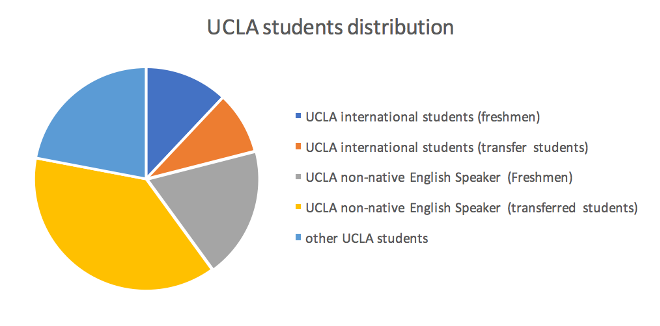
A comment about Figure 1 below showing the breakdown of UCLA students and their experience with English. Moving onto online learning platforms during the global COVID-19 pandemic, international students face new challenges like adapting to the lack of visual cues — such as facial expression and gestures — as well as the colloquial way people speak during Zoom lectures. As a consequence, international students’ ability to comprehend course materials may be compromised by the lack of social cues. With limited understanding of course material, these students could subsequently feel disconnected, or even isolated from the class, and hence disengaged with the course.

International students who engage primarily on non-English social media platforms, such as Wechat, Weibo or KakaoTalk, may have found it more difficult to navigate higher education in this virtual environment. Within this experimental study, we investigated how the use of slang and the lack of visual cues contribute to international students’ comprehension difficulties and their feelings of alienation. Specifically, we expected to find increased feelings of alienation and reduced engagement among international students in the face of online English jargon and little visual cues. However, we hypothesized that the use of slang should not significantly impact students when visual cues are present in the recorded lecture because non-verbal communication can be an important source of motivation and concentration for students’ learning as well as a tool for taking and maintaining attention (Zeki ,2009).

Figure 1: UCLA students’ distribution


Collecting Data: Setting up a Classroom

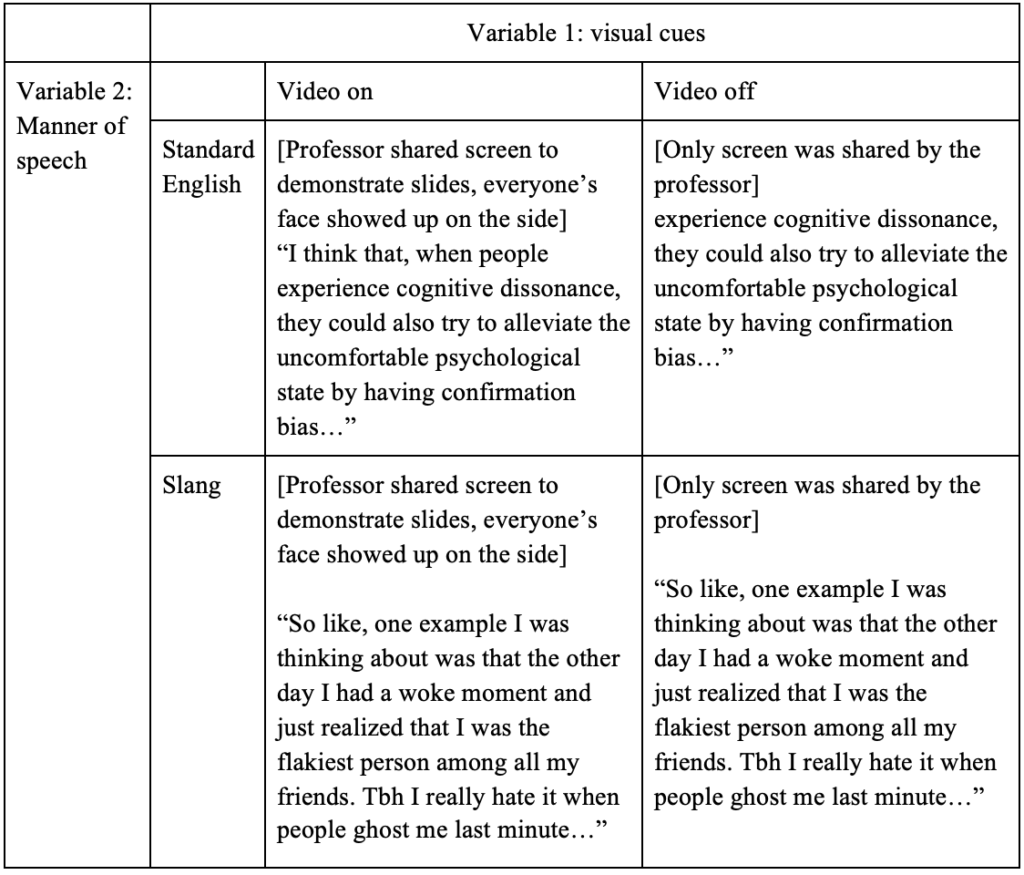
An experimental study was conducted to test our hypotheses about how the manner of people’s speech during the lecture and visual cues (i.e., facial cues and gestures) interacted with each other to influence international students’ understanding of the course materials and their feeling as a member of the class. In the current experiment, we showed our 16 international student participants one of the four Zoom lecture recordings in which we systematically varied the manner of speech of people in that class, as well as the presence of visual cues. To manipulate people’s manner of speech during class, the student confederates discussed the class material in standard English or in a colloquial manner that involved the use of English slangs, like “btw” or “hella”. To manipulate the presence (or absence) of visual cues such as facial cues and gestures, confederates in the current class video will either turn on or off their camera and showed their face and hand movement during the lecture recordings. Please see Table 1 for a demonstration.

Table 1: Matrix of variables and samples of corresponding experimental script


After the participant watched one of the four mock zoom lecture recordings, they were instructed to complete a questionnaire that assessed their understanding of the lecture content, which is about this basic psychological phenomenon called the cognitive dissonance theory. Besides the objective measure of participants’ understanding of the class material, their subjective perception of how well they understood the lecture was also assessed. Finally, we measure how much these participants feel like a member of the class and the likelihood of engaging with the lecture if they were present in the Zoom meeting room.

Results and What They Mean

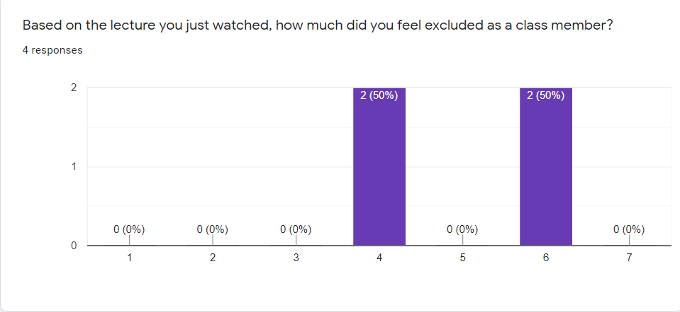
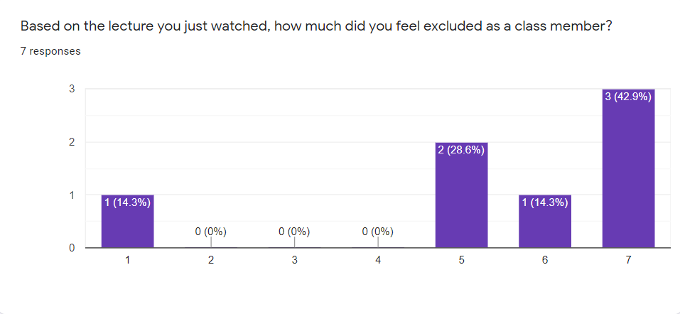
Figure 2: Video On and using Slang trail; participants’ feeling of alienation


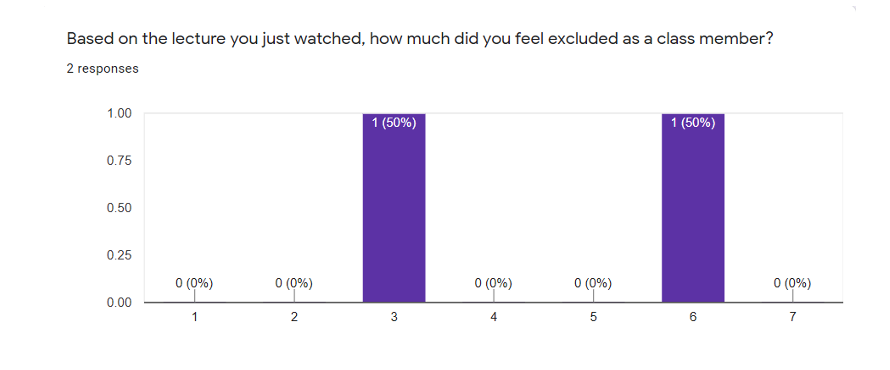
Our findings supported the initial hypothesis that having video on in these online lectures affected students’ level of comprehension. However, there wasn’t a statistically meaningful difference in feelings of exclusion. In particular, the analysis showed that there was a meaningful difference between the results of the survey question regarding subjective comprehension conducted with the students who watched the lecture with video and without video, regardless of whether there was slang or standard English used. However, even by looking at Figure 2 and Figure 3, it is clear that students felt excluded either way.

Figure 3: ’Video Off and using Slang trial; participants’ feeling of alienation


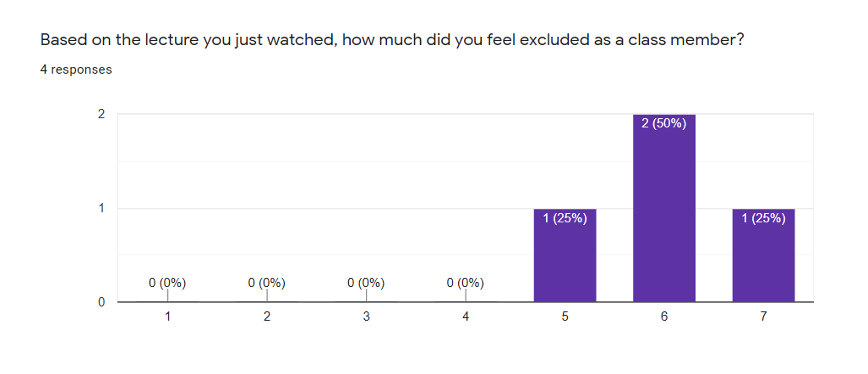
The same was true regarding our initial hypotheses about slang usage. The study showed a statistically meaningful difference in level of self-reported comprehension, but not on the feelings of exclusion. Visually comparing Figures 2 and 4 shows that the responses to the question about alienation were not meaningfully different when video was on vs. off in Figures 3 and 5. Even a cursory review of the results of all the survey questions that attempted to measure feelings of exclusion and alienation showed high levels across the board, boding negatively for online classes as a whole.

Figure 4: Video On and using Standard English trial; participants’ feeling of alienation


Figure 5: Video Off and using Standard English trial; participants’ feeling of alienation


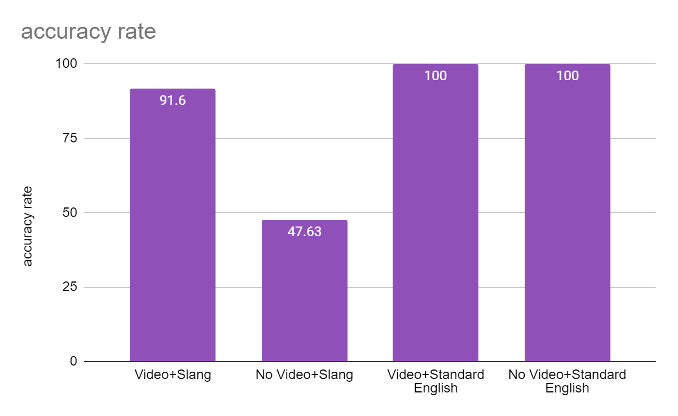
And perhaps the most important result came from comparing the interaction factors of video and slang in the comprehension question. What our study found was that while there is a statistically meaningful difference in individual comprehension in response to both factors, i.e., video and slang, there was not significant interaction between them when it came to self-reported levels of comprehension. That is to say, contrary to our initial hypothesis, a factor like having video on doesn’t necessarily interact meaningfully with the differences caused by slang usage in comprehension.

Figure 6: The rate of participants correctly answering the quiz questions


However, when it comes to the actual analysis of the answers to the quiz questions, not just self-reported comprehension, there is a noticeable interaction factor. Figure 6 shows that when slang is used, the presence of video had a significant impact on actual comprehension as measured through the quizzes, whereas video had less impact when standard English was used. 

There are, of course, various factors that could be complicating this kind of analysis. The subjects chosen for the mock lesson, were it more or less visual, may have more of an effect on how these two variables interact. The length of the lesson may have an impact on all these variables depending on how often it becomes relevant that video is used or not. This study is not necessarily definitive but poses some important questions on how all of these variables can be utilized by educators in aiding comprehension and limiting alienation in classrooms.

Conclusion: The Classroom and Beyond

All in all, more research should be done with regards to the virtual learning environments that most of the world was thrown into due to the pandemic. There may be many key improvements to education in general, whether online classes are here to stay for a while or not. From our initial hypothesis that English slang negatively impacts international students’ engagement with and understanding of classroom material, we find that comprehension may be hindered by slang usage and a lack of visual cues, independently; however, international students seem to feel like they do not “fit in” with the class regardless of these variables, and their aptitude does not seem to suffer because of that in general.

We live in an ever growing technologically dependent society, yet online meetings can often feel like an obstacle and/or a divider when compared to in-person classes. In the article “Depression and Everyday Social Activity, Belonging, and Well-Being,” Michael and Todd stated that “When people experience positive social interactions, they should be more likely to feel a sense of belonging.” Alongside virtual meetings in the workplace, there is a lot that can be done by the hosts to improve distracting and frustrating video calls. Based on this small study, we recommend professors and teachers to encourage students to turn on their videos, with the caveat that there may be personal and privacy challenges. We can say that there may be evidence that doing so will help students’ comprehension of the material. We also suggest addressing slang and jargon when it arises in the classroom, making sure to at least clarify rather than exacerbate what may negatively impact some students’ learning outcome.

There are an endless number of questions to be asked in the realm of education research, with regards to both online and in-person mediums. Perhaps this experiment may be repeated with a live virtual classroom setting to really capture engagement and chat-box interaction data. Furthermore, there is something to be examined in asynchronous learning, i.e., these pre-recorded lectures in the study that subjects independently and asynchronously watched. In a pandemic that generates so many struggles, personally and in education, there is the possibility that Zoom lectures are a breakthrough to education access the world needs; we just need to optimize and adapt to it, rather than conceding at its shortcomings.


Further info

The PowerPoint form of this blog entry

A TedTalk which talks about the relationship between inclusiveness and your manner of speech


References

Albalawi, A.S. (2014). Saudi L2 learners’ knowledge and perceptions of academic English slang. [Order No. 1566835]. Southern Illinois University at Carbondale.

Bradford P.B. (2010). The acquisition of colloquial speech and slang in second language learners of English in El Paso, Texas . [Order No. 1484150]. The University of Texas at El Paso.

Steger, M. F., & Kashdan, T. B. (2009). Depression and Everyday Social Activity, Belonging, and Well-Being. Journal of counseling psychology, 56(2), 289–300. https://doi.org/10.1037/a0015416

Sueyoshi, A. & Hardison, D.M. (2005). The Role of Gestures and Facial Cues in Second Language Listening Comprehension. Language Learning, 55: 661-699. https://doi.org/10.1111/j.0023-8333.2005.00320.x

Zeki, C. P. (2009). The importance of non-verbal communication in classroom management. Procedia-Social and Behavioral Sciences, 1(1), 1443-1449.

[/expander_maker]
, , ,

Code-Switching Between Mandarin Chinese and English: Do You Use “lol” or “xswl”?

Wenqian Guo, Sum Yi Li, Yichen Lyu, Sok Kwan Wong, Yingge Zhou

Code-switching has become increasingly common as globalization allows international exchanges across cultures to take place more frequently. And as studying abroad becomes more accessible to students around the world, more speech communities with distinctive code-switching patterns are being formed. As we pondered the topic for our research project, we looked around and realized that not only are the majority of our group members native Mandarin speakers studying in the US, but collectively we also belong to this wider speech community that tends to code-switch between Mandarin and English. We could not help but wonder — do local students in China talk like us at all? And is there a reasoning behind the way we talk? It is these questions that formed the basis of our research.

For the project, we narrowed down our research to focus on just Internet slang used on WeChat, China’s answer to WhatsApp. Through our proprietary survey and by combing through chat history we collected from our participants, we discovered some very interesting findings. Continue reading to find out how and why Mandarin-speaking international students in the US code switch on WeChat.

[expander_maker id=”1″ more=”Read more” less=”Read less”]

Introduction and background

Chinese students who study in the U.S. often code switch between Mandarin and English and our project was aimed at examining the motivations behind the phenomenon.

We specifically looked into our subjects’ texting patterns on messaging app WeChat and compared them to Chinese students either residing in China or other non-English speaking countries in an attempt to confirm our assumption that code-switching is prevalent among Chinese students in the US. We also surveyed the students and asked for reasons behind their choice of words. We hypothesized that convenience as well as a desire to appear foreign-educated are what motivated the code-switching.

We based our project on Luke’s (1984) study on language mixing in Hong Kong, where English words are often inserted into Cantonese conversations. Luke (1984) concluded that code-switching in Hong Kong is partly pragmatically motivated (when the objects being discussed do not have Chinese translation) and partly socially motivated (when the individuals want to identify as better educated and westernized).

We extended Luke’s (1984) study to cover Mandarin Chinese, which is spoken in Mainland China. Presumably English mixing is more prevalent in Hong Kong because it is a former British colony. Code switching is not common among locals in China, but it is observed among individuals who have exposure in English-speaking countries.

Methods

The target population for our project consists of two major groups: college students who study in the US and college students who study in their home country China. Both groups of students are native Mandarin speakers. Our data collection was divided into two parts. First, we created a survey to ask both groups of students to select from provided word choices under different text conversation scenarios and provide us with a reason behind each choice. The participants were also asked to specify how frequently they would code-switch in their daily conversations with friends and family on WeChat. Second, we collected a series of chat history based on three main topics, namely schoolwork, casual conversations and sensitive topics. For the survey, we interviewed a total of 17 students from UCLA as our sampling for the groups of students who are foreign educated. We also interviewed a total of 6 college students who are based in China.

Results

For the purpose of discussion, our project referred to college students who study overseas as “US students” and those who study in China as “local students”.

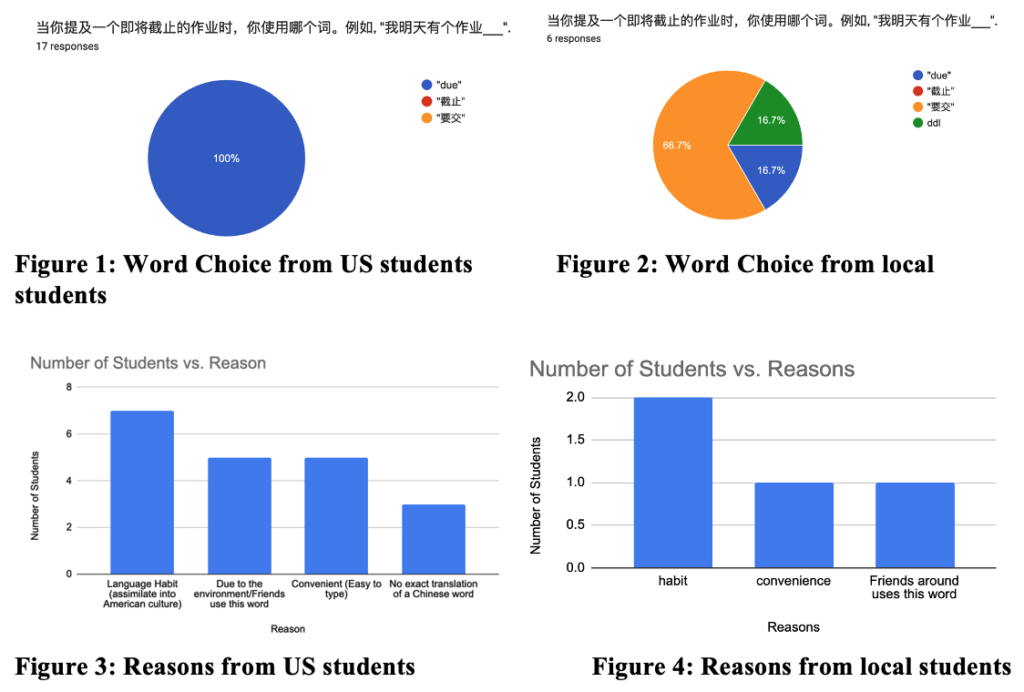
School Work Survey Question 1: Which word would you use when you want to talk about a homework assignment that will be due soon. For example, “我明天有个作业___”. (Tomorrow I have some homework__)

For the first survey question regarding homework assignment, all of the US students chose the English word “due”, while the majority of the local students chose the equivalent Chinese words “要交”. Even though most students from both groups attributed their choice to a similar reason, which is language habit, from the perspective of the US students, “language habit” refers to a way to try to assimilate into the American culture, while in the context of the local students, it is more of an innate and natural habit.

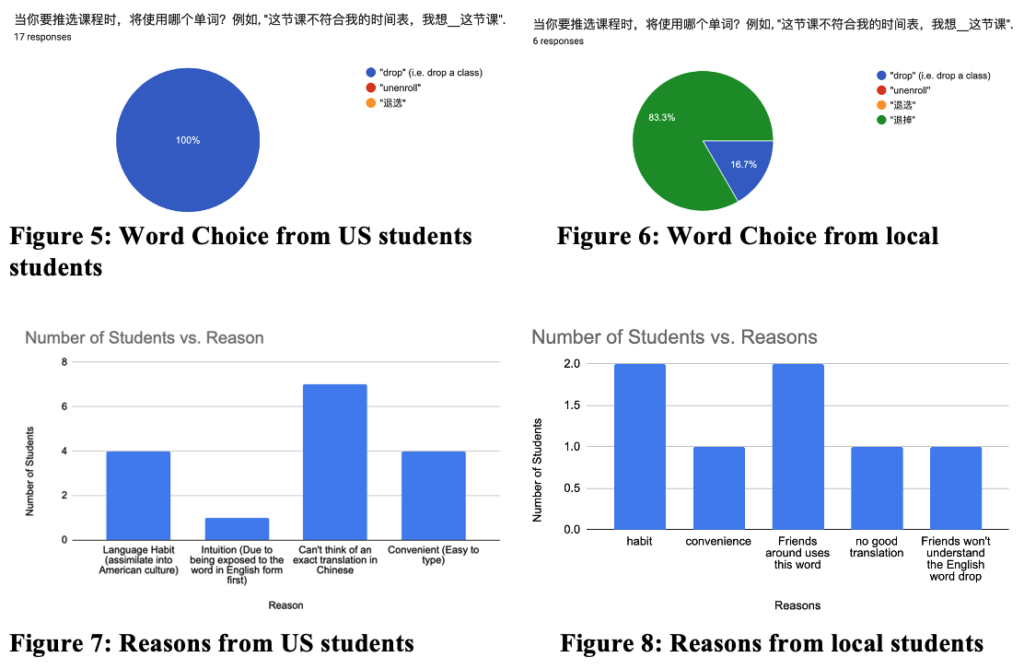
School Work Survey Question 2: Which word would you use when you want to unenroll a class you have registered before? For example, “这节课不符合我的时间表, 我想__这节课”. (This class doesn’t match my schedule, I want to __ this class.)

For the second survey question relating to unenrolling classes, all of the US students chose the English word “drop”, while the majority of the local students picked the Chinese equivalent “退选”. However, both groups have different reasons behind their word choice. The majority of the US students said they chose the word “drop” because there is no equivalent translation in Chinese. On the other hand, the local students preferred using Chinese due to language habits influenced by their friends and family.

Based on the reasons the participants provided, it appears that being in different environments and different speech communities are the main reason students develop different language habits. Besides, the source of learning also influences their word choices. The US students tend to find it hard to find Chinese translation for words related to schoolwork since they learned these words in an English-speaking environment.

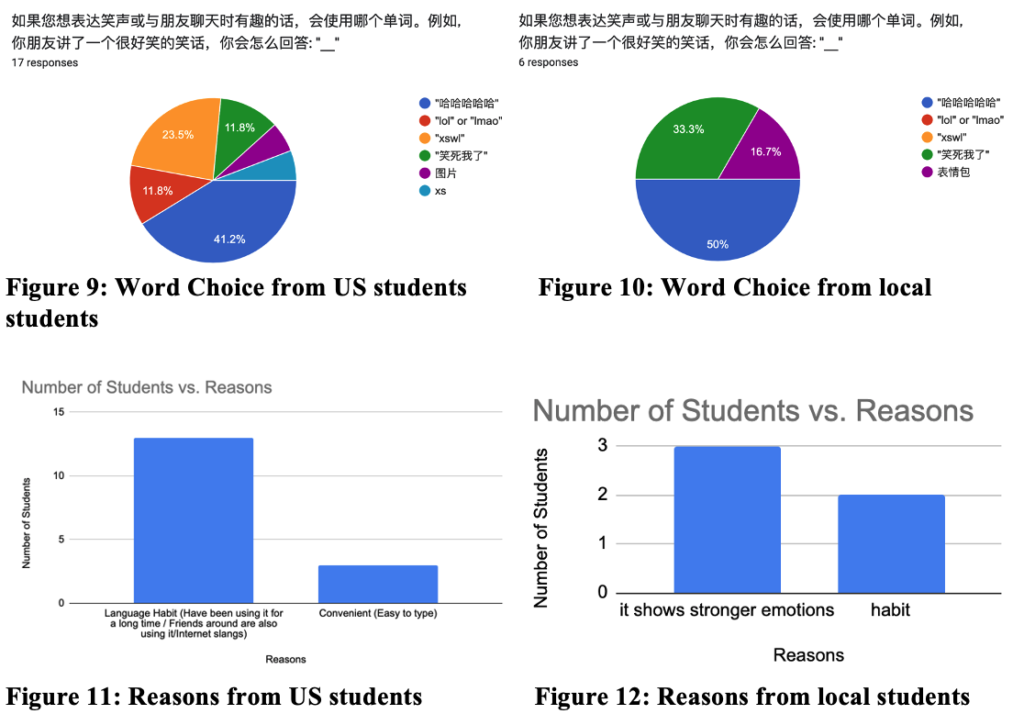
Casual Conversation Survey Question 1:  Which word would you use if you want to express laughter or something that is funny when you are chatting with your friends.

When asked how they would express laughter when texting, the majority of the US students chose the Chinese words “哈哈哈哈” (“Hahahaha”), while the majority of the local students picked another Chinese phrase “笑死我了” (“I laugh to death”). Even though both groups of students used Chinese to express laughter, each side has their own reason for the specific choice. The US students said they preferred “哈哈哈哈” (“Hahahaha”) as a language habit, while the local students preferred “笑死我了” (“I laugh to death”) because they believed the expression could better demonstrate their emotions and the situation. The results showed that Mandarin-speaking college students preferred to use Chinese when expressing laughter regardless of where they are studying.

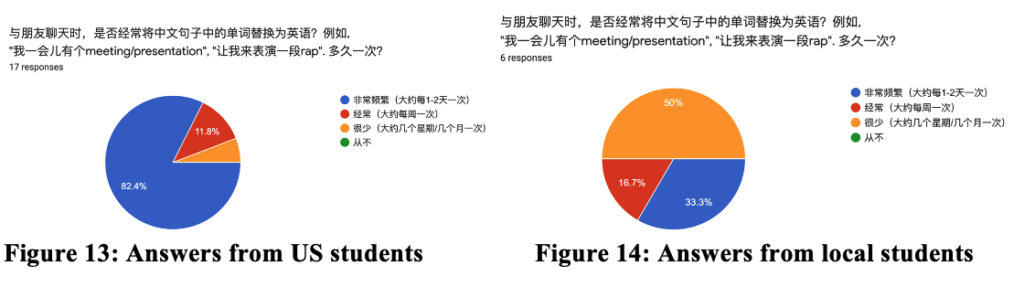
Casual Conversation Survey Question 2: How often do you often replace words in a sentence from Chinese to English when you are chatting with your friends? For example, “我一会儿有个meeting or presentation”, “让我来表演一段rap”.

When asked how frequently they code-switch between Chinese and English when texting their friends and family, the majority of the US students said at least once every one to two days. Meanwhile, half of the local students said they seldom code-switch — only at least once every few weeks or months during their daily conversations.

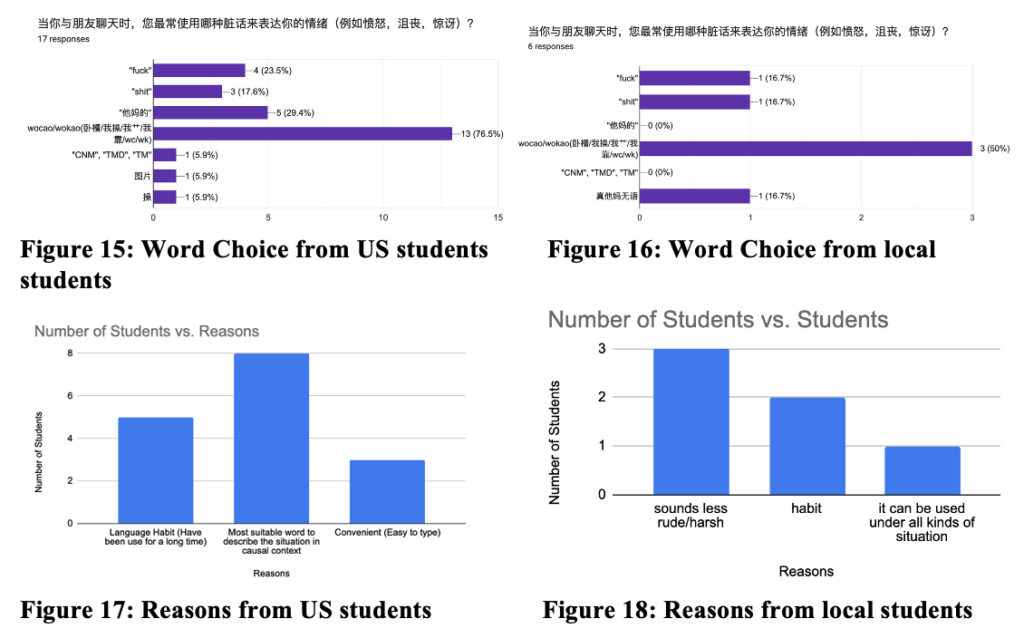
Sensitive Topic Survey Question 1: What kind of curse words would you use most frequently when you are chatting with your Mandarin speaking friends?

When asked which curse words they most frequently use, both groups of students chose “卧槽/我操/我靠” (roughly translated as “Damn it/Fuck”) but for different reasons. The US students said this option best describes their feelings, while the local students said it sounds less harsh than the other choices.

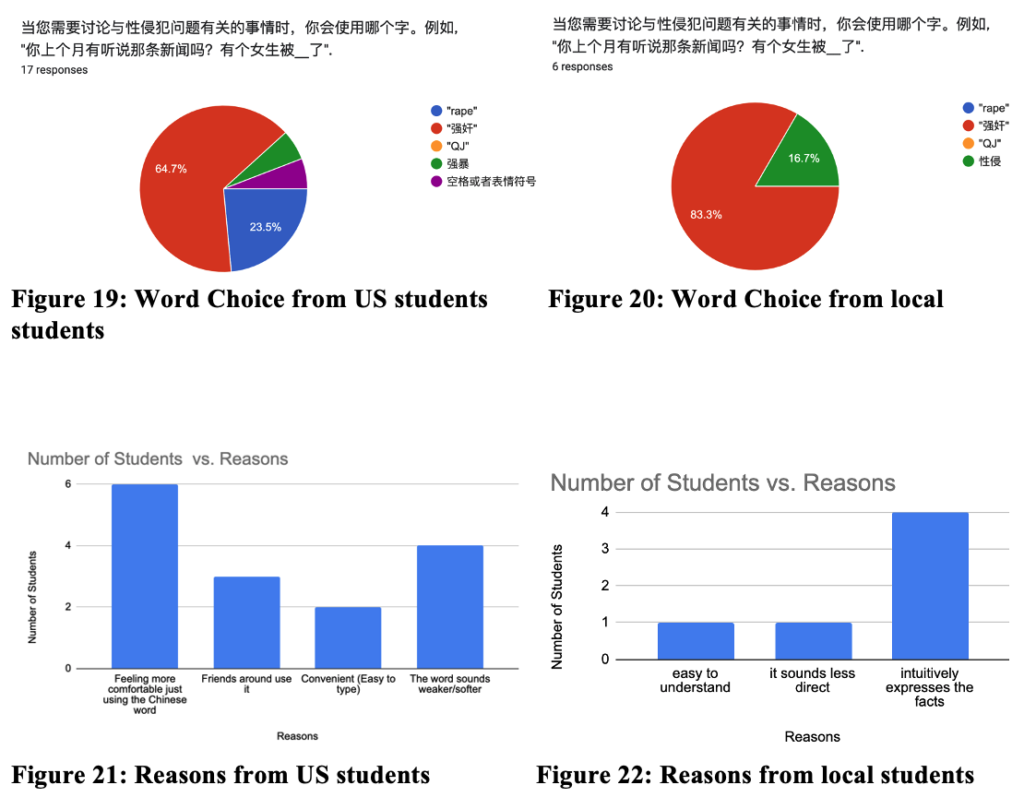
Sensitive Topic Survey Question 2: Which word would you use when you need to discuss something that is related to the issue of sexual assault. For example “你上个月有听说那条新闻吗?有个女生被__了”. (Did you hear the news? A girl was __)

When asked what words they would use to say “rape”, the majority of both the US and local students chose the Chinese words “强奸”, instead of “rape” in English or the abbreviation “QJ”. Most local students said they did not worry whether the word sounds too direct or inappropriate but would rather want to just say what really happened. Similarly, the US students said they felt more comfortable with the Chinese words.

Our survey: English version and Chinese version

Chat History Analysis

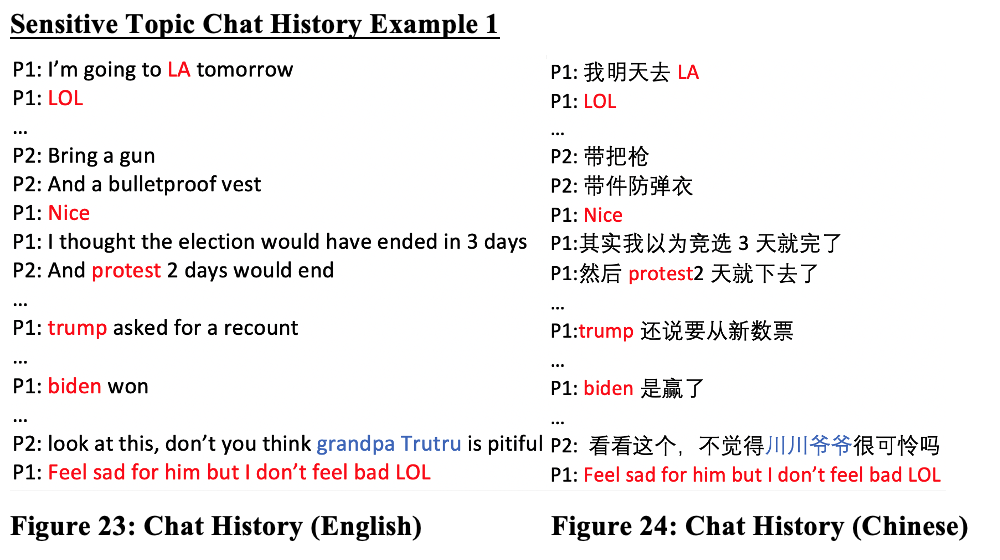
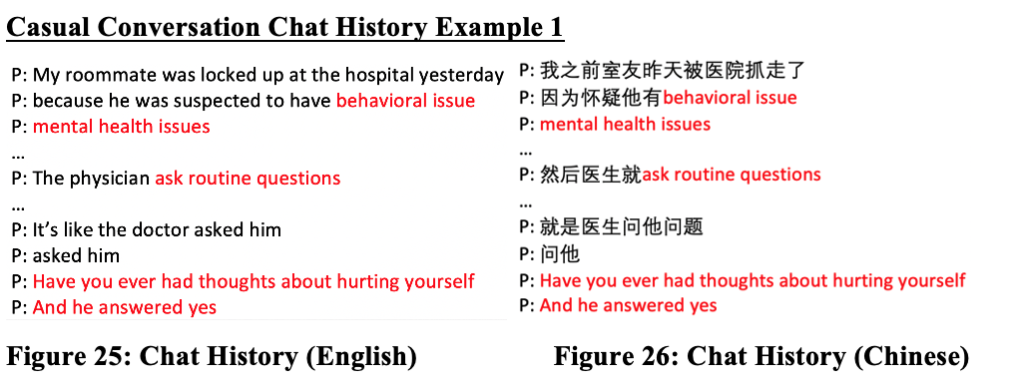
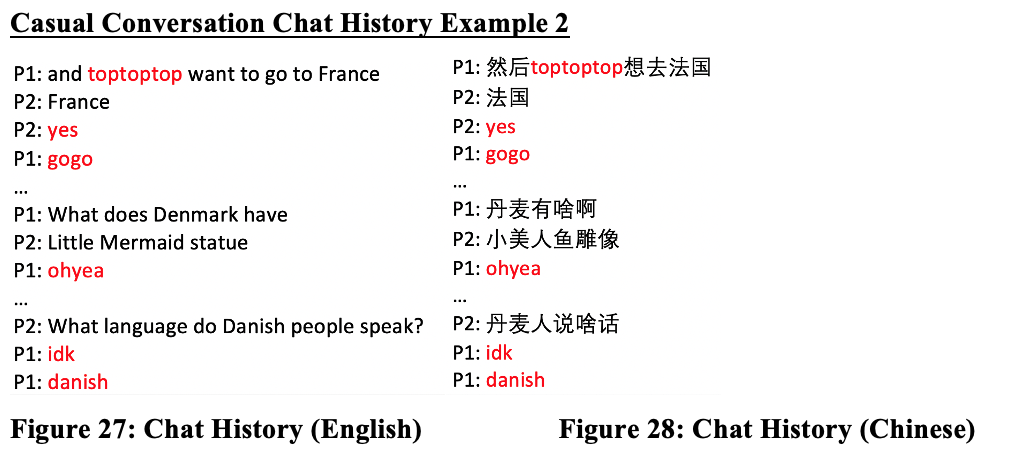
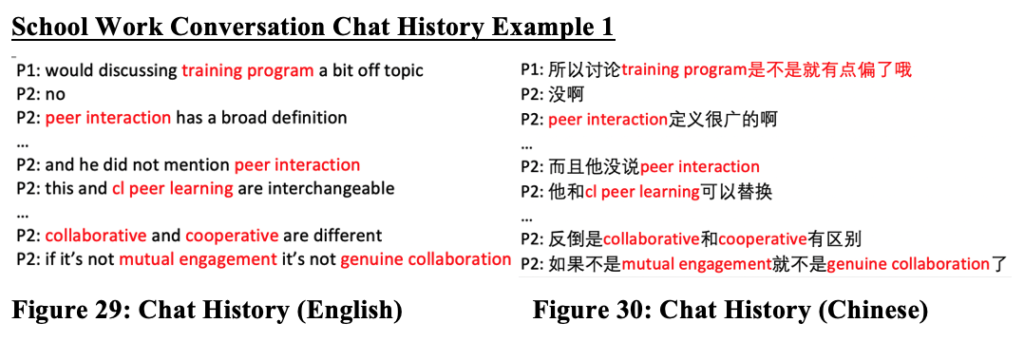
The chat history was obtained from Chinese students studying in the US. The words marked red were originally in English, while those in black are translations from Mandarin.

This is a conversation between two participants about the recent US election. P1 said they expected people to stop protesting in two days. Instead of using the Chinese words (“游行”) for protest, P1 code-switched from Mandarin to English. Since protests are rare in China, and the Chinese words for protests are rarely used, presumably it is easier for the participant to just use the English word when texting.

Marked code-switching is observed when P1 expresses a slight disagreement with P2. As P2 feels empathetic to Trump, P1 emphasizes with English to express that they don’t feel sad for Trump’s loss.

Another interesting point is that P2 referred to Trump as “Grandpa Trutru”, his Chinese nickname. Chinese people sometimes use nicknames to refer to important politicians, which is likely stemmed from China’s censorship on sensitive topics. Discussions about certain politicians are considered highly sensitive, so to avoid censorship, they come up with nicknames for the politicians. For example, Trump is also known as “懂王” (“the king who knows it all”), while Biden is “睡王” (“the sleepy king”). The use of nicknames exudes a sense of humor as well as dials down the seriousness of the discussion of political issues.

In casual conversations, code-switching again lends convenience and gives emphasis. It also constructs a common identity among people in the conversation. In the above conversation, the participant is telling a story about their roommate being forcefully taken away to the hospital after answering routine behavioral questions wrong, which is a well-known cultural shock among Chinese students studying in the US. As this routine is not performed in China, the participant constantly code-switched on noun and verb phrases for convenience. Also, all participants of this conversation are Chinese international students. The code-switching builds a common identity among them because the participant expects everyone to know the consequences of answering yes to routine behavioral questions. The last two sentences are examples of marked code-switching that emphasize on the participant’s disbelief: The participant is surprised that his roommate answered yes. It is a final revelation of the ending to this anecdote.

Similarly, in the above conversation, code-switching again serves as building a common identity among Chinese students in the US. The participants constantly chose to use short English vernaculars, such as “yes,” “go,” and “yea.” This indicates that they have been immersed in an English-speaking environment, so when expressing agreement and excitement, they tend to code-switch to English. Also, P1 ignored all English spacing in the conversation. This is because when typing English with the Chinese keyboard, adding spacing can be time-consuming. For convenience, P1 simply ignored the spacing during texting. Even so, P1 chose to respond in English, demonstrating that it is more natural for them to use these English vernacular phrases.

In academic scenarios, code-switching almost entirely occurs in jargon. By using English jargons such as “peer interaction” and “mutual engagement”, the participants demonstrated their educational background as foreign.

Discussion and Conclusion

From the aforementioned data findings, it can be concluded that Chinese students who study abroad and those who only study in China show different patterns in their language usage. When it comes to schoolwork and casual conversations, insertions of English words into Chinese sentences and code-switching between English and Chinese are mainly observed among students who study abroad, while less so is seen among the domestic students. This difference can likely be attributed to a lack of translation equivalence, as many school work-related words are only applicable in the US. The same goes for casual conversations. It is therefore not difficult to understand why the US students would tend to code-switch to English when there seems to be a lack of translation equivalence in Chinese.

Besides, the needs for social and emotional expressions evoked by surrounding cultural environments and contexts also contribute to the different language patterns and code-switching. In China, a conservative country both culturally and politically, pro-government language is encouraged, while the freedom of speech is repressed. This repression has in turn cultivated stronger needs for expressing emotions among the local students, leading to their choice of more confrontational and direct wordings when discussing sensitive topics. On the other hand, a higher frequency of code-switching among the US students revealed their needs to be identified as foreign-educated and share common identities with other speech participants of similar backgrounds.

Our findings point to the important roles that social surroundings and the kind of language encouraged within these environments could play in one’s speech patterns and code-switching. That being said, the language choices that the participants made are not entirely dependent on their own characteristics but are rather choices commonly negotiated by one’s surrounding social context as a whole. This contextual-based understanding therefore sets a reminder for future conversation analysis and sociolinguistic study, that one’s speech patterns could not be analyzed and identified without incorporating the nature of the surrounding speech contexts and cultural environments.


More on the topic:

Video about attitudes toward code switching in China

Paper on Chinese-English code-switching in conversations

References

K.K. Luke (1984), Expedient and Orientational Language Mixing in Hong Kong, York Papers in Linguistics 11, 191-201

[/expander_maker]

, , , , ,
Scroll to Top