Why it’s Really Not You, It’s Them. Hook Up Culture, Explained
Have you ever wondered why participants of hook-up culture have a hard time communicating with one another? Whether it’s differences in intentions or the usage of different communication styles, it’s likely that they’re not on the same page. As a result of our extensive research, this paper will highlight the reality of hook-up culture and the big question that haunts the community: How do participants of hook-up culture communicate differently than the ingrained standards we see within long-term relationships? Our hypothesis specifically focused on the idea that communication within hook-up culture will differ between genders and communication styles, ultimately creating a larger gap between methods of communication in short-term and long-term relationships. With the help of our studies, we were able to identify the use of code-switching through emojis and slang, common communication themes (vernaculars and communicative traits), and overall motivations! Overall, we hope to help many be able to overcome communication barriers within hook-up culture in order to see some healthy change within our social dynamics and communication!
[expander_maker id=”1″ more=”Read more” less=”Read less”]
Introduction and Background
The goal of our paper was to research the intricacies of a prevalent communication topic in our generation: “hook-up culture”. More specifically, we chose to focus on the motivations behind each gender’s experiences or participation in hook-up culture, ultimately allowing us to analyze the different communication patterns exhibited as well. Hook-ups within “hook-up culture” are defined as, “… activities [that] may include a wide range of sexual behaviors, such as kissing, oral sex, and penetrative intercourse …. these encounters often transpire without any promise of, or desire for, a more traditional romantic relationship…” (Garcia/Merriwether, 2012). With this definition, the rise of hookup culture is then marked by the phenomenon of, “…increasingly normative among adolescents in North America, representing a marked shift in openness and uncommitted sex…” (Garcia/Merriwether, 2012). As a result, our research was conducted on the basis that hook-up culture is prevalent within our society. However, given the constraints of our research project, we had research gaps that prevented us from reaching further conclusions, including the short amount of time we had to conduct our research (given more time we would research a larger group). Another limitation was due to the lack of empirical research on hook-up culture due to the prominence of the topic only flourishing within this past decade.
Our last limitation came as a result of the demographic in which we focused on. Obviously, our demographic was catered to college students, but there may be different results if our demographic was different– so that most definitely should be noted. However, our research, as shown throughout this blog post, will illustrate that our hypothesis is mostly supported by our conducted research. Our research highlights different modes of communication, varying personal intentions, and the popularity of hook-up culture amongst college-aged students.
Methods
Within our method, we looked at different sources of information such as scholarly articles, scholarly speeches (TedTalk), and our own research conducted through the usage of Google Forms. Our scholarly references ranged from communicating commitment in a romantic relationship to communication in the modern hook-up culture, but we made sure to organize an array of valuable sources that would not only prove our hypothesis but also explain our results within our conducted survey. We distributed a survey (through GroupMe chats, Instagram stories, and professors showcasing it at the beginning of class) to our wide demographic of students at UCLA who have knowledge or a basic understanding of hook-up culture, ultimately granting us valuable responses that could help us with our research on how communication differs within hook-up culture through studying gender imbalances/differences in viewpoints and styles. Through our survey, we politely asked our respondents to share their experiences with hook-up culture and answer our specific questions to the best of their abilities. Additionally, there were no incentives and we made sure to inform them that their responses would be anonymous and removable at any point in time. We asked 10 specific questions in connection to our research and our own personal wonderings alongside an entry method for attachments of physical experiences with hook-up culture. Some examples of our questions were: check off boxes of emojis you’ve used when communicating with a prospective partner or how to communicate your intentions to a prospective partner, therefore giving us a deep understanding and a specific answer to the ideas that our research would mention but not specifically answer for us. Within our research, we analyzed communication styles such as emojis or slang, collective gender differences within communication patterns and beliefs, and overall values within personal communication styles and methods such as direct vs. passive communication. For more information on our exact survey, here is a direct link to it: https://forms.gle/cGUqi9sAmSsGQoNX8.
Results and Analysis
In summary, our hypothesis focused on how romantic communication differs between types of connections/relationships (hook-up partners vs long-term relationships), and how each gender engaged with each category differently. Through our extensive research methods, we found that there were factual differences between male and female ideologies. For example, there were similarities within our target audience such as age, education status, and lifestyles – which played a role in the situations these individuals would imagine and partake in throughout their experiences with or without hook-up culture. Our respondents were 50% male and 50% female, mostly aged at 21 to 23 years old by 87.5%. Now, the differences range from gender perceptions/mindset, communication styles, and personal values/needs.
Our survey questions were able to support our hypothesis. For further context, here are some of the most important pieces of information gained from our studies. When asked about hook-up culture in our generation and if they (respondents) participate in hook-up culture, 87.5% answered yes (Figures 1 and 2).
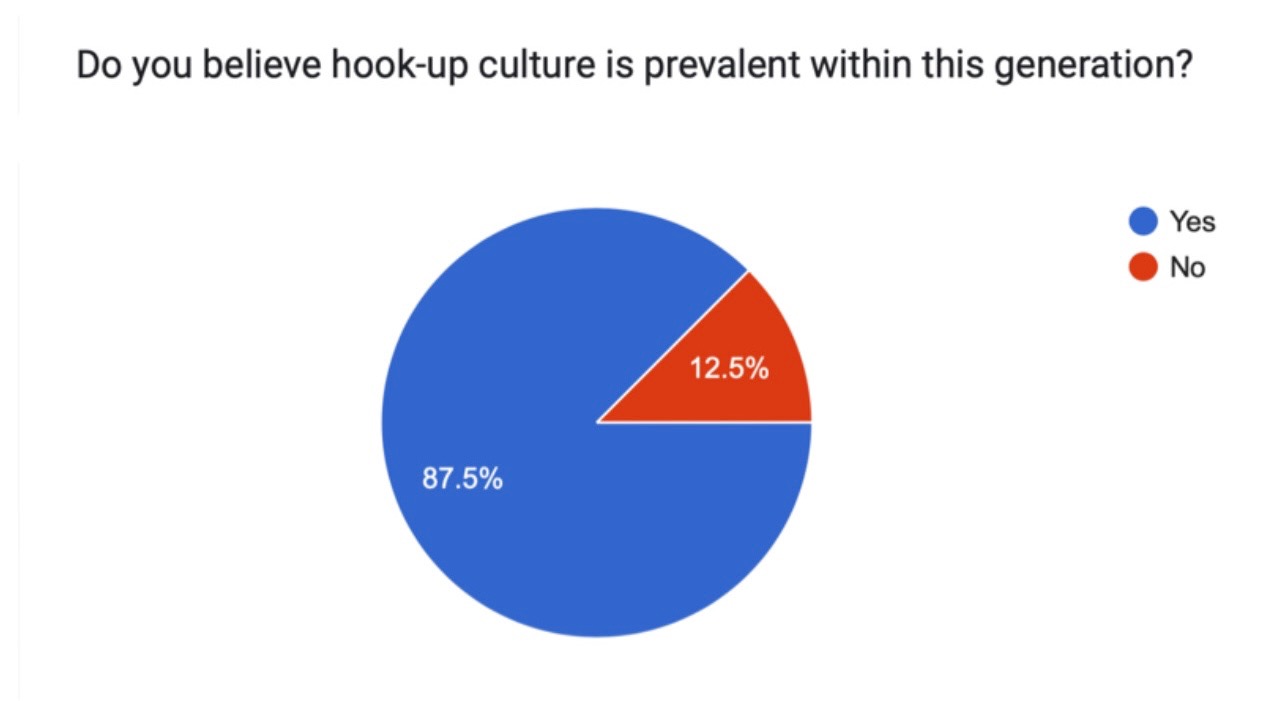
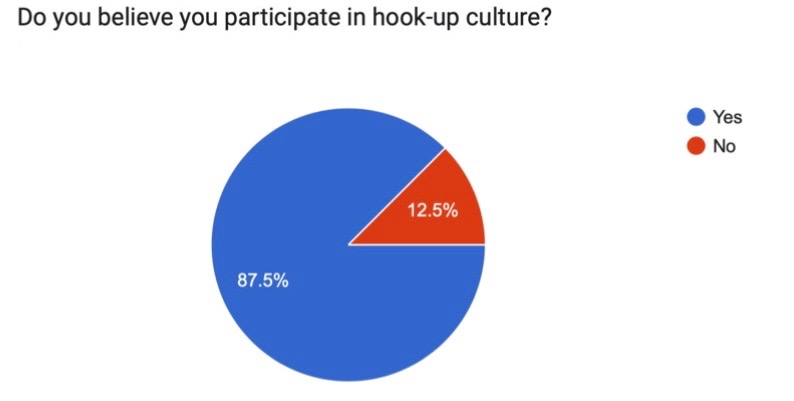
With most of our respondents knowing about or experiencing hook-up culture, the results of our survey would most definitely help us understand the reality of hookup-culture whether it proved or disproved our hypothesis. Now, our questions became more specific in order to curate a representative sample of patterns within hook-up culture. Furthermore, these two questions below provided the most valuable information within our survey research.
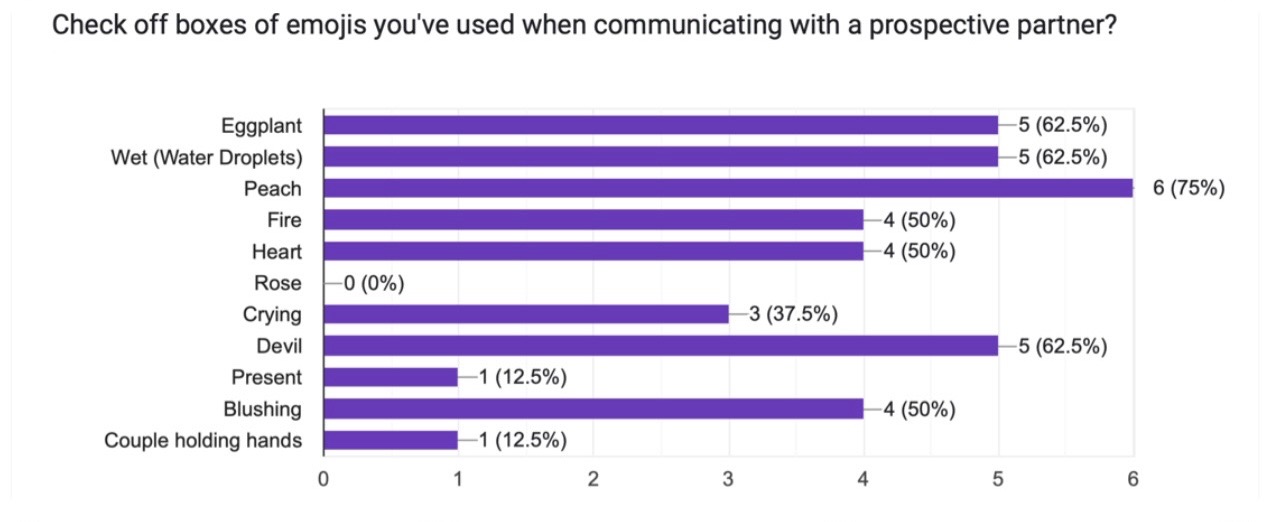
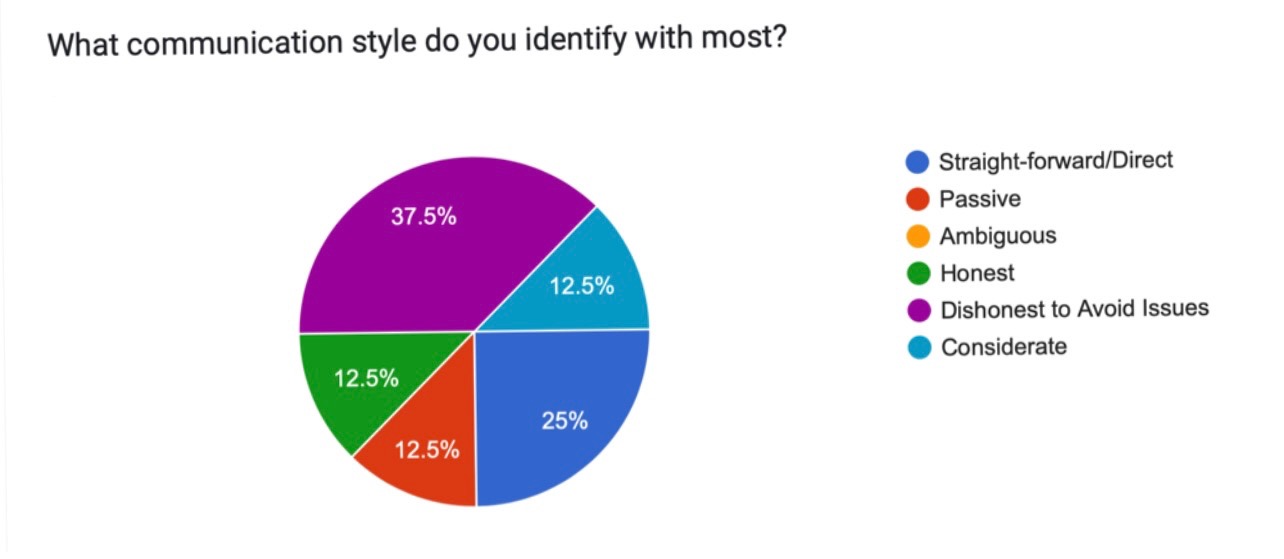
Within our hypothesis, we predicted that there would be a difference between communication styles and methods. So, with our own experience with hook-up culture, and our learnings from Amanda N. Gesselmen’s research article on “Emoji as affective signals for relationship-oriented digital communication”, we were able to create our question about the influence of emojis on romantic communication and how different ones convey different meanings (casual hook-up vs long-term love). As can be seen, a majority of respondents affiliated with emojis were deemed to be used for “sexting” within hook-up culture communication (Figure 3). For further support, on our side, we can see that most of our respondents that used those emojis are also the same individuals who announced their participation in hook-up culture as well. Next, Figure 4 provided us with the different communication styles we noted through romantic communication in general, but we mentally sorted them into different categories that would analyze different perspectives. For example, those who answered that their communication style was direct and dishonest were usually men (remember: one can be directly dishonest– they are not mutually exclusive). On the other hand, those who answered that their communication style was more honest, considerate, and passive were women. Through these results, we were able to see that there IS a difference of communication styles between genders AND relationship/partner status (hook-up vs long-term). Furthermore, we were able to conclude that men’s expectations are more short-term and casual while female expectations are more long-term and exclusive, ultimately impacting their different communication styles that portray most men as direct, dishonest, dominant, selfish, and confident while portraying most women as passive, considerate, committed, and honest.
Discussion and Conclusions
As discussed at the beginning of the paper, ‘hook-up culture’ has gained high levels of popularity, and more recently amongst younger generations. With influential communication-based platforms and media, such as TikTok, “…. popular culture is simultaneously representing aspects of actual contemporary sexual behavior and providing sexual scripts for emerging adults…”, which has potentially played a role in why we concluded the results from our research as we did (Garcia / Merriwether, 2012). Our results suggest a few common themes within the communication patterns of ‘hookup culture’. As seen in the data above, our results suggest that there is a correlation between men’s motivations for just wanting to participate in casual sexual intercourse, whereas women want to participate in sexual intercourse more so in the pursuit of a serious partner, thus suggesting genders do in fact have different motivations when participating in hookup culture. Additionally, our results show a form of ‘code-switching’ that occurs when individuals use emojis and slang to communicate within hook-up culture. Furthermore, code-switching is defined as, “…the practice of selecting or altering linguistic elements so as to contextualize talk in interaction…”, which we see has occurred when individuals interchanged emoji’s arbitrary meanings with more sexual notions only in the context of hook-up culture communication (Nilep, 2006). Additionally, we saw that the most popular ages amongst participants who take part in hookup culture range from 21-23. Given these results, and the inferences we’ve made from our research, our paper concludes that communication with hookup culture has a unique nature to it that involves various tactics in order to achieve that ‘hook-up goal’, and that there are many mechanical and analytical parts involved in the motivations behind hook up culture. However, depending on who you are, it’s highly likely that if you aren’t achieving that dream ‘hook up’ it really isn’t you, it’s them.
References
Ackerman, J. M., Griskevicius, V., & Li, N. P. (2009). Let’s get serious: Communicating commitment in romantic relationships. PsycEXTRA Dataset. https://doi.org/10.1037/e615882011-144
Garcia, J. R., Reiber, C., Massey, S. G., & Merriwether, A. M. (2012). Sexual Hookup Culture: A Review. Review of General Psychology, 16(2), 161–176. https://doi.org/10.1037/a0027911
Gesselman, A. N., Ta, V. P., & Garcia, J. R. (2019). Worth a thousand interpersonal words: Emoji as affective signals for relationship-oriented digital communication. PLOS ONE, 14(8). https://doi.org/10.1371/journal.pone.0221297
Klinger, L. (n.d.). Hookup Culture on College Campuses: Centering College Women, Communication Barriers, and Negative Outcomes. https://doi.org/https://scholarworks.gvsu.edu/csal/vol3/iss2/5/
Lundquist, J. H., & Curington, C. V. (2019). Love me Tinder, love me sweet. Contexts, 18(4), 22–27. https://doi.org/10.1177/1536504219883848
Nilep, C. (2006). “Code Switching” in Sociocultural Linguistics. Colorado Research in Linguistics, 19. https://doi.org/10.25810/hnq4-jv62
Pham, J. M. (2017). Beyond hookup culture: Current trends in the study of college student sex and where to next. Sociology Compass, 11(8). https://doi.org/10.1111/soc4.12499
Tom Tong, S., & Walther, J. B. (2010). Just say ‘‘no thanks’’: Romantic rejection in computer-mediated communication. Journal of Social and Personal Relationships, 28(4), 488–506. https://doi.org/10.1177/0265407510384895
Webb, S. (n.d.). Communication in the Modern Hookup Culture: A Literature Review. https://doi.org/https://commons.lib.jmu.edu/lexia/vol4/iss1/3/
Wood, M. (n.d.). Addressing Context with Hymes’s SPEAKING Model. https://doi.org/https://the-ofla-cardinal.org/2018/01/14/addressing-context-with-hymess-speaking-model/
Appendix
NPR Podcast – Hook-up Culture: The Unspoken Rules of Sex on College Campuses https://www.npr.org/transcripts/552582404
TedTalk – Stripping Down the Hook-up Culture: The Need for Emotional Visibility https://youtu.be/EhzOohyAZjs
[/expander_maker]