music

Gender Portrayals in Hip-Hop Lyrics

Jazmin Flores, Charlene Juarez, Javier Nuñez-Verdugo, Sofia Nyez

Hip-hop music as a genre has grown in popularity and oftentimes notoriety among younger generations for its catchy beats, the interesting artists behind them, and the relationships that come as a result of them, whether those be for better or for worse. Beyond its redeeming qualities, however, there has been a push in recent years especially to investigate the prominence of gendered violence in the form of lyricism. In this study, we analyzed the frequency with which certain gendered noun substitutions are found in the top hip-hop songs of 2023 written by men and women alike. With an emphasis on analyzing opposite-sex noun substitutions, our group found that women more often than not tend to refer to men in their music the most out of any other gender-to-gender category. Additionally, we found that women also tend to use the substitute “bitch” up to 3 times more than men do. 

[expander_maker id=”1″ more=”Read more” less=”Read less”]
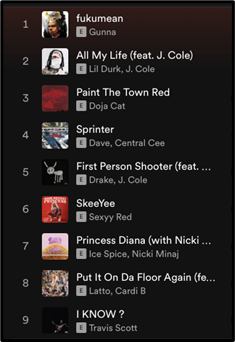
Figure 1. Several songs that will be analyzed in this article.

Introduction

Hip-hop is a largely male-dominated industry that often finds itself as an entertaining medium/genre for promoting self-pride and rapper “beef” in the form of diss tracks towards other artists. However, the genre has also found itself to be associated with more negative ideas relating to arrogance, misogyny, hypersexuality, and drugs in the public eye. This study will focus on the issues of misogyny surrounding the hip-hop/rap industry, specifically on how women are portrayed in songs via the lyrics, to understand how these communities have contributed to creating a hostile environment for women in our society. In more recent years, there has been an uptick in female rappers who have aimed to take back their power (Krasse, 2019). Female rap artists have transformed targeted, derogatory phrases like “bitch,” “hoe,” and “slut” into forms of empowerment. Through their music and lyrics, they reclaim ownership of these words, reshaping them into symbols of strength and resilience. In doing so, they redefine societal perceptions and assert their power in the face of adversity. This study will mainly focus on the differences between how male and female rappers portray the opposite gender in their music, with a strong focus on how male rappers sexualize or objectify women and how women threaten men’s masculinity. Additionally, we will also take some time to address same-gender portrayals in the hip-hop genre using similar research strategies. We will be examining this through the lexical use and variation across the aforementioned categories.

Background

In recent years, there has been a glorification of this genre of music despite its content. While we are aware that misogyny is clearly present in these songs, it is interesting to analyze how it has influenced our society for better or for worse. First, we will be focusing on the language that current male and female rap artists use in their work. Music has the power to change a person’s mood or perceptions in relation to sexism (Cobb & Boettcher, 2007). Therefore, we will also comment on how the content of current male and female rap artists’ music has affected younger generations. It is important to analyze how the use of explicit language about women has affected society’s perception of them.
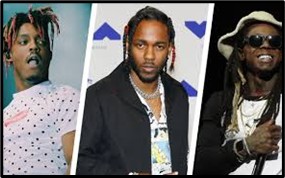
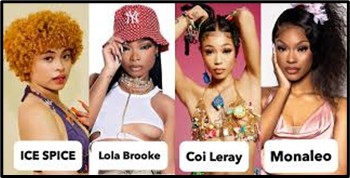
Figure 2. Popular rappers included in Spotify playlist ‘RapCaviar Presents: Best Hip-Hop Songs of 2023.’

In this study, we proposed the question: How has misogyny manifested itself in Hip-Hop/Rap music in 2023 comparatively between men and women, as demonstrated through their lyrics when addressing the same or opposite gender? Based on previously investigated data (Sallam & Shim, 2021), we expect to find that men describe women negatively at a higher rate than when they describe themselves, when women describe men, and when women describe themselves.

Methodology

In our study, we will be examining the descriptors of the genders (such as “wack”) and any noun substitutes (such as “hoe”). Popular artists like Gunna, Central Cee, and Travis Scott commonly use noun substitutes like “gold diggers,” ”bitches, and ”hoes” in reference to women. The use of insulting and/or derogatory language towards another on the basis of gender can be seen as a means of affirming the gender of the speaker. While the reasons behind such thoughts are nuanced, the pressing reason that we would like to highlight is gendered linguistic violence being a means of reinforcing traditional gender norms that paint men as superior to women. For a modern-day example of this, we can look no further than to the self-proclaimed “Alpha Male” influencer Andrew Tate, who was popular for a large part of 2023 for his social media content aimed at defending rather reductive and traditional views on gender (Radford, 2024). These views have the end goal of defending this idealized masculinity that celebrates male confidence and resentment towards women for apparently posing a threat to and stigmatizing such traditional gender norms.

The project design will consist of identifying and gathering 20 songs from 2023 male and female rappers. We have narrowed down the song selection to the top 10 rap songs by female rappers and the top 10 rap songs by male rappers from Spotify in 2023. As we analyze the lyrics of this genre, we will look at how men describe women, women describe men, men describe men, and women describe women through the use of lexical items. Specific lexical items include adjectives, phrases, and slurs that are used as forms of derogatory remarks towards the gender that is being described. To identify our data we looked at three categories of lyrics: those addressing women, those addressing men, and those talking about anything else. As a form of methodology, we will calculate how often slurs or insulting/provoking phrases are used in regard to an individual’s gender (Sallam & Shim, 2021).

Results and Analysis

To quantify our data, we looked at three categories across the board through the use of pie charts; one for male artists and one for female artists to help us compare our data. In order to qualify this data, we created a histogram with the most commonly used noun substitutions to get a side-by-side view of its usage by both groups of artists.
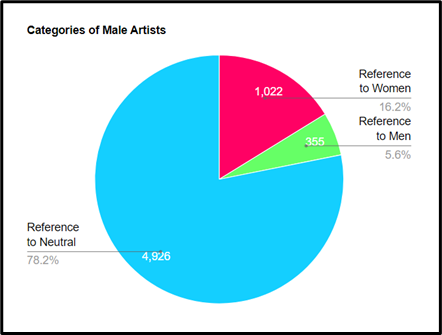
Figure 3. Pie chart to tabulate how many references MALE artists make to the following three categories – towards women, towards other men, and everything else/general language.

Figure 3 shows a greater tendency for men to refer to women at 3 times the rate than they do other men when just considering gender-to-gender ratios of speech.
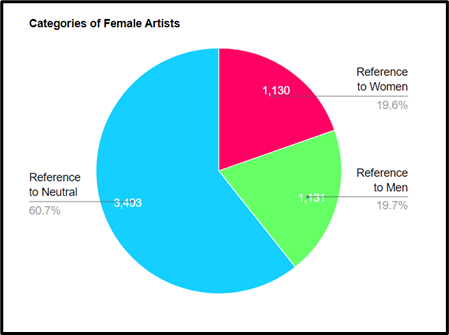
Figure 4. Pie chart to tabulate how many references FEMALE artists make to the following categories – towards men, towards other women, and general language usage.

Figure 4 shows different results and serves as a contradiction to our original hypothesis, showing that women in the top songs of the 2023 hip-hop genre have almost an equal ratio to referring to other women than they do to men (19.6% vs. 19.7%, respectively).
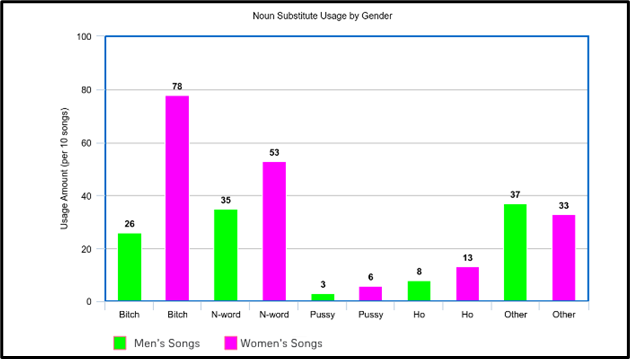
Figure 5. Bar chart tallying the total number of times a noun-substitute to refer to the opposite or same gender was used, divided by gender. Green refers to songs written and sung by men, while pink refers to the same for women.

Figure 5 directly goes against our original hypothesis that men would refer to women negatively the most out of our aforementioned gendered categories. Instead, we see that, for example, women use the selected noun substitutions (excluding “Other”) in their music more than their male counterparts in each bar with at least a 50% or more increase. Conversely, both men and women almost utilize the same rate of “Other” gendered noun substitutes. Examples of these substitutes would be “Karen” towards women and “slow” as a general derogatory noun substitute.

Discussion

Although we originally hypothesized that male artists were to have the highest scores to their female counterparts, the findings based on the data collection were that women tend to talk about men more than men talk about men. In addition, women use profanity more often than men. Specifically, the noun substitute “bitch” is used by women 3 times more than men do, which in the early stages of our study was one of the key noun substitutions. While these findings do prove the large usage of this noun substitution, we were not anticipating it to appear under female rap artists. Relating back to the hypothesis and research question, our hypothesis was disproved, given how women speaking on men was the highest subcategory. It is important to analyze hip hop for its contributions to popular culture and therefore, the influence it has on the greater population when it specifically utilizes gendered language. Some examples were seen in the number of words that were used, for instance, in Men’s Hip-Hop Top 10: there were 6,303 words versus 5,814 words for Women’s Hip-Hop Top 10. The noun substitutions for women are a direct manifestation of misogyny in hip-hop music. In the hip-hop world, words often carry a double meaning. Is it possible that we were proven wrong? Or do the usages of “bitch,” “hoe,” and “slut” carry a double meaning? It is possible that the times we simply tally these words neglected the context of its usage in the song. In particular, there is a difference when male rap artists use certain words and when female rap artists use the same word. Let’s take a look at the importance of double meaning and context:
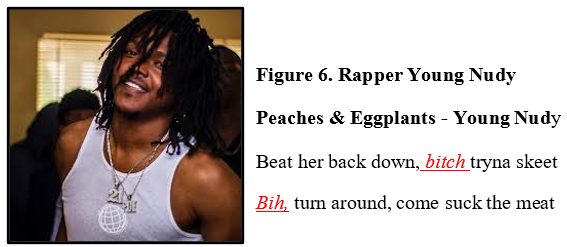
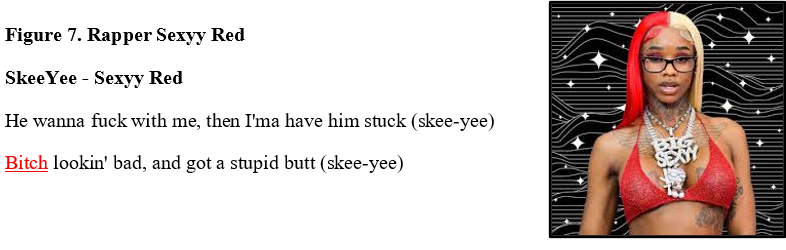
While male artists use the noun substitution to degrade and sexualize women, female artists use it to empower women. They redefine what “bitch” means to women. By doing so, these women are taking back their power, as they no longer give men the ability to use words as weapons.

Conclusion

We believe it would be beneficial for future research to be conducted concerning this topic, as some limitations of this study included time constraints and a need for more expansion. One area of expansion includes analyzing music from other languages that hip-hop and rap are produced in besides English, and a possible comparative analysis between English-language music and foreign languages could be beneficial as a cross-cultural study. Furthermore, a study comparing the hip-hop of earlier decades to current music could also yield significant results, as hip-hop and rap are rapidly changing cultures owing to a number of factors, as detailed in Ellen Chamberlain’s TED Talk on the history of misogyny in the hip-hop industry. While a bit broad, it could also be interesting to look into some comparisons between other genres of music in conversation with the hip hop genre.

During our presentation, we were asked if the race of the rapper had anything to do with their language use. While this is probably a factor, as we investigated during the course that every aspect of a person’s personality plays a role in the way they speak, we chose to focus on the gender of the artists instead. This is because many of the artists in the hip hop industry are African American, and thus, it would be difficult to distinguish between marks of the group or marks of the music industry. We also did not want to perpetuate the stereotype of the “violent black man” or “angry black woman” through our research and decided to stick to only the gender differences. Though, it should be noted that there are definitely more factors at play in the language use of hip-hop artists besides their gender, and it could be beneficial to study more into that topic using careful consideration.

We believe that this study can fit into the larger body of research surrounding misogyny in the hip-hop industry as displayed through linguistic elements. Though the results aren’t exactly exemplary of what has been previously displayed in the literature, we believe it opens the floor for more discussion about not just the prevalence of discrimination but the forms in which it might come. While much literature believes women to be the target of discrimination from men for the most part, our research found that women not only speak about men at a higher frequency but use derogatory terms more often as well.

All in all, while progress has been made in addressing misogyny within hip-hop, rap music, and artists, there is still much work to be done. By understanding the nuances of gender representation in lyrics and challenging harmful stereotypes, the industry can move towards a more inclusive and unprejudiced community for future artists and listeners.

References

Boettcher, W. A., & Cobb M. D. (2007). Ambivalent Sexism and Misogynistic Rap Music: Does Exposure to Eminem Increase Sexism?. Wiley Online Library. https://doi.org/10.1111/j.1559-1816.2007.00292.x.

Chery, C. (2024). RapCaviar Presents: Best Hip-Hop Songs of 2023. Spotify. https://open.spotify.com/playlist/37i9dQZF1DWZFV9Asvj1J9?si=PdIXfalHQs-tcMM0hRggZg&pi=u-Abilm4LaTuW5&preview=coverart.

de Leon, A. (2007, June 6). The complex intersection of gender and hip-hop. NPR. https://www.npr.org/2007/06/06/10783904/the-complex-intersection-of-gender-and-hip-hop.

Krasse, L. (2019, Spring). A Corpus Linguistic Study of the Female Role in  Popular Music Lyrics. https://www.diva-portal.org/smash/get/diva2:1481063/FULLTEXT01.pdf.

Neff, S. (2014, May 24). Sexism Across Musical Genres: A Comparison. Undergraduate Thesis Western Michigan University. Pp. 38. https://scholarworks.wmich.edu/cgi/viewcontent.cgi?article=3486&context=honors_theses.

Prior, J. (2017, March 1). Teachers, what is gendered language?. British Council. https://www.britishcouncil.org/voices-magazine/what-is-gendered-language.

Radford, A. (2024, March 12). Who is Andrew Tate? The self-proclaimed misogynist influencer. BBC News. https://www.bbc.com/news/uk-64125045.

Sallam, A. M., & Shim, J. Y. (2021, February). Gender-biased English language in hip hop music. ARC Publications. https://www.arcjournals.org/pdfs/ijsell/v9-i2/1.pdf.

Wayne University. (2019). Misogyny in Hip Hop. TED. Retrieved June 12, 2024, from https://www.ted.com/talks/ellen_chamberlain_misogyny_in_hip_hop.

[/expander_maker]
, , , , ,

Beyond the Beat: Exploring Objectification in Rap and Country Lyrics

Riley Go, Ashley Lew, Ileen Luu, Ysabella Yuquimpo

“Don’t my baby look good in them blue jeans?” Rap music has been largely criticized for its objectification of women. Yet, why has country music not gained the same reputation? Known for being family-friendly, romantic, and inoffensive, “country music is often left out of sexual media analyses as it is traditionally thought to be less harmful than other genres of music” (Lin & Rasmussen, 2018). However, 2010s studies have exposed the phenomenon of “bro country,” in which country songs have become increasingly misogynistic and centered on attractive, young women in tight clothing and casual sex (Rasmussen & Densley, 2017). Since exposure to objectifying music can lead to harmful outcomes, such as the development of body image issues and eating disorders in adolescents (Flynn, 2016), our research aims to uncover the nuanced ways in which both rap and country music objectify women and perpetuate harmful gender stereotypes, and how they may do this in different ways.

[expander_maker id=”1″ more=”Read more” less=”Read less”]

Introduction

Our focus is on the identities of male rappers and male country musicians, examining how they use lyrics to assert dominance over women and reinforce unequal power dynamics and how these patterns may change over time. Thus, our research question is: “How do the linguistic portrayals of women differ between songs by male rappers and male country musicians from the 1990s to now?”

We hypothesize that both genres contribute to the objectification, domestication, and degradation of women. While rap music is known for overtly promoting misogyny, we hypothesized that country music promotes misogyny in more covert ways (e.g. promoting female domesticity or a possessive attitude toward women).

Male rappers, often from marginalized urban areas, may objectify women and encourage a “player” lifestyle to assert dominance and reaffirm social status within their communities. Weitzer and Kubrin (2009) found that while women were portrayed as subordinate to men in most rock and country songs, rap was the most graphic in objectifying women, rarely depicting them as independent, trustworthy, or educated.

In addition, Adams and Fuller (2006) emphasize how misogynistic lyrics in rap are often at the expense of African American women, portraying them as “ not only something to be used sexually, but…also the recipient of degrading acts, disrespect, and violent behavior.” These portrayals, in turn, reinforce the American population’s negative stereotypes about African American women, and desensitizes them to the mistreatment and abuse of women as a whole (Adams & Fuller, 2006).

Male country musicians, often from rural, conservative areas, may depict women as subservient and dependent on men, to confine them within the patriarchal systems of their communities. Rasmussen and Densley (2017) examine the emergence of “bro country” in the 2010s, characterized by songs focusing on women in revealing clothing and referring to a woman using slang. Discovering that women in country songs in the 2010s were objectified more than in the past, they call attention to the negative progress toward female empowerment within the genre (Rasmussen & Densley, 2017).

Furthermore, Rogers (2013) highlights themes in country music that depict women in traditional gender roles, promote the idea that attractive women inherently have more value, and normalize coercive sexual behavior, suggesting that sexism in country music may be more dangerous when hidden within the lyrics.

Here is a YouTube video, entitled “Why Country Music Was Awful in 2013,” poking fun at the repetitive themes present in “bro country”: https://www.youtube.com/watch?v=WySgNm8qH-I

Methods

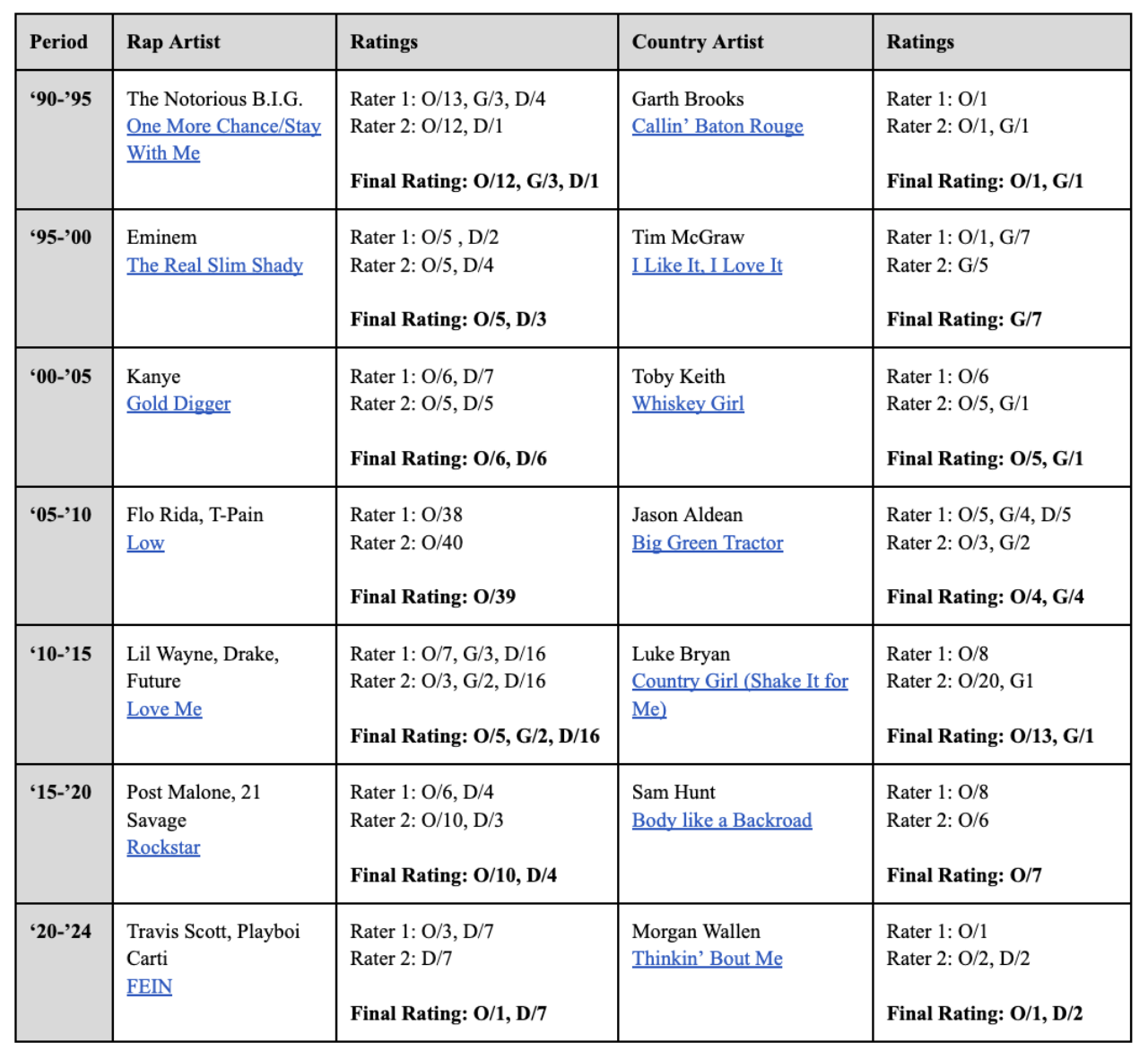
For our methodology, we utilized Billboard’s lists of top-grossing rap and country artists, and randomly selected a subset of musicians for analysis. Afterward, we drew from Billboard to identify a top song of each artist that negatively portrayed women at least once. Covering the 1990s to now, we analyzed one top rap song and one top country song per five-year period. These songs were highly popular in their respective time periods, providing a representative snapshot of prevalent lyrical themes and content.

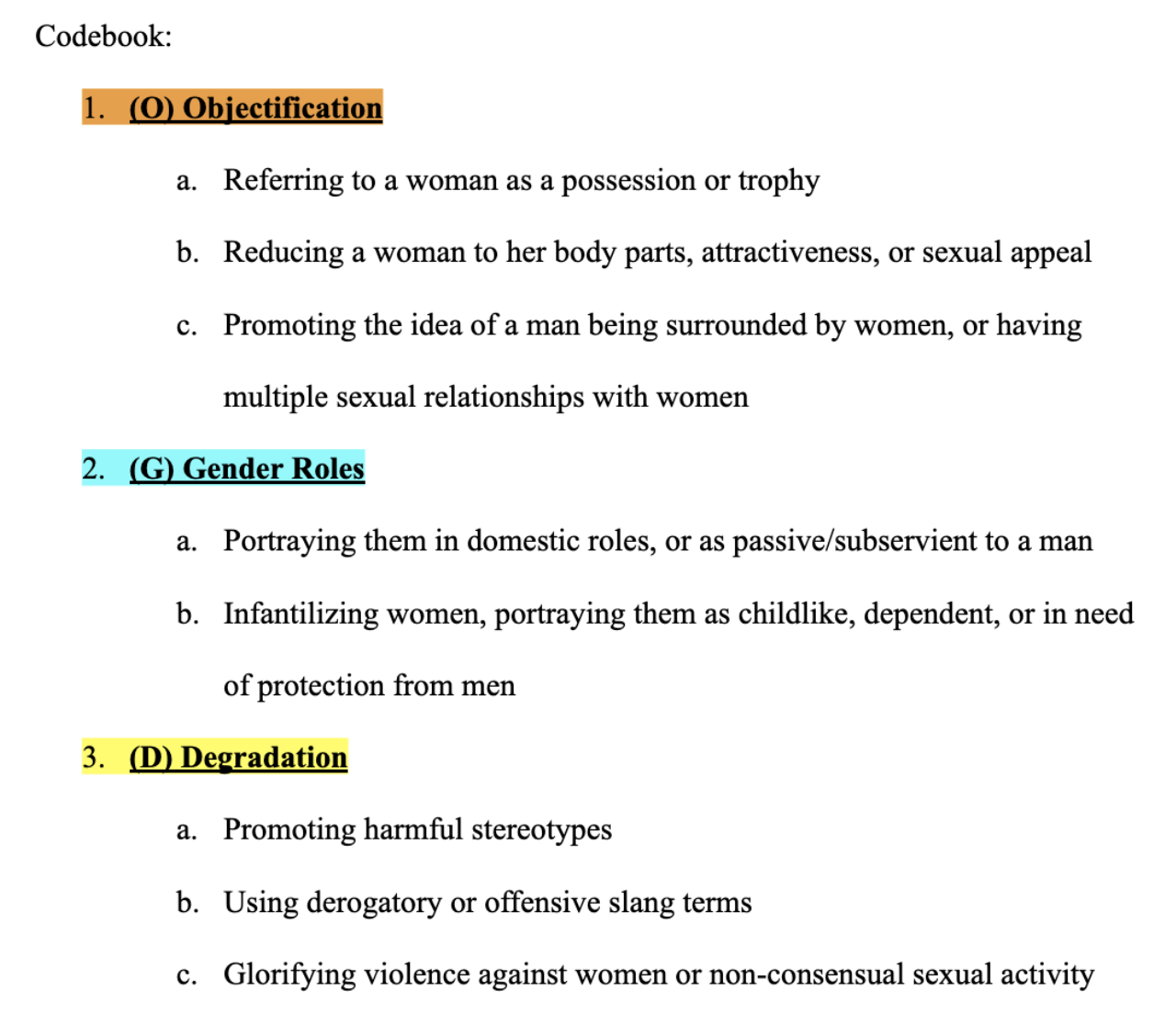
Figure 1: Our codebook, with condensed metrics from Rogers’ (2013) study. This codebook served as a comprehensive framework, enabling the operationalization of abstract concepts such as “objectification” within song lyrics.

To ensure consistency, two individuals within our research team independently analyzed each song, providing it with a rating that noted the number of unrepeated lines with instances of Objectification, Gender Roles, and Degradation. In cases of disagreement, they presented their reasoning to a third party who provided the final rating.

Results

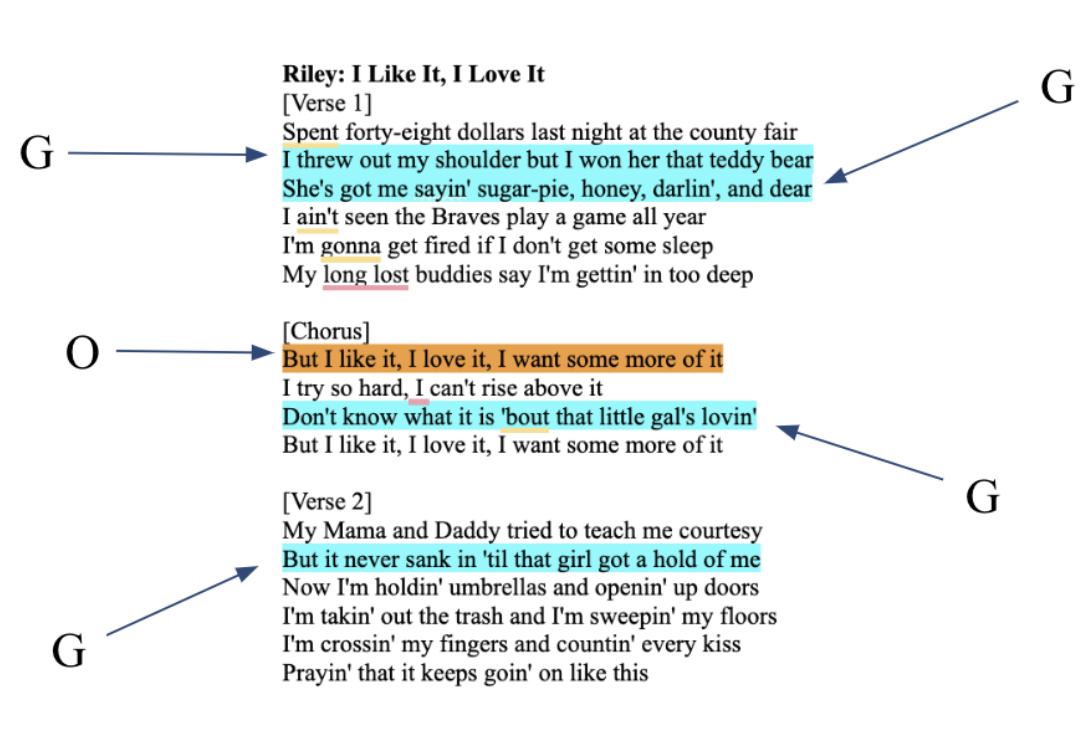
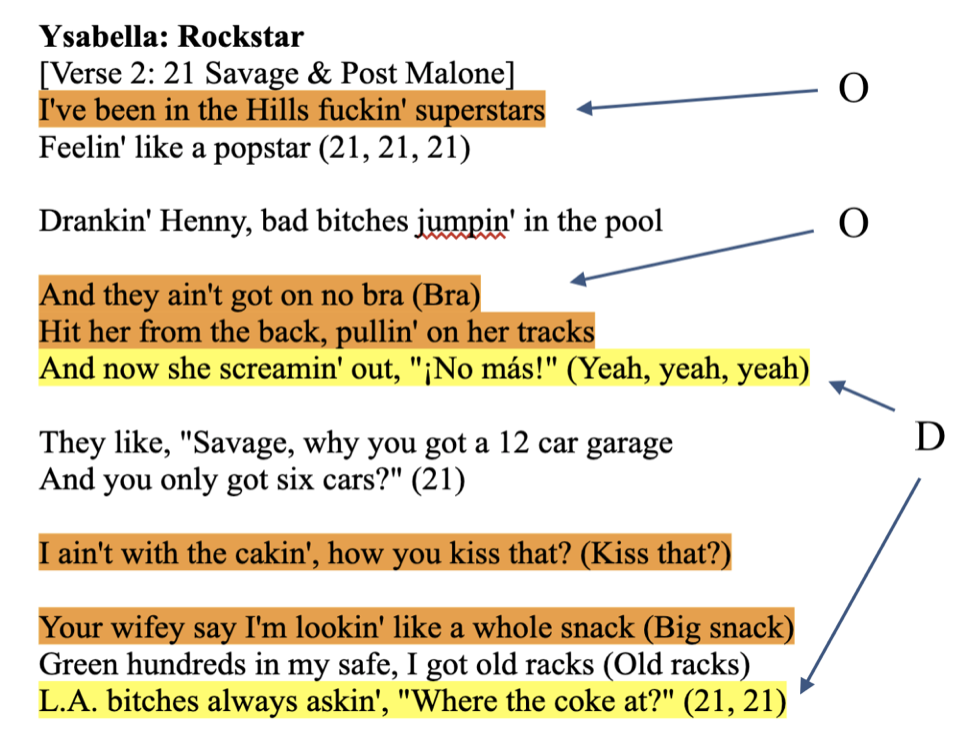
The following is an example of how instances of misogyny were identified in different songs. We noticed that in country songs, like “I Like It, I Love It”, there was a tendency for singers to use terms like “little gal” or “girl” to describe women, and this was in line with our interpretation of Gender Roles-based misogyny. We also noticed that in rap songs, like “The Real Slim Shady,” there was a tendency to call women derogatory names, or in some cases, such as in this specific song, reference violence towards women. This was in line with our interpretation of Degradation-based misogyny.

Table 1: These are our final ratings, indicating the number of unrepeated lines with instances of Objectification, Gender Roles, and Degradation. (For instance, O/12 indicates 12 instances of Objectification within the song).

Figure 2: Gender Roles and Objectification present in Tim McGraw’s country song, “I Like It, I Love It.”

Figure 3: Objectification and Degradation present in 21 Savage and Post Malone’s rap song, “Rockstar.”

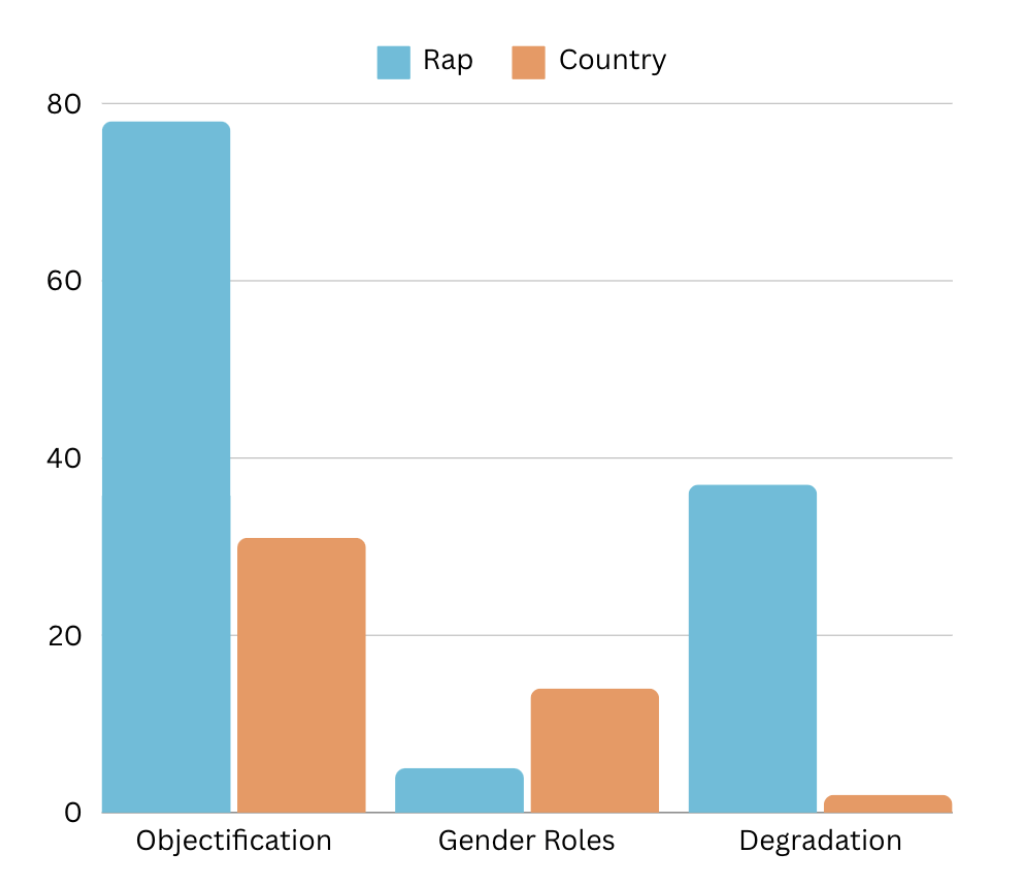
Figure 4: Bar graph, comparing the instances of Objectification, Gender Roles, and Degradation in Rap vs. Country music.

We found that rap had a total of 120 misogynistic lines, while the country had a total of 47 misogynistic lines. Objectification and Degradation-based sexism were most common in rap music, while Gender Roles-based sexism was most common in country music. This could be due to the differing attitudes towards women in rap and country music circles. Because we understand that the two genres should not be analyzed in a vacuum, their historical contexts should be considered when theorizing why they represent women in such distinctive ways.

In the late 1990s and the early 2000s, rap music saw an emergence of the subgenre, gangsta rap, which focused on the hardships of growing up in the Bronx and the culture produced by that upbringing. Violence, poverty, and criminal activity are all central themes of the lyrics of gangsta rap; thus, it follows that violently misogynistic attitudes could spawn from those topics. Further, because gangsta rap is held in such high regard as a staple of the rap genre, it makes sense that modern rap artists would try to emulate the misogynistic rhetoric of the subgenre.

Country music, on the other hand, does not necessarily have as overtly misogynistic lyrics. Instead, the genre utilizes a more subtle form of misogyny that reinforces traditional, conservative gender roles. In the United States, country music is generally associated with right-wing-leaning, Southern, Judeo-Christian values. As such, many country artists conform to those values in their personal life and lyrics. It follows that country artists would portray women in ways that conform to traditional gender roles, as doing that caters to their audiences and may also reinforce what the artists themselves believe.

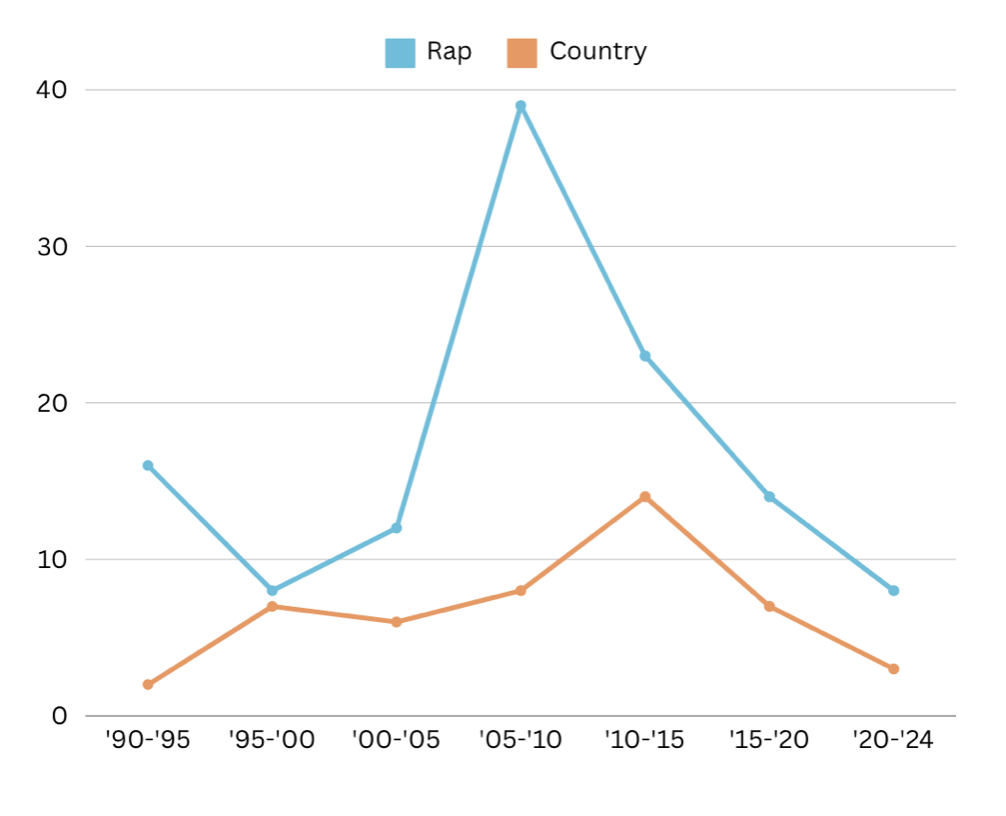
Over time, we saw a peak in misogynistic lyrics from 2005-2015, and then the numbers declined. The drop in misogynistic lyrics after 2015 is in line with the timing of the MeToo movement and other 3rd wave feminist efforts to dismantle harmful stereotypes and attitudes towards women. To stay relevant, marketable, and politically correct, male artists likely made an intentional decision to tone down the misogynistic rhetoric in songs.

Figure 5: Line graph, examining Misogyny (Objectification + Gender Roles + Degradation in total) over time in Rap vs. Country music.

Discussion

Through our song analysis, we discovered that both genres contribute to the objectification, domestication, and degradation of women. Rap music flaunts misogyny in its lyrics by calling women derogatory terms and glorifying rough, non-consensual sex and a “player” lifestyle. On the other hand, country music promotes misogyny more discreetly by infantilizing women, focusing only on their attractiveness and sexual appeal, and portraying them as subservient and dependent on men. Despite results indicating that Objectification and Degradation were higher in rap, Gender Roles exceeded in country music. Yet, these forms of misogyny are equally harmful to women, fueling both our prevalent patriarchal system and the cycle of violence against women. The impact of our analysis is solely to challenge preconceived notions about these genres and their deep-rooted association with misogyny, as well as highlight how objectifying music can both reflect and shape our reality.

While we do not want to label a music genre “problematic,” since that is harmful in itself, women are still represented as subordinate to men in rap and country, and we urge listeners and musicians to understand that the messages being conveyed fuel the cycle of female objectification.

References

Adams, T. M., & Fuller, D. B. (2006). The Words Have Changed But the Ideology Remains the Same: Misogynistic Lyrics in Rap Music. Journal of Black Studies, 36(6), 938–957. http://www.jstor.org/stable/40034353

Flynn, M. A., Craig, C. M., Anderson, C. N., & Holody, K. J. (2016). Objectification in popular music lyrics: An examination of gender and genre differences. Sex Roles, 75(3–4), 164–176. https://doi.org/10.1007/s11199-016-0592-3

Grady Smith (2013, December 20). Why Country Music Was Awful in 2013 [Video]. YouTube. https://www.youtube.com/watch?v=WySgNm8qH-I

Lin, R., & Rasmussen, E. (2018). Why don’t we get drunk and screw? A content analysis of women, sex and alcohol in country music. Journal of Popular Music Studies, 30(3), 115-128. https://doi.org/10.1525/jpms.2018.200006

Rasmussen, E.E., Densley, R.L. Girl in a Country Song: Gender Roles and Objectification of Women in Popular Country Music across 1990 to 2014. Sex Roles 76, 188–201 (2017). https://doi.org/10.1007/s11199-016-0670-6

Rogers, A. (2013). Sexism In Unexpected Places: An Analysis of Country Music Lyrics – Office of the Vice President for Research | University of South Carolina. Sc.edu. https://sc.edu/about/offices_and_divisions/research/news_and_pubs/caravel/archive/2013/2013-caravel-sexism-in-unexpected-places.php

Weitzer, R., & Kubrin, C. E. (2009). Misogyny in Rap Music: A Content Analysis of Prevalence and Meanings. Men and Masculinities, 12(1), 3-29. https://doi.org/10.1177/1097184X08327696

, , , ,

Exploring Hegemonic Language: Its Impact on Insults in Media, Rap Battles, and Lyricism

Isabella Chaves, Amee Davis, Amanda Layfield, Anna Lytz, Nina Grilli

This study delves into the investigation of the intersection of gendered language, hegemonic masculinity, homophobia, and social class structures found in hip-hop lyrics. Inspired by the insights of linguistic anthropologist H. Samy Alim, we explore the manifestation of “lyrical freedom” as both oppressive and liberating within the genre. Our research analyzes data from live rap battles and pre-recorded songs which allows us to understand the strategic use of language used to dominate one’s opponent. We highlight examples such as 21 Savage’s controversial lyricism in the “XXL Freshmen Cypher ” and A$AP Rocky’s use of homophobia and classism in rap battles. Our research ultimately displays how the word choice and phrases used within these examples are misogynistic and homophobic, a routinely found element in hip-hop culture. We too discovered an emergence of classist language in these spaces. Through this interdisciplinary approach, we aimed to evaluate the complex interplay between linguistic expression, cultural identity, and social power dynamics within the hip-hop community.

[expander_maker id=”1″ more=”Read more” less=”Read less”]

Introduction and Background

Linguistic Anthropologist H. Samy Alim once stated, “Lyrical freedom is both oppressive and liberating” (Alim, 2023). Our research is inspired by Alim, whose work is centered on lyrical analysis with a specific focus on Black language and hip-hop culture. More specifically, we are inspired by his work on the cis-heteropatriarchy1. Our research centers around the use of words and phrases in hip-hop and their role in perpetuating oppressive language.

Our study employed a multifaceted approach to investigate the effects of hegemonic language2 in hip-hop culture. Firstly, we conducted an in-depth examination of impromptu rap battles, where we observed live performances to analyze the spontaneous use of language. This allowed us to capture the raw, unfiltered expressions of rappers in real-time settings, providing valuable insights into the prevalence and nature of hegemonic language. Secondly, we undertook a comprehensive analysis of contrived lyrics from pre-recorded hip-hop songs. By scrutinizing the choices made by rappers in their lyrics, we aimed to understand the patterns and trends in the use of misogynistic and homophobic language. Specifically, we focused on prominent examples such as the “XXL Freshman Cypher,” a renowned platform for emerging rap talents, to gather insights into the stylistic variations prevalent in hip-hop culture.

Within the landscape of hip-hop culture, one notable phenomenon is the cipher—a gathering where rappers engage in spontaneous performances over a shared beat, surrounded by other rappers. The cipher produces a unique call-and-response environment. The setting of ciphers as a performance both enables and protects rappers in perpetuating oppressive remarks, specifically sexism and homophobia. Sexism in lyricism is a rather common phenomenon used to be successful in the hip-hop community and involves “putting one’s opponent into a female passive role,” (Dundes et al. 1970). Our team proceeded to investigate different data sets of lyrics, both improvised and pre-recorded, to see how sexism and homophobia are weaponized.

Methods

In examining impromptu rap battles and contrived lyrics, we conducted a thorough literature review to contextualize our research findings. We synthesized insights from diverse sources, such as studies by linguistic anthropologists such as H. Samy Alim. His work on hip-hop cultures and language politics informed our theoretical framework. For instance, Alim’s study, “Global linguistic flows: Hip hop cultures, youth identities, and the politics of language” (2009), provided valuable perspectives on the cultural dynamics found within hip-hop language. Our data from impromptu rap battles, contrived lyrics, and scholarly literature, seeks to provide a nuanced understanding of the impact of hegemonic language in hip-hop culture.

Results and Analysis

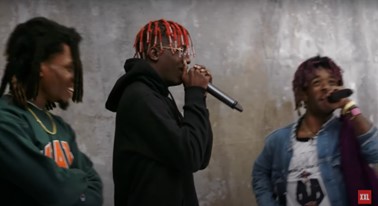
First, the research focused on oppressive language within impromptu rap battles by analyzing, “XXL Freshmen Cypher”. These performances are notorious for hosting up-and-coming rappers to display their talent. In 2016, 21 Savage took to his part and freestyled, “Pulled up on your bitch, she suck my dick, and then you kiss her,” to which Lil Uzi Vert immediately reacts with “Goddamn” (XXL, 2016, 02:43). 21 Savage’s line appears to be a homophobic diss, mocking the woman’s partner for “technically” kissing 21 Savage’s genitals. The swift positive reactions from other rappers allowed 21 Savage to continue his verse, albeit without revisiting the subject of homophobia and inadvertently perpetuating misogyny.

Denzel Curry, Lil Yacthy, and Lil Uzi Vert’s reactions to 21 Savage’s line (XXL, 2016, 02:44).

Through further exploration of homophobic and misogynistic word use, this example provides us insight into the strategies used to be successful in a hip-hop battle: “Okay, let’s start out with Deray, ‘cause he’s gay. Fuck that. Let’s talk about his dreads. He got those on eBay” (D-Wreck, et. al., 2013, 16:51). We can see how Rocky utilizes strategies such as homophobia and classism to make his opponent inferior. A line as simple as “let’s start out with Deray, ‘cause he’s gay,” elicits a positive response from the audience highlighting the success of using oppressive language. Homophobia is consistently weaponized to put one into a superior position thus insinuating that being gay is inferior. Rocky’s comment regarding Deray getting his dreads on eBay also suggests an element of classism. It seems that buying a potentially second-hand or cheaper item is framed with negative connotations. Another lyrical device used in rap battles is the assimilation with expensive items and its association with dominance. Overall, we can see in this example how A$AP Rocky attempts to emasculate his opponent and reinforce his status through homophobic and classist language.

It is apparent that these themes are used in lyrical hip-hop just as often as in rap battles. Moreover, their use is employed purposefully in both cases: to boost their status as well as put others down. For example, a lyric from Lil Wayne’s aptly named “Gonorrhea” reads “Life’s a bitch, naw, better yet a dumb broad” (Wayne, L, 2010, 00:55). This line demonstrates misogynistic language, taking a common phrase and using it to demean women by stating, “dumb broad”. This is but one instance of a common pattern in hip hop in which word choice is key in the development and maintenance of an idea of one’s “higher status”. Ultimately, this device and use of gendered language found within lyrics about contracting a venereal disease from a woman is used to reinforce the notion that Lil Wayne is better than the peripheral women in his life.

Discussion and Conclusion

The prevalent use of oppressive language within hip-hop songs and impromptu freestyle battles suggests how artists can establish a sense of dominance through oppressive language. The language not only embodies a quest for victory but upholds existing power structures. In cases where gendered and homophobic language is weaponized, we are able to see the reinforcement of the cis-heteropatriarchy—functioning to frame femininity and homosexuality as non-normative behavior. With those who use hegemonic and oppressive language in these spaces generally being cisgender straight men, achieving dominance can be seen as authenticating one’s masculinity. Therefore, through our sample of data, we are able to see themes such as misogyny, homophobia, and classism present in hip-hop culture. These themes ultimately manifest in oppressive ways through the use of hegemonic language which uphold notions of existing hierarchies.

Footnotes

1 An ideological system that naturalizes normative views of what it means to ‘look’ and ‘act’ like a ‘straight’ man and marginalizes women, femininity, and all gender non-conforming bodies that challenge the gender binary, i.e., how cis-heteropatriarchal structures are formed and maintained (Alim 2018).

2 An umbrella term meant to encompass language that frames another individual as inferior, while reinforcing the others status in a social context e.g. sexist, homophobic, and classist language.

References

Alim, H. S., Ibrahim, A., & Pennycook, A. (2009). That’s All Concept; It’s Nothing Real: Reality and Lyrical Meaning in Rap. Global linguistic flows: Hip hop cultures, youth identities, and the politics of language. (pp. 195-212). Routledge.

Alim, H. S., Lee, J., Carris, L. M., & Williams, Q. E. (2018). Linguistic creativity and the production of cisheteropatriarchy: A comparative analysis of improvised rap battles in Los Angeles and Cape Town. Language Sciences, 65, 58–69. https://doi.org/10.1016/j.langsci.2017.02.004

Dundes, A., Leach, J. W., & Özkök, B. (1970). The Strategy of Turkish Boys’ Verbal Dueling Rhymes. The Journal of American Folklore, 83(329), 325–349. https://doi.org/10.2307/538809

D-Wreck, DJ. Hodges, M. (Producers). (2013). A$AP Rocky [Video]. PlutoTV. https://pluto.tv/en/on-demand/series/5d4c7f8a93192d923dce9f0b/season/5/episode/5d4c7 f8d93192d923dce9f9d?utm_medium=textsearch&utm_source=google

Kearny, Christine. “Guns and Drugs? Some Rappers Inflate Hustler Image.” Reuters, June 5, 2009. https://www.reuters.com/article/uk-rap-image/guns-and-drugs-some-rappers-inflate- hustler-image-idUKTRE55404G20090605.

Wayne, L. (2010). Gonorrhea [Song]. On I Am Not A Human Being [Album]. Cash Money Records Inc. https://www.youtube.com/watch?v=XBQwlYWcUBc

XXL. (2016, July 6). Kodak Black, 21 Savage, Lil Uzi Vert, Lil Yachty & Denzel Curry’s 2016 XXL Freshmen Cypher [Video]. YouTube. https://www.youtube.com/watch?v=U_IbIMUbh-k

[/expander_maker]

, , ,

“American Slang” in Global Pop: The Adoption of AAVE by L2 English Speakers

Ashley Ghodsian, Maddie Kostant, Kat Escobar, Maxime Guerra

Much of the previous work that has studied African American Vernacular English (AAVE) has focused on either native speakers of AAVE or native speakers of Standard American English (SAE) who adopt certain language features of AAVE into their speech (a phenomenon known as “language crossing”). This study investigates the adoption of AAVE features into the language of individuals who speak English as a second language (hereafter, “L2”). We hypothesized that our L2 speakers would exhibit language crossing into AAVE in a manner similar to that of native SAE speakers’ crossing, but may have different (likely unconscious) motivations for doing so. Specifically, we expected that any language crossing into AAVE by our L2ers would not only be motivated by an attempt to index proximity to Blackness (as with non-Black, native SAE speakers) but also by a desired proximity to an international conception of “American-ness,” and that this indexicality would differ for men and women as has been observed for native AAVE speakers. We analyzed the English-language interviews of two fluent, L2 English-speaking hip-hop artists who sing in Spanish in order to understand both the rates at which and the act sequences in which they adopt features of AAVE, and found evidence in favor of our hypothesis.

[expander_maker id=”1″ more=”Read more” less=”Read less”]

Introduction and Background

The origin of hip-hop and rap stems from the oral practices of enslaved Africans that were brought over to the Americas. Its style of deliverance is meant to embody the roles of the storyteller and culture historian that resemble those in traditional African society (Álvarez-Mosquera, 2015). One of the most integral aspects of hip-hop is its use of AAVE to index African-American culture.

Given the level of prominence that hip-hop has attained in global popular culture, music, and language and its considerable exposure in global media (Tamasi & Antieau, 2014), non-Black hip-hop artists whose native variety of English is Standard American English often end up adopting and appropriating aspects of AAVE (Chun 2001). Rampton (2020) has coined this phenomenon “language crossing.” Language crossing occurs when speakers borrow features from dialects that do not “belong” to them and is particularly problematic when the language being “crossed” into is socially marginalized. Because hip-hop is so closely associated with African-American culture, non-Black artists are left to differentiate themselves from the social expectations of their own culture and reinforce their authenticity as hip-hop artists through the use of crossing into AAVE (Álvarez-Mosquera, 2015).

This study builds on all of the aforementioned previous research into language crossing by investigating the non-native use of AAVE in specific language communities with whom it had yet to be explored. Also notably, this study builds on the work done by Britt & Weldon (2015), who found that African-American women who natively speak AAVE use linguistic features more similar to those of SAE compared to their male counterparts. Exploring these gendered differences was also relevant to our project design.

As such, this project aimed to answer the following research questions: (1)  In what speech contexts and with what goals—conscious or otherwise—do non-Black hip-hop artists who are L2 English speakers adopt features of AAVE into their speech? And (2) How does said feature adoption vary depending on the speakers’ genders? As previously mentioned, L2 English speakers are a speech community whose potential appropriation of AAVE has yet to be investigated. We hypothesized that like non-Black native SAE speakers, our L2 speakers would exhibit language crossing into AAVE, but that they may have had different (again, likely unconscious) motivations for doing so. Namely, we expected that any language crossing into AAVE by our L2ers would not only be motivated by an attempt to index proximity to Blackness (as with non-Black, native SAE speakers) but also by a desired proximity to an international conception of “American-ness” altogether. Following Britt & Weldon’s findings, we also anticipated that this indexicality would differ for men and women, as it does for those who are native AAVE speakers.

Methods

As previously mentioned, we analyzed the English-language interviews of two fluent, L2 English-speaking hip-hop artists who sing in Spanish to investigate our claims: ​​J Balvin, a Colombian reggaeton artist, and Rosalía, a Spanish pop artist. Two interviews were analyzed for each artist, one in which they primarily discussed topics such as their global success and interactions with famous American celebrities, and one in which they focused on their cultural and/or family backgrounds. For both J Balvin and Rosalía, their “success” interviews were chosen to be The Tonight Show Starring Jimmy Fallon, a major American late-night talk show that both artists had attended, as a method of controlling for the interviewer. The “personal” interviews were harder to control for in the same way. J Balvin’s was hosted by the YouTube channel HardKnockTV and Rosalía’s was hosted by Billboard Music’s YouTube channel. Crucially, neither of the “personal” interviews was as nationally televised in the U.S. as the “success” interviews were, and they were both centered more around personal content.

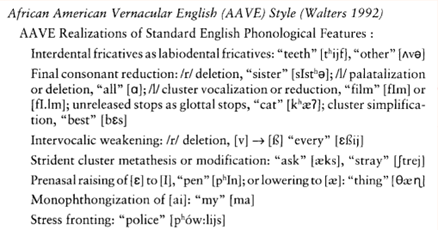
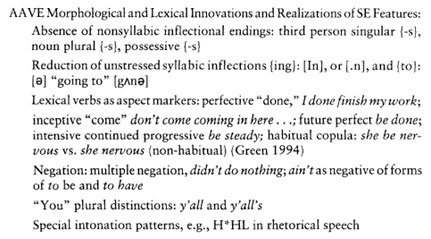
For each interview, we noted each instance in which the artist adopted at least one phonological or morphosyntactic AAVE feature and observed the frequency with which they were adopted in relation to the speech context (e.g., establishing comradery with the interviewer, discussing their childhoods, etc.). Many of the features of AAVE that this study investigates have already been widely studied by linguists. As such, we primarily followed a list of features presented by Walters (1992), found in Figures 1 and 2 below, which includes AAVE phonological features as well as AAVE morphological and lexical features. In order to minimize possible confounds, any features of AAVE that overlapped with aspects of the speakers’ L2 English dialect coming from their L1 Spanish (e.g., dropping of a final ‘g’ in verbs ending in ‘-ing’) were not considered in our analysis.

Figure 1. AAVE Style (Walters 1992): AAVE Phonological Features
Figure 2. AAVE Style (Walters 1992): AAVE Morphological and Lexical Features

The results in the following section are analyzed both quantitatively and qualitatively. The quantitative analysis considers the features of AAVE used per minute by each artist (measuring by the rate of feature adoption as opposed to considering a net total measurement is motivated by the fact that each artist’s respective videos were not equal in duration), and the qualitative analysis explores select examples of AAVE usage and aims to explain them within the lens of the conversational contexts they were used in in order to relate them back to the research question and hypotheses. We counted each syntactic, phonological, and lexical feature as one (1) instance of AAVE. For example, in his “success” interview, J Balvin produced the sentence “Yo, give it up for his Spanish!” We counted the lexical item [yo] as one feature, and the phrase [give it up for] as a second.

Results

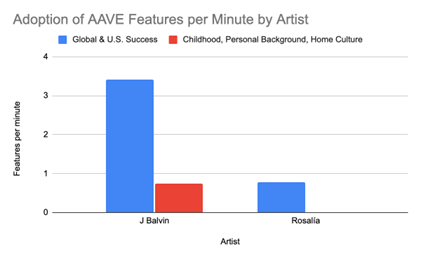
We found that both J Balvin and Rosalía adopted features of AAVE more frequently during their “success”-oriented videos than during their “personal” interviews. Specifically, J Balvin adopted AAVE features at a rate of 3.42 features per minute during the “success”-oriented interview, compared to 0.75 features per minute during his “personal” interview. Rosalía adopted AAVE at a rate of 0.78 features per minute during her “success” interview, compared to 0 features per minute for the “personal” interview.

J Balvin utilized AAVE features throughout his “success”-oriented interview. However, he only used AAVE a few times during his “personal” interview: once when establishing comradery with the interviewer, and once when he described moving to New York and the inspiration he drew from the city’s hip-hop culture. Examples from J Balvin’s “personal” and “success” interviews can be seen below. AAVE features are highlighted using bold font:

Personal

Talking about moving to New York

5:08: And that was the vibe that I was looking for.


Success

Talking about style for Guess magazine

4:09: You know, sort of Miami vibe

4:13: Shout-out to Miami.

Rosalía did not use AAVE features as frequently as J Balvin for both interview types. However, there was still a disparity between the results for her “personal” and “success” interviews: while she did adopt AAVE features in the “success” interviews when talking about her new album, “Motomami,” Rosalía did not adopt any AAVE features at all during her “personal” interview. An example from her “success” interview is shown below, again with AAVE features highlighted in bold:

Success

Talking about success of new album, “Motomami”

1:54: ‘Cause I feel like Motomami’s an energy.

Our quantitative results are illustrated in Figure 3 below:

Figure 3. Adoption of AAVE Features per Minute by Artist: J Balvin adopted features more frequently than Rosalía for both interview types, and both artists adopted features more frequently during the “success” oriented interviews.

Additionally, we did not count AAVE lexical items that have entered the Standard American English (SAE) lexicon such as “gonna,” “wanna,” and “you know” toward our tallied per-minute totals for each artist. This was a subjective decision that we made based on our prediction that the use of these terms is not generally used by SAE speakers to index social identity in the same way that strictly-AAVE terms are.

Discussion

As mentioned, J Balvin used AAVE features more frequently in both of his interview types than Rosalía did, and both of them adopted AAVE more frequently in their “success” interviews than in their “personal” interviews. These findings are in line with our hypothesis, which predicted that both artists would use aspects of AAVE in contexts for which they have an incentive to communicate their connection to an “American” identity. Additionally, the overall difference between J Balvin’s and Rosalía’s utilization of this variety is in line with Britt & Weldon’s (2015) observations of native AAVE speakers’ gendered differences. It is important to note that these are only numerical comparisons, and we cannot assert any statistical significance.

Fortunately, the “success”-oriented interviews for J Balvin and Rosalía covered similar topics, including friendship (with both the interviewer and U.S. celebrities), major performances and releases, fashion, and the artists’ success with English-speaking audiences. The “personal” interviews generally explored the artists’ childhoods and family backgrounds, the artistic inspirations they drew from their home cultures, and their immigration stories. The thematic similarities between the two “personal” interviews and the two “success” interviews, respectively, allowed us to analyze them together.

The fact that J Balvin used AAVE throughout his “success” interview, which only covered topics related to his success in the U.S., while he only used AAVE in the “personal” interview when discussing moving to New York provides evidence that he crosses into AAVE when trying to communicate his proximity to “American-ness.” Additionally, our findings that Rosalía did not use AAVE features as frequently as J Balvin for both interview types is in line with the aforementioned gendered differences observed among native AAVE speakers. However, this could also be due to the fact that Rosalía’s English is not as strong as J Balvin’s, and thus she may not be as confident in switching between English varieties. At the same time, there was still a disparity in the results for her “personal” and “success” interviews: while she did adopt AAVE features in the “success” interviews when talking about her new album, “Motomami,” Rosalía did not adopt any AAVE features during her “personal” interview. This may be because her “personal” interview did not cover any topics related to the U.S., and focused mainly on her inspiration from Spanish culture. Therefore, unlike in J Balvin’s interview, in which he talked about moving to the U.S. and New York’s hip-hop culture, Rosalía did not have any incentive to index proximity to “American-ness” based on the thematic components of her interview.

Conclusion

In conclusion, we found that both J Balvin and Rosalía adopt features of AAVE more frequently when they are talking about their international success and topics related to the United States. These results provide evidence that L2 English speakers adopt features of AAVE in order to index a connection to a global conception of “American-ness.” However, despite our study corroborating our hypothesis, there were several limitations: (a) Rosalía’s English is not as fluent as J Balvin’s; (b) we only worked with a small sample size; and (c) the categorization of act sequences and features is inevitably subjective (e.g., the way we differentiated topic types into “success” versus “personal”; ambiguous lexical items that we encountered such as “gonna,” “wanna,” and “you know” that are now a part of the Standard English lexicon). Additionally, it is worth noting that Rosalía and J Balvin are celebrities; their results are not necessarily representative of all L2 English speakers since they have a particularly strong incentive to connect to Americanness (it is essentially their job to do so if they want to break into the American market).

Finally, although we did observe a gendered difference in the frequency of adoption by J Balvin and Rosalía, the Britt & Weldon study that found gendered differences for native AAVE speakers measured this difference in terms of manner (primarily, phonetic), not in terms of frequency. However, since our study was forced to disregard much of the phonetic information from J Balvin’s and Rosalía’s interviews in order to minimize confounds with their L1 accents, we were unable to conduct a similar analysis. As such, we cannot definitively state that our results align with those of Britt & Weldon (2015).

In the end, our research suggests that L2 English speakers use AAVE features to communicate a connection to the “American identity,” and calls for a future, more robust experiment.

References

Álvarez-Mosquera, P. (2015). Underlining authenticity through the recreolization process in rap music: A case of an in-group answer to an identity threat. Sociolinguistic Studies, 9(1), 51.

Britt, E., & Weldon, T. L. (2015). African American English in the middle class.

Chun, E. W. (2001). The construction of white, black, and Korean American identities through African American Vernacular English. Journal of Linguistic Anthropology, 11(1), 52-64.

Rampton, B. (2020). Crossing. The International Encyclopedia of Linguistic Anthropology, 1-5.

Tamasi, S., & Antieau, L. (2014). Language and linguistic diversity in the US: An introduction. Routledge.

Walters, K. (1992). Supplementary materials for AFR 320/LIN 325: Black English. Master’s thesis, University of Texas at Austin.

[/expander_maker]

, , ,

Do you Entiendes?

Roni Grushkevich, Iffet Dogan, Isaac Verdugo, Nandana Suresh

The following research on receptive multilingualism seeks to observe if exposure to popular Spanish singing artists of various dialects impact Spanish heritage and non-Spanish heritage speakers’ ability to comprehend their song’s lyrics. 8 participants (4 native Spanish speakers, 2 romance language speakers, and 2 individuals who learned Spanish in school) were given a combination of a C-test and song test via Google survey. The C-test was administered to standardize the level of basic Spanish comprehension across the participants. 3 separate song tests were made for each of the following Spanish singing artists of different Spanish dialects: Vicente Fernandez (Mexican), Bad Bunny (Puerto Rican), and Shakira (Columbian), containing their most popular song. Out of the 8 participants, only 25% of them stated to have relied on their romance language in order to comprehend Spanish. Direct translations were uncommon, however, interpretations of the music were accurate. The results from the study suggest that heritage Spanish speakers were able to comprehend more than their non-heritage counterparts.

[expander_maker id=”1″ more=”Read more” less=”Read less”]

Introduction and Background

Can exposure to various dialects within the context of music impact a Spanish speaker’s ability to comprehend lyrics of a dialect they can not necessarily speak? As widely known global sensations, Bad Bunny, Vicente Fernandez, and Shakira are enjoyed by speakers of various languages. These artists, Bad Bunny originating from Puerto Rico, Vicente Fernandez from Mexico, and Shakira from Columbia, sing in various dialects of Spanish and have the potential to subliminally impact non Spanish heritage and Spanish heritage speaker’s ability to comprehend Spanish from exposure alone. This phenomenon relates to receptive multilingualism, which refers to a mode of interaction wherein people can use a language or language variety that the person with whom they are communicating does not speak, without compromising any understanding between both parties, and without the use of any additional lingua franca (Rehbein et al. 2011). This essentially means that people who have been exposed to a particular language can develop the ability to understand it, without necessarily being able to speak it. This phenomenon allows for different, varied modes of communication, especially between speakers of similar languages and dialects, who may be able to understand each other while not speaking each others’ mother tongues. Similar research on this topic has revealed mixed findings. A study by Gooskens & Heeringa (2014), found that Norwegian speakers, who tend to be more exposed to different dialects of Norwegian, were better at translating texts in other Scandinavian languages than Danish speakers. In Sloboda & Nábělková (2013), the researchers found that in online spaces, there were mixed results on whether Slovak is intelligible to Czech speakers. The following research differs from existing findings as it focuses on receptive multilingualism within the context of music, focusing on heritage and non-heritage Spanish speakers specifically. We predict that through receptive multilingualism, Spanish heritage speakers will have the highest comprehension of song lyrics of various dialects; however, non-heritage speakers will have some level of comprehension through learned Spanish or familiarity with Spanish.

From left to right: Shakira, Bad Bunny, Vicente Fernández

Methods

Our participants were composed of both heritage Spanish speakers and non-heritage Spanish speakers. Participants were not asked to report their age or other demographic information. All of our participants are based in Los Angeles, California and were UCLA students. We got our participants by asking individuals who we know meet the requirements and asking individuals enrolled in a UCLA Italian course. We ended up having 8 participants (4 heritage Spanish speakers, 2 romance language speakers, and 2 individuals that learned Spanish in school). Non-native Spanish speakers were asked to report if they had received formal education in Spanish and if they did not speak Spanish, what Romance language they did speak.

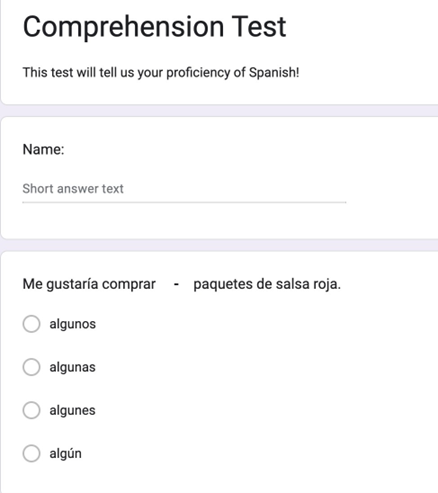
We were able to conduct our study via C-test and song test, both of which were presented to the participants online in one survey. A C-test is a tool to measure language proficiency and this shows us where the participant’s levels of proficiency in Spanish is placed. We used the C-test from an online source (One to One Spanish). We chose to have this C-test in Spanish because it would allow us to compare our participants although they all come from different backgrounds. The entire C-test is multiple choice but we asked each participant to explain what skills they used to answer the questions.

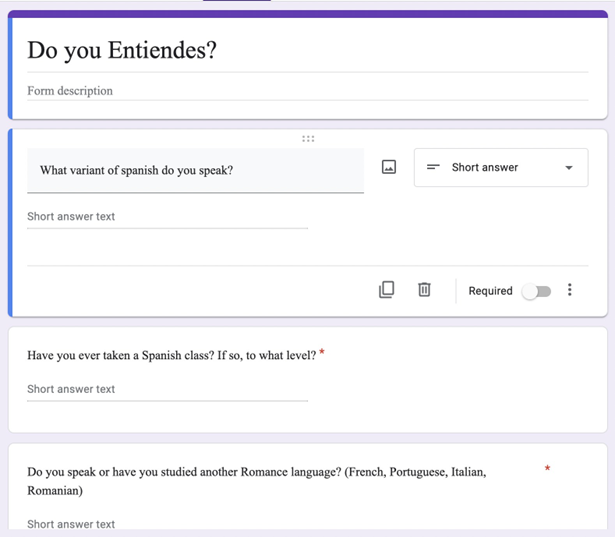
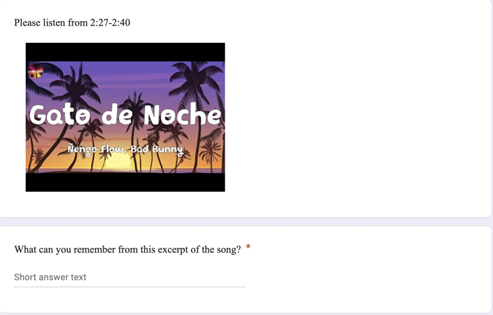
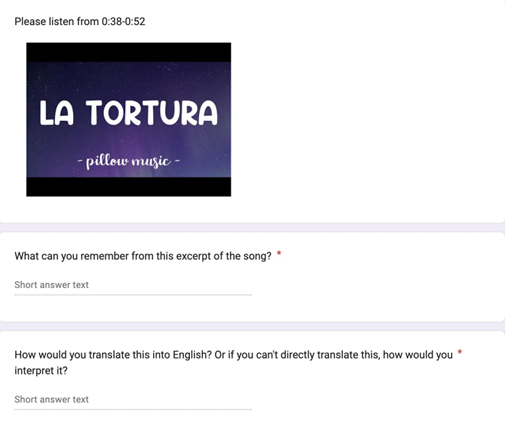
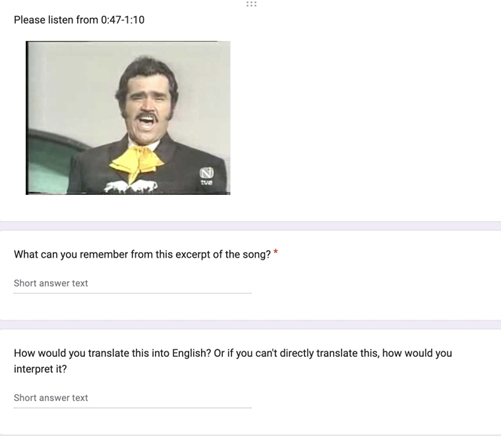
The second part of the Google survey consisted of a set of questions that revolved around a song by one of the Spanish language artists, Vicente Fernandez, Bad Bunny, and Shakira. The participant was given a survey with one of the artists that does not sing in the variation of Spanish that they are privy to in the case that they are one of the heritage speakers of that variation. For example, a heritage Mexican-Spanish speaker was not given Vicente Fernandez as their musical artist to interpret. Moreover, each participant was pre-screened and elaborated on which type of Spanish they are familiar with/speak in order to select the song from an artist who sings in a variation of Spanish they’re unfamiliar with. The survey asked questions like what variation of Spanish they speak, if they have ever taken a Spanish-language class, if they have studied another romance language and to what level. Upon answering these questions, the participant listened to a section of the song they were given. Upon listening to the section of the song, the survey asked participants what they remember hearing from the song and followed up with asking the participant how they would translate what they heard into English and if they could not do so, how would they interpret what they heard. Lastly, they were asked how they came to this interpretation. We anticipated word chunks to be an important element in the analysis because of the similarities some words have with a similar romance language which would contribute to the receptive multilingualism. We evaluated the amount of word chunks that they were able to register in each survey. We accounted for the amount of word chunks they input as well as the frequency of entire sentences they input among the three different songs.

Results / Analysis

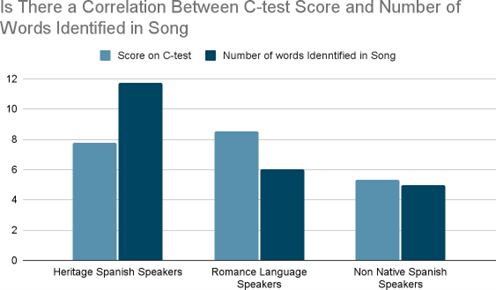
Based on our results, it is clear that our participants scored fairly well on the C-test. Out of nine questions, we were able to compare participants’ comprehension of Spanish in comparison to each other. As shown by Figure 1, the heritage Spanish speakers and romance language speakers performed better on average in comparison to the non-native Spanish speakers. This is something that we predicted when creating our study. This could be due to the fact that the heritage and romance speakers have more background with Spanish and have better knowledge to apply when taking the C-test. It is important to note that the non-heritage Spanish speakers scored exactly where we predicted they would. With some prior knowledge in Spanish, averaging a 5.5/9 on the C-test is fairly high.

Figure 1 aims to see if there is a correlation between the score participants got on the C-test and the number of words/chunks they identified in the second part of the Google survey when listening to the song. It is clear that heritage Spanish speakers performed the best at identifying words/chunks out of the song they heard. One surprising thing we do see in the graph is that the romance language speakers did much better on the C-test portion in comparison to the music component. This could be due to the fact that the C-test relies more on recall because it is multiple choice. This means that romance language speakers see the options listed which could help them reach the right answer. However, when needing to write chunks/words they remember, it is a much harder task that requires more knowledge of Spanish.

Overall, Figure 1 proves the fact that the performance on C-test is highly correlated to the way participants performed on the song test.

Figure 1. Shows correlation between the score participants got on their C-test and how well they performed on the second part of the Google survey.

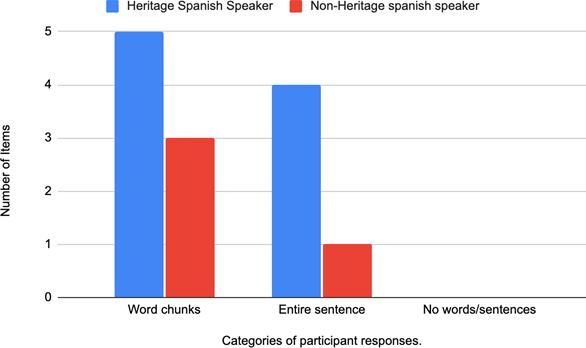
Below is a column chart that displays the amount of participants that were able to register word chunks, entire sentences, and no sentences or word chunks. The heritage Spanish speakers were able to register more word chunks and entire sentences than their non-heritage counterparts.

Figure 2. Column chart with participant’s results.

The excerpts from each song were less than 15 seconds each and displayed roughly three whole sentences. Vicente Fernández’s Volver Volver included the lyrics “Nos dejamos hace tiempo pero me llegó el momento de perder. Tú tenías mucha razón le hago caso al corazón y me muero por volver.” Our two participants that were given the song Volver,Volver comprehended a good amount of lyrics that they were able to translate into small pieces of information like word chunks. Their knowledge of pop-culture and their respective romance language backgrounds were able to assist them in their interpretations of the song and lyrics. Bad Bunny’s Gato de noche exhibited the following lyrics from the excerpt “Tú ere’ mi loca y hoy te toca la terapia si no se lo meto le da rabia puedo tener más de veinte pero tú ere’ mi bichota, tú ere’ mi sicaria tanto’ pece’ en el mar”. Three heritage Spanish-speakers were able to register the entirety of the song excerpt; however, they did not register every word. Their knowledge in Spanish and the use of context clues based off of that knowledge was able to assist them in their interpretation of the song. The one non-heritage Spanish speaker that was given the Bad Bunny excerpt registered a few word chunks but did not succeed in translating the excerpt entirely. They did mention that their romance language assisted them in their interpretation and therefore led to their response aligning with what the lyrics entailed.

Shakira’s La Tortura was given to two participants, both of whom are heritage-Spanish speakers. The following lyrics were exhibited in the excerpt: “Ay amor me duele tanto, me duele tanto. Que tú fueres sin decir a dónde ay amor fue una tortura perderte.” The two participants had very accurate translations of the excerpt as well as the amount of word chunks and sentences they were able to register. Both of them translated the lyrics and their interpretation of the excerpt was accurate. They stated that their background in Spanish was the main reason for their accurate responses. Out of the eight participants, only 25% of them stated to have relied on their romance language in order to comprehend Spanish. Direct translations were uncommon, however, interpretations of the music were accurate.

The findings of the data suggest that heritage Spanish speakers were able to comprehend more than their non-heritage counterparts. Given that we received eight responses, it is not clear whether or not the findings reflect this on a macro level.

Discussion and Conclusions

Overall, while our C-test results were mixed, there certainly was a positive correlation between one’s prior exposure to Spanish and the amount of words they were able to translate during the music component of this experiment. This shows that, for the romance language speakers and non-native Spanish speakers, the prior exposure that they may have had to Spanish or another romance language probably did help them translate the song lyrics that were given to them, especially when we consider the fact that, even though many of the non-native Spanish speakers were not able to perfectly translate the lyrics, a large proportion of them were still able to accurately understand the meaning of the song lyrics. In essence, while they may not have been able to understand the meaning of each individual word, they may have been able to use what they did know, in conjunction with context clues, to make an educated guess as to what the general meaning of the lyrics were.

As it turns out, this is a strategy that many of our participants reported that they were able to follow, in that they described being able to recognize some of the more “important” content words (nouns, verbs, adjectives, and adverbs), and use them to their advantage. These words happened to be those that were either well known to non-Spanish speakers, such as loca, or those that share a similar form to their counterparts in English or other romance languages. From there, they described being able to use context clues to help them derive the meaning of the surrounding word chunk. Aside from this, there were some non-linguistic aspects of each song that may have somewhat aided the participants in their translations, in that features like tone, rhythm, tempo, etc. may have helped them identify the mood, and likely subject matter of the song. we did not see this described in our data enough, though, to make any concrete conclusions surrounding this.

However, when discussing this experiment, it is important to consider factors such as formal education that may have skewed our data—many of our non-native Spanish speakers had taken Spanish to quite a high level in the past, which can explain the relatively high proficiency that was found in their C-test results, and may have boosted their ability in the song lyric task as well. This is not necessarily a bad thing, since it doesn’t disprove that receptive multilingualism is the underlying mechanism in their success in these tasks. In terms of better understanding the strength of receptive multilingualism, though, we would probably have wanted to include participants who had less, but still some, exposure to Spanish. In this way, we would have been able to draw stronger conclusions from the data we collected—if people who had a very basic level of formal exposure to Spanish were still able to understand the meaning of the song lyrics, while likely performing poorly on the C-test, it would ultimately mean that their receptive capabilities were the main reason as to why they were able to understand the lyrics.

Additionally, only two out of the three videos we used to present the songs to the participants contained closed captions, which definitely showed in our data. We noticed that while most participants were able to understand the lyrics of the songs that contained closed captions, the participants that were assigned to the song that did not have closed captions struggled considerably with recognizing words and translating lyrics as a whole. This is not particularly surprising—while many words may share written forms between English, Spanish, and other Romance languages, they don’t necessarily sound similar. Because of this, when participants were forced to rely purely upon auditory stimuli during the music component, they may not have recognized some words that they would have recognized if they had access to closed captions while listening. In terms of receptive multilingualism, this indicates that people’s receptive abilities are stronger when they have both audio and visual input, as opposed to just audio input, as it makes it easier to make connections between the words in the received language and their counterparts in their native languages.

While we cannot make any claims about whether this makes it easier to then learn these words in the received language, perhaps, in the future, doing something like adding closed captions to all songs would help people understand their lyrics, even if they don’t speak the language that the song is sung in. Thus, receptive multilingualism can be a powerful tool in understanding non-native languages especially when considering songs and other forms of media, because we have various amounts of ways in which we can present information to listeners to aid their understanding of the material, no matter what their background may be.

Appendix

Comprehension Test

Survey Inquiry

Song Test A: Bad Bunny
Song Test B: Shakira
Song Test C: Vicente Fernandez


References

Bahtina-Jantsikene, D. (2013). Mind Your Languages: Lingua Receptiva in Estonian-Russian Communication. LOT. http://www.lotpublications.nl/Documents/338_fulltext.pdf

Bulatović, S., Schüppert, A. & Gooskens, C. (2019). Receptive multilingualism versus ELF: How well do Slovenes understand Croatian compared to Croatian speakers’ English? . Journal of English as a Lingua Franca, 8(1), 37-65. https://doi.org/10.1515/jelf-2019-2005

Gooskens, C. & Heeringa, W. (2014). The role of dialect exposure in receptive multilingualism. Applied Linguistics Review, 5(1), 247-271. https://doi.org/10.1515/applirev-2014-0011

Rehbein, J., ten Thije, J. D., & Verschik, A. (2012). Lingua receptiva (LaRa) – remarks on the quintessence of receptive multilingualism. International Journal of Bilingualism, 16(3), 248–264. https://doi.org/10.1177/1367006911426466

Sağın-Şimşek, Ç., & König, W. (2012). Receptive multilingualism and language understanding: Intelligibility of Azerbaijani to Turkish speakers. International Journal of Bilingualism, 16(3), 315–331. https://doi.org/10.1177/1367006911426449

Sloboda, M. & Nábělková, M. (2013) Receptive multilingualism in ‘monolingual’ media: managing the presence of Slovak on Czech websites, International Journal of Multilingualism, 10:2, 196-213, DOI: 10.1080/14790718.2013.789523

Spanish Quiz – Prueba de Español – B1. Free Spanish quiz B1 – Intermediate Low level. (n.d.). https://121spanish.com/spanish-quiz-B1

Verschik, A. (2012). Practising receptive multilingualism: Estonian–Finnish communication in Tallinn. International Journal of Bilingualism, 16(3), 265–286. https://doi.org/10.1177/1367006911426465

Weiss, Gretchen. (2021) The Effect of Music Instruction on Bilingual Early Language Acquisition. [Master’s thesis, California State University]. https://scholarworks.calstate.edu/downloads/1j92gd72g#:~:text=Children’s%20songs%20 and%20chants%20taught,and%20reinforcement%20by%20the%20family.

[/expander_maker]

, , , ,
Scroll to Top