Aiyanna Flores, Bryn Richards, Kiki Zeng, Justin Zhang
Millennials often scroll through TikTok or Instagram comment sections with confusion, while Gen Alpha users seem to effortlessly understand phrases like “no cap” or “main character energy.” Yet this raises an important question: why do those who are highly skilled at interpreting digital language often struggle to express the same meanings in formal academic English?
This study examines how smartphone use and social media exposure shape this divide by comparing participants’ ability to interpret and translate digitally mediated language into academic expression. Through meme interpretation and sentence reformulation tasks in our questionnaire, we find that while both groups are familiar with internet slang, their strengths differ.
Gen Alpha demonstrates strong interpretive competence, reconstructing humor, context, and implicit meaning, but struggles to expand these compressed meanings into formal language. Millennials, in contrast, produce more structured academic paraphrases but may miss cultural and intertextual references.
Rather than indicating language decline, these findings suggest the coexistence of two distinct literacy systems—digital and academic—resulting in a generational register mismatch.
Keywords: Social media, Millennials, Gen Alpha, meme culture, digital communication, slang
[expander_maker id=”1″ more=”Read more” less=”Read less”]
Introduction and Background
In recent years, online platforms have witnessed the rise of “brain rot” meme culture, characterized by a highly compressed and playful form of English. Featuring neologisms such as rizz and sigma, this emerging digital dialect—closely associated with Generation Alpha—is shaped by TikTok, YouTube, and gaming communities. Its emergence has generated generational tension, as older speakers often dismiss it as degraded or non-academic, reflecting a broader tendency to devalue unfamiliar forms and overlook the ongoing reinvention of English in a digitalized world (Rachmijati & Cahyati, 2024).
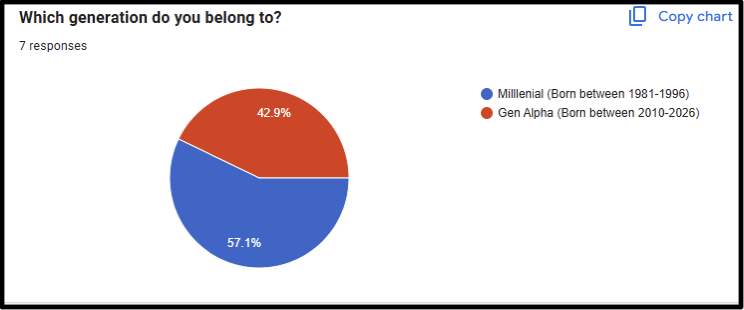
While digital communication highlights the adaptability of English, such forms are not equally appropriate across contexts. As younger speakers become increasingly fluent in Generation Alpha slang, questions arise about their ability to shift into formal academic registers. Conversely, Millennials often struggle to interpret the highly contextual, multimodal discourse of online platforms. To examine this register mismatch, our study focuses on Generation Alpha (2010–2024) and Millennials (1981–1996) (Springtide Research Institute, 2025).
Here, we intend to focus our research on how these two groups perceive linguistic features such as simplified syntactic structure, acronyms, and digital-specific discourse, particularly investigating how they are interpreted in everyday digital communication, and then reformulated within the academic context. Utilizing the previous data classifications conducted by Tilagavati Subramaniam & Muthualagan Thangavelu in the Journal “Exploring The Use of Digitalised Slang in Verbal Communication Among Generation Alpha” data and word meaning shown in Table A.1 Gen Alpha Slang and Definition for reference.
Therefore, we ask, “How has the rise in smartphone usage and digital media consumption, specifically in the form of online humor and digitally-mediated slang, contributed to an overall register mismatch between digital language and academic English language across Generation Alpha adolescents and Millennials?” This question ultimately seeks to determine whether individuals who are fluent in interpreting these highly contextual forms of digital language are equally able to reformulate them within the formal language expected in academic writing.
Methods
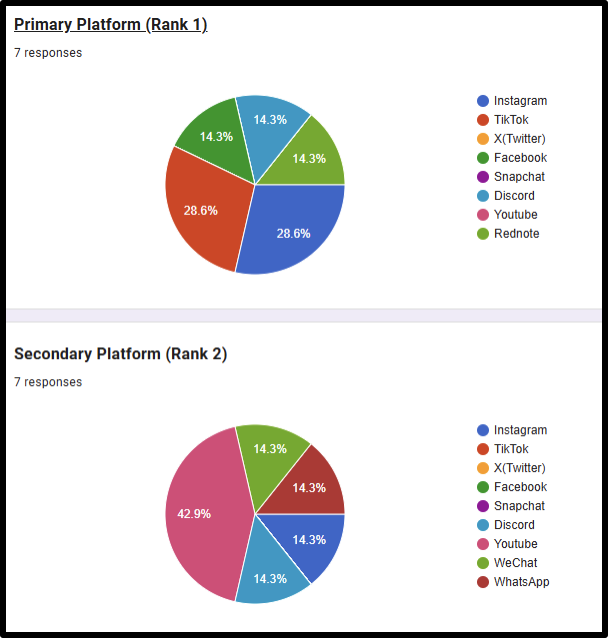
We collected data through an online questionnaire distributed to seven participants from both Generation Alpha and Millennial groups. The survey examined both participants’ exposure to digital language and their ability to interpret and reformulate it. Participants first reported their daily screen time and most frequently used platforms. They then completed interpretation tasks based on real examples of online discourse (e.g., “I’m dead,” “too real”), where they expanded comments from an Instagram reel to explain their meaning in context. In addition, participants interpreted a meme involving layered cultural references.
Finally, participants completed reformulation tasks, rewriting slang-based expressions (e.g., “main character energy,” “clout chasing”) into formal academic language. Responses were analyzed by comparing interpretive competence (ability to explain meaning and context) and linguistic competence (ability to produce structured academic language), with attention to patterns across generational groups.
Results and Analysis
All participants reported high levels of digital exposure, with four to nine hours of daily screen time and frequent use of TikTok and Instagram. Both groups were familiar with widely circulated slang such as “rizz,” “slay,” and “no cap,” yet this shared exposure did not translate into similar communicative competence.
When shown the reel, interpreted by the contrasting attitudes of an Asian father before and after his child’s success, Generation Alpha consistently demonstrated strong interpretive ability. When explaining expressions such as “I’m dead,” they produced context-rich paraphrases (e.g., “it means something is so funny that you can’t react normally”), and for “too real,” they referenced shared social experiences (“parents likes telling others what to do”). In the meme task, Gen Alpha participants explicitly recognized intertextuality; one described the meme as “a bunch of brain-rot text where each word references another meme,” showing awareness that meaning emerges from accumulated cultural references rather than sentence-level semantics.
Table B.1 Gen Alpha Slang and Definition
| Slang | Meaning |
| 1.Skibidi | Nonsense |
| 2.Sigma | Independent |
| 3.Gigachad | Hyper-masculine ideal |
| 4.Gyatt | Admiration |
| 5.Yeet | Exclamation of excitement |
| 6. Slay | To do something exceptionally well |
| 7.Delulu | Delusional |
| 8. Its Giving | Something Aesthetic |
| 9.Cap | Lie |
| 10. No Cap | No Lie or Truth |
| 11.Vibe | The atmosphere |
| 12.W | Success |
| 13.Tea | Gossiping |
| 14.Fanum Tax | Stealing Something |
| 15.Ate | Awesome |
| 16.Cloud 9 | Happy |
| 17.Feeling Blue | Sad |
| 18.Sus | Suspicious |
| 19.Bruh | Addressing someone boy or girl |
| 20.Ohio | Awkward |
| 21.Rizz | Ability to flirt or attract others |
| 22.Drip | Stylish |
| 24.Idk | I don’t know |
| 25.Cook | Doing really well at something |
| 26.Snatched | Looking amazing |
| 27.Bet | Okay |
| 28.Flex | Show |
| 29.Yassify | Exaggerated Beauty |
| Note:Table B.1 Gen Alpha Slang and Definition referenced Ishita & Radhika Mamidi’s study and compilation 100 slang words and definitions from Gen Alpha research subject Source: Cited from “Exploring The Use of Digitalised Slang in Verbal Communication Among Generation Alpha” by Tilagavati Subramaniam & Muthualagan Thangavelu. |
This pattern is even more evident in the meme task. One Gen Alpha participant described the meme as consisting of “a bunch of brain-rot text… each word is a callback to another meme,” demonstrating awareness of intertextual meaning. Understanding such content requires familiarity with broader cultural references rather than sentence-level logic.
These differences became more pronounced in reformulation tasks. Gen Alpha participants were generally able to grasp the meaning but struggled to expand it into formal academic language; for example, “main character energy” was reduced to “confidence,” and “clout chasing” to “seeking attention,” omitting evaluative and social nuance. Millennials, however, often struggled at both stages: some failed to interpret phrases like “The function was totally Ohio but the fit was a massive W,” recognizing “W” as success but expressing confusion about “Ohio,” which relies on meme-specific context.
Taken together, these results suggest a distinction between interpretive competence and linguistic competence. Participants are often able to understand digital language but vary in their ability to translate it into formal academic expression.
Discussion and Conclusions
These findings suggest that the gap between digital and academic language reflects differences in how meaning is structured, rather than differences in overall ability. Digital discourse often compresses complex meanings—such as identity, humor, and social evaluation—into short, context-dependent expressions. Academic language, by contrast, requires these meanings to be made explicit and fully articulated. Moving between these systems therefore requires different communicative skills.Generational differences further highlight this divide.
Generation Alpha participants showed strong interpretive competence, particularly in reconstructing context and understanding implicit meaning. Millennial participants, on the other hand, were more comfortable producing structured academic language but sometimes lacked familiarity with digital cultural references. Rather than indicating a decline in language ability, these patterns point to the coexistence of two distinct but overlapping literacy systems. The observed register mismatch emerges not because one group is less capable, but because different forms of competence are developed in different communicative environments.
Works Cited
Rachmijati, C., & Cahyati, S. S. (2024). Know your skibidi: Navigating Gen Alpha’s slang types and trend on social media X. Proceeding of the 4th International Conference on Research and Development (ICORAD), 3(2), 392–400. https://doi.org/10.47841/icorad.v3i2.219
Springtide. (2025, May 20). New Data From Our Study on Gen Alpha. Springtide Research Institute. https://springtideresearch.org/thirteen-a-first-look-at-gen-alpha.
Subramaniam, T., & Thangavelu, M. (2025). Exploring The Use of Digitalised Slang in Verbal Communication Among Generation Alpha. Journal of Cultural Analysis and Social Change, 10(3), 236–243. https://doi.org/10.64753/jcasc.v10i3.2401
[/expander_maker]