Ava Castillino, Melissa Ranjbar, Taey Traisorat
Have you ever noticed that in different social situations, you may speak differently? At work, you might use more formal language when talking to your boss, but at home, you would speak more casually with your sibling. In linguistic anthropology, we call this phenomenon “code switching.” Most of the time, this linguistic strategy isn’t used on purpose – it just happens naturally when you adjust to a specific social context. If you know multiple languages, have you ever felt like you have a completely different personality depending on which one you are using, but still inexplicably feel like yourself? It’s a common result of code-switching to better fit the culture of the language. However, things can get complicated when you’re required to code-switch between both languages and workplace contexts. Our study examines how Thai restaurant workers in Los Angeles use code-switching and politeness strategies in multilingual service environments, focusing on three Thai-owned restaurants: Sanamluang Cafe in Thai Town, Emporium Thai in Westwood, and Mr. Noodle in Westwood. We analyzed staff surveys, menu language, and interactional data. Our findings show that workers strategically switch between Thai and English depending on the customer and social context.
Keywords: Code-switching, Thai-American Restaurants, Los Angeles, Audience Design
[expander_maker id=”1″ more=”Read more” less=”Read less”]
Some Info and Context
Our study shines a spotlight on the Thai restaurant workers of Westwood, Los Angeles. In the mid-20th century, Thai migration to the U.S grew significantly, and inevitably Thai-owned businesses grew in urban centers (Losavio, 2021). Now, some might say almost every town in America has a Thai restaurant. More specifically though, LA Thai restaurants shape the representation of Thai identity and community (Padoongpatt, 2011). They function as multilingual and multicultural spaces, despite being in a predominantly English-speaking city. LA is a unique location to research Thai people; most of them didn’t immigrate to flee war and were instead seeking opportunities (Losavio, 2021). Most were already middle-to-upper-class people who immigrated for higher education, tourism, or careers.
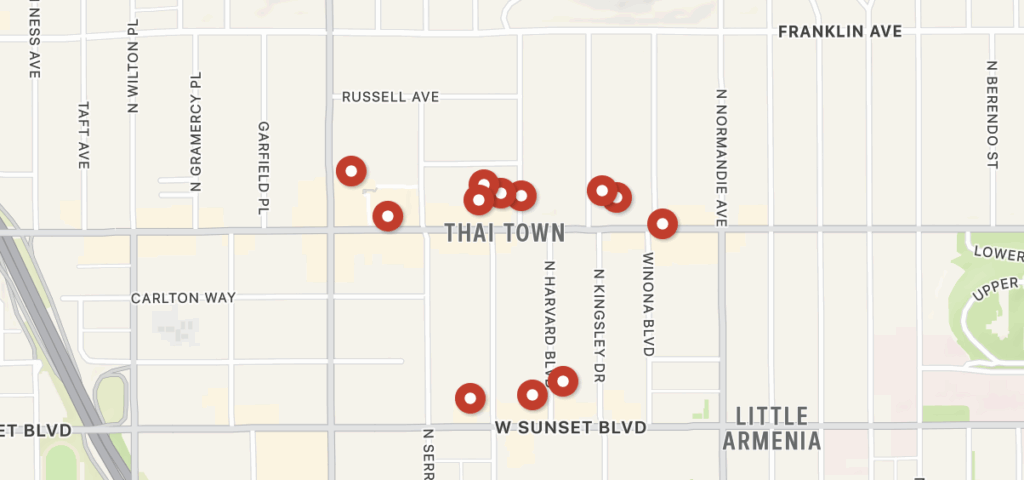
Figure 1. Locations of top-rated Thai restaurants in LA, all observed in Thai Town, Los Angeles.
Thailand used food as a tool of cultural diplomacy through gastrodiplomacy in the 21st century. It’s a form of public diplomacy used to communicate culture and identity through national cuisines, often effectively creating brand recognition and expanding soft power abroad (Raksarat 2022). Cuisine is a tool for countries to shape international perceptions in a globalized world. The Thai government created training programs for chefs, financial assistance for restauranters, encouraged Thai investors to open locations overseas, and special visas for Thai chefs. This increased the global visibility of Thai food and stimulated tourism, shifting international perceptions towards a richer identity rooted in culinary traditions (Raksarat 2022).
Padoongpatt (2011) additionally argues that Thai people undermine their racialisation through food, keeping a distinct identity from other Asian cultures, but also that Thai cuisine is used to establish racial boundaries by white people and that their quest for “exotic” cuisine is ultimately rooted in colonialism and U.S. imperialism. Thai cuisine began to gain popularity in richer white neighborhoods, but it remained dependent on frequently exploited workers with their own hierarchies. These might overlap with Thai cultural norms’ emphasis on respect, age-based hierarchy, and relational harmony. We examined Thai-English code-switching and politeness strategies in restaurant settings shaped by context — norms may be different in multicultural service compared to the average American priority of being direct and friendly.
What Did We Decide To Do?
The rundown: we looked at three different Thai-owned restaurants in LA, California: Sanamluang Cafe in Thai Town, Emporium Thai in Westwood, and Mr. Noodle in Westwood. Thai Town is one of the two federally recognized Thai Towns in the US. It serves as a Thai cultural enclave and has the largest number of Thai residents outside of Thailand. Westwood is a neighborhood in West LA and is the home of UCLA, with many affluent neighborhoods bordering it.
We visited all three restaurants in person and took notes of our observations of communication styles with ourselves as English-speaking customers. At Emporium Thai, staff spoke only English with us. The server greeted us with “How are you doing?” and later said, “I like your top.” At Sanamluang Cafe, staff interaction was brief and direct, such as asking “How spicy?” and giving options like “Mild, Medium, Spicy.” Conversation was minimal. At Mr. Noodle, staff interactions were more personal than Sanamluang, but less conversational than Emporium Thai. Our server checked in with “Is everything ok? For to go?” and later “Everything ok na?”. Staff interacted casually with customers.
In surveys, we asked questions about comfort level speaking English and Thai, in or out of work, and with customers or other staff. Questions regarding proficiency in English were rated on a scale of Very Poor, Poor, Average, Good, and Very Good. Questions on the frequency of speaking in English or Thai were rated on a scale of Never, Rarely, Sometimes, Often, Very Often. Questions regarding comfort level speaking English or Thai to customers or staff were rated as Yes, Neutral, No.
We also looked at the menu language of each restaurant and compared how they describe the same dishes. For example, the dish ส้มตำ or /sôm tām/ – Thai papaya salad. On Sanamlaung’s menu, this dish is written in Thai as “ส้มต่ำ ตลาด อ.ต.ก.,” which translates to “Papaya Salad from Or Tor Kor Market” (a famous market in Thailand), and listed in English as “SOM TUM” (the English transliteration). However, on Emporium Thai’s menu, this dish is listed as “Papaya Salad Vegan.”
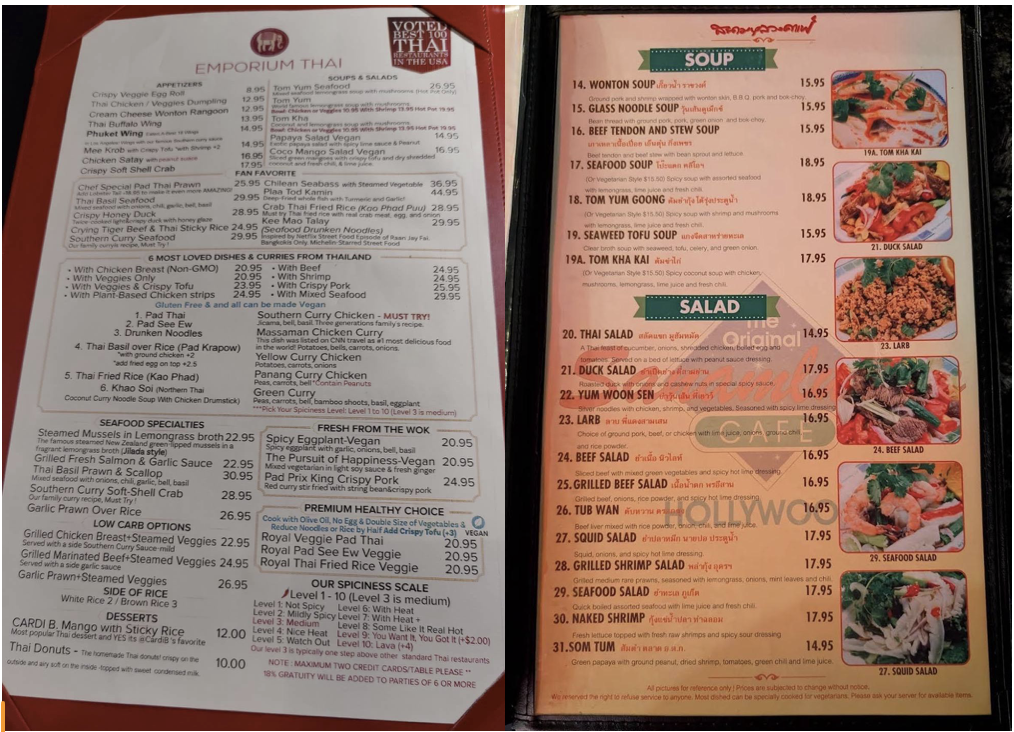
Figure 2. Side-by-side comparison of menu language from Emporium Thai and Sanamlaung Cafe. Thai Town restaurants appeal to a Thai-speaking audience, while Westwood restaurants use descriptive English names.
Lastly, we recorded and transcribed a naturally occurring interaction between a Thai-speaking customer and two non-Thai diners at Mr. Noodle. The transcript was analyzed line-by-line to identify instances of Thai–English code-switching, and shows how the conversation switches between English and Thai based on who the server is talking to in the group.
So, What Did We Find?
Survey responses from two staff members at Mr. Noodle suggest that both Thai and English are used in the workplace, but English is primarily used when interacting with customers. As seen in Figure 3, they reported comfort speaking English and described the dominant customer demographic as “Americans,” suggesting that English is the primary service language in restaurants serving mostly non-Thai clientele.
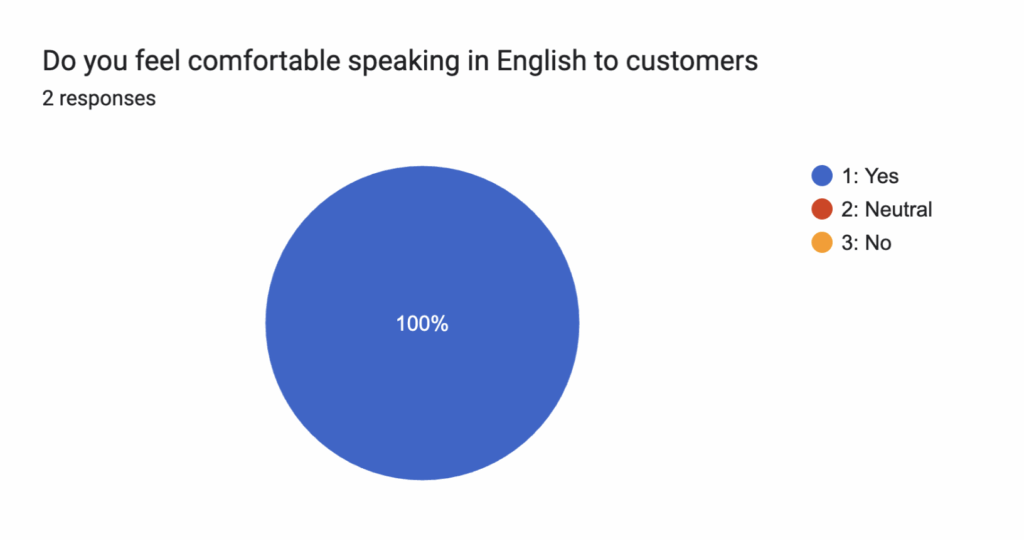
Figure 3. Staff-reported comfort in English language use at Mr. Noodle. English is used more comfortably with customers, while Thai is used more in staff interactions.
These language choices can be understood through “audience design”, where language is adapted depending on the expected audience. Restaurants serving mostly non-Thai customers have menu language to make dishes more familiar to Westerners. At the same time, these choices may reflect the commodification of culture, elements of Thai cuisine repackaged to be Westernized.

Figure 4. Lines 7 and 8 from transcript. Example of Thai–English code-switching during ordering. The speaker switches languages within a single utterance and the waiter continues in English when addressing non-Thai diners.
To further support this pattern, the transcript from Mr. Noodle shows a waiter switching between Thai and English depending on who they are addressing (Figure 4). The waiter speaks Thai with the Thai-speaking customer but switches to English when communicating with other diners, particularly when discussing spice levels. This suggests that the Thai-speaking customer acts as a linguistic intermediary between staff and other diners.
Field notes also show differences in interactional style across restaurants. At Emporium Thai, staff used more positive face strategies, while interactions at Sanamluang used negative face strategies. Restaurants serving mostly non-Thai clientele tend to use more English and culturally adapted menu descriptions of Thai dishes, while establishments in Thai Town retain more traditional Thai terminology. This suggests that language choice and interaction style shift depending on the expected customer base, highlighting how restaurants adapt linguistically to their surrounding communities. Overall, code-switching functions as a practical and social strategy, helping workers navigate cultural expectations, communicate effectively, and adapt Thai identity to diverse audiences.
Food For Thought
Mr. Noodle appears to occupy a middle position between these models. Based on our notes, Mr. Noodle seems to cater more toward Asian or Asian-American customers, incorporating several pan-Asian items. The restaurant lists “Hainan Chicken” rather than the Thai name “Khao Man Gai,” which may make the dish recognizable to a broader audience. Interaction styles also fell between the other two restaurants: staff interactions had less positive face than at Emporium Thai but more conversational exchanges than observed at Sanamluang. Our transcript also shows staff switching between languages depending on the customer, suggesting that the restaurant navigates multiple linguistic and cultural audiences at once. Though Emporium Thai and Mr. Noodle are both in Westwood, our findings suggest there can still be stark linguistic differences in customer-staff interactions tied to the specific demographic of the restaurant area, demonstrating a wide range of linguistic flexibility within one neighborhood. Our theory is that since the location of Mr. Noodle is very close to UCLA and its diverse population, it influences the language used. Emporium Thai is located further, and the language used by staff could be influenced by the demographics of the predominantly White surrounding areas.
This linguistic flexibility shows a willingness to adapt to different environments and market Thai culture to different audiences. The history of Thai immigration may allow Thai immigrants more flexibility to adapt to Western audiences, confident in the preservation of their culture. The claim that Thailand was the “only South East Asian country to avoid colonization from a European power” created a sense of exceptionalism and national pride (Losavio, 2021). When there is less concern for survival and preservation, it typically follows that there is less concern for loss, as perhaps showcased by Thai immigrants’ willingness to adapt and blend for a higher Western appeal.
Bibliography
Bailey, B. (1997). Communication of respect in interethnic service encounters. Language in Society, 26(3), 327–356.
Half as Interesting. (2021, December 22). Why Almost Every Town In America Has a Thai Restaurant. YouTube. https://www.youtube.com/watch?v=W09QCLmnCUU
Losavio, J. (2021). Temporary Thais: Circular Thai–US Migration in the 1960s. Journal of American Ethnic History, 40(4), 41–85. https://doi.org/10.5406/jamerethnhist.40.4.0041
Padoongpatt, T. M. (2011). Too hot to handle: Food, empire, and race in Thai Los Angeles. Radical History Review, (110), 83–108. https://doi.org/10.1215/01636545-2010-027
Prin, N. (2021). A case study of code-switching among Thai waiters in a Cambridge, UK restaurant. MANUSYA: Journal of Humanities, 24, 106–125. https://doi.org/10.1163/26659077-02401004
Raksarat, N. (2022). THE ORIGINS AND DEVELOPMENT OF THAILAND’S GASTRODIPLOMACY https://ethesisarchive.library.tu.ac.th/thesis/2022/TU_2022_6203120016_17855_27618.pdf
Tritle, H. L. (1996). To Switch or Not to Switch: Using Hymes’ SPEAKING Model to Analyze Code-Switching in a French Restaurant. Ohio Working Papers in Linguistics and Language Teaching, 15(fall), 77–84.
Young, H. (2022). Code-Switching: Patterns and Motivations for Thai American Code-Switching: Patterns and Motivations for Thai American Bilingual Speakers. https://huskiecommons.lib.niu.edu/cgi/viewcontent.cgi?article=2432&context=studentengagement-honorscapstones
Zhang, Z. (Victor). (2024). Identity Construction and Second Language Acquisition: A Multiple Case Study of Thai Immigrants in Hong Kong. Journal of Language, Identity, and Education, 23(4), 498–511.https://doi.org/10.1080/15348458.2021.1999816
[/expander_maker]