language proficiency

The Experiences of Non-Native English Speakers at UCLA

Christina Oghlian, Cia Evangelio, Nina Esteghlal, Rikuto Kawada, Yuka Tanaka

As a native speaker of a language, we never really stop to think about the experiences and challenges of those who are not native speakers. It is especially difficult for those who are studying in a foreign country where almost everyone is fluent in a different language than them. We decided to research what challenges international students face in order to gain a greater understanding of their experiences as non-native English speakers at an American university. In addition, we want to use the results of our findings to understand what resources are available for international students who are not English-proficient.

We conducted our research by interviewing 10 international students attending UCLA, 5 of which were male and 5 of which were female, about their English academic proficiency levels and their experiences in various social settings as non-native speakers. By creating more spaces where international students can meet one another or consult with fluent English speakers about difficulties they might have with the language, educational institutions can help their international students feel more safe and comfortable in both academic and social settings.

[expander_maker id=”1″ more=”Read more” less=”Read less”]

Introduction

Think about yourself living in other countries where people do not speak your native language. What would you feel, and what difficulties would you face? This curiosity makes us want to study how each international student struggles to live in other countries. We focus on the linguistic, social, and mental challenges that international students face during their study abroad experiences. Our research question is: “How does international students’ English proficiency affect their personal life to be fulfilling while they are studying abroad, and what are the difficulties for international students to achieve their ideal life in new countries?” We hypothesize that international students with higher proficiency in speaking English have more opportunities to socialize in groups. On the other hand, international students who have lower English proficiency will face more difficulties in socialization and having an awareness of their speaking English, increasing their anxieties while they are speaking English to native speakers.

Background

International students face new challenges in a new country. There can be many reasons and situations, such as the language barrier, socialization, and mental condition. Those challenges have a huge negative impact on international students in terms of their studying or speaking English. Many international students are willing to enhance their speaking skills and engage in new social interactions, such as engaging in conversation, making new friends, and so on, in the new countries they go to (Bernhard and Gregory, 2017). Depending on the individual international students, there are differences in these achievements to be different because their English proficiency will be affected.

The linguistic barrier can make people feel they are not in the conversation while people are speaking English because they cannot understand and speak out while people are using English. This can make international students feel socially excluded because of the differences in their English ability (Hilt, 2016). In addition, linguistic barriers are affecting not only the social life of international students but also their mental awareness of their English ability in many ways. While international students feel they are not good enough at speaking English, it can affect their feelings of anxiety (Idrissi, 2022). Moreover, the linguistic barrier can also affect international students’ confidence in speaking (Iris and Lopez, 2014). Therefore, English proficiency has a huge impact on the interactions with international students, their social lives, and their awareness of anxiety.

Methods

For our research study, we aim to interview 10 international UCLA students between the ages of 18-25. Out of the 10 international students, we will specifically interview 5 males and 5 females. Our research will examine how these international students face difficulties when they are speaking English to a native English speaker. Before the interview, the students will complete a Google form asking a couple of questions about their demographics, including identity, where they are from, previous schools they have attended, and for how long they have been attending UCLA. After completing the Google form, each participant will be notified with a follow-up interview and be asked questions based on their familiarity with English. The interviews will take approximately 30 minutes, and we will ask questions related to their knowledge of English, such as, “How comfortable are you speaking English”, “What is the most complicated part about speaking the English language”, “ How comfortable are you when slang is being used in conversation”, and “What linguistic features do you pay attention to when speaking with native speakers”. Based on the interview answers, we will analyze them to see what international students struggle with and which areas of linguistics they have difficulty understanding the most. We especially want to understand how international students have a difficult time with their English ability in social situations and mental interaction.

Results and Analysis

The results that we have found are quite intriguing. We conducted a total of nine interviews and created graphs to represent our findings.  As represented on the charts, the demographic of our participants is a majority of Japanese participants followed by Indian, South Korean, and Armenian, as shown in Figure 1.
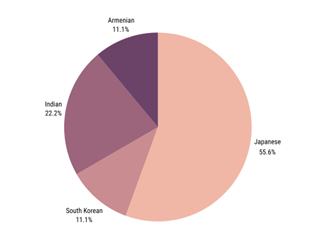
Figure 1: Demographics of Participants within the Study

A large majority of the participants were exposed to English in high school– whether that be that they went to an international school or they had an integrative English course as represented through Figure 2.
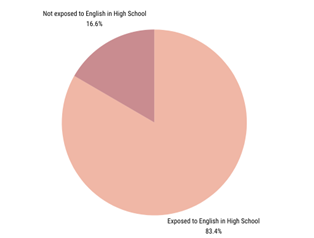
Figure 2: Percentage of Participants who were exposed to English in High School

While conducting our research, we realized it was only fair that we separate international students from what was shown in Figure 2. Out of those international students that were exposed to English in high school, Figure 3 represents what they found the most difficult when participating in conversation with native English speakers.
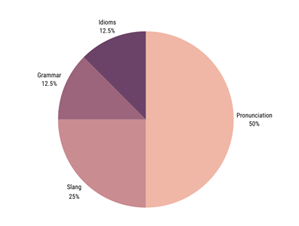
Figure 3: What International Students with strong English proficiency struggle with

On the other hand, Figure 4 shows what international students that have lesser English proficiency struggle with. Interestingly, both international students with strong English proficiency and students with lower English proficiency are most conscious about pronunciation.
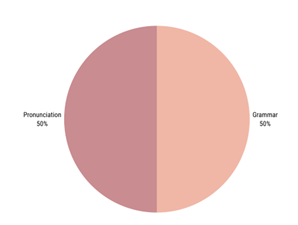
Figure 4: What International Students with lesser English proficiency struggle with

The results show that the international students that have a strong English-speaking background are most likely to feel comfortable speaking English to individuals, and group settings however, international students with no English background feel less comfortable. International students have more difficulty grasping English morphological and syntactic structures due to the complicated grammatical structures that are used in academic settings. The use of slang terms and pop culture usually in social and school settings often would give international students confusion. Most international students mentioned how they struggled understanding slang terms and pop culture and that they are still learning.

Discussion and Conclusions

Previous studies have shown that the ability to speak English is highly related to one’s involvement with the surrounding environment in which he or she grew up. The results show that international students who received an academic English education before entering university are almost as confident and comfortable with their English skills as native English speakers, whereas international students who did not receive much English education before entering university are a little more hesitant to speak English. As our research indicates, they may feel anxious or difficult to speak depending on their proficiency in English and may feel that they do not belong in that group.

Moreover, our study allows us to speculate that difficulties in grasping specific and unique syntactic structures, such as pop culture references, may have an impact on the minds and bodies of international students. While it is difficult to draw conclusions, this phenomenon may be true for many international students who did not receive much English education before college. Proficiency in English is a necessary skill for international students to adapt to social life, but confusion often arises when slang and pop culture references are mixed in. Therefore, it could be argued that international students hang out with other international students to avoid being excluded because of differences in fluency or proficiency that they do not possess compared to native English speakers. This research can be applied to various university communication settings to help understand how to properly engage with international students and what type of environment is most effective for language learning.

References

Alkhammash, R. (2022). Processing figurative language: Evidence from native and non-native speakers of English. Frontiers in Psychology, 13, 1057662–1057662. https://doi.org/10.3389/fpsyg.2022.105766

Drljaca Margic, B. (2017). Communication courtesy or condescension? Linguistic accommodation of native to non-native speakers of English. Journal of English as a Lingua Franca, 6(1), 29–55. https://doi.org/10.1515/jelf-2017-0006

Halic, O., Greenberg, K. H., & Paulus, T. M. (2009). Language and Academic Identity: A study of the experiences of Non-Native English speaking international students. International Education, 38(2), 73–93.

Hilt, L. T. (2016). Education without a shared language: Dynamics of inclusion and exclusion in Norwegian introductory classes for newly arrived minority language students. International Journal of Inclusive Education, 21(6), 585–601. https://doi.org/10.1080/13603116.2016.1223179

Idrissi, O. (2022). Anxiety as a psychological barrier to students’ speaking fluency: IELTS as a case study. International Journal of Linguistics, Literature and Translation, 5(12), 111–120. https://doi.org/10.32996/ijllt.2022.5.12.14

Jessen, A., Festman, J., Boxell, O., & Felser, C. (2017). Native and Non-native Speakers’ Brain Responses to Filled Indirect Object Gaps. Journal of Psycholinguistic Research, 46(5), 1319–1338. https://doi.org/10.1007/s10936-017-9496-9

Lopez, I. Y., & Bui, N. H. (2014). Acculturation and linguistic factors on international students’ self-esteem and language confidence. Journal of International Students, 4(4), 314–329. https://doi.org/10.32674/jis.v4i4.451

Streitwieser, B. T., & Light, G. J. (2017). Student conceptions of international experience in the study abroad context. Higher Education, 75(3), 471–487. https://doi.org/10.1007/s10734-017-0150-0

Yu, X., & Peters, B. (2019). Let All Voices Be Heard!: Exploring International Students’ Communication Challenges in the Internationalized Classroom. Journal of Interdisciplinary Studies in Education, 8(1), 107–116. https://doi.org/10.32674/jise.v8i1.1080

Cross-referencing relevant info: https://www.youtube.com/watch?v=na04NxGZuKU

[/expander_maker]
, , , ,

Navigating New Worlds: The Role of English Proficiency in the Social Integration of Chinese International Students at UCLA

Rista White, Yue Yu (Elena), Nadia Ruiz, Brianna Sobrero, Ruby Jimenez

The present study investigated whether Chinese international students (CIS) attending the University of California, Los Angeles, with high self-reported English proficiency, experience easier social integration and comfortably form more friendships with domestic students. CISs comprise the largest group of international students at UCLA, and this considerable demographic experiences various unique sociolinguistic challenges while adjusting to American university life. To answer this question, we analyzed 13 questionnaire responses that we received from individuals who identified as CISs attending UCLA. Subsequently, four respondents agreed to interviews where we learned more about their personal experiences. The findings show that greater self-reported English competence among UCLA CISs positively correlates with easier social integration and a wider variety of friendships. Given the growing population and trend of international study, these findings are helpful for the university and student organizations to consider when creating programs to improve the experience of CISs attending UCLA.

[expander_maker id=”1″ more=”Read more” less=”Read less”]

Introduction and Background

Recognizing that international students may face more struggles than ordinary American university students is important. International students come to a foreign country on a student visa or permit to pursue education, and the US has many such students (Sin et al., 2021). Our research investigates the relationship between English proficiency and social interactions and the impact of language barriers on CIS’s ability to communicate effectively with peers at UCLA. By understanding these aspects, we hope to shed light on the diverse struggles of CISs and provide insights into how English proficiency can affect their sense of culture and belonging in a foreign country.

Each year, the number of CISs in the United States increases as more students from China come to the U.S. to pursue higher education. These students often find themselves encountering a common barrier: English proficiency. Despite the significant role of English proficiency in social integration, this correlation is often overlooked. Several studies have researched second-language acquisition among international students and how it affects their academic and personal lives in the United States. However, few studies specifically study the direct correlation between proficiency in English as a second language and socialization in American universities, despite its significant influence on academic performance and social integration. Limited proficiency in the host language diminishes students’ satisfaction by impeding their ability to communicate, socialize, and comprehend lectures in academic settings (Campbell & Li, 2008, as cited in Wilczewski & Alon, 2023).

Studies also emphasize that international students are frequently prevented from mingling with American peers because of their limited exposure to American culture and language, leading them to primarily socialize with fellow international students (Liu & Dong, 2019; Moglen, 2017, as cited in Garrison & Chang-Tran, 2023). International students tend to predominantly socialize with peers from their own cultural backgrounds while rarely engaging with domestic individuals or students from different cultural backgrounds, largely due to language barriers (Wang & Zhou, 2021).

 In his TedTalk, Miga Xie (2020), recounted that he was told by his mother to stay away from other Chinese children. She believed that the way to get the most out of American education and improve spoken English was by minimizing contact with those of similar backgrounds. Miga explains that he eventually overcame the feeling of assimilating into American student culture and avoiding his culture. Xie understands that most CIS feel more comfortable around people with the same background. Still, because of the unique guidance received from his mother, he suggests that CISs should value their diversity and use it to engage in cross-cultural conversations rather than feeling obligated to socialize exclusively with people who look like them or fully assimilate into American culture.

 These studies and stories collectively demonstrate the importance of second-language proficiency in facilitating social interaction with domestic students, as insufficient proficiency often leads international students to socialize within their own international student community. Higher levels of second-language proficiency facilitate more extensive and smoother socialization experiences. While the body of existing studies reinforces our hypothesis, our research narrows its focus to UCLA as the setting and English as the specific second language, with a particular emphasis on CIS. Our study addresses a significant gap in the literature by examining the relationship between English proficiency levels and socialization in American universities.

Methods

We followed a mixed-method research design. Specifically, we utilized the facilitation approach, a process involving two research methods, using one strategy to expand on the results of another strategy (Young, 2015). Beginning with a quantitative method, we created a questionnaire on Google Forms with four sections, two of which were close-ended, to acquire data concerning CIS’s self-reported English proficiency and social connections relating to a sense of belonging. We shared the questionnaire in a group chat for CIS attending UCLA on WeChat, a dominant Chinese messaging application. After receiving 13 responses, we emailed all respondents to schedule an interview, and only four agreed. So, to take a more engaging approach, we followed up with the four people to perform semi-structured interviews. We divided our twelve open-ended interview questions into four sections: Experiences with English and Social Integration, Challenges and Strategies, Social Networks and Sense of Belonging, and Institutional Support and Suggestions.

Data Analysis and Results

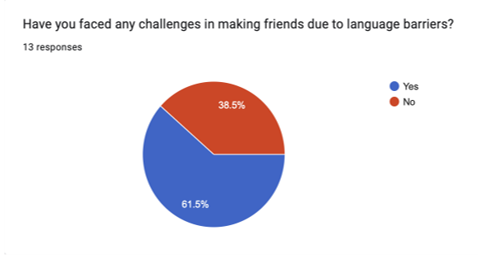
Through our close-ended survey responses, the results of one of our questions stood out to us (Figure 1). Most respondents, eight to be exact, said yes to having faced challenges making friends due to language barriers. The eight responses add value to our research, confirming the plausibility of a correlation between English language proficiency and social integration.

Fig. 1: Question 11 of Section 4, Social Connections and Sense of Belonging in our Google Form questionnaire

Interviews were recorded with participant consent. The interview transcripts were then analyzed using an interpretive analysis approach. This style of interview deconstruction consists of multiple read-throughs of interview transcripts (Hatch, 2002). The first read-throughs emphasized looking for major themes and were carried out individually. We searched for patterns and relationships within these themes on the second read-through. Then, insights were shared with other research group members, and a comparative approach was adopted. Finally, we describe emerging patterns across interviews in short sentences and connect them to supportive excerpts. This left us with bite-sized takeaways supported by evidence that we can easily connect to the preexisting sociolinguistic literature on international students.

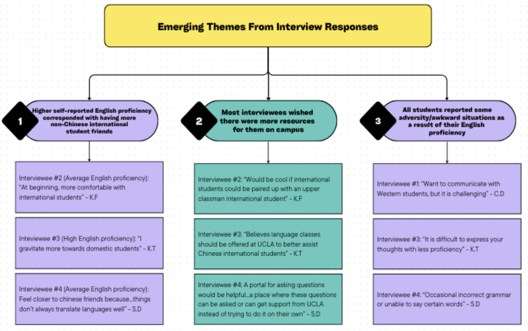
The three emerging themes are shown in Figure 2. Theme 1: higher self-reported English proficiency corresponded with having more non-Chinese international student friends. Theme 2: most interviewees wished they had more resources on campus. Lastly, in theme 3, students reported some adversity/awkward situations due to their English proficiency.

Fig. 2: Flow chart created to organize themes

Discussion and Conclusions

Three main themes emerged after evaluating the data collected by the survey and interviews. The first theme was that participants with a higher self-reported English proficiency tended to correspond with their response to having more non-Chinese international student friends. Implying that the participants felt that having a more proficient level of English helped them establish connections with non-Chinese individuals. Secondly, most, if not all, interviewees explained they wished there were more resources for them on campus. Some of these resources included the possibility of a mentor or a CIS club. This suggests that there is ample opportunity for UCLA to offer greater support to its international Chinese students and help international students create their own programs based on their needs. The final theme was that all the students reported some adversity or awkward situations resulting from their English proficiency.

While analyzing the data gathered from this study, we kept some important details in mind to help us understand our collection and conclusions. Our survey and interviews were based on self-reported proficiency levels rather than an actual language test, meaning the results are based more on a self-reported confidence level in their proficiency.

While attempting to conduct our interviews to gather more data, we found ourselves with a few limitations. One limitation was the lack of preliminary survey respondents who were willing to participate in a secondary interview. Our goal was to conduct five interviews. We secured three easily, but the other two were more difficult. Another limitation was the time available to explore our research question. With greater time, we could have spent more time collecting and examining more data.

In closing, after we analyzed the personal experiences of CIS at UCLA, we have been able to gather a better understanding of the relationship between English proficiency and the ease of social integration. We completed our research with the takeaway that there is a connection between language proficiency and socialization. Slang and cultural references are common difficulties, even with high fluency, and most people have created ideas on how to improve the international student experience. With future research, larger data samples could reveal more about these connections and other insights. Through the lens of these personal stories, we are not just uncovering challenges but also paving the way for a future where every student’s voice is heard. 

References

Garrison, Y., Park, S., Yeung, C. W., Li, Z., Ho, Y. C. S., & Chang-Tran, J. (2023). The social class worldviews of Chinese international students in the United States. Journal of International Students, 13(1), 40-58.

Hatch, J. A. (2002). Doing Qualitative Research in Education Settings: Analyzing Qualitative
Data
. (pp, 185-224). State University of New York Press.

Sin, C., Tavares, O., Aguiar, J., Biscaia, R., & Amaral, A. (2021). International students in Portuguese higher education: who are they and what are their choices? Studies in Higher Education, 47(7), 1–14. https://doi.org/10.1080/03075079.2021.1916907

Wang, P. & Zhou, G. (2021). A Study Of Chinese International Student Dropout: Acculturation Experiences And Challenges In A Pre-University English Language Improvement Program. McGill Journal of Education / Revue des sciences de l’éducation de McGill, 56(1), 52–70. https://doi.org/10.7202/1087048ar

Wilczewski, M., & Alon, I. (2023). Language and communication in international students’ adaptation: a bibliometric and content analysis review. Higher Education, 85(6), 1235–1256. https://doi.org/10.1007/s10734-022-00888-8

Xie, M. (2020, February). (Don’t) Talk to the Chinese Kids: My Journey with Diversity. and Inclusion [Video]. TEDxEmory. https://www.ted.com/talks/miga_xie_don_t_talk_to_the_chinese_kids_my_journey_with_diversity_and_inclusion?utm_campaign=tedspread&utm_medium=referral&utm_source=tedcomshare

Young, T. J. (2015). Questionnaires and Surveys. Research Methods in Intercultural Communication, 163–180. https://doi.org/10.1002/9781119166283.ch11

[/expander_maker]

, , ,

Is Instagram the New Duolingo? Investigating How Social Media Usage Affects Heritage Language Competence

Sarah Bassiry (Sky), Anna Harutyunyan, Akina Nishi, Jasmine Shao

Diaspora communities and heritage language speakers are a very unique population when it comes to language and bilingualism. Heritage speakers vary greatly in their language skills, language background, and environment. As heritage speakers are generally exposed to their heritage language only at home or in other limited contexts such as a cultural community group, this study investigated to see if social media may also be a context of heritage language exposure for some heritage speakers. If so, this study investigates the role social media might play in language competence. Four Eastern Armenian and four Mandarin heritage speakers attending UCLA and one native speaker in each language, were participants in this study. The participants were given a language background survey, a grammaticality judgment test, and an elicitation task judged by a dominant native speaker using a Likert scale. Initially, we expected to see a positive correlation between social media usage in the heritage language and the participants’ heritage language skills. However, the results did not provide sufficient evidence to support this hypothesis. Thus, further testing with a larger sample size is recommended to further investigate whether or not there might be a correlation.

[expander_maker id=”1″ more=”Read more” less=”Read less”]

Introduction and Background

The concept of bilingualism is interesting to discuss in the context of heritage speaker populations, as these groups include speakers of a vast variety of language competence. Heritage language speakers ‘may or may not be frequent users of the language or exceptionally proficient in the language” (Mahootian, 2000). Many heritage speakers are also receptive bilinguals, which Nakamura (2019) notes, “does not imply zero production of the weaker language but highly limited language use in interaction.” These speakers usually have strong listening and comprehension skills but weaker production skills in their heritage language.

This study sets out to determine if there is a correlation between heritage speakers’ social media consumption in their heritage language and their competence in that language. A prior study on bilinguals and newspaper consumption conducted by Moring (2011) et al., found media to be an instrumental resource in maintaining language competence. Flewitt and Zhao (2020) also conducted a study investigating the relationship between heritage speakers and social media usage. In their study, they observed two adolescent Mandarin Chinese heritage speakers and their usage of WeChat to connect with relatives in the heritage language. They found that WeChat acted as a “springboard to include multilingual practices” and facilitated a motivating environment of supportive feedback from interlocutors for their language to grow.

Given the previous research in the field, we hypothesized that our study would show that more frequent social media consumption in the heritage language will be correlated with a higher degree of language competence. Previous studies have noted that in the case of young children, engagement with social media often involves “several types of learning and socialization occurring all at once” (Zhao, 2019). In this study, we aimed to observe the role social media activity plays in the heritage language competence of young adults at UCLA.

Methods

The population this study investigated was heritage speakers of either Mandarin or Eastern Armenian who attend UCLA, testing 4 participants for each language. This project utilized survey methods, grammaticality judgment tasks, and elicitation tasks to investigate the research questions.

Our general survey asked participants basic questions regarding demographics, social media usage in the heritage language, and information regarding details of heritage language background and exposure. Two separate grammaticality judgment tests with 20 questions each were created by bilingual speakers of each language from the research team. The Eastern Armenian task tested plural suffixation and word order, the morphosyntactic structure of the language. The Mandarin task tested participants’ knowledge of aspect markers and measured words. We chose to test structures that differ from English, which are commonly lost by heritage speakers. They also included romanization and audio recordings of the tasks to account for the varying degrees of literacy.

The elicitation tasks consisted of a story-retelling exercise where the participants were virtually shown an animated short story from Youtube in the heritage language and then asked to retell the story in the heritage language. A Likert scale was then used by a native speaker to judge each participant’s fluency levels as they viewed the recording of the participant’s elicitation.

Results

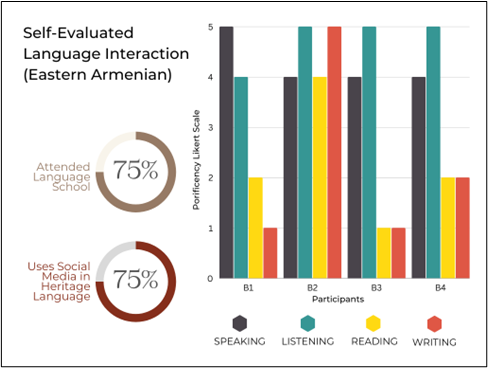
Figure 1. Self-Evaluated Language Interaction Survey Results (Eastern Armenian).
Figure above shows that more than half of the participants use social media in their heritage language and received formal education in Armenian.

The participants in the study varied in the production and comprehension levels of their respective heritage languages, and their use of social media in the heritage language.

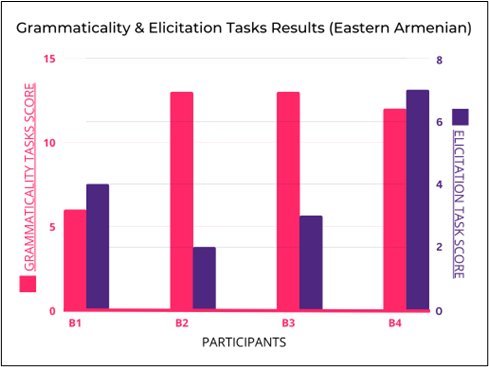
Eastern Armenian heritage speakers varied in their production and comprehension levels of the language. Based on the results of the elicitation and grammaticality tasks, it appears that receptive knowledge is not necessarily related to expressive knowledge. For instance, the native speaker ranked participants B2 and B3 as the lowest proficient speakers of the heritage language, but these same participants had two of the highest scores for correctly identifying grammaticality judgments in their heritage language.

Figure 2. Grammaticality & Elicitation Tasks Results (Eastern Armenian).
Figure above shows that participants had varying results on the grammaticality judgment tasks and the elicitation task. Only B4 has high scores on both tasks.

Additionally, the Eastern Armenian heritage speakers who score the highest on the elicitation and grammaticality judgment tasks consumed social media in various amounts, ranging from rarely or never to as frequent as daily consumption. Participants B2 and B3 scored the highest on the grammaticality judgment tasks, but B3 said that they rarely or never consume social media in their heritage language, while participant B2 did so on a daily basis, in formats of video, audio, and text. Participant B4 scored highest on the elicitation task and the second highest on the grammaticality judgment tasks, and used social media in the form of Instagram video multiple times a month. Lastly, participant B1 scored the lowest on the elicitation task and had a somewhat low score on the grammaticality judgment task. They consume social media in their heritage language on a weekly basis in the form of audio and text.

All in all, the data from our Eastern Armenian speakers does not represent any correlation between social media usage and heritage language competence.

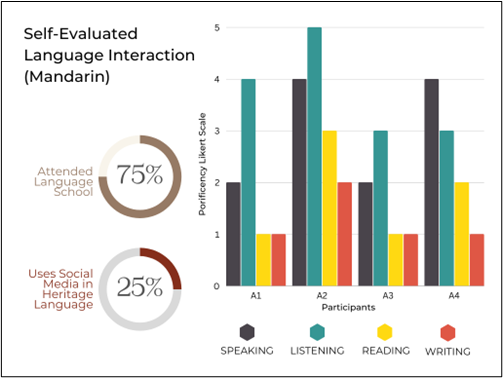
Figure 3. Self-Evaluated Language Interaction Survey Results (Mandarin).
Figure above shows that more than half of the participants received formal education in Mandarin and only a quarter of the participants use social media in Mandarin.

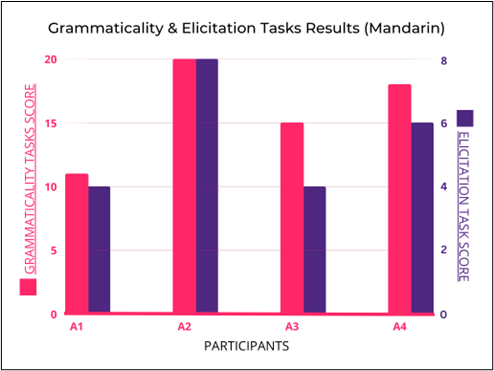
Our Mandarin heritage speaker participants also varied in their levels of fluency. Diverging from the lack of relationship we observed in Armenian, those who performed highly on one test usually performed highly on the other. Only one of our four participants for Mandarin, participant A2, expressed consumption of social media in Mandarin, and this participant also had the highest score on the grammaticality judgment tasks. This speaker could serve as one data point to support our hypothesis that heritage language social media consumption is correlated to higher levels of retention in the heritage language. However, participant A4 scored second highest on both tasks, but they do not consume social media in Mandarin. Participants A1 and A3 also do not consume social media in their heritage language and received lower scores on both tests. Although the rough possibility of a correlation exists in the Mandarin data set, there is not enough evidence to definitively support our hypothesis.

Figure 4. Grammaticality & Elicitation Tasks Results (Mandarin).
Figure above shows that participants had varying results on the grammaticality judgment tasks and the elicitation task. Only A2 has high scores on both tasks.

Discussion and Conclusion

As a result of our investigation, we were unable to find supporting evidence for our initial hypothesis that higher social media consumption in the heritage language corresponds with higher competency in the heritage language. Some factors that led to this conclusion is the lack of concrete and frequent social media usage among the participants. For instance, in the Mandarin heritage speakers cohort, participant A2 claimed they use social media and received the highest scores on both tasks as seen in Figure 4, however, participant A4 who claimed they don’t use social media got the second-highest scores in the task. Similarly, in the Armenian heritage speaker cohort, participants B2 and B3 received similar results in both tasks (Figure 2) and the two highest on the grammaticality judgment task. However, participant B3 claimed they use social media never/rarely, while participant B2 uses social media on a daily basis. The contrast can be thought of to be due to formal instruction in the heritage language.

Our new finding, formal education, correlated with higher scores on both tasks.  For instance, participants B2, B3, and B4 received formal instruction in learning Eastern Armenian. The Mandarin heritage speaker who performed the highest on both tasks, A4, also received formal education in Mandarin. This correlation was of interest for other scholars who claim that the lack of formal education has negative effects on the acquisition of the heritage language; children who don’t receive formal education do not learn the formal registers, vocabulary, and complex structures in written language (Montrul, 2010). Our data reflects the aforementioned claim as the participants who did not receive formal instruction in Eastern Armenian and Mandarin performed the lowest or second lowest on the grammaticality judgment task which tests their knowledge of the language grammar. While formal education can be a factor that influences higher competency in the heritage language, this correlation has to be interpreted in terms of production or grammatical knowledge. This is because the participants who received formal education performed well on the grammaticality judgment task, but not as well on the elicitation task. These results show that analysis between formal education and heritage language competency should be further investigated.

Another factor that can influence the participant’s competence in the heritage language is the age of exposure. There is contrasting data on how the age of exposure relates to language competence. Proponents of the Critical Period Hypothesis claim that children should be exposed to a language at a certain age to be able to acquire it native-like (Mahootian, 2020). Others claim that other factors such as ‘the child’s temperament or motivation’ can affect their learning of a language (Yuldasheva, 2021). In our research, we found that 7 out of the 8 participants in our study claimed that they were exposed to their heritage language from 0 to 3 years old, with one exception, A4, who claimed they were exposed to their heritage language from 4 to 8 years old. In addition, more than half of the participants, 5 out of 8, claimed that they were exposed to both English and the heritage language at the age of 0-3, simultaneously. The participant who performed the best on both tasks in Mandarin claimed to have been exposed to English and Mandarin simultaneously from the age of 0-3. The participant who performed the best on both tasks in Eastern Armenian stated that they were exposed to English from the age of 4-8 and Armenian, from the age of 0-3. This shows that age of exposure may not play a major role in the heritage speaker’s language competency. Perhaps, the difference lies in simultaneous and sequential bilingualism. Age of exposure to the heritage language may be a sufficient factor in the heritage language competency, however, this factor has to be accompanied by other factors, perhaps, social media consumption and formal education in the heritage language.

Another finding is that there may be a correlation between longer attendance to formal instruction and higher social media usage. Social media in the heritage language provides an extension to the traditional classroom setting. Going back to Zhao & Flewitt’s case study, heritage language speakers’ language practices on WeChat extended their “Chinese-speaking social world and provided them with opportunities to engage in contextualized, transnational heritage language and literacy practices beyond their home and Saturday Chinese school environment.” (Zhao & Flewitt, 2020). We could make the claim that formal instruction and social media in the heritage language complement one another to learn, and a longer history of instruction may motivate the bilingual speaker to seek more natural and conversation-based learning environments, such as social media.

 Overall, claiming that the heritage speakers’ competency in the heritage language correlates with their social media consumption would be invalid based on the findings of our research. Other variables that can account for this contrast are formal education in the heritage language or age of exposure to the language. Perhaps, formal education in the heritage language could account for these three heritage speakers’ higher performance on the grammaticality judgment and in one of the cases, the elicitation task. In a similar manner, the age of exposure to the language can be a variable that influences the results. A detailed analysis above shows that these are sufficient factors of heritage language competency and the limitations of our study prevent further research into these variables. Some of the limitations of our study include a smaller sample size. With a larger sample size, the findings of our research could be more reliable and generalizable.

However, it was interesting to see a small sample size showcase such a wide variety of language proficiency. Bilingual heritage speakers have unique backgrounds in their heritage language because of many internal and external factors, such as “the role of the school system and other institutions, the historical experiences of particular language communities, the unique circumstances involved in the adoption by some communities or individuals of proxy HLs as part of the complex multiple identities of contemporary life, and the specifiable impact of a language ecological pattern over the life cycle of individuals and families” (Lo Blanco, 2001). Our participants had different characteristics, such as high proficiency in listening but lower proficiency in writing, or vice versa, as well as the amount of formal education, ranging from a couple of years to over 10 years.

For future research, if these methods are adapted, we suggest that elicitation tasks are performed in an in-person setting rather than virtual, where the native speaker listens to the heritage speaker’s elicitation and rates them in person. Additionally, the elicitation tasks should be reviewed by different native speakers. We believe that these changes will allow the results to be more reliable and generalizable.

References

Lo Bianco, J. (2001). Language Policies: State Texts For Silencing and Giving Voice. Difference, Silence and Textual Practice: Studies in Critical Literacy, 31-71.

Mahootian, S. (2019). Bilingualism. Routledge.

Montrul, S. (2010). Current issues in heritage language acquisition. Annual Review of Applied Linguistics, 30, 3-23.

Moring, T., Husband, C., Lojander-Visapää, C., Vincze, L., Fomina, J., & Mänty, N. N. (2011). Media use and Ethnolinguistic Vitality in bilingual communities. Journal of Multilingual and Multicultural Development, 32(2), 169–186. https://doi.org/10.1080/01434632.2010.541918

Nakamura, J. (2019). Receptive bilingual children’s use of language in interaction. Studies in Language Sciences, 18, 46-66.

Yuldasheva, D. (2021). Age and The Second Language Acquisition. Research Jet Journal of Analysis and Inventions, 2(04), 124-130.

Zhao, S. (2019). Social media, video data and heritage language learning. In G. Falloon, J. Rowsell, & N. Kucirkova (Eds.), The Routledge International Handbook of Learning with Technology in Early Childhood. Routledge.

Zhao, S., & Flewitt, R. (2020). Young Chinese immigrant children’s language and literacy practices on social media: a translanguaging perspective. Language and Education, 34(3), 267–285. https://doi.org/10.1080/09500782.2019.1656738.

[/expander_maker]

, ,

Language Proficiency and Cultural Identity of Korean Heritage Speakers

Griffin Gamble, Erin Kwak, Joanna Kwasek, and Hannah Shin

A heritage language is defined as a minority language spoken at home that is not part of a dominant language in society. This study looked specifically into Korean heritage speakers living in the United States and investigated whether language proficiency in Korean will align with the degree of Korean cultural identity. In order to study this relationship, we utilized two separate data collection methods: an elicitation task to assess language proficiency and a self-reported questionnaire to record cultural identity. As expected, we found that the more grammatical errors the participants made, the less they identified with their Korean culture. This finding suggests a positive relationship between Korean language proficiency and Korean self-identity, which contradicts previous findings that higher proficiency in a heritage language predicts a more balanced bicultural identity that is not dominated by one culture.

[expander_maker id=”1″ more=”Read more” less=”Read less”]

Introduction and Background

With the U.S. being known as a melting pot of cultures, numerous languages are constantly being spoken and intermingled in public and private. Following this observation, we were interested in understanding how heritage speakers–more specifically, Korean heritage speakers–juggle multiple cultural identities.

Previous findings suggest that one’s cultural identity and language proficiency are correlated. Lee (2002) studied the relationship between heritage language proficiency and cultural identity of Korean heritage speakers. They were able to observe that Korean heritage speakers who were proficient in Korean largely reported having a bicultural identity, or one that is equally American and Korean (Lee, 2002). Furthermore, Adaobi (2014) studied the link between a minority language, Etulo, and the majority language, Tiv, to understand if bilingualism affects self-identity. Similarly to Lee (2002), Adaobi found that Eluto speakers identified with both cultures, but did experience a sense of identity conflict, or dual identity, from time to time (Adaobi, 2014). Such findings indicate that proficiency in both the dominant and minority languages facilitate a unique bicultural identity.

One of the biggest limitations that we observed in the studies above was the use of self-assessments as a measure of language proficiency. Self-reports can be unreliable in producing standardized data, as it does not involve an objective assessment of language proficiency; it is susceptible to biases about how well one believes they can speak a language. Therefore, in our study, we have decided to implement a widely used method in the study of bilingualism: the elicitation task (Bialystok and Frohlich, 1980; Dechert, 1983). As grammatical competence is often a strong predictor of overall oral proficiency (Magnan, 1988), it is plausible to assume that grammatical errors will decrease as the proficiency level increases. With such assumptions, the current study conducted a grammaticality judgment of participant speech to determine language proficiency (Cornips & Poletto, 2005), in hopes of enhancing both the validity and reliability of the research addressing heritage language proficiency and cultural identity.

We hypothesized that there will be a positive relationship between Korean language proficiency and Korean cultural identity. In other words, Korean heritage speakers who 1) exhibit higher grammatical accuracy in Korean and 2) are able to utilize more cultural references will identify with the Korean identity to a larger degree.

Methods

We studied twelve Korean heritage speakers currently living in Southern California, between the ages of 15 and 23. Eight of the participants identified as female, three as male, and one as other. They had differing levels of exposure to formal Korean language education but all of them used Korean at home with their family (aligning with our definition of a heritage speaker).

Table 1: Participant Demographics

The study utilized two separate data collection methods. The first was an elicitation task, which involved a slideshow that depicted the Korean fairytale titled The Heavenly Maiden. We began by telling the story to the participants in English, accompanied by the corresponding image for each scene (See Figure 1).

Figure 1: Example of a slide from the elicitation task

The participants were then asked to retell the story in Korean as we flipped through the images in the slideshow. Their speech was recorded and transcribed for further analysis. The second data collection method was a questionnaire that was distributed to participants after the elicitation task. By doing so, the questions regarding ethnicity, culture, and comfortability in speaking Korean did not influence their performance in the storytelling task. The survey also included questions about the participants’ general background information, such as their age, the circumstances in which they learned Korean, in what situations and how frequently they use Korean today, etc.

The recording was reviewed for two main variables: instances of any grammatical errors (such as subject, verb, and object word order errors) and the usage of culturally-relevant vocabulary within the story. Regarding the culturally-relevant vocabulary, there are a few terms, such as 선녀 (“heavenly maiden”) and 두레박 (“bucket”), that are important aspects of the fairytale. We expected to find that participants who are more in touch with Korean culture would be able to better identify and use those cultural references.

Results and Analysis

Out of the twelve participants, only ten participants fully participated in our study as two people opted out of the elicitation task as they felt that the task would be too difficult with their language abilities. However, we still decided to give them the option of completing the questionnaire so that we could note any potential patterns.

When analyzing the data, we noticed two main patterns amongst the participants: irregular formality and sentence structure. These were interesting to us because the Korean language is highly sensitive to different degrees of formality–that is, a speaker should not be suddenly switching between multiple formality levels unless the recipient has changed. An instance of irregular formality can be seen in this excerpt of participant 1’s transcript: “사슴이 남자에게 도움을 요청했습니다. 사냥꾼이 사슴을 사냥하고 있었다.” The first sentence ends with –습니다, which is formal and respectful. However, the next sentence ends with –다, which is less formal and more direct. Additionally, Korean sentences typically follow a subject-object-verb order, but the participants seemed to use different word order structures purposefully. Korean-American speakers were repeatedly and deliberately utilizing an alternative word order structure as a stylistic choice, not as a momentary mistake. An example of irregular sentence structure can be observed in this excerpt of participant 4’s transcript: “사슴이 살려달라고 그래서 나무속에 숨겨놨는데 사냥꾼이 와서 찾았어요 사슴을.” This sentence notably ends with an object (“사슴을”), which is not common in Korean speech, and more resembles English’s subject-verb-object order.

Surprisingly, participants were generally lacking in the use of cultural references with two people using none, seven people using one, and one person using two. Patterns regarding the usage of cultural referents were thus not evident, which made it difficult to answer the relevant aspect of our hypothesis.

Regarding the self-reported cultural identity of our participants, a majority of our participants considered themselves Korean-American, but more Korean or equally Korean and American. None of our participants considered themselves fully American with no Korean identity. Interestingly, the participant with the least amount of errors and highest self-perception of being Korean (i.e., they viewed themself as fully Korean, rated themself 5 in Korean proficiency, and 5 for how comfortable they are in speaking Korean), only utilized one cultural referent throughout the whole speech. She instead opted for a more casual and simple nuance, using Korean versions of an English word, such as “샤워” ([ɕʰawʌ] ‘shower’) and 버켓 ([bʌket̚] ‘bucket’). We also noticed that the two people who opted out of the task but filled out the questionnaire were the only ones who marked “very uncomfortable” for the question asking how comfortable they are in speaking Korean and “strongly agree” for the statement “I celebrate most American holidays.”

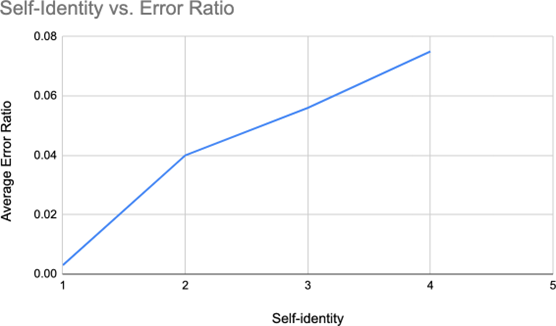
In comparing the self-identity question to their overall error ratio in speech, we found that the average error ratio increased as the participants identified as more American (See Figure 2). Although we were not able to run a formal statistical analysis due to our limited sample size, we expect this trend to transfer onto a bigger sample size as well due to its concreteness.

Figure 2: Self-Identity and Error Ratio

Another interesting observation we made was that those who marked that they took Korean in school for foreign language credit (which were participants 9, 10, A, and B) had either: the highest ratios of errors or completely opted out of the elicitation task due to low proficiency.

Discussion and Conclusion

The results suggest that language proficiency and cultural identity seem to have a positive correlation, as the participant who rated herself as fully Korean had the least errors in speech, and the average error ratio of participants increased along with American identity. In addition, we also observed a common linguistic pattern among our Korean-American participants. Those who rated themselves a score of 2 or 3, and therefore did not fully identify as Korean, were using a word order structure similar to English subject-verb-object (SVO). This word order is not technically ungrammatical in Korean, but it’s usually only used if the second clause is an afterthought therefore it can come off as awkward especially if used repetitively. However, the Korean-American participants appeared to be using it as a stylistic choice, and not by mistake. This finding opens up a new area of research for bilingualism: emerging linguistic patterns in heritage speakers that were not previously observed in native speakers. By studying how this linguistic trend is preserved or even replaced within generations, we would also be able to study how multiple languages reform as they come in contact with a different language. In the case of our participants, it was mainly the fusing of English and Korean that prompted the rise of English’s SVO-like word order structure in Korean.

One of the biggest limitations was our small sample size. A larger sample size would help identify stronger, statistically significant correlations between our variables, and in turn, promote the external validity of our findings. Furthermore, we could better target the elements within our hypothesis by improving the elicitation task. As we were unable to observe a consistent use of cultural references among the participants, we could better assess the role of cultural proficiency or cultural awareness by utilizing or creating a story that prompts the use of more cultural references. The analysis method of our study would also have been more standardized if the grammaticality judgment was not done by the researchers themselves. Although we were limited in our time and resources, recruiting a panel of native Korean speakers to rate the grammaticality of each participant’s speech would lead to a more concrete assessment of language proficiency.

So why do these findings matter in our day-to-day lives? First of all, the observations we made throughout our study support the idea of a bidirectional relationship between language and identity. Even though our main research question dealt with the positive connection between language proficiency and the corresponding cultural identity, this relationship encompasses so many other factors such as our attitude towards our culture, the amount of language use per day, the quality of language use, the context of language use, and much more. Each of the aforementioned variables could equally serve as a byproduct of or the driving elements behind one’s language proficiency. For instance, one could be using their heritage language only with their parents because they lack proficiency, or lack proficiency because they only use it with their parents and no one else. If you factor in the role of cultural identity, it further raises the question of “which came first?” as it could be the depth of cultural identity that motivates language use or vice versa. Knowing this, it brings us to the second reason why the findings of this study are important: we could potentially promote language proficiency and cultural identity by elevating one another! To provide an example, enhancing one’s cultural identity could serve as a big motivator behind learning a heritage language. The positive attitude allocated to a specific culture could definitely act as an incentive for learning a language while enhancing the learning process itself. Similarly, one might wish to identify with their heritage culture on a deeper level. The findings in this study suggest that increasing one’s proficiency in their heritage language could in turn intensify one’s respective cultural identity.

References

Adaobi, N. O. (2014). Bilingualism and identity in etulo. OGIRISI: A New Journal of African Studies, 10(1), 23. https://doi.org/10.4314/og.v10i1.2

Bialystok, E., & Fröhlich, M. (1980). Oral Communication Strategies for Lexical Difficulties.

Interlanguage Studies Bulletin, 5(1), 3–30. http://www.jstor.org/stable/43135243 Cornips, L., & Poletto, C. (2005). On standardizing syntactic elicitation techniques (part 1).

Lingua, 115(7), 939–957. https://doi.org/10.1016/j.lingua.2003.11.004

Dechert, H. W. (1983). How a story is done in a second language. In C. Faerch, & G. Kasper, (Eds.), Strategies in Interlanguage Communication, 175-196. New York: Longman.

Jee, M. J. (2016). Exploring Korean heritage language learners’ anxiety: ‘We are not afraid of Korean!’ Journal of Multilingual and Multicultural Development, 37(1), 56–74. https://doi.org/10.1080/01434632.2015.1029933

Lee, J. S. (2002). The Korean language in America: The role of cultural identity in heritage language learning. Language, Culture and Curriculum, 15(2), 117–133. https://doi.org/10.1080/07908310208666638

Magnan, S.S. (1988). Grammar and the ACTFL Oral Proficiency Interview: Discussion and Data. The Modern Language Journal, 72, 266-276.

Montrul, S. (2013). How “Native” Are Heritage Speakers?, Heritage Language Journal, 10(2), 153-177. doi: https://doi.org/10.46538/hlj.10.2.2 

Rothman, J. (2009). Understanding the nature and outcomes of early bilingualism: Romance languages as heritage languages. International Journal of Bilingualism, 13(2), 155–163. https://doi.org/10.1177/1367006909339814

[/expander_maker]

, , , , ,
Scroll to Top