Cross-culture

The Enigma of Everyday Speech: Why some casual language might be nearly impossible to translate

Eden Amsellem, Anaïs Clancy, Emily MacDonald, Jennifer Padilla Villegas, Summer Xia

Communication in casual contexts appears to be less directly translatable between languages than communication in formal contexts. Several of our group members are bilingual and have experienced difficulties when translating between the different languages they speak. Based on their personal experiences, we wanted to determine whether language in casual or formal contexts tended to be more untranslatable. To do this, we analyzed texts that had been translated between English and French, Spanish, or Mandarin. Our bilingual group members searched each text for instances where the translation was noticeably inconsistent with the original meaning. These inconsistencies came from a variety of language aspects including tone, connotations, idioms, and slang. The translators recorded these inconsistencies as our data. From that data, we found that the casual texts had more instances of untranslatability than the formal texts. We discuss why this might be and why the greater degree of untranslatability in casual language might suggest it carries more cultural meaning.

[expander_maker id=”1″ more=”Read more” less=”Read less”]

Introduction and Background

We are building our research first on a foundation of literature that defines untranslatability along with its many different variations. Untranslatability is a phenomenon in which the full meaning of some communication does not have an equivalent in another language (Lomas, 2018). There are different types of untranslatability, distinguished by the reason why translation is not possible. One way of dividing untranslatability is into linguistic untranslatability and cultural untranslatability (Cui, 2012). Linguistic untranslatability occurs when two languages do not share the linguistic features necessary to convey meaning in quite the same way (further explanation of one type of linguistic untranslatability). Cultural untranslatability occurs when there is a cultural gap between two language communities that makes it impossible to convey the same meaning in both languages.

Lomas (2018) and Özgen (2004) discuss how language influences a person’s perception of the world by dictating the ways they are able to categorize ideas and conceptualize their experiences through the language available to them, an idea known as the Sapir-Whorf Hypothesis. From this perspective, untranslatability indicates not only barriers in available words but barriers in entire frameworks of understanding. Additional literature also explores the importance of cultural differences as a major factor that contributes to untranslatability (Cui, 2012; Lomas, 2016; Talukder, 2020; Witherspoon, 1980). Related to this, Talukder (2020) even points to untranslatability as important to cultural identity, reasoning that the inability to translate parts of a language can keep certain information and practices exclusive to the cultural in-group.

Originally, we planned to examine untranslatability more generally, but as we read through previous studies, we realized that there was no research we could find that touched on the differences between translating formal language and translating casual language. The bilingual members of our group thought that this was an important topic because in their experience, translating casual language is very different from translating standard or formal language. Because of that, we decided that we should fill that research gap and narrow our focus to comparing untranslatability in formal and casual texts.

We approached our research asking the question: How effective are cross-cultural translations in conveying meaning in language in casual contexts compared to language in formal contexts? In response, we hypothesized that more meaning would be lost when translating casual communication compared to formal communication.

Methods

In order to find instances of untranslatability, we collected data in the form of inconsistencies in translations of texts. We analyzed texts that had been translated from French, Spanish, and Mandarin into English or from English into any of those three languages. We included these languages in our research because three of our group members are fluent in each of them. Because we wanted to explore the differences between untranslatability in formal and casual contexts, we included texts which had contexts of differing levels of formality ranging from governmental speeches (Guterres, 2023; 特朗普就职演讲完整版, 2017), which were the most formal, to conversations between highschoolers in television shows (Andem, 2018; Ipartment, 2014), which were the least formal. In the middle was Martin Luther King Jr.’s “I Have a Dream” speech (Mali, 2008; 马丁·路德·金, n.d.), as it is somewhat formal while also intended to be accessible to the average person.

Our translators recorded any inconsistencies they encountered between the original texts and their translations in a table (examples of potential inconsistencies in translation) They noted what aspect of language caused the inconsistency and how it changed the meaning. This allowed us to compare the frequency and causes of untranslatability between the different contexts and between the different languages.

Figure 1: An example of an inconsistency in translation in a casual context. The text is translated “I would understand if you were mad at me” despite the original French text having more aggressive connotations that do not translate. Andem, J. (2018). Skam France. Season 7. Episode 3.

Results and Analysis

Our results support our hypothesis, as we found more inconsistencies in the translations of casual contexts than we did in translations of formal contexts. In all of the languages we looked at, there were more inconsistencies in the translation of the casual speech from the television show than there were in the translations of the formal governmental speeches. In Spanish, our translator found four inconsistencies in the translation of the casual text, four in the translation of the intermediate text, and none in the translation of the formal text. In French, our translator found nine inconsistencies in the translation of the casual text, one in the translation of the intermediate text, and six in the translation of the formal text. Lastly, in Mandarin, our translator found fifteen inconsistencies in the translation of the casual text, eight in the translation of the intermediate text, and none in the translation of the formal text.
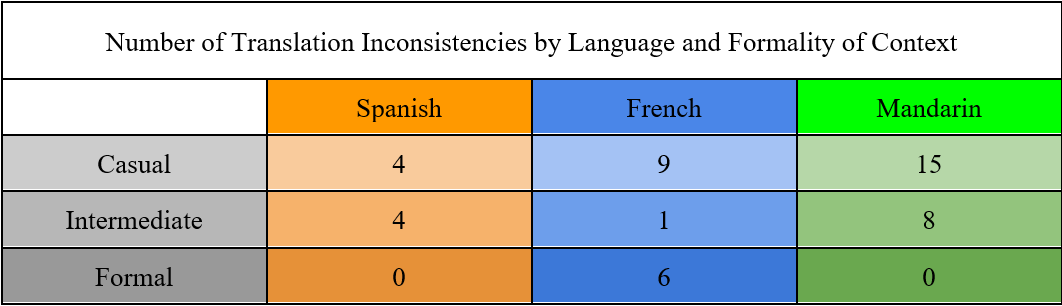
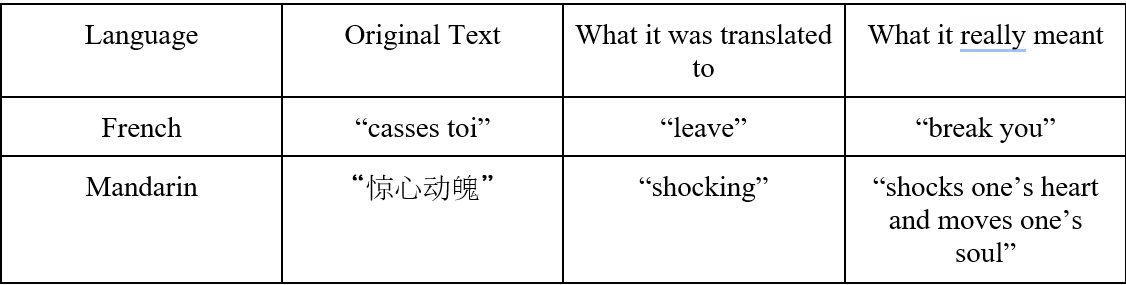
Figure 2: Number of translation inconsistencies by language and formality of context
Figure 3: Two examples of strong emotional connotations being lost in translation (Andem, 2018; Ipartment, 2014)

The two types of untranslatability discussed by Cui (2012) are cultural untranslatability and linguistic untranslatability. If the greater degree of untranslatability within casual contexts of speech is caused by cultural untranslatability, that would suggest that there are more concepts discussed in casual speech that are culture-specific. Talukder (2020) proposes the idea that untranslatability corresponds with cultural identity, while Cui (2012), Lomas (2016), Talukder (2020), and Witherspoon (1980) cite cultural knowledge as one of the main causes of untranslatability. If cultural meaning is correlated with greater untranslatability as the background research suggests, and our results show that casual speech has more instances of untranslatability, then that might suggest that casual speech tends to carry more culturally specific meaning than formal speech. Talukder (2020) also explains the importance of untranslatability as a mechanism that keeps certain aspects of a culture exclusive to those who belong to that culture. If casual language is less translatable than formal language, it could also be a way of indexing oneself as part of a cultural group and ensuring that the full meaning of what one is talking about is only understood by other cultural insiders. It is also possible, however, that the greater degree of untranslatability we observed within casual speech is due to linguistic untranslatability. In that case, it may suggest that linguistic construction is more standardized, even between languages, in formal contexts.

Another reason why casual contexts hold more meaning than standard contexts of a language can be explained by the Sapir-Whorf Hypothesis. As described by Lomas (2018), the Sapir-Whorf hypothesis argues that “language plays a constitutive role in the way people experience and understand life” (p. 478). As we previously stated, standard contexts of a language have a universal aspect to them in that they can be easily translated from one language to another as it is more formal and don’t require too many culture-specific references or words. However, in casual contexts, it is not made to be universally translated and is instead very culture-specific as it holds more untranslatable words or phrases like idioms or slang.

More than formal contexts, casual contexts illustrate people’s perspectives and understandings of life who speak a certain language because it is so unique to that specific culture or language. Indeed, Özgen (2004) researched language and color perception and stated that “Berinmo, a language spoken in Papua New Guinea… has just five basic color terms,” additionally, “these terms seem to have unusual referents, such as the color of dead leaves” (p. 96). If one were to translate colors from Berinmo to English word for word, the meaning would not be understood by an English speaker. Even if the word was translated for the color that it is referring to, significant meaning would be lost as the English speaker would not be aware that the word was translated from a word that does not directly mean the color that it is referring to. Therefore, certain words in certain languages are often hard to translate because they provide a different perspective or insight about the world that itself isn’t easily conveyed to someone who has not grown seeing the world through that perspective.

Discussion and Conclusions

Our research is helpful in that it points to a possible pattern in untranslatability, namely that formal language appears to be easier to translate while casual language presents more instances of untranslatability. This opens the door to possible future research and could help readers and translators be aware of where potential inconsistencies in translation are likely to be found. When people read or listen to a translation, they should be aware that cultural differences might impede their understanding of the original meaning, especially when the translation they are reading is of language in a casual context.

Though our research is an interesting starting point, it is limited by our time and resources. We only looked at three languages, only had one translator per language, and our sample size of texts is small. More research is needed to elaborate on these ideas or to prove or disprove our findings.

References

Andem, J. (2018). Skam France. Season 7. Episode 3.

Cui, J. (2012). Untranslatability and the method of compensation. Theory and Practice in Language Studies, 2(4), 826–830. https://doi.org/10.4304/tpls.2.4.826-830

Guterres, A. (2023). UN secretary-general’s remarks to the 52nd session of the Human Rights Council secretary-general. United Nations. Retrieved March 23, 2023, from https://www.un.org/sg/en/content/sg/speeches/2023-02-27/un-secretary-generals-remarks-the-52nd-session-of-the-human-rights-council

https://Agendamagna.wordpress.com/2009/01/20/Discurso-De-Toma-De-Posesion-De-Barack-Obama/, El Comercio Website, 20 Jan. 2009, http://obamaspeeches.com/.

Ipartment. (2014). YouTube. Retrieved March 23, 2023, from https://youtu.be/goQzSuBwBa4

King, M. L. (2023). Martin Luther King, Jr. I Have a Dream. Martin Luther King Jr. I Have a Dream speech – American Rhetoric. Retrieved March 23, 2023, from https://www.americanrhetoric.com/speeches/mlkihaveadream.htm

Lomas, T. (2016). Towards a positive cross-cultural lexicography: Enriching our emotional landscape through 216 ‘untranslatable’ words pertaining to well-being. The Journal of Positive Psychology, 11(5), 546–558. https://doi.org/10.1080/17439760.2015.1127993

Lomas, T. (2018). Experiential cartography and the significance of “untranslatable” words. Theory & Psychology, 28(4), 476–495. https://doi.org/10.1177/0959354318772914

Mali, U. S. M. (2018, February 8). ” I have a dream ” : Le texte intégral en français du discours de martin luther king. Ambassade des Etats-Unis au Mali. Retrieved March 23, 2023, from https://ml.usembassy.gov/fr/dream-le-texte-integral-en-francais-du-discours-de-martin-luther-king/

Özgen, E. (2004). Language, Learning, and Color Perception. Current Directions in Psychological Science, 13(3), 95–98. http://www.jstor.org/stable/20182921

Talukder, B. (2020). Matijaner Meyera in Translation: Cultural Identity Construction Through Untranslatability of Language. Advances in Language and Literary Studies, 10(6), 36-40. https://doi.org/10.7575/aiac.alls.v.10n.6p.36

“The Complete Text Transcripts of over 100 Barack Obama Speeches.” The Complete Text Transcripts of Over 100 Barack Obama Speeches, http://obamaspeeches.com/.

Witherspoon, G. (1980). Language in Culture and Culture in Language. International Journal of American Linguistics, 46(1), 1–13. http://www.jstor.org/stable/1264442

特朗普就职演讲完整版. (2017). 哔哩哔哩_bilibili. Retrieved March 23, 2023, from http://b23.tv/ZEZpQA6

马丁·路德·金《我有一个梦想》伟大演讲全文(中英文对照)-随笔. 【姚从刚】. (n.d.). Retrieved March 23, 2023, from http://www.yaoconggang.com/post96/96.html

[/expander_maker]
, , ,

Nature vs. Nurture: Do Our Cultural Backgrounds or Personal Preferences More Heavily Affect the Way We Verbally Affirm Our Romantic Partners?

Tina Festekdjian, Krunali Mehta, Mark Keosian, Tatiana Akopyan

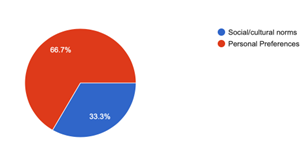
Do you ever wonder why people belonging to different cultures express love differently in their romantic relationships? Are they accustomed to verbal or nonverbal forms of affirmation, and does this carry on throughout generations? This study explores why and how second-generation college students living in Los Angeles who identify as Latin American, Asian American, or American verbally affirm their partners, as we were curious to see if culture may cause communicative differences in relationships. Whether words of affirmation can be attributed to the way people were raised, their cultural habits, or their personal preferences, the population we studied displayed an interesting trend: individuals are less heavily influenced by their culture, and the majority (66.7%) are more likely to follow their personal preferences when expressing love. While the minority (33.3%) displayed cultural allegiance, we generally noticed that one’s culture is not the leading contributor to how they express love – possibly due to the generational shift that embodies independence, socialization, and even Americanization. We can conclude that our target population is perhaps more open-minded, individualistic, and willing to break cultural barriers for love to embody their own preferences. Breaking barriers can make students more comfortable to approach others, adapt to new love languages, and better learn how to express love verbally.

[expander_maker id=”1″ more=”Read more” less=”Read less”]

Introduction and Background

 Do second-generation college students living in Los Angeles prefer to follow cultural guidelines or personal preferences when expressing verbal love in romantic relationships?

We hypothesize that particular people will be influenced by their culture if they abide by cultural norms, but that this most likely does not separate people – especially in a younger generation of college students who may be more willing to branch out. The motivation for our research was to explore what role culture plays in verbal affirmation in romantic relationships for second-generation college students, and whether social norms, family life, or personal feelings are the leading contributors. The problem is, based on the way we were raised, or based on our own preferences, we show love differently, which can cause miscommunication. By investigating different forms of linguistic communication among Latin American, Asian American, and American college students in Los Angeles, we can deduce how intimacy is present through verbal communication in their relationships. Some specific aspects of communication that we will look at include words of affirmation, romanticism in conversations, tone, and context of affection. For example, in a cross-cultural context, this means: the specific words people use to address their partner and whether it comes from their own language/culture, if someone is more expressive verbally or uses nonverbal communication, and in what situations they will be verbally affectionate. Virtual communication like text-messaging will also be studied to develop a deeper understanding of day-to-day interactions and what exactly is said in these relationships. Above personal experience, relevant literature tells us what we know so far. Brinton (1886) displays how many tribal and modern languages of Latin America tie the sentiments of love to verbal expression. The Nauahtl and Aztec tongue, for example, indicate higher levels of emotional strength with words of origin that hold deeper meanings and cultural values. These lexical attributes can provide evidence as to why Latin America is the home to many “romance languages”. Lindholm (2006) explores the Western (American) vs. Eastern scope of view, delineating how Western linguistic expression is often romanticized in the media and verbal expression of gratitude and admiration is common. On the other hand, Bello et. al. (2010) provides evidence for how in some Asian cultures, communicative patterns like verbal affirmation are less likely to be expressed. Allendorf (2013) provides context on how romantic relationships have evolved from arranged marriages to love marriages in many parts of Asia. Ultimately, we were able to bridge this gap by bringing generational evolution to the table. Because our population is second-generation college students, and most of our literature is broadly culturally based, we were able to understand that the evidence for our trend generally lay in the people, rather than what cultural group they belong to. Being in college in Los Angeles leads to Americanization, socialization, and the added element of independence that our literature did not address.

Methods

Through the use of a clear and straightforward 4 question questionnaire and student-submitted text message screenshots, we gathered responses from 27 second-generation college students about which form of love expression they prefer to use when expressing love to a romantic partner, along with the social and cultural norms of love expression they are familiar with. Finally, we had the students answer whether they prefer to use their chosen personal preferences or the social and cultural norms they are familiar with when expressing love and affection to a romantic partner in order to see which influences students’ communication and verbal affirmation to a greater degree. These methods allowed us to analyze the specific words and tones being used by students to express affection to a partner, along with the conversational structures and atmosphere. We compared these results with the social and cultural norms of love expression the students responded they were familiar with in order to see if their personal preferences were or were not being influenced by social or cultural norms. While a student’s personal preference for verbal affirmation or love expression and the social and cultural norms they are familiar with may overlap, this may be attributed to strong cultural roots or identity. By looking at which words, verbal affirmations, and other forms of love expression second-generation college students preferred to use when expressing love or affection to their romantic partners, we hoped to find whether culture played a significant role in the specific words, affirmations, or actions being used by these students or whether the personal preferences these students have just simply outweigh the social and cultural norms in their lives.

Results and Analysis

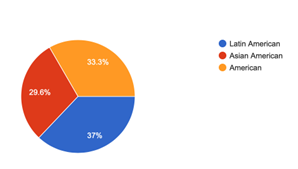
In regards to our results from Table 1: Culture, we collected information from 3 different cultural groups: 37% being Latin American college students, 33.3% American college students and 29.6% Asian American.  We collected a fairly good range of responses from our intended cultural groups to get a fair representation of second-generation college students.

Table 1: Cultures of Respondents

When asked about their preference on personal preferences or social/cultural norms shown in Table 2: Norms, 66.7% chose personal preferences while 33.3% chose social/cultural norms. 

Table 2: Preference for sociocultural norms or personal preferences in a relationship

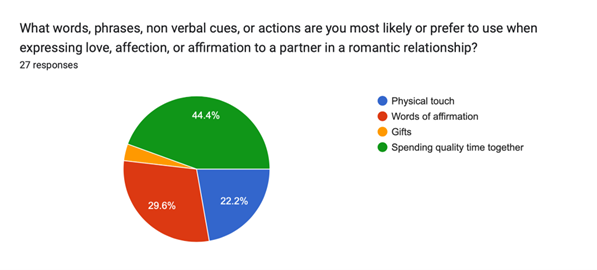
These students were then asked what words/actions were their preference in romantic relationships shown in Table 3: Preferences, from choices of spending quality time together (44.4%), words of affirmation (29.6%),  physical touch (22.2%), and gifts (3.7%). 

Table 3: Preference for words/actions in romantic relationships

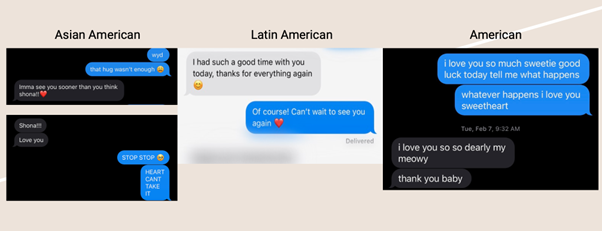
We were able to collect examples of text messages in Table 4: Cross Cultural Text Messages from each cultural group. We found Asian American college students to be showing love through using words like “shona” that embodies their cultural background where Latin American college students show love by saying thank you and words of appreciation. The difference we found in American college students shows love through constant repetition of words of affection and reassurance.

Table 4: Cross-Cultural Text Messages

Discussion, Conclusion, and Contributions

Through conducting our research, we concluded that our findings are truly impactful as we found that college students are more likely to use their own personal preferences during verbal affirmation in a romantic relationship rather than their known social and cultural norms. This is important to recognize because it highlights that students aren’t restricted or limited by their cultural upbringing and actually care more about their own personal preferences when expressing verbal affirmation to a romantic partner. Another finding to recognize is the bias when students are asked if they follow social norms or their own personal preferences. They might not answer truthfully or not even realize that social norms have become their personal preference overtime.  For generations to come, we may find that students have become more approachable or sociable as culture may not play as big of a role in verbal affirmation and love expression as we may thought. Ultimately, our findings could definitely benefit students who are in existing romantic relationships or are interested in finding a romantic partner as it can help break social barriers and make students more comfortable when communicating romantically and approaching those of different cultures. We were able to analyze various findings through code-switching from Hindi to English in the Asian American text message and how emotions/feelings are shown through the usage of emojis in online communication to further understand how society and cultural factors have contributed to various forms of communication.  Although some students still prefer to follow their known social and cultural norms in verbal affirmation with a partner, our findings show that students are more open minded to adapting to one another’s love languages and potentially learning how to better communicate and express love verbally, as they are not being tightly confined by social and cultural norms.

References

Allendorf, K. (2013). Schemas of Marital Change: From Arranged Marriages to Eloping for Love. Journall of Marriage and Family, 75(2), 453–469. http://www.jstor.org/stable/23440792  

Bello, Brandau-Brown, F. E., Zhang, S., & Ragsdale, J. D. (2010). Verbal and nonverbal methods for expressing appreciation in friendships and romantic relationships: A cross-cultural comparison. International Journal of Intercultural Relations, 34(3), 294–302. https://www.sciencedirect.com/science/article/abs/pii/S0147176710000118?via%3Dihub

Brinton, D. G. (1886). The Conception of Love in Some American Languages. Proceedings of the American Philosophical Society, 23(124), 546–561. http://www.jstor.org/stable/983335

Gumperz, J. J. (1962). Types of Linguistic Communities. Anthropological Linguistics, 4(1), 28–40. http://www.jstor.org/stable/30022343

Lindholm, C. (2006). Romantic Love and Anthropology. Etnofoor, 19(1). 5–21. http://www.jstor.org/stable/25758107

Sergeyevna Kim. (2021). EXPRESSION OF LOVE AS LINGVOCULTURAL AND GENDER LINGUISTIC CONCEPT AND ITS REFLECTION IN DIFFERENT CULTURES. CURRENT RESEARCH JOURNAL OF PHILOLOGICAL SCIENCES, 2(5), 48–54. https://masterjournals.com/index.php/crjps/article/view/89/77

[/expander_maker]

, , , ,

Could you pass the salt-juseyo? A Comparison of Politeness Strategies in American English and Korean

Verania Amaton, Kimberly Maynard, YueYan Kong, Yi Wang

BTS. Gangnam Style. K-dramas. Korean culture has been steadily making its way into the United States’ mainstream culture leading to more contact between the cultures and languages. Any fan of Korean media knows that Korean has built-in formality tiers, a tricky part for native speakers of English to master when learning Korean. But does the English language really lack levels of formality just because they aren’t built into its grammar? In this study, we look into alternate ways of expressing politeness in both American English and Korean. By looking at how speakers of both languages make requests, refusals, and apologies, we were able to find what types of strategies they use outside of the expected word choice and grammar. Based on our data, there are more similarities than one might expect in terms of how speakers of these languages use politeness strategies. Continue reading to learn more about how we approached a cross-cultural comparison of the politeness strategies in the U.S. English and Korean!

Figure 1 and 2: The TV series posters for Never Have I Ever, an American show, and Inheritors, a Korean drama.

[expander_maker id=”1″ more=”Read more” less=”Read less”]

Introduction and Background

With the rise of popularity of Korean media in the United States, more Americans are being exposed to Korean language and culture. One of the most notable differences between the English and Korean languages is the idea behind formality tiers which don’t exist as clearly in English. It would be unfair to presume English speakers are inherently impolite because they don’t have a built-in formality system, so we expect they would have other strategies they could use to be polite. This leads to the next question of whether Korean would also have other strategies outside of grammar to express formality and how those strategies might compare to ones used in English. First, we looked into pre-existing research on these languages and cultures to give us an idea of what we could expect.

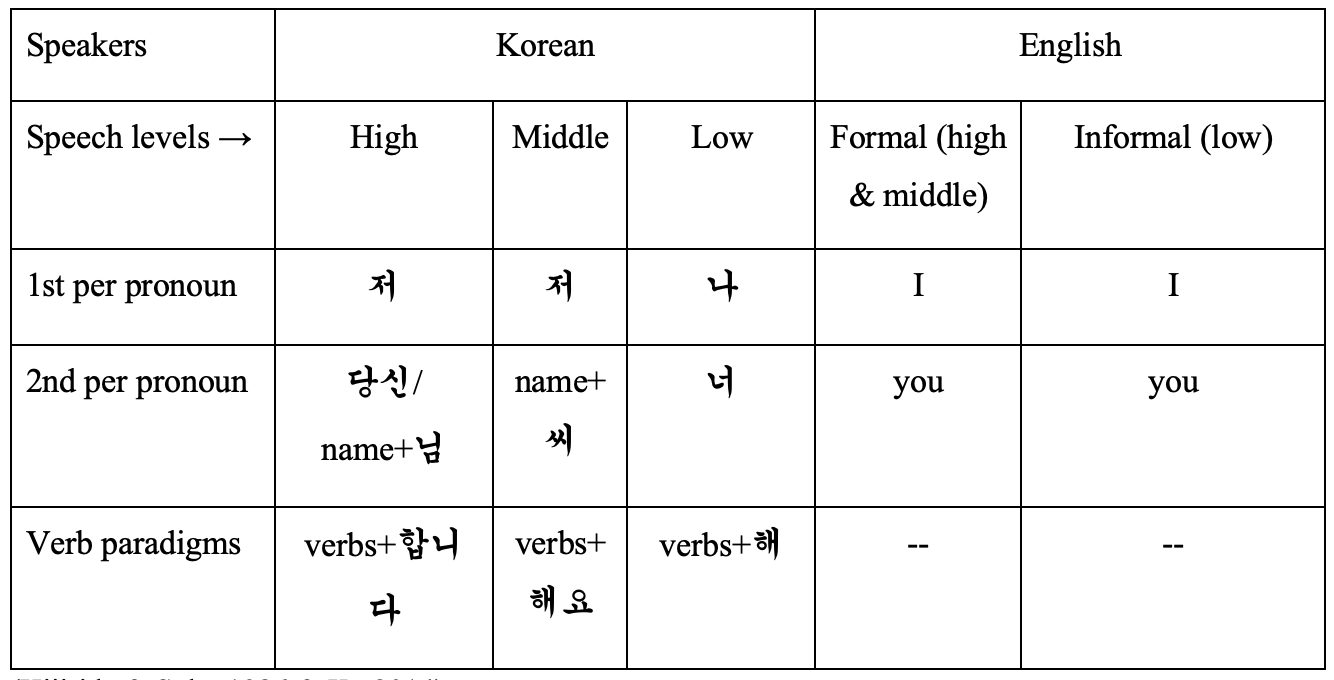
Table 1: A comparison chart between Korean and English formality tiers (adapted from Hijirida & Sohn (1986) and Ku (2014)).

Korea is considered a collectivist-low-context culture which means that Koreans have a strong emphasis on group harmony and using context more so than words to convey messages. On the other hand, America is an individualistic-high-context culture in which there is a stronger focus on individuality and more responsibility falls on speakers to explicitly state their point (Cho, 2010). This significant difference in language culture feeds into unique styles to express politeness. The two major linguistic ways one can express politeness are through positive politeness, making the receiver feel good about themselves, and negative politeness, an apologetic stance to interaction based on the assumption that one is intruding on the listener (Brown and Levinson, 1987).

Given the contrasting cultures of communication, we would expect Koreans to be more vague overall and utilize more negative politeness in order to avoid being imposing while Americans would be more direct in their politeness, thus leaning towards more positive politeness strategies.

Methods

We know from intuition that regardless of culture, both American and Korean teenagers are expected to change their speech style when addressing their peers versus adults in their lives. That is why we chose to focus on collecting data from two TV series: Never Have I Ever (American English) and Inheritors (Korean), which mainly focus on the lives of teenagers. For data collection we focused on gathering pieces of dialogue that we thought could show how these characters were expressing politeness in different situations. We categorized the data into three specific speech acts (requests, refusals, and apologies) to know how politeness theory would be displayed in English and Korean. We also split this data according to the participants, specifically into peer-to-peer and student-to-adult categories1. The analysis was primarily focused on instances of positive and negative politeness, but we kept an eye out for other strategies.

Results/Analysis

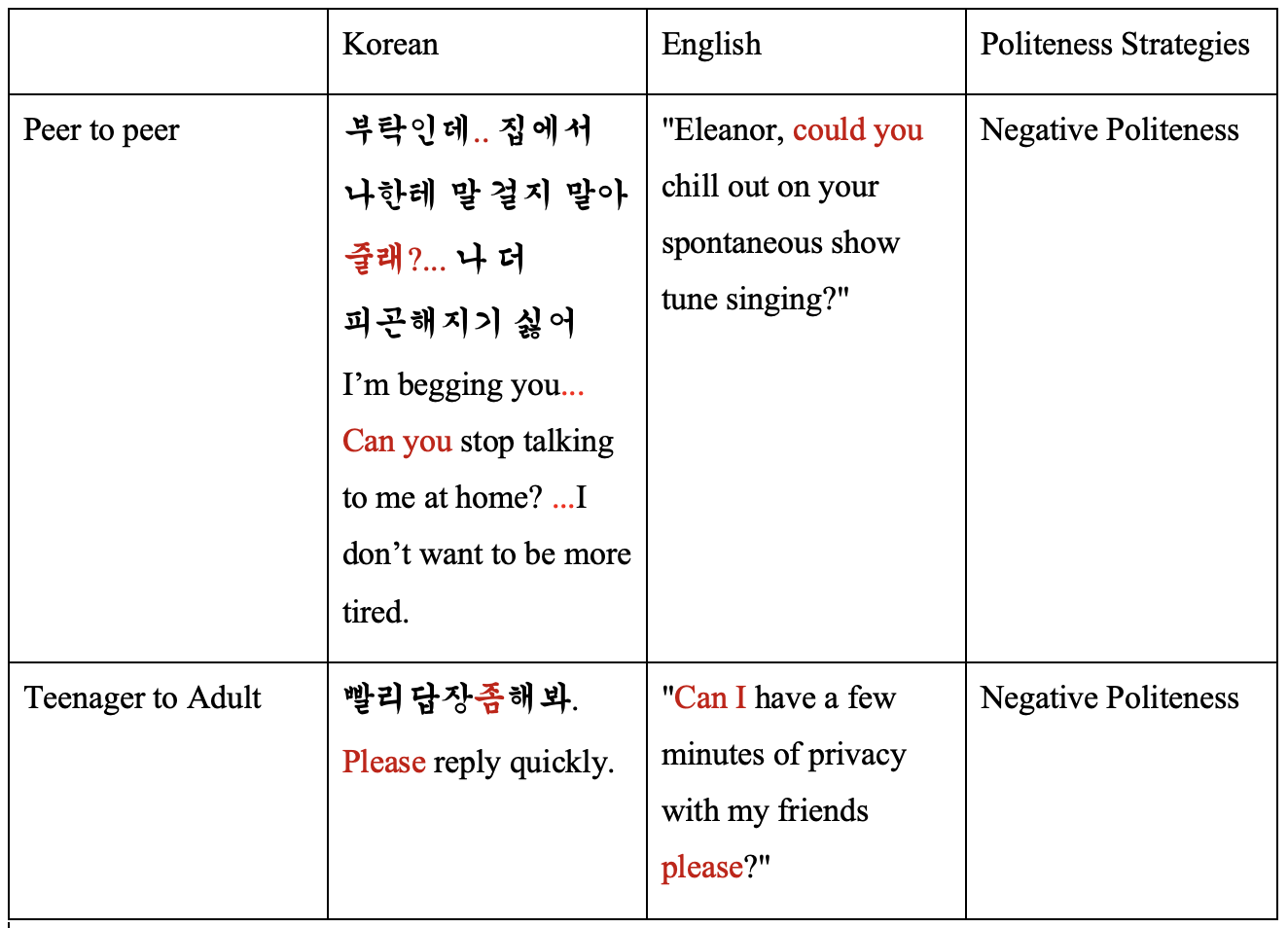
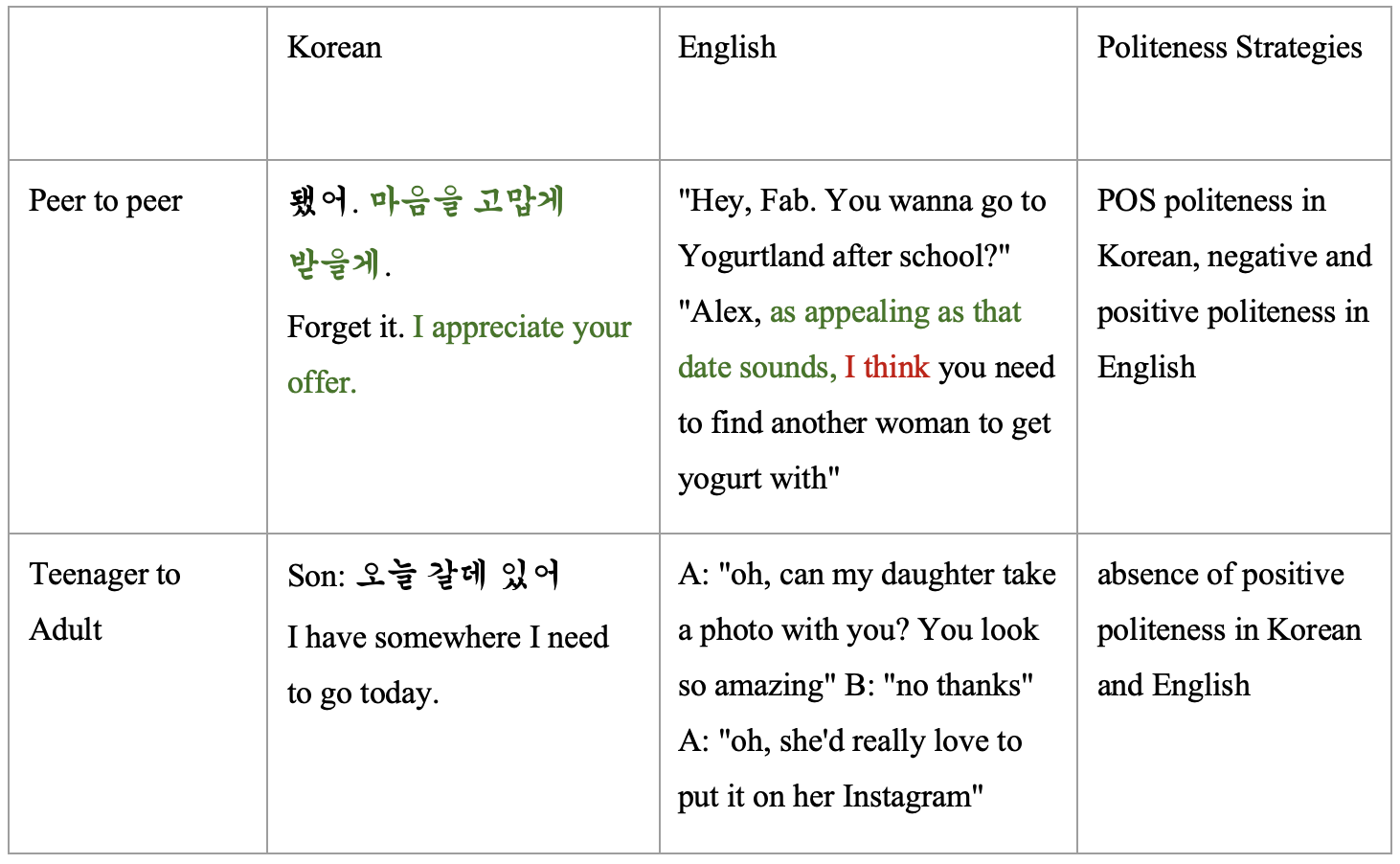
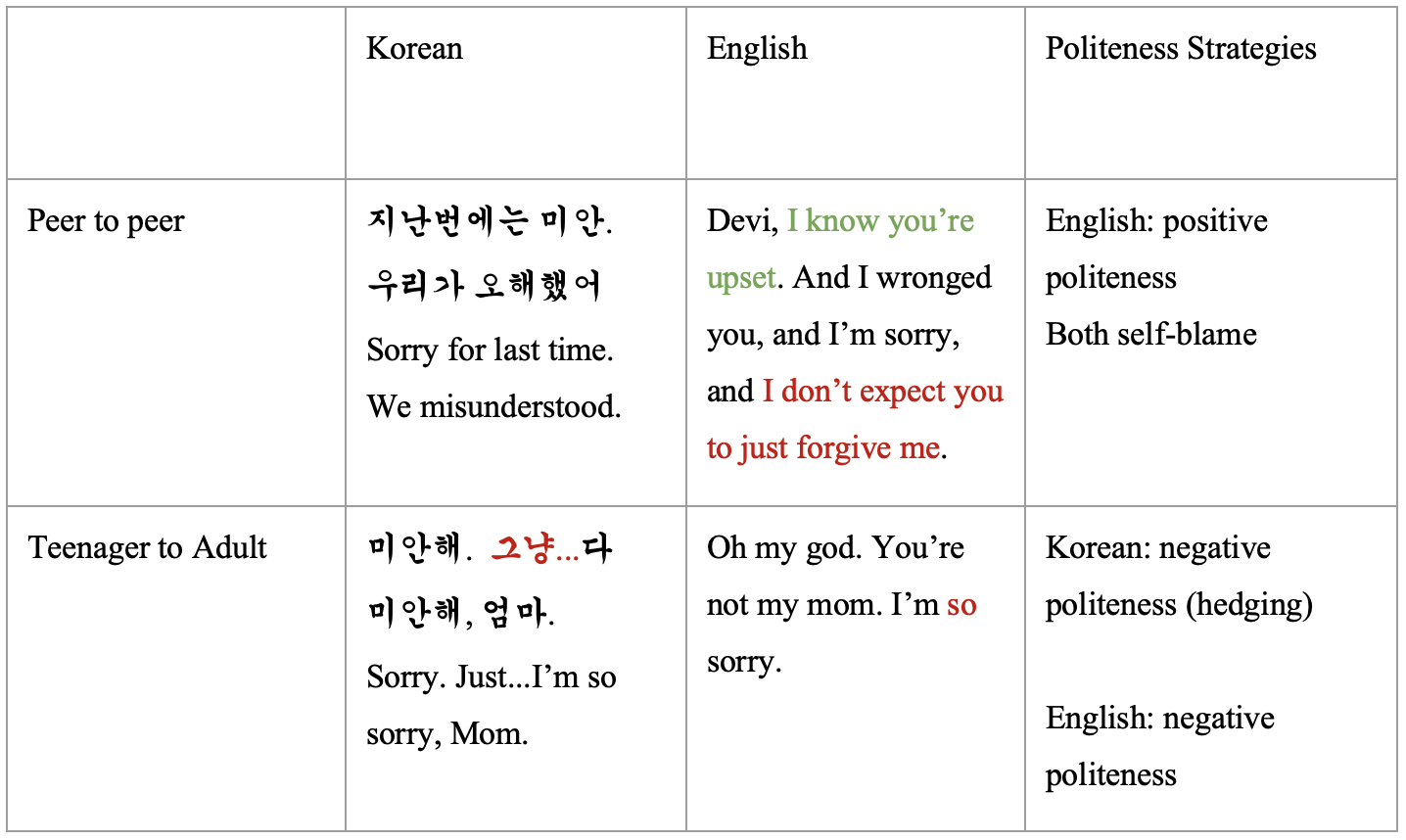
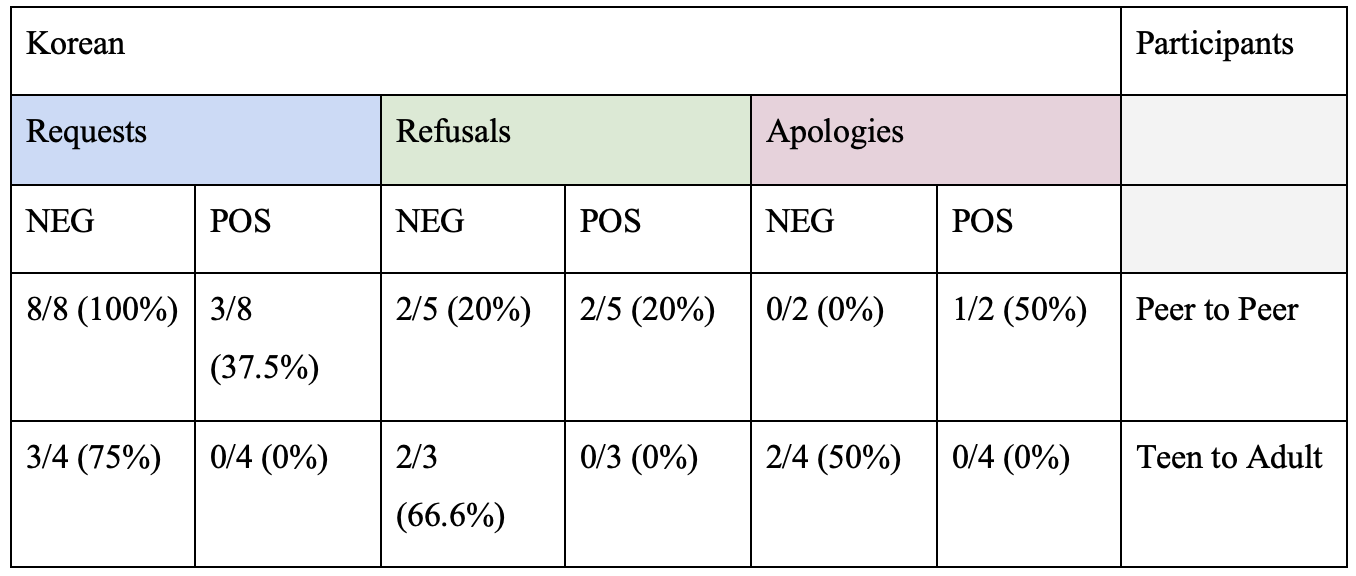
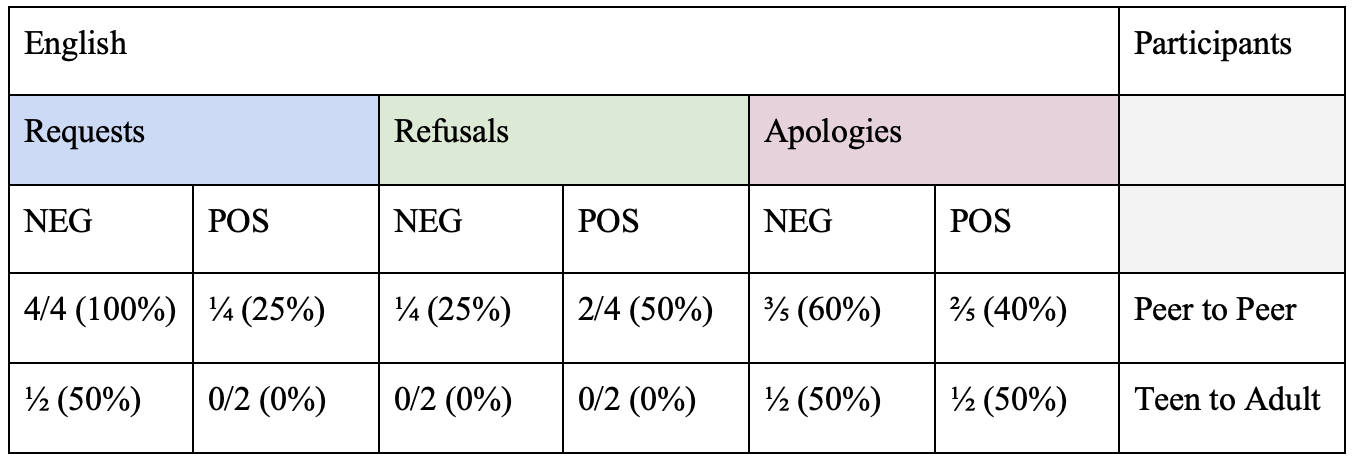
We organized our data into separate sections depending on the language, participants, and speech act. We’ll cover a couple examples for each speech act and show them in a table with some color coding to show politeness strategies used. Any negative politeness will be written in red text and positive politeness will be written in green text. At the end of this section, we will show a table that has the numbers that encompass all the data. The first speech act we looked at was requests.

Table 2: Table on Requests in Korean and English.

In Korean we noticed the use of negative politeness strategies both between peers and between the student and adult. In the case of the peer-to-peer request shown above, there was some pausing before making the request and before explaining why the request was made. They also formatted the request as a question using “줄래? jullae?” or “Can you…” which is one way to decrease imposition or make the request feel less intrusive, thus falling into the category of negative politeness. This is similar to the use of “좀 jom” or “please” when the student is making a request to the adult, once again decreasing imposition. Something that we noticed from these Korean examples is that speakers were generally more direct than expected. In the peer-to-peer request, the student making the request explains her reasoning as her “not wanting to become more tired” which is directly related to her own wants/needs. Typically, we would expect explanations in Korean to be more vague and related to a third party or some uncontrollable situation (Lyuh 1992, p.115). Furthermore, in the student to adult example, the student used “빨리 ppalli” and “해봐 haebwa” which create a sense of urgency and is also said informally as according to Table 1. This is unexpected with a teenager approaching an adult, but we deduced that since this student was talking to her mother, the closeness of their relationship overrode the need to be more formal or polite when speaking to someone older.

While we expected more positive politeness from English speakers, surprisingly we saw a high rate of negative politeness in English requests as well. As can be seen in the examples above, English speakers tended to format their requests as questions, using forms such as “Could you…?” and “Can I…?” and again in the student to adult request we see the use of “please” to further decrease imposition. Altogether, both English and Korean showed high rates of negative politeness in their requests. In looking at the additional data, there were some instances of positive politeness in peer-to-peer requests in both languages, but it wasn’t used nearly as often in the overall data for requests.

Table 3: Table on Refusals in Korean and English.

The general trend found in Korean for refusals between students is that peers are more direct and use less positive politeness when declining something. Our example in the chart above points to the use of positive politeness in using the phrase “I appreciate your offer,” but instances such as these were uncommon across our data. Between students and adults, there was more indirect speech with an absence of positive politeness as well. One of our best examples showed the use of “I have somewhere I need to go today” from a Korean student in order to decline an invitation from his mother. Unlike in our data for Korean requests, in this instance we did see the type of vagueness or reference to an outside force when providing an explanation for something, as expected of collectivist cultures. We analyzed this as the absence of positive politeness because while it was expected he would follow up with something like thanking his mother for the invitation, he focused on his lack of time. On the other hand, we found that English was much more direct across this speech act. There are instances of both positive and negative politeness, and it varies with the speaker, context, and social distance between the interlocutors (people engaging in a conversation). In the peer-to-peer example given in Table 3 for English, the speakers are friends while the teenager-to-adult interaction is between strangers. The peer-to-peer refusal was softened by the phrase “as appealing as that date sounds,” which we categorized as positive politeness because it exaggerated how much she liked the proposed idea by her peer even if she didn’t want to accept his invitation. In the English data, the first refusal is more euphemistic and the second is more direct, but both are clearly refusals.

Table 4: Table on Apologies in Korean and English.

In the case of apologies, both languages behaved opposite from what we expected based on our hypothesis. In Korean, there was a much lower rate of politeness strategies being used overall. For example, in peer-to-peer, there was no use of negative politeness strategies. Even in the example given in the table, we were not able to identify any particular strategies being used. The apology was simple and straight-forward. We do believe it is worth noting that our data for the Korean apology section was scarce in sample size and could have had more examples, which may contribute to the low numbers we are seeing. In the case of student to adult apologies however, we did see more use of negative politeness strategies. As seen in the table, the student used “그냥 geunyang” or “just” with a slight pause during her apology. This is an example of hedging, a negative politeness strategy where one delays or lengthens their statement. In terms of positive politeness strategies, we saw them only being used in peer-to-peer apologies in Korean.

In English, the rates of both positive and negative politeness were higher than expected, leading us to conclude that in this particular speech act, English speakers may employ more outside help to achieve the purpose of their apologies. In one of our English examples for peer-to-peer, a speaker says “I don’t expect you to just forgive me” as a negative politeness strategy to emphasize that the receiver does not owe them their forgiveness.

Outside of politeness strategies we observed that in both languages there was a pattern for emphasizing the aspect of self-blame across apologies. This was achieved by explaining their wrongdoings within the apology in order to bring awareness to their guilt.

In cross comparing our data for both languages overall, we found that there was no significant difference between the rates of politeness strategies used across the three speech acts we observed. English had a 37.5% rate of politeness strategies employed overall while Korean had a similar rate of 34.9%. However, an interesting trend we could identify was that while Korean teenagers did not necessarily use more negative politeness, they did demonstrate a wider variety of it while American teenagers stuck to using the same forms in their negative politeness strategies.

Table 5: Politeness Strategy Rates in Korean.


Table 6: Politeness Strategy Rates in English.


Discussion and Conclusions

After we had collected all the data above, we found that some of our data was consistent with our hypothesis while other data went against expected politeness patterns. We concluded that the Korean language does use negative politeness more often than positive politeness. Still, English also had a lot of unexpected evidence of negative politeness.

In addition, the importance of politeness strategies goes beyond vocabulary and grammar. It can also be expressed through strategies such as hedging and pausing in interaction. Despite the lack of a formality system in English, English speakers can change formality and politeness through the use of these identified positive and negative politeness strategies.

Based on what we concluded above, this study could be helpful for cross-cultural interlocutors to gain a deeper understanding of the language and communication styles of different cultures. For example, it could help politicians who need to conduct diplomatic affairs and business workers of international companies. Language learners would also benefit because memorizing phrases isn’t always enough to fully understand the underlying nuances of a language. Being able to properly understand the politeness strategies used by someone else and being able to apply them yourself can help greatly decrease misunderstandings.

In the early stage of collecting data, we also encountered some problems. Since we had yet not narrowed down the speech acts to requests, refusals, and apologies at the beginning, the initial data collection and analysis was not smooth. In future research, those interested in this topic can narrow down the scope of speech acts before collecting their data and perform future studies with more reliable sources. Our data results were affected by a relatively small sample size as we could not watch entire seasons of our shows, but future studies should consider collecting data from entire seasons if time allows. Future researchers of this topic could improve the source material by utilizing questionnaires, naturalistic observations, real person interviews, a wider variety of TV shows, or unscripted YouTubers’ speech patterns to collect data for their studies.


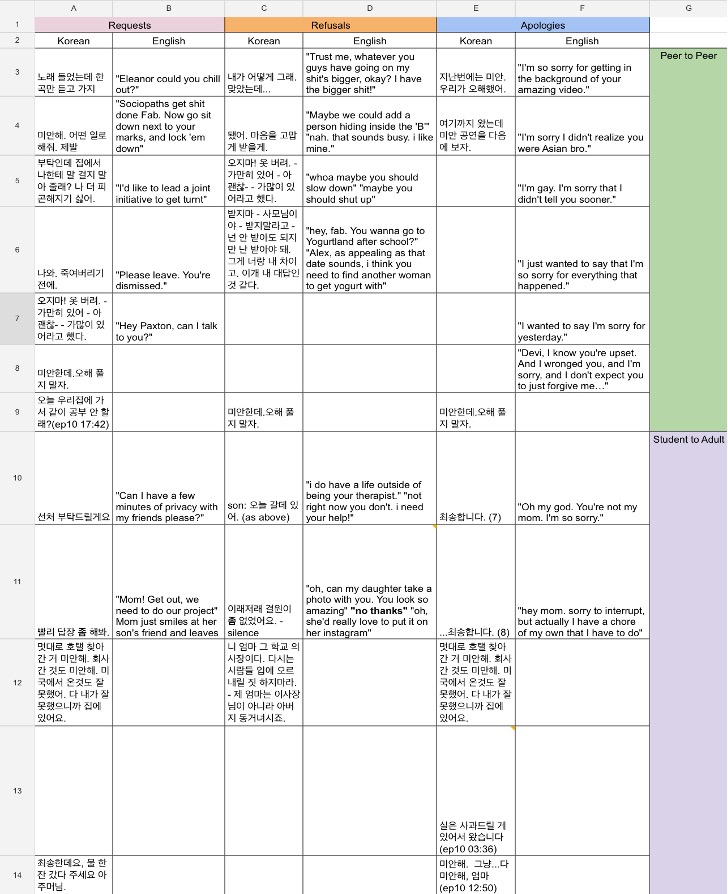
Extended Data Table:

Our data for requests, apologies, and refusals in English and Korean.


References

Brown, P., & Levinson, S. C. (1987). Politeness: Some universals in language usage. Cambridge University Press.

Cho, S. E. (2010). A cross-cultural comparison of Korean and *American social network sites: Exploring cultural differences in social relationships and self-presentation (Order No.3397528). Available from ProQuest Dissertations & Theses A&I; ProQuest Dissertations & Theses Global. (305224890). pp. 23-25

Ku, Jeong Yoon. “Korean Honorifics: A Case Study Analysis of Korean Speech Levels in Naturally Occurring Conversation.” ProQuest Dissertations Publishing, 2014. Print. P.7.

Kyoko Hijirida & Ho‐min Sohn (1986) Cross‐cultural patterns of honorifics and sociolinguistic sensitivity to honorific variables: Evidence from English, Japanese, and Korean, Research on Language & Social Interaction, 19:3, 365-401, DOI: 10.1080/08351818609389264) p. 370.

Lyuh, I. (1992) The art of refusal: Comparison of Korean and American cultures. ProQuest Dissertations & Theses A&I; ProQuest Dissertations & Theses Global. pp. 87-117

Mindy, K., Fisher, L., Klein, H., Miner, D., Shapeero, T. (Executive producers). (2020-present)

Never Have I Ever [TV series]. Kaling International, Inc.

Yoon, H. (Executive Producer). (2013). Inheritors [TV series]. Hwa & Dam Pictures.

[/expander_maker]

, ,
Scroll to Top