Paulina Rodier, Pearl Tawadros, Phoebe Qian
Have you ever watched your favorite animated movie in another language and noticed a beloved joke completely fall flat or changed into something else entirely? Animated films are filled with culture-specific references, from nursery rhymes to iconic pop-culture moments, that rely on shared knowledge to be funny. But what happens when a joke doesn’t survive translation? When these films are dubbed into other languages, those cultural references often shift, disappear, or transform entirely. This blog explores how audiovisual translators adapt culture-bound references across Polish, Arabic, and Japanese dubbing contexts. By analyzing highly culturally dense scenes from English films like Shrek and Toy Story using Davies’ (2003) framework, this study reveals fascinating cross-cultural patterns. We found that Polish dubbing heavily favors localization, Arabic uses flexible strategies to balance clarity and emotion, and Japanese often simplifies or omits references entirely. Ultimately, translation extends beyond direct linguistic mirroring; it is a cultural process that reshapes how global audiences experience the exact same story.
Keywords: audiovisual translation, cultural references, dubbing strategies
[expander_maker id=”1″ more=”Read more” less=”Read less”]
Introduction & Background
Anyone who has watched the same movie in two different languages has probably noticed that the dialogue does not always translate directly. Animated movies, in particular, are landmines for translators. They frequently rely on culture-bound references: nursery rhymes, idioms, historical events, or well-known characters that the original audience is just expected to recognize. In the original English context, these references can enrich a scene by adding layered humor and shared cultural knowledge.
However, when films are dubbed, these elements hit a massive barrier. Translators working in audiovisual media aren’t just swapping English words for their direct Polish or Japanese counterparts; they must make critical, culturally loaded decisions. Should they preserve the original reference and risk confusing the audience? Adapt it to something local and familiar? Or remove it entirely?
These choices mean that translation is never a word-for-word transfer. It is an active cultural process that shapes how global audiences understand the same film. While previous research shows that Arabic dubbing navigates complex dialect choices to build emotional connection (Al-Yasin, 2022), Polish dubbing domesticates references (Leszczyńska & Szarkowska), and Japanese translations often engage in “cultural deodorization” to soften foreign elements (Hyland, 2015), there is still a gap in understanding how major dubbing studios systemically navigate these choices across vastly different linguistic contexts side-by-side.
This project explores how translators adapt these references across Polish, Arabic, and Japanese, and how these decisions reflect specific sociocultural expectations.
Methods: Decoding the Dubs
To figure out how studios handle this, we didn’t just re-watch our childhood favorites; we conducted a qualitative comparative analysis. We zeroed in on culturally dense scenes from Shrek, Shrek 2, Toy Story, Aladdin, Monsters Inc., and Finding Nemo.
We defined a “culture-bound reference” as any element relying on shared knowledge for its meaning or humor (like a specific food, idiom, or pop-culture nod). We then aligned the original English dialogue with its Polish, Arabic, and Japanese dubbed versions.
To make sense of the changes, we coded every translated line using Davies’ (2003) translation strategies framework. The main categories we look at were:
• Preservation: keeping the original reference
• Localization: replacing it with a culturally familiar equivalent
• Globalization: using a more general or neutral term
• Transformation: significantly altering the meaning or structure
• Omission: removing the reference entirely
Coding was conducted by comparing the original line with its dubbed versions and identifying how the cultural reference was handled. In cases where multiple strategies appeared in a single line, the dominant strategy based on the most significant shift in meaning was selected.
While the analysis focuses on linguistic changes, it also takes into account key constraints of audiovisual translation, such as lip synchrony and timing, which can limit how closely dialogue can match the original. This allowed us to interpret translation choices not only as linguistic decisions, but as responses to both technical and cultural pressures.
Results & Analysis: Who Changed the Joke?
When coded using Davies’ framework, the data revealed different adaptation strategies across the three languages.
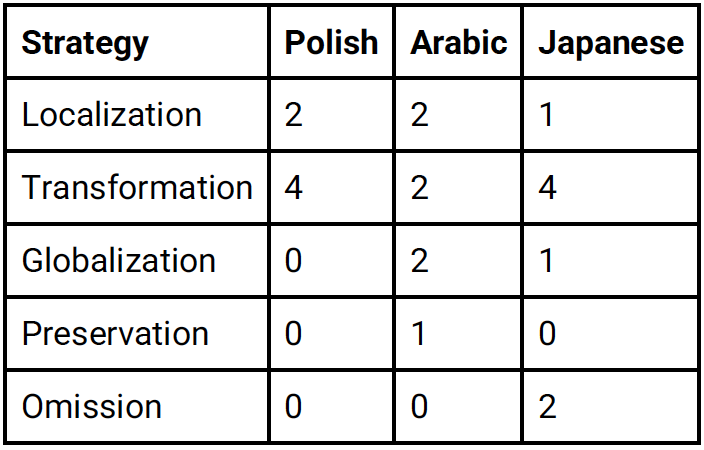
Table 1: Frequency of adaptation strategies for culture-bound references in Polish, Arabic, and Japanese dubs of English animated films, categorized using Davies’ (2003) framework. The data shows Polish favoring Transformation/Localization, while Japanese favors Transformation/Omission
The patterns suggest that Polish dubbing prioritizes cultural substitution, where the goal is not to preserve the original reference itself, but to recreate its effect for the audience. Rather than expecting viewers to interpret unfamiliar references, translators replace them with culturally accessible equivalents that allow the humor to land immediately. This reflects an underlying assumption that shared cultural knowledge is essential for comedic impact.
Arabic dubbing shows a broader mix of strategies. This flexibility reflects the incredible linguistic and cultural diversity of Arabic-speaking audiences. In some cases, translators localize references, such as replacing “muffin” with ka’k, a well-known Middle Eastern baked good. In other cases, references are simplified through globalization, such as translating “white bronco” as “white horse.”
We found that Arabic dubbing balances between cultural familiarity and broad accessibility. Because dubbed media often targets a wide, transnational audience, translators may avoid highly localized substitutions that would only resonate in one region. Instead, they favor solutions that are widely understandable across dialects and cultural contexts, prioritizing clarity over introducing specific cultural references.
Japanese dubbing tends to rely on transformation or omission, often removing references that don’t translate culturally. For instance, the nursery rhyme reference to the “Muffin Man” is omitted entirely and replaced with a more neutral line self-referencing the speaker as the “Cookie Man”.
Clear favoring of transformation and omission in Japanese dubbing suggests a preference for maintaining clear narrative flow and cultural neutrality rather than confusing the audience with unfamiliar Western concepts. This also aligns with a broader tendency to minimize overt foreignness, allowing the story to feel more cohesive even if some cultural detail is lost.
To see this in action let’s look at the famous interrogation scene in Shrek.
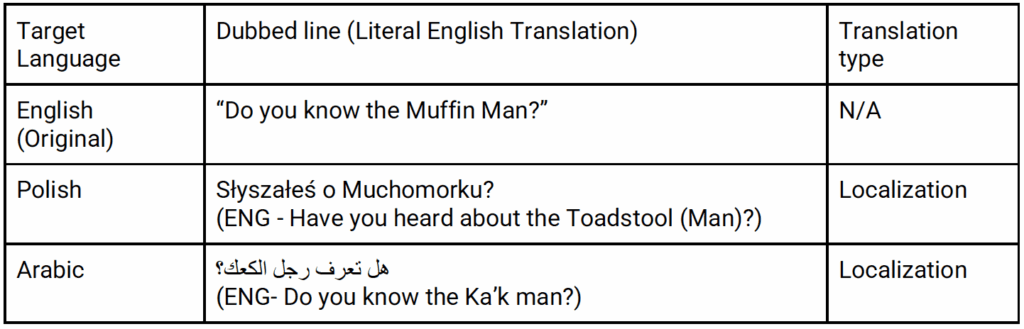

Table 2: Adaptation of the “Muffin Man” nursery rhyme reference in Shrek. This highlights how a single joke fractures into three entirely different linguistic strategies based on cultural expectations.
Disscusion
Our findings confirm that language in animated films is deeply tied to culture. Rather than acting as a direct transfer of meaning, dubbing functions as an active form of cultural adaptation. As Johnson (2020) argues, dubbing exists in a space “between” languages and cultures, where meaning is actively reconstructed to fit new contexts. This helps explain why the same film can feel subtly different depending on the language in which it is viewed.
The patterns observed aren’t just random choices made by translators in a booth; they reflect broader language ideologies about what audiences should understand and how much “foreignness” is acceptable in media. These translation choices affect indexical meaning- the social and cultural associations carried by language. Culture-bound references like the Muffin Man do more than just push the plot forward; they signal shared knowledge, history, and identity. When translators replace or erase those references, the indexical meanings shift, fundamentally altering how audiences engage with the characters on screen.
Ultimately, global media is not experienced uniformly. What may seem like a tiny change to a joke about a muffin actually reveals a much larger, ongoing process of cultural negotiation. The next time you watch a dubbed film, pay close attention to the jokes- you might be surprised by what you’re actually laughing at.
References
Al-Yasin, N. (2022). Translation Procedures of Cultural-Bound Expressions in the Egyptian Vernacular Dubbed Versions of Three Disney Animated Movies. Open Cultural Studies, 6(1), 294-306.
Burczyńska, P. (2012). Translation of cultural items in dubbed animated comedies. Translation Journal.
Di Giovanni, E. (2016). Dubbing and redubbing animation: Disney in the Arab world. Altre Modernità.
Huber, L., & Kairys, A. (2021). Culture Specific Items in Audiovisual Translation: Issues of Synchrony and Cultural Equivalence in the Lithuanian Dub of “Shrek the Third.” Kalbų Studijos, 1(38), 5-16.
Hyland, R. (2015). A culture of borrowing: Iconography, ideology and idiom in Kari-gurashi no Arietti/The Secret World of Arrietty. East Asian Journal of Popular Culture, 1(2), 205-222.
Leszczyńska, U., & Szarkowska, A. (2018). “I don’t understand, but it makes me laugh”: Domestication in contemporary Polish dubbing. The Journal of Specialised Translation, (30), 203-221.
Rababah, L. M. (2025). Cultural challenges and subtitling strategies in American animated movies. Journal of Posthumanism, 5(2).
[/expander_maker]