Asian Americans

Culture and Language: How Stigma Can Impact Students’ Mental Health Conversations

College students in America have had a rise in mental health concerns, finding themselves facing internal and external troubles when seeking support and open dialogue. Although past studies discuss the external factors that impact the rise in mental health concerns in college students, few discuss the cultural factors that affect these college students’ ability to seek and maintain support– particularly in the Chinese community, which has been found to carry a stigma for mental health. This study looks at the cultural influences that impact the conversation surrounding the mental health of Chinese college students. Using data from semi-structured interviews, this study frames the cultural reasons for how Chinese college students view mental health and support for mental health. Chinese UCLA undergraduate students discuss their mental health experience in three different contexts: with themselves, their family, and their friends. These students emphasize the difficulties of growing up in a community that stigmatizes mental health and lacks an open dialogue about it. Conversations growing up had impacted their own perceptions. These students needed to learn how to approach mental health conversations. The experiences and perceptions of mental health discussion of these students suggest that stigma perpetuated through communication can cause Chinese students and others from stigmatizing cultures to face various cultural challenges that hinder them from feeling confident in seeking resources.

[expander_maker id=”1″ more=”Read more” less=”Read less”]

Introduction

In recent years, there has been an increase in conversation about the mental health crisis, specifically in the student population. More than half of college students have at least one mental health problem. As mental health becomes a more significant crisis, there is a need to understand how different communities perceive and discuss the topic of mental health, as communication plays an essential role in perpetuating stigma (Rusch et al., 2005). A crucial aspect of understanding people’s perceptions of mental health would be their background.

Past studies have shown that in Chinese and other Asian communities, there is a great deal of mental health stigma, followed by a lack of knowledge and discussion on mental health. Understanding the perspective of one community of college students provides a significant opportunity to see how culture and its stigma could impact how people discuss mental health and, in turn, address it.

Background

In the Chinese community and other Asian communities, there is a mental health stigma and a lack of mental health knowledge (Yin et al., 2020; Shu et al., 2022). In recent years, there have been increased conversations about the mental health crisis, specifically in the student population. Past studies have found that more than 60% of college students have at least one mental health problem, with there being an increased rate of anxiety, depression, and suicidal ideation on college campuses (Lipson et al., 2022; Pedrelli et al., 2014).

As mental health becomes a bigger crisis, there is a need to understand how different communities perceive and discuss the topic of mental health. An important aspect of understanding people’s perception of mental health would be to consider their background.

Chinese undergraduate students may face mental health complications but struggle to address them because of their cultural stigma. In particular, perceptions of mental health by their parents may play a role in how they manage their mental health. Disconnects between immigrant parents and their children have been reported in previous studies. The variation in how people interpret language has significantly changed, and one is more likely to find a disconnect between how individuals interpret words, phrases, and expressions (Sharma & Dodsworth, 2020). Such differences may play a role in how Chinese undergraduate students perceive stigmatized topics and discuss them within their community and their parents. It is essential that we understand how culture and relationships may impact perceptions of mental health and language (Toppelberg & Collins, 2010). Understanding these variations, even if just in the Chinese undergraduate community, will allow for a better understanding of how to address stigma around critical health topics like mental health.

Methods

This research was conducted with UCLA Chinese undergraduate students. Interviewees were recruited through word-of-mouth. They participated in an in-person, 15-to-30-minute, semi-structured interview to answer open-ended questions (see Appendix). This structure allowed a natural conversation flow when discussing a heavy topic like mental health to understand how language and culture are intertwined.

Five Chinese undergraduate students participated in the interviews. Two are international students from China, and three are domestic students from America. To analyze our data, we used grounded theory to categorize and frame the prominent ideas expressed by our participants.

Positionality

Four undergraduate students conducted this study for a linguistic anthropology project. Each researcher is of a different ethnicity and background, and only one researcher is a member of the Chinese community. As college students, we recognize the significance of mental health and hope to understand the cultural and linguistic nuances of how students like us perceive mental health.

Findings and Analysis

Our five interviewees shared three main experiences, established through grounded theory to understand our interviewees’ beliefs about mental health dialogue.

Lack of Conversation

Growing up, Chinese undergraduate students did not have conversations about mental health with their parents. If these topics did come up, they were stigmatized, broad, and swept under the rug. Our participants emphasized how they have tried talking to their parents about mental health, only for the topic to be highly frowned upon and ignored. The only conversations about mental health that our participants had were stigmatizing, creating a negative perception of mental health and the lack of ability to discuss mental health.

Learning About Mental Health and its Dialogue

After coming to college, students had to grapple with mental health and how to really talk about it, especially to their peers. Starting conversations and looking for support was difficult because they felt they lacked a foundation due to their culture and how they were raised. These conversations were only sought after they started college and were away from home.

Figure 1: Quotes from two Chinese undergraduate students talking about their current journey with mental health and its dialogue. Participant 2 (left box) needed to learn how to talk to her peers. Participant 3 (right box) believed that their upbringing and their parents’ mental health stigma played a role in their ability to address their mental health.

Chinese students who grew up in a family that stigmatized mental health, primarily through conversation or a lack of conversation, came into college feeling uncomfortable with starting conversations about mental health. Even when they sought out support from friends, it was a slow process. One student stated that it was a “trial and error phase,” they were uncomfortable talking to their friends or therapist but knew it was necessary for “healing.” In the same conversation, they said they slowly learned how to “properly” tell their friends as they never learned how to. Participants implied that they feel like there is a right way to talk about mental health, but they lacked the toolkit to do so due to their cultural upbringing.

Differences Between Conversations and Language with Parents and Peers

Students meticulously choose words when talking to their parents because they recognize the culture and barriers they were raised with. When they brought mental health up as an undergraduate student, they used terms they believed would be better accepted by their parents.
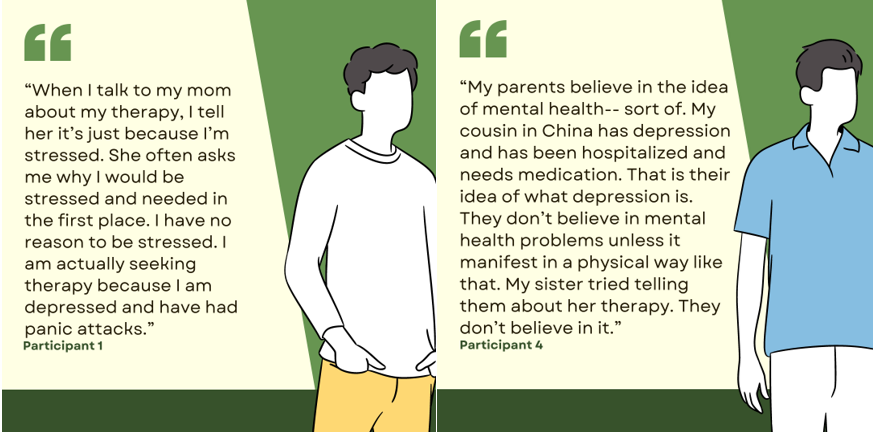
Figure 2
Quotes from two Chinese undergraduate students talking about how and why there are differences in how they talk about mental health to their parents versus their peers. Participant 1 (left box) reveals how he has to think about the right words to use to talk about his mental health with his parents. Participant 4 (right box) believed that because their parents have a specific view of what mental health is, they have to be careful with how they talk about mental health, especially if it does not fit their parents’ perception.

When speaking with peers, participants believed they had a space to be accepted, compared to speaking with their parents. During these conversations with their peers, they openly use terms like “depression,” “anxiety,” and “panic attacks.” When speaking with their parents, they use euphemisms. One participant uses “stress” instead of “depressed” because their parents better understand it, though it is still brushed over in conversations. The identity that was being used in each conversation was different. Students were less afraid of being identified as “mentally struggling” when with their friends. Participants expressed that they felt it was something they were all going through. However, using these linguistic labels with parents or elders felt much too far. Three participants indicated that the words “depressed” or “anxious” held more negative weight if said in Chinese in contrast to their English-speaking friends.

Discussion and Conclusions

The beliefs and experiences of these Chinese undergraduate students imply that culture plays a role in the language people use to discuss mental health. Cultural stigma can be perpetuated through the use of communication. Our Chinese participants grew up with a lack of positive mental health dialogue. Mental health dialogues were negative and filled with stigmatizing language. This led to our participants feeling unsure about seeking conversations about mental health with their parents at home.

The lack of opportunities to learn how to discuss mental health created difficulties when it came time for them to have these conversations. When mental health became an important topic in college, where their peers and themselves faced mental health experiences, these Chinese students felt ill-prepared to conversationally start and address the topic. Because of their upbringing, they needed to learn how to reframe their and others’ potential perception of mental health to feel comfortable doing so. Recognizing their parents’ and their peers’ opposing perceptions of mental health impacts the way they choose to talk about mental health, code-switching for the comfort of their parents.

 Communities with stigmatizing cultural beliefs about mental health could lead to individuals having trouble accessing the support that they need because they lack the language to have and start conversations about their mental health. It is then essential to increase access to resources for parents and younger generations. Parents should become knowledgeable about mental health and normalize its dialogue to reduce stigmatization and be open to their children. These resources could provide younger generations with an avenue to recognize and learn about mental health and address it when necessary. Knowing the role of culture also allows professionals to be more culturally aware and adaptive.

Culture can affect how and if people communicate about topics, eventually impacting whether or not people are confident in seeking the right resources. As the mental health crisis among students rises, it is critical to consider all of the factors that could be mitigated to allow students to seek the support they need.

References

Babchuk, Wayne A. and Hitchcock, Robert K. (2013). “Grounded Theory Ethnography: Merging Methodologies for Advancing Naturalistic Inquiry,” Adult Education Research Conference. https://newprairiepress.org/aerc/2013/papers/5

Lipson, S. K., Zhou, S., Abelson, S., Heinze, J., Jirsa, M., Morigney, J., Patterson, A., Singh, M., & Eisenberg, D. (2022). Trends in college student mental health and help-seeking by race/ethnicity: Findings from the National Healthy Minds study, 2013–2021. Journal of Affective Disorders, 306, 138-147. https://doi.org/10.1016/j.jad.2022.03.038

Lu, Xing and Guo-Ming Chen. (2011)”Language change and value orientations in Chinese culture”. China Media Research, vol. 7, no. 3, pp. 56- 63. http://www.wwdw.chinamediaresearch.net/index.php/backissues?id=51

Pedrelli, P., Nyer, M., Yeung, A., Zulauf, C., & Wilens, T. (2015). College Students: Mental Health Problems and Treatment Considerations. Academic Psychiatry: The Journal of the American Association of Directors of Psychiatric Residency Training and the Association for Academic Psychiatry, 39(5), 503. https://doi.org/10.1007/s40596-014-0205-9

Toppelberg, C., & Colins, B. A. (2010). Language, culture, and adaptation in immigrant children. PubMed Central (PMC). https://www.ncbi.nlm.nih.gov/pmc/articles/PMC3526379/

Rüsch, N., Angermeyer, M. C., & Corrigan, P. W. (2005). Mental illness stigma: concepts, consequences, and initiatives to reduce stigma. European psychiatry : the journal of the Association of European Psychiatrists, 20(8), 529–539. https://doi.org/10.1016/j.eurpsy.2005.04.004

Sharma, D., & Dodsworth, R. (2020). Language variation and social networks. https://www.annualreviews.org/doi/10.1146/annurev-linguistics-011619-030524

Shu, J. L., Alleva, J. M., & Stutterheim, S. E. (2022). Perspectives on mental health difficulties amongst second-generation Chinese individuals in Germany: Stigma, acculturation, and help seeking. Journal of Community & Applied Social Psychology, 32(6), 1099-1114. https://doi.org/10.1002/casp.2620

Yin, H., Wardenaar, K.J., Xu, G. et al. Mental health stigma and mental health knowledge in Chinese population: a cross-sectional study. BMC Psychiatry 20, 323 (2020). https://doi.org/10.1186/s12888-020-02705-x

Additional Resources 

https://embed.podcasts.apple.com/us/podcast/the-impact-of-mental-health-stigma-on-chinese-americans/id539018756?i=1000326453174

https://embed.podcasts.apple.com/us/podcast/mental-illness-and-its-cultural-stigma/id1273577192?i=1000420737041

Appendix

Guiding Interview Questions

Defining Mental Health and General Questions

  1. Have you heard of mental health diagnoses? What do you consider as mental health conditions?
  2. How did you learn about the topic of mental health?
  3. Do you know anyone with mental health concerns?
  4. What causes mental health concerns?
  5. How prevalent do you think mental health concerns are within the student population?
  6. What do you think about your own/people’s mental health diagnoses/state?

Family

  1. Do you talk to your family about mental health concerns? Why/why not?
  2. How do you talk to your family about mental health concerns?
  3. Does anyone in your family talk to you about mental health?

Community

  1. Do you talk to your peers about your mental health? Why/why not?
  2. Do your peers talk to you about their mental health? Why/why not?
  3. When talking to your peers/when your peers talk to you about mental health, how do they describe and talk about it?

[/expander_maker]

, , , ,

(Ap)parent Gender: Gendered Language and its Use in Asian American Parenting

Kara Chu, Iffet Dogan, Jay Iyengar, and Alisara Koomthong

The following research seeks to observe linguistic variability in the way Asian immigrant parents speak to their Asian American sons compared to their daughters. Participants for the study include two female participants and one male participant who recorded phone calls with their parents sharing both good news and bad news. The phone calls were analyzed for linguistic variability through word choice and intonation use by the participants’ parents. In addition to data collection, scenes from television shows that represent Asian American family dynamics were analyzed to find possible linguistic variability in the way parents spoke to their daughters in comparison to their sons. This research aimed to uncover the use of gendered language within the cultural norms of Asian American parent-child relationships. More positive language and lower tonal variability were found with the parents of the boy, while more practical language and higher tonal variability were generally found with the parents of the girls.

[expander_maker id=”1″ more=”Read more” less=”Read less”]

Introduction

Children are known to absorb cultural linguistic expectations and gender norms imposed on them from interactions with their parents and caregivers. We are seeking to explore the common gender differences that children of Asian immigrant parents experience when speaking to their parents. By analyzing the parents’ supportive phrases, negative phrases, tone, and pitch in varying situations, we will look at the difference in language use towards sons versus daughters. Research has shown that mothers talk more and use more supportive language with their daughters than with their sons (Leaper et al., 1998). We hypothesize that our findings will align with existing gender research, and we aim to go one step further by viewing the data with a cultural lens to examine the intersection between how gender and culture may affect the children’s self identity.

Background

Asian families hail from a wide variety of cultures on the Asian continent, many of which are rooted in patriarchy. These customs have resulted in internalized misogyny within many Asian American families, leading to a distinct difference in the way they treat sons versus daughters. Fong (1997) addresses how Asian American women are in “the midst of conflicting values, identity crises, consciousness raising” all while developing their sense of womanhood (92). Asian Americans are subject to harmful stereotypes, which often include the rhetoric that Asian American women are submissive and incompetent compared to men. This is why we find it valuable to study if there are any linguistic markers that would help us understand how this difference in expectations is communicated to children. We are seeking to observe not only the linguistic variation in the way Asian women are spoken to in comparison to men, but also to make connections about whether that inflicts an altered self-image for Asian American women.

Methods

For our methodology, we wanted to recruit men and women from Asian-American family households that speak English with their parents. Due to our specific demographic, we could only find three Asian-American participants in their 20s: two women and one man. Initially, we had one more male participant, but he decided to drop out at the last minute. Each participant gave out their versions of good news and bad news (i.e. aced an exam, dropped out of school) that aligned with their lives, which enabled them to steer the conversation freely and have our results be as natural as possible. After obtaining all the participants’ and their parents’ consent to be recorded, we collected the recordings of their conversations of them delivering their news and getting their parents’ reactions. One of our female participants presented fake good and bad news while the male and the second female participants’ news were true. Only our male participant had both of his parents in the conversation while the rest interacted with either their mother or their father.

In order to support our data, we examined scenes from television shows relevant to our experiment: Never Have I Ever and Kim’s Convenience. It provided us insight into how media portrays the relationship between parents and their children in an Asian-Western household. In Never Have I Ever, the scene we chose was when the mother assumed the worst in Devi (her daughter) after Devi’s classmate said “Well you know Devi. She is a real firecracker.” In Kim’s Convenience, we used two scenes: the first was an interaction between the daughter and her parents and the second was between the mother and the son. Both were delivering the bad news to the parents and we were able to find a significant difference in how they were treated.

Results

1. Word Choice

We began by analyzing word choices used by the parents in response to good and bad news. All words have tones, and individuals make choices to use certain words/tones to convey more meaning than literal definition (Bakhtin, 1982). When certain tones are repeated in conversation with a specific individual it can begin to have an effect on their mood and lead to longer-term consequences. A study by Richter et al. (2010) provides more support for this by analyzing MRI scans of individuals when certain tone-words are spoken to them, noting that brains react differently to words with different moods and the subjects’ emotions can be changed by language itself (Richter et al., 2010). When parents apply this approach to their children, consistent usage of certain language can have long-lasting effects on development.

Our first subject’s (a girl) parent was less congratulatory than the other parents and seemed to place high expectations on his child:

Figure 1. [8:58-9:10]

06  KID: I like kept messing up my interview questions and they were like asking me things and just the structure was really weird so like I think I did really bad

07  PAR: Oh no (.) You always do so well

He uses comparative statements in response to the bad news: “you always do so well.” He also focuses on areas where the student’s grades may be falling rather than offering comfort. Even in response to good news, he begins with a question, as if doubting the ability of her child to succeed:

Figure 2. [6:53-7:07]

01  KID: You know the um homework I was doing earlier today? I got a hundred percent(.) My grade came back already

02  PAR: You wait you got a hundred percent what?

03  KID: On the homework I was just doing

04  PAR: Awesome;

05  KID: Yeah

The congratulatory “awesome” that the parent offers is the only positive word choice in the entire conversation. Even so, our analysis of tone points towards the positivity of such a statement being muffled at best. At other points in our first subject’s conversation, he focuses on how much his child’s success will be affected, rather than mollifying her emotions. Regardless, it appears he still has the best interests of his child at heart.

Our second subject’s (a girl) parent took a similar tone. Instead of positive language use, when speaking to her child, she stays within the bounds of advice and hedging:

Figure 3. [2:41-2:56]

01 KID: It’s just really embarrassing

02 (2.1)

03 PAR: Then you talk to your advisor ask that fo:r advice that what you to do some things it is out of your control you can’t do anything (.) don’t stress for that

She is more concerned with her child’s actions and success than her well-being, and uses direct language (the ‘command’ to talk to her advisor) to ensure that happens. In response to good news, she uses the words “not bad”:

Figure 4. [4:48-5:01]

04  PAR: How-how many hou:rs does he require you to help [him?]

05  KID: [three] hours a week

06 PAR: OH not bad

07 KID: Yeah (.) yeah

08 PAR: That’s good

And in response to the student’s worries, she offers advice and stresses the idea of working hard. Girl 2’s parent is practical and expects independence from her child, and uses her language to communicate that to her daughter. She continues in the conversation to use neutral or negative language, even in positive reactions, implying through her “negative” reaction to her daughter that what she is doping should not be thought of positively; only that it is expected behavior.

On the other hand, our male subject’s parents do provide some practical advice, but we note a lot more positive language in their interactions. When presented with good news, the boy’s parents’ language and tone are happy, with audible laughter and multiple positive statements:

Figure 5. [0:00 – 0:30]

01  KID: Good news is that I got an A on my environmental econ midterm

02  DAD: Oh [very nice] (1.5) [yeah]

03  MOM:     [mmm:::]        [congratulations!]

04  MOM&DAD:(inaudible)<<laughing>>

05  MOM: Good job!

06  KID: Thank you.

07  MOM: <<laughing>>

And perhaps even more interesting, when confronted with bad news about his budget, the parents continue to use words like “thank you for letting us know” and place trust in his ability to handle his business, telling him to keep track of his own budget:

Figure 6. [0:42-1:01]

08  KID: ‘Ca-’cause like I feel like–it feels like I’m spending too much but I’m like–I . should probably keep track of my budget better (0.1) [so:] (0.2) we’ll see

09  MOM&DAD: [Oh:]

10  DAD: You stay within your budget?

11  KID: Well–I–I need to be better about that. [So we’ll see]

12  DAD: [Oh okay]

13  DAD: Well, thank you for letting us know about [that]. So, you know,

14  MOM: [yes]

15  DAD: Keep track of your budget(1.2)and how much you spent.

We do not have enough data to tell whether these are truly differences between treatment of girl/boy children or simply differences in parent personality, as we know parent gender in addition to having one parent versus two parents present can affect the conversation. However, there are minute trends in word choice that differentiate the two genders. The boy’s parents are more positive about his accomplishments and more trusting of his faults, while the girls’ parents take a more high-expectation position and are more neutral about their efforts.

2. Intonation

In addition to evaluating word choice, we also put the recordings into a speech analysis software called Praat to analyze pitch and intonation. According to previous research, intonation, which is the change in pitch, is a really important part of communicating a speaker’s emotions and their attitude towards the listener (Wells, 2006). Their pitch will differ depending on what emotion the speaker is conveying.

The first thing we looked at was the parents’ initial short one-word response to the child’s piece of bad news. For the boy, it was “Sooo,” and for the girls it was “Oh no” and “Okay?” as seen in Figures 7 – 9. These spectrograms show the strength of certain frequencies as a speaker talks. Their pitch is indicated by the blue line. We used a pitch range of 75 to 300 Hz for male speakers and 75 to 500 Hz for female speakers, as females have a higher speaking pitch. We found pretty consistently that the parents of the girls had higher tonal variability, meaning their pitch changed a lot, while the parents of the boy had low tonal variability. However, we acknowledge that the content of the speech can have an effect on the speaker’s pitch which can make it hard to compare one to one.

Figure 7. To Boy, “Sooo” – Low tonal variability
Figure 8. To Girl 2, “Okay” – High tonal variability
Figure 9. To Girl 1, “Oh no” – High tonal variability

All the parents asked their kids a question after hearing the bad news. For the boy, one question his parent asked was “you don’t have enough?” which has a low tonal variation, as seen in Figure 10. He doesn’t increase pitch at the end which you would normally expect from a question, especially a yes or no question.

Figure 10. To Boy, “You don’t have enough?” – Low tonal variability

On the other hand, you can see the parent of Girl 1 varied a lot in intonation in Figure 11 during the question, “So how does that affect your grade?”. Girl 2’s parent’s pitch didn’t change as much throughout the sentence, but a big pitch increase is seen at the end of the yes or no question “If you fail, can you retake the class for the next quarter or whatsoever?” in Figure  12. This expresses itself much more like a question as opposed to the boy’s parent, whose question ends on a level pitch similar to a statement.

Figure 11. To Girl 1, “So how does that affect your grade?” – High tonal variability
Figure 12. To Girl 2, “…for the next quarter or whatsoever?” – Ends on rising pitch

This difference in parents’ tonal variation for questions is consistent with the parents’ tonal variation in their one word responses. For responses to bad news, the parents of daughters used more tonal variability than the parents of the son.

However, for the responses to the good news, we couldn’t find a clear difference between the boy and the girls. For both, the parents said congratulations, which for the boy has more variety and ends on a falling tone while for the girl has a level tone at a high pitch. We looked at another congratulatory phrase from the parents, and you can see variety for both the boy and girls. We believe this could mean that parents react to good news similarly regardless of gender pitchwise.

Figure 13. Varied pitches for parent responses to good news

3. Media

Media plays a large role in reflecting the dynamics between Asian American parents and their children. One example of this is Devi from the show Never Have I Ever.

B: well you know Devi (.) she’s a real firecracker.

N: Oh no :: what did she do?

In this particular scene, Devi’s classmate Ben refers to her as a “firecracker” to which her mother, Nalini immediately assumes the worst and jumps to the conclusion that Devi did something wrong. In general with Devi’s character, in the midst of developing into womanhood and growing up, she is constantly given these types of negative reinforcement about her personality traits that are commonly misconstrued as “unladylike”. She is outspoken and expressive and often reprimanded for being that way, as this particular scene represents. Media representations such as the show Never Have I Ever are reflective of these kinds of parent-child relationships and interactions that many Asian American women face in real life.

In Kim’s Convenience, Jung is the oldest and the only son of the family where high expectations were placed on him. He told his mother that he applied for a new position in a car rental company that has higher pay and responsibilities, however, his mother interpreted it negatively.

Jung: Assistant manager, Umma. And it’s a good job. It’s got more pay, benefits, and more responsibility.

Umma: So does doctor or judge or (1.2) website design!

The mother’s response was a clear indication that she was not satisfied with her son’s choice. She wanted him to choose a career that is more reputable, such as a doctor, a judge, or a website designer. It is a portrayal of Asian parents’ ideas of what is best for their children by setting high standards for them to follow.

Janet is the youngest and only daughter of the family. In comparison to Jung, she has fewer responsibilities and lower expectations than him other than to be obedient. In Season 1, Episode 10, Janet’s friend revealed to her parents that she got a job without their approval.

Umma: Janet, you get job?

Gerald: At the car rental store. She starts tomorrow.

Umma: At Handy Car Rental?

Janet: Yeah

Umma:(1.6)*sigh* N(h)o, Janet. You work here. You tell them it’s

   mistake. Tell her, Appa

Appa: You know what’s a big mistake? Pork rind. Never sell. Look.

[5:39-5:48]


Janet: I need the job, Umma. How else am I going to earn any actual money?

Umma: We work something out. Right, Appa?

Appa: And what’s the deal with the wine gum? Not wine, not gum.

In this scene, both parents were dismissive of her but in different manners. The mother was trying to reassure her that she did not need a different job because she is already working at their family’s store and was persistent for her daughter to stay. The father, on the other hand, reacted by not responding to her news. Instead, he decided to change the topic as if it did not matter to him. It’s a representation of how parents would have low expectations from their daughter in this scene but try to influence her to be compliant with them. Her individuality can only be accepted if it aligns with their concept of what is best for her.

Conclusion

We found that hedging was used by parents of both boys and girls, but that girls’ parents used it significantly more. The parents of our male subject also spent a lot of time reacting to and understanding his problem, while the girl’s parents tended to offer more vague advice and “close off” subjects as soon as they were done offering their piece on the subject, before moving on to the next subject unless the child brought it up again. For both genders, the parents provided serious advice, but the advice for the boy was more direct when it was given while the girls’ parents provided mostly vaguer advice to their children, often having to do with working harder or being more resolute in the face of challenges. When presented with issues in the students’ lives, the girls’ parents were significantly more negative or neutral in speech, and placed far higher expectations through their word choice when reacting to bad news, while the boy’s parents were hopeful and positive in tone, implying a sense of trust in their child’s ability to fix his issue. Intonation varied less for the boy’s parents than it did for the girls’ parents, and the girls’ parents’ intonation varied the most especially when reacting to bad news.

The data has not supported pre-existing research studies on this topic and our hypothesis that more supportive and positive language would be used with the girls. While we were able to dissect and analyze the data that gave some clear distinctions between sons and daughters, the obstacle of finding participants does not allow us to give a definite conclusion or correlation from our small sample and apply it to the general public. There are several factors as to why we cannot definitively conclude that gender is the sole cause of the linguistic differences. For instance, parents may have more progressive views that are from Western or American culture instead of their heritage and/or not speaking the inherited language with their children. Another contributor includes the level of closeness and comfort. The data would have been stronger if we included various levels of connection between parents and their children to observe any similarities and differences in their language. If we have the opportunity to conduct this experiment again, we would take more time on the recruiting process as that was our main issue. Additionally, we would want both parents present when interacting with our participants so everything is more consistent. Regardless, our study provides an often-forgotten insight to the relationships between Asian American students and their families, and through such understanding, we can only hope to foster more thoughtful and egalitarian approaches to parenting children.

References

Bakhtin, M. M., & Holquist, M. (2000). The dialogic imagination: Four essays. University of Texas Press.

Fong, Lina Y. S. (1997). Asian-American Women: An Understudied Minority. The Journal of Sociology & Social Welfare, 24(1), pp. 7.

Leaper, C., Anderson, K. J., & Sanders, P. (1998). Moderators of gender effects on parents’ talk to their children: A meta-analysis. Developmental Psychology, 34(1), 3–27.

Wells, J. C. (2006). English Intonation PB and Audio CD: An Introduction. Cambridge: Cambridge University Press.

Richter, M., Eck, J., Straube, T., Miltner, W. H. R., & Weiss, T. (2010). Do words hurt? brain activation during the processing of pain-related words. Pain, 148(2), 198–205.                              https://doi.org/10.1016/j.pain.2009.08.009

[/expander_maker]

, , , ,
Scroll to Top