content analysis

Code-Switching Habits of BTS

Sylvia Le, Lien Joy Campbell, Jose Orozco, Noah SS

Do you know BTS? – If you answered no, where have you been? In the past five years Korean pop music (K-pop) has undergone a global explosion. Built into the successful business model of K-pop is the central idea of English as a Lingua Franca. While several studies throughout the years have focused on code combinations in lyrics, our study addresses specifically code-switching in a less structured environment: interviews. We elected to focus on the “biggest boy band in the world” and, arguably, the most well-known and culturally recognizable act in the international K-pop industry, BTS. The central question driving us was: does code-switching correlate to the success of BTS? In this study, we focused on interviews from three parts of BTS’s career and analyzed them for the structure, type, and cause of code-switching, while also comparing the frequency to their album sales and streams. We found that while language as a tool for international growth may be tangible, it is perhaps not as productively used as we assumed.

[expander_maker id=”1″ more=”Read more” less=”Read less”]

Background

Oftentimes, musicians and artists have found language to be a barrier between them and larger, global audiences. As artists, they are responsible for their audience connecting with their work, as well as their audience connecting with them as artists – and the way we use language in conversation has a huge impact on other people’s perception of us. So, the language in which an artist communicates can play a huge role in the reception of their work and the way they connect with fans and audiences. Recently, this has been a distinct element of modern music, where global streaming and social media connection is at an all-time high. In particular, K-Pop groups have found an increasingly English-speaking audience.

Recognizing this, we chose to investigate more deeply whether K-Pop groups have relied more on code-switching when interacting with their audience. Specifically, we wanted to analyze how K-Pop groups have used English, incorporating it into their interviews, music, and public persona, to garner a wider audience, as according to Ahn (2021), English is one of the main factors associated with the success of K-pop on the world stage.

Code-switching, for our purposes, may be defined as the practice of alternating between two or more languages or varieties of language in conversation.

While plenty of K-Pop groups have, over the years, made serious international inroads, it is arguable that none have achieved as much success as the boy band Bangtan Sonyeondan, BTS. They debuted in 2013 producing and performing hardcore hip-hop music and enjoyed their first breakthrough and commercial success in 2015, after the release of HYYH, a Youth series demonstrating their evolving musical style. Alongside the shift in music, they began using “more elaborate storylines” and “multi-layered narratives” to create the BTS Universe. HYYH was aimed at the Chinese market, but after the Chinese government closed its market to K-pop in 2016 due to the THAAD crisis, BTS was one of the first K-pop bands to actively aim at the US market, the largest and most influential in the world. Now, BTS is widely regarded as the biggest boy band in the world (Parc & Kim, 2020).

Given the established desirability of the US market from Shin and Kim (2013) and an understanding of the growing power of English as lingua franca in Asia from Kirkpatrick (2010), we chose to study instances specifically of BTS’ English/Korean code-switching.

Methodology

Several studies have focused on the use of code-switching in the actual performance and songs of K-Pop. We believed that studying English in interviews would be more casual and supplement previous lyric research. We were inspired by a study conducted by Octaviani and Yamin (2020) on the triggers of code-switching in the TV show, The Immigration, and a thesis conducted by Luthfiyani (2014) based on code-switching in the TV show, The After School Club.

Our data took the form of BTS’ interviews given to English-speaking international press/media. The selection of these was based on the popularity of the interviews as well as their chronological position in BTS’s career. Exempting their hiatus years, we split BTS’ career into three parts. We analyzed the two most viewed international interviews, via YouTube, from the beginning (2013-2015), the middle (2016-2018), and the most recent part of their career (2019-2021).

As BTS present themselves as a group and to account for variance in Korean/English proficiency, we elected to analyze them as a group rather than on an individual basis. Instances of single word assent, echoing, and “noise” were not counted as instances of switching, as they generally contributed to the sound texture of the interviews rather than content.

We then analyzed BTS’s rate of codeswitching and compared this to their album sales and song streams. We also categorized the switching as intrasentential, intersentential, and extrasentential as originally introduced by Poplack (1980). We additionally analyzed the type of code-switching in relation to Blom and Gumperz (1972) and Yohena’s (2003) categorizations: situational and metaphorical code-switching. Situational code-switching is based in situations where the speakers find that they speak one language in one situation and another in a different situation with no topic change. Metaphorical code-switching happens when there is a topic change (formal to informal, official to personal, serious to humorous, and politeness to solidarity). Finally, we analyzed the contextual motivations for code-switching using the frame of functions laid out by Holmes (2013).

We predicted that the frequency of code-switching would increase in reflection of their international career growth, and that their code-switching would grow in contextual complexity in relation to growing exposure to international environments. We further predicted that the contexts of code-switching would display more metaphorical use, too, as an indicator of their growing international group identity.

Results and Analysis

Before presenting our results, there are some confounders and limitations from our study that must be addressed. One limitation was our small sample size. This was a case study done for only one band and due to time limitations, we analyzed a small number of interviews. The conductors of this research are not native Korean speakers, so some of the code-switching analysis was aided by outlet provided subtitles, which could lead to mistakes due to cultural differences in the language and phrases that are used during Korean code-switching. Finally, band-wide analysis lacks granular specificity. It is difficult to draw causational lines in band-data, there being many extraneous variables, so although our study deduces a correlation, we cannot conclude causation.

We began our analysis by looking at the structures in which code-switching occurred. We found that there was an overwhelming preference for intersentential code-switching, see Figure 1.
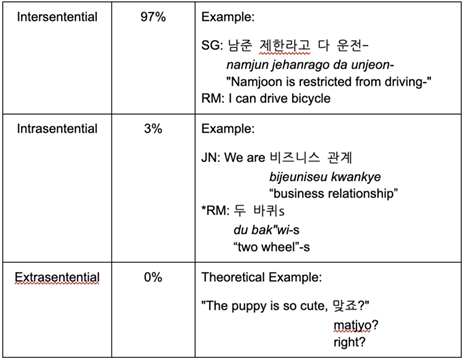
Figure 1: Table illustrating structural types of code-switching and the rate at which they appear in the data. Also included are example sentences from the data, exempting the theoretical example. Additionally of note is the singular instance of a word level/morpheme mix with the Korean NP and English plural morpheme -s

Interestingly, most intersentential examples were the result of turn-taking by the speaker. This points to the conclusion that most code-switching occurred independently and did not involve grammatical combinatorial structures. Typically, code-switching preferentially occurs intrasententially, as Koban (2013) confirmed with English/Turkish bilinguals. However, in this case, perhaps the semi-structured nature of interviews produces a preference for providing “complete” answers resulting in standalone sentence switches. Additionally, intersentential switching may be more accessible as they could have time to prep and foresight into normal interview questions.

In terms of the total lack of extrasentential switching observed, there are two primary possible causes. The first is that this form of switching – most often found in the form of tag questions – likely is more common in contact situations, as well as in situations where the languages occur in a more balanced distribution and particularly productive phrases remain active across both languages, which, due to the language imbalance observed in BTS, is less likely. The second possible cause is the interview format, which is not conducive to the use of tag questions.

We next compared the rate of code-switching that BTS engaged in throughout their career in relation to their album sales and streams. Firstly, we found that BTS’ popularity grew exponentially over the years we studied. We compared their sales over time and the amount of their streams of Spotify over time and both showed a clear increase, as shown in Figure 2.
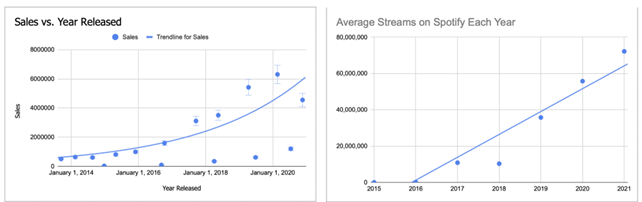
Figure 2: BTS’ record sales over per release as well as their average streams on Spotify per year

This was directly proportional to another criteria we considered that calculated the amount of English utterances the group produced per minute. There was a similar exponential increase with 1.13/min. in their Early era, 1.40/min. in their Mid era, and 2.06/min. in their Recent era, shown in Figure 3. This increase was directly proportional with the impact of their music and, therefore, their brand, strongly suggesting that their use of code-switching is related to their popularity and global exposure.
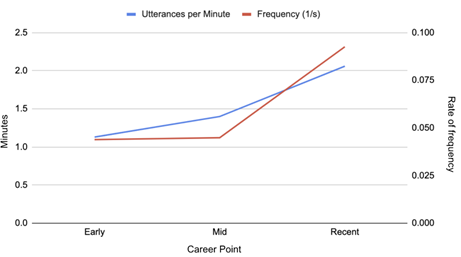
Figure 3: English utterances per minute across the three time periods as well as the frequency 1/s of the code switches across the time periods

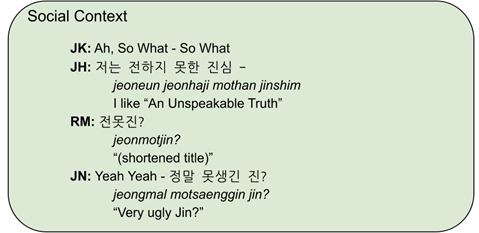
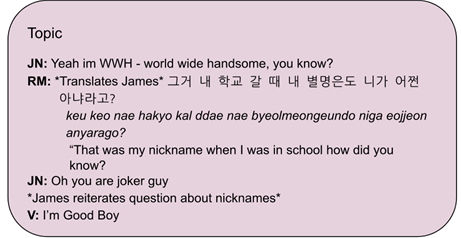
Additionally, we looked at the styles of code-switching that the band engaged in utilizing the framework of situational and metaphoric switching. The data samples found in Figures 4 and 5 are examples of these switches.
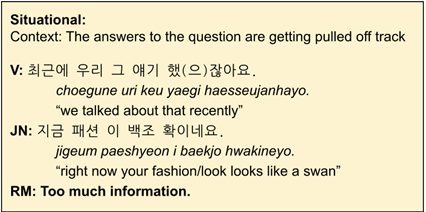
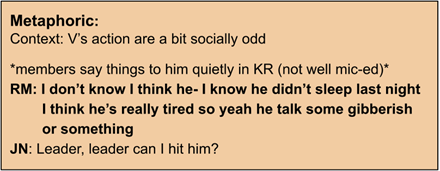
Figure 4: An example of situational code-switching note that RM uses a switch to English to recenter the interview’s social context on the interview and transition to the next question [BTS Answer the Web’s Most Searched Questions: 2:50 – 2:54]
Figure 5: An example of metaphoric code-switching. Note that RM transitions more strongly than in figure (4) in social position from fellow to leader and on-screen translator to repair the socially awkward/non-answer by V, and to create distance between himself and V’s display [BTS Chats to Andy Trieu at SBS PopAsia HQ: 2:52 – 3:08]
Interestingly, the two examples are relatively similar. The defining feature between these two are the stances conveyed. In the situational switch, RM is stopping the Korean conversation to transition the conversation to a new topic and it is directed at the members to refocus them. In comparison, the metaphoric switch conveys both emotional distance from V, as well as a shift in his attention and language goal from being a team-member to the leader, so there is a social position change conveyed as well. Additionally, Jin acknowledges RM’s switch, displaying solidarity by making a joke also in English, targeting V’s “weird behavior.”

In our comparison of situational vs. metaphoric switching over their career, we found that there was a strong preference for situational code-switching, as seen in Figure 6.
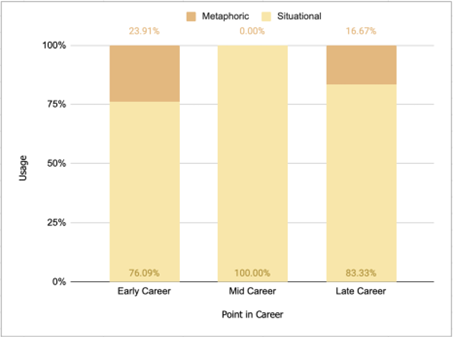
Figure 6: The percentage of use for both metaphoric and situational code-switching in relation to BTS’ early career, mid career, and late career. Interestingly there was no metaphoric switching found in their mid career

Our data shows a general preference for situational switching overall and unexpectedly very little change in metaphoric switching. Metaphoric switching remained consistently low, even dipping to 0% in their mid-career. However, this may be due to the interviews that were analyzed for this period. This was unexpected, however, metaphoric switching is more indicative of a speaker’s internal world, or how they situate themselves in a social interaction, which lends itself to more advanced multilingual speech – this may require a higher English proficiency to be used strategically than many BTS members currently possess. This can be corroborated by the fact that many of the metaphoric switches observed were performed by RM, who is fluent in English, and the most balanced and practiced bilingual of the group.

The final aspect of code-switching that we analyzed was Holmes’ influencing factors, which can be defined as

  1. Participant: motivated by a change in the participants or goal receiver of utterance
  2. Solidarity: signaling shared group membership
  3. Social Context: motivated by a change in the social dimension of conversation
  4. Topic: motivated when a specific topic is more accessible in one language

The data samples found in Figure 7-Figure 10 provide examples of these different influencing factors.
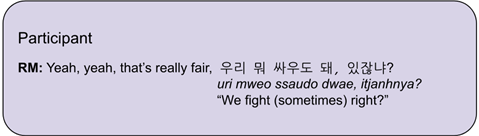
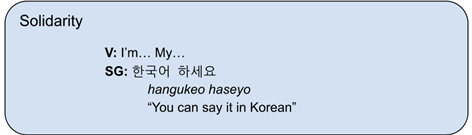
Figure 7: An example in which RM code-switches as the goal receiver of the sentences changes from James Corden to the rest of his members. [BTS Carpool Karaoke: 8:01 – 8:05]
Figure 8: Suga, recognizing V’s struggles, switches to Korean to show solidarity with V as a fellow Korean speaker and member. [BTS Reveal Their Hidden Talents, Impersonate Each Other, and Reveal Their Celebrity Crushes to Andy Trieu: 2:14 – 2:20]
Figure 9: J-Hope switches to Korean to say his favorite song on the album, after joking with the puppies about the title track; it is a reaction to the socially more formal question. Interestingly this triggers the other members to switch to Korean and continue joking. (Jin’s comment is a play on words that sounds like the shortened version of the title RM uses to confirm with J-Hope) [BTS Plays With Puppies While Answering Fan Questions: 1:49 – 1:57]
Figure 10: Unlike the last example in Figure 7, where RM’s translation and subliminal signal that a switch to Korean is fine, the conversation continues in English, as some members have specific nicknames. This is a topic that they are more comfortable discussing in English [BTS Carpool Karaoke: 5:15 – 5:36]
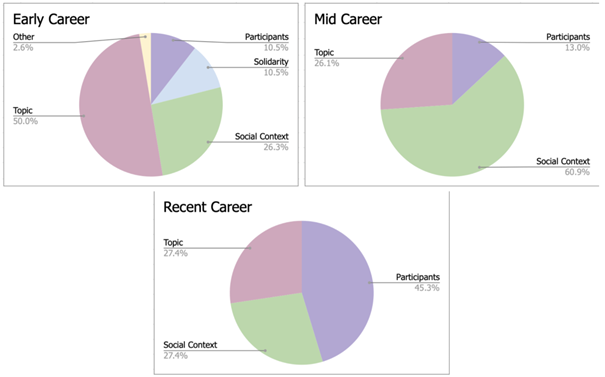
In our analysis of our data, we found that complexity actually decreased somewhat from their early career to their mid/recent career as seen in Figure 11.

Figure 11: Comparisons in the different influencing factors that affected BTS’ code-switching throughout their career

Moreover, the complexity of code-switching exhibited in their mid and recent careers did not show the same distribution of influencing factors – with notable shifts in the prominence of Social Context and Participants. This could be due to the style of interviews, as well as growing sensitivity to interacting with English-speaking interviewers/hosts. However, the decrease in overall complexity from their early career points to a relatively consistent pattern of code-switching in terms of broad contextual influence.

Discussions and Conclusions

In recent years K-Pop has undergone a surge in popularity and groups like BTS have begun to code-switch more to relate with fans. With English being a lingua franca, we analyzed the code-switching between Korean to English from BTS. Some unexpected findings were that metaphorical switching did not increase as they began to grow. Originally, we thought that metaphorical switching would increase, but this was not the case. BTS displayed a preference for situational switching and there was little change in their metaphorical usage. We also believed that their code-switching would grow in complexity as they gained greater exposure to international environments, but this was not the case as per our research. This data is significant because it provided a greater insight into code-switching and how L2 language learners switch more in a certain style than others. It may also demonstrate that outside pressure to use an L2 language – in this case English – may not have as much effect on the actual surfacing of this language in use.

We found that most intersentential examples were member-by-member, which suggested that code-switching in this case was a standalone feature in the languages. We typically have seen new language learners start from intrasentential code-switching. This could be true for some learners, but perhaps intersentential sentences are sometimes simpler in structure and less complex. They are used in isolation, so it is easier to remember, and these types of sentences are used in everyday conversations so they are easier to pick up. So, complex mixing may be less frequent amongst BTS due to this reason, as more complicated structures require more advanced knowledge of the language. Such limited access to L2 can shape a language learner’s usage of metaphoric language as well, since it requires more proficiency in the language. Learners may struggle to use and understand metaphorics efficiently as they cannot comprehend the nuances such as with cultural references or ties. Since BTS is a Korean group, the cultural aspects of code-switching also bring in further struggles when attempting to switch to English, predominantly American English.

In conclusion, the code-switching for BTS was mainly intersentential, as the data demonstrated. There were clear preferences for intersentential code-switching over other types. We believe that this was due to the fact that the group is not very proficient in English. Based on the data that we collected, BTS code-switching has stayed relatively constant throughout the years, further illustrating the fact that they had a preference for the type of switching they use. Generally speaking, groups code-switch with friends and family when they are most comfortable. These groups may also code-switch to impress others or to send a different perception of themselves to a larger audience. Having the group code switch amongst themselves could have helped gain further attraction among fans. Meanwhile, code-switching would have also been used to convey their English skills, as it is an important language to learn in the fields of business and music.

There was an increase in overall code-switching as the group grew in international popularity. This makes sense, as they have to spread to keep up with demand. Due to this, corporations tend to gravitate to these markets where they can capitalize the most. From this standpoint, it makes sense as to why groups like BTS code switch to English rather than another language, or why their prevalence is so large among English-speaking nations and across the world. However, with the rising popularity of K-pop and Korean culture internationally, too, there has been a spike in Korean language and culture studies, so perhaps there will be a lessening of overt pressure to perform multilingualism in the future. Overall, it appears that the usage of English has aided BTS’ popularity; however, it may not be as definitively related to their success in the international music industry as we assumed.

While there were certain limitations to our study, as mentioned previously, in the larger phenomena of linguistics and bilingualism with its relation to code-switching, the data and analysis we had created could be important for future work. Future research could focus on the effects of code-switching on BTS’ audience and their reactions to it rather than how often they code-switch and why, encompassing whether or not the perception of code-switching amongst fans enhances or detracts from their appreciation of the music. On a similar note, we could also analyze the cultural implications of code-switching and how it impacts Korean culture on a global scale. This data can help future researchers better understand code-switching and its impacts on an audience relating to global sales, popularity, and positive outlook.

References

Ahn, H. (2021). English and K-pop: The case of BTS 1. English in East and South Asia, 212-225.

Blom, Jan-Petter, and John Gumperz. (1972). “Social Meaning in Linguistic Structures: Code Switching in Northern Norway.” In: John Gumperz and Del Hymes (eds.): Directions in Sociolinguistics:Sociolinguistics: The Ethnography Communication, 407-434.

Holmes, J. (2013). An Introduction to Sociolinguistics (4th ed.). Routledge. https://doi.org/10.4324/9781315833057

Kirkpatrick, A. (2011). English as an Asian lingua franca and the multilingual model of ELT. Language Teaching, 44(2), 212-224. DOI:10.1017/S0261444810000145

Koban, D. (2013). Intra-sentential and Inter-sentential Code-switching in Turkish-English Bilinguals in New York City, U.S. Procedia – Social and Behavioral Sciences, 70, 1174–1179. doi:10.1016/j.sbspro.2013.01.173

Luthfiyani, F. (2014). Code-switching and Code Mixing on Korean Television Music Show After School Club (thesis). UIN Syarif Hidayatullah Jakarta: Fakultas Adab dan Humaniora, Jakarta.

Nilep, C. (2006). “Code-switching” in Sociocultural Linguistics. Colorado Research in Linguistics, 19. https://doi.org/10.25810/hnq4-jv62

Octaviani, Andita Dyah & Yamin, Haruki Manik Ayu. (2020, July 30). The Rise of English Among K- Pop Idols: Language Varieties in The Immigration. Proceedings of the International University Symposium on Humanities and Arts (INUSHARTS 2019), 117-121. DOI: 10.2991/assehr.k.200729.023

Parc, J., & Kim, Y. (2020). Analyzing the reasons for the global popularity of BTS: A new approach from a business perspective. Journal of International Business and Economy, 21(1), 15-36.

Poplack, S. (1980). Sometimes I’ll start a sentence in Spanish y termino en Español: Toward a typology of CS. Linguistics 18, 581-618.

Shin, S.I. & Kim, L. (2013). Organizing K-Pop: Emergence and Market Making of Large Korean Entertainment Houses, 1980–2010. East Asia 30, 255–272. DOI: 10.1007/s12140-013-9200-0

Yohena, S. O. (2003). Metaphorical code-switching revisited. (Vol. 38, pp. 138–158). essay, Ferris University.

[/expander_maker]
, , ,

Code-switching and Conversation Consistency: How Bilingual Speakers Code-switch to Communicate Effectively

Danbi Jang, Louise Chen, Katherine Escobar, Alena Hong

Bilingual speakers code-switch for conversation consistency. Code-switching is more effective when describing cultural words with only that language and when both speakers are in an argument situation because code-switching increases conversation compatibility. Our research looked at the Kim’s Convenience Season 1 show and analyzed the Korean-Canadian bilingual family code-switching pattern. We analyzed Kim’s family’s conversation and found that intra-sentential code-switching is the most frequent type. Additionally, we realized that the function of each code-switching frequently happens for expressing identity, objectification, interjection, and clarifying repetition. The results showed that bilingual code-switching is necessary and efficient between two bilingual speakers when they intend to create connections with each other or solve problems. As a result, code-switching creates smoother conversations for bilingual speakers so they rather naturally mix two languages than only talking in one.

[expander_maker id=”1″ more=”Read more” less=”Read less”]

Introduction and Background

If you are a bilingual speaker, you must code-switch at least once. Bilingual communities frequently use code-switching. It has become a powerful communication tool for expressing and developing language skills. Code-switching is the process in which a bilingual (or multilingual) person alternates between two (or more) different languages in a bilingual (or multilingual) communication environment. There are several reasons bilinguals do code-switching. According to past research by Stępkowska (2022), bilingual people may demonstrate dissimilar verbal behavior in their two languages. Interlocutors perceive languages differently depending on their language in a given context. Additionally, attitudes toward languages permeate daily life and impact communication patterns within the couple (ibid.). Based on past research, we were curious whether bilingual speakers are more compatible than speakers who do not code-switch. According to another research, code-switching gives “a built-in sensibility that conversational regularities are both content-independent and context-sensitive” (Dumanig et al., 2015). Therefore, our research question is how bilingual speakers code-switch to communicate effectively. We mainly focused on Korean-Canadian bilingual speakers’ families and close friends, as well as investigated how Korean-English bilingual speakers code-switch to communicate effectively in complicated discussion situations and daily life.

Methods

We mainly collected data from the show Kim’s Convenience, season 1. We observed code-switching in bilingual speakers, how frequently they switched, and what purpose and function the code-switch served to communicate with other bilingual speakers in conversations. We attempted to provide transcriptions of specific examples of code-switching. We analyzed the type of code-switching primarily in categories of Inter-sentential, Intra-sentential, and Extra-sentential code-switching. We defined Inter-sentential code-switching as the language switch done at sentence boundaries, like sentences before, in the middle, or after another sentence. In our data, we have mostly seen this type of code-switching in fluent bilingual speakers. Intra-sentential code-switching is done within the sentences, with no pauses or interruptions to indicate a shift. The speakers in the show usually switched this type when they called Korean appellations, or greetings within part of the sentence. Finally, we found extra-sentential code-switching, which is switching a slang or a single word from one language to another (ESEN, 2022). In addition, we defined culturally related words or phrases such as 갈비찜(galbi-jjim) and those expressing feelings and interjections as extra-sentential code-switching.

Furthermore, we investigated the functions and purpose of code-switching and how the speakers resolved their disputes and communicated well based on the context of conversations. We classified the functions of code-switching into four which are interjections, objectification, clarifying repetition, and expressing identity. Then, we focused on examining when the bilingual speakers use code-switching to communicate more effectively in the conversation. Also, we quantified whether the data retrieved from the show conveyed more compatibility and resulted in conflicts resolved by observing any frequent types of code-switching and different functions of code-switching in speech patterns of the show. We hypothesized that code-switching plays a different role in each context, helping promote effective communication.

Results and Analysis

From the data we collected, we observed that code-switching is a highly-efficient communication tool for the Korean-English bilingual Kim’s family. At the same time, there are several talks taking place in between the monolingual speaker and the bilingual speaker. In the same way that code-switching helps bilinguals solve problems more easily and quickly in situations where there might be an argument, misunderstandings tend to last longer and occur more frequently in monolinguals because they cannot do code-switching. For instance, in episode 7 from 18:15-19:13, there is a good example of a monolingual and bilingual argument about Taekwondo and Hapkido that doesn’t go smoothly. Here we include a shortened version of the script.

Mr. Kim:  wah you know 태권도(Taekwondo)?

Customer:  Not really but I’m a big fan.

Mr. Kim:  They have 태권도 (Taekwondo) in Africa?

Customer:  oh yeah! Somalia won silver at the 2003 international open.

Mr.Kim:  wow impressive! You don’t look Somalian.

Customer:  No I’m not. This is just a Taekwondo fact.

Mr. Kim:  태권도(Taekwondo) is Korean.

Customer:  I know.

Mr. Kim:  I am a Korean

Customer:  I know.

Mr. Kim:  합기도(Hapkido) is Korean too!

Customer:  Hapkido?

Mr. Kim:  Yea but the much better fight style! Choi he invited 합기도(Hapkido) while serve in the military in Japan.

Customer:  So.. in a way it could also be considered as Japanese martial art.

Mr.Kim:  No! (angry face) You joking me?

Customer:  no… I just meant… Taekwondo was invented by Korean too?

Mr.Kim:  Of course Korean!

Customer:  I didn’t realize Korean was that strong!

In this case, Mr. Kim and the monolingual customer have a small fight because the customer does not truly know about Taekwondo or Hapkido, but he thinks he does. So, the original topic was to discuss a group of children learning Taekwondo, but due to the misunderstanding, Mr. Kim needs to expand more about Taekwondo and Hapkido knowledge. In a way, it implies that there is a higher chance for monolingual speakers to have misunderstanding or misapprehension thus reducing the consistency of the conversation. When the same situation happens on two bilingual speakers, they don’t need to stop and explain the content of their code-switching. According to Brezjanovic-Shogren (2002), code-switching “establishes a connection between the contributions of the participants thus making the conversation coherent. Considering participants are always “talking about something”, focusing on the “description of the topic” will answer directly what is the topic of the conversation.” This suggests that code-switching helps speakers stay on a certain topic and creates consistency for the conversation. Thus, there is a positive relationship between code-switching and communication.

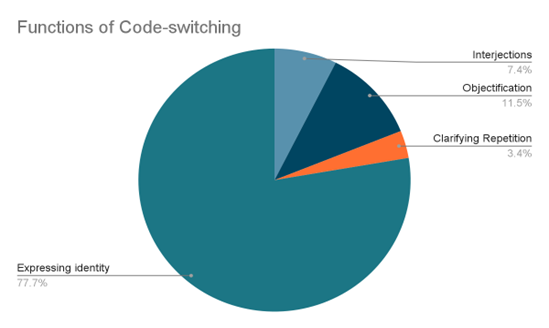
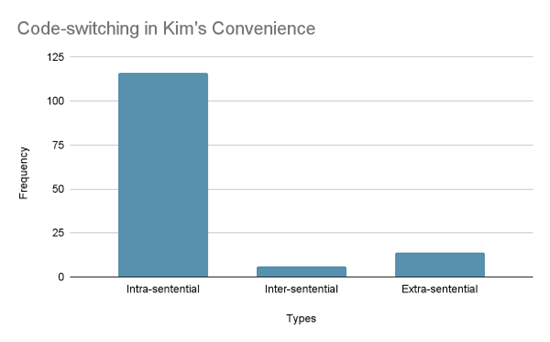
There are three types of code-switching, intra-sentential, inter-sentential, and extra-sentential. To our surprise, intra-sentential is far more numerous than the other two types (See Fig.1). This is because inserting another language phrases or words is more natural and simple than whole sentences. A significant number of these intra-sentential data come from Korean appellations, such as 아빠(Dad), 엄마(Mom), 아줌마(Auntie). The transformation of the titles into Korean reflects the function of code-switching in expressing identity and establishing connection. Prihatin (2018) proves that code-switching occurs to express identity when an individual wishes to express solidarity with a social group. According to the statistics (See Fig.2), this function is the most common one, accounting for 77.7 percent. There are also three other major roles of code-switching, namely, objectification (11.5%), interjection (7.4%), and clarifying repetition (3.4%). Code-switching uses for objectification can quickly help speakers get a more concrete image in their mind about the topic. Because this function is often present on culturally relevant code-switching, it can often be classified as the extra-sentential type. For example, Mr. Kim says Korean 합기도 (Hapkido) instead of English pronunciation Hapkido in episode 7 where the conversation takes place between him and his bilingual daughter, Janet. Because Hapkido is a Korean traditional activity, Mr. Kim wants Janet to quickly recall what 합기도(Hapkido) is and all the information related to it. This is where the advantage of code-switching comes in. Sometimes people code-switch to interrupt someone, this is the function called Interjection, doing so helps get attention or start a new topic. In other cases, code-switching is able to emphasize or reaffirm the topic when the speaker does clarifying repetition (See Appendix).

Fig. 1. Frequency of each type of code-switching in Kim’s Convenience
Season 1


Fig. 2. Percentage of each function of code-switching in Kim’s Convenience, Season 1

Discussion and Conclusions

The findings from our study contributed to our understanding of interpersonal communication, more so how to make communication more effective through the use of code-switching. Our data suggests that code-switching occurs as a way to fulfill a purpose in communication such as expressing identity through the ability to relate to cultural values and strengthen relationship bonds. Additionally, through other functions such as objectification, repetition, and interjections, it improves communication by clearing any misunderstanding for phrases that do not translate well into the dominant language. In a similar field of research, Helena Merschdorf presented a TED Talk about the paradox of intercultural communication. Her studies suggest that there are invisible understandings, where biases from our primary language and culture can cause misunderstandings and misconstrue due to societal norm differences (Merschodorf, 2022). In the case of Kim’s Convenience, we found that code-switching occurred to address these societal differences. As the show was based in Canada, the respectful terms don’t translate with the same cultural significance so characters would code switch in order to express their Korean identity, avoiding an invisible understanding of potential disrespect or disregard for their Korean heritage. For example, in episode 8, the context surrounds a neighborhood pastor for Koreans, though all are welcome. The pastor is very close with the Kims as he is a frequent patron at the convenience store, but because he takes advantage of his important and influential role at the church, he believes he can get away with taking gum without needing to pay anything. The Kims are obviously worried because the continual free gum will begin to add up once rent is due, or Pastor Choi could begin to take something of greater value should he get comfortable not paying. Mrs. Kim did not want to let this continue, so she code switches and says “목사님 (Moksanim) I think we cannot…” (E8, 20:41). The purpose of this code switch was to express their Korean identity by using a formality to show respect to Pastor Choi despite telling him something that he probably would not like to hear. Because the formality does not translate in English, the code-switch in this instance eliminates a misunderstanding of disrespect as Mrs. Kim did not want to let the pastor continue misunderstanding their kindness for generosity.

Originally, our focus was to explore if code-switching would make communication more effective in couples that are in an argument. What we ended up studying was the types of code-switches and the instances in which they occur. By isolating four different purposes for the code-switch, we unveiled that by serving one of those purposes, code-switching was used to prevent miscommunication or to find a way to clarify true meaning despite a language barrier. As Merschodorf (2022) suggested, a way to prevent misunderstandings is to take into account the different linguistic knowledge from other cultures before communicating. By doing so it would prevent any marginalization or discriminatory language. This could be done through “pidgin” languages such as Konglish or Spanglish, where combining two languages that were stripped to the simplest forms, may serve as a means to accommodate both parties in a conversation in a way that keeps all cultural identities intact. Though marginalization can be perceived as a phenomenon usually concerned with targeting an individual’s identity, excluding someone through unfamiliar words and phrases without considering their needs can also be a form of marginalizing. Code-switching can then resolve this issue by allowing speakers to clarify what their true intending may be in an inclusive manner. This could be seen in episode 9 of Kim’s Convenience, where this episode follows interactions between Pastor Nina and Mrs. Kim. Mrs. Kim was dealing with embarrassment over her son’s Jung intimate relations with someone from the church, so when Pastor Nina said she heard something about Mrs. Kim, her mind was worried that there was gossip about how sexually active her son is though Pastor Nina was talking about 갈비찜, the meat dish galbi-jjim (E9, 10:03). Her attempt to code switch was to affirm and create a closer relationship with one of her church regulars, Mrs. Kim, by relating to her culture and being inclusive of the Korean language. Additionally, she asks Mrs. Kim if her pronunciation was correct, showing that she is eliminating an egocentric bias of assuming she was correct, and actively seeks feedback from Mrs. Kim as she recognizes that she is unfamiliar with Korean linguistic culture. Overall, our findings uncover that code-switching in a broader context serves to prevent misunderstandings as a result of a language barrier, through the fulfillment of communication purposes such as expressing identity, objectification, repetition for clarification, and interjections for emphasis. Without such purposes in mind, perhaps code-switching might not have an influence on the quality of communication between speakers as misunderstandings could occur without the clarification and inclusivity that code-switching can elucidate.

References

Brezjanovic-Shogren, J. (2002). ANALYSIS OF CODE-SWITCHING AND CODE-MIXING AMONG BILINGUAL CHILDREN: TWO CASE STUDIES OF SERBIAN-ENGLISH LANGUAGE INTERACTION. Wichita State University, 1-82. https://soar.wichita.edu/bitstream/handle/10057/5051/t11060_Brezjanovic%20Shogren.pdf?sequence=3&isAllowed=y

Choi, I., Kohler, R., White, K., dirs. Kim’s Convenience. 2016; Ottawa, Ont.: Canadian Broadcasting Corporation (CBC). Netflix. https://www.netflix.com/browse?jbv=80199128

Choi, I., Kohler, R., White, K., writers. Kim’s Convenience. Season 1, episode 7, “Hapkido.” Directed by Dawn Wilkinson, featuring Paul Sun-Hyung Lee. Aired November 22, 2016, in Canadian Broadcasting Corporation (CBC). https://www.netflix.com/watch/80236367?trackId=14170289&tctx=2%2C0%2Cb8235341-19ea-4083-9317-21b3f05687f2-7917841%2CNES_EDA12732B35623D7FB1CFDD00F5D6A-B9F225DDE3A711-4A0417714B_p_1679516526251%2C%2C%2C%2C%2C80199128%2CVideo%3A80199128

Choi, I., Kohler, R., White, K., writers. Kim’s Convenience. Season 1, episode 8, “Service.” Directed by James Genn, featuring Paul Sun-Hyung Lee, Jean Yoon, and Hiro Kanagawa. Aired November 29, 2016, in Canadian Broadcasting Corporation (CBC). https://www.netflix.com/watch/80236368?trackId=14170289&tctx=2%2C0%2Cb8235341-19ea-4083-9317-21b3f05687f2-7917841%2CNES_EDA12732B35623D7FB1CFDD00F5D6A-B9F225DDE3A711-4A0417714B_p_1679516526251%2C%2C%2C%2C%2C80199128%2CVideo%3A80199128

Choi, I., White, K., writers. Kim’s Convenience. Season 1, episode 9, “Best Before.” Directed by James Genn, featuring Jean Yoon and Amanda Brugel. Aired December 6, 2016, in Canadian Broadcasting Corporation (CBC). https://www.netflix.com/watch/80236369?trackId=14170289

ESEN, S. (2022). Code switching: Definition, types, and examples – owlcation. Code Switching: Definition, Types, and Examples. https://owlcation.com/humanities/Code-Switching-Definition-Types-and-Examples-of-Code-Switching

Merschodorf, H. (2022, June 17). The Surprising Paradox of Intercultural Communication [Video]. TED. https://www.ted.com/talks/helena_merschdorf_the_surprising_paradox_of_intercultural_communication?utm_campaign=tedspread&utm_medium=referral&utm_source=tedcomshare

Pietikäinen, K.,S. (2014). ELF couples and automatic code-switching. Journal of English as a Lingua Franca, 3(1), 1-26. https://doi.org/10.1515/jelf-2014-000

Prihatin, Y. (2018). CODE SWITCHING USED BY ENGLISH DEPARTMENT STUDENTS OF PANCASAKTI UNIVERSITY ON FACEBOOK. View of code switching used by English department students of Pancasakti University on facebook. https://journal.peradaban.ac.id/index.php/jdpbi/article/view/358/287

Yun, S. (2009). The socializing role of codes and code -switching among Korean children in the U.S (Order No. 3356438). Available from Linguistics and Language Behavior Abstracts (LLBA). (305085390).https://www.proquest.com/dissertations-theses/socializing-role-codes-code-switching-among/docview/305085390/se-2

[/expander_maker]

, , ,

How Do Gender Stereotypes from 1973 Hold Up in Modern Media?

Griffin Gamble, Shayan Karmaly, Rahul Reddy, and Michael Zhan

Our team was interested in looking at some speech features that were found primarily in women’s speech in a famous study by Robin Lakoff in 1973. We wanted to see if Lakoff’s findings were still prevalent in today’s media. In our study, we followed two characters, Robin Scherbatsky and Barney Stinson, in the TV show How I Met Your Mother. When analyzing their various conversations with friends throughout the show, we focused on two of the many speech features that Lakoff initially identified – tag questions and intensifiers. We separated their conversations into two social contexts – single-gender and mixed-gender conversations. We were curious to see if the frequency of the speech features would increase or decrease depending on the type of social situation that Robin and Barney were in. In addition, we were interested in the overall frequency of tag questions and intensifiers in Robin’s speech versus Barney’s speech because, according to Lakoff, these speech features should be more prominent in female speech (1973). We found that Barney had more tag questions and intensifiers per line than Robin, but in single-gender situations, Robin had significantly more intensifiers per line.

[expander_maker id=”1″ more=”Read more” less=”Read less”]

Introduction and Background

Our research hoped to answer the following questions: Are tag questions and intensifiers still predominantly found in women’s speech more than in men’s speech? Does the gender of the speaker’s conversation partners play a role in how often speakers will use tag questions and intensifiers? One of the reasons that we are interested in both these questions and revisiting Lakoff’s findings is that since 1973, there have been many changes to gender norms as well as the ways that people represent themselves. In general, people are a lot more tolerant and accepting of differences, so we predict it could be the case that the gender stereotypes in language have changed as well.

While we initially planned on getting live recordings of UCLA students in different social contexts, we quickly realized that this would be difficult to accomplish within the ten weeks allotted for this study. It would also be placing a large burden on the participant as they would need to record themselves as they went about their already busy day. Because of this difficulty, we shifted gears toward analyzing TV show characters. It ended up working out because one of the research methods that Lakoff (1973) used in her initial study was observing the media, so we decided to do the same with the show How I Met Your Mother.

From left to right: Barney Stinson (Neil Patrick Harris), Robin Scherbatsky (Cobie Smulders), Ted Mosby (Bob Saget), Lily Aldrin (Alyson Hannigan), Marshall Eriksen (Jason Segel)

The show is a rom-com about five friends who live their lives and navigate the social setting of New York. We chose this show because it’s only been eight years since the show finished and the main cast all exhibit male and female gender stereotypes. Specifically, the two characters we followed are Robin and Barney because while they both exhibit typical stereotypes for their gender, they also often portray stereotypical gender norms of the opposite gender.

Methods

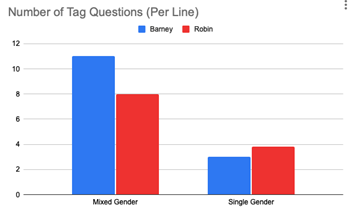
We analyzed six episodes of How I Met Your Mother which totaled two hours of footage and 559 lines from our two characters combined. We specifically picked episodes that Robin and Barney were featured in so they would have more lines and we could collect more data from them. When watching the episodes and reading the transcripts, we noted each time Robin or Barney used either of the two speech features. We wrote down the speech feature that was used, the character that said it, and whether it was a single-gender or mixed-gender situation. For each episode, we created a separate section on our spreadsheet for inputting the data and an area sectioned off for calculating the total counts.

It is important to note that not all tag questions are equal and they may not share the same function to portray the speaker as having less authority or power (Cameron 76). While you can use a tag question as a self-lowering device by giving your interlocutor the floor to respond to your statement, you can also use a tag question as an aggressive tool. For example, “You aren’t all that great, are you?” That said, all the tag questions in our data were of the hedging type. Here is an example from Robin, “If you’re going to be this disgusting, we’re not watching this, okay?”

Robin Scherbatsky (Cobie Smulders), looking shocked

Results/Analysis

So what exactly were our findings? Overall, we analyzed six episodes totaling two hours of footage and our findings were different from what we expected to find based on existing research. In (Seigler & Seigler, 1976, p. 169) and (Kramer, 1977, p. 159) both studies found that gender stereotypes in speech aligned with Lakoff’s theory. Keep in mind, these studies were focused on the perceptions of speech, not what each gender actually says in real life. We expected to find that the speech characteristics that were once associated primarily with women’s speech can now be found equally in both male and female speech, and are no longer strong indicators of the gender of the speaker. This was our hypothesis. Below, I will go into details including visualizations that display what we ended up analyzing.

Our data consisted of two different social contexts for analysis. Specifically, we looked at mixed-gender situations (where there was at least one male and one female in a social setting) and at single-gender situations (where there was only one gender in a social setting). For the purposes of the experiment, the genders will refer to non-trans males and females who identify as the gender that they were born with. Now, let’s look at the data:

Table 1 – Number of Tag Questions

As we can see in Table 1, we examined situations in which Robin and Barney are in mixed-gender and single-gender lines for the purposes of the tag questions. For this, we tried to choose episodes where we thought the two characters would have an equal number of lines in this context and to our convenience, they did for the mixed-gender situations, but NOT for the single-gender ones. So, while Robin and Barney have nearly the same number of total mixed-gender lines, Barney had 31.5% more tag questions. On the other hand, Robin led this category in single-gender situations!

Table 2 – Number of Intensifiers (Per Line)

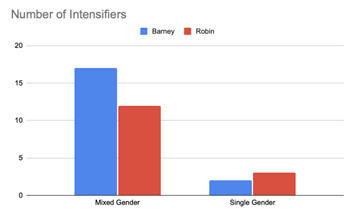
Similarly, when looking at Table 2, we can see that Barney had 34.5% more intensifiers and from the raw data, it would actually seem as if Barney is the winner in both categories, however, when we equalize the data (as shown in the graph), Robin has more intensifiers per line in the single-gender situations. The tricky part of this table is that it shows the analysis per line rather than the total amount. We decided not to go with raw numbers so that it is not confusing to look at the total speaking time, but rather easier to look at the date per line. This average is more precise since it allows us to equalize the data for both Barney and Robin. And if we look more specifically at the single-gender situations, Robin actually has roughly half of Barney’s lines. Overall though, the single-gender data is pretty sparse; therefore, we can conclude that it’s not super conclusive of anything.

Discussion and Conclusions

The conclusion that can be drawn from our analysis and findings is that Lakoff’s speech features that were stereotypically and data-backed as either higher for men or women no longer hold true in modern times. We can see from our data that speech features that were shown in Lakoff’s research as higher for women such as tag questions and intensifiers were actually around the same for Barney and Robin. In some cases, they were even higher for the male focus of the study, Barney. Although we were not able to find much data for single-gender situations, from the evidence that we do have we can conclude that modern-day society has moved into a third-wave sociolinguistics lens that puts much more emphasis on the individual when compared to the past. After taking into consideration the time gap between the gender stereotypes of 1973 and the stereotypes of today in 2022, we can see that our hypothesis did indeed hold true where these outdated assumptions on stereotypical speech features can no longer be linked to a single gender. This makes sense as we now live in a much more gender-fluid and accepting society than in the past where everyone was strictly grouped as masculine and feminine and deviating from the norm was shunned by most. Some high-quality TED talks that reinforce these ideas are “Language around Gender and Identity Evolves” presented by Archie Crowley and “How Language Shapes the Way We Think” presented by Lera Boroditsky. The first TED talk by Archie delves into how language is ever-changing and a powerful tool to allow people to identify themselves and find something that makes them feel comfortable. In the second TED talk, Lera uses scientifically backed data to prove that language does indeed shape the way we think and how we have over 7,000 cognitive universes, each linked with a language as each language gives the user a unique way of viewing the world and is very impactful in shaping the way we view the things around us without us even knowing. Both presentations talk about language being a powerful tool for self-expression and tie into our appeal that language should not be confined to preconceived notions of gender schema as it might have been in the past. Language should be something that brings people closer together instead of a weapon that further alienates people. If there were more time, we would have liked to expand upon our research by analyzing real people instead of just fictional TV characters and comparing the results. We also realize that analyzing real people would mean we would also need to account for external influencing factors such as race, occupation, geographical origin, etc.

While we began looking at how speaker agency can play a role in changing one’s speech through single and mixed-gender situations, it would be valuable in a future study to analyze different types of conversations. For example, an argumentative conversation may have significantly fewer self-lowering tag questions while it might have more intensifiers to help get the point across. Podesva’s (2011) study could be used as inspiration for a framework for how to conduct a study involving participants that move through discrete social contexts.

References

Cameron, D., McAlinden, F., & O’Leary, K. (1988). Lakoff in context: The social and linguistic functions of tag questions. Women in their speech communities, 74, 93.

How language shapes the way we think | Lera Boroditsky. (May 2, 2018). https://www.youtube.com/watch?v=RKK7wGAYP6k

Kramer, C. (1977). Perceptions of Female and Male Speech. Language and Speech, 20(2), 151–161. https://doi.org/10.1177/002383097702000207

Lakoff, R. (1973). Language and Woman’s Place. Language in Society, 2(1), 45–80. http://www.jstor.org/stable/4166707

Language around gender and identity evolves (And always has) | Archie Crowley. (April 16, 2021). https://www.youtube.com/watch?v=XguYZXUChhY

Podesva, R. J. (2011). The California Vowel Shift and Gay Identity. American Speech, 86(1), 32–51. https://doi.org/10.1215/00031283-1277501

Siegler, D. M., & Siegler, R. S. (1976). Stereotypes of Males’ and Females’ Speech. Psychological Reports, 39(1), 167–170. https://doi.org/10.2466/pr0.1976.39.1.167

[/expander_maker]

, , , , ,

The Use of Gendered Language in Interviews of Male and Female Athletes

Julia Offerman, Isabelle Sandback, Samantha Morgan, and Niki Agarwal

Societal viewpoints regarding sports can be partially attributed to gender bias in sports commentating and interviews. This is true even for tennis, which has become very gender-inclusive in terms of media coverage, as well as respect for female athletes. Still, many studies have found biases in language used for male and female tennis players—but have not examined interviews or interview questions. In this study, we analyzed six post-game interviews of mixed doubles tennis players to ascertain if there was a difference in questions directed to female and male tennis players. We observed the proportion of emotional and practical questions directed to each, as well as the proportion of questions regarding the interviewee themself, their partner, or teamwork for each player. We found that the women were asked significantly more emotional questions than their male counterparts, but that both were asked relatively similar percentages of interviewee-partner-teamwork questions. This study has important implications for language, respect, and gender-inclusivity surrounding tennis and women’s sports, as well as interview protocol between men and women interviewees in other fields. These metrics analyzed could be used in these other cases, and ideally, the differences should be mitigated in order to promote equality in interviews.

[expander_maker id=”1″ more=”Read more” less=”Read less”]

Background

Although media coverage of tennis has been more gender-inclusive than other sports, biases are still present in the language used by interviewers when interacting with male versus female tennis players. In our study, we analyzed the post-match interviews of mixed-doubles teams, which consisted of one female player and one male player, to see if word choice and question type display any gendered bias. This allowed us to test the hypothesis that gender-based bias found in broadcasting also extends to in-person interviews with the athletes.

Gendered language in tennis has served as the subject of several studies. Though the definition of gender may be fluid depending on context and background, tennis itself has established a gender line between male and female that we used as our baseline. Previous studies, such as Messner and Jensen (1993), have compared the broadcasts of men’s and women’s tennis matches because they are usually held at the same venue and given equal amounts of coverage.

Articles reporting on the 2015 Australian Open were analyzed for “gender-specific descriptors” in a 2016 study conducted by Adrian Yip (2016). It was found that “stereotypical beliefs about females were largely reinforced in mediated gender representations,” and specifically focused on the disproportional discussion of women’s appearance, mental-weakness, and other stereotypical female traits (Yip, 2016). The 2015 Australian Open media coverage was additionally analyzed by the International Review for the Sociology of Sport, and strong gendered differences in how announcers “created spectacle” and described athletes during the live matches were found (Quayle et al., 2019). Commentators were again analyzed during the 2018 US Open and found that they reported emotionality more frequently with female athletes (Gerbasi, 2019).

Despite the focus on bias in sports media coverage, no studies have looked at how gender bias shows up in press conferences and interviews. Interactions with the players deserve their own focus since reporters are not describing the athletes or offering their own commentary, which therefore makes it more difficult to identify examples of stereotypes or biased language.

Overall, we expect that female athletes will be asked more emotional-coded questions and males will be asked more practical-coded questions. In addition, we hypothesize that women will be asked more questions about their partner than men will be asked about their partner, and that women will be asked more questions about teamwork in general. If we see these differences, we can determine that there may be bias in the question choice when directed towards female and male athletes.

Methods

For our study, we looked at post-match interviews from Grand Slam tennis tournaments and decided to focus exclusively on mixed-doubles teams. Since a mixed-doubles pair includes one female and one male athlete who are both being interviewed about the same match, gender is isolated as a difference between the players; therefore, the differences in the questions posed to each athlete could be indicative of gender biases. We chose to analyze 6 formal interviews of players that were successful (had each won major tournaments before both in individual and doubles events) and well-known within the tennis world. The interviews totaled 71 minutes for analysis. Additionally, we chose to disregard the gender of the interviewers because the questions seemed to be highly scripted and therefore not indicative of the interviewers’ personal biases. After an initial scan, we conducted two waves of analysis: one that marked the subject of the question (i.e. emotional versus practical) and one that marked the referent of the question.

For the first part, we defined “emotional questions” as questions that either are meant to elicit an emotional reaction or ask about the player’s feelings. We looked for keywords or question topics that indicate emotions, specifically focusing on—but not limited to—the following list of keywords and concepts: therapy, emotional wellbeing, “feel,” personal life, emotional reaction to the results of the match, “happy” instead of “satisfied,” support. We used this framework in order to tally and average the number of emotional questions directed towards the female and male athletes.

An example of an emotional question is the following, posed to Serena Williams at the 2019 Wimbledon Tournament:

(1) “You said you had gone to see a therapist after the-dealing with the uh US Open incident, can you just talk about that process-what it did for you and how maybe it has affected you going forward?” – Question to Serena Williams in the Second Round Mixed Doubles Press Conference Wimbledon 2019 (0:16)

This targets both personal life and therapy, making the question emotional. Other times, the lexical choices indicated gender biases—competition related for the male player and emotional/psychological interaction for the female—such as in the following questions:

(2) “Were you surprised at how well you came together, you really seemed to have excellent chemistry this week?” – Question to Martina Hingis in the Mixed Doubles Finals Press Conference Australian Open 2015 (5:55)

(3) “How is the mixed doubles helping mentally and physically your, you know, your ambition to get back to singles?” – Question to Andy Murray in the Mixed Doubles Second Round Press Conference Wimbledon 2019 (6:38)

(4) “How did it feel to hit so many return winners against Martin?” – Question to Serena in the Second Round Mixed Doubles Press Conference Wimbledon 2019 (9:17)

In the second round of analysis, we tracked each question’s referent by sorting them into three possible categories: questions referring to the interviewee, questions referring to the interviewee’s partner, and questions referring to teamwork. We marked questions as referring to the interviewee when they asked about the player’s personal life, mental health, individual match play, opinions on larger news stories, etc., such as in the following question:

(5) “Andy, on TV you said that uh once Wimbledon finishes, hopefully on Sunday, you’re gonna practice a bit more singles? Does that mean you’ve made your decision about if you’ll go to the US Open or you will try the US swing as a singles player?” – Question to Andy Murray in the Second Round Mixed Doubles Press Conference Wimbledon 2019 (0:48)

Questions were marked as referring to the interviewee’s partner when players were asked about the other’s personality, habits, or style of play, such as in this example:

(6) “What is it about playing with Jamie that is so good for you?” – Question to Bethany Mattek-Sands in the Mixed Doubles Final Post-Match Interview US Open 2019 (2:29)

Finally, questions were marked as referring to teamwork when players were specifically asked about their partnership or future plans to play together. For instance:

(7) “You said on court that you only sort of teamed up again in the last couple weeks, was there ever a chance that you weren’t going to play together?” – Question to Neal Skupski in the Mixed Doubles Final Press Conference Wimbledon 2022 (11:42)

We conducted a paired t-test for each set of averages in order to determine the statistical significance of our results.

Results

On average, male tennis players were asked 58.33% of questions and females 41.67%, which was not significantly different (p-value=0.16).

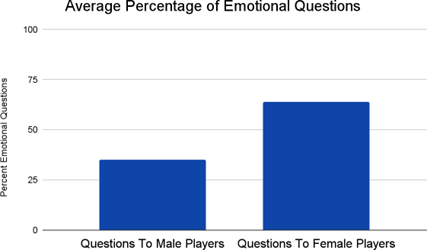
Of the questions asked to the male partner, 35.83% were emotional-based and 64.33% to the female partner. This gives a two-tailed p-value of 0.006, which is very significant. Out of the total emotional questions, the female partner was asked 64.5% of the questions on average, with a p-value of 0.04, also significant.

Figure 1: The average percentage of questions that are emotional-based asked to the male and female tennis players; the percentage is the number of emotional questions divided by total questions asked to each partner.

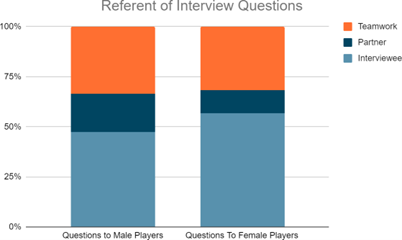
Of the questions asked to the male, 51.4% referred to themselves, 17.7% referred to their partner, and 30.9% referred to teamwork. Of the questions asked to the female, 54.6% referred to themselves, 14.8% referred to their partner, and 30.6% referred to teamwork. The p-value between these two groups is over 0.9, indicating that there is no significant difference between the questions for male and female tennis players regarding if the question is about themselves, their partner, or teamwork.

Figure 2: The average percentage of questions asked about the interviewee, partner, and teamwork to each gender. The averages are comparable for each group; the percentages are taken out of total questions asked.

Discussion

Overall, the study indicated that there were some significant differences in the questions directed at male and female tennis players, but certain aspects were more likely to be gender specific than others. Based on the data, we can accept our hypothesis that female tennis players tend to be asked more emotion-based questions than male tennis players on average. We cannot, however, accept our hypothesis that female tennis players are asked more questions about their partner than male tennis players are, as the proportions are similar. This could indicate that emotional versus practical questions could be a metric for examining gender bias in sports interviews, but interviewee-centered versus partner-centered versus teamwork-centered may not be—at least, for mixed doubles tennis.

This has several implications not only for current perceptions of men’s and women’s sports, but for future actions that should be taken in order to mitigate gender bias in sports interviews. Based on the current understanding, interviewers direct more emotional questions towards female tennis players, which can undermine their competitive and athletic ability. If equal respect is going to be given to male and female athletes, the proportion of emotional and practical questions should be comparable for both genders—and this must be done deliberately. Though emotional aspects can be relevant in an interview or discussion with athletes, the priority should likely be the competitive aspects to establish any athlete’s prowess as paramount. “Gender Inequality in Sports: Women Face a Double Bind” from the publication The Hilltop Monitor, talks about a running hashtag back in 2015 called “#CoverTheAthlete.” This hashtag was created in order for people to highlight how male and female athletes were interviewed online and in the news, or, more importantly, how females were asked questions not related to their skill or game, but ones about personal life, looks, emotions, and how they felt about the male-side of sports. The author’s hypothesis was to see if there was a link between these interview differences and female athletes’ pay. Women are paid incredibly lower versions of their male-counterparts’ salaries. “The Women’s National Basketball Association (WNBA) had a 2018 salary cap of $110,000 while the National Basketball Association (NBA) minimum salary was $582,186” (Porth 2019). The blog argues that gendered language and lower pay go hand in hand; if female athletes are going to be interviewed like their games do not matter, then their games will matter less to people, resulting in less revenue. Does the request “can you give us a twirl” sound like what an interviewer would ask to a serious, skilled player? It might be why women’s sports are seen as less serious than men’s.

Furthermore, tennis is a sport in which female athletes are seen as relatively equivalent to their male counterparts when compared to athletes in other sports. This suggests that the disparity could be even greater in other sports, underscoring a need for studies such as these to explore the way gender bias presents itself. The emotional and practical question metric could be applicable in these cases as well, and the necessity for similarity in questions directed to athletes of different genders in order to promote equal respect is key. Further differences in interview questions between men and women may be present in other industries and fields, which is another area for future development.

In order to truly determine if gender biases were present in these interviews, we specifically needed to limit the scope of this study to focus on quantifiable and qualifiable differences in the questions asked to male and female athletes. However, each athlete has multiple other aspects of their identities that could affect how they are perceived, such as race and age. There are intersections between said identities that may play an additional role in the choice of questions directed to them. Broadening the extent of this study could help account for some of these intersections. In addition, a longer study with more interviews would be ideal in order to further solidify the relationships noted.

There are efforts that can be made to help reduce the biases held regarding women’s sports in general, which can be considered a possible cause of the difference in questions posed in interviews. The International Women’s Day campaign offers a few ways that individuals can combat biases in women’s sports. Encouraging young women and girls and supporting them in sports can help instill equitable perceptions at a young age. Additionally, closing the gender gap in sports salaries will improve the legitimacy of women in the field. One of the easiest ways anybody can make a difference is simply supporting professional sports in any way, from attending a game to buying merchandise (“Support female athletes”). Supporting women and being aware of the stereotypes reflected in their sports interviews will contribute to the effort in improving gender inequities. This study, among many others, has revealed evidence of gender biases and awareness of this prejudice can allow for progress towards eliminating it.

References

AK. (2016, June 4). Martina Hingis and Leander Paes seal career grand slams at French Open. https://www.youtube.com/watch?v=D8Fh-fF8Zek

Australian Open TV. (2015, February 1). Martina Hingis and Leander Paes press conference—Australian Open 2015. https://www.youtube.com/watch?v=cAPoYiZHzeU

Cooky, & Messner, M. A. (2018). No slam dunk: gender, sport and the unevenness of social change / Cheryl Cooky and Michael A. Messner. Rutgers University Press. https://muse.jhu.edu/chapter/2124054

Gerbasi, A. (2019). Game, Set, and Match: A Content Analysis on the Commentating of Tennis Broadcasters for the 2018 US Open Championship Weekend. [Master’s thesis, East Tennessee State University]. ProQuest, https://dc.etsu.edu/etd/3575

Messner, Duncan, M. C., & Jensen, K. (1993). Separating the Men from the Girls: The Gendered Language of Televised Sports. Gender & Society, 7(1), 121–137. https://doi.org/10.1177/089124393007001007

Porth, M. C. (2019). Gender Inequality in Sports: Women face a double bind – The Hilltop Monitor. Retrieved December 8, 2022, from https://hilltopmonitor.jewell.edu/gender-inequality-in-sports-the-double-bind-women-face/

Quayle, M., Wurm, A., Barnes, H., Barr, T., Beal, E., Fallon, M., Flynn, R., McGrath, D., McKenna, R., Mernagh, D., Pilch, M., Ryan, E., Wall, P., Walsh, S., & Wei, R. (2019). Stereotyping by omission and commission: Creating distinctive gendered spectacles in the televised coverage of the 2015 Australian Open men’s and women’s tennis singles semi-finals and finals. International Review for the Sociology of Sport, 54(1), 3–21. https://doi.org/10.1177/1012690217701889

Support female athletes worldwide and help #breakthebias in women’s Sport. International Women’s Day. Retrieved December 7, 2022, from https://www.internationalwomensday.com/Missions/17255/Support-female-athletes-worldwide-and-help-BreakTheBias-in-women-s-sport

US Open Tennis Championships. (2019, September 7). Mixed Doubles Final—Ceremony and Post Game Interview | US Open 2019. https://www.youtube.com/watch?v=QMDNRmO1cyY

Wimbledon. (2019a, July 9). Andy Murray & Serena Williams Second Round Mixed Doubles Press Conference Wimbledon 2019. https://www.youtube.com/watch?v=cqckd0HxyWY

Wimbledon. (2019b, July 10). Andy Murray & Serena Williams Third Round Press Conference Wimbledon 2019. https://www.youtube.com/watch?v=o_AD9GhiFNA

Wimbledon. (2022, July 8). Neal Skupski and Desirae Krawczyk Final Press Conference | Wimbledon 2022. https://www.youtube.com/watch?v=DamI3-8RWjU

Yip, A. (2018). Deuce or advantage? Examining gender bias in online coverage of professional tennis. International Review for the Sociology of Sport, 53(5), 517–532. https://doi.org/10.1177/1012690216671020

[/expander_maker]

, , , ,
Scroll to Top