cultural identity

Friendships For the Mono- and Bi-Lingual College Student: Does The Language You Speak Make A Difference in How You Make Friends?

In the course of our research, we endeavored to examine the difference in the social life of UCLA college students, their capacity to make friends, and satisfy their need for social support with fellow students based on their status as a monolingual or bilingual speaker of English. Drawing on support from previous research dealing with different student populations, we concluded that the way bilingual students are treated and form communities is different from the way monolinguals do, whether because of “othering” by speakers who did not understand their language or culture or because they sought out connections with those who shared their ethnic or linguistic ties. It was almost universal in our interviews where bilingual speakers had a bias towards others who spoke their non-English language, and many of the monolinguals admitted to preferring the company of those who shared their language and culture. Not every speaker who our team interviewed had an exactly identical experience, however- none of our bilingual speakers derived from the same culture or spoke the same language- and there were a few interesting perspectives and outliers.

[expander_maker id=”1″ more=”Read more” less=”Read less”]

Introduction

In the course of their education, every single college student is faced with the point where they realize that they are now, effectively, adults and they are now- potentially for the first time- on their own. Many freshmen entering into university are inbound to a new city, a new county, new state, or even an entirely new country. The locale, culture, and people are all different than where they are originally from.

This gap in culture (and sometimes even language) and the responsibilities endowed by college life can make it difficult to make friends in a new place– but it is also extremely pivotal for mental and social well being to make social connections, given the loneliness of being far from home and isolation from the people one knows.

Researching into how students- particularly bilingual students- construct their new friendships is invaluable for anyone incoming to university. Using UCLA students as a representative example, we can explore some of the insights of students navigating their new social landscape. Most specifically, we want to see how- and if- monolinguals and bilinguals differ when it comes to trying to form friendships, and why.

Methods

We began our research on how bilinguals and monolinguals in college differ in making friends and their differing level of social satisfaction in the college environment by consulting various published literature on the subject, but intended to do our own interviews and surveys to see if anecdotal evidence matched the broader scientific findings. Across many different papers- from bilingual college students of Chinese or Latinx descent all the way to the bias of young monolinguals from 4 to 6 years of age- we found a fairly consistent trend: bilinguals liked grouping with other bilinguals (specifically ones of their own culture and language) and monolinguals tended a slight cognitive bias (conscious or otherwise) towards other grouping with monolinguals.

When we had seen the literature’s assessment of college friendships by bilinguals, we formed our hypothesis about the difference: that bilinguals tended to find it easier to make friends with bilinguals from their culture and that monolinguals tended either to “not care” or stick with monolinguals. We also sought out whether being bilingual was particularly helpful in making social connections compared to monolinguals, and other potential social benefits of bilingualism in a predominantly English-controlled American college environment. With our research question and secondary and tertiary objectives in mind, we put our theories and the broader literature to the test through qualitative and quantitative surveys and interviews.

Results

The results of the interviews with bilinguals were quite illustrative in relation to social connections through their first language. Using direct quotes from interviews, many of the answers were quite straightforward:

INTERVIEW 1 – BILINGUAL

I: Did you find it easier to connect and meet people who spoke the same language as you?

J: Yes, most definitely. Uhm, I really liked connecting with people who also spoke Vietnamese because there were a lot of like, you know, Vietnamese language jokes that only Vietnamese people would get.

INTERVIEW 2 – BILINGUAL

I: Have you found it easier to connect with people who speak the same language as you?

S: […] Definitely, yeah. It’s much easier. I mean, it really depends on the person. I wouldn’t say, “Oh, I’m going to go and make friends with whoever speaks Farsi”, because some people, it depends on how approachable they are or if I vibe with them. But in terms of, uh, having one thing to connect. Yes, I would say it’s much easier for me to connect to someone who speaks the same language versus non-Farsi.

INTERVIEW 3 – BILINGUAL

I: Do you find it easier to connect with people who speak the same language(s) as you?

E: Definitely, I feel like it’s easier if I can also speak your language and understand what I’m saying.

Very consistently across bilingual speakers that we interviewed, sharing a language and culture was essential for forming social ties. They expressed feeling at ease with people who spoke their own language, or how being among a bilingual speaker enhanced their experience more than it would be otherwise.

INTERVIEW 1 – MONOLINGUAL

I: Do you think language or culture has any bearing on who you choose to interact with in your day to day life?

A: Uhm, I definitely would say so… it’s easier for me to talk to or be around someone who has the same language and culture as me.

INTERVIEW 2 – MONOLINGUAL

I: Do you think language or culture has any bearing on who you choose to interact with in your day to day life?

J: […] It kinda sounds like an asshole thing to say– but I think that I’m accepting of a lot of different cultures and stuff– I think there are some subconscious elements, but I wouldn’t know what they were, there are probably some groups I don’t interact with just off of, I don’t know, vibes…

Monolinguals, in their parallel questions to the bilingual speakers, hedged a little when answering but definitely seemed to be likewise confident that they preferred to stay within their own clade of language and culture.

When it came to the respective groups, bilinguals occasionally went out of their way to specifically connect with their own cultures (the interviewee of Interview 1 professed to specifically looking for Southeast Asian clubs on campus in order to connect with others and make friends) but monolinguals had no such compunctions (no one we interviewed was, for instance, attending an “Born American Student” or “Monolingual English” club, nor did such a thing exist). When it came to making friendships, typically they went for shared hobbies unrelated to culture (in one case, gaming clubs).

This is not a zero sum game, however– in many cases, bilinguals at UCLA had the added benefit of being able to draw on their extra language in addition to monolingual strategies, meaning their opportunities for friendships were more diverse than the monolingual opportunities. Though the potential for exclusion from these more monolingual-oriented experiences is possible, rejection by monolingual speakers for language or culture was rare, if existent at all.

Many of the monolinguals we interviewed wished they had the opportunity to learn other languages and be fluent in them, viewing their English exclusion as a missed opportunity; only one subject of interview wanted to remain a monolingual, though when pressed admitted he would like to learn American Sign Language (and advocated that the rest of the US did, as well) and wasn’t sure if that counted as being multilingual. Broadly speaking in our interviews, bilinguals were happy to provide a social bridge for monolingual to monolingual interactions and delighted to get the chance to share their culture or language with others. No one regretted being bilingual or thought it made their social opportunities at UCLA worse.

Conclusion

A primary finding that stood out in our research was the absence of in-group/out-group biases within both groups. Instead, we found that linguistic diversity among the population created opportunities for cultural exchange and that in-group preferences did not completely discourage students from reaching out to other cultures. Our results revealed that bilingual students expressed stronger social ties to their cultural communities compared to their monolingual counterparts who conversely expressed a strong desire for second-language acquisition.

These findings led us to conclude that: (1) linguistic diversity can foster a positive school environment by providing opportunities for cultural exchange among different cultures, (2) in-group/out-group biases do not pose negative effects on social relationships among bilingual and monolingual students, (3) bilingualism and second-language acquisition can potentially enhance the social experience of students.

However, these findings are limited by several factors within our study. Firstly, our population of study is representative of a unique environment with a relatively higher proportion of politically liberal, ethnically diverse students than the average American university. Our research is also limited to the study of English-speaking students, restricting our data from being representative of environments with speakers of different dominant languages. Given these limitations, we believe that linguistic diversity thrives most successfully in diverse environments wherein cultural exchange is a social norm and speakers are collectively open-minded to learning

We believe that our findings contribute to a deeper understanding of the importance of second-language acquisition in childhood development to enhance social connections in adulthood and potential positive effects of bilingualism in combating cultural differences in diverse settings. Furthermore, these findings highlight the importance of language knowledge of one’s own culture in strengthening community ties and individual identity. We believe that future research in bilingual and monolingual differences should focus on studying the potential positive effects of second-language acquisition on social skills, educational development, and in overcoming cultural differences.

References

Byers‐Heinlein, K., Behrend, D. A., Said, L. M., Girgis, H., & Poulin‐Dubois, D. (2016). Monolingual and bilingual children’s social preferences for monolingual and bilingual speakers. Developmental Science, 20(4). https://doi.org/10.1111/desc.12392

Toppelberg, C. O., & Collins, B. A. (2010). Language, culture, and adaptation in immigrant children. Child and adolescent psychiatric clinics of North America, 19(4), 697–717. https://doi.org/10.1016/j.chc.2010.07.003

Wang, L., Gonzalez, P. D., Lau, P. L., Vaughan, E. L., & Costa, M. F. (2023). “Dando gracias”: Gratitude, social connectedness, and subjective happiness among bilingual Latinx college students. Journal of Latinx Psychology, 11(3), 203-219. https://doi.org/10.1037/lat0000227

Sebanc, A. M., Hernandez, M. D., & Alvarado, M. (2009). Understanding, Connection, and Identification: Friendship Features of Bilingual Spanish-English Speaking Undergraduates. Journal of Adolescent Research, 24(2), 194-217. https://doi.org/10.1177/0743558408329953

Xu, C. L. (2022). Portraying the ‘Chinese international students’: a review of English-language and Chinese-language literature on Chinese international students (2015–2020). Asia Pacific Education Review, 23(1), 151–167. https://doi.org/10.1007/s12564-021-09731-8

[/expander_maker]
, , , , ,

Cultural Identity Maintained Through Code-switching among Immigrant Generations in a Dominant English Country

The United States is often hailed as a country of immigrants, but in reality there are complex social and cultural factors which play a role in the U.S. immigrant experience, one of the greatest being language. While the U.S. has no official language, English is the predominant means of communication, and plays a large role in multi-generational communications of immigrant communities. Our research seeks to answer: how does code-switching between English and native languages influence identity formation and social interactions among different generations within immigrant communities? Through participant observation and interviews at Los Angeles Latino and Chinese American church communities, we found that first-generation immigrants code-switch more often in work and public environments, whereas second-generation immigrants code-switch for the sake of multi-generation communication. Overall, we demonstrate that through code-switching, immigrant families and subsequent generations struggle to balance assimilation into American culture and the ability to preserve their cultural identity.

[expander_maker id=”1″ more=”Read more” less=”Read less”]

Introduction and Background

According to Pew Research (2020), “more than 1 million immigrants arrive in the U.S. each year.” With the arrival of various ethnic groups to the United States, and integrating themselves into American culture, new cultural exchanges emerge. Nevertheless, discrimination against migrants persists, hindering their integration and sense of belonging. Consequently, migrants often assimilate into the dominant hegemonic groups’ culture – rejecting their own.

Because of the ongoing presence of discrimination, it is crucial to understand the impact of dominant ideologies on both first-generation migrant communities and subsequent generations.

Language plays a key role in identity formation, with immigrants often teaching their children their native languages to maintain cultural ties. However, pressures to adapt to the dominant culture often lead parents to prioritize English as a first language. So how does learning your native language influence your identity and that of your children amidst a society that prioritizes English as the official language? Multiple studies have focused on code-switching as a form of expressing cultural identity (Bosire 2006). According to Myers-Scotton (1993), code-switching is defined as the mixing of different codes (or languages) by speakers in the same conversation (video explanation on code-switching). Moreover, scholars have also highlighted code-switching as a form of learning (Kremin et al. 2022) and socializing (Wei 1995; Lee 2019). Yet, Rangel et al. (2015) have critically emphasized the amount of stigmatization code-switching continues to receive. For this reason, our research focused on code-switching among immigrant communities in the United States, particularly focusing on the contrasts and similarities between first-generation and subsequent generations of immigrants. This study contributes to the wider discussion of code-switching as we explain from a sociolinguistic perspective how migrants and subsequent generations express their identity in a country where non-standard languages are viewed as inferior to standard English. Through qualitative methods, this research answers the following questions: how does code-switching between English and native languages influence identity formation and social interactions among different generations within immigrant communities? Our findings show that through code-switching, immigrant families and subsequent generations struggle to balance assimilation into American culture and the ability to preserve their cultural identity.

Methods

We collected data from two different churches in the Los Angeles area, with participants from Chinese and Latino/a descent communities. We used both participant-observation and semi-structured interview methods. The former was to note how speakers interacted in public spaces, specifically those that are similar in purpose. The latter was to hear the opinions of our participants about their language use.

Our observations took place in group settings, during which we took notes on verbal and non-verbal interactions between three groups: first-generation, second-generation, and a mixed group of both. We chose to limit the time of our observations to 15-25 minutes (due to assignment and situational constraints). In interviews, we spoke to two first-generation parents from each ethnic demographic (Latino or Chinese), ranging from middle-aged to older adults, and with one of each of their (second-generation) children, ranging from young to regular adults.

After data collection, we first compared answers within the most specific group, for example, responses from first-generation Latinos or from second-generation Chinese Americans. Then, we compared the data between generations within the same immigrant group (e.g. responses from Latinos), and the same generation between immigrant groups (e.g. second-generation responses). These were chosen as the methods for analysis because they forced us to consider all possible nuances between the various groups and once we had data for a set of the smaller groups (same generation & ethnicity) we could accurately compare the data for the larger groups (ethnic vs generational).

Results

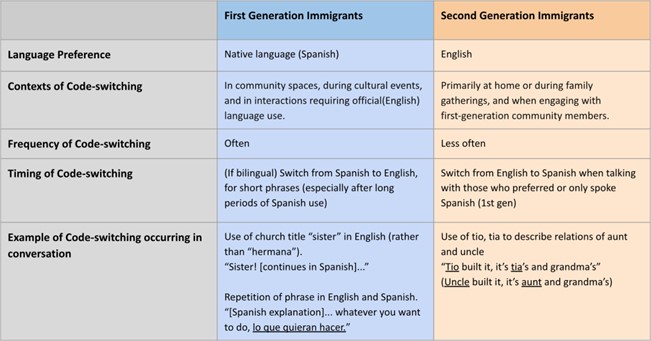
Figure 1: Comparing code-switching experiences between first-generation immigrants and second-generation immigrants

The table illustrates the comparison between first-generation immigrants and second-generation immigrants. We observed various factors of code-switching between both generations and discovered that there is a major difference in the context of code-switching. First-gen has been found to code-switch more often and will code-switch in the context of their root community’s events or situations that require using English. On the other hand, second-gen has been found to code-switch less in general. Code-switching behavior only occurs when they are speaking to people whose first choice of language is Spanish or native Spanish speakers.

Discussion and Conclusions

In conclusion, our findings touch on the importance of language use and perspectives from the first and second generations, particularly with an emphasis on the role played by code-switching among the groups. This research seeks to delve into the effect that code-switching brings in the process of identity formation and socialization of immigrant families and the generations. Therefore, it looks deeper into individual experiences and perspectives to understand the complex position this language takes in this domain. However, language behaviors observed among first and second-generation immigrants more than confirm that code-switching is the most effective tool through which to fully understand the subtleties of bilingualism and acculturation.

First-generation immigrants are struggling to learn and use English in respect to their native languages, and this shows a conscious choice to balance between assimilation and retention of culture. This has been seen in situations where some people never saw English as very important compared to their mother tongue; and that has also seemed to be the area of difficulty in integration, but to them, it’s an area of great importance. For code-switching of second-generation immigrants, it shows some ways that language influences identity and integration with society. These show movement away from an identification with American culture and toward the linguistic assimilation of their parent-native languages. Others maintain strong ties to their cultural heritage by being bilingual. They illustrate perfectly how family and personal language attitudes condition one’s approach to code-switching as a means of bicultural identity navigation. This approach further infiltrates the appreciation of code-switching as a changing and context-bound practice that reflects the challenges and opportunities presented to immigrant communities in maintaining their linguistic heritage in another environment. In this dimension, it calls for comprehensive recognition of multifarious language roles within the experience of migration. We also must observe the aspect of functionality and symbolism, and ultimately, consider the wider implications for the number of cultural identity, social integration, and intergenerational shifts.

While the researchers question the negative stamp of code-switching and non-standard language use, rather, it encourages a broader acceptance of bilingualism, or on a higher level, even of multilingualism, that respects the differences in the use of languages. This work was undertaken in order to remove the stigma from practicing code-switching, keeping in view the positive aspects of bilingualism, which pertains to strengthened cultural ties and increased flexibility of personalities. Overall, our research offers new and interesting data, bringing relevant insights and contributions to research in sociolinguistics on code-switching among immigrants. Through empirical evidence we have shown how practices of identity, cultural preservation, and adaptation intertwine with language practices. This highlights how complex the nature of language used among immigrant communities is and does provide a window into socio-cultural forces which are at play on code-switching and bilingualism. This serves to open further investigations into the complexity of the relations between language, identity, and community in diverse sociolinguistic contexts.

References

Bosire, M. (2006). Immigrant Identity: Code Switching among Kenyans in Upstate New York. In Selected Proceedings of the 35th Annual Conference on African Linguistics, ed. John Mugane et al., 44-52. Somerville, MA: Cascadilla Proceedings Project.

Budiman, A. (2020, August 20). Key findings about U.S. immigrants. Pew Research Center. https://www.pewresearch.org/short-reads/2020/08/20/key-findings-about-u-s-immigrants/.

Cher. L. L., (2019). Filling gaps or code choice? Code-switching across generations in colloquial Singapore Mandarin. Global Chinese 2019; 5(1): 1–24. https://doi.org/10.1515/glochi-2019-0001

Kremin, L. V., Alves, J., Orena, A. J., Polka, L., & Byers-Heinlein, K. (2022). Code-switching in parents’ everyday speech to bilingual infants. Journal of Child Language, 49(4), 714–740. doi:10.1017/S0305000921000118

Rangel, Natalie., Loureiro-Rodriguez, Veronica., & Moyona, Maria Irene. (2015). “Is that what I sound like when I speak?”: Attitudes towards Spanish, English, and code-switching in two Texas border towns. Spanish in Context, 12(2), 177-198. https://doi.org/10.1075/sic.12.2.01ran

Wei, Li. (1995). Code‐switching, preference marking and politeness in bilingual cross‐generational talk: Examples from a Chinese community in Britain. Journal of Multilingual and Multicultural Development,16(3), 197-214, https://doi.org/10.1080/01434632.1995.9994600

 [/expander_maker]
, , , , ,

The Persian Identity Crisis

This study delves into the intricate relationship between language practices and the construction of individuals’ sense of belonging and cultural identity, with a specific focus on the Persian language, also known as Farsi. For second-generation Iranians residing in Los Angeles, this linguistic journey takes on a multifaceted nature, as they navigate a complex interplay between Farsi and English. This often leads to the adoption of code-switching, a phenomenon where individuals seamlessly alternate between the two languages, colloquially referred to as ‘Finglish’ or ‘Pinglish.’ Through interviews and observations within Iranian diaspora communities, this research aims to answer the following question: “Have Persians lost their self-identity and how is this reflected in language use? Our results would shed light on explaining how language proficiency, cultural adaptation, and social dynamics intertwine to shape the nuanced ways in which code-switching serves as a mechanism for negotiating and expressing multiple cultural identities, thus shedding light on its implications for Persian identity.

[expander_maker id=”1″ more=”Read more” less=”Read less”]

Introduction

The complex relationship between language practices and the construction of individual identity within diaspora communities is an interesting area to study, particularly in the context of second-generation Iranians residing in Los Angeles. Our project focuses on the Persian language, also known as Farsi, and its role in shaping cultural identity among the demographic. In the hugely diverse and multicultural landscape of Los Angeles, navigating between Farsi and English becomes a complex journey, often manifesting in code-switching or more commonly known as “Finglish”. Through a mix of interviews and observations within the Iranian diaspora, it begs the question: Have Persians lost their identity? Furthermore, what language traditions have changed to reflect that language might be a casualty of this identity crisis? Does a change need to happen to regain a sense of identity within the Fasi-speaking communities? By unraveling the complexities of language proficiency, cultural adaptation, and social dynamics, we seek to illuminate how code-switching serves as a mechanism for negotiating and expressing multiple cultural identities, thereby offering insights into the implications for Persian identity in diaspora settings.

Background

When we examine Iran’s rich history, it becomes evident that Iranians possess a heritage steeped in antiquity, vastly different from the modern Iran that it is today. This historical depth is intricately interwoven with the Persian language, serving as a tangible reflection of Iran’s multifaceted evolution. Among some Iranians, regardless of their location, Persian is revered as a cultural benchmark, embodying resilience and continuity across generations. However, the accessibility of resources pivotal for preserving and nurturing Persian proficiency varies among Iranian Americans. While some benefit from cultural events, media outlets, and language courses, others encounter barriers that impede their linguistic immersion and connection to their community.

Thus, many Iranian Americans resort to “code-switching,” a practice where an individual uses two or more language varieties in the same speech event or exchange, as defined by Woolard (2004). Within the diaspora, instances of code-switching manifest in colloquial phrases such as “is so zesht” to denote something ugly or rude, or expressions like “Kheili cute-eh,” signifying endearment. However, code-switching often elicits skepticism within the diaspora, particularly among native speakers. They perceive it as a departure from correct language usage, thereby exacerbating a disconnect between generations and contributing to the evolving linguistic landscape of Persian.

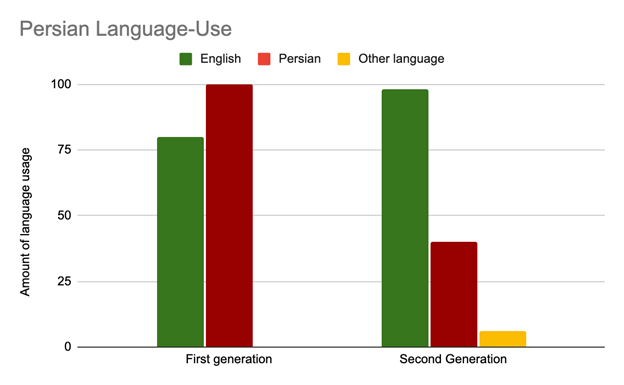
This disconnect is even more evident in the results of the ACS data analysis conducted by Bozorgmehr and Douglas (2011). Their findings reveal a notable linguistic divide within the second-generation Iranian diaspora: while 40% reported proficiency in Persian, a striking 98% acknowledged fluency in English, underscoring the prevalence of English as the dominant language of communication. As second-generation Iranians struggle with the intricacies of their linguistic identity amidst shifting cultural landscapes, this study sheds light on the nuanced dynamics shaping contemporary Persian language usage within the diaspora.

Figure 1: Persian language use among first-generation and second-generation Persians

Furthermore, in the middle of this linguistic mismatch, most of the participants in this survey acknowledge only speaking Persian, while speaking with their group of friends in Farsi alongside English. As a result, diaspora youth unknowingly serve as informal language brokers, facilitating the seamless exchange and merger of both languages in their daily lives. This informal linguistic exchange not only highlights the intricate interplay between cultural adaptation and identity creation but also demonstrates the adaptability of the second-generation Iranian diaspora.

Discussion

The information discussed in this section is a widespread concern among the Persian diaspora. It is a common question of whether Persian is being taught enough, and if not, why parents are not teaching their children Persian. Although the first generation of Iranians overwhelmingly understands Persian and could teach it to their children, they choose not to due to Persian’s position when compared to English. Should a parent teach their child Persian to keep the language alive, and thus risk their child’s ability to speak fluent English, or do they teach their child English first and risk their child’s ability to speak the native tongue well? When framed against the financial success of the Persian diaspora, it makes sense that many would stray away from teaching Persian, even when they could do so.

Survey

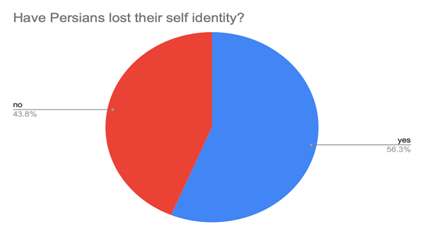
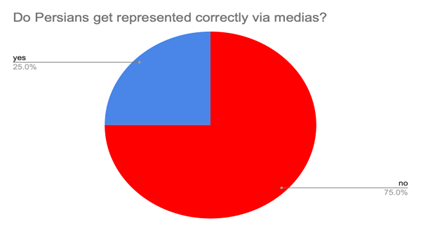
To get a better grasp of Persian Identity, we conducted a brief survey on the UCLA campus and asked participants, mainly of Iranian backgrounds, whether they believe that Persians have lost their self-identity or not. When we gained our participant’s answers and compared them to our original hypothesis, the data shown below was not surprising to us, however, what followed next was:

Figure 2: Have Persians lost their self-identity?
Figure 3: Are Persians represented correctly in the media?

Survey Experiment Conclusion

From the two surveys that we conducted, the data clearly showed us that most Persians do not believe that they have kept their original identity and almost all of them agreed that the media’s coverage of Iranians does not help at all to fix this issue. When we take the findings we gathered from this experiment and combine them with our other data, we constantly see the same trends and conclusions about the Iranian people and their identity which will be discussed in more detail below!

Discussion and Conclusion

When we take a moment to evaluate all of our data and findings that we have stated so far, it is clear to us that the Persian people have lost their identity to some shape or extent. As shown, a lot of our data and participants believe this to be true for the most part and many agreed that for the Persian community to regain their identity and status, something must change with the Iranian Regime (government) representing them back in Iran. Although we do not have public data on this topic many of our participants and even articles universally agree that a direct change to the Iranian regime influences the words views and perceptions of the Iranian people. Overall, we are pleased to report that our original hypothesis of how “Persians have lost their self-identity” is to at least some extent true and the continued destiny of whether it remains true or not simply depends on the actions that the Iranian government and Iranian people continue to take.  

References

Bozorgmehr, M., & Douglas, D. (2011). Success(ion): Second-Generation Iranian Americans. Iranian Studies, 44(1), 3–24. http://www.jstor.org/stable/27919961

Woolard, K. A. (2004). Codeswitching. In A. Durantic (Ed.), A companion to linguistic anthropology. Malden: Blackwell Publishing.

Survey Results

M150 Project Survey

[/expander_maker]
, , ,

Do actions really speak louder than words? Exploring Nonverbal Communication at UCLA Through a Lens of Internationality, Identity Formation, and Socialization

Fanny Berger, Alyssa Cole, Helena Hu, Hunter Sarmiento, Makayla Smith

This article focuses on channels of nonverbal communication across different cultures; primarily, the study conducted aims to better understand differences in including, but not limited to, gestures, facial expressions, eye contact, touch, space, and posture across different cultures. A secondary focus was also shifted to understanding how people of different cultures interpret and perceive each other’s body language in a conversational context, and to the extent to which they feel comfortable understanding others’ nonverbal communication styles. The study was conducted in two rounds: preliminary data collection was performed across UCLA students of different cultural backgrounds, with a deeper dive into select respondents from different cultural backgrounds through extensive interviewing. Respondent data reflected that most nonverbal communication is influenced by cultural upbringing and interpreting body language from someone of a different culture proves to be a challenge for most, demonstrating the impact of culture, identity, and community on how one interacts with the world.

[expander_maker id=”1″ more=”Read more” less=”Read less”]

Introduction and Background

In America’s melting pot, communication transcends cultures as people of different cultural backgrounds are in constant contact with one another, whether that be through school, work, or day-to-day living. However, beneath the surface of words lies a complex web of nonverbal cues that often serve as the silent language of our interactions. These cues, ranging from facial expressions and gestures to physical positioning and body language, play a crucial role in conveying meaning and go hand-in-hand with verbal communication in socialization and acts of interaction (Phutela, 2015). Within this realm of nonverbal communication, culture plays an essential part. According to what a culture determines, there can be several meanings attached to one form of nonverbal communication, thus making cross-cultural communication all the more necessary to understand (Jabber & Mahmood, 2020).

Today, nonverbal communication is more important than ever—advanced video technology has enabled computer-mediated communication to expand the benefits of face-to-face communication, now making non-verbal communication available in multiple formats. Here at UCLA, over 106 countries are represented within the 2023-24 school year student body, meaning that people from all over the world can connect face-to-face in both academic and non-academic settings. We became interested in understanding the meaning of nonverbal communication across different cultures, specifically how these gestures and behaviors relate to having a sense of social belonging in a culturally diverse community like UCLA.

Methods

We employed a two-step process to conduct our research and answer our primary research question: How does nonverbal communication across cultural groups contribute to one’s identity and ability to participate in various social settings, such as forming friendships and interacting with peers and professors?

The first phase involved a preliminary Google Form meant to collect data on undergraduate students at UCLA and their understanding of the relationship between body language and their culture, as well as their perception of body language within other cultures. The survey was spread through social media and word of mouth, with additional outreach to cultural clubs on campus to recruit respondents. Via the survey, we were able to collect demographic information such as one’s year at UCLA, gender identity, and cultural identity. Respondents were then asked to rate themselves on a scale regarding how comfortable they felt in nonverbally communicating or interacting with other students and faculty on campus. Similarly, they were asked to detail any instances in which nonverbal communication was misinterpreted as a result of their sociocultural differences. The collected data was then transformed into visual illustrations, such as graphs and spreadsheets, which provide indications for how people of different cultural backgrounds both understand and participate in nonverbal communication.

In the second phase, we reached out to individuals who had engaged with our survey and collected a total of five interviews from individuals from China, South Korea, Hungary, Spain, and Taiwan. Through our interviews, we were able to gain a deeper understanding of nonverbal communication and its impacts concerning cultural identity and one’s lived experience on campus. Additionally, we learned about personal experiences in which miscommunication or misinterpretations have occurred after using nonverbal communication with someone from a culture different than their own. Our respondents were able to elaborate in more detail than on their prior responses on the Google Form and explain their understanding of nonverbal communication across sociocultural contexts and interactions on campus and beyond.

Results and Analysis

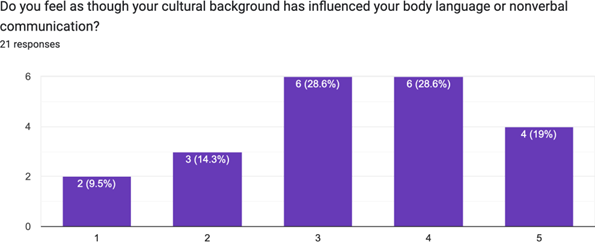
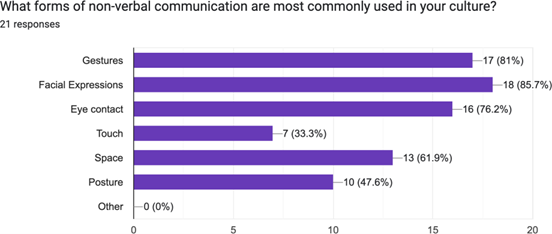
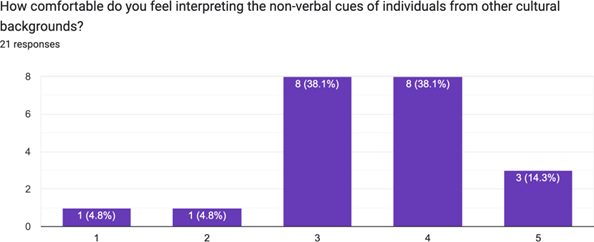
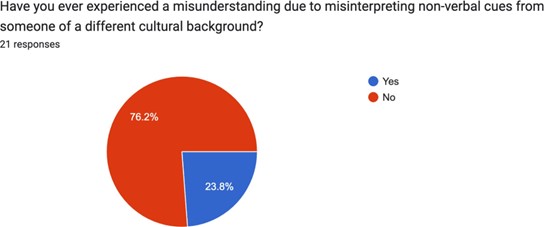
Our research project on nonverbal communication between various cultural groups provides some important insights into how cultural background affects the interpretation of nonverbal cues in a variety of social contexts. The project’s survey and interview data revealed that a substantial majority of participants (76.2%) agreed that their cultural backgrounds—which included people from Chinese, South Korean, British, Taiwanese, Spanish, Hungarian, and Indian backgrounds—have an impact on their nonverbal communication, which includes gestures, facial expressions, eye contact, touch, space, and posture (Figure 1). The study also found that the three most common nonverbal communication techniques used by people with these cultural identities are facial expressions, gestures, and eye contact (Figure 2). However, 47% of the respondents reported that they felt uneasy interpreting nonverbal cues from other cultures (Figure 4), and another 24% said that they had experienced a misunderstanding of nonverbal cues from someone of a different cultural background (Figure 5). These results demonstrate the nuanced function that nonverbal cues play in cross-cultural relationships, showing that these cues can both help and hinder connection between people of different cultural backgrounds in their attempts to understand each other.

Furthermore, our results yielded information regarding socialization and identity formation on campus. Through our survey and interviews, we were able to understand that students form in and out-groups according to feelings of acceptance or isolation associated with their nonverbal communication style. The students we interviewed explained that perceived cultural influences in their nonverbal communication caused them to feel a sense of social “othering” by American students who positioned themselves above these varying cultural identities due to their variation from the American, hegemonic standard at UCLA. With this, students embodied feelings of anxiety and disconnection that enabled them to develop in-groups with other international students, while feeling like a collective out-group from American students and faculty. Similarly, our research further supports the elimination of universal forms of nonverbal communication as both the expression and interpretation of nonverbal communication differ widely according to culture. This is additionally evidenced by students’ use of code-switching in nonverbal communication on campus. Many students expressed that they picked up on more Americanized forms of nonverbal communication, such as being more forward with their gestures and body language, and adapted their own forms of nonverbal communication to conform with this standard. For example, in our interview with a South Korean student, she expressed that she has a nonverbal linguistic repertoire of both South Korean and American influence and can “tap into” each form of nonverbal communication depending on who she is talking to. Through our research, we were able to gather data on the importance of nonverbal communication in identity expression, social and scholastic inclusion, and sociocultural power dynamics.

Figure 1: Cultural Influence on Nonverbal Communication. The Y-axis represents the number of responses. The X-axis represents the scale of agreement with the prompt: 1=Not at all, 2=Very little, 3=Somewhat, 4=A good amount, 5=Definitely.
Figure 2: Most Common Forms of Nonverbal Communication. The Y-axis represents the forms of nonverbal communication. The X-axis represents the number of responses.
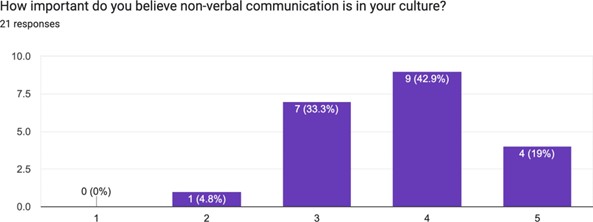
Figure 3: Cultural Importance of Nonverbal Communication. The Y-axis represents the number of responses. The X-axis represents the scale of agreement with the prompt: 1=Not at all, 2=Very little, 3=Somewhat, 4=A good amount, 5=Extremely.
Figure 4: Comfortability in Interpreting Nonverbal Communication from Different Cultural Backgrounds. The Y-axis represents the number of responses. The X-axis represents the scale of agreement with the prompt: 1=Not at all, 2=Very little, 3=Somewhat, 4=A good amount, 5=Extremely.
Figure 5: Cultural Influence on Misunderstandings in Nonverbal Communication.

Discussion and Conclusion

Our results illuminate that a multitude of misunderstandings within nonverbal communication arise from a difference in sociocultural upbringing. Although our results were specific to UCLA students, our research on nonverbal communication and its cultural ties serves as a model for further understanding and analyzing the implications of nonverbal communication on socialization and identity formation. College campuses are known to be extremely diverse communities, bringing in students from all around the world, thus replicating a larger world context through a social and scholastic lens. In this context, we were able to understand that cultural background largely influences how people both express and interpret nonverbal communication. Misinterpretations, as well as feelings of social isolation, were directly tied to cultural differences in nonverbal communication, with students expressing their need to code-switch and conform to American standards of nonverbal communication to feel fully comfortable interacting on campus. It is these nonverbal misunderstandings that play into the larger phenomenon of miscommunication due to cultural differences, thus pointing to the need to study this subject further.

The main point of our study was to provide awareness of a struggle that many students experience at UCLA, but, similarly, what many people face on a day-to-day basis around the world. We want to provide empathy regarding differences in communication and how cultural influence should be recognized and accepted instead of stigmatized. It is essential to understand how cultural identities influence nonverbal communication to not only ensure ease in interaction and information sharing, but to also ensure that all individuals, no matter their cultural background, feel included and understood. We hope our project further sparks discussions about nonverbal communication and its sociocultural influences in order to increase cross-cultural competence, enhance empathy, and educate others on the importance of communication.

References

Akkilinc, F. (2019, August). The Body Language of Culture. International Journal for Innovation Education and Research, 7(8), 32-39. https://www.researchgate.net/publication/335689301_The_Body_Language_of_Culture

Jabber, K. W., & Mahmood, A. A. (2020). Non-verbal communication between two non-native English speakers: Iraqi and Chinese. Theory and Practice in Language Studies, 10(2), 189-196.

Kirch, M. S. (1979). Non-Verbal Communication across Cultures. The Modern Language Journal, 63(8), 416-423. https://www.jstor.org/stable/326027

Phutela, D. (2015). The importance of non-verbal communication. IUP Journal of Soft Skills, 9(4), 43.

Ren, Z. (2014). Body Language in Different Cultures. US-China Foreign Language, 12(12). https://doi.org/10.17265/1539-8080/2014.12.008

Rugsaken, K. (2006). Body Speaks: Body Language Around the World. NACADA. https://nacada.ksu.edu/Resources/Clearinghouse/View-Articles/Body-Language-Around-the-World.aspx  

Thompson, J. (2023, May 15). How Much of Communication is Nonverbal?. The University of Texas Permian Basin. https://online.utpb.edu/about-us/articles/communication/how-much-of-communication-is-nonverbal/ 

[/expander_maker]

, , , ,

The Power of Bilingualism: Cultural Identification Amongst LA Bilinguals

Marnie Cavanaugh, Reese Gover, Ethan Lee, Elisa Marin, Eva Reyman

Did you know that Los Angeles is the second most bilingual city in the US? Intrigued by the relevance of this topic, we were interested in taking a deeper dive into how the bilingual experience in LA shapes cultural identification and belonging, focusing on bilingual Spanish speakers. Although bilingualism can allow someone to connect to a broader range of people, we hypothesized at the beginning of our research that English-Spanish bilinguals in LA may feel cultural isolation. Feeling too American to connect to Hispanic culture, but with the knowledge of the Spanish language, too Hispanic to fit into American mainstream culture. However, our research concluded that being bilingual does not hinder one’s ability to connect with multicultural communities. Rather, bilingualism enhances it. Bilingualism helps thousands in the LA area connect with their Hispanic culture through the use of Spanish and American mainstream culture through their knowledge of English. Speech communities become expanded through their understanding of two or more languages. Cultural identification does not have to mean choosing one culture over the other. Many bilingual individuals choose to identify cross-culturally. Bilingualism in the LA area seems to be a tool to form greater connections rather than a tool that inhibits one’s ability to understand their cultural identification.

[expander_maker id=”1″ more=”Read more” less=”Read less”]

Introduction and Background

Our project examines Spanish-English bilingualism within Los Angeles, specifically focusing on how speaking Spanish and English affects the size and strength of speakers’ speech communities. Our community of practice is Spanish-English bilinguals who primarily reside in Los Angeles. Among this population, we studied the narrative aspects of language and language in use, asking bilinguals to tell their own stories through a mix of semi-structured interviews and survey responses. Using these methods, we examined how Spanish-English bilinguals in L.A. utilize their knowledge of both languages to signal belonging in various speech communities and how their bilingualism affects the communities to which they belong. Our main questions are: What role does Spanish-English bilingualism play in the size of one’s speech community within Los Angeles? Does Spanish-English bilingualism lead to increased community, or does it cause feelings of isolation? We hypothesized that, though bilingualism may theoretically create larger speech communities, Spanish-English bilinguals in L.A. may feel isolated from English- and Spanish-speaking communities.

Bilingualism is a trait that most people in the world share (Schroeder et al. 2017). But much of the bilingual experience is yet to be discovered. Our focus on the development of cultural identity amongst Spanish-English bilinguals in Los Angeles fits within the knowledge gaps in previous research surrounding this topic.

Ana Sanchez-Munoz (2018) discusses Los Angeles as a bilingual, bicultural city, emphasizing the unique role that Spanish and English speakers play in creating their sociolinguistic environment. Her research examines language practices in educational settings, finding that English is more commonly spoken than Spanish, suggesting that Spanish-English bilinguals may assume different linguistic identities in formal (i.e., educational) and casual settings. Thus, we were inspired to obtain data on the languages that Spanish-English bilinguals utilize more often in different social environments.

Likewise, Norma Mendoza-Denton and Bryan James Gordon (2011) argue that Hispanic identity is mediated through language ideologies prioritizing English speakers over Spanish speakers. Bilinguals occupy a liminal space, where they’re privileged over non-English speakers, especially in professional settings, and pressured to fit within an English-majority society through linguistic assimilation (Mendoza-Denton & Gordon 2011). Their research provides a framework for us to formulate interview questions surrounding participants’ feelings of inclusion/exclusion within English- and Spanish-speaking communities.

Moreover, Carmen Silva-Corvolan (1986) observed 27 Spanish-English bilinguals in East L.A., researching the effects of linguistic contact between multiple languages. She found that where consistent language contact occurs, linguistic simplification often follows. This is important to consider not only to understand how bilinguals may have differing levels of fluency in different languages but also because the shifts in language unique to Los Angeles bilinguals suggest the formation of unique, bilingual-focused speech communities.

Research focusing on the cognitive and developmental aspects of bilingualism helped structure our survey and interview questions. Raluca Barac and Ellen Bialystok (2012) discuss the effects of bilingualism on cognitive ability. A survey of 104 bilingual and monolingual six-year-olds found that bilingual children performed better on cognitive tasks when they received instructions in their primary language (Barac & Bialystok 2012). The findings from this study suggest that Spanish-English bilinguals may feel more comfortable utilizing the language they learned first and thus participate more in the speech communities associated with their primary language.

This literature review provided us with a baseline of knowledge. It structured our methods, allowing us to explore the topic of cultural identification among Spanish-English bilinguals in Los Angeles in an informed, systematic manner. Our findings suggest that contrary to our hypothesis, speaking Spanish is integral to participants’ feelings of inclusion in both Spanish and English speech communities. The majority of participants reported feelings of belonging to both language communities. Additionally, many participants noted that bilingualism was a beneficial attribute in their personal and professional lives.

Methods

We used three different methods of data collection to provide our project with a well-rounded, comprehensive understanding of our topic. First, we utilized a review of relevant literature (noted above) to provide context and relevant information for our research. As well, the knowledge gaps we identified justified our research questions. Second, we used a 14-question survey incorporating True/False, Likert scale, and optional open-ended questions. The criteria for survey respondents were that they are Spanish-English bilinguals primarily residing in Los Angeles; responses were anonymous, though demographic data (age, gender, primary language) was collected. Finally, we utilized a 15-question, semi-structured interview to gain in-depth, qualitative data. Each group member conducted one interview, resulting in five interviews. Similarly to survey participants, interviewees were required to be Spanish-English bilinguals primarily residing in Los Angeles. Interviews lasted 20-30 minutes each. The observable elements of communication we studied included participants’ fluency in both languages, the speech communities they most identified with and participated in, and feelings of isolation or inclusion regarding speech communities.

Results and Analysis

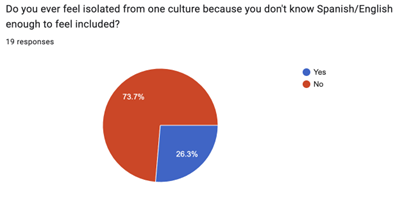
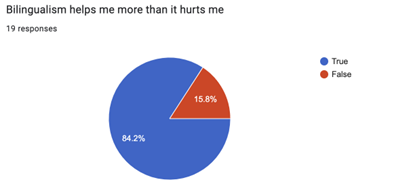
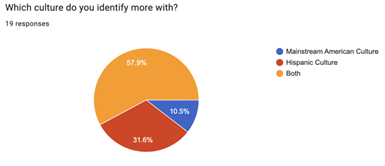
We first surveyed Spanish-English bilingualism and received nineteen responses. The survey had twelve demographic, multiple choice, true/false, and Likert-scale type questions, as well as two optional open-ended questions, where respondents could expand on their previous answers. We received seven responses for these open-ended questions, which expanded on the question, “Do you ever feel isolated from one culture because you don’t know Spanish/English enough to feel included?” We also received eight responses expanding on the true/false statement, “Bilingualism helps me more than it hurts me.” The survey questions and responses are shown in Figures 1, 2, and 3 below.

Figure 1: Responses to survey question: “Do you ever feel isolated from one culture because you don’t know Spanish/English enough to feel included?”
Figure 2: Responses to survey prompt: “Bilingualism helps me more than it hurts me”
Figure 3: Responses to survey question: “Which culture do you identify more with?”

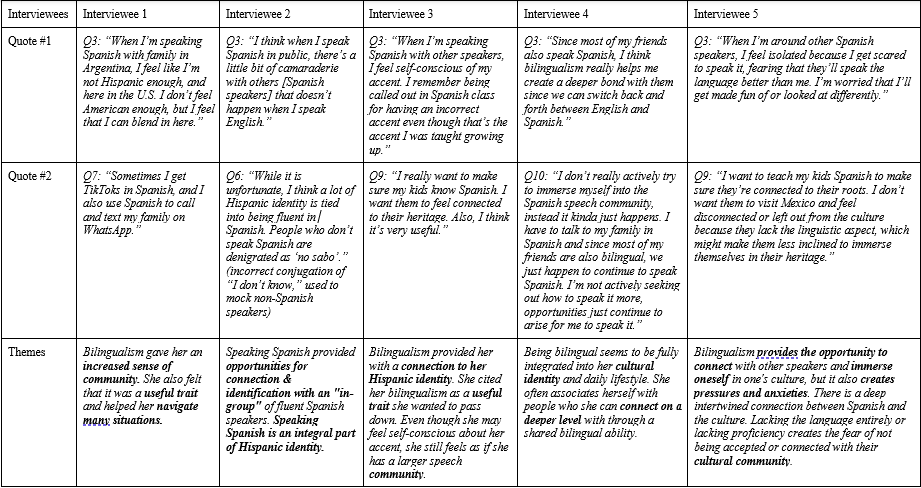
After the survey, we each conducted one interview. Table 1 provides select quotes from each interview, along with the main themes that these quotes suggest. Out of five interviewees, two specifically mentioned feeling insecure speaking Spanish and fearing they would be made fun of for their speaking ability, one interviewee stated “[in Argentina] I don’t feel like I’m Hispanic enough”. The other two interviewees didn’t mention personal experiences of feeling isolated. Despite citing feelings of isolation, interviewees also spoke about how bilingualism is beneficial. Interviewees stated that their speech community is larger and their connection to their heritage increased due to their ability. Bilingualism was seen as a positive trait that they desired to pass on.

Table 1: Quotes from interviews with five Spanish-English bilinguals

Discussion and Conclusions

Throughout the study, we found our original hypothesis that Spanish-English bilinguals would feel isolated to be generally incorrect. Our interviewees claim that being bilingual has aided them in the way of social and professional opportunities, with one stating “I’ve had more educational opportunities since I do research in Spanish [at university]”. While two of our interviewees explicitly expressed insecurity about speaking Spanish, it was a general feeling among our interviewees that bilingualism made them feel included. Our interviewees see their bilingualism as a crucial part of their identity and a method for connecting with their heritage. Interviewees cited connection to culture as a main reason for wanting to pass on bilingualism. The data collected is useful for understanding the importance of language to Hispanic identity in Spanish-English bilinguals.

References

Ahearn, L. M. (2021). Living Language: An Introduction to Linguistic Anthropology. Wiley Blackwell.

Barac, R., & Bialystok, E. (2012). Bilingual Effects on Cognitive and Linguistic Development: Role of Language, Cultural Background, and Education. Child Development, 83(2), 413–422. http://www.jstor.org/stable/41416093

Mendoza-Denton, N., & Gordon, B. J. (2011). Language and Social Meaning in Bilingual Mexico and the United States. In The Handbook of Hispanic Sociolinguistics (pp. 553–578). Wiley-Blackwell. https://www.norma-mendoza-denton.com/_files/ugd/e4ef1f_932d492a6a7e4b73ba091db41ee046f3.pdf

Sanchez-Munoz, A. (2019). Bilingualism in California: The Case of Los Angeles. In Biculturalism and Spanish in Contact: Sociolinguistic Case Studies (pp. 51–68). Taylor & Francis/Routledge.

Schroeder, S. R., Lam, T. Q., & Marian, V. (2017). Linguistic Predictors of Cultural Identification in Bilinguals. Applied linguistics, 38(4), 463–488. https://doi.org/10.1093/applin/amv049

Silva-Corvalan, C. (1986). Bilingualism and Language Change: The Extension of Estar in Los Angeles Spanish. Language, 62(3), 587–608. https://doi.org/10.2307/415479

[/expander_maker]

, , , ,

Hebrew and Armenian as Case Studies of Language Endangerment and Rejuvenation

Alex Muck, Armine Mkrtchyan, Gagik Hovhannisyan, Fiona Choi, Sara Ohannessian

Language endangerment is an important yet relatively unknown threat in our world today. As the world continues to become more globalized, languages not spoken by the majority run the risk of dying out due to people adopting languages that are more widely spoken. This study focuses on how the speakers of minority languages, such as Hebrew and Armenian, view their language and its relation to their culture to assess the risk these languages face of being replaced or going extinct. Evidence was gathered from one-on-one interviews with native speakers of the language. These interviews shed light on the central themes surrounding the usage of these languages, primarily that they are important anchors for diasporic communities to connect more closely with their heritage, rather than just being used for communication. Based on our findings, we tried to understand how languages that face endangerment may be preserved so that the cultures that rely on them do not suffer from their loss.

[expander_maker id=”1″ more=”Read more” less=”Read less”]

Introduction and Background

Language endangerment and language shift are concepts that grow increasingly important to understand as our world grows increasingly globalized (Bradley, 2023). Language endangerment is generally defined as a reduction in the usage of a language. This phenomenon can have many causes, such as language shift, which is when a new language is adopted to be used instead of a native language (Tsunoda, 2006). Two languages that are of particular interest to our own experiences and cultures are Hebrew and Armenian, both of which face language endangerment today. Through our data collection, we seek to answer: What factors contribute to the endangerment of languages or can cause them to shift to usage of other languages? How has historical and socio-political change impacted the status of these languages? What can be done now to ensure languages are preserved for the future?

Methods

Our data was gathered through 20-30 minute, one-on-one interviews conducted with either Hebrew or Armenian speakers. Our questions focused on assessing: the individual’s proficiency with the language; how they learned the language; the contexts in which they use the language; their familial and cultural background in relation to the language; their personal views about the language and what it means to them; and their thoughts on transmitting the language to future generations.

Results and Analysis

Armenian

The Armenian language serves as a vital channel for preserving and transmitting the rich cultural heritage of the Armenian community. This is especially important for a globally dispersed diaspora aiming to retain a unified cultural identity despite physical distances. The language is a symbol of resistance and survival, reflecting the community’s determination to keep their culture vibrant across generations and geographies.

Context of Language Use

The use of the language is mostly confined to the home and events such as weddings or family functions. Respondents mentioned how they had no other choice but to speak Armenian in cultural settings, emphasizing its role in maintaining cultural and familial bonds. There are specific contexts, such as speaking with grandparents or in public settings, where the language is exclusively used. Because most speakers are immigrants from the Armenian Diaspora who only speak Armenian, they constantly influence those around them with the language’s use.

Family Background and Historical Influence

The Armenian language is an ancestral language passed down through generations. One respondent noted that her family’s history of moving from country to country has heavily influenced her relationship with the language. She blends English grammar and vocabulary from Arabic and Farsi into her Armenian, reflecting her birthplace and family heritage. The Armenian Genocide deeply influences their connection with the language, underlining the importance of its preservation as a symbol of survival. “They tried to eliminate us, we have to keep going,” a respondent stated.

Religious & Cultural Impact

The connection between the language and cultural heritage is seen as inseparable, with the language being a vital component of Armenian culture. For many, the language holds personal significance as a rare and important aspect of their identity, emphasizing the need to keep their ancestors’ language alive. It connects them to their heritage and makes them “feel more Armenian.” Respondents participate in cultural practices associated with the language, like attending Armenian church gatherings and celebrating traditional holidays, further strengthening their cultural ties. As expressed in one interview, “without the language, you can’t have the culture.”

Language Transmission and Revitalization Efforts

Respondents are determined to teach their future children Armenian as a vital part of their heritage, involving them in cultural activities and education. The drive to preserve the Armenian language spans across ages and immigration statuses among the Diaspora, highlighting a unified effort to maintain their culture and language against a backdrop of historical challenges. This emphasizes the critical role of language in upholding cultural identity.

Hebrew

As a product of tragedies in the past, diasporas, and immigration movements, there has unfortunately been a steady decline in the ability to speak Hebrew. Traditions and culture, however, remain as prevalent and important aspects of identity for Jewish individuals. Through celebrating religious holidays and ceremonial milestones, such as Yom Kippur and Bar/Bat Mitzvahs, a sense of community and cultural pride grounds individuals. Revitalization efforts for the language are a priority to continue being a connecting force for generations ahead.

Context of Language Use

Hebrew is a language that is mostly restricted to religious and ceremonial situations outside of native Orthodox individuals. Interviewees revealed that the decrease in Hebrew usage can be attributed to the language not being used in most everyday conversational respects, at least for most Jewish Americans. The limited use and context in which the language is spoken decreases the incentive to learn.

Family Background and Historical Influence

Jews have been a group disproportionally discriminated against, with devastating genocide efforts that resulted in an exponential loss of population. Considering the historical tragedies, their shared language and culture became more impactful, serving as a form of resistance to their oppressors while honoring their losses. In addition, a growing disconnect between elders results from declined spoken language. Most older family members solely speak Hebrew so communication is unfortunately challenging.

Religious and Cultural Impact

The motivation to learn Hebrew stems from the religious and cultural impact. Jewish culture, religion, and language are largely intertwined. One individual who grew up with Hebrew as her first language and self-identified as ethnically Jewish was very involved with her culture and religion and she even holds classes at the nearby Hillel teaching others how to speak and write. On the other hand, another individual who self-identified as Jewish American and strictly culturally Jewish also felt very involved in a religious sense. However, she felt disconnected and lacked a sense of belonging compared to the native speaker.

Language Transmission & Revitalization Efforts

There exists a strong motivation to pass the language down to future generations to restore a shared sense of community and heritage. Orthodox and generational Jewish Americans alike expressed the need to enact efforts to preserve the language and enrich their children with strong cultural affinity. Examples of these efforts include a push to pivot the language for more daily usage to produce greater motivation to learn or to have children formally educated through Jewish schools to both augment their appreciation for the language and build a like-minded community as well.

Discussions and Conclusions

The findings from our research on the endangered languages of Hebrew and Armenian contribute to our existing understanding of the larger phenomenon of language endangerment and revitalization. Despite facing histories of erasure like the Holocaust and the Armenian Genocide, both languages have survived and serve as crucial channels for preserving cultural heritage and identity. Speakers of Hebrew and Armenian perceive language preservation as an imperative responsibility because it serves as a link to ancestral roots. This shared commitment underscores the importance of language as a conduit for transmitting cultural traditions and values to future generations. Although this project recognizes the endangered state of these languages, we made a conscious effort to avoid unintentional consequences of universal ownership, hyperbolic valorization, and enumeration that are so common with language preservation research (Hill, 2002).

To deepen our understanding of language endangerment and shift, we plan to broaden our research scope by conducting additional interviews with individuals from diverse age groups to explore whether the observed patterns in language usage and vitality persist across different generations. Moreover, examining how attitudes and language transmission practices vary among age groups will provide valuable insights into formulating targeted preservation strategies. This future direction aligns with our goal of understanding the many factors influencing language endangerment and finding effective measures to preserve linguistic diversity for future generations.

References

Bradley, D. (2023). Language Endangerment: What it is, how to measure it and how to act. In Derhemi, E., & Moseley, C. (Eds.), Endangered Languages in the 21st Century (1st ed.) 130–136. Routledge. https://doi.org/10.4324/9781003260288.

Hill, J. H. (2002). “Expert Rhetorics” in Advocacy for Endangered Languages: Who Is Listening, and What Do They Hear? Journal of Linguistic Anthropology, 12(2), 119–133. http://www.jstor.org/stable/43104007.

Tsunoda, T. (2006). Language Endangerment and Language Revitalization. Knowledge Unlatched (KU). http://library.oapen.org/handle/20.500.12657/31654.

[/expander_maker]
, ,

Pero Like… The Prevalence of Spanglish Use in Instagram Over the Course of a Six Year Time Span (from 2018 – 2024)

Alayla Navarro, Apoorva Gunti, Jester Mediano, Kaitlin Carlos, Steven Arias

Through social media, the exercise of language has never been more documented. Online communication in the Anthropocene is commonplace in many parts of the world, expanding the prevalence of language mixing, such as Spanglish. This can be brought on by different factors. Our research aims to track how over time, Spanglish became a relatively common way of speaking in social media apps like Instagram. We present data analyzing three different social media accounts on Instagram that employ the use of Spanglish vocabulary, exhibiting a positive correlation of Spanglish use over time. The analysis is done on the Instagram comments under posts targeting the Hispanic community. The comments were randomly chosen and manually examined, where we looked at whether the comment had Spanish/Spanglish and what the comments meant. The increase was documented over the time period of 2018-2024, where Instagram users utilized Spanglish the least in 2018 and the most in 2024. We also expand on this idea and analyze the prevalence of both Spanglish and the use of Spanish in an English-language dominated social media platform, such as Instagram, where the latter saw a larger increase over the time period we documented.

[expander_maker id=”1″ more=”Read more” less=”Read less”]

Introduction and Background

Because of different factors like stigmatization, languages like Spanish have constantly been derided in the United States. Up until recently, the use of Spanish has been a point of contention. Through rising acceptance of Spanish in popular media such as TV shows, movies, and through the popularization of Spanish-speaking artists, Spanish itself has made its way into mainstream acceptance in the United States. This phenomena can also be seen in social media like Instagram where comedic accounts like meme pages whose main language is Spanish is followed by hundreds of thousands of people. Through those social media pages, the use of Spanglish also became increasingly common as the acceptance of Spanish slowly became accepted. By tracking comments and responses from those Spanish meme pages on Instagram ranging from 2018 all the way to 2024, we aim to see how the use of hybrid language increased over time.

Methods

The project design sought to examine the frequency of hybrid language use and code-switching among online bilingual Spanish and English-speaking individuals over time. The expressions to be analyzed were sourced from the comments sections of three Instagram accounts that foreground Latin American culture, have large follower bases, and have posted consistently for the time span this study examines: perolike, so.mexican, and corridoybandas.

From these accounts, three posts from 2018-19, 2021, and 2024 were taken from each. 50 comments were selected as impartially as possible from those 9 posts, and collated into tables that marked expressions as either fully English, or as having some presence of Spanglish or Spanish. After investigating the increasing or decreasing prevalence of Spanglish use with these comments over the span of 6 years, expressions were then translated and interpreted to determine how users authenticate or negate aspects of culture and personal identity.

Results

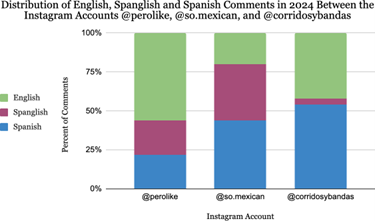
After compiling Instagram comments and categorizing them, we created tables tracking the change in frequency of the use of Spanish and Spanglish on Instagram comments over the time period of 2018 to 2024, shown in figures one and two. Figure one has data in tally form and figure two has data in percentage form.

Figure 1: Use of Spanish and Spanglish comments on Instagram account by tally (out of 50)
Figure 2: Use of Spanish and Spanglish comments on Instagram account by percentage

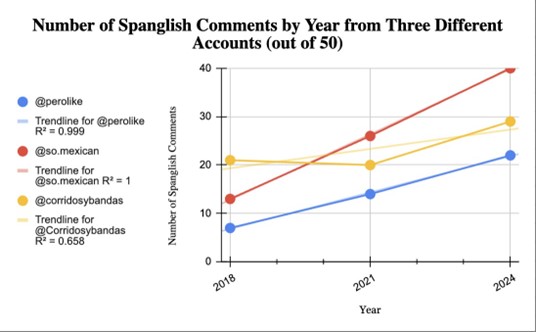
We then used this data to create a graph, in which all three Instagram accounts show a positive correlation over time, indicating an increase in the use of Spanglish within the comment sections of these accounts. Figure three shows this graph.

Figure 3: Number of Spanglish comments by year from three different accounts (out of 50)

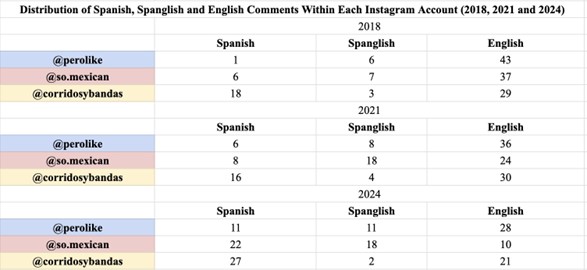
We also went further and analyzed the prevalence of Spanglish and Spanish. We separated these two categories specifically to understand and categorize hybrid-language use versus the use of a different language in an English-predominant social media platform. A table of data distributing Spanish, Spanglish, and English Comments between the three Instagram accounts, separated by year, is listed below in figure four.

Figure 4: Distribution of Spanish, Spanglish, and English comments within each Instagram account (2018, 2021, and 2024)

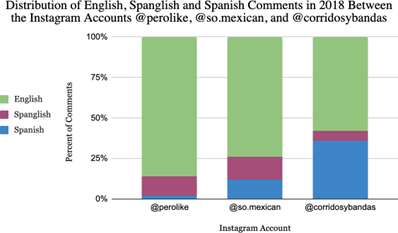
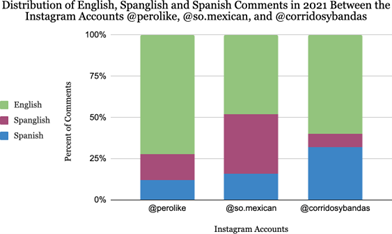
We took this data table and transformed the data into a column chart, as listed below in figures five, six, and seven.

Figure 5: Distribution of Spanish, Spanglish, and English comments within each Instagram account (2018)
Figure 6: Distribution of Spanish, Spanglish, and English comments within each Instagram account (2021)
Figure 7: Distribution of Spanish, Spanglish, and English comments within each Instagram account (2024)

Based on these distributions, although the use of both Spanglish and Spanish generally have increased, the use of Spanish has increased at a greater rate than Spanglish. This increase is specifically highlighted with the @corridosybandas Instagram account.

Discussion

According to Crooks (2004), new communication technologies, such as social media platforms like Instagram, have influenced the formation of linguistic and social identities from its users, allowing for shifts and adaptations of the language. To further expand on past literature findings, we identify Spanglish as an indexical tool used to assert a sense of belonging with a twist. Our findings indicate that within the Spanish-speaking culture, Spanglish users exploit Spanish’s emergent language development and constant linguistic varieties it possesses at the user’s convenience, with intention (Wentker and Schneider, 2022). This is seen during 2018-2019 in comments of the account @so.mexican where the use of Spanglish was low and was predominantly English. This is similar to the finding by Maliani (2021), where 43% of Indonesian bilingual speakers inserted English words in their tweets. Although this article explored the different forms of code mixing, our research took this trend to the next level by looking into the context of which these words were used. Our research identified a trend where users consistently chose Spanish word insertions that referred to cultural traditions or types of relations used by that community. For example, the use of “la dieta”, “otro taco” (“the diet” “another taco”) from the commenter indicated that users have experienced this cultural concept of risking your diet for tacos, a deeply desired food by people within this community. This asserts belonging within the community by relating to an experience shared by other members.

Another form of word insertion commonly found was the use of relational words translated into Spanish, such as “Tio,” “Tia,” and “Mami”, respectively translating to “uncle”and “aunt”, and the slang word for “beautiful girl”. We can conclude, with these insertions, that this Spanglish use was intentional, with the goal of connecting to the community and identifying as a member themselves.

A second finding expanding beyond current literature is the user’s demonstration of their own Spanglish ideologies and how they express these expectations when someone does not follow them. From past literature, we have understood the following: code-switching is intentional and asserts sense of belonging, social media allows for adaptation and variation of language, code-switching differs from face-to-face and online uses, and non-native English speakers have increasingly opted to use their native language within online platforms (Crooks, 2004; Dailey-O’Cain, 2017; Maliani, 2021; Wentker and Schneider, 2022). In 2021, users critiqued a post on their use of Spanglish, which stated “When todos andan muriendo de frio but tienes tu cobija de tigre” (translating to: “when everyone is dying from the cold but you have your tiger blanket”). The commenters corrected the post by sharing what Spanglish is and described their “improper use” of it as “forced” and “dumb.” This demonstrates how in addition to social media allowing for Spanglish users of varying levels to be confident in using Spanglish more frequently, those who consider themselves experts in this language can inform and correct other users through social media platforms as well. This adds to past literature because it opens up a new door for a different view on Spanglish. With this finding, we can have a small piece to the bigger picture of Spanglish use. We can now look further and ask ourselves, what is Spanglish from the perspective of fluent Spanglish users, what ideologies and expectations do they have in terms of Spanglish linguistics and how might this perspective change depending on the region in which this speaker resides?

Conclusion

In conclusion, the normalization and usage of Spanglish, a hybrid language that incorporates elements from both English and Spanish, has increased and become relevant in digital spaces like social media. Despite Spanglish’s contested history, it serves as a means of cultural affiliation and experience for many in the Mexican and Latin American communities. Although the research contains limitations, such as not knowing the location of users, the results are indicative that an increase in usage and frequency has occurred.

References

Cook, S. E. (2004). New Technologies and Language Change: Toward an Anthropology of Linguistic Frontiers. Annual Review of Anthropology, 33, 103-115. https://www.jstor.org/stable/25064847

Dailey-O’Cain, Jennifer. “Language Ideologies, Multilingualism, and Social Media.” Trans-National English in Social Media Communities, edited by Jennifer Dailey-O’Cain, Palgrave Macmillan UK, 2017, pp. 23–60. Springer Link, https://doi.org/10.1057/978-1-137-50615-3_2.

Maliani, P. (2021, August). Code mixing as language style in communication through Social Mediatwitter.Researchgate. https://www.researchgate.net/publication/357686277_CODE_MIXING_AS_LANGUAG E_STYLE_IN_COMMUNICATION_THROUGH_SOCIAL_MEDIA_TWITTER

Piasente, J. (2013). Looking for identity in a multicultural world: The Case of Spanglish in the United States.

Wentker, M., & Schneider, C. (2022). And she be like ‘tenemos frijoles en la casa’: Code-switching and identity construction on YouTube. Languages, 7(3), 219. https://doi.org/10.3390/ languages7030219

 [/expander_maker]

, , , ,

“American Slang” in Global Pop: The Adoption of AAVE by L2 English Speakers

Ashley Ghodsian, Maddie Kostant, Kat Escobar, Maxime Guerra

Much of the previous work that has studied African American Vernacular English (AAVE) has focused on either native speakers of AAVE or native speakers of Standard American English (SAE) who adopt certain language features of AAVE into their speech (a phenomenon known as “language crossing”). This study investigates the adoption of AAVE features into the language of individuals who speak English as a second language (hereafter, “L2”). We hypothesized that our L2 speakers would exhibit language crossing into AAVE in a manner similar to that of native SAE speakers’ crossing, but may have different (likely unconscious) motivations for doing so. Specifically, we expected that any language crossing into AAVE by our L2ers would not only be motivated by an attempt to index proximity to Blackness (as with non-Black, native SAE speakers) but also by a desired proximity to an international conception of “American-ness,” and that this indexicality would differ for men and women as has been observed for native AAVE speakers. We analyzed the English-language interviews of two fluent, L2 English-speaking hip-hop artists who sing in Spanish in order to understand both the rates at which and the act sequences in which they adopt features of AAVE, and found evidence in favor of our hypothesis.

[expander_maker id=”1″ more=”Read more” less=”Read less”]

Introduction and Background

The origin of hip-hop and rap stems from the oral practices of enslaved Africans that were brought over to the Americas. Its style of deliverance is meant to embody the roles of the storyteller and culture historian that resemble those in traditional African society (Álvarez-Mosquera, 2015). One of the most integral aspects of hip-hop is its use of AAVE to index African-American culture.

Given the level of prominence that hip-hop has attained in global popular culture, music, and language and its considerable exposure in global media (Tamasi & Antieau, 2014), non-Black hip-hop artists whose native variety of English is Standard American English often end up adopting and appropriating aspects of AAVE (Chun 2001). Rampton (2020) has coined this phenomenon “language crossing.” Language crossing occurs when speakers borrow features from dialects that do not “belong” to them and is particularly problematic when the language being “crossed” into is socially marginalized. Because hip-hop is so closely associated with African-American culture, non-Black artists are left to differentiate themselves from the social expectations of their own culture and reinforce their authenticity as hip-hop artists through the use of crossing into AAVE (Álvarez-Mosquera, 2015).

This study builds on all of the aforementioned previous research into language crossing by investigating the non-native use of AAVE in specific language communities with whom it had yet to be explored. Also notably, this study builds on the work done by Britt & Weldon (2015), who found that African-American women who natively speak AAVE use linguistic features more similar to those of SAE compared to their male counterparts. Exploring these gendered differences was also relevant to our project design.

As such, this project aimed to answer the following research questions: (1)  In what speech contexts and with what goals—conscious or otherwise—do non-Black hip-hop artists who are L2 English speakers adopt features of AAVE into their speech? And (2) How does said feature adoption vary depending on the speakers’ genders? As previously mentioned, L2 English speakers are a speech community whose potential appropriation of AAVE has yet to be investigated. We hypothesized that like non-Black native SAE speakers, our L2 speakers would exhibit language crossing into AAVE, but that they may have had different (again, likely unconscious) motivations for doing so. Namely, we expected that any language crossing into AAVE by our L2ers would not only be motivated by an attempt to index proximity to Blackness (as with non-Black, native SAE speakers) but also by a desired proximity to an international conception of “American-ness” altogether. Following Britt & Weldon’s findings, we also anticipated that this indexicality would differ for men and women, as it does for those who are native AAVE speakers.

Methods

As previously mentioned, we analyzed the English-language interviews of two fluent, L2 English-speaking hip-hop artists who sing in Spanish to investigate our claims: ​​J Balvin, a Colombian reggaeton artist, and Rosalía, a Spanish pop artist. Two interviews were analyzed for each artist, one in which they primarily discussed topics such as their global success and interactions with famous American celebrities, and one in which they focused on their cultural and/or family backgrounds. For both J Balvin and Rosalía, their “success” interviews were chosen to be The Tonight Show Starring Jimmy Fallon, a major American late-night talk show that both artists had attended, as a method of controlling for the interviewer. The “personal” interviews were harder to control for in the same way. J Balvin’s was hosted by the YouTube channel HardKnockTV and Rosalía’s was hosted by Billboard Music’s YouTube channel. Crucially, neither of the “personal” interviews was as nationally televised in the U.S. as the “success” interviews were, and they were both centered more around personal content.

For each interview, we noted each instance in which the artist adopted at least one phonological or morphosyntactic AAVE feature and observed the frequency with which they were adopted in relation to the speech context (e.g., establishing comradery with the interviewer, discussing their childhoods, etc.). Many of the features of AAVE that this study investigates have already been widely studied by linguists. As such, we primarily followed a list of features presented by Walters (1992), found in Figures 1 and 2 below, which includes AAVE phonological features as well as AAVE morphological and lexical features. In order to minimize possible confounds, any features of AAVE that overlapped with aspects of the speakers’ L2 English dialect coming from their L1 Spanish (e.g., dropping of a final ‘g’ in verbs ending in ‘-ing’) were not considered in our analysis.

Figure 1. AAVE Style (Walters 1992): AAVE Phonological Features
Figure 2. AAVE Style (Walters 1992): AAVE Morphological and Lexical Features

The results in the following section are analyzed both quantitatively and qualitatively. The quantitative analysis considers the features of AAVE used per minute by each artist (measuring by the rate of feature adoption as opposed to considering a net total measurement is motivated by the fact that each artist’s respective videos were not equal in duration), and the qualitative analysis explores select examples of AAVE usage and aims to explain them within the lens of the conversational contexts they were used in in order to relate them back to the research question and hypotheses. We counted each syntactic, phonological, and lexical feature as one (1) instance of AAVE. For example, in his “success” interview, J Balvin produced the sentence “Yo, give it up for his Spanish!” We counted the lexical item [yo] as one feature, and the phrase [give it up for] as a second.

Results

We found that both J Balvin and Rosalía adopted features of AAVE more frequently during their “success”-oriented videos than during their “personal” interviews. Specifically, J Balvin adopted AAVE features at a rate of 3.42 features per minute during the “success”-oriented interview, compared to 0.75 features per minute during his “personal” interview. Rosalía adopted AAVE at a rate of 0.78 features per minute during her “success” interview, compared to 0 features per minute for the “personal” interview.

J Balvin utilized AAVE features throughout his “success”-oriented interview. However, he only used AAVE a few times during his “personal” interview: once when establishing comradery with the interviewer, and once when he described moving to New York and the inspiration he drew from the city’s hip-hop culture. Examples from J Balvin’s “personal” and “success” interviews can be seen below. AAVE features are highlighted using bold font:

Personal

Talking about moving to New York

5:08: And that was the vibe that I was looking for.


Success

Talking about style for Guess magazine

4:09: You know, sort of Miami vibe

4:13: Shout-out to Miami.

Rosalía did not use AAVE features as frequently as J Balvin for both interview types. However, there was still a disparity between the results for her “personal” and “success” interviews: while she did adopt AAVE features in the “success” interviews when talking about her new album, “Motomami,” Rosalía did not adopt any AAVE features at all during her “personal” interview. An example from her “success” interview is shown below, again with AAVE features highlighted in bold:

Success

Talking about success of new album, “Motomami”

1:54: ‘Cause I feel like Motomami’s an energy.

Our quantitative results are illustrated in Figure 3 below:

Figure 3. Adoption of AAVE Features per Minute by Artist: J Balvin adopted features more frequently than Rosalía for both interview types, and both artists adopted features more frequently during the “success” oriented interviews.

Additionally, we did not count AAVE lexical items that have entered the Standard American English (SAE) lexicon such as “gonna,” “wanna,” and “you know” toward our tallied per-minute totals for each artist. This was a subjective decision that we made based on our prediction that the use of these terms is not generally used by SAE speakers to index social identity in the same way that strictly-AAVE terms are.

Discussion

As mentioned, J Balvin used AAVE features more frequently in both of his interview types than Rosalía did, and both of them adopted AAVE more frequently in their “success” interviews than in their “personal” interviews. These findings are in line with our hypothesis, which predicted that both artists would use aspects of AAVE in contexts for which they have an incentive to communicate their connection to an “American” identity. Additionally, the overall difference between J Balvin’s and Rosalía’s utilization of this variety is in line with Britt & Weldon’s (2015) observations of native AAVE speakers’ gendered differences. It is important to note that these are only numerical comparisons, and we cannot assert any statistical significance.

Fortunately, the “success”-oriented interviews for J Balvin and Rosalía covered similar topics, including friendship (with both the interviewer and U.S. celebrities), major performances and releases, fashion, and the artists’ success with English-speaking audiences. The “personal” interviews generally explored the artists’ childhoods and family backgrounds, the artistic inspirations they drew from their home cultures, and their immigration stories. The thematic similarities between the two “personal” interviews and the two “success” interviews, respectively, allowed us to analyze them together.

The fact that J Balvin used AAVE throughout his “success” interview, which only covered topics related to his success in the U.S., while he only used AAVE in the “personal” interview when discussing moving to New York provides evidence that he crosses into AAVE when trying to communicate his proximity to “American-ness.” Additionally, our findings that Rosalía did not use AAVE features as frequently as J Balvin for both interview types is in line with the aforementioned gendered differences observed among native AAVE speakers. However, this could also be due to the fact that Rosalía’s English is not as strong as J Balvin’s, and thus she may not be as confident in switching between English varieties. At the same time, there was still a disparity in the results for her “personal” and “success” interviews: while she did adopt AAVE features in the “success” interviews when talking about her new album, “Motomami,” Rosalía did not adopt any AAVE features during her “personal” interview. This may be because her “personal” interview did not cover any topics related to the U.S., and focused mainly on her inspiration from Spanish culture. Therefore, unlike in J Balvin’s interview, in which he talked about moving to the U.S. and New York’s hip-hop culture, Rosalía did not have any incentive to index proximity to “American-ness” based on the thematic components of her interview.

Conclusion

In conclusion, we found that both J Balvin and Rosalía adopt features of AAVE more frequently when they are talking about their international success and topics related to the United States. These results provide evidence that L2 English speakers adopt features of AAVE in order to index a connection to a global conception of “American-ness.” However, despite our study corroborating our hypothesis, there were several limitations: (a) Rosalía’s English is not as fluent as J Balvin’s; (b) we only worked with a small sample size; and (c) the categorization of act sequences and features is inevitably subjective (e.g., the way we differentiated topic types into “success” versus “personal”; ambiguous lexical items that we encountered such as “gonna,” “wanna,” and “you know” that are now a part of the Standard English lexicon). Additionally, it is worth noting that Rosalía and J Balvin are celebrities; their results are not necessarily representative of all L2 English speakers since they have a particularly strong incentive to connect to Americanness (it is essentially their job to do so if they want to break into the American market).

Finally, although we did observe a gendered difference in the frequency of adoption by J Balvin and Rosalía, the Britt & Weldon study that found gendered differences for native AAVE speakers measured this difference in terms of manner (primarily, phonetic), not in terms of frequency. However, since our study was forced to disregard much of the phonetic information from J Balvin’s and Rosalía’s interviews in order to minimize confounds with their L1 accents, we were unable to conduct a similar analysis. As such, we cannot definitively state that our results align with those of Britt & Weldon (2015).

In the end, our research suggests that L2 English speakers use AAVE features to communicate a connection to the “American identity,” and calls for a future, more robust experiment.

References

Álvarez-Mosquera, P. (2015). Underlining authenticity through the recreolization process in rap music: A case of an in-group answer to an identity threat. Sociolinguistic Studies, 9(1), 51.

Britt, E., & Weldon, T. L. (2015). African American English in the middle class.

Chun, E. W. (2001). The construction of white, black, and Korean American identities through African American Vernacular English. Journal of Linguistic Anthropology, 11(1), 52-64.

Rampton, B. (2020). Crossing. The International Encyclopedia of Linguistic Anthropology, 1-5.

Tamasi, S., & Antieau, L. (2014). Language and linguistic diversity in the US: An introduction. Routledge.

Walters, K. (1992). Supplementary materials for AFR 320/LIN 325: Black English. Master’s thesis, University of Texas at Austin.

[/expander_maker]

, , ,

Language Proficiency and Cultural Identity of Korean Heritage Speakers

Griffin Gamble, Erin Kwak, Joanna Kwasek, and Hannah Shin

A heritage language is defined as a minority language spoken at home that is not part of a dominant language in society. This study looked specifically into Korean heritage speakers living in the United States and investigated whether language proficiency in Korean will align with the degree of Korean cultural identity. In order to study this relationship, we utilized two separate data collection methods: an elicitation task to assess language proficiency and a self-reported questionnaire to record cultural identity. As expected, we found that the more grammatical errors the participants made, the less they identified with their Korean culture. This finding suggests a positive relationship between Korean language proficiency and Korean self-identity, which contradicts previous findings that higher proficiency in a heritage language predicts a more balanced bicultural identity that is not dominated by one culture.

[expander_maker id=”1″ more=”Read more” less=”Read less”]

Introduction and Background

With the U.S. being known as a melting pot of cultures, numerous languages are constantly being spoken and intermingled in public and private. Following this observation, we were interested in understanding how heritage speakers–more specifically, Korean heritage speakers–juggle multiple cultural identities.

Previous findings suggest that one’s cultural identity and language proficiency are correlated. Lee (2002) studied the relationship between heritage language proficiency and cultural identity of Korean heritage speakers. They were able to observe that Korean heritage speakers who were proficient in Korean largely reported having a bicultural identity, or one that is equally American and Korean (Lee, 2002). Furthermore, Adaobi (2014) studied the link between a minority language, Etulo, and the majority language, Tiv, to understand if bilingualism affects self-identity. Similarly to Lee (2002), Adaobi found that Eluto speakers identified with both cultures, but did experience a sense of identity conflict, or dual identity, from time to time (Adaobi, 2014). Such findings indicate that proficiency in both the dominant and minority languages facilitate a unique bicultural identity.

One of the biggest limitations that we observed in the studies above was the use of self-assessments as a measure of language proficiency. Self-reports can be unreliable in producing standardized data, as it does not involve an objective assessment of language proficiency; it is susceptible to biases about how well one believes they can speak a language. Therefore, in our study, we have decided to implement a widely used method in the study of bilingualism: the elicitation task (Bialystok and Frohlich, 1980; Dechert, 1983). As grammatical competence is often a strong predictor of overall oral proficiency (Magnan, 1988), it is plausible to assume that grammatical errors will decrease as the proficiency level increases. With such assumptions, the current study conducted a grammaticality judgment of participant speech to determine language proficiency (Cornips & Poletto, 2005), in hopes of enhancing both the validity and reliability of the research addressing heritage language proficiency and cultural identity.

We hypothesized that there will be a positive relationship between Korean language proficiency and Korean cultural identity. In other words, Korean heritage speakers who 1) exhibit higher grammatical accuracy in Korean and 2) are able to utilize more cultural references will identify with the Korean identity to a larger degree.

Methods

We studied twelve Korean heritage speakers currently living in Southern California, between the ages of 15 and 23. Eight of the participants identified as female, three as male, and one as other. They had differing levels of exposure to formal Korean language education but all of them used Korean at home with their family (aligning with our definition of a heritage speaker).

Table 1: Participant Demographics

The study utilized two separate data collection methods. The first was an elicitation task, which involved a slideshow that depicted the Korean fairytale titled The Heavenly Maiden. We began by telling the story to the participants in English, accompanied by the corresponding image for each scene (See Figure 1).

Figure 1: Example of a slide from the elicitation task

The participants were then asked to retell the story in Korean as we flipped through the images in the slideshow. Their speech was recorded and transcribed for further analysis. The second data collection method was a questionnaire that was distributed to participants after the elicitation task. By doing so, the questions regarding ethnicity, culture, and comfortability in speaking Korean did not influence their performance in the storytelling task. The survey also included questions about the participants’ general background information, such as their age, the circumstances in which they learned Korean, in what situations and how frequently they use Korean today, etc.

The recording was reviewed for two main variables: instances of any grammatical errors (such as subject, verb, and object word order errors) and the usage of culturally-relevant vocabulary within the story. Regarding the culturally-relevant vocabulary, there are a few terms, such as 선녀 (“heavenly maiden”) and 두레박 (“bucket”), that are important aspects of the fairytale. We expected to find that participants who are more in touch with Korean culture would be able to better identify and use those cultural references.

Results and Analysis

Out of the twelve participants, only ten participants fully participated in our study as two people opted out of the elicitation task as they felt that the task would be too difficult with their language abilities. However, we still decided to give them the option of completing the questionnaire so that we could note any potential patterns.

When analyzing the data, we noticed two main patterns amongst the participants: irregular formality and sentence structure. These were interesting to us because the Korean language is highly sensitive to different degrees of formality–that is, a speaker should not be suddenly switching between multiple formality levels unless the recipient has changed. An instance of irregular formality can be seen in this excerpt of participant 1’s transcript: “사슴이 남자에게 도움을 요청했습니다. 사냥꾼이 사슴을 사냥하고 있었다.” The first sentence ends with –습니다, which is formal and respectful. However, the next sentence ends with –다, which is less formal and more direct. Additionally, Korean sentences typically follow a subject-object-verb order, but the participants seemed to use different word order structures purposefully. Korean-American speakers were repeatedly and deliberately utilizing an alternative word order structure as a stylistic choice, not as a momentary mistake. An example of irregular sentence structure can be observed in this excerpt of participant 4’s transcript: “사슴이 살려달라고 그래서 나무속에 숨겨놨는데 사냥꾼이 와서 찾았어요 사슴을.” This sentence notably ends with an object (“사슴을”), which is not common in Korean speech, and more resembles English’s subject-verb-object order.

Surprisingly, participants were generally lacking in the use of cultural references with two people using none, seven people using one, and one person using two. Patterns regarding the usage of cultural referents were thus not evident, which made it difficult to answer the relevant aspect of our hypothesis.

Regarding the self-reported cultural identity of our participants, a majority of our participants considered themselves Korean-American, but more Korean or equally Korean and American. None of our participants considered themselves fully American with no Korean identity. Interestingly, the participant with the least amount of errors and highest self-perception of being Korean (i.e., they viewed themself as fully Korean, rated themself 5 in Korean proficiency, and 5 for how comfortable they are in speaking Korean), only utilized one cultural referent throughout the whole speech. She instead opted for a more casual and simple nuance, using Korean versions of an English word, such as “샤워” ([ɕʰawʌ] ‘shower’) and 버켓 ([bʌket̚] ‘bucket’). We also noticed that the two people who opted out of the task but filled out the questionnaire were the only ones who marked “very uncomfortable” for the question asking how comfortable they are in speaking Korean and “strongly agree” for the statement “I celebrate most American holidays.”

In comparing the self-identity question to their overall error ratio in speech, we found that the average error ratio increased as the participants identified as more American (See Figure 2). Although we were not able to run a formal statistical analysis due to our limited sample size, we expect this trend to transfer onto a bigger sample size as well due to its concreteness.

Figure 2: Self-Identity and Error Ratio

Another interesting observation we made was that those who marked that they took Korean in school for foreign language credit (which were participants 9, 10, A, and B) had either: the highest ratios of errors or completely opted out of the elicitation task due to low proficiency.

Discussion and Conclusion

The results suggest that language proficiency and cultural identity seem to have a positive correlation, as the participant who rated herself as fully Korean had the least errors in speech, and the average error ratio of participants increased along with American identity. In addition, we also observed a common linguistic pattern among our Korean-American participants. Those who rated themselves a score of 2 or 3, and therefore did not fully identify as Korean, were using a word order structure similar to English subject-verb-object (SVO). This word order is not technically ungrammatical in Korean, but it’s usually only used if the second clause is an afterthought therefore it can come off as awkward especially if used repetitively. However, the Korean-American participants appeared to be using it as a stylistic choice, and not by mistake. This finding opens up a new area of research for bilingualism: emerging linguistic patterns in heritage speakers that were not previously observed in native speakers. By studying how this linguistic trend is preserved or even replaced within generations, we would also be able to study how multiple languages reform as they come in contact with a different language. In the case of our participants, it was mainly the fusing of English and Korean that prompted the rise of English’s SVO-like word order structure in Korean.

One of the biggest limitations was our small sample size. A larger sample size would help identify stronger, statistically significant correlations between our variables, and in turn, promote the external validity of our findings. Furthermore, we could better target the elements within our hypothesis by improving the elicitation task. As we were unable to observe a consistent use of cultural references among the participants, we could better assess the role of cultural proficiency or cultural awareness by utilizing or creating a story that prompts the use of more cultural references. The analysis method of our study would also have been more standardized if the grammaticality judgment was not done by the researchers themselves. Although we were limited in our time and resources, recruiting a panel of native Korean speakers to rate the grammaticality of each participant’s speech would lead to a more concrete assessment of language proficiency.

So why do these findings matter in our day-to-day lives? First of all, the observations we made throughout our study support the idea of a bidirectional relationship between language and identity. Even though our main research question dealt with the positive connection between language proficiency and the corresponding cultural identity, this relationship encompasses so many other factors such as our attitude towards our culture, the amount of language use per day, the quality of language use, the context of language use, and much more. Each of the aforementioned variables could equally serve as a byproduct of or the driving elements behind one’s language proficiency. For instance, one could be using their heritage language only with their parents because they lack proficiency, or lack proficiency because they only use it with their parents and no one else. If you factor in the role of cultural identity, it further raises the question of “which came first?” as it could be the depth of cultural identity that motivates language use or vice versa. Knowing this, it brings us to the second reason why the findings of this study are important: we could potentially promote language proficiency and cultural identity by elevating one another! To provide an example, enhancing one’s cultural identity could serve as a big motivator behind learning a heritage language. The positive attitude allocated to a specific culture could definitely act as an incentive for learning a language while enhancing the learning process itself. Similarly, one might wish to identify with their heritage culture on a deeper level. The findings in this study suggest that increasing one’s proficiency in their heritage language could in turn intensify one’s respective cultural identity.

References

Adaobi, N. O. (2014). Bilingualism and identity in etulo. OGIRISI: A New Journal of African Studies, 10(1), 23. https://doi.org/10.4314/og.v10i1.2

Bialystok, E., & Fröhlich, M. (1980). Oral Communication Strategies for Lexical Difficulties.

Interlanguage Studies Bulletin, 5(1), 3–30. http://www.jstor.org/stable/43135243 Cornips, L., & Poletto, C. (2005). On standardizing syntactic elicitation techniques (part 1).

Lingua, 115(7), 939–957. https://doi.org/10.1016/j.lingua.2003.11.004

Dechert, H. W. (1983). How a story is done in a second language. In C. Faerch, & G. Kasper, (Eds.), Strategies in Interlanguage Communication, 175-196. New York: Longman.

Jee, M. J. (2016). Exploring Korean heritage language learners’ anxiety: ‘We are not afraid of Korean!’ Journal of Multilingual and Multicultural Development, 37(1), 56–74. https://doi.org/10.1080/01434632.2015.1029933

Lee, J. S. (2002). The Korean language in America: The role of cultural identity in heritage language learning. Language, Culture and Curriculum, 15(2), 117–133. https://doi.org/10.1080/07908310208666638

Magnan, S.S. (1988). Grammar and the ACTFL Oral Proficiency Interview: Discussion and Data. The Modern Language Journal, 72, 266-276.

Montrul, S. (2013). How “Native” Are Heritage Speakers?, Heritage Language Journal, 10(2), 153-177. doi: https://doi.org/10.46538/hlj.10.2.2 

Rothman, J. (2009). Understanding the nature and outcomes of early bilingualism: Romance languages as heritage languages. International Journal of Bilingualism, 13(2), 155–163. https://doi.org/10.1177/1367006909339814

[/expander_maker]

, , , , ,
Scroll to Top