sociolinguistics

Sociolinguistic Activism and White Fragility

Jamie Seals, Makena Larson, Betsy Benavides, Faith McCormick

When looking at the work previously done on the intersection of white fragility and sociolinguistics, we noticed a gap in research that we wanted to fill. We conducted interviews between two white peers, the topic of conversation being sensitive topics such as race and racism. We hypothesized that the interviewees would take a neutral stance when speaking on the subject of race. We looked specifically at word choice, stance, and circumlocution. Using conversation analysis on all three interviews conducted, we were able to look at these linguistic elements and draw conclusions. It was found that interviewees used circumlocution, hedged and hummed, and all held a very particular stance. In our article, we delve more deeply into what we found, the examples of conversation analysis, and what the most significant takeaways were.

[expander_maker id=”1″ more=”Read more” less=”Read less”]

Introduction

For our project, we wanted to take a sociolinguistic approach to look at white fragility and discussions pertaining to sensitive topics. We looked specifically at how white people respond to questions regarding race and racism. When looking at previous work examining the intersection of white fragility and sociolinguistics, we found a lack of research that we wanted to supplement and deepen. We wanted to look at white fragility by conducting interviews with two white peers regarding race, which we could not find had ever been done. Previous research done by Robert DiAngelo, highlighted a discomfort that white people had when dealing with issues of race, “a single required multicultural education course taken in college, or required “cultural competency training” in their workplace, is the only time they may encounter a direct and sustained challenge to their racial understandings.” (DiAngelo, 2011). DiAngelo’s, along with others’ work done on white fragility, led us to our final decision on the aspects of our interviews. We conducted interviews between two white peers, both of which were twenty to twenty-two years old. We wanted to analyze these interviews specifically through a sociolinguistic lens, which makes our research unique. Our research is necessary because, by better understanding how white people feel regarding race and discussions about it, we can start to break down walls between one another and have more open conversations. These discussions allow for transparency and a sense of stronger community values within the UCLA culture and in our greater society. Furthermore, we believe that conversation is very important which is why we looked at it in depth. We did conversation analysis on our three interviews and examined them by looking at circumlocution, word choice, and stance. We hypothesized that all the participants would take a neutral stance, and we found this to be accurate but much more nuanced than we had expected. 

Methodology and Results

After careful thought and consideration throughout our experiment, we found that within our three interviews it was vital to keep in mind what key linguistic features we were searching for when conducting the research portion of our project. Having both the interviewer and the interviewee identifying as white, we hoped this environment would create a sense of comfort within the conversation. We also reassured the individuals that this was a safe space to speak freely and reflect on what they have personally experienced here at UCLA. After analyzing the recordings of each interview and uploading the conversations through Trint, a transcription processing application, we were able to effectively observe the outcome of our data and look at the speech and language patterns between the two speakers. Our first finding from the interviews was how there was still an obvious level of uncomfortability between the interviewer and interviewee when asking the questions. For example, in the second interview, the interviewee is asked the question, “do you think racism exists in UCLA culture or on campus?” The interviewee responds by saying, “yes, but it’s not like I’ve seen it directly.” This response is important to our study because it proves how students here are aware that here on campus there are individuals experiencing racism. However, they quickly reassure us that they are not involved or a part of the problem at hand. Throughout the interviews, we also noticed how, when asking the question, “Do you think UCLA is inclusive to all students?” The individuals were swift to respond and say no. However when asked if they believe racism exists on campus or in the culture here at UCLA, they take more time and reply hesitantly with “yes, Uhm, probably” (Interview 2). This longer pause can signal that the interviewee could be slightly caught off guard or uncomfortable answering the question, in fear of giving the wrong response. Secondly, we found that in our third interview, when the individual was asked about racism at UCLA, they responded with, “I heard from the grapevine that….” This immediately personifies to the interviewer that the individual wants to be excluded from the information they are about to share. The interviewer does this in a way to agree that, yes, there is exclusion here on campus happening but wants to ensure she is not accounted for in that statement. This is critical for our study because it helps us reveal how quick students are to agree there is blatant inequality here at UCLA, but in a way, they would like to acknowledge it is problematic but are quick to cover themselves before even pressing more into the issue. The second interviewee, at the opening of the conversation, also expressed their feelings on how they felt about these questions. When asked if they think UCLA is inclusive to all students, they respond with, “uh, this is not a fun topic to talk about” in the recording, the student pauses and then nervously laughs while saying this is not a fun topic to talk about. The nervous laugh along with them voicing how this is not a fun topic to talk about, are both powerful indicators the individual was hesitant to talk on this subject without feeling uncomfortable. We must circle back to our hypothesis stating these students would take a neutral stance. It is clear from our findings that our pool of participants remained completely neutral throughout the interview. All three students agreed they benefited from white privilege at UCLA, however when being asked these questions about race, we found they all displayed levels of discomfort and attempted to sever themselves from any racist or discriminatory acts people might be experiencing or hearing about in UCLA culture or campus.

Discussion

Although all three interviewees had different responses to the questions, we found a few patterns across the three. Upon answering each question, interviewees would often find ways to distance themselves from the issue. From saying things like “I’ve heard”, “Actually, I can’t really think of an example, so maybe not” or “Yes, but it’s not like I’ve seen it directly.” This is what sociologist Caprice Hollins describes as the individual approach White individuals often use when speaking about race. Individuals may find ways to maintain a positive self-image by pushing away their closeness to these issues or moving around the topic of conversation (2020, Hollis). To add onto this, something we picked up on was the interviewees avoidance using racialized language, instead opting for terms like “minorities” or “different race” instead. This is what is described as aversive racism, or racism that is manifested in subtle ways (Diangelo, 2018, p.59). Furthermore, they never directly state their opinion on some of the questions, often finding a sort of a neutral position or a middle ground. This type of stance is known as a form of White solidarity, where individuals in conversation will often build on this idea of a “common stance” regarding race-related issues. These stances rely on both silence on racial matters and a subconscious implied unity between parties to uphold this solidarity (DiAngelo, 2018, p.72). When all three of the interviewees used this back and forth, yes and no response, it is possible that they are not able to navigate that common ground which could lead to some of the discomfort demonstrated.

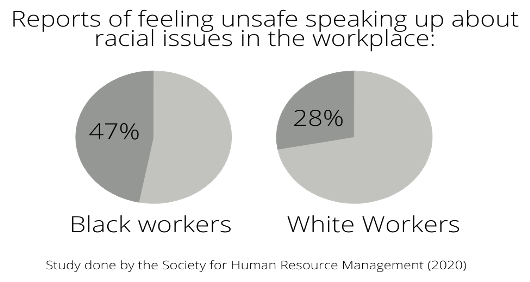
After conducting our study, most of what we saw fell in line with what sociologists are saying about conversations on race, however it does not match some of the quantitative data we found. The stances we picked up on during the interview were things we expected but did not expect to find clear discomfort. This is what prompted us to look into other research where we found that White individuals feel significantly less discomfort speaking about these topics compared to Black individuals. The following Figure 1 is demonstrative of a 2020 study done by the Society for Human Resource Management which collected data from 1,275 participants about their workplace environment. While our study focuses on universities, we feel that the study on the workplace environment is still relevant to our topic. The study found that 47% of Black respondents do not feel safe speaking out about issues of racial justice compared to 28% of White respondents who said they do not feel safe for the same reason (2020, p.11). There can be many reasons for this discrepancy. While this data could indicate that our 3 interviewees happened to be a part of the 28% of people who feel uncomfortable, it’s also possible that the perception of themselves is different than the way others (us interviewers) perceive them. If given the opportunity, we would have a second round of interviews where we would ask not only about racial issues but also how individuals feel about speaking on racial issues.

Figure 1

Observing our results and how they fit into a broader context, racial issues and racial justice has always been prevalent, deeply and radically well-established, and formed in society. UCLA represents its own subcategory of society, as a community. By theoretical implications, these findings we provided show to be significant in spaces of policy, practice, and further research. Additions are also made to the existing discussion of race and social inequalities related to. By practical applications, it presents how we can better self-reflect and ask ourselves: if certain conditions were fulfilled, not only for the student body but beyond that. Our findings can be extended to other situations, such as friend groups, educational spaces, relatives, and workplaces. Anywhere we find a place of interaction and community, this study could be applicable. Our findings help us understand a broader topic of the foundations of human interaction. With continued conversations regarding social injustice, we are better equipped to integrate our worldviews, as well as comprehend and be attentive to that of others. We can improve and create equitability for all, resulting in better representation, accountability, uplifting underrepresented groups, and improving the overall well-being of one another.

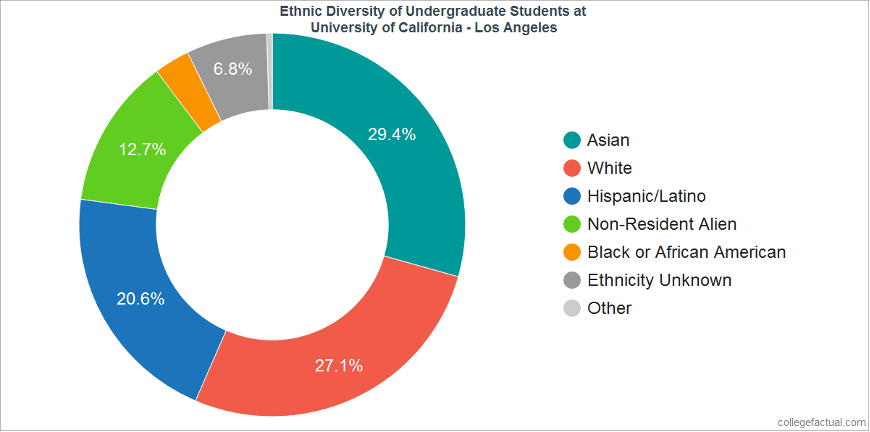
As seen below, a chart of the ethnic diversity of undergraduate students at UCLA. An article was written at Penn State in 2018 by the Diversity group in response to College Factual’s ranking of UCLA’s diversity and ethnicity. The article aimed at identifying and examining how diverse of an institution UCLA is. We found this article written at Penn State to be extremely critical and relevant to our work because it perfectly analyzes the exact breakdown of each ethnicity present on campus at UCLA. From this data in the chart, we are allowed the opportunity to more effectively determine the disproportions or inequalities that may be prevalent based just on the percentages of various ethnicities here at UCLA As seen in the chart, carefully note how the orange percentage of the chart is not even listed and exact percentage. In this chart the color that represents individuals of black or African American ethnicity accounts for less than 4% or the entire student body. This statistic is crucial to the argument we pose in our experiment because the percentage of African American and black individuals is disproportionately represented on campus here at UCLA, while the percentage of white or Caucasian presence on campus stands at 27.1% the second to highest percentage of all ethnicities listed.

Figure 2- UCLA Student Demographics Chart, 2018


References

DiAngelo, Robin (2011). White fragility. International Journal of Critical Pedagogy 3(3):54–70.

DiAngelo, D. R. (2018). White Fragility: Why It’s So Hard for White People to Talk About Racism. Beacon Press.

Diversity at UCLA – Diversity. (2018, March 8). Sites at Penn State. Retrieved June 8, 2022, from https://sites.psu.edu/pasternakcivic/2018/03/08/diversity-at-ucla/

Hollis, C. (2020). What white people can do to move race conversations forward. Youtube.com. Retrieved 6 7, 2022, from https://youtu.be/7iknxhxEn1o

Society for Human Resource Management. (2020). Together Forward. The Journey to Equity and Inclusion. Retrieved 6 5, 2022, from https://shrmtogether.wpengine.com/wp-content/uploads/2020/08/20-1412_TFAW_Report_RND7_Pages.pdf

[/expander_maker]

, , , , ,

Latecomers’ Usage of the [ɹ] Sound and Identity Construction

Bingbing Liu, Kejia Zhang, Nina Cai, Ze Ning, Zehao Yao

Recent sociolinguistic studies show interests in exploring people’s language practices and their corresponding social influences. In China, the rapid development of the society has attracted more and more people immigrating from the countryside to the city. Beijing, one of the most prosperous cities in China, welcomes immigrants coming from various cities. When different groups live together, their linguistic varieties actively interact with each other in a long run. This study focuses on the comparison between the insiders who were born and raised in Beijing and latecomers who settled down there in later times. Through observing their usages of [ɹ] sound, this study displays the pattern that latecomers might imitate the pronunciation of this sound and use it daily life, but they will not overcompensate it nor use in inappropriate contexts. Also, this study demonstrates that the acquisition of specific linguistic features is social-cultural affected, which is related to the speaker’s personalities, life experience, and preferences.

[expander_maker id=”1″ more=”Read more” less=”Read less”]

Introduction

China has witnessed a dramatic economic boost since the 1970s when the Reform and Opening-up Policy was promoted. Along with the acceleration of industrialization and urbanization, the social classes were changing due to massive internal immigration. Beijing, the most rigorous city in China, was the place where the capital, information, people, and culture were centralized. Numerous people swarmed into the city and settled there. These latecomers not only got used to the life there but also were influenced by local cultures. The use of the accent, the most frequently encounter in daily life, strongly influenced people’s perception of others and their own identities.

One of the most apparent features of the Beijing accent is the rhotacization of the [ɹ] sound, which usually occurs in syllable finals and is used as a diminutive suffix (Eckert 2018). It is often used to distinguish a local from an immigrant because it is hard to imitate and master. This study shows the latecomer’s acquisition and use of the [ɹ] sound in their daily life, and their understanding of the relation between the feature and identity construction. This paper includes several parts. A brief introduction and studies and research at home and abroad will be first presented. Then, the participants’ backgrounds and research methodology are introduced. After that, the data collection and interview recordings are displayed and analyzed. Finally, major findings are discussed in detail.

Literature Review

The rhotacization of [ɹ] sound was firstly studied phonetically because it works as a maker to distinguish a local in Beijing from a non-local. Many scholars have studied this phenomenon. According to Xu (2020), the morphosyntactic meanings of the [ɹ] sound is gradually diminishing, while it is used as a phonetic suffix attached at the end of words. Rather than focusing on the linguistic essence of the [ɹ] sound, other scholars pay attention to the socio-cultural influences of the Beijing accent. Zhang and Liu (2017) conducted a project on Northeast immigrants’ attitudes towards the Beijing accent. In their project, they found that female immigrants who tend to imitate [ɹ] sound are perceived as more educated, professional, and powerful the society, which helps to promote their social status. Besides, Liu (2018) observed that Chinese speakers in America with Chinese accents are more likely to welcome and accept each other because they are linked to national identities and a sense of belonging, which increases the interactions between immigrants. Dong and Blommaert (2009) have developed a theory, working on the relationship between space, scale, and accent. They suggest that the Beijing accent also catches immigrants’ attention since it symbolizes mandarin or the official language in China, which is beneficial for immigrants to interact with locals and assimilate into their cultures. Zhang (2005) studied the difference in language usage between the professionals in foreign companies and professionals in state-owned companies. She found that phonological variables of [ɹ] sound were not equally used in the market. Professionals in foreign companies frequently used [ɹ] sound to construct their identity as a new social class relating to consumerism, wealth, and citizenship, while their counterparts working in the state-owned companies prefer local accents. That obviously reflects the social stratification caused by various language usages.

However, limited studies focus on the latecomer’s usage of [ɹ] sound and how they used it to build their identities at the same time. This study aims at studying how this specific sound could be employed in linguistic capital and identity creation in Beijing, based on the research on the difference in the sound between insiders and latecomers, and the frequency and accuracy of using this sound. The hypothesis is that latecomers might overcompensate by using it more frequently than insiders, but not always correctly.

Methodology

The experimental approaches used in this study are to analyze the participants’ recordings and interviews. Participants are chosen using “a friend of a friend” since one of the group members is from Beijing. There are 24 people, aged 20 to 40, 12 males and 12 females, who were divided into two groups, insiders and latecomers respectively. Latecomers all have lived in Beijing for more than five years while insiders living here from birth. To make the experiment more general and accurate, other factors such as age and gender were excluded.

Two well-thought-out scripts were given to participants, one is a narrative paragraph and another is a tongue twister. The tongue twister contains a lot of [ɹ] sounds and is very intuitive to observe. However, having a tongue twister may not be enough because they may become defensive and consider adding or removing [ɹ] sounds. Thus, another narrating paragraph was added, which focuses on everyday conversation. From which we can see how they add or subtract [ɹ] sounds without being prepared. After all our observers have read the tongue twisters and narration paragraphs, the recording can then be analyzed to determine how many [ɹ] each person uses and where everyone is using [ɹ]. We try to find out if any interesting phenomena would occur, then investigate the causes of this linguistic behavior. Distributing and asking the participants to read the scripts without their prior knowledge of the research makes their speeches more natural, and that let us find interesting patterns of the locality of the [ɹ] sound.

The following video is an interview about Xiaotong Guan, a native speaker with authentic Beijing accent. The narrating paragraph chosen for our participants was extracted from the video, starting from 2:24 to 2:42. To better understand the Beijing accent and the [ɹ] sound, another video is provided which shows the clear distinction with and without the [ɹ] sound. 

Authentic Beijing Accent with the [ɹ] sound – Xiaotong Guan

Master the Beijing Accent with Chinese Stand-Up

Analysis

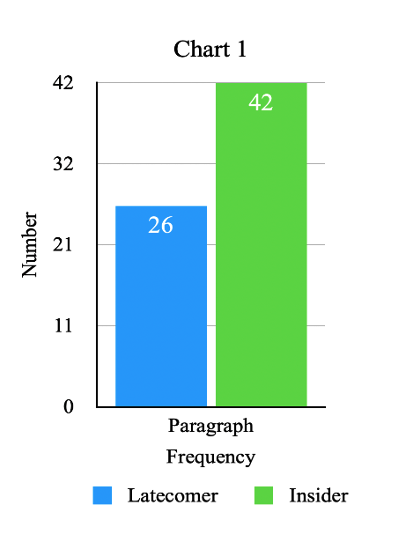
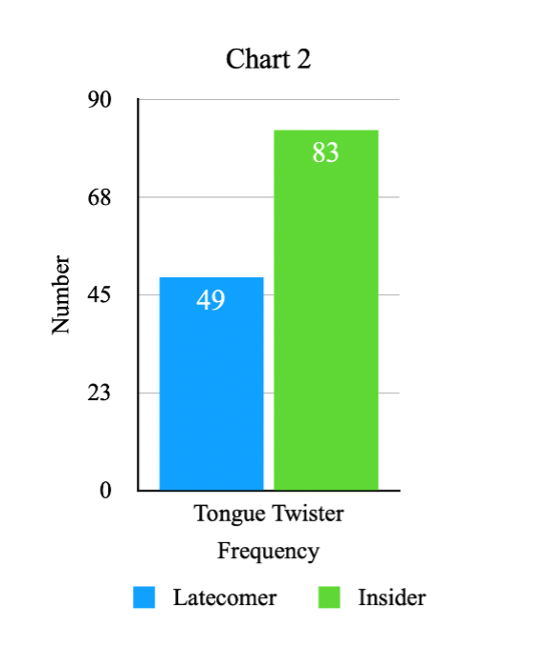
This study picked one script from our interview of the participant and wrote it in the Pinyin written system, and recordings of one of each participant’s pronunciations among the two groups. The data shows that insiders were adding more [ɹ] sounds than latecomers. Then, two charts show the result of the collected data. To show the differences in the data more visually, this study marked the areas of difference in red (refer to Appendix).

Chart 1: The Number of the Sound in Paragraph Showing the Different Frequency Between Latecomer and Insider
Chart 2: The Number of the Sound in Tongue Twist Showing the Different Frequency Between Latecomer and Insider

As the two tables above show, concerning the frequency of use of er sounds, in the case of interviews, latecomers used them 26 times however insiders used them 42 times. The percentage ratio is 62% to 100%. This means that insiders used the [ɹ] tone 100% of the time, while latecomers used the [ɹ] tone 62% of the time. In the case of tongue twister, latecomers used it 49 times, but insiders used it 83 times. The percentage ratio is 54% to 93%. The result indicates that in the “standard” case, the number of [ɹ] sound was used should have been 90 because two participants of the insiders did not add the [ɹ] sound where it should have been added, thus resulting in a non 100% value.

Based on this result, the researcher analyzed the data from a positional perspective, this study found two specific examples of the tongue twisters.

Example 1 一串串(means ‘Strings of..’)
Yi   chuan-er   chuan-er
Example 2 一段段(means ‘Paragraphs of..’)
Yi   Duan-er  Duan-er

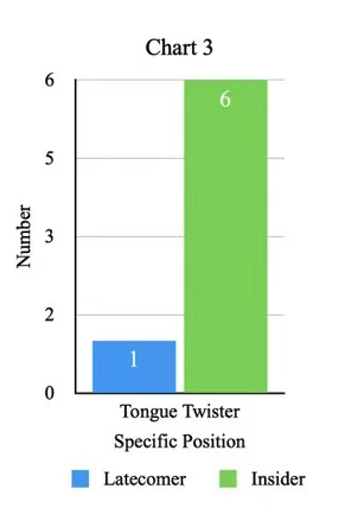
The data shows that two examples have the same pattern position of the [ɹ] sound insertion, i.e., insiders add both er sound to not only the penultimate but also the final word. However, most of the latecomers only add the [ɹ] sound to the final word. The specific data is that only one latecomer has the same insertion as the insiders whereas all 6 insiders add [ɹ] sound at both positions. The percentage ratio would be 17% to 100%, just like the data shows in Chart 3.

Chart 3: The Number of the Correct Position in Tongue Twister Added by Latecomer and Insider

Discussion and Conclusion

One of our major findings was that our previous assumptions were tested completely false by data analysis. We were expecting that latecomers use more [ɹ] sounds than insiders while talking about frequency. In addition, we were expecting latecomers would use the [ɹ] sound in incorrect positions. However, the result of the data showed the opposite.

The result from the data of our research appears to go against our hypothesis, which is that we think people who moved to Beijing in later times will employ “erhua” sounds more often, but not in the appropriate position. However, two of our (latecomer) participants stood out to us. The first participant was referred to P1. P1 employed the least of the [ɹ] sound among all of our participants from the two scripts we sent out. The second participant, P2, had employed the [ɹ] sound in an appropriate position and the frequency matched with locals. Due to the extreme differences shown in our data, we proceeded to interview them.

There are different linguistic findings from our interview for the two participants such as nature of personality, identity/language attitude, and linguistic capital. For P1, she is introverted. In the interview, she stated, “ I am more of an introvert, so I don’t like to socialize. I came here with a few friends from my town, and I usually only hang out with them.” A second finding from the interview for P1 is her identity/Language Attitude. The participant expressed that she does not believe in language prestige. Moreover, she is proud of her identity, so she doesn’t think adapting a Beijing accent is essential for her to live there.

Interestingly, our P2 participant expressed a different view on this matter. During the interview with P2, we found out about her attitude towards her Linguistic Capital. The participant believes that adapting a Beijing accent will help her in the future whether it’s for more job opportunities, networking, and better future, education, and an environment for her children. These findings connect with the Ted x Talks video on Youtube “Why your speaking style, like, says about you” by Vera Regan. The research tries to understand why people use the small word “like” in their casual speech. The results of the research communicate that language helps individuals to express their agency and choices. They let people freely identify with a country or a place, and they speak about people’s long-term plans. For P1, she identifies with her hometown and she is proud of her own identity. P2 identifies with Beijingese, thus, she adapts a Beijing accent to express that. She also has thought about her future in Beijing which comply with the long-term plans as in the research stated above.

For this research, since our target population focuses on the Beijing latecomers, studying their frequency of using the [ɹ] sound allows us to learn more about their social status including social identities, recognition, and self-identity construction. According to the main findings, we found that participants who used the [ɹ] sound more frequently are those people who tend to have a long-term plan to stay in Beijing and are willing to be socially reintegrated. In the process of research, we also encounter a few constraints due to the small number of participants which could cause limitations to the research results. First of all, there is actually no way of the “correct” Beijing accent since the geographical location and environment in which one lives will also affect the pronunciation of the [ɹ] sound. For example, people from the east side of Beijing may speak differently from those from the south side, Chongwen may speak slightly differently from Xuanwu, and even people from the same alley may have some minor differences in the use of [ɹ].  Therefore, we did not include an answer key for the “ɹ” sound in both the paragraph and the tongue twister. Instead, we could only take local Beijing participants’ pronunciation as the “standard” way and compare it with the latecomers to analysis amount of “ɹ” sound. The second limitation would be the sample volume. If we are only able to record and interview people in our social circle, the number is defined.

Among these local participants, most of them are the same age as us since we are still students with a fixed network, so classmates and friends while growing up are our first choice. The limited sample due to the lack of the diversity of age, occupation and other aspects caused our participants to not be representative enough. We assume that all latecomers would present similar data as we collected, but we ignore the fact that different social status and the stage of maturity would also possibly affect our hypothesis. Based on this limitation, our future research will pay more attention and develop our research on these social aspects to discover if there are any interesting patterns such as the differences of older people and new generation using [ɹ], as well as how people adopt the sound differently in various fields and positions. Moreover, we are passionate about learning the understanding of various demographic groups towards morphosyntactic functions of rhotacization as well as different expressions such as word choices for Beijing people specifically compared to people from other regions.


References

Dong, J. & Blommaert, J. (2009). Space, scale and accents: Constructing migrant identity in Beijing. Multilingua, 28(1), 1-23. https://doi.org/10.1515/mult.2009.001

Eckert, P. (2018). Meaning and linguistic variation: The third wave in sociolinguistics. Cambridge University Press.

Liu, K. F. (2018). Chinese Speakers in America: Diglossia as Style. essay: critical writing at Pomona College, 2(2), 5.

Xu, Z. (2020). Choosing rhotacization site in Beijing Mandarin: The role of perceptual similarity. University of California, Los Angeles.

Zhang, Q. (2005). A Chinese yuppie in Beijing: Phonological variation and the construction of a new professional identity. Language in society, 34(3), 431-466.

Zheng, M., & Liu, J. (2017, June). Language Attitude and Linguistic Practice of Northeastern Migrants in Beijing, China. In Proceedings of the 29th North American Conference on Chinese Linguistics (NACCL-29) (Vol. 2), Michigan State University.


Appendix 1

Paragraph


1

latecomer

/insider

2

latecomer

/insider


3

latecomer

/insider


4

latecomer

/insider


5

latecomer

/insider

6

latecomer

/insider

干活儿

ganhuo-er

1/1 1/1 1/1 -/1 1/1 -/1
官儿

guan-er

1/1 1/1 1/1 -/1 1/1 -/1
从小儿 congxiao-er 1/1 1/1 -/1 -/1 -/1 1/1
外套儿

waitao-er

1/1 1/1 1/1 -/1 1/1 1/1
这块儿 zhekuai-er 1/1 1/1 1/1 -/1 1/1 -/1
出门儿 chumen-er -/1 1/1 -/1 -/1 -/1 -/1
别这儿

biezhe-er

-/1 1/1 1/1 1/1 1/1 1/1
Tongue twister 1 latecomer

/insider

2 latecomer

/insider


3 latecomer

/insider


4 latecomer

/insider


5

latecomer

/insider

6

latecomer

/insider

哥俩儿

gelia-er

-/1 1/1 1/1 -/1 1/1 1/1
脸蛋儿

liandan-er

1/1 1/1 1/1 -/1 1/1 -/1
手拉手儿 shoulashou-er -/1 -/1 1/1 -/1 -/1 1/1
一块玩儿 yikuaiwan-er 1/1 1/1 1/1 -/1 1/1 1/1
一串串儿 yichuanchuan-er 1/1 1/1 1/1 -/1 1/1 1/1
一段段儿 yiduanduan-er 1/1 1/1 1/1 -/1 1/1 -/1
贪玩儿

tanwan-er

1/1 1/1 1/1 -/1 1/1 1/1
小猫儿 xiaomao-er 1/1 -/1 -/1 -/1 -/1 -/1
圆圈儿 yuanquan-er 1/1 1/1 1/1 -/1 -/1 1/1
小狗儿 xiaomao-er 1/1 1/1 1/1 -/1 -/1 -/1
庙台儿

miaotai-er

-/- -/1 1/1 -/1 1/- -/1
小鸡儿

xiaoji-er

-/- -/1 1/1 -/1 -/- 1/-
小米儿

xiaomi-er

-/- -/1 1/1 -/1 -/- 1/1
小鱼儿

xiaoyu-er

-/- -/1 1/1 -/1 1/1 1/1
水泡儿 shuipao-er 1/1 -/1 1/1 -/1 1/1 1/1


Tongue twister 1 latecomer

/insider

2 latecomer

/insider


3 latecomer

/insider


4 latecomer

/insider


5

latecomer

/insider

6

latecomer

/insider

一串串儿 yichuanchuan-er 1/1 1/1 1/1 -/1 1/1 1/1
一串儿串儿 yichuanchuan-er -/1 -/1 -/1 -/1 1/1 -/1
一段段儿 yiduanduan-er 1/1 1/1 1/1 -/1 1/1 -/1
一段儿段儿 yiduanduan-er -/1 -/1 -/1 -/1 1/1 -/1

[/expander_maker]

, , , ,

THE GAY PONDER: Closeted Sapphic Celebrities Deciding How To Talk About Their Private Lives

Kayla Cardoso, Van Hofmaister, Jamie Jiang, Clarissa Sie, Rainey Williams

In 2016 a 1979 interview with Jodie Foster resurfaced on the internet and instantly took hold in the meme community. When asked about a potential boyfriend, Jodie smirks, licks her lips, and raises her eyebrows in a manner that gives the impression she knows something that her interviewer does not. The label [gay silence] was given to this instance and it has become a part of gay culture and  the LGBT community as an identifying feature of closeted individuals. With this in mind, our study takes a sociolinguistic approach to analyzing and examining the idea of a sapphic/lesbian code. Coded sapphic speech is not well studied in sociolinguistics, and while the community itself is able to identify markers of such, there has been little to no substantial research on identifying features present in sapphic language. In analyzing the speech and body language of sapphic celebrities, we seek to provide evidence and tools to identify linguistic markers.

[expander_maker id=”1″ more=”Read more” less=”Read less”]

Introduction and Background

If you’re a particularly online or memelord-y queer person, you might have seen the “gay silence” meme by now. A young Jodie Foster, who now publicly identifies as lesbian, stares off-camera at her interviewer with a slight knowing smile and a strained look in her eyes. The subtitles characterize her contribution to the conversation as “gay silence.”
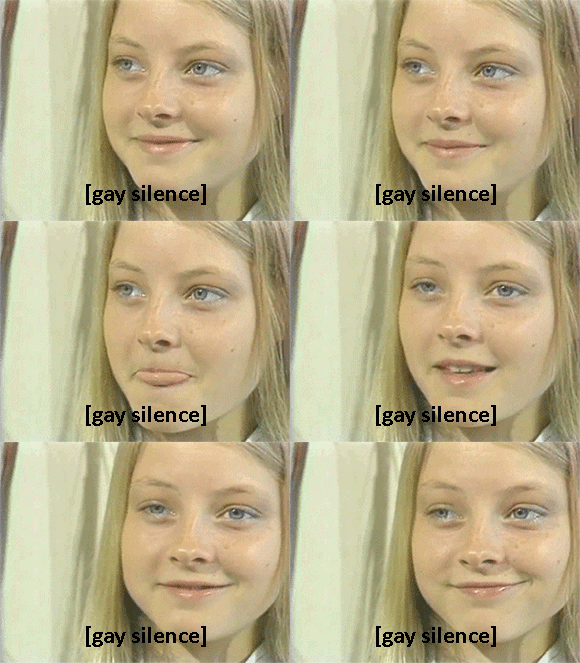
The image comes from a 1979 interview with 17-year-old Jodie Foster on the Macneil/Lehrer Report. Clips of the interview resurfaced a couple years ago and caught the attention of the sapphic community (“sapphic” is an inclusive term referring to any person, woman or otherwise, who identifies as lesbian). In the clip, Foster answers awkward questions about the kind of boyfriend she would like and the qualities in actresses that “turns” her on.

Foster is generally seen as early lesbian “icon”. One YouTube comment about the interview jokes: “Jodie Foster founded Lesbianism. She’s like the final boss”. Another viewer writes: “the gay energy in this is immaculate.” Most viewers point out Foster’s subtle subversion of the heternormative questions. Another commenter points out how young Foster’s mannerisms match contemporary codes of lesbianism – “Every mannerism she has is now lesbian code. Funny, right? (Way of sitting, way of taking the cup of tea, way of talking).”

Coded sapphic speech is not well studied in sociolinguistics. While the community itself is able to identify lesbian markers, as demonstrated by the commenters above, there has been very little empirical research on those markers in language. One commentary by April Jackson published in a feminist journal called “Bringing Lesbian Language Out of the Closet” claims lesbians do not have a collective public language. Nothing in the literature we found could support this claim, but the literature pool is already small. Most studies on sapphic speech are conducted on lesbian acoustic features under the stereotype-driven fallacy that gay women are the acoustic mirror of gay men, otherwise known as “Gender Inversion Theory” (Kachel 2017).

Our study aims to fill this gap with a thorough study of “out” sapphic speech. Specifically, we provide two case studies, lesbian and sapphic icons Jodie Foster and Kristen Stewart, characterizing the way sapphic celebrities speak about love, family, and sexuality before and after coming out.

Methods and Transcription Notation

Our hypothesis was that these women will behave differently depending on if they know the interviewer – and by extension, the greater audience – is aware of their identity or not.

With particular interest given to observing lesbian speech in environments where responses are elicited by another individual in regard to matters of romance, personality, and private life, we performed conversation analysis on queer women Jodie Foster and Kristen Stewart from the existing canon of interviews in the public record. We analyzed interviews on a scale of “outness” – before publicly coming out, in more “out” settings, and after publicly coming out – in order to draw comparisons and see if different aspects of their employed speech changed after they perceived members of their audience as aware of their identity.

Using conversation analytic methods, that data was examined for prosodic changes, i.e. hesitations, silences, breathiness, emphasis, and volume fluctuations. Particular attention was paid to: potential pauses[1] between utterances (the question and the intended response), employment of gendered versus gender-neutral words, and perhaps instances where the subject avoids the topic altogether. Furthermore, although more paralinguistic than overtly linguistic in nature, physical movements and posturing of the body in response to different questions allowed further insight into an interviewee’s response. Comparing this with later interviews where a given celebrity’s identity is public knowledge gave us an idea of whether or not these linguistic and paralinguistic choices were simply personality quirks. 

[1] In conversational analysis, a pause conveys meaning. The amount of time after an utterance is spoken may reflect different attitudes in a speaker. Such length after a pause can be interpreted as a few things, including hesitancy, disagreement, lack of interest, or that the speaker is having a hard time thinking of how to respond. We will be actively taking note of the length of any pauses within interviews in order to gauge how the speaker might be feeling in response to some interview questions.

Special attention was given to the interviewer’s demeanor, attitude, and in what context the celebrity was being asked these questions, as well as the content of the questions being asked, and whether those questions became more invasive once an interviewer knows they are asking someone who is lesbian. We tested for the possibility that our subjects were simply exhibiting discomfort while answering personal romantic questions, no matter their sexuality. As a method of control, the study includes conversation analysis on Brooke Shields and Amanda Seyfried; two heterosexual women who are contemporaries with Jodie Foster and Kristen Stewart respectively.

Transcription Notation:

  • [Overlap Bracket: Left brackets mark the point at which the current talk is overlapped by other talk.
  • Stressed Syllables: Underlined letters are used to indicate an emphasis on a word.
  • ° Low Volume: A degree sign indicates that talk it precedes is low in volume
  • Silence: Numbers in parentheses mark silences in seconds and tenths of seconds
  • Increased Volume: Upper case indicates increased volume.
  • Breathiness: An (h) indicates plosive aspiration, which could result from events such as breathiness, laugher, or crying
  • Noticeable Pauses: A period between two parentheses is used to indicate (short) pauses.

Results and Analysis

Brooke Shields

In order to have a point of comparison to Jodie Foster (one might say, hetero to Jodi’s homo), we chose to do conversational analysis on acclaimed actor and model Brooke Sheilds. Shields has been in the public eye as a famous figure her entire life, given her assimilation into the acting and model industry from a very young age (Shields was doing model jobs as an infant). Shields was also considered a very attractive individual, and given the subject matter she starred in (one example being the controversial–and in this writer’s opinion, very gross–film “Pretty Baby”) became a “sex symbol” in her teenage years.

This mindset of the public in regard to Shields led to her interviews being riddled with topics circulating towards: sex, men, crushes, boys, and other sexually or romantically charged vocabulary.

Given the frequency of such words as well, it provides viewers a good point of reference to how Shields would respond to questions that were deemed more harmless (crushes) to those that are more inappropriate (sex). For our study in particular, having interviews where the interviewer had the pre-existing mindset that Shields is someone her fans “desired” is a good control for Foster’s behavior. This way, we  can look into similarities and differences with regards to how invasive a question is without any distinction made between sexuality. Sometimes the things people are asked, point blank, make them uncomfortable.

The first conversational analysis performed was on an interview in 1981 by the interviewer Bobbie Wygant (who also interviewed Foster two years prior). In the interview Wygant asked Shields many questions about sex, rather than the plot of the film she was in at the time. Wygant  asked things like whether or not she thought that young girls are able to have sexual relationships, later leading to her question to Sheilds, herself, about whether she could handle a sexual relationship or not. Shields at the time was 15 and seated between two of her adult male co-stars in the film “Endless Love”.
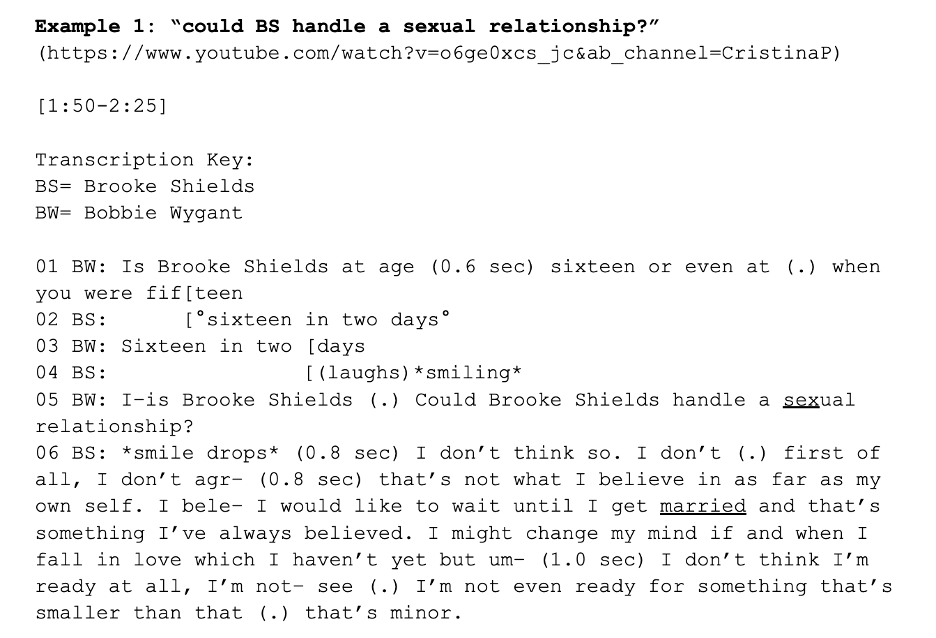
Some of the aspects of Shields’ response that were particularly noteworthy was her use of laughter towards the beginning of the interview, as well as the significant pauses she evokes after Wygant asks her the invasive question. Shields also stutters slightly, and has more pauses as she gathers her thoughts together in order to construct what people in the comments of the interview called “classy” or “graceful” despite the question’s probing content . Overall, the biggest instance of perceived discomfort for Shields’ responses to questions was found in this interview where the topic itself was something deeply personal and invasive to ask anyone.

The second interview of import was conducted by Bill Boggs around a similar time in Shields’ life. Contrary to the Wygant interview, Boggs interview doesn’t explicitly ask Shields about sexual relationships, some of it is implied however. At one point in the interview Boggs asks Shields about her ability to make men feel “comfortable” with her. He even compares her ability to “thirty five year old women” he knows who aren’t capable of the same thing. Such a question, to an observer, seems off, especially considering the comparison between fully grown adult women and Shields, who was only a teenager at the time.
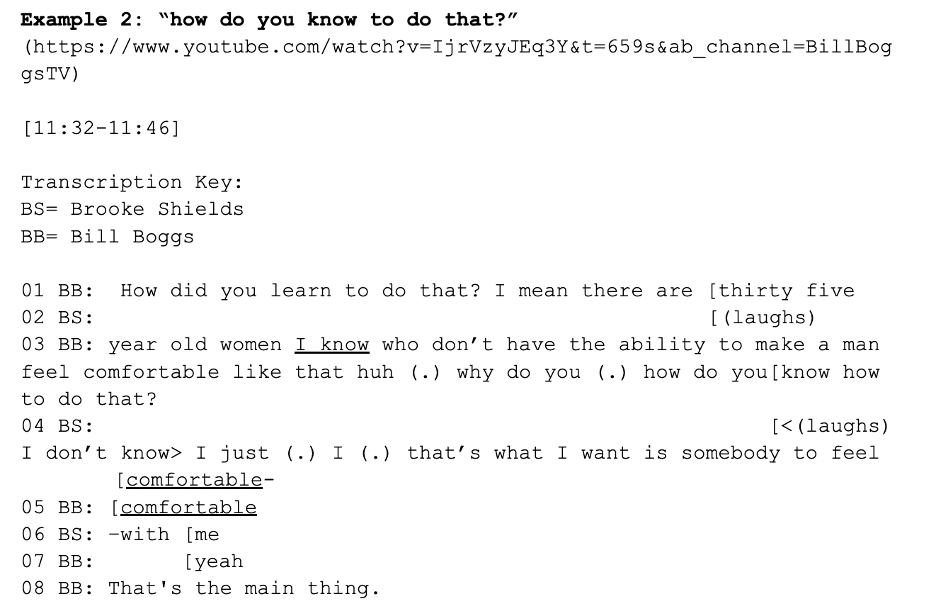
Similar to the previous interview there is evidence that Shields uses laughter as a response to a question that has some degree of romantically charged backing. In the later part of the interview Boggs asks Shields about the difficulty of not getting a crush on her male counterpart in a film.
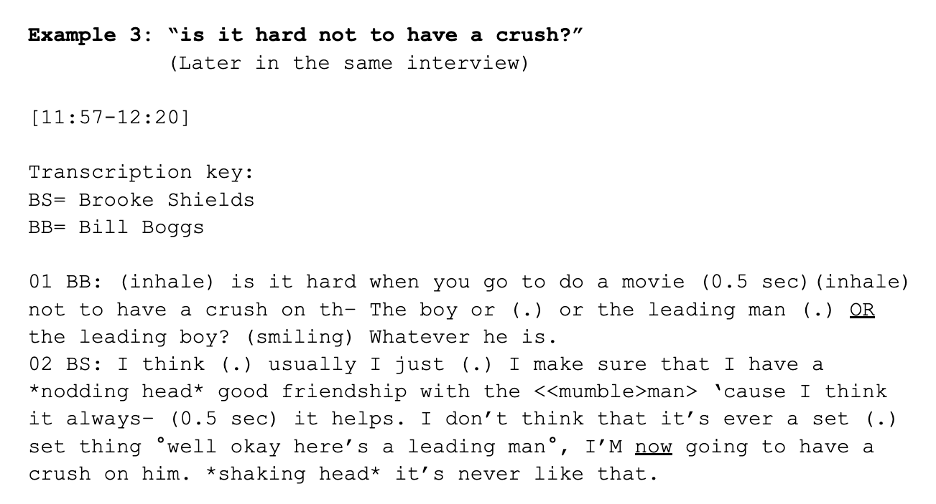
Shields doesn’t hesitate to use masculine pronouns to refer to the recipient of her hypothetical crush, and although she does include a pause, it is more similar to her gathering her thoughts than being read as uncomfortable as it was in the first interview example (comparing a 0.5 second pause to the 0.8 or solid 1.0 seconds in the interview with Wygant). The only instance in which there is some aspect of her response that could portray uncomfort is when she mumbles the word “man,” however this is much more likely to be attributed to the fact that she was still a teenager at the time and her co-stars were more often than not older than her by a decently large margin.

Shields also has open body language in her interviews, where she smiles back at the interviewer, nods or shakes her head, and most noticeably laughs as a response to various questions.

Jodie Foster

Results from conversational analysis on Jodie Foster stood out from conclusions we drew on her heterosexual contemporary, Brooke Shields, in four ways:

(1) Foster used “the gay silence” when closeted;

(2) Foster used gender-nonspecific terms when closeted;

(3) Foster played with gender roles more often in a more “out” setting than in a closeted one;

(4) Foster was a more supportive and intimate conversation partner in an “out” setting.

In the interviews we analyzed discussing romance and sexuality, Shields responds to interviewers using laughter 50% of the time. By contrast, Foster used “the gay silence”. In a 1979 interview with Bobbie Wygan, Foster responded to heteronormative questions about her love life with several pregnant pauses.
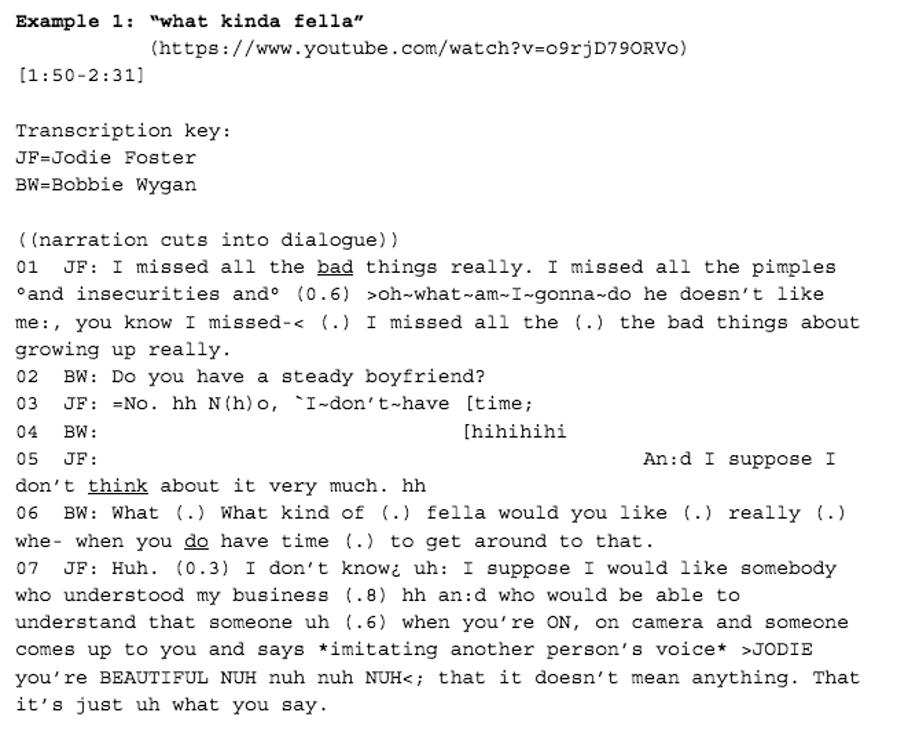
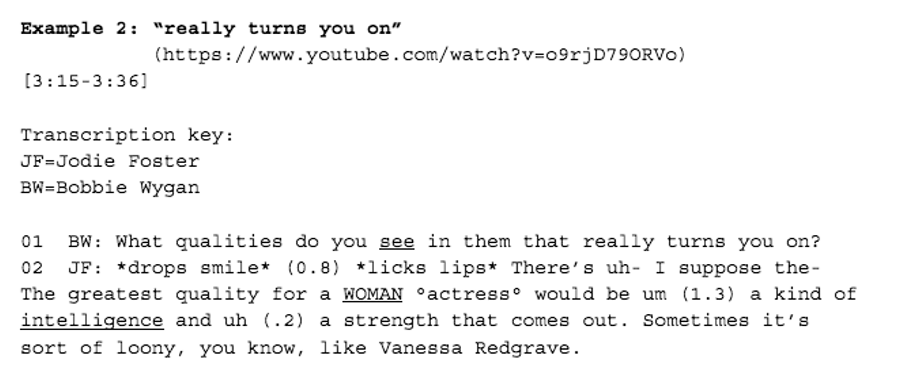
Foster’s silences came to an average of 0.49 seconds overall, twice using a 0.8-second silence during clips from the 1979 interview. Her longest silence occurred after the interviewer asked an awkwardly phrased question – what qualities in a female actress “turns” Foster “on” – a total of 1.3 seconds. This is the longest silence of any interviewed subject in our research.

Foster also used gender non-specific terms when closeted and avoided giving pronouns to potential romantic partners. In Example 1, Foster expresses a desire to date “somebody who understood my business” when the interviewer specifically asked about a “fella.”

We classified an interview with fellow closeted lesbian Rosie O’Donnell as a slightly more “out” setting than other interviews, even though the public was still largely unaware of her sexuality. The brash show host with a deliberately comedic style, O’Donnell played with gendered language and perceived gender roles during her conversation with Foster, prompting the same subversive gendered language in Foster.
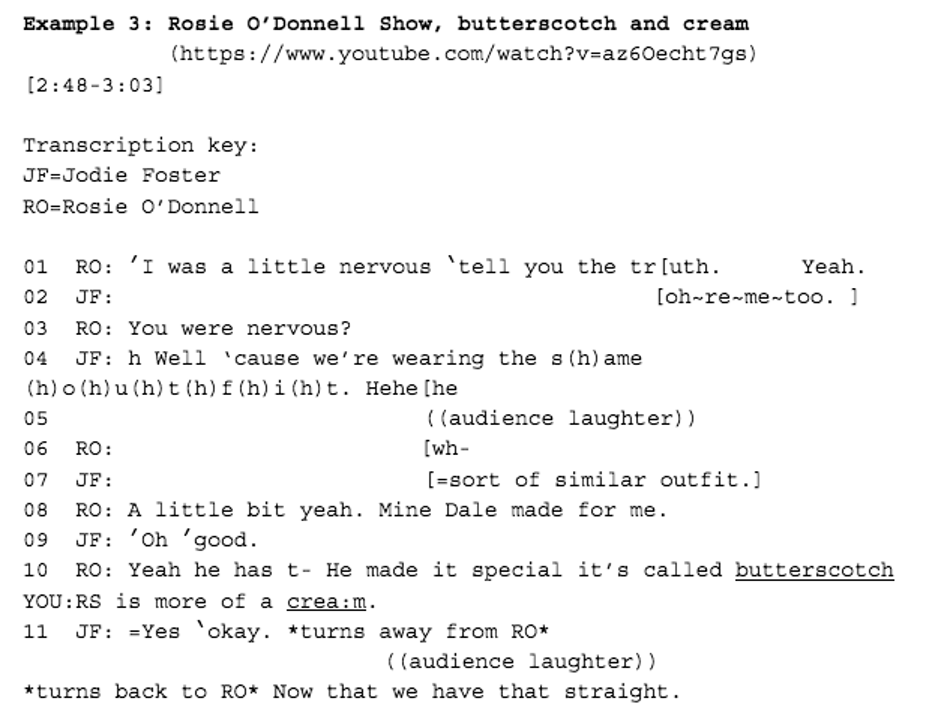
Robin Lakoff (1973) hypothesized that “women’s language” (WL) incorporated more color vocabulary than non-WL. The performance and nonperformance of WL in this interview highlights how queer women subvert gender in liminal “out” spaces. In Example 3, O’Donnell prompts audience laughter by drawing an exaggerated distinction between “butterscotch” and “cream” clothing. She appropriates highly feminine language (pointing out shades of difference in clothing colors) while highlighting her less prestigious New York accent (perceived as “rough” and “lower class” and therefore masculine). The joke results in a clash between feminine language and masculine presentation.

Foster responds by rejecting the feminine language and instead adopting a masculine disinterest in the color difference. She turns away from O’Donnell to look at the audience before ironically saying, “now that we have that straight.” This presents another clash in gender presentation and therefore subversion of gendered language.

We analyzed another “out” setting in which Foster comfortably indexed her queer identity in an interview. In 2014, Foster presented the “Glamour Woman Of The Year” prize to transgender icon and friend Laverne Cox. This was only a year after Foster publicly “came out” in the public sphere. Foster and Cox’s interview with Katie Couric after the awards ceremony displays Foster’s intimacy and vulnerability while speaking about her family and the state of queer liberation in 2014.
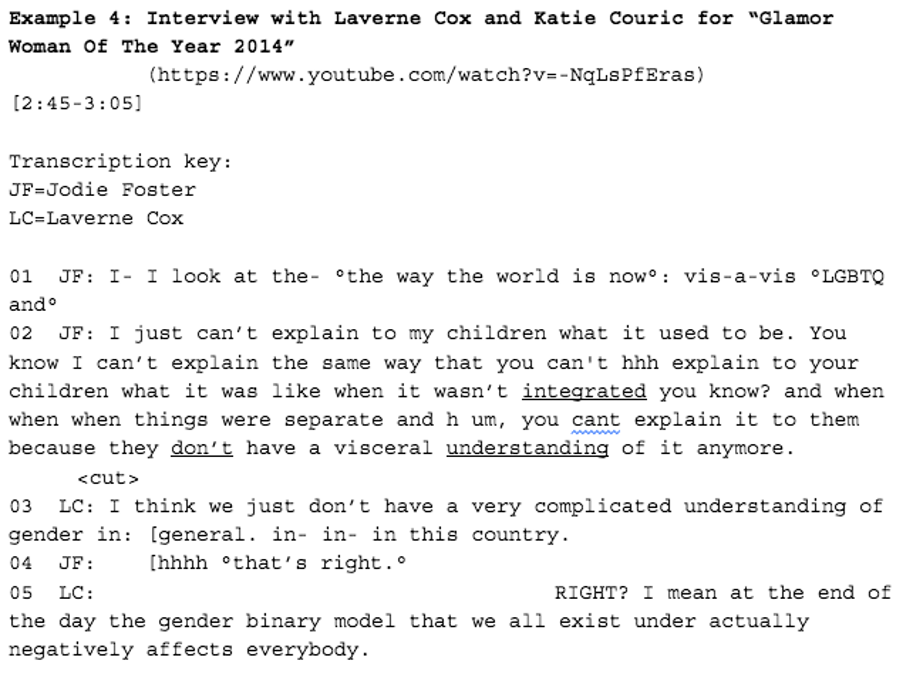
Foster speaks quietly and slowly, with heavy and personal emphasis, while speaking about the progression of LGBTQIA+ liberation. In the next cut, Foster indexes her intimate friendship with Cox as well as her solidarity with Cox’s experiences through supportive interruption (Tannen, 1993). Foster cuts in with a positive response (chuckling in line 04) and affirms Cox’s experiences. Cox, in turn, acknowledges the support in line 05.

Contrast this interaction with a far more disastrous interview from 2007 in which a straight male interviewer made an inappropriate joke about Foster’s lesbianism. In that interview, we found Foster speaking in extremely high pitch, laughing, stuttering, and backing away from engaging with her interviewer on several topics of conversation. In the next appearance Foster made on the show, the interviewer joked that Foster didn’t like him; perhaps alluding to her uncomfortable retreat from their last interview. 

Amanda Seyfried

Amanda Seyfried was chosen as Kristen Stewart’s heterosexual counterpart because of her similar exposure to fame. Amanda’s breakout roles in Mean Girls (2004) and Mama Mia (2008) lead to a surge of interviews in the young actress’s life, just as Stewart’s breakout role in Twilight (2008) spawned a plethora of interviews. Seyfried’s dating activity has always been accessible to the public, whether that be through social media posts from the actress herself or public interviews. In our chosen interview Seyfried is being interviewed by Ellen on daytime television, with the topic of conversation being Seyfried’s recent vacation with then boyfriend Justin.
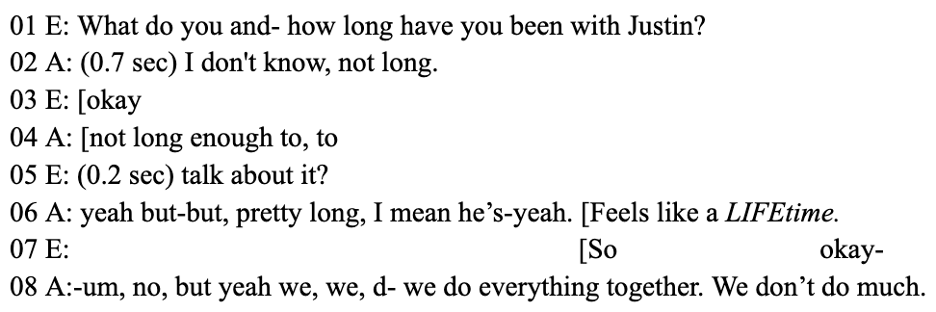
After Ellen’s initial question of how long she has been with Justin, Seyfried pauses and is unsure of her answer. She continues to build on her thoughts and answers Ellen’s question fully with sincerity across lines 04-08. When Seyfried says in line 06 that it feels like a LIFEtime, she make a contrast between the short time they’ve been together and the potential romantic exaggeration of saying “lifetime,” making the line come out as almost a mocking joke, but her follow-up with sincerity, saying they “do everything together” in line 08 confirms the truthful tone of her latter statement.

Kristen Stewart

Kristen Stewart is an actress who has stated that she has never felt truly “closeted” – in the sense that she never attempted to hide her attraction to women, and even before any official statements about her sexuality, or public appearances with female/nonbinary partners, she has shown obvious interest in women. When analyzing her speech, it’s important to keep this in mind, because it may inform interpretations of her answers to certain questions.

Stewart is an interesting subject to study, particularly because of her strong presence in the public eye as a romantic lead in Twilight. Conveniently, during filming of the Twilight series, she also appears as Joan Jett in The Runaways, where she has an on-screen romance with female co-star, Dakota Fanning. Comparing her reactions to prying questions in context of both Twilight and The Runaways gives us a way of judging her comfort level without confounding variables such as age or level of fame, since they take place in the same timeframe.

Stewart is a person who has been classified as shy, guarded, or introverted, mostly in response to questions about her romantic life, and such discomfort can be seen in several interviews where an interviewer will ask her about her relationship with Twilight co-star, Robert Pattinson. In one interview, an interviewer questions Kristen on filming a particular kissing scene with Pattinson.
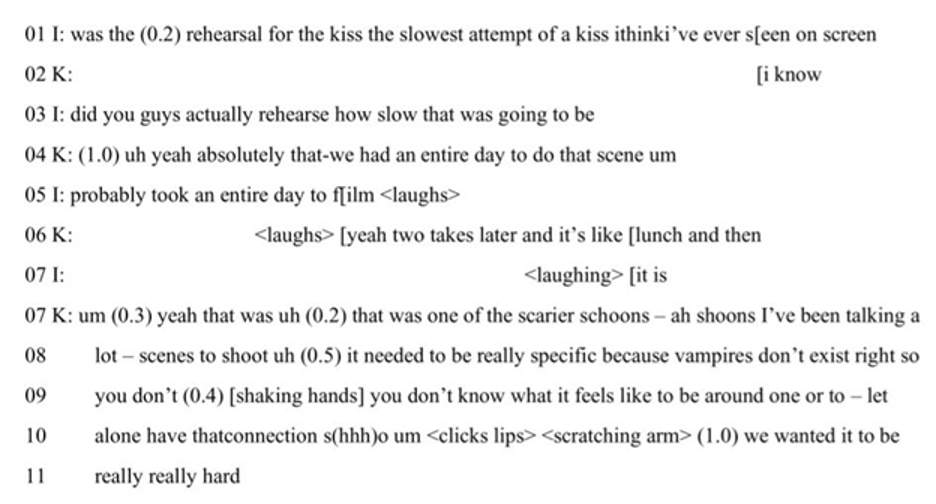
Previously fluid and casual, Stewart begins to stutter, use filler words, and make speech errors, as well as take significant pauses in her speech. Most notably, she also avoids the question entirely, choosing instead to mark on the filming process and vampirism as a concept, rather than her chemistry with Pattinson. Similar reactions can be found in several other interviews on the same subject, where solicitations of romantic involvement with Pattinson are met with stuttering and subject avoidance. In one interview with Oprah, the host even remarks on Stewart’s publicly-known coyness on the subject, directing the question to Pattinson himself only for him to similarly dodge the question, albeit in a more humorous and comfortable way.

Alternatively, Stewart’s shyness did not seem to extend with her onscreen romance with Fanning, and in interviews with similar questioning, responded with confidence, humor, and ease.
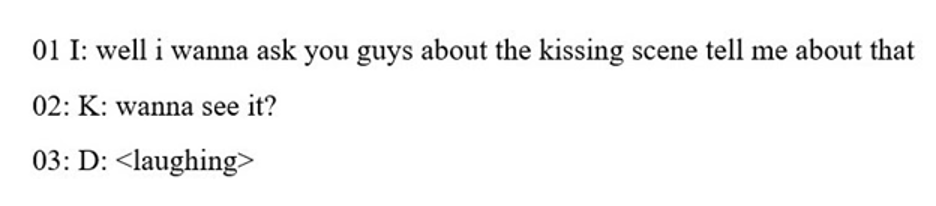
Rather than avoid the subject, she leans into it and encourages more conversation. When questioned about the “best kisser” in the context of her Twilight love triangle, she responds with “Dakota” in several different instances. This lack of trepidation is consistent among a number of interviews, with and without Fanning next to her.

Later in her life, Stewart began making her romantic involvement with women more public, and announced an engagement with her fiancée, Dylan Meyer. The same ease, confidence, and positive language can be observed when she talks about Meyer in an interview with Jimmy Fallon.
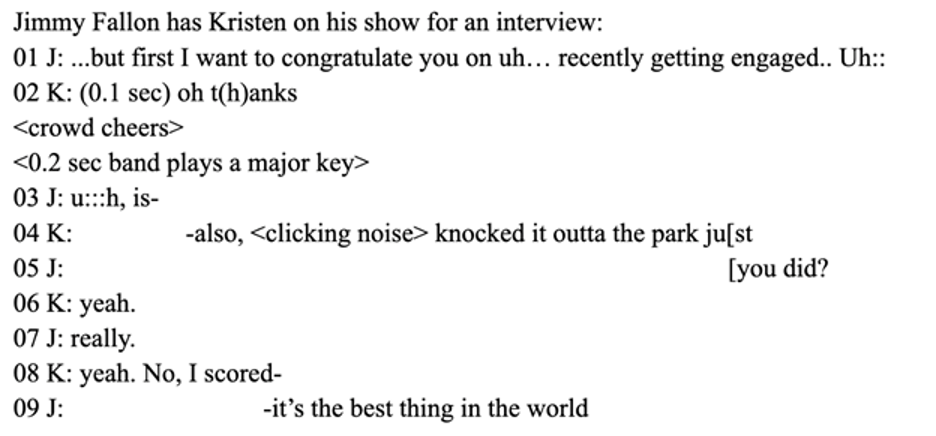
She no longer stutters, she uses objectively positive language discussing her partner, and has an open and relaxed posture. Additionally, Kristen in line 02 begins to laugh as she says “thanks” causing a break in her voice. This is her first observed initiation of laughter, possibly displaying increased confidence (compared to previous interviews where she only mimics laughter after someone else has initiated it).

Discussion + Conclusions 

This study rebukes previous literature that claims sapphic people do not index their identities in their speech or that sapphic mannerisms should be mirrored counterparts of gay mannerisms. Our study of famous sapphic celebrities and “icons”, juxtaposed with their heterosexual contemporaries, show us that those sapphic individuals speak very differently in “out” settings than in “closeted” settings (whether they are completely closeted, in the presence of other sapphic people without being out to a larger audience, or completely out and discussing matters of love and sexuality). They exhibited a marked difference in comfort level, gender role performance or subversion, and positive or more intimate interlocutory behaviors.

Our results show that Foster in “out” settings, unlike her contemporary Shields, tends to subvert gender roles more often in interviews. Additionally, “out” Foster acts more supportive towards LGBTQIA+ interlocutors than towards heterosexual interlocutors. “Out” Foster speaks personally and intimately about matters of queer liberation, whereas closeted Foster becomes greatly uncomfortable and withdrawn when confronted with the question of her sexuality.

Additionally, unlike Shields (who used laughter as a frequent form of response), closeted Foster tends to display discomfort about probing personal questions with the “gay silence,” a knowing silence that avoids an admission of homosexuality but also tends not to display overt heterosexual enthusiasm.

Amanda Seyfried’s playful but overall sincere comments on her current partner can be compared to a closeted Kristen Stewart’s reaction to questions about heterosexual romantic scenes with long silences and avoidant interlocutory behaviors. Contrasting these behaviors with “out” Kristen Stewart’s speech, we find a marked positivity and confidence, given her newfound laughter initiation and active gesturing (“knocking” it out of the park) when speaking on subjects engaging in her sexuality.

Our research adds to Kachel 2017’s work by further providing evidence that Sapphic speech cannot be indexed in the binary of heterosexual women vs. homosexual women. Rather, our results show that the psychological states and conscious identifications of these individuals (awareness of interlocutors’ sexuality, awareness of audience’s knowledge about their sexuality, comfort level with indexing non-normative gender or sexuality identities) are much more important factors in whether or not sapphic speech surfaces.

This research also marks one of the first uses of CA in individual case studies to examine the use of Sapphic speech. We recommend that further research follow our direction of case studies and examine larger corpuses of data from one Sapphic subject in “out” and closeted settings to corroborate our findings about gender performance, “gay silence”, and comfort level. Additionally, we recommend further conversation analysis studies performed on sapphic individuals’ conversations within the sapphic community and compare those results with sapphic-heterosexual conversations. Finally, we recommend more robust research into the sapphic community’s online language to better understand how sapphic speech may have developed in recent years.

Additional References 

We have included an assortment of different links below used to draw conclusions and make connections between our research topic and other sources. The type of links vary from articles from pop culture media, to youtube links of different interviews conducted with celebrities.

Vice – Lesbian Culture Has Had a Major Update

(an article briefing “additions” to lesbian culture form the year 2018)


Interviews (including the interviews where conversational analysis was done and those where it wasn’t)

Jodie Foster

Famous Jodie interviews

https://www.youtube.com/watch?v=mqxkA46eIOI

https://www.youtube.com/watch?v=DiCwI4Xdvrk- https://www.youtube.com/watch?v=ct3UPiWPKS8


Jodie and gender

https://www.youtube.com/watch?v=X7p25iyvmsg&t=298s

https://www.youtube.com/watch?v=aTmjZf2NH3c

https://www.youtube.com/watch?v=ity8XVVSdI0

https://www.youtube.com/watch?v=kQQrlGjeHIM


Jodie and sexuality

https://www.youtube.com/watch?v=-NqLsPfEras

https://youtu.be/243NYLOn6WE?t=122


Kristen Stewart

Heterosexual Interactions and “Chemistry”

https://www.youtube.com/watch?v=sE0fPDIKGD8

https://www.youtube.com/watch?v=NhlS_TikKXE

https://www.youtube.com/watch?v=fREjpeShur0


On Sexuality

https://www.youtube.com/watch?v=GUMHSDzLBy4


Discussing Engagement

https://youtu.be/P7jsmfpF82M

https://www.youtube.com/watch?v=ItTWGCJGTeA


Homosexual Indications

https://www.youtube.com/watch?v=ZxvrV5UH2NE

https://www.youtube.com/watch?v=nU6gCC3DTCc


Amanda Seyfried

About her boyfriend

https://www.youtube.com/watch?v=-GSou1Dk0hc


On her Marriage and Homelife

https://www.youtube.com/watch?v=TbRtVJYUADs


Brooke Shields

On matters of sex and sexuality

https://www.youtube.com/watch?v=J31pcI3ZgN4&ab_channel=MervGriffinShow

https://www.youtube.com/watch?v=o6ge0xcs_jc&ab_channel=CristinaP

https://www.youtube.com/watch?v=aTSSBJ6xyi4&ab_channel=TheDianeRehmShow


Romance

https://youtu.be/IjrVzyJEq3Y?t=659

https://www.youtube.com/watch?v=3QWQ4gN3j4E&ab_channel=WatchWhatHappensLivewithAndyCohen

https://www.youtube.com/watch?v=htnMcHxr-Dw&ab_channel=MichaelMYoung


On Motherhood

https://www.youtube.com/watch?v=A9j2ZPcSCR4&ab_channel=BobbleheadConan


References

Clayman, Steven and Virginia Gill  (2012).  “Conversation Analysis.”  In James P. Gee and Michael Handford, (Eds.)  The Routledge Handbook of Discourse Analysis. London, Routledge: 120-134.

jackson, april. (1994). Semantic Space: Bringing Lesbian Language Out of the Closet. Off Our Backs, 24(10), 13–13.

Jacobs, G. (1996). Lesbian and Gay Male Language Use: A Critical Review of the Literature. American Speech, 71(1), 49. doi:10.2307/455469

Jones, L. (2018). ‘I’m not proud, I’m just gay’: Lesbian and gay youths’ discursive negotiation of otherness. Journal of Sociolinguistics, 22(1), 55-76. doi:10.1111/josl.12271

Kachel, S., Simpson, A. P., & Steffens, M. C. (2017). Acoustic correlates of sexual orientation and gender-role self-concept in women’s speech. The Journal of the Acoustical Society of America, 141(6), 4793-4809. doi:10.1121/1.4988684

Kulick, D. (2000). Gay and Lesbian Language. Annual Review of Anthropology, 29(1), 243-285. doi:10.1146/annurev.anthro.29.1.243

Lakoff, R. (1973). Language and women’s place.Language in Society, 2, 45–80.

Shrikant, N. (2014). “It’s like, ‘I’ve never met a lesbian before!’”. Pragmatics. Quarterly Publication of the International Pragmatics Association (IPrA) Pragmatics / Quarterly Publication of the International Pragmatics Association (IPrA) Pragmatics, 24(4), 799-818. doi:10.1075/prag.24.4.06shr

Sidnell, Jack (2013). “Basic Conversation Analytic Methods.” In Sidnell and Stivers, Handbook of Conversation Analysis, pp. 77-99.

Tannen, D. (Ed.). (1993). Gender and conversational interaction. Oxford University Press.

[/expander_maker]
, , ,

“I’m Sorry”: A comparative study of gender and individual differences in applying apology strategies in YouTube videos

Kristin Nguyen, Luxuan Huang, Vanessa Zhu, Andrea Mata, Shiyun Zhou

In recent years apology videos have become a very popular tactic used by social media influencers in efforts to help restore their online image. This study will compare and contrast the apology strategies used in 3 male and 3 female YouTuber apology videos by investigating the types of linguistic features that are found in both genders.  Moreover, we will further explore how the specific apology strategies being used influence the perception that their audiences/supporters have towards these specific Youtubers based on the comment section. The results showed that male Youtubers are more likely to use the “acknowledgement of responsibility” and “promise of forbearance” approach when apologizing while females are more likely to use the “explicit expression of apology” and explanation or account” strategy. Interestingly enough, the videos with the most positive responses came from 2 male and 1 female YouTuber which suggests that, according to their data set, there is a pattern in certain apology strategies that are more effective than others.

[expander_maker id=”1″ more=”Read more” less=”Read less”]

Introduction & Background

An increasing number of influencers apologized by publishing YouTube videos as an act to save faces and restore their images in the public’s mind. Previous studies about gender differences in using interpersonal apology strategies categorized apology strategies into 4 categories — explicit expression of apology, explanation or account, acknowledgement of responsibility, and a promise of forbearance, and concluded that women used more explicit apologies than men in interpersonal apologies (Holmes, 1989). However, apology videos are a fairly new phenomenon, and we wonder whether the pattern would also appear in our studies. As a result, we form our topic as a comparison study of gender difference and individual differences in Youtube apology videos in which we would explore the individual YouTuber’s choices of apology strategies and also gender differences based on the categorization mentioned above. 

Project Design

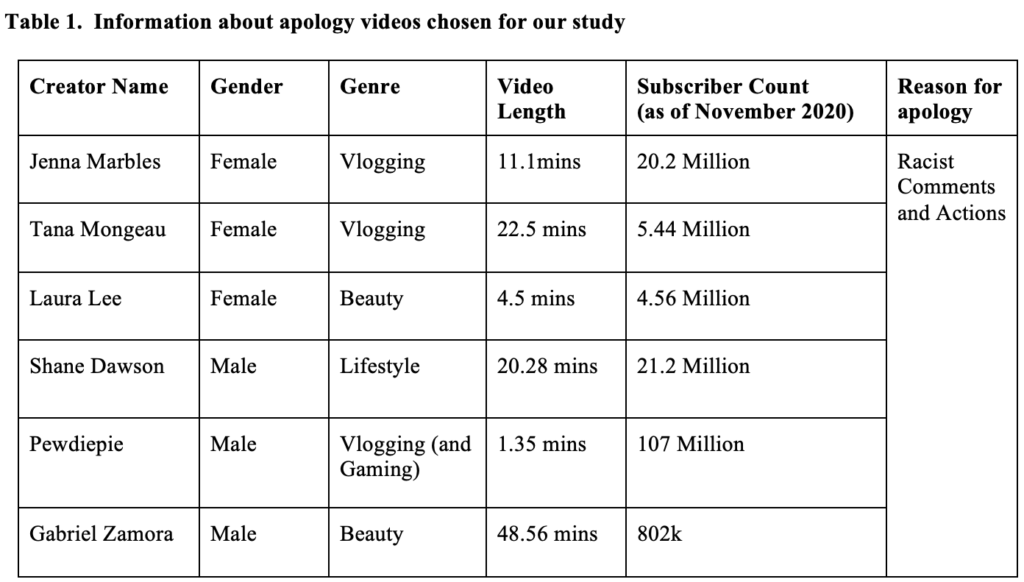
To identify how different apology strategies are used by individual YouTubers as well as by each gender, we chose a sample of 6 Youtube apology videos, 3 by females and 3 by males (see Table 1). The criteria for sample choice were based on Karlsson (2020)’s standards, which are 1) made by an independent Youtuber who runs and owns the channel, 2) made originally for Youtube and conducted in English, 3) belong to Beauty, Lifestyle, or Vlogging genre, 4) apologized for racist comments. By choosing videos addressing the same controversy over past racist comments, we minimized the influences of social and cultural contexts.

Following Holmes (1989)’s categorization for apology strategy, we collected the instances from each apology video that fit into the classification. Both qualitative and quantitative methods were used to analyze each individual video as well as all videos produced by each gender. We mainly employed discourse analysis to conduct the qualitative research when examining each individual Youtuber’s utterances as categorized by the four apology strategies and we also calculated the proportions of each strategy usage as divided by the total instances of apology in individual videos as well as in all videos produced by each gender. Besides, we also took the top 10 comments into account to evaluate how these apology videos were perceived (negative or positive), which then gave us implications of the effects of different combinations of apology strategies.

Results & analysis

A. Individual Differences

A.1. Jenna Marbles – apology video

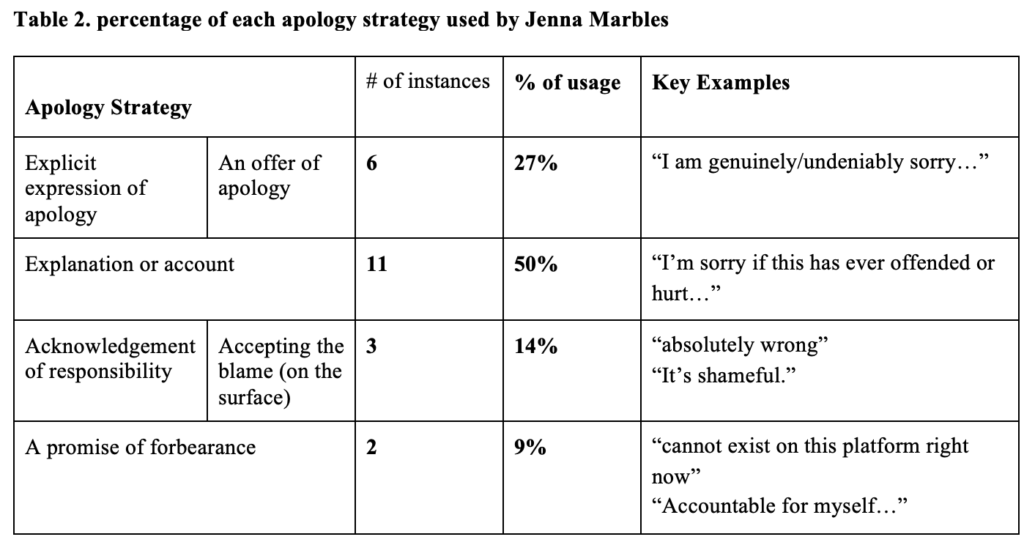
Jenna Marbles’s apology video (which has been taken down along with her channel by Marbles herself) consisted of four different occurrences that she addressed. Three were ones that people criticized and questioned her about, and one was an issue that she felt she needed to apologize for, despite her claim that no one said anything negative about this issue. Her most used strategy was “explanation or account,” which was 11 times out of the total 22 strategies in her video. She showed regret in her old content and emphasized that when she made those videos, her intention was never to hurt anyone. Although the comments we analyzed were not pulled from the original video, we still believe they reflect the general opinion of her apology. Viewers almost unanimously agreed that her apology for all four instances were genuine, and many users actually displayed sympathy for her. Her apology generated many conversations and discourse about the existence of “cancel culture.” Her least used strategy was “promise of forbearance”; however, this is arguably her most effective strategy. Marbles claimed that she wanted to “be accountable for myself” and that she could not continue being on Youtube. Since the release of the apology, Marbles has not returned to Youtube.

A.2. Tana Mongeau – apology video

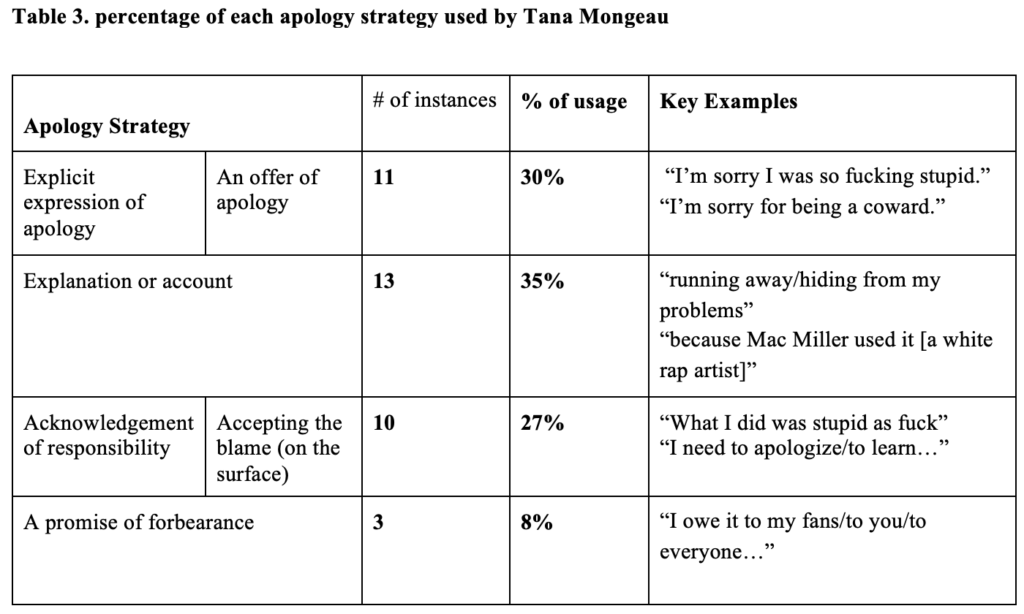
Tana Mongeau is a “storytime-centric creator. To preface this particular analysis, she was already well-known for embellishing some of her stories. It is interesting to note that her credibility was already questionable before the apology was released. This apology was in regard to her younger self using the N-word and to her reaction to another creator (iDubbbz) heavily criticizing her for this. Looking at the numerical data of her strategy usage, “explicit expression of apology” and “explanation or account” are nearly equal, with 11 times for the former and 13 times for the latter. However, 17 out of the 22 minutes in run time consisted of her explaining her logic of why she used to believe the Nword was acceptable to use and why she reacted aggressively towards iDubbbz. It was important to take into account the runtime and to consider that the number of times she used “explanation or account” alone does not fully reflect the implications of this strategy. She often repeated her explanations with slight variation in syntax but the overall lexical meaning was retained; she explained she was always “running away” or “hiding from my problems.” When there were “explicit expression of apology,” Mongeau also frequently berated her own image and character along with the explicit expression, such as “I’m sorry I was so fucking stupid.” Her apology had a significant negative reaction from her the audience, and many did not find her apology to be sincere or authentic.

A.3 Laura Lee – apology video

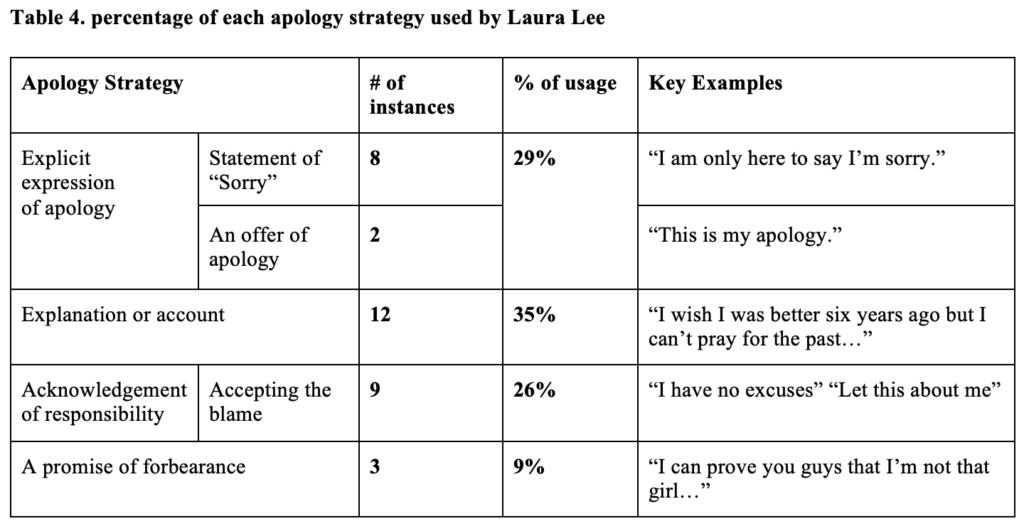
Laura Lee apologized for retweeting with racist comments in the year 2012. In her apology video, she applied explicit expression of apology 10 times, explanation or account 12 times, acknowledgement of responsibility 9 times, and a promise of forbearance 3 times. Laura used explanation or account most (p=35%) and explicit expression of apology (p=29%). Laura’s accounts or explanations were supposed to express remorse or clearly present the context of the event, but she ended up shifting blame. Laura’s strategy was to shift the responsibility to the younger her by reiterating the time when the retweet event took place was “six years ago” when she was “stupid and ignorant”. In terms of explicit expression of apology, Laura expressed her apology 10 times to different target audiences. She used “sorry” 8 times out of 10 and only said “apology” 2 times in the video which set an informal tone to her video. Overall, Laura’s apology video was like an interpersonal talk to her subscribers. Thus, even after editing, the apology video was not logical and seemed that she did not plan ahead and the use of sorry instead of a more formal term “apology” fit with this general tone.

A.4. Pewdiepie – apology video

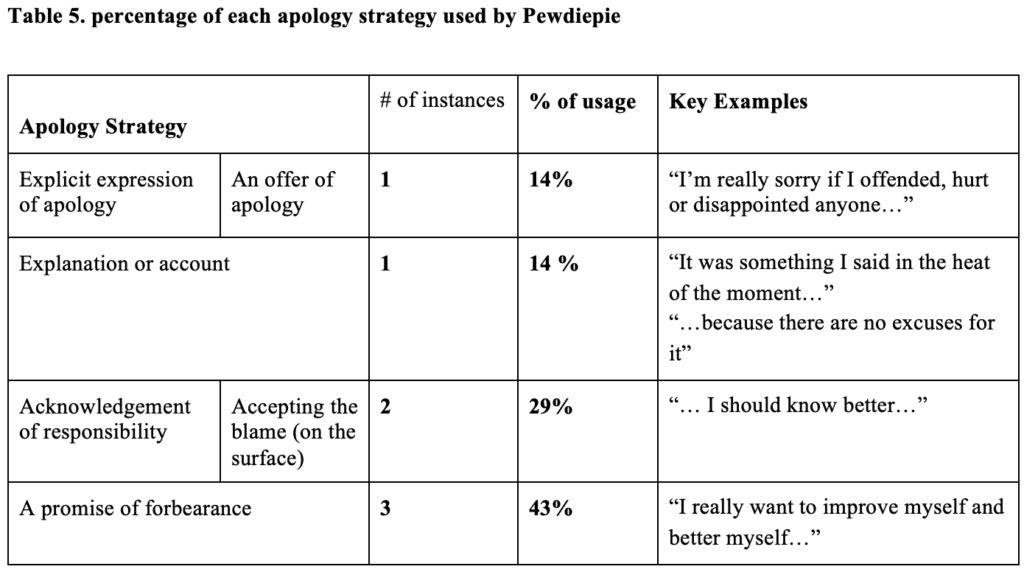
From our pool of samples, Pewdiepie (Felix Kjellberg) had the shortest video where the run time was under two minutes. He has over 100 million subscribers, and he made the apology video in order to address and apologize for his use of the N-word during a livestream. He used all strategies a total of only six times. He only explicitly apologized for hurting and offending viewers once, and his most used strategy was “promises of forbearance.” He explained he had used the slur in the heat of the moment but that it was ultimately an inexcusable action. He placed focus on his own need to be accountable for his character and what he planned to do moving forward. His video was extremely concise compared to our other samples, and viewers seemed to react positively towards his apology. In general, most viewers commented and judged that his apology was genuine. It is also interesting to note that his comment section had many users comparing aspects about his apology to other apologies, especially that of Laura Lee’s and Tana Mongeau’s.

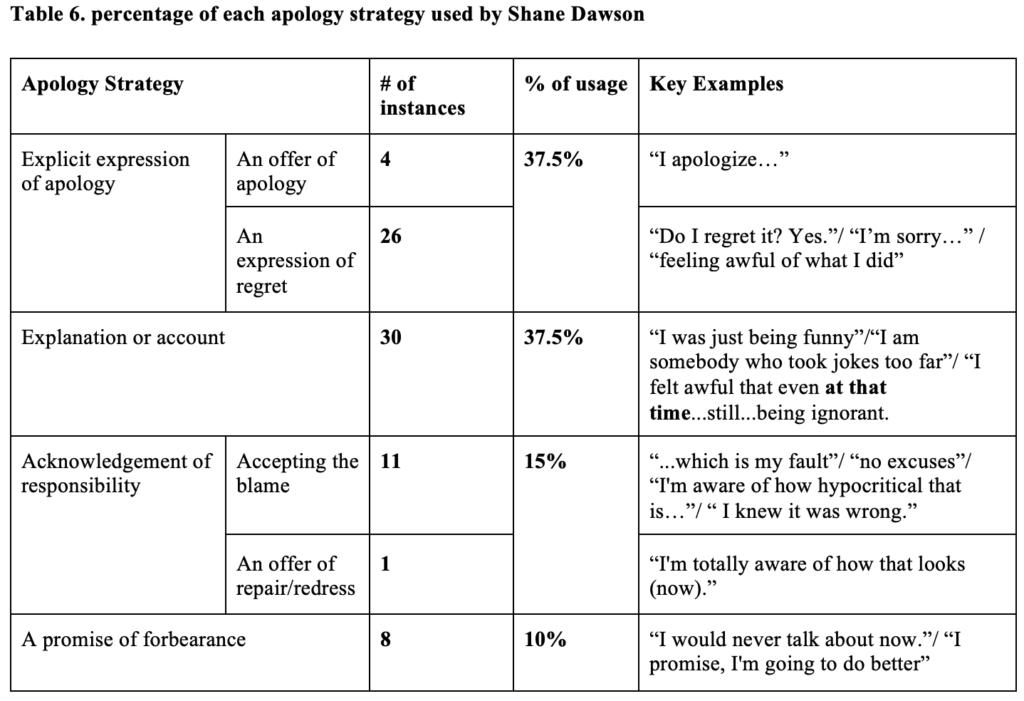
A.5. Shane Dawson – apology video

Shane Dawson made an apology video for doing blackface and saying the n-word in past racist YouTube videos. In his video, 80 instances counted as apology strategies, Shane mostly used “explicit expression of apology” (p = 37.5%) and “explanation or account” (p = 37.5%). “Acknowledge of responsibility” made up 15% of his apology, followed by 10% of “a promise of forbearance”. Specifically, the way Shane used “explicit expression of apology” mainly focused on expressing his regret (N = 26) through informal offers of apology “I’m sorry” which indicates Shane’s intention to resonate with his audiences. By repeating “I’m sorry” with the lowering of pitch, Shane reinforces his remorse and desperation. In terms of how Shane explained his wrong-doing, he frequently used –“funny” and “joke[s]” — to define his past mistakes. Moreover, he shifted to a higher pitch to imitate what the young Shane thought. However, this voice-shifting may not contribute to the apology but create the impression that Shane was trying to disassociate from the then-self and shift the blame. Shane also addressed himself from a third-person perspective, such as “I can’t even…see this white fucking guy do blackface.” The way he referred to himself may strengthen the impression that he was shifting the blame. The Youtuber did not frequently employ “acknowledgement of responsibility” and “a promise of forbearance”. Shane accepted the blame mostly and hardly offered a repair. Shane’s promises are also quite general and vague, such as his use of the demonstrative pronoun “that” in “I would never talk about that now”, which does not specify the action or mindset he would change.

A.6. Gabriel Zamora – apology video

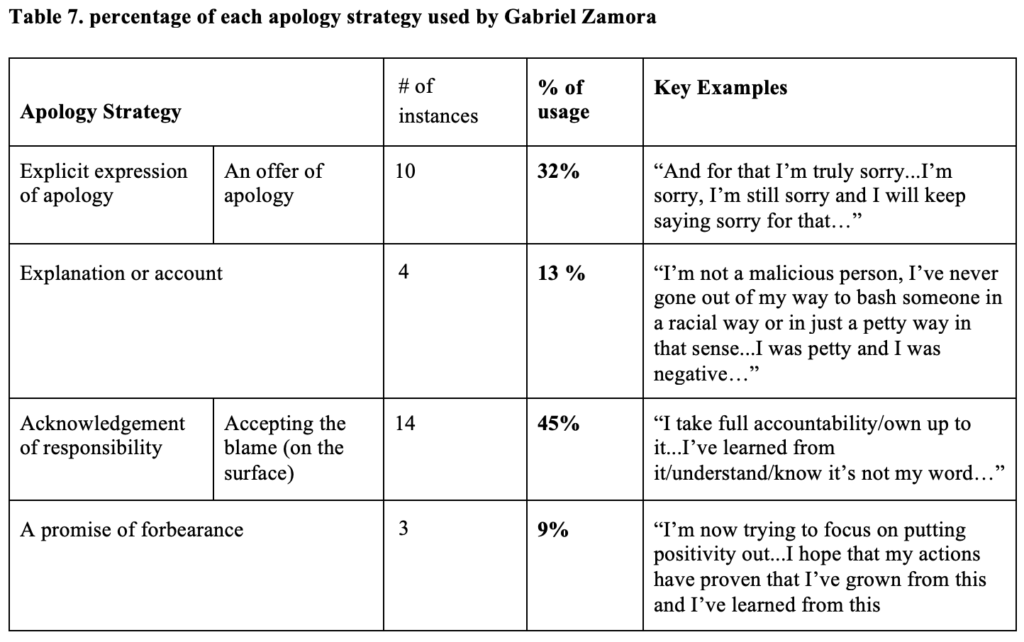
Gabriel Zamora, an influencer with over 800 thousand subscribers, made an apology video for racist tweets he has posted in the past. By analyzing his apology video the data set above reveals that his most used strategies were “acknowledgement of responsibility” (p = 45%) and “explicit expression of apology” (32%). That being said, conclusions could be made towards the fact that those specific strategies are what contributed to bringing a positive light to his image because he is not just ignoring what he did, rather he is owning up to his mistakes and not making any excuses for himself. He recognizes his ignorance and explicitly states taking full accountability for it repeatedly throughout his video. Interestingly, he consistently used the phrase “truly sorry” 4/7 times he used the word “sorry”…“and for that i’m truly sorry…“the fact that i wasn’t [a positive creator] im truly sorry…” I believe his way of using it allowed for a greater expression of the extent to how regretful he actually was. Gabriel occasionally combined his strategies with “explanation or account,” his third most used (p = 13%) in efforts to disclose his true intentions…“i’m not a malicious person, i’ve never gone out of my way to try to bash someone in a racial way or in just a petty way in that sense.” Lastly, Gabriels usage in “promise of forbearance,” he promises his supporters/audience that he has educated himself and continues to do so. He also takes it upon himself to spread more awareness on the history behind the n-word by linking two educational videos about it in the description of the video. Although this seemed to be his least used strategy (p = 9%), the videos he linked helped boost his reputation by showing his audience that actions speak louder than words and he is moving towards the right direction to prove his growth.

B. Gender Differences

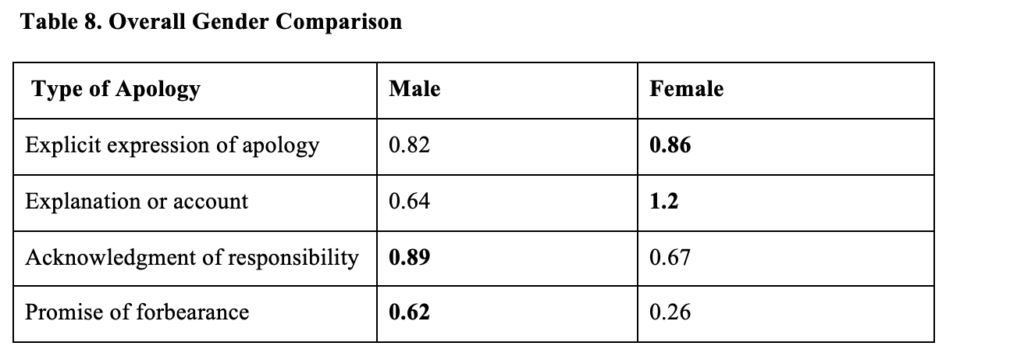
In Table 8, we calculated the ratio of each apology strategy usage by gender and came to the following realizations: 

  • The Frequency of Apologies: The result seems to buttress the theory that females were more likely to present explicit expressions of apology (Holmes,1989). However, as an evitable part of an apology video, the percentage of male and female using this approach is relatively close. From this point of view, gender seems to merely exert an influence on the linguistic differences of these stances (Stubbs, 2001).
  • Explanation or Account: Based on the data collections, females seem undoubtedly offer more verbal explanations or accounts than males. While most of the explanation or account for females is recounting the emotions, their apology video became longer and more complex. Females seem to include more verbal statements of concluding the whole controversial incident than males frequently may be less willing to use affirmative words to go over the account (Bennet, 2008). Overall, explanation or account drew huge linguistic differences between how males and females approach their apology.
  • Acknowledge of responsibility: Males present more acknowledgment of responsibility than females from the final data set. Gender differences in this stance are evident that males seem more likely to recognize their faults of actions. The mythological consideration for some females is vague. In Laura Lee’s video, she uses the denial strategies to shift the responsibility (Benoit, 2008), hence leading to an adverse audience reaction. In comparison, males seem more willing to acknowledge responsibility and re-evaluate the prior self who committed the transgression.
  • Promise of forbearance: Males perform more promise of forbearance than females. As usually the last part of an apology video, the promise of forbearance is crucial to provide the major idea of remedy to the transgression. Males seem more likely to provide corrective action and repair in the collecting data (Benoit, 2008). However, the overall proportion of promise of forbearance seems to appear identical for two genders without looking at the data of Shane Dawson who used this strategy the least. Hence a concrete conclusion is hard to draw from these 6 limited cases.

Discussion & Conclusion

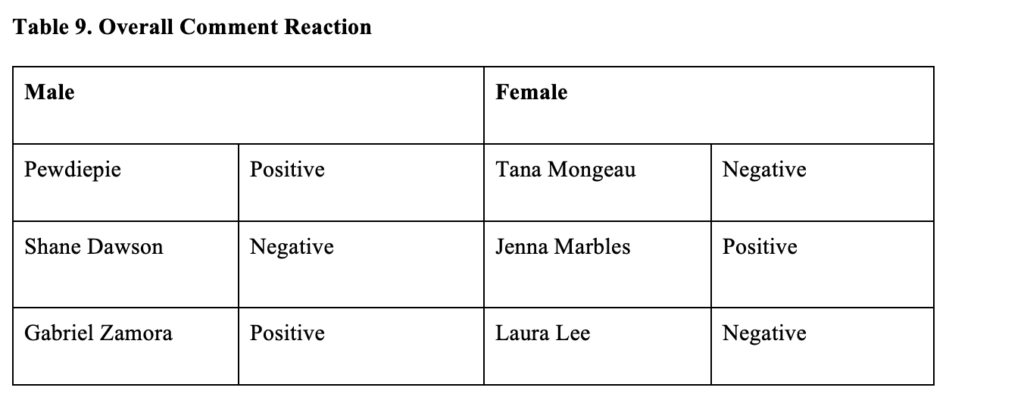
The discussion on individual differences and gender differences are presented above. This section dedicated to looking at the audience’s overall comments reaction as outlined in Table 9, only Pewdiepie, Gabriel Zamora, and Jenna Marbles received a positive response. They all have different focuses on their strategies. Pewdiepie addressed most in the promise of forbearance, Gabriel Zamora focused on Acknowledge of responsibility and Jenna Marbles spent most of her video approaching explanation and account. Which might indicate promise of forbearance, acknowledgement of responsibility and explanation and account are more effective strategies. The overall conclusion is females are more likely to approach explanation and the frequency of apologies while males approach acknowledgement of responsibility and promise of forbearance strategies. However, all these conclusions just came from the limited 6 data sets and in a broader view, after excluding the extreme cases, most of the data appear to be identical between both genders (Holmes 1989). A key implication for this research is the importance of not only considering the difference in gender while looking at the apology videos, but also by looking at the approaches taken by different people on a larger view. The analysis and data for this paper might provide a good sample for further future studies of linguistics features in gender differences and apologies approaches.

References

Benoit, W. L. (2008). Image restoration theory. The International Encyclopedia of Communication.

Bennet, S. (2008). Gender and apologies: Exploring offended females’ perceptions of apologies from males and females. https://ro.ecu.edu.au/theses_hons/127

Cheng, M. (n.d.). The Stance of Personal Public Apology. Retrieved November 17, 2020, from https://scholar.uwindsor.ca/ossaarchive/OSSA11/papersandcommentaries/96/?utm_source=scholar.uwindsor.ca%2Fossaarchive%2FOSSA11%2Fpapersandcommentaries%2F96

Gabriel Zamora. (2018, Aug. 21). My Truth. [Video]. YouTube. https://www.youtube.com/watch?v=QWnmPEHzRrk&list=PLsuhXm2zs07IwijVL8Mkm4EnPab78F7TC&index=8

Holmes, J. (1989). Sex Differences and Apologies: One Aspect of Communicative Competence1. Applied Linguistics, 10(2), 194-213. doi:10.1093/applin/10.2.194

Jenna Marbles. (2020, July 2). Jenna Marbles Apology. [Video]. YouTube. https://www.youtube.com/watch?v=679d-SQfWLk

Karlsson, G. (2020). The YouTube Apology: analysing the image repair strategies and emotional labour of saying sorry online. Retrieved 2020, from https://www.diva-portal.org/smash/get/diva2:1483089/FULLTEXT01.pdf

Laura Lee. (2018, Aug. 20). Laura Lee apology video with original captions. [Video]. YouTube. https://www.youtube.com/watch?v=NYVmWxitVSQ&t=182s

Leppänen, S., Møller, J., Nørreby, T., Stæhrc, A., & Kytölä, S. (2015). Authenticity, normativity and social media. Discourse, Context and Media, 8, p. 1-5

Maclachlan, A. (2013). Gender and Public Apology. Transitional Justice Review, 1-21. doi:10.5206/tjr.2013.1.2.6

Pewdiepie. (2017, Sep. 12). My Response. [Video]. YouTube. My Response (Pewdiepie)

Shane Dawson. (2020, June 26). Taking Accountability. [Video]. YouTube. https://www.youtube.com/watch?v=ardRp2x0D_E

Smith, N. (2008). I was wrong: The meanings of apologies. New York: Cambridge University Press.

Tana Mongeau. (2017, Feb. 17). An Apology. [Video]. YouTube. https:/ /youtu.be/Fazh9Lm1kDE

[/expander_maker]

, , , ,
Scroll to Top