Friendship

Breaking the Code: Understanding the Dynamics of Gendered Communication through Report Talk and Rapport Talk

Xiaotong Xi, Jullie Gu, Yaruo Tang, Scarlet Gu

This research explores Tannen’s original idea of report and rapport talk on gendered communication under a more modern context by investigating the conversational styles of college students aged 18-25. While previous research conducted by Tannen mainly utilized qualitative observational case studies, this research gathered quantitative data on gendered patterns in a conversational style by conducting surveys on 72 participants and 3 observational studies with detailed conversational data recorded. The research findings from both categories indicate that women’s conversational styles approach rapport talk more frequently by communicating with a tentative communication style and empathetic tone and topics surrounding personal experience. On the other hand, men approach report talk by using an assertive communication style, with conversation topics surrounding their own expertise and factual information.

[expander_maker id=”1″ more=”Read more” less=”Read less”]

Introduction and Background

People grew up with the expectation to adhere to different socially constructed labels. Men and women grew up under different expected gender roles, thus developing different gender-based cultures. This research explores the variations in communication styles fostered by the different cultures between men and women. In the book “You Just Don’t Understand,” Tannen explored the phenomenon that women intend to pursue intimate connections while men intend to build status in communication, which is further referred to as rapport vs. report talk (Tannen, 2007). To be more precise, our research defines rapport talk as a conversational style with features including a tentative communication style, topics surrounding personal feelings, and an empathetic tone; and report talk as a communication style of assertive tone, nonverbal cues to assert dominance, and topics surrounding personal expertise and factual information.

Elaborating on Tannen’s previous qualitative approach, our research aims to explore gendered patterns of gendered communication under modern contexts through quantitative methods, targeting the research population as college students aged 18-25. To quantify the data, this research collected survey responses and conversational elements from observations, categorized them as either rapport or report talk features, and compared the frequency of these features that appear in the communications for both genders.

To investigate the research question, “To what extent do women pursue intimate connections within communications regarding friendship while men pursue status?” We surveyed 72 effective participants on communication style and content-related questions. The survey supplemented observations on three conversations between friend groups and gathered quantitative data. Based on the research data, men perform report talk that establishes status more frequently, while women are more inclined to use rapport talk that builds intimate connections.

Methodology

The research first conducted surveys to gather data from 100 college students aged 18-25. The survey consists of 16 questions to examine cross and same-gendered communications, including analyzing patterns of frequency, length, and responses to specific scenarios, categorizing answers based on the rapport and report talk elements, and recording the frequency they occurred (Martin Terre Blanche et al., 2006).
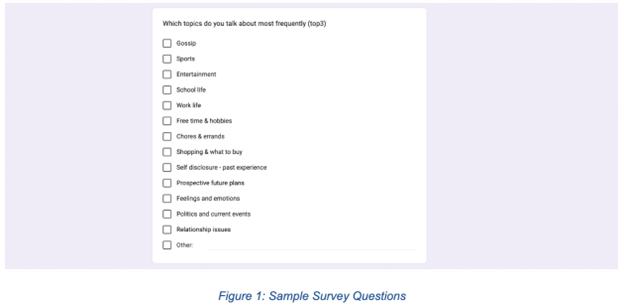
Figure 1: Sample Survey Questions

The research also conducted three real-life observations to analyze the gendered pattern in conversation under more natural and authentic contexts. Conversations were recorded but presented with made-up names. Participants were selected from survey respondents. Conversations were coded with different elements that fall into rapport or report talk category.

Analysis – Survey

Due to the small sample size and potential diversity of non-binary gender, our research focused on the population who identifies as male (48%) or female (52%). 72 out of 100 were considered effective data, excluding participants outside the age range (18-25) and non-binary gender (Reiter, 2017).
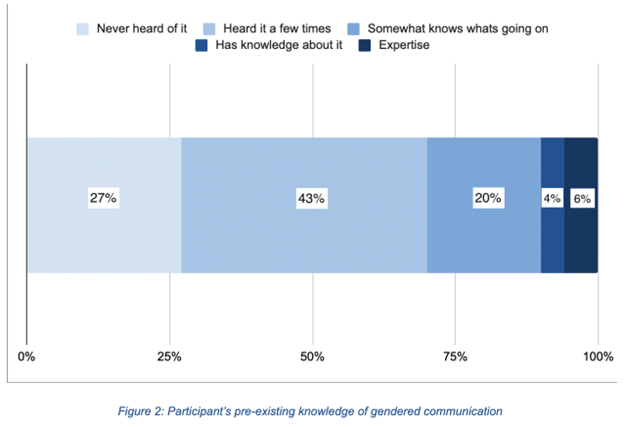
Figure 2: Participant’s pre-existing knowledge of gendered communication

As shown in figure 2, over 80% of participants had little to no knowledge about gendered communication, reducing the barrier of choosing the most appropriate answers; however, gendered communication patterns are never new, as shown in figure 3, female and male had completely different reactions towards Rachel and Ross sharing their kiss from the beloved show Friends (Crane, 1995).
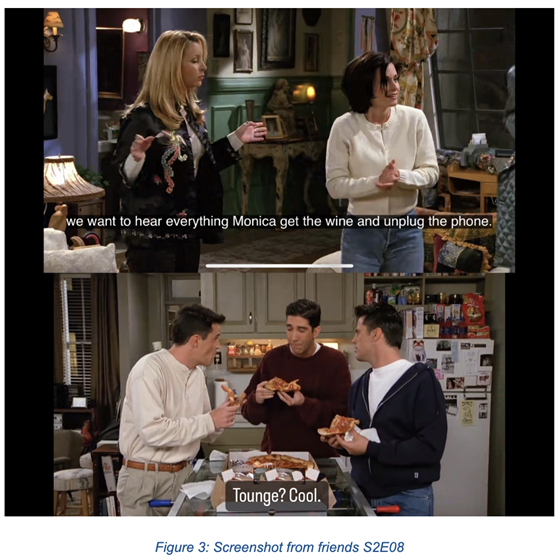
Figure 3: Screenshot from “Friends” (S2, E08)

Figure 4 shows the top 3 chosen topics participants reckon to recurrently talk about. Among females, the most discussed topics include school life, gossiping, hobbies, and entertainment. Most male communications depicted school life, sports, self-disclosure, and prospective future plans. As anticipated, females chose intimate topics, while males did talk more about sports and future plans. Surprisingly, self-disclosure – a sign of intimacy and connection, also appeared frequently among males. Opposite-gendered communication topics are extremely similar to patterns of same-gendered communication.
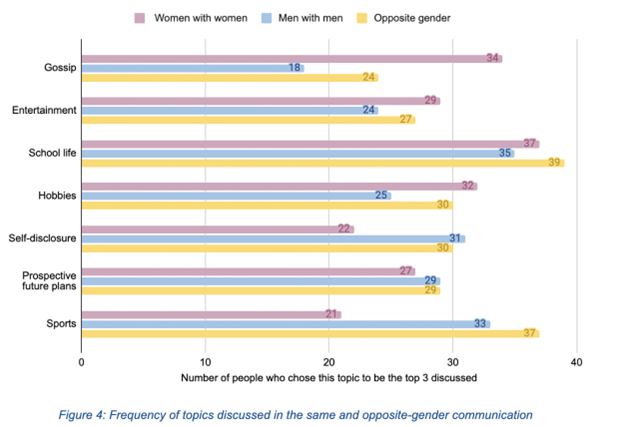
Figure 4: Frequency of topics discussed in the same and opposite-gender communication

However, the frequency of topics may be too broad, and the selection of topics could be biased even with support from past literature reviews. Therefore, the participants were given a short, explicit situation to choose their most likely reaction.

As demonstrated by comparing figures 5 and 6, men and women have completely different attitudes towards gossiping. 51% of the male respondents have a positive or neutral attitude toward gossiping, while 62% of the female respondents reacted positively. From figure 4, 66% of the male and 92% of the female respondents have chosen to gossip as a commonly discussed topic. Even though participants knew the survey was anonymous, untruthful answers may still be chosen (Manza, 2018). Therefore, the survey is applied as supplementary material for later observations.
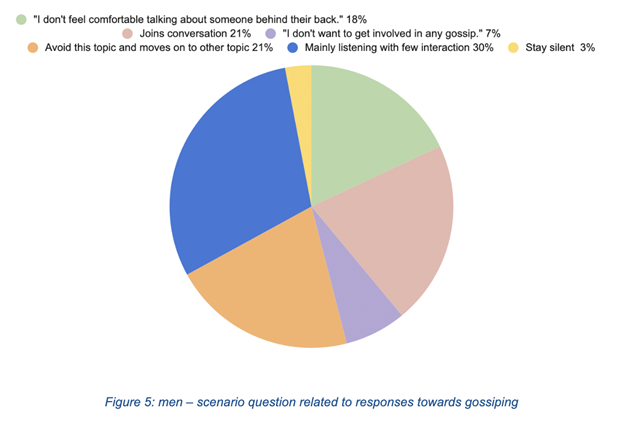
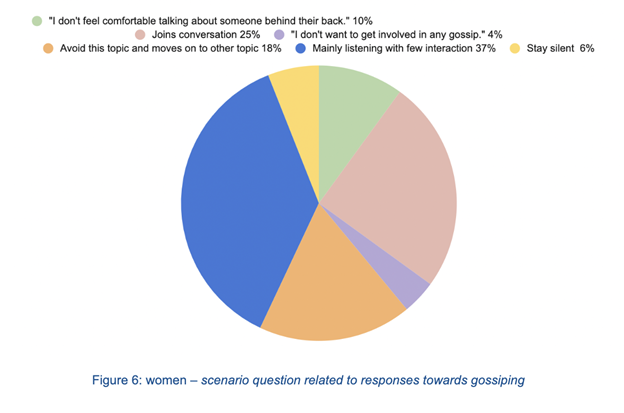
Figure 5: Men – scenario question related to responses towards gossiping
Figure 6: Women – scenario question related to responses towards gossiping

Analysis – Observation

Quantitative Analysis

The data collected demonstrates an explicit distinction in communication styles between genders. We categorized various features under report talk or rapport talk, as labeled in the x-axis of figures 7 and 8 (Klinetob & Smith, 1996). To be more precise, the use of direct and assertive communication styles includes declarative statements or giving direct orders and less polite or deferential language, making direct requests, or stating their opinions without apology. For example, “I’m absolutely certain…” “Trust me, I know what I’m talking about…” “Let me tell you…”. Nonverbal cues to assert dominance or authority can be implied by taking up more physical space. Indirect and tentative communication style refers to hedge words or phrases like “kind of” or “sort of” or more polite or deferential language, such as asking questions instead of making statements or using euphemisms instead of direct language.
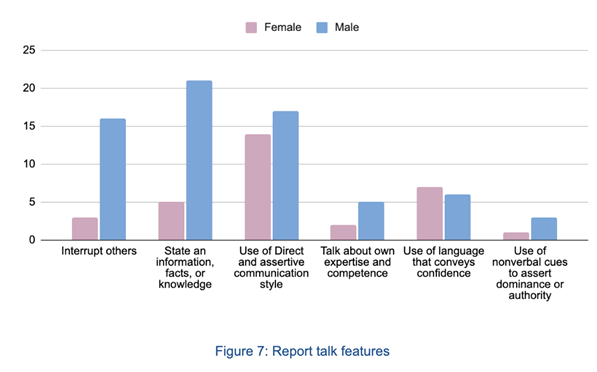
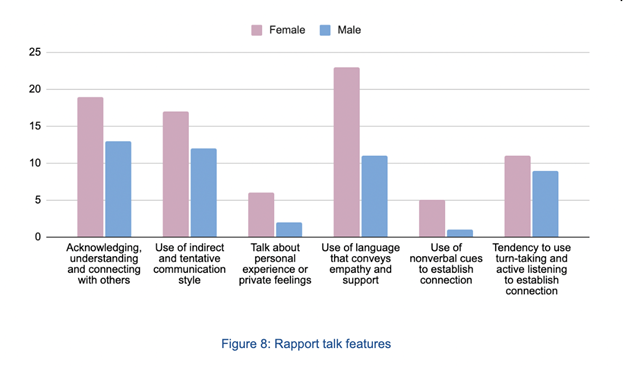
Figure 7: Report talk features
Figure 8: Rapport talk features
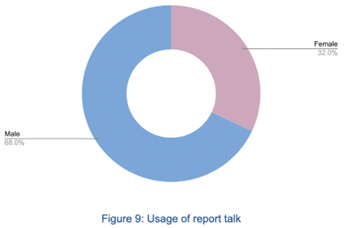
Figure 9: Usage of report talk
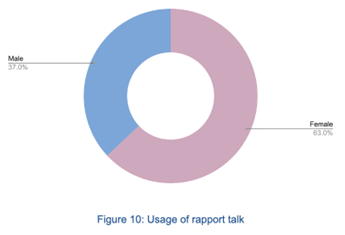
Figure 10: Usage of rapport talk

Male participants in the study used more direct and assertive communication styles than female participants, who used more indirect and tentative ones. Regarding report talk features, male participants were found to interrupt others more frequently than female participants. In addition, male participants were observed using nonverbal cues to assert dominance or authority, such as taking up more physical space. Female participants were found to use more rapport talk features. They were observed acknowledging, understanding, and connecting with others more frequently than male participants.

Female participants used more indirect and tentative communication styles, such as hedge words or phrases and deferential language. Regarding nonverbal cues, female participants were more likely to have physical contact to establish a connection with others.

However, communication styles can vary significantly between individuals. The data collected in our research does not suggest that all male or female individuals use the same communication styles (Locander & Ladik, 2017). Nevertheless, the data indicate differences in communication styles between genders, supporting the rapport and report talk theory.

Qualitative Analysis – Conversation A

From extract A; male participants exhibit more report talk features by making direct statements and offering their opinions, while all three female participants utilize more rapport talk features by acknowledging and supporting others, expressing empathy and understanding, and using more indirect and tentative language.
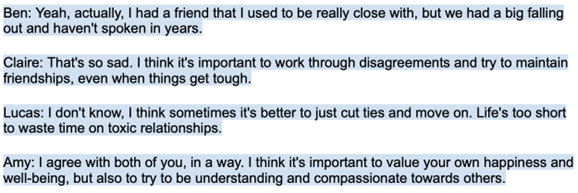
Extract A-1: Conversation regarding friendship

Ben and Lucas both exhibit more report talk features by offering their opinions and making direct statements about friendship. Ben shares his personal experience of a friendship that ended in a falling out, and Lucas shares his perspective on cutting ties and moving on from toxic relationships. Both men contribute to the discussion by offering their thoughts on maintaining friendships as people’s lives change over time:
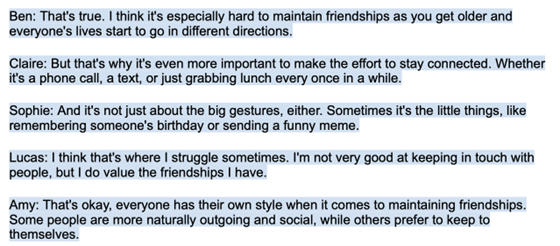
Extract A-2: conversation regarding friendship

Females, as shown in A-2, tend to use more rapport talk features by building connections and supporting others. Amy introduces the topic of friendships ending and asks the group if they’ve experienced this before. Sophie shows empathy for Ben’s experience and emphasizes the importance of working through disagreements and maintaining friendships. Amy also acknowledges Ben’s and Lucas’s perspectives, showing she values their contributions to the conversation. Overall, extract A demonstrates a balance between report talk and rapport talk (Taylor, 2003).

Qualitative Analysis – Conversation B

From extract B, male participants Chris and John exhibit report talk features by interrupting others and making direct statements. For example, Chris interrupts Maggie to assert his opinion on the best way to maintain friendships:
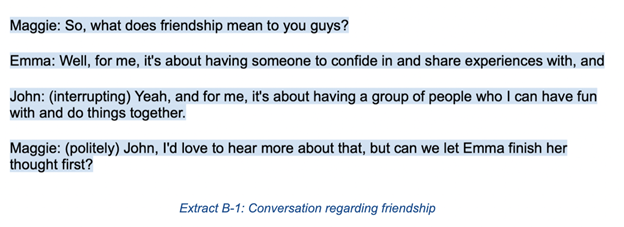
Extract B-1: Conversation regarding friendship

As from extract B-2, female participants, Maggie and Emma, use more rapport talk features. They acknowledge and support others, like when Maggie expresses empathy for Chris’s recent stress at work. They also use more indirect and tentative language, such as when Emma suggests a possible activity for the group but asks for others’ opinions before making a final decision:
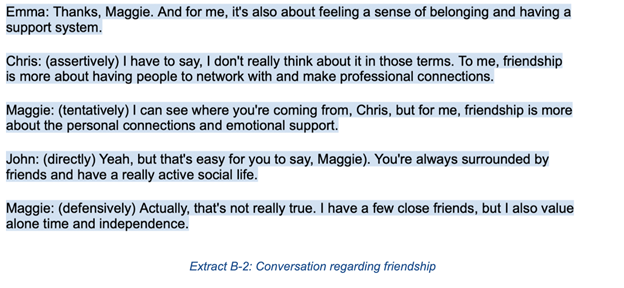
Extract B-2: Conversation regarding friendship

Participants also differ in the level of engagement, male participant John speaks the most in conversation B, contributing to almost half of the number of turns. Female participant Maggie, who spoke the most in conversation A, spoke the least in this conversation and only contributed 10% of the total turns.

Conclusion and Discussion

Overall, this research finding aligns with Tannen’s argument that ‘men perform report talk while women perform rapport talk.’ The results also corroborate the previous hypothesis regarding the difference in gendered communications. Signs of report and rapport talk are revealed through both survey data and observational conversations. Differences in communication styles and content may be related to gender and cultural norms; men are socialized to be more assertive and competitive, while women are socialized to be more nurturing and supportive.

Wider implications of our study include: Individuals could reduce the chances of miscommunication and understand each other fluently in the future by conducting more in-depth and variant social exchanges. Employers can adopt workplace communication strategies to reduce potential discriminatory acts. Businesses and social media platforms, or products with targeted audiences could adjust their plans and features accordingly, improving user engagement (Gunter, 2009).

References

Crane, D. (1995, November 6). Friends – Season 2 (No. 8) [TV – series]. NBC.

Gamble, T. K., & Gamble, M. W. (2020). The Gender Communication Connection. Milton: Taylor and Francis. https://doi.org/10.4324/9780367822323.

Gunter, R. (2009). THE EMERGENCE OF GENDERED PARTICIPATION STYLES IN SCIENCE-RELATED DISCUSSIONS: IMPLICATIONS FOR WOMEN’S PLACE IN SCIENCE. Journal of Women and Minorities in Science and Engineering, 15(1), 53–75. https://doi.org/10.1615/jwomenminorscieneng.v15.i1.40

Klinetob, N. A., & Smith, D. A. (1996). Demand-Withdraw Communication in Marital Interaction: Tests of Interspousal Contingency and Gender Role Hypotheses. Journal of Marriage and Family, 58(4), 945–957. https://doi.org/10.2307/353982

Locander, W. H., & Ladik, D. M. (2017). CEO Tweet Behavior: The Use of Metaphors and Gendered Communication Style. Journal of Managerial Issues, 29(4), 365–379. http://www.jstor.org/stable/45176558

Manza, J. (2018). The sociology project. Pearson Canada Inc.

Martin Terre Blanche, Durrheim, K., & Painter, D. (2006). Research in practice: applied methods for the social sciences. University Of Cape Town Press.

Reiter, B. (2017). Theory and methodology of exploratory social science research. Ttu-Ir.tdl.org. https://hdl.handle.net/2346/86610

Tannen, D. (2007). You Just Don’t Understand. William Morrow Paperbacks.

Taylor, F. (2003). Content Analysis and Gender Stereotypes in Children’s Books. Teaching Sociology, 31(3), 300–311. https://doi.org/10.2307/3211327

[/expander_maker]
, , , ,

Males and Females, Are We Really That Socially Different? An Exploration of Same-Sex Friendship Dynamics

Shirley Yao, Sabrina Meyn, Viktoria Hovhannisyan

The friendship dynamics that males and females form with the same-sex differ in how they bond homosocially: either vertical or horizontal. Homosocial bonds are those that are non-romantic social bonds between those of the same-sex. Historically, these two types of homosocialities are used to regulate how people perform gender. Vertical homosociality, also known as hierarchical homosociality, is relationally tied to males, and horizontal homosociality with females. Vertical is centered on building power socially, whilst horizontal captures non-profitable aspects of social bonds. Research has shown that heterosexual males tend to be hypersensitive to their sexuality being misinterpreted in homosocial contexts, whilst females are presumed not to be. This has been previously attributed to female homosocial bonds being defined as desexualized relations and their intimate relations as being friendly or as a sexual display for the heterosexual male gaze. However, in the literature there is room to explore female’s friendship and social dynamics and obtain updated information on male homosocial friendship dynamics by comparison. Using a comprehensive questionnaire that aimed to gather data on participant’s homosocial friendship dynamics, we found that both females and males exercise homosociality similarly.

*Disclaimer: Gender and sex are not interchangeable terms, as gender refers to something people do or perform socially, and sex is what you are biologically. The participants in this study identified their sex as either being male or female.

[expander_maker id=”1″ more=”Read more” less=”Read less”]

Introduction and Background

From “bros” to “babes,” males and females tend to have different friendship dynamics. The topics of sex, friendships, and homosociality has been widely studied. Homosociality is a phenomenon between people of the same-sex with a “nonsexual attraction” to each other (Bird, 1996, p. 121). Through a study to determine the type of homosociality practiced between males and females, we aim to better understand the friendship dynamics across sex. Specifically, our target population includes straight males and straight females in college who form close-knit homosocial circles, tracking homosocial situations where homosexual intentions may be incorrectly perceived within friendships.

Historically, homosociality comes in two strokes: vertical (hierarchical) and horizontal. Vertical homosociality is “a means of strengthening power and of creating close homosocial bonds to maintain and defend hegemony” and as a result, it has strong ties with hegemonic masculinity (Hammarén & Johansson, 2014, p. 1,5). Hegemony is related to structural social power dynamics. Hegemonic masculinity is built on an archaic conception of masculinity rooted in institutionalized practices that value males and devalue females (Bird, 1996, p. 1-2, Rose, 1985, p. 63-4). Horizontal homosociality is defined as being built on “emotional closeness, intimacy, and a nonprofitable form of friendship” and has strong ties to female homosociality (Hammarén & Johansson, 2014, p. 1,5). Most studies conducted that explore homosociality are focused on heterosexual males. There is little research on female homosociality, especially those that do not have a heteronormative foundation (Sanders, 2015, p. 887). In addition, data on male homosociality is outdated. Rose (1985) performed a study on cross-sex and same-sex preferences in homosocial bonds (p. 83). It was found that males and females have the same expectations in same-sex friendships, while expecting less help and loyalty in cross-sex or heterosocial friendships (Rose, 1985, p. 63). Friendship formation and maintenance were found to differ for same-sex and cross-sex friendships between the sexes as well (Rose, 1985, p. 63). Bird (1996) claims gender is relational – where a person will perform gender in accordance with either vertical or horizontal homosociality (p. 122). Bird (1996) also identified how hegemonically masculine ideals are perceived as being the socially ideal form of masculinity (celebrates emotional detachment, competition, and the sexual objectification of females) (p. 121). Studies have found that homosexual people can have their own language, especially specific vocabulary words (Kulick, 2000, p. 243). We will review data on the usage of homosexually charged nicknames between the sexes in results.

This study is a step towards more representational and up-to-date data on both male and female homosocial tendencies and in particular, friendship dynamics. Based on previous research, the foreground expectation is for the data to show that gender is relational, where, a person’s sex will predict the type of homosociality present in their friendship dynamics. In particular, males will overcompensate for their fear of being perceived incorrectly as having homosexual intentions, projecting an overly masculine persona and using linguistic features to create social distance. Comparatively, females will embrace the idea of receiving incorrect perceptions. They will prioritize emotional closeness in their friendships, and exhibit no particular linguistic behaviors different from their everyday conversations.

Methods

To test our hypothesis we gathered data from ​​16 college students, ages 17 to 25, which included 8 females and 8 males, 14 straight and 2 bisexual. We asked them to fill out a questionnaire that was designed to test their beliefs, lexicon, and conversational content as it relates to their homosocial friendships. We used multiple choice, short answer, checking boxes, and rating comfort levels on Google Forms to collect information from anonymous participants. The survey included five parts aiming to gather: ​​biographical information, ideological beliefs (to test for horizontal or vertical beliefs), short answer questions directed towards the conversational content, a section directed towards investigating a person’s lexicon to see what phrases and nicknames are used to create or lessen social distance and a section directed towards investigating reactions to inappropriate/appropriate language use or behavior. Vertical answers emphasize emotional detachment, sexual objectification of females, sport, competition, and deny horizontal things such as gossip, feelings, etc.

Examples – An example of a question that was asked is the following: “friendships are important to my social standing” this question was intended to answer with either “yes” or “no.” A yes or affirmative to a vertically loaded question would result in adding a point to a person’s vertical homosociality score, and a negative would add a point to a person’s horizontal homosociality score, and vice versa for horizontally loaded questions. Examples of horizontally loaded questions would be: “being emotionally close to my friends is important to me” or “intimacy is important to my friendships.” In the short answer sections, horizontally loaded answers would receive a point per question, and same for vertically loaded responses. Comfortability scores over 5 for a particular type of question would result in a point being added as well depending on the question category.

Results and Analysis

Results

DEMOGRAPHICS

16 participants ages 17 to 25, 8 female, 8 male, 14 Straight, 2 Bisexual

IDEOLOGICAL

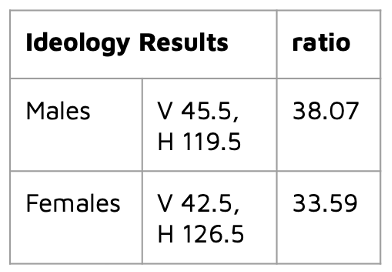
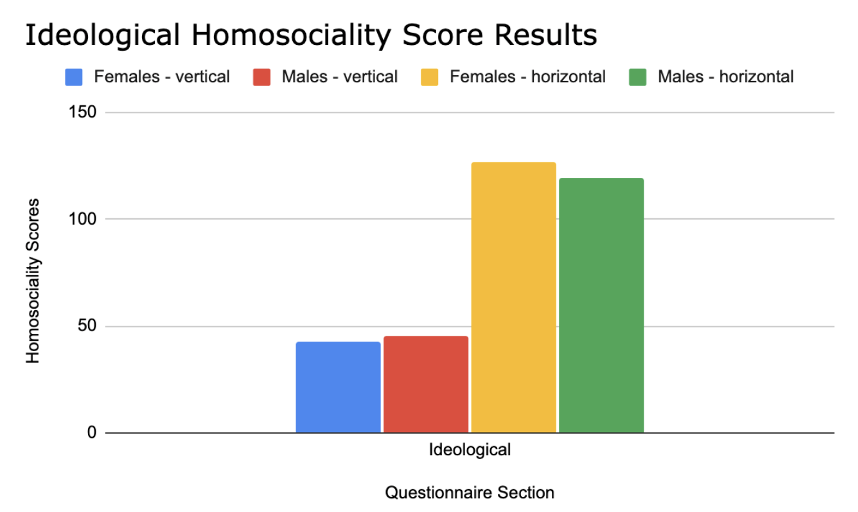
We found that both females and males are ideologically more horizontally homosocial leaning.

Examples of questions included: if friendships were important to social standing, maintaining the patriarchy, if it was acceptable to use friends as a means to an end, if they observed people in their homosocial circles discuss, disparage, or use the opposite sex to gain social status, as well as if they individually believed it was acceptable to do so. About ½ of participants observed this happen, but ¾ of the responses said they felt it was unacceptable. Surprisingly, over 90% said it was false that friends should not have romantic feelings for one another and friends should not have feelings in general for each other, and that it was true that being emotionally close was important.

Figure 1: Ideological Homosociality Scores: Comparing Males and Females
Table 1: Ideological Homosociality Scores- Ratio of Vertical Scores to Horizontal Scores

FEAR OF MISINTERPRETATION OF SEXUALITY

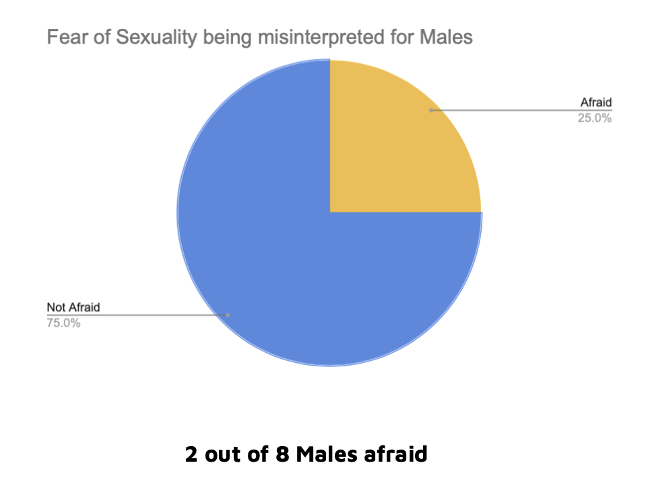
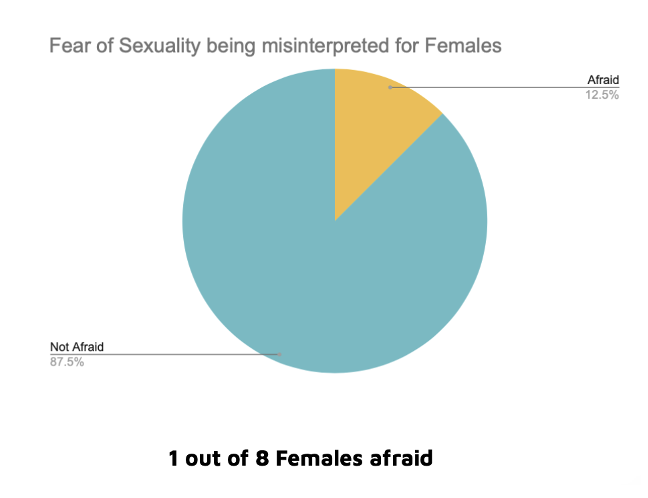
Ideologically speaking, 25% of the males surveyed are afraid of their sexuality being misinterpreted, and 12.5% of females are afraid of their sexuality being misinterpreted.

Figure 2: Fear of Misinterpretation of Sexuality by Males
Figure 3: Fear of Misinterpretation of Sexuality by Females

FRIENDSHIP FORMATION AND MAINTENANCE

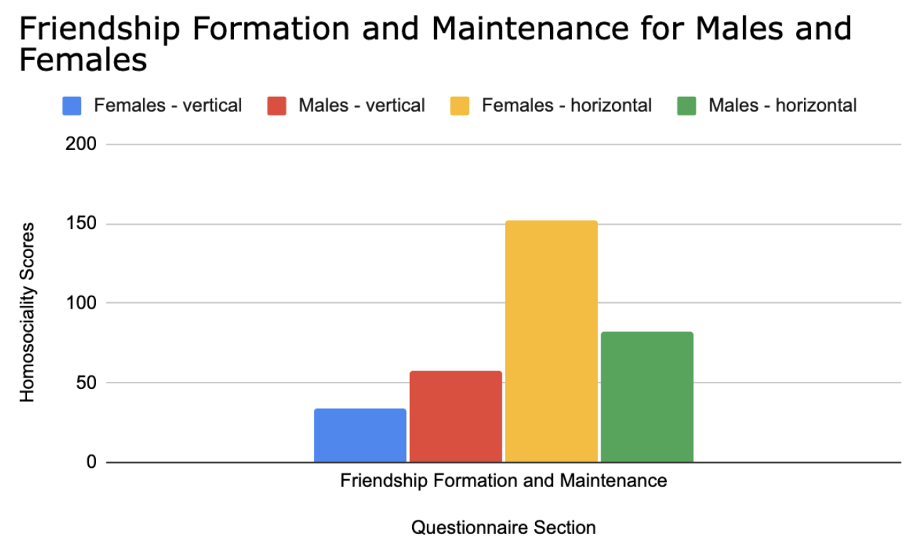
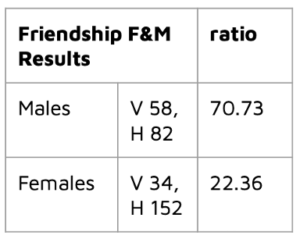
Similar to the results of the Rose study, friendship formation and maintenance differed between the sexes. The homosociality scores for both males and females were overwhelmingly more horizontally leaning, but females were approximately 85.36% more horizontally homosocial than males.

Figure 4: Friendship Formation and Maintenance Homosociality Scores: Comparing Males and Females


Table 2: Friendship Formation and Maintenance Homosociality Scores – Ratio of Vertical Scores to Horizontal Scores

NICKNAMES

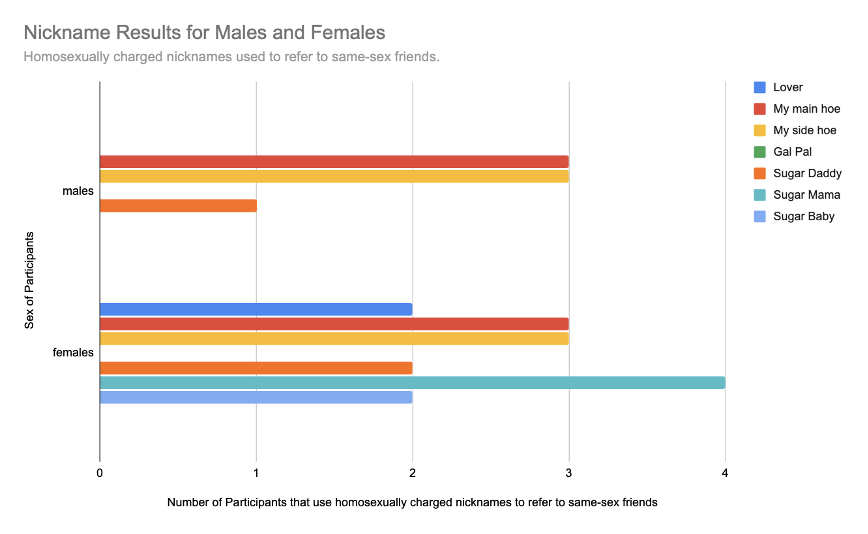
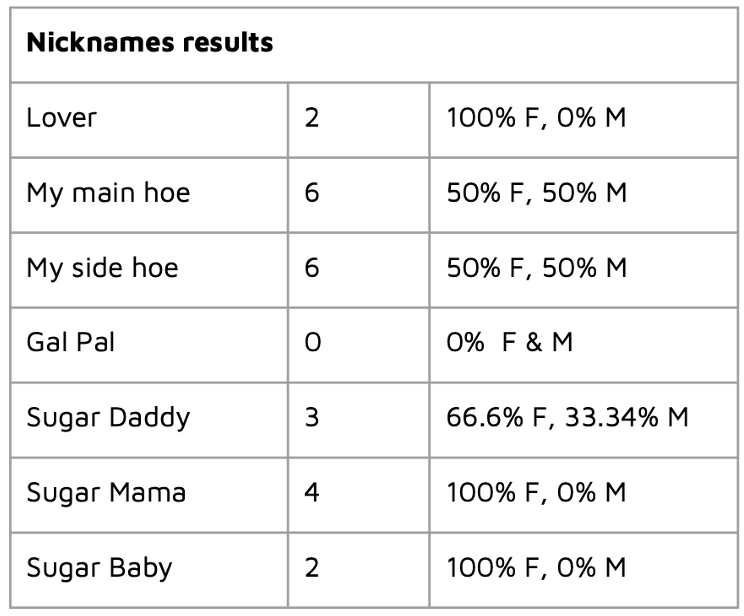
Although a percentage of males and females who are afraid of their sexuality being misinterpreted, we found females use more homosexually charged nicknames and pet names than males by approximately 39.13%.

Figure 5: Usage of Homosexually Charged Nicknames: Comparing Males and Females


Table 3: Usage of Homosexually Charged Nicknames: Comparing Males and Females

CONVERSATIONS (appropriate vs. inappropriate topics)

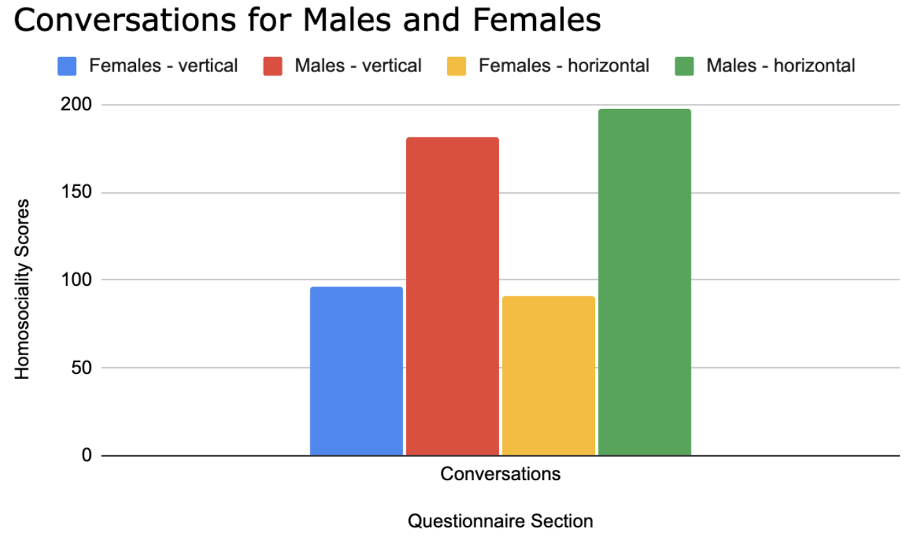
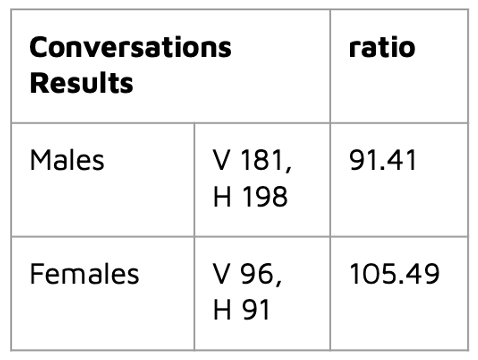
We found that both females and males are a combination of vertical and horizontal, and marginally lean one way or the other.

Examples – For conversations participants rated their comfortability and indicated if they did talk about a range of topics with their same-sex friends that ranged from: school, business, social status, sexual activities, sexual conquests or accomplishments, to test for vertical homosociality, to topics which do not make for a profitable exchange like gossip, feelings, saying “I love you,” worries, morals, etc. We also asked about topics they do not think are acceptable to be discussed with their same-sex friends and the responses ranged from nothing being off limits, to family drama, insecurities, sexual life, politics, religion, weight, romantic relationships, etc.

Figure 6: Conversations Homosociality Scores: Comparing Males and Females
Table 4: Conversation Homosociality Scores – Ratio of Vertical Scores to Horizontal Scores

REACTIONS  (to inappropriate topics and/or actions)

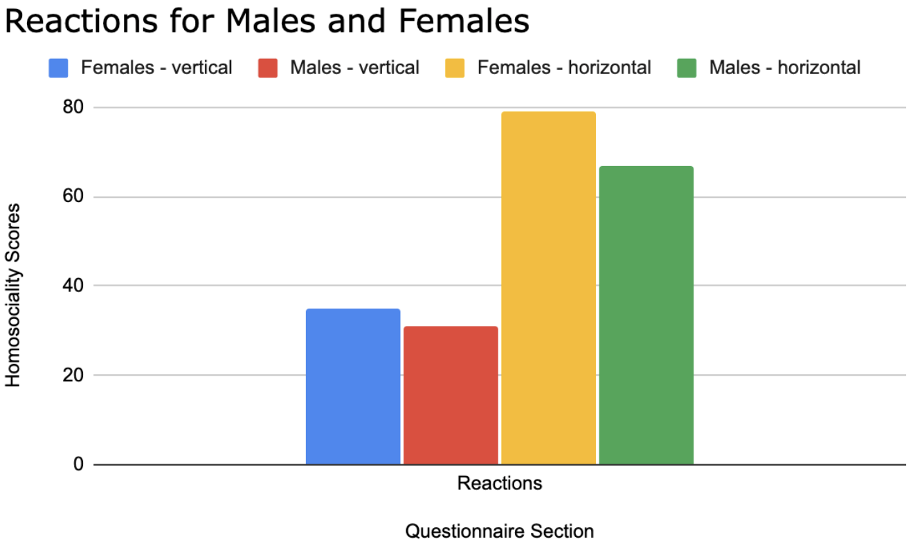
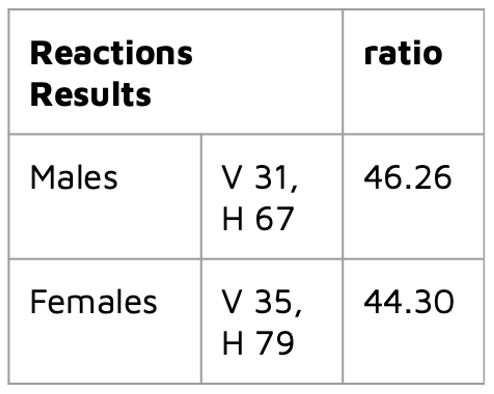
Here we were looking for their reactions to various topics and actions that would lead to a misinterpretation of their sexuality. We found that both males and females have horizontal homosocial tendencies in reaction to behavior which may be perceived as having homosexual intentions.

Examples – We asked participants to rate comfortability, and express what they might be met with or observe if any of the following topics or actions would come up: compliments, hugging, kissing friends, cuddling with friends, holding hands, platonic feelings for same-sex friend, romantic feelings for same-sex friend, actions/words which are perceived as having homosexual undertones, actions/words which may be perceived as having homosexual undertones, saying “I love you” to your same-sex friend.

Figure 7: Reactions (to inappropriate topics/actions) Homosociality Scores: Comparing Males and Females


Table 5: Reactions (to inappropriate topics/actions) Homosociality Scores – Ratio of Vertical Scores to Horizontal Scores

OVERALL MALE HOMOSOCIALITY SCORES

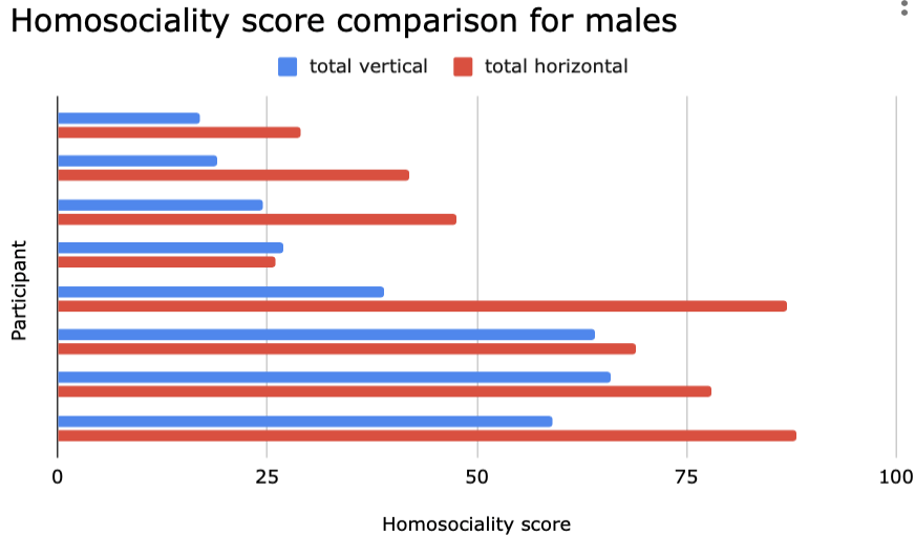
The majority of our male participants had horizontally leaning homosociality scores, while only one male participant was more vertical leaning by 1pt (approximately 0.037%).

Figure 8: Homosociality Scores: Comparing Male Participants

OVERALL FEMALE HOMOSOCIALITY SCORES

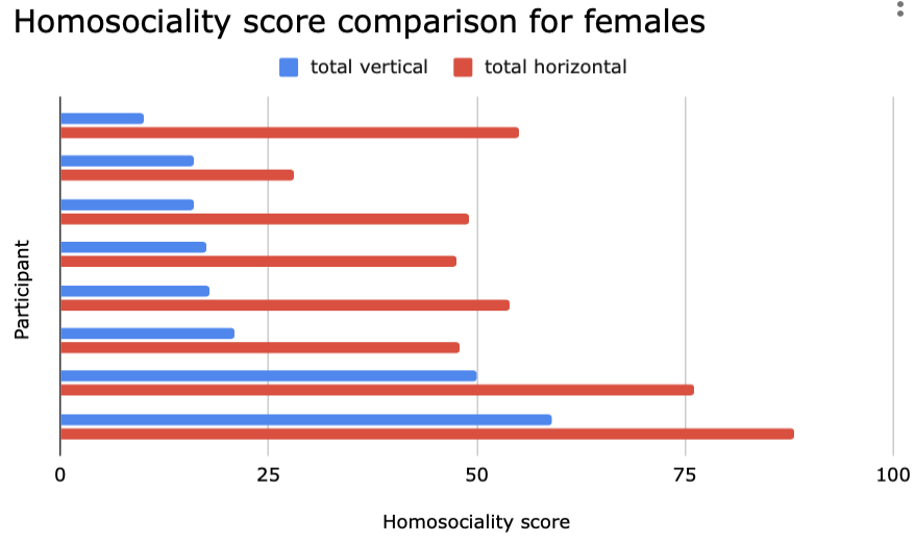
All of our female participants scored more horizontally leaning homosociality scores.

Figure 9: Homosociality Scores: Comparing Female Participants

OVERALL HOMOSOCIALITY SCORE COMPARISON: MALES VS. FEMALES

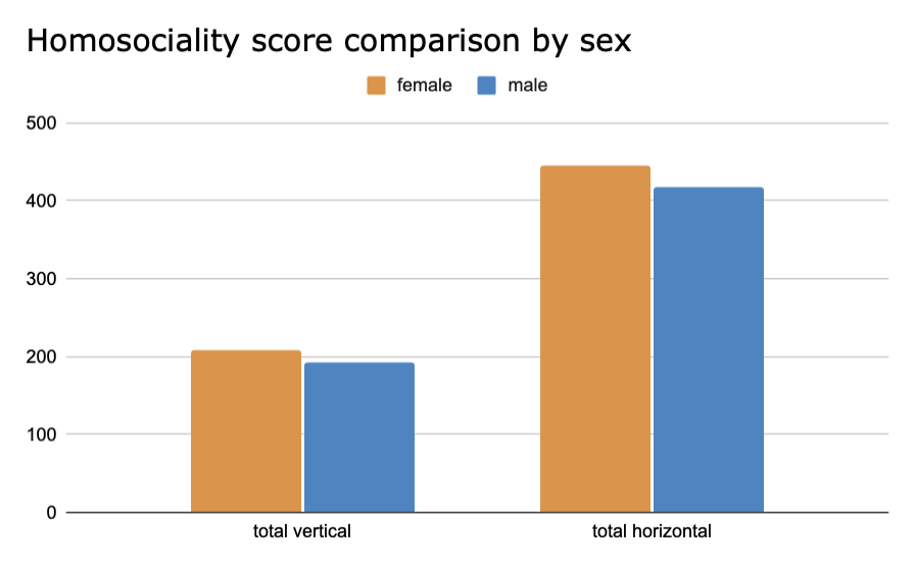
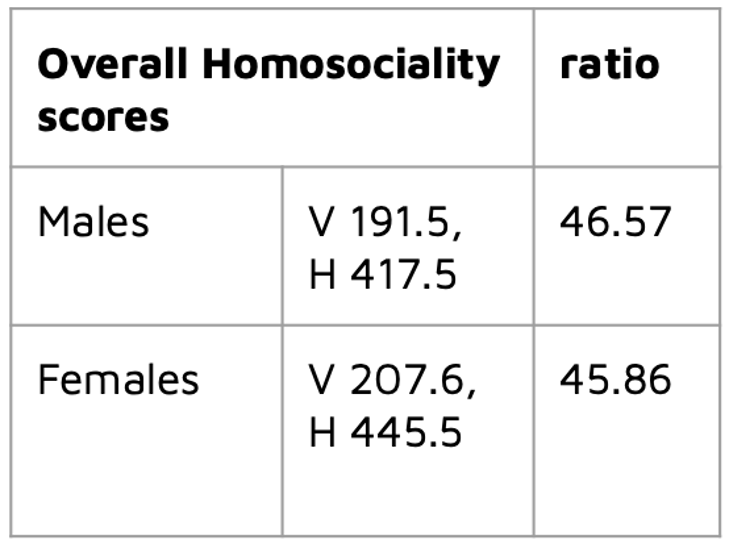
Overall, females and males were found to be overwhelmingly horizontally leaning, with a combination of vertical and horizontal homosocial tendencies and beliefs. Their overall vertical scores are also similar, with females scoring approximately 8.4% more vertical than males, and 6.7% more horizontal than males, with a minimal overall margin of difference of 0.71.

Figure 10: Homosociality Scores: Comparing Males and Females
Table 6: Males and Females Overall Homosociality Scores – Ratio of Vertical Scores to Horizontal Scores

Our results show that both females and males have a combination of vertical and horizontal homosocial tendencies and beliefs, with an overwhelming slant towards horizontal homosociality. What this means is that the homosocial tendencies of females and males are similar. Since they were found to be a combination, this means that females and males don’t just correspond to one kind of homosociality over the other. This disproves the idea that gender and homosociality are strictly relational since males did not score strictly vertically, and females did not score strictly horizontally.

Discussion and Conclusion

Discussion

While sex does not determine the type of homosocial friendship present, it plays a factor in understanding different interactions within homosocial friendships. With no significant statistical difference between vertical and horizontal scores, gender is overall not relational, meaning horizontal and vertical homosociality scores do not reflect the predicted homosociality of males and females. In fact, both sexes have a relatively higher horizontal score compared to their vertical scores in total.

However, when looking into each of the four topics individually, observations about the different friendship dynamics arise – with areas worthy of further exploration. The most distinct difference occurs in the area of friendship formation and maintenance. With ratio score comparisons of 70.73 and 22.36, males and females are strikingly different when it comes to building and sustaining homosocial friendships. Comparatively, females are more likely to form and maintain friendships horizontally than males – using intimacy and closeness as their powers to reach out and establish connections. In the real world, males tend to strengthen relationships by participating in activities together, and females tend to do so by sharing feelings and talking about various things. Linguistically, females are also more likely to use linguistic features that are indicative of intimacy and closeness, reflecting horizontal homosociality through their everyday conversations. Through the use of specific lexicon such as the homosexually charged pet names of “sugar mama” and “sugar baby,” females are unafraid – and even embrace – the idea of their sexuality being incorrectly perceived.

Ideologically speaking, most males and females have similar ideological beliefs about homosocial friendships, with nearly identical ratios between their ideological vertical and horizontal scores. As the sample is composed of college and high school students, it is understandable for many to have a similar group mindset to find social circles and fit in. The COVID-19 pandemic may have exacerbated the isolation anxiety for many to feel eager to belong. The societal norm also values honesty and friendships and paints betrayals and loneliness as traits that should be avoided. The topic of conversational content also reveals similarity between males and females. Though females have lower vertical and horizontal scores compared to those of males respectively, the ratio between the two is still similar across sex, meaning males and females have similar shares of vertical and horizontal conversations. Looking into conversational content linguistically, many responses include talking about school and friends, regardless of gender, mainly because of the social setting within colleges to define conversational topics. It is interesting to note that females are more likely to talk about males, whereas males have a higher tendency to talk about careers and the future – further demonstrating the foundation of female homosexuality to be rooted on the exchange of intimate facts and truth compared to male homosexuality.

Last but not least, the examination of reactions to incorrect perceptions between males and females also prompt similar homosociality scores. However, as predicted, males are relatively more likely to be afraid of receiving incorrect perceptions regarding sexuality. Interestingly, 12.5% of the females surveyed are afraid of being perceived incorrectly in terms of sexuality – a higher percentage than expected. While reasons behind this relatively surprising number need further investigation, it is worth noting that the sample is small and localized.

Conclusion

In conclusion, the study establishes a step towards understanding both male and female homosociality. Despite its limited participant tool, the small localized sample creates an in-depth and cohesive look under a college setting, recognizing specific characteristics and linguistic features in context to better understand homosocial friendship dynamics. Furthermore, the four particular areas reflect the fundamental concepts between vertical and horizontal homosociality. For example, females are more likely to form friendships horizontally and use lexicon reflective of emotional closeness compared to males, providing specific observations worthy of analyzing between the two genders.

The study needs further investigations to capture the essence of homosociality between sexes. One future direction is to acquire larger sample sizes for a more holistic understanding of homosocial friendship dynamics. It includes surveying a much bigger and more inclusive target population. Expanding the survey pool to more college participants can help further research the underlying patterns that a smaller sample size may fail to show. A more diverse target population should also be considered, such as surveying varying ages and occupations across different generations of gender. Different age groups may prompt different responses to incorrect perceptions of sexuality, taking into consideration the context under which they grew up and the societal ideals toward homosexuality at that time. Both of these paths of research are worth exploring for the future, whether to dig deep into the college setting or to grow to a broader population.

Another future direction of this research is to expand the sexuality of the pool of participants. This research aimed to study heterosexual male and female participants within homosocial friend groups. However, studying homosexual males versus heterosexual males or homosexual females versus heterosexual females can lead to new directions. When participants are all of one sexuality within a homosocial friend group, how would their responses differ compared to when participants are of varying sexualities? Would those in friend groups with varying sexualities be comparatively more accepting and inclusive? Would more lexicon related to homosexuality be used without fear? These questions open up new paths of research, further honing down on the topic of sexuality in terms of homosociality and sex. Whether it’s the “bros” or the “babes,” male and female homosocial friendship dynamics are densely packed. While the overall homosocial friendship dynamics for males and females in this study reveal no significant difference, their relative scores and specific responses establish the distinction between how males and females perceive, build and maintain intimacy linguistically.

References

BIRD, S. R. (1996). Welcome to the Men’s Club: Homosociality and the Maintenance of Hegemonic Masculinity. Gender & Society, 10(2), 120–132. https://doi.org/10.1177/089124396010002002

Hammarén, N., & Johansson, T. (2014). Homosociality: In Between Power and Intimacy. SAGE Open, 4(1), 215824401351805–. https://doi.org/10.1177/2158244013518057

Kulick, D. (2000). GAY AND LESBIAN LANGUAGE. Annual Review of Anthropology, 29(1), 243–285. https://doi.org/10.1146/annurev.anthro.29.1.243

Rose, S. M. (1985). Same- and cross-sex friendships and the psychology of homosociality. Sex Roles, 12(1-2), 63–74. https://doi.org/10.1007/BF00288037

Sanders, K. (2015). Mean girls, homosociality and football: an education on social and power dynamics between girls and women. Gender and Education, 27(7), 887–908. https://doi.org/10.1080/09540253.2015.1096921

[/expander_maker]

, , ,
Scroll to Top