millennials

You’re Just Somebody That I Used to Know

Audrey Edwards, Hung-Yi (Henry) Chen, Laksha Chhaddva, Sarah Manwani
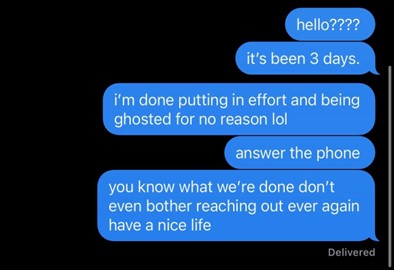
Figure 1. A text message screenshot sent in by a Gen-Zer demonstrating breakup practices over text

Let’s face it, ghosting sucks. Some may comment on the exchange above and say no response is a response, but does that provide effective closure in breakups? Although most people feel indirect breakups are outright disrespectful, the reality is that many of us are guilty of engaging in unhealthy breakup practices. However, has the rise of the Digital Age made this problem worse than before? Our study investigates how breakup practices differ amongst the two generations, Millennials, and Gen Z. Through our exploration of dating differences between these two generations using surveys and interviews, we found that tech use is more common in romantic relationships and breakups amongst Gen Z and indirect breakups are more common amongst Millennials. Ultimately, while the fact that indirect breakups wear is different, it seems like our tendency to do so is little changed by the prevalence of digital technology, one way or the other.

[expander_maker id=”1″ more=”Read more” less=”Read less”]

Introduction and Background

Our study intended to assess the effect of technology on relationship practices between Gen-Zers (born between 1997 and 2012, according to Dimock (2019)) and Millennials (born between 1981 and 1996, according to Dimock). We know that technology has impacted both Gen Z and Millennial romantic relationships, but the impact of tech use on romantic relationships is contested. Christenson’s (2018) study found that heavy social media users experience a severe decline in the quality of interpersonal relationships. On the other hand, Nicolas (2020) found that relationships formed on social media achieve similar self-disclosure and companionship as in-person relationships. More generally, Seemiller and Grace (2018) contended that Millennials were self-absorbed and ill-equipped to deal with meaningful relationships, while McGuire (2015) finds that Millennials still learn proper romantic expectations. The emergence of ghosting (the sudden cessation of communication over digital platforms) as a breakup method has further increased academic alarm, with LeFebvre and her colleagues (2019) finding that 96% of the college students they interviewed had been a part of ghosting interactions in some capacity. With this disagreement in scholarly assessments of technology and the younger generations in general, we feel that the healthiness of relationships experienced by these generations is worthwhile to study, with breakup methods as a good proxy. Baxter (1984) found that indirect breakups (without telling the partner directly, as in ghosting) were associated with self-centered breakups, prolonged the breakup process, and were a source of regret for breakups. Therefore, we expected that Gen-Zers were more likely than Millennials to use indirect breakup methods and to use technology in their breakups. If this hypothesis is true, then it demonstrates that tech use is likely to have a negative impact on breakup methods, since the biggest difference between Millennials and Gen-Zers is their exposure to tech use (as a consequence of their respective birth years).

Methods

To study the effects of technology on break-up methods, we sent a survey to Gen-Zers and Millennials that we knew and asked them to send it on to other Gen-Zers and Millennials that they knew as well. The survey was conducted through an anonymous Google Form to enable honest responses to sensitive questions. Ultimately, 27 Gen-Zers and 20 Millennials responded to the survey. The survey asked respondents how much they agreed with statements about the prevalence of technology use in their romantic relationships and their experience with breakups. The questions used the Likert scale, with respondents stating their agreement from “strongly agree” to “strongly disagree,” and binary (Yes-or-No) questions concerning whether they had encountered or engaged in specific break-up strategies described in Baxter’s (1984) study.

To complement the survey, we also conducted anonymous interviews with three Gen-Zers and two Millennials that we knew. Each interview proceeded with a set of interview questions that covered the same topics as the survey, but in an open-ended way. The interviewees were encouraged to go into detail on their experiences that relate to the questions, such as by describing the break-up experience in narrative form rather than merely categorizing it. Since the survey’s responses relied on the Likert scale and binary questions, which included no way to explain the answers, we needed a way of discovering more nuance in the relationship between technology use and healthy break-up methods. The interviews, which were fewer in number but far more detailed, provided a way to get into the details.

Results

The survey results show that indirect breakup methods are less preferred by both Gen-Zers and Millennials compared with direct breakup methods.  However, Millennials are more likely to have used indirect breakup methods than Gen-Zers. 30% of Millennials report having broken up with someone indirectly, versus 15% of Gen-Zers.  The results illustrate that Gen-Zers have been broken up over text more often than Millennials, with 44% of Gen-Zers having experienced this versus 25% of Millennials. The key takeaways that we acquired from the interview questions were that both Gen-Zers and Millennials predominantly prefer direct break-ups rather than indirect breakup methods.  On the other hand, one of our Gen-Zer interviewees preferred to break up indirectly, especially if they were not in a serious relationship with their partner.  This somewhat contrasted our findings, but our interviewees still largely preferred direct over indirect breakups, and they were generally of the opinion that indirect breakups are messy and disrespectful.
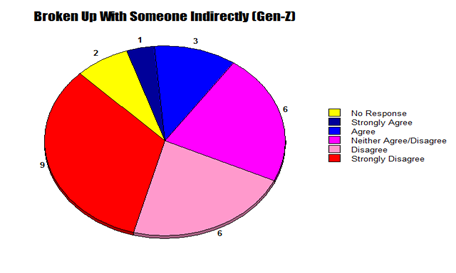
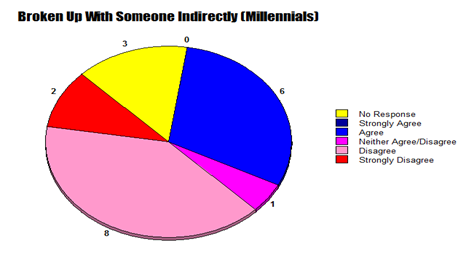
Figure 2: This pie chart indicates that Generation-Z individuals most likely Strongly Disagree (9 people) or Disagree (6 people) with the statement “When terminating a relationship, you ended the relationship without ever directly stating your intention”.
Figure 3: This pie chart illustrates that Millennials disagree more than they agree with the statement “When terminating a relationship, you ended the relationship without ever directly stating your intention”.
The results illustrate that Gen-Zers have been broken up over text more often than Millennials, with 44% of Gen-Zers having experienced this versus 25% of Millennials.

Analysis

According to the results, Millennials tend to break up in person, whereas Gen-Zers break up less in person and more over text than Millennials. This confirms our hypothesis that tech use is more common among Gen-Zers for breakups. On the other hand, Gen-Zers are actually less likely than Millennials to break up indirectly, which contradicts our hypothesis. While this does not necessarily indicate that tech use leads to healthier breakup methods, it does put a wrench in the scholarly speculation that they render younger generations actively unprepared for romantic relationships.
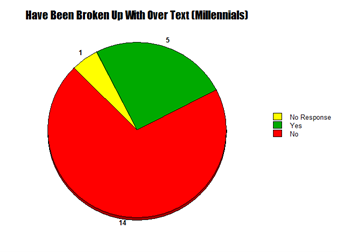
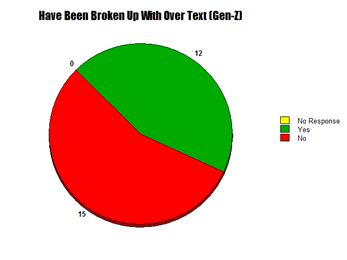
Figure 4: This pie chart shows that a vast majority of Millennials have not been broken up with over text.
Figure 5: This pie chart shows that 44% of Gen-Zers have been broken up over text.
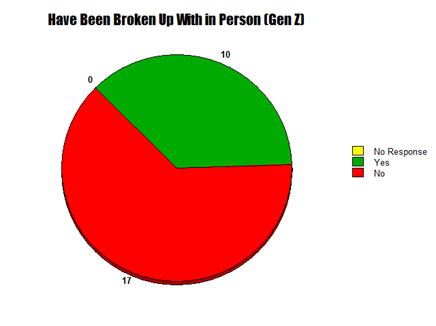
However, Millennials are more likely to have been broken up with in-person than Gen-Zers, with 75% of Millennials having experienced this versus 37% of Gen-Zers.
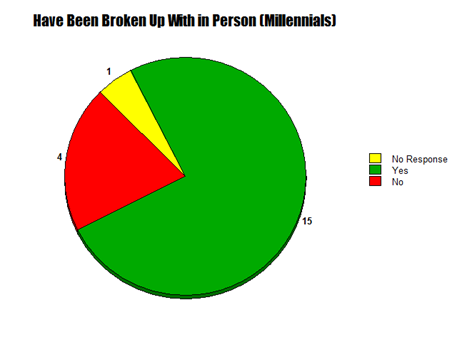
Figure 6: This pie chart indicates that Millennials are more likely than not to have been broken up with in person.
Figure 7: In the pie chart above, this chart illustrates that Generation-Z individuals are less likely than not to have been broken up with in person.

Discussion and Conclusion

Our hypothesis that Gen-Zers would engage in more indirect breakup methods than Millennials was incorrect. Contrary to our expectations, it doesn’t seem like Gen-Zers are less equipped than Millennials to deal with breakups. However, we found that technology was more extensively used in Gen-Zer breakups compared to Millennial break-ups. This verified our hypothesis that Gen-Zers use technology in romantic relationships more than Millennials and suggests that there was no correlation between being exposed to technology and the tendency to use indirect breakup methods. This is important because it suggests the rise of technology use by Generation Z doesn’t affect their relationship readiness as negatively as scholars fear. Moreover, neither of these two generations exhibited any special tendency towards indirect breakups compared with other generations. Baxter’s (1984) study found that 49% of the relationships examined were broken up through indirect means. This rate is much higher than the 30% of Millennials and the 15% of Generation Z who had engaged in at least one indirect breakup in our study. While the numbers are not fully convertible and the Baxter study involved more interviewees, one could reasonably conclude that Millennials and Generation Z are not more likely, and are quite possibly less likely, to use indirect breakup methods than Baxter’s Baby Boomer subjects. Of course, break-up methods are only a small part of the overall process of a relationship, but this finding supports the opinion of scholars who feel that the younger generations are as capable of healthy relationship practices as the older ones. 

References

Baxter, L. A. (1984). Trajectories of Relationship Disengagement. Journal of Social and Personal Relationships, 1(1), 29–48. https://doi.org/10.1177/0265407584011003

Christensen, S. P. (2018). Social Media Use and Its Impact on Relationships and Emotions (Order No. 28107583). Available from ProQuest Dissertations & Theses A&I; ProQuest Dissertations & Theses Global. (2442249267). https://www.proquest.com/dissertations- theses/social-media-use-impact-on-relationships-emotions/docview/2442249267/se-2

Dimock, Michael (2019). Defining Generations: Where Millennials End and Generation Z Begins. Pew Research Organization. https://www.pewresearch.org/fact-tank/2019/01/17/ where-millennials-end-and-generation-z-begins/

Krafchick, Julie and Yue Xu. (2020, March 10). Millennial vs. Gen Z Dating (No. S10E5) [Audio podcast episode]. Dateable. Drank Production. https://www.dateablepodcast. com/episode/s10e5-millennial-vs-gen-z-dating

LeFebvre, L. E., Allen, M., Rasner, R. D., Garstad, S., Wilms, A., & Parrish, C. (2019). Ghosting in Emerging Adults’ Romantic Relationships: The Digital Dissolution Disappearance Strategy. Imagination, Cognition and Personality, 39(2), 125–150. https://doi.org/10.1177/0276236618820519

Mateo, Ashley. (2019). How to Break Up With Someone Without Hurting Them. Oprah Daily LLC. https://www.oprahdaily.com/life/relationships-love/a27865922/how-to-break-up -with-someone/

McGuire, Kate, “Millennials’ perceptions of how their capacity for romantic love developed and manifests” (2015). Masters Thesis, Smith College, Northampton, MA. https://scholarworks.smith.edu/theses/659

Nicolas, É. M. (2020). The Impact of Social Media on Adolescent Attachment Style for Generation Z (Order No. 27737202). Available from ProQuest Dissertations & Theses A&I; ProQuest Dissertations & Theses Global. (2348090364). https://www.proquest.com/dissertations-theses/impact-social-media-on-adolescent-attachment/docview/2348090364/se-2

Seemiller, C., & Grace, M. (2018). Generation Z: A Century in the Making (1st ed.). Routledge. https://doi.org/10.4324/9780429442476

Further Reading and Listening

[/expander_maker]

, , , , ,

From Slay to On Fleek: Linguistic Features of Millennial and Gen Z Internet Communication

Aileen Dieu, Makenna Kumlue, Nicholas Litt, Jazmine Pineda, Rafael Santos

The social media community is truly that, a community. Groups of people gather based on common interests to share ideas, offer support, and even criticize opposing views, for better or worse. Millennials were the first generation to create an online community, and through that, a whole new array of lingo, trends, and even celebrities arose. Then, Gen Z entered social media and created their online community filled with their interpretations of millennial slang, as well as bringing a whole new batch of slang to the mix. However, the interactions between both groups yield confusion, amusement towards popular trends in either community, and even irritation due to a lack of comprehension of new terms. In our research, we observed the specific tokens and behavior displayed by both groups individually and in interactions with one another across varying social media platforms. We found varied sentence structure, emoji use, and critical attitudes of Millennials towards Gen Z slang. Yet, for the most part, Millennials and Gen Z communities interact fairly effectively across some parts of the internet.

[expander_maker id=”1″ more=”Read more” less=”Read less”]

Background

Digital communication plays a crucial role daily. Regardless of occupation, race, gender, or class, social media is a form of communication with others and provides a place to express opinions to a targeted audience. Social media usage began around 1997 with a website called “Six Degrees” where people could communicate with close contacts. This was popular among the Millennial generation (1981-1996), and the emergence of another application called “MySpace” in 2004 was another big hit (Ortiz-Ospina, 2019). Fast forward a decade later, Generation Z (1997-2012) has evolved to also use multiple social media platforms at once (not as much as Millennials). Recent studies showed that Millennials use 5 to 6 social media platforms at once while Generation Z use around 2 to 3 social media platforms (Vacalares et al., 2023). The advancement of technology along with the comfort of being more expressive in an online setting was appealing to Generation Z, as we see them use more current social media apps than millennials today. As a result, they have created their forms of communication and language styles that are derived from digital trends (Jeresano et al., 2022).

The types of slang used are also motivated by a sense of social conformity. Depending on the app, the social norms differ greatly based on the demographics of users as well as the app’s intended purpose. If anyone were to talk outside the “social norms” of the app, it would lead to negative feedback, loss of followers, and a negative social media presence (Taber et al., 2023). Generation Z also utilizes social media apps for various purposes such as education, shopping, entertainment, and socializing (Mude, 2023). We hope to explore more on the types of linguistic features seen across various apps like TikTok, Instagram, X, and Facebook among Millennials and Generation Z individuals. How would these differences reflect evolving cultural and technological influences?

Methods

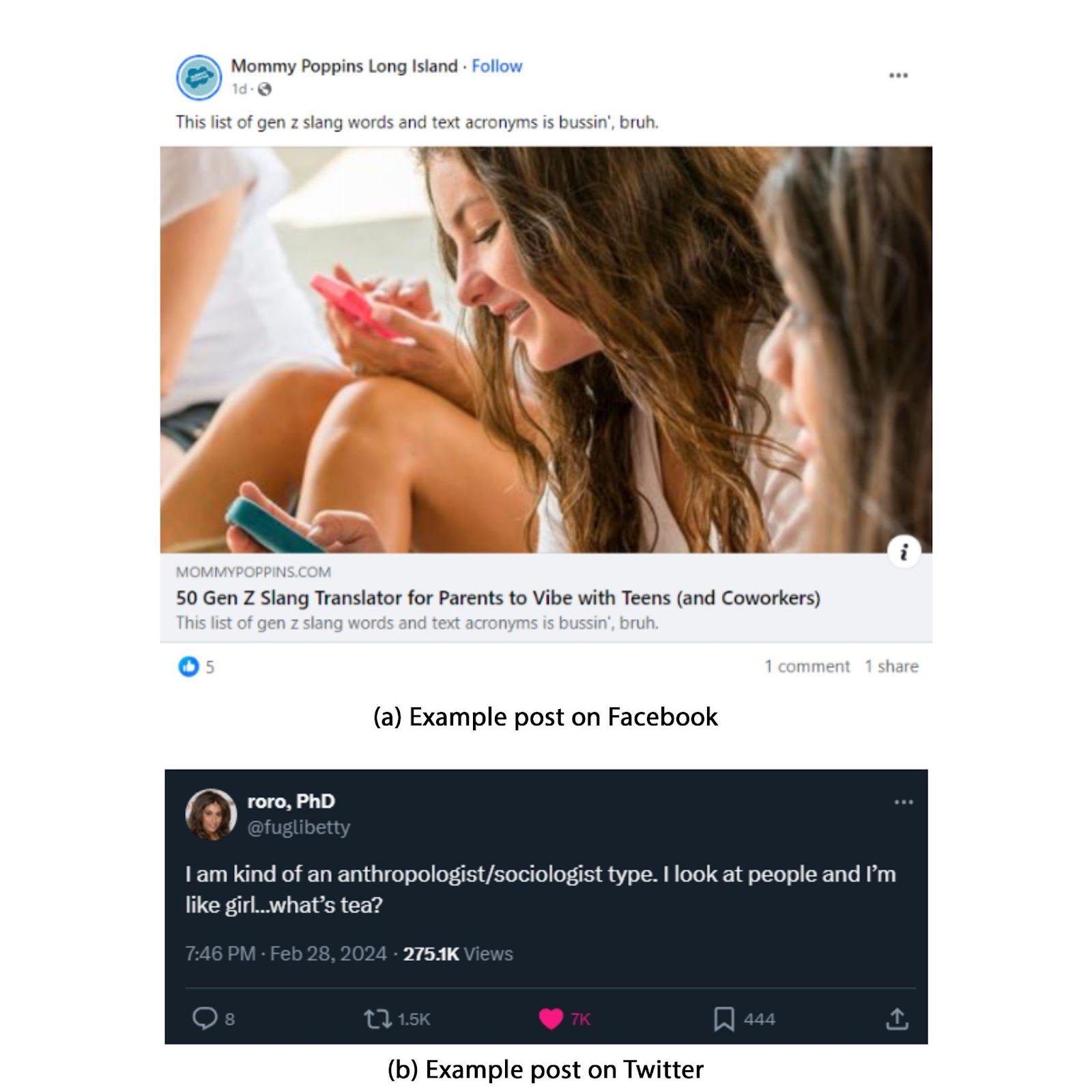
Data for this article was acquired through observation and analysis of different word usage on various social media platforms such as TikTok, Instagram, X, and Facebook, based on usage and popularity. Observations were then assigned to team members by platform and instances of slang were captured as screenshots (See Figure 1) and then analyzed by individuals. Instances of slang, word choice, tone, and sentence structure were assigned a rating of Gen Z or Millennial based on prior perception and/or investigation of user age. Perceptions of Gen Z versus Millennial word usage and choice were based on a consensus around Gen Z’s abbreviation usage and knowledge of contemporary media culture (Jeresano et al., 2022), in comparison to the Millennial generation’s lower intelligibility for newer slang (Taber et al., 2023). The team then convened and analyzed for further patterns of linguistic choice and feature. Lack of or inaccurate user information was addressed to the best of our ability.

Figure 1. Sample posts with instances of slang usage.

Results and Analysis

There were some semantic communication barriers between those we identified as Millennials and Generation Z. Both generations demonstrated similar morphological features within their slang, namely, acronyms and euphemisms (Which may be due to the platform’s format, like character limits and censorship). However, the resemblances begin to deviate when examining specific slang words and phrases. Our data exhibits the referential and ironic nature of Generation Z’s coined words and phrases rapidly generated and circulated across each platform. These coined words and phrases, derived from internet culture and AAVE (African American Vernacular English), contain a level of specificity within them that, to use properly, one must know the original to some extent. Accordingly, our collected data suggests that Millennials tend to use outdated or misused slang or are entirely oblivious to the terms.

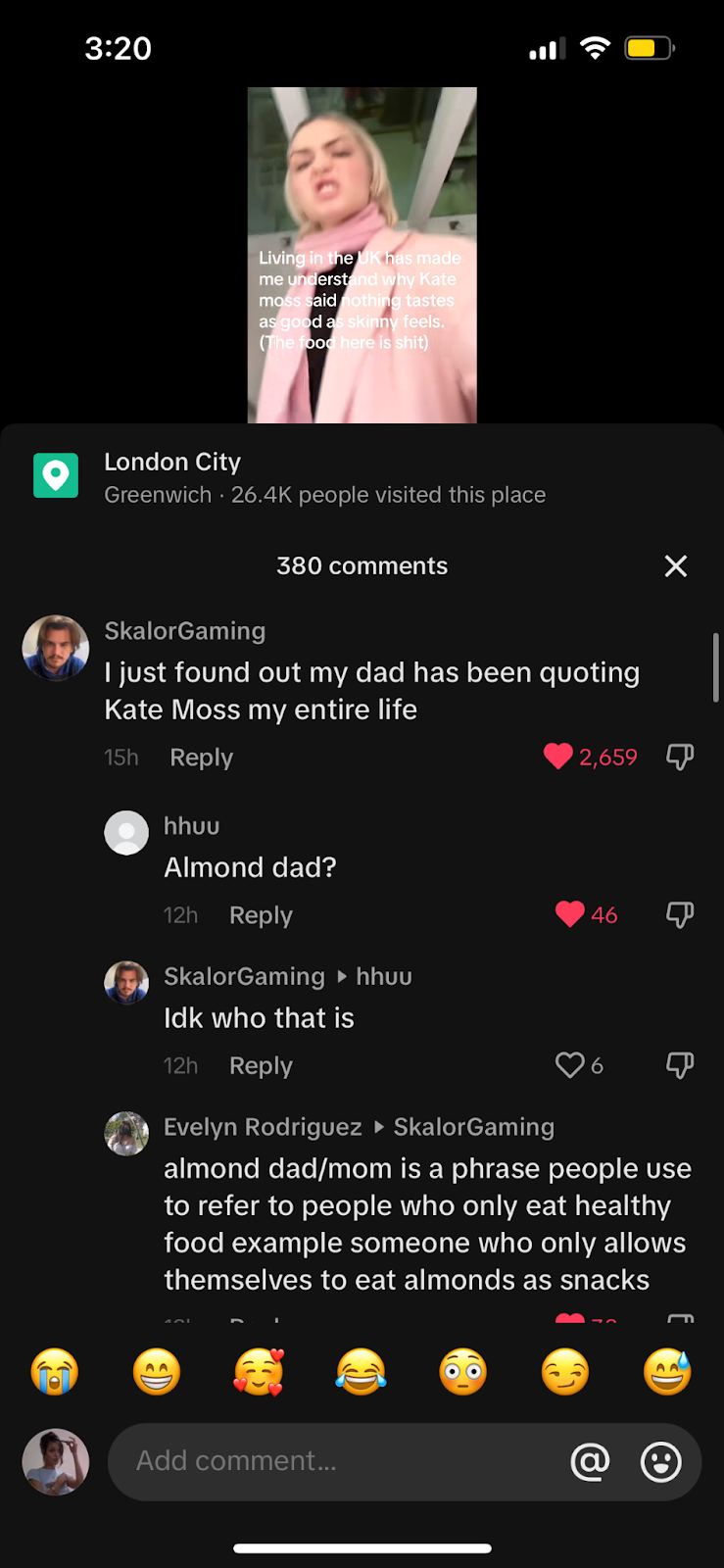
Therefore, there appears to be frustration and confusion between Millennial and Generation Z interactions, primarily exhibited on the Millennial side. In Generation Z-dominated media, like TikTok, the cross-generational interactions are question-oriented. Our data includes numerous accounts of deemed Millennials seeking meaning and context behind creators’ and commenters’ posts to better understand the jokes and discourse occurring (See Figure 2). However, apps containing older demographics tend to display rejection, ridicule, or misunderstanding of Generation Z’s communication style. Additionally, these apps depict Millennials attempting to increase their engagement and flaunt their relevance through overcompensation, i.e., frequently using slang and emojis. Thus, generating derision from members of Generation Z who come across their content. 

Figure 2. A Millennial TikTok user obtaining an understanding of a popular culture reference from the video content and learning Generation Z coined slang through user-to-user engagement within the comment section.

However, it is essential to note that the gap between generational differences in slang is shortening due to high social media exposure and interactions across generations. With the growing demographics of Generation Z-dominated apps, there tends to be more exposure to viral content from which these terms are derived. Additionally, personal interactions between each generation further the understanding and adoption of coined words and phrases. While our data exhibits the semantic communication barriers between Millennials and Generation Z, we question whether this issue will remain prevalent in the foreseeable future.

Discussion

Our results provide insights into the linguistic differences and communication trends between Millennials and Generation Z individuals in social media. Through observation of various social media platforms such as TikTok, Instagram, X (formerly Twitter), and Facebook, our research highlights distinct linguistic features and communication practices exhibited by each generation.​ Millennials tend to use “outdated” slang words and phrases, while Gen Z incorporates slang derived from abbreviations and references to other viral trends. ​This reflects the evolving cultural and technological influences on language use, with Gen Z being more influenced by internet culture and current trends. The demographics of each social media platform also play a role in the linguistic practices observed, which suggests that the linguistic features seen on these platforms may be influenced by the dominant generation using them. ​

TikTok demonstrates semantic barriers in communication between Millennials and Gen Z. Gen Z individuals on TikTok use coined words and phrases derived from internet culture and AAVE (African American Vernacular English), heavy acronym usage, and euphemisms. On Instagram, Gen Z users use informal slang with abbreviations and unique vocabulary from internet culture. At the same time, Millennials exhibit a more formal writing style with complete sentences, positive affirmations, and subtle humor. ​Both Millennials and Gen Z individuals use X, but there are some differences in their linguistic practices. ​Gen Z shows strong use of irony, informality, and word choice derived from current internet culture and technology. ​Millennials, on the other hand, use outdated terms and references, specific to their periodical upbringing, and have a more formal sentence structure.

Conclusion

In conclusion, the linguistic differences and communication trends observed between Millennials and Generation Z in social media reflect the evolving cultural and technological influences on language use. ​ Each generation exhibits distinct linguistic features and practices, influenced by their respective demographics and exposure to internet culture. ​ The interactions between Millennials and Gen Z online highlight both generational differences and a willingness to engage in a compromised social bubble. ​ Further research in this area can provide a deeper understanding of how language evolves in the digital age and its impact on intergenerational communication.

References

Taber, L., Dominguez, S., & Whittaker, S. (2023). Ignore the Affordances; It’s the Social Norms: How Millennials and Gen-Z Think About Where to Make a Post on Social Media. Proceedings of the ACM on Human-Computer Interaction, 7(CSCW2), 1–26. doi.org/10.1145/3610102

Jeresano, E. M., & Carretero, M. D. (2022). Digital Culture and Social Media Slang of Gen Z. United International Journal for Research & Technology, 3(4), 11-25. 

Vacalares, S. T., Salas, A. F. R., Babac, B. J. S., Cagalawan, A. L., & Calimpong, C. D. (2023, June 11). The Intelligibility of Internet Slangs Between Millennials and Gen Zers: A Comparative Study. International Journal of Science and Research Archive. doi.org/10.30574/ijsra.2023.9.1.0456

Mude, G., & Undale, S. (2023). Social Media Usage: A Comparison Between Generation Y and Generation Z in India. International Journal of E-Business Research, 19(1), 1–20. doi.org/10.4018/ijebr.317889

Ortiz-Ospina, E. (2019) “The Rise of Social Media” Our World In Data ourworldindata.org/rise-of-social-media. [/expander_maker]

, , ,
Scroll to Top