Mandarin

Media & Reality All at Once: How ‘Everything Everywhere All at Once’ is doing its best to exemplify our code-switched conversations

Jacqueline Aguirre, Josiah Apodaca, Kaitlyn Khoe, Mason Uesugi, Wonjun Kim

Code-switching, or the use of more than one language, dialect, or code in an utterance or conversation, can be a way to signal identity. This study compares two sources of code-switching — conversations from media, specifically Everything Everywhere All at Once (2022), and conversations in real life — by categorizing utterances and types of code-switching. This study investigates the representation of code-switching in bilingual media and the similarities and differences to code-switching in daily life. The real life conversations were conducted with Mandarin-English bilinguals, and the two conversations ran for 8 and 10 minutes. The findings demonstrated that intersentential switching occurred more often in this particular media, while intrasentential switching was preferred by the real-life speakers. The various types and functions of code-switching were present in the media, which was expected given the larger sample size and production resources and timelines. Nonetheless, both case studies demonstrated significant levels and mannerisms of code-switching, aligning with the proposed variables and categories. Further studies could utilize other syntactic properties, pitch contours, and tonal articulations in order to auditorily represent accuracies and behaviors of code-switches as more bilingual media makes its way into the American entertainment landscape.

[expander_maker id=”1″ more=”Read more” less=”Read less”]

Introduction and Background

Code-switching (CS) refers to when a speaker alternates between two or more languages, or language varieties, within a single sentence or interaction. Code-switching is a linguistic function mostly used in bilingual speech communities to convey a mutual “in-group” status between speakers, as the ability to code-switch demonstrates proficiency in both of the utilized languages. Our study seeks to answer these questions: How is code-switching represented in media? What are the differences and similarities to code-switching in everyday life?

Deriving from the studies conducted by Shen, Gahl, and Johnson on English-to-Mandarin code-switches, we compared the types of code-switching between Mandarin and English in media, through the 2022 film Everything Everywhere All at Once (EEAO), versus real life to see how accurately code-switching is being represented. The aforementioned study by the researchers suggest the existence of “switch cost,” as the English-Mandarin bilinguals consistently displayed slower reaction times specific to the code-switches in sentence-medial positions, as highlighted in their eye tracking experiment (Shen et al,. 2020). However, while there are many studies giving structure to code-switching, there are fewer applying them to media. 

Our target population for this project were Mandarin Chinese and English bilingual speakers. Mandarin Chinese belongs to the language family of Sino-Tibetan languages, which is under the Sinitic branch (Odinye 2015). Internationally, about 1.3 billion people use the language, being the official language of China and Taiwan (Odinye 2015).
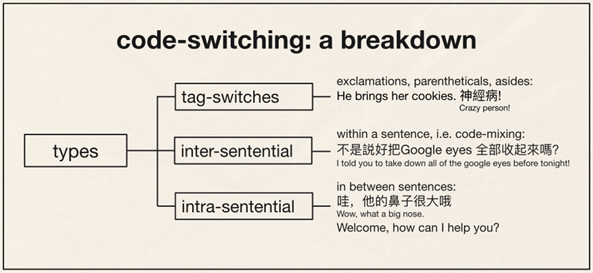
Figure 1. Explanation and examples of code-switching types.

There are three different types of code-switching: tag-switches, which are exclamations, parentheticals or an aside in another language than the rest of the sentence; intrasentential switches, which occur in the middle of the sentence and are typically called code-mixing; and intersentential switches, which occur between sentences (Appel & Muyusken, 2006). We will use these categories in our data analysis to see if some forms of media uphold current code-switching practices.
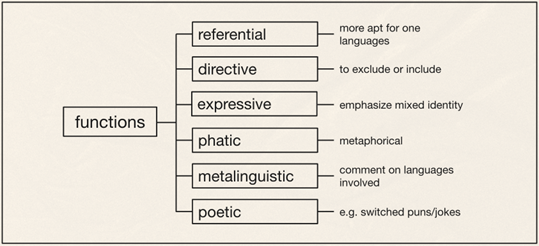
Figure 2. Explanation of code-switching functions.

Code-switching in a sentence can also serve different functions depending on the speaker, topic, and context of the language used. Researchers Appel & Muyuskend determined six categories as follows: (1) referential, where some subjects or words are more apt for one language, perhaps due to a lack of knowledge; (2) directive, to exclude or include the hearer; (3) expressive, emphasizing mixed identity; (4) phatic, or metaphorical switching; (5) metalinguistic, to comment indirectly or directly on the languages involved; and (6) poetic, which are switched puns or jokes (Appel & Muyusken, 2006).

There is going to be a lot left out about the filmmakers here, but in terms of context about the media that is relevant to code-switching, one of the writer/director duo ‘the Daniels,’ Kwan, is a second-generation Chinese-American. Having been in a Chinese Mandarin and English home environment, he is likely comfortable with engaging in code-switching because of his multilingual parents. One of the producers, Jonathan Wang, hopped on this project also because he wanted to tell a story inspired by his own immigrant parents, so he likely had a hand in ensuring language accuracy, like with the Cantonese, alongside with several translators. With this background in mind, we hypothesized that the movie’s representation of code-switching should be fairly accurate to how speakers code switch in real life.

We hypothesize that the participants and the script should have similar examples and amounts of code-switching in type and function within the given environmental parameters, as established earlier. Our research will help determine whether change is needed in how bilingualism is being represented, or if there is already a solid structure in place for new media to follow.

Methods
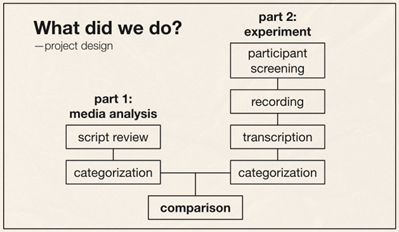
Figure 3. Step-by-step breakdown of our methodology.

Our project design comes in two parts: analyzing the media and analyzing a conversation in real-life. The script had both lines as they were spoken along with translations, so we could categorize them based on type of CS. We applied that same process to two conversations, around 10 minutes each, recorded between two sets of participants. They did know they were being recorded but eventually seemed to forget (over a period of around 10 minutes for each set), so the conversation seemed to flow naturally, with them code-switching subconsciously.
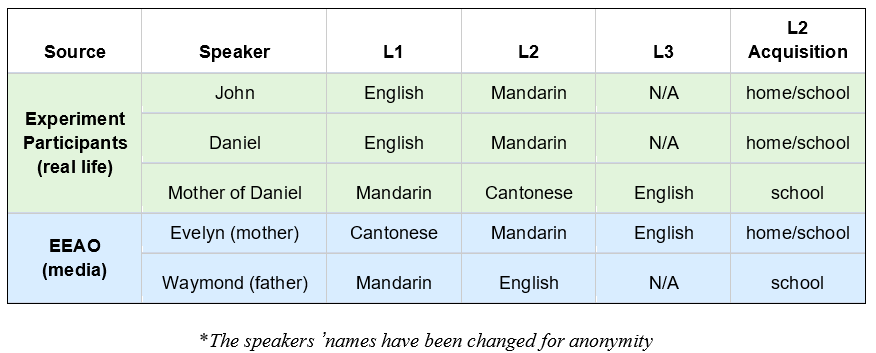
Figure 4. Language background of participants and EEAO characters.

We then analyzed the two sources of code-switching and made comparisons. For the screening process, we found our participants based on a language background survey collecting information, such as their L1, L2, and how they acquired their L2, as shown above. The characters’ method of L2 acquisition and L3 is speculated based on context. It is also likely that Evelyn is a simultaneous bilingual in Cantonese and Mandarin. Only the L2 acquisition method is listed, as it is relevant to our focus on bilingual speakers. Two of the participants (John and Daniel) were close cousins to reflect, while not exactly, the close relationship between Raymond and Evelyn. We also had one of them talk to their own mother to see if there would be a change with the different social dynamic. 

Results and Analysis

The table below shows the tallies for the types of code-switching used in the EEAO script (the blue indicating code-switching in media) and the conversations recorded with our participants (green for real-life code-switching). Since the conversations were not exactly the same amount of time, the proportions for each type of CS were calculated by dividing the total for each conversation by the count. There was insignificant information for tag switching in both the script and recordings, so it was left out of the table.
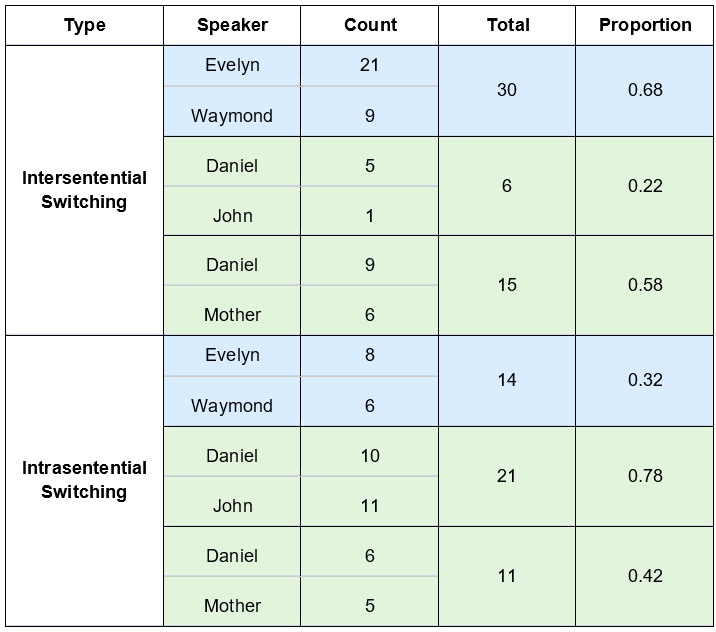
Figure 5. Code-switching frequency in media vs. recorded conversations. Proportion represents type of code-switching used in conversation out of total occurrences of code-switching.

Waymond and Evelyn used intersentential switching more than intrasentential (30 versus 14 times). That pattern is the same for Daniel and his mother (15 versus 11 times), while Daniel and John opted for more intrasentential switching (6 versus 21 times). The type of CS (intrasentential) that is more common for Daniel and his mother, whose language background and fluency matches best with EEAO characters, is the same as in EEAO conversations.

As for functions, each pair (Daniel and John, and Daniel and his mother) were dominant in the referential function, where some words or phrases are more easily expressed in one language. This outcome is likely because of the speakers’ proficiency in their second language — Mandarin. In a self-reported survey, both Daniel and John rated their L2 proficiency as a 3. The expressive and poetic function appear in the recorded conversations (CS was also used to repeat and clarify). The directive function likely does not appear in these conversations because they were recorded in isolated, controlled environments. Had they been in more natural environments, out in public, it is likely that the directive function would appear.

As for the functions present in the EEAO conversation, they were also dominant in the referential function of code-switching, with directive being the second most used. Considering the characters, Waymond and Evelyn, immigrated to America and were likely not exposed to their L2 (English) until later, it makes sense that the referential expression is dominant for them as well. Regarding their use of the directive function, this is most likely due to Waymond and Evelyn being in various environments where there was a third-party to exclude or include (e.g., customers, Gong Gong). Additionally, unlike our speakers, the expressive function does not appear in the movie, but the poetic function does show up once. 

Based on these results, it seems that the code-switching in EEAO supports the theory of the different types and functions of code-switching. When comparing our speakers’ code-switching with the movie, both align in having referential code-switching be primarily used in communication. Though with our speakers, they showed slightly more variety in function, as they covered expressive functions while the movie did not. While the movie significantly used the directive function, our speakers did not. Again, we conclude that this is due to a difference in environments between the speakers.

Discussion and Conclusion

The data promotes the idea that EEAO and its representation of code-switching is accurate. Since Daniel’s code-switching varied based on the hearers (with his cousin versus his mother), the movie’s representation is also accurate in representing how code-switching is employed for differing functions based on environment.

While the conversations and media we analyzed ended up with similarities, affirming our hypothesis of EEAO being an accurate representation of code-switching, further research is needed to extend these results to media in general. After studying natural conversations of English-Mandarin bilinguals, researcher Xitong Zhang found that “the occurrence of code-switching not only depends on the language ability of the speaker, but also the purpose and the environment in which the conversation occurs” (Zhang, 2019, p. 44). One of the ways to expand this study in the future would be to observe participants in more environments and situations over longer periods of time (e.g., recording conversations over the course of a week) because EEAO has more environments. This choice would provide more data for analysis and allow for a richer case study of CS.

It would also help to have participants whose language background better matches the characters even better because Daniel and John did not have the same L1/L2 as Waymond and Evelyn. However, the time constraint of this study provided a limited participant pool to see how identity and linguistic competency affect code-switching.

We could also look into instances of “bad” code-switching in media, likely tied to older media sources, to develop concrete standards of accurate code-switching — including what not to do — for future representations of the bilingual experience. We could just look at more films, maybe in other language pairings, or other sources of media, like TV shows, whether good or bad examples, as well.

In his video essay “English. Language. Movies. Parasite,” Kyle Kallgren studies code-switching in the 2019 film Parasite and the cultural implications of mixing English and Korean in conversation. The Parks, a rich family, often uses English to confide in each other or to establish solidarity with their hired workers. It seems that English is worked into the plot accents, signifying the divide between the poor and rich families. In a similar fashion, language boundaries reinforce relationships in the plot of EEAO, with code-switching being a big part of it.

America tends to fawn over foreign culture without realizing it is their own culture being sold back to them — just accented — which is probably why they find connection to it. There is something to be said about how these two movies employ code-switching as a tool to hint at language hierarchies. Studying the use of language and code-switching in media like this is important for providing a foundation for how to approach appropriate representation in media. There are harmful social implications if one does not consider the influence of how language is used in movies. As language hierarchies exist in reality, noticing and replicating them in media will only reinforce them when they should be dismantled. Understanding how media perpetuates practices in which social classes are tied to certain manners of speaking can help us counteract that.


References

Anindita, K. (2022). An Analysis of Code-Switching in the Movie “Luca”. ELTR Journal, 7(1 23-33. https://doi.org/10.37147/eltr.v7i1.164

Appel, R. & Muysken, P. (2006). Language Contact and Bilingualism. Chicago: University of Chicago Press.

Chen, Z., & Liu, X. (2023). Types and Functions of Code-Switching in the Film Everything Everywhere All at Once. Journal of Education, Humanities and Social Sciences, 13, 171-176. https://doi.org/10.54097/ehss.v13i.7889.

Kwan, D. and Scheinert, D. (Writer). (2022). Everything Everywhere All at Once. A24.

Odinye, S. I. (2015). Phonology of Mandarin Chinese: Pinyin Vs. IPA. Quarterly Journal of Chinese Studies, vol. 4, no. 2, p. 51–58.

Reformadita, A., & Setyaji, A. (2021, October). Code-Switching Analysis on Pixar’s “Coco” Movie. In Undergraduate Conference on Applied Linguistics, Linguistics, and Literature. (Vol. 1, No. 1, pp. 26-37).

Shen, A., Gahl, S., & Johnson, K. (2020). Didn’t hear that coming: Effects of withholding phonetic cues to code-switching. Bilingualism: Language and Cognition, 23(5), 1020-1031.

Zhang, X. (2019). Code-Switching in English-Chinese Ordinary Conversations. TESOL Working Paper Series, 17, 38-45.


Appendix A

PDF Link for EEAO Script

[/expander_maker]

, , , ,

Pattern Differences Between Voices Across Sina Weibo and Their Indications on Speakers’ Sociolinguistic Ideologies

Wenqian Guo

This study investigates how and why a specific speaker’s linguistic behavioral patterns may differ across channels on the same social media platform. Specifically, this research addresses important components in conversations, such as grammaticality and illocutionary indications, as well as the emoji feature that is exclusive to online media, the Chinese social media platform Sina Weibo in this case. Through comparing speakers’ comments between posts on the state-controlled People’s Daily Weibo channel and the “super-topic” free discussion forum on social, cultural, and political events, it is clear that the topics being addressed and the functions that different channels serve in each case, respectively, contribute to the speakers’ different perceptions of these channels. Additionally, from individual speakers’ responses in interviews during the study, the special censorship nature of social media in China and the exclusively superior accessibility of state-controlled media also complicate speakers’ linguistic choices, emphasizing their consideration of locating “safety” and practical usefulness on social media. As there remains limited previous research focusing on this specific area, this research hopes to offer new insights on exploring sociolinguistic ideologies embedded in Mandarin online communication.

[expander_maker id=”1″ more=”Read more” less=”Read less”]

Examples

1. Discussions of Social Events

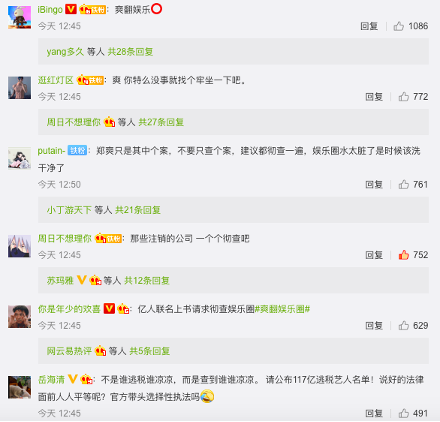
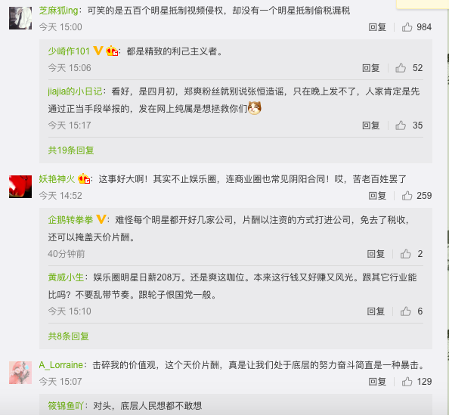
Event: The China Tax Administration declares its serious attitudes towards the actress Zheng Shuang’s tax fraud and evasion event

Fig. 1 Screenshot of the Zheng Shuang Event Under the People’s Daily Channel
Fig. 2 Screenshot of the Zheng Shuang Event Under the Free Discussion Forum
  • Comments under People’s Daily: mostly well-formed sentences, with either full SVO structures or simplified VO structures with implicit subjects in place, regarding one’s attitude toward the unfair privilege associated with Zheng, along with active and academic-like usage of vocabularies that urge for the government’s investigation. Emojis are more used in illustrative, direct manners.
  • Comments under the free discussion forum: fragmented, short phrases popping up randomly; the presence of “four-letter words” associated with negative emotions; pure complaints about unfairness that the general public is subjected to when compared with privileged individuals like Zheng. Emojis are more used in metaphoric and illocutionary manners.

2. Discussions of Cultural Events

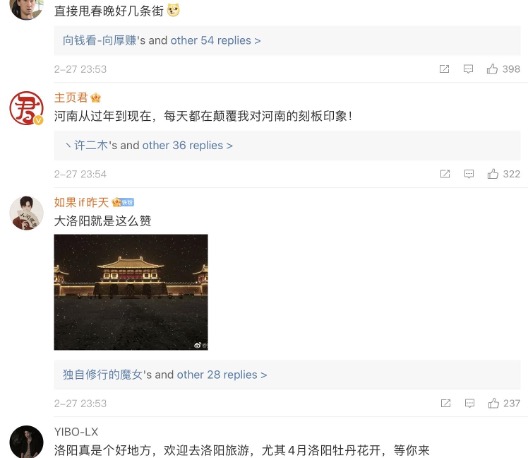
Event: Around this year’s Spring Festival, the capital city of the Tang Dynasty, Luoyang, reconstructed the palace city of Tang and held light festivals that also reflected on the glorious past days.

Fig. 3 Screenshot of the Luoyang light festival Under the People’s Daily Channel
Fig. 4 Screenshot of the Luoyang light festival Under the Free Discussion Forum

Informal expressions and phrases that lack complete sentence structures appear frequently. As for contents, while comments under both platforms contain recurrent praise for the beauty of the reconstructed ancient city, specifically, among comments under the People’s Daily, there are some noticeable distinctions. For example, there are comments that urge the national government to propagate the replication of such efforts in other cities, as well as comments of local people of Luoyang that take the commenting channel as a place to advertise their cities to potential visitors who come from other cities. This clearly marks the distinctive characteristic that only the state-controlled People’s Daily channel could be entitled to, as being the representation of the government’s voices, the public may consider it as a direct and effective channel to communicate with the government, as well as its easy accessibility and widely accepted popularity makes it appropriate for propagation. On the other hand, the free discussion forum could not similarly reach the government, as well as it may not be entitled to that high level of popularity and accessibility, given that many people would not visit the forum if not necessary or not interested.

[/expander_maker]


,

Code-Switching Between Mandarin Chinese and English: Do You Use “lol” or “xswl”?

Wenqian Guo, Sum Yi Li, Yichen Lyu, Sok Kwan Wong, Yingge Zhou

Code-switching has become increasingly common as globalization allows international exchanges across cultures to take place more frequently. And as studying abroad becomes more accessible to students around the world, more speech communities with distinctive code-switching patterns are being formed. As we pondered the topic for our research project, we looked around and realized that not only are the majority of our group members native Mandarin speakers studying in the US, but collectively we also belong to this wider speech community that tends to code-switch between Mandarin and English. We could not help but wonder — do local students in China talk like us at all? And is there a reasoning behind the way we talk? It is these questions that formed the basis of our research.

For the project, we narrowed down our research to focus on just Internet slang used on WeChat, China’s answer to WhatsApp. Through our proprietary survey and by combing through chat history we collected from our participants, we discovered some very interesting findings. Continue reading to find out how and why Mandarin-speaking international students in the US code switch on WeChat.

[expander_maker id=”1″ more=”Read more” less=”Read less”]

Introduction and background

Chinese students who study in the U.S. often code switch between Mandarin and English and our project was aimed at examining the motivations behind the phenomenon.

We specifically looked into our subjects’ texting patterns on messaging app WeChat and compared them to Chinese students either residing in China or other non-English speaking countries in an attempt to confirm our assumption that code-switching is prevalent among Chinese students in the US. We also surveyed the students and asked for reasons behind their choice of words. We hypothesized that convenience as well as a desire to appear foreign-educated are what motivated the code-switching.

We based our project on Luke’s (1984) study on language mixing in Hong Kong, where English words are often inserted into Cantonese conversations. Luke (1984) concluded that code-switching in Hong Kong is partly pragmatically motivated (when the objects being discussed do not have Chinese translation) and partly socially motivated (when the individuals want to identify as better educated and westernized).

We extended Luke’s (1984) study to cover Mandarin Chinese, which is spoken in Mainland China. Presumably English mixing is more prevalent in Hong Kong because it is a former British colony. Code switching is not common among locals in China, but it is observed among individuals who have exposure in English-speaking countries.

Methods

The target population for our project consists of two major groups: college students who study in the US and college students who study in their home country China. Both groups of students are native Mandarin speakers. Our data collection was divided into two parts. First, we created a survey to ask both groups of students to select from provided word choices under different text conversation scenarios and provide us with a reason behind each choice. The participants were also asked to specify how frequently they would code-switch in their daily conversations with friends and family on WeChat. Second, we collected a series of chat history based on three main topics, namely schoolwork, casual conversations and sensitive topics. For the survey, we interviewed a total of 17 students from UCLA as our sampling for the groups of students who are foreign educated. We also interviewed a total of 6 college students who are based in China.

Results

For the purpose of discussion, our project referred to college students who study overseas as “US students” and those who study in China as “local students”.

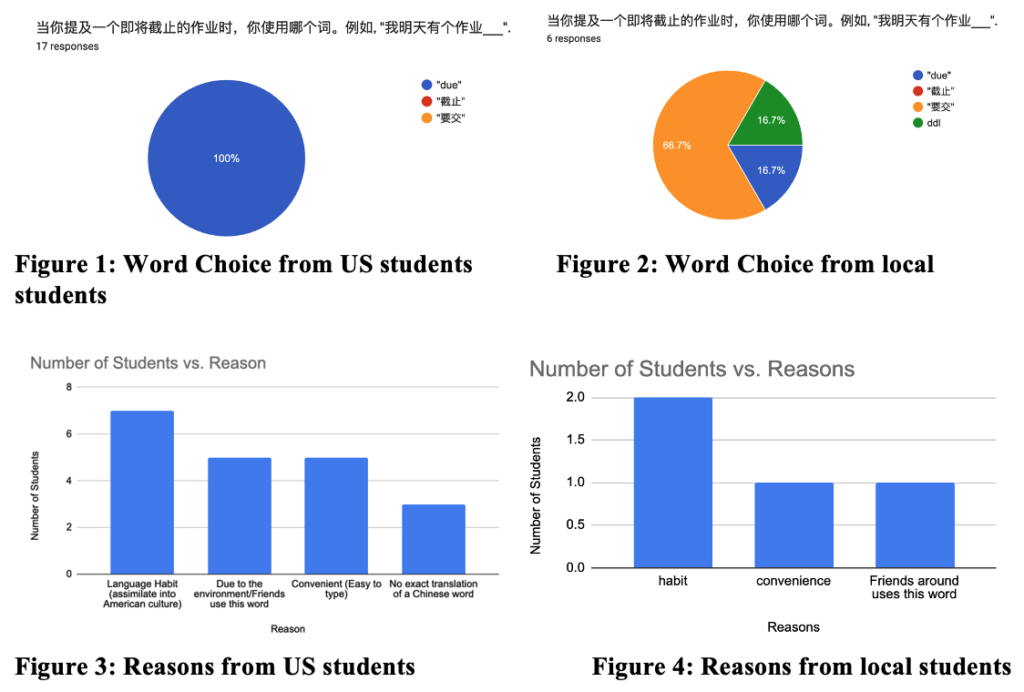
School Work Survey Question 1: Which word would you use when you want to talk about a homework assignment that will be due soon. For example, “我明天有个作业___”. (Tomorrow I have some homework__)

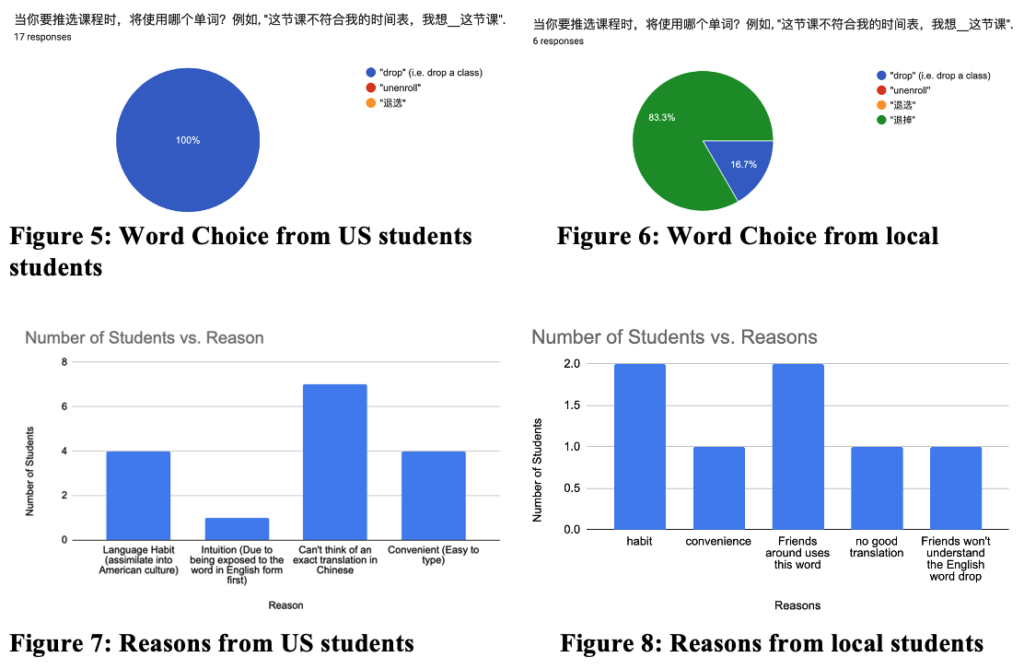
For the first survey question regarding homework assignment, all of the US students chose the English word “due”, while the majority of the local students chose the equivalent Chinese words “要交”. Even though most students from both groups attributed their choice to a similar reason, which is language habit, from the perspective of the US students, “language habit” refers to a way to try to assimilate into the American culture, while in the context of the local students, it is more of an innate and natural habit.

School Work Survey Question 2: Which word would you use when you want to unenroll a class you have registered before? For example, “这节课不符合我的时间表, 我想__这节课”. (This class doesn’t match my schedule, I want to __ this class.)

For the second survey question relating to unenrolling classes, all of the US students chose the English word “drop”, while the majority of the local students picked the Chinese equivalent “退选”. However, both groups have different reasons behind their word choice. The majority of the US students said they chose the word “drop” because there is no equivalent translation in Chinese. On the other hand, the local students preferred using Chinese due to language habits influenced by their friends and family.

Based on the reasons the participants provided, it appears that being in different environments and different speech communities are the main reason students develop different language habits. Besides, the source of learning also influences their word choices. The US students tend to find it hard to find Chinese translation for words related to schoolwork since they learned these words in an English-speaking environment.

Casual Conversation Survey Question 1:  Which word would you use if you want to express laughter or something that is funny when you are chatting with your friends.

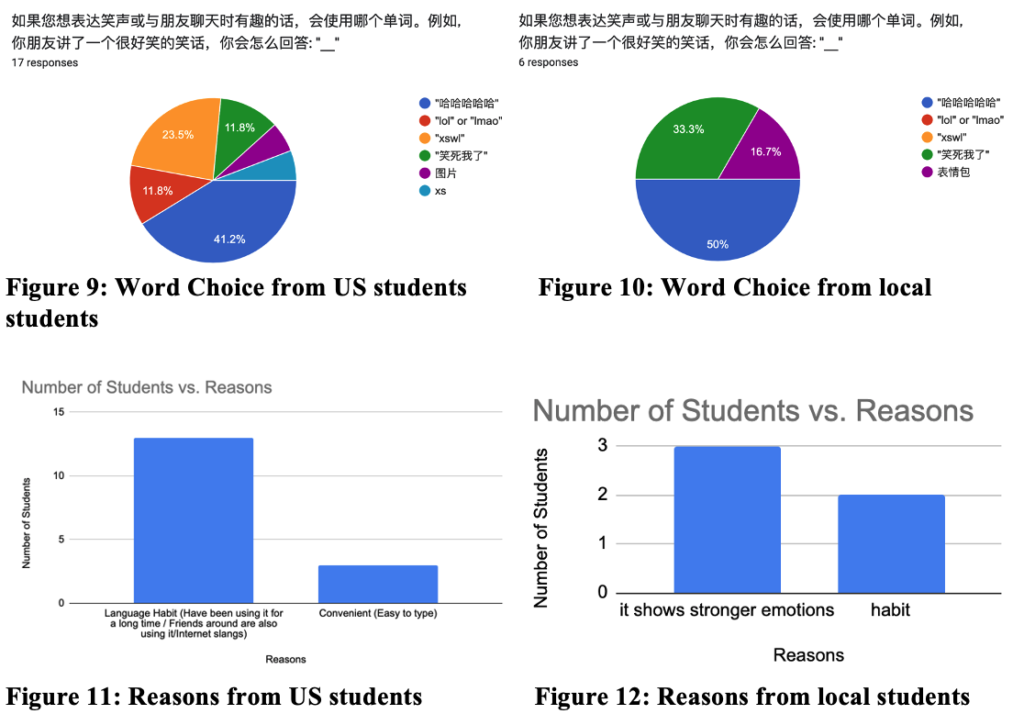
When asked how they would express laughter when texting, the majority of the US students chose the Chinese words “哈哈哈哈” (“Hahahaha”), while the majority of the local students picked another Chinese phrase “笑死我了” (“I laugh to death”). Even though both groups of students used Chinese to express laughter, each side has their own reason for the specific choice. The US students said they preferred “哈哈哈哈” (“Hahahaha”) as a language habit, while the local students preferred “笑死我了” (“I laugh to death”) because they believed the expression could better demonstrate their emotions and the situation. The results showed that Mandarin-speaking college students preferred to use Chinese when expressing laughter regardless of where they are studying.

Casual Conversation Survey Question 2: How often do you often replace words in a sentence from Chinese to English when you are chatting with your friends? For example, “我一会儿有个meeting or presentation”, “让我来表演一段rap”.

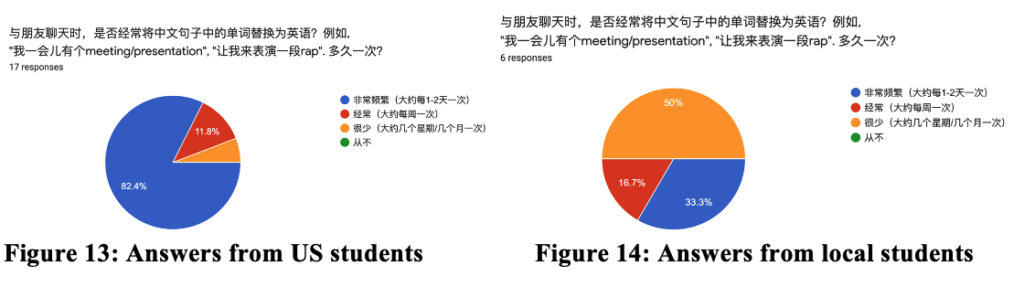
When asked how frequently they code-switch between Chinese and English when texting their friends and family, the majority of the US students said at least once every one to two days. Meanwhile, half of the local students said they seldom code-switch — only at least once every few weeks or months during their daily conversations.

Sensitive Topic Survey Question 1: What kind of curse words would you use most frequently when you are chatting with your Mandarin speaking friends?

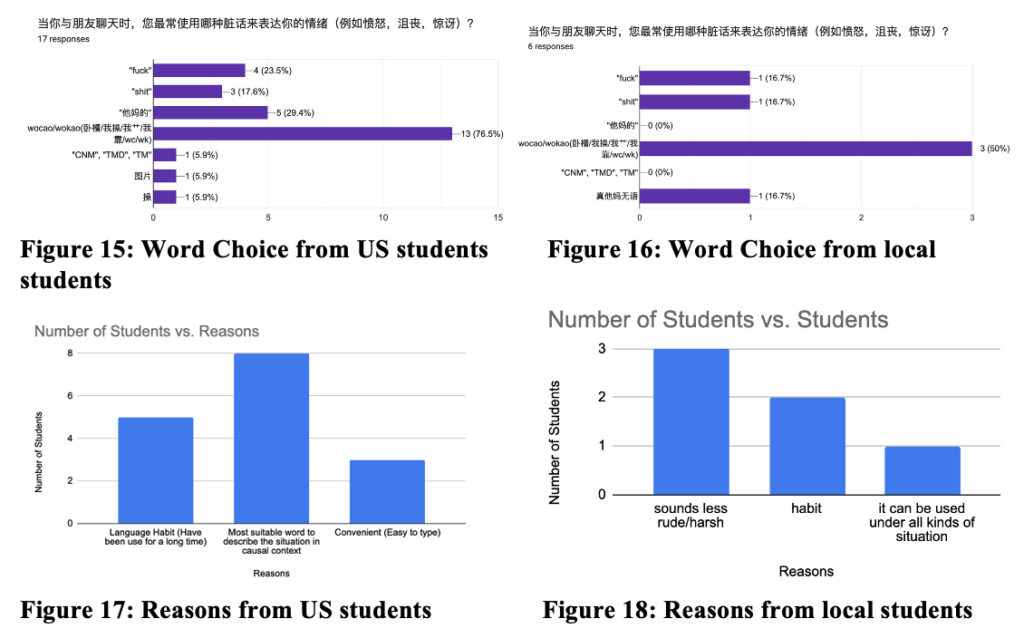
When asked which curse words they most frequently use, both groups of students chose “卧槽/我操/我靠” (roughly translated as “Damn it/Fuck”) but for different reasons. The US students said this option best describes their feelings, while the local students said it sounds less harsh than the other choices.

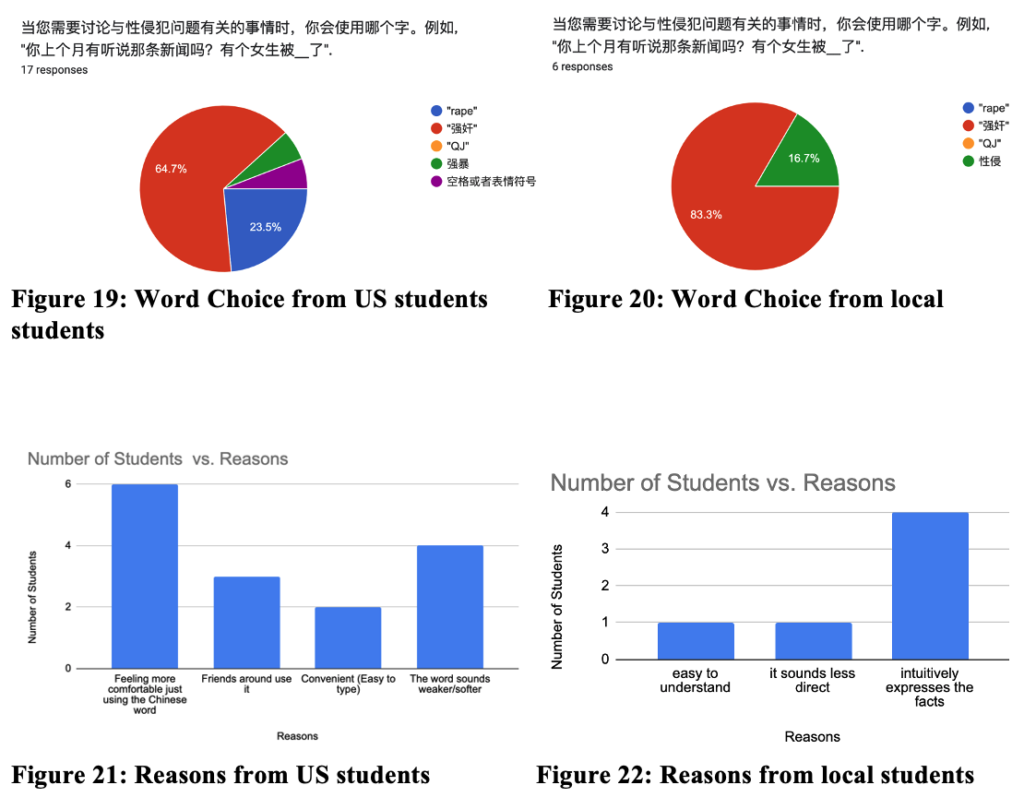
Sensitive Topic Survey Question 2: Which word would you use when you need to discuss something that is related to the issue of sexual assault. For example “你上个月有听说那条新闻吗?有个女生被__了”. (Did you hear the news? A girl was __)

When asked what words they would use to say “rape”, the majority of both the US and local students chose the Chinese words “强奸”, instead of “rape” in English or the abbreviation “QJ”. Most local students said they did not worry whether the word sounds too direct or inappropriate but would rather want to just say what really happened. Similarly, the US students said they felt more comfortable with the Chinese words.

Our survey: English version and Chinese version

Chat History Analysis

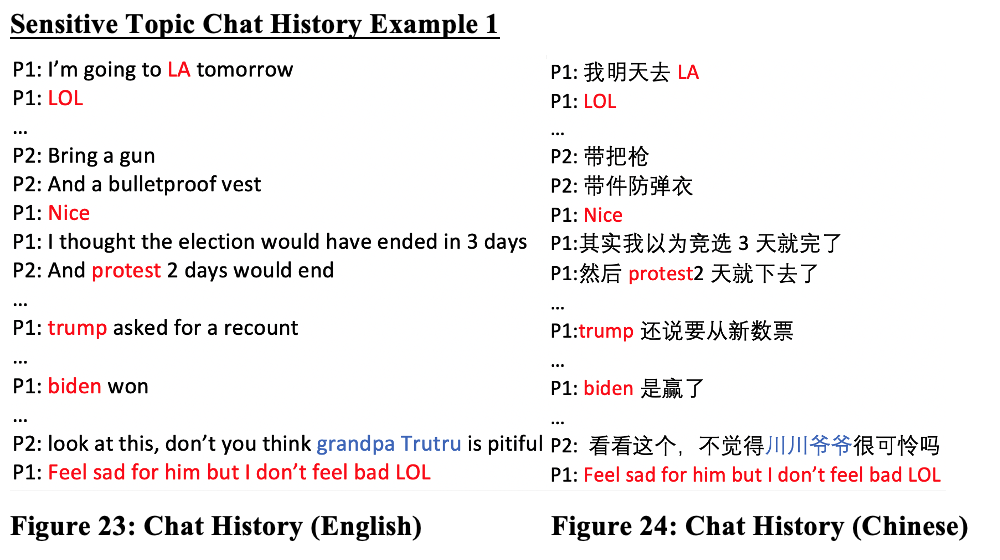
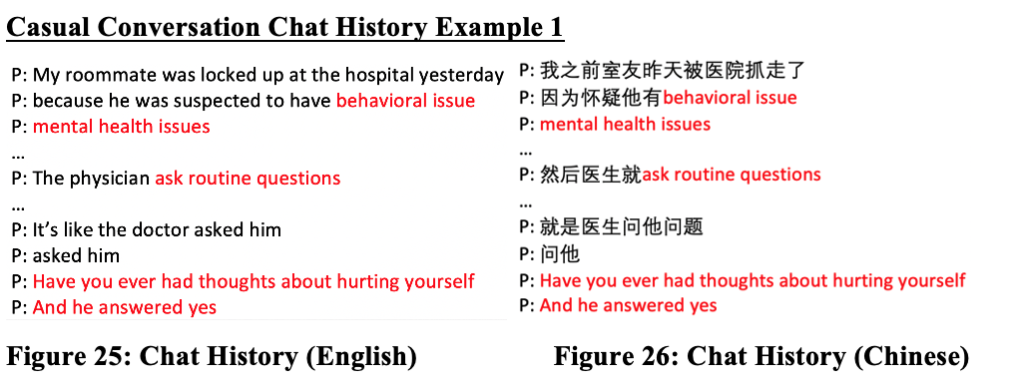
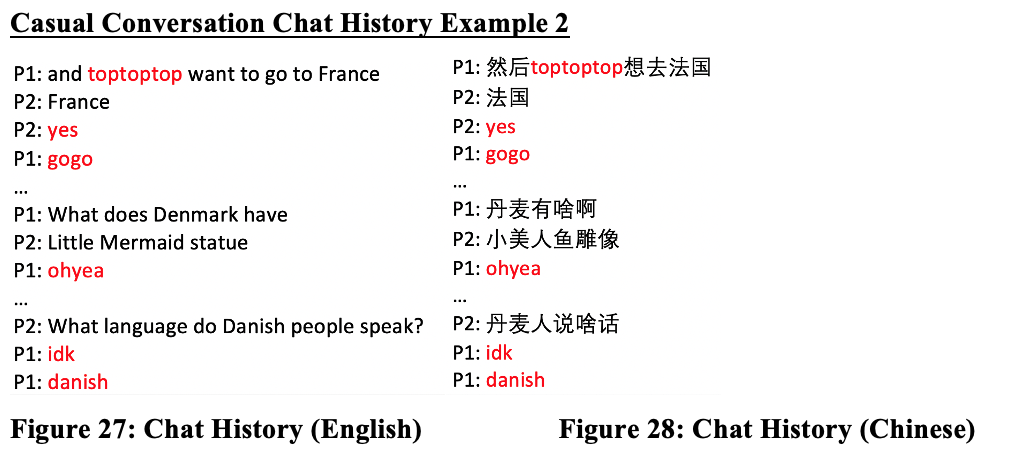
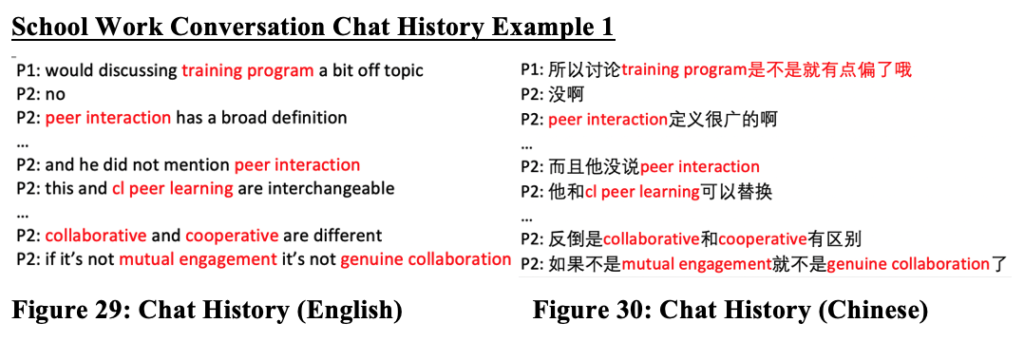
The chat history was obtained from Chinese students studying in the US. The words marked red were originally in English, while those in black are translations from Mandarin.

This is a conversation between two participants about the recent US election. P1 said they expected people to stop protesting in two days. Instead of using the Chinese words (“游行”) for protest, P1 code-switched from Mandarin to English. Since protests are rare in China, and the Chinese words for protests are rarely used, presumably it is easier for the participant to just use the English word when texting.

Marked code-switching is observed when P1 expresses a slight disagreement with P2. As P2 feels empathetic to Trump, P1 emphasizes with English to express that they don’t feel sad for Trump’s loss.

Another interesting point is that P2 referred to Trump as “Grandpa Trutru”, his Chinese nickname. Chinese people sometimes use nicknames to refer to important politicians, which is likely stemmed from China’s censorship on sensitive topics. Discussions about certain politicians are considered highly sensitive, so to avoid censorship, they come up with nicknames for the politicians. For example, Trump is also known as “懂王” (“the king who knows it all”), while Biden is “睡王” (“the sleepy king”). The use of nicknames exudes a sense of humor as well as dials down the seriousness of the discussion of political issues.

In casual conversations, code-switching again lends convenience and gives emphasis. It also constructs a common identity among people in the conversation. In the above conversation, the participant is telling a story about their roommate being forcefully taken away to the hospital after answering routine behavioral questions wrong, which is a well-known cultural shock among Chinese students studying in the US. As this routine is not performed in China, the participant constantly code-switched on noun and verb phrases for convenience. Also, all participants of this conversation are Chinese international students. The code-switching builds a common identity among them because the participant expects everyone to know the consequences of answering yes to routine behavioral questions. The last two sentences are examples of marked code-switching that emphasize on the participant’s disbelief: The participant is surprised that his roommate answered yes. It is a final revelation of the ending to this anecdote.

Similarly, in the above conversation, code-switching again serves as building a common identity among Chinese students in the US. The participants constantly chose to use short English vernaculars, such as “yes,” “go,” and “yea.” This indicates that they have been immersed in an English-speaking environment, so when expressing agreement and excitement, they tend to code-switch to English. Also, P1 ignored all English spacing in the conversation. This is because when typing English with the Chinese keyboard, adding spacing can be time-consuming. For convenience, P1 simply ignored the spacing during texting. Even so, P1 chose to respond in English, demonstrating that it is more natural for them to use these English vernacular phrases.

In academic scenarios, code-switching almost entirely occurs in jargon. By using English jargons such as “peer interaction” and “mutual engagement”, the participants demonstrated their educational background as foreign.

Discussion and Conclusion

From the aforementioned data findings, it can be concluded that Chinese students who study abroad and those who only study in China show different patterns in their language usage. When it comes to schoolwork and casual conversations, insertions of English words into Chinese sentences and code-switching between English and Chinese are mainly observed among students who study abroad, while less so is seen among the domestic students. This difference can likely be attributed to a lack of translation equivalence, as many school work-related words are only applicable in the US. The same goes for casual conversations. It is therefore not difficult to understand why the US students would tend to code-switch to English when there seems to be a lack of translation equivalence in Chinese.

Besides, the needs for social and emotional expressions evoked by surrounding cultural environments and contexts also contribute to the different language patterns and code-switching. In China, a conservative country both culturally and politically, pro-government language is encouraged, while the freedom of speech is repressed. This repression has in turn cultivated stronger needs for expressing emotions among the local students, leading to their choice of more confrontational and direct wordings when discussing sensitive topics. On the other hand, a higher frequency of code-switching among the US students revealed their needs to be identified as foreign-educated and share common identities with other speech participants of similar backgrounds.

Our findings point to the important roles that social surroundings and the kind of language encouraged within these environments could play in one’s speech patterns and code-switching. That being said, the language choices that the participants made are not entirely dependent on their own characteristics but are rather choices commonly negotiated by one’s surrounding social context as a whole. This contextual-based understanding therefore sets a reminder for future conversation analysis and sociolinguistic study, that one’s speech patterns could not be analyzed and identified without incorporating the nature of the surrounding speech contexts and cultural environments.


More on the topic:

Video about attitudes toward code switching in China

Paper on Chinese-English code-switching in conversations

References

K.K. Luke (1984), Expedient and Orientational Language Mixing in Hong Kong, York Papers in Linguistics 11, 191-201

[/expander_maker]

, , , , ,
Scroll to Top