influencers

I’m Sorry! – The Language Behind YouTube Apologies and Cancel Culture

Jessica Chen, Jean Maynard, Naomi Muñoz, Daisy Terriquez

“I’m sorry, I’m taking accountability” is a phrase that may sound familiar to those who frequent the internet. This is referencing the category of YouTube videos known as the “apology video,” where, as the name suggests, influencers post videos of themselves apologizing for actions that caused them to be “canceled.” In this blog, we examine if these apology videos share any patterns in their word choice and behavioral manners and if certain key words and phrases contained in these videos have become recognizable to audiences and associated with this style of video. This study was conducted in two parts: (1) analyzing 10 different apology videos posted to YouTube to map the commonalities found in word choice and gestures and (2) a two-part survey to deduce if participants could identify apology videos based solely on a provided comment or phrase. With this entry, we hope our findings can further the understanding of internet language, as well as promote conversations of media literacy, social advocacy, and mental health surrounding internet spaces.

[expander_maker id=”1″ more=”Read more” less=”Read less”]

Introduction and Background

With the globalization of technology, the ability to connect with a broad audience and build a large following has become readily attainable. Today social media platforms such as TikTok, YouTube, Twitter/X, and Instagram have facilitated the emergence of “influencers,” individuals who regularly post content on the internet and have managed to captivate a large following by sharing their daily lives, opinions, and thoughts. However, with such a large social media presence comes an increased possibility of every one of one’s actions being perceived and criticized by individuals who do not share similar morals or values. Consequently, it has become quite common to open social media apps to see yet another influencer on camera sighing and apologizing for an alleged act of misdemeanor they are being framed with. Essentially, this has made the online “celebrity apology” become so common; it has given rise to “cancel culture” and with it, the “YouTuber apology” category of videos.

The concept of “cancel culture” first emerged in the early 2010s and gained significant traction in the mid to late 2010s. Across social media platforms, “cancel culture” is defined as the practice where numerous people express their disapproval and withdraw support from a particular individual or brand (Roos, 2020). It encourages current supporters to “flock away” from influencers who have engaged in actions that are not deemed socially acceptable (Lewis & Christin, 2021). Cancel culture originated on Twitter/X with the intent to bring awareness and accountability to celebrities who have committed social injustices, dating back to movements like #MeToo, but has since been colloquially used to refer to the mass bullying and harassment of creators (Roos, 2020).

Cancel culture, with its “canceled” celebrities, gave rise to the category of videos on YouTube known as the “Youtuber Apology Video.” This is when a content creator records and posts a video of themselves apologizing, expressing their remorse for their misconduct, and asking their audience for forgiveness (Karlsson, 2020). As content creation is a livelihood for many of these influencers, losing monetary support due to overwhelming criticism can be a source of emotional and financial distress, motivating these influencers to release an apology video in an attempt to repair their public image (Goanta & Ranchordás, 2019).
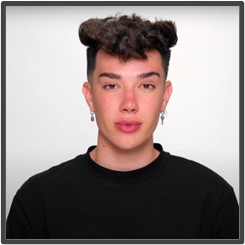
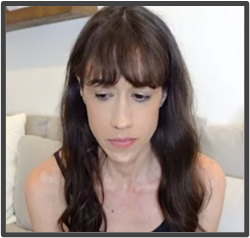
Influencer James Charles via YouTube (Reuploaded).


Influencer Colleen Ballinger via YouTube.

Interestingly, although the reason behind each of these videos may differ, there is reason to believe that many of them contain similar content. In their study analyzing various public celebrity apologies, Cerulo and Ruane (2014) found patterns of apology techniques that many celebrities employed in their statements. This looked like 27% of celebrity apologies containing “evasion” statements where they avoid responsibility, 29% of apologies having “action-ownership” statements where they acknowledge an action, and 32% having “mortification” statements in which the celebrity acts mortified by their own actions (p. 130-135). Though this study predates the rise of many famous YouTube apologies, it suggests a possible pattern that past celebrity apologies may have formed, which proved to be a useful foundation for our research. Although we did not utilize the same categories as Cerulo and Ruane (2014) and opted to find our own keywords, our research aimed to expand on what patterns, if any, could be found in this new form of celebrity image repair.

While research on “cancel culture” exists, our study attempts to address the research gap on both the precise language employed by YouTube content creators’ apologies, as well as how the individual viewers react to and process the content found within these videos. We believe that most research has not addressed the possible relationship between language used by the influencer and how the viewer interacts with it. This research will thus focus on the language used in influencers’ apology videos when they are being “canceled” by the general public. With a focus on Generation Z (Gen Z) and Millennials, the two generations who grew up with technology as an integral part of their daily lives (Serbanescu, 2022), the two research questions that arise are the following: First, can Gen Z and Millennial individuals tell whether an influencer is being canceled solely based on the language being used? Second, does an influencer change their speech patterns or behavioral gestures when they are being canceled? Our aim was to compare the reactions of Gen Z and millennial individuals to language and behavioral gestures used by an influencer when they are being canceled versus when they are in good standing. We hypothesize that when an influencer is aware that they are being canceled, they will engage in specific behavior and speech patterns. Further, we hypothesize that Gen Z and Millennial individuals will be able to tell without context when an individual is being canceled simply by reading comments or quotes with keywords associated with cancel culture.

Methods

To capture commonalities among influencer apologies, we started by compiling 10 YouTube apology videos, all involving YouTube creators who had amassed at least one million subscribers at the point they were canceled (See Image A).
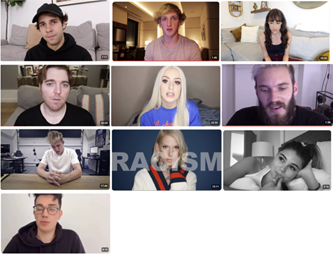
Image A. (left to right) David Dobrik, Logan Paul, Colleen Ballinger, Shane Dawson, Tana Mongeau, PewDiePie, Jake Paul, Jeffree Star, Olivia Jade, James Charles.

Even before this, we started by coding James Charles’ apology video titled “tati” and looked out for words and gestures that were constantly repeated. Based off that initial coding, we created a data chart with eight different keywords (“excuses,” “mistake,” “accountability,” “sorry,” “apologizing,” “um,” “disappointed,” and “idiot”) and four gestures (sighs, gulps, long pauses, and deep breaths) and continued meticulously examining and coding each video to pull out every instance of any of the keywords or gestures. In other words, each video received a tally of how many times these phrases or gestures appeared in the video. Gestures such as sighs and gulps, deep breaths, and long pauses were important in order to grasp an idea about the important factors, other than utterances, that can act as non-verbal communication methods and accompany the keywords to further emphasize the presence of “cancel culture.” Due to the important existence of gestures, we also operationalized “disappointment” as when an influencer simultaneously looks downwards and squints their eyebrows.

To continue our data collection, we created Survey 1, a survey that tests whether or not people know which influencer is being “canceled” based on comments from their YouTube videos (See Image B). With four survey questions in total, two contained comments from normal videos, while the other two contained comments from apology videos. These comments were chosen specifically from James Charles’ YouTube videos, as he was the initial focus for this research; however, future studies should expand to other influencers’ comments to have more variety. The comments were selected randomly, but we intentionally searched for comments that seemed more positive, had humor, and contained little context. This survey was largely utilized to supplement the overall definition of “cancel culture” by assessing Gen Z and Millennials’ topical understanding of it.

Furthermore, another survey, known as Survey 2, was created with the same test; however, it was based on utterances from both apology and normal videos of the influencers (See Image C). Among the several questions that were given in this survey, we deliberately crafted a suitable set of utterances from apology videos that involved our specific keywords to test if people associate those keywords with “cancel culture,” making it one of the most crucial parts of our data collection. By extracting quantitative data from the YouTuber apology videos and surveys, we were able to analyze what specific words and linguistic styles Gen Z and Millennial individuals deem to be associated with apologies and “cancel culture.”   
Image B. Title of Survey 1.


Image C. Title of Survey 2.

Results and Analysis

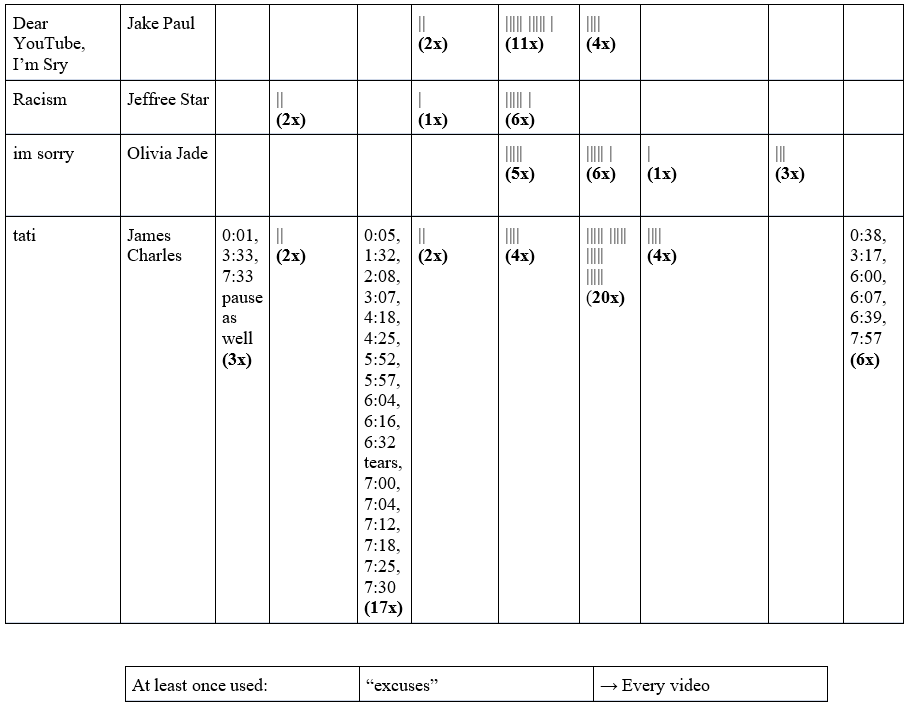
We can start by examining the data table that quantifies specific keywords uttered in the 10 apology videos and non-verbal communication methods that supplemented those keywords (see Table 1). 
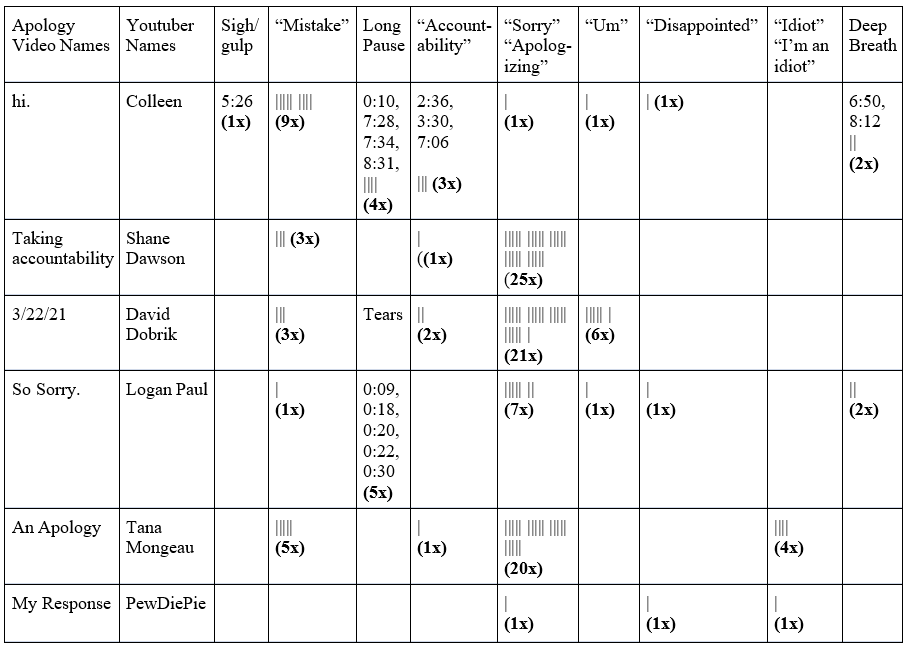
Table 1. Data table with tallies of key words and gestures from each video.

Table 1 displays the heavy use of “sorry” and “apologizing” in all of the apology videos, as well as the common effort to include mentions of “accountability” and making “mistakes.” Some YouTubers occasionally described themselves as feeling “disappointed” in themselves or feeling like an “idiot.” Most importantly, it was extremely common for them to use the word “excuses” in their apology videos. As for gestures, long pauses (with occasional tears) were the most frequent and seemed to dramatize the keywords.

Moreover, four graphs were created to illustrate the results of Survey 1, and eight graphs were made for Survey 2. Among our 55 Gen Z and Millennial survey takers, we gauged the amount of those who felt confident in their ability to tell if an influencer is actively being “canceled,” to which most replied they were somewhat confident (See Tables 2a and 3a).
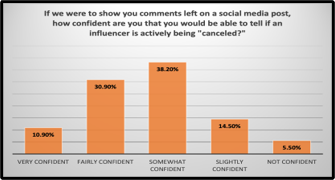
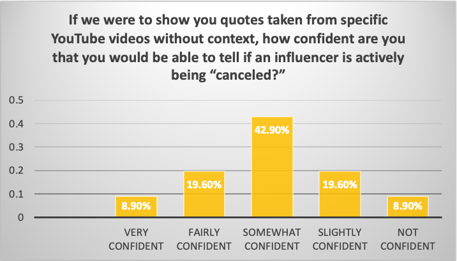
Table 2a. Survey responses to question at top of graph.


Table 3a. Survey responses to question at top of graph.

Table 2b exhibits the quantified survey results from Survey 1 that involve two comments from when an influencer was actively being “canceled” and two comments from when they were not. For Comment #1, answers were roughly split; however, there were fewer individuals who could determine that the influencer was actually actively being “canceled.” For Comment #2, #3, and #4, most individuals were able to determine the existence of “cancel culture.”
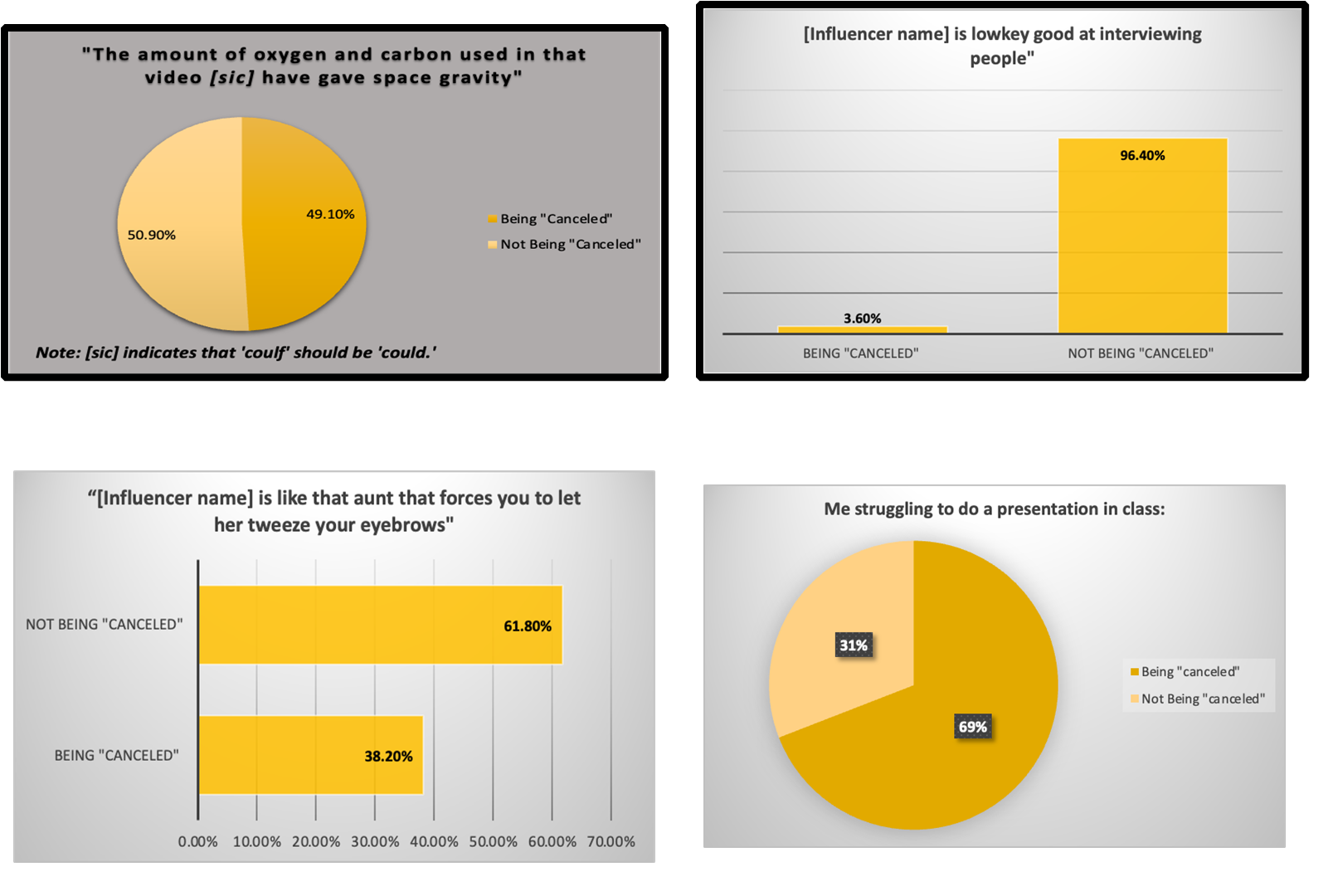
Table 2b. Results from Survey 1 on comments.

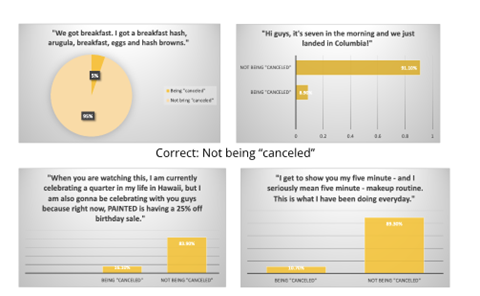
Subsequently, Tables 3b and 3c display results for Survey 2, specifically for utterances derived from our chosen apology videos and that contain our significant keywords. Individuals were more likely to be correct and be able to tell that an influencer was actively being canceled; however, Table 3c illustrates that more than half of the survey respondents were unable to determine whether an influencer was actively being “canceled” based on the keyword “um.” Individuals were also more likely to be correct when determining a normal utterance where there were no keywords present (see Table 3d).
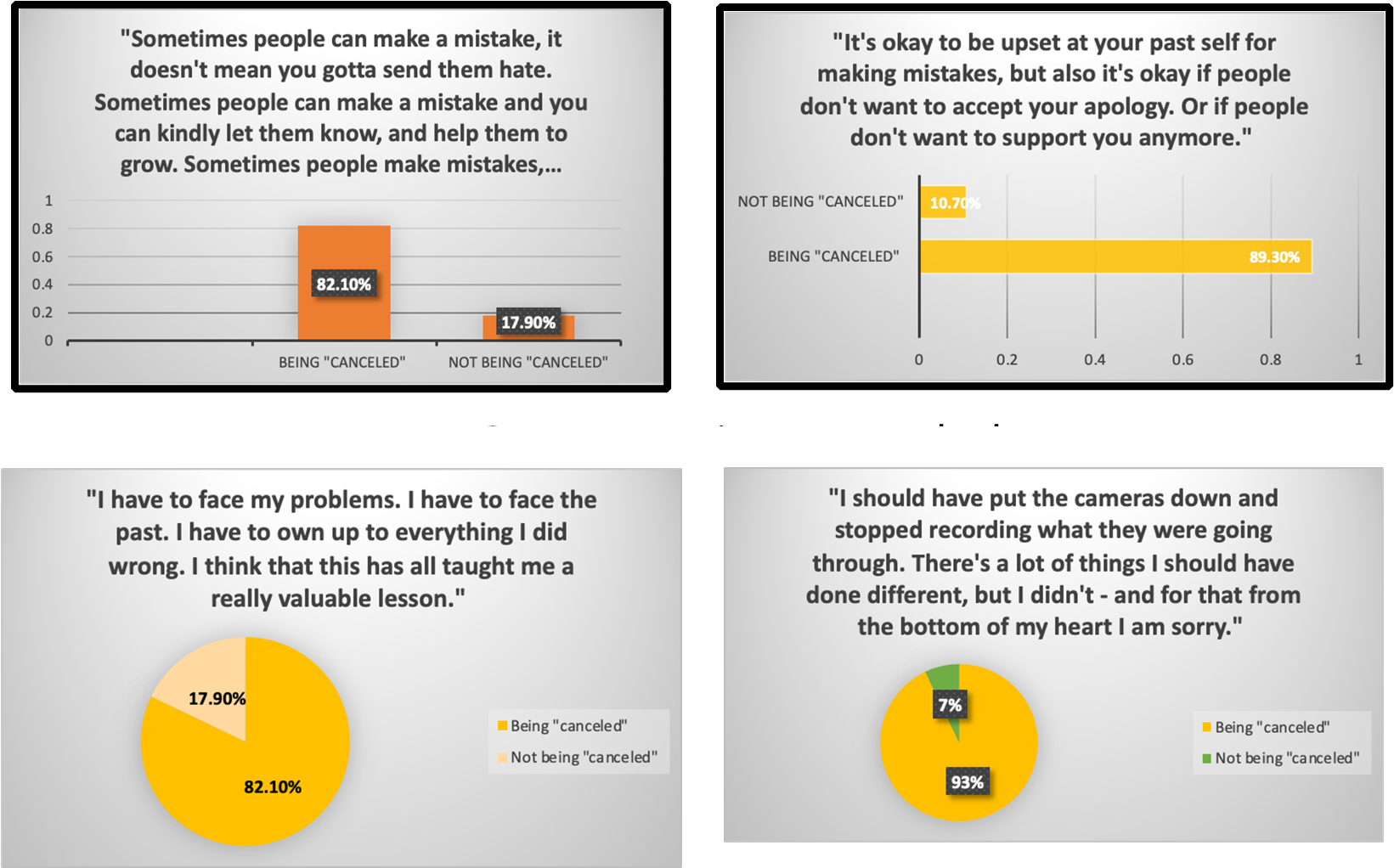
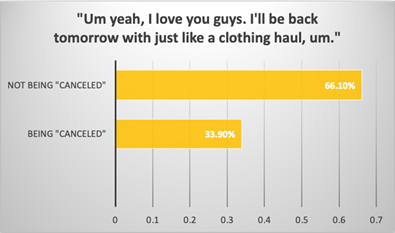
Table 3b. Results from Survey 2 on “canceled” utterances.


Table 3c. Results for “um” in Survey 2.


Table 3d. Results from Survey 2 on normal speech from YouTube videos.

Discussion

The current investigation attempts to fill these major gaps within the research by examining cancel culture from a linguistic perspective. Data gathered from YouTube suggests that the comments left on videos where an influencer is being canceled tend to be harsh and demeaning, aiming to publicly shame and bully the creator. The negative language used in the comment section appears to prompt the creator to upload a YouTube video where their language appears to be apologetic, while their behaviors simultaneously portray disappointment and shame in themselves. Since an influencer is aware that they are being canceled, they resort to the use of language that has proven to be effective when crafting an apology.

The findings from this investigation indicate that, in what appears to be an act of desperation to put an end to negative comments and find themselves in good standing with the YouTube community, influencers often resort to the use of the keywords discussed above. Their language quickly shifts from casual everyday language to words that show that they deeply regret their actions and are willing to take accountability.

In Survey 1 (See Table 2b, #1), a comment without context was purposefully chosen in order to test what most respondents think about “cancel culture” comments off the bat. Without context, it is difficult to tell what a comment is specifically referring to. Therefore, our results suggest that there are differences in how individuals view internet language, and it in turn influences whether they think an influencer is being “canceled” or not. In other words, because Comment #1 had no negative keywords and Comment #4 did (“struggling”), it hints that people associated the negative word with “cancel culture,” and therefore, “cancel culture” has this negative linguistic connotation to it. It is also important to note context in our Survey 2 results. When choosing utterances for our survey (See Tables 3b and 3d), we intentionally included utterances about breakfast, trips, sponsorships, and makeup routines, all contexts that are far from the idea of “cancel culture” and negative linguistic aspects. The context completely juxtaposes the utterances from apology videos (See Table 3b) because they are missing the “cancel culture” keywords. A very important finding in Table 3c suggests the importance of those negative associations. In this example, the apology video utterances are more ambiguous than others, especially with the inclusion of “um.” We include the keyword “um” because although it is an extremely common human utterance, it acts as a neutral keyword and requires more context. Most people responded with “Not being canceled,” suggesting that due to the absence of an explicitly negative keyword, respondents were not naturally drawn to viewing it as an apology video utterance.

Previous studies have primarily focused on exploring the psychological effects that cancel culture has on the individual that is actively being canceled. Such studies suggest that while cancel culture originated with good intentions — to hold individuals accountable for socially unacceptable actions — the psychological effects of cancel culture are oftentimes negative and include: social isolation and loneliness, depression, low self-esteem, and constant fear and anxiety (Berryman & Kavka, 2018). Although these findings add to the existing body of research, they also highlight gaps and consequently lead to further research questions: Why does cancel culture lead to these negative psychological states of mind? Does language play a role in cancel culture? Can cancel culture be viewed from another point of view?

Essentially, examining cancel culture from a linguistic perspective adds to the existing research because these findings can be tied back to a psychological perspective and begin to answer these questions. Understanding that the language associated with cancel culture is oftentimes negative and harsh, instead of critical and constructive, allows us to understand why the influencers who are exposed to cancel culture are negatively impacted psychologically. Looking at cancel culture from different lenses can lead us to discovering new findings, but considering the importance of language to our everyday lives, a linguistic analysis is an effective way to begin.


References

Berryman, R., & Kavka, M. (2018). Crying on YouTube: Vlogs, self-exposure and the productivity of negative affect. Convergence, 24(1), 85-98. https://doi.org/10.1177/1354856517736981.

Cerulo, K. A., & Ruane, J. M. (2014). Apologies of the Rich and Famous: Cultural, Cognitive, and Social Explanations of Why We Care and Why We Forgive. Social Psychology Quarterly, 77(2), 123-149. https://doi.org/10.1177/0190272514530412.

Goanta, C., & Ranchordás, S. (Eds.) (2019). The Regulation of Social Media Influencers. Edward Elgar Publishing. Elgar Law, Technology and Society series. http://dx.doi.org/10.2139/ssrn.3457197.

Karlsson, G. (2020). The YouTube Apology; Analysing the image repair strategies and emotional labour of saying sorry online. Malmö University, School of Arts & Communication K3. https://www.diva-portal.org/smash/get/diva2:1483089/FULLTEXT01.pdf.

Lewis, R., & Christin, A. (2022). Platform drama: “Cancel culture,” celebrity, and the struggle for accountability on YouTube. New Media & Society, 24(7), 1632–1656. https://doi.org/10.1177/14614448221099235.

Roos, H. (2020). With(Stan)ding Cancel Culture: Stan Twitter and Reactionary Fandoms. Muhlenberg College. https://jstor.org/stable/community.31638145.

Serbanescu, A. (2022). Millennials and Gen Z in the Era of Social Media. In A. Atay & M. Z. Ashlock (Eds.), Social Media, Technology, and New Generations: Digital Millennial Generation and Generation Z (pp. 61-77). Lexington Books.

All Videos Used for Analysis

Ballinger, C. [Colleen Vlogs]. (2023, June 28). hi. [Video]. YouTube. https://www.youtube.com/watch?v=ceKMnyMYIMo.

Dawson, S. (2020, June 26). Taking Accountability [Video]. YouTube. https://www.youtube.com/watch?v=ardRp2x0D_E.

Dobrik, D. (2021, March 22). 03/22/21 [Video]. YouTube. https://www.youtube.com/watch?v=lB734hc89x8.

Dunsmorel, J. (2019, May 13). James Charles Tati re-upload [Reposted Video]. YouTube. https://www.youtube.com/watch?v=U3Ukl4l_LM8.

Jade, O. (2018, August 6). im sorry [Video]. YouTube. https://www.youtube.com/watch?v=LAJArLC6v70.

Kjellberg, F. [PewDiePie]. (2017, September 12). My response [Video]. YouTube. https://www.youtube.com/watch?v=cLdxuaxaQwc.

Mongeau, T. (2017, February 17). An Apology [Video]. YouTube. https://www.youtube.com/watch?v=Fazh9Lm1kDE.

Paul, J. (2017, June 3). Dear YouTube, I’m sorry…. [Video]. YouTube (min. 10:36-17:43). https://www.youtube.com/watch?v=C45-1rf65PU.

Paul, L. (2018, January 2). So Sorry. [Video]. YouTube. https://www.youtube.com/watch?v=QwZT7T-TXT0.

Star, J. (2017, June 20). RACISM. [Video]. YouTube. https://www.youtube.com/watch?v=Su6FeI7lHVg.

Related Resources

Languaged Life post: Celebrities and Controversies: What Works and What Doesn’t in Apology Videos

Interesting interactive graphic on the history and patterns of apology videos: https://pudding.cool/2020/01/apology/

[/expander_maker]
, , ,

Influencer Speech and Indexicality

Shogo Payne, Olivia Brown, Jade Reyes-Reid, Ricardo Muñoz, Priscella Yun

Stereotypically, people consider TikTok influencers to be vapid and unimportant. However, through our research on the language of TikTok influencers, we have found that through particular lexical choices, influencers establish their niche within the beauty industry by appealing to the emotions of viewers, becoming vessels for product promotion and marketability. Our work has proven that the greater frequency of inclusive and second-person pronouns, as well as language heavily using imagery and hyperbole, is the key to success for beauty influencers. We compare videos from five of TikTok’s most popular beauty influencers to see if our targeted lexical features can be shown to not only correlate with an increase in popularity on the platform but also to engage viewers as part of an exclusive community. Creators and brands will benefit from awareness of these linguistic tools’ ability to promote their message and products, while also giving them linguistic factors to consider in terms of marketing.

[expander_maker id=”1″ more=”Read more” less=”Read less”]

Background

In recent years, TikTok has risen to unfathomable popularity, overtaking leading social media apps. While the premise of short-form content like that of TikTok is not new – its predecessor being Vine – TikTok is different in that it has the ability to reach mass audiences and create communities centered around a person and their interests. This in turn gets heavily exploited by brands eager to hand out sponsorships in an attempt to market to these communities of interest.

Many of the larger “niches,” a term we define as a subculture of TikTok, establish themselves as bona fide online communities through a distinct style of content made to satisfy viewers’ expectations from creators. While this “style” of content is often related to the niche of interest, creators’ identities undeniably play a role in the reception of such content. Afterall, two creators in the same general niche may attract individuals with different preferences as a result of the linguistic differentiation. Thus, the language used by Tiktok creators is equally important in establishing a style which connects with audience members.

In the world we live in, we cannot escape from media information. Constantly, we endure such things as advertisements, billboards, and TikTok notifications. The amount of words and numbers we take in every day seems to be increasing, almost violently so. Think about how Instagram creators refer to their content output as their “feed,” which we interpret literally: a stream of consciousness which their followers consume. Consequently, and subconsciously, we have to be able to “filter” what knowledge we take in, that knowledge which is concerning to us. TikTok and similar social media platforms already have a system in place to expedite this. TikTok’s “For You” page, the home page, is where the app’s analytical system gathers recommended content, based on the user’s recent viewed-content activity, to show the user. Psychologically, this is what we deem as “influencer speech.” This phenomenon of speech has been noted by many including new articles, like in one by VICE, stating that it is “the perfect balance between buoyant yet flat; it gives just enough away, without really giving anything away; it keeps me from scrolling past the video” (Hall). The visual and audio content of a video needs to be attention-grabbing in a novel way to the user, in order to not be scrolled away. If the TikTok creator cannot capture the attention of the user within the first couple of sentences, it may as well be an admission of defeat. If we look at it differently, the main property that influencer speech holds is the ability to build an image or identity in your mind that psychologically indexes for a particular niche which may or may not suit us.

The duty of a TikTok influencer is to relate to audiences while also being marketable to brands for the purpose of product promotion. With the importance of strategic language in mind, we ask the question: Do TikTokers modify their speech to increase marketability? Our expected answer to this question was yes. Through observation of a collection of lexical features that we deem influencer speech, we found correlations with greater frequency of positive feedback, as well as indexation of leadership within a specific online community.

Previous investigation into social media advertising has proven social media promotion to now be more effective than traditional TV commercials (Chen, et al. 2023). This finding motivated our research in proving the importance of understanding social media advertising in this social media-driven landscape we find ourselves in. Additionally, a study conducted by Munaro et al. suggests that certain lexical items can increase audience engagement and brand partnerships (Munaro, et al. 2024). Previous research has also indicated that lexical terms act as facets of one’s identity in discourse (C.M Davis. 2020). We wanted to take this research a step further to address how particular lexical features often associated with influencer speech may help or hinder one’s marketability within the volatile landscape of TikTok influencing. It was important for us to address this question in a way that would be easy for non-linguists to understand while providing flexibility, so that any conclusions we found should not be so prescriptive as to limit the individuality inherent in casual speech.

We decided to look at the beauty community within TikTok for our data collection not only for its large scale – 1⁄3 of American adults use TikTok, with the majority of those users being women between the ages of 18-24, meaning the majority of TikTok users are likely beauty consumers (Bestataver 2024) – but because product promotion within this niche is highly prevalent and interwoven with the content. The content, as we will be focusing on it, will be the aforementioned lexical terms.

There is a common misconception and stereotype that influencer speech, particularly within the beauty community, is vapid and meaningless. However, we reject this ideology, instead asserting that beauty influencers use particular lexical features to garner engagement and increase marketability. We call this bundle of features “influencer speech”, or “I.S.” in its abbreviated form.

The features we used to define influencer speech are as follows: precision in synonyms, pronoun usage, and hyperbole. Firstly, precision is the usage of descriptive, repetitive synonyms used to build imagery for audiences that creates a psychological closeness to the product. Secondly, we examined usage of particular types of pronouns such as first-person, second-person, and inclusive pronouns (as in we and let’s) to gauge how influencers engaged with their audiences through their speech. Previous research asserts that inclusive language allows influencers to connect with and gain reputability amongst their audience (Prudencio, et al., 2023), thus inspiring us to look more closely at TikTok beauty influencers’ use of inclusive pronouns. Furthermore, in a podcast about effective persuasion, Professor Jonah Berger describes how tapping into consumer identities causes them to call to action while feeling a closeness (Jonah, 2023). Lastly, we looked at hyperbole, which we consider any speech that exaggerates a product’s quality and novelty and/or a consumer’s need for the product. We included hyperbole since research on its use within everyday speech suggests its use as ‘highly’ interactive, which emphasizes its potential power as a lexical term to connect with audiences (McCarthy & Carter, 2004). Within this category of hyperbole, we looked at phrases such as “life-changing,” “you need this product,” or influencers describing products as “the best ever.”

Methods
Previous research indicates TikTok’s immense value as a tool to gather legitimate sociolinguistic data (Alajmi, 2023). We examined the speech of five top TikTok beauty influencers by first inspecting five non-sponsored videos from each respective creator to create a baseline idea of their speech when they are not advertising a product. We then compared this data against their speech when they were advertising a product or doing a review, surveying five additional videos of this kind and recording how many of our target lexical features were used and how often. The relative frequency of each lexical item was counted in terms of categorizing every video into whether it contains more hyperbolic language, precision, or pronoun usage. This in turn would allow us to gauge a shift in influencer speech when promoting products through analysis of frequencies. Ultimately, this would allow us to determine the potential most effective aspects of influencer voice when it comes to influencing audiences.

We knew it was vital to consider the context of content creators’ backgrounds, which may lead to inherently unfair comparisons. This is why the five influencers we chose are leading American makeup creators known to innovate in products and methods of application. All five have at one point or another been looked to for advice and to dictate what the next trending item or application method would be. As all of the creators are American, we can generally consider their cultural backgrounds to be similar, therefore eliminating concern surrounding cultural differences as a factor in their speech.

On each video, we documented the number of views and likes garnered, then took a sample pool of 20 comments to evaluate whether the responses were mainly positive, negative, or neutral. Our evaluation process was this: comments expressing approval, excitement, or support for either the product, video, or creator are positive; comments unrelated to the topic or creator are neutral; comments expressing disapproval, disappointment, or disagreement with the video or creator are negative. We then compared these findings for each of the TikTokers to see what lexical features or variables are associated with influencers and how their presence affects the audience.

Results

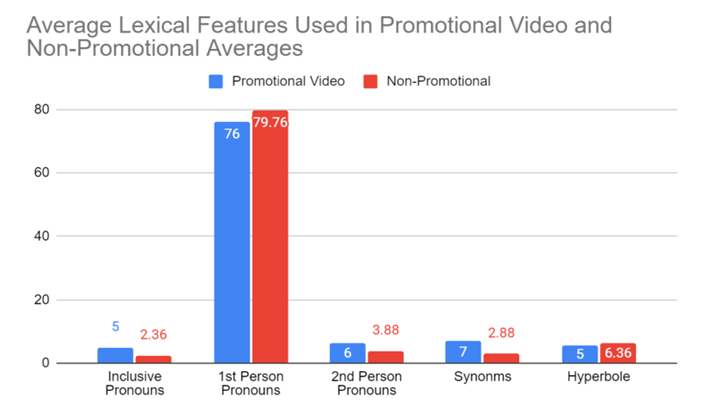
Overall, we found that influencers generally increased their usage of second-person pronouns and synonyms across all promotional content. We also found an increase in use of inclusive pronouns, with the exception of one creator from our sample, Meredith Beauty. As for first-person pronouns and hyperbolic language, we had more inconclusive results, as usage did not shift much from promotional to non-promotional content within our sample. As seen in Figure 1.1 below, inclusive pronoun usage increased 106% in sponsored content, second-person pronouns increased 62%, and synonyms increased 141%, while first-person pronoun usage decreased slightly by 18%, and hyperbole similarly had a slight decrease by 14%.

Figure 1.1. Average lexical features used in promotional videos versus non-promotional videos.

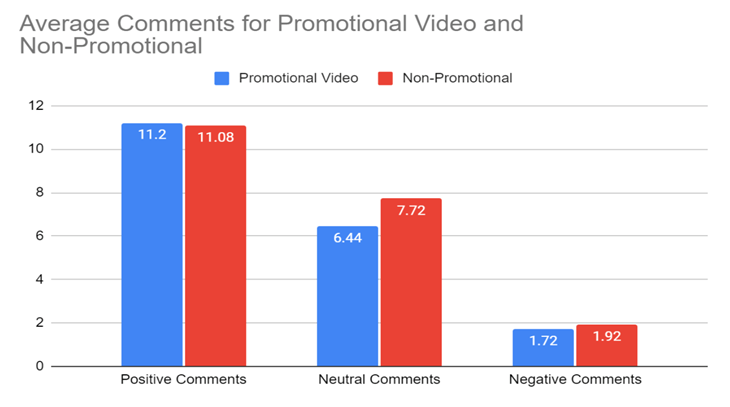
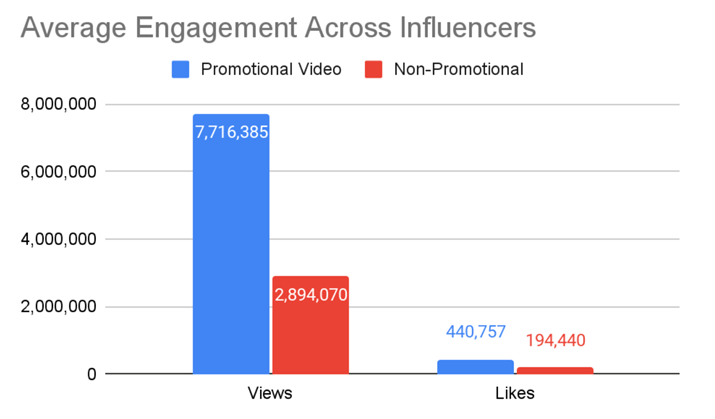
We also observed a higher number of positive comments, views, and likes within sponsored videos. Inversely, neutral and negative comments seemed to decrease with sponsored content. Figures 1.2 and 1.3 showcase our data on the quality of comments and the levels of engagement. Positive comments were shown to increase slightly by 1% in sponsored content, indicating inconclusive results due to the miniscule amount of change from sponsored to non-sponsored content. Neutral comments decreased by 16%, and negative comments decreased by 10%. As these numbers are relatively small, we cannot draw any complete conclusions from this sample. However, a large uptick in viewership of content was noted in our data, with a 106% increase for sponsored content. Additionally, likes increased by 125% in the sponsored content we observed.

Figure 1.2. Average comments for promotional versus non-promotional videos.

Figure 1.3. Average engagement across promotional versus non-promotional content.

Overall, we found that our identified lexical features of influencer speech were used more often in promotional content, indicating a correlation between usage of influencer speech and product promotion.

Discussion and Conclusion

Our findings on influencer speech and promotional content on Tiktok carry various implications in real world application of marketing strategy and engagement. For instance, our findings suggest that certain lexical terms, when used strategically in social media content, can result in higher levels of engagement. We hypothesize that this higher engagement results from creators’ indexation of a leadership role in the beauty community through the use of lexical terms audiences connect to, aiding in the development of trust between creator and consumer. Our results also raise questions about the role of influencers in our society. Rather than just provide entertainment, there is immense value in their role as a talking head for product promotion. Our analysis could help us demystify the distinction between entertainer and advertiser. Future research could examine influencer speech outside of the beauty community to see if these findings are consistent across all online influencing communities and platforms, rather than the TikTok beauty community alone.

Results that strayed from the overall trend of the data could correlate to numerous hypotheses. Demonstrating credibility by restraining from fallacies such as hyperboles and increased use of inclusive pronouns causes viewers to believe the review of the product is credible and therefore, increases the marketability of content. There may also be differences between personal speaking styles and brand guidelines that are required when creating sponsored content, such as promises to include certain phrases or even scripts given to influencers.

We acknowledge that limitations pertaining to scope occurred throughout our research project. Due to our project’s scale, we viewed 5 different influencers with 10 videos each. All the influencers were from similar backgrounds as rich, successful, American influencers. If we had more time, we could expand our sample size to include influencers from more diverse backgrounds to see if influencer speech is still used in other cultures. This revision could determine if the trends we found are generalizable. Additionally, influencers on TikTok are able to moderate their comment section, meaning our data gathered from comment sections could be inaccurate and cherry-picked by the influencer. Finally, we did not take video length into account. However, if we had more time, analyzing video length alongside these other features could reveal patterns relating to how often features were used per second or per minute, giving an even more accurate analysis of the data.

Despite these limitations, our exploration of influencer speech has revealed intriguing insights into how code-switching within influencer speech appears to aid marketability. Our thesis predicted that influencers used influencer speech more often in promotional content in order to increase marketability. After analyzing our data, we can say that this is partially true. Inclusive pronoun, second-person pronoun, and synonym usage did increase in promotional content, though our analysis of first-person pronouns and hyperbole was inconclusive. We hope that our research can serve as a catalyst for deeper inquiry into how persuasion appears in the digital world as a sociolinguistic tool.

References

Alajmi, N. M. (2023, August 1). The Speech of Social Media Influencers in Najd: Introducing a New Source of Sociolinguistic Data. Academy Publication. https://tpls.academypublication.com/index.php/tpls/article/view/6552.

Berger, J [Social Media Examiner] (2023, March 16). The Language of Persuasion: Magic Words to Get Your Way. YouTube. https://www.youtube.com/watch?v=6teWZLgvUso.

Bestvater, Samuel. (2024, February 22). How U.S. Adults Use TikTok. Pew Research Center. https://www.pewresearch.org/internet/2024/02/22/how-u-s-adults-use-tiktok/.

Chen, G., Li, Y., & Sun, Y. (2023, February 15). How youtubers make popular marketing videos? speech…Sage Journals. https://journals.sagepub.com/doi/full/10.1177/21582440231152227.

Hall, Alice. VICE. (2023, March 29). Why does everyone on TikTok use the same weird voice?. https://www.vice.com/en/article/k7zq49/why-everyone-uses-tiktok-voice.

McCarthy, Michael & Carter, Ronald. (2004). “There’s millions of them”: Hyperbole in everyday conversation. Journal of Pragmatics – J PRAGMATICS. 36. 149-184. 10.1016/S0378-2166(03)00116-4.

Munaro, A. (2024, July). Does your style engage? linguistic styles of influencers and digital consumer engagement on YouTube. ScienceDirect. https://www.sciencedirect.com/science/article/abs/pii/S0747563224000852.

Prudencio, A. B., Sherwin, C. C., Barcelona, J. A., Niduaza, B., & Tongawan, P. F. C. (2023, July). Stylistic and discourse analysis of the language of social … IRE Journals. https://www.irejournals.com/formatedpaper/1704877.pdf.

[/expander_maker]

, , , ,

The TikTok Influencer Voice: Do Sociolinguistic Features Influence the Success of TikTok Videos?

Natalia Adomaitis, Lam Hoang, Maryam Shama, Sydney Trieu, Kristina Zhao

TikTok is a growing social media platform that launched in 2016 and since has gained 1 billion monthly active users, 60% of which are a part of the Gen Z demographic. Many influencers have rapidly grown in popularity, leading to social changes due to trendsetting by these influencers. In our study, we analyzed linguistic features used by three TikTok influencers: Erika Titus, Katie Fang, and Alix Earle. Our goal was to analyze how the use of two linguistic features: filler words and rising intonation (uptalk) by female Gen Z TikTok influencers impact engagement. We gathered data by comparing analytics of 6 videos from each of the three influencers, 3 of which being their most popular videos and 3 being of average performance. We tracked the number of times rising intonation and filler words were used per video along with video length and amount of views and likes. We hypothesized that influencers incorporate these specific linguistic elements to better relate with their audience, which ultimately leads to an increase in video engagement.

[expander_maker id=”1″ more=”Read more” less=”Read less”]

Introduction and Background

TikTok has become one of the most popular video-sharing social media apps since its launch in 2016. Approximately 60% of the users and influencers who daily consume or create content on this app belong to Gen Z (Moshin, 2022; Rezek, 2022). In addition, it is predicted that TikTok will have 1.8 billion monthly users by the end of 2024 (Iqbal, 2024).

Because of the rapid growth of this app in recent years, in addition to its daily prevalence in our target demographic of Gen Z individuals (ranging from ages 18-24), and its continuous expected growth, we were motivated to investigate if the verbal linguistic content, or language and speech pattern used by TikTok influencers, had any role or influence in determining the success of their videos.

Our research focused on the sociolinguistic features frequently observed in the language content from popular TikTok influencers: Erika Titus, Katie Fang, and Alix Earle. Specifically, we analyzed upward intonation, filler words, “Valley Girl” speech, and conversational style.

  • Upward intonation- also known as “uptalk”, a speech pattern where the pitch of a voice rises, is typically used at the end of sentences to indicate a question or throughout a sentence to signal that a phrase is incomplete. This tactic can keep the viewer anticipating what will come next.
  • Filler words- Examples include “like, um, literally, actually”. Use of this speech pattern maintains the flow of speech, fills pauses in a conversation, thus keeping the viewer’s attention.
  • “Valley Girl” speech/conversational style- the previously mentioned speech patterns “uptalk” and filler words, are reminiscent of the “Valley Girl” speech and are commonly associated with being used by affluent, middle-class teenagers from California (Nycum, 2018). When used in videos, it can create a casual, one-on-one, conversational-like style that connects with Gen Z.

Erika Titus, Katie Fang, and Alix Earle all have a substantial following with Titus having 4 million followers, Fang with 5.1 million followers, and Earle at 6.8 million followers as well as belonging to the Gen Z demographic. Geographically, Titus along with Earle were born in the U.S. and currently reside in the U.S., and Fang was born in Taiwan, but resides in Canada.

These influencers mainly create lifestyle content such as daily routines, “get ready with me” videos, fashion choices, and product endorsements. Erika Titus and Katie Fang similarly produce casual, at-home, sit-down videos, whereas Alix Earle creates more spontaneous videos in addition to at-home style videos.

Our overall hypothesis is that video success (high like and view count) is attributed to influencers’ use of sociolinguistic features: upward intonation, filler words, and “Valley Girl” speech, which contribute to creating a conversation-like style that is effective at engaging and connecting with the Gen Z audience.

Methods

Our project aimed to investigate the impact of filler words and rising intonation phrases on the success of TikTok influencers’ videos. Success was measured through view count and like count, assessing whether there was a correlation between the frequency of these linguistic features and video engagement success.

To conduct this study, we analyzed six videos from each of the three selected TikTok influencers. For each influencer, three of their best-engaged videos (identified by the highest number of likes and views) were selected, along with three average-performing videos.

Several key factors were tracked for each video. We recorded the number of rising intonation phrases and counted the occurrences of filler words such as “like,” “literally,” and “um.” Additionally, we noted the number of likes and views to measure engagement success and tracked the length of each video in seconds for further analysis. This methodology enabled us to compare the frequency of linguistic features across different levels of video success.

We hypothesized that a higher frequency of filler words and rising intonation phrases would correlate with an increase in views and likes, suggesting these linguistic features enhance engagement.

Results and Analyses 

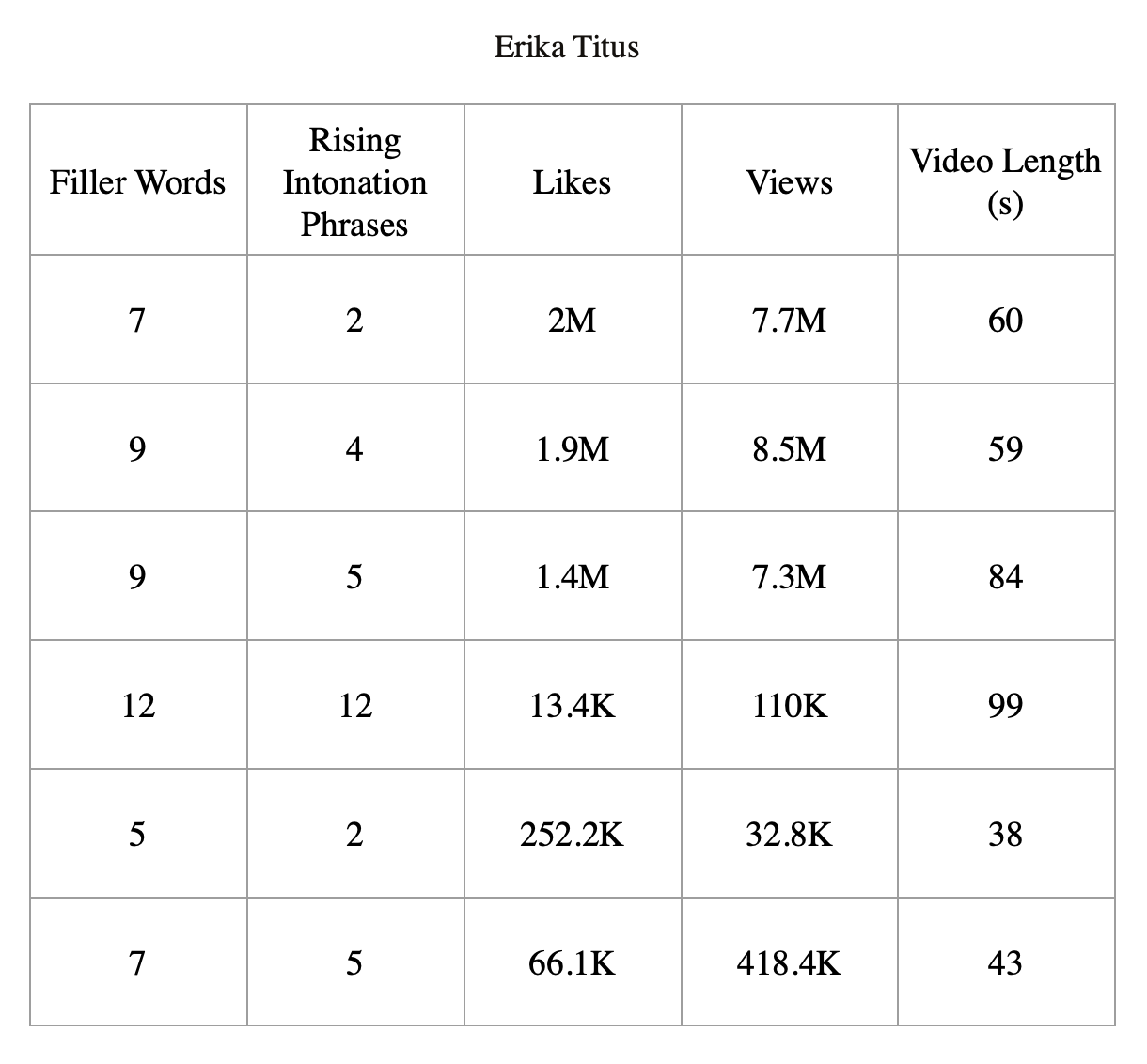
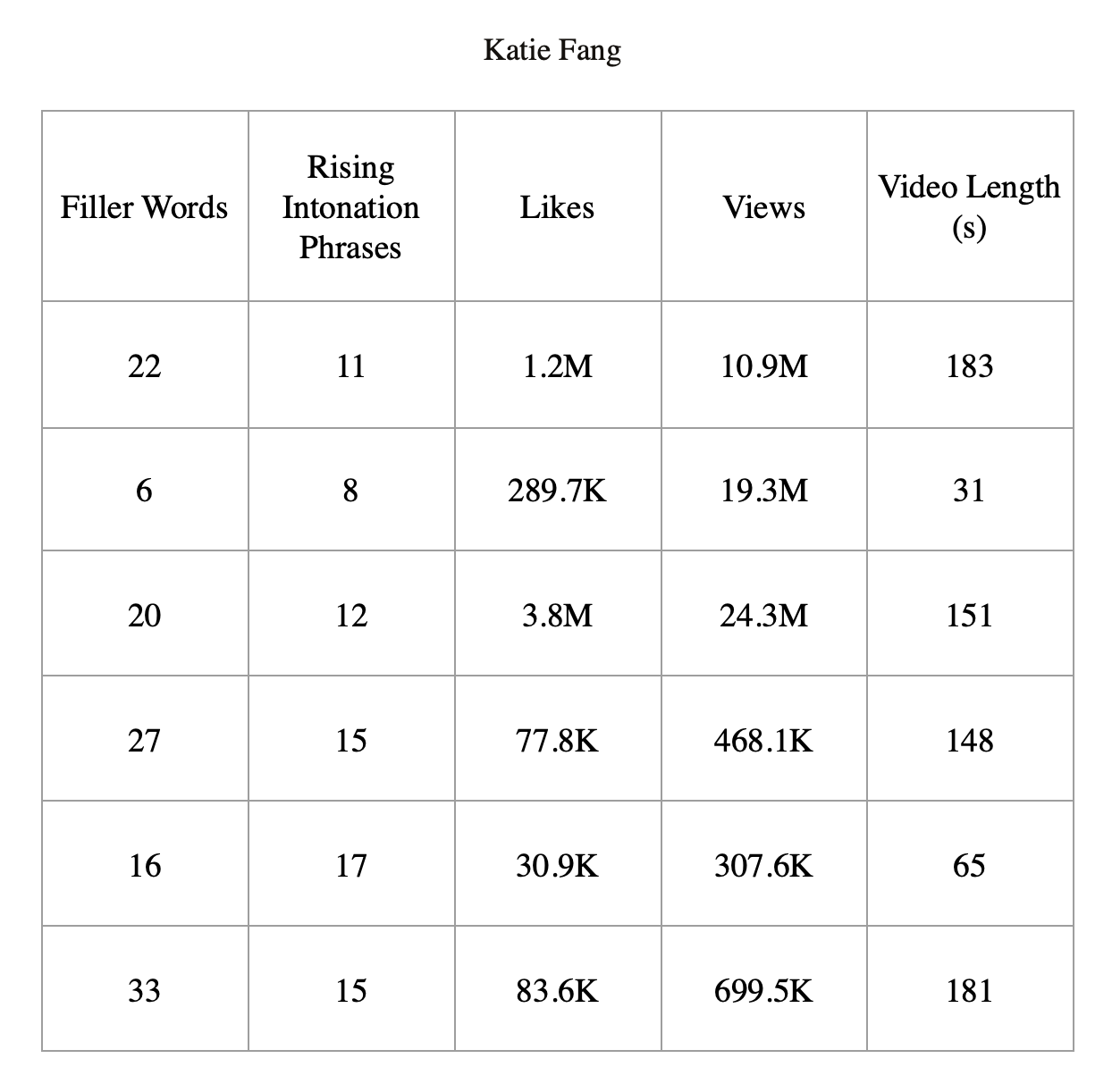
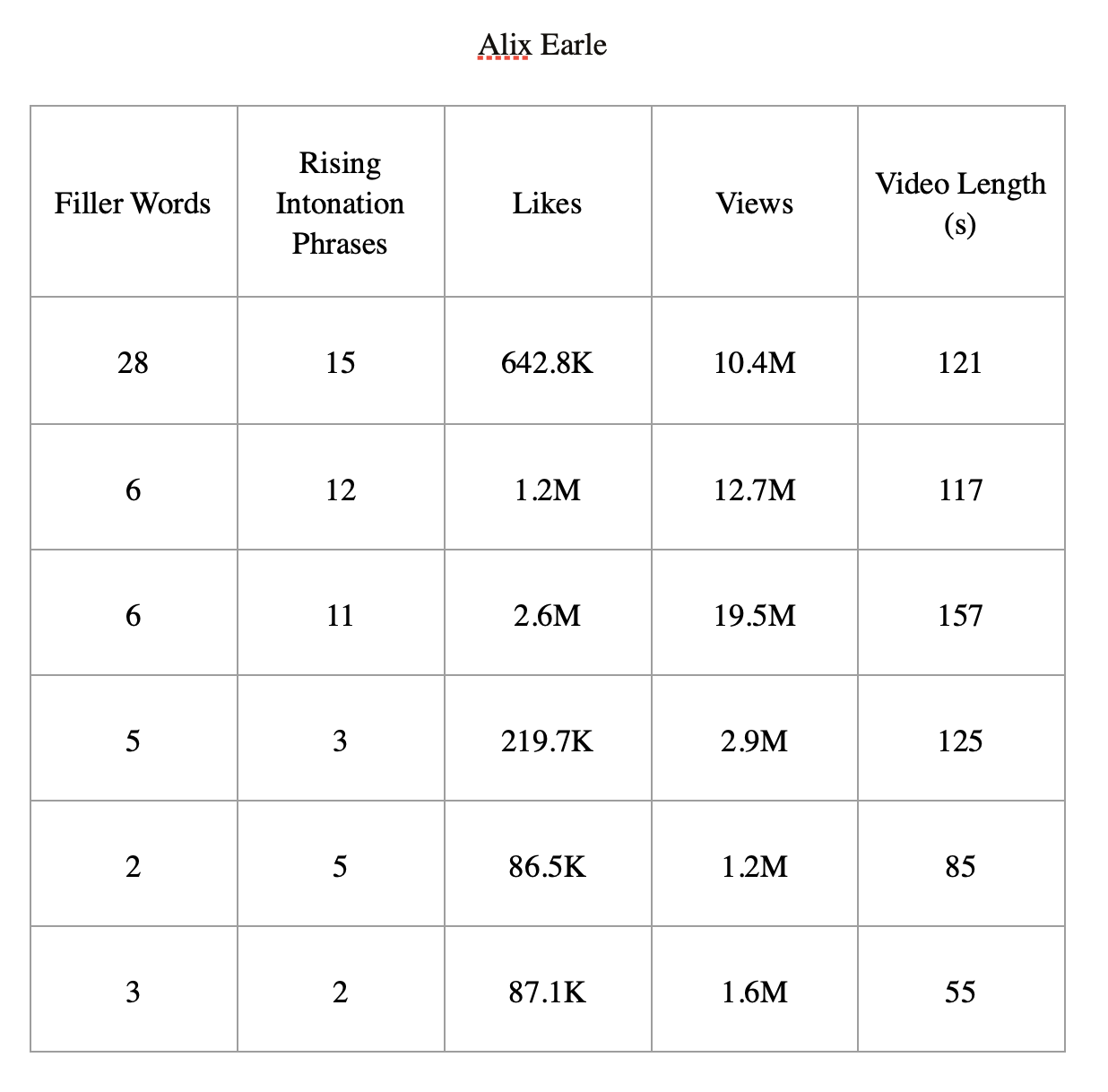
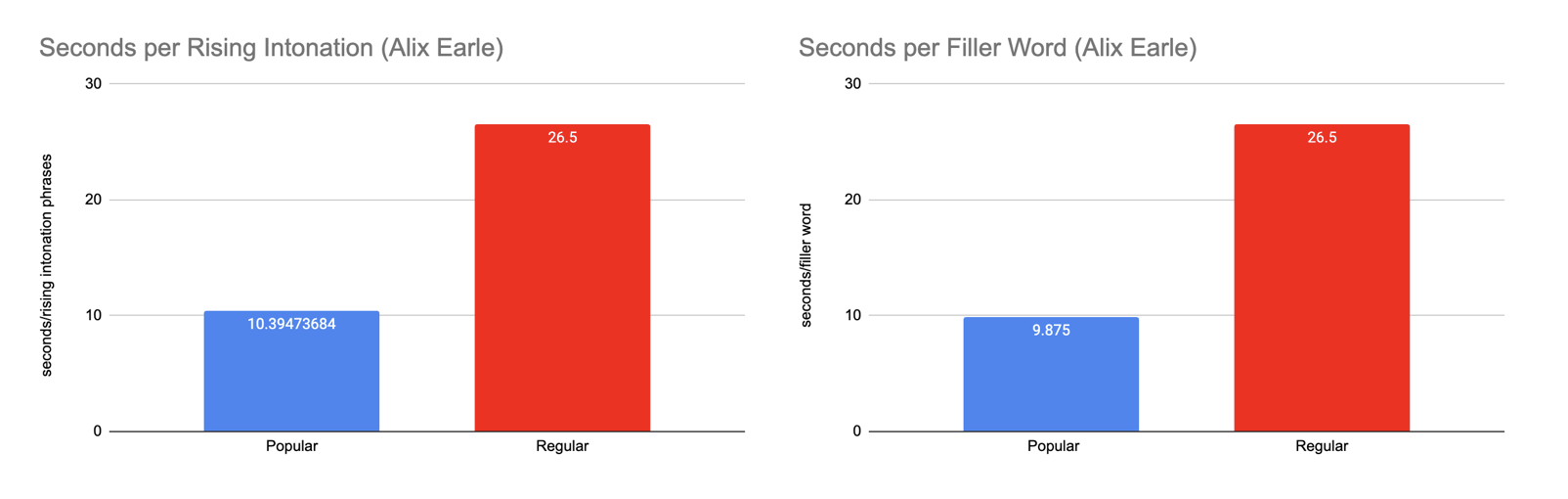
Following our methods, our results are shown below:

From this data, we extract two key metrics: the average frequency of rising intonation and the average frequency of filler words. We focus on the frequency of these elements in terms of occurrences per unit time (e.g., one occurrence every x seconds) rather than their rate (e.g., x occurrences per second). This perspective allows us to contextualize sociolinguistic factors within TikTok videos, which are short-form content designed to capture attention. Following our hypothesis, influencers’ most popular videos tend to employ rising intonation or filler words frequently (e.g., every 5 seconds) to maintain audience engagement.

Based on our hypothesis, we expect that higher average frequencies of rising intonation and filler words are correlated with more likes and views on the videos. We will compare these metrics between popular and less popular videos to potentially reveal their effects on engagement. Initially, we will analyze the data for each influencer individually before aggregating and analyzing the data as a whole.

Erika Titus:

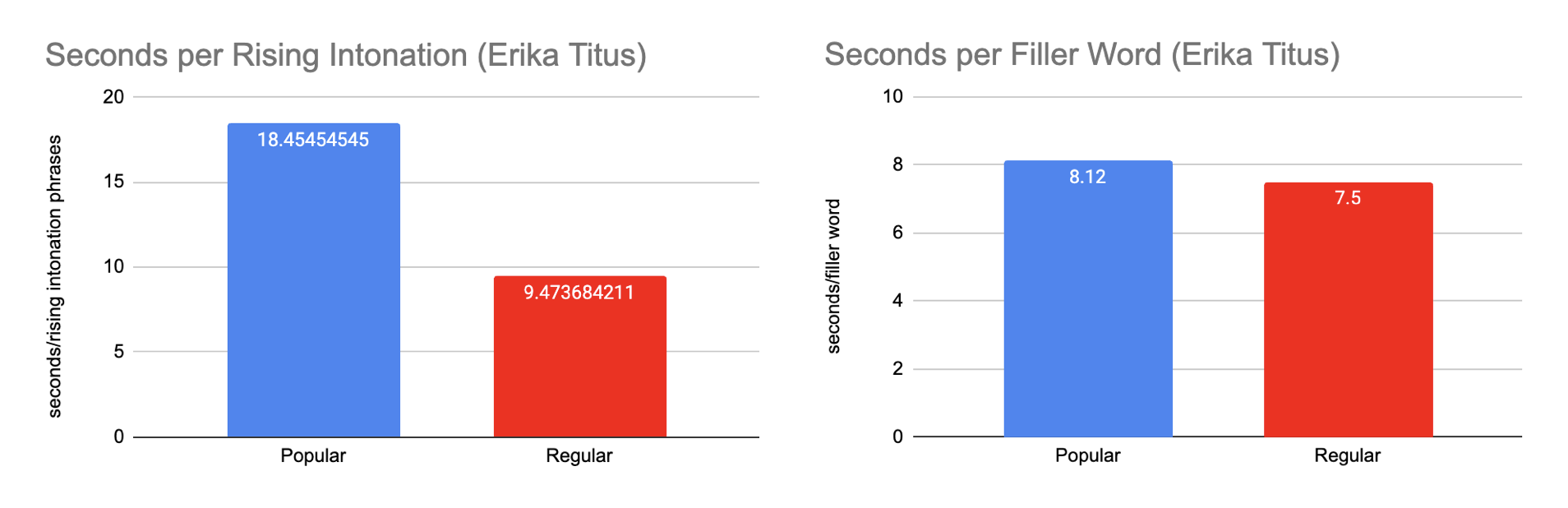
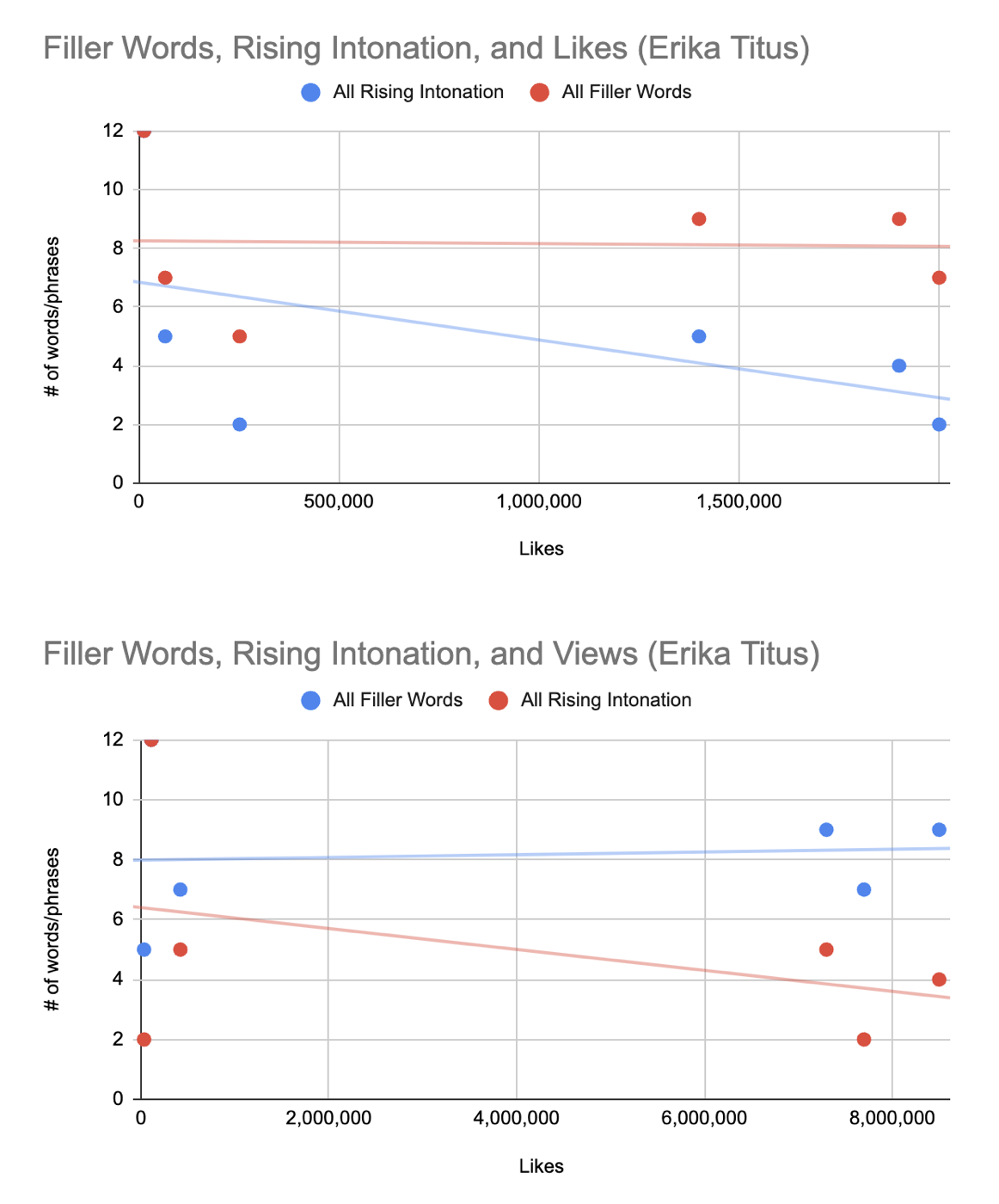
As observed in Erika Titus’s case, her popular videos exhibit an average of one rising intonation every 18 seconds, while her regular videos feature an average of one rising intonation every 9 seconds. Similarly, the frequency of filler words is lower in her popular videos compared to her regular ones. These patterns suggest that for Erika Titus, both rising intonation and filler words appear to have an inverse relationship with engagement, implying that lower frequencies of these features may be associated with higher popularity.

Katie Fang:

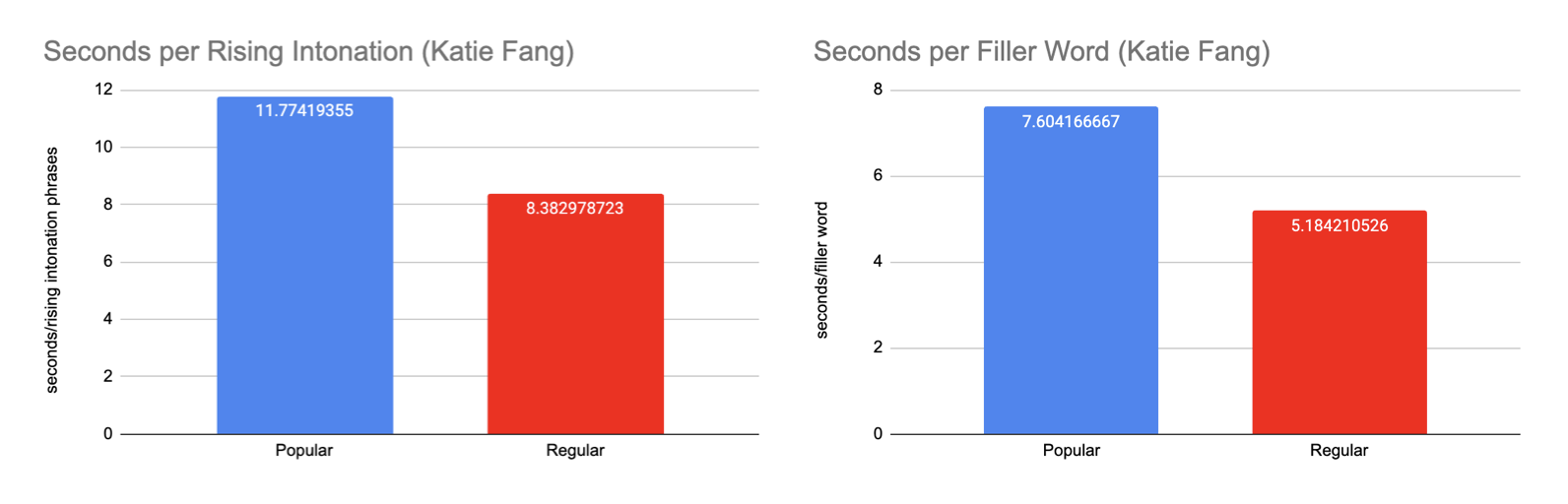
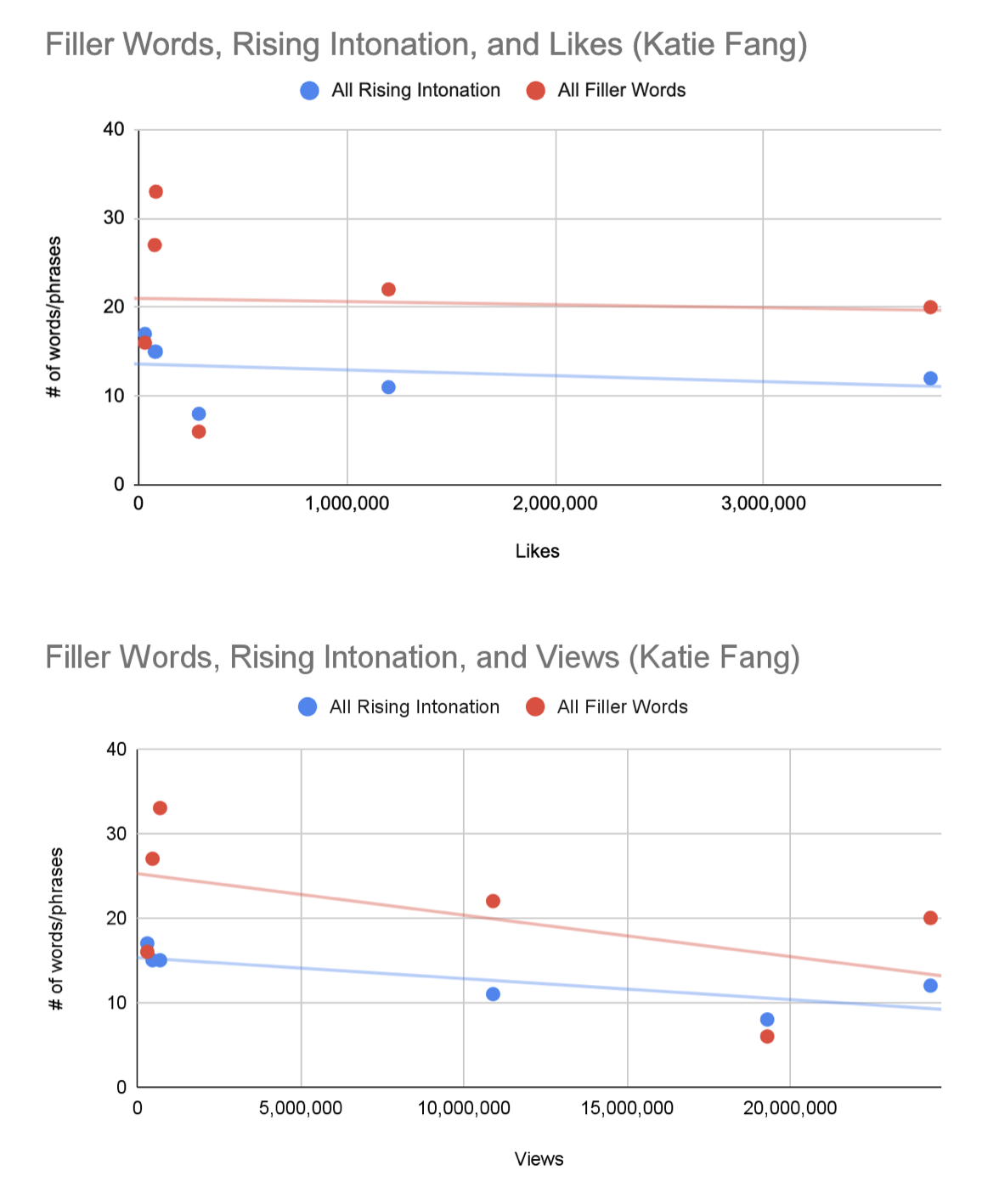
Moving on to Katie Fang, we observe a similar pattern to that seen in Erika Titus’s videos. Katie’s popular videos exhibit a lower frequency of rising intonation and filler words compared to her regular videos. Both factors again seem to have an inverse effect on engagement. From the line graphs depicting sociolinguistic factors versus views, it appears that these sociolinguistic features negatively correlate with views, suggesting that lower frequencies may contribute to higher popularity.

Alix Earle:

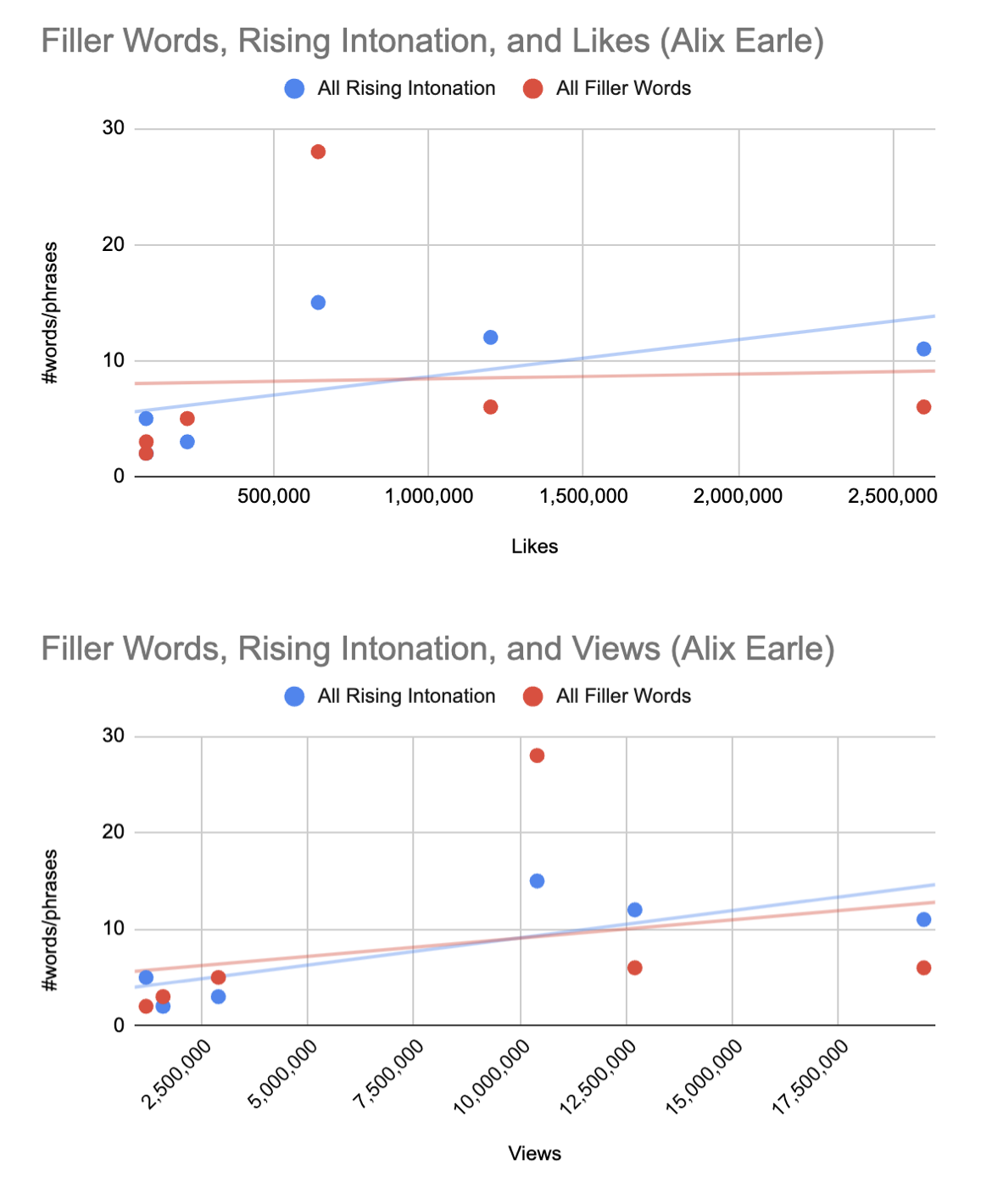
For Alix Earle, we observe the opposite pattern compared to Erika Titus and Katie Fang. Alix’s popular videos have a higher frequency of both rising intonation and filler words. These factors appear to have a positive effect on engagement. The line graphs depict a positive linear relationship between both rising intonation and filler words with views and likes, suggesting that higher frequencies of these features are associated with increased popularity.

Overall:

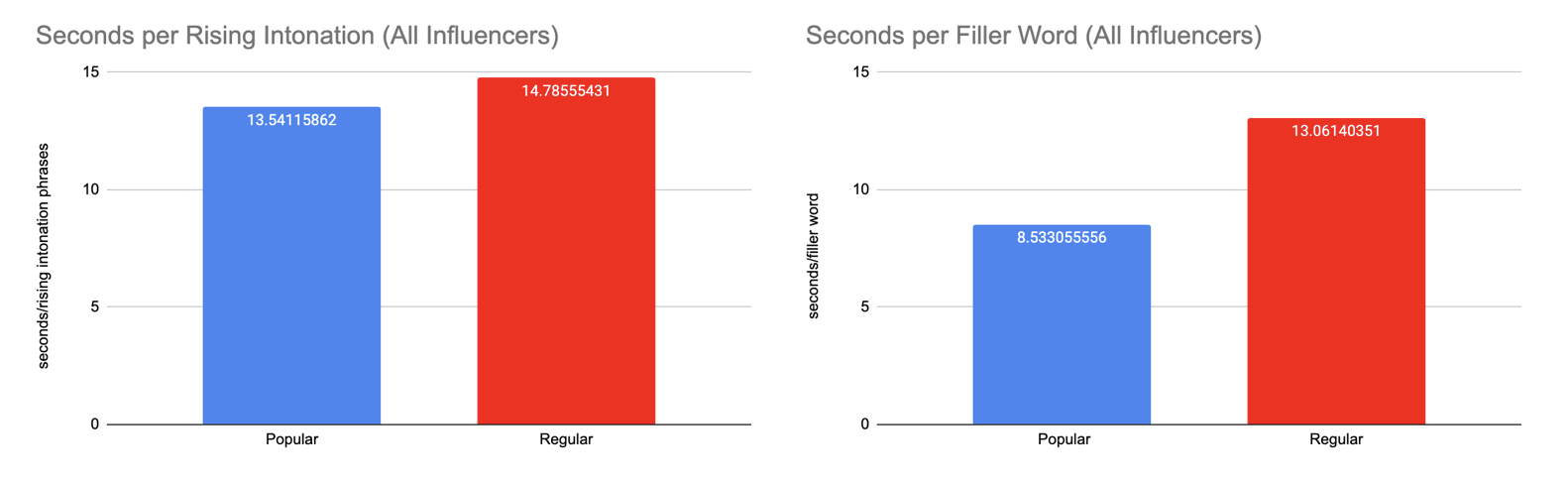
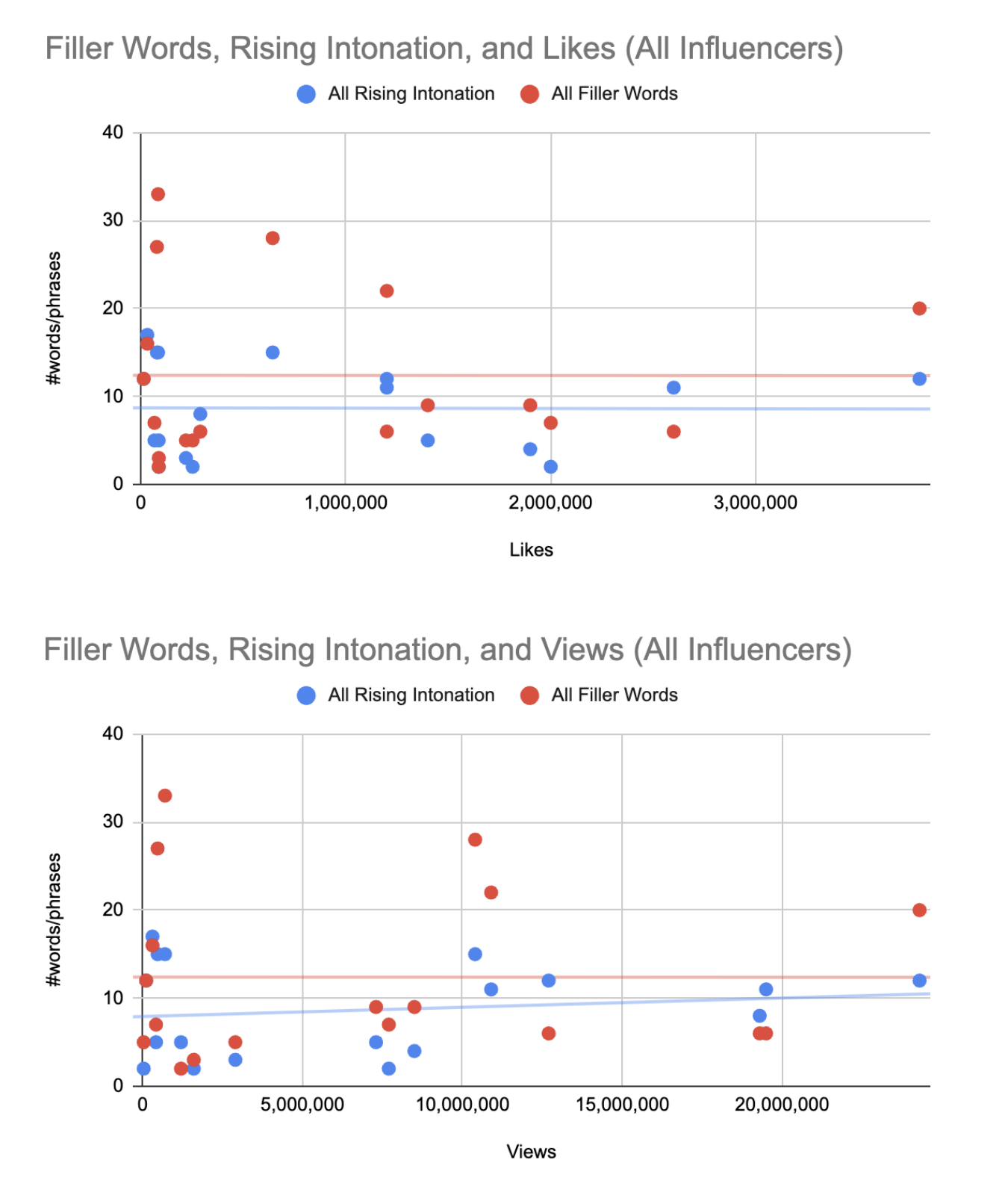
Looking at the data across all three influencers, we observe that popular videos generally exhibit a higher frequency of both rising intonation and filler words. These factors appear to have a positive effect on views and likes. However, the line graphs reveal scattered data, and the line of best fit does not clearly indicate a direct relationship, suggesting that other variables may also influence engagement.

Discussions and Conclusions

To summarize, Erika Titus and Katie Fang’s data do not support our hypothesis, but most of the data we collected from Alix Earle’s does support our hypothesis. Given these findings, our data is inconclusive about whether or not rising intonation and the use of filler words have a positive effect on the success of audience engagement on TikTok.

The differences in like and view count in the data between the influencers can be attributed to multiple factors that would need to be taken into consideration and further researched. Elements such as differences in influencers’ backgrounds, the racial identity and/or personality traits of the influencers, video content, and editing style may have played a role in the use of “uptalk” and filler words, which in turn would affect the success of their videos (Swerts, 1998).

Additionally, negative associations with “Valley Girl” speech could have also played a role in causing less engagement from audiences. Use of this speech by individuals who might not sociologically parallel the stereotypes accompanying the linguistic features of the “Valley Girl” accent, such as “being white, privileged”, can raise questions about how authenticity is perceived by the Gen Z audience, as well as reveal structural biases held by audiences on TikTok (Habasque, 2021). In an article by Sophia Smith Gaeler, Gaeler elaborates on the identities associated with these speech patterns and how linguistic features of female TikTok influencers can pave the way for new forms of English to evolve. (Gaeler, 2024).

Furthermore, having a substantial following and audience can potentially cause the influencer to be or appear more anxious, which in turn may lead to the use of more filler words that can also impact the success of a video (Bodie, 2010).

Video length, content, quality, and editing styles could also be investigated. We observed that Alix Earle created more spontaneous content, while Erika Titus and Katie Fang created more at-home content, which may have impacted the relevancy of the content to the viewer. The general public views spontaneous content as a reflection of the influencer’s true self. In a study done by Jacqueline Rifkin and Katherine Du, the participants rated content creators as “more sincere, genuine, and authentic.” (Du and Rikfin, 2023). Therefore, more people would be drawn to influencers that create more spontaneous content, which in turn would influence which particular linguistic features they utilize to engage their audiences.

Editing styles such as “jump cuts” which produce choppy transitions, can result in the cutting off of rising intonation at the end of a video and negatively affect the success of the video. As reported, the effect of these jump cuts can affect our brain’s perception of what we visually and audibly understand as starting or ending (McMullan, 2021). While collecting data, it was observed that Erika Titus and Katie Fang had choppier editing in their videos. Additional research would be needed to determine if content with these factors negatively impacts the quality of the video, in addition to the viewer’s experience, and therefore resulting in a lower like count. 

Moreover, other aspects like trends, hashtags, and the TikTok algorithm in addition to the aforementioned factors, can inconclusively support that linguistic styles may have more of an impact on the type of audience influencers attract, rather than audience engagement or video success.

Further research can be done to analyze other linguistic styles in comparison to “Valley Girl” speech and possibly account for linguistic features like word choice and vocal fry, to determine more conclusive results about the positive effects of linguistic features on audience engagement or the prevalence of certain linguistic features across varying categories of content. For example, in an article by Alice Hall on Vice, she discusses how different types of content utilize different linguistic features to capture audiences and maintain their engagement (Hall, 2023).

Other research can be done to investigate how influencers linguistically construct their personal brands, what linguistic techniques or features influencers use to engage with their audience in comments and direct messages, or how influencers use language to build and maintain a community among their followers.

This research and further research’s findings exemplify how language adapts and evolves with the increasing use of digital media and technology. It also contributes to the construction of personal identity and community on digital platforms. Lastly, it can be used to analyze how to engage audiences and keep their engagement from a marketing standpoint.

References

Bodie, G. D. (2010). A Racing Heart, Rattling Knees, and Ruminative Thoughts: Defining, Explaining, and Treating Public Speaking Anxiety. Communication Education, 59(1), 70–105. https://doi.org/10.1080/03634520903443849.

Habasque, P. (2021, December 21). Is creaky voice a valley girl feature? Stancetaking & Evolution of … Anglophonia. French Journal of English Linguistics. https://doi.org/10.4000/anglophonia.4104.

McMullan, J. (2021b, January 21). View of the Great Jump Cut (r)evolution: A case for studying the evolution of vlogging production techniques. https://firstmonday.org/ojs/index.php/fm/article/view/10547/11266.

Mohsin, M. (2022, September 3). 10 TikTok Statistics That You Need to Know in 2019 [Infographic]. Oberlo; Oberlo Dropshipping app. https://www.oberlo.com/blog/tiktok-statistics.

Nycum, R. (2018, May). In Defense of Valley Girl English. In The Compass (Vol. 1, No. 5, p. 4).

Rezek, A. “How Brands Go Viral: An Analysis of Successful Brand Marketing on Tik Tok with Gen Z” (2022). Honors Theses. 2645. https://egrove.olemiss.edu/hon_thesis/2645.

Swerts, M. (1998). Filled pauses as markers of discourse structure. Journal of Pragmatics, 30(4), 485–496. https://doi.org/10.1016/S0378-2166(98)00014-9.

Cross-Referenced Sources

Source 1: Hall, Alice. “Why Does Everyone on TikTok Use the Same Weird Voice?” Vice, 29 Mar. 2023, www.vice.com/en/article/k7zq49/why-everyone-uses-tiktok-voice.

Source 2: Rifkin, Jacqueline, et al. “Research Identifies Why People Prefer Spontaneity in Entertainment.” Phys.org, phys.org/news/2023-06-people-spontaneity.html.

Source 3: Smith Galer, Sophia. “How TikTok Created a New Accent – and Why It Might Be the Future of English.” Www.bbc.com, 23 Jan. 2024, www.bbc.com/future/article/20240123-what-tiktok-voice-sounds-like-internet-influencer.

[/expander_maker]

, , , , , , , , , ,

“Get Ready With Me: Blog Post Edition”: How Influencers Self-Brand on TikTok

Emerson Howard, Kaira Edwards, Kat Balchunas, Kylee Bourbon, Nicole Hernandez

“Ok storytime.” “Get ready with me to go to class.” “Doing my makeup for literally no reason.” We can’t get enough.

Why are “get ready with me” videos so captivating? Are the communicative methods used what contributes to flop or fame…. a like or dislike…a slay or a nay?

In recent years, a new wave of social media “influencing” has emerged. The phenomenon of self-branding, the continuous action of establishing an image or identity of oneself, is most relevant in such an industry. We sought to investigate how influencers’ slang and body language used in “Get Ready With Me (GRWM)” videos conveys or does not convey a sense of perceived authenticity from followers. Our study focuses on three popular lifestyle influencers and their GRWM videos on the platform TikTok. We sought to identify patterns of body language, speech, and audience perception within GRWM videos that allow our subjects to establish and maintain an authentic relationship with their audiences. We hypothesized the intimate and casual nature of GRWM videos allow creators to establish a more personal connection with their audience if accompanied by a positive tone of voice, use of inside slang, as well as high levels of engagement.

[expander_maker id=”1″ more=”Read more” less=”Read less”]

Introduction and Background

TikTok is a rapidly growing social media platform which revolves around the creation and sharing of short, user-generated videos (Montag et. al, 2021). The app launched in 2016 and since then has provided an outlet for social media influencers, who are users that obtain a large following through posts, engagement, and advertising (Abidin, 2015). Our study looks specifically at white, female lifestyle influencers aged 18-30 who are recognized for documenting seemingly inconsequential and mundane elements of everyday life such as putting on makeup, getting dressed, etc. These influencers communicate personal information about themselves to create a sense of intimacy between them and their followers, emphasizing their realness and relatability (Abidin, 2015). Like any other social media influencer, lifestyle influencers create a “brand” for themselves by developing a consistent theme and style for their account through patterns of language, images, and content in order to create a certain expectation for how people should perceive them (Marshall).

To provide a basis for our understanding of how TikTok influencers create a ‘brand’ for themselves, we apply Erving Goffman’s dramaturgical approach to the digital media space to explain how influencers put on a performance through self-branding. Goffman’s dramaturgical theory proposes that everyday interactions are like a play in which humans put on a performance. This phenomenon is often displayed on social media in which influencers curate their posts and profiles to express an idealized presentation of self. Influencers employ impression management by being selective with what to post publicly, in order to preserve the identity they have curated for themselves—their “brand.” We feel that GRWM videos uniquely blur the line between Goffman’s concepts of backstage and frontstage, since these videos are predicated on providing followers with a sense of intimacy, seeing the ‘backstage’ of an influencer’s daily life. These videos commodify intimacy by providing the audience with the impression they are privy to intimate and generally inaccessible aspects of the influencer’s lives—this is what makes lifestyle influencer branding successful (Abidin, 2015).

Methods

For our data, we gathered and analyzed the three most recent “GRWM” videos from February 17th to March 1st, from the selected lifestyle influencers: Alix Earle, Darcy McQueeny, and Mikyla Nogueira, to investigate how they create a persona through language and behavior patterns. We gathered our data via the TikTok social media platform and the data was collected in two separate categories: video content and audience response. To observe video content, we looked at their patterns of communication including their body language, as well as their use of “inside slang.” We then observed audience response by focusing on the top seven comments to investigate whether there was a more positive or negative reception, as well as the number of likes per comment. This allowed us to measure each influencer’s level of audience engagement, level of influencer engagement, and engagement sentiment. We then took into account any differences and similarities that may exist amongst the influencers and how those aspects account for the way they’re perceived.

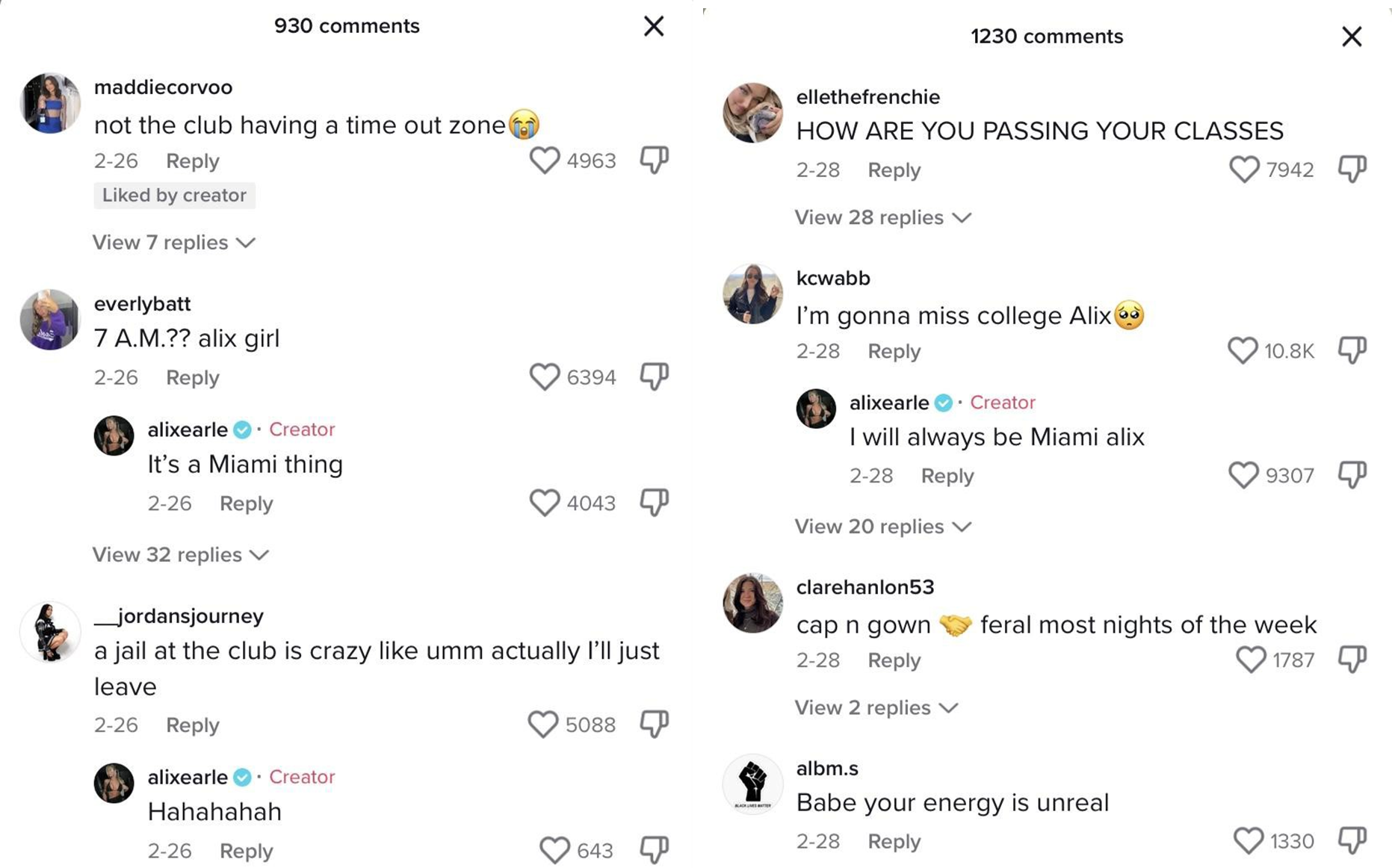
Screenshots of TikTok comments on influencer Alix Earle’s posts

Results and Analysis

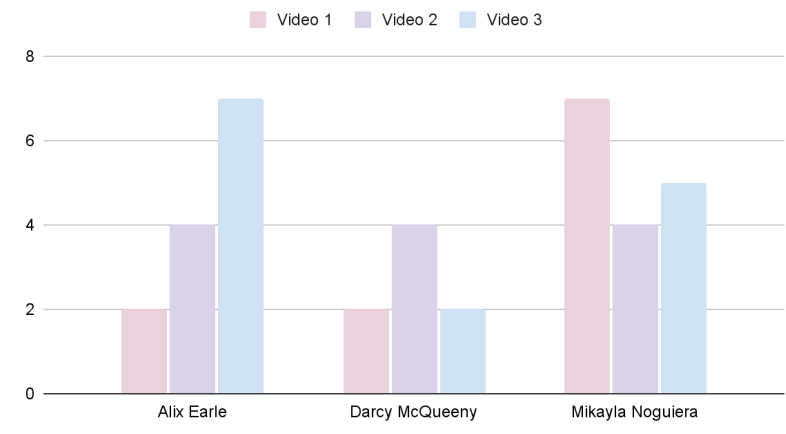
Our research both confirmed and rejected aspects of our hypothesis that GRWM videos allow creators to establish a more personal connection with their audience if accompanied by a positive tone of voice, use of inside slang, as well as high levels of engagement. After measuring the creator response rates within their comment sections, we noticed that Mikayla Nogueira had the highest level of engagement with viewers (see Figure 6).

Figure 6: Number of Responses to Top 7 Comments

She not only responded to comments more frequently than other creators but also in a variety of ways: liking, messaging, and video responding. However, Alix appeared to have more audience engagement (see Figures 3 and 5) of all influencers we investigated despite her not interacting with them as much as Mikayla.

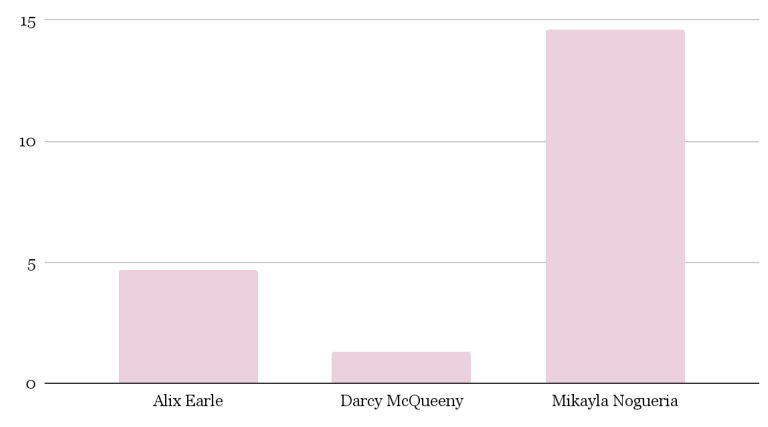
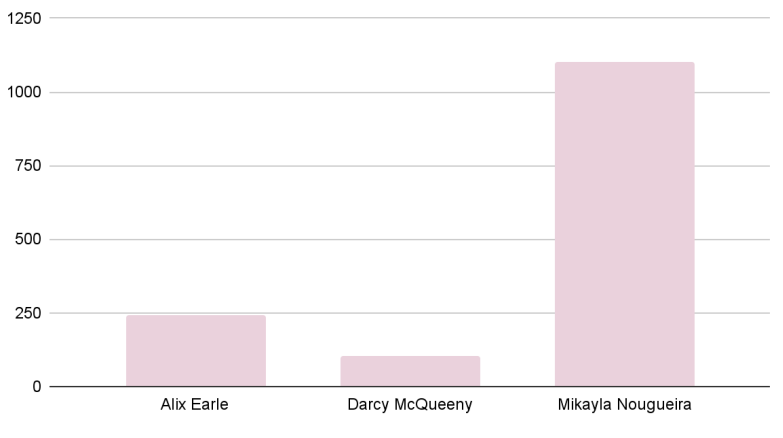
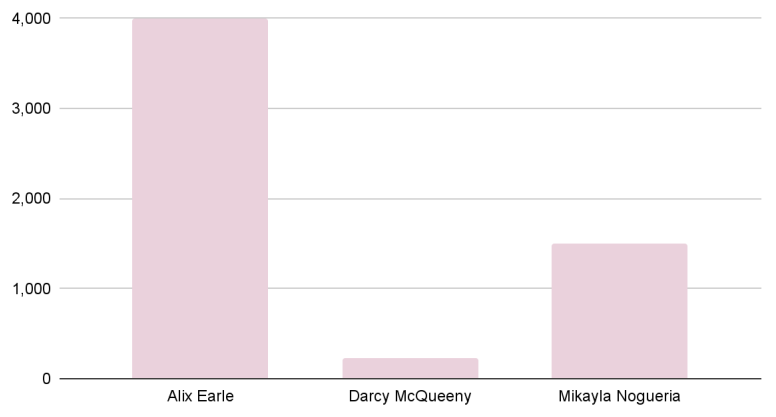
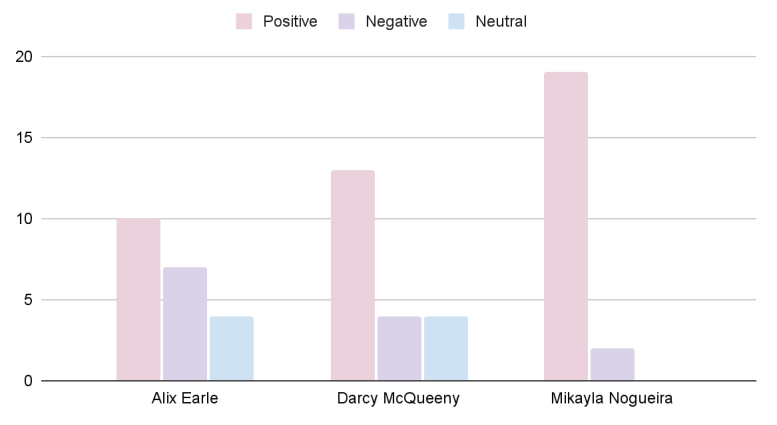
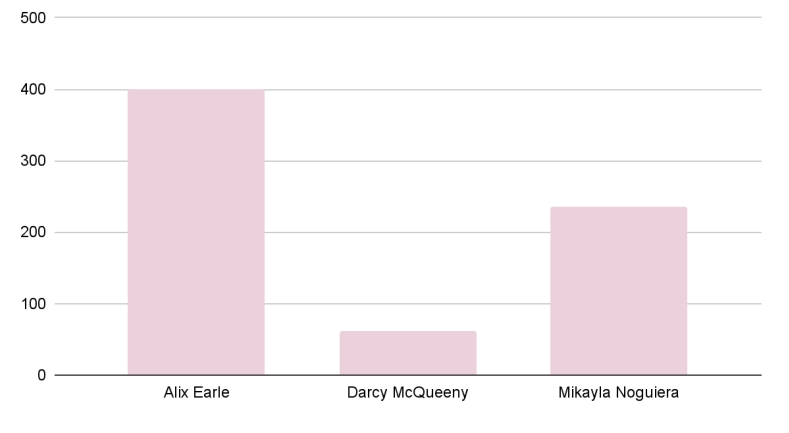
Despite having greater creator engagement, followers (see Figures 1 and 2) and the most positive engagement sentiments (see Figure 4), Mikayla Nogueira received less likes per GRWM video (see Figure 5) and likes on the top 7 comments (see Figure 3) per GRWM video (236.4k / 1,506), than Alix Earle (400.9k / 3,996). Darcy McQueeny received the least likes per video and comments (61.8k / 227).

Figure 1: Follower Count (in Millions)

Figure 2: Total Likes on All Videos (in Millions)

Figure 3: Average Likes on Top 7 Comments (in Thousands)

Figure 4: Connotations of Top 7 Comments on 3 Observed Videos

Figure 5: Average Likes on 3 Observed Videos (in Thousands)

Through our analysis of this data we established that, as opposed to our hypothesis, it is a “laid-back” neutral tone of voice, use of inside slang, and moderate levels of engagement that is most popular within GRWM videos and most effective in garnering audience engagement.

We observed that Alix is a very good storyteller, creating a more laid-back demeanor and anecdotal style of GRWM videos that is more relatable amongst audiences. Mikayla can seem too enthusiastic, as if she is trying too hard to be liked and seen as a positive person (i.e. “Thank you!!! [exuding love face emoji]”); while Alix interacts just like a friend would on Facetime and responds to comments similar to how friends respond to texts; in a more neutral and moderate manner (i.e. “Hahahahah,” “No”). Mikayla expresses herself very openly and her outgoing personality may be a bit overwhelming for some. Additionally, her high level of engagement with her comment section may appear to some as trying too hard. Contrastingly, Alix exudes a more relaxed persona, talking about her friends as if the audience knows them personally, to solidify this ‘friend-like’ relationship, and utilizing slang such as “it’s not giving” throughout various videos and “losers,” which she notes is used by her own friend group, allowing the audience to feel included. We found that Darcy McQueeny utilizes a monotone/unengaging tone of voice and scarcely engages with comments, resulting in her low levels of likes, audience engagement, and negative engagement sentiments.

Discussion and Conclusions

In relevance to class, this course is centered around social communication and how our everyday speech and interactions are revealing of identity and character. We are able to better understand tone in internet gestures the more we partake in them. Additionally, verbal variation, in that influencers are distinguished on TikTok by speech variation. We also suspect that the successful influencers don’t switch from their normal and internet personality. If we had more time, we would be interested in conducting more research about this.

With self-branding on social media having an ever-growing prominence in modern social communication, especially among our age group, we thought this topic was relevant and crucial to study. Now when we navigate our social media presence, we are keener on how the language and the level of formality we use affects those viewing us.

The limitations in our research included the use of interpretive/qualitative data, restricted data (3 videos, 3 creators), and a narrow demographic (young, white, girls).

References

Abidin, C., (2015). Communicative Intimacies: Influencers and Perceived Interconnectedness. Ada: A Journal of Gender, New Media, & Technology, 8, 1-16: http://adanewmedia.org/2015/11/issue8-abidin/

BBC Radio 4. (2015, April 15). Erving Goffman and the Performed Self [Video]. YouTube. https://youtu.be/6Z0XS-QLDWM

Goffman, E. (1959). The Presentation of Self in Everyday Life. New York: Anchor Books.

Hogan, B. (2010). The Presentation of Self in the Age of Social Media: Distinguishing Performances and Exhibitions Online. Bulletin of Science, Technology & Society, 30(6), 377–386. https://doi.org/10.1177/0270467610385893

Jennings, R. (2018). What Is TikTok? The App That Used to Be Musical.ly, Explained. Vox, www.vox.com/culture/2018/12/10/18129126/tiktok-app-musically-meme-cringe.

Marshall, S. (n.d.). An introduction to brand building through social media – learn. Canva. https://www.canva.com/learn/introduction-brand-building-social-media/

Montag, C., Yang, H., & Elhai, J. D. (2021). On the psychology of TikTok use: A first glimpse from empirical findings. Frontiers in Public Health, 9, https://doi.org/10.3389/fpubh.2021.641673

Pulse Advertising. (2021, September 1). What Is an Influencer? | Influencer Marketing Explained [Video]. YouTube. https://youtu.be/JLiKXW82tjE

TikTok Videos

[/expander_maker]

, , , ,
Scroll to Top