Generational Differences in Social Media Communication
Giordano Camera, Dylan Carr, Phoebe Haas, Nicole Wasserman
Have you wondered why your dad sends you extremely long texts compared to your best friends, who use memes and slang phrases for most of their communication? In our study, we explored two generations, Generation Z and Generation X and their language use on online social networking sites. We studied different social media posts between the two generations and looked at the differences in how they communicate, especially using text-dominant platforms. We used a plethora of social media sites to validate our findings, but our main areas of study were Facebook and Twitter/X. Our study concluded that Generation Z uses fewer words, more images in their post, and more slang phrases than Generation X does. We want our findings to highlight the contrast between the way these two generations communicate, as miscommunication can lead to unnecessary conflict. Our research contributes to the process of cataloging online communication trends among different generations.
[expander_maker id=”1″ more=”Read more” less=”Read less”]
Introduction
Our group aimed to study the differences in how different generations communicate on various social media platforms. Since its creation, social media has become a place where individuals can communicate with each other in ways they could not have before. People also tend to communicate on a topic that is currently popular in a particular social group, regardless of age (You et al. 2017). Using that factor, we can find valuable data that proves our hypothesis correct. Our research method proved perfectly accurate, as all of our data was correct, with minimal gaps in our study. Our group hopes that the data findings we provided also propel researchers to study differences in communication for other generations. The prevalence of social media is only growing, so our data can act as a stepping stone for future studies.
Methods
Our primary method of data collection revolved around influential people on social media. We would look at social media posts discussing a variety of topics (such as sports, popular culture, and politics) in order to look at data from a wide range of people, like Donald Trump. We made sure to expose ourselves to Generation Z and Xers from each perspective. This is because there are a lot of varying opinions by a diverse group of people on popular posts compared to smaller tweets that may have more of a hive-mind mentality. In addition, we looked at a variety of topics to get stronger evidence and to ensure the communication differences we found were not due to any topic differences (Achinstein, 1994).
Originally, we planned to contact people on Twitter or Facebook to gather their age, but instead, we only targeted accounts where they said their age in a previous post/bio or where it was publicly available (like a celebrity). Once we collected twenty Twitter/Facebook accounts from each generation, we randomly selected three accounts from each generation to really do a deep dive on. While we didn’t interview the people behind the social media accounts that we found like the researchers at Pennsylvania state did, we found that it was unnecessary as all information was available publicly (Zhao and Rosson 2009). In a matched pairs case study, we assembled all of the posts in an easy to view format and then compared the content of each generation’s posts. We noticed a variety of clashing factors across generations, and simultaneously noticed similarities within.
Results
After conducting our research, we found that there were many differences between the ways Generation X and Generation Z communicate online in posts and tweets on social media. Our results showed that differences in online communication was not dependent on the topic of the post or tweet (ie. sports, popular culture, politics) nor the social status of the user (ie. celebrity or common folk), but rather the age generation of the user.
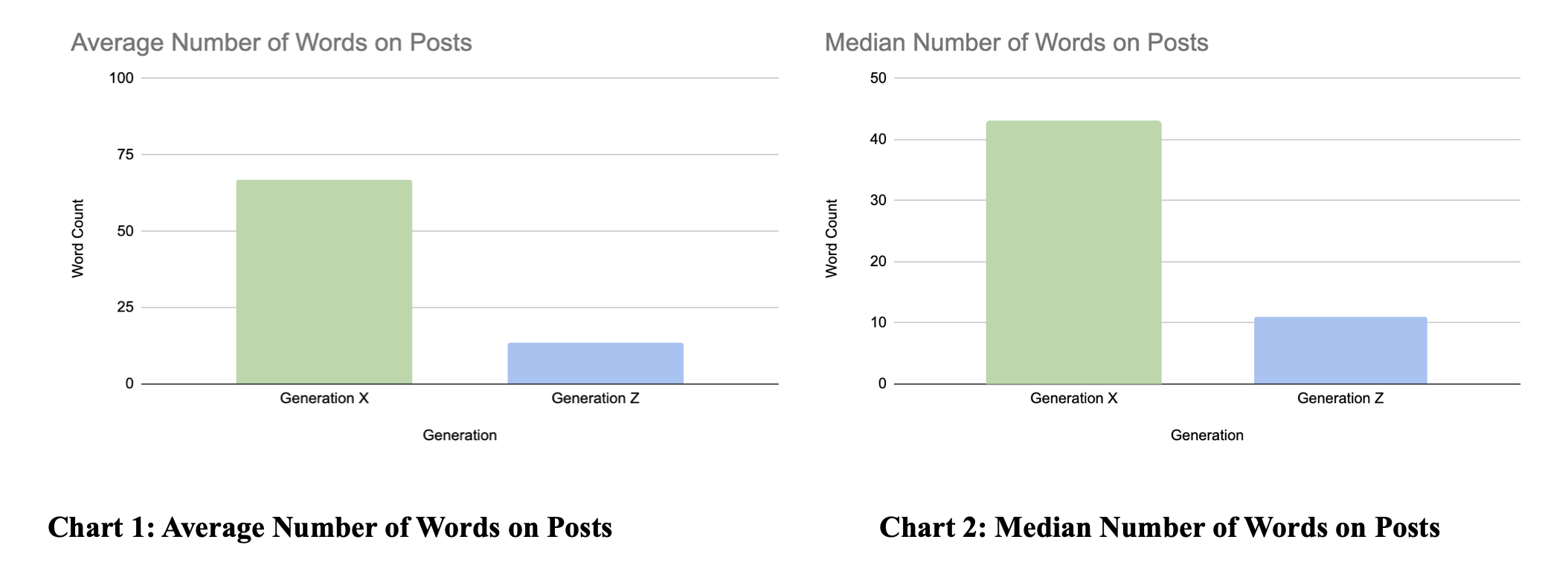
One difference we found in the posts and tweets we analyzed was the number of words that each generation tended to put in their post/tweet. As seen in Chart 1 below, the average number of words on a post/tweet by a member of Generation X was 67 words and the median was 43 words. As seen in Chart 2, the average number of words by a member of Generation Z was 13.4 words, with the median being 11 words. From this, we concluded that Generation X tended to conduct more lengthy and descriptive posts with complete sentences in comparison to the younger Generation Z.
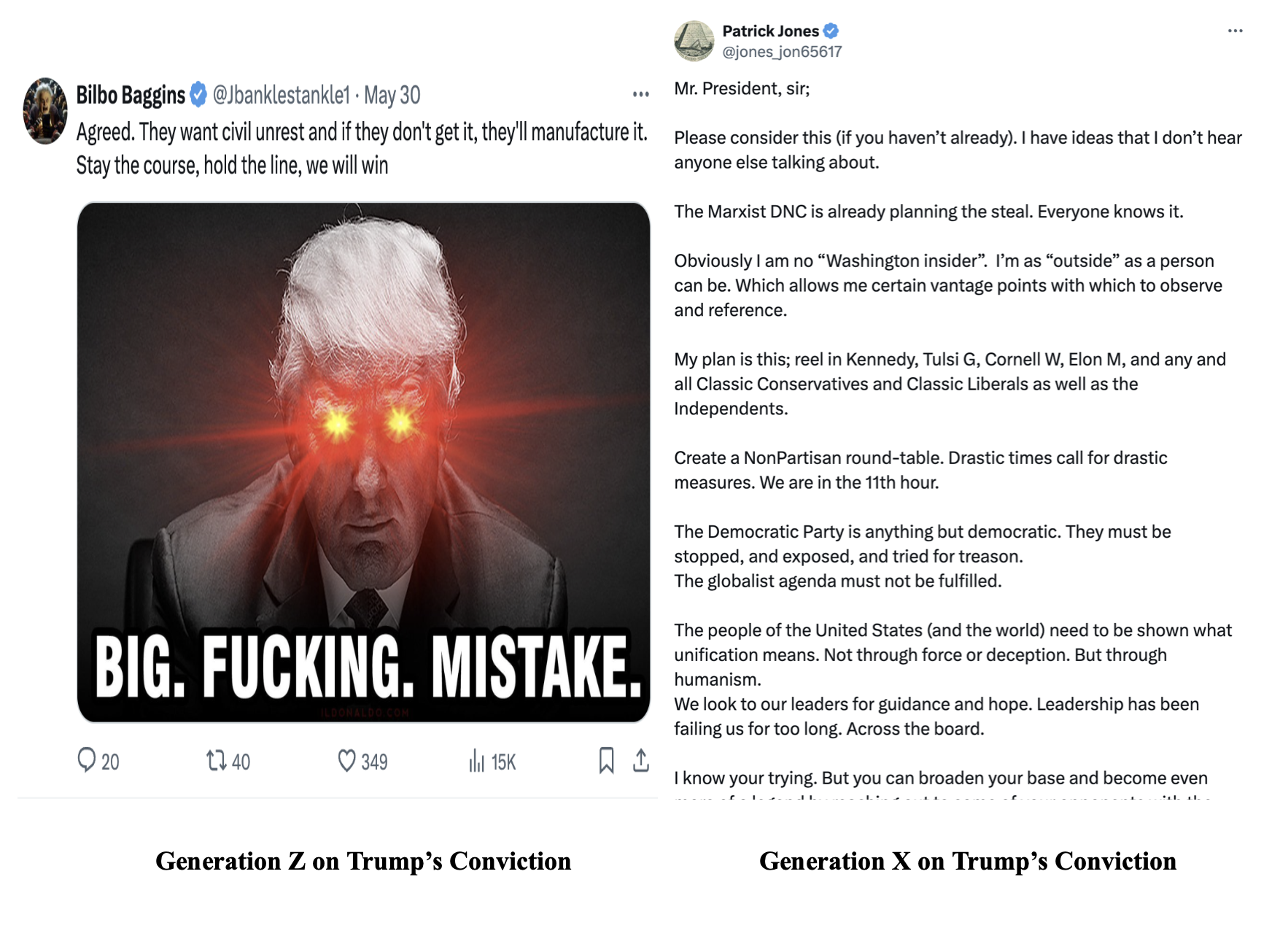
Another difference between the generations we found from our results includes the tendency for Generation Z to incorporate pictures in their posts/tweets and for the lack of imagery in posts/tweets by Generation X. Below is an instance where a member of Generation Z, Bilbo Baggins, uses a picture in their tweet about Trump’s recent conviction and the member of Generation X, Patrick Jones, does not.
Another contrast was the tendency for Generation X to more likely include words in all capital letters and the tendency for Generation Z to have slang terms in their posts/tweets. Below is an instance where a member of Generation Z, bella, uses a slang term, “brain rot” and the member of Generation X, Richard Shepard, does not include any slang words. The term “brain rot” is a slang term used by Generation Z (TikTok “Brain Rot”: How TikTok Is Changing the Way Gen Z Speaks | Redbrick Life&Style, 2024). Also in the example below, the member of Generation X has two words in all capital letters while the member of Generation Z only has one, and it is a shorter word. Both users are discussing the recent “Challengers” movie.

Discussion
Our findings demonstrate clear online communication trends within both generations that are not shared by the other generational group. These distinct patterns in writing and visual communication on social media add to our understanding of how different generations communicate in ways that do not always align with one another. These differences can contribute to intergenerational misinterpretations and tension. Our project identified what some of the prominent generational patterns on social media are, which are beneficial findings that provide a basis for wider intergenerational understanding. Additionally, it lays the groundwork for future research, such as the intricacies of these patterns and how the other generation perceives them.
The results of our research aid in our understanding of two broader phenomena: generational differences and online communication trends. As social media continues to grow and become a staple in people of all ages’ lives, it becomes a new arena for intergenerational tension to arise and unfold. Certain aspects of an age group’s communication can be specific and unique, and does not usually reflect ill intent. This knowledge is important for maintaining dialogues between multiple age groups, so that they do not fall to misunderstandings due to believing a form of speech was rude. For example, Gen X’s use of all capital letters for certain words could potentially be read as aggressive by a younger person who rarely does so, while Gen Z’s use of slang and images may appear unserious or confusing to an older person. Previous research has demonstrated similar phenomena, such as younger people finding the use of periods in text messages to have a negative valence and make the message insincere (Gunraj et al., 2015). Knowing these communication methods are simply an attribute of their generation can ease any potential misgivings on the receiver’s end.
Analyzing the patterns found in our research can also contribute to future literature about online trends and cycles. Gen Z especially uses numerous contemporary references and constantly evolving slang terms and reference images that reflect the state of the internet and popular culture, particularly within their generation’s main bubble on the web. Our findings contribute to the academic understanding of social media trend cycles and communication.
In conclusion, our research begins to catalog numerous generation-specific social media communication patterns into the literature on online communication. We provide many examples of observable differences between how Generation X and Generation Z structure text-based posts on social networking sites, often in ways that directly contrast each other. Though we can offer hypothetical insights into potential misunderstandings these may cause, we recognize that further research is required to analyze these trends in full and begin to study how they verifiably contribute to intergenerational conflict.
References
Achinstein, P. (1994). Stronger Evidence. Philosophy of Science, 61(3), 329–350. https://www.jstor.org/stable/188049?seq=21
Gunraj, D. N., Drumm-Hewitt, A. M., Dashow, E. M., Upadhyay, S. S. N., & Klin, C. M. (2015, November 22). Texting insincerely: The role of the period in text messaging. ScienceDirect. https://www.sciencedirect.com/science/article/abs/pii/S0747563215302181?via%3Dihub
TikTok “Brain Rot”: How TikTok Is Changing The Way Gen Z Speaks | Redbrick Life&Style. (2024, April 22). Redbrick. https://www.redbrick.me/tiktok-brain-rot-how-tiktok-is-changing-the-way-gen-z-speaks/#:~:text=The%20language%20associated%20with%20Generation
You, Q., García-García, D., Paluri, M., Luo, J., & Joo, J. (2017). Cultural Diffusion and Trends in Facebook Photographs. Proceedings of the International AAAI Conference on Web and Social Media, 11(1), 347-356. https://doi.org/10.1609/icwsm.v11i1.14902
Zhao, Dejin, and Mary Beth Rosson. (2009). How and why people twitter. Proceedings of the ACM International Conference on Supporting Group Work, https://doi.org/10.1145/1531674.1531710.