Hindi

“Swag Toh Dekho:” Hindi-English Code-Switching in Bollywood Movies of the Last 30 Years

Krithi de Souza, Kara Bryant, Sophia Adams, Medha Kini

Bollywood! We know (and love) the films for their grand and magnificent dance sequences, epic love stories, and extra long running times. Bollywood is often referred to as the “Indian Hollywood,” and this Hindi cinema industry has a large fanbase of its own. But how much overlap is there between Bollywood and Hollywood? Is there a strong language barrier that separates them? If you’ve watched a modern Bollywood movie, you would know that English words are often scattered throughout the script or used for funny catch phrases and apologetic remarks. But has that always been the case? In our project, we analyze the code-switching in three different Bollywood movies — Kuch Kuch Hota Hai, Student of the Year, and Rocky aur Rani Kii Prem Kahaani — all made by the famous filmmaker, Karan Johar. Each movie was released in a different decade, and we wanted to know how code-switching in Bollywood movies has changed as time passed. Read more to find out about the patterns we observed as the movies became more recent!

[expander_maker id=”1″ more=”Read more” less=”Read less”]

Introduction and Background

In this project, we decided to focus on changes in code-switching from the 1990s onward in order to analyze how globalization and other factors have impacted screenwriting in Bollywood. Hindi-English code-switching has been a part of Indians’ vernaculars for over a century. Far before the advent of the internet age, British colonial rule led to English being incorporated into Hindi to indicate prestige and education (Rai, 2009). Then, as globalization increased over the last 30 years, particularly through the development of the internet as a global resource, more and more Indians gained access to English content through online means. In addition to formalized English education, the population increasingly consumed media produced in English. This came in the form of professionally developed productions such as English-language movies and television, as well as informal, interpersonal content such as social media videos coming from YouTube, Tiktok, and more. Moreover, the Indian economy liberalizing in 1991 brought more access to things such as satellite TV, social media, and other global market products (Kumar, 2013). All this likely affected how often characters code-switched in Bollywood movies.

Our hypothesis is that code-switching will increase overall as the year of release for the films progresses. In other words, as time passes, code-switching will occur more often and become more prevalent in the films as a result of increasing globalization and access to English media. To measure this, we have chosen three Bollywood movies that were produced across three decades — Kuch Kuch Hota Hai (KKHH) (1998), Student of the Year (2012), and Rocky aur Rani Kii Prem Kahaani (Rocky aur Rani) (2023) — to analyze. They are all written by the same screenwriter, Karan Johar, in an attempt to eliminate variables across different filmmakers’ tastes. They all also come from roughly the same genre, romantic comedies, for the same reason. We will use this data to draw conclusions about how much exposure the effects of globalization had on the Bollywood industry. Furthermore, we will be able to say how English use in Bollywood films reflects English use in different populations within India in real life.
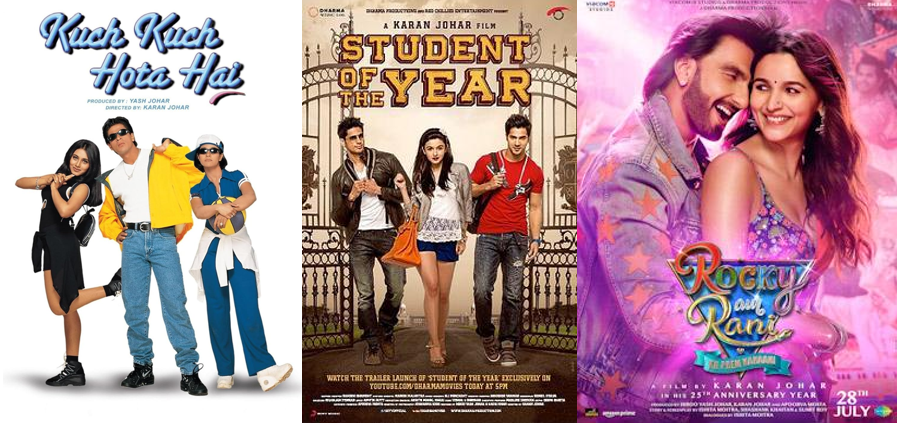
Figure 1. Movie posters from KKHH, Student of the Year, and Rocky aur Rani.

Methodology

Based on existing research, we found many different ways to categorize code switches in movies. Our data collection was modeled after a study done on code-switching in three Bollywood movies from three different decades (Anttila, 2015). We categorized the code-switching into two different types: proper code-switching and loanwords. Loanwords are what we define as phrases that were otherwise incorporated into a Hindi matrix sentence, such as the sentence “तु नहिइ  educated है” or “tuu nahiiN educated hai” (Translation: “You are not educated”). “Proper” code-switching as we are defining it for this research project occurred when characters included full phrases or sentences in English, such as “How are you?” (Bali et. al, 2014).

Watch this short clip to see an example of code-switching in Rocky aur Rani.

Each film was watched by at least two members of our team to minimize errors. While watching the movie, every instance of code-switching by the main characters was tallied into one of these two categories. When multiple instances of English words were uttered in a phrase, we used our best judgment to determine its categorization. We only tallied the code-switching of two to three main characters per movie to minimize variables across character type (age, class, education) and maintain a reasonable scope for project.

Results and Analysis

The oldest movie, KKHH, focuses on a best friend duo. Between those two main characters, they produced 13 loanwords and 58 proper code switches, for a total of 71 code switches overall. The next movie, Student of the Year, was released 14 years later. We counted 193 loanwords and 135 proper code switches across three main characters, or 328 code switches overall. Lastly, Rocky aur Rani came out 12 years after that and had 328 loanwords and 290 proper code switches between two main characters, totaling 618 overall code switches. The total number of code switches across the three movies can be visualized in the bar graph below:
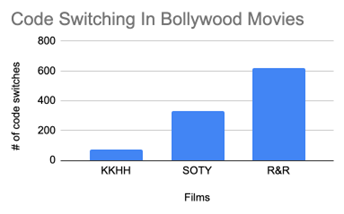
Figure 2. Total number of code switches.

Given the data, our hypothesis was correct. The amount of code switches steadily increased across all three movies. Notably, we focused on one fewer protagonists in Rocky aur Rani, yet it still almost doubled the number of total code switches. Thus, we see that over the last 30 years, English usage in Bollywood movies has gone up considerably.

There were several patterns we noticed while analyzing the code switches. Many of the most common instances of code-switching came from characters using popular English phrases, such as “thank you,” “I’m sorry,” or “you’re welcome.” All of these were considered proper code switches for the purposes of our study, although there was some debate of whether they should be considered a single loanword unit because of how they were tied to one meaning. For example, we never saw a code switch like “thank आप,” or “thank aap” (Translation: “thank you”).

One of the biggest changes we noticed over the years was the use of Hindi-English code-switching in songs. Most Bollywood movies are musicals regardless of genre. Music is inherent to the industry, and we counted code-switching in the lyrics of songs the same way we counted spoken lines of dialogue. KKHH has eight songs, Student of the Year has seven, and Rocky aur Rani has eleven. KKHH had no code-switching in the songs. Every song was sung exclusively in Hindi. Student of the Year had slightly more code-switching in the songs, particularly in Shanaya’s entrance song, “Gulabi Ankhen,” which included many brand names. Additionally, there was one song titled in English, “The Disco Song.” Although the title is not an exclusive indicator of English use in the song itself, it does reveal a trend that English was becoming more accepted in the music side of Bollywood. This pattern continued with Rocky aur Rani, which had two songs with some English in the title: “What Jhumka?” and “Heart Throb.” More importantly, the content of the songs throughout the movie had regular code switches. It appears that songs are more resistant to incorporating English, since KKHH had code-switching in dialogue but not songs. However, by 2024, English was heavily included in Bollywood song lyrics. code This may be related to Shet (2022)’s findings that code-switching in film songs signifies purpose in discourse rather than for “aesthetic” purposes like in dialogue.

Another pattern was the use of brand names as a form of code-switching. Given that English can be a signifier of prestige, this effect is heightened when the code-switching indexes luxury items. Characters in Student of the Year and Rocky aur Rani regularly referenced brands such as Louis Vuitton, Ferrari, Jimmy Choo, and Versace. The character Rocky in Rocky aur Rani did this the most consistently. His character is upper class and frequently mentions his possessions by brand name. Interestingly, his code-switching often indexes a superficial, vapid personality as a result. This counters what Antilla (2015) found in her assessment, that English had become a language of professionalism and accomplishment. Rocky frequently uses English slang, but since he uses it haphazardly and without formal education, he is sometimes considered an idiot by those around him. Therefore, we can surmise that not only is the amount of English code-switching changing, but that its meaning in Bollywood is changing too.

Both code-switching in songs and use of brand names can be seen in the example below, which shows three lines from the verse of the song “Heart Throb” in Rocky aur Rani.
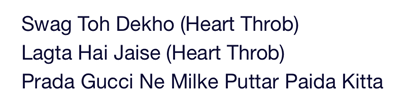
Figure 3. Lyrics from “Heart Throb”

In just this excerpt, lasting six seconds in the song, there are five loanwords: “swag,” “heart throb” twice, “Prada,” and “Gucci.” The line roughly translates to “Look at the swag, it’s like Prada and Gucci gave birth to a son.” Thus, we see Rocky using English slang (“swag,” “heart throb”) and brand names (Prada, Gucci) to signify coolness and style.

Discussion and Conclusion

Our analysis of our three films — Kuch Kuch Hota Hai, Student of the Year, and Rocky aur Rani Kii Prem Kahaani — show a clear trend of increasing code-switching. Since these three films came out in sequential decades following the explosion of the internet age and social media usage, the data supports our hypothesis that globalization and media exposure are driving forces behind these changes. Each film demonstrates a greater frequency of English phrases and loanwords, suggesting that modern day Bollywood films are catering to an audience that is more familiar with an inclusion of English.

However, there are several limitations to our study. In future research, it would be helpful to have access to the scripts, so we can accurately count the number of code-switches used in the films. Our method of manually tallying code-switching instances while watching the movies might not have captured every instance accurately. Having access to scripts that we could read would provide a more precise count and better context for each instance of code-switching. Additionally, we focused on three films from a single filmmaker, which might not fully represent broader trends across the industry.

Future research could address these limitations by expanding our method to include films from various filmmakers and genres and collect data from multiple characters, not just the protagonists. Furthermore, it would be beneficial to perform research confirming the correlation between code-switching in Bollywood and English usage in real life. We could do this by exploring the perception of English among viewers who recently finished watching Bollywood movies. Researchers can also analyze if non-English speakers’ perception of English changes after watching a Bollywood film due to the presence of code-switching between Hindi and English. Another possibility would be to compare native Hindi speakers’ code-switching with that of the fictional characters to see if the frequency is comparable. This would be one way to determine whether Hindi-English code-switching changes when it is scripted versus non-scripted. Therefore, due to this research, researchers can discover the impact code-switching has on society.

Since our research project effectively replicated Anttila (2015)’s project studying three movies from 1988, 1996, and 2005, it will be interesting to see if the use of Hindi-English code-switching will continue to trend upward. Anttila found that code-switching increased over time across her three movies, just like we did. But if this study were performed again another ten years from now, will English in Bollywood movies continue to increase or will it eventually stagnate? Is there a “saturation point” for English usage? At a certain point, the question becomes when is the movie itself “bilingual” rather than the characters?

In conclusion, analyzing Bollywood movies can help assess how English is perceived and used in India. The findings suggest that English is steadily increasing across Bollywood. Since media is a reflection of its society, we can conclude that English access is increasing overall in India, thus reflecting trends of a globalized society and proliferation of digital media. This increase in code-switching suggests that English is becoming more ingrained in everyday society in India, not just as a symbol of prestige but also as a tool for communication. Due to the creation of the Internet and the rise in social media, there is now greater access to English across India. These platforms provided greater access to English content in the media. This creates a positive feedback loop because as more people use the Internet, their exposure to English increases, encouraging them to adopt English in their vernaculars, which in turn exposes more people to English. Our research project highlights the increasing presence of English in Bollywood films, reflecting broader societal changes driven by globalization and digital media.

References

Anttila, H. (2015). You come-come, memsaabCode-switching in Sherni (1988), Raja Hindustani (1996) and Dus (2005) (Publication No. 6357) [Master’s Thesis, University of Vaasa]. OSUVA Open Science.

Bali, K., Sharma, J., Choudhury, M., & Vyas, Y. (2014). “I am borrowing ya mixing?” An analysis of English-Hindi code mixing in Facebook. Proceedings of The First Workshop on Computational Approaches to Code Switching, 116-126. https://aclanthology.org/W14-3914.pdf.

Kumar, A. (2013). Globalization and Changing Patterns in the Hindi Cinema Industry. Journal of South Asian Studies, 29(2), 433-448

Rai, A. (2009). English in Postcolonial India: History, Politics, and Cultures. Oxford University Press.

Shet, J. P., & Premkumar G. (2022). To switch and mix or not to: Code switching and code mixing in Indian film songs. Journal of Positive School Psychology, 6(3), 1417-1430. https://www.journalppw.com/index.php/jpsp/article/view/1672.

[/expander_maker]
, , , , ,

The Linguistic Portrayal of Social Mobility in Bollywood Cinema through Hinglish

Hashim Baig, Siuzanna Shaanian, Georgia Lewis, Jacob Cook, Christian Atud

The rise of English as the global lingua franca has had profound effects on multiple cultures worldwide. One such spot is the Indian subcontinent, especially with the emergence of India from centuries of colonial rule. This paper looks at how Hindi-English code-switching (popularly called Hinglish) in Bollywood films post-2000 both reflects and constructs social identities. It analyzes five contemporary Bollywood films and argues that the increase in Hinglish usage corresponds with characters’ social mobility, still signifying English as a potent symbol of prestige. This research aims to unearth the interplay of dynamics between language usage and perceived social standing in contemporary Indian cinema.

[expander_maker id=”1″ more=”Read more” less=”Read less”]

Introduction

English, being a global language, has influenced many cultures worldwide. One of the most impacted cultures was that of India, a former British colony. One of the most exciting consequences of this influence is the rise of Hinglish — a mixture of Hindi and English — primarily in the context of Bollywood films. Our project will investigate how Bollywood movies use Hinglish as a means of social change by depicting a character as having a higher social status through excessive code-switching into English.

Background

Bollywood is the leading film industry in India, providing fertile ground for the use and experimentation of different languages and linguistic expressions. The most salient is the integration of English into Hindi dialogues, often called Hinglish. This is relevant since some of the more recent films with this thematic feature in the foreground also depict the interaction between the English and Hindi languages as facilitators of social mobility. The fact that English is the prestigious code in Indian society and Bollywood is very influential in molding cultural trends, thus marking these films as good starting points for studying linguistic portrayals of social mobility.

Literature Review and Context

The Colonial Hangover

The continuing popularity of English in India began during the British colonial era, when the English language was used in administration and education. Within this context, the English language symbolized both sophistication and higher social status. Chandra (2014) says that in recent times, English has become a fashionable aspect of filmmaking in India, “associated with modernity and prestige.” Chakraborty (2022) also mentions what he refers to as the ‘Colonial Hangover.’ Knowledge of English, he says, is equated with higher social status and respect.

Bollywood’s Linguistic Landscape

Even in their language use, Bollywood films reflect changes in society. According to Rao (2010), English is identified with modernity and prestige; Hindi, however, is an intimate language of traditional values. Furthermore, this dichotomy has been depicted using code-switching. Context and social aspirations govern the switch between Hindi and English.

Code-Switching as a Tool of the Narrative

Si (2011) holds that code-switching is not random but rather a narrative device in Bollywood movies. English words or phrases are inserted into Hindi dialogues to portray a character’s social mobility, education, or cosmopolitanism. The present paper seeks to understand how, drawing from these studies, such linguistic choices could potentially stand synecdochally for social mobility in contemporary Bollywood films.

Project Design

This paper endeavors to examine and find evidence of any relationship that may exist between patterns of code-switching and the rise and fall of the characters’ social status in five films: Thank You for Coming (2023), Sukhee (2023), Laapataa Ladies (2023), Mission Raniganj: The Great Bharat Rescue (2023), and 3 Idiots (2009). The reason these movies have been selected for this purpose is that they essentially belong to a genre of ‘rags-to-riches’ stories and because they have been widely viewed.

Methodology

Collectively, we utilized a mixed-methods approach; qualitative content analysis was combined with quantitative frequency measures. We analyzed under what context code-switching occurs. That is, for particular scenes, social interaction and visual information related to socioeconomic status. We also counted the frequency of code-switching. We grouped each instance of code-switching into one of two categories: light and heavy. Light code-switching refers to sporadic insertions and alternations of English into Hindi, as well as forms borrowed from English. Heavy code-switching would refer to the use of extended English expressions, sentences, and rapid switching between English and Hindi. Each instance was counted across different narrative stages: exposition, rising action, climax, and falling action. Hopefully, through such an examination, we may develop insight into how Hinglish use is representative of social identities and how code switching shapes them in Bollywood films.

Results and Analysis

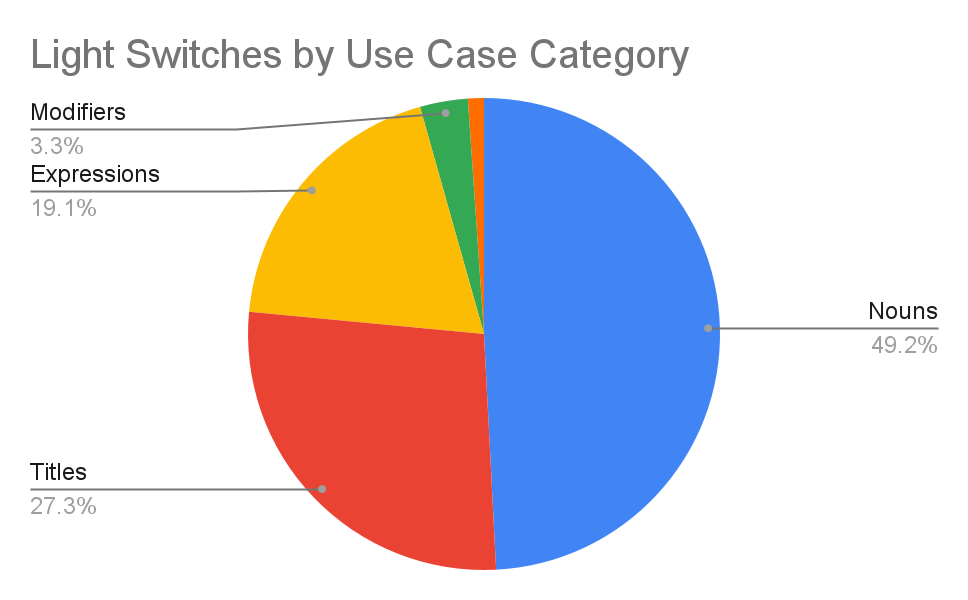
In this research, we found that there was a moderate use of light phrases in middle socioeconomic environments, with much more frequent usage towards and between people in high social positions. Light phrases are pervasively used in these environments and are almost entirely used for referring to specific items such as “boreholes” or “walls,” as well as specific titles such as “Sir” or “Doctor.”

Figure 1. Relative Distribution of Light-Switching: Categories. This pie chart summarizes the relative distribution of the types of light switching observed in this study. A majority of the switches were used to refer to nouns or specific nouns. Each category is defined by its context and use case. Discrimination was made between titles and nouns, as their use cases were notably distinct.

In this study, the average amount of light utterances per movie totals to around 400 phrases. Of those 400 phrases, about 25%, on average, include non-noun switching. This subset mostly consists of expressions/sayings (e.g., ‘Thank you,’ ‘I’m sorry’) and modifiers (insertion of adjectives, adverbs, etc.). Of the nouns, it is worth noting that a majority of these utterances are a form of borrowing from western culture. These include scientific/official names (e.g., ‘Carbon Dioxide,’ ‘Instagram’) and specific titles (e.g., ‘Doctor,’ ‘Sir,’ ‘Upper Management’). In especially institutionalized contexts, such as in educational or professional settings, this tendency is much more pronounced, as it would correlate with intelligence and competency. It is akin to using proper jargon when in an official discussion between peers or co-workers. Although nouns and titles share similar linguistic qualities, a distinction must be made between the two in order to account for their differing use cases. Titles, in particular, were commonly used towards individuals of high standing as a form of politeness and respect in a professional setting. One of the most common examples of this would be the usage of the word ‘Sir’ towards high ranking individuals. It is also worth noting that verbs were more commonly used in heavy switches and see little to no usage in light switches. This is largely due to the usage of English verbs in command/directive phrases rather than as a simple insertion/alternation. Most commands would be issued by an individual with authority and power. This would lead to the switching of the entire sentence to English, which would give the order a more serious/official connotation and allow the individual to leverage their position.

In regards to heavy code-switching, we observed 40-70 instances of heavy switching per movie, on average. This number would fluctuate depending on the overall setting of the movie. Movies set in professional settings, such as Mission Raniganj, would see a higher usage of heavy code-switching as a marker for ‘officiality.’ This trend exists because a much larger cast of characters are depicted as ‘intelligent’ and ‘powerful’ enough to use these forms. Heavy-switching forms can also be split into several categories: extended sayings/proverbs, official conduct, and narrative effect. The frequency of each category would also depend on the movie genre, with action movies opting for more instances of official conduct. Official conduct, in this study, would be a character’s tendency to use English as a medium to denote seriousness, power, and hierarchical respect. Medal ceremonies, press conferences, and board discussions would include many instances of ‘official’ code switching. Usage of English for narrative effect would mostly be tied to specific characters as part of one’s personality and could be used to highlight/exaggerate a powerful point during the movie. Such instances include the usage of English to look cool, smart, or funny. On the topic of sayings and proverbs, scriptwriters would use large English expressions to flesh out a specific character’s identity. One character, for example, would use the expression “I know this place like the back of my hand” as a catchphrase to denote professionalism, while also being entertaining for the audience.

Another interesting finding includes intentionality when switching between English and Hindi. We found several instances where rapid switching between English and Hindi would depend on the context and emotion behind each utterance. Some pivotal scenes would hinge on the differentiation between officiality and intimacy. Moments where a character must command/exert one’s authority in an official manner would invite the use of English. In moments of weakness, intimacy, and affection, characters would often switch back to Hindi. This finding runs similar to Rao (2010)’s findings, where he would describe this tendency as a “preservation of Indian values.”

To demonstrate this, we can take a look at an example from the movie Mission Raniganj.

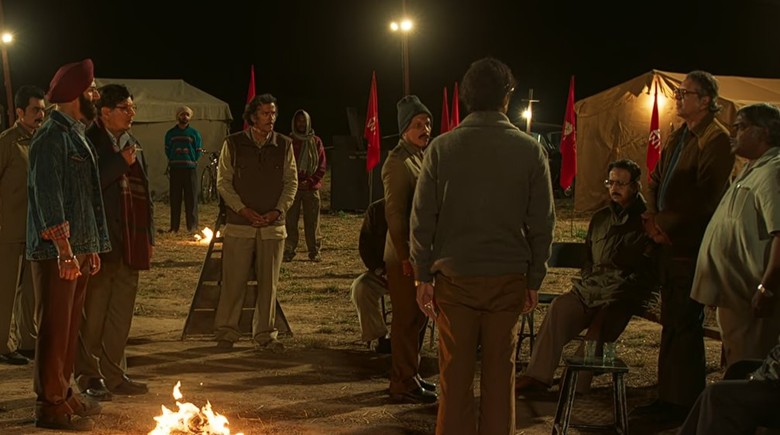
Figure 2. Mission Raniganj. Protagonist Rescue Officer Gill (Left) confronts main antagonist Director Technical Dayal (Right) in front of a board of managers (Mission Raniganj: The Great Bharat Rescue, 2023, 1:40:32). Gill and Dayal each appeal to the managerial board using both English and Hindi. When appealing to status, they switch to English. Conversely, they switch to Hindi when appealing to emotion.

In this scene, the main character, Gill, is the main rescue officer in charge of rescuing 70 miners who were trapped in the Raniganj Colliery. Gill is rich and depicted as intelligent, calm, and heroic in a majority of the scenes he appears in. The other characters in this scene, such as Director Ujwall and Director Dayal, are all well-dressed and depicted as intelligent, powerful people. In this scene, the managing board is picking out an individual to head into the mines through a borehole to help manage the manual rescue of the miners. CO2 gas is forming, making the operation potentially lethal. Director Dayal, in an attempt to steal the credit, says: “No, we can’t be so selfish; [Gill has a bright future]; we can’t send a talented officer [down to sacrifice his life].” Gill responds: “Thank you for your concern sir, but I promise you, [I will have my morning tea with you].” The blue words that are within brackets represent phrases in Hindi, whereas all other words are mentioned in English.

This scene demonstrates the intentional switching between English and Hindi in an official setting. Here, we see both individuals speak in English when formulating an official response, such as Gill’s appreciation and Dayal’s request. They both, however, intentionally switch to Hindi when appealing to emotion and intimacy. This scene is powerful and successfully depicts Gill as not only intelligent but magnanimous in a way that parallels Indian values.

Film Analysis Examples (Excluding the already discussed Mission Raniganj)

  • Thank You for Coming
    • Brief Summary: Kanika Kapoor is the lead character. This 32-year-old unmarried girl lives with her mom and grandmother. Kanika goes on a journey searching for love and sexual satisfaction for herself, getting intertwined along the way with her college friend, a professor, and much later with some guy called Rahul. Nothing seems to satisfy her enough for her to reach that satisfaction. She learns that during depression, particularly after breakups or on her birthdays, Kanika finds support from her best friends, Pallavi and Tina.
    • Scene Example: In the first five minutes of the film, a young elementary school Kanika gets in trouble with her principal and asks to leave because she announces during a school play that their presentation of “conception” is incorrect and not how babies are made, but rather men and women “must have sex.” Following this formative memory and pivotal scene, the film cuts to Kanika’s mother speaking to the principal in Hinglish: “I don’t want to confuse my child, Miss Kukreja. Main ek clinic chalata hoon aur mareez aate hain-” (Translation: “I don’t want to confuse my child, Miss Kukreja. I run a clinic and patients come-”).
    • Visual Cue: Kanika’s mother is dressed in a floral suit jacket and pants as she communicates with the principal, who is much older than her mom. The principal is noticeably older and dressed in a sari. Her hair is perfectly curled, and she wears mid-sized purple hoop earrings.
    • Analysis: In Thank You for Coming, the mother of the protagonist repeats what her daughter has been telling her regarding how serious she is in going back to school, which she finds professional, in Hinglish. In the real sense, her daughter discusses with her classmates about sexual intercourse, which is not appropriate to her. Her use of the word “clinic” in English shows the pride she wants to pass on to the principal, implying that her work is medical. She then further reiterates that with English, saying “I do not want to confuse my child,” and stressing the gravity and formality of the issue at hand. This again pushes home the fact that she is a medical professional, hence her daughter’s excellent knowledge of sex.
  • Sukhee
    • Brief Summary: This light-hearted film narrates how Sukhee, an exuberant 38-year-old Punjabi housewife, gets tired of living a monotonous life and books herself a flight to Delhi for her high school reunion. Over that week, Sukhee rediscovers her teenage self and more; she got to experience new things for the first time in her life that brought back a zest for living. Through this journey, she undergoes a dramatic transformation from her housewife-mother duo role to rediscovering and asserting the woman within.
    • Scene Example: Towards the end of the film, after the crazy ups and downs of a reunion adventure, Sukhee and her three girlfriends are shown to have reunited and are sharing lessons learned and goals set for themselves. This emotional ending has the women sharing their plans for growth and evolution. One of the friends, Mansi Parekh, shares her goal-cum-intention, which contains a heavy amount of code-switching: “Central sunishchit karunga ki meri agli naukri mein mujhe respect, promotion, aur equal opportunities milein.” (Translation: “In my next job, I’ll assure respect, promotion, and equal opportunities.”)
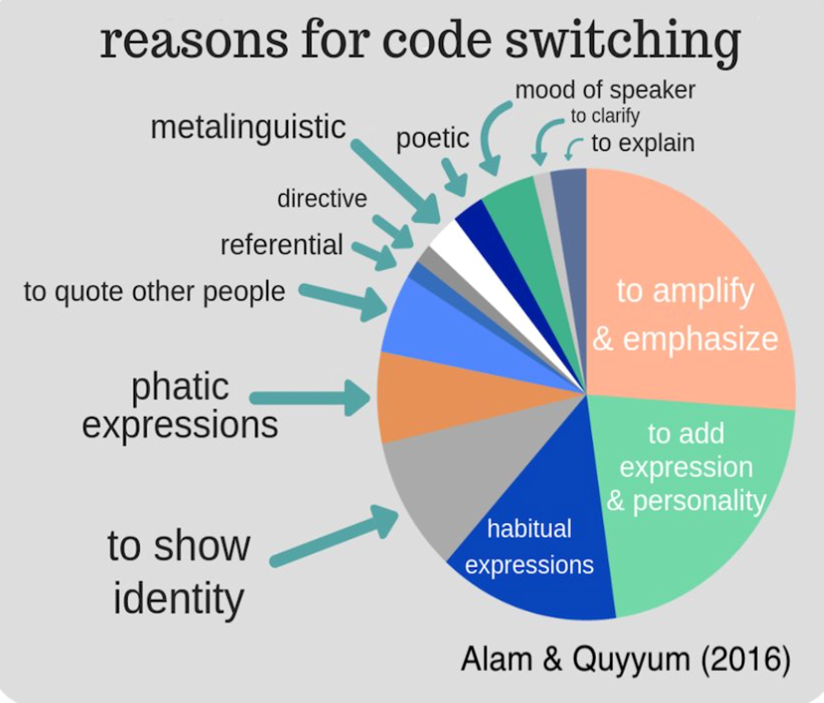
    • Visual Cue: The frame contains the four ladies dressed in relatively executive but casual clothes. Mansi, for instance, is dressed in a traditional blouse and denim. As all four pose in the camera frame, they demonstrate the increasing connotation of relative wealth and distance from the ideas of poverty, while maintaining the idea of closeness in their talk about future aspirations and promises to each other. Here, at the outset, Mansi is shown code-switching to express her goals and to “exaggerate and intensify” the need to achieve them (Alam & Quyyum 2016). The words “respect,” “promotion,” and “equal opportunities” are translated into English to show what makes them so vital and imperative. This also automatically infers an acknowledgment of the prestige factor because she fights for something that is her right, and by using English, she demonstrates her achievement of some type of social status.
    • Analysis: Here, Mansi is employing code-switching for the portrayal and “amplification as well as emphasis” of the desire that her demands be fulfilled sequentially. As Alam & Quyyum (2016) states: “respect,” “promotion, and “equal opportunities” are in English so that she lays stress on the importance and necessity of it. It automatically carries with it respectability as well because she is struggling for something she has to get. The use of English emphasizes the achievement of a particular social status.
Figure 3. Alam & Quyyum’s Functions of Code-Switching (2016). Alam & Quyyum (2016) describe the functions of code-Switching in conversational language. In relation to this study, several of Alam et al.’s findings provide reasons as to why characters code-switch regardless of the ‘weight’ of the code-switch. In this instance, the scriptwriters of Sukhee use English as a means to ‘amplify & emphasize’ Mansi’s desire for positional power. This is further exaggerated by India’s perception of English as a formal, powerful language.
  • Laapataa Ladies
    • Brief Summary: This is a story of two newlywed brides who get mixed up in a crowded train shortly after their weddings. One bride ends up with the wrong husband, Manohar, after landing at their destination, and they stay together until their situation can be resolved. It turns out that this bride is being abused by her just-married husband. When the two reunite, he slaps her, and therefore, she happens to be freed. They later find Manohar’s wife and reunite. The mixed-up, now-free bride is sent back to school to pursue her dreams.
    • Scene Example: In the following example, a character employs code-switching for just one word: “Kaise be? Hum to bahut saal se try kar rahe hain, kho hi nahi rahi sasuri…” (Translation: “How? I’ve been trying for many years, the damned thing is not going away…”)
    • Analysis: In contrast to examples of intra-sentential code-switching, this sentence only uses a singular English word: ‘try.’ It’s important to mention that an equivalent word for ‘try’ exists in Hindustani, so this is not merely an example of borrowing. Since no connotative meaning would be foregone if the native word were used, the reasons for employing this word would be social or linguistic. This word happens to be one syllable, as opposed to the Hindi word for ‘try.’ A quicker onset or lexical retrieval may be another reason for code switching in instances like this.
  • 3 Idiots
    • Brief Summary: This was a story about the friendship of three engineering students, and a satirical take on the societal pressures of the Indian education system.
    • Scene Example: During a classroom scene, one character uses Hinglish to make a point: “Sir, yeh formula toh practically impossible hai apply karna.” (Translation: “Sir, this formula is practically impossible to apply.”)
    • Visual Cue: He is shown in a prestigious engineering college, reflecting his academic aspirations.
    • Analysis: This student provides the most compelling example of using Hinglish during classroom discussion while he shows his learning journey through the use of 3 Idiots. Such switching tells that this character feels comfortable in both Hindi and English. It is a widespread phenomenon found in most urban educational institutes in India where the language of instruction is English. Hinglish allows the character to put his ideas across much better since the technicality of English is complemented by the conversational ease of Hindi. The same selection also exemplifies the pressure and tensions that an Indian student experiences in such an extremely stressful learning environment, where proficiency in English is equated with academic and professional success. The use of English terms such as “practically impossible” emphasizes the technicality of the discussion and how well the character is acquainted with academic vocabulary pertinent to the discussion, which is also an example of the fusion of cultures and languages common to modern Indian writing.
  1.  
  •  
  •  

Discussion and Conclusions
Our results elucidate the social mobility aspect of English usage and code switching in Indian cinema. In the films we analyzed, those who used more English were depicted as having a higher social status, better education, and better job prospects than those who used mostly or exclusively Hindi. The lexical decisions of Bollywood script writers is pertinent in this context, as well as Indian society as a whole, given the oversized impact that these movies have on the culture of South Asia. As such, code-switching in Indian cinema is reflective of broader social perceptions of English and its associations with coolness, erudition, etc.

India has more than a billion people. Given our small sample size of five movies, we are not able to make sweeping generalizations about code-switching in Indian society outside the context of its cinema. If we look at code-switching as a plot device used by Indian moviemakers, we are able to better understand the implicit interpretations of such language usage and thus, how it correlates with class and other socioeconomic indicators. This paper focused on several linguistic aspects of code-switching, including the syntactic category of the English words used. Overall, our statistical analysis is in line with previous findings on this topic, that is to say, that mostly nouns and titles are used in intra-sentential code-switching.


References

Balabantaray, S. R. (2020). Impact of Indian cinema on culture and creation of world view among youth: A sociological analysis of Bollywood movies. Journal of Public Affairs. https://doi.org/10.1002/pa.2405.

Chakraborty, O. (2022). Prevalence of Colonial Hangover in Bollywood Movies with Primary Focus on Queen and English Vinglish. https://www.questjournals.org/jrhss/papers/vol10-issue5/Ser-1/G10053338.pdf.

Chandra, S. (2014). Main ho gaya single I wanna mingle…: An evidence of English code-mixing in Bollywood Song Lyrics Corpora. 16(1). https://www.researchgate.net.

Mahbub-ul-Alam, A., & Quyyum, S. (2016). A Sociolinguistic Survey on Code Switching & Code Mixing by the Native Speakers of Bangladesh. Manarat International University Studies, 6(1). https://www.researchgate.net.

Rao, S. (2010). “I Need an Indian Touch”: Glocalization and Bollywood films. Journal of International and Intercultural Communication, 3(1), 1–19. https://doi.org/10.1080/17513050903428117.

Si, A. (2011). A Diachronic Investigation of Hindi–English Code-Switching, Using Bollywood Film Scripts. International Journal of Bilingualism, 15(4), 388–407. https://doi.org/10.1177/1367006910379300.

[/expander_maker]

, , , , , ,
Scroll to Top