gender

She’s the Man: The Role of Interruptions in Conversation in Establishing Power in Politics

Mannat Sukhija

Election season is heating up,  and one of the most thrilling parts of the election is watching candidates go at each other during their debates. Whether the argument is over healthcare, gun control, immigration and so forth, there’s something about watching the most educated and successful politicians in America call each other idiots and try to talk over each other that I find very entertaining. There are always certain points of debates, during large disagreements or differences in opinion where the candidates start ignoring the moderator and going at each other. During these periods of crosstalk, there can be extensive interruption, which is surprising in this relatively structured conversation. These interruptions could be interpreted as a display of power dynamics at play, which is especially important between candidates of different genders. How does the gender of a candidate influence their role in these power-establishing interruptions in conversation? By qualitatively and quantitatively analyzing the interruptions in the Democratic National Committee’s debates, a better understanding of how the gender of a candidate influences their ability to express power in an election may be better understood.

[expander_maker id=”1″ more=”Read more” less=”Read less”]

Introduction and Background

We’re in the midst of election season, and extensive debates between candidates constitute this component of our politics. Candidates come on stage to share their opinions, spread their ideas, and also to minimize their opponents and show that they are deserving of the party’s nomination. Like any conversation, gender influences the discourse in these debates, as one could easily argue that American politics are a man’s world, and thus the female candidates have to fight for their place on the stage. Looking at the role of gender in this form of political discourse could help us understand how gender influences elections, debates, and the power dynamic in politics as a whole.

In order to look specifically at the establishment of power and assertion of dominance, which are key outcomes of a debate6, the linguistic device of interruptions can be analyzed. Interruptions in gendered conversation have been extensively studied, and a multitude of theories surrounding the frequency of interruptions with gender have been established. I looked at studies done by Tannen, Lakoff, Anderson and Leaper, and James and Clarke to hypothesize how gender would influence frequency of interruptions by candidates based on gender. According to James and Clarke, who conducted a series of reviews between 1965 and 1991, there is no difference in the frequency of interruption between men and women, however the cause or function of the interruption can vary.4 Aligning with this theory, we can expect no drastic difference in the frequency of interruptions by any given gender group, in the context of the ongoing democratic debates starting from June 2019.

Methods

The study done on the ongoing democratic debates was two-fold, consisting of both a qualitative and quantitative analysis. The entire 2 hour debate from July 30th, between 7 male and 3 female candidates was analyzed and all instances of interruption, including the gender of the candidate who interrupted and the gender of the candidate who was interrupted were recorded. In addition, transcription on the 22-minute segment of the debate regarding healthcare was also executed. Transcriptions will help understand how the structure imposed by the Democratic National Committee for turn-taking is disturbed through linguistic features other than interruption.

For the purposes of this study, an interruption will be marked by a candidate speaking over, and successfully pausing the speech of another candidate, and interruptions of the moderator, silent interruptions, and non-intrusive interruptions will not be considered.

Results and Analysis

The quantitative analysis of interruption during a debate was conducted on the first night of the second 2019 Democratic Debate, seen below.
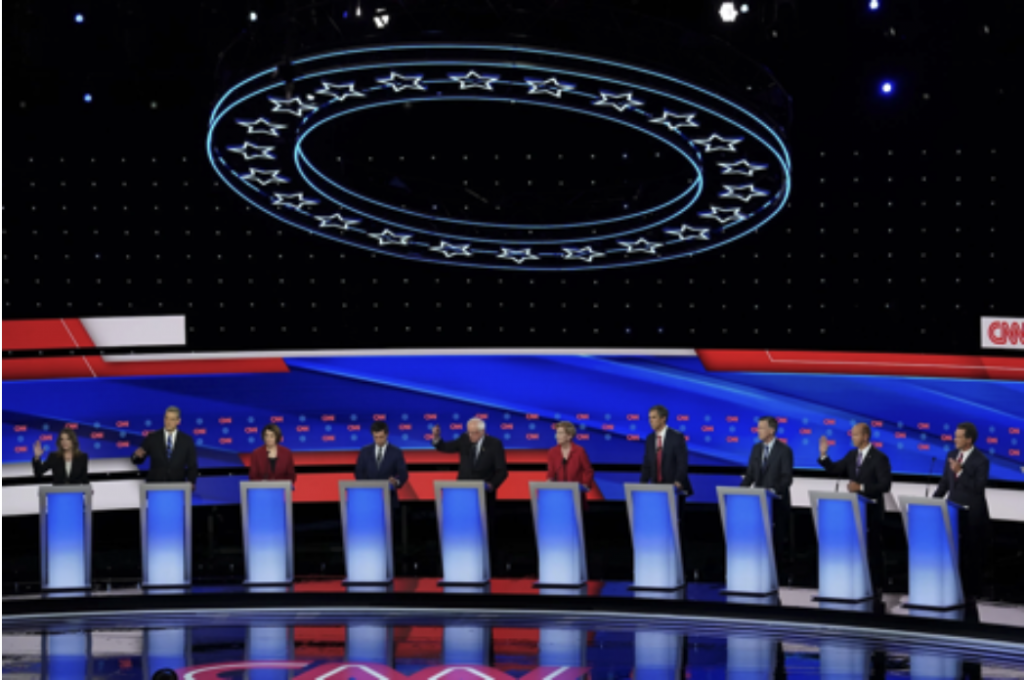
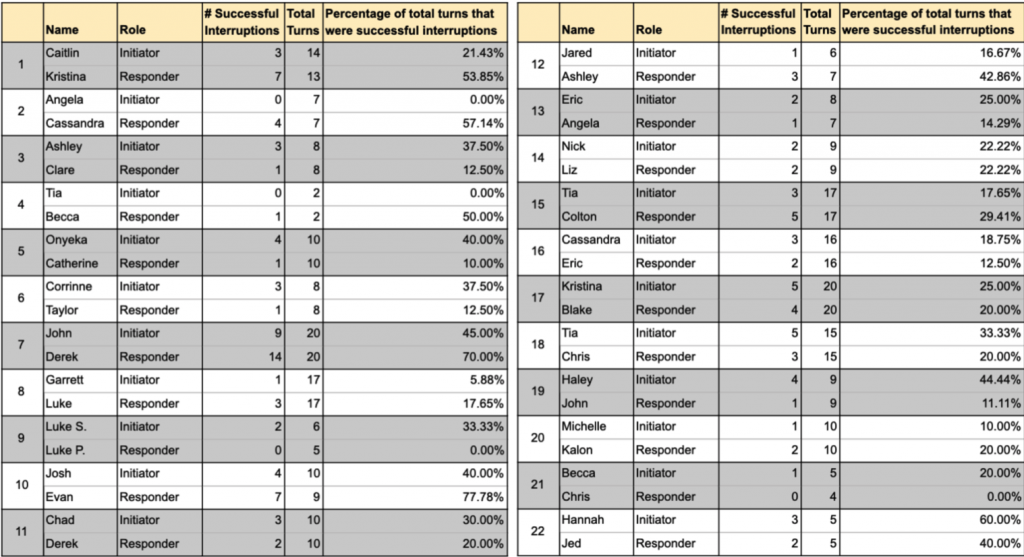
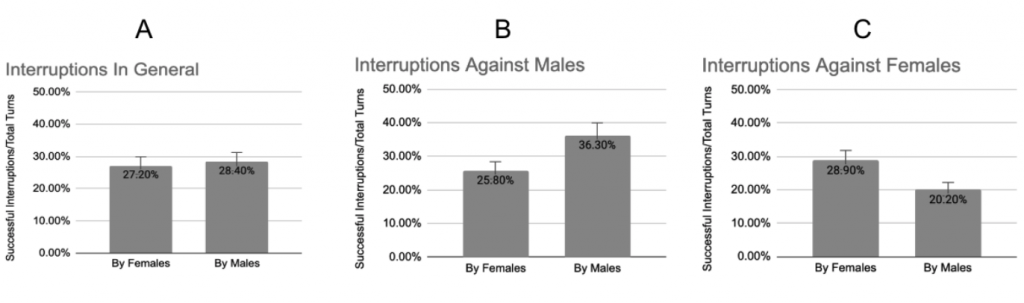
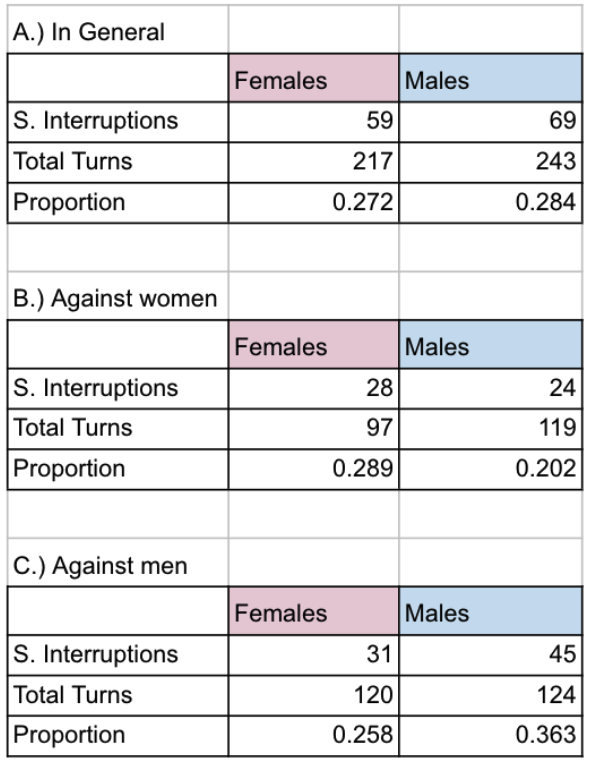
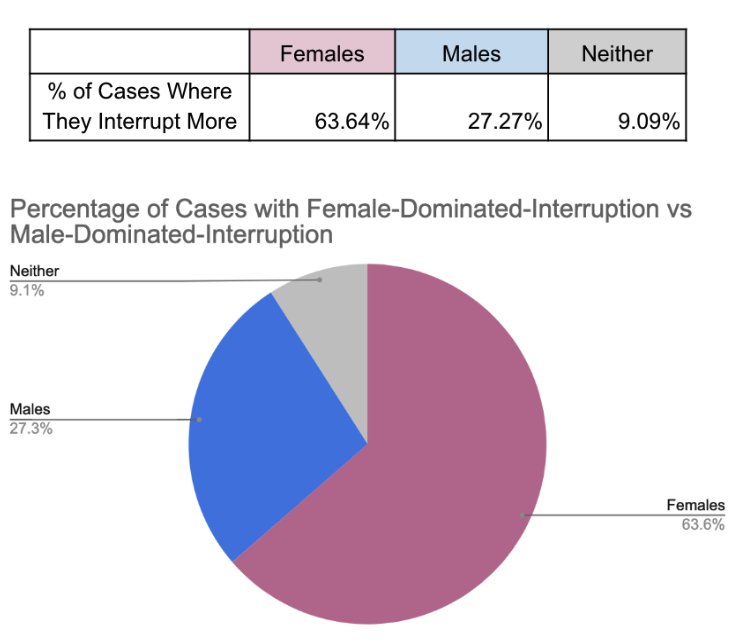
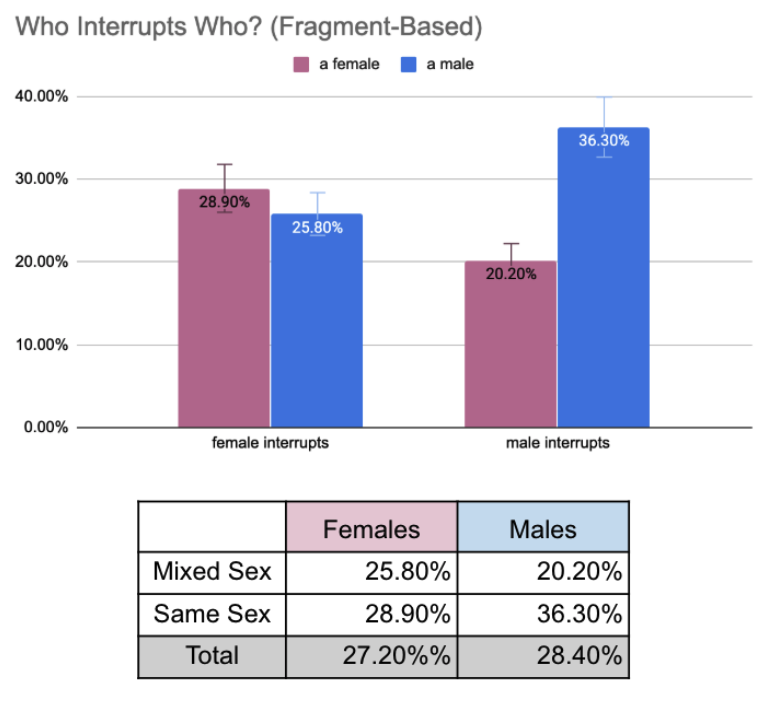
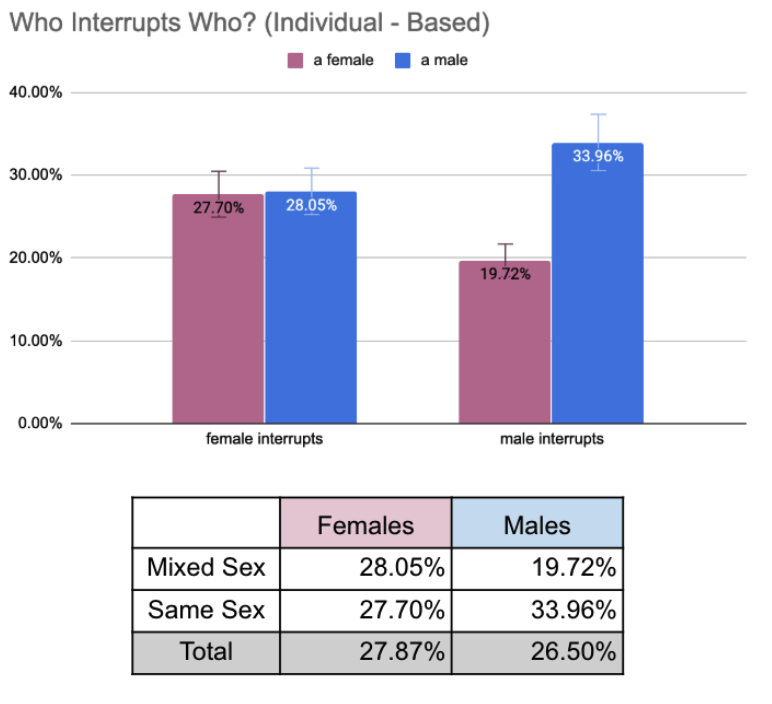
Throughout the debate, there were 24 occurrences of interruption, which are further broken down into four groups in the following tables.
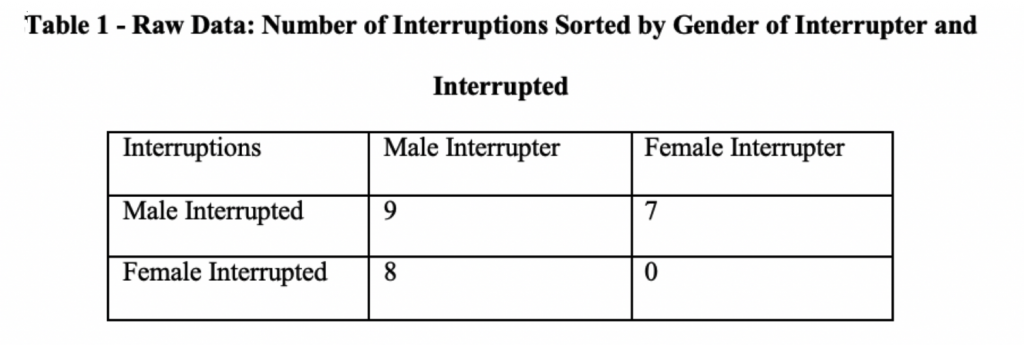
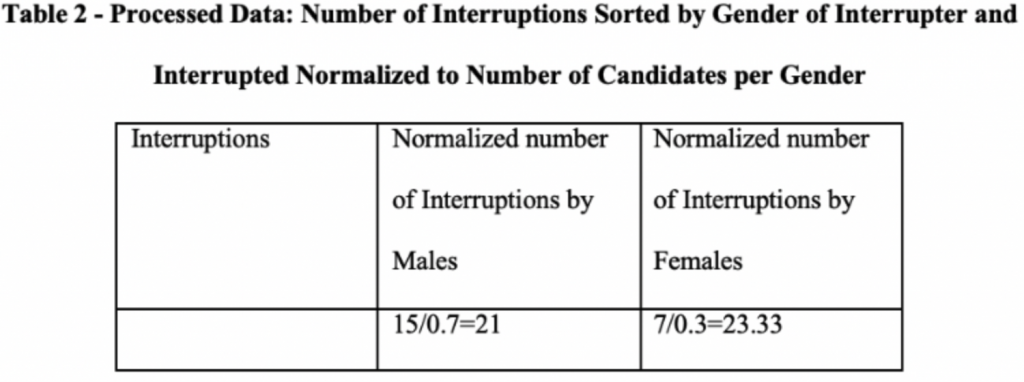
As seen in the data above, when the number of interruptions instigated by males and females was normalized to the number of candidates per gender, there was no difference in the frequency of interruption by any gender group. This aligns with James and Clarke’s theory that interruption does not vary in frequency between genders, but rather in origin and meaning.

It is important to normalize these results, so that our understanding of interruption is not skewed by the imbalance in gender seen in this realm of politics.  Claims such as males interrupt more during debates, or males speak more during debates are not necessarily false, but prevalence of males and females in the conversation must be considered. To determine if females are responsible for fewer interruptions due to a characteristic of their gendered language, or simply because there are less women present at the stage during the debate, a comparison of the origin and execution of the interruptions can be done. Further detailed analysis of the marked occurrences of interruption can help explain the nature of the conversation in a more qualitative manner.         

Starting from the first two occurrences of interruption in the debate, of which one is by a female candidate and the other is by a male candidate, a great deal of discrepancy in the nature of interruption is observed.
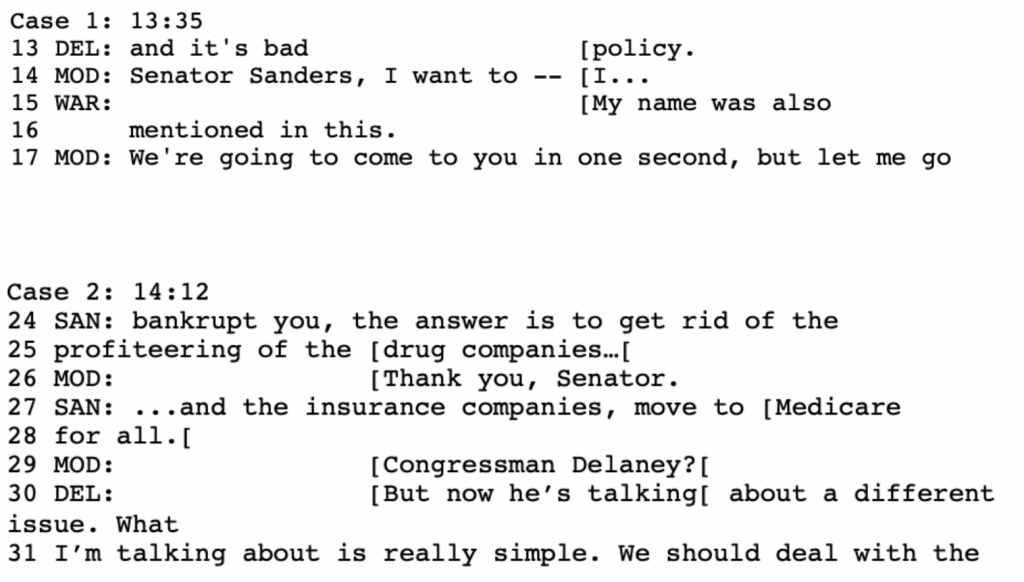
In the first interruption, of a male candidate by a female candidate, she interjects to inform the speaker that she should get an opportunity to speak, as in accordance with the rules after one is name-checked in question response.

In the interruption by a male candidate, there are many differences. The interrupted, Delaney, takes this opportunity to address the audience regarding the flaws in Sanders’ opinion by saying “But now he’s talking.” This interruption is not confrontational, but rather argumentative in nature.

While both these intrusive interruptions, regardless of propagator, are similar in the way they impact the conversation, there are differences in why and how they are executed.

Conclusion

In this study, the frequency of interruption between male and female candidates was not drastically different, yet when qualitatively analyzing the nature of the interruptions it was apparent that gendered differences did exist. While the results of this study are informative about the power dynamics between different genders in politics, this study is quite possibly limited to the field.

It could be argued that women in politics may be a deviant case from a woman in other fields, as they have to use dominance-establishing discourse in the form of interruptions to assert their position in a debate. No one would doubt that a male candidate belongs in a debate for a presidential nomination due to his gender, but a female candidate would have to prove her belonging in that scenario.

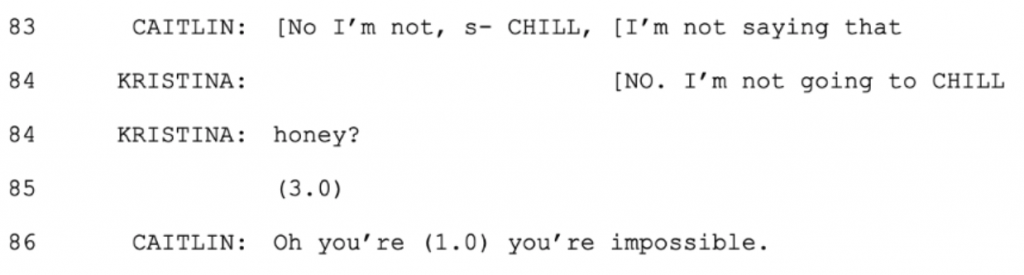
Interruptions can help establish dominance or an imbalance of power, but when utilized by a population that historically has not held power on the platform of presidential debates, can result in a gendered view of this language. The repeated interruption by Senator Warren during the debate analyzed is just one example of this. Successive interruptions by Warren could be in an attempt to express equality in this playing field by asserting dominance in a conversation, but also indicate an acquittal from gender roles and thus are additionally marked. Her dominance is therefore interpreted as “pushiness” or “nastiness” in the political realm, as illustrated below9.
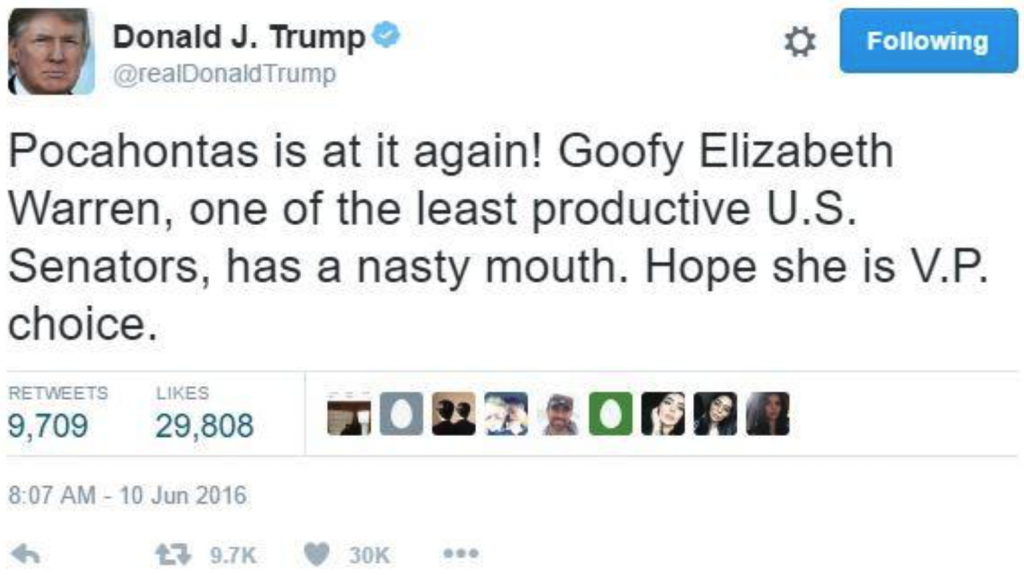
The gendered expectation is that women should behave and speak differently from men, and when this is contrasted, can lead to disruption of the hierarchy discussed in Tannen’s theory.7

While not many conclusions regarding how the frequency of interruptions influence the power dynamic in democratic presidential debates can be reached from this study, the understanding that a power imbalance can exist is quite evident. It is not only the frequency of interruptions but also their execution and response that influences who can assert dominance in these conversations.


References

1. Anderson, K.J., Leaper, C. Meta-Analyses of Gender Effects on Conversational

Interruption: Who, What, When, Where, and How. Sex Roles 39, 225–252 (1998).

2. Burns, A., Flegenheimer, M., Lee, J. C., Lerer, L., & Martin, J. (2020, February 7).

Who’s Running for President in 2020? The New York Times.

3. Eckert, P., & McConnell-Ginet, S. (2013). Language and Gender. Cambridge University Press.

4. James, D., & Clarke, S. (n.d.). Women, Men, and Interruptions: A Critical Review. In Critical Reviews of the Literature (pp. 231–277).

5. Lerer, L., Epstein, R. J., Goldmacher, S., & Glueck, K. (2019, July 30). 6 Highlights From Night 1 of the July Democratic Debates. The New York Times.

6. McLeod, J. (1999). The Sociodrama of Presidential Politics: Rhetoric, Ritual, and Power in the Era of Teledemocracy. American Anthropologist, 101(2), 359-373. Retrieved March 4, 2020, from www.jstor.org/stable/683206

7. Tannen, D. (1994). Gender and discourse. New York: Oxford University Press.

8. Trucotte, J., & Paul, N. (2015). A Case of More Is Less: The Role of Gender in U.S. Presidential Debates. Political Research Quarterly, 68(4), 773-784. Retrieved February 11, 2020, from www.jstor.org/stable/24637815

Links

9. https://twitter.com/realDonaldTrump

10. https://www.youtube.com/watch?v=r8dHaIN1Rds

[/expander_maker]
Interruption: Is It a Men’s Thing?

Viona Sihono

Commonly heard stereotypes regarding men’s strength is not only applicable physically but also linguistically. For instance, the idea that men are more powerful than women created this stereotype that men typically interrupt more frequently than women in a conversation due to male dominance (Eckert & McConnell-Ginet, 2013, p. 95). Though gender and interruption have been the focus of multiple types of research in the past, the results have been inconsistent as one study proves that the difference in the number of interruptions used in a conversation amongst both genders is insignificant (James & Clarke, 1993), while the other proves otherwise.

Besides proving whether or not this theory is applicable in all situations, I will also take a closer look beyond the frequency of interruptions between both genders. Since interruption is thought to occur unconsciously, I will see whether avoiding eye contact can be characterized as a gendered action while doing deep interruptions. Thus, I am going to test whether this stereotype of men dominating a discussion occurs in the community of New York chefs from the Bon Appetit Test Kitchen. Through this experiment, it is hoped that people could be more aware of each gender’s behavior in different types of interaction and eventually diminish the use of stereotypes regarding male dominance.

[expander_maker id=”1″ more=”Read more” less=”Read less”]

Introduction

Interruption is described by O’Canaill and Frohlich (1995) as “a synchronous interaction which was not initiated by the subject, was unscheduled and resulted in the recipient discontinuing their current activity” (p. 262). In this study, I decided to focus on the use of deep interruptions, which disrupts the flow of the conversation and ultimately changes the topic of the discussion. According to Lakoff (1975), the idea of male dominance signifies a more hierarchical status that men hold, throwing women under their dominance, even linguistically. Since the male dominance model has been affecting the performance of women’s speech negatively, I conducted this test to prove whether or not this objective applies to my subject of study and whether the difference is significant. In addition, the role of eye contact in human interaction is crucial for the delivery of information from one another (Russon, Bard & Parker, 1998). Therefore, I would like to see if deep interruptions would affect the absence of eye gaze depending on who and to whom it is applied to.

Methods

I separated this study into two distinct cases: mixed-sex interaction and same-sex interactions and in each case, I observed five different videos to determine the frequency of successful interruptions as well as the avoidance of eye contact while deep interrupting. Unfortunately, due to the limited number of video availability, there are only three videos of female-female interactions that can be used for this analysis. Throughout watching each video, I tallied up the number of deep interruptions that occur, including the frequency of eye contact avoidance which takes time during the deep interruption itself. Since all of the videos that were observed have various time intervals, I divided the number of deep interruptions observed by the length of the video to obtain the number of deep interruptions per minute. Once I gathered the numbers from all of the sample data, I calculated the average frequency per minute for each gender in each type of interaction. Next, I would find the p-value for each combination of gender and the type of interaction to dictate the significance of these differences. Similarly, I would do the exact same thing with the frequency of avoiding eye contact while successfully interrupting. The only difference is that I divided the number of eye contact absences by the number of deep interruptions that was previously calculated to obtain its percentage. The succeeding steps remained the same.

Results

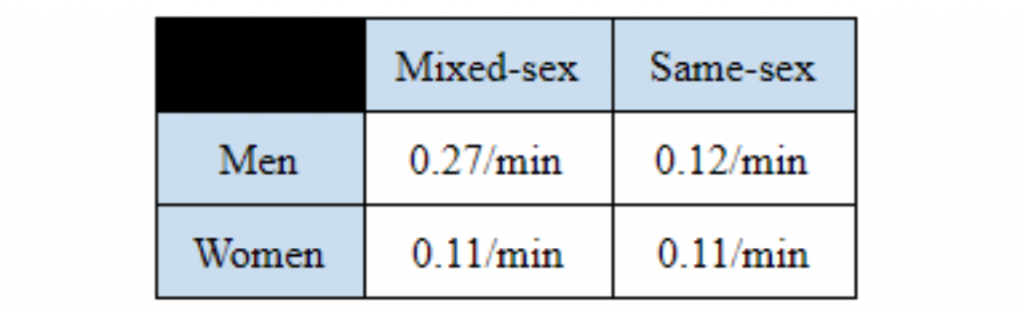
After gathering all of the data and quantifying the number of deep interruptions that arises in each interaction, I have found the average number of incidents in both cross-sex and same-sex interactions

Table 1: Frequency of deep interruptions between men and women in mixed-sex and same-sex interactions


Looking at the table above, it is obvious that men from the Bon Appetit Test Kitchen successfully interrupt more in a mixed-sex conversation, where the difference is twice as much as the women’s behavior. However, using R Programming, I discovered that the p-value for this particular situation (0.1276) is larger than 0.05, which means the difference between the use of deep interruptions in a mixed-sex conversation between men and women from this sample data is not significant. Likewise, this insignificance also occurs in any other combination of gender and type of interruption of the Bon Appetit Test Kitchen Members.

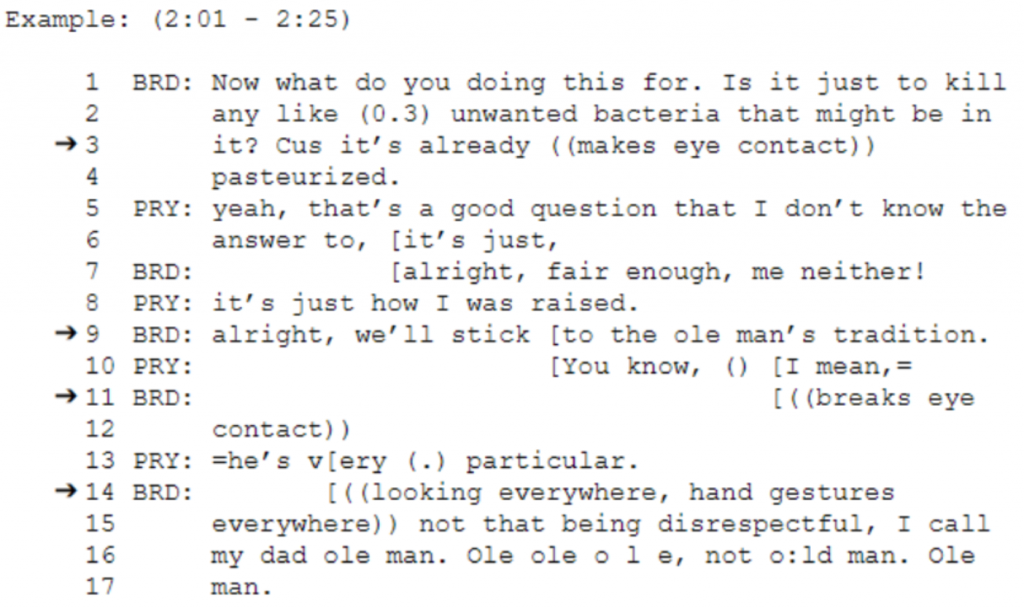
Successful interruptions that occur in this particular setting are oftentimes denoted by a pattern of eye contact avoidance between the speakers prior to or while interruption takes time. Below is one of the examples that can be found in cross-sex interaction between Brad and Priya regarding the steps of making home-made yogurt.

From the example above, a successful interruption occurs at line 14 when Brad is justifying his use of the term ole man. Being worried that people misheard him for calling Priya’s dad an old man, he cuts Priya off with his explanation without making any eye contact. This absence of eye contact allows him to share his opinions without getting interrupted. A similar situation also arises prior to the successful interruption, which occurs in lines 1 through 4. While Brad is asking a question to Priya, their eyes do not meet and this, too, enables Brad to talk at a longer period of time without being cut off by Priya.

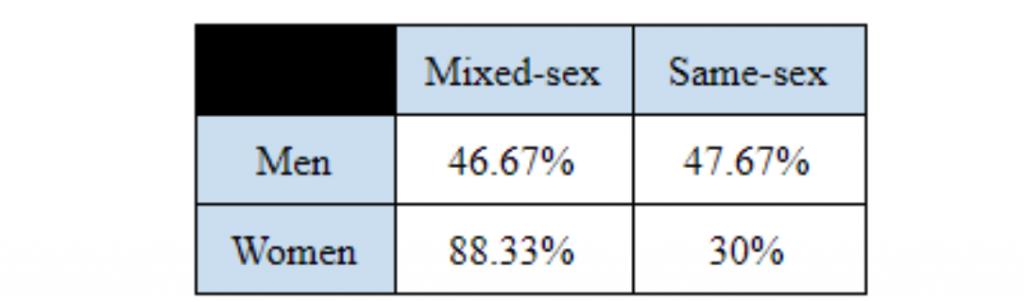
To give a better insight related to the evidence shown above, I have observed the mean percentage of eye contact avoidance in each type of interruption.

Table 2: Percentage of eye gaze avoidance between men and women in mixed-sex and same-sex interactions


Merely from the table above, there are a few apparent deviations that stand out, like the difference between men and women in mixed-sex interaction and the difference between mixed-sex and same-sex interactions in women’s speech. Nevertheless, by applying the same statistical method as I did for the frequency of deep interruptions, I found that the only significant difference results from the latter one.

Discussion & Results

After thorough analysis, I have found that there is no power dominance in the community of Bon Appetit Test Kitchen in which one gender successfully interrupts more than the other while conversing. Perhaps due to time development, there has been a lot of positive improvements towards the approach that society provides to women, thus refining the way women construct their speech. Moreover, in regard to the pattern of avoiding eye contact while successfully interrupting, I found that there are patterns in which this action is not merely a subconscious gesture. Just like the example shown in the results section, the absence of eye contact gives the speaker the ability to talk in a longer period of time without any interruption. Other than that, in other observations, I found that speakers tend to break eye contact while deep interrupting the other person to shift his/her focus to the object that is being discussed. Finally, for the members of Bon Appetit Test Kitchen alone, considering they make videos to be uploaded to YouTube, they often successfully interrupt the other to engage more with the audience by looking straight to the camera.


References

Eckert, P., & McConnell-Ginet, S. (2013). Language and gender. Cambridge: Cambridge University Press.

James, D., & Clarke, S. (n.d.). Women, Men, and Interruptions: A Critical Review. In Critical Reviews of the Literature (pp. 231–277).

Lakoff, R. (1975). Language and women’s place. New York: Harper and Row

O’Conaill, B., & Frohlich, D. (1995). Timespace in the workplace. Dealing with Interruptions. doi: 10.1145/223355.223665

Russon, A. E., Bard, K. A., & Parker, S. T. (1998). Reaching into thought: the minds of the great apes. Cambridge: Cambridge University Press.

[/expander_maker]

May I Answer Next? Politeness Strategies within Speech Overlap and Interruptions Among Presidential Hopefuls

Kaylie Sagara

As the 2020 Presidential Election gets closer, the Democratic primary candidates are battling it out on the debate stage, which airs live to the public on National Television. While the American political system has been consistently male-dominated since the time of our Founding Fathers, recent years have shown a candidate pool that is getting closer to representing the general population, with more female candidates in the running. However, traditional gender differences illustrated in speech between men and women may affect female politicians’ ability to steal the floor during these debates. Since debates are under a strict schedule and structure, it is already difficult to squeeze in an answer between other candidates and the network moderators, so polite requests used by women are ineffective compared to the forceful demands of their male counterparts. This study analyzes and compares the turn-taking strategies employed by male and female candidates in several of the 2019 televised debates in order to interrupt or take the floor, revealing how traditional gendered forms of speech can negatively impact female politicians in this debate setting.

[expander_maker id=”1″ more=”Read more” less=”Read less”]

Background

The presidential democratic debates are tightly structured and the rules are stated directly by a moderator at the start of each debate, where amounts of time are set for answers and rebuttals, and a warning is given against interruptions. Despite the tight format, as illustrated in video compilations like this one, there are many instances when rules are broken and there is a lot of overlap and interruptions as candidates attempt to get a chance to speak. This is where we can see examples of overlap and interruptions, as well as the use of polite requests and demanding directives.  The way in which candidates either demand or request time reflect overarching societal expectations of politeness on gender and power. 

The two debates I have analyzed interactions from are the September 12th, 2019 debate at Texas Southern University in Houston (Fig. 1), and the October 15th, 2019 debate at Otterbein University in Westerville, Ohio (Fig. 2). 

On the topic of linguistics and gender, we know that there are traditional differences in the way women and men speak, due to differences in how we are raised and taught. Robin Lakoff (1973) examines how women speak and the effect that is produced, which is a position of subordination to men because of politeness and an unsureness. However, a more recent and properly conducted study by O’Barr and Atkin’s chapter on women’s language as powerless language (1998), examines courtroom dialogue to look at language variance due to gender differences in a courtroom. They classify the features as a language of powerlessness, which can apply for men, not only women, and depends on power relationships between participants (1998, 24). Something that Lakoff (1973) examines is the use of requests and politeness, which I have examined in this study. While being wary of Lakoff’s view on classifying requests as women’s language, the use of simple requests on the debate stage is predominantly exemplified by women, whereas direct orders are rare, and are more often used by male candidates.  Requests with please are described as “distinctly unmasculine” (Lakoff, 57) in a way that allows women to prevent expressing a strong statement. However, the point of the presidential debates is to make strong statements when conveying views on topical issues in order to gain attention from the public. The use of “please” and forming polite requests thus relinquishes a candidate’s ability to appear compelling and strong to viewers. In Carroll and Fox’s book (2018) on gender in elections, they note that language used in the public’s expectations about politicians and candidates illustrate a very stereotypically masculine space, where “tough, dominant, and assertive” are used to describe ideal leaders; typically gendered as male words (Carol & Fox, 2018). Gender also operates within the public’s approval of political candidates and how they should act. This traps female candidates in a traditionally feminine box, where they must act out certain womanly stereotypes and expectations in order to earn favor with implicitly biased citizens who are socialized with these ideals about gender. By examining these debates, it will help show what extent gendered speech strategies have on male and female candidates’ ability to take the floor.

Methods

I used conversational analysis conventions to transcribe the excerpts of the debate where there are significant overlap or interruptions occurring, as well as opportunities for interjection during pauses and lowering pitch, which normally occurs when someone is ending a sentence. I will also look at word choice by candidates when making attempts to get the floor, and whether or not they are successful by looking at whether or not the moderator grants them time to answer. 

Analysis

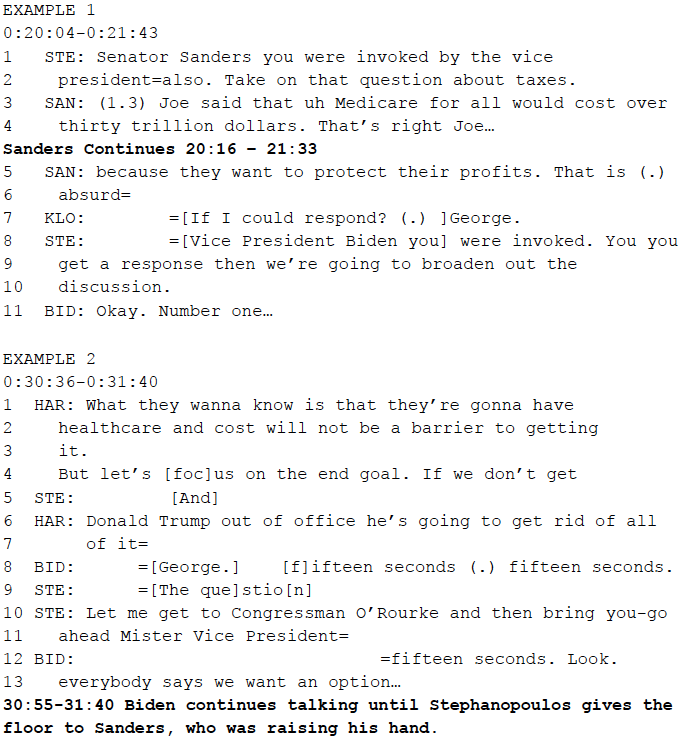
In two excerpts from the September Debate, Amy Klobuchar and Joe Biden both attempt to grab the floor, following the end of another candidate’s answer. They both engage in overlap with moderator George Stephanopoulos—who is supposed to choose the next speaker by name. These contrasting attempts at self-selection and the reaction from the moderator illustrate the importance of demands, rather than requests, when commanding authority.

We can see that in Example 1, Klobuchar attempts to enter the debate after Bernie Sander’s starts to finish his response, but she was unsuccessful. Klobuchar’s word choice in line 7 indicates politeness, using an “if I could” request to interject, instead of a demand.  This request is contrasted by Joe Biden’s response in example 2 when he attempts to get the floor using a directive.In line 8, Biden says “fifteen seconds;” he is not asking, he is demanding. The strategy employed by Biden is successful, and the moderator changes his mind in line 10 to give the floor to give him the floor instead of O’Rourke. Klobuchar’s use of politeness toward the moderator designates respect, and illustrates the power to which moderators have over the candidates, as they are the ones choosing speakers and deciding when rules can be broken. Biden does not use respect, and he is ultimately successful.


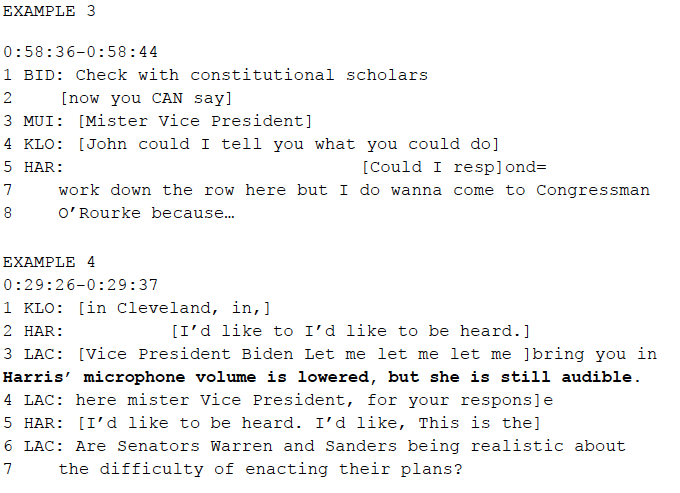
Once in both debates, Kamala Harris unsuccessfully attempts to enter the conversation after another candidate’s turn is over by using phrases “could I” and “I’d like.” Both times the moderator denies her request by choosing a different speaker. 


In example 3, Harris is ignored. In example 4, Harris is ignored again, but her persistence in requesting to answer results in her microphone volume being shut off. She can still be heard speaking as Lacey then refers to Biden for the next question. This transcription exemplifies the quieting of women in political arenas. 


In the next examples, we see the candidates verbally deny the moderator’s request to choose a new speaker by using masculine, demanding tones. 


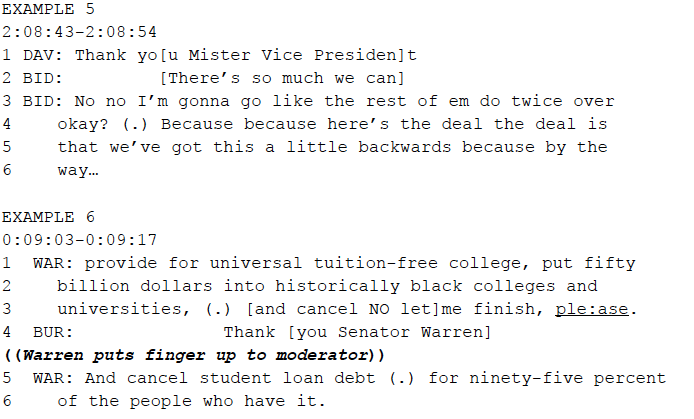
In example 5 from the September Debate, Biden does not allow Lindsey Davis to fulfill her role in choosing the next speaker because he was not done answering. Instead, he references the previous candidates who also overlapped with moderators and continued answering despite attempts to give the floor to someone else. Biden is direct and firm in his speech in line 3, saying “No no” to the overlap by Davis, to which she allows. In example 6, from the October Debate, Elizabeth Warren also states “no” and raises her voice when moderator Burnett starts to overlap her speech and firmly denies the attempt at selecting a new speaker and is eventually successful in standing her ground. However, she ends her firm statement by using “please” in line 3 to prevent the command from sounding too assertive. This goes back to the idea in Gender and Elections that female candidates cannot adopt the demeanor of male politicians to become equals (Carrol & Fox, 2018). Rather, they have to play into public ideas of women in power and what normal citizens expect to see and hear from a woman.


Conclusions

The goal of the debates is to allow Americans to hear the candidates’ platforms, as well as assess their ability to command respect on stage through articulate speech. As seen in the transcription examples, it appears that male candidates tend to speak with more demand than the female candidates, and are also able to take the floor more often than women. This goes back to the theme of politeness, and the societal expectation that women use “feminine” speech that projects a tentative and unsure quality.


The ability of each candidate to select themselves when a new turn is beginning is not exactly reflected in the overall time spoken during these debates. In Fig. 3 and Fig. 4, there is varied distribution for speaking time between the female and male candidates, with Biden and Warren switching off between the top two spots for both debates, so we cannot explicitly correlate gender and gender strategies of speech with ability to get time on the stage, since both candidates show different approaches to turn-taking in the above examples and had different success rates in interrupting.  However, we can use these transcriptions to show that gender stereotypes in language do persist and are evident in formal, traditionally male settings like these debates. As the democratic debates and primary elections end, the persistence of misogyny and scrutiny over female politicians is exemplified in the two last candidates standing; heteronormative, white male candidates Bernie Sanders and Joe Biden. As more women run for elections in the future, methods of speaking and taking the floor may become more similar between male and female politicians, and will hopefully allow women leaders to contribute to changing power dynamics, shifting stereotypes about women in leadership roles, and thus affect linguistic strategies and norms.  


References

Carrol, Susan J. & Richard L. Fox. (2018) Gender and Elections: Shaping the Future of American Politics. Cambridge University Press.

Lakoff, Robin (1973). Language and Woman’s Place: Language in Society 2 (1): 45–80.

O’Barr, William M., and Bowman K. Atkins. (1998) Language and Gender, A Reader: Women’s Language or Powerless Language? Malden, MA: Blackwell. 377-387.

[/expander_maker]


Um, I Wasn’t Finished: How We Undermine Female Expertise Through the Misinterpretation of Filler Phrases

Sandhya Rajkumar

The so-called “cultural mismatch” between femininity and expertise has been pointed to as a source of the gender discrepancies in academia. However, this phenomenon has consequences that reach beyond the scope of the ivory tower, as the notion of expertise is present in nearly every field. This “cultural mismatch” is even present in the culinary field, a field that is often presumed to be free of common gender stereotypes that are present in other spheres. In order to better understand how this phenomenon is perpetuated, interviews of famous male and female culinary experts were recorded and transcribed. Portions of the interviews in which the interviewees were discussing their areas of expertise were analyzed, through which it was observed that though both men and women use filler phrases such as uh and um, women’s use of these filler phrases was more likely to be interpreted as a cue for interruption, and thereby followed by subsequent interruption, while men were able to use these phrases to hold the conversational floor. This finding may be one way through which women’s authoritative expertise and influence are undermined, thus furthering the negative stereotype of the “cultural mismatch” between femininity and expertise.

[expander_maker id=”1″ more=”Read more” less=”Read less”]

Introduction

A previous study on gender and expertise found that in group settings, even when men and women possessed similar levels of expertise, women were perceived as less expert than men, were less influential, and were less confident about their impact (Thomas-Hunt & Phillips, 2004). Another study found a difference in the styles of interaction used by male and female graduate students, namely that male students were much more likely to use styles that highlighted their expertise (Hirshfield, 2017). Though the culinary field seems to subvert many of the age-old gender stereotypes, previous work has shown that in foodie culture, men are more likely to focus on the theme of knowledge and expertise when describing their relationship with food (Cairns et al., 2010). This study will focus on gender-related linguistic differences pertaining to expertise and how they present themselves in an interview setting, specifically within the culinary field. 

Filler phrases like uh and um are commonplace in our everyday language. However, these simple terms can have large effects on the way speakers are perceived by their audiences. One study found that though these phrases can be used by speakers to “hold the floor” and give them time to continue their thought, they may not always be interpreted as such (Clark & Fox Tree, 2002). In fact, another study found that people often interpret use of filler phrases as a sign of nervousness or inadequate preparation (Christenfield, 1995). The present study seeks to find any gendered difference in the way the use of filler phrases is interpreted, and if this difference in interpretation can affect the occurrence of interruptions.

When looking at interruptions, the present study classifies them based on their purpose; interruptions can serve to either change the topic, express disagreement, or obtain the conversational floor (Murata, 1994). These interruptions will be distinguished from other types of speech overlap, such as backchanneling, which is often used to show encouragement by the listener, rather than to change the topic or take control of the conversation (Murata, 1994). 

This study found that women’s use of filler phrases such as uh and um were more likely to be interpreted as a cue for interruption, and thereby followed by subsequent interruption, while men were able to use these phrases to extend their conversational turn. This phenomenon may be a potential mechanism through which women’s expertise is undermined.

 Methods

The analysis was performed on a viral interview series called “Hot Ones,” posted by the First We Feast channel on the streaming platform YouTube. In these videos, the interviewer, Sean Evans, a 33-year-old male, interviewed celebrities while they ate hot wings in order of increasing spice level. Four interviews with famous culinary experts, two males and two females, were chosen in order to look at differences in language use between genders. The focus of the study was on gender and expertise, so only portions of the interview in which the interviewees were discussing their respective areas of expertise were transcribed.

Results

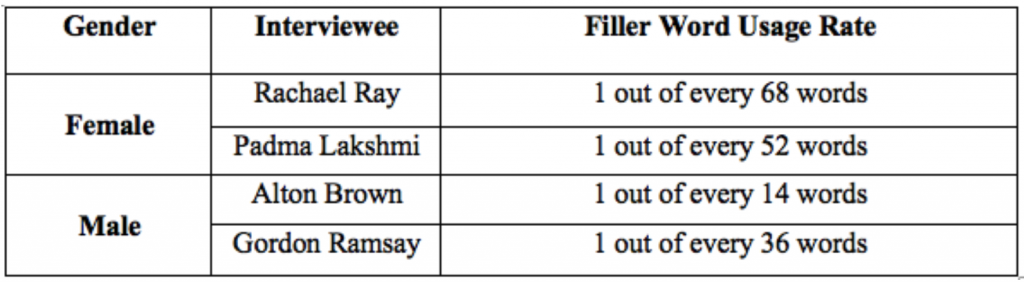
 Before delving into a more detailed conversation analysis of each interview, the first metric that was recorded was the frequency of the use of filler words. Filler words are a feature of “women’s language” (Lakoff, 1973) so the default assumption would be that they would be more present in the interviews with female interviewees than with male interviewees. To measure this, the total number of filler word usages was divided by the total number of words spoken by the interviewee during the clips of interest. This gave a measurement of how frequently each interviewee used filler words, which is presented in the table below.

Figure 1: Each interviewee, by gender, and their filler word usage rate

Surprisingly, both of the male interviewees used filler phrases much more frequently than either of the female interviewees in these data.

The first interviewee that was looked at was Rachael Ray, a 51-year-old Caucasian woman. The following is a transcription from the opening clip of her interview:

Figure 2: Transcription from Rachael Ray (00:10-01:10)

This interruption is particularly interesting because it coincides with the use of the filler phrases um and uh in lines 18-19. The interviewer appeared to have read these filler phrases as a cue for him to comment, as he proceeds to interrupt her in line 20. However, she then proceeds to interrupt him to continue her thought, reclaiming the conversational floor, which could indicate that her use of filler phrases in previous lines were not intended as a cue to interrupt.

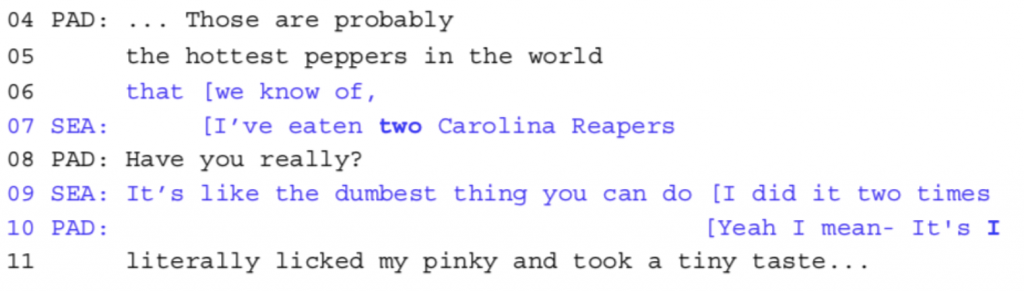
However, it is important to note that female interviewees were still interrupted in other scenarios when they did not make use of filler phrases. This becomes apparent through the interview with Padma Lakshmi, a 49-year-old South Asian woman.

Figure 3: Transcription from Padma Lakshmi (00:24-00:58)

When Sean interrupted Padma in line 7, he shifted the focus of the conversation from Padma to himself, and “took the floor” of the conversation. This shift in focus persisted until line 10, where she then interrupted him to bring the focus of the conversation back to herself. Also, in that same statement, she emphasized the word I, which also could have been an attempt to reclaim the conversational floor.

 As seen in Figure 1, both male interviewees use filler phrases more often than the female interviewees. Alton Brown, a 57-year-old Caucasian male who used filler words the most frequently, was actually interrupted less often and less disruptively than either of the female interviewees. In the opening clip of his interview, there was only one instance of overlapping speech between Alton and the interviewer.”

Figure 4: Transcript from Alton Brown (00:35-01:16)

The speech overlap in line 14 could be classified as a form of back-channeling, as the interviewer is trying to express his agreement, rather than change the topic or take control of the conversation. Note that in lines 12 and 15, Alton is making use of the filler phrases um and uh, but the interviewer does not seem to interpret this as a cue to interrupt. This is different than what occurred in the interview with Rachael Ray, where her use of filler phrases were often met with subsequent interruptions.

This same trend was present for the interview of Gordon Ramsay, a 53-year-old Caucasian man. During his clip of the interview, there was not a single successful interruption by the interviewer.

Figure 5: Transcript from Gordon Ramsay (03:04-04:01)

The overlapping occurrence of “oh” in the above transcript was the only time there was an incidence of overlapping speech during this portion of the interview. Again, though compared to Rachael Ray, he used more filler phrases and took longer pauses, the interviewer did not seem to interpret these as a cue to interrupt.

Discussion

This analysis suggests that there could potentially be a relationship between the way women’s use of filler phrases are interpreted and the negative stereotypes that undermine female authority and expertise. In conversations, the person who is doing the interrupting can come off as the more powerful, dominant party, leaving the person who is being interrupted as their less-powerful counterpart. In situations where a woman is sharing her expert opinion, this dynamic can function to undermine the perception of the woman as an expert.

However, there are a few study limitations that should be kept in mind. First and foremost, these interviews are from an online streaming platform, and were edited and put together by the Hot Ones team before being uploaded. Additionally, this study only looked at portions of the interview where interviewees were discussing their relevant areas of expertise; future work could be done to see if and how these portions differ from those where other topics are being discussed.


References

Cairns, K., Johnston, J., & Baumann, S. (2010). Caring About Food: Doing Gender in the Foodie Kitchen. Gender and Society, 24(5), 591-615. Retrieved February 10, 2020, from www.jstor.org/stable/25741206

Christenfeld, N. (1995). Does it hurt to say um? ​Journal of Nonverbal Behavior​, ​19​(3), 171–186.doi: 10.1007/bf02175503

Clark, H., & Fox Tree, J. E. (2002). Using uh and um in spontaneous speaking. ​Cognition,​ ​84(​1), 73–111. doi: 10.1016/s0010-0277(02)00017-3

Hirshfield, L. E. (2017). “I Don’t Know Everything, But Ethan Would Know”: Language, Expertise, and the Cultural Mismatch for Women Scientists. NASPA Journal About Women in Higher Education, 10(1), 118–137. https://doi.org/10.1080/19407882.2016.1268167

Lakoff, R. (1973). Language and woman’s place. ​Language in Society,​ ​2​(1), 45-79.doi:10.1017/S0047404500000051

Murata, K. (1994). Intrusive or co-operative? A cross-cultural study of interruption. ​Journal of Pragmatics​, ​21​(4), 385–400. doi: 10.1016/0378-2166(94)90011-6

Thomas-Hunt, M. C., & Phillips, K. W. (2004). When What You Know Is Not Enough: Expertise and Gender Dynamics in Task Groups. Personality and Social Psychology Bulletin, 30(12), 1585–1598. https://doi.org/10.1177/0146167204271186

[/expander_maker]

Your Voice Speaks Volumes: Linguistic Insight Into the Trauma Affiliated with Adoption

Sakina Qadir

Adversity plays a large role in how one thinks, behaves, and acts. Early life experiences countlessly show both negative and positive long-term effects that can be brought out in later stages of adult hood. This study looks at how early childhood adversity can induce differences in speech patterns. Additionally, to properly measure adversity this study focuses on adopted children as subjects and transcribes interactions with parent guardians from a set of YouTube videos on the channel called “The Cut”. This study also compares gender differences between these interactions to see if male or female behaviors exist and whether they show deviant behavior. More so, two linguistic features: volume and word choice tests whether further differences exist, such as tone of pitch and vocabulary. This study will seek to determine if linguistic features and gender differences between the adopted and biological children exist in the way they communicate and whether societal pressures push children to act in a certain manner. Different identity faces give insight into how individuals react in their environment and this paper analyzes whether a child’s upbringing provides a reasonable explanation to their linguistic variances.

[expander_maker id=”1″ more=”Read more” less=”Read less”]

Introduction & Background

Jim Beggs once said, “What we say is important…for most cases the mouth speaks when the heart is full.” The way we talk is tightly connected to social norms that motivate our choices. As humans we reflect upon the community we surround ourselves to. A lot of research has shown connections to cognitive differences with speech fluctuations. Interestingly enough, the Social Affective Neuroscience and Development (SAND) Lab at UCLA shows that adopted adolescents seem to show the highest level of cognitive variances and therefore are a vital group to conduct a study on. While a stressed-induced situation may vary, for the purposes of this paper a stressful situation is defined as the adoption of children. This experience has been proven to show markers that indicate adopted children deal with more trauma in their childhood and therefore have more fluctuations in the way they speak (Silvers et. Al, 2017). With this in mind, this paper identifies linguistic differences within these groups of children by looking at their volume of speech and word usage. Beyond this, gender may play a role in the interactions of male and female adopted and non-adopted children as topic of conversation may vary and volume of voice can be lower for females than males.

As seen from Eckert, construction of an identity is based on obligations and rights that one has, and based upon the expectation they have within a society (Eckert et.al, 2013). As human beings we are subjugated to indexicality 1 as we are constantly constructing to build new personas based on the experiences that occur around us. Gender can have different responses and the context that individual places themselves in will allow one to make choices and choose which face they want to display. The environment we are in shapes us and the outcome is the communicative style we put forward. In other words, people use different performative displays to communicate aspects of their moment-to-moment identities (Butler, 1990).

In considering speech differences between genders, Debora Tannen’s viewpoint on gender is that men portray their speech behavior as hierarchical, meaning that they are actively trying to assert dominance, whereas women are seen as more supportive and less demeaning (Tannen, 1990). In simpler terms a man is deemed in society to be more assertive, whereas women are not. This study demonstrates how adolescents’ use of volume and word choice become stylistic resources to convey momentary identity displays consistent with gender expectations as a response to authority.

Methods

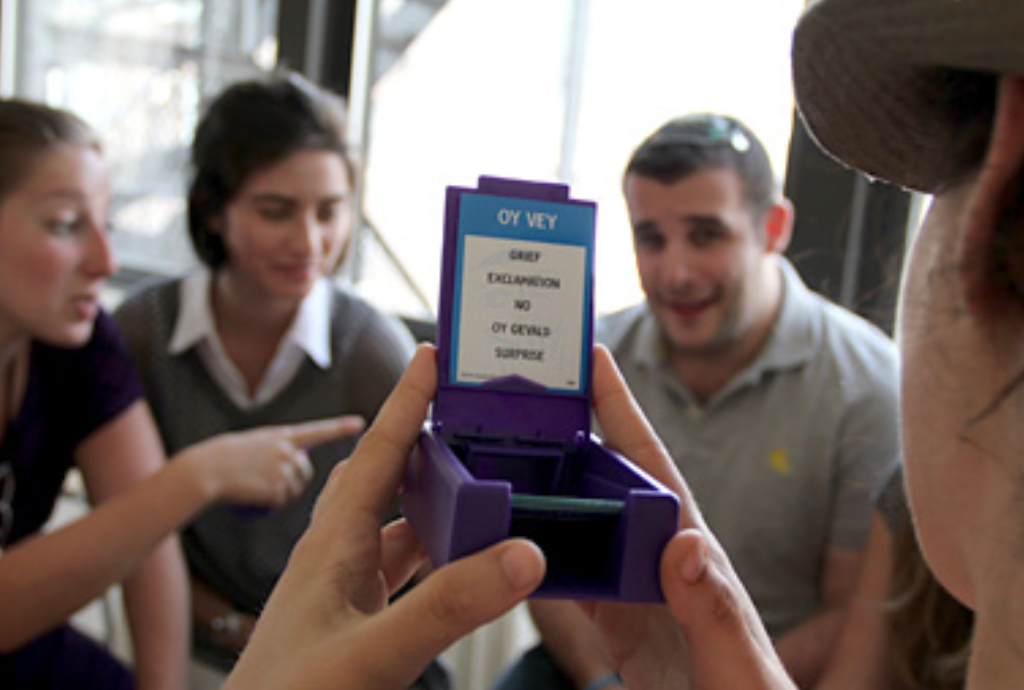
For this paper, language differences are being analyzed from a YouTube series called, “The Cut”. These short six-minute videos adequately provide interactions that happen between adopted children and their parents as well as biological kids and their parents. The set-up of the conversation involves answering questions from a deck of cards (Figure 1), and those questions that go unanswered elicits the individual taking a shot of alcohol.

Figure 1: The type of cards in the Truth or Drink game, each card lists two questions in which one player must answer. If the player chooses not to answer they will be forced to drink alcohol.

This behavior can act as a type of identity display, for sake of understanding it deems to see whether the act of taking alcohol, i.e. not answering the question, is a nature seen in one group of kids over the other. The reason this behavior is of importance is because the individual forgoes from talking and therefore indicates a level of deviance from a normal conversation that should occur. On top of linguistic differences in speech orientation, it seeks to answer whether this identity display of taking a shot of alcohol is seen more heavily between adopted kids or not, or if this behavior is more often associated with males or females which would highlight important differences between gender. These videos also deem to answer and compare occurrences of behavior that may be expected by society when in reality there could be occurrences that may not adhere to an anticipated outcome.

Results

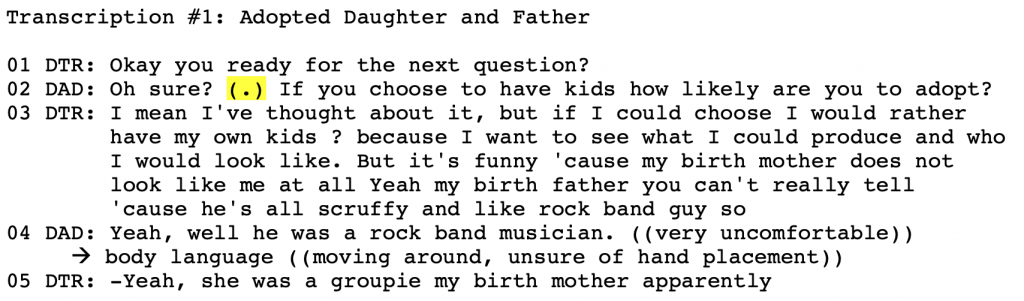
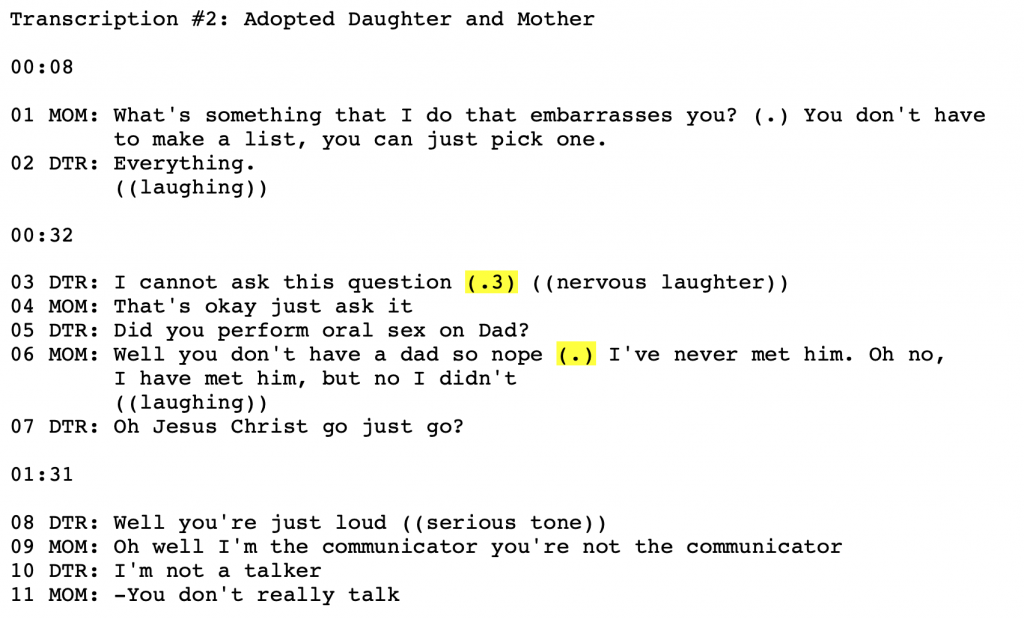
Yellow highlighter: shows moments of pause in the conversation
Arrow: shows deviant body behavior
Figure 2: The dad’s facial expression, paying close attention to his hand placement and how far back he is leaned, he seems very uncomfortable and is avoiding eye contact.

This is one example of a conversation between an adopted daughter and her father. This analysis is unique because it highlights an occurrence of negative face 2 when the daughter answers no to adopting any children, which in itself shows a response unlikely to be perceived as a decent one in any community. As seen in line 3 of the transcription above, there are some serious differences in both language and body behavior (Figure 2) when the father asks his adopted daughter the question and the response he gets from her. Even more so, the adopted child seems more alert when answering this question and answers it quite thoroughly without any hesitancy to show some remorse or compassion. This interaction seems very deviant because the adopted child then seems to go on about her real parents in which the father seems to have a reaction to, as he starts to shift in his chair and becomes unsure on how to respond. The daughter displays a face threatening act as she is critiquing her father. We believe that adopted children seem to avoid this subject but this participant also uses a higher pitch which is a behavior more associated with a biological child. Indexicality in this example is outwardly defiant as the daughter displays herself as someone who is unable to be affected by her past, and goes to the extent in which she seems disapproving of her dads choice in adopting children.

Yellow highlighter: shows moments of pause in the conversation

One other example, that seems more cohesive and supportive of the hypothesis is an interaction between an adopted daughter and her mother. In this example, the daughter is extremely hesitant to ask her mother a question, as seen in line 3, whereas biological children in the other interactions in the same videos had no problem in doing so. Her shyness comes off as peculiar as the question, although personal, is not anything to be hesitant from. This highlights an identity face that could have been developed due to strenuous conditions from her childhood that makes this child unsure of her actions. As Tannen also proclaimed, women tend to be less assertive as compared to men so a gender difference could be in effect in this example as well. However, that is not to say that all adopted children act in one way as there are some cases where the adolescents are actually more geared to raise their volume and use proactive language to purposefully exhibit bad behavior. Children are often times a tricky group to study as their development can be easily altered by what they face and respond by displaying different indexicalities (Umberson et. al, 2014).

Conclusion

In conclusion, differences in behavior can be well associated with how the world perceives certain people to behave. Even though this paper points out various examples of behavior that elicit differences in gender and language, there is no guarantee that this is a product of how these young children believe that they should behave versus the way they truly want to. Both word usage and speech volume showcase a wide variety of implications that can still vary by situation. Adopted children are faced with an early childhood adversity and the way they behave can be the product of their hardships (Juffer et. al, 2011). Kids are often times neglected, especially adopted children, so they develop to pick up on cues around them which they are seldom aware of and this leads to speech and gender differences which coincidently arise from their identity displays they have inherently adapted (Silvers et.al, 2017).


Useful YouTube links

A Crash Course on Language and Meaning

Politeness Theory


Academic references

Butler, J. (1990) Gender Trouble: Feminism and the Subversion of Identity. New York: Routledge.

Eckert, P., & McConnel–Ginet, S. (2013). Speech situations, events, and activities. Language and gender (2nd edition).

Juffer, F., Palacios, J., Le Mare, L., Sonuga-Barke, E., Tieman, W., Bakermans-Kranenburg, M., Verhulst, F. (2011). II. Development Of Adopted Children With Histories Of Early    Adversity. Monographs of the Society for Research in Child Development, 76(4), 31-61. Retrieved February 25, 2020, from  www.jstor.org/stable/41408756

Silvers, J.A., Goff, B., Gabard-Durnam, L., Gee, D.G., Fareri, D.S., Caldera, C., & Tottenham,    N. (2017). Vigilance, the amygdala, and anxiety in youth with a history of institutional careBiological Psychiatry: Cognitive Neuroscience and Neuroimaging, 2, 493-501.

Umberson, D., Williams, K., Thomas, P., Liu, H., & Thomeer, M. (2014). Race, Gender, and Chains of Disadvantage: Childhood Adversity, Social Relationships, and Health. Journal of Health and Social Behavior, 55(1), 20-38. Retrieved February 25, 2020, from www.jstor.org/stable/43186878

Tannen, D. (1990). You Just Don’t Understand: Women and Men in Conversation. New York, NY: Morrow.

YouTube Videos

Cut. (2019, March 7). Adopted Kids & Their Parents (Frederick & Marisa)|Truth or Drink [Video]. YouTube. https://www.youtube.com/watch?v=ob1m8CU70E0&t=83s

Cut. (2019, March 14). My Adopted Daughter & I Play Truth or Drink (Cynthia & Tabitha |Truth or Drink [Video].YouTube.             https://www.youtube.com/watch?v=0z6gznGsfBM&t=98s


[/expander_maker]
I’ll Make a Man Out of You: A Look at Asian American Male Interactions in a Competitive Game Setting

Anonymous Author

With the sudden increase in Asian representation in American media, more light has been shed on Asian culture and common stereotypes are slowly being dismissed. Nuances of Asian culture, specifically the Asian American experience have yet to be explored. Delving into such an experience reveals a historical portrayal of Asian men as often being weak and effeminate. Asian American men are subject to sociocultural expectations of gender roles dictated by a tradition of patriarchy. Masculinity, for many Asian American men is externally defined, and the strength of a male’s connection to his Asian American heritage may be indicative of the pressure he experiences to conform to such cultural expectations. This study examines male-male interactions involving Asian American men to look at how aggressive displays may inform the pressure caused by the desire to conform to sociocultural expectations that such men often experience. A transcription analysis was performed on recorded conversations between Asian American male friends during a competitive board game setting, to determine the frequency and type of both interruptions and profanity, and level of speaking volume during the interactions. Although there seems to be no direct relationship between an Asian American male’s perceived connectedness to his cultural identity and level of aggressiveness in his language use, this may indicate the likelihood of other contributing factors such as the desire for him to preserve in-group norms.

[expander_maker id=”1″ more=”Read more” less=”Read less”]

Introduction/Background

One context in which gender roles and masculinity often play a significant role is dyadic interactions. Although much research has been done on mixed-sex interactions, research on same-sex interactions, specifically focusing Asian American males, is lacking. The current literature on same-sex interactions between Asian American males involves studies on father-son relationships, but there has not been extensive research on how the degree to which a male identifies with his Asian heritage affects his use of language. Looking at the linguistic units of profanity, interruptions, and speaking volume, this study explores how an Asian American male’s perceived connectedness to his cultural identity manifests itself in the form of aggressive behavior through language. By doing so, this study posits that within a competitive game setting, aggressive displays such as speaking at a higher volume and using both more profanity and non-supportive interruptions at a greater frequency during male-male interactions, are indices of sociocultural expectations that Asian American males who are strongly connected to their heritage might feel pressured to conform to. While this correlation may exist in certain settings such as in a competitive game setting, this hyper masculine behavior may, instead, be a product of a male’s relational proximity or perceived closeness to his audience, or a way for a him to demonstrate camaraderie by maintaining in-group norms.

Methods

Target population

Participants included four Asian American males and one, non-Asian male who were all part of the same friend group. All of the participants were college students, also known as emerging adults, with ages ranging from 18 to 22 years. Likewise, homosexual males were excluded from this study because sexual orientation was a potential confounding variable. Participation in this study was voluntary. 

Data collection

Data collection involved collecting audio recordings of participants playing the competitive board game, Taboo, where partners were tasked with describing and guessing words. In each round, the non-Asian friend was tasked with being the guesser while the describer would rotate amongst the Asian American friends until all had participated. At the end of the rounds, the Asian American participants were asked to complete an exit survey to be kept and used for later analysis. The recordings were then compiled and analyzed for each pairing using an online software, and then subsequently transcribed for further analysis.

Linguistic units

This study focused specifically on the linguistic features of interruption, profanity, and volume as units for analysis. In the study, interruptions were defined as either cooperative/supportive or competitive/non-supportive. Cooperative interruptions, as described in Yang (1996) involves interruptions that are more supportive of a speaker’s hold of the floor and serve to draw focus on the speaker’s claims or statement. Likewise, Yang (1996) characterizes competitive interruptions as interruptions that attempt to take the floor away from a main speaker when another speaker feels that their ideas are more valuable. Additionally, profanity was categorized as mild, medium, or strong, with mild profanity being words that one could use in everyday conversations without much offense or words that are acceptable on nationally broadcasted media, strong profanity being words that most individuals would not use in a school setting without some sort of disciplinary consequence, and medium falling roughly between the two. Lastly, volume in this study was differentiated into categories of normal, loud, and soft. Normal volume was defined as a speaking volume appropriate in a café, soft volume was defined as the speaking volume appropriate in a library, and loud volume was defined as the speaking volume appropriate in a noisy environment.

Results

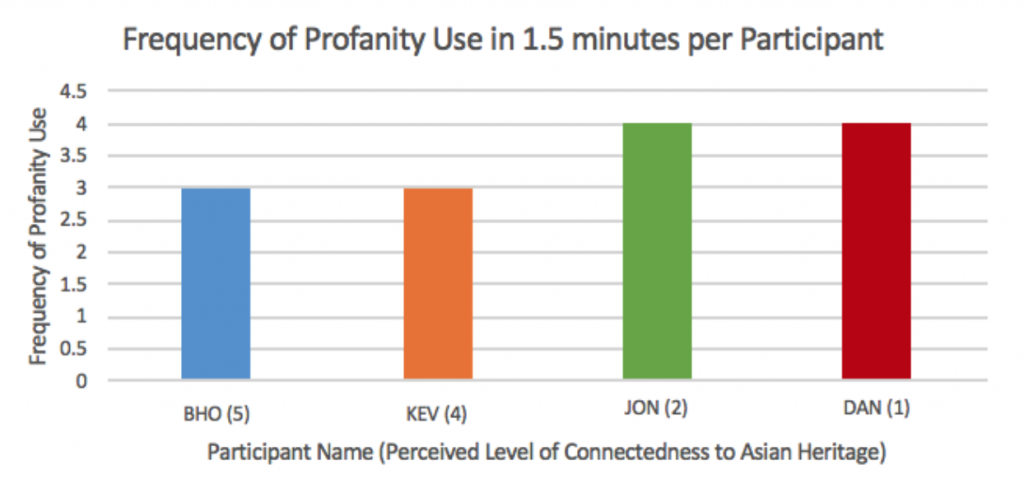
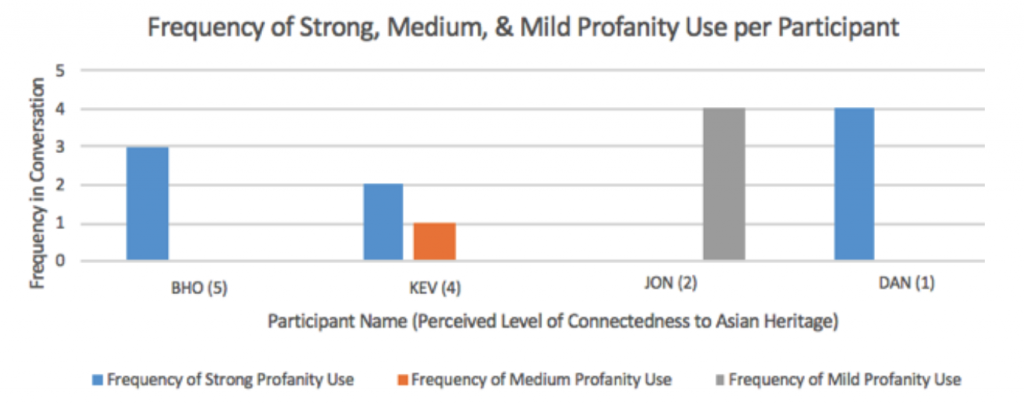
The data collected was comprised of both qualitative and quantitative data. In four different conversations, the frequency of interruptions, profanity, and speaking volume were recorded to assess displays of aggression. The results on interruptions and profanity were further stratified, with interruptions separated between the categories of supportive and non-supportive, and profanity separated between strong, medium, and mild. These results were then compared with results from the exit survey on the participants’ perceived level of connectedness with their Asian heritage to determine if there was a correlation between each of the two variables. A 5 on the survey would indicate a strong connection to a one’s Asian heritage and a 1 on the survey would indicate little to no connection to one’s Asian heritage.

Figure 1: Overall Frequency of Profanity Use per Participant


Figure 2: Frequency of Strong, Medium, and Mild Profanity Use per Participant


As indicated in Figure 1, there is no clear difference between the overall use of profanity between males with varying levels of connectedness to his Asian heritage. The average use of profanity in each of the four scenarios was around 3.5 times per the 1.5-minute span of the conversation. However, when stratifying the data to differentiate between the 3 levels of profanity: strong, medium, and mild (Figure 2), there is a clear contrast between each of the participants. Excluding the outlier DAN, it seems like there is a positive correlation between the variables of strong profanity use and perceived connectedness to one’s Asian heritage.

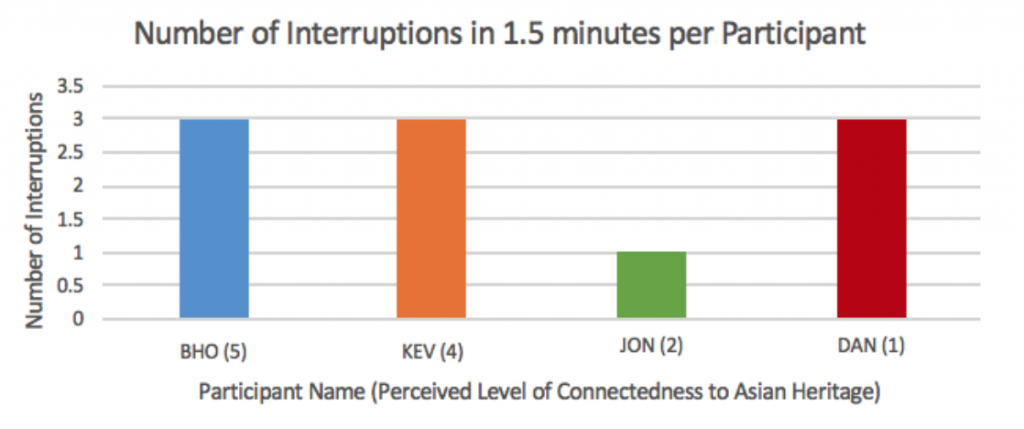
Figure 3: Overall Number of Interruptions per Participant


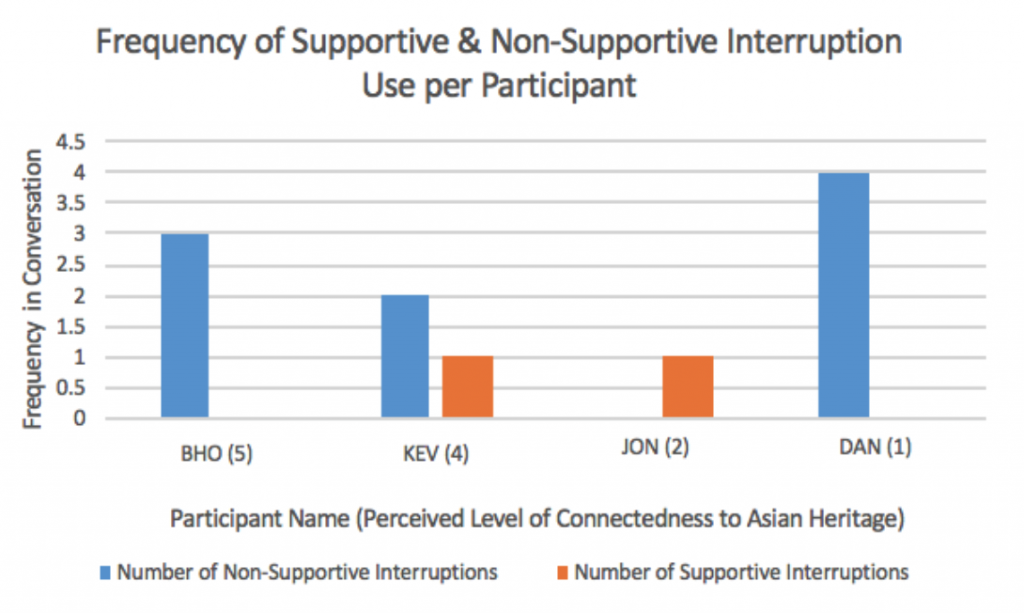
Figure 4: Frequency of Supportive and Non-Supportive Interruption Use per Participant


Likewise, in Figure 3, there is also no clear difference between the overall number of interruptions between males with varying levels of connectedness to his Asian heritage. The average number of interruptions in each of the four scenarios was around 2.5 times per the 1.5-minute span of the conversation. However, when stratifying the data to differentiate between the supportive and non-supportive interruptions (Figure 4) there is a clear contrast between each of the participants. Excluding the outlier DAN, it also seems like there is a positive correlation between the frequency of non-supportive interruptions and perceived connectedness to one’s Asian heritage.

Discussion & Conclusions

Examining the results from the surveys and recordings, there were discrepancies between an Asian American male’s perceived connectedness to his own culture and his expected display of aggression through language during male-male interactions. In some instances, it seemed as if the degree to which a male identified with his Asian heritage was a strong predictor of his displays of aggression. However, this correlation was not applicable to every scenario in the study. What is important to note is that all of the conversations occurred within the parameters of a competitive game amongst a group of friends. As such, regardless of the degree to which an Asian American male identifies with his heritage, this does not mean that this is an identity that is static or present in every situation. The in-group solidarity that Kiesling (1998) calls “camaraderie” could ultimately be the underlying/confounding factor that could also inform the observed results. By constructing their identity within the constraints of heteronormative masculinity, males are pressured to perform in a way that expresses or exerts dominance with others. Yet amongst other males, this shared experience is what ultimately fosters community relationships, something that may have played a role in each of the conversations.

There were several limitations to this study. One of these limitations involved sample size, which was quite small for this study. Likewise, although having a non-Asian male assume the position of a guesser for each round did control for the variable of familiarity to the describer, it may have been more conducive to have participants play multiple rounds of Taboo and then take the average of the results. Additionally, although the study did define the various operational variables, it would have been better if they were defined quantitatively as opposed to qualitatively. Future studies could possibly benefit from taking a look at the effect of racial identity of a partner in a conversational dyad on the level of aggression displayed in language used by Asian American men.

The main takeaway of this study was that, although there seems to be somewhat of a positive correlation between an Asian American male’s feelings of connectedness to his culture and the level of aggression he displays in his language, this does not hold true for all Asian American males. There are likely a multitude of factors which could possibly contribute to such an observation, one of which could be due to the desire for such males to maintain in-group norms by performing hyper masculine acts such as displaying aggressive behavior.


Other Informative Works    

How Men Talk (an opinion piece on Medium)

Male Friendships Are Just Bullying (a YouTube episode by CollegeHumor)

The Comedians Challenging Stereotypes About Asian-American Masculinity (The New York Times article)


References

Kiesling, S. F. (1998). Men’s identities and sociolinguistic variation: The case of fraternity men. Journal of Sociolinguistics2(1), 69-99.

Yang, L. C. (1996, October). Interruptions and intonation. In Proceeding of Fourth International Conference on Spoken Language Processing. ICSLP’96 (Vol. 3, pp. 1872-1875). IEEE.

[/expander_maker]
Obsessed with Men? Gender-Inclusive Language is the Answer

Maddy Doane

Within discourse, the observation of male implicit bias is prevalent and is often caused by words that reflect and refer to generic masculine associations. The question at hand is, does the adoption of gender-inclusive language reduce male bias and therefore, increase women’s involvement in mental associations? In two experiments, I analyze interactions between groups of people either involving gender-neutral words, or not. Afterwards, all people are asked to take an implicit bias test to see if the gender-inclusive language has an effect, if any. The participants are comprised of men and women attending UCLA, all of which are comfortable conversing with each other. In observing conversation, the use of gender-inclusive words reduces the amount of automatic male associations in the subsequent implicit bias test. Thus, explaining the importance of avoiding gender-fair words as well as including gender-inclusive language in everyday conversation. The goal of this study is to inform and educate participants and readers about the effects of adopting gender-inclusive language into common vocabulary.

[expander_maker id=”1″ more=”Read more” less=”Read less”]

Introduction and Background

Often, common vocabulary is marked for one specific gender but is continually used as the default word, allowing for gendered language to exist. The gradual shift to include gender-neutral words involves altering words like “fireman” to a more inclusive term, “firefighter”. However, because the word “fireman” originated to specifically describe men that put out fires for a living, and has been in constant circulation since, it is typical to use the gendered word regularly, without even realizing it. Another side effect relies on the implicit associations that brains make when hearing the word “firefighter”, a traditionally male occupation. Although the gender-inclusive word is being used, because of its institution, it is common for it to directly index a male firefighter.

Within this research experiment, the focus is surrounded upon whether shifting to gender-inclusive language reduces implicit associations and removes mental assumptions. In doing so, two experimental groups were composed of multiple groups of UCLA students and their responses and reactions to gender neutral language were recorded. Because the participants share a common concern for gender equality, as do most people, they will learn how to promote gender equality better as they interact regularly.

Through the introduction of gender inclusive language in conversation, understanding the impact of making illogical, implicit associations is revealed and correction of language is made. Demonstrated through implicit bias tests, the phenomenon of those who understood their gendered mistake showed less automatic association towards a specific gender regarding professions was created. Thus, due to the prior exchange, adopting gender neutral language into one’s vocabulary helped intentionally shape others’ implicit associations.

Methods

Multiple groups of UCLA students were randomly sampled from the specific population of the track and field team. They were given the task of formulating a story about the images placed in front of them. The set of images included: a house on fire, a person on the phone, a fire truck, a firefighter with a hose, a firefighter carrying a person to safety, an EMT using a defibrillator, and a person thanking a firefighter. The first set of groups (3) will be asked to formulate a story about the sequence of images and then asked to complete an implicit bias test centered around gendered professions. The purpose of the implicit test is to evaluate attitudes or beliefs that are not normally exposed or reported willingly. For this experiment, participants will be tested on the speed and accuracy of their associations when pairing words like children and business with either men or women, as directed.

Within the next set of groups (3), participants were asked to formulate a story about the same sequence of images, however, a “secret agent” was selected to participate within all the different groups. The secret agent was tasked with the objective of only using gender-neutral language when formulating the story. The other conversationalists were recorded to see if they followed suit with the gender-neutral language and if they applied certain gendered words or pronouns to the person they were describing. Shortly after, the participants were asked to complete the same implicit bias test as described above. The results were focused towards how many more women/men show implicit bias over men/women, and how many people exposed to the gender-neutral conversation completed the test with less or no bias over those who were not. My hypothesis is as follows, the use of gender-neutral language will promote the increased cognitive involvement of women which, in turn, will remove male bias in mental associations. By coming to this conclusion, or one similar, the importance (if any) of adopting gender neutral language into common vocabulary can be understood.

Results and Analysis

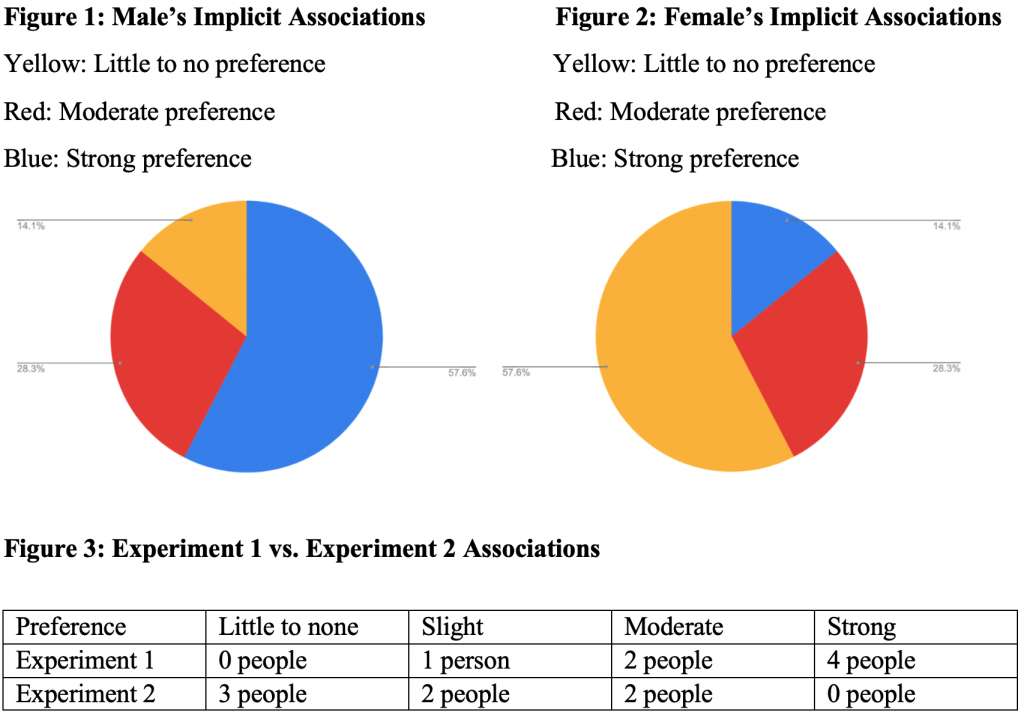
Throughout all groups, male implicit bias was assessed through the gender and career Implicit Association Test (IAT). Out of 14 people, half men and half women, males showed more automatic preference toward male and career than did females (Figure 1, Figure 2). As in Experiment 1, male implicit bias was assessed through the IAT after recording a previous exchange about the sequence of images while solely using gendered language. Compared to Experiment 2, where participants took the IAT test after having been exposed to gender-neutral language through the secret agent. As illustrated in Figure 3, people exposed to the gender-neutral language (Experiment 2) demonstrated less male implicit bias than those in Experiment 1.

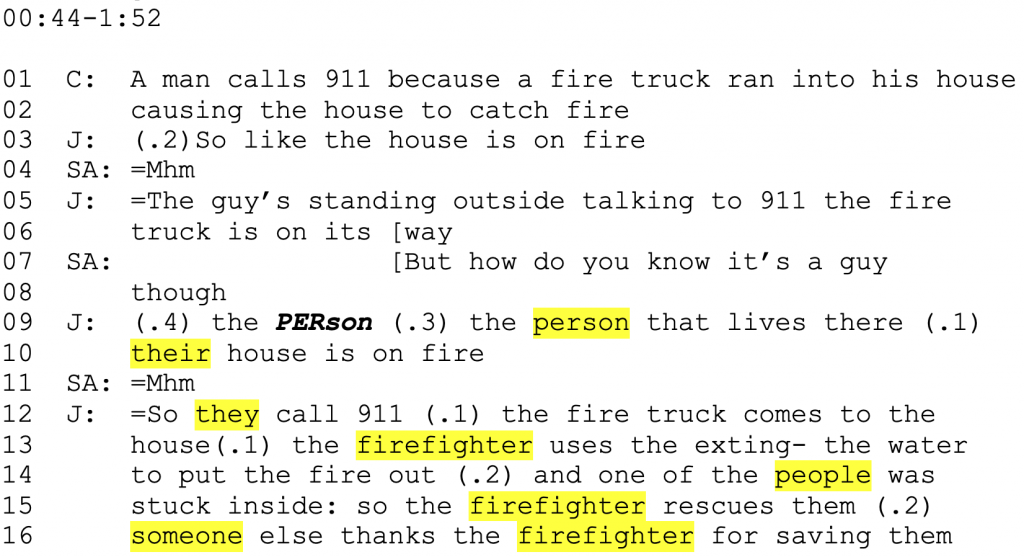
This example is an excerpt from a group in Experiment 2 after being presented with the images and asked to formulate a story. One member is asked to be the secret agent and is privately told to only use gender-neutral language when telling the story and to correct those who automatically associate a certain person with a certain gender. All members of the group are friends and are comfortable interacting with each other.

Following suit, Confederate
Cameron = C; Jade = J; Secret Agent = SA

The initial person, Cameron, immediately assumes and assigns the gender of the figure he is looking at in the picture to male (line 1).  Jade interrupts him (line 3), presumably because she disagrees with how the story is supposed to begin. The secret agent agrees with Jade and prompts the continuation of her storytelling. Again, the gender of the figure is assumed and assigned male. The secret agent initiates repair, which indicates that the word used was problematic. The secret agent questions Jade about her reasoning behind referring to the person as a “guy”. The question does not signify a lack of understanding between the two conversationalists nor does it ask for clarification, instead the question is a means of conveying that using the term “guy” is problematic. Afterwards due to the silence, Jade understands that she may have mislabeled the figure’s gender, realizing that there are no significant distinguishing marks that allow her to label the figure a man. The secret agent has therefore created a conversation in which the terms that are considered problematic are avoided. The act of simply conveying issue with the use of gendered terms, prompts the other person to understand the problematic feature of their choice of words and correct any of their supplementary language. Because of the secret agent’s stance, Jade continues to solely use gender-neutral terms (lines 9-16) to describe the rest of the people involved in the story. Because the secret agent initiates repair about using the term “guy”, and Jade’s subsequent language avoids using gendered terms, a phenomenon is created that is effective in reducing male associations.

Discussion and Conclusions

Within discourse and conversation, people may be completely unaware of the implicit male bias they possess, especially when asked to draw their own conclusions about a nondescript person or thing. For many, it is an instinct to attribute certain words or images with a certain gender. But with the incorporation of gender-neutral speech styles, there can be a decrease in implicit male bias and thus an increase in the cognitive awareness of women. Along with the introduction of gender-neutral language, the recognition of a person’s own incorrect, automatic association reduces further male bias. As shown in Experiment 2, each member of the group begins with automatically assigning the male gender to the person in the sequence of images, but when their claim is disputed, each person recognizes their false assumption and changes their approach. From then on, most people were recorded to continue telling the story but now with the adoption of gender-neutral speech. So, with the understanding of their careless, implicit male bias, people open their minds to allow the possibility that both genders could suffice as the “person” or “firefighter”. Shortly after having been exposed to gender-neutral language within the conversation, those that followed suit performed better on the implicit bias test afterwards. Because of this, the importance of adopting gender neutral language into our common vocabulary becomes evident.


References

Gauhar, Z., Anderson, J., Li, S., & Fox, S. P. (n.d.). Why gender-inclusive language is important. Retrieved from https://www.dailyprincetonian.com/article/2016/09/why- gender- inclusive-language-is-important

Gender-Inclusive Language. (n.d.). Retrieved from https://writingcenter.unc.edu/tips-and-tools/gender-inclusive-language/

Harris, C. A., Blencowe, N., & Telem, D. A. (2017, December). What is in a Pronoun?: Why Gender-fair Language Matters. Retrieved from https://www.ncbi.nlm.nih.gov/pmc/articles/PMC5774006/

Jennifer, L, A., Ali, Bhardwaj, S., Burgh, G., Glen, … Portilla, L. (2014, January 16). BU Research: A Riddle Reveals Depth of Gender Bias: BU Today. Retrieved from http://www.bu.edu/articles/2014/bu-research-riddle-reveals-the-depth-of-gender-bias/

Lingquivst, A (2019, July 15). Reducing a Male Bias in Language? Establishing the Efficiency of Three Different Gender-Fair Language Strategies. Retrieved from https://link.springer.com/article/10.1007/s11199-018-0974-9

Rogers, A. (2019, August 15). Actually, Gender-Neutral Pronouns Can Change a Culture. Retrieved from https://www.wired.com/story/actually-gender-neutral-pronouns-can-change-a-culture/

Tavits, M., & Pérez, E. O. (2019, August 20). Language influences mass opinion toward gender and LGBT equality. Retrieved from https://www.pnas.org/content/116/34/16781


Appendix


The implicit bias test administered to the participants:

Gender and Career: https://implicit.harvard.edu/implicit/takeatest.html


The sequence of images for the formulation of the story:

[/expander_maker]
He said, She said – “CUT THE LVAD WIRE”

Analysis of Interruptions by Male and Female Surgical Residents in Grey’s Anatomy

Alyssa Chin

On November 14, 2019, Alex Karev surprises Grey’s Anatomy fans with his last appearance after 14 years on the show! Karev was an exceptional surgical resident along with his star peer and friend, Meredith Grey. This blog explores and analyzes the linguistic nature of interpretations made by these two surgical residents, which include features like differences in gender, power, reputation, etc. It specifically focuses on whether the interpretations were carried out based on the dominance model, where males naturally dominate over their counterparts, or on a power dynamic, where professional and/or social standing matters.

My hypothesis is Karev will interrupt primarily on the basis of his gender, while Grey will carry out interruptions on the basis of her professional status. Through analyzing conversations in an episode, it appears the male surgical resident interrupts primarily based on his professional status, therefore reinforcing the professional hierarchy in place at the hospital. The female surgical resident however interrupts when she had an advantage so her professional reputation would not be compromised.

Continue to read the following blog to learn more about how our findings can shed some light on how this impacts social interactions!

[expander_maker id=”1″ more=”Read more” less=”Read less”]

Introduction and Background

According to Parsons (1964), male and female have often been viewed as two clearly defined and opposite identities and their separate roles maintain a sense of balance in society. This belief leads to the dominance model which states that the differences observed in women and men’s speech are established because of male’s natural dominance over women. As a result the dominance model persists to keep women subordinate to men (Penelope, 1990).

To learn more about the dominance model as well as Robin Lakoff’s Women language theory, check out this YouTube Video

Interruptions is the focus of this blog analysis because this linguistic feature can reveal a lot about where the speaker is coming from in terms of his social behaviors and norms that he is influenced by. Interruptions often serve as a way to take over from the initial speaker’s point by asserting the interrupter’s own statements. For the purposes of this research, interruptions were defined as a statement, comment, or recommendation made by subject two during subject one’s statement, comment, or recommendation to undermine subject one’s thoughts and/or take the floor from subject one.

It is a common belief that men carry out interruptions more than women and women get interrupted more than men; however, previous studies have shown interruptions between men and women may be more related to a power dynamic rather than gender. For instance an article by James and Clarke (1993) state that there were not any significant genders patterns during interpretations.

Interruptions can also be a result of a power dynamic or hierarchy that is set in place. It is less of a social deviance for one who possesses a superior standing due to position determined by society, finances, education, seniority, and/or profession to carry out more interruptions. Lastly interruptions may be the result of a combination of those two or other factors.

Check out this app that counts how many times men interrupt women

This blog specifically analyzed these linguistic features in the popular American medical drama television series, Grey’s Anatomy, which started in 2005 and is still airing today! The series focuses on the journey of surgical interns into surgical residents at Seattle Grace Hospital in Seattle, Washington. The two characters analyzed were Alex Karev and Meredith Grey. The purpose of this study was to observe whether scripted media showed the dominance model, a power dynamic, or a combination of both or other factors by specifically analyzing the interruptions made by surgical residents of different genders.

Through analyzing conversations in one Grey’s Anatomy episode, the results showed that the male surgical resident interrupted primarily because of his professional status, which he closely identified with. He only interrupted his subordinates but never his superiors or bosses, which reinforces the hospital’s professional hierarchy. The female surgical resident on the other hand mainly interrupted her superiors but only when she had an advantage over her recipient. This was to preserve her professional standing and her socially perceived character.

Methods

The methods for this study involved a conversation-analytic (CA) approach, which is a fancy term for analyzing conversations. This blog analyzed conversations between superiors/subordinates and the two focused characters to describe how the interruptions occur. I transcribed the excerpt of conversations that involve interruptions by Karev and Grey in an episode from season four.

Season four narrates the daily lives and struggles of the main characters as they embark on their journey as first year residents. As residents they now are responsible for teaching their own interns, but also have to report to their superiors who include the attending, fellows, and chief of surgery. I analyzed the context in which the interruptions took place (i.e. in surgery, in the ICU, outside the hospital, etc) and with whom (i.e. their subordinates, superiors, or colleagues). I also focused on the means in which the interruptions were carried out such as with the uses of pauses, increase in volume, politeness, etc.

Check out Chase Wesley Raymond’s article about gender and sexuality in “Family Guy” using conversation analysis.  

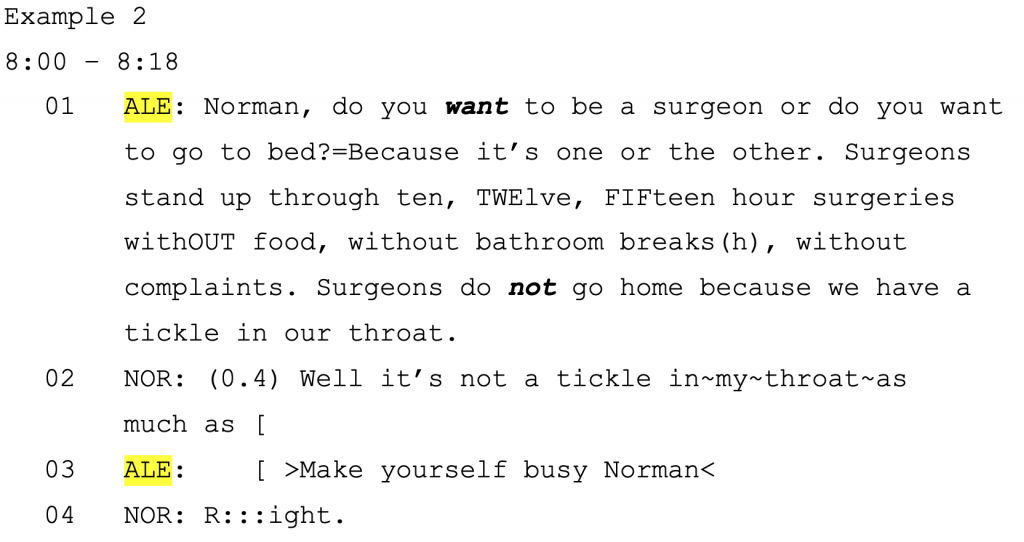
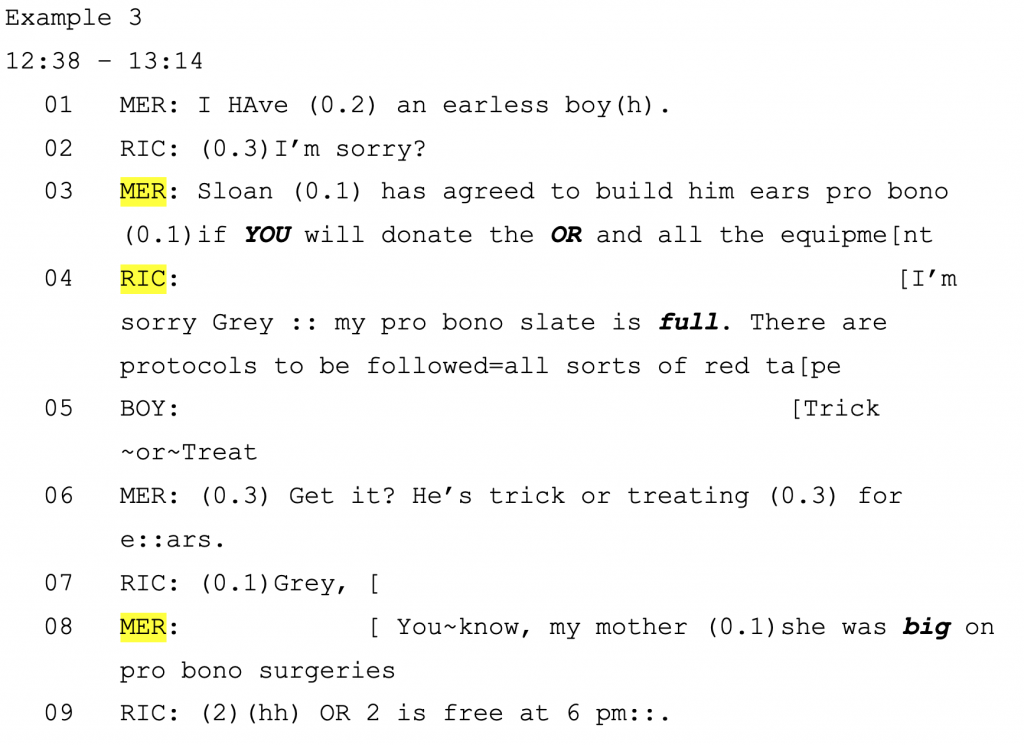
Results and Discussion

The first example is from season four episode five of Grey’s Anatomy which narrates the characters first day as new residents. The following transcript is a conversation between first year resident Meredith Grey and her neurosurgeon attending boyfriend, and therefore her superior, Derek Shepherd.

Figure 1: This episode follows the new resident’s day as they juggle mentoring their new interns along with advocating for surgeries and recent personal tragedies during Halloween. Grey faces a dilemma of deciding what to do with her mother’s ashes, who recently died from Alzheimer’s, which she brought to carry around in the hospital. This conversation takes place in the hallways of the hospital where Grey collides with Shepherd and drops the ashes on the floor.

The first interruption by Grey took place in line five and it is accompanied by an emphasis on the word “that.” The emphasis on “that” along with her rapid speech in line three displays her attempt to share her thoughts and justify her behavior of carrying her mother’s ashes, which Shepherd perceives as abnormal, as conveyed through the lengthening of his word in line four.

Her need to justify this action can be explained by how women define their status. According to Eckert and McConnell-Ginet (2013), men justify and define their status based on their accomplishments, possessions, or institutional position while women justify and define theirs on the basis of their overall character. Grey may perceive the action of carrying her mother’s ashes around as a threat to her character which could affect how the people around her view her. As a result this could negatively affect a potential advancement in her career professionally and/or socially. Therefore in an effort to preserve not only her professional image but also her personal character, she quickly interrupts her superior before he could make any comments that may negatively impact her reputation.

This conclusion is further supported when Grey interrupts a second time as seen in line nine. Shepherd was about to share his thoughts on Grey’s behavior in line eight when she interrupted in line nine by saying that her behavior is highlighting her efforts to evolve, most likely in her character. This comment is significant because it shows her pursuit to evolve as a person and therefore improve her image which validates the odd behavior of carrying around her mother’s ashes in the hospital. In other words, Grey interrupts as a mean to save face and to be perceived highly in the workplace even if the person she is interrupting is her boss.

The following example is another instance of an interruption; however it displays a conversation between first year resident Alex Karev and his intern Norman Shale whom Karev is responsible for teaching and getting acquainted to the work flow of the hospital.

Figure 2: In this episode Shale has been complaining about not feeling well as they walk around the emergency room. However Karev has been dismissing all his complaints. Karev interrupts Shale’s explanation when he sees a familiar patient.

The increased volume when stating the number of hours in surgery and emphasis on key words, both seen in line one, highlights Karev’s assertiveness and power over his intern as he lectures him. After a short pause, Shale tries to clarify his symptoms. However Karev pays no attention to his statement when he gets distracted by another patient and interrupts him in line three by further directing his intern to do something else.

The display of power as seen in the raised voice and the short lecture from Karev to Shale places Karev as professionally dominant over Shale. The professionally hierarchy is already established by the culture and protocol of hospitals, however Karev uses that structure as a means to interrupt and disregard Shale’s comment even though Karev’s responsibility is towards caring for Shale and his education.

In addition, the lecture in line one shows how proudly Karev identifies with his profession as a surgeon, which further exemplifies Eckert and McConnell-Ginet (2013) argument that a man finds is personal worth mainly in goods, status, and power in the marketplace. Using increased volume and emphasizing key words, he states the amount of hours a surgeon stands in surgery without food or breaks as defining characteristics and strengths of a surgeon and therefore deserves awe and respect. From this example Karev carries out interruptions with his subordinates as a result of his pride in his profession along with his power from his professional status. This is significant because it reflects where men may extract their credibility to exert their dominance through interruptions.

A final example from season four episode five is a conversation between Grey and the general chief of surgery, Richard Webber, where Grey asks for approval for a pro bono surgery for a young boy without the external structure of an ear in his office.

Figure 3: Grey is asking the chief of surgery, Richard Webber, permission to have a pro-bono surgery in his office. She uses her mother as an emotional leverage over Webber because he had a professional as well as a personal connection with her.

The norm of society concerning interruptions is that superiors have an acceptable right to interrupt their subordinates. However the excerpt shows Grey interrupting the chief of surgery who is her superior, therefore deeming this example as a deviant, or out of the ordinary, case. She carries this out in linguistic manners by pausing before key words that may evoke an emotional response from Webber, as seen in line one where there is a pause before “earless boy.” She also brings into the conversation and emphasizes other superior figures, Sloan an attending plastic surgeon in line three, with a pause. The introduction of another superior and male figure into the conversation who also agrees with Grey’s course of action gives her request more credibility.

However her first attempt fails when Webber, in line four, interrupts Grey to logically explain why the pro bono surgery cannot take place. Grey counters with her own interruption as she mentions her mother followed by a pause in line eight, since Webber had a professional and romantic relationship with her mother. Since the first strategy of appealing to Webber’s emotions and referencing other male superiors was not a success, Grey approaches the situation differently by resorting to introducing her mother into the conversation.

This approach showcases that Grey will interrupt her superiors when she has an personal advantage over her recipient and their emotions rather than an advantage based on merit or her professional status as a surgeon. These interruptions by Grey are significant because it shows how female may need to resort to other methods of appeal rather than solely relaying on their own merits and authority for a successful appeal.  

Conclusions

These transcriptions show that the context in which a male surgical resident and a female surgical resident interrupt their subordinate and superiors differ in the show Grey’s Anatomy and are not just limited to the dominance or power model.

In the episode analyzed, Karev only interrupted his subordinate, such as his intern, but did not carry out interruptions with his superiors. The justification for his interruptions involved asserting his dominance and power through the predetermined professional hierarchy of the hospital. This was also further strengthened by his personal self worth and identity in his profession. Grey primarily interrupted her superiors, but only when she had an emotional advantage over her recipient to preserve and highlight positive aspects of her reputation.

Although there is not enough information to conclude that female surgical residents on the show are more concerned with saving face and the males are not or males closely identify with their dominant profession and females do not, the analysis does show that interruptions involve a variety of factors.

Despite the limitation that script media has on the extent to which the conclusions drawn from this show can be applied to real-life interactions, these conclusions are still significant because it reveals how the show producers and writers perceive the operations that take place in a hospital and how language highlights gender differences in the profession. It also displays what they define as social and behavioral norms in a medical setting and how that affects patient care and workplace relationships. This affects the viewers by playing a role in how they define and accept the social and behavioral norms they see on television and by possibly distorting their expectations what they to expect in a real-life hospital setting.


References

an ABC Studios production; Shondaland; created by Shonda Rhimes. (2013). Grey’s anatomy. Season four episode five. Burbank, Calif. :Distributed by Buena Vista Home Entertainment

Eckert, P., McConnell-Ginet, S. 2013. Language and Gender. United Kingdom: Cambridge University Press.

James, Deborah and Clarke, Sandra. 1993. Women, men and interruptions: a critical review. In   Tannen 1993, 231–280.

Parsons, Talcott. 1964. The Social System. New York: Free Press.

Penelope, Julia. 1990. Speaking Freely: Unlearning the Lies of the Fathers’ Tongues. New York: Pergamon Press.

Tannen, Deborah. 1994. The relativity of linguistic strategies: rethinking power and solidarity in gender and dominance. In Gender and Discourse, ed. by Deborah Tannen, 19–52. Oxford University Press.

[/expander_maker]
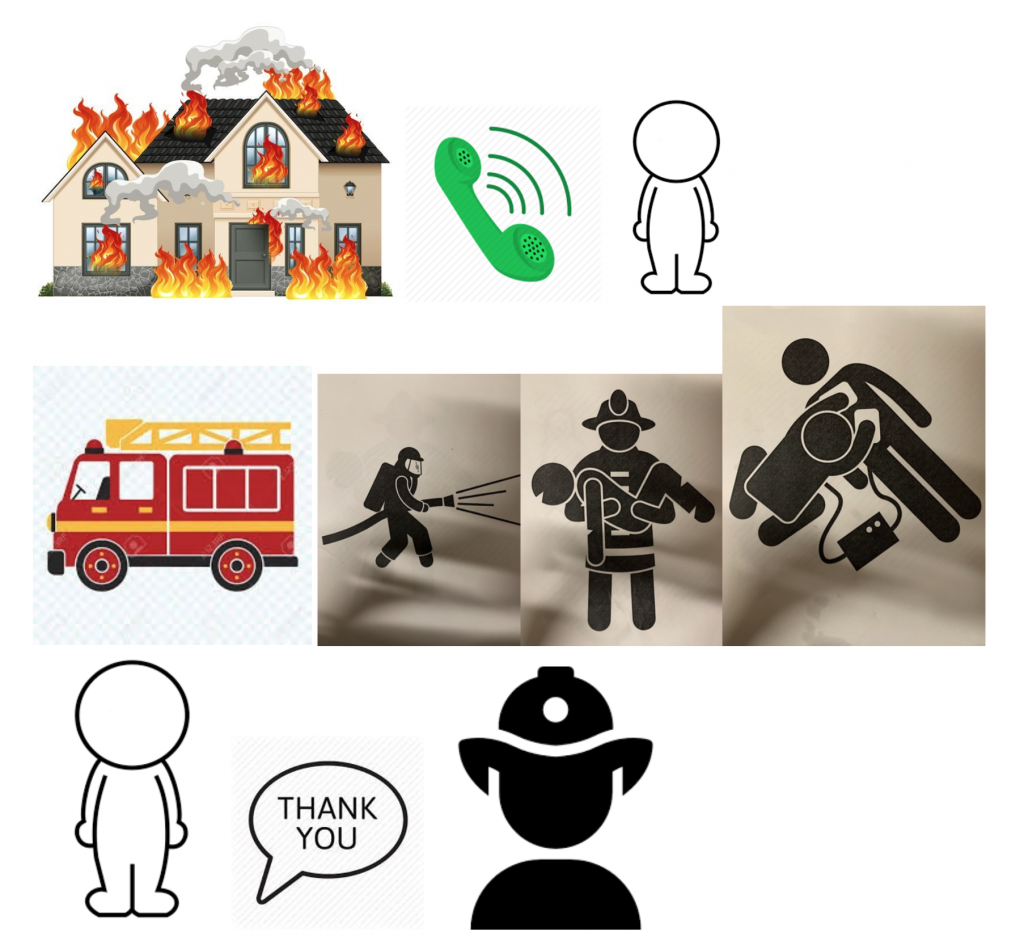
Will You Accept this Interruption? Analysis of Successful Interruptions and Gender in the Bachelor Franchise

Fengting Liang

Many sociolinguists argue that gender asymmetry exists, and that language both reflects and perpetuates this inequality. One such area of linguistics that showcases this inequality is interruptions. Intrusive interruptions have been correlated with dominance and power, and many can agree that males are usually more dominant and interruptive.

The Bachelor franchise, which includes multiple reality dating television shows, creates a unique environment for the study of language and gender. Given the competitive nature of the shows, there are often instances of conflict and high-stress discussions. Eleven mixed-sex conversations which were typically about intimate relationships and feelings, as well as eleven same-sex conversations which were typically more combative, were chosen from these shows and analyzed for successful interruptions to expose a gender-related language asymmetry.

The results of this study showed that: (1) females interrupted males more than males interrupted females in mixed sex conversations; (2) males interrupted other males more than they would females; (3) females interrupted other females just as much as they would males. This discrepancy with what is normally expected may be explained by the difference in the content of mixed-sex versus same-sex conversations. These findings may provide insight into what contexts and power dynamics that show producers believe are best for entertainment.

[expander_maker id=”1″ more=”Read more” less=”Read less”]

Introduction and Background

Intrusive interruptions have been associated with dominance, suggesting that in conversation, the participant who makes more interruptions would be more dominant. One study found that in pairs of mixed-sex conversation participants, the individual that identified themselves as the more “dominant” personality showed a higher frequency of interruptions, regardless of their gender (Kollock, Blumstein, & Schwartz, 1985). Another study found that parents were more likely to interrupt their children than vice versa (West & Zimmerman, 1977). These results support the notion that interruptions are related to dominance, but not implicitly tied to gender.

However, if one gender has an overall tendency to be more dominant, one would observe more interruptions in the more dominant gender. Robin Lakoff’s proposed dominance model of communication maintains that men are dominant and women are subordinate, and that this asymmetry is reflected and maintained by language (Eckert & McConnel-Ginet, 2013, p. 39), which suggests that we would observe a higher frequency of interruptions from males than from females in mixed-sex conversation, and no such inequality between participants in same-sex conversation. There are many situations that have found this to be the case, like in public university conversations (Zimmerman & West, 1975), or in supreme court arguments (Feldman & Gill, 2019).

There are also conversation contexts in which other power dynamics overshadow Lakoff’s proposed gender power dynamic, like the parent-child example (West & Zimmerman, 1977), or in the Bachelor franchise. This is explained by Judith Butler’s performativity model, which maintains that gender is “performed,” meaning people make individual choices on how to act in certain contexts to best maintain and perpetuate their gender identity (Eckert & McConnel-Ginet, 2013). This phenomenon was exemplified in this study once the contexts of the conversations analyzed from the Bachelor franchise were explored.

Methods

Twenty-two confrontational or high stress conversations that revolved around a romantic relationship were chosen and transcribed from video clips in various episodes of shows from the Bachelor franchise. These conversations, which each had only two participants, were categorized into same-sex (male-male or female-female) and mixed-sex. The number of conversation “turns” and successful intrusive interruptions were tallied for each participant. Frequency of interruptions was calculated by dividing the number of successful interruptions by the number of total turns.

Results

The three main findings of this study were that (1) females interrupted males more than males interrupted females in mixed sex conversations; (2) males interrupted other males more than they would females; and (3) females interrupted other females just as much as they would males.

Across all twenty-two conversations, males and females made successful interruptions at the same frequency (Table 1a and Figure 1a). This suggested that any inequality observed was not in total volume of interruptions, but in how each gender distributed their interruptions across genders. In fact, females interrupted other females at the same frequency that they would interrupt males. However, males interrupted other males much more than they would interrupt females (Table 1b-c and Figure 1b-c), showing that the asymmetry seen was because men acted differently in mixed-sex versus same-sex conversations. This resulted in the observation that females were more “dominant” in the mixed-sex conversations than the males were (Figure 2).

Figure 1a-c: Fragment-Based Interruption Analysis
Table 1a-c: Fragment-Based Interruption Analysis


Table 2 and Figure 2: Mixed-Sex Conversations Where Females Interrupted More vs Cases Where Males Interrupted More

An alternate way to interpret the data is provided in Tables and Figures 3 and 4. Females interrupted each gender at the same frequency while males interrupted males more than they interrupted females. This was consistent both when the frequencies were obtained by counting total interruptions across one gender (fragment) and when the frequencies were obtained by counting interruptions of an individual and finding the average across one gender (individual).

Figure 3 and Table 3: Who Interrupts Who? (Fragment0Based). Re-imagining of Figures 1b-c.
Figure 4 and Table 4: Who Interrupts Who? (Individual-Based)


Discussion

Earlier, we showed that the asymmetry observed was due to males acting differently in different conversational contexts (since females showed no difference between mixed versus same-sex conversations). So, why did males interrupt each other more than they interrupted females?

This question can be answered by examining the content of mixed-sex and same-sex conversations. Unintentionally, all mixed-sex conversations analyzed were about intimate feelings and all same-sex conversations were explosive arguments. This makes sense, considering these are competitive shows that highlight heterosexual relationships.

Figure 5: Example of an aggressive male-male conversation
Figure 6: Transcript of an aggressive female-female conversation

Prior research has shown that men show resistance to communicating intimate feelings (Jansz, 2000), and express anger more than women do (Brody & Hall, 2008). Women have also been shown to be more emotionally expressive about their feelings than men (Kring & Gordon, 1998). This offers an explanation as to why males interrupted more successfully in same-sex conversations, which in this study were usually aggressive, than they did in mixed-sex conversation, which in this study were usually about intimate feelings. Males were less inclined to participate in conversations involving intimate feelings, so women dominated more simply because men dominated less. However, males were more expressive in anger-driven conversations than women were, so they showed an increased amount of interruption in same-sex conversation, which was not observed in female same-sex interruption. Males’ ability to switch from being more dominant in certain contexts and less dominant in other contexts, with both actions upholding the male identity, supports Judith Butler’s idea that gender is performed.

Conclusion

The findings of this study provide an example of Judith Butler’s performativity model by showing that males can modify their behavior in different contexts to maintain their masculinity. Being more dominant in conversations involving anger is associated with the male identity, but being less dominant in conversations involving emotions and feelings is also associated with the male identity. However, just because males can be less dominant in certain situations does not mean that Robin Lakoff’s dominance model of communication has been disproved, because in general there are likely more contexts in which females are subjugated and males are dominant.

Lastly, the observations made in this study reveal a lot about the types of conversation that television show producers expect to be most entertaining. The abundance of aggressive arguments in same-sex conversations shows that these may be the types of dynamics that are received well by reality television fans. They also aired a lot of feelings-based mixed-sex conversations, increasing the “dramatic-ness” of the show. Ultimately, the Bachelor franchise producers successfully created a very entertaining platform for the study of unique gender-dynamics.


References

Brody, L. R. & Hall, J. A. (2008). “Gender and emotion in context”. Handbook of Emotions, 3, 395–408.

Eckert, P., & McConnell-Ginet, S. (2013). Language and Gender (2nd ed.). Cambridge: Cambridge University Press.

Feldman, A., & Gill, R. D. (2019). Power Dynamics in Supreme Court Oral Arguments: The Relationship between Gender and Justice-to-Justice Interruptions. Justice System Journal, 40(3), 173-195.

Fleiss, M., Hilton, M., Woods, N.,Gale, E. & Warner, T. (Producers). (2014-2019). Bachelor in Paradise [Television series]. Mexico: Warner Bros. Television.

Fleiss, M. (Producer). (2002-2020). The Bachelor [Television series]. Warner Bros. Television.

Gale, E. (Producer). (2003-2019). The Bachelorette [Television series]. Warner Bros. Television.

Jansz, J (2000). Masculine identity and restrictive emotionality. Gender and Emotion: Social Psychological Perspectives. pp. 166–186.

Kollock, Peter, Philip Blumstein & Pepper Schwartz (1985). Sex and power in interaction: Conversational privileges and duties. American sociological review, 50, 34-46.

Kring, A. M.; Gordon, A. H. (1998). Sex differences in emotion: expression, experience, and physiology. Journal of Personality and Social Psychology. 74 (3): 686–703.

West, C., & Zimmerman, D. H. (1977). Women’s place in everyday talk: Reflections on parent-child interaction. Social Problems, 24(5), 521–529.

Zimmerman, D. and West, C. (1975). Sex Roles, Interruptions and Silences in Conversation. In B. Thorne & N. Henley (Eds.), Language and Sex: Difference and Dominance, pp. 105-129. Rowley, MA: Newbury House.

[/expander_maker]
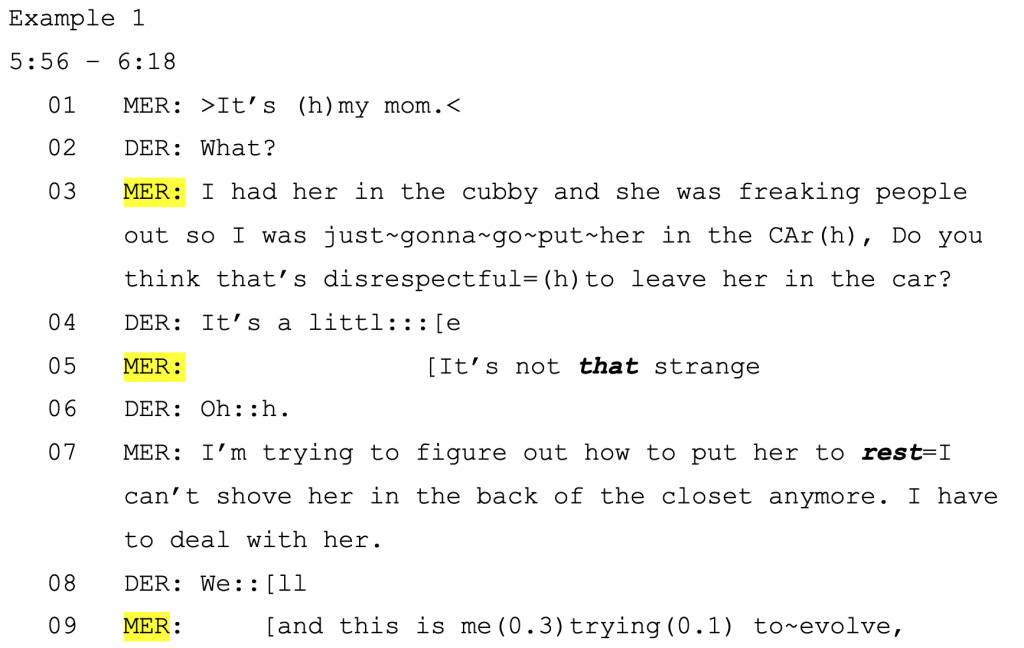
Teachers’ Pets: Do Undergraduate Instructors Treat Female and Male Students Differently?

Catherine Le

The impact that teachers have is invaluable due to their power to shape futures and develop minds, and the Undergraduate Learning Assistants (LAs) at UCLA are no different. They undergo extensive training to teach their peers alongside graduate student TAs, and with so much weight on their shoulders, they must be well-equipped to treat all students equitably, right?

After analyzing video footage from LA/student interactions in lower-division STEM courses, educational strategies utilized by instructors like wait time, interruptions, and praise were evaluated to recognize the presence and magnitude of a gender and power asymmetry in classrooms. The study revealed that there is a significant difference between how the genders interact, and the discovery of these results show that instructors possess the ability to not only expose their students to, but unfortunately also normalize the social realities of gendered behavior. Therefore, recognizing the existence of a gender gap and unequal power dynamic between instructor and student could help future educators make the program and its goals to encourage interest and retention in STEM more achievable.

[expander_maker id=”1″ more=”Read more” less=”Read less”]

Introduction

The Learning Assistant Program at UCLA was established as part of an initiative to facilitate active and collaborative learning in STEM (Science, Technology, Engineering,  Mathematics) courses by teaching undergraduates how to instruct future cohorts of various lower-division courses. The program significantly and positively impacted students: on exam questions requiring higher-order cognitive skills, students with LA exposure performed significantly higher than students without LAs in their classrooms, and students of minority groups especially benefited from LA support (Sellami et al., 2017). While the program is comprehensive in many aspects and does a great job of helping student pass on the gift of teaching and education onto their peers, the topic of educational gender bias has been neglected. Therefore, gendered linguistic choices may reveal if the academic playing field is truly level.

Research has indicated that male and female teachers teach differently, so this study explored specifically how both genders exercise wait time, interruptions, and praise differently with their male and female students (Lacey et al., 1998). Wait times (the time between asking a question and speaking again), connect to West and Zimmerman’s claims about silences and interruptions. According to them, men utilize interruptions to dominate women in conversation and limit silences in an effort to gain conversational power; my study expands specifically on how males in classrooms exert dominance over females, especially male instructors (1983). Also, teachers’ interruptions and shorter wait-times are associated with obstruction of student participation and overall learning effectiveness (Yataganbaba & Yildirim, 2016). Yet another vital tool employed by teachers to motivate students that is influenced by gender is praise, with Wilkinson and Marrett finding that female educators are more complimentary (1985, p.122). Equally important is how this praise is earned; praise based on effort (process praise) motivates students more effectively than praise based on accuracy (person phrase) (Corpus & Lepper, 2007). The majority of this research was performed in primary school classrooms, but my research extends this literature to college students. By exploring these aspects as utilized by undergraduate instructors, we may be able to reveal underlying issues and biases in the educational system, which would require immediate attention and rectification.

Methods

As a part of the program, LAs record footage of them interacting with students during class to track their own progress. Nine LAs volunteered 67 minutes of male LA-led interactions and 71 minutes of female LA-led conversations, and these conversations were categorized as follows: Male LA-Male Student (M/M), Male LA-Female Student (M/F), Female LA-Male Student (F/M), and Female LA-Female Student (F/F). Three aspects were then recorded and analyzed in this study─ (1) Wait times, (2) Interruptions, and (3) Praise.

First, wait times were defined as silences exceeding three seconds between an LA asking a question and either the student answering it or the LA following up. Next, interruptions were outlined as instances where the original speaker was disrupted by another individual; they were classified as successful if the interrupter then took a turn in the conversation to finish their thought, or as unsuccessful if the interrupted subsequently regained control of the conversation. Lastly, praise was characterized as any verbal encouragement from the LA to the student. Person praise referred to comments that complimented the student’s abilities or the accuracy of their answers (e.g., “You got the right answer!”) and process praise emphasized the student’s efforts (e.g., “I liked your logic.”) All data was recorded and analyzed by computing averages (for wait time) and tallies of instances (for interruptions and praise).

Results and Analysis

The results of the study suggest evidence of a gender bias perpetuated by Learning Assistants across all three different aspects I examined. The magnitude of difference between genders did vary, but most of the hypotheses discussed were confirmed to some degree.

1. Wait Time

Generally, male LAs used wait time much less than female LAs and for shorter periods; the lowest wait time averages and instances were observed out of four M/M Student interactions. However, the highest average wait time was found with F/M interactions. A strikingly large difference between LAs was found in F/F conversations, with a total of 13 instances of wait time versus 3 occurrences in M/M interactions. Table 1 summarizes the length and number of wait time incidences in the four different categories previously mentioned.

In most conversations, male students filled silences with filler words and phrases like “Well…” and “Hmm” while female students would wait until they had formulated a cohesive reply. Males’ tendency to reply quickly is consistent with demonstrating that they have mastered the knowledge required to answer the question as an effort to preserve positive face. Brown and Levinson defined the concept as a component of an individual’s public self-image that requires approval from others to establish self-esteem, and studentsIn most conversations, male students filled silences with filler words and phrases like “Well…” and “Hmm” while female students would wait until they had formulated a cohesive reply. Males’ tendency to reply quickly is consistent with demonstrating that they have mastered the knowledge required to answer the question as an effort to preserve positive face. Brown and Levinson defined the concept as a component of an individual’s public self-image that requires approval from others to establish self-esteem, and students’ positive faces become threatened if they fail to adequately impress the LA and their peers (Eckert & McConnell-Ginet, 2013, p.122). On average, female LAs created more wait time than male LAs, but gave male students a significantly longer time to think than females. This discrepancy suggests male students do not need to save face with female instructors as much as with male LAs due to a gender asymmetry, or that female LAs boost males’ self-esteem by unconsciously subjugating themselves and allowing men to dominate through language usage. This suggests male students unconsciously allow themselves to take more time because their intelligence and self-confidence cannot be undermined by a female, even if she is in “power” due to her knowledge and status as an LA.

2. Interruptions

Men also interrupt more, with male LAs being the worst offenders at twice the rate of female LAs (Table 2). This can be attributed to the fact that male LAs are ultimately dominant through the combination of their gender and teaching role; their more frequent interruptions are a show of power and dominance in order to gain conversational control. Female LAs interrupt the least due to their hesitance to threaten their students’ positive faces, since interrupting can be seen as a challenge to the thoughts of the original speaker. Conversely, female students forgo politeness to assert that they are just as knowledgeable as their peers, and interrupt frequently to avoid being seen as less confident or competent if they lose control of the discussion.

Both genders are fairly equal in the success of interruptions (Table 3); this is most likely due to the fact that if the interrupted individual thinks the interjection is valid, they will let the interrupter finish their thought. In conclusion, male LAs use their power to dominate all students, but female students will combat that by fighting to control the discussion as well.

Table 2: Interruptions by Status & Gender      Table 3: Interruptions by Success & Gender

3. Praise 

When analyzing praise from LAs, evidence of a gender asymmetry was less significant. Males offered slightly less praise than females but complimented other males only 21% of the time (Table 4). In contrast, the highest amount of praise seen was in F/F interactions. The hesitance for male LAs to flatter other males is suggestive of traditional ideals of heterosexual masculinity; acting too complimentary to another male may be misinterpreted as non-professional or could be potentially humiliating. However, females are not subjected to the same risk of being perceived as homosexual, and in a society that frequently preaches for women to stop being “pit against” other women, the data suggests that women are doing exactly that.

Table 4: Praise by Gender & Category               Table 5: Praise by Gender & Status

Additionally, as seen in Table 5, both genders overwhelmingly focused on person praise, but women used person and process praise more evenly. This aligns with previous research that claimed that women are more complimentary, but the few occurrences of male LAs using process praise can originate from the fact that men use language more abstractly than women; men tend to speak about the “bigger picture” while women utilize specific language (Joshi et al., 2020). Prior research also found that power differences play a part as well, since an individual in a dominant role was more likely to speak abstractly. This suggests that power and gender are intimately connected in ways that cannot be distinctly separated with current research, but future studies should endeavor to delineate how exactly all these mechanisms intertwine.

Conclusion

This study found several indications that gender and power asymmetries exist in the academic field, specifically between teachers and students in STEM courses. Obviously, it would be difficult to believe that LAs intentionally set out to treat their students differently according to their gender, but the fact is that despite best intentions, the imbalance still exists. Unfortunately, research proves that these disparities may have long term effects on the success of students; through analyzing strategies such as wait time, interruptions and praise, male teachers assert power over students more overtly than female instructors. They allow students less time to think, interrupt more often, and praise less often and more vaguely. Still, they are judged to be just as effective as their female counterparts, despite identical performance, personality, and appearance (Mitchell & Martin, 2018). This points to a looming issue within the academic community: if these differences are not being recognized in the first place, how will their effects be addressed?

However, this study was limited: a small sample size of nine LAs was examined due to the voluntary aspect of data collection, and while the recordings were intended to be as representative as possible, some students or LAs may have acted differently in the moment. Future directions for research that could expand upon the current investigation could include: analyzing non-STEM courses to explore whether stereotypes of certain genders excelling in particular subjects may play a role; considering alternative characteristics such as sexual orientation, cultural background, or experience level as an LA to isolate the effects of gender; and exploring if the same trends exist with Graduate Teaching Assistants.

This paper is by no means a conclusive or exhaustive analysis, but it does provide enough evidence to suggest that the LA Program may benefit from expanding its curriculum to expose LAs to the potential of unconscious gender bias in order to ensure a more equitable academic experience for all. This recommendation is further substantiated by this TED Talk by Elizabeth Wolfson, founder of the first all-female school in Denver, discussing the implications of a gender-based education and how it can alter students’ futures. The STEM field is currently one of the largest and fastest-growing industries, but women still only make up 35.5% of the population earning bachelor’s degrees in STEM (Catalyst, 2019). However, while women are attempting to close the gender gap by increasing these numbers, will they ever succeed? Small changes can start in classrooms, and it is up to all of us to guarantee no one gets left behind.


References

Catalyst. (2019, June 14). Women in Science, Technology, Engineering, and Mathematics (STEM): Quick Take. https://www.catalyst.org/research/women-in-science-technology-engineering-and-mathematics-stem/

Corpus, J. H., & Lepper, M. R. (2007). The effects of person versus performance praise on children’s motivation: Gender and age as moderating factors. Educational Psychology, 27(4), 487–508. doi: 10.1080/01443410601159852

Eckert, P., & McConnell-Ginet, S. (2013). Language and gender. Cambridge, England: Cambridge University Press.

Joshi, P. D., Wakslak, C. J., Appel, G., & Huang, L. (2020). Gender differences in communicative abstraction. Journal of Personality and Social Psychology, 118(3), 417–435. doi: 10.1037/pspa0000177

Lacey, C. H., Saleh, A., & Gorman, R. (1998). Teaching nine to five: A study of the teaching styles of male and female professors.

Mitchell, K. M. W., & Martin, J. (2018). Gender Bias in Student Evaluations. PS: Political Science & Politics, 51(03), 648–652. doi: 10.1017/s104909651800001x

Sellami, N., Shaked, S., Laski, F. A., Eagan, K. M., & Sanders, E. R. (2017). Implementation of a learning assistant program improves student performance on higher-order assessments. CBE life sciences education, 16(4), ar62. doi:10.1187/cbe.16-12-0341

West, C., & Zimmerman, D. H. (1983). Small insults: A study of interruptions in cross-sex conversations between unacquainted persons. In B. Thorne, C. Kramarae, & N. Henley (Eds.), Language, gender and society (pp. 102-117). Rowley, MA: Newbury House.

Wilkinson, L. C., & Marrett, C. B. (1985). Gender influences in classroom interaction. Orlando: Academic Press.

Yataganbaba, E., & Yildirim, R. (2016). Teacher interruptions and limited wait time in EFL young learner classrooms. Procedia – Social and Behavioral Sciences, 232, 689–695. doi: 10.1016/j.sbspro.2016.10.094

[/expander_maker]

Scroll to Top