gender

Does Gender Affect Learning Outcomes In Undergraduate STEM Majors?

Anonymous Author

The Learning Assistant program at UCLA aims to create a positive and engaging learning environment where undergraduate students who have mastered a certain course’s material can help teach that material to students who are currently in the class. This study observed ten undergraduate Learning Assistants at UCLA to determine whether there was a difference in how often positive and negative politeness were used in discussion sections. The differences in their usage were looked at from a gendered perspective: the study sought to determine whether similarities or differences in gender resulted in one kind of politeness getting used more often than another. The study ultimately determined that, when looking at same-gendered interactions, positive politeness was used more commonly in same-gendered interactions than different-gendered interactions. However, what about negative politeness? Would gender differences potentially make Learning Assistants act with more hesitancy, and, therefore, use it more frequently? This article provides the answer to this question, as well as goes into greater depth about this study’s intriguing findings.

[expander_maker id=”1″ more=”Read more” less=”Read less”]

Background

At UCLA, undergraduate students who have excelled in certain STEM classes can return to those courses and help teach current students as part of the Learning Assistant program. As part of the Learning Assistant program, undergraduate Learning Assistants attempt to foster an inclusive learning environment where students can better understand the topics covered in their respective courses. They are trained to promote an interactive environment, even through Zoom, as well as use a Socratic questioning style which encourages students to think independently (Talbot et. al 2015). As seen in this video, Learning Assistants are encouraged to let students figure out the answer themselves rather than feeding it to them. Promoting interaction and encouraging independent thinking, according to the program, force students to think more critically about the content they have to learn, and, as a result, develop a more solid understanding compared to if one were to just passively teach it (Furtak and Kunter, 2012).

However, a problem potentially arises when looking at the interactions between Learning Assistants and students themselves. In order to promote inclusivity, LAs are encouraged to act with kindness and politeness towards the students (Sellami et al., 2017). Creating a warm, supportive atmosphere has been shown to improve with facilitating student learning (Jardine et al., 2020). However, the kinds of polite statements which the Learning Assistants use may differ based on their gender, as well as potentially even the gender of the student who they are addressing. This may potentially lead to differential learning outcomes based on gender due to different levels of support from the Learning Assistants. This study sought to answer one major question: do LAs tend to use a certain kind of politeness more than another when students identified as the same gender as themselves?

Methodology

This study collected data from ten Learning Assistants for an organic chemistry class, five male and five female, who agreed to participate. These Learning Assistants recorded their discussion sections, which were held over Zoom, and sent them as attachments in emails for this study’s analysis.

When analyzing the conversations that Learning Assistants had with students, this study looked for two main kinds of politeness: positive and negative politeness. Each of these was categorized in the following ways (Brown and Levinson, 1987):

Positive Politeness: Words of affirmation towards a person who is part of an in-group or considered a friend. A very casual and friendly statement with the intent of encouragement or support.

Negative Politeness: A more formal and avoidant strategy used to maintain distance between the user and the target. There is more restraint with negative politeness and, occasionally, apologetic wording. It may involve hedging, which is used to add uncertainty or decrease assertiveness to a particular statement.

When analyzing each of the Zoom recordings, this study categorized Learning Assistant-student interactions based on the LA’s gender, the student’s gender, and whether the student’s provided answer was correct or incorrect. The number of instances of each kind of politeness was tallied for each recording. This was then divided by the number of minutes the LAs spent talking to the students in order to obtain frequencies for each kind of politeness. The frequencies for each LA were averaged, and then analyzed as data below.

Analysis

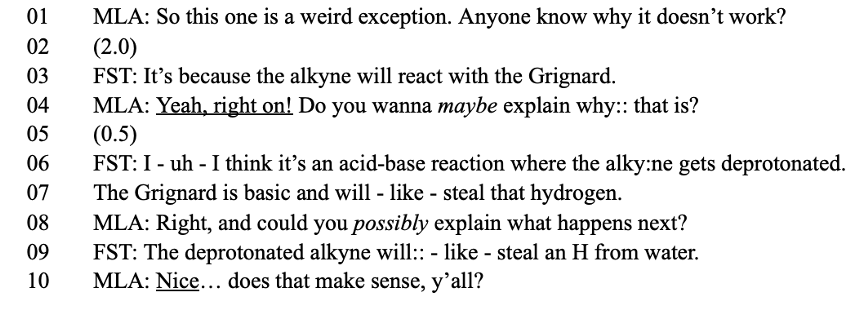
We can use the technique of discourse analysis (Janks, 1997) to analyze the conversation in Example 1 between a male Learning Assistant and a male student. 

Transcription Key:

MLA indicated Male Learning Assistant

MST indicates Male Student

FST indicates Female Student

(time) indicates a pause for [time] seconds

- indicates a short, untimed pause

: indicates a stretched syllable

(.h) indicates an inhalation

Underline indicates positive politeness phrases


Italics indicates negative politeness phrases

For the purposes of confidentiality, the actual names of the students and LA will be replaced in conversations with MST/FST/MLA, respectively.
Example 1: Male Learning Assistant with Male Student, Correct Response

In Example 1, the male Learning Assistant uses four instances of positive politeness with the male student. When looking at this conversation with the idea of a student’s perceived levels of support in mind, one can see how this student would feel very supported. The casual language which the Learning Assistant uses, such as “dude,” as well as the phrases of encouragement such as “You got it!” and “Exactly!” would most likely make this student feel as if his answer was validated and that he belonged in such a learning environment. The four instances of positive politeness, marked using an underline, reaffirm the student that he is correct. The Learning Assistant’s action of making this student more comfortable in the discussion section may, in turn, make him feel more confident about his ability to succeed in the class.

Now let’s take a look at an example of a conversation where the same male Learning Assistant interacts with a female student:

Example 2: Male Learning Assistant withFemale Student, Correct Response

Much like the male student from the previous example, the female student in Example 2 also answered the male Learning Assistant’s question correctly. However, the Learning Assistant’s response towards her answer was not as comforting and casual as it was with the male student. For example, he only used two instances of positive politeness compared to the four he used in the previous example. Additionally, he now uses two instances of negative politeness, indicated in italics, when asking her to further explain her answer.

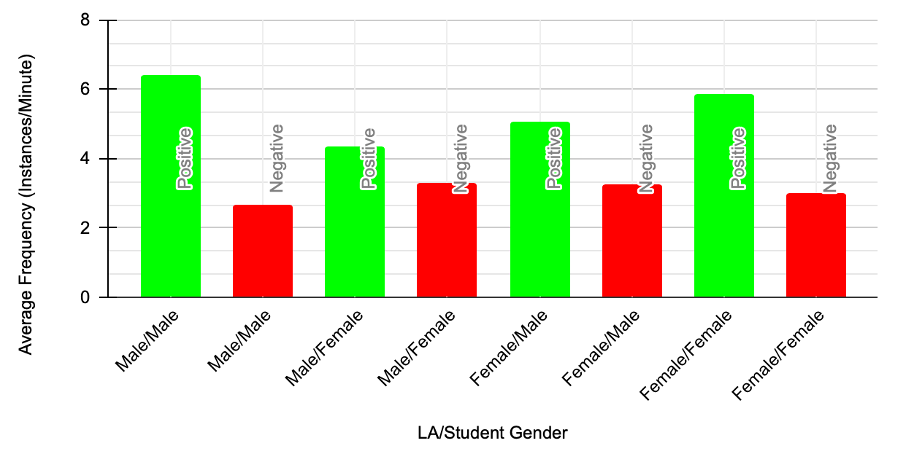
Similar overall trends to the two examples above are seen when looking at the combined data of this study. This data is pictured in the two graphs below:

Figure 1: Average Frequencies of Positive and Negative Politeness After Correct Responses

There are two major points of interest in Figure 1. First, when looking at each interaction, every correct response yielded more frequent positive politeness than negative politeness. However, more importantly, one can notice that male LA/male student and female LA/female student interactions have more frequent use of positive politeness than the other two kinds of interactions with different LA/student genders. This finding supports the idea that positive politeness is more commonly used when an LA interacts with a student of the same gender.

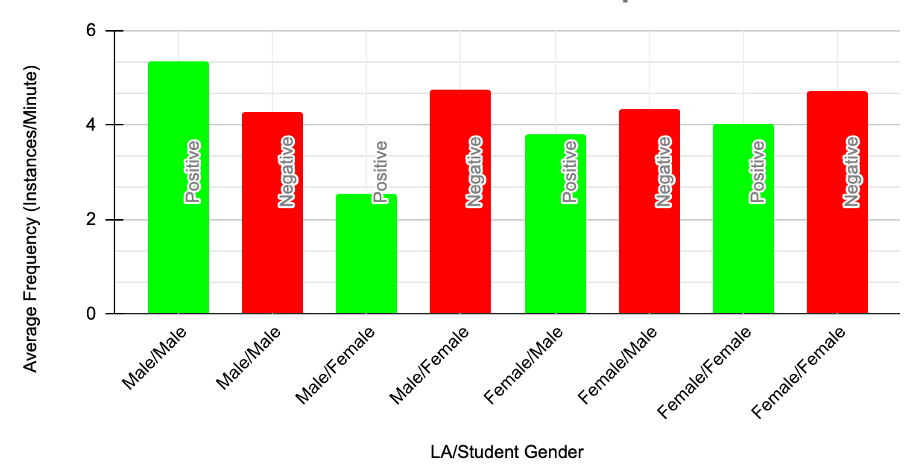
Figure 2: Average Frequencies of Positive and Negative Politeness After Incorrect Responses

The results for incorrect responses in Figure 2 are not as conclusive as they were for correct responses. Once again, this data shows that positive politeness is used more frequently when a student and LA have the same gender compared to when they have different genders. More importantly, however, is the fact that female/female interactions had more instances of negative politeness than female/male interactions here. This finding disproves the idea that negative politeness is dependent on gender in interactions. Unlike positive politeness, which was higher in same-gendered interactions for both examples, negative politeness does not have any trend with relation to gender.

Conclusion

After analyzing the data, the study ultimately concluded two things. The first conclusion reached was that positive politeness is used more frequently when Learning Assistants interact with students who share the same gender as them. In addition to this, however, the study also concluded that the frequency of negative politeness is independent of the Learning Assistant and student’s genders.

The finding that positive politeness is higher in same-gendered interactions may have implications with regard to perceived student support: students may feel more supported if they interact with LAs who identify with their same gender compared to LAs who do not. Increasing awareness of this issue amongst LAs may allow them to be cognizant of the existence of such a bias, and therefore, would help them know to be just as supportive towards differently-gendered students. Similar future studies should include non-binary participants in order to extend the results past the gender binary.


References

Brown, P., & Levinson, S. C. (1987). Politeness: Some Universals in Language Usage. In Politeness: Some universals in language usage (pp. 311-323). Cambridge: Cambridge University Press.

Furtak, E. M., & Kunter, M. (2012). Effects of autonomy-supportive teaching on student learning and motivation. The Journal of Experimental Education,80(3), 284-316. doi:10.1080/00220973.2011.573019

Janks, H. (1997). Critical discourse analysis as a research tool. Discourse: Studies in the  Cultural Politics of Education,18(3), 329-342. doi:10.1080/0159630970180302

Jardine, H., Levin, D.M., & Cooke, T. (2020). Group Active Engagement in Introductory Biology: The Role of Undergraduate Teaching and Learning Assistants.

Sellami, N., Shaked, S., Laski, F. A., Eagan, K. M., & Sanders, E. R. (2017). Implementation of a learning assistant program improves student performance on higher-order assessments. CBE—Life Sciences Education,16(4). doi:10.1187/cbe.16-12-0341

Talbot, R.M., Hartley, L., & Wee, B. (2015). Transforming Undergraduate Science Education With Learning Assistants: Student Satisfaction in Large Enrollment Courses. The journal of college science teaching, 44, 24.

[/expander_maker]

Yeah, Um… So Like, Are Filler Words Considered Feminine?

Jennifer Beck, Jaymie Bernardo, Theo Chen, Karl Danielsen, and Calista Eaton-Steinberg

At some point in your life, you have probably experienced the intense awkward silence that comes about when it’s your turn to speak and you have no idea how to respond. Whether you’re not sure how to answer a question or you simply got lost in your train of thought, perhaps you’ve found yourself choosing one of these coping mechanisms to deal with that moment of dreaded stillness in the conversation: (1) you accept the silence and ponder your next move; (2) you fill the silence with filler words to buy time. Filler words such as “like,” “well,” and “um” are a common occurrence for people in conversation who are thinking of what to say. If you pay attention, you might notice that you use these words unconsciously in daily conversation, not even noticing when they slip out.

By observing, collecting, and analyzing video interviews, our study focuses on the correlation between gender and filler words in Californian college students. Studying the use of filler words in different genders of the cis-binary will allow researchers to better understand the way that gender and filler word usage interact. The purpose of this study is to clarify the assumption that women use more filler words than men due to persisting social pressures and the social implications of filler words.

[expander_maker id=”1″ more=”Read more” less=”Read less”]

Introduction and Background

Professor Eckert discusses in her linguistic studies that women typically have a different linguistic role in society compared to men (Eckert, 2012, pp. 90). When men speak, they try to keep up a persona that exudes confidence. As filler words explicitly foreground someone’s lack of confidence in speaking – they indicate that the speaker does not feel entirely certain about the things they are saying – men are presumed to more commonly avoid using filler words. In comparison, women generally assume a more mediating role in conversation (Van Herk, 2017, pp.110), so they might be expected to use more filler words.

Finding a connection between gender and filler word usage could indicate that one gender is less affected by the negative traits associated with filler words. In other words, one gender group may feel less social pressure to avoid filler words despite their pre-existing negative implications. Alternatively, one gender might actually prefer using filler words as modes of marking discourse to connect and organize the things they say in specific ways (Divett, 2014, pp. 37-42). A paper in the Journal of Language and Social Psychology found that men and women both use filler words equally when filling pauses, but that women use them more as discourse markers (Laserna et al., 2014, pp. 332-334). In this way, women use filler words to assert their authority in a conversation by directing its path and indicating it is their turn to speak. Due to the unprofessional associations with filler words, we hypothesize that women will use filler words more than men, as women face lower levels of societal pressure to sound professional. They may also utilize these words more often to direct conversation. We conducted a small-scale study of casual interactions between college-age men and women to assess the patterns of filler word use.

Methods

We analyzed 15 interviews of Californian college students posted on college-related YouTube channels. These casual one-on-one interviews asked random students basic questions about their college experiences. We looked at results from women interviewing men and men interviewing women and calculated the number of filler words (including “um/uh,” “like,” “yeah,” “so,” “I mean,” and “you know”) relative to the number of total words spoken.                                                                                                                                        
Results/analysis

Previous research into this topic suggests that women do, in fact, use more filler words than men (Laserna et al., 2014, pp. 332-334). However, as gender roles become less important to our modern society, the previously discovered results may have become outdated. We set out to see if we could reproduce other studies’ outcomes in a modern, progressive college setting, while simultaneously seeking out answers as to what factors could cause the gendered differences in filler word usage.

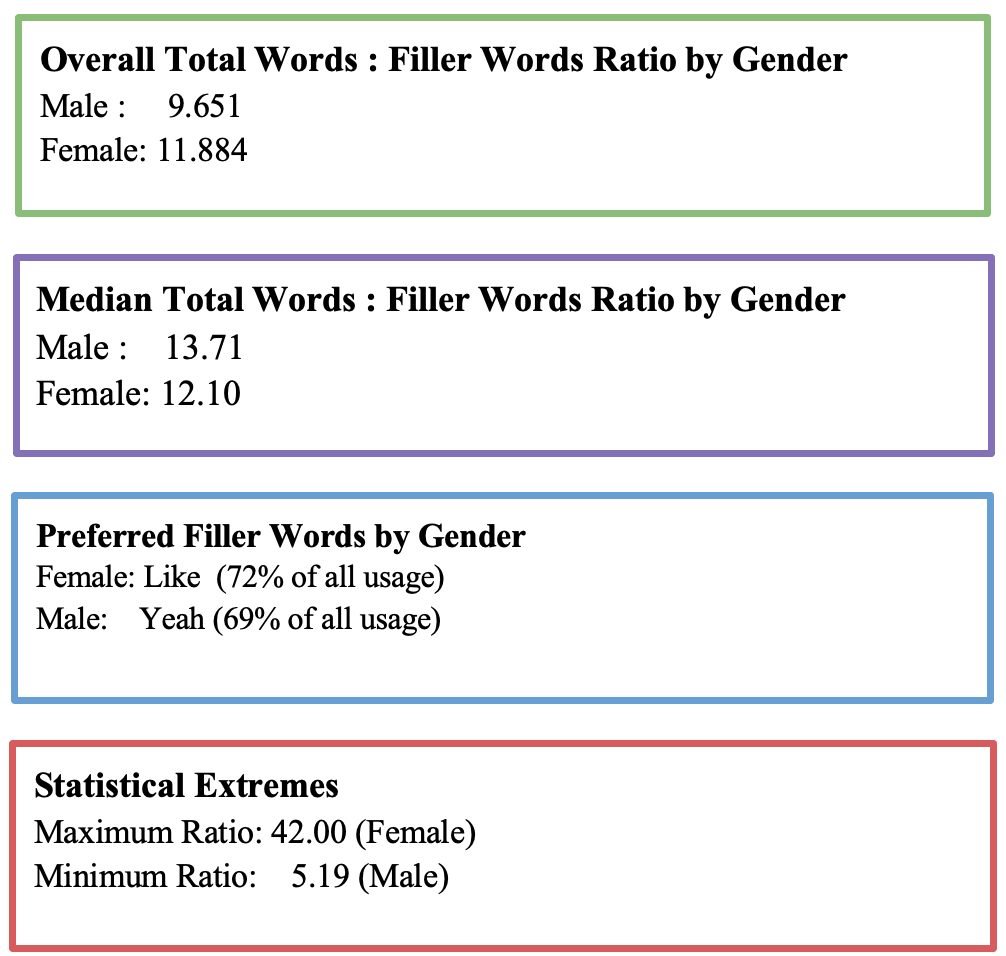
While our final results matched those of previous studies in confirming a gender difference, the difference we found was not what we expected. Below are a couple of statistics from our data collection:

Figure 1: The most significant data from our research; note the difference between mean and median results.

Looking at the overall ratio result, our results did not support the previous findings on this topic. Women surveyed actually used significantly fewer filler words than men. Looking at the overall total words to filler words ratio, males displayed a 9.651 ratio, while females displayed a 11.885 ratio, showcasing a 2.233 difference in filler word usage between the two genders. Oddly enough, the median of the data contrasted this. The median female used more fillers than the median male. This could potentially mean that men tend more towards extremes, while women speak more similarly across the board. Indeed, one interview with a male revealed the most filler word usage of all interviews, as the male spoke with almost one filler word per five words.

In spite of the inconclusive results of our mean/median analysis, two segments of the data did show a clear trend. Across all interviews, women and men showed preferences as groups for different filler words. Women favored the word “like,” which is increasingly androgynous but still closely associated with the “valley girl” archetype. Men, in place of using the effeminate “like,” preferred words such as “yeah.” It appears that both genders selected their filler words carefully to index different personas, even if they used filler words at similar rates. This means that social pressure is still strongly at play in word choice, even if neither gender has a stronger need for the confidence lent by decreased filler usage.

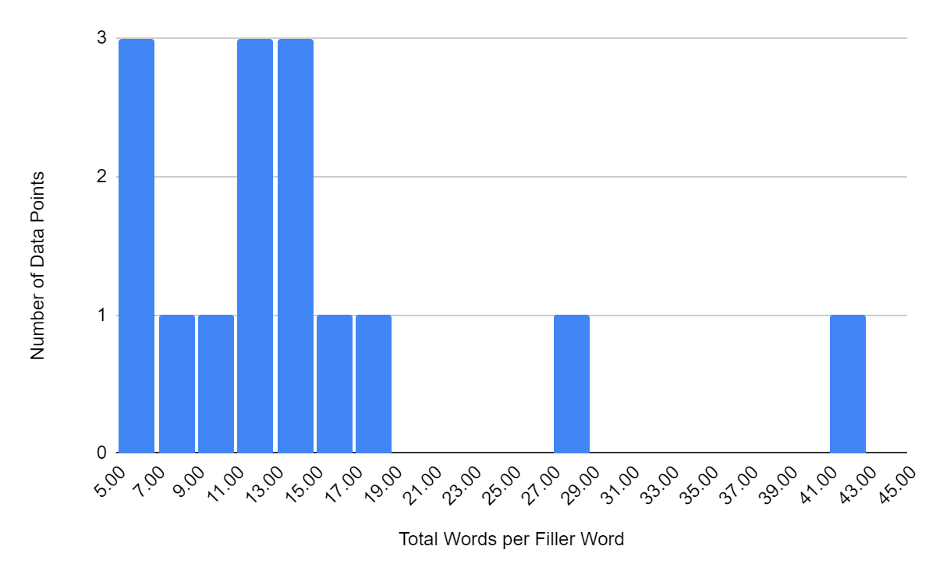
Both genders together indicated another interesting trend: the presence of two, not one, spikes on the graph of filler ratios. Figure 1 below shows that there is a peak of people using ~6 words/filler word and one of people using ~13 words/filler word. This two-peak system indicates that there are likely two separate modes of speech people use, one casual with a higher ratio of fillers, and one formal with a lower ratio. Filler word use overall is likely distributed across two standard deviations centered at these spikes.

Figure 2: A histogram showing the number of interviews with a certain filler ratio. Make note of the two separate peaks – one at 6, and one at 13.


Discussion/Conclusion

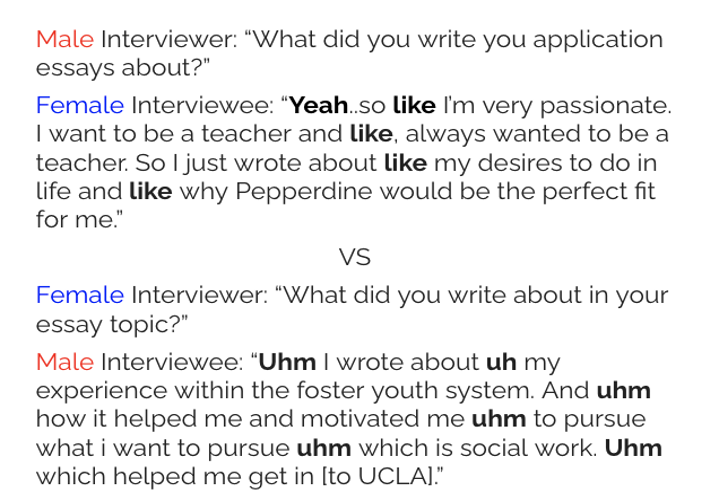
Our research shows that the differences in filler word usage across genders are more complex than previous findings suggest. Figure 2 below shows the transcript between two different interviews we observed, both being asked similar questions. You can see the female interviewee produces five filler words out of 43 words total. On the other hand, the male interviewee produces six filler words out of a total 40 words. The margin of filler word usage is slim here. As we mentioned before, females have been found to favor the filler word, “like” while men favored “yeah”. You will note that in this case, the male favored the word, “Uhm.”  While not every male favors the same word, overall data suggests that there is still a generally consistent difference between male and female filler word choice, especially in the use of “like.”

This could be a result of gender stereotypes for speech – “like” and “so” are associated more with femininity, while “um” and “yeah” seem more masculine. There aren’t rules for who can say what, but speech can be very gendered. Part of it might be conscious – for example, males might avoid “like” for fear of sounding feminine – but it might also be a result of who these people are spending time around and what kind of speech they naturally pick up from friends and family.

Figure 3: Transcripts of two interview segments, both involving the opposing gender. Extracted from ProWrite Admissions YouTube channel.


It is important to keep in mind that the data used for our results was extracted from online videos of causal speech. Casual speech with a fellow young person allows for a more comfortable setting, therefore allowing for more filler words to be used. Because these videos were spontaneous and filmed, it is also possible that certain participants were more nervous than others, causing them to use more filler words as they collected their thoughts. Some people are more anxious speaking spontaneously in front of a camera, which would definitely affect their mannerisms, while other people might love being filmed and thrive in the same situation, speaking with confidence and ease.

Our current research sought to analyze the long-lived stereotype of women using more filler words than men, which may exist due to the even older stereotype of women having less intelligence. With these results, we come to the conclusion that college-aged males within California use filler words more frequently in casual speech than college-aged women in California. This could result from a number of factors. For one, more male college students are in STEM fields (Blackwood, 2020) where interpersonal skills are de-emphasized, and students might use more fillers. Men could also be more willing to index a casual persona in interviews because there are fewer expectations against their intelligence that they want to combat. With the persisting sociological stereotypes that deem women less intelligent, women have to work twice as hard in order to gain the respect that men have, especially within the work field (Eckert, 2012, pp. 90). Women are held to different expectations than men, which could impede on filler word usage.

Furthermore, a strong negative social stigma exists around young women who use filler words, especially “like.” Frequent use of the word “like” is a characteristic of the valley girl accent, a Californian accent associated with wealthy, unintelligent, and annoying young women. (This NPR article talks about some other ways that women’s language is stigmatized and disrespected). Since women have to overcome these pre-existing stereotypes, it is possible that they consciously work harder at not using filler words.

Should this research be conducted in another state with another age range, or in a more formal setting, the results may differ. However, our data challenges a conventional understanding of filler word use, suggesting that this topic is very complex and requires further investigation. Potential future research could look into formal interviews between an employer and potential employee, and whether this context decreases filler word use, regardless of gender. Research could also look into stereotypes surrounding different filler words, and whether these stereotypes consciously affect filler word use.


References

Crimson Education. (2013). Home [YouTube Channel], from https://www.youtube.com/c/CrimsonEducation/about

Divett, S., Duvall, E., Graham, T. Robbins, A. (2014) How and why people use filler words (pp. 35-46). https://schwa.byu.edu /files/2014/12/F2014-Robbins.pdf

Eckert, P. (2012). Three waves of variation study: The emergence of meaning in the study of sociolinguistic variation. Annual Review of Anthropology, 41, 87-100.

Laserna, C., Pennebaker, J., Seih, Y. (2014). Um . . . Who Like Says You Know: Filler Word Use as a Function of Age, Gender, and Personality. Journal of Language and Social Psychology. 33(3), 328-335. DOI: 10.1177/0261927X1452699 OR https://www.researchgate .net/publication /27 5005568_Um_Who_Like_Says_You_Know_Filler_Word_Use_as_a_Function_of_Age_Gender_and_Personality

ProWrite Admissions. (2017). Home [YouTube Channel]. YouTube. Retrieved November 16, 2020, from https://www.youtube.com/channel/UCpjORe_vOMevyxImw90igLw

Van Herk, G. (2017) Gender. What is Sociolinguistics? Wiley Blackwell. (pp. 97-115)

W.K.C., Kate Blackwood. (2020, July 1.). Gender gaps in STEM college majors emerge in high school. Cornell Chronicle. https://news.cornell.edu/stories/2020/07/gender-gaps-stem-college-majors-emerge-high-school

[/expander_maker]

, , , ,

Periodt, Sis!   Gender Identity and TikTok Term Usage

Camille Lanese, Chang Liu, Heather Pritchard, Merton Ung, Tracy Zeng

If you were to go on TikTok right now, one word might stand out to you: “periodt.” With a hashtag including more than 632 million views and endless videos with teenagers exclaiming “and that’s on periodt!”, you might wonder what is up with this word. In our study we examined exactly who is using the term “periodt” and when they are using it. Through surveying college-aged students, we examined if factors such as gender identity and sexual orientation affected whether or not TikTok users used the term “periodt” online or in their daily lives. After looking through the results, we concluded that gender identity and sexual orientation seemed to affect whether TikTok user knew of the word “periodt,” but had no impact on when they used the term. Overall, most participants were most comfortable using the term online, and were extremely uncomfortable with the idea of using “periodt” in a professional setting. In the future we aim to further examine the origins of “periodt” and how people acquire it as a word.

[expander_maker id=”1″ more=”Read more” less=”Read less”]

Introduction

TikToks are vertically filmed videos 6-60 seconds long. TikTokers play off various viral trends with repeated phrases and terms, and introduce new lexical items into users’ everyday speech. Importantly, users comment on others’ TikToks and share TikToks on other social media platforms. Also of note, TikTok users will write specific hashtags in their captions to make their videos appear on the “For You page”, the place where TikTok users discover new videos. Due to a combination of the users comments, hashtags, and sharing it is common for new words to become extremely viral through widespread use. TikTok’s powerful influence is reflected by the fact that the social media platform has over 800 million users worldwide. Thus, TikTok forms a kind of speech community with jargon through interaction between speakers. We analyzed college-aged students’ usage of the TikTok lexical item “periodt”, used to emphasize a point or signal the end of a discussion. We hope to answer, does a speaker’s gender identity and/or sexual orientation affect whether they adopt TikTok terms into real-life social interactions?

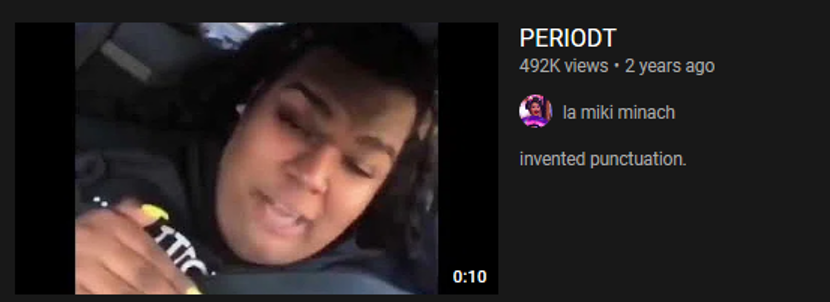
Figure 1: a YouTube compilation of female AAVE speakers saying Periodt

Background

The field of sociolinguistics understands linguistic variation as an “essential feature of language” through which speakers “index” aspects of their identity (Eckert 2012: 94). Specifically, gender is performance, in which speakers use linguistic features to construct and reinscribe their gender for their audience (Butler 1990: 179). For the older 18+ TikTok population, which includes our target population, using TikTok language requires more speaker agency because TikTok is not the norm, and thus TikTok language indexes aspects of identity for these speakers. Holloway and Valentine (2014) show that a teenager’s identity can become a mixture of their online and offline influences, since teenagers perceive both their online and offline identities as real spaces. Based on the studies by Eckert and Butler we see that a person’s identity is reflected in their lexicon. Our study seeks to examine whether the influence of the online spaces of TikTok will be reflected in our participant’s lexicons. Podesva (2011) analyzed the Californian vowel-shift for one LGBTQIA+ speaker and demonstrates that speakers use phonological features to index their identity. Podseva focuses on speech acoustics in various social settings. Our study is different from this in the way that we are examining our participant’s lexicons, and in the way that we are analyzing a large number of people rather than one person. The study that was most similar to ours was Banman’s (2014) which analyzed Tweets by men and women and compared gender markers such as pronouns. Banman et. al found that there are lexical items strongly associated with each gender. Our study is similar because we also seek to examine the lexical differences between gender, but also different because we are also examining their sexual orientation. To learn more about gender and other demographics in social media, check out this TED Talk by Johanna Blakley.

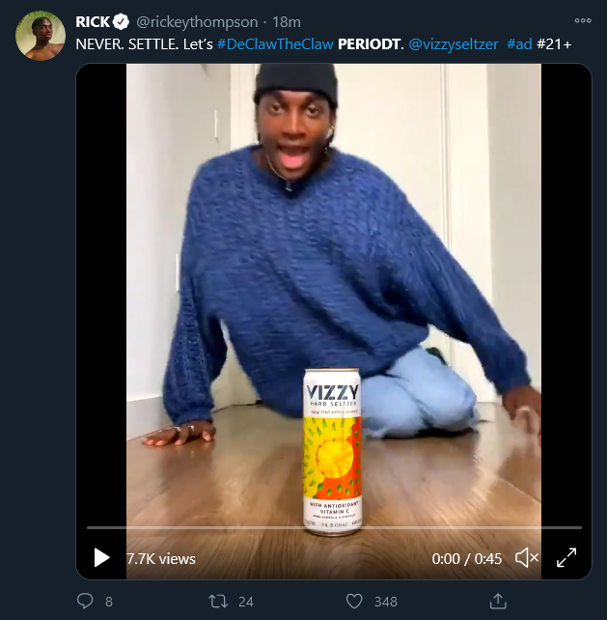
Figure 2: Rickey Thompson, openly gay American actor, using “periodt” on Twitter

Methods

We collected data from 100-200 American college students (aged 18-22) through an online survey with questions about usage of TikTok lexical items as well as gender and sexual orientation. Our preliminary hypothesis was that members of the LGBTQIA+ community are more likely to know and actively use TikTok language, since many TikTok terms are associated with said community. We also hypothesized that self-identified females are more likely to use TikTok terms, because of TikTok’s origins in Musical.ly and because self-identified females are usually the pioneers of new lexical items. The word that we chose to analyze was “periodt”, since it is a word that not only has roots in the LGBTQIA+ community, but was also popularized through TikTok by the use of hashtags and viral audios used in various videos. If you’re interested, check out this TED Talk by Dao Nguyen that discusses what kinds of videos and topics go viral.

Results

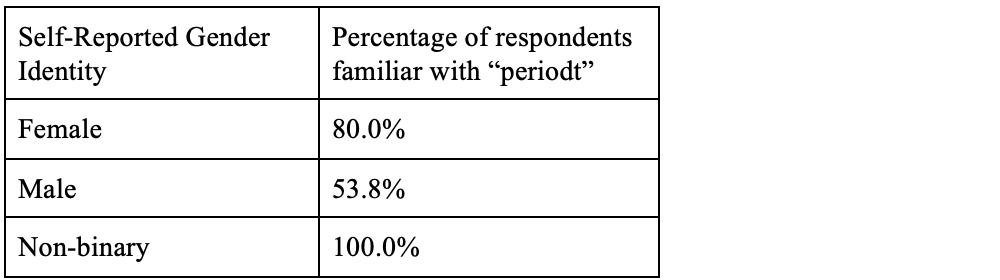
We received 109 total responses. Of those, we received 80 female responses, 26 male responses, and 3 nonbinary responses. Although our percentage of female responses was disproportionate, we still found that a far greater majority of female respondents were familiar with the term.

Table 1: Percentage of respondents familiar with the term “periodt”, by gender

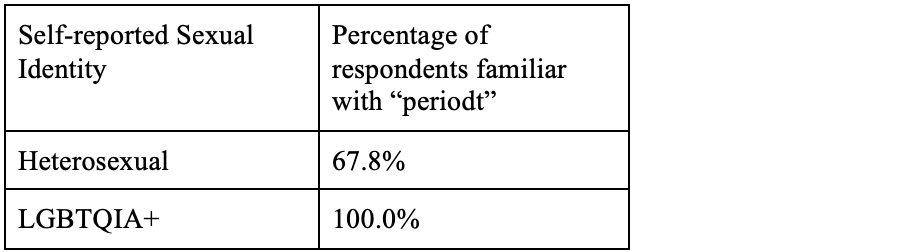
Similarly, according to our hypothesis, when sorted by self-reported sexual identity, all of our LGBTQIA+ respondents were familiar with the term, while a smaller percentage of our heterosexual respondents were familiar with the term. At the same time, we are aware that there is further diversity within the queer community, so analyzing the entire LGBTQIA+ community as one homogenous section does weaken our analysis.

Table 2: Percentage of respondents familiar with the term “periodt”, by sexual orientation


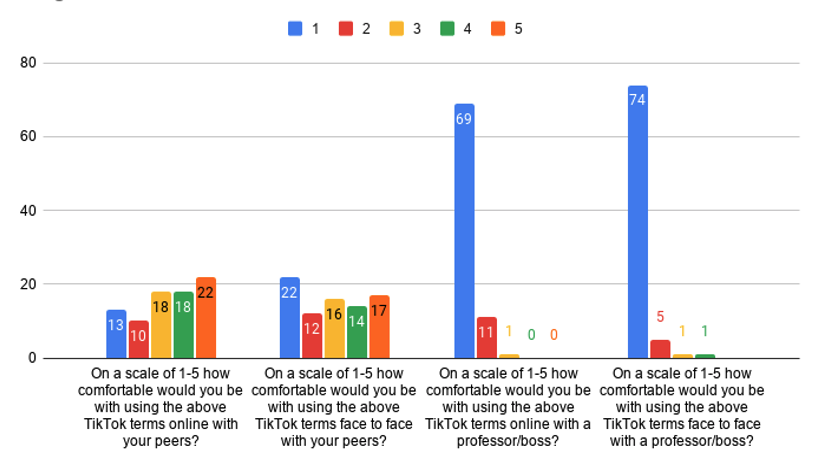
Figure 3: How comfortable participants are using TikTok terms in different scenarios from a scale of 1 to 5, including all participants that know the term “periodt”


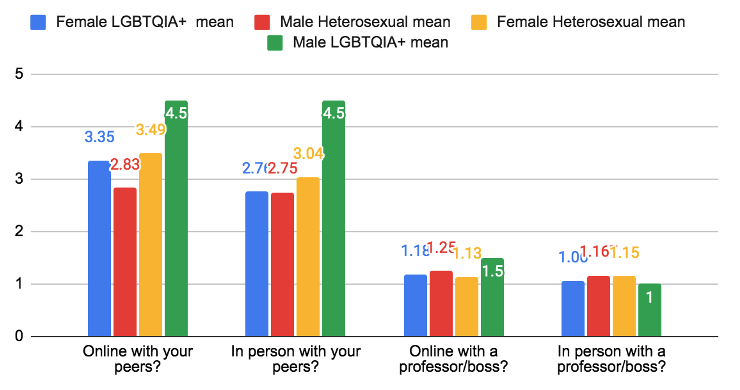
Figure 4: How comfortable participants are using TikTok terms in different scenarios from a scale of 1 to 5, divided by both gender identity and sexual orientation


Regardless of gender identity and sexual orientation, overall, the participants feel the most comfortable using the term “periodt” online with their peers, a little less comfortable when using it face-to-face with peers, and almost equally uncomfortable when using it online and face-to-face with a professor/boss. When using the term with peers, female and non-binary participants feel slightly more comfortable when using it online than using it face-to-face. From our data, male LGBTQIA+ participants clearly feel more comfortable than other groups when using the term “periodt” with their peers online and face-to-face, and slightly more comfortable when using it with a professor/boss online. But since only 2 LGBTQIA+ male participants responded, we cannot confirm that this pattern applies to most people with this gender identity and sexual orientation. Also based on the results we received, non-binary participants feel less comfortable than other groups when using the term with their peers online and face-to-face. But since only 3 non-binary participants responded, we cannot confirm that this pattern applies to most people with this gender identity and sexual orientation.

Discussion and conclusions

Based on our results, we conclude that gender identity and sexual orientation seems to affect the familiarity with newly-emerged TikTok terms, but have little effect on the usage of those terms in both online and in-person settings. We collected data on many factors that we didn’t have the time or space to explore, such as participants’ native languages and hometowns. We also asked participants which other TikTok terms they were familiar with, which in the future could be helpful to contextualize “periodt” among other TikTok lexical items. An additional factor that we didn’t have the space to explore was race. Although the word “periodt” originates from the African American community, we did not analyze whether our participant’s knowledge of the word could originate from their racial backgrounds. The final shortcoming of our study was our lack of LGBTQIA+ participants. In an ideal study, our study would have equal amounts of participants for every subdivision we analyzed, especially for the male LGBTQIA+ participants.

In further studies, we would be interested in correlating time spent on TikTok with comfort using the word. Then, we would analyze whether time spent on the app factors more into TikTok term usage than gender or sexual identity (Holloway and Valentine, 2014). A similar study could also be performed on other words that have become popular with AAVE and LGBTQIA+ roots, like “shady, tea, sis”, but on platforms like YouTube or Twitter. Also of interest, how do people, especially non-binary and LGBTQIA+ groups, acquire TikTok terms? Our study asked whether the participants knew the word, but not whether the participants learned the word from TikTok. A few more specific questions to investigate include: Is there a difference in the usage between talking with close friends and classmates? Is there a difference when talking with the same group of people, but about different topics?

Our study regarding the term “periodt” is also important for broader research and issues. The large number of participants using “periodt” despite not knowing the origins of the word is emblematic of the larger issue of erasure in western society. Despite the fact that “periodt” has its origin from AAVE, the word was co-opted by the LGBTQIA+ community during the late 1960s. “Periodt” was then popularized in mainstream culture as a word that indexes LGBTQIA+ membership, since it was popularized by shows like Rupaul’s Drag Race, Queer eye, and various YouTube content creators. Prior to TikTok, “periodt” was only popular within the LGBTQIA+ and African American communities. After “periodt” was popularized on TikTok through famous audios, and hashtags, the word had become viral and it was no longer used exclusively by the queer and African American communities. Our study shows an abundance of users who use “periodt” without actually knowing the origin of the word. Other viral phrases that were created by the black community and was co-opted by the LGBTQIA+ along with “periodt” that do not have their origins widely acknowledged would be “spill the tea, sis, yas, queen, shady”. Acknowledgement of the origins of “periodt” is important because of the U.S. erasure of black and queer history.


References

Bamman, David, et al. “Gender Identity and Lexical Variation in Social Media.” Journal of Sociolinguistics, vol. 18, no. 2, 2014, pp. 135–160., doi:10.1111/josl.12080.

Butler, Judith. 1990. Gender Trouble: Feminism and the Subversion of Identity. New York: Routledge

Eckert, P. (2012). Three waves of variation study: The emergence of meaning in the study of sociolinguistic variation. Annual Review of Anthropology, 41, 87-100.

Holloway, Sarah, and Gill Valentine. “Cyberkids? Exploring Children’s Identities and Social Networks in On-Line and Off-Line Worlds.” 2014, doi:10.4324/9781315011257.

Kulkarni, Vivek, and William Yang Wang. “TFW, DamnGina, Juvie, and Hotsie-Totsie: On the Linguistic and Social Aspects of Internet Slang.” 22 Dec. 2017.

Podesva, R. (2011). The California vowel shift and gay identity. American Speech, 86(1), 32-51

[/expander_maker]

Hedging and Gender in the STEM Community

Eric Chen, Abbey Mae Gozon, Khoi Nguyen, Paul Vu, Julia Wang

Hedging is an aspect of language that is easy for non-linguists to overlook. These terms are used to apply uncertainty to a statement, to make it seem less assertive. The question we seek to answer is, do women make more use of hedging than men do? Specifically, we seek this in the context of an environment where more is expected of women than of men. In this experiment, we take a look at the presence of hedging in the speech of female STEM students. These participants participate in interviews about the subjects they study, and then afterwards take a short survey in order to determine what it is that the participants believe is the root cause of their own hesitations. The recordings of the interview portions are scanned for hedges that are measured as uncertainty in the participant’s explanations. A numerous presence of which would imply that the speaker is not completely sure that they are correct and are choosing to leave room for themselves to err. This study intends to find out whether or not women hedging more than men contains more substance than is implied by the stereotype.

[expander_maker id=”1″ more=”Read more” less=”Read less”]

Introduction + Background

Entering new environments with high expectations can be difficult for anyone. This is especially relevant in academic environments, where imposter syndrome and the resulting stress are abundant. As a general stereotype and resulting from years upon years of patriarchal oppression, it is believed that women hedge more than men. This also carries the implication that women are less intelligent. Now we know from a lot of other research (and a thing I like to call common sense) that simply being a woman does not make a person less smart than anyone else. Though why are we looking at female STEM majors in particular? The number of women in stem has been far less than the number of men in the field for many years in our past. In recent years, many more women have been joining the STEM field, choosing to become STEM majors. Their numbers have been steadily increasing every few years from what it was in the past, but also has not been increasing fast enough to be considered a “boom” of any sort. Does the high expectation for the small percentage of women entering these male-dominated fields make them feel less confident in their abilities to acquire/distribute STEM-related information? Could the use of more hedging be intentional, and used as a sort of cushion for being able to make mistakes? It is also possible that the content within STEM fields, which is generally considered difficult to grasp, may make it harder for people to assert their knowledge of the subject. This semi-spontaneous interview test attempts to collect data that can be used as evidence to answer these questions.

Methods

To collect our data, we used a sample of twelve STEM majors at UCLA: six male, six female. We conducted a short interview, asking questions that would illicit hedging. The questions were:

    1. What is one STEM class that you’re currently taking?
    2. Can you explain something that you’re learning in that class?
    3. What is the most difficult thing you have learned in that class?

These questions were designed to provoke deeper thought and test mastery of the participant’s field of study. After the interview, we then explain to the interviewees our study and hedging, specifically what it is and how someone might use it in certain scenarios. We give this explanation to allow them to reflect on the subject and determine how much they think they use it and why they use it as a linguistic tool. We also do this after conducting the interview so the participants are unaware of the topic, giving us the most genuine, unaltered responses. Finally, we give them a post-interview survey to answer based on their recent reflections on a scale from 1- 10. The questions include:

    1. How often do you think you use linguistics hedging?
    2. How confident or capable do you feel in your field of study?
    3. How often do you feel condescension or face condescending remarks said to you in your field?
    4. How much do you believe the environment you face (and the amount of discrimination / condescension) in your field has contributed to this your confidence in said field?
    5. How much do you believe the level of confidence you have affects the number of hedges you use?

With this whole study, we are able to collect genuine responses of hedging from the interview and perspectives on hedging from the participants with the survey.

Results

Each interview from the twelve STEM majors lasted around two to three minutes. We noticed that the STEM majors commonly used hedges: “like”, “possibly”, and “may”. From the twelve interviews, we noticed that the most common hedge used by both genders was the word “like”. The STEM majors used the word “like”, not to show comparison, but to express vague statements. For example, one of the interviewees said:

“… Learning how you compose and create a CT scan from like Fourier transforms …”

Here, the interviewee used hedging to evasively state that she was learning how CT scans are created through Fourier transforms.

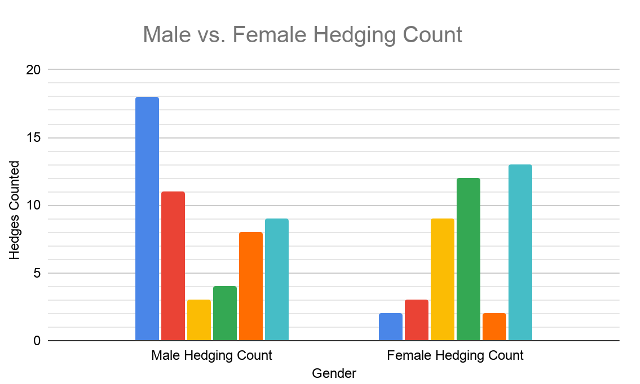
To analyze the interviews, we counted the occurrences of hedges in each interview and calculated the average frequency of hedges per gender.

Figure 1: Hedges Counted per Interview

The data revealed that females had an average of 6.83 hedges per interview while males had an average of 8.83 hedges per interview. Although females had a lower average of hedges than males, we noticed that the amount of hedges for both males and females were fairly similar with the exception of a few outliers. The maximum amount of hedges used was 18 hedges by a male, which is much higher than the amount of hedges counted for the other males. The minimum amount of hedges used was two hedges by two females. Because of the outliers and the fairly similar amount of hedges, it is hard to conclude that gender causes a change in frequency of hedges. Our data suggests that it is possible that the frequency of hedges is related to the individual’s competency in the subject rather than gender. To have more conclusive results, we should have interviewed a large amount of people, but because our sample size was too small and hedging counts were fairly similar, it is hard to definitely conclude that gender affects hedging usage.

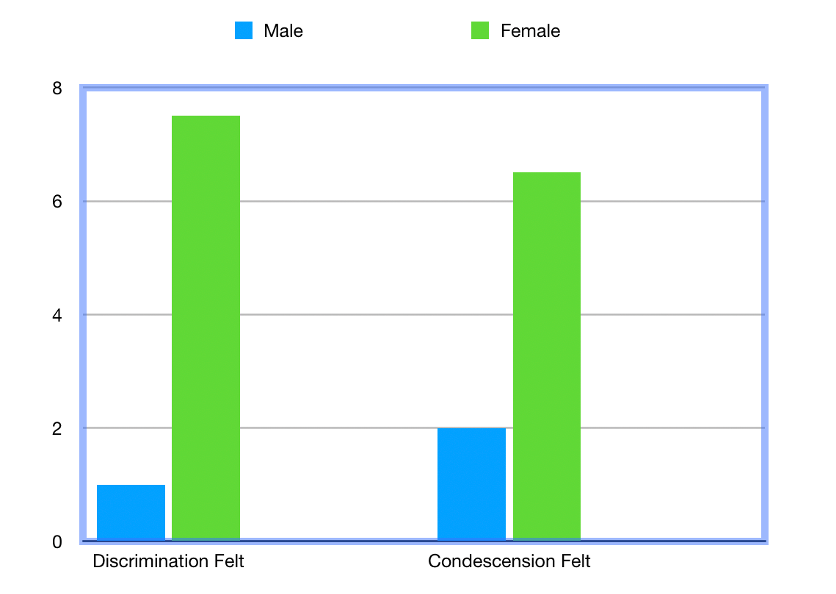
When we analyzed the questionnaire data from our post-interview surveys, we discovered several notable observations. One of those observations was that women felt significantly more adversity than men. For the question “how often do you feel discriminated against or underrepresented in your field?”, we found that women felt approximately 7 times more discrimination than men. Similarly, for the question “How often do you feel condescension or face condescending remarks said to you in your field?”, we observed women feeling about 3 times more condescension than men.

Figure 2: Perceived adversity by men and women

From those two questions alone, the data suggests that gender disparity continues to exist and has propagated into the UCLA community as well. Specifically, it seems that how much women experience discrimination today has not changed enough especially when it comes to factors such as earnings and promotions in the workplace.

Furthermore, when we analyzed the data from the question asking how confident they felt in their field of study, we observed that women felt more confident than men by a slight margin of 0.5. However, the data from the “How much do you believe the environment you face (and the amount of discrimination / condescension) in your field has contributed to your confidence in said field?” showed that women gave less credit to their environment. Surprisingly, the data suggests women believe they developed their confidence outside of the environment in their respective fields. This begs the question, if this is the case then where exactly are they getting their confidence from and why is this the case?

Discussion and Conclusions

Our hypothesis was inconclusive that women in stem hedge more than men since the data that we received was inconsistent. Even though women in the survey reported a higher frequency of using hedging the frequency of hedges in the interviews conducted was around the same. Therefore, we cannot conclude from our study that women in STEM hedge more because of under representation and lower confidence levels in their field. However, there are many parameters that could influence our findings such as our small sample size, as there were only 12 people interviewed and surveyed in total. Another factor is that the people we used in our experiment were people we were familiar or friends with thus they might have been more comfortable around us, which could influence the frequency of hedges they used.

In the future we could possibly recreate the study but with a larger sample size which would even out the outliers in our data. We could also sample random people which we have not met previously. Furthermore ,we could research the differences in hedging between gender in different majors of the STEM field, such as computer science, mathematics, physics, etc, and observe whether the field you are in can affect the difference in hedging frequencies of men and women. We could also conduct the study among people interested in STEM of different education levels, such as in high school, and different colleges.

Through examination of hedging we can have a better understanding of the effects of gender in the STEM fields and language use. A continuation of this study could be very beneficial to stem majors when considering the role of gender in the stem field and the level of confidence they portray. In particular this research can be important when considering the work force, specifically that women are less likely to ask for raises and promotions. This could be tied into hedging since hedging relates to being uncertain and less confident in one’s ideas. We believe that this is a very important area of research with a lot of potential to explore the effects of gender in STEM and look forward to future contributions regarding this topic.


[/expander_maker]


Does She Listen to ‘Girl in Red’? Linguistic Markers in WLW Flirting

Tiffany Dang, Brianna Lombardo, Carlos Salvador Vasquez, Denisa Tudorache, Yuyin Yang

The present article focused on linguistic markers that are adopted by the Women Loving Women (WLW) population when identifying potential members of the WLW community. More specifically, this study focused on the strategies used by members of the WLW community for identifying fellow WLW with the intentions of pursuing a romantic or sexual relationship. Through analyzing popular YouTube videos featuring strategies on flirting with WLW, our first study captured the common beliefs regarding the need to take an extra step, and the possible methods on identifying WLW before taking any romantic or sexual advances. Followed-up by semi-structured interviews in study two with UCLA students who self-identify as WLW, we were able to examine the accuracy of the tips offered by the YouTube videos. This allowed for further investigation on the existence of specific linguistic markers adopted by WLW when flirting. We found that both popular YouTube videos and participants both discussed the need for WLW to take an extra step before they can comfortably pursue another woman and tend to make a conscious effort to not be too direct.

[expander_maker id=”1″ more=”Read more” less=”Read less”]

Introduction and Background

While there have been past studies done on examining the speech of gay men, particularly the California vowel shift among gay men (Podesva, 2011), and one that revealed a concept of gay-dar, the belief that gay men possess an ability to pick out each other in a crowd (Shelp, 2003), little research has been done on uncovering linguistic patterns within the Women Loving Women population (WLW). A member of the WLW community is loosely defined as anyone who identifies as a woman and differs from the mainstream preferences in terms of their sexual practice and identity (Eliason & Morgan, 1998). Due to being seen as deviant from the mainstream practices, they may feel the need to take different approaches when making romantic pursuits in order to establish a mutual understanding of their interest in women when talking to another individual. As WLW may often struggle with compulsory heterosexuality, the fear of being perceived as predatory, as well as the potential dangers that come with revealing their sexuality, we aimed to investigate whether there were any linguistic markers adopted among the members of the community to aid in implicitly seeking each other out. This study explores the ways WLW work around the potential barriers they face when pursuing romantic interests and when revealing their identity in hopes of gaining insight on ways to improve the inclusivity of a general community. We hypothesized that WLW would adopt practices where they refer to certain WLW-group-specific terminologies or features before making romantic or sexual advances towards another woman.

Methods

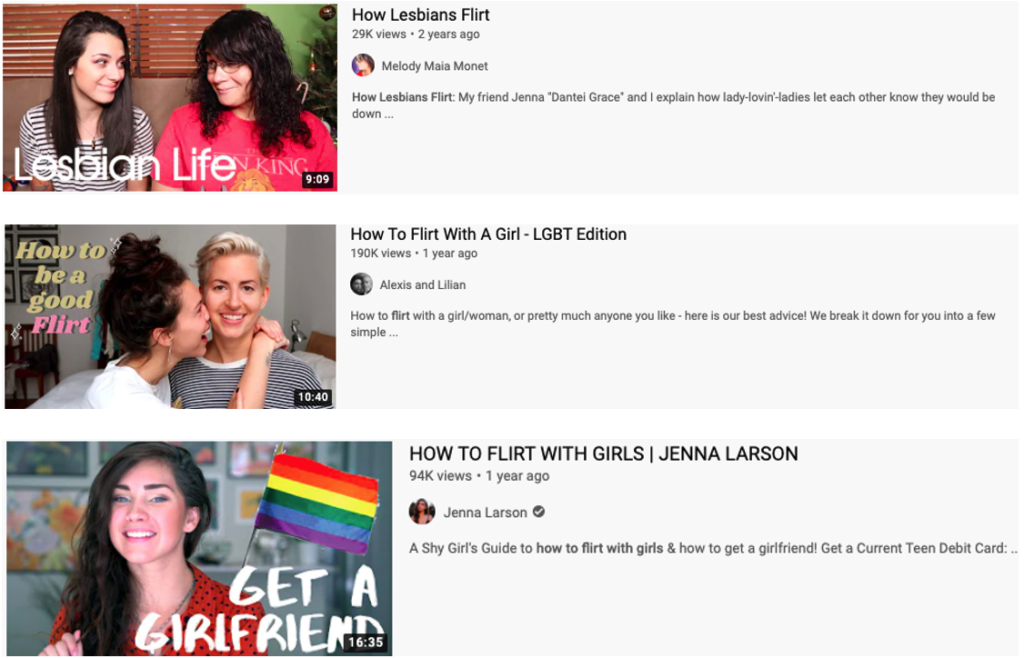
Study 1 collected people’s lay knowledge on identifying WLW by looking at popular YouTube videos that featured strategies on how to initiate romantic/sexual advances with a WLW. We found three relatively popular videos created by members of the WLW community who also covered a large realm of dating advice and made a list of those that were related to indexing sexual identity. In addition, we watched two videos that featured heterosexual dating advice and made note of the advice given to men to romantically or sexually pursue other women. By comparing the two lists of notes, we were able to identify potential strategies that are WLW group-specific.

Study 2 consisted of two semi-structured interviews that took place and were recorded through Zoom. We interviewed a total three members of the WLW community, with two of them being in a committed relationship. They were primarily asked to describe and draw from their past experiences. The interviews were guided by six open-ended questions (see Appendix A) with the interviewer following up with questions when necessary. Our questions focused on the WLW’s description of their experiences in establishing mutual interest in women using non-direct measures. Participants were recruited using snow-ball sampling and all answers were kept anonymous. After the interviews, we listened to the audio recordings and made notes of the different ways WLW chose to index their sexual identity as well as the cues they used to determine the sexual identity of their romantic interest.

Study 1 Results

In Study 1, we were able to uncover several recurring themes. One point made consistently across multiple videos was that the WLW always felt the need to immediately make their sexuality known once they realized they had feelings for the other party.

Reasons for this were that they did not want to confuse the other party into thinking that they just wanted a female friend, and they also did not want the other party to assume that the speaker is straight and think differently of them. WLW worry about giving ambiguous signals if they were to not reveal their sexual identity soon enough, which leads to the subtle incorporations of various cues in conversations, such as mentioning the pride parade, to demonstrate their sexual identity.

They also made mentions of lurking through the other party’s social media for signs pertaining to possible membership of the WLW community to know whether it would be appropriate for them to make romantic advances. WLW also tend to be cautious in making advances as they adopt a “flirting by not flirting” technique. This allows them to slowly determine if the other party has reciprocated romantic feelings without being too overbearing and only continue to proceed if there is a positive response.

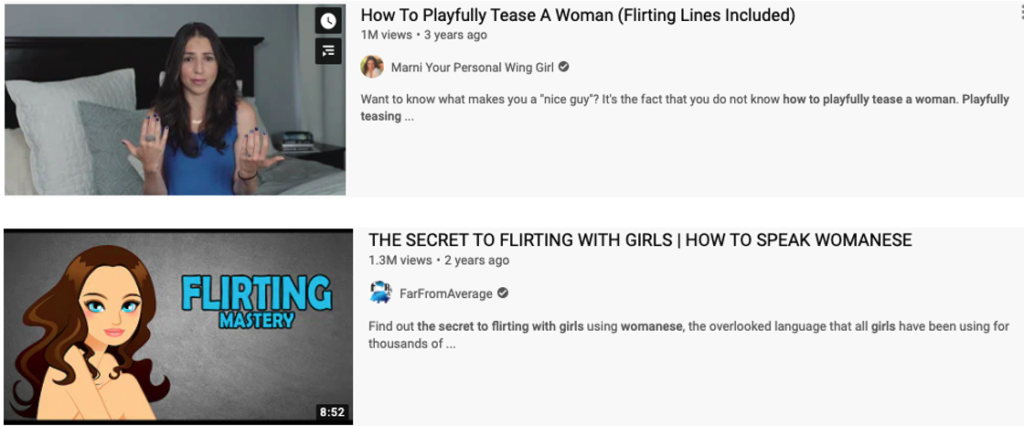
Figure 1: A selection of videos on WLW flirting used in Study 1

WLW flirting:  Video 1      Video 2     Video 3

In contrast, when we explored flirting advice geared towards men to pursue women, there was no  mention for men to index their sexual identity to women before flirting or at any stage of the courting process. The videos generally focused on advising men to be indirect to increase excitement in women and how to appear playful and masculine.

Figure 2: A selection of videos on heterosexual flirting used in Study 1

Heterosexual Flirting: Video 1      Video 2

Although there was some overlap in advice given to women to pursue other women and given to men to pursue women, such as being subtle and indirect, the reasoning behind it was different,  and a clear difference was the need for WLW to drop hints about their sexual identity. Because there tends to be less confusion in intentions when a male approaches a female, neither party is advised to hint at their own sexual identity nor advised on how to determine the other party’s sexual identity. In contrast, a common theme across videos geared towards WLW is to use references to hint at their own gayness or try to determine whether the other party is gay before advancing.

Study 2 Results

Interview 1

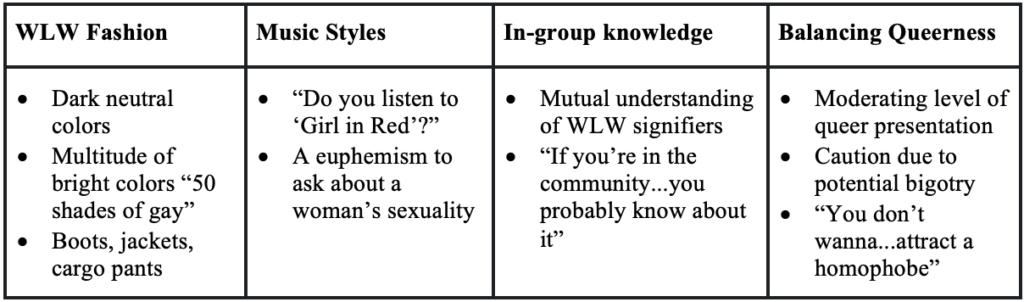
A summary of common themes that arose in Interview 1 are presented in Table 1 below along with some illustrative examples given by the interviewee.

Table 1: Recurring themes and examples from Interview 1

Interview 2

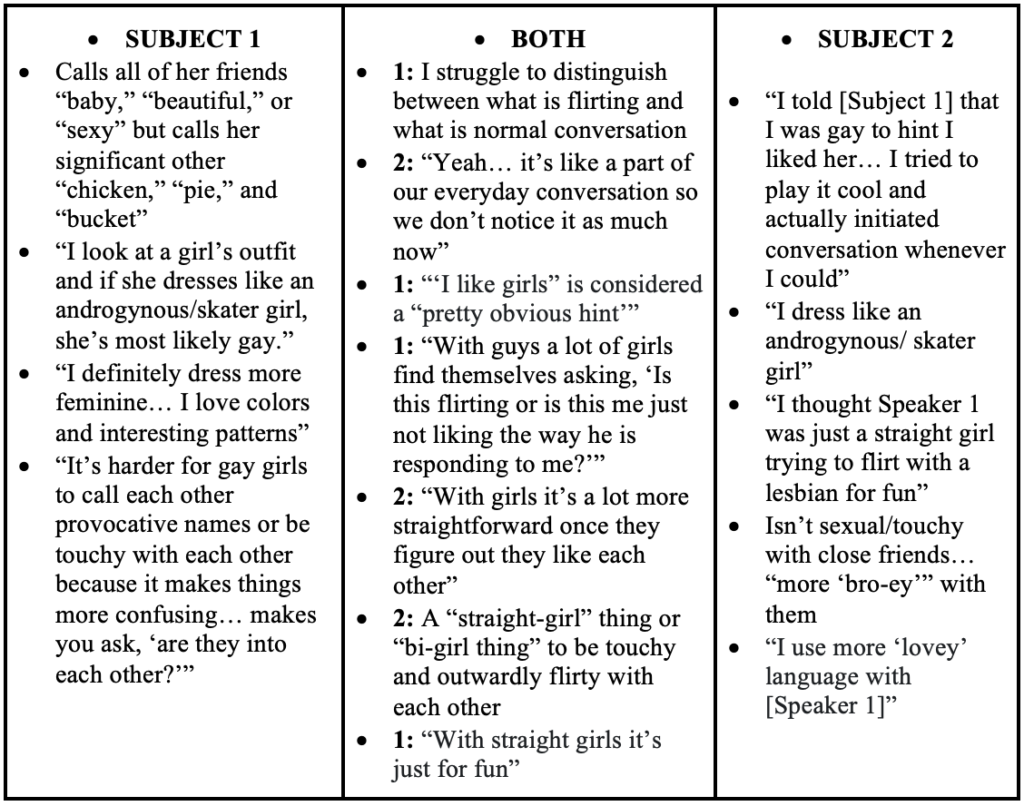
To illustrate the results derived from Interview 2, Table 2 consists of the most important statements made by both Subject 1 and Subject 2 in the conversation. It is important to note that Subject 1 and Subject 2 have been in a WLW relationship for over a year. When answering the interviewer’s questions, they both reflected on when they first met and how this has changed or remained consistent. The middle column consists of what they answered similarly.

Table 2: Noteworthy excerpts from each subject of Interview 2 and areas of overlap


Study 2 Analysis

From our interviews we gathered that the majority of strategies available for Women-Loving Women to identify and flirt with other WLW are mostly non-linguistic in nature. In both interviews, WLW referred to style of dress as a primary identifier for fellow WLW. These and other aspects of popular WLW culture were also drawn upon during the flirting itself, which leads us to one overtly linguistic flirting strategy we found was used by WLW– compliments. Compliments between WLW referenced nonverbal yet mutually understood markers of WLW identity, so they were used to confirm sexuality and communicate an attempt to flirt, in addition to their function as simple compliments. Importantly, compliments between WLW and platonic ones between heterosexual women were said to differ solely in their content and not their form. We conclude that this arises from a need or desire for WLW to flirt “under the radar” to avoid the very real danger of homophobia and bigoted comments.

We also noted the potential for confusion and ambiguous interpretations of these, arguably necessary, nonverbal flirting methods. Subject 1 even described a trend among WLW to pull back on “standard” physical or verbal affection (at least among other WLW) as a way to avoid creating confusion since more open displays of platonic affection are expected among groups of women. This may contribute to a societal perception of WLW as being “colder” or “more masculine.” Future studies might investigate whether or not this is true among a larger sample size.

Figure 3: A meme employing WLW popular music artist ‘Girl in Red’ to euphemistically index a WLW identity


Discussion and Conclusions

Our ultimate takeaway from these interviews was a strong indication that, motivated by a possible fear of negative attention, members of WLW groups feel the need to be covert in romantic contexts. As a result of this covertness, we noticed a trend of relying on nonverbal cues (like clothing choice) more than an awareness of individuals phonetically or lexically indexing their “gayness.”

Even in situations where an individual might directly state “I like girls,” the implication of “I’m romantically interested in you” often remains covert. This gives the other individual a choice as to whether or not an interaction is romantic in nature, but can end up causing some confusion. Thus arises the stereotype that WLW do not flirt. In many cases, their advances can easily be interpreted as platonic interaction among women in a society where affection among women is more normalized than among men, and where revealing your sexuality to the wrong person can have negative repercussions.

Further Reading Recommendations: Although we did not cover this information in our study, there have been numerous studies done on the language WLW may use that distinguish their patterns from heterosexual women. Robin Lakoff in Language and A Woman’s Place (1975), defines stereotypical “women’s language features (WL)” as those associated with “heterosexual women’s performance of femininity.” She contrasts this with the existence of typical “men’s language features (ML),” thus creating a binary of “women’s speech v men’s speech.” It would be interesting to use this and analyze whether women in the WLW community use either one or both of the language features, and whether this could be a distinguishing feature.


References

 Eliason, M.J., Morgan, K.S. Lesbians Define Themselves: Diversity in Lesbian Identification. International Journal of Sexuality and Gender Studies 3, 47–63 (1998). https://doi.org/10.1023/A:1026204208243

Lakoff, Robin (1975). Language and A Woman’s Place. Language in Society, Vol. 2, No. 1, 45-80.

Podesva, R. J. (2011). The California vowel shift and gay identity. American speech, 86(1), 32-51.

Rich, A. (1980). Compulsory heterosexuality and lesbian existence. Signs: Journal of women in culture and society, 5(4), 631-660.

Rieger, G., Linsenmeier, J. A., Gygax, L., Garcia, S., & Bailey, J. M. (2010). Dissecting “gaydar”: Accuracy and the role of masculinity–femininity. Archives of Sexual Behavior, 39(1), 124-140.

Shelp, S. G. (2003). Gaydar: Gaydar. Journal of Homosexuality, 44(1), 1-14.


[/expander_maker]

, , , , ,

They and Them: Gender Inclusivity Across Languages

Alexander Gonzalez, Maeneka Grewal, Nico Hy, Zoe Perrin, Vivian San Gabriel

The relevance of gender-neutral language has surged due to growing acceptance towards nonbinary and gender non-conforming people as well as the dissolution of the gender binary. Through comparative analysis of native English and Spanish speakers, we investigated the impact of grammatical gender on the methods speakers employ to express gender neutrality. Since Spanish sentences require full gender and number agreement, expressing gender neutrality in Spanish presents more challenges than in English. We asked participants to describe images of individuals and observed that the English speakers used gender-neutral language at higher rates than the Spanish speakers did. Their methods differed as well. Spanish speakers were more likely to mix feminine or masculine forms, alongside neutral descriptions, which we interpreted as attempts to use gender-neutral language. We can infer that even when Spanish speakers are looking to express something gender-neutrally, they may be limited by the lack of gender-neutral lexical items that can be used throughout an entire utterance. Our experiment was limited to written responses and as a result may not be representative of these speakers’ language use overall. More experiments dealing with oral speech and analyses of other gendered languages would contribute to the knowledge and understanding of this field.

[expander_maker id=”1″ more=”Read more” less=”Read less”]

Introduction

The language of gender inclusivity is constantly shifting and becomes increasingly relevant as our understanding of gender changes and the voices of nonbinary individuals are amplified. The recent surge in nonbinary visibility has drawn attention to the grammar of gender-neutral pronouns, especially in languages that have grammatical gender marking. We wanted to explore how speakers navigate using gender identity-related pronouns and terms to express gender neutrality, particularly in English, a language that does not use grammatical gender, and Spanish, a language that does use grammatical gender. 

In English, the pronoun “they” is often used as a gender-neutral pronoun. The Spanish equivalent would be the novel pronoun “elle/ellx.” However, Spanish’s grammatical gender makes this pronoun difficult to use in spontaneous speech. In Spanish, all nouns and everything associated with them must be modified to fit gender and number agreement, while in English, nothing needs to be modified in order to use “they” in a sentence.

Through this experiment, we were looking to explore how grammatical gender may impact the ways speakers’ expresses gender neutrality when referring to a subject. This experiment focused specifically on individuals’ use of pronouns and other gender markers in their writing. We collected responses from native English and Spanish speakers of varying gender identities, looking to highlight the different ways gender neutrality is encoded in languages with grammatical gender compared to languages without it. As English already possesses a gender-neutral pronoun and does not use gender agreement, we predicted that English speakers will be more likely to use gender-neutral terms than Spanish speakers.

Methods

To test out this hypothesis, we conducted an experiment using Google Forms surveys to track the usage of pronouns and gender marked words in English and Spanish written communication. We collected our data through 2 separate surveys, each written in English and Spanish respectively. Each survey contained the same 10 computer generated images of androgynous individuals paired with a prompt requesting that participants describe the individuals using full sentences. It was important for us to disclose that the individuals in the photos were computer generated so as to avoid participants manipulating answers due to fears of misgendering real people. It was also important that we asked participants to describe the people in full sentences to increase the likelihood of participants using pronouns and gender marked terms.

Figure 1: A computer-generated image of a person (from www.thispersondoesnotexist.com)

The methodology used in this experiment was inspired by a prior study done by Bradley, Salkind, Moore & Teitsort (2019) which examines English L1 cisgender subjects’ perception of singular “they” as a non-gendered pronoun. In this study, the researchers analyzed English recordings of participants’ verbal reactions to image stimuli. However, our experiment will be analyzing how gender neutrality is expressed in writing for both English and Spanish. We chose to analyze written communication because of possible difficulties in verbally expressing gender neutrality in Spanish due to the language’s grammatical gender. It was found in the study by Slemp (2020) that verbally expressing gender neutrality in Spanish takes conscious effort. This is not only because of Spanish’s grammatical gender agreement, but also because there is no verbal standard gender neutral morpheme. Slemp found that, in order to express gender neutrality, participants alternated between the morphemes -e and -x in written language as replacements for -a and -o. These findings guided our decision to analyze written language as opposed to verbal responses.

Results

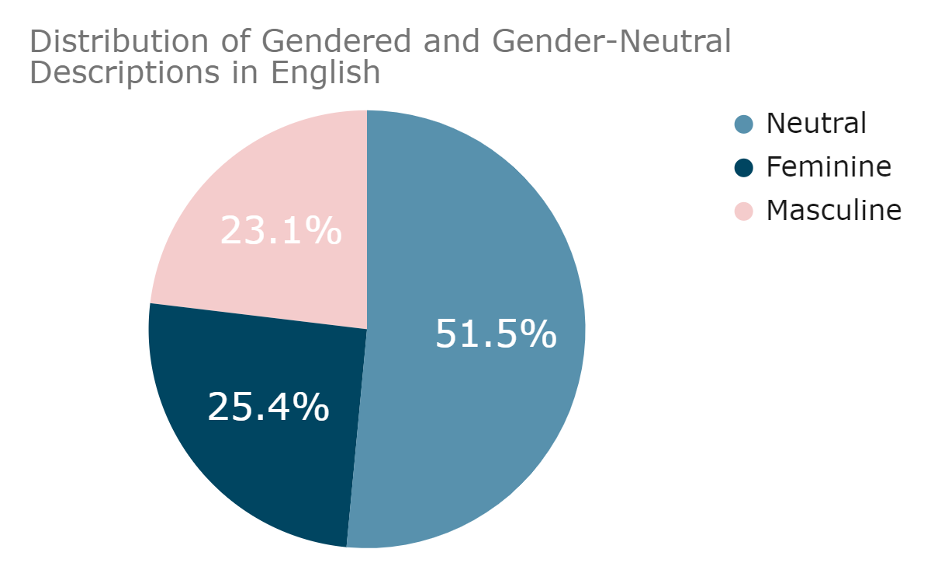
We received 13 responses to our English survey, and since each responder was asked to describe 10 images, we received a total of 130 descriptions in English. We found that 51.5% of these descriptions used gender-neutral language. Examples of gender-neutral language found in our English speakers include the explicit use of the gender-neutral pronoun “they” in sentences like “they have dark colored eyes with crow’s feet,” as well as the total avoidance of pronouns in favor of gender-neutral terms like “person” in sentences like “this person has dimples.”

The remaining 48.5% of descriptions used gendered language, with 25.4% of the responses being feminine descriptions and 23.1% being masculine descriptions. Of our 13 responders, 10 people (76.9%) used a neutral description at least once, while 3 people (23.1%) did not use a neutral description at all, meaning that they gendered every single image.

Figure 2: Percentage of feminine, masculine, and gender-neutral descriptions used by English speakers, from a total of 130 descriptions.

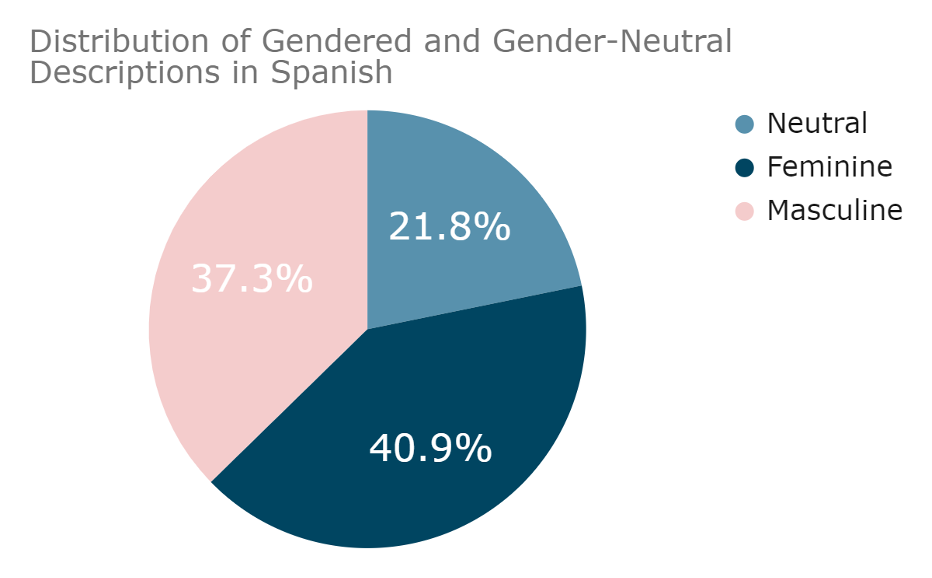
We received 11 responses to our Spanish survey for a total of 110 descriptions. While the use of gender-neutral language was a majority in the English survey, only 21.8% of the Spanish descriptions used gender-neutral language, and 5 of these gender-neutral responses used feminine or masculine pronouns or adjectives combined with neutral descriptions. We interpreted these responses as attempts to use gender-neutral language. Other ways in which Spanish speakers expressed gender neutrality include the avoidance of pronouns similar to the avoidance practiced by English speakers, the use of question marks to signal uncertainty about gender, as in “el señor?” and the use of a dual marker “-o/a” for gender-neutral adjectives.

Within the remaining 78.2% of gendered descriptions, 40.9% were feminine and 37.3% were masculine. Of our 11 responders, 7 people (63.6%) used a neutral description at least once, while 4 people (36.4%) did not use neutral descriptions at all.

Figure 3: Percentage of feminine, masculine, and gender-neutral descriptions used by Spanish speakers, from a total of 110 descriptions. Five of the neutral responses combined feminine or masculine pronouns or adjectives with neutral descriptions.

Discussion and Conclusions

Our results show that our English-speaking participants used more gender-neutral language than our Spanish-speaking participants. We can most likely attribute this to the fact that using the pronoun “they” was the most common way English speakers chose to convey gender neutrality: as we hypothesized, it appears that the availability of the gender-neutral “they” is what allowed them to do so. Gender-neutral language also seems to be more easily accessible in English, as shown in the way some of the English speakers fluidly switched between the pronouns “he,” “she,” and “they,” both between and within sentences.

            On the other hand, none of the Spanish speakers used the novel pronouns “elle/ellx,” which suggests that these pronouns are less widely accepted and less readily available than the English “they.” This highlights an obstacle to introducing a new pronoun into a language: it is not likely to be understood and used in casual language if it is not well-known by speakers. It is most likely because the Spanish speakers didn’t have this gender-neutral pronoun available that they used various other methods to convey gender neutrality, such as mixing the gender agreements of articles, adjectives, and nouns. Mixing masculine and feminine forms suggests that they were aiming to construct gender-neutral sentences using the resources available to them.

            In both languages, there were speakers who avoided pronouns altogether and used the word “person” or “individual” instead of gendered terms like “man” or “woman.” Some speakers expressed uncertainty over their use of gendered language as well as the gender of the person in the image, either explicitly through words like “I think,” or implicitly through the use of question marks. These uncertainties suggest that participants would have been more confident if there were more gender-neutral options in circulation—not only existent, but well-known and commonly used, as to allow a mutual understanding of the word between both speaker and listener.

            While our data was collected in the form of written responses and may not accurately reflect the use of gender-neutral language in English and Spanish speakers, especially because written language lacks the spontaneity of spoken language, our results suggest that English speakers use gender-neutral language at a higher rate than Spanish speakers do. We think it would be worthwhile to conduct a similar study with a focus on speech rather than writing, as it would not only allow more insight into the use of gender-neutral language in general, but also investigate the feasibility of introducing new phonemes into languages for the sake of gender inclusivity, such as the -x marker in “ellx.” Ultimately, though, we have reached a better understanding of the various ways speakers can incorporate gender-inclusive language in their casual speech.

Bibliography

Balhorn, M. (2004). The Rise of Epicene They. Journal of English Linguistics, 32(2), 79–104. https://doi.org/10.1177/0075424204265824

Bradley, E. D., Salkind, J., Moore, A., & Teitsort, S. (2019). Singular ‘they’and novel pronouns: gender-neutral, nonbinary, or both?. Proceedings of the Linguistic Society of America, 4(1), 36-1. https://journals.linguisticsociety.org/proceedings/index.php/PLSA/article/viewFile/4542/4148

Lew-Williams, C., & Fernald, A. (2007). Young children learning Spanish make rapid use of grammatical gender in spoken word recognition. Psychological science, 18(3), 193–198. https://doi.org/10.1111/j.1467-9280.2007.01871.x

Schriefers, H., & Jescheniak, J. (1999). Representation and Processing of Grammatical Gender in Language Production: A Review. Journal of Psycholinguistic Research, 28, 575-600.

Slemp, K. (2020). Latino, Latina, Latin@, Latine, and Latinx: Gender Inclusive Oral Expression in Spanish.

https://ir.lib.uwo.ca/etd/7297

[/expander_maker]

, , , , ,

“I’m Sorry”: A comparative study of gender and individual differences in applying apology strategies in YouTube videos

Kristin Nguyen, Luxuan Huang, Vanessa Zhu, Andrea Mata, Shiyun Zhou

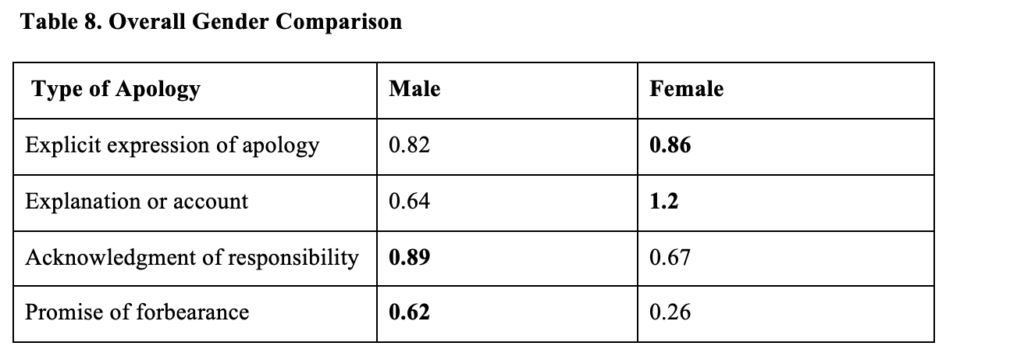
In recent years apology videos have become a very popular tactic used by social media influencers in efforts to help restore their online image. This study will compare and contrast the apology strategies used in 3 male and 3 female YouTuber apology videos by investigating the types of linguistic features that are found in both genders.  Moreover, we will further explore how the specific apology strategies being used influence the perception that their audiences/supporters have towards these specific Youtubers based on the comment section. The results showed that male Youtubers are more likely to use the “acknowledgement of responsibility” and “promise of forbearance” approach when apologizing while females are more likely to use the “explicit expression of apology” and explanation or account” strategy. Interestingly enough, the videos with the most positive responses came from 2 male and 1 female YouTuber which suggests that, according to their data set, there is a pattern in certain apology strategies that are more effective than others.

[expander_maker id=”1″ more=”Read more” less=”Read less”]

Introduction & Background

An increasing number of influencers apologized by publishing YouTube videos as an act to save faces and restore their images in the public’s mind. Previous studies about gender differences in using interpersonal apology strategies categorized apology strategies into 4 categories — explicit expression of apology, explanation or account, acknowledgement of responsibility, and a promise of forbearance, and concluded that women used more explicit apologies than men in interpersonal apologies (Holmes, 1989). However, apology videos are a fairly new phenomenon, and we wonder whether the pattern would also appear in our studies. As a result, we form our topic as a comparison study of gender difference and individual differences in Youtube apology videos in which we would explore the individual YouTuber’s choices of apology strategies and also gender differences based on the categorization mentioned above. 

Project Design

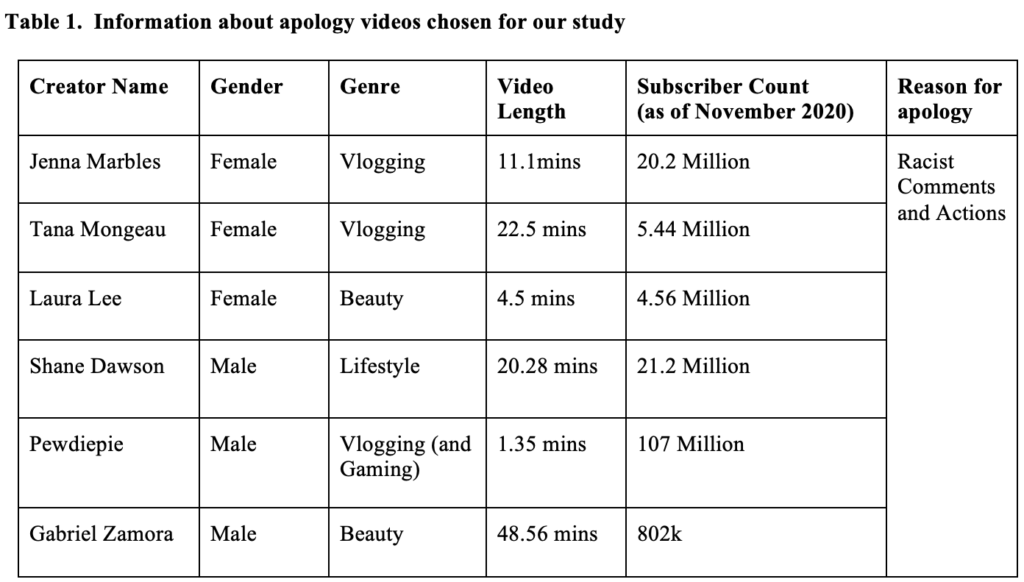
To identify how different apology strategies are used by individual YouTubers as well as by each gender, we chose a sample of 6 Youtube apology videos, 3 by females and 3 by males (see Table 1). The criteria for sample choice were based on Karlsson (2020)’s standards, which are 1) made by an independent Youtuber who runs and owns the channel, 2) made originally for Youtube and conducted in English, 3) belong to Beauty, Lifestyle, or Vlogging genre, 4) apologized for racist comments. By choosing videos addressing the same controversy over past racist comments, we minimized the influences of social and cultural contexts.

Following Holmes (1989)’s categorization for apology strategy, we collected the instances from each apology video that fit into the classification. Both qualitative and quantitative methods were used to analyze each individual video as well as all videos produced by each gender. We mainly employed discourse analysis to conduct the qualitative research when examining each individual Youtuber’s utterances as categorized by the four apology strategies and we also calculated the proportions of each strategy usage as divided by the total instances of apology in individual videos as well as in all videos produced by each gender. Besides, we also took the top 10 comments into account to evaluate how these apology videos were perceived (negative or positive), which then gave us implications of the effects of different combinations of apology strategies.

Results & analysis

A. Individual Differences

A.1. Jenna Marbles – apology video

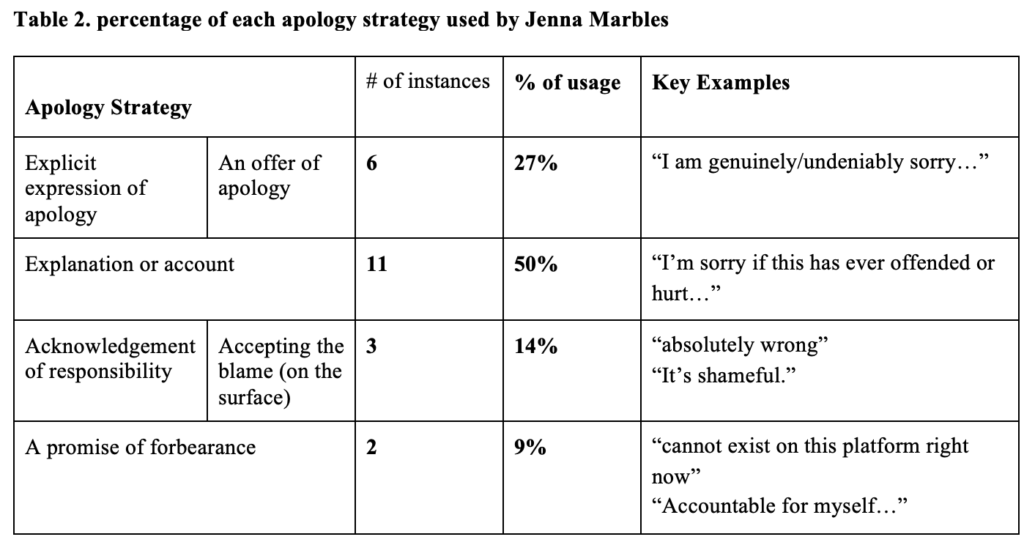
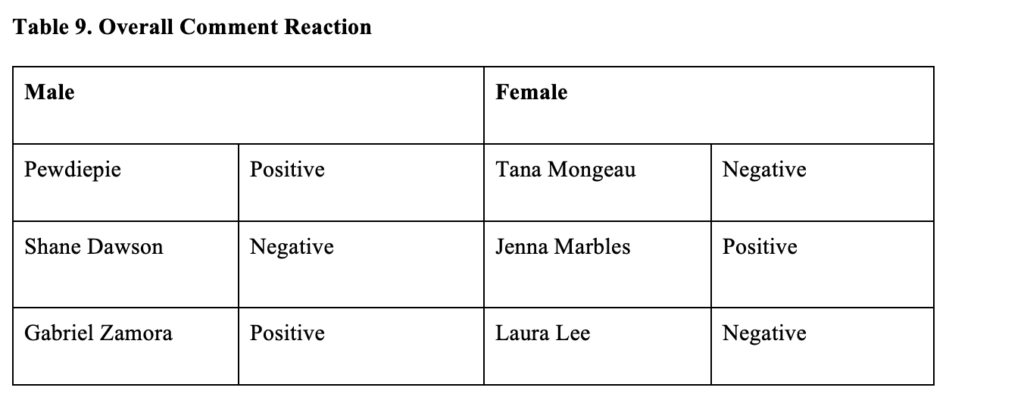
Jenna Marbles’s apology video (which has been taken down along with her channel by Marbles herself) consisted of four different occurrences that she addressed. Three were ones that people criticized and questioned her about, and one was an issue that she felt she needed to apologize for, despite her claim that no one said anything negative about this issue. Her most used strategy was “explanation or account,” which was 11 times out of the total 22 strategies in her video. She showed regret in her old content and emphasized that when she made those videos, her intention was never to hurt anyone. Although the comments we analyzed were not pulled from the original video, we still believe they reflect the general opinion of her apology. Viewers almost unanimously agreed that her apology for all four instances were genuine, and many users actually displayed sympathy for her. Her apology generated many conversations and discourse about the existence of “cancel culture.” Her least used strategy was “promise of forbearance”; however, this is arguably her most effective strategy. Marbles claimed that she wanted to “be accountable for myself” and that she could not continue being on Youtube. Since the release of the apology, Marbles has not returned to Youtube.

A.2. Tana Mongeau – apology video

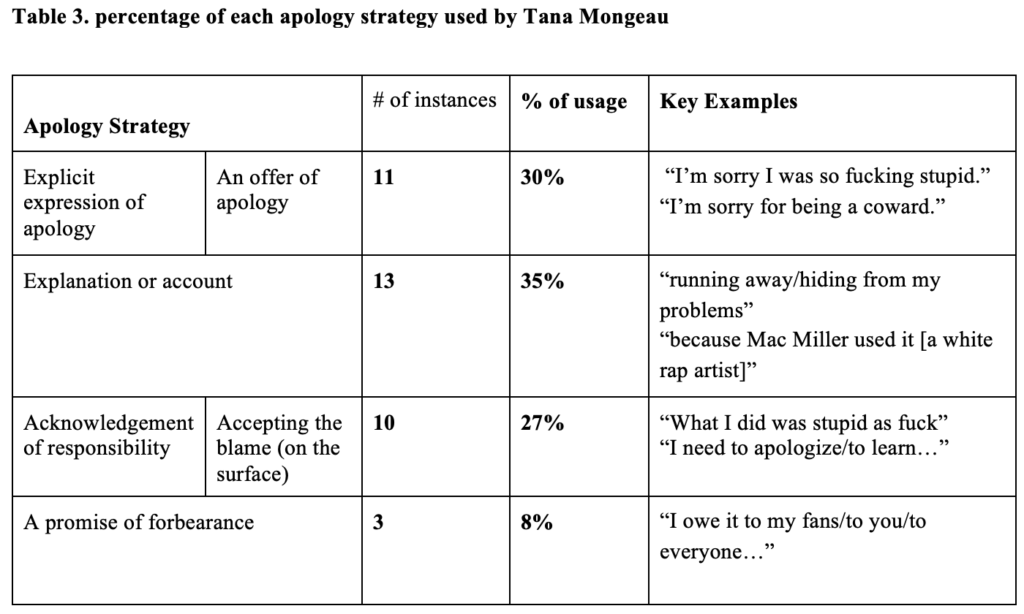
Tana Mongeau is a “storytime-centric creator. To preface this particular analysis, she was already well-known for embellishing some of her stories. It is interesting to note that her credibility was already questionable before the apology was released. This apology was in regard to her younger self using the N-word and to her reaction to another creator (iDubbbz) heavily criticizing her for this. Looking at the numerical data of her strategy usage, “explicit expression of apology” and “explanation or account” are nearly equal, with 11 times for the former and 13 times for the latter. However, 17 out of the 22 minutes in run time consisted of her explaining her logic of why she used to believe the Nword was acceptable to use and why she reacted aggressively towards iDubbbz. It was important to take into account the runtime and to consider that the number of times she used “explanation or account” alone does not fully reflect the implications of this strategy. She often repeated her explanations with slight variation in syntax but the overall lexical meaning was retained; she explained she was always “running away” or “hiding from my problems.” When there were “explicit expression of apology,” Mongeau also frequently berated her own image and character along with the explicit expression, such as “I’m sorry I was so fucking stupid.” Her apology had a significant negative reaction from her the audience, and many did not find her apology to be sincere or authentic.

A.3 Laura Lee – apology video

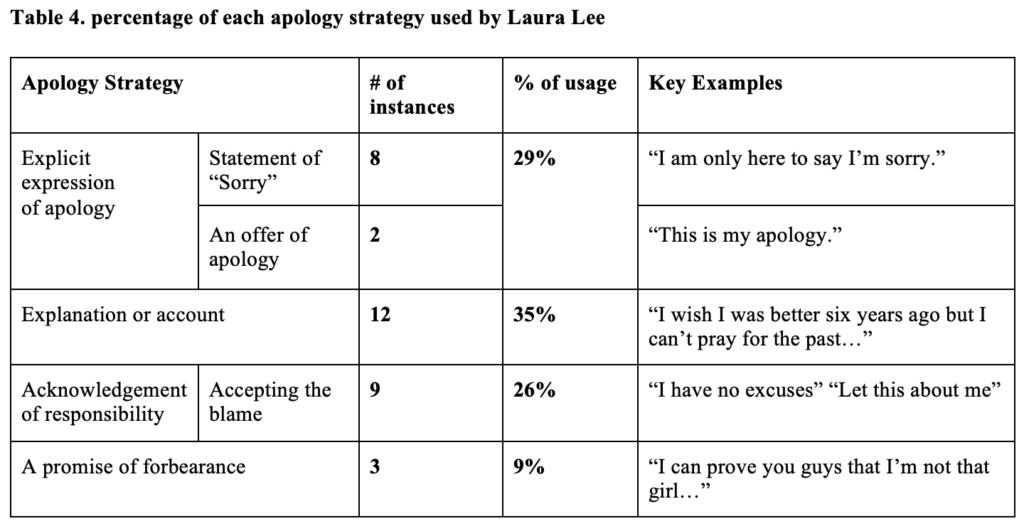
Laura Lee apologized for retweeting with racist comments in the year 2012. In her apology video, she applied explicit expression of apology 10 times, explanation or account 12 times, acknowledgement of responsibility 9 times, and a promise of forbearance 3 times. Laura used explanation or account most (p=35%) and explicit expression of apology (p=29%). Laura’s accounts or explanations were supposed to express remorse or clearly present the context of the event, but she ended up shifting blame. Laura’s strategy was to shift the responsibility to the younger her by reiterating the time when the retweet event took place was “six years ago” when she was “stupid and ignorant”. In terms of explicit expression of apology, Laura expressed her apology 10 times to different target audiences. She used “sorry” 8 times out of 10 and only said “apology” 2 times in the video which set an informal tone to her video. Overall, Laura’s apology video was like an interpersonal talk to her subscribers. Thus, even after editing, the apology video was not logical and seemed that she did not plan ahead and the use of sorry instead of a more formal term “apology” fit with this general tone.

A.4. Pewdiepie – apology video

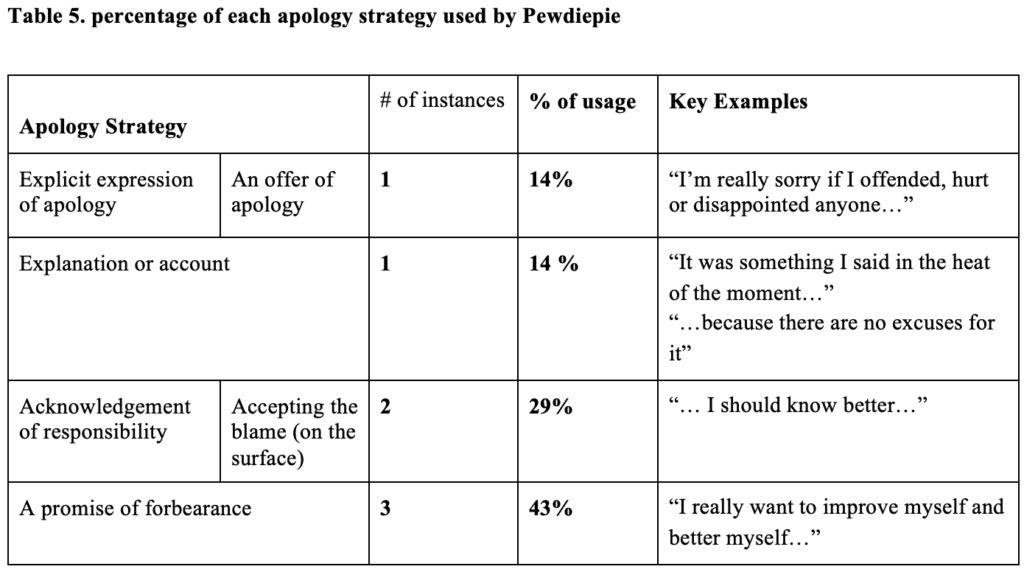
From our pool of samples, Pewdiepie (Felix Kjellberg) had the shortest video where the run time was under two minutes. He has over 100 million subscribers, and he made the apology video in order to address and apologize for his use of the N-word during a livestream. He used all strategies a total of only six times. He only explicitly apologized for hurting and offending viewers once, and his most used strategy was “promises of forbearance.” He explained he had used the slur in the heat of the moment but that it was ultimately an inexcusable action. He placed focus on his own need to be accountable for his character and what he planned to do moving forward. His video was extremely concise compared to our other samples, and viewers seemed to react positively towards his apology. In general, most viewers commented and judged that his apology was genuine. It is also interesting to note that his comment section had many users comparing aspects about his apology to other apologies, especially that of Laura Lee’s and Tana Mongeau’s.

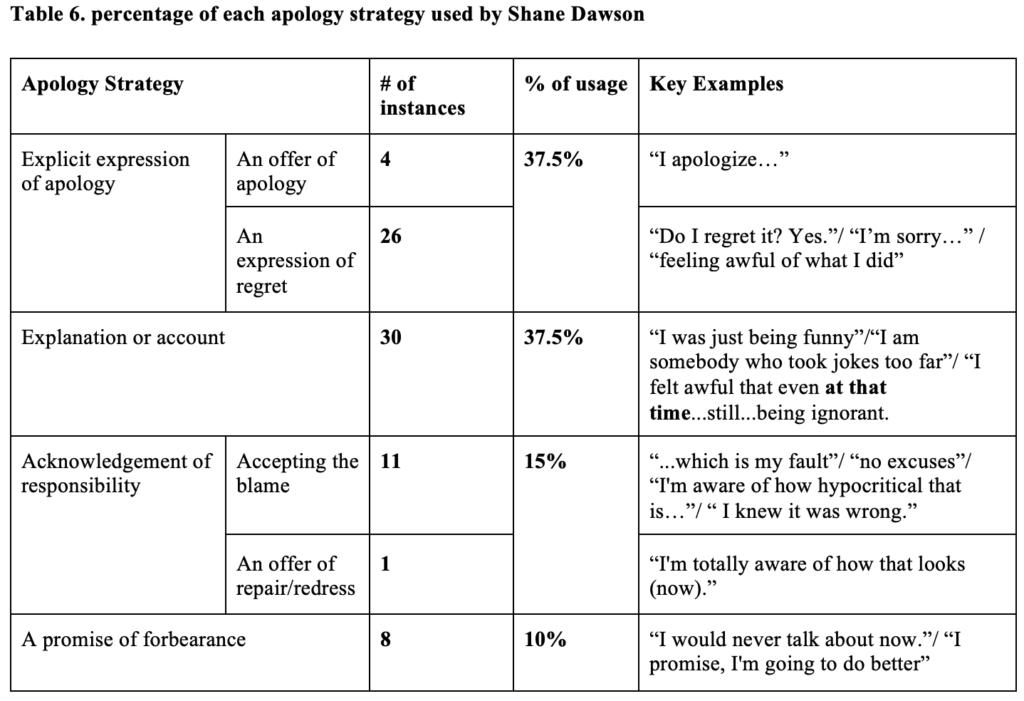
A.5. Shane Dawson – apology video

Shane Dawson made an apology video for doing blackface and saying the n-word in past racist YouTube videos. In his video, 80 instances counted as apology strategies, Shane mostly used “explicit expression of apology” (p = 37.5%) and “explanation or account” (p = 37.5%). “Acknowledge of responsibility” made up 15% of his apology, followed by 10% of “a promise of forbearance”. Specifically, the way Shane used “explicit expression of apology” mainly focused on expressing his regret (N = 26) through informal offers of apology “I’m sorry” which indicates Shane’s intention to resonate with his audiences. By repeating “I’m sorry” with the lowering of pitch, Shane reinforces his remorse and desperation. In terms of how Shane explained his wrong-doing, he frequently used –“funny” and “joke[s]” — to define his past mistakes. Moreover, he shifted to a higher pitch to imitate what the young Shane thought. However, this voice-shifting may not contribute to the apology but create the impression that Shane was trying to disassociate from the then-self and shift the blame. Shane also addressed himself from a third-person perspective, such as “I can’t even…see this white fucking guy do blackface.” The way he referred to himself may strengthen the impression that he was shifting the blame. The Youtuber did not frequently employ “acknowledgement of responsibility” and “a promise of forbearance”. Shane accepted the blame mostly and hardly offered a repair. Shane’s promises are also quite general and vague, such as his use of the demonstrative pronoun “that” in “I would never talk about that now”, which does not specify the action or mindset he would change.

A.6. Gabriel Zamora – apology video

Gabriel Zamora, an influencer with over 800 thousand subscribers, made an apology video for racist tweets he has posted in the past. By analyzing his apology video the data set above reveals that his most used strategies were “acknowledgement of responsibility” (p = 45%) and “explicit expression of apology” (32%). That being said, conclusions could be made towards the fact that those specific strategies are what contributed to bringing a positive light to his image because he is not just ignoring what he did, rather he is owning up to his mistakes and not making any excuses for himself. He recognizes his ignorance and explicitly states taking full accountability for it repeatedly throughout his video. Interestingly, he consistently used the phrase “truly sorry” 4/7 times he used the word “sorry”…“and for that i’m truly sorry…“the fact that i wasn’t [a positive creator] im truly sorry…” I believe his way of using it allowed for a greater expression of the extent to how regretful he actually was. Gabriel occasionally combined his strategies with “explanation or account,” his third most used (p = 13%) in efforts to disclose his true intentions…“i’m not a malicious person, i’ve never gone out of my way to try to bash someone in a racial way or in just a petty way in that sense.” Lastly, Gabriels usage in “promise of forbearance,” he promises his supporters/audience that he has educated himself and continues to do so. He also takes it upon himself to spread more awareness on the history behind the n-word by linking two educational videos about it in the description of the video. Although this seemed to be his least used strategy (p = 9%), the videos he linked helped boost his reputation by showing his audience that actions speak louder than words and he is moving towards the right direction to prove his growth.

B. Gender Differences

In Table 8, we calculated the ratio of each apology strategy usage by gender and came to the following realizations: 

  • The Frequency of Apologies: The result seems to buttress the theory that females were more likely to present explicit expressions of apology (Holmes,1989). However, as an evitable part of an apology video, the percentage of male and female using this approach is relatively close. From this point of view, gender seems to merely exert an influence on the linguistic differences of these stances (Stubbs, 2001).
  • Explanation or Account: Based on the data collections, females seem undoubtedly offer more verbal explanations or accounts than males. While most of the explanation or account for females is recounting the emotions, their apology video became longer and more complex. Females seem to include more verbal statements of concluding the whole controversial incident than males frequently may be less willing to use affirmative words to go over the account (Bennet, 2008). Overall, explanation or account drew huge linguistic differences between how males and females approach their apology.
  • Acknowledge of responsibility: Males present more acknowledgment of responsibility than females from the final data set. Gender differences in this stance are evident that males seem more likely to recognize their faults of actions. The mythological consideration for some females is vague. In Laura Lee’s video, she uses the denial strategies to shift the responsibility (Benoit, 2008), hence leading to an adverse audience reaction. In comparison, males seem more willing to acknowledge responsibility and re-evaluate the prior self who committed the transgression.
  • Promise of forbearance: Males perform more promise of forbearance than females. As usually the last part of an apology video, the promise of forbearance is crucial to provide the major idea of remedy to the transgression. Males seem more likely to provide corrective action and repair in the collecting data (Benoit, 2008). However, the overall proportion of promise of forbearance seems to appear identical for two genders without looking at the data of Shane Dawson who used this strategy the least. Hence a concrete conclusion is hard to draw from these 6 limited cases.

Discussion & Conclusion

The discussion on individual differences and gender differences are presented above. This section dedicated to looking at the audience’s overall comments reaction as outlined in Table 9, only Pewdiepie, Gabriel Zamora, and Jenna Marbles received a positive response. They all have different focuses on their strategies. Pewdiepie addressed most in the promise of forbearance, Gabriel Zamora focused on Acknowledge of responsibility and Jenna Marbles spent most of her video approaching explanation and account. Which might indicate promise of forbearance, acknowledgement of responsibility and explanation and account are more effective strategies. The overall conclusion is females are more likely to approach explanation and the frequency of apologies while males approach acknowledgement of responsibility and promise of forbearance strategies. However, all these conclusions just came from the limited 6 data sets and in a broader view, after excluding the extreme cases, most of the data appear to be identical between both genders (Holmes 1989). A key implication for this research is the importance of not only considering the difference in gender while looking at the apology videos, but also by looking at the approaches taken by different people on a larger view. The analysis and data for this paper might provide a good sample for further future studies of linguistics features in gender differences and apologies approaches.

References

Benoit, W. L. (2008). Image restoration theory. The International Encyclopedia of Communication.

Bennet, S. (2008). Gender and apologies: Exploring offended females’ perceptions of apologies from males and females. https://ro.ecu.edu.au/theses_hons/127

Cheng, M. (n.d.). The Stance of Personal Public Apology. Retrieved November 17, 2020, from https://scholar.uwindsor.ca/ossaarchive/OSSA11/papersandcommentaries/96/?utm_source=scholar.uwindsor.ca%2Fossaarchive%2FOSSA11%2Fpapersandcommentaries%2F96

Gabriel Zamora. (2018, Aug. 21). My Truth. [Video]. YouTube. https://www.youtube.com/watch?v=QWnmPEHzRrk&list=PLsuhXm2zs07IwijVL8Mkm4EnPab78F7TC&index=8

Holmes, J. (1989). Sex Differences and Apologies: One Aspect of Communicative Competence1. Applied Linguistics, 10(2), 194-213. doi:10.1093/applin/10.2.194

Jenna Marbles. (2020, July 2). Jenna Marbles Apology. [Video]. YouTube. https://www.youtube.com/watch?v=679d-SQfWLk

Karlsson, G. (2020). The YouTube Apology: analysing the image repair strategies and emotional labour of saying sorry online. Retrieved 2020, from https://www.diva-portal.org/smash/get/diva2:1483089/FULLTEXT01.pdf

Laura Lee. (2018, Aug. 20). Laura Lee apology video with original captions. [Video]. YouTube. https://www.youtube.com/watch?v=NYVmWxitVSQ&t=182s

Leppänen, S., Møller, J., Nørreby, T., Stæhrc, A., & Kytölä, S. (2015). Authenticity, normativity and social media. Discourse, Context and Media, 8, p. 1-5

Maclachlan, A. (2013). Gender and Public Apology. Transitional Justice Review, 1-21. doi:10.5206/tjr.2013.1.2.6

Pewdiepie. (2017, Sep. 12). My Response. [Video]. YouTube. My Response (Pewdiepie)

Shane Dawson. (2020, June 26). Taking Accountability. [Video]. YouTube. https://www.youtube.com/watch?v=ardRp2x0D_E

Smith, N. (2008). I was wrong: The meanings of apologies. New York: Cambridge University Press.

Tana Mongeau. (2017, Feb. 17). An Apology. [Video]. YouTube. https:/ /youtu.be/Fazh9Lm1kDE

[/expander_maker]

, , , ,

Gendered Use of Compliments and Insults in Professional Video Game Streaming

Kavi Dalal

This study examines male to male power hierarchy in online multiplayer video games. Using screen recorded footage of a professional gamer’s live broadcast as data in addition to transcription based conversation analysis, I present some observations on how compliments and insults are used in male socialized environments. The analysis sheds light on actual tactics employed by men in order to build solidarity and/or establish power amongst themselves. In conclusion I discuss the importance of continuing linguistic analysis at the intersection of gender and hierarchy in emerging online and male dominated environments.

[expander_maker id=”1″ more=”Read more” less=”Read less”]

Introduction

Gender inequality is a growing concern in the professional video gaming industry. Esports and professional gaming channels are growing more rapidly than ever as a form of globally reaching entertainment. Twitch, the most popular video game channel streaming platform, is presently ranked as the 32nd most traffic-heavy site in the world, ranking ahead of Twitter.com with millions of daily viewers and subscribers. Undoubtedly the market for professional gaming has grown to include a larger and more diverse following than ever. Still, male professional gamers continue to outnumber females by far in their field. According to the 2019 ESA annual report, female gamers represent roughly 46% of all video game players, yet only represent about 5% of the tactical shooter genre that is most commonplace amongst Esports competitions and professional competitive play. For this reason, sites like Twitch that broadcast professional gameplay videos are dominated by male-to-male dialogue between members of all-male gaming teams. These videos offer a unique window into the linguistic patterns of a highly gendered industry that is only growing in popularity and size.

Various studies have been conducted locating the meaning of compliments relative to gender and hierarchy in professional environments. Few however have analyzed male-male utilization of compliments and insults in a professional setting and none have used professional gaming as the sample for researching the operation of evaluative speech acts. Deborah Tannen and Janet Holmes are the loudest voices in academia when it comes to the gendered nature of complimenting. Both have proposed that women tend to perceive complimenting as an expression of positive affect or solidarity while men tend to view compliments referentially or with more emphasis on their objective informational content  (Holmes, 2008, p. 11). In You Just Don’t Understand: Women and Men in Conversation, Tannen (1990) argues that for men, complimenting is primarily about asserting one’s authority over the other through evaluation. Even when evaluating  someone positively, a person who gives a compliment is asserting that they have the authority to pass judgement on someone else. In return this causes men to occasionally perceive compliments as a face threatening act. Insults, another form of evaluation, are face threatening acts by nature. In an insult, the speaker gives a negative evaluation of some trait, possession, or behavior of their addressee, thereby attacking their positive face (Eckert & McConnell-Ginet, 2013, p. 187). This, coupled with knowledge that even positive evaluations can be used to assert dominance over an addressee, helps to explain why in interaction research, insults are viewed as a way to establish hierarchy and power. Perhaps surprisingly, however, many scholars have also theorized about how insults can be used to strengthen community bonds and establish solidarity. In The Hidden Life of Girls: Games of Stance, Status, and Exclusion, Goodwin (2006) describes both boys and girls trading mock insults as a way to practice verbal skills through play. Kochman (1972) has observed similar mock ritual insult exchanges between boys and theorizes that, while ritual insult can be used as a way to build bonds between addressors and addressees, even if an insult is intended as play, it may be taken seriously and seen as a face-threatening act. This risk is especially high when the insult just exaggerates an actual characteristic of the addressee. This research seeks to determine whether evaluative speech acts are used to build solidarity or enforce power differentials in an all-male professional game setting. Taking into account that there already exist observable power asymmetries between the owners of video game streaming channels and the other players they invite to play with them on their channel, research methods were designed to answer the following question. How are complimenting and insulting behaviors affected by the dominance status? Who pays more compliments and insults? Who is the typical addressee? Based on the prevailing theory that men typically use evaluation to assert their own authority to judge others, I hypothesized that both compliments and insults would flow down the power differential more freely than they flowed up it, and that ownership of a channel would contribute to the hierarchical power distribution.

Methods

Target Population

Research for this study was conducted by recording and analyzing gameplay dialogue between professional male gamers and their male teammates in multiplayer, first-person shooter games. Twitch is a live video streaming website specializing in E-sports broadcasting and personal streams of individual players known as “streamers”. The website operates on a channel and subscriber model in which a streamer runs a channel and amasses followers through streaming content and participating in tournaments. A streamer is able to monetize their channel through endorsing sponsors as well as being gifted small money contributions from subscribers. A typical stream session consists of broadcasted live game footage either solo or with teammates invited to play in a game broadcasted onto the channel. The video game that was chosen for this study was a first person shooter (FPS), battle royale style game titled Call of Duty: Warzone. Gameplay in Warzone is multiplayer, consisting typically of four teams fighting against each other to be the last one standing. Teammates communicate verbally through audio chat to strategize, but the audio communication is often used for socializing in less strategy demanding situations of gameplay. In the context of the gaming platform, the owner of the channel is superordinate to the guest players, and streamers with large followings hold particular status. As of June 16, 2020 TimTheTatman was the 8th most followed Twitch channel, boasting roughly 4.9 million followers and making him one of the most successful professional streamers. In this professional gaming environment, TimTheTatman’s role was analogous to a boss to his guests, some of which were professional streamers themselves but with smaller followings. Guest players were privileged to be on TimTheTatman’s stream and have exposure to his fanbase with no guarantee that they would be invited back again. In this context, the channel owner was the dominant player, and his guests were subordinates, or occupying a position of lower status.

Data Collection & Linguistic Units

This study analyzed six hours worth of gameplay dialogue between TimTheTatman and his channel guests. To collect data, instances of compliments and insults were recorded and tallied noting the speaker and the addressee. Addressors were broken into two categories: the dominant player (TimTheTatman) and non-dominant players (Tim’s three teammates). Addresses were broken into three categories: the dominant player, the non-dominant teammates, and the opponents (players on other teams that were encountered during the game). For this research a compliment was defined as a speech act that attributed credit from a speaker to an addressee, be it explicitly or implicitly, for some trait, action or possession valued positively by both interlocutors (Holmes, 1986, p. 485). An insult, on the other hand, was defined as “a negative appraisal and attack on the addressee’s positive face through implicit blame for what is being criticized” (Eckert & McConnell-Ginet, 2013, p. 187). Once the data was collected, certain calculations were required to accurately compare the data. The number of compliments/insult speech acts made collectively by all three guest players were subsequently divided by three to arrive at the mean number of compliments/insults made per guest player. Guests were not counted individually because there was no conclusive way to distinguish the voices of the three guest players on the audio chat. For that reason, the average number of compliments and insults per guest was calculated instead. The total number of speech acts by each type of speaker was also tallied, as well as the ratio of compliments to insults given by each type of player.

Results

Overall, the data from this study indicated that while the non-dominant player complimented others with more frequency than the dominant player did, the dominant player insulted his teammates more than non-dominant players did. Both dominant and non-dominant players complimented and insulted their opponents at roughly the same rate. As indicated in Figure 1, there was a significant difference in the frequency of compliments given out by the dominant player versus non-dominant players. On average, non-dominant players complimented their teammates and the dominant player twice as often (4 times) as he complimented them (twice). Interestingly, both dominant and non-dominant players complimented their opponents at exactly the same rate (twice). There was no difference between the rate at which the dominant player complimented his teammates and his opponents. However, non-dominant players averaged slightly more than twice as many compliments for their teammates as for their opponents.
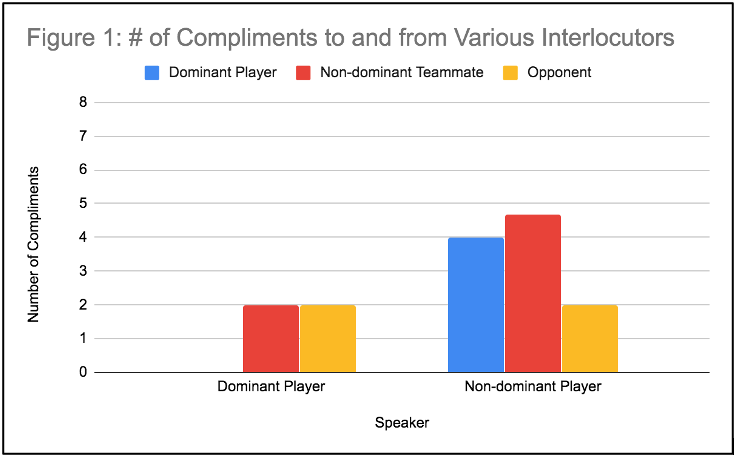
By contrast, Figure 2 shows that the dominant player insulted his teammates at a much higher rate (7 times) than the average non-dominant player insulted him (2.3 times) or other non-dominant teammates. Both the dominant player and the non-dominant players insulted their opponents at roughly the same rate (2 and 2.6 times respectively), and interestingly, this was similar to the rate at which both speakers complimented their opponents. The dominant player insulted his teammates at more than three times the rate that he insulted his opponents. The average non-dominant player insulted the dominant player slightly less than he insulted his opponent, and insulted other non-dominant players even less than that.
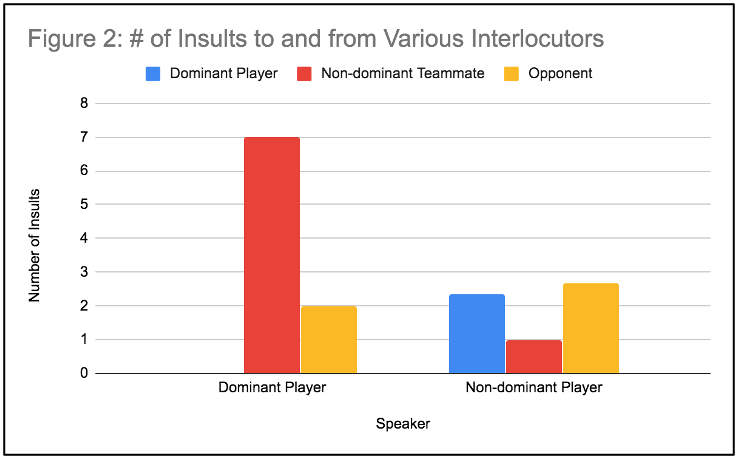
In total, dominant and non-dominant players engaged in a similar number of evaluative speech acts. As is visible in Figure 3,  the dominant player engaged in a total of 13 evaluative speech acts, and the average non-dominant player engaged in an average of 16.7 evaluative speech acts over the course of six hours of gameplay. The preferred type of evaluation differed by addressor, however. 
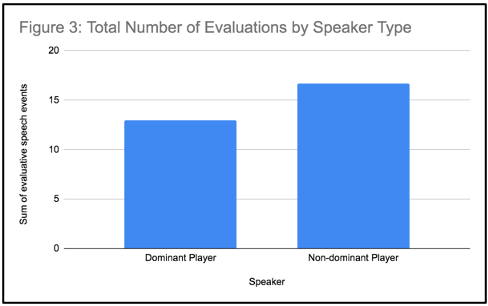
Figure 4 shows that 69.2%, or slightly more than two thirds, of the dominant player’s evaluative comments were insults and only 30.8% were compliments. Conversely, only 36%, or slightly more than a third, of the average non-dominant player’s evaluative comments were insults, while 64% were compliments.
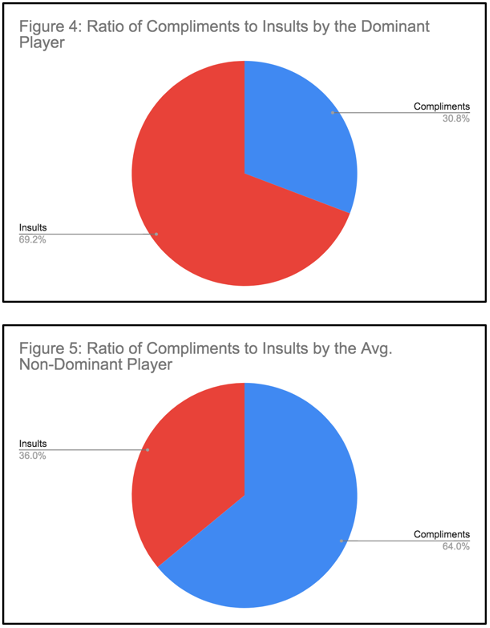
Discussion

In setting out to conduct this research, I hypothesized that evaluative speech acts would be used in all-male gaming settings to assert power and reinforce hierarchy. I expected that the dominant player would engage in more evaluative speech acts than non-dominant players did. The data suggests, however, that the overall frequency of evaluative speech acts does not reflect the hierarchy within this setting as much as the types of evaluations and whom they were directed to do. Both the dominant and non-dominant players had similar numbers of evaluative comments, and, in fact, the non-dominant players made ever so slightly more evaluative comments.  The fact that dominant and non-dominant players both complimented and insulted their opponents at a similar rate suggests that evaluating individuals outside of a group is a low-risk way for all players, regardless of hierarchical status, to build solidarity amongst individuals within the group. Goodwin (2006, p. 232) reinforces how insults can function to unite those laughing with the insulter while othering the target. Contrary to my hypothesis, the data showed that while the dominant player had a higher tendency to insult teammates, the average non-dominant player had a higher tendency to compliment. One explanation is that,  “implicit in any evaluation is a claim on the part of the evaluator that he or she is in a position to judge the evaluatee. And taking an evaluation seriously attributes this position to the evaluator.” (Eckert & Sally McConnell-Ginet, 2013, p. 180). In other words, the dominant player’s frequent use of insult seems to support the interpretation of evaluations as speech acts used to assert power.

However, the frequency of compliments from the non-dominant player directed toward the dominant player raises questions about this interpretation. One potential explanation is that non-dominant players used compliments to facilitate interaction and create solidarity within the gameplay. This type of compliment use has been frequently observed within groups of women, as well as in co-ed groups where women take on the role of the ‘interactional shitworker’, instigating and facilitating communication between the parties present (Fishman, 1978, p. 398). Given the inferior status of non-dominant players within the Twitch power hierarchy, it seems likely that these players use of compliments in this setting is evidence that they were attempting to deliver positive affect compliments, which have been typically gendered as a more feminine use of complimenting, (Holmes, 2003, p. 143). The difference between the use of compliments as a solidarity building linguistic act as opposed to an evaluative linguistic act is illustrated in the excerpt below.

Excerpt 1

3:59:43-4:00:10

TIM=TimTheTatman        PL1=guest player 1 
PL2=guest player 2      PL3=guest player 3

01  PL1:     Tim the Tatman’s~cookin ~now~uh-

02           ((Tim’s character dies))

03  TIM:     I got sniped at the same fucking time I just want to 

                                                      fuck myself

04           baby, YEAH:::=

05  PL1:     =(h):::m (h)m (h)m? 

            ((laughter followed by 6x slow claps))

06  TIM:     Put it right in my f(h)ucking a:::ss.

07  PL2:     Alright calm down for two seconds I’m coming.=

08  PL3:     =I’m stayin here cause they’re hunting me

09  PL1:     hhhhu hhh (1) hhhhhe:: ((laughter))

10           ((Tim gets revived by PL2))

11  TIM:     Hey thank you Matt you’re a good friend.

Excerpt 1 opens with a compliment from Player 1, a non-dominant player, about Tim, the dominant player. Player 1 observes that Tim is “cookin,” a metaphor implying that Tim is playing well. Although the compliment is about the dominant player, it is not addressed directly to him. Rather, it is addressed to the group and names Tim in the third person. This, coupled with the fact that the compliment evaluates Tim’s playing generally without describing any specific feature of his gameplay, suggests that Player 1 is using flattery to create solidarity with Tim rather than to evaluate him objectively. “Giving praise is inherently asymmetrical,” and compliments given from a high hierarchical position to someone lower are called “praise” while a compliment from a lower position upwards is called “flattery”, (Tannen, 1990, p. 69). Immediately after Player 1 flatters Tim, Tim makes a mistake and his avatar dies. Tim acknowledges the mistake and then adds “I want to FUCK myself baby,” followed by “put it right in my fucking ass”.  Often, men use sports metaphors to describe sex, but in this example the inverse is true (Eckert & McConnell-Ginet, 2013, p. 250).  Sex, specifically the act of being penetrated, is a metaphor for losing, or dying, in the game. Tim uses misogyny to liken himself to a woman or other passive participant in sex. His use of profanity and hyperbole detracts from the sincerity of the admission that he made a mistake, and therefore diverts blame away from himself. Ironically, by linguistically equating himself with a powerless participant in a graphic sexual act, he is able to save face by avoiding a sincere apology or acknowledgement of his mistake. This outburst spurs Player 2 to put his own avatar at risk to revive Tim’s player, after which Tim says, “Hey thank you Matt, you’re a good friend.” In contrast to Player 1’s compliment, this statement is directed at its subject and directly acknowledges a specific helpful behavior from Player 2. This is a rare instance of compliment from the dominant player, and is in keeping with the observation that when compliments are less frequent, they are more likely to be referentially oriented or genuine expressions of admiration (Herbert, 1990). This compliment garnered no response from the addressee or the other players, which is typical of most compliments in this setting apart from the occasional expression of gratitude. This evaluation allows Tim to assert his authority to evaluate Player 2. Perhaps he does this in part to recover his face after having lost agency in the course of gameplay.

Excerpt 2 illustrates the ways that insults are used to assert power and establish solidarity. It is an outlier situation in which we get to see both dominant and non-dominant players insult each other.

Excerpt 2

4:19:55-4:20:21

TIM=TimTheTatman     PL1=guestplayer 1

01  PL1:     Tim you’re always nowhere near us [fighting people

02  TIM:                                       [ºsh:::: I got this 

                                                          shit bro

03  PL1:     ((sarcastic)) Oh here we go

04           ((tim kills opponent))

05  TIM:     wha what did you say Matt,

06  TIM:     ((mocking)) Oh here we go. Yeah look at that shit bro

07  PL1:     Tim I gotta be honest with you man 

08           like know your truth. You die a lot=

09  TIM:     =No I do not.

10  PL1:     Tim there’s another guy there’s another guy below 

11           you. I mean you are deaf as a fucking.

12  TIM:     under me::?

13           (3)

14  Tim:     ºI’m so confused bro

This excerpt begins with a non-dominant player implying that Tim is too far away from his teammates, to which Tim tries to reassure Player 1 that he “got this shit,” and is therefore in control, not a liability. Player 1 responds in an exasperated tone, implying that he doesn’t trust Tim not to mess up. His use of sarcastic tone suggests this is an instance of an off-record request using irony (Brown and Levinson, 2014). The implied request is that Tim not enter into combat by himself. Rather than accepting the request, Tim quickly questions and repeats Player 1, in effect insulting and mocking him. Even though non-dominant players rarely insult Tim, overtly or implicitly, in this instance, Tim responds to Player 1’s suggestion as if it were an insult. This is a reasonable reaction  considering Eckert & McConnell-Ginet posit that “comments can be taken as serious insults even if not so intended” (Eckert & McConnell-Ginet, 2013, p.188) . He sees it as a face threatening request and he questions player 1’s right to challenge Tim. He then mocks Player 1’s indirect, less confrontational, and more stereotypically feminine speech style by repeating the phrase “Oh here we go,” in a mocking tone. This indirect insult reaffirms Player 1’s subordinate status. What follows in lines 6 to 11 is an escalated series of insults from Player 1 and more deflections from Tim. Given the tone of the insults, this seems to be an example of “mock ritual insult” (Kochman, 1972, p. 314). The teammates seem to be verbally jousting more than they are giving serious insults. Tim holds his face throughout the whole altercation. He didn’t give legitimacy to any of the insults by evaluating them as false. In this way he was able to maintain face by resisting imposition (Brown and Levinson, 1987).

Conclusion

The total amount of evaluative speech acts had no bearing on enforcing power differentials in an all-male professional game setting. Insults flowed down the power differential more frequently as expected, but contrary to my hypothesis, compliments flowed up it more frequently. This was ultimately attributed to non-dominant players’ assumption of a more typically feminine speech style that utilized compliments effectively to boost solidarity. This exposes how gendered hierarchies are present in language between men, even when no women are present.

One limitation of this study was difficulty distinguishing the voices of guest players. In a future study a stream in which the voices of players could be distinguished via timbre and pitch would be preferable. This study also only analyzed one small slice of the gaming world. Future studies could benefit from analyzing a wider spectrum of games and streamers that might reflect different power hierarchies. In addition there are more nuanced speech acts such as declaratives which were far more frequently occurring than compliments and insults. I would encourage subsequent studies to analyze other evaluative speech acts in male-male gameplay and how they operate to assert a hierarchy. This research unsurprisingly shows that language between males in professional gaming ascribes to strict patriarchal tendencies. This is important to understand in the growing field of professional gaming, and this language must be challenged if women are to have a more representative presence in the profession. Certain Twitch streamers such as KittyPlays are paving the way for the next generation of female pro gamers by challenging sexist language as it is encountered real time during her stream. Nonetheless, given that hidden biases are likely to perpetuate in this domain through language even if there are more professional female players,  more studies should look into gender hierarchy’s implications on the gaming world given its influence over language in popular culture.


See also:

HALO 3: Negative comments by gender

SEXISM IN VIDEO GAMING: Online harassers are literally losers?


Bibliography

Berger, P. L. and T. Luckmann (1966). The Social Construction of Reality: A Treatise in the Sociology of Knowledge. Garden City, NY: Anchor Books.

Brown, P. & Levinson, S. C. (1987). Politeness: Some universals in language usage. Cambridge: Cambridge University Press.

Eckert, P. & McConnell-Ginet, S. (2013). Language and Gender. Cambridge: Cambridge University Press.

Fishman, P. (1978). Interaction: The Work Women Do. Sociolinguistics by N. Coupland and A. Jaworski. London: Palgrave.

Goodwin, M. H. (2006). The Hidden Life of Girls: Games of Stance, Status, and Exclusion. Oxford: Blackwell.

Herbert, R. K. (1990). Sex-based Differences in Compliment Behavior. Language in Society, vol. 19. Cambridge: Cambridge University Press.

Holmes, J. (2003). Complimenting: A positive politeness strategy. Sociolinguistics: The essential readings. ed. by Christina Bratt Paulston and G. Richard Tucker. Malden, MA: Wiley-Blackwell.

Holmes, J. (2008). An introduction to Sociolinguistics. London: Pearson Education Limited.

Kochman, T. (1972). Rappin’ and Stylin’ Out: Communication in Urban Black America. Chicago: University of Illinois Press.

Tannen, D. (1990). You just don’t understand: Women and men in conversation. New York: William Morrow.

twitch.tv Competitive Analysis, Marketing Mix and Traffic – Alexa”. www.alexa.com. Retrieved June 16, 2020.

[/expander_maker]
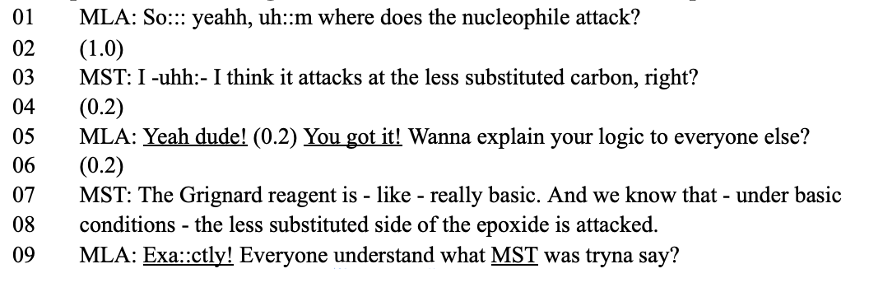


Manspeak: Is It a Real Thing? Is It Sexist?

Evan Yong

Videos of celebrity interviews on the show “Conan” are analyzed to see whether female guest interviews or male guest interviews have more authoritative language. In this study, authoritative language is broken down into three components: interruptions, commands, and hedging. Hedging occurs when a speaker is trying to convey uncertainty or ambiguity by using tag questions or phrases such as “kind of,” “sort of,” or “I guess.” For each and every interview, I count the number of times the celebrities and Conan interrupt each other, the number of times they give commands to each other, as well as the number of times they hedged their sentences. Results show that overall, there is more authoritative language used in Conan interviews with male celebrities than female celebrities. The male guest star interviews with Conan have more interruptions and commands as well as less hedging than the female guest star interviews. Men appear to be more “in competition” with other men, more so than with women. In today’s modern-day society, this is characterized by fighting over control of the floor to establish linguistic dominance in a conversation.

[expander_maker id=”1″ more=”Read more” less=”Read less”]

Don’t men seem to have their own language when they talk to other? It is most definitely characteristically different from the way they talk to women. Aside from the trite but quintessential stereotype of guys calling each other “dudes” or “bros,” they also appear to use harsher language when speaking to one of their own. There seems to be a universal preconceived notion that this is the way a man must act with other men; little boys were raised and taught to embody certain traditionalistic masculine behaviors growing up, such as the way they should talk to members of same as well as opposite sex. A study conducted by Yokoyama (1999) on Russian children’s literature found that even the texts in children’s books were rife with these stereotypes that men have to be strong and women are inherently weak. The gender stereotypes were even represented in the way male and female characters talk in the books. Female characters are nine times more likely to speak with diminutives and interjections compared to male characters (Yokoyama, 1999), giving the impression that they “softer,” “cuter,” more polite, as well as more easily confused than male characters.

These are the types of books that we commonly get for our developing young children. Apparently, these textually-represented gender stereotypes are prevalent from nursery books all the way to preschool level texts (Yokoyama, 1999). Children are able to differentiate between the two sexes and their associated activities (i.e. boys play with toy soldiers and girls play with dolls) from as young as 2 years old (Thompson, 1975). Because of this, Yokoyama (1999) argues that these children’s books can most definitely influence the way children grow up and how they come to think of the two genders as they develop into mature adults.

Fortunately, this may not be the case. A recent study conducted by Park et al. (2016) claims that based on their Facebook posts, women are just as assertive as men are. The study found women to be warmer, politer, and have more compassion than men, but are just as assertive. It would appear that, based on people’s online behavior, they did not grow up to fulfill the traditionalistic stereotypes imposed on them as children.

The study conducted here today hopes to solidify and support Park at al.’s (2016) findings that women are just as assertive as men by analyzing the language used in internet videos. Internet videos are arguably the most accessible and popular form of media being used today. Just imagine the possible implications of sexist overtones being present in the viral videos young children around the globe watch during recess in the playground, quietly influencing their views on the world. My focus today is specifically on Conan celebrity interviews on the TeamCoco channel on YouTube. “Conan” is a late-night TV talk show that airs on TBS but also has clips frequently uploaded to their YouTube channel. It is hosted by comedian Conan O’Brien and “sidekick” Andy Richter.

I analyzed the differences in authoritative language between Conan interviews with male celebrities and female celebrities. I divided authoritative language into three subsections: hedging, interruptions, and commands. Hedging is a linguistic phenomenon that occurs whenever a speaker is trying convey uncertainty or ambiguity. A common example of this is by adding the phrases “I guess” or “kind of” to sentences. Another is by adding tag questions to the end of sentences like, “You’re John, aren’t you?” Hedging would be an example of unauthoritative language. Interruptions is further divided into two more subsections: successful interruptions and unsuccessful interruptions. A successful interruption is when someone successfully interjects and the other person stops talking. An unsuccessful interruption is when someone interjects but the other person continues talking and so the first person who initially interrupted stops talking. Commands is anytime anybody in the interview tells another person to do something using a direct imperative like, “Tell us about your day,” or “Stop it!” Any commands addressed to the live studio audience were not counted into the results of this study. Interruptions and commands would be considered examples of authoritative language. A combination of low instances of hedging and high instances of interruptions and commands would mean a high “score” for overall authoritative language.

Table 1. Total number of instances of hedging, interruptions, and direct imperatives (commands) in female celebrity interviews with Conan
Table 2. Total number of instances of hedging, interruptions, and direct imperatives (commands) in male celebrity interviews with Conan

Based on the tables above, it is quite clear that male celebrity interviews had far more instances of overall authoritative language than female celebrity interviews; male celebrity interviews had more instances interruptions and commands as well as far less instances of hedging. It would appear that the hosts (both men) appear to use different types of language when speaking with male celebrities than with female celebrities. This is not consistent with the results from Park et al. (2016) that women were just as assertive as men. In the context of celebrity interviews, the female celebrity Conan interviews had far less authoritative language used than the male celebrity Conan interviews. Moreover, the hosts consistently hedged more in the female celebrity interviews than they did in the male celebrity interviews. This further solidifies and supports the idea that men do indeed talk differently with other men than with women.

It would seem that we as a society have not quite reached the level of progressiveness as we had hoped and that traditionalistic stereotypes still haunt our subconscious biases to this very day. The frightening takeaway from this study is that these effects were observed after only analyzing two hours’ worth of Conan footage. If we were to assume that these Conan celebrity interviews accurately represented and reflected the entire population of internet videos, it would indeed be a dangerous and unnerving precedent. Almost every young child in the Western hemisphere carries around a smartphone around with them and with that, internet access. Should you choose to believe Yokoyama (1999), these viral videos that your kids are watching everyday are casually and subconsciously influencing the way they think, particularly on their beliefs and opinions on the two sexes, based on the subtle linguistic differences that occur between the men and women in those videos. The language used in these videos, and consequently the beliefs that come along with it, will be emulated by our future generations unless we decide to make a change, now and today.


References

Park, G., Yaden, D. B., Schwartz, H. A., Kern, M. L., Eichstaedt, J. C., Kosinski, M., … & Seligman, M. E. (2016). Women are warmer but no less assertive than men: Gender and language on Facebook. PloS one11(5).

Thompson, S. K. (1975). Gender labels and early sex role development. Child Development, 339-347.

Yokoyama, O. T. (1999). Gender linguistic analysis of Russian children’s literature. PRAGMATICS AND BEYOND NEW SERIES, 57-84.

[/expander_maker]
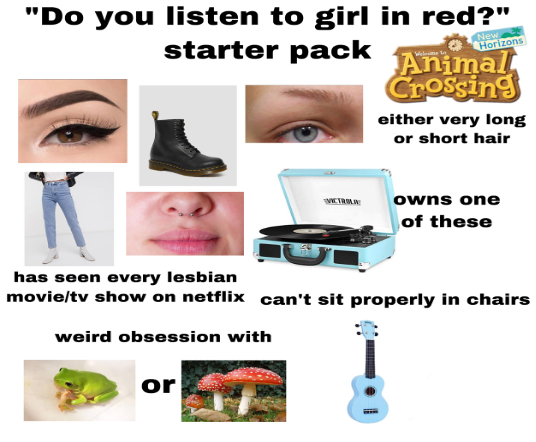
Did you just interrupt me again? Gender and Interruptions in Presidential Political Debate

Chloe Tamadon

The central question I want to address in this blog is the impact that gender can have on the way politicians choose to express themselves in political debates and how gender can influence the type of interruption. Interruptions can range from being more destructive and face-threatening to being more supportive and polite. So what is a face-threatening act? A face threatening act threatens the face of the speaker or the hearer and may threaten what is called a positive or a negative face. Politicians on the debate stage commonly threaten the positive face of their opponents by negatively evaluating the hearer’s face through criticism and interruption.

According to Brown & Levinson, “face is threatened when individuals intrude on others to pursue their own goals, and even minor face threats can threaten the other’s chosen image and damage the relationship”. This can be seen on the debate stage as male politicians will threaten and criticize other candidates by employing face-threatening interruptions while female candidates are more likely to use supportive and non-threatening interruption as a result of the societal expectation that “women ought to communicate politely” (Rudman & Glick, 2001). Women utilize face threatening acts less often. This is because they are expected to communicate more politely by endorsing politeness speech strategies. As expressed in literature, “politeness enables people to make requests or express ideas and opinions without threatening the other’s face, which is one’s chosen image” (Goffman, 1967). Women are more likely to engage in this form of polite and non-threatening communication than men.

[expander_maker id=”1″ more=”Read more” less=”Read less”]

Introduction

I am going to study the Democratic presidential debate held on February 19, 2020 in Las Vegas, Nevada. This is an interesting opportunity to study gender dynamics, and the effects gender can have on the types of interruptions politicians employ during a debate. To understand this, it is important to study the portions of the debate where there is a lot of discussion and conversation between candidates. In these moments, we see different kinds of interruptions take place: some threatening while others are more supportive. It is expected that the evidence will point towards the following: that when men interrupt others, they are more likely to do it in a face-threatening or rude manner so that they can criticize and threaten the image of their opponent while women are more likely to interrupt in ways that are supportive and less face-threatening (thus communicating politely). This can be applied in the context of debates as male candidates will likely interject and interrupt other candidates in order to either make a threatening comment or to defend against a face-threatening act in order to damage their opponents’ image and position themselves in a better light. Women, on the other hand, are less inclined to jump in with the same assertiveness for fear of being deemed too aggressive or threatening by the public (Pfafman, 2014). During the course of this Democratic presidential debate, candidates frequently interrupt and challenge one another on stage by employing different kinds of interruptions (either more threatening or more supportive)—specifically looking at how these types of interruptions are utilized by each gender and how often they are used.

Methods

In watching the Democratic Presidential Debate that was in Las Vegas on February 19th, 2020, I focused on portions of the debate where candidates entered into heated discussions and responses that resulted in a high frequency of interruptions. The portions studied were about 1-2 minutes in length and contained multiple interruptions of varying types. These interruptions span the range from face-threatening to supportive. I counted the number of interruptions of each type and kept track of who made them (whether the person was male or female). The following legend decodes the transcriptions below:


Results and Discussion

The following examples from the beginning of the debate depict interruptions between Buttigieg and Sanders that are considered to be face-threatening acts since they threaten the hearer’s positive face. In this example, Buttigieg is speaking about the campaign contributions he has received from his supporters and says the following:

Sanders interrupts Buttigieg in order to threaten Buttigieg’s face and self-image (in this case Buttigieg is the hearer). This interruption is an expression that negatively evaluates Buttigieg’s positive face as Sanders is criticizing who Buttigieg is receiving his campaign contributions from. It can also be understood that the speaker (Sanders) does not care about the hearer’s positive face because he is not only interrupting Buttigieg, but also criticizing him in the same moment in line 4. A few moments later, Sanders interrupts Buttigieg again in line 14.

This example of a face-threatening act is motivated by the desire to damage Sanders’s positive face and threaten his image. The interruption in line 11 comes as a response to this attack, so Sanders interrupts Buttigieg in order to defend himself and take back some control from Buttigieg. It is understood that communication style is shaped by many factors—one of the most important ones being gender (Pfafman, 2014). Thus, the relationship between the use of face-threatening acts and their frequency must at least in part be due to the differences in communication styles between the genders. Politeness strategies and politeness patterns differ based on gender: men are less likely to reduce the inherent harm of face-threatening acts while women are more likely to behave in ways that utilize politeness strategies in order to mitigate the harm of face-threatening acts (Ramadhani, 2014).

Interruptions may not always be face-threatening, sometimes interruptions can be more supportive. In this example, Warren attempts to interrupt Buttigieg in line 5:

In line 5, Warren interrupts Buttigieg but does so just as Buttigieg is wrapping up his response in line 4. This type of interruption is non-threatening as Warren is not attempting to criticize Buttigieg nor is she striving to defend herself; she is attempting only to insert her opinion in a moment when Buttigieg is done speaking. Her interruption was not disruptive, and it did not occur at a time in the conversation where it would have derailed the speaker’s train of thought. Therefore, it cannot be considered a deep interruption. The interruption also did not have any face-threatening qualities to it since there is no indication in line 5 that Warren was motivated to threaten Buttigieg’s image or attack him.  Since the interruption occurred right at the end of her opponent’s statement and was not meant to criticize; this interruption can be classified as non-face threatening because it does not threaten the speaker’s face or the hearer’s face. Women are challenged by the constructed notion that “they ought to communicate politely” (Rudman and Glick, 2001) so when female politicians interrupt others on the debate floor; it is less likely because they want to introduce criticism or threaten another individual and more likely because they want to “make requests or express ideas and opinions without threatening the other’s face” (Goffman, 1967). This is done so through the patterns of politeness that women are socially expected to present.          

Conclusion

In this blog, I studied the types of interruptions in presidential debates and how gender plays a role in these interruptions. I was specifically studying whether the interruptions were more supportive or more face threatening. There is evidence that politeness does have an impact on how each gender employs different types of interruptions in language. It is found that women, since they more commonly utilize politeness patterns and strategies, are less likely to produce interruptions that threaten or attack another person’s positive face. This is because there are societal expectations and standards in western culture that favor polite women, and in these situations, women will attempt to mitigate and reduce the harmful effects of face-threatening acts by using these politeness strategies to appear less assertive. This becomes especially important on the debate stage where the perception of the candidate is important to maintain a certain public image. The genders have different communication styles that allow them to use language in different ways—meaning that the types of interruptions as well as how and why they are used in conversation are also gender dependent.


If you are interested in learning more about politeness theory or face-threatening acts in general, the following links to videos may be of interest:

A Coursera video on the notion of face (free course)

A YouTube introduction to Politeness theory

References

Brown, P., & Levinson, S. C. (2006). Politeness: some universals in language usages. In A. Jaworski & N. Coupland (Eds.), The Discourse Reader (pp. 311-323). London & New York: Routledge.

Eelen, Gino (2001). A Critique of Politeness Theories. Manchester: St Jerome.

Goffman, E. (2006). On Face-Work: an analysis of ritual elements in social interaction. In A. Jaworski & N. Coupland (Eds.), The Discourse Reader (pp. 299-310). London & New York: Routledge.

Janney, Richard W. and Horst Arndt (1993). Universality and Relativity in Cross-cultural Politeness Research: A Historical Perspective. Multilingual 12.1: 13-50.

Locher, Miriam A. and Richard J. Watts (2005). Politeness Theory and Relational Work. Journal of Politeness Research 1.5: 9-33.

O’Driscoll, Jim (2007). What’s in an FTA? Reflections on a Chance Meeting with Claudine. Journal of Politeness Research 3.7: 243-268.

Pfafman, Tessa M. “Polite Women at Work: Negotiating Professional Identity Through Strategic Assertiveness.” Taylor & Francis, 2014.

Ramadhani, Putri. (2014). Politeness Strategies And Gender Differences In Javanese Indirect Speech Acts. Jurnal Linguistik Terapan Pascasarjana Unimed. 11 (1): 24-33.

[/expander_maker]

Scroll to Top