gender

Feminine Stereotypes: a Closer Look at The Princess and the Frog

Tasha Bierling, Sophia Maxson, Angela Ramirez, and Daniel Walsh

The Princess and the Frog, the diversity jewel in Disney’s crown, might not be as progressive as you’d think. Pink frilly dresses, big blonde hair, bows and sparkles, and an over-the-top, ditzy personality–it’s a stereotype we’ve all seen before in movies and tv. The creators of The Princess and the Frog took this well-known “dumb blonde” stereotype to another level with the character Charlotte La Bouff, and in doing so, perpetuated a stereotype to their viewers, many of whom tend to be very young.

It’s clear from her appearance that the New Orleans princess enjoys the feminine things in life. Charlotte visibly conforms to many misogynist stereotypes in both her appearance and her viewpoint. However, the focus of our research is to investigate whether her over-the-top feminine portrayal carries through in her speech as well. We have identified several linguistic features through other research that sound stereotypically feminine: uptalk, repetition, interjections, and rapid speech.

If Disney has employed these markers in the stereotypical portrayal of a female character, then they have presented a platform for impressionable youth to internalize these unsaid judgements. We are curious as to whether these aspects are more common in Charlotte’s speech than in that of the other main characters, Tiana and Naveen, whose presentations are less traditionally feminine.

[expander_maker id=”1″ more=”Read more” less=”Read less”]

Intro

In Disney’s The Princess and the Frog, the ditzy side character Charlotte is depicted as an overemphasized representation of femininity.

She is the beautiful, blonde princess, and her character carries all its demeaning perceptions: being unintelligent, emotional, spoiled, superficial, and socially incompetent. Her personality and appearance often exaggerate these characteristics–she has a high-pitched voice, often wears puffy pink dresses, and her main goal in life seems to revolve around “finding her prince.” The way she speaks also reflects this feminine stereotype.

Comparing how often Charlotte uses these features to that of the other characters could reveal how the film uses language to stereotype Charlotte as superficial and stupid. For instance, by contrasting Charlotte with Tiana, we see that Tiana’s personality and appearance are much less stereotypically feminine.
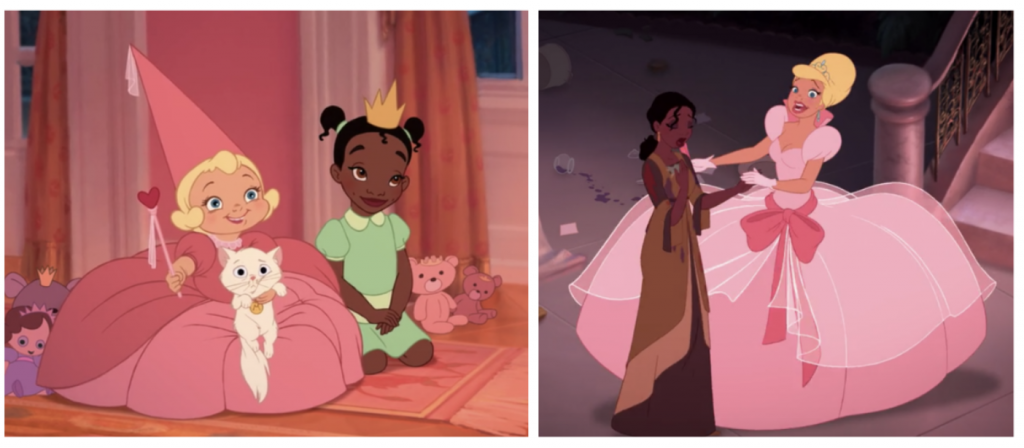
Tiana is portrayed as responsible, practical, intelligent, and grounded, opposing Charlotte’s over-the-top personality. This is important because society often stereotypes individuals similar to Charlotte, either by making them seem dumb or criticizing this representation of women. Furthermore, studying the portrayal of these stereotypes in Disney movies is especially important, since Disney’s audience is young and impressionable.

We theorized that specific aspects of Charlotte’s linguistic performance emphasize the stereotypes that go along with her character: to the audience, she is just an airhead. We will explain why it was so easy for Disney to use these aspects to box Charlotte in under “Background.”

Our goal is to analyze how specific aspects of her speech help her sound more stereotypically feminine, that is, dumb, emotional, and socially unaware. To do so, we will focus on her use of uptalk, rapid speech, repetition, and interjections. We will compare how often she uses these linguistic aspects with two other characters: Prince Naveen, a male, and Tiana, a female who displays more masculine characteristics, such as being hardworking, practical, and independent.

We will focus our study on Charlotte because she is a side character included for comedic purposes, and therefore the stereotype is exaggerated,  as well as to contrast Tiana’s character. As a result, we expect these stereotypes to be plentiful and more noticeable in Charlotte’s language than in that of the other characters.

Background

Identity

Charlotte plays a rich, white princess in 1920’s Louisiana. She is an upper-class woman who displays acts of significant extravagance, lack of awareness, egotism, and shallowness, which are representative of a typical wealthy woman of this time. Her exorbitant wealth acts to demean her in a story about the American Dream, and her indoctrination in 1920’s gender roles helps categorize her as shallow.

If her appearance, worldview, and speech patterns weren’t enough to define her as a feminine stereotype, you only have to look at what she actually talks about: every time we see her, Charlotte is obsessing about a man, a prince. Disney defines her as “girly” by giving her dreams of a little girl: to marry a prince and become a princess.

Target population

We will be analyzing the linguistic patterns of Charlotte, Tiana, and Prince Naveen, and how they might factor into the overall portrayal of feminine expression in the Disney film.

Charlotte’s depiction as unintelligent suggests that women who hold similar characteristics are unintelligent as well.

A push for the audience to draw unfavorable conclusions towards individuals who hold the same linguistic and characteristic patterns as Charlotte causes prejudice. Disney designates Charlotte as a stereotype as a way to further emphasize the fact that feminine women like her only serve a role as side characters.       

Linguistic aspect

The linguistic aspects we will be investigating are uptalk, rapid speech, repetition, and interjections.

Uptalk refers to when your vocal tone rises at the end of a phrase, as it would in a question. It is often seen as expressing inferiority, lack of confidence, etc. It can be seen across cultures or dialects and usually occurs in a group that society puts into an inferior position (Guy, 1986). Uptalk has been recorded in teenagers and the working class, but it is the most identifiable as being feminine and is generally understood as a female trait.

Rapid speech refers to Charlotte’s tendency to speak faster than normal, or at least more quickly than Prince Naveen and Tiana. It has been observed in numerous scientific studies that men believe that women talk more frequently and faster than they actually do. Studies such as Cutler (1990) show that women are often perceived as talking faster and more often than they really do in everyday conversation.

Also, repetition refers to Charlotte’s tendency to state the same words or phrases in quick or immediate succession. Repetition is often used for emphasis or to imply desperation or urgency. Thus, Charlotte’s use of repetition could highlight her portrayal as being dramatic.

Finally, interjections are words that are thrown into sentences that seem to be unnecessary or lack meaning, such as “Oh!” or “Eek!”. They are often an exclamation and are usually related to an emotional reaction. Since women are often stereotyped as being overly emotional, Charlotte’s frequent use of interjections further characterizes her this way.

Experiment

Methods

In this experiment, we quantified the linguistic aspects we found to be related to feminine stereotypes.

    1. We counted the number of times each character uses interjections.
    2. We counted the number of times each character repeated words or phrases to measure repetition.
    3. We counted the amount of words spoken per second by each character to measure rapid speech.
    4. We counted the average number of times each character used uptalk in a given situation.

We contrasted each variable’s occurrence in Charlotte’s speech with Tiana and Naveen’s, whose language patterns tended to remain relatively consistent throughout the dialogue.

Data
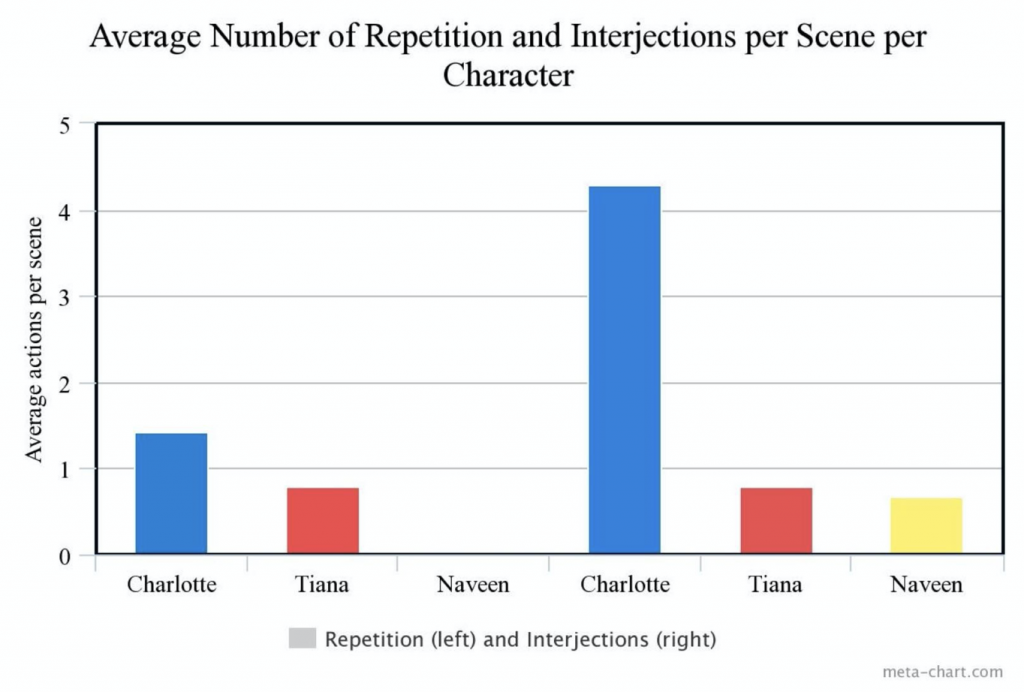
As illustrated in the first graph, Charlotte uses significantly more repetition and interjections on average than both Tiana and Naveen. On average, Charlotte used 1.4 repeated phrases and 4.3 interjections per scene, while Tiana used 0.8 repeated phrases and interjections per scene, and Naveen used the least of both, with no repeated phrases and an average of 0.67 interjections per scene.
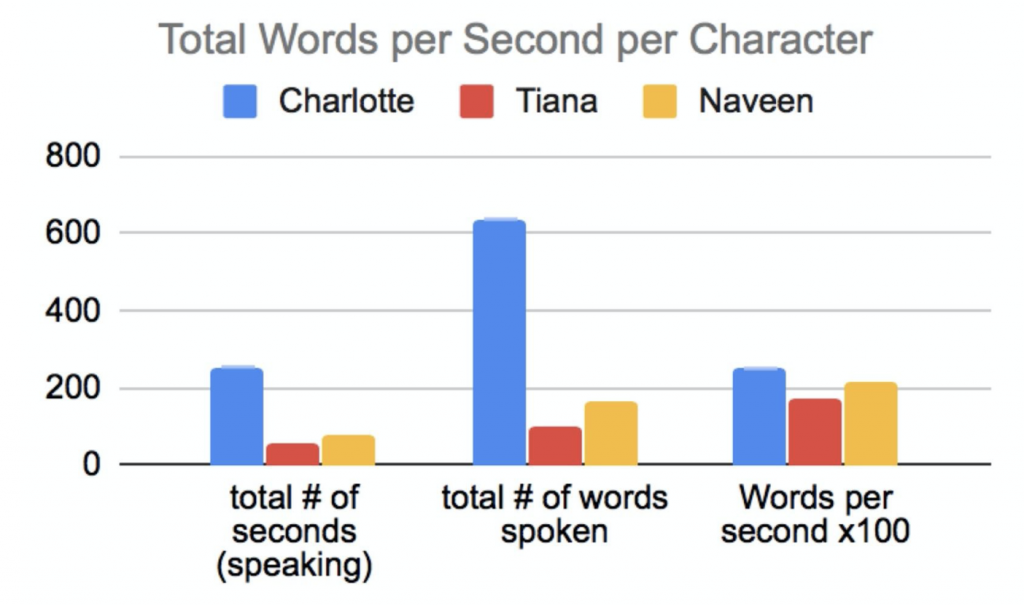
 

As illustrated in the second graph, Charlotte has a higher rate of words per second used in comparison to the rates depicted by Naveeen and Tiana. As Charlotte speaks at a rate of 2.20 words per second, while Tiana and Naveen speak at rates of 1.80 and 2.10 words per second. In other words, proving that there is a faster rate of speech in Charlotte’s speech patterns.
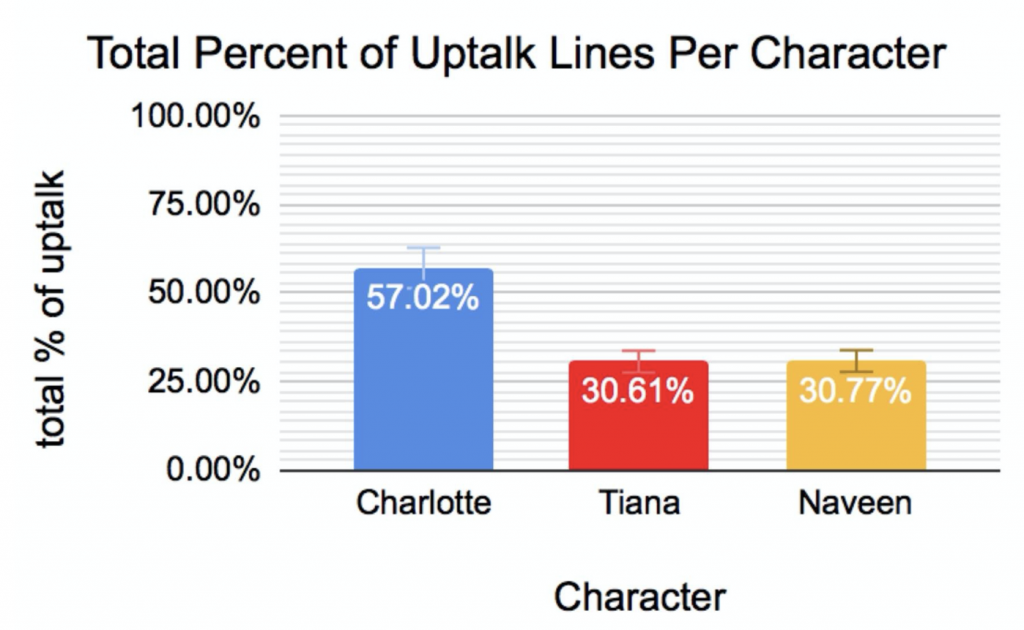
 

As illustrated in the third graph, nearly 60 percent of Charlotte’s lines were examples of uptalk. This percentage was almost double that of both Tiana and Naveen’s total percent of uptalk lines, which were both around 30 percent. This data proves that Charlotte uses uptalk much more than the other characters, likely as a result of her overly feminine portrayal.

Conclusions

Many baseless standards and stereotypes are placed onto women’s speech. We see a prime example in the character Charlotte, whose personality is drawn completely from the stereotypes of groups she is a member of. We see this especially in her frequent use of uptalk, repetition, rapid speech, and interjections compared to the other characters. For these reasons, it is conclusive that Charlotte’s portrayal is indicative of Disney’s corporate misogyny and exploitation of linguistic stereotypes.


References

Cutler, A., & Scott, D. R. (1990). Speaker sex and perceived apportionment of talk. University of Sussex.

Guy, G., Horvath, B., Vonwiller, J., Daisley, E., & Rogers, I. (1986). An Intonational Change in Progress in Australian English. Cambridge University Press, 15(1), 23–51.

[/expander_maker]
Queer Speech: Real or Not?

Samantha Dao, Audrey Harrison, Sonia Hauser, Elizabeth Rutkevich

Have you ever thought, “Wow. That person sounds so gay.”? Maybe it’s because of the way the person speaks –his/her pitch is higher/lower than a straight person’s, the pitch at the end of his/her sentence is higher than the rest, or they have a melodious/creaky voice. But is there actually a difference between the way queer and straight people speak or is it just a stereotype? Is language used as an identifier of sexuality?

We were interested in these questions, but specifically if there’s a difference between queer and straight women’s speech. Therefore, we did an experiment, in which we asked 20 women, 10 straight and 10 queer, to tell us about a time in which they almost died and analyzed their speech to determine if a difference exists.

Our hypothesis was that there would be no significant differences in the phonetics, or in the way sound in speech is produced, except that queer women would have a bit more roughness or creakiness in some parts of their casual speech. We also believed that queer women would speak at a lower pitch than straight women. However, after getting the results, we found that our hypothesis wasn’t entirely correct. Can you guess what part of our hypothesis was proven wrong?

[expander_maker id=”1″ more=”Read more” less=”Read less”]

Language is so powerful and can let people know a lot about ourselves. Beyond what you literally say, the way you speak can cause people to form opinions about you, or what you are implying can be interpreted differently by different people. Stereotypes even in language are constantly shaping the way people see us (Waksler 2001), so how can we use language to align ourselves with our identities instead of projected ones other people place on us?

We perform gender, sexuality, and identity constantly, so how is language used to perform these things? We did a little experiment to see if there is a difference in the ways that queer and straight women cultivate their own identities through language. We concocted a study involving 20 UCLA undergraduate women from ages 18-24, half being straight and the other half being queer. We asked participants to tell us about a time they almost died. This could be funny and dramatized or serious, whatever they wanted, in hopes to get them to speak casually, how they would outside the space of an interview.

We compared how many times each group used vocal fry, the creakiness found in speech, typically in vowels (for example in this video clip from 0:00-0:31), and upspeak, the rising in voice at the end of sentences (as demonstrated in this video from 0:00-1:03), and rated overall pitch, the highness or lowness of voice, from 1-5 (you can learn about high and low pitch in this video). We were curious about pitch because some studies say it differs between the two groups (Barron-Lutzross 2015) while others say there are no significant differences (Waksler 2001). Vocal fry and upspeak are stereotypical of women’s speech as a whole.

Before doing the actual experiment, we thought queer and straight women would have similar usage of upspeak because they belong to the same gendered social category, so parts of their identity formations and expressions would be similar (Valocchi 2005). However, we thought queer women would use more vocal fry and have a deeper overall tone than straight women to differentiate themselves and construct distinct identities from straight women.

Background Information

There is a cultural awareness and focus on the way gay men speak. The stereotypically effeminate “gay voice” is characteristic of a higher pitch, slight lisp, and hyper-enunciation. The documentary Do I Sound Gay? questions where the “gay voice” comes from and some possible explanations of this phenomena (Thorpe 2014). The documentary concludes that gay men’s voices are a complex mix of the presence of female role models, group identification, and the persistent association with the aesthete stereotype (similar to a dandy, aesthetes are a Wildean, intellectual, effeminate man). Here is a clip from The New York Times of Thorpe, along with a linguist featured in his documentary, describing the specifically male “gay voice.”

What, then, does a lesbian or queer woman’s voice sound like? Are these categories distinct enough to draw phonetic conclusions? In what ways are gender and sexuality intertwined in the way we speak, complicating intra-gender distinctions? To answer philosophical questions about gender we looked to Judith Butler’s seminal Gender Trouble. Butler proposes the idea of “performativity” in relation to gender–all gender is a performance and reliant on external interaction. Others pick up gender cues from the ways we dress, speak, and move. So how do queer and straight women express their identities and gender differently? Or is the category of woman unifying enough to surpass sexuality?

Methods

In order to find out if there was a difference in speech between queer and straight women, 10 UCLA undergraduate women from ages 18-24 in each category were asked to tell about a time in which they almost died. This question was to make sure that they would speak their mind without worrying who they were talking to since the purpose of the experiment was to compare casual talk. Participants were friends and acquaintances and were asked to be recorded before the interview took place. The recordings were analyzed for upspeak, vocal fry, and pitch. Since each interview differed in the length of time, vocal fry and upspeak were analyzed by times used per minute. Pitch was determined on a scale of 1 to 5 with 1 being the lowest and 5 being the highest, and it was evaluated by the interviewer.

Results

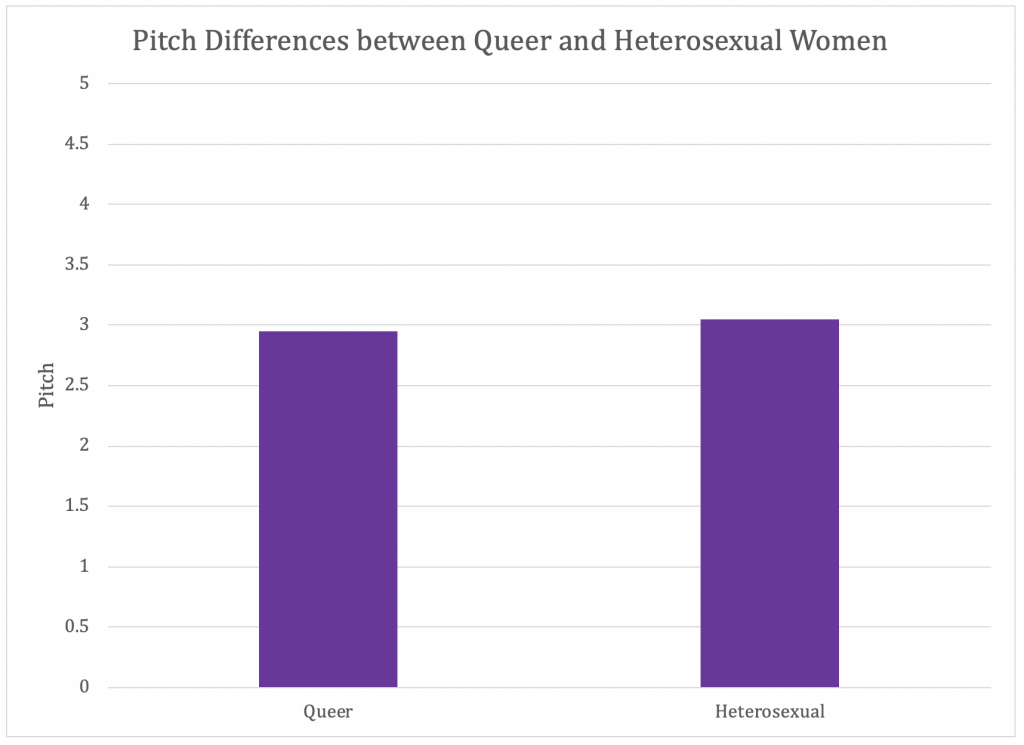
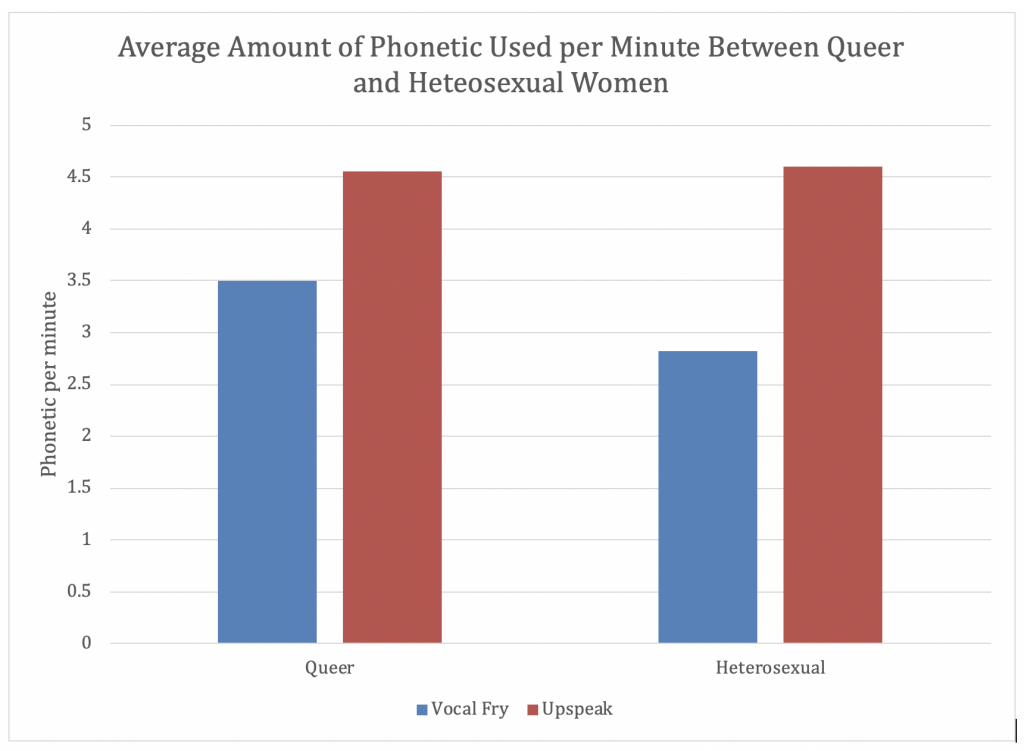
There was no significant difference in the average amount of upspeak used per minute between the two groups with 4.56 and 4.6 upspeak used per minute in queer and straight women’s speech respectively. (Fig. 1). However, as seen in figure 1, queer women used slightly more vocal fry (3.5 usage per minute) than straight women (2.82 usage per minute). There was no significant difference between the pitch of both groups as the pitch was measured to be 2.95 and 3.05 for queer and heterosexual women, respectively (Fig. 2).

Figure 1. Analysis of average vocal fry and upspeak used per minute shown in blue and red bars respectively. The data was analyzed from speech of 10 queer and 10 straight women.
Figure 2. The graph shows the average pitch from 10 queer and 10 straight women. Pitch was measured from a scale of 1 to 5, with 1 being the lowest and 5 being the highest.

Discussion and conclusions

The results of the study revealed a ubiquity of phonetic linguistic performance among women regardless of their self-identified sexualities. The lack of significant differences in pitch and upspeak occurrence, and the predicted, slight variation in vocal fry occurrence points to the similarities in the phonetic patterns of all the women aged 18-24, in our immediate UCLA-range community that participated in the study. This predictable finding about the range of women’s speech within immediate speech communities and social networks carries implications that gender categories and socialization are stronger determinants of speech than sexuality is.

There are possible errors associated with our methods. Participants could still have modified their speech since it was an interview. Friends were interviewed which could have affected the speech samples, but keep in mind that the experiment was comparing casual speak, so in fact this could have been beneficial. The sample size was relatively small and involved a specific group, so the results may not be representative to all queer and heterosexual women. The evaluation of pitch was subjective, and there was possible bias as prior research was done. Lastly, recordings might not be true to the actual voice because there’s error in the recording equipment. The errors were minimized as best as possible.

For future studies involving the role of sexuality in women’s linguistic performance, non-phonetic features, such as the frequency of tag questions and filler words, could be tested for differences between queer and heterosexual women. It could also be beneficial to perform a preliminary study evaluating whether there are pre-existing perceived differences between and stereotypes about the speech of queer versus straight women.

Acknowledgements

We would like to thank the volunteers that participated in the study and our teaching assistant Madeleine Booth and Professor Daria Bahtina for guiding us through our experiment. 

References

Barron-Lutzross, A. (2015). “The Production and Perception of a Lesbian Speech Style.” UC Berkeley PhonLab Annual Report, 11. Retrieved from https://escholarship.org/uc/item/7f6332bh

Butler, J. (2006). “Gender Trouble.” Routledge.

Howard, G. and Thorpe, D. (Producers) and Thorpe, D. (Director). (2014). “Do I Sound Gay?” United States: Sundance Selects.

Valocchi, S. (2005). “Not Yet Queer Enough: The Lessons of Queer Theory for the Sociology of Gender and Sexuality.” GENDER & SOCIETY, 19(6), 750-770, DOI: 10.1177/0891243205280294.

Waksler, R. (2001). “Pitch range and women’s sexual orientation.” Word, 52(1), 69-77, DOI: 10.1080/00437956.2001.11432508

[/expander_maker]

How Do Different Genders Speak in The Office?

Chelsea Gleason, Priscilla De Luna, Kat Dang, Briana Tena

Do males and females speak differently in a professional setting? If so, does this cause any implications? In this study, we look at the different language patterns in the popular TV show, The Office, a comedy show following the lives of workers at a desk job.

The aim of our research was to see if differences in speech establish a power hierarchy between genders in the workplace. This research was motivated by the growing number of women in higher skilled professions compared to previous decades. Thus, we developed a coding system to study the frequency of rise in pitch and use of interruptions among the characters in this TV show. We then analyzed the data and found that the speech patterns did contribute to a power hierarchy, however it was represented through men establishing dominance over other men, rather than men establishing dominance over women.

[expander_maker id=”1″ more=”Read more” less=”Read less”]

In recent decades, more women are securing higher skilled positions in the workforce compared to previous time periods in which professional work was mostly male dominated (Ziman, 2013, p. 1). There is little to no research studying the new relationships between genders in this setting, thus we conducted a study focusing on one of the fundamental aspects of interaction: language.

We completed a linguistic analysis of the American version of The Office, meaning we studied the differences in language use between individuals. The Office served as an excellent source for our study as the show has over 57 million viewers (Stern, 2018, col. 4), so the show should represent what Americans view as common speech.

To complete this study, we took a sociolinguistic approach, which relates differences in language to social factors, most notably in our case: gender. We collected our data by analyzing phonetics, which is the study of speech sounds, and via conversational analysis, which is a broad linguistic field that studies natural conversations in everyday situations. To make our data more quantifiable, we defined phonetics as the use of upspeak, which is the rising pitch at the end of a statement, or more commonly known as the “Valley Girl Accent”, and defined conversational analysis as any interruptions made between characters.

We chose upspeak and interruption because social scientists have previously found that these factors aid in creating differences in power among genders and ultimately form a gender hierarchy (Linneman, 2013, p. 83), (Schegloff, 2001, p. 289). However, there is no research indicating if this is true in a professional setting where individuals are expected to act and speak in a more polite manner.

This led us to hypothesize that the use of upspeak and interruptions in the workplace places males in a superior power position compared to females.

First, we had to research if there was any data that indicated gender inequality in the workplace, and what steps, if any, are being made to address the issue.

As of 2019, women get paid 80 cents on the dollar, compared to men, and only 79 women are promoted to a higher position compared to every 100 men (Schooley, 2019). Women in the workplace experience microaggressions verbally and behaviorally during the communications at work. These actions are both intentional and unintentional, ranging from, but are not limited to “hostile, derogatory, or negative prejudicial slights and insults.” (Schooley, 2019). 

This idea is illustrated in Nidhi Dua’s Tedx Talk, “Gender Equality at Workplace.” Dua discusses the problem of obtaining gender equality, where the problem stems from, and possible solutions. Gender equality is a series of complex issues with no single, direct cause. It is acknowledged that no single person or group can solve the problem, but they can each do their part.

In order to start positive changes in the workplace, Dua believes that “engaging with men and women workers, spreading awareness, and addressing issues that act as impediments to gender equality” were important factors. The training at the factorial level consisted of : peer to peer learning, audio-visual presentations, focus-group discussions, role plays that highlight gender stereotypes, and developing grievance handling mechanisms. Dua highlighted the development of grievance handling mechanisms because women (especially) are put through tremendous amounts of stress and pressure both in and out of the workplace. Women also tend to feel uncomfortable with speaking up and reporting their incidents and concerns.

We applied this idea and studied the grievance handling mechanisms through upspeak. “Upspeak” (or “uptalk”) refers to one’s pitch rising towards the end of a statement. This speech pattern is often compared between men and women. Upspeak’s existence can be dated back to as early as the 17th century (Gorman, 1993) and its usage is common among women. This linguistic phenomenon has the connotation of  being a “Valley Girl” accent, although it has become more common in both men and women since its “discovery” (Rutter, 2013). 

Despite being practiced by both men and women, what upspeak determines for each gender in society varies greatly. In a study that was conducted on the show Jeopardy! By Virginia Rutter, PhD., she found that men use upspeak when they are uncertain or unconfident with their responses to a statement or question. It was also discovered that men would use upspeak more with women when they are correcting a woman compared to a fellow man. Her study indicated that men used upspeak 22% of the time when correcting another man, but was used 53% of the time with women. It is speculated that men do this as a form of chivalry towards women.

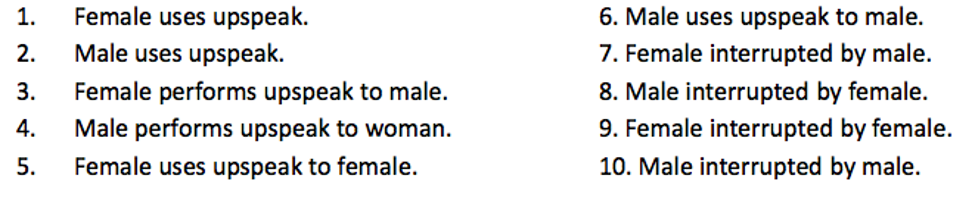
We wanted to see if these findings correlated with our study. So, we began analysis on the TV show, The Office. The Office, contains 9 seasons with a total of 201 episodes. Since there was not much time to gather all of the data, only 20 episodes were chosen to be analyzed. This way, each group member was responsible for 5 episodes. A random number generator, set to 1-201, was used to select which episodes were used. The episodes were randomly selected to make sure that the data collected was a good representation of the entire show. To analyze each episode, a system of coding was created that focused on how each gender used uptalk and interruptions (Reed, pgs. 10-11). The code used is shown below:

When a character used upspeak or interrupted someone, the exact words they used in the conversation were recorded. To show when upspeak was used the words were either highlighted yellow or made bold and a dash line was used to signify an interruption. For example, the scene from the image below is from the episode “Frame Toby” in season 5, episode 9 of The Office. In this scene, Michael found out that Toby came back to work at Dunder Mifflin. When Michael saw Toby he immediately interrupted Toby by yelling, “No”. This interruption was classified using the number 10 from the code, since Michael interrupted a male colleague, and recorded as shown below. There is also an example below about how upspeak would be recorded. In the second example, 2 and 6 coded the scene because Michael used upspeak when talking to Dwight.

The Office- Season 5, Episode 9 “Frame Toby”

(19:52-19:48), 10

Toby: “Hi Michael-”

Michael: “Noooo god! Nooo god! Please no. Nooo.”

(13:04-12:57), 2 & 6

Michael: “You’re the bait for Toby?”

Dwight: “Mmmhm.”

Michael: “Uhh for one thing he’s not gay and if somebody were to be bait, it would be Jim or Ryan or me.”

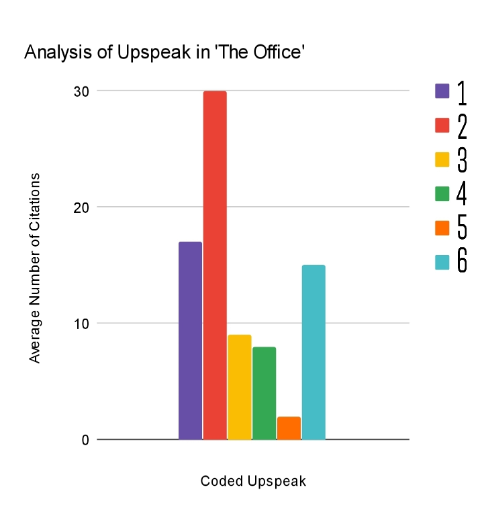
From the data, we were able to construct two different graphs to display the visual variations found when deciphering the different phonetic codes used within The Office. When analyzing coded upspeak, we found that the ratio of upspeak used in a professional setting greatly differs between men and women.

Data shows that men tend to use upspeak at least twice the given amount a woman does within the workplace. Upspeak towards the opposite sex differed as well.  Women were more likely to use upspeak towards men in ratio to the amount of times men used upspeak towards women. This is an effect of  lack of confidence within the workplace, thus women felt the need to critique men less often to avoid coming across as too strong. Men however, were likely to use upspeak towards women as a form of peer correction or chivalry, not as a form of dominance, hence they used upspeak towards the opposite sex less often.

Data also implies that males are more likely to use upspeak towards men as opposed to the usage of it towards women. The stark difference has led us to believe that in a work setting, men often feel the need to assert their dominance and establish a visible hierarchy amongst their male coworkers than towards women.

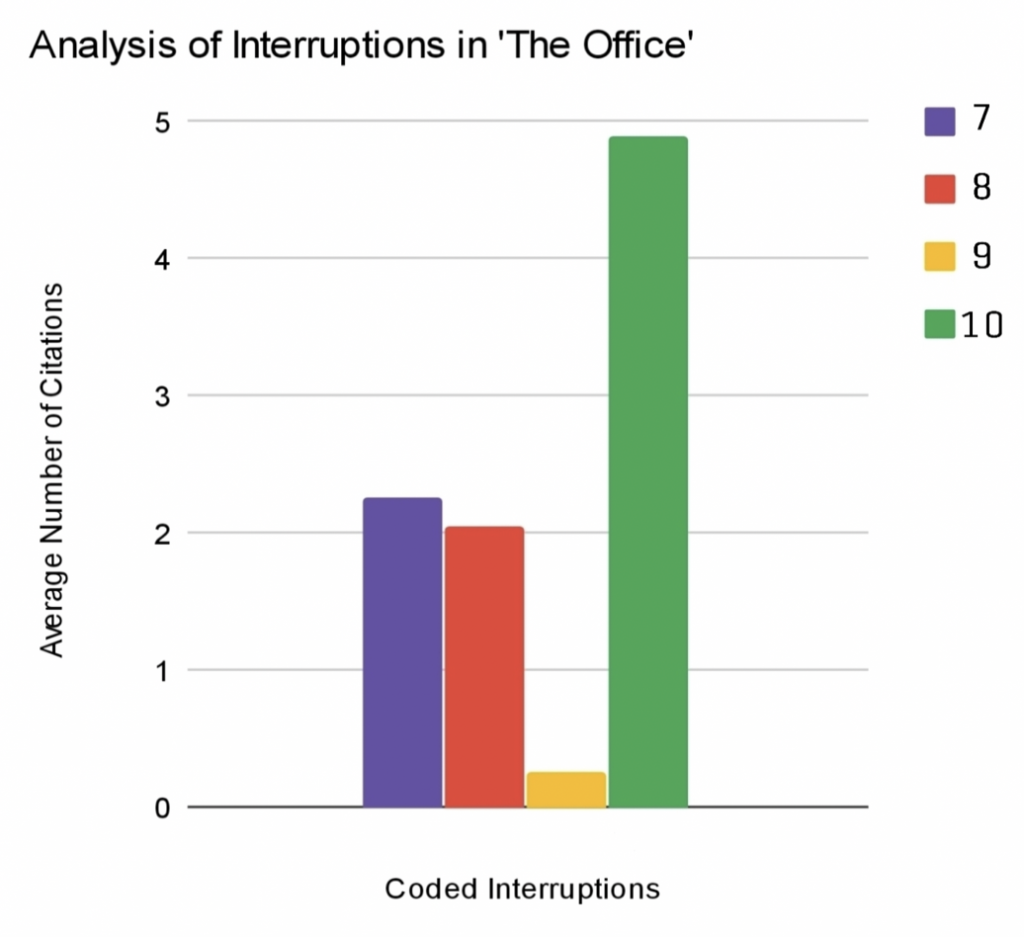
In coded interruptions, there was a small difference between data when analyzing codes 7 and 8. Females were more likely to be interrupted by males than males were to be interrupted by females. However, in codes 9 and 10, our data displayed a stark contrast of a <1: 5. Essentially, this established the notion that males are more likely to interrupt a male coworker in the workplace than females were to interrupt a female coworker.      

In the original hypothesis, we expected men to use more upspeak and interruptions towards women than towards men. We hypothesized that this would occur in the form of chivalry or as a form of peer correction. Data results, however, differed greatly from our initial theory.

After analyzing the codes through a random draw of various scenes, we can infer that men used more upspeak than women within the workplace altogether. Males, however, were less likely to use upspeak towards the opposite sex than women. This correlates to the notion that women are more likely to use upspeak when speaking to men because they felt the need to be apologetic of their success.

Further analysis concluded that males were more likely to interrupt another male counterpart than a female counterpart. With this data we were able to see a clear sense of hierarchy and several dominant attributes within men in the workplace. As a result, men often establish more dominance over male counterparts through peer correction and interruptions than towards female coworkers.

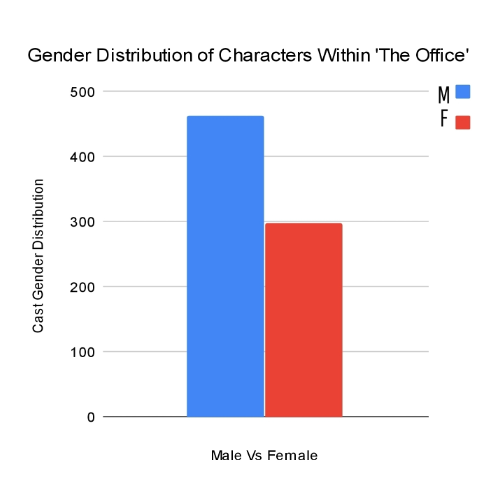
These findings coincide with the gender distribution of characters within The Office. A larger male population within this workplace can be a correlative factor that encourages males to assert dominance over a competitive atmosphere with other men. Women, however, were less likely to interrupt the same sex or use more upspeak than men since The Office is not female dominated, therefore they were not encouraged to assert their dominance like males in this setting.

References

Gorman, J. (1993, August 15). ON LANGUAGE; Like, Uptalk? The New York Times Magazine. Retrieved from https://www.nytimes.com/1993/08/15/magazine/on-language-like-uptalk.html

Rutter , V. (2013, December 28). Men and Women Use Uptalk Differently: A Study of Jeopardy! – Sociological Images. Retrieved from https://thesocietypages.org/socimages/2013/12/28/men-and-women-use-uptalk-differently-a-study-of-jeopardy/.

Schegloff, E. A. (2001). Accounts of conduct in interaction: Interruption, overlap, and turn-taking. In J. H. Turner (Ed.), Handbook of Sociological Theory (pp. 287–321). https://doi.org/10.1007/0-387-36274-6_15

Schooley, S. (2019, May 20). The Workplace Gender Gap and How We Can Close It. Retrieved from https://www.businessnewsdaily.com/4178-gender-gap-workplace.html.

Stern, M. (2018, December 15). Is ‘The Office’ the most popular show on netflix? The Daily Beast. Retrieved from https://www.thedailybeast.com/is-the-office-the-most-popular-show-on-netflix

YouTube. (2019, February 26). Gender Equality at Workplace | Nidhi Dua | TEDxGurugramWomen. Retrieved from https://www.youtube.com/watch?v=qEtTGkICKtY&app=desktop.

Ziman, Rebecca L., “Women in the Workforce: An In-Depth Analysis of Gender Roles and Compensation Inequity in the Modern Workplace” (2013). Honors Theses and Capstones. 157.

[/expander_maker]

Modifier Use Between Male and Female Bosses in Movies and Television Shows

Grace Gibbons, Maya Kardouh, Orla Lynagh-Shannon, Diya Razdan

Does one’s gender affect the language features that he or she uses? Previous studies, specifically by Robin Lakoff, a prominent linguist, have shown that women’s language differs from men’s in that women are expected to “talk like a lady” and consequently use more hedges, intensifiers, tag questions, and adverbs in their language (Lakoff, 1975). Lakoff argued that this difference in language features reflects uncertainty, less assertiveness, and unequal power in women as compared to men. Another study done by Hanafiyeh and Afghari refuted such argument where the hypothesis was rejected in their data (Afghari and Hanafiyeh, 2014).

Such contradiction motivated us to conduct our own study by investigating the same question, however, the setting would be specific, workplace settings, and the language scripted. We did that by selecting male and female boss characters from 2000s movies and TV shows. We compared if there is a difference between the number of modifiers used by male vs. female characters.

Although the language used by the characters is scripted, it still reflects how the two genders are intended to be viewed and the reality that they are intended to mimic. The specific language feature we investigated was modifiers per adjective, which can be divided into qualifiers and intensifiers. Our selected movies were The Proposal, Horrible Bosses, The Devil and Wears Prada, and TV shows were The Office and Parks and Recreation.

[expander_maker id=”1″ more=”Read more” less=”Read less”]

Modifiers consist of qualifiers, which are words or phrases that precede an adjective or an adverb to weaken or minimize it, as well as intensifiers, which are words or phrases that emphasize and strengthen adjectives and adverbs. In order to see if the use of modifiers is related to gender in the workplace, we compared the number of times qualifiers and intensifiers are used by female boss characters vs. male boss characters when speaking to an employee in an office setting. Our hypothesis was that there is a significant difference between the number of times that modifiers are used between female and male boss characters since the heightened use of modifiers is already linguistically associated with females. Not only is the use of modifiers associated with females, but it is also associated with passiveness. Inversely, the decreased use of modifier words is an indicator of assertiveness, which is tied to males. When we investigated how the media portrays assertiveness in males versus females in positions of power, we expected to see these associations to be reflected in the scripts, in which women are portrayed as less assertive even when it is logical for them to be so in their character’s position.

We chose to study this particular topic because gender inequity, now more than ever, is an increasingly relevant topic. In the context of the workplace, boss and subordinate roles add an extra layer of power interplay that affects the identities males and females adopt. For example, most organizations have males occupying senior level positions. Furthermore, women tend to avoid assertiveness and positions of visibility in order to “avoid conflict” (Sing, Magliozzi, Ballakrishnen, 2018). Across the board, women in the workplace therefore tend to find themselves in positions of submissiveness and passivity. We predicted that this would transfer over to language use by way of use of modifiers, which are typically seen as less assertive. With this in mind, our target population was aimed at men and women in positions of authority, as they are portrayed in film and television.

Linguistically, we focused on qualifiers and intensifiers and what their usage indicates about the speaker. A modifier’s function is to increase or decrease the quality signified by the word it modifies. Furthermore, we used Lakoff’s description of women’s language as hyper-polite and non-assertive as opposed to men’s language being more assertive as a base for our expectations of the two genders’ language in workplace environments. We set out with the belief that females are more inclined to use both qualifiers and intensifiers, which are seen as more passive than assertive. In contrast, we expected more of the men in film and television to use fewer qualifiers and intensifiers to come off more assertive and direct.

We selected scenes from movies and TV shows made in the 2000s that involve interactions between a female boss character with her employee(s) or a male boss character with his employee(s). The sample number was three female and three male boss characters. We analyzed enough scenes to count 20 adjectives and adverbs per character. Then, we counted intensifiers and qualifiers used per adjective/adverbs.

We defined modifier words as intensifiers and qualifiers, specifically, we adopted the Towson University definition “qualifiers are function parts of speech. They do not add inflectional morphemes, and they do not have synonyms. Their sole purpose is to “qualify” or “intensify” an adjective or an adverb.” Qualifiers include words as “kind of”, “barely”, “possibly”, “probably”, “sort of”, “slightly”, and “somewhat.” Intensifiers include words such as “rather”, “absolutely”, “totally”, “really”, “utterly”, “completely”, “very”, “quite”, and “extremely.”

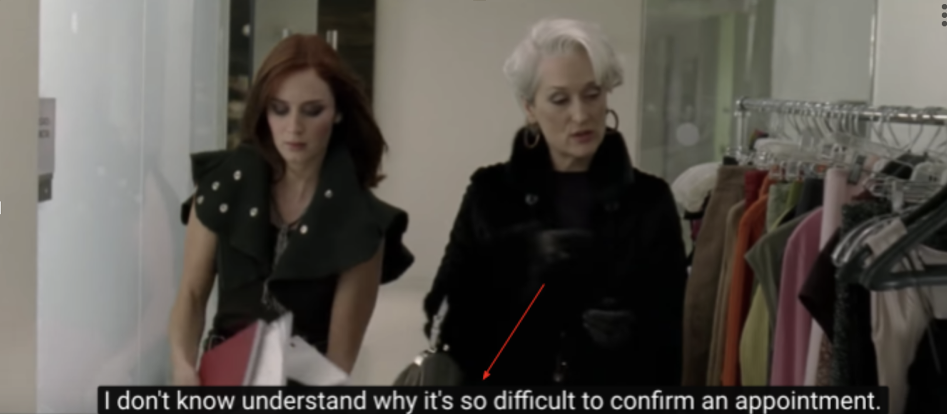
Figure 1a: In this scene of The Devil Wears Prada, Meryl Streep uses the intensifier “so” to modify the “difficult” adjective and emphasize it.
Figure 1b: In this scene of The Office, Steve Carell uses the qualifier “a little bit” to modify the adjective “rough” and lessen its severity.

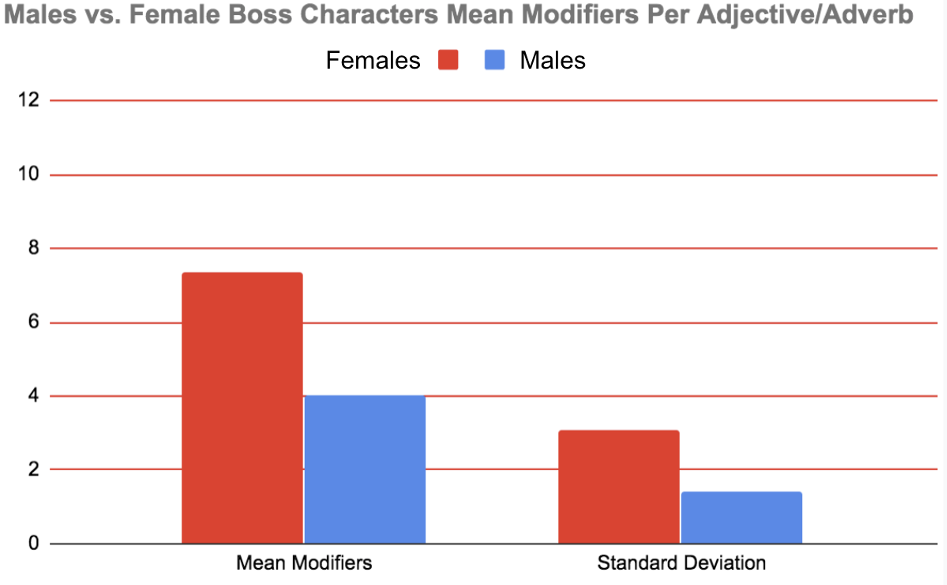
Adding the numbers of qualifiers and intensifiers and dividing them by 20 adjectives/adverbs, we found the numbers of total modifiers per adjective/adverb used. Calculating the average and standard deviations for the total modifiers per adjective/adverb for the male and female groups, we used the statistical significance test to evaluate if there indeed is a significant difference in this language feature between males and females as proposed by Lakoff.

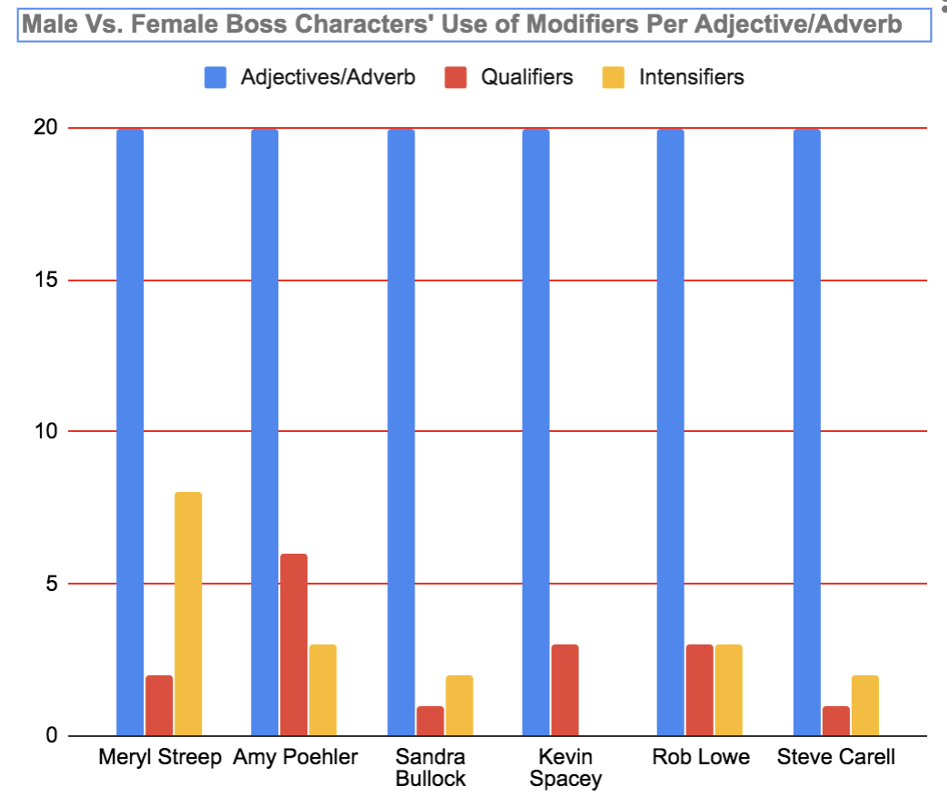
We observed a greater average of modifiers per adjective/adverb in the female boss characters group as compared to the male boss characters group. The female group also had greater standard deviations well. All women tended to use both qualifiers and intensifiers. Specific characters such as Meryl Streep in The Devil Wears Prada used more intensifiers than qualifiers, conversely Kevin Spacey in Horrible Bosses used very few qualifiers and no intensifiers at all. No trend was seen in qualifiers or intensifiers use alone. Although females on average used more modifiers than males, the difference was not significant according to the statistical significance test.

Figure 2a: A variation in the use of intensifier and qualifiers is seen among both men of the same group and women in the same group. In other words, no trend is seen. Note that Meryl Streep in The Devil Wears Prada used the highest number of intensifiers per adjective/adverb, while Kevin Spacey in Horrible Bosses did not use any intensifiers at all.
Figure 2b: Although female bosses showed a higher number of modifiers per adjective/adverb, according to the statistical significance test, there was not a significant difference between males’ and females’ use of modifiers per adjective/adverb.

Analyzing our data, we found that there was no statistical significance in the number of modifiers used by females in comparison to male characters. Though there was a slight tendency for female boss characters to use more modifiers on average, there was not enough of a difference for the results to be deemed significant. This being said, some choices in the way we conducted our study may have impacted these results –  as such, our results do not necessarily reflect how male and female language use differs in real life. For one thing, most of the shows we analyzed were comedies. The fabricated nature and humorous intent behind many of the scenes we observed may have led them to be less authentic representations of genuine language use.

Furthermore, the number and types of scenes we looked at may also have skewed the data — using a larger sample size may have reduced the effect of outliers and randomizing the scenes we chose may have produced more accurate results. Therefore, while our experiment in particular did not show any statistically significant difference in modifier use, it is possible that different contexts or circumstances may yield more stratified results.

While we see that our hypothesis was not supported, there are multiple possible explanations for the observed results. We originally believed that stereotypes of the sexes would persist in these portrayals of male and female bosses, but the difference in the amount of modifiers used between the sexes was not nearly significant enough to support this idea. We now realize that since holding positions of power is already associated with masculinity, this could potentially explain why the female bosses overall were very similar to the male bosses in their use of modifiers. Because the language of both the observed male and female characters follow similar speaking patterns, this could explain how these women fit the “boss” role as men started working before women and their language became associated with the work positions they occupied. We believe that this conclusion is very important, since it shows how in this data sample females who achieve positions of power generally take on linguistic styles more related to males, which further perpetuates the idea that men are more fit for positions of power.

As we previously mentioned, gender inequity is an increasingly relevant topic. And because all of us behind this study identify as women, we hope ourselves to not be victims of gender inequity in our own careers. Thankfully, studies like these will continue to investigate, highlight, and hopefully change this inequity in all aspects of life, not just in the workplace.

For further information on the comparison of men and women’s speech patterns in the workplace, we recommend listening to “Deborah Tannen on Talking from 9 to 5 – The John Adams Institute.” This talk was given by the linguistics professor at Georgetown University who specializes in the role of speakers’ gender in language. Tannen sheds light on how women and men in the workplace differ in how they ask for information, delegate, and make decisions.

References:

Ballakrishnen, S., Fielding-Singh, P., & Magliozzi, D. (2019). Intentional Invisibility: Professional Women and the Navigation of Workplace Constraints. Sociological Perspectives, 62(1), 23–41. https://doi.org/10.1177/0731121418782185

Crosby, F., & Nyquist, L. (1977). The female register: An empirical study of Lakoff’s hypotheses. Language in Society, 6(3), 313-322. doi:10.1017/S0047404500005030

Deborah Tannen on Talking from 9 to 5—The John Adams Institute. (1995). Retrieved from https://www.youtube.com/watch?v=UCMmTmD-OJI

Fahy, P.J. (2002). Use of Linguistic Qualifiers and Intensifiers in a Computer Conference. Hanafiyeh, M., & Afghari, A. (2014). GENDER DIFFERENCES IN THE USE OF HEDGES,TAG QUESTIONS, INTENSIFIERS, EMPTY ADJECTIVES, AND ADVERBS: A COMPARATIVE STUDY IN THE SPEECH OF MEN AND WOMEN.

Lakoff, R. (1973). Language and Woman’s Place. Language in Society, 2(1), 45-80. Retrieved from www.jstor.org/stable/4166707

Park, G., Yaden, D. B., Schwartz, H. A., Kern, M. L., Eichstaedt, J. C., Kosinski, M., Seligman, M. E. (2016). Women are Warmer but No Less Assertive than Men: Gender and Language on Facebook. PloS one, 11(5), e0155885. doi:10.1371/journal.pone.0155885

QUALIFIERS / INTENSIFIERS – words like very, too, so, quite, rather. (2019). Retrieved November 13, 2019, from Towson.edu website: https://webapps.towson.edu/ows/qualifiers.htm

Why Women Stay Out of the Spotlight at Work. (2018, August 28). Retrieved November 13, 2019, from Harvard Business Review website: https://hbr.org/2018/08/sgc-8-28-why-women-stay-out-of-the-spotlight-at-work

[/expander_maker]


Scroll to Top