gender

Is Disney’s Beauty and the Beast Guilty of Promoting Women’s Language?

Teresa D Dueñas Mayorga

Walt Disney movies are notorious for highlighting the differences between genders and promoting certain gender standards. Since these movies target children, they can have an impact on how children view themselves and others. This study will focus on investigating whether the classic Disney movie Beauty and the Beast, includes a culture of gender differences by using forms of so-called women’s language. To do so, mix-gender conversations from the movie will be analyzed on whether they contain polite forms, hedges, and interruptions, the rate in which these are used and the amount of time spent talking in a conversation by each gender will be compared. It was concluded that some aspects of women’s language are present in Beauty and the Beast which signify that gender differences are being promoted to children. This suggest that film makers should be more attentive on how gender if depicted to children as it can instate stereotypes on how women and men should communicate with each other.

[expander_maker id=”1″ more=”Read more” less=”Read less”]

Introduction

Walt Disney movies play a crucial role in the lives of some children. They provide a source of entertainment while promoting life lessons. However, Disney movies are notorious for highlighting differences between genders and promoting certain gender standards. Although most recently, new Disney movies have tried to depart from upholding gender standards and differences, the classic Disney movies still uphold these differences and have an immense influence in our culture. It is important to analyze how gender is depicted in Disney movies as their targeted audience are children from the age of four to the age of twelve. During this age, children are developing gender comprehension and watching gendered movies can contribute to the establishment of gender differentiating attitudes and the stereotypes they develop. This study will focus on investigating whether the classic Disney movie, Beauty and the Beast, includes a culture of gender differences by using forms of “women’s language”, the use of tag questions, avoidance of interruptions, use of hedges and use of super-polite forms (Lakoff, 1973).

I theorize that the mixed-gender conversations in this movie will show a higher ratio of deep interruptions, and talking time from male characters which results in a higher ratio of politeness, supportive interruptions, and hedges from female characters. In addition, the types of hedges, interruptions and polite forms used by a character are different which can create a culture where women are expected to talk a certain way.

Methods

This study focused on the mix-gender conversations between Belle and Gaston, and Belle and the Beast. The linguistic units that were analyzed revolved around what Lakoff (1973) considers “women’s language”. The main linguistic features of women’s language that were investigated are:

  • Hedges: a word/phrase used to lower the impact of a remark, avoid answering a question or making a direct statement.
  • Interruptions: an overlap in speech in which a person is disrupted before they have finished their line. There two different types of interruptions: supportive (back-channel), and deep (non-supportive) interruptions.
  • Polite forms: the use of words/phrases to demonstrate regards for others.

Throughout each conversation, the types of hedges, interruptions, and polite forms were analyzed based on the impact it had on the conversation. A count of the number of hedges used, the number of interruptions, the number of polite forms, and the number of seconds each character talked during the conversation was conducted.

Results and Discussion

Belle and Gaston

Belle and Gaston

One of the most interesting conversation between Belle and Gaston occurred when Gaston had planned a wedding with Belle. Gaston had gathered the town and states that everything is ready for the wedding, he just first needs to go ask Belle to marry him. He then goes to Belle’s house and begins to ask Belle to marry him:
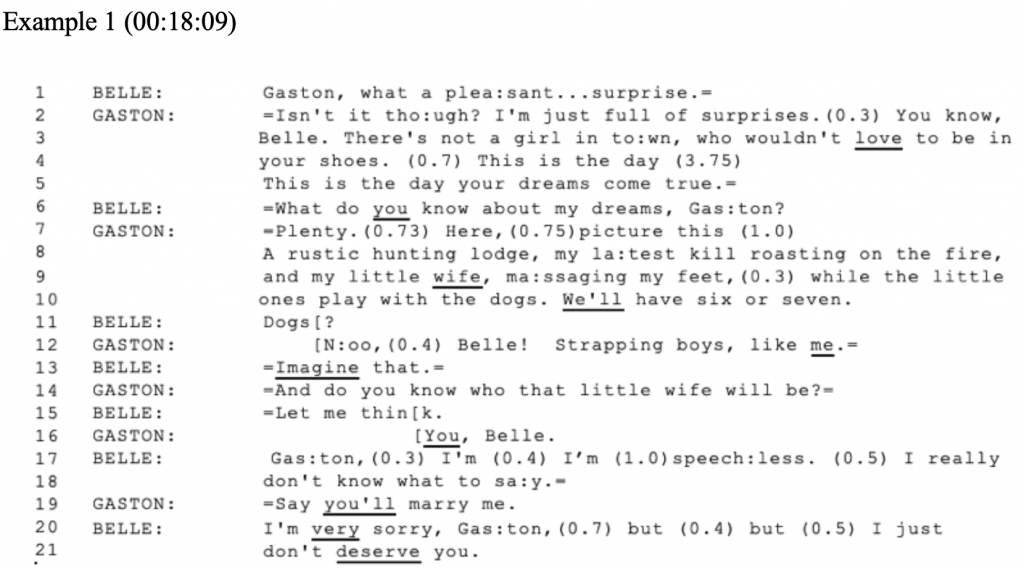
In the lines before 17 and 18, Gaston is discussing the life he pictures with Belle which lead to her using hedges to avoid saying that she will not like that life.  Belle also uses politeness to avoid Gaston feeling abruptly rejected which helps prevent a conflict between them. In the first line, Belle uses the word pleasant to be polite even though she did not believe it was a good surprise for Gaston to be at her house. She then uses to polite phrases, line 20 and 21, to reject Gaston’s offer of marriage. The polite forms used impact the conversation as they further exchange between Belle and Gaston where she must explain the reason she is rejecting his offer.

In this conversation, Gaston interrupts Belle twice. The first interruption occurs in line 12 when Belle suggest something that is far from what he was trying to say in his previous remarks. This deep interruption helps create a perception in which Belle is seen as unintelligent as she needs to be corrected even before she finishes talking. The second interruption occurs in line 16 when Gaston abruptly mentions that Belle is the little wife he has been talking about. These interruptions had an impact of on the conversation as it suggests Gaston frustration with Belle because she is trying to avoid his references and ultimately his marriage proposal.

Belle and the Beast

The first conversation between Belle and the Beast occurred after Belle traded places with her father. In this scene, the beast is walking Belle to the room in the castle she will be living in:
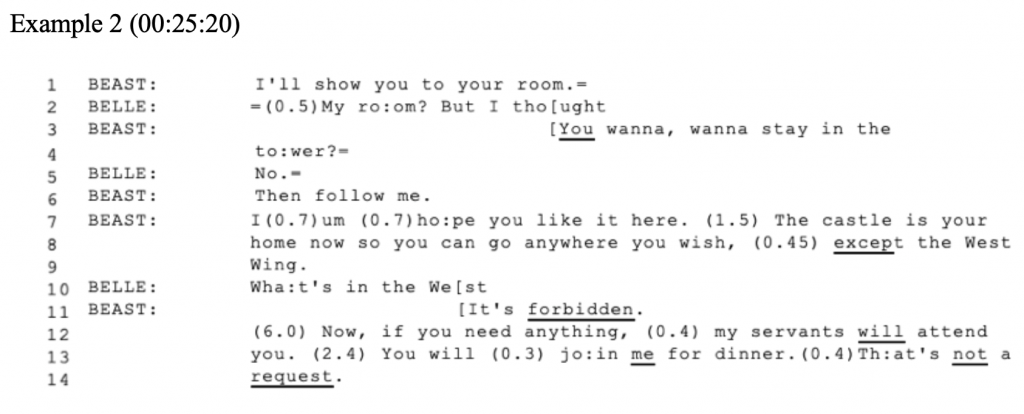
This conversation contains two interruptions, line 3 and line 11. In both occasions, the Beast deeply interrupts Belle to avoid providing an explanation of his actions. In the first interruption, the Beast is avoids giving a reason to why he is moving her to another room, and in the second interruption, the Beast avoids describing the secret the lies in the castle’s west wing. This helps create a difference in power between the Beast and Belle. Through these interruptions, the Beast is able to take control of the conversation by preventing Belle from questioning his decisions and establishes her inferiority.

Towards the end of the conversation, there is a switch in politeness from the Beast. In line 12, he politely talks to Belle about how his servants will attend her if she needs anything. However, in the middle of line 13, he begins to demand Belle to join him for dinner. By not including polite forms, such as please, the Beast further demonstrates his power over Belle since he does not have to ask politely to get something he wants.

Quantitative Data

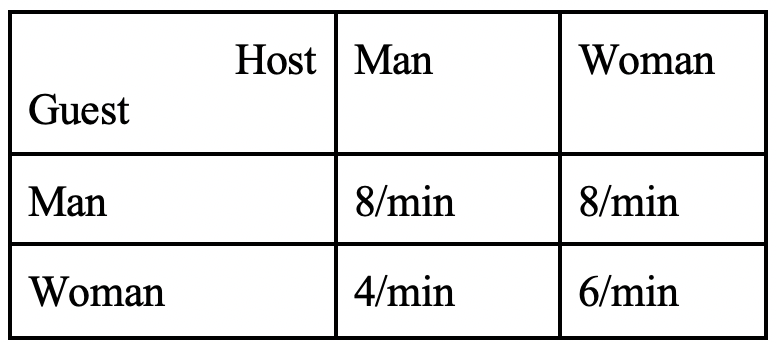
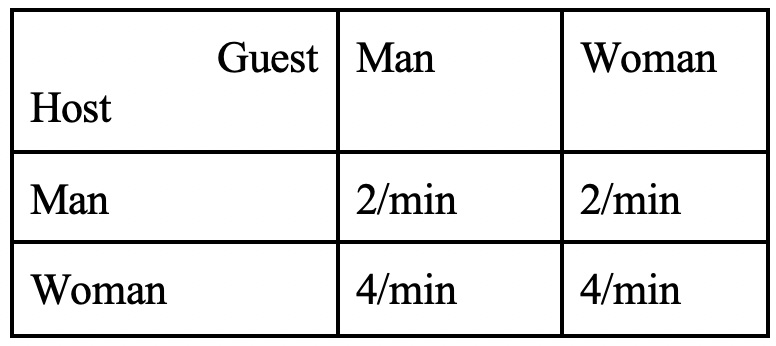
Amount of Time Spent Talking: From the five conversations quantitatively analyzed, on average the female character in the conversations spent 12.406 seconds talking while the male character spent 23.862 seconds talking. This significant difference demonstrates the male dominance. By the male character talking during most of the conversation, they take full control of the conversation and decide when the other person should start to talk.  
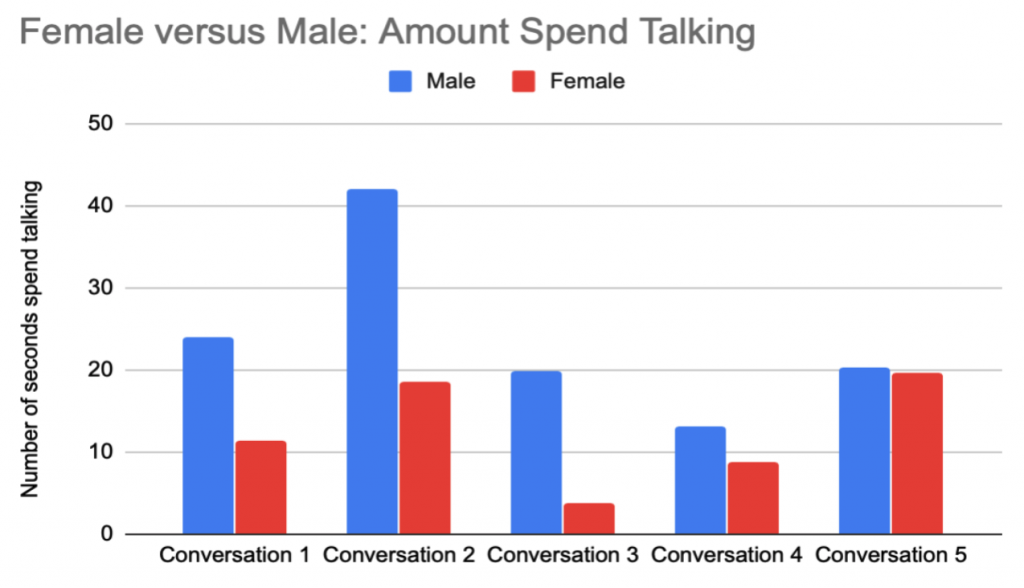
Figure 1

Number of Interruptions: From the five conversations analyzed, deep interruptions were present in conversation 2 and 3. There is a positive correlation between the number of interruptions and the number of seconds the male character talks. For example, the two conversations that show the highest difference are the ones that contain interruptions. This correlation demonstrates that male dominance in a conversation can be established with interruptions (Octigan & Niederman, 1979, p. 51). In all conversations, Belle does not interrupt. This can be related to Lakoff’s (1973) idea that women will avoid using interruptions.

Amount of Politeness: In most of the conversations analyzed, Belle uses more polite words than either Gaston or the Beast (see Figure 2). This can demonstrate women’s language as women are expected to be more polite in conversations than men. Conversation 3 is the only exception as the Beast is the one who uses politeness in the conversation. This could have been the case because it was the shortest conversation, Belle talked the least, and it had deep interruptions. These different aspects of the conversation could have prevented Belle from having time to use polite forms on communication.
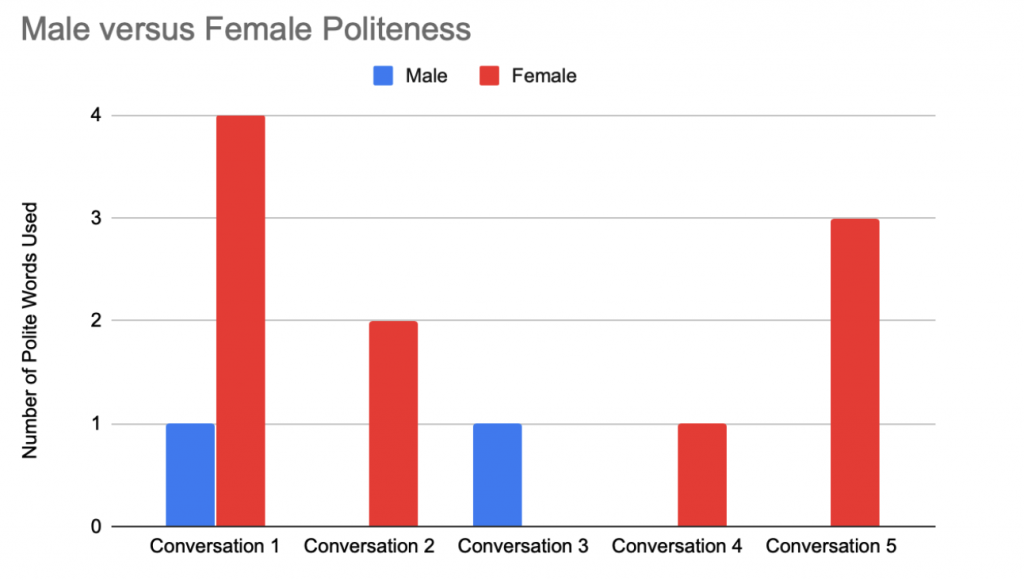
Figure 2

Number of Hedges: Hedges were present in conversation 1,2, and 5, and were used by the female character. This can demonstrate a woman’s insecurity in the conversation. For example, a hedge is able to lessen the remark of a statement which can indicate that the person using this feature does not feel confident enough to engage in an argument.

Conclusion

Based on this study’s findings, it can be concluded that some aspects of women’s language is present in the mix-gender conversations in Beauty and the Beast. Throughout the film Belle’s rhetoric was submissive towards both Gaston and the Beast. She only spoke in a certain manner while being careful not to interrupt them or offend them in any way. Furthermore, the Beast and Gaston constantly interrupted Belle while she was speaking. This creates a visual picture of women being inferior to men. The findings suggest that movie creators should pay more attention on how they are presenting gender to children as it can install stereotypes on how women and men should communicate with each other. Beauty and the Beast is a movie that is viewed by all different ages; however, being an animated film is caters towards children. Children often learn and copy what they see, and this helps reinforce inequality between males and females. Rather than teaching children that men and women can act and speak in the same manner, it teaches them that there is a specific way women should speak, and that is acceptable for men to interrupt women.

References

Agarwal, Vivek & Dhanasekaran, Saranya. (2012). Harmful effects of media on children and adolescents. Journal of Indian Association for Child and Adolescent Mental Health. 8.        38-45.

Atkinson, J. M. & Heritage, J. (1984). Transcript notation. In J. M. Atkinson & J. Heritage (Eds.), Structures of social action (pp. ix – xvi). Cambridge University Press.

Eckert, P., McConnell-Ginet, S. (2013). Language and Gender. United Kingdom: Cambridge University Press.

Janks, H. (1997). Critical discourse analysis as a research tool. Discourse: Studies in the Cultural Politics of Education, 18(3), 329–342.

Lakoff, R. (1973). Language and Woman’s Place. Language in Society, 2(1), 45-80. Retrieved February 25, 2020, from www.jstor.org/stable/4166707

Octigan, M., & Niederman, S. (1979). Male Dominance in Conversations. Frontiers: A Journal of Women Studies, 4(1), 50-54. doi:10.2307/3346669

Raymond, C. W. (2019). Category accounts: Identity and normativity in sequences of action. Language in Society, 48(4), 585–606.

Raymond, C. W. (2013). Gender and sexuality in animated television sitcom interaction. Discourse & Communication7(2), 199–220. doi:            10.1177/1750481312472971

Rubinstein, E. (1978). Television and the Young Viewer: The pervasive social influence of television on children is being increasingly documented, but has yet to be translated into a continuing and effective social policy. American Scientist, 66(6), 685-693. Retrieved February 25, 2020, from www.jstor.org/stable/27848957

Yokoyama, O. T. (1999). Gender linguistic analysis of Russian children’s literature. In M. H. Mills (ed.), Slavic Gender Linguistics, (pp. 57–84). Amsterdam/Philadelphia. John   Benjamins.

[/expander_maker]
I Hate to Interrupt, but… Examining Interruptions, Face-Threatening Acts, and Banter in Mixed-Sex Two-Person Conversational Style Sports Interviews

Korosh Bahrami

Previous research conducted on differences in interruption usage between men and women yielded inconclusive results, providing the impetus for this study. This present study seeks to explore gender differences in the usage of interruptions in mixed-sex two-person conversational style sports interviews. In addition, I am exploring whether the informal structure of a sports interview, involving frequent banter, back-and-forth exchanges, and playful talk alters the relationship between gender and interruption usage and/or leads to certain conversational phenomena. In order to do so, I am observing sports reporters engaging in turn-taking with athletes over the course of interviews that are posted on YouTube. The overall objective is to see whether or not there is a qualitatively significant difference in interruptions between men and women over the course of these interviews. In order to accomplish this, transcripts from these conversations will be analyzed using critical discourse qualitative analysis techniques. Continue reading to see what results the study was able to yield!

[expander_maker id=”1″ more=”Read more” less=”Read less”]

Introduction

Overall, up to this point in time, the research on gender-based differences in use of interruptions has not been definitive. While Deborah James and Sandra Clarke (1993) found a non-significant effect of speaker gender on interruption rates, Zimmerman and West (1975) found evidence to the contrary, mainly that in mixed-sex conversations, men engage in dominant interactive styles, ultimately resulting in more male-initiated interruptions. What is even more unclear is whether such phenomena can be seen in the world of sports, a traditionally male-dominated field. As mentioned before, this study analyzed the usage of interruptions by both men and women in two-person conversational style sports interviews. A prevailing societal stereotype is that men tend to be interrupters of conversation so I put that to the test. After conducting analysis on the relevant interviews, it was found that interviewers, by poking fun and teasing, threatened the negative faces of the interviewees, prompting a response by the interviewee intended to lessen the blow of the teasing.  

Methods

Two YouTube videos (one being an interview of LeBron James by Rachel Nichols in May 2018 and one being an interview of Serena Williams by Andy Roddick in September 2013) were viewed. Transcripts were then created for relevant dialogue across the two videos and then analyzed using a critical discourse analysis (CDA) approach, primarily keying in on turn-taking moments. Standard transcript guidelines were followed.

Results

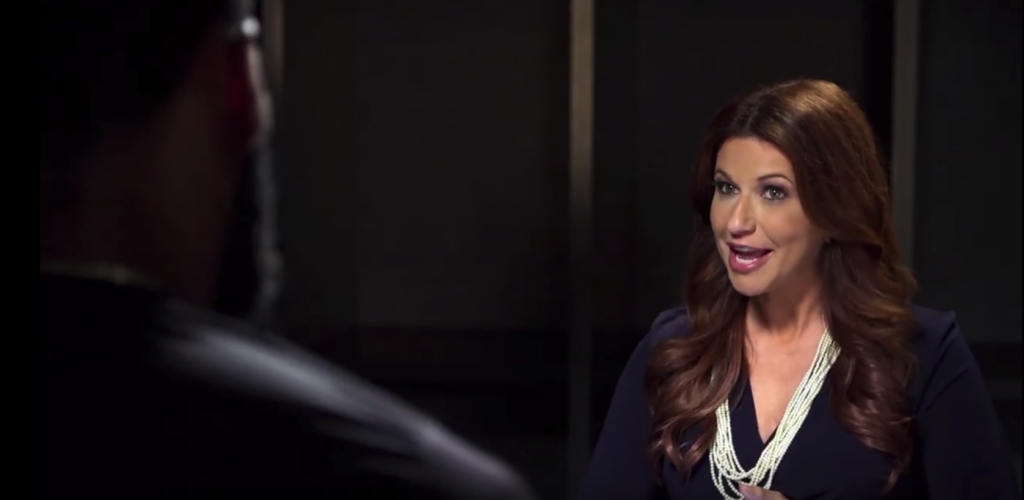
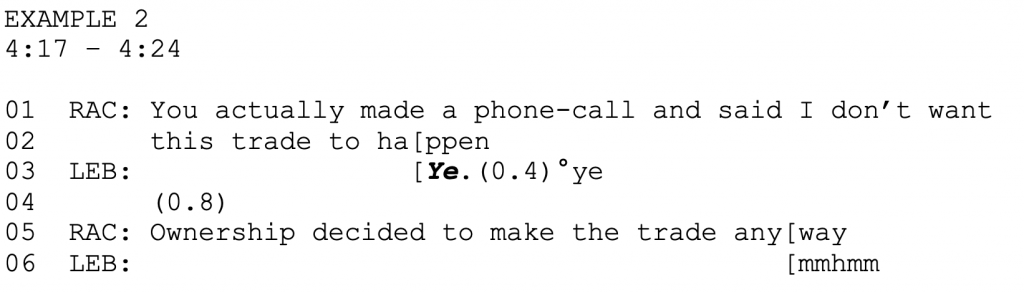
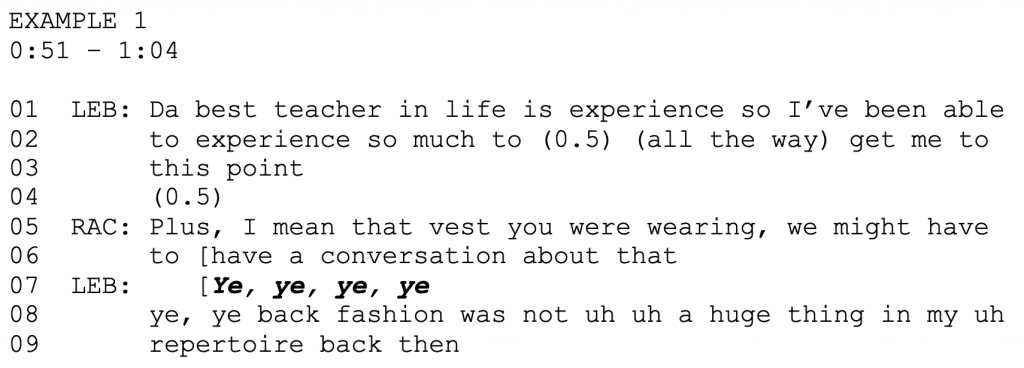
In the following conversation, Rachel Nichols and LeBron James discuss LeBron’s 9th trip to the NBA Finals shortly after LeBron’s Cleveland Cavaliers won the Eastern Conference. The first interruption happens when Rachel pokes fun at LeBron’s teenage fashion choices:

LEB = LeBron James. RAC = Rachel Nichols
LeBron James sitting down to speak with Rachel Nichols in May 2018
Taken from https://www.youtube.com/watch?v=LSyyd4CgIBY

Towards the end of her turn, Rachel playfully bringing up LeBron’s decision to wear a vest in lines 5-6, at which point LeBron begins speaking, leading to temporarily overlapping talk which ends when Rachel cedes talking while LeBron continues to do so. Because LeBron broke in at a point in the conversation that cannot possibly be taken as an appropriate place for a transition (Sacks et al., 1974) and he increases the amplitude of his voice as he breaks into the conversation, this would be considered an interruption. In lines 8-9, LeBron seemingly backs himself up on why he wore a vest, pointing to the fact that he was a different person then than he is now. By interrupting, LeBron does not allow for Rachel to tease him anymore and further threaten his negative face, which is defined as a person’s desire for independence and freedom from imposition (Eckert & McConnell-Ginet, 2018). Lines 8-9 in effect serve to lessen the blow of Rachel’s face-threatening act. The next example illustrates a productive overlap:

In contrast to the previous example, Rachel does not completely cede talking when LeBron begins to talk. She jumps right back into the conversation after a 0.8 second break that can be seen in line 4. Line 3 is thus a productive overlap coming at the end of a turn construction unit (TCU). It is intended to move the conversation forward and signify LeBron’s agreement with Rachel’s statements made in lines 1-2.

Going into the interview, both Rachel and LeBron know that it will be televised and broadcast globally. Consequently, face-threatening acts become magnified. A face-threatening act initiated by Rachel in this case undermines LeBron’s stature and social image on a larger scale, causing him to butt in as a defense mechanism to protect himself and his social image.

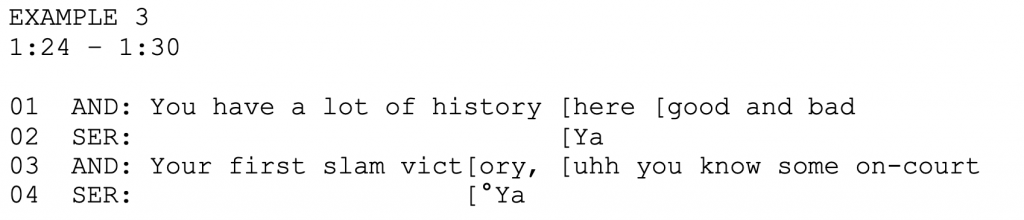
In the next conversation, Serena Williams is interviewed by Andy Roddick. Their discussion revolves around the U.S. Open:

AND = Andy Roddick. SER = Serena Williams

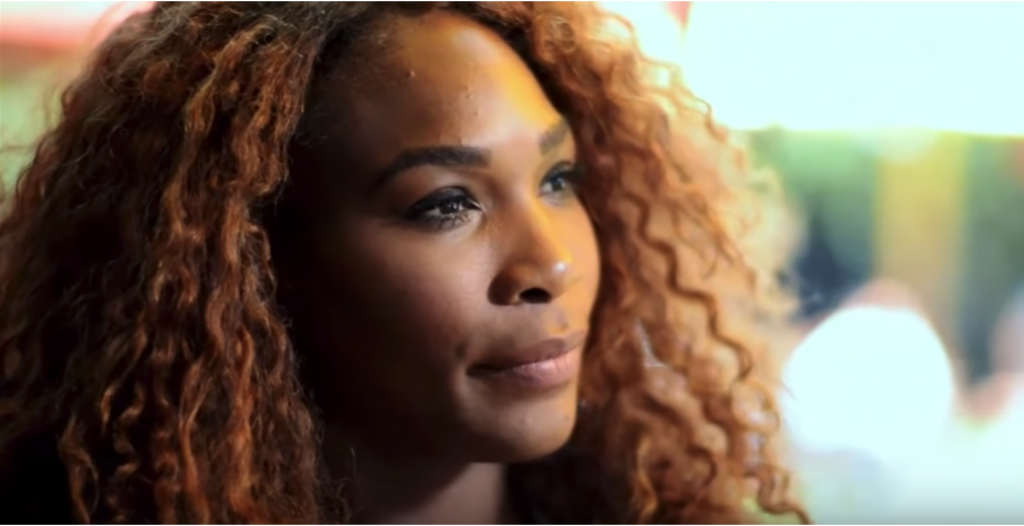
In line 2, Serena interjects Roddick’s speech with a reassuring “Ya,” but Roddick then continues to talk, similar to the conversation documented in example 2. In line 4, Serena also interjects with a “Ya.” In both instances, as she speaks, Serena nods her head up and down and orients her body towards Roddick, illustrating the role that her body language plays in physically showing Roddick that she is comfortable in the conversation.

Serena Williams sitting down to speak with Andy Roddick in September 2013
Taken from https://www.youtube.com/watch?v=LSyyd4CgIBY

In the next excerpt, Serena and Roddick discuss Serena’s match-day style:

AND = Andy Roddick. SER = Serena Williams

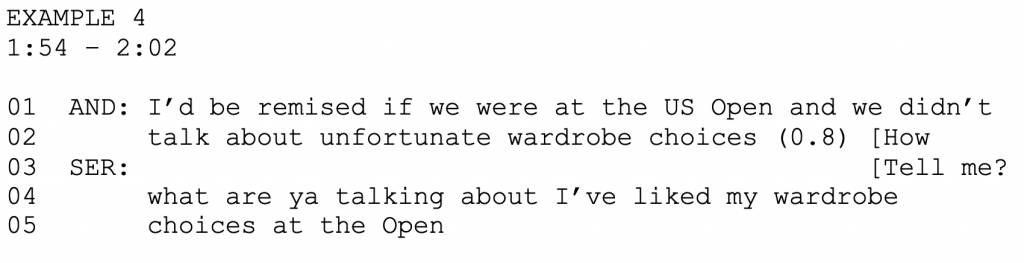
In line 2, after Roddick finishes talking, no one talks for 0.8 seconds, a momentary break in the conversation. Usually, gaps of around 200 ms are characteristic of the end of a turn and the beginning of a new one (Levinson & Torreira, 2015). As a result, Serena begins talking because Roddick seemingly ended his turn, eventually leading to overlapping talk. When Roddick says “unfortunate wardrobe choices” in line 2, jokingly making fun of Serena’s attire, Serena responds with a tilt of her head and opening of her mouth in surprise. Serena’s negative face is threatened. She then follows that by not backing down. Whereas LeBron went along with Rachel, Serena tries to give Roddick a chance to take back what he said by prompting him with a question in line 3. After she finishes talking in line 5, Serena tilts her head back to the right again, staring into space, a clear change in body language.

Discussion/Conclusion

CDA was inconclusive in proving whether or not there is a gendered difference in interruption usage. Interestingly, however, the manner in which the interviewees responded to the face-threatening acts significantly differed. While LeBron was agreeable, Serena remained steadfast, not giving an inch.

Overall, this study sheds light on the concepts of face-threatening acts, negative face, and social image. A face-threatening act doesn’t necessarily have to take the form of clearly hostile, aggressive words. As seen in both of the videos, it can also take the form of banter. Individuals expect their own face needs to be met and are then in return expected to meet the face needs of others (Eckert & McConnell-Ginet, 2018). When these needs are not met, problems arise, which can hurt personal relationships.

Social image is basically society’s beliefs, thoughts, and feelings about us. When it comes to well-known public figures in the world of sports who are constantly seen in the media, their social images take on a larger than life form. Everything they do is put under a microscope, subject to scrutiny and the world of public opinion. Obviously, an individual wants to be seen in the most favorable light and therefore he/she will act accordingly to ensure this. Being the subject of the interviews, LeBron and Serena understand that it is in their best interest to be mindful of what they say.

References

Eckert, P., & McConnell-Ginet, S. (2018). Language and gender. Cambridge: Cambridge University Press.

James, D., & Clarke, S. (1993). Women, men, and interruptions: A critical review. In D. Tannen (Ed.), Oxford studies in sociolinguistics. Gender and conversational interaction (pp. 231–280). Oxford University Press.

Levinson, S. C., & Torreira, F. (2015). Timing in turn-taking and its implications for processing models of language. Frontiers in Psychology, 6. doi: 10.3389/fpsyg.2015.00731

Sacks, H., Schegloff, E. A., & Jefferson, G. (1974). A Simplest Systematics for the Organization of Turn-Taking for Conversation. Language, 50(4), 696. doi: 10.2307/412243

Zimmerman, D. H., and West, C. (1975). Sex roles, interruptions and silences in conversation Language and sex: Difference and dominance (pp. 105 – 129. Stanford, CA: Stanford University Press.

[/expander_maker]
So like, why do they keep saying “um” so much?

Ellee Vikram

College is a time for learning, but learning what? Surely we can attest that only a select few of us really remember college calculus. College is really a place to learn who you are and why you are the way that you are. But what shapes this? Arguably, the language and linguistic styles that you use are quite indicative of the identity you associate with, which is altogether very fluid. This study focuses on the relationship between the gender and sexuality identities of college organization student leaders and their rates of use of like, uh or um when placed in a leading speaker or a replying speaker role during a board meeting. Specifically, I am looking at the differences in the ratios of like, uh or um to all other words spoken by directors of the club Asian Pacific Health Corps at UCLA when in different speaker roles who also have different gender and sexuality identities. The study found that women and bisexual men have a higher prevalence of like, uh or um than straight men, and that there is a higher prevalence of like, uh or um when the speaker is in the leading role rather than the replying role regardless of gender or sexuality. These findings suggest that filler words serve as methods of indicating speech roles while also contributing to gender and sexuality through their purpose in defining performative identities. So, in this way, college students are shaping their identities through the way they speak and how they utilize like, uh or um.

[expander_maker id=”1″ more=”Read more” less=”Read less”]

Introduction and Background

Have you ever counted the number of times your professor said “um” during a lecture? Has it ever bothered you, or do you feel that it is a sign of poor public speaking skills? If so, that’s totally okay. In some ways, filler words, which are the likes, uhs, and ums (2, 6, 7) that seem to slip through the cracks of speech, are indeed indicative of confidence level when speaking (12,14), but they can also mean so much more. In linguistics, filler words can serve as ways of holding the stage while speaking (5), as if to let the audience know that the speaker isn’t quite done yet. In applied linguistics, filler words can serve as markers for gendered language theories (14), which seek to explain the differences in male and female speech patterns and how it ties into gender dynamics.

This study is looking at the instances of filler words spoken by college student leaders of Asian Pacific Health Corps (APHC), a pre-health organization at UCLA led by ten directors who are Asian American college students majoring in the sciences. On this board, four identify as male and six identify as female. Two females and one male identify as bisexual while the others identify as straight. At board meetings, each director is in charge of a specific section of the club, so each director has a chance to be a leading speaker (who leads a discussion) while the others assume replying speaker roles (who simply provide feedback and follow the leading speaker’s topics).

Methods

An audio recording of an APHC board meeting was taken and transcribed (1) at various time points that best highlighted the usage of filler words or clearly indicated what position the speaker was in. The instances of filler word usage (like, uh, or um) for each example chosen for the study were counted and reported as a ratio of filler words to all other words spoken for ease of comparison. These transcriptions were analyzed for linguistic features using conversation analysis (8), and were then related to larger gendered language study theories and concepts.

Results

From linguistic analysis of the transcriptions, it became evident that females and bisexual males shared a trend in filler word usage that was different from the straight male usage when in the leading speaker role, but when in the replying speaker role, all individuals use fewer filler words overall.

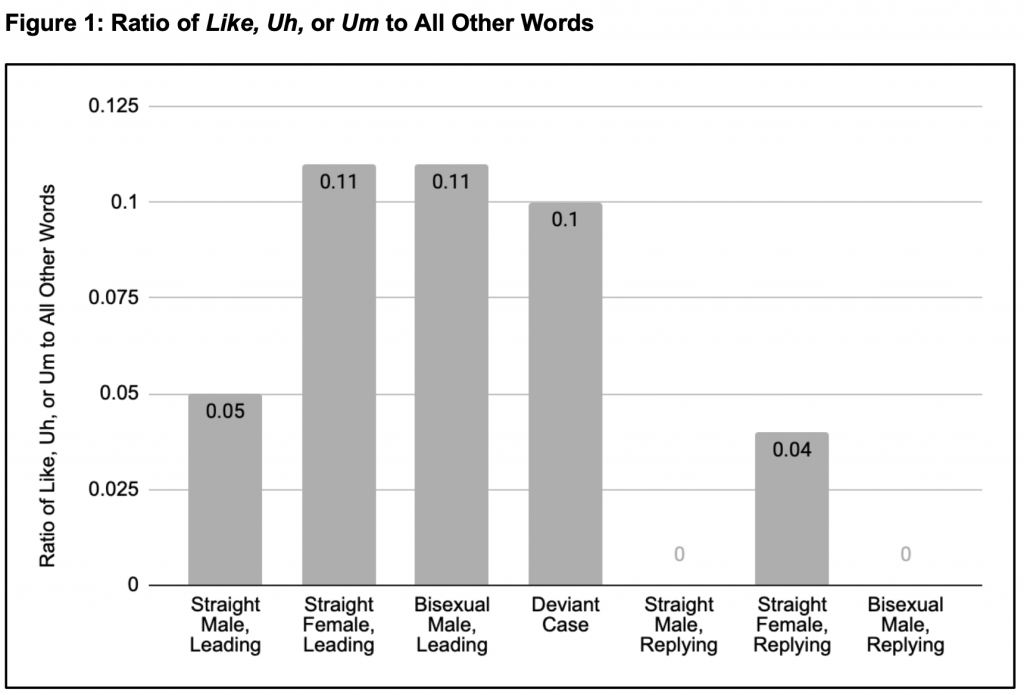
Figure 1 shows that the straight female and bisexual male in the leading speaker role have a higher ratio of filler words than the straight male in the leading speaker role, while the replying speaker role shows a lower ratio overall. The deviant case is a straight male in the leading speaker role; it is an outlier due to other circumstances surrounding the example, such as supplemental linguistic features and social pressures.

The horizontal axis indicates the individual observed, and the vertical axis is the ratio of filler words to all other words.

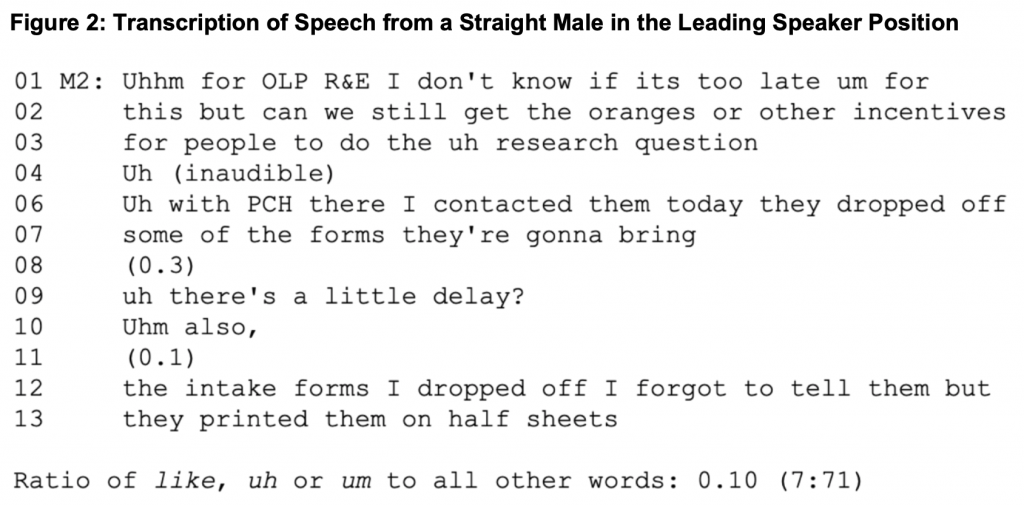
The example in Figure 2 highlights the single deviant case that was found in this study where a straight male showed filler word usage similar to females and bisexual males. This case is noteworthy because it gives some insight into factors that can affect speakers more strongly than gender or identity performance. Here the speaker is admitting to a fault and comes off as trying to be reserved about it, and the frequency of pauses that supplement filler word usage that push his performative identity to be less dominant and less confident, which is somewhat opposite of what is expected from a straight male in the leading speaker position.

M2 = Straight Male 2

After reading the transcription it becomes apparent that the male in this case is leading conversation but is admitting to a few faults. Admitting to faults is often tough, so a linguistic tactic is to use politeness by reducing authority and assertiveness, which is something that the filler words used in this example are doing, along with the various pauses present in the speech.

Overall, the results suggest that there is some underlying difference in filler word usage between genders and sexualities depending on the speaker role, but what importance does this hold?

Discussion

In gendered sociolinguistics, the Difference Model is a theory postulated by Deborah Tannen that suggests that men and women have different cultures of speech entirely (think Spanish and Mandarin, for example) which ultimately explains why men’s speech will oftentimes dominate women’s speech (15). This then bleeds into the Performativity Model, as postulated by Judith Butler, which is applicable to the actual identity that each individual is perceived as by others (3). In the case of APHC, this study suggests that college organization student leaders indeed model differences in language according to gender and sexuality, and fit into both models in some ways. This study is a very suitable example of how men and women express themselves in different ways even when in the same environment under the same pressures (9), and how strongly sexual identity can play into the gendered “culture” that one aligns with (11, 13).

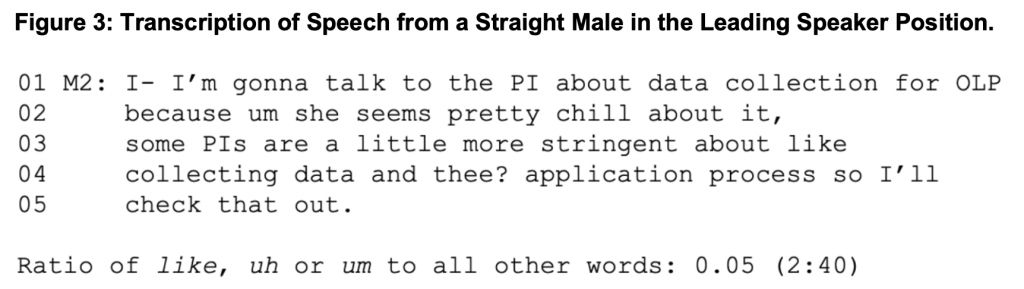
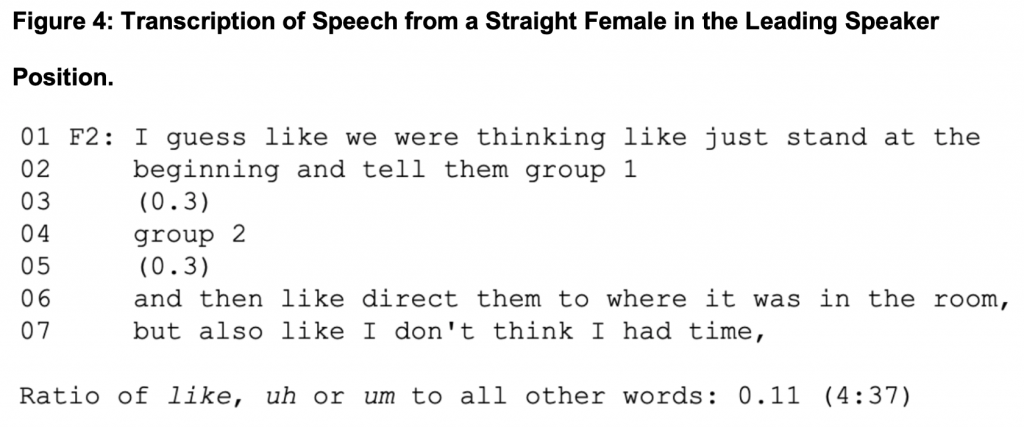
Beginning with the Difference model, the results suggest that straight males use fewer filler words than females and bisexual males in the examples studied from APHC. Filler words, as mentioned briefly before, can act as markers for lessening assertiveness when speaking, which is quite common for women as women’s speech will position them in the less assertive role simply because it is their “culture” to do so, according to the Difference model (9, 15). In Figures 3 and 4, examples of straight male speech and straight female speech in the leading speaker role from the APHC board meeting are compared, and it is evident that there are multiple linguistic features at play:

M2 = Straight Male 2

As seen in transcription in Figure 3, the usage of filler words is fewer and the assertiveness of getting the point across is more evident, as this individual simply jumps into saying what they need to say without too much hedging. The assertiveness is a common feature in male linguistic culture.

F2 = Straight Female 2

In example in Figure 4, filler word usage is higher than the previous example involving the straight male speaker. Filler words here are causing the speaker to be less assertive in getting her words across, and the pauses further push the speech to seem less dominating.

Most of the filler words used by the female in the example pictured in Figure 4 are like, which in this case serve as “approximative adverbs.” These words increase the flexibility of interpretation of the idea by not confining it to any solid concept (6, 13). This is different from the male speech example where he mostly cut straight to the point without approximations, which ultimately highlights the Difference model in play, showing that males and females have different speech methods, even when in the same role, that lead to males having a more dominant character (6, 9, 15).

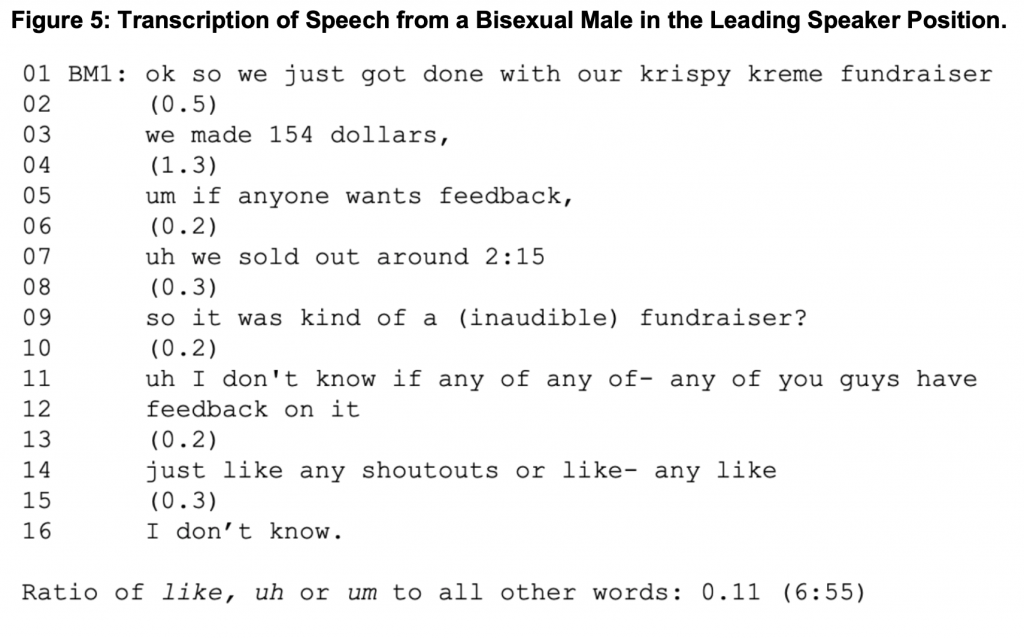
Lastly, the Performative model comes into play when looking at the example with the bisexual male in the leading speaker role. The transcription is shown in Figure 5:

BM1 = Bisexual Male 1

The ratio of filler words to all other words is similar to the ratio seen in the straight female example (0.11), suggesting a close relationship between these two examples from an applied linguistic standpoint.

Again, this example shows filler words accompanied by numerous pauses. Looks familiar, yes? In this case, the individual’s performative identity is more similar to the female in that there is far less assertiveness in this segment of speech, which is actually expected from this individual as bisexual and gay males tend to have performative identities comparable to females (11, 13). In this case, the linguistic features support such an idea because the same patterns of filler words and pauses are seen, and they serve the same purpose in reducing the assertiveness of the individual speaking.

Conclusion

In conclusion, filler words are actually quite important despite being overlooked so often. Their usage alone often is not very definitive of any purpose, but when combined with other linguistic features and thought of from an applied sociolinguistic standpoint, they suddenly become appreciably important in describing gender and sexuality identities of individuals through language.


References

  1. Atkinson, J. M. & Heritage, J. (1984). Transcript notation. In J. M. Atkinson & J. Heritage (Eds.), Structures of social action (pp. ix – xvi). CUP
  2. Bortfield, H. et al. (2001). Disfluency Rates in Conversation: Effects of Age, Relationship, Topic, Role, and Gender. Language and Speech, 434 (23), 123–147.
  3. Butler, J. P. (1993). Bodies That Matter: On the Discursive Limits of Sex. Routledge.
  4. Christodoulides, G. (2016). Effects of Cognitive Load on Speech Production and Perception. PhD Thesis, Université catholique de Louvain.
  5. Duvall, E. D., Robbins, A. S., Graham, T. R., & Divett, S. (2014). Exploring filler words and their impact. Schwa. Language & Linguistics, 11, 35-49.
  6. Eckert, Penelope, and Sally McConnell-Ginet. (2013). Language and Gender. Cambridge University Press.
  7. Fuller, J. M. (2003) The influence of speaker roles on discourse marker use. Journal of Pragmatics, 35, 23–45.
  8. Hoey, E. M. & Kendrick, K. H. (2017). Conversation Analysis. Research Methods in Psycholinguistics and the Neurobiology of Language, 152-189.
  9. Koike, D. A. (1986). Differences and Similarities in Mens and Womens Directives in Carioca Brazilian Portuguese. Hispania, 69(2), 387. doi: 10.2307/341699
  10. Lakoff, R. (1975) Language and Women’s Place. New York: Harper and Row.
  11. Pennington, S. (2009). Bisexuals “Doing Gender” in Romantic Relationships. Journal of Bisexuality, 9(1), 33–69. doi: 10.1080/15299710802660029
  12. Siegel, M. E. A. (2002). Like: The Discourse Particle and Semantics. Journal of Semantics, 19(1), 35–71. doi: 10.1093/jos/19.1.35
  13. Smyth, R., Jacobs, G., & Rogers, H. (2003). Male voices and perceived sexual orientation: An experimental and theoretical approach. Language in Society, 32(3), 329–350. doi: 10.1017/s0047404503323024
  14. Shriberg, E. (1996). Disfluencies In Switchboard. Proceedings of the International Conference on Spoken Language Processing.
  15. Tannen, D. (1990). You just don’t understand: Women and men in conversation (p. 42). New York: Morrow.

[/expander_maker]

Man Up! Women in American Sitcoms

Mariam Alghamdi

“Man up!”: A phrase that has come to mean “toughen up”. It is a phrase that we still hear, well into the twenty-first century; it is a phrase that even those who deem themselves feminists, myself included, let slip out of their tongues accidentally. The occasional use of such a phrase says a lot about the engraved stereotypical views of men as strong and women as vulnerable in our society. Even in the absence of such a phrase, sadly, such views find a way to shine through. This article studies the representation of women as vulnerable beings and as active participants of conversations, mainly by other male characters, in two American sitcoms from two different eras – Cheers and Brooklyn Nine-Nine. Cheers, which aired in the eighties, revolved around a group of people that frequent a bar. On the other hand, Brooklyn Nine-Nine, which is still airing, revolves around a police precinct in Brooklyn. In order to study such depiction of women, I will specifically be using conversational analysis with a focus on four language units: word choice, pauses, elongation, and emphasis. By investigating such representations of women, I am investigating if there is hope in a society that still uses the phrase “man up”; if the representation of women in American sitcoms has changed enough that young women can feel empowered through watching such shows.

[expander_maker id=”1″ more=”Read more” less=”Read less”]

Introduction

The stereotype that women are vulnerable, incompetent individuals that need the guidance of a man in order to move through life has existed for centuries, which comes hand in hand with the dismissal of women’s opinions. This article investigates the representation of women as vulnerable, incompetent beings as well as their contribution to general discourse in two American sitcoms, Cheers and Brooklyn Nine-Nine. The difference in the eras these sitcoms were/are aired during is a key factor to this article since I am interested in the progress of such representation of women through time. As this article will show, Cheers perpetuates and reinforces the categorization of women as vulnerable, incompetent individuals and simultaneously dismisses their contributions to the discourse. On the other hand, Brooklyn Nine-Nine resists such categorization while validating the contributions of women.

Methods

In order to carry out this study, I looked into the first six seasons of Cheers and Brooklyn Nine-Nine. To make the comparison between these sitcoms as fair as possible, I specifically picked situations that were parallel or semi-parallel in both sitcoms. I then analyzed these scenes using conversational analysis with a focus on word choice, pauses, elongation, and emphasis to better understand the role language plays in such representation of women.

Before diving into the findings of my investigation, I will briefly talk about each of the linguistic units I chose to investigate to prevent any confusion throughout the article. When looking at the choice of words, whether it is intentional or not does not matter in my investigation not only because one cannot deduce the intentions of the characters/writers – not to mention the function of intention in scripted data is complex – but also because regardless of intention, the choice of words reflect certain ideologies whether intentionally or not. On the other hand, pauses, can be used to amplify the importance of certain statements as Penelope Eckert and Sally McConnell-Ginet discuss in their book Language and Gender (Eckert & Sally McConnell-Ginet, 2013). Lastly, from Robert E. Pittenger and Henry Lee Smith Jr, elongation, which indicates elongating certain parts of a word, and emphasis can be used to magnify the importance of certain parts of the conversation since they capture the audience’s attention (Pittenger & Smith, 1957).

Results and Discussion

To arrive at effective conclusions, I am comparing Cheers and Brooklyn Nine-Nine by studying two parallel situations. I am also studying a fan favorite scene from Brooklyn Nine-Nine to understand its limitation in resisting the aforementioned representation of women.

The first situation is a discussion regarding a female character by male characters, which take place in the pilot episodes of both sitcoms. In the pilot episode of Cheers, Sumner and his fiancé, Diane are at the bar, where Sam serves them drinks. Sumner is going to leave Diane alone at the bar while running an errand. Sumner asks Sam, a total stranger, to look after his fiancé during that time, clearly indicating that in his absence, the guidance of another man is needed. Sumner emphasizes the words “alone” and “bar” as well as elongate the word bar when he discusses with Sam how stupid of an idea it is to leave Diane there. Sumner’s exact words are shown in Figure 1. This further indicates Diane’s need of a man’s guidance.

Figure 1 – Cheers S01E01: Sumner leaving Diane alone in a bar

On top of that, Sumner chooses imperative words such as “sit” and “chat”, when telling Diane what to do as he runs his errand. This indicates that he is not suggesting how Diane should spend her time, but rather giving her directions. This is further echoed by Sumner’s body language, which is shown in Figure 2, as Sumner guides Diane to the chair by holding her shoulders and directing/moving her towards the chair.   

Figure 2 – Cheers S01E01: Sumner guiding Diane to sit

Please note that Diane’s annoyed face at the first image in Figure 2 is not a reaction to Sumner’s words but a reaction to a snarky comment Sam made.

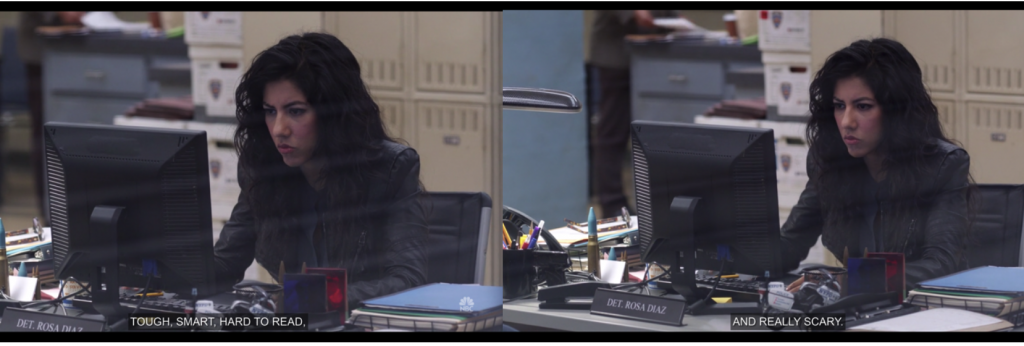
In the parallel scene in the pilot of Brooklyn Nine-Nine, Sergeant Terry tells the new precinct’s captain about his detective squad. In his introduction, he uses word choice, emphasis, and elongation to portray one of the female detectives, Rosa, as a strong character. Terry uses words such as “tough”, “smart”, and “scary”, which portrays Rosa as anything but incompetent and vulnerable. Terry also adds the word “really” before scary elongating and emphasizing it, which indicates that Rosa is not only scary but terrifying. 

Figure 3 – Brooklyn Nine-Nine S01E01: Terry describing Rosa

The second parallel situation is the discussion of the sexual harassment of a female character. In Cheers season 2 episode 3, Diane is upset about constantly being harassed by potential employers and complains about it. Even though Sam tries to be helpful, his choice of words is poor and reflects a lack of understanding regarding the severity of the situation. He uses phrases like “lighten up” and even cracks a joke while trying to be supportive as he says, “Sometimes I’m just ashamed to be a guy, but if I made the switch now I’d have to buy a whole new wardrobe.” He even laughs amusingly at his joke.

Figure 4 – Cheers S02E03: Sam cracking a joke while Diane is upset

Sam’s lack of understanding and disregard to Diane’s feeling is further amplified by his sexual treatment of Diane. At a point in the conversation, Sam expressed some anger regarding Diane’s situation, but his use of emphasis illustrates that his anger is misdirected. His angry moment is shown in Figure 5.

Figure 5 – Cheers S02E03: Sam upset

Sam emphasizes the words “those”, “my”, and “sex object”. This emphasis indicates that he is angry that other men dare treat his women in a sexual way. His use of emphasis implies an anger relating to his ego and his sense of ownership over Diane rather than Diane’s mistreatment. Not to mention his use of the word “squeeze” when describing Diane sexualizes and objectifies her. In this way, Diane’s contributions, her complaints about her sexual harassment, is not being validated by Sam.

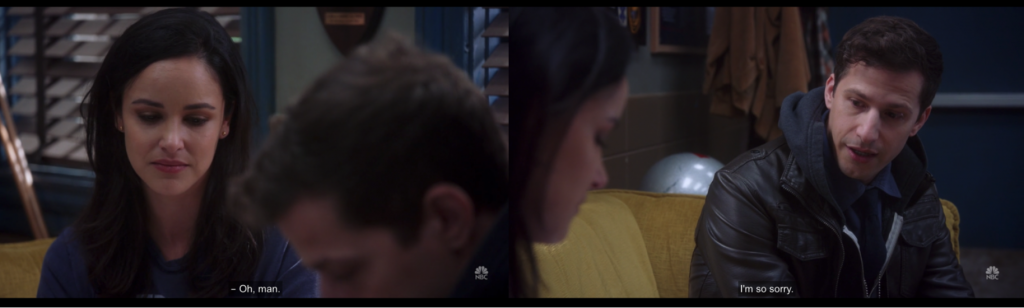
In Brooklyn Nine-Nine in season 6 episode 8, when Amy, a female detective, discusses her sexual harassment experience with her husband Jake, another detective, the response is quite different. The contrast is not only shown through the fact that no jokes whatsoever take place during this scene, unlike in Cheers, but it is also shown through the use of pauses and through Jake’s replies. Amy’s retelling of her experience was filled with long pauses, ones that exceeded one second. These pauses indicate two things. First, they elevate the importance of Amy’s statement. They allowed for the severity of the situation to sink in; for Amy’s thoughts to stay a little on the floor for the audience to subconsciously or consciously dissect them. Second, they highlight Jake’s support as he did not try to talk during these pauses even when he had more than enough time to talk. Not to mention, Jake only spoke two times during Amy’s retelling which is shown in Figure 6 and Figure 7.

Figure 6 – Brooklyn Nine-Nine S06E08: Jake first time speaking
Figure 7 – Brooklyn Nine-Nine S06E08: Jake second time speaking

His words themselves show extreme support as he treats Amy as a fellow human – unlike how Sam objectifies Diane in Cheers – even if he does not completely understand her suffering, but his support is shown in different ways as well. Jake even spoke in a low volume in both times, suggesting either an attempt to sound gentle at the news of such pain, uncertainty in what to say, or both. He even spoke quickly the second time which could suggest his frustration at the situation his wife has been through even if he doesn’t relate as well as his desire to not take too much time away from his wife. Jake’s support is emphasized by his facial expressions throughout the times he spoke – in Figure 6 and Figure 7 – as well as throughout the times Amy was speaking, which is shown in Figure 8.

Figure 8 – Brooklyn Nine-Nine S06E08: Jake’s expression

Jake’s support through his silence and facial expressions and such reflects that while he may not understand what Amy is going through, he supports her and validates her contribution.

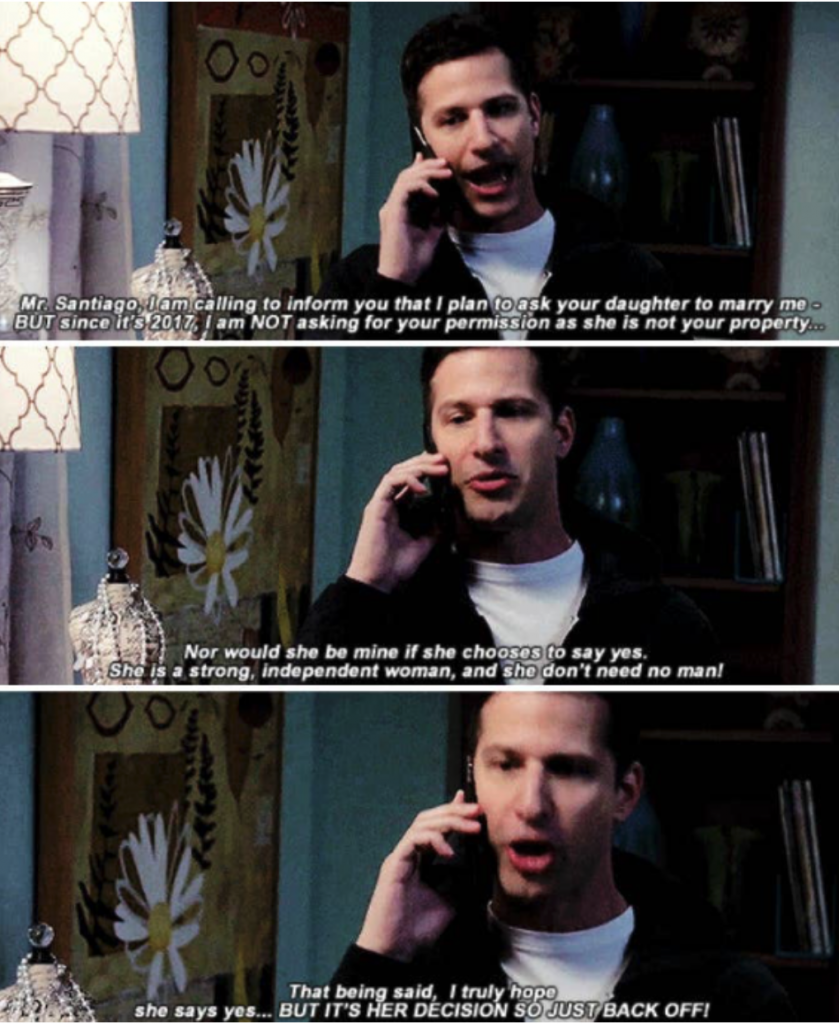
Last but not least, I will study a scene well loved by many fans of Brooklyn Nine-Nine, which takes place in season 5 episode 4. Before Jake proposes to Amy, he leaves her father a voicemail. This scene is shown in Figure 9.

Figure 9 – Brooklyn Nine-Nine S05E04: Jake calls Amy’s dad (Angus, 2017)

This scene is well loved by many fans because it refutes the categorization of women as vulnerable, incompetent and in need of a man’s guidance. This is clear through Jake’s choice of words as he describes Amy as “strong” and “independent”. He even explicitly says that “she don’t need no man”. However, an important thing to note that lovers of this scene tend to forget is that Jake still felt the need to call Amy’s father. It was not in a way to inform the family either, because if it was he would not have highlighted the fact that he was not asking for permission. Not to mention, he would have called her mother as well, and there was no indication at all that he ever did. So, while this scene does in fact refutes the categorization of women as in need of a man’s guidance, it also reflects the fact that such categorization is not completely wiped out. In a way, this scene perpetuates such stereotypes as it highlights that even though Jake does not ask for permission, the idea still floats in his mind and he still is expected to inform Amy’s father. This ties back to Raymond’s idea that the representation of categories in scripted shows can in fact perpetuate stereotypes even when it tries to combat them (Raymond, 2013).  

In order to reach a conclusion confidently, I analyzed one other parallel situation, which was a marriage proposal in both sitcoms. To grasp the comparison between the two sitcoms in more depth and for more details, see the FULL PAPER which includes transcript and linguistic analysis of the interactions discussed in this article as well as the additional parallel situation.

Conclusion

While analyzing scripted data using conversational analysis, in this case Cheers and Brooklyn Nine-Nine, does not help us better understand human beings, Chase Raymond argues that applying conversational analysis on scripted data is fruitful since it helps us understand society’s interpretations and indexation of certain categories (Raymond, 2013). My findings in this article indicates that society’s view and interpretation of women has in fact changed from the eighties to today, at least in those two sitcoms. From the analysis of the two parallel situations above, we can see that language aids in the depiction of women as vulnerable, incompetent being that need a man in the older sitcom Cheers. Language is also used to dismiss the contributions of women in Cheers as analyzed above. This representation of women reflects a similar societal view of them as vulnerable, incompetent individuals whose contributions are not taken seriously. On the other hand, language helps women contribute to the general discourse in the more modern sitcom Brooklyn Nine-Nine as well as aids in refuting the stereotypes of women as vulnerable beings. Once again, this representation of women reflects a similar societal view of them as strong, competent individuals whose contributions are not only taken seriously but supported as well. It is important to note that while the representation of women has progressed, the progress is not as simple, as linear as saying that the more modern sitcoms tend to be resist all stereotypes and validate all women’s contribution. As analyzed in the fan-loved example, some attempts at resisting certain stereotypes comes hand in hand with perpetuating said stereotypes.

Lastly, while this article does not aim to make any statements regarding the effect of such representation on society, almost everyone in today’s society agrees that representation matters. The way someone’s categories are represented in the media including sitcoms affects their self-esteem as I know from experience and as I am sadly sure many others do as well. Hence, even though more studies are needed to make a firm conclusion, it is fair to assume that the representation of women could help encourage or discourage young women, and fortunately it seems like the representation of women in American sitcoms is moving in the right track even if it comes with limitations.


References

Angus, Kat. (2017, November 3). 21 Times Jake and Amy’s Love On “Brooklyn Nine-Nine” Made Us Melt. Buzzfeed. https://www.buzzfeed.com/katangus/peralta-and-santiago-4eva

Eckert, P., & McConnel–Ginet, S. (2013). Language and gender (2nd edition). Cambridge University Press.

Raymond, C. W. (2013). Gender and Sexuality in animated sitcom interaction.    Discourse & Communication, 7(2), 199–220.

Robert, P.E.  & Smith Jr, H.L. (1957). A Basis for Some Contributions of Linguistics to Psychiatry. Psychiatry, 20(1), 61-78.

[/expander_maker]
Using Language to Examine Power and Gender Gradients Between YouTube’s Influencers

Helen Ng

With YouTubers, or influencers, rapidly pervading the younger generation’s social media spaces, the following article takes a stab at uncovering the linguistic patterns of successful interruptions and rising intonations at the end of declarative statements in YouTubers’ language. This observational study’s sample consists of beauty and comedy influencers, the types of YouTubers who tend to produce some of the most popular types of videos. This study examined five-minute segments of videos between influencers conversing while completing an activity. These conversation segments were transcribed and the functions and how often the above linguistic features occur were used to determine whether these language patterns expand on, diminish, or add new insight to previous literature regarding power imbalances and gender displays. Does YouTuber “lingo” provide directions as to what the younger generation may ultimately embed into their own speech? Will we become the next James Charles?

[expander_maker id=”1″ more=”Read more” less=”Read less”]

Introduction

The microcosm of YouTube is a popularly visited platform but is a relatively unexplored field in research. Information regarding YouTubers’ speech is primarily centered around voice, such as in this article from The Atlantic. Influencers are YouTubers with a large following on YouTube and belong to a community, such as beauty, comedy, etc. and often film collaboration videos together, in which they complete an activity together while conversing in front of a camera.

Accordingly, this study examined influencers’ uses of successful interruptions and uptalk. Successful interruptions display the interrupter’s dominance, while uptalk, a rising intonation at the end of declarations, invites addressees to add input to maintain conversation (Eckert & McConnell-Ginet, 2013). Successful interruptions were defined as i) the interrupter interjecting while the speaker talks, regardless of the latter’s intonation trajectory, and ii) the interrupter taking over before the speaker ceases talking. This definition was motivated by the notion that taking turns is expected while speaking; interruptions violate this politeness norm and contribute to displays of gender identity and power characteristics.                       

Excerpts from conversations were analyzed in relation to previous studies’ findings. Lynn Smith-Lovin and Charles Brody’s work on social status in groups suggests that successful interruptions are attributed to men’s indexing of power and masculinity (1989). As well, in Roger and Schumacher’s 1983 study, and Roger and Nesshoever’s 1987 study, they found positive relationships between successful interruptions and dominance traits (Tannen, 1999). In addition, uptalk has been associated with women’s language (Gorman, 1993). From Penelope Brown’s 1980 study on politeness in villagers in Tenejapa, Mexico, she found that females tended to put more effort in enacting positive politeness than and toward men, which she and Stephen Levinson described as conveying unity (Eckert & McConnell-Ginet, 2013).

Altogether, this study’s motivation was to identify whether choices behind successful interruptions and uptalk were common in the speech of YouTube influencers, and reflected observable gender identity performances and power asymmetry expressions. Even though these linguistic practices’ links to gender and power, there exists little research in the context of YouTube. Hence, this study demonstrated that despite the presence of a camera, gender and power hierarchies in influencers’ conversations resembled those in non-YouTuber interactions, and that successful interruptions and uptalk normalize social imbalances between genders on the platform.

Methodology

Five-minute YouTube video segments of dyadic, single and mixed-gender interactions between influencers within and across the beauty and comedy domains were transcribed and analyzed. Conversation and discourse analyses were performed on dyadic interactions between male and female American, native English-speaking influencers. The following pairings’ conversations were analyzed: Jeffree Star and Tati Westbrook, Jeffree Star and James Charles, Jeffree Star and Shane Dawson, James Charles and Liza Koshy, James Charles and Jenna Marbles, Bethany Mota and Kian Lawley, and Jaclyn Hill and Kim Kardashian. In transcriptions, successful interruptions were indicated by a red square bracket with no corresponding right square bracket in the person being interrupted’s line of speech, while uptalk was marked with a blue question mark and the associated declarative statement in blue.

Results

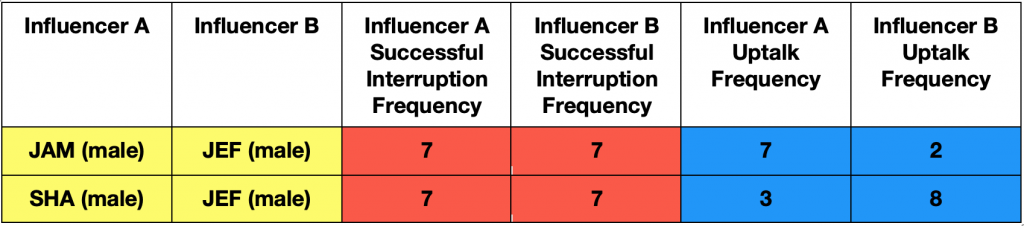
The five-minute video segments produced consistent, significant results in successful interruption and uptalk frequencies, summarized in Tables 1-4 (see Appendix A). In the transcribed conversations, female influencers were interrupted more frequently by male influencers and used uptalk at a similar or greater frequency than males.

In male-male interactions, each successfully interrupted the other with the same frequency, but their uptalk frequencies were imbalanced.

In the female-female interaction, successful interruption and uptalk frequencies were imbalanced, in that the female who successfully interrupted more often did not use uptalk more, which deviated from the pattern in mixed-gender data.

Analysis

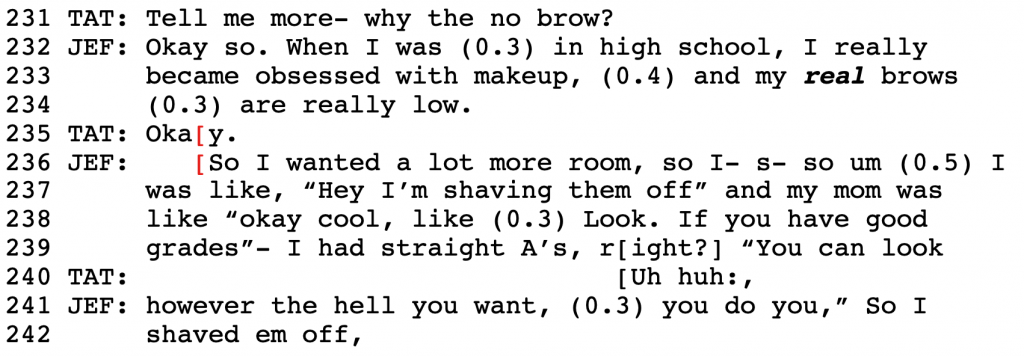
Previous research points to successful interruptions being associated with males to establish dominance (Smith-Lovin & Brody, 1989). This power move is depicted in the transcribed conversation between beauty influencers Jeffree Star (coded JEF) and Tati Westbrook (coded TAT), in which they talk about Jeffree’s choice of shaving his eyebrows:

Tati provides a supportive backchannel in line 235 (timestamp 8:41), in which she is successfully interrupted by Jeffree so he can continue his story for several lines of speech. He did not cede the floor when Tati unsuccessfully interrupted him while he was speaking on a topic in which he has more knowledge than Tati in line 239 (timestamp 8:50), maintaining the power gap between them.

It is also worth exploring how males react when females exercise this power move instead. One example is in a conversation between beauty influencer James Charles (coded JAM) who successfully interrupts Liza Koshy (coded LIZ), a comedy influencer, while she is speaking about YouTube’s shift:

Liza reciprocated James’ successful interruption in line 47 (timestamp 15:45). In turn, James agrees with Liza in line 48, then successfully interrupts her in line 51 (timestamp 15:50) to take the floor again within five seconds. Furthermore, James’ expression changed at 15:45 from nonchalant to holding his tongue, when Liza successfully took the floor from him, designating her interruption as unnatural; subsequently, James presided over both the female and the conversation again. This case perpetuates the notion that male influencers are allowed to interject to establish dominance, whereas this would be inappropriate for female influencers.

James’ Expression Before and When Liza Successfully Interrupts Him

With regard to uptalk, female influencers tended to use this female-associated linguistic feature (Gorman, 1993) to maintain conversation by inviting addresses to add input, which was depicted in Liza and James’ conversation. In the following excerpt, Liza discusses how her outfit had been criticized:

Liza relied on pauses and slight intonation rises before using uptalk at the end of her statements, culminating in the addressee contributing. After Liza’s pause in line 184, she injected uptalk in lines 187 and 188, when explaining how criticism affected her. James interrupts after Liza’s uptalk in line 188 (timestamp 19:16), taking the floor to express prior knowledge in handling a similar situation. Liza’s uptalk signaled that entry points for interjections were available. Thus, Liza deferred speaker authority to James, allowing him to spearhead the conversation, thus highlighting unequal linguistic expectations bestowed upon each gender.

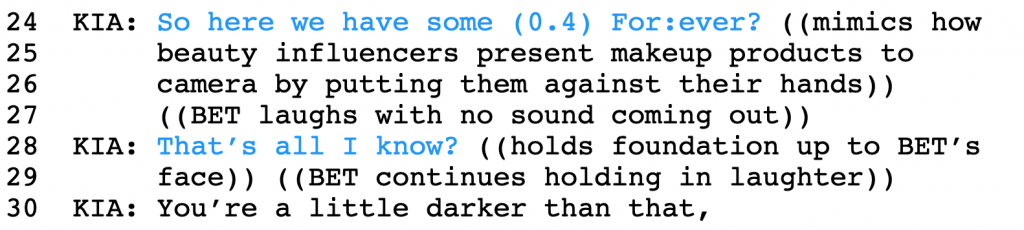
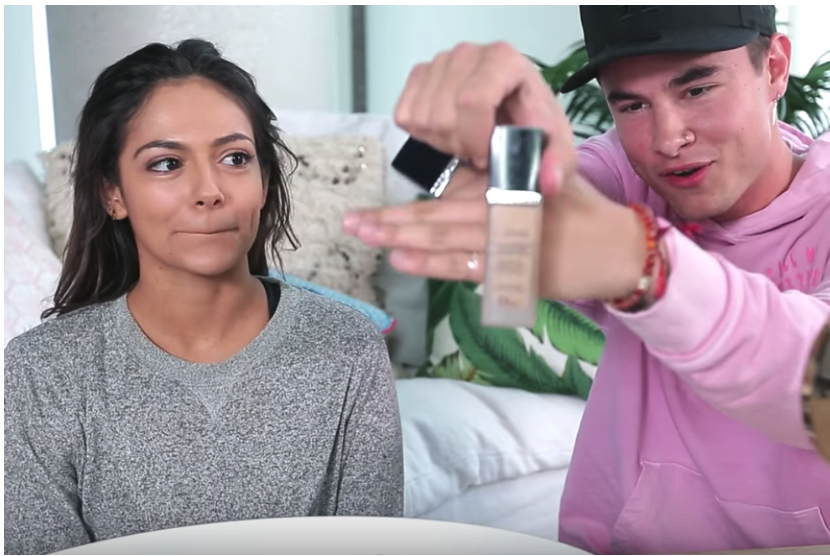
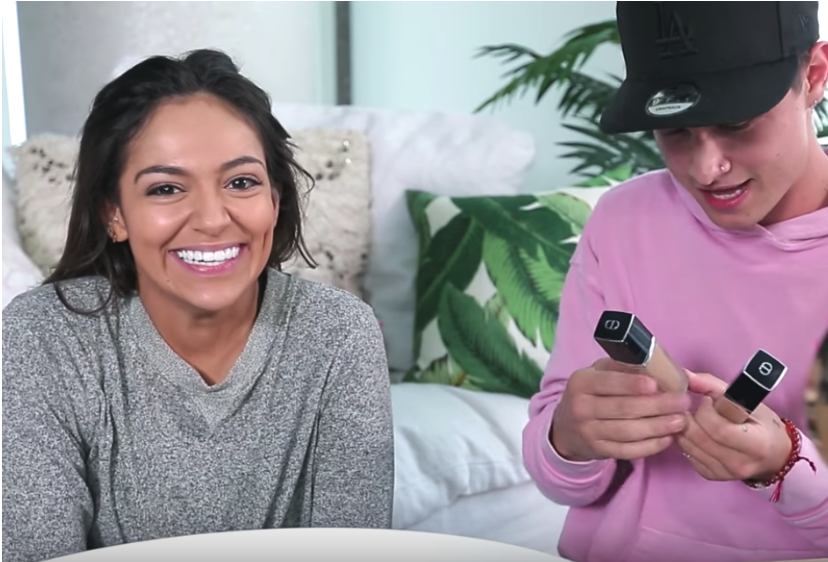
Whereas male influencers added uptalk at the end of their declarations to appear funny, female influencers were tasked with facilitating the conversation, such as in the conversation between Kian Lawley (coded KIA), a comedy YouTuber, and Bethany Mota (coded BET), a beauty YouTuber, Kian describes the foundation he will be applying:

In lines 24-26, Kian held the foundation against his hand in conjunction with his rising intonation to elicit laughter. He did not mean to engage Bethany in conversation, since she did not chime in after his use of uptalk in lines 24 (timestamp 0:54) and 28 (timestamp 0:55), but stifled a laugh, indicating his actions as comical. Kian used uptalk again in line 28 (timestamp 0:55) to emphasize his lack of knowledge about the product – with Bethany still containing her laughter – then continues talking. Thus, the male influencer was unwilling to yield the speaker position after implementing uptalk, showing that he was not obligated to maintain conversation flow.

Bethany Holding in Laughter and Laughing After Kian’s Use of Uptalk

Conclusion

Overall, these linguistic features positioned female influencers to consolidate their gender identity by being polite through being successfully interrupted more often by males and of using uptalk to facilitate conversations. On the whole, the YouTubers studied have millions of subscribers and cater toward younger female audiences, which poses multiple problems. These include: the normalization of females being interrupted by males, establishing a power gradient, and of females taking on the role of facilitating conversations, organizing a gender asymmetry on YouTube. Ultimately, as YouTube rises in popularity, influencers’ speech may permeate non-YouTubers’ conversations, shaping the evolution of gender and language performances on a larger scale.


References

Eckert, P. & McConnell-Ginet, S. (2013). Language and Gender (2nd ed.). Cambridge, UK: Cambridge University Press.

Gorman, J. (1993, August 15). ON LANGUAGE; Like, Uptalk? The New York Times Magazine. Retrieved from https://www.nytimes.com/1993/08/15/magazine/on-language-like-uptalk.html

Griffiths, S. (2013, December 6). American men have started to talk like WOMEN: Californian  study finds that males are rising in pitch at the end of sentences. Daily Mail. Retrieved from https://www.dailymail.co.uk/sciencetech/article-2519363/Men-started-talk-like-WOMEN-Study-finds-males-rising-pitch-end-sentences.html

Rosenberg, E. (2018). How Youtube Ad Revenue Works. Retrieved January 31, 2020, from Investopedia Web site: https://www.investopedia.com/articles/person-finance/032615/how-youtube-ad-revenue-works.asp

Smith-Lovin, L., & Brody, C. (1989). Interruptions in Group Discussions: The Effects of Gender  and Group Composition. American Sociological Review, 54(3), 424-435. Retrieved February 9, 2020, from www.jstor.org/stable/2095614

Tannen, D. (Ed.). (1993). Gender and Conversational Interaction. New York, NY: Oxford  University Press.

YouTube videos

Charles, J. [James Charles]. (2019, February 26). Doing Jenna Marbles’ Makeup [Video]. YouTube. https://www.youtube.com/watch?v=zhfGLn2wu9k

Charles, J. [James Charles]. (2018, December 7). Doing Liza Koshy’s Makeup [Video]. YouTube. https://www.youtube.com/watch?v=AvQj2VVd5s8

Charles, J. [James Charles]. (2018, December 4). Palette Swap ft. Jeffree Star [Video]. YouTube. https://www.youtube.com/watch?v=Rfs-4DPlm7I

Hill, J. [Jaclyn Hill]. (2017, July 11). Get Ready With Me & Kim Kardashian | Jaclyn Hill [Video]. YouTube. https://www.youtube.com/watch?v=GEhOZooB3bw

Mota, B. [Bethany Mota]. (2017, May 28). KIAN LAWLEY DOES MY MAKEUP | Bethany Mota [Video]. YouTube. https://www.youtube.com/watch?v=EP6FiH8vBMo

Star, J. [jeffreestar]. (2019, June 2). Kylie Skin Review with Shane Dawson [Video]. YouTube. https://www.youtube.com/watch?v=gnhub9-KLsE

Star, J. [jeffreestar]. (2017, June 17). GET READY IN MY PRIVATE JET feat. Tati Westbrook [Video]. YouTube. https://www.youtube.com/watch?v=r0KXRM5GuMY

[/expander_maker]

 

Is Tennis Truly a Gender Neutral Sport? How Grand Slams and Gender Stereotypes Affect the Language of Tennis Stars

Alyssa Ishimoto

Tennis is considered gender-neutral. In fact, if asked to name famous tennis players, most people would recall athletes of both genders, such as Roger Federer or Serena Williams. However, it is doubtful whether tennis is truly a “gender-neutral” sport that is immune to pervasive gender stereotypes and whether tennis athletes, in particular, succumb to these gender patterns.

The way people speak may reflect what they perceive their social status in a specific situation to be (Segalowitz, 2001). Entitlements to act certain ways based on perceived status are called affordances. If people perceive themselves as having a higher social status and higher knowledge, then they may express self-confidence without explicitly boasting about their own talents. In the context of tennis, gender stereotypes and the amount of career experience may affect athletes’ perceived affordances to speak confidently. To determine this, we will analyze linguistic features in the tennis interviews of major athletes after their first grand slam and after multiple grand slams. Keep on reading to find out if tennis is truly a gender-neutral sport, or if males use more confident language than females do, like the gender stereotypes would presume.

[expander_maker id=”1″ more=”Read more” less=”Read less”]

Introduction and Background

Sports are integral to many societies. They provide a chance for individuals of different backgrounds, genders, and ethnicities to come together and demonstrate their talent, passion, and national pride. However, despite the promotion of diversity, the sport’s culture has implicitly incorporated gender stereotypes. These stereotypes are reflected in the athletes’ behaviors, the media’s representation of the sport, and society’s view of the sport. Gender studies are important to help understand how athletes in different sports, even ones considered gender-neutral, are influenced by these gender stereotypes.

The concept of affordances has been a widely researched area in linguistics, psychology, and sociology. Norman (1999) argued that perceived affordances are the behaviors that people believe they can do based on society’s beliefs, which encourage some behaviors and discourage others. The way we speak also reflects our perceived affordances because we feel entitled to speak a certain way depending on our social status, expertise, and goals in the interaction (Segalowitz, 2001). However, those that choose to speak in a manner that is not acceptable for their status will face negative consequences (Aronin, 2014).

A previous study looked at how the media, which is influenced by gender stereotypes, frames women’s sports as inferior to men’s sports in basketball and tennis tournaments by framing women’s accomplishments as insignificant (Messner et al., 1993). Our study expands because we focus on how the athletes’ language, not the media, demonstrates gender stereotypes in tennis.

Our study compared the interviews of tennis stars after winning their first grand slam to their interviews after winning multiple grand slams. We found that male athletes displayed confident language in both interviews, while female athletes displayed confidence after winning multiple grand slams. The linguistic features that represented confidence displays were the assertiveness in players’ accounts of success and the frequency and purpose of hedges, which are short phrases or words that convey uncertainty. The gender differences in the tennis players’ displays of confidence portray that men may perceive themselves to have greater affordances to speak with confidence, due to gender stereotypes. These gender stereotypes suggest that men should act assertively and women should act modestly (Prentice & Carranza, 2002). Overall, our study may reflect the broader societal pattern of gender differences in affordances, due to professional expertise, social standing, and gender stereotypes.

Methods

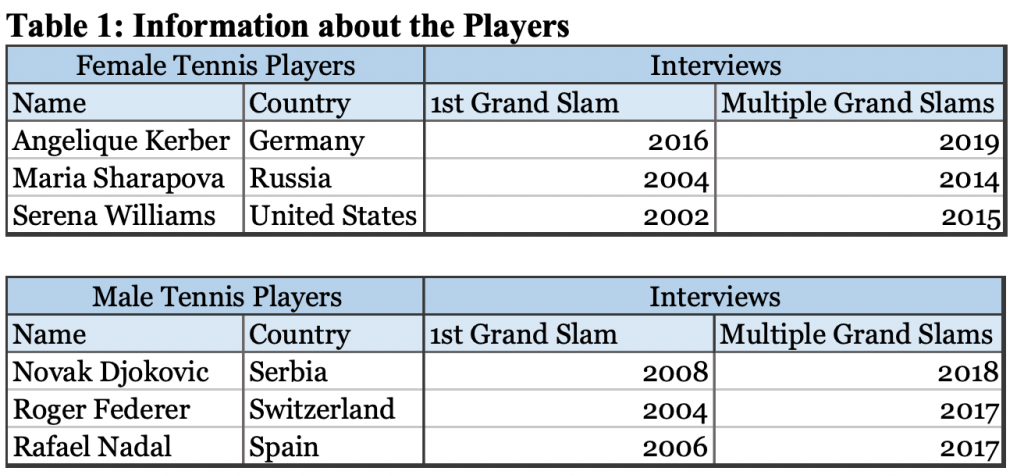
This study looked at gender differences in linguistic features that reflected confidence in the interviews of tennis players after they won their first grand slam and after they won three or more grand slams. A player gets a grand slam title when they win one of the major tournaments, which are Wimbledon, the French Open, the U.S. Open, and the Australian Open. The following table shows information about the players we studied (Table 1). All interviews were found on YouTube.

This table shows the names of the players we studied, the country they represent, the year of their first grand slam interview, and the year of their multiple grand slam interview.

The first linguistic feature studied was the assertiveness in the accounts of success. We looked at the athletes’ use of direct language when describing how they won the grand slam or progressed in their career. Phrases that conveyed uncertainty and doubt were “I think” or “I was trying to.” Phrases, such as “I knew” or direct statements, conveyed confidence (Johnson & Maratsos, 1977).

 The second linguistic feature studied was the frequency and function of hedges. Robin Lakoff defined hedges as utterances that indicate uncertainty and are oftentimes used in women’s language (Lakoff, 1973). Common hedges in the interviews were:

I don’t know – little bit – kind of – I guess – maybe – probably

The frequency was the number of hedges per second of response time and was measured for each player.

The functions of hedges were also noted for each player. There were three functions:

Self-softening hedges were used by athletes when they shared opinions about themselves. They were to protect against the possible criticism towards the athlete’s self (Salager-Meyer, 1994). Other-softening hedges were used by athletes when they shared opinions about another player. They were to protect the other player from possible criticism (Myers, 1989). Low knowledge hedges were used by athletes when they did not have enough knowledge about a subject (Wang, 2016). Only the self-softening hedges lowered the display of confidence because they portrayed uncertainty in oneself.

Results and Analysis

The Accounts of Success after First Grand Slam

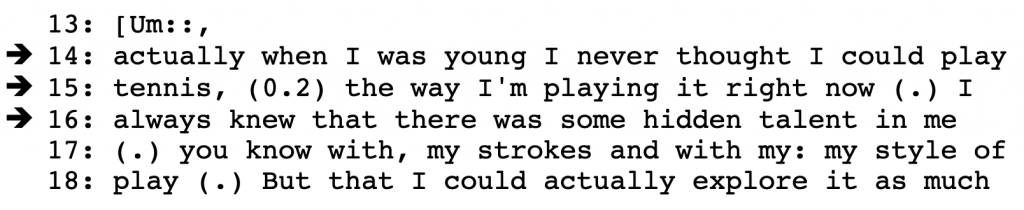
The tennis players differed in their assertive language in the accounts of success after their first grand slam. Two out of the three males used assertive language, including definitive statements. An example is found in Roger Federer’s 2004 interview. The interviewer asked Federer if he had ever expected his game to be where it is at currently. Federer’s response is:

Federer contrasts his younger self with his older self in his response. In lines 14-15, Federer uses the phrase “never thought” to clarify that his younger self displayed the lack of confidence in his tennis ability. On the other hand, in lines 15-16, Federer emphasizes that his current self-projects confidence in his tennis talent. The phrase “I always knew” indicates that Federer is very certain that he has talent.

On the other hand, the three female tennis players used nonassertive language in their accounts of success after their first grand slam. An example is found in Angelique Kerber’s 2016 interview. The interviewer asked Kerber what made her think, in the months leading up to the Australian Open, that she would win. Kerber’s response is:

In line 11, Kerber uses the phrase “I was trying…to,” which conveys that she was not certain about her statement regarding her optimism about winning major tournaments. This uncertain language displays a lack of confidence and shifts personal responsibility for the statement away from her to protect her from possible criticism.

The Accounts of Success after Multiple Grand Slams

After achieving three or more grand slams, both female tennis players and male tennis players used confident language in their accounts of success, although female players still used nonassertive language.

Frequency and Function of Hedges after First Grand Slam

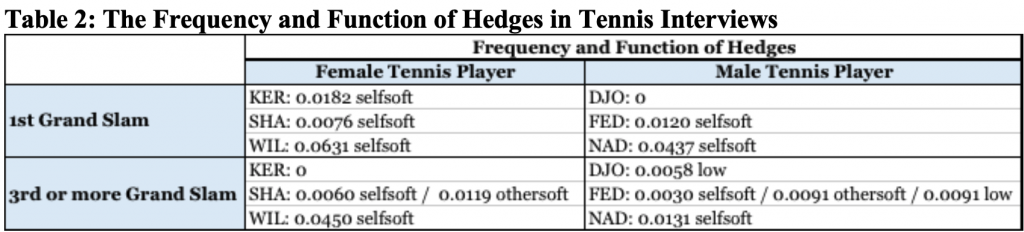
This study also looked at the frequency and function of hedges in the interviews after the tennis players’ first grand slam. Both genders only used self-softening hedges, which decrease the confidence display. However, female tennis players used more hedges than male players did (Table 2).

Females used more hedges than males in the first grand slam interviews. There was a decrease in the use of self-softening hedges and an increase in the use of different types of hedges in the later interviews for both genders, compared to the earlier interviews.
KER = Angelique Kerber, SHA = Maria Sharapova, WIL = Serena Williams, DJO = Novak Djokovic, FED = Roger Federer, NAD = Rafael Nadal. Selfsoft = self-softening hedge, othersoft = other player softening hedge, low = low knowledge hedge

An example of the self-softening hedge is found in William’s 2002 interview. The interviewer asked Williams how she elevated her game in the last year. Williams responded:

In line 13, Williams uses the hedge little bit to lessen the possible backlash to her opinion that she should have been ranked better than nine or ten. The use of self-softening hedges displays unconfident language because the athlete is protecting himself or herself from possible criticism.

Frequency and Function of Hedges after Multiple Grand Slams

In the interviews after multiple grand slams, males and females used more types of hedges. As seen in Table 2, both genders used self-softening and other-softening hedges and only male players used low-knowledge hedges in their later career interviews. Although the total frequency of all hedges increased for male tennis players after multiple grand slams, they used low knowledge hedges and other-softening hedges, which do not affect confidence displays.

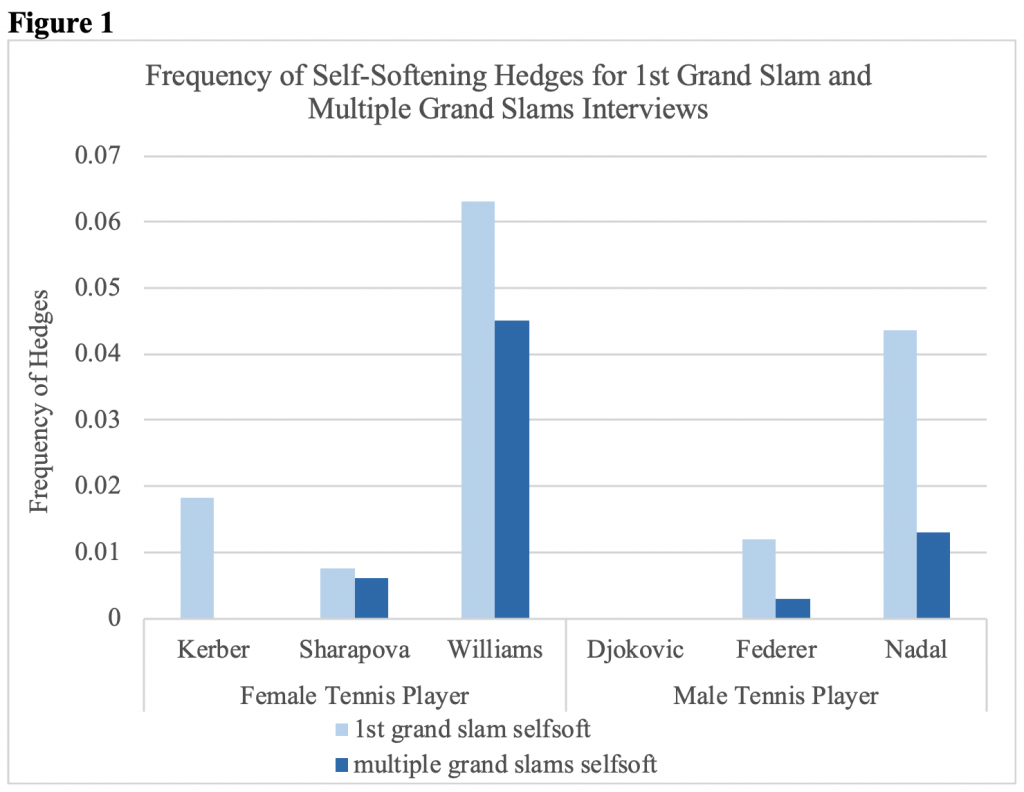
However, both genders used fewer self-softening hedges compared to their earlier interviews, as shown in Figure 1. Self-softening hedges lower the display of confidence so both genders displayed more confidence in their later career interviews.

The frequency of self-softening hedges decreased in the later interviews compared to the earlier career interviews for both genders. This type of hedge decreases an athlete’s confidence display.


Discussion

In the first grand slam interviews, males used more confident language in accounts of success and fewer self-softening hedges when compared to female players. On the other hand, females used nonassertive language in accounts of success and more self-softening hedges. The pattern of males using confident language and females using nonassertive language after their first grand slam may portray that females perceive themselves to have less capability to speak with confident language due to gender stereotypes. These stereotypes pressure women to act indecisively so female players may use nonassertive language to conform to the gender norms (Eagly & Mladinic, 1994). On the other hand, male players may speak confidently to conform to the gender stereotypes that men should act assertively.

One deviation from the common pattern that male professionals use confident language in their first grand slam interview was Rafael Nadal. Nadal displayed nonassertive language in his accounts of success and used more self-softening hedges than two of the female players in his 2006 interview. Although he broke the gender stereotype that men should act confidently, he did not face backlash. The media viewed Nadal’s language after his first grand slam as being gentleman-like and polite. This one case may represent the broader pattern that society comments upon those who do not conform to societal norms.

In the multiple grand slam interviews, all three males used confident language in accounts of success and used fewer self-softening hedges compared to their earlier career interviews. All three females used both confident and nonassertive language in accounts of success and used fewer self-softening hedges compared to their earlier career interview. Both genders’ use of confident language in accounts of success and their lower frequency of self-softening hedges in their later interviews may be due to their perceptions that the winning of multiple grand slams gives them more entitlement to speak confidently. The higher expertise in their profession gives both genders more affordances to act confidently (Sarsons & Xu, 2015). However, females still spoke with nonassertive language in their accounts of success in their later career interviews because of the gender stereotypes that maintain that women should act modestly.

Nadal was, again, the deviation case, because he used more self-softening hedges than two of the female tennis players in the multiple grand slams interviews. It is uncommon for male players to use a high amount of self-softening hedges so the media notices Nadal’s uncertain language. However, the media views the unconfident language as a display of humility.

Conclusion

Overall, our results show that both gender stereotypes and professional expertise may affect a tennis player’s perceived affordances to speak confidently. Both genders see themselves as being able to speak assertively once they have achieved a higher status, through the winning of multiple grand slams. However, the female players still speak indirectly and unassertively in some scenarios because they conform to the gender stereotypes which state they should act modestly. These patterns reflect the broader gender differences in perceived abilities to behave in certain ways based on career accomplishments, social status, and societal stereotypes. We show that gender stereotypes can be widespread and reflected in the language. Even the sports that seem gender-neutral, such as tennis, are not safe from these gender patterns.

To Read Next:

Full research paper

Impactful women in the world of sports:

Ted Talk: This tennis icon paved the way for women in sports

Ted Talk: On tennis, love, and motherhood

Article: The 36 most iconic female athletes of the past century

Current issues facing female athletes:

US Soccer says women don’t deserve equal pay because they have less skill


References 

[AneresEleVen]. (2009, February 26). Serena Williams and Pete Sampras Interview (2002) [Video File]. Retrieved from https://www.youtube.com/watch?v=PbrsvISNqzk.

[delpieroaus]. (2008, January 27). Djokovic Interview after 2008 AO Final Pt. 1 [Video File]. Retrieved from https://www.youtube.com/watch?v=VbseGMLQNp8.

[ESPN]. (2018, September 10). 2018 US Open Interview: Novak Djokovic after Defeating Juan Martin del Potro in Men’s Final [Video Final]. Retrieved from https://www.youtube.com/watch?v=vwhb6R0Gmgs.

[History Nadal]. (2019, September 13). Center Court with Chris Myers: Rafael Nadal 2006 [Video File]. Retrieved from https://www.youtube.com/watch?v=TYadF-M0g2A.

Fox, Mike. (2020, January 20). Beyond the Baseline – Angelique Kerber 2019 [Video File]. Retrieved from https://www.youtube.com/watch?v=8FgBOWGN0fI.

[Indian Wells Media Co.]. (2016, September 4). Angelique Kerber US Open ESPN Interview [Video File]. Retrieved from https://www.youtube.com/watch?v=Bg-iY5a6lMQ.

[Indian Wells Media Co.]. (2017, July 16). Roger Federer Wimbledon 2017 Championship Interview [Video File]. Retrieved from https://www.youtube.com/watch?v=nCe-ukkkLWo.

Li, Scarlett. (2010, October 28). 2004 Interview: Charlie Rose – A Conversation with Tennis Great Roger Federer [Video File]. Retrieved from https://www.youtube.com/watch?v=uFTbGfh8n3c.

[masha19maria]. (2012, June 26). Maria Sharapova Talks Career Slam, Wimbledon, and Olympics ESPN Interview 2012 [Video File]. Retrieved from https://www.youtube.com/watch?v=u1a_6d843rA.

[msfan419]. (2008, November 11). Sharapova speaks with M. Lauer about her Wimbledon win [Video File]. Retrieved from https://www.youtube.com/watch?v=ACNX6ekRkAc.

[Rafa Nadal – King of Tennis]. (2017, September 10). Rafael Nadal at the ESPN Studio after his Victory at USO 2017 [Video File]. Retrieved from https://www.youtube.com/watch?v=Z0nbNvphH_E.

[Serena Williams]. (2015, February 17). Serena Williams ESPN Interview with Chris Evert and Pam Shriver about winning Australian Open 2015 [Video File]. Retrieved from https://www.youtube.com/watch?v=6whr9oAadgY.

[/expander_maker]


“Yeah” “Mhmm” “Right”: A gendered study on supportive overlap among a group of UCLA friends

Yasmine Choroomi

Have you ever heard people use words like “yeah”, “mhmm”, or “right” while you’re speaking to them in a conversation? This method of cooperative communication is called supportive overlap in linguistics and can be presented undetected in mundane conversations. Although such an interaction can take place in less than a second of conversation and is sometimes overlooked, it can be used to compare interactions between groups of people. I transcribed conversations between a group of friends at UCLA that consisted of two men and two women to see if we could find a gendered difference in their use of supportive overlap, or if this difference was due to another factor like relationships. I was curious as to whether differences in participants’ gender, or another factor such as their relationship to each other or even the type of conversation they are engaging in, affects their use of supportive overlap in a conversation.

[expander_maker id=”1″ more=”Read more” less=”Read less”]

Introduction: What are we studying?

Methods of cooperative communication are present in daily conversations and can be utilized to discuss linguistic differences in groups of people. It includes interjections such as “yeah”, “uh-huh”, and “okay” during a conversation not for the user to take over the conversation, but rather to show support (Tannen 1995). This concept is different from the traditional interruption, which requires the interrupter to talk over a speaker with the intention of terminating their turn speaking (Tannen 1994). The use of supportive overlap has cultural variations as well, as its use was detected more on the island of Antigua than a larger country like England (Tannen 1995). This device was also examined among a group of coworkers at lunch, and White 2003 noted that it was a common linguistic device used in enthusiastic conversation. One of the only studies that examined this supportive overlap in a gendered context is Coates (2003), who looked at the use of overlap among a group of women to determine it’s highly utilized in conversations between women. While previous literature looks at the presence of overlap in a variety of contexts, there remains a content gap regarding its appearance among a group of friends consisting of both genders. The following study serves to examine the relationship between supportive overlap and gender while simultaneously accounting for alternative factors such as conversation type and relationship. Supportive overlap is used primarily among women among a group of friends in order to show support during vulnerable parts of conversations while simultaneously portraying them as a supportive person.

Methods: How to Count the Uncountable

To probe the topic of gendered supportive overlap I audio recorded a group of friends with the same major at UCLA discussing three topics. The group is composed of two men and two women to observe if the difference is overlap is due to gender. I accounted for other variables that could explain the data outside gender, so the group consists of a couple as well.

Figure 1: Participants involved (and labeled below)

I wanted to see if the familiarity within the group rather than gender accounts for this linguistic difference in speech. The group thus consists of a group of friends: Javier (male), Geoffrey (male), Tara (female), and Lilia (female). Javier and Lilia are a couple, while the rest of the group are all friends with each other.

Figure 2: UCLA’s campus where study was held

I created three situations for the group to discuss: a neutral case, a case more commonly discussed among men, and one among women. The neutral or control topic is one they are all comfortable with: physiology. The following conversation involves controversy in the makeup world, which tends to be a female dominated industry. The final conversation involves controversy among weightlifters, which tends to be a male-dominated discussion and more prevalent among their daily conversations than women. The CDC notes that only 20% of American college woman meet the strength training recommendations while 37% of college men do (CDC). The three questions were constructed as follows: 1. What is the hardest physiology class you have taken?, 2. You are weightlifting at the gym and see someone with incorrect form: what do you do?, 3. Do you think makeup is necessary in the workplace to appear presentable and why?

I collected both qualitative and quantitative data regarding supportive overlap from 6 minutes of each conversation. I counted the number of supportive overlaps based on Tannen’s definition used by each individual in terms of both their gender and relationships and transcribed the data.

Qualitative Analysis: Who Said What

The first case involves opinions on the hardest physiology class at UCLA. Prior to this interaction, Tara had already elicited that she believed the hardest physiology class at UCLA was Physiological Sciences 111A, while Lilia selected a different class entirely.

This case differs from the rest because it shows two women overlapping the speaker. Geoffrey shows a face-threatening act in lines 3 and 4 by explaining a class traditionally found difficult was easier for him, which can appear as bragging. We see his discomfort with the use of uptalk and elongation of the word “better”. Both Tara and Lilia overlap him with positive words to reassure him and show that his social standing is not in question.

The next case examines a conversation about makeup. This conversation arose when they reached a disagreement about the necessity of makeup in the workplace. The following interaction shows Tara’s explanation as to when she chooses to wear makeup.

Tara’s anecdote was used to illustrate her experiences, which are not ones shared by Javier. She expresses vulnerability and thus a face-threatening act by discussing why she wears makeup. In lines 3 and 5, she explains how some wear makeup to “cover up parts” or when “[she] feel[s] insecure”. As a result, Javier says “right” in both lines 4 and 6 immediately following Tara’s displays of vulnerability to illustrate his support for his friend. Tara never previously showed hesitation in her speech, so the use of overlap shows attentiveness and encouragement. Additionally, the use of “right” rather than “sure” and “yeah” carries stronger weight and allows Javier to help alleviate the vulnerability displayed.

Quantitative Analysis: Tallying Up the Overlaps

Table 1: Overlap analyzed by gender: Table illustrates the numerical amount of overlap initiated in each conversation compared to who they were overlapping (the receiver) by gender.

In the first two conversations, women appeared to initiate more overlap and especially toward men (Table 1). In the third conversation, this trend seems to somewhat dampen. A possible explanation could be explained by the men’s lack of topic familiarity and desire to show support for their female friends. It can also be explained because by the end of the study, Lilia was less talkative due to pulling an all-nighter the evening before.

Table 2: Overlap analyzed by relationship: Table illustrates the numerical amount of overlap in each conversation within a couple versus between friends.

When analyzing the data in the context of a relationship, I found little to no overlap within a couple. One possible is the unnecessary need for the couple to use linguistic devices like overlap to show their support and attentiveness toward each other.

 Discussion: So what does this all mean?

Conversational analysis among UCLA friends offers evidence of some gendered and relationship difference in the use of supportive overlap during three controversial conversations. Upon further analysis of their conversations, supportive overlap is used to not only show support in a conversation but also to provide assurance during a vulnerable conversation or face-threatening act. Quantitative analysis of the data shows that in 2/3 conversations, women utilized supportive overlap far more than their male counterparts. When rearranging the data based on individuals’ relationship to each other, there is significantly more overlap between friends rather than the couple. While no previous data on such interactions occur, I believe further research on this topic could prove worthwhile.

So what can this all mean? In Ochs & Taylor (1995), we see that the stereotype that women are the more supportive gender was perpetuated by the use of introductions by mothers in dinnertime conversation. Although this study does not look at the use of introduction, this stereotype of women being the more supportive gender is also illustrated in the context of this group of friends in a similar manner, but through the use of cooperative overlap.

I propose more extensive future study to probe the gendered use of supportive overlap in the context of multiple variables.


References

Centers for Disease Control and Prevention. (n.d.). Retrieved from https://www.cdc.gov/nchs/data/nhis/earlyrelease/earlyrelease201212_07.pdf

Coates, J. (2003). Women Talk: Conversations Between Women Friends, London, Blackwell Publishers, 1996, 324 p. Clio, (11). doi: 10.4000/clio.228

Ochs, E & Taylor, C. (1995). The “Father Knows Best” Dynamic in Dinnertime Narrative.

Tannen, Deborah (1994). The relativity of linguistic strategies: rethinking power and solidarity in gender and dominance. In Gender and Discourse, ed. by Deborah Tannen, 19-52. Oxford University.

Tannen, D. (1995). Conversational style: analyzing talk among friends. Norwood, NJ: Ablex.

White, A. (2003). Women’s usage of specific linguistic functions in the context of casual conversation: analysis and discussion. University of Birminghan.


[/expander_maker]
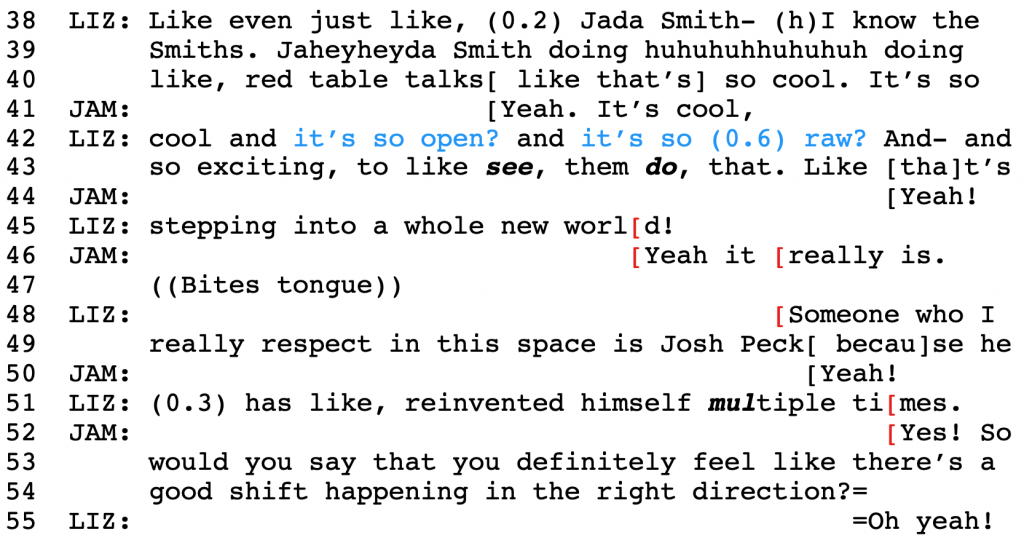
May I Speak Now? Examining Gendered Turn-Taking in Televised Debates

Daniel Li, Jennifer Moon, Ming Liang, Minh-Khoa Tran

The present text explores turn-taking by focusing on two prominent models which describe gender differences in communication — the dominance model and the difference model. The idea of deep interruptions is also employed in this study to better measure turn taking during interactions. We are focusing on inter-gender and same-gender interaction by observing talk show hosts engaging in turn-taking with their guests. Our goal is to determine whether or not there is a statistically significant difference between the number of interruptions utilized by men and women during debates in talk shows. Our empirical study analyzes the difference in the average number of interruptions per minute from men and women by using four thirty second clips. Overall, we found that men and women do not differ in terms of the frequency of interruptions but hosts tend to interrupt guests more. It was unexpected that without extensively interrupting, men still try to maintain power and discredit the female speaker through facial expressions or gestures.

[expander_maker id=”1″ more=”Read more” less=”Read less”]

Introduction

A lively debate on television is always fun to spectate. When the discussion gets heated, it appears as if power shifts at a moments notice — whoever’s speaking at the time seems persuasive and commanding. Sometimes the structure starts to break down, and the speakers begin interrupting each other in a bid for more speaking time.

Research on turn-taking in conversations has been conducted before. In this blog post, we hope to contribute to the scientific literature on turn-taking by investigating what sort of impact gender may have on the dynamic between talk show hosts and their guests. We’re curious to find out whether or not there is a statistical difference between the frequency of interruptions in mixed gender debates when compared to single gender debates on live television. We are also interested in whether the host and guest relationship will have any impact on the frequency of interruptions and if this plays any role in the dynamic between men and women. 

Background Information

There have been numerous studies and established theories about the power dynamic between men and women, and how this manifests itself in spoken language. We expect that the frequency of interruption between men and women will be explained by one of the three major models.

In Deborah Tannen’s difference model, men and women are members of their own distinct culture. This separation between male and female culture means that women and men will take noticeably different approaches to verbal communication (Tannen 1990). These cultures aren’t intrinsically bad or good. Women’s culture isn’t inferior to men’s culture, and it follows that their speech isn’t inferior to men’s speech. Deborah Tannen suggests that the clash of disparate cultures poses problems for respectful and equal communication.

Robin Lakoff proposed a dominance model which asserts that men and women’s unequal places in society’s power structure results in necessarily different communication styles, including how people of different gender are expected to speak and are spoken of (Lakoff 1973). Lakoff suggests that real-world imbalances and inequities will be reflected by linguistic imbalances. These two models both suggest that women and men tend to have distinct speech style and the higher social status of men makes it more likely for men to interrupt in interactions than women.

A very crucial idea that will be utilized in our study is deep interruption, which is an interruption that starts “two or more syllables before or after the last syllable of a place where you’d expect to switch speakers” (West & Zimmerman 1983).  West and Zimmerman predict that men are more likely than women to employ deep interruptions. In other words, it is more likely that men would forcefully change the subject of discourse to their desired topic regardless of the previous speaker’s intention.

However, despite the fact that males have been hypothesized to employ interruptions for domination and control, James and Clarke had very contradictory findings; they found an absence of significant differences in the amount of interruptions between women and men (James & Clarke 1993). Therefore, our first hypothesis is that men and women will average a similar number of interruptions per minute towards the other speaker. We also predict that hosts will tend to interrupt more than guests because of power dynamics between hosts and guests.

Methods

To collect data on turn-taking, we first needed to choose clips of debates to analyze. To make sure that we cover each relevant permutation of genders and speakers, we found four video clips. We have two video clips where the genders are the same (man-man, woman-woman). Then we have two more video clips where the genders are different (man-woman, woman-man). We needed two separate gender video clips to see if their status as host or guest on the show would significantly change our results.

Once we gathered our clips, we transcribed a climactic point in the debate where we found the most interruptions occurring. For each clip, we transcribed 30 seconds of debate. We transcribed a video with a man host and man guest which included Piers Morgan and Ben Shapiro. For the woman host and the man guest, we chose a clip with Cathy Newman and Jordan Peterson. For the man host and woman guest, we chose a clip with Tucker Carlson and Cathy Areu. Finally, for the woman host and woman guest, we chose a clip with Poppy Harlow and Janet Porter.

To transcribe the various videos, we used a transcription method of conversation analysis that included turn-taking markers to clearly indicate the turn of the speaker. This also showed whether the host or guest interrupted each other and if the interruptions occurred, we could see at what point the interruption was made during the speaker’s turn. We were also able to see if men had indeed interrupted women more, or if the level of interruptions were similar from both sides. Through this transcription process, we counted token instances of deep interruptions that were made by each speaker. Once the analysis of the deep interruptions was completed, we were able to collect our metrics and form a conclusion based on the amount of deep interruptions that occurred.

Results

To help visualize our results, we plotted interruptions onto a rough timeline. The reasoning for these visual aids was to help us in our qualitative analyses of the clips. The timeline of interruptions helps to capture the flow of conversation and which ideas the most fiery clashes were centered around. Placing them onto a linear timeline also made it clearer which side of the debate was responsible for most of the interruptions. Here are the visualizations for all four of the clips that we analyzed, were time flows from left to right and only the interruptions are marked on the timeline. We have collated our results from the collection of token instances of deep interruption in Table 1.1 and 1.2 that count up these instances of interruption as a function of interruptions per minute.

Figure 1: Rough Timeline of Interruptions in Video 1.
Figure 2: Rough Timeline of Interruptions in Video 2.
Figure 3: Rough Timeline of Interruptions in Video 3.
Figure 4: Rough Timeline of Interruptions in Video 4.
Table 1.1 Interruptions per minute from host to guest.
Table 2.2 Interruptions per minute from guest to host.


To summarize, men as hosts interrupted their man guests 8 times per minute and their woman guests 4 times per minute. Women interrupted their man guests 8 times per minute and their woman guests 6 times per minute. Men as guests interrupted their man hosts 2 times per minute and their woman hosts 4 times per minute and women interrupted their man hosts 2 times per minute and their woman hosts 4 times per minute.

Discussion and Conclusion

To touch once more on the focus of this study, we are primarily interested in two dimensions of power in a verbal exchange, the gendered differences between men’s and women’s place in society and social normative expectations, and the dynamic between a host and their guest specifically in the arena of debate talk show. Our predictions based on our original hypothesis following the seminal work of James and Clarke in 1993 stated that we were expecting to not find a significant difference between the rate of interruption from man to woman and woman to man. Our results from analysis of these four clips support this hypothesis, wherein as hosts, people interrupt their guests the same number of times per minute regardless of the guest or host’s gender. In fact, both men and women are less likely as hosts to interrupt their women guests than their man guests, specifically men interrupt their women guests half as often as they interrupt men. However, this is not to say that they were showing their women guests more respect by interrupting less often, rather in these situations the man host controlled the conversation with the woman guest nonverbally.

Qualitative analysis of the accompanying videos show that when a man host is not interrupting a woman verbally he is still displaying physical behaviors that express disbelief or disinterest, which still disrupts the flow of conversation albeit less explicitly. Further, as guests, both men and women interrupt their hosts at very similar rates as well. However, in this situation, both men and women as guests interrupt women hosts more often than they do man hosts (twice as often). To analyze this particular facet of the study we first have to discuss our two big foci of power — man/woman and host/guest. It appears that the more salient dimension of power when it comes to producing significant differences in the rate of interruption is actually host/guest dynamics. As hosts, both men and women produce four times as many interruptions per minute in same gendered interactions.

From here we turn back to our original finding that men and women interrupt at similar rates. While as hosts men and women interrupt their man guests more often than they do their woman guests. As guests they interrupt their woman hosts at twice the rate they do their men hosts.  If this host guest dynamic is the most important consideration, this statistic suggests that as the guest and weaker in the dynamic both women and men consider a woman host to hold less power over the course of the debate than a man host as evidenced by their greater willingness to interrupt their host when she is a woman. These observations are preliminary and speculative however and would require much more rigorous control over the interactions including but not limited to: combing through a much greater amount of raw data, controlling for having the same person acting as both guest and host, and developing better accounting methods for nonverbal interruptions.


References

Block, D. (2002). Language and Gender and SLA. Quaderns De Filologia: Estudis Lingüístics, VII, 49–73.

Hoey, E. M. & Kendrick, K. H. (2017). Conversation Analysis. In A. M. B. de Groot & P. Hagoort (Eds.), Research Methods in Psycholinguistics: A Practical Guide (pp. 151 -173). Wiley-Blackwell

James, D. & Clarke, S (1993). Women, Men, and Interruptions: A Critical Review. Critical Reviews of the Literature, 231-279.

Kendall, S., & Tannen, D. (2015). Gender and Language in the Workplace. Gender and Discourse Gender and Discourse, 81–105. doi: 10.4135/9781446250204.n5

Lakoff, R. (1973). Language and Woman’s Place. Language in Society, 2, 45–80.

Tannen, D. (2012). Turn-Taking and Intercultural Discourse and Communication. The Handbook of Intercultural Discourse and Communication, 135–157. doi: 10.1002/9781118247273.ch8

West, C., & Zimmerman, D. (1987). Doing Gender. Gender and Society, 1(2), 125-151. Retrieved from http://www.jstor.org/stable/189945

[/expander_maker]
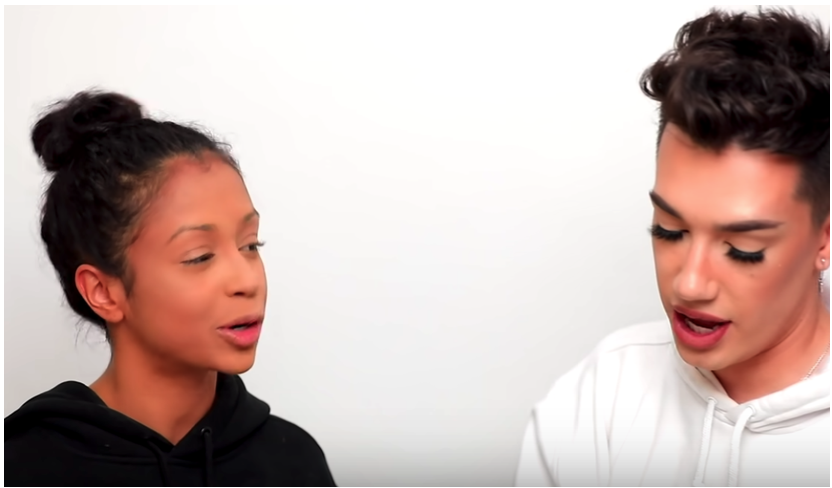
Gender Differences in Written Language

Jasmine Murphy, Hannah Hong, Kyungjo Kim, Omar Balawag

This study investigates gender differences in written language. Particularly, by analyzing cover letters for women-preferential language indicators, we find how gender is enacted in formal, written contexts. Furthermore, we investigate how usage of women’s language indicators is affected when discussing subjects deemed to be masculine or feminine. Therefore, by surveying participants for their attitudes towards STEM and Humanities fields, we find that identification of a subject as masculine or feminine did not have as significant an effect on language usage as whether participants perceived the fields to be female or male-dominated. Therefore, this study finds that considerations of social and audience expectations plays the greatest role in whether writers use of gender-linked language indicators.

[expander_maker id=”1″ more=”Read more” less=”Read less”]

Introduction

While people know that there are differences in the way men and women think, there has been an influx in research that proves that these differences extend to the communicative level, that is, the way that people use language. Studies focused on the ways that biological sex impacts language fail to understand that the key factor in gendered language is in the performance of these differences (Fitzpatrick, Mulac, & Dindia, 1995). In other words, people behave in ways that follow their perceptions of gender and masculine and feminine identities (Janssen & Murachver, 2004). In these situations, the question becomes: how do people perform gender?

‘Performance’ within language can be seen in the ways that people phrase things, their word choices, tone, voice pitch, etc. All these factors and more can influence how people express their gender identity. However, the ways that these factors indicate femininity or masculinity differ between spoken and written forms of communication. Additionally, these factors might be affected by different external influences. For instance, writers do not receive immediate feedback based on the reactions of the person they are communicating with; hence, they are not directly faced with social and audience pressure to behave in alignment with gender stereotypes (Janssen & Murachver, 2004). Furthermore, writers have more time to consciously construct their content and thus are able to modify the degree to which they reveal gender (Janssen & Murachver, 2004).

Background Information

Robin Lakoff’s findings in Language and Woman’s Place (1973) indicates the existence of ‘women’s language,’ which is characterized by an identifiable group of linguistic features, including hedges (e.g. sort of), fillers (e.g. well, you know), tag questions (e.g. She’s very nice, isn’t she?), empty adjectives (e.g. charming), and intensifiers (eg. I like him sooo much.), among others. According to Lakoff, using these “women’s speech” features function to express femininity, lack of assertiveness, and subordination in a male-dominated society (Lakoff, 1973). The difficulty in using these features to support Lakoff’s claim about subordination and dominance can be seen in the way multimodality of these features within communication. For instance, tag questions can be used as a form of passive-aggressive speech and as a way to show subordination. Lakoff called these features “women’s language indicators” because of their increased presence within women’s speech. Additional research has also reported the existence of similar phenomenon. In a study by Fitzpatrick et al. (1995), women reportedly used more polite forms of speech, made references to emotion, and used communication to develop and maintain rapport, whereas men were more likely to report facts, solve problems, and debate issues. In this case, the phenomenon might be the same, but the reasons for their appearance differs.

However, this understanding of women’s language indicators within speech has generated a few questions. Are these really feminine language indicators or are they product of something deeper? Does society influence the way that people communicate, not just within speech, but also in their writing? Can this affect how people are perceived when applying for jobs? While the possibility of language indicators actually affecting the success of job applicants is the debate of another study, this research attempts to understand if there is a certain degree of transfer in these features across mediums and the extent to which these indicators are present in written works.

If Lakoff’s (1973) observance of the dominance model is correct, it suggests that people – in particular, women – use subordinate speech to ingratiate themselves with the people around them. This is particularly relevant in environments like the workplace, which have hierarchical positions of dominance and subordination that might influence an individual’s chance of success or failure beyond their conversational capabilities. In addition to the dominance model, there are other reasons why feminine language indicators might appear in written forms of communication. For instance, when speaking about topics deemed to be feminine, individuals tend to use more feminine language indicators and vice versa (Janssen & Murachver, 2004).

Hypotheses

The objective of our research is to determine if women’s language indicators also occurs in written, formal works, particularly within cover letters, where the usage of hedges and fillers, may be considered inappropriate. We will identify which linguistic features are indicative of women’s language in formal written contexts and how frequently they occur. In addition, we will analyze whether the interpretation of topics — like STEM or Humanities fields— as masculine or feminine affects the frequency of women’s language features used in writing and the degree of influence in comparison to personal gender identities. 

As we conduct our research, we hypothesize that gender-associated linguistic features will be evident in formal written forms of communication. Additionally, we predict there will be an inclination to use features associated with women’s language when discussing subjects determined to be feminine and an aversion from using such forms when the subject is interpreted as masculine.

Based on these hypotheses we have generated several predictions about our research. First, while the perceptions of the gender divide – as well as expression of the participants’ gender identity – will have the most influence on indicator usage, topics deemed masculine or feminine will also have an impact on language use. Since we predict that STEM fields will be considered masculine and Humanities fields feminine, that women will have more indicators than men, and that individuals in the humanities fields will use indicators more often than STEM, we predict that the greatest number of these feminine language indicators will be present in cover letters written by women/feminine identities in the Humanities field.

The usage of these indicators can inform us on how and why gender differences in language are performed in different contexts. It will also help to explain why perceptions of STEM and Humanities fields work in correlation with feminine language features. Based on our results, we might be able to find implications for whether linguistic features can be used by both men and women as they modify their usage in specific contexts to align with particular expectations, which would have implications for how we perceive gender.

Methods

Our participants in this study were student volunteers between eighteen and thirty years old. Through the use of a questionnaire, we received cover letters from the four populations were comparing: Humanities women/feminine identities, STEM women/feminine identities, Humanities men/masculine identities, and STEM men/masculine identities. Our goal was to receive an even number of cover letters from each of our participant groups, of which we received a total of sixteen cover letters.

This study was conducted through surveys and analysis of the submitted cover letters. Participants were asked to fill out a survey asking several questions related to their background and views on related topics, like how they perceive STEM and Humanities fields. See Appendix for details. They were also asked to upload a sample copy of their cover letter. This sample was then analyzed through a series of software (called Atlas.ti Cloud and Voyant) that are designed to create ‘codes’ qualitatively and quantitatively code for particular language features. Particularly, we coded for five women’s language indicators: 1) Hedges: which we defined as being indirect, vague, cautious (perhaps, maybe); 2) References to Emotion: such as happiness, sadness, love; 3) Uncertainty Verbs: like think, believe; 4) Empty Adjectives: which we defined as adjectives that “soften” speech without contributing meaningful information beyond a slightly positive meaning (adorable, gorgeous); and 5) Intensifiers like really, so, extremely. For example, the indicators analyzed are shown in the table below. 

We also calculated the average frequencies between each of the categories that we were looking at: women, men, STEM, Humanities, Humanities women, Humanities men, STEM women, and STEM men. Additionally, we found the standard deviation for each of these groups to better understand the amount of variance found amongst them. 

Results

The responses we received from our participants made it clear that from both a societal and personal perspective, most people perceive the STEM fields as being masculine/male-dominated. In contrast, the perceptions of the Humanities fields received mixed results, as participants seemed to be unable to reach a consensus about the field being either feminine/female-dominate or masculine/male-dominated. See the tables below for more details.


We discovered that women overall used more language indicators than men, but also that participants in the STEM field used indicators more frequently than individuals in the Humanities majors. After breaking down the groups further, we discovered that STEM women use the language indicators more frequently than any of the other groups, but also that STEM men use these indicators more often than Humanities men, although slightly less often than Humanities women. 

In terms of Standard Deviation amongst participant results, we discovered that between the Humanities, STEM, women, and men, the groups with the least amount of variation are women and STEM. Between Humanities men, Humanities women, STEM men, and STEM women, the groups with the lowest Standard Deviation are Humanities women and STEM men. This indicates that while STEM women have the most frequent usage of women’s language indicators, Humanities women have the most consistent frequencies, along with STEM men. See the Standard Deviation table below for more details.


Discussion

The central finding of this work is that STEM women and STEM men use feminine language indicators more frequently than their Humanities counterparts. While we predicted that Humanities women would have the highest frequency of feminine language indicator usage, women in general used these indicators more frequently than men, regardless of their fields. This suggests that there are additional factors that might have influenced the results.

After tallying the responses to the survey (see Appendix for more details), it is clear that people’s impressions of the STEM and Humanities fields had an impact on their usage of feminine language indicators. As mentioned previously, while the participants’ perceptions of the language divide were mixed for Humanities, they consistently perceived a divide within STEM, which indicates that they might have been influenced by these perceptions when writing cover letters. In accordance to Lakoff’s model of dominance and subordination, their higher frequency within the STEM fields also implies that participants are more sensitive to the ways that gender and power interact within STEM fields.

Conclusion

While this study contributed to our understanding of the interaction between gender and language, there are several limitations. The small scale of the study makes it difficult to determine if the phenomenon observed extends beyond our small population. The results of this study imply that it is inaccurate to call these linguistic features ‘women’s language indicators’ as they are present in both genders. Instead it would be better to say that these language features are the result of the perceived dominance divide between men and women, but also that these are ‘subordination indicators’ and not necessarily restricted to women’s language. To claim otherwise ignores their presence within men’s speech and written forms of communication.


References

Argamon, S., Koppel, M., Fine, J., Shimoni, A. R. (2003). Gender, genre, and writing style in formal written texts. Text, 23, 321-346. Retrieved from http://writerunboxed.com/wp-content/uploads/2007/10/male-female-text-final.pdf

Fitzpatrick, M. A., Mulac, A., & Dindia, K. (1995). Gender-Preferential Language Use in Spouse and Stranger Interaction. Journal of Language and Social Psychology, 14(1–2), 18–39. https://doi.org/10.1177/0261927X95141002

Janssen, A. & Murachver, T. (2004). The Relationship between Gender and Topic in  Gender-Preferential Language Use. Written Communication. 21.344.10.1177/0741088304270028.

Lakoff, R. (1973). Language and Woman’s Place. Language in Society, 2(1), 45-80. Retrieved from http://www.jstor.org/stable/4166707

Mulac, A., Studley, L.B., & Blau, S. (1990). The gender-linked language effect in primary and secondary students’ impromptu essays. Sex Roles, 23, 439-470.

Newman, M. L., Groom, C. J., Handelman, L. D., & Pennebaker, J. W. (2008). Gender differences in language use: An analysis of 14,000 text samples. Discourse Processes, 45(3), 211-236. Retrieved from http://dx.doi.org/10.1080/01638530802073712

[/expander_maker]
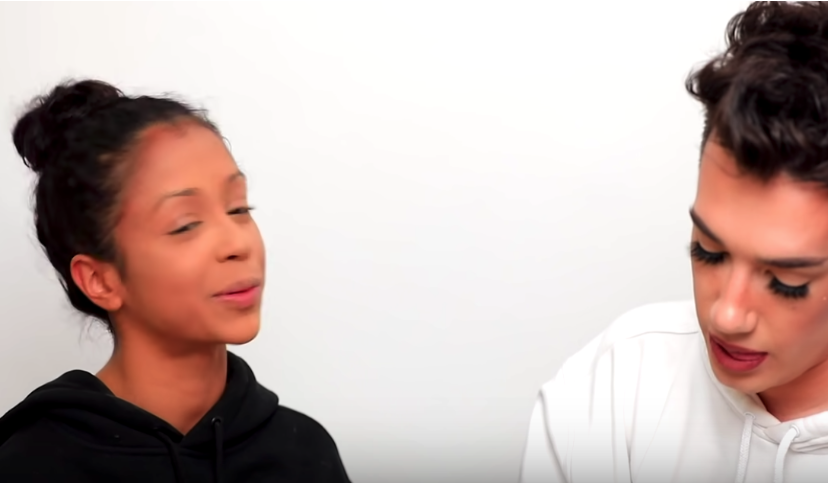
Language and Power in Politics: A Gender Stereotype Game

Sarah Thomas, Emma Greene, Cameron Brewer, Jamie Dela Cruz

With 2020 fast approaching, everybody has their eyes on the many candidates running for president, calling into attention how they frame particular issues to gain public support. The mixed-gender debates within the Democratic party raise the question of how this new dynamic will affect future political conversations. However, it’s no secret that women have a harder time making themselves heard, with their gender inspiring the public to maintain traditional stereotypes about them.

Existing gender inequalities, or sexism, persist in language, and can be maintained through the speaker and their audience (Suleiman & O’Connell 2008). In this context, the relationships with a candidate to other candidates and the public reflect a power dynamic that women must handle to assert their own place in the political sphere. To understand how these candidates navigate mixed-gender debates, we looked at one of the Democratic primaries, paying special attention to what language tactics they used.

[expander_maker id=”1″ more=”Read more” less=”Read less”]

Introduction

The United States is a melting pot of individuals with unique backgrounds, cultures, and ideals. However, this diversity is not adequately reflected in the country’s political realm. One such identity that is not equally represented is that of women; despite making up over half of the United States’ population, women represent a mere 23.6% of congressional office (Rutgers 2019). Gender politics is essential to help explain why women are so underrepresented in elective offices.

Every speech, conversation, and debate is thoroughly analyzed, critiqued, and judged by the press and public. With the upcoming Presidential election, the Democratic party’s mix-gendered political debates create a distinct dialogue between candidates and with their audience.

Politicians are intentional with their language, having a team of writers work with them to decide how they want to speak about a particular issue. In the context of gender, some linguistic functions are perceived as linked to one gender more than the other; this association gives rise to potential stereotyping of politicians based on how they speak, not their politics (Suleiman & O’Connell 2008). Communication differences and gender communicative patterns have been found to link specific traits with gender (Grebelsky-Lichtman & Katz 2019).

The present study seeks to better understand how gender communication structures of women and men in politics compared to one another in terms of usage and relate these findings to press and public reaction.

Background information

In a study that looked at how much women and men spoke, it was found that even though women speak less than men, men lashed out when they believed there were more women talking than them. This discovery emphasized the idea that men truly dominated public talk and pushed back when women tried to gain equal footing (Mooney & Evans 2015). Multiple studies have found a relationship between patterns in communication differences and gender, which are summarized in the following table (Grebelsky-Lichtman & Katz 2019).

Methods

The project design investigated how politicians spoke in a mixed-gender debate, specifically the October 15, 2019 Democratic Primary Debate.

Using the video recording  and online transcript  provided by CNN and the Washington Post, the candidates were considered individually and compared with each other. He or she was analyzed for feminine and masculine identifiers, based on Grebelsky-Lictman and Bdólach’s verbal gender communicative accountability framework, and received a mark for each unique use of the aforementioned linguistic features (2019).

After averaging how frequent each gender and each individual candidate used communicative identifiers, the speaking styles of the top and bottom-rated candidates of both genders were examined to determine whether there was a relationship between communicative patterns and public appeal.

The purpose of analyzing political candidates in the context of gender-oriented communication is to answer the following questions:

    1. How do the gender communication structures of female and male American politicians compare?
    2. What, if any, masculine communicative structures are most commonly used by females? What, if any, feminine communicative structures are most commonly used by males? In these instances, are structures that are used equally by both females and males more gender-neutral?
    3. Are a candidate’s polling numbers related to which opposite gender communicative structure they use?

Results

From New York Time’s Democratic Polling Data, we found Elizabeth Warren to be the top female candidate and Joe Biden the top male candidate. A total of 61.7% of Elizabeth Warren’s speech patterns were considered masculine, while Joe Biden’s speech patterns had a ratio of 70.3% that were masculine-identified. When comparing the usage of specific identifiers, Warren favored emotional reference, personal example, display of solution and practical economic issues. Biden favored assertive and direct speech, pertinacity, and speech in first person, singular.


When comparing Castro, the lowest polling male candidate, to Biden, we found that his main masculine identifiers consisted of action demand, direct speech, display solution, and speech in first person singular. Similarly, Biden’s consisted of activity, direct speech, and action demand. When examining their feminine identifiers, Castro primarily used concrete examples, personal examples, and emotional reference, whereas Biden used hesitant speech, passive speech, and questions.

Klobuchar, the lowest polling female, primarily used accusatory speech, rationality, and display solution as her masculine identifiers, while Warren used display solution, activity, and practical economic issues. Both used emotional reference and personal examples as their primary feminine identifiers.

Discussion and conclusions

With this being the fourth debate in the race for the Democratic nomination, the public is familiar with each candidate’s communication style by now. Interestingly, it can be seen from the following graph that Elizabeth Warren’s likability, or public appeal, was projected to dramatically increase, which it did: she began with 5% support, and following the October debate, it rose above 20%. 

In terms of feminine communication structures, Warren focused on emotional reference and personal examples over five times more often than Biden. It is clear that despite Biden’s use of identifiers, they were commonly used as a pause to gather his next thought, not as part of his argument. With feminine speech being associated with more passive and hesitant behavior, we suspect that using personal example and emotional reference are effective identifiers that don’t hinder perceived competence. However, it is also significant to note that because Warren utilized masculine identifiers such as significant opinion or action demand, they were used more as persuasive, support gathering tools.

Warren dominated over all other candidates, including Biden, with her constant usage of masculine identifiers, such as display solutions and references to practical economic issues. Biden dominated in more aggressive and assertive language, using direct speech, pertinacity and speech in first person singular. While Biden can use aggression to show strength and leadership, when a woman uses aggression, the public reaction is widely different. Aggression in female communication patterns is portrayed more often emotionally unstable outbursts or unlikeability, or even “shrilly.” 

Despite their drastic differences in polling success, Biden and Castro had extremely similar masculine identifiers: assertive speech and action demand. What seems to truly set these candidates apart is their use of feminine identifiers; Castro’s feminine identifiers functioned more emotionally and anecdotally (concrete examples, personal examples) and Biden’s were more passive (hesitant speech, passive speech). This implies that males are judged more on their usage of feminine speech than masculine speech. Also, there is a question of whether men are judged more for their feminine identifier use than women. Specifically, while Castro’s main feminine identifiers were identical to Warren’s, they proved to be much less effective for Castro than for Warren.

When comparing the top and bottom-rated female candidates, Klobuchar also employed the same feminine identifiers as Warren; however, their masculine identifiers differed. Warren exhibited a more calm demeanor, focusing on practical masculine identifiers (activity, practical economic solutions, display solution). Klobuchar’s reliance on accusatory and emotionally-charged masculine identifiers proved less effective in the public’s eyes.

What set the top and bottom candidates of each gender apart was their use of identifiers that were typical of the opposite gender. It makes sense that the public will more closely analyze communicative patterns that are atypical of a candidate’s gender when forming an opinion about them.

Will we ever have a female president? After the unexpected upset of Donald Trump over Hillary Clinton in the 2016 Election, strong opinions formed regarding the deciding factor that led to Trump’s victory. Many people claimed the result was due to sexism in the U.S., while others summed it up to Hillary’s lack of likeability.

What if these things are just extensions of how each candidate chose to present themselves? Hillary often used very aggressive masculine identifiers, as Trump did, but what really separated them was the perceptions the public had of both of them. For women, as shown in one of Trump’s tweets, aggression and anger is viewed as a sign of weakness, while aggression in male candidates is validated and expected.

This adds to a common theme in which the effectiveness of identifiers is very context specific, depending on the gender of the candidate, their intended audience, etc. These linguistic double standards add up, and although the message the candidates are trying to convey, much of their impact on the audience has to do with the way they present their messages, and their personal identity that impacts the potential voters.

READ THESE NEXT

More on the October 15, 2019 Debate:

         Want this article in powerpoint form? We’ve got you.

         Watch the Debate on CNN 

         NPR’s Fact Check 

         The Fourth Democratic Debate in 6 Charts

2020 Presidential Race from the Democratic Side:

          NY Times: Which Democrats Are Leading the 2020 Presidential Race? 

          NPR: Tracking the Issues in the 2020 Election 

         Statistics of Women in Elective Office


Referenced Journal Articles:

Grebelsky-Lichtman, T., & Bdolach, L. (2017). Talk like a man, walk like a woman: an advanced political communication framework for female politicians. The Journal of Legislative Studies, 23, 275–300. doi: https://doi.org/10.1080/13572334.2017.1358979

Grebelsky-Lichtman, T., & Katz, R. (2019). When a man debates a woman: Trump vs. Clinton in the first mixed gender presidential debates. Journal of Gender Studies, 28, 699–719. doi: https://doi.org/10.1080/09589236.2019.1566890

Suleiman, C., & O’Connell, D. C. (2008). Race and gender in current american politics: A discourse-analytic perspective. Journal of Psycholinguistic Research, 37(6), 373-389. doi:10.1007/s10936-008-9087-x

Mooney, A., & Evans, B. (Eds.). (2015). Language, Society and Power: An Introduction. (4th ed.).

[/expander_maker]
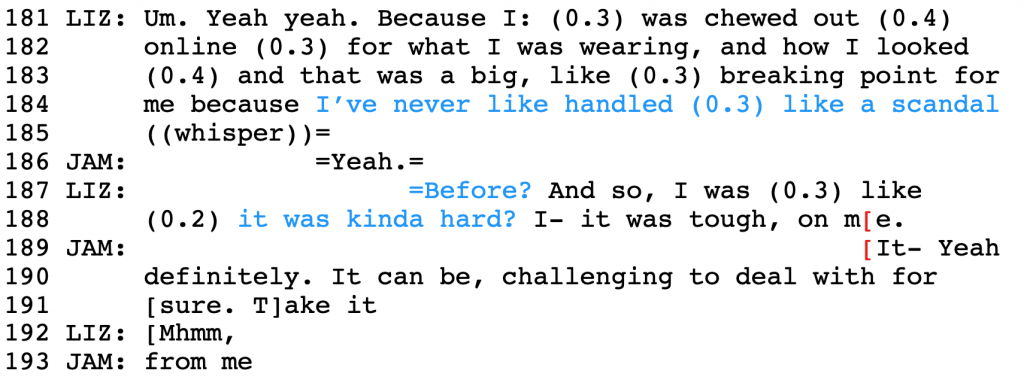
Scroll to Top