LOL vs 😂: How Digital Laughter Varies Across Generations

Cydney Jover, Daelyn R Johnson, Mia Dibono, Yexalen Casas, Ashanti Bracamontes

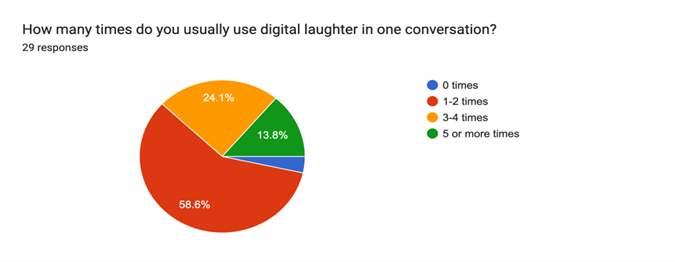
Over time, as a society, we have seen a general increase in online and digital communication. Since online communication has become more mainstream and a key format of expression that is universally common among society is the expression of laughter, the main focus here is the study of digital laughter in the form of specific expression, including “lol”, “LOL”, “haha”, “HAHA”, “hehe”, “LMAO”, or “😭”- to name a few. Typically, these phrases are used in social encounters digitally to convey laughter or humor. What we aim to acknowledge in this research project is how these specific phrases are used both similarly and differently as forms of digital laughter among Gen Z and Gen A communities. We wanted to dive deeper into how digital laughter slang can fluctuate in meaning depending on the social context, as well as the speaker’s generation or age. This research project focused on studying the sociolinguistic aspects of digital laughter and humor, as well as how specific phrases and emojis could indicate differing social meanings depending on specific factors, including generation, age, social context, and scenario.

[expander_maker id=”1″ more=”Read more” less=”Read less”]
Research Question: LOL vs 😂: How Digital Laughter Varies Across Generations

Introduction and Background            

For this project, the target population will be Generation Z and Generation Alpha. Generation Z refers to those born in 1997 up until those born in 2012. Generation Alpha refers to those born in 2010 up until those born in 2024. With digital communication being one of the main sources of communication in today’s world, we want to explore how the two most recent generations, more specifically the younger generations, have become linguistic innovators. In these more recent generations, it has become evident that people now create their own rules for punctuation and have normalized not using punctuation (Guo, 2016). Both Generation Z and Generation Alpha have grown up using technology. From smartphones to social media to messaging platforms, both generations have been surrounded by technology as a main source of communication. In typical face-to-face communication, people physically show their emotions, whether they are happy, sad, excited, shocked, angry, humorous, etc. However, in today’s digital world, those non-verbal cues like facial expressions and vocal intonation are replaced by the use of emojis and expressions of amusement. The specific expressions we are going to focus on for this project are “LOL, LMAO, and HAHA,” and when they are being used by Gen Z and Gen Alpha, as well as certain emojis that pertain to humor. It is made clear that age is something that significantly impacts how emojis are classified (Chen et al., 2024). It is well established that textese are commonly used (Sánchez-Moya & Cruz-Moya, 2015). Both generations tend to use these phrases digitally quite often. “LOL” is an acronym that means laugh out loud, and over time, it has been used as a tone marker instead of an actual sign of laughter. “LMAO” is a more bold and exaggerated phrase to signal laughter, and “HAHA” is also used to express genuine laughter. Understanding the reasoning behind these linguistic patterns will allow for more expansive knowledge on how digital communication norms evolve and continue to grow amongst the new generations and today’s youth.
Methods

Our approach was to collect data using our two population groups. These participants were chosen due to their generational ages and the majority of individuals had relationships to the researchers. These relationships consisted of group members and included siblings, roommates, friends, classmates and cousins.

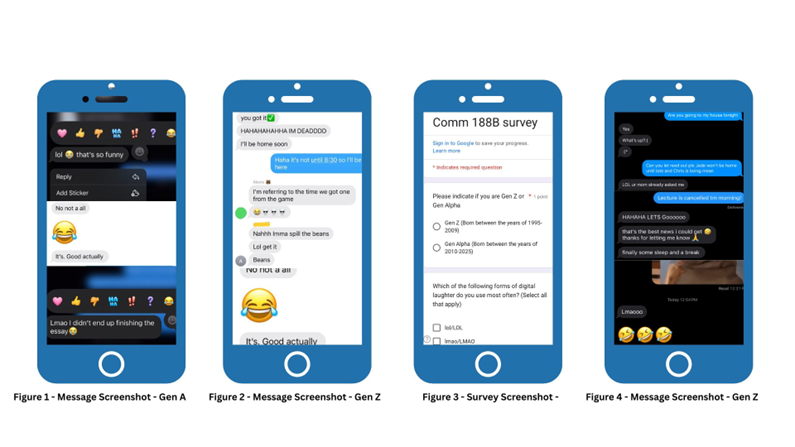
Next, the materials used throughout our research were observable data through screenshots of text messages and google form surveys to collect individual data. We first collected the observable data using real life conversations within text messages and organized these into the two generational groups. After collecting observable data we created google form surveys to either discredit or prove our origin hypothesis. The survey used the same questions for both generations and included 10 responses from Gen Z and 10 responses from Gen A participants. This survey began by asking those engaging in the study to indicate whether they are Gen Z or Gen A. Then, the succeeding question followed with a “Select All That Apply” to indicate which styles (i.e. lol/LOL, haha/HAHA, lmao/LMAO, 😭, 😂, 💀) of digital laughter they use. Additionally, the next questions after those included Likert scales ranging from (1) Not at All to,  (5) Frequently. This scale determined the likelihood and frequency of each form of digital laughter and allowed us to measure the different forms of usage between each generation. The survey questions are specific to ensure detailed conclusions of responses, which changes in polarity to see visible opposing viewpoints. Although, due to using the survey method, the participants must have personal accountability to respond truthfully. All responses collected were anonymous and included all participants to agree on responses being used publicly.

Furthermore, the data collected within this methodological procedure was coded using all participants’ responses to understand the opposition among generations. Using the survey responses we divided each individual reply into Gen Z and Gen A categories. We then analyzed each form, marking down each response from all 13 questions. This is how we gathered the differences between frequency and style of digital laughter used in online communication styles between Gen Z and Gen A. This procedure allowed us to determine statistical data in which we could affirm or negate the hypothesis from our observable data.
Results and Analysis

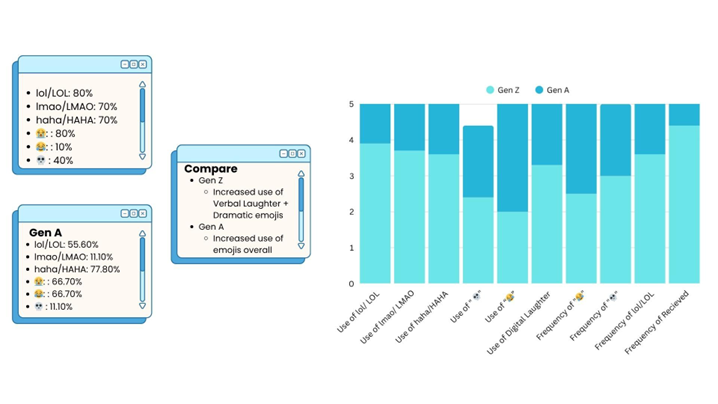
Through the collection of our data, we were able to confirm details within our hypothesis as well as gather new information that supported our research study. Our results suggested that while both generations profusely engage in online laughter, there is a difference in how they use it and in what forms. For example, results from our survey collection indicated higher use of overall online laughter particularly verbal laughter amongst Gen Z with phrases such as “lol/LOL” and “lmao/LMAO” receiving 70-80% usage compared to that of Gen A’s (55% and 11%). Gen A on the other hand relied on emoji usage more so than Gen Z. However as per survey data, Gen A participants were less likely to use digital laughter than their counterparts. These results were portrayed through our bar graph which compared digital laughter use among the generations with Gen Z represented in teal color and Gen A through blue. When comparing verbal laughter and emoji usage, our graph depicted patterns of Gen Z participants selecting verbal responses with ranging levels of 2-4 while Gen A participants selected fewer verbal responses and drifted to emoji usage at higher levels. As stated previously, these results aided in identifying patterns between the generations and noting the differences in expression through online laughter.
Based on the results, we see that while there are some differences between the two generations, there are no big differences. Usually when comparing 2 different generations, there are clear and distinct differences, often big ones. However, we found that the differences are hardly any and relatively small. The small differences can show how similar and closely related these 2 generations are in regards to digital communication and emoji usage. The gap between generations is not large, they have some nuances but it doesn’t stop them from effectively communicating with each other. Our findings show that both Gen Z and Gen Alpha frequently use digital laughter, but slightly differ in how and with what tone they express it. Emojis allow us to speak in ‘gestures’ through digital platforms and let conversation flow more freely (McCulloch, 2019). It is almost as if texting is the new speaking in-person in today’s day and age. While texting using digital laughter, in a study done on Whatsapp, researchers found that this turn-taking was similar to face-to-face conversations (Petitjean & Morel, 2017).
Discussion and Conclusion

Based on the results, we see that while there are some differences between the two generations, there are no big differences. Usually when comparing 2 different generations, there are clear and distinct differences, often big ones. However, we found that the differences are hardly any and relatively small. The small differences can show how similar and closely related these 2 generations are in regards to digital communication and emoji usage. The gap between generations is not large, they have some nuances but it doesn’t stop them from effectively communicating with each other. Our findings show that both Gen Z and Gen Alpha frequently use digital laughter, but slightly differ in how and with what tone they express it. Emojis allow us to speak in ‘gestures’ through digital platforms and let conversation flow more freely (McCulloch, 2019). It is almost as if texting is the new speaking in-person in today’s day and age. While texting using digital laughter, in a study done on WhatsApp, researchers found that this turn-taking was similar to face-to-face conversations (Petitjean & Morel, 2017).

As Gen Z college students ourselves, we are aware that the majority of Gen Z had a childhood without texting, but as we grew older, we started to text more using emojis and digital laughter as those evolved. While Gen Alpha grew up with texting, we wanted to explore if that dynamic made a difference in the use of digital laughter between the two generations. Early Gen Z are digital natives but vividly remember analog life. They’re the last generation who remembers what it was like to have a flip phone as their first device, use physical CDs or DVDs, write handwritten letters or notes, and live without constant access to everything online. Yet, they adapted to technology so quickly that they can navigate both analog and digital worlds fluidly. Gen Alpha however, cannot relate to that since emojis and digital laughter have been around since the beginning of that generation. For example, the “tears of joy” emoji, or the first laughing emoji was created in 2010, which is the beginning of Gen Alpha. Digital laughter amongst both generations is a crucial part of online communication and a way of expression.
References:

Chen, Y., Yang, X., Howman, H., & Filik, R. (2024). Individual differences in emoji comprehension: Gender, age, and culture. PLOS ONE. https://journals.plos.org/plosone/article?id=10.1371%2Fjournal.pone.0297379

Guo, J. (2016). Stop. Using. Periods. Period. – The Washington Post. The Washington Post. https://www.washingtonpost.com/news/wonk/wp/2016/06/13/stop-using-periods-period-2

McCulloch, G. (2019, June 1). Because the internet: Understanding the new rules of language. Explorations in Media Ecology. https://doi.org/10.1386/eme_00039_5

Petitjean, C., & Morel, E. (2017, January 25). “hahaha”: Laughter as a resource to manage WhatsApp conversations. Journal of Pragmatics. https://www.sciencedirect.com/science/article/pii/S0378216616302594

Sánchez-Moya, A., & Cruz-Moya , O. (2015, April 21). WhatsApp, Textese, and moral panics: Discourse features and habits across two generations. Procedia – Social and Behavioral Sciences. https://www.sciencedirect.com/science/article/pii/S1877042815013786

[/expander_maker]
Redemption for Him, Ruin for Her: Gender Bias in Cancel Culture

Eva Melnik, Arsema Solomon, Gabriel Gumbiner, Cody Dukhonvy, Jessica Podgur

Do you ever wonder why some celebrities successfully resurface after being cancelled, while others disappear forever? Online culture constantly reshapes the reputations of public figures. Our project aims to understand how gender plays a role in who gets forgiven and who does not. We began our project by collecting and analyzing social media responses from TikTok and Reddit on four high-profile public figures: James Charles, Dr Disrespect, Chrissy Teigen, and Colleen Ballinger. From this data, we found consistent patterns suggesting that public reactions are not gender neutral. Misconduct by male figures was often responded to with humor or calls for their redemption that downplayed their misconduct. In contrast, women were subjected to moral judgments, body shaming, and attacks on their character. James Charles received mixed responses, suggesting that gender expression and sexuality also play a role. Our findings support existing research on gendered digital surveillance and expand it by showing how language, tone, and content of online discourse reinforce gender double standards. Our study reveals that cancel culture public commentary reflects and reinforces gendered power imbalances by normalizing male misconduct and inflating women’s. Further, our findings encourage reform in the digital language of cancel culture.

[expander_maker id=”1″ more=”Read more” less=”Read less”]

Introduction and Background

Our project examines how responses to cancel culture operate within and reinforce gender norms. Male misconduct is downplayed through humor and trivialization, and women are held to a higher standard of morality. Further, we argue that cancel culture perpetuates existing power imbalances between men and women. Current research examines cancel culture from moral and emotional lenses, but fails to consider gender’s role in shaping public responses. Our project bridges this gap by analyzing qualitative thematic and linguistic data from social media comments and interpreting how gender influences the reactions.Cancel culture is the widespread phenomenon of cancelling, the public shaming and withdrawal of support from figures engaged in unacceptable behavior (Minkkinen, 2024). Reactions range from moral activism to cyberbullying, and support to moral outrage (Forster & Spitz, 2015). Research shows that cancel culture reflects gender norms. Sailofsky (2021) and Bouvier (2020) found that men’s misconduct is mitigated through “redemption talk.” Ochs & Taylor (1996) show men use narrative control to preserve authority. Dubrofsky (2011), Marwick & Caplan (2018), Cohen (2010), Aprill (2022), Banet-Weiser (2018), and Sobande (2021) show us that women face strict media surveillance around their physical appearance, emotional expression, and perceived morality. Cameron (2005), Ng (2020), and Kosnik & Feldman (2019) demonstrate how gendered expectations shape language and digital expression.

Methods

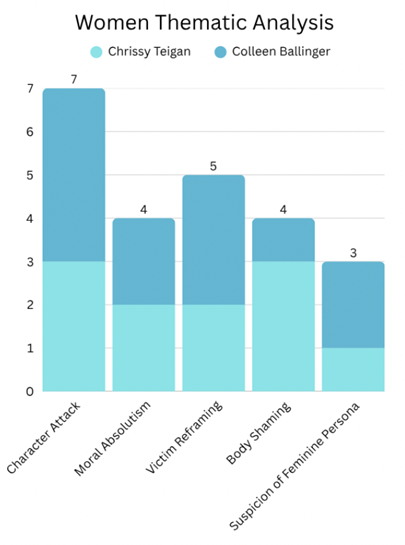
Our study applies qualitative and thematic discourse analysis to public commentary on four canceled public figures. James Charles, Dr. Disrespect, and Colleen Ballinger were all canceled for inappropriate communication with minors, while Chrissy Teigen was canceled for online harassment and bullying. We collected nondiscriminatory data from TikTok and Reddit, then randomly selected six comments per public figure from the collected data. Our analysis focused on the emerging patterns found in themes, tone, and sentiment. We then noted how the patterns we identified reflect gendered expectations and reactions in common culture. Thematic analysis was established by coding each comment for language, tone, and sentiment patterns. These codes were grouped into themes such as character attack, moral absolutism, victim reframing, body shaming, suspicion of feminine personas, redemption, minimization, believability, audience support, and jokes about appearance. We illustrated our findings with four graphs that were created by counting the occurrences of each theme per person and gender across the sample. Our graphs visually represent and compare the most common reaction themes and how they vary by case and gender.

Results and Analysis

Our findings revealed clear patterns of gendered responses in cancel culture discourse, supported by our thematic and linguistic data.

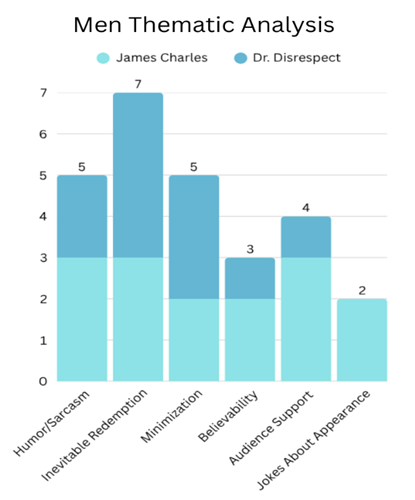
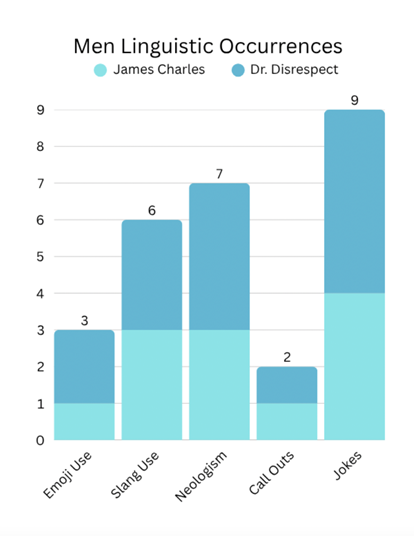
Male Figures – The responses to James Charles and Dr Disrespect were centered around humor and redemption. Charles and Disrespect received seven instances of redemption talk, five of minimization, and four of audience support. Commenters joked about the men nine times, using humor to deflect accountability, aligning with Sailofsky’s (2021) theory of minimizing male misconduct. Our findings suggest a pattern of forgiving and rationalizing men’s misconduct.

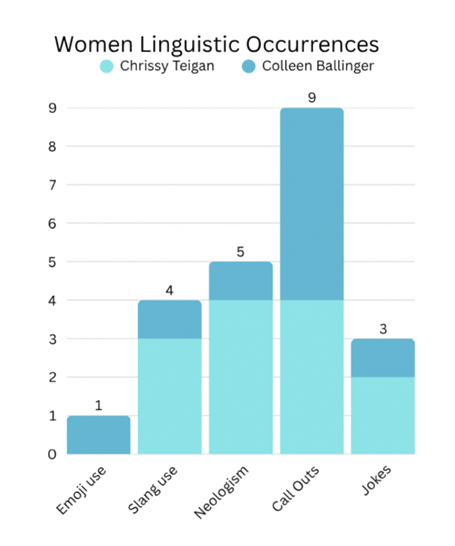
Female Figures – Chrissy Teigen and Colleen Ballinger were subjected to severe judgments. They faced seven attacks on their character, four of moral absolutism, and four of body shaming. The responses focused on the women’s appearance and morality, reflecting the severity of emotional surveillance of women in media (Dubrofsky, 2011). The data also revealed only three instances of jokes in the responses. Call-outs were also much more common for women than men, who had nine occurrences compared to two, highlighting a harsher scrutiny and lower tolerance for women and their misconduct.

Public defenses also suggested a gendered pattern. Men were defended through the minimization and trivialization of their actions and allowances for redemption. Supporting the theory of a double standard in forgiveness and trust, the women did not receive public support or defenses in the responses.

The findings support our thesis by demonstrating how responses to cancel culture are shaped by gender norms. Women are evaluated by what they do and who they are perceived to be. On the other hand, men are more likely to be separated from their actions and allowed to return to their careers. The unequal responses found in the cancellation discourse limit women’s ability to save their reputations from permanent ruin. This suggests that cancel culture does not function as a neutral or impartial form of accountability. Instead, cancel culture is shaped by gender norms and expectations. Rather than responding based on the severity of the misconduct, the public’s responses were contingent on gendered norms and assumptions that reflect who is viewed as redeemable or not.

Discussion and Conclusion

Our findings illustrate how cancel culture functions as a way to police morality, identity, and credibility in a gendered way. Male public figures like James Charles and Dr Disrespect were discussed using themes of understanding, minimization of their misconduct, and the allowance for their redemption. In contrast, responses to Chrissy Teigen and Colleen Ballinger centered on moral absolutism, character attacks, and body shaming. Our analysis suggests men are judged by their perceived intent or potential for change, while women are evaluated based on who people think they ought to be. Further, our findings suggest the personas of the influencers we examined add context to gendered standards. This is particularly important with a figure like James Charles. Charles is a male influencer who goes against traditional masculinity norms. Perhaps due to his perceived femininity and sexual orientation, he did not receive the same protection from appearance-based jokes as men like Dr Disrespect, who personifies stereotypical masculinity. However, his status as a male may have shielded him from the level of cruelty directed at women, particularly Chrissy Teigen, whose appearances were targeted ruthlessly.

The patterns we identified support existing literature on gendered surveillance, digital public shaming, and current understandings of respectability politics. The consistency in findings across public figures also supports the idea that cancel culture is not the equalizing accountability that people understand it to be. Instead, it reinforces double standards across genders. Women are more likely to face moral scrutiny tied to their appearance and character, while men are afforded redemption. Our research expands the understanding of online accountability and public discourse by exposing how cultural scripts of gendered forgiveness, credibility, and judgment persist even in places meant to challenge norms. As participants in online culture, we play a role in the narratives that shape the perception of public figures. Being mindful of how we respond to public figures’ misconduct, through the language we use and standards we uphold, can help challenge and reform gender bias in media scrutiny. Holding people accountable is important, but we must do so objectively and with self-awareness in order to foster an equitable digital society.

Figure 1: Thematic Findings in Cancelled Women’s Discourse

Figure 2: Thematic Findings in Cancelled Men’s Discourse

X-axis: Categories Identified in Comment Sections  Y-axis:  Number of Occurrences

Figure 3: Linguistic Findings in Cancelled Women’s Discourse           

Figure 4: Linguistic Findings in Cancelled Men’s Discourse

X-axis: Linguistic Categories Identified in Comment Sections Y-axis:  Number of Occurrences

YouTube Videos on Cancel Culture

  1. James Charles Misconduct

James Charles Career Is Basically Dead. Why?

  1. Discussion Surrounding Dr Disrespect’s Misconduct Dr Disrespect Situation Just Got Worse
  2. Chrissy Teigen Misconduct

The rise and fall of ‘undercover bully’ Chrissy Teigen

  1. Colleen Ballinger Misconduct Colleen Ballinger Controversy: The FULL Story Break Down | E! News
  2. Problems in Cancel Culture TED Talk

Cancel Culture: The Decline and Disconnect Within Society  | Jasmine Iacullo | TEDxYouth@NBPS

Keywords

  1. Gendered forgiveness: the observed phenomena of the act or severity of forgiveness being correlated to the presented gender of the accused or wrongdoer
  2. Asymmetric accountability: Individuals or groups are held responsible for their actions asymmetrically. The consequences, repercussions, or scrutiny they face are not equal to those of other individuals or groups.
  3. Misconduct minimization: downplaying the significance or severity of one’s wrongdoing through various methods to reduce guilt, shame, or accountability
  4. Aesthetic and emotional surveillance: The act of monitoring and analyzing a public figure’s appearance and emotions, especially women’s, to control, influence, or make judgments comparative to societal and gender norms
  5. Redemption: the successful offset or compensation for a defect, misconduct, or failure

References

Aprill, Julie, “The Effects of Moral Violations on Parasocial Relationships with Influencers” (2024). Electronic Theses and Dissertations. 3981. https://digitalcommons.library.umaine.edu/etd/3981

Banet-Weiser, S. (2018). Empowered: Popular Feminism and Popular Misogyny. Duke University Press. https://doi.org/10.2307/j.ctv11316rx

Bouvier, G. (2020). Racist call-outs and cancel culture on Twitter: The limitations of the platform’s mechanisms for accountability. Discourse, Context & Media, 38, 100431. https://doi.org/10.1016/j.dcm.2020.100431

Cameron, D. (2005). Language, Gender, and Sexuality: Current issues and new directions. Applied Linguistics, 26(4), 482–502. https://doi.org/10.1093/applin/ami027

​​Cohen, E. L. (2010). Expectancy violations in relationships with friends and media figures. Communication Research Reports, 27(2), 97–111. https://doi.org/10.1080/08824091003737836

De Kosnik, A., & Feldman, K. (Eds.). (2019). #identity: Hashtagging race, gender, sexuality, and nation. University of Michigan Press https://library.oapen.org/bitstream/handle/20.500.12657/24497/9780472901098.pdf

Dubrofsky, R. E. (2011). The Surveillance of Women on Reality TV: Watching The Bachelor and The Bachelorette. Lexington Books https://digitalcommons.usf.edu/spe_facpub/646

Marwick, A. E., & Caplan, R. (2018). Drinking male tears: Language, the manosphere, and networked harassment. Feminist Media Studies, 18(4), 543–559. https://doi.org/10.1080/14680777.2018.1450568

Minkkinen, L. (2024b). “Girl, you’re still cancelled”: analysis of public ‘cancel culture’ Apologies and responses. https://jyx.jyu.fi/jyx/Record/jyx_123456789_95151#description

Ng, E. (2020). No grand pronouncements here. . .: Reflections on cancel culture and digital media participation. Television & New Media, 21(6), 621–627. https://doi.org/10.1177/1527476420918828

Ochs, E. and Taylor, C.” (1996) The Father Knows Best:’ Dynamic in Family Dinner Narratives.” In Gender Articulated: Language and the Socially Constructed Self. K.Hall (ed). Routledge. Pp.97-121.

Sailofsky, D. (2021). Masculinity, cancel culture and woke capitalism: Exploring Twitter response to Brendan Leipsic’s leaked conversation. International Review for the Sociology of Sport, 57(5), 734-757. https://doi.org/10.1177/10126902211039768 (Original work published 2022)

Sobande, F. (2021). Spectacularized and branded digital (re)presentations of Black women on YouTube. Television & New Media, 22(2), 131–146. https://doi.org/10.1177/1527476420983745

Tukachinsky Forster, Rebecca & Spitz, Daniel. (2025). I Love You, but I Have Got to Cancel You: Psychological Consequences of Participation in Cancel Culture. Psychology of Popular Media. 10.1037/ppm0000598.

[/expander_maker]
Lights, Camera, Contrition: The Social Media Apology Explained

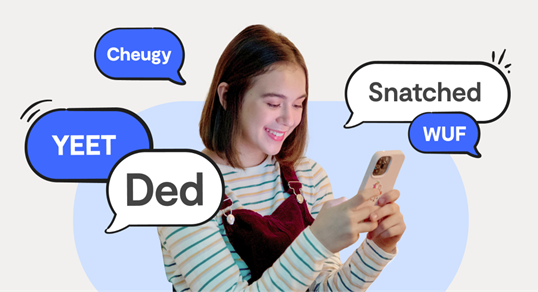
Ever watched a YouTuber cry and thought “This feels fake”? You’re not alone. As public figures rush to apologize online, audiences are becoming expert lie detectors — decoding every tremble, tear, expression, and “I’m sorry” for signs of sincerity. Our project explores how language, tone, and visual presentation influence audience perceptions of sincerity in these moments of crisis. Focusing on apology videos from Logan Paul, Laura Lee, and Colleen Ballinger, we will analyze how public figures use rhetorical strategies to rebuild trust. We will gather qualitative as well as quantitative insights on what makes an apology feel genuine or performative. Using frameworks such as interpersonal apology theory and image repair discourse, we will evaluate how verbal repetition, emotional expression, and appearance affect judgments of credibility and accountability. Our goal is to better understand how audiences interpret public apologies and what these reactions reveal about trust, vulnerability, and reputation in digital spaces. The problem(s) we intend to address are the following: How do public figures (Colleen Ballinger, Logan Paul, Laura Lee) use language, tone, and image (with both verbal and nonverbal methods) to influence audience perceptions of their sincerity in public apologies?

[expander_maker id=”1″ more=”Read more” less=”Read less”]

Introduction and Background

When deciding which videos to use for our analysis, there was an initial limitation to our study related to cropping longer videos for brevity and how that would affect audience perceptions of the apologies. With Colleen’s video, for example, we cropped her 10-minute video into a 4-minute video and decided that the middle of the video was a good way to gauge the overall language use. This decision aligns with Ambady and Rosenthal’s concept of thin slices, which suggests that people can accurately judge complex traits such as sincerity or emotional state from brief snippets of behavior. By focusing on a representative portion of the video, we aimed to preserve the essence of the apology while still enabling meaningful analysis grounded in the reliability of these short behavioral samples. (Ambady & Rosenthal, 1992)

Our contribution lies in bridging rhetorical analysis with audience perception, using YouTube apology videos as a case study to explore how sincerity is communicated and interpreted in digital spaces. By analyzing apology videos from these “influencers,” we aim to investigate not only what these public figures say, but how they say it (visually, emotionally, and linguistically). Our thesis is that public apologies are performative acts in which specific communicative choices (like a tearful tone, minimal makeup, or carefully crafted phrasing/scripting) shape whether an audience sees the apology as genuine or manipulative. This project sheds light on how the intersection of image, tone, and language affects credibility in the age of viral accountability and offers a nuanced perspective on the performance of remorse in online culture.

Methods

To examine how public figures convey sincerity in their apology videos, we selected three widely circulated YouTube apologies from the previously mentioned figures. We then distributed these clips to 30+ college students via an open-ended and multiple-choice Google form survey. Participants were asked to reflect on their impressions of the apologies’ sincerity, whether they believed the public figure should be forgiven, and what verbal or nonverbal elements shaped those judgments. Our analysis was guided by two core theoretical frameworks: interpersonal apology theory and Benoit’s image repair discourse (Sandlin, J. K. et al., 2018). Interpersonal apology theory, rooted in communication studies, outlines five key components of a sincere apology: Admitting fault – clearly acknowledging responsibility for the offense, Acknowledging harm – recognizing the damage done to others, Expressing remorse – showing emotional regret and guilt, Asking for forgiveness – signaling a desire to make amends, and Offering compensation or corrective action – providing a tangible or verbal commitment to change.

These components emphasize the relational and emotional dynamics between the offender and the audience, underscoring that sincerity is not just about what is said, but how it’s expressed. To evaluate rhetorical strategies, we applied Benoit’s image repair discourse theory(Sandlin, J. K. et al., 2018). This framework categorizes how individuals and organizations respond to crises through specific strategies, including: Denial (refusing responsibility or shifting blame), Evasion of responsibility (claiming lack of intent or knowledge), Reducing offensiveness (minimizing the severity or attacking accusers), Corrective action (promising to fix the issue), and Mortification (openly admitting guilt and asking for forgiveness).

These strategies are often used in combination and serve to repair the speaker’s public image. By identifying which of these strategies were present in the videos, we could compare them with how participants responded in terms of perceived sincerity and forgiveness.

We also paid attention to nonverbal and contextual cues, such as facial expressions, vocal tone, emotional displays (e.g., crying), clothing, setting, and even the presence or absence of makeup. These elements were analyzed to understand how visual and tonal choices contributed to the perception of sincerity, whether, for instance, a more casual appearance or a somber tone enhanced credibility. We used a dual-method approach to analyze how public figures use specific linguistic and visual strategies in their public apology videos on YouTube to influence the audience’s perception of sincerity, accountability, and forgiveness.

Results and Analysis

Drawing on Benoit’s image repair discourse theory and interpersonal apology theory, we performed a content analysis of the three YouTube videos, focusing on four specific aspects: the influencers repetition of performative verbs (“sorry” or “apologize”), their emotional appearance, denial, and personal presentation to help us better visualize and interpret the survey results (Sandlin, J. K. et al., 2018). We then used a Likert-type scale of 1-10 to measure our perceived perceptions of these four variables (see Table 1), rating 10 as the highest level perceived and 1 as the lowest level perceived. For example, in Table 1, Laura Lee received a 10 for Repetition Level of performative verbs, meaning she repeated the verbs “sorry” and/or “apologize” over ten times. 

Table 1

Perceived level of linguistic and visual features in influencer apology videos (1 = low,10 = high). Levels rated are based on content analysis of all three apology videos.

 Logan PaulColleen BallingerLaura Lee
Repetition Level of Performative Verbs6110
Visually Emotional Level529
Denial Level181
Personal Presentation Level131

Survey Results

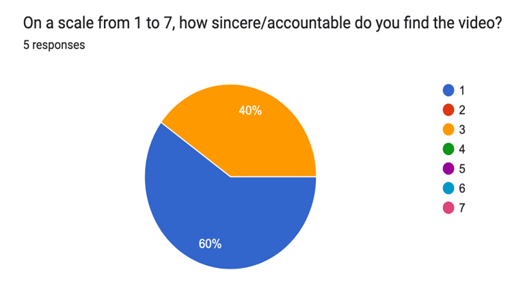
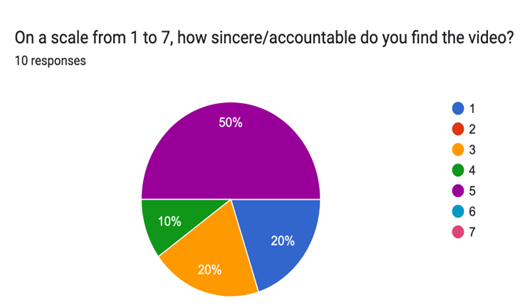
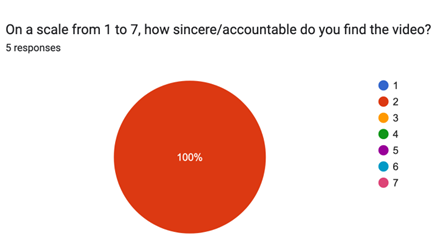
The other method that we used in our dual method approach was an open-ended online survey. To better visualize how the audience rated the sincerity/accountability of the video, we included one of the responses to our question asking the audience “On a scale from 1 to 7, how sincere/accountable do you find the video?” (1 = not sincere at all, 7 = took full accountability). Highlighting the most significant findings from this question, we found that 60% of surveyors did not find Colleen Ballinger to be sincere/accountable (see Pie Chart 1). We then found that 50% of surveyors found that Logan Paul was somewhat sincere/accountable (see Pie Chart 2). Finally finding that 100% of surveyors did not find Laura Lee sincere/accountable (see Pie Chart 3).

Pie Chart 1

Measuring audiences’ perception of the sincerity of Colleen Ballinger’s apology video (respondents either choose 1 or 3).

Pie Chart 2

Measuring audiences’ perception of the sincerity of Logan Paul’s apology video (here we see a bit more variation in responses).

Pie Chart 3

Measuring audiences’ perception of the sincerity of Laura Lee’s apology video (here we see a unanimous decision).

Measures of Audience Perception:

To better understand the significance of the survey responses and to have clear numerical data, we then used a Likert-type scale of 1-10 to quantify the audience’s free response answers (see Table 2).

Table 2

Audiences’ perceived level of sincerity, forgiveness, accountability, and their changed perception (1 = low, 10 = high). Levels rated are based on free-response answers from open-ended surveys.

 Logan PualColleen BallingerLaura Lee
Perceived Sincerity Level523
Changed Perception Level211
Forgiveness Level312
Perceived Accountability level752

We, from quantifying audiences free-response questions into a Likert-type scale, were able to see a clear trend. In the videos where the influencers received higher numbers on our content analysis scale, audience members were more likely to rate sincerity levels lower. Meaning, influencers who were visually more emotional, used more repetition of words such as “sorry”, and who expressed more denial of wrongdoing, were found by the audience to have less sincere apologies. The audience was also likely to rate the accountability level lower (see Table 2). For Logan Paul, responses were more mixed, though they mostly leaned negative or unchanged. For Laura Lee, the majority of participants reacted very negatively, describing the apology as overly emotional, manipulative, or performative. Finally, for Colleen Ballinger, we found that the apology reinforced or worsened existing negative opinions, even if they had already stopped watching her (likely due to the use of a guitar and breaking out into song, which can come off as dismissive and playful during a serious situation). Overall, we were able to see that Logan and Laura took more of an interpersonal route of apology (5/5 components of IAT), whereas Collen was geared more towards image repair (4/5 components of IRDT), which heavily affected audience perception of sincerity.

Some things to note when looking at such apologies are that “The medium is the message”. This reminds us that how an apology is delivered (through a platform like YouTube) shapes audience perception just as much as the content of the apology itself. (McLuhan, 1964)

Discussion and Conclusion

In conclusion, we considered audience commentary on YouTube as part of the broader discursive context. Comment sections often revealed whether viewers thought the apology was believable or performative, and frequently referenced the public figure’s prior reputation. This ties into the two-step flow model, which suggests that public opinion is shaped not just by media content but by influential opinion leaders (for example; top commenters or media coverage) who interpret and amplify messages for others. We also acknowledged the mass-personal nature of YouTube apologies (where personal disclosures are made in mass communication formats) and how this shapes expectations of authenticity and vulnerability. (Lazarsfeld, Berelson, & Gaudet, 1944)

References

Choi, G. Y., & Mitchell, A. M. (2022). So sorry, now please watch: Identifying image repair strategies, sincerity and forgiveness in YouTubers’ apology videos. Public Relations Review, 48(4), 102226. https://doi.org/10.1016/j.pubrev.2022.102226.

Holmbom, M. (2015). The YouTuber : A Qualitative Study of Popular Content Creators (Dissertation). https://urn.kb.se/resolve?urn=urn:nbn:se:umu:diva-105388.

Ohbuchi, K.-I., Watanabe, N., & Narisawa, K. (2013). Effects of timing and sincerity of an apology on satisfaction and changes in negative feelings during conflicts. Communication Reports, 26(1), 2–11. https://doi.org/10.1080/10570314.2013.770160.

Uoti, K. (2022). Apology as a Speech Act Set: Apology strategies of social media influencers in the context of the Covid-19 Pandemic (Doctoral dissertation, Master’s Thesis, University of Turku]. UTUPub. https://urn.fi/URN:NBN: fi-fe2022042530307).

Matheson, B. (2023). Fame and redemption: On the moral dangers of celebrity apologies. Social Philosophy. https://epub.ub.uni-muenchen.de/108820/1/Journal_of_Social_Philosophy_-_2023_-_Matheson_-_Fame_and_redemption__On_the_moral_dangers_of_celebrity_apologies.pdf

Sandlin, J. K., & Gracyalny, M. L. (2018). Seeking sincerity, finding forgiveness: YouTube apologies as image repair. Public Relations Review, 44(3), 393–406. https://doi.org/10.1016/j.pubrev.2018.04.007.

[/expander_maker]
“Who Said What Now?”: Navigating T.V. Portrayal of Gendered Gossip from 1997-2022

Madeline Doring, Abigail Garza, Julian Goldman, Dylan Sherr, Faye Turcotte

From high school hallways to corporate backchannels, gossip is everywhere. But what if the whispers are pointing to something more profound about how we’re communicating, who’s holding power, and how cultural norms are getting passed on and contested? To understand this from a closer standpoint, we examined the portrayal of gossip along gender and generational lines in the media with an emphasis on rethinking the cultural worth and communicative role of gossip. Gossip has traditionally been dismissed as frivolous or emotionally illogical, but researchers have begun to understand it as a socially significant practice. Based on sociolinguistic theories of gendered communication, we compared select instances of gossip from TV shows for two generations. Our results cemented gossip as a prism for understanding identity, power, and belonging in general cultural awareness. It not only functions as a social glue but also as a channel whereby people negotiate group dynamics and social norms.

[expander_maker id=”1″ more=”Read more” less=”Read less”]

Introduction and Background

Stereotypes associated with gossip divert from its basic communicative, relational, and cultural functions. Gossip is constantly misunderstood as idle chatter in scholarly as well as popular discourse. Recent research in psychology, communication science, and organizational behavior has reframed gossip as a socially strategic action. Gossip has been shown to be critical to social coordination, identification, and norm enforcement as a primary way in which individuals acquire knowledge about both others and themselves (Dores Cruz et al., 2021). Through our study, we examined these ideas from the specific perspective regarding how gendered depictions of gossip have evolved across generations within popular media, namely television dramas.

Before looking into this, we were already aware of previous information regarding gendered patterns of gossip, i.e., the idea that women and men gossip differently. Past research characterized women as gossiping primarily about relationships and personal matters so as to participate in social bonding, whereas men gossip to acquire humor or attain status (Levin & Arluke, 1985). Current research maintains this trend, with women participating in emotion-focused, relation-directed means of gossip in the context of coalition-building (Davis et al., 2018). We also know that men, on the other hand, gossip far less overall and use gossip in instrumental functions as a way to navigate social positioning. Such behaviors cohere with Deborah Tannen’s theoretical framework, distinguishing “rapport talk”, a related, connection-directed characteristic of women, and “report talk,” an informational, hierarchical characteristic of men (Van Herk, 2018).

Despite the fact that such patterns have long since taken root, there was no framework to comprehend the way in which media representations reinforce or challenge these gendered communication norms in the long run–the leading question guiding our own research. While prior research has explored gendered patterns in gossip, few studies have examined whether and how gossip has evolved across generations or been portrayed differently over time in television. This gap in the literature motivated our study, as we aimed to investigate whether shifts in gender norms were mirrored in media discourse. With continued influence from television to the public eye regarding social conduct, the issue we examined involved whether gender representations in gossip have shifted in sync with gender norms. With this, our research documents the construction of gossip across two periods (1990s–2000s, 2009–2022) in U.S. television with attention to gender. By combining empirical content analysis with sociolinguistic theory, our analyses help demonstrate the idea that gossip is neither fixed nor gendered; it is an evolving social practice.

Methods

In terms of gossip across different generations and genders, we were more interested in how TV shows categorized gossip across two distinct periods and how female-identifying individuals differed in their communication features from male-identifying individuals. First and foremost, we coded for gender identity based on the pronouns that were used in the show. We analyzed different TV shows representing two generational periods. The first period involved shows that were released between 1997-2009, including Friends (Seasons 5 and 8) and Survivor (Season 6). The second period involved TV shows released between 2009-2022, including Love Island (Seasons 1 and 2), Outer Banks, and The White Lotus. All of these episodes were accessed through streaming platforms, including Netflix and Hulu. Because television remains a powerful force in shaping public understandings of identity and interaction, analyzing TV dialogue allows us to observe how gossip reflects or resists evolving social norms.

For each of these shows, we chose approximately three scenes, each around 2 minutes in duration, that featured confrontation, gossip, or situations that all displayed differences between how the two identities communicated with one another. A total of 15 scenes were analyzed and transcribed across all shows. By observing the contrast between individuals, there was an exposure to how gossip can be challenged, and it allowed us to gain insight into each generational period. So, we assessed the prevalence of communication features in the scenes in the two periods of time.

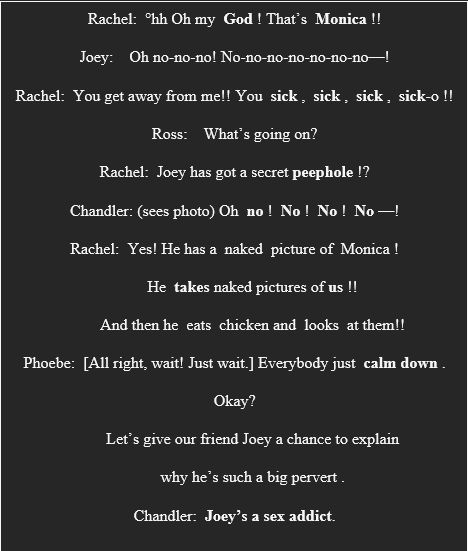
*See Figure 1 below for an example of our transcriptions.*

Figure 1. Transcription from Friends (Season 5, Episode 9), showing a gossip scene used to analyze gendered communication styles like humor and confrontation.

Each television scene was analyzed using six communication features, each previously associated with gendered communication and gossip behavior: indirectness, report, rapport, humor as a shield, status assertion, and meta-commentary. For example, we see indirectness in Love Island when Caro and Cashel are talking about other couples as well as themselves. Caro, who identifies as female, says “ °hh I just (0.3) feel like (0.4) you’re not being ↑honest with me.” Use of the words “I just feel like” indicates hedging, suggesting Caro’s unwillingness to be straightforward due to nerves about how her words may be perceived. In response, Cashel, who identifies as male, says “ <<laughing> I guess I’m just the worst boyfriend ever.>” He uses humor as a shield to avoid taking ownership of his behavior. We also observed a report talk in Friends, when Ross asks, “What’s going on?” to get a factual explanation of the situation, contrasting with rapport talk, like Harper in The White Lotus confiding in Ethan to build emotional alignment over shared social discomfort. Status assertion occurred in Survivor, where one contestant claimed, “They’re playing us,” in an attempt to establish control over the narrative. Lastly, meta-commentary was seen in Outer Banks, when a character prefaced gossip with, “I know we’re being shady, but hear me out…” acknowledging the act of gossiping itself.

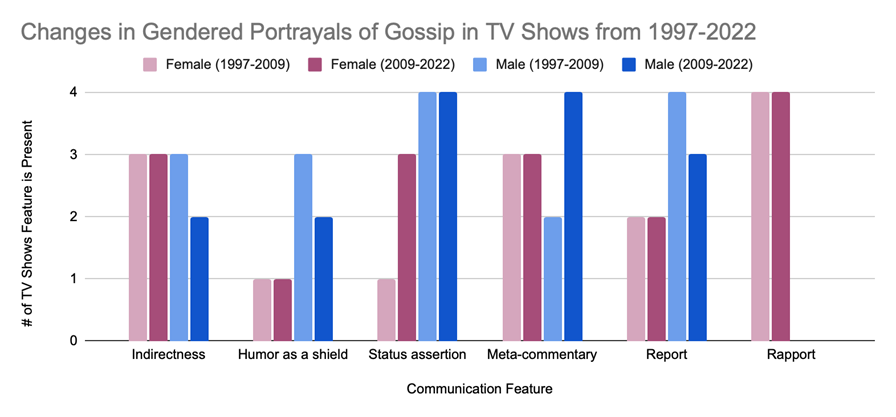
Figure 2. Bar chart comparing six gossip features across male and female characters from two TV generations (1997–2009 and 2009–2022), based on average frequency.

Figure 2, a grouped bar chart, compares the previously mentioned communication features across male and female characters in TV shows from two time periods: 1997–2009 and 2009–2022. The X-axis contains the coded communicative traits, while the Y‑axis shows their average frequency on the 0–4 scale. The pattern is striking: use of gossip communicational features by female characters in TV shows remained relatively consistent across the periods, while portrayals of male gossip noticeably shift, especially in regards to a reduced use of humor and indirectness. This suggests a slow blending of gendered language styles, even as clear differences persist.

In addition to data, we analyzed specific TV scenes to demonstrate these trends across contexts. Figure 3 features a moment from the White Lotus, between husband and wife, Ethan and Harper. In one scene, Harper attempts to gossip with Ethan about the other couple they are traveling with, whom she sees as fake, snobby, and arrogant (White, 2022). She uses an indirect style of gossip to assert her status as well as gain rapport from her husband, exemplifying the modern portrayal of female gossip both strategically and socially.

Figure 3. Scene from The White Lotus (Season 2, Episode 2), showing indirect and strategic gossip between characters Harper and Ethan.

To situate our project within real-world discourse, we included several informal references. A TEDx Talk titled “Why gossip is good” by Assem Bisenbay breaks down gossip’s benefits in modern society (Bisenbay, 2019). Another TEDx video, “The virtues of gossip” by Richard Weiner, echoes these ideas by arguing that gossip can foster social cohesion (TEDx, 2013). Additionally, a Reddit thread asking “Why do we love gossip?” offers everyday perspectives that parallel our findings about social bonding and status (CommonRash, 2022). Taking this media into account, our project was structured around five key ideas: gendered gossip, generational communication, TV media discourse, sociolinguistic method, and report vs. rapport talk. These pinpoint our population (TV characters), method (scene-based communication coding), and theoretical orientation. All TV show clips analyzed were publicly available; no private data or human subjects were involved. Our research is the collaborative work of Abigail Garza, Julian Goldman, Faye Turcotte, Madeline Doring, and Dylan Sherr, conducted under the mentorship of Professor Bahtina.

Discussion and Conclusion

Our findings across various scenes in TV shows contribute to the idea of gossip as a whole and what it truly means to privately discuss personal information with others through means of conversing. Gossip itself provides key insights into the ways in which individuals interact on a broader scale, both culturally and socially. In terms of gender and generational differences, studying gossip across all individuals can be used to highlight key aspects of the progression that can be seen in conversational analysis across genders. Through studying numerous television dramas, it can be seen that the ideas of report and rapport amongst male-identifying and female-identifying individuals remain true no matter the time period. This report vs. rapport stereotype can be generally accepted as being a ‘mainstay’ in the scene of gossip itself. So, although there are constant changes occurring in the world, there will still be aspects of gendered gossip that remain constant no matter where we are or what time it is.

References

Bisenbay, A. (2019, September). Why gossip is good [Video]. TED Talks. https://www.ted.com/talks/assem_bisenbay_why_gossip_is_good?utm_campaign=tedspread&utm_medium=referral&utm_source=tedcomshare

Burnett, M. (Executive Producer). (2003, April 3). Girls vs. boys (Season 6, Episode 8) [TV series episode]. In Burnett, M. (Executive producer), Survivor. CBS.

CommonRash. (2022). Why do we love gossip? Reddit. https://www.reddit.com/r/CasualConversation/comments/v9dyen/why_do_we_love_gossip/

Davis, A. C., Arnocky, S., & Vaillancourt, T. (2018). Sex differences, initiating gossip. In T. K. Shackelford & V. A. Weekes-Shackelford (Eds.), Encyclopedia of evolutionary psychological science (pp. 1–8). Springer. https://doi.org/10.1007/978-3-319-16999-6_190-1

Dores Cruz, T. D., Nieper, A. S., Testori, M., Martinescu, E., & Beersma, B. (2021). An integrative definition and framework to study gossip. Group & Organization Management, 46(2), 252–285. https://doi.org/10.1177/1059601121992887

Jonas, J., & Pate, S. (Writers), & Pate, J. (Director). (2020, April 15). The runaway (Season 1, Episode 8) [TV series episode]. In Jonas, J., Pate, J., & Pate, S. (Executive producers), Outer Banks. Netflix.

Kauffman, M., & Crane, D. (Writers), & Bright, K. S. (Director). (1998, December 17). The one with Ross’s sandwich(Season 5, Episode 9) [TV series episode]. In Kauffman, M., & Crane, D. (Executive producers), Friends. NBC.

Kauffman, M., & Crane, D. (Writers), & Bright, K. S. (Director). (1999, February 11). The one where everybody finds out (Season 5, Episode 14) [TV series episode]. In Kauffman, M., & Crane, D. (Executive producers), Friends. NBC.

Kauffman, M., & Crane, D. (Writers), & Bright, K. S. (Director). (2001, November 15). The one with the rumor (Season 8, Episode 9) [TV series episode]. In Kauffman, M., & Crane, D. (Executive producers), Friends. NBC.

Levin, J., & Arluke, A. (1985). An exploratory analysis of sex differences in gossip. Sex Roles, 12(3–4), 281–286. https://doi.org/10.1007/BF00287594

Macleod, C. (Director). (2015, June 7). Episode 6 (Season 1, Episode 6) [TV series episode]. In Richard Cowles et al. (Executive producers), Love Island. ITV2.

Macleod, C. (Director). (2016, June 10). Episode 9 (Season 2, Episode 9) [TV series episode]. In Richard Cowles et al. (Executive producers), Love Island. ITV2.

TEDx Talks. (2013, November 19). The virtues of gossip: Richard Weiner at TEDxMiami 2013 [Video]. YouTube. https://www.youtube.com/watch?v=WpiTp2COVZk

Van Herk, G. (2018). Gender. In What is sociolinguistics? (2nd ed., pp. 122–141). Wiley Blackwell. White, M. (Writer & Director). (2022, November 6). Italian dream (Season 2, Episode 2) [TV series episode]. In White, M. (Executive producer), The White Lotus. HBO.

[/expander_maker]
Patterns in Personality Changes Amongst Bilingual Chinese Americans

Existing literature has long since supported the idea of a perceived personality change that occurs in bilingual individuals when switching between which languages they speak in. In this study, we interviewed ten Chinese-speaking Asian American university students by asking them surface level questions related to their daily life to discern additional patterns in the demographic. Ten people were interviewed in total, once in English and once in mandarin, with a period in the two between to allow for a mental “reset.”

Ultimately, we found there to be a strong pattern of Chinese being the more concise language, with the participants being able to organize their responses in a more effective manner and taking a shorter amount of time to respond to the questions. There also exists a contrast between the formality of the two languages, but the associations are dependent on the individual, finally, we observed differences in approaches to question answering, including different thought patterns and interpretations.

[expander_maker id=”1″ more=”Read more” less=”Read less”]

Introduction and Background

Bilingualism/multilingualism is a common phenomenon globally, though the U.S. does lag behind the rest of the world in terms of that trend. Language and how we use it is deeply influenced by social forces, like interpersonal dynamics, institutional context, and cultural association. All of this leads to the intriguing phenomenon within bilingual communities of a perceived “personality change” when speaking in a different language other than their mother tongue. While previous research has documented this perceived shift in personality, especially amongst bicultural speakers, much of the literature focuses on the confirmation of this phenomenon instead of questioning the reasons behind individual manifestations of this change. What our studies do is take qualitative data from various Chinese-speaking bilinguals and record in detail the changes that occur when they are answering the same questions between English and Chinese. We analyze these results with a sociocultural lens to discover how life experiences and background can manifest in the way they unconsciously carry themselves across languages.

Literature Review

The change in personality in bilingualism is well documented phenomenon (Chen, S.X., & Bond, M.H. 2010) and one largely informed by culture, as seen in the way that is observed only in those who are exposed to the culture of both languages (Bene-Martinez et al., 2002), in other words, it is as much a result of biculturalism as it is bilingualism. People cannot perform a frame switch without having both, which is a bilingual switch between culturally rooted self-concepts depending on the language they are using (Ross et al., 2002) and is a huge contribution to what people perceive as a change in personality. As an extension of that, the language used can directly affect the emotional state of the person with the culturally informed perceptions it brings (Zhou et al., 2021), resulting in different reactions to the same thing, which is what our research design is set out to test. And finally, to add onto the differing emotional reactions that come with language, the language used in a conversation can change a person’s logical interpretation of the situation. (Li et al., 2004) find that those who learned English later in life change their way of interpreting information depending on the language used, going from categorical in English to relational in Chinese. While those who learned at an earlier age in a singular culture where both languages are used officially by their country are observed no change in logical reasoning. Ultimately, showing that the culture of a language influences the thinking process of an individual, and that is then what causes a perceived change in their personality.

Our findings differ significantly from precious literature, as Chinese is a clear efficient language for most participants. Responses are shorter, more organized, direct, and confident. This is even true for participants who use English to communicate daily in an academic setting. On the other hand, English is perceived as a casualness, narrative and hesitation language. This informality is often accompanied by markers of uncertainty, like filter words: “um, like” etc., and more abstract or indirect wording.

Some participants stated that Chinese individuals process the ability to express emotions in formal settings such as family interaction. In contrast, influenced by educational background and social interactions primarily occurring in English-speaking environments, responses in English exhibit informality, emotional vulnerability, and lower confidence. This is mainly because for most of our participants, Chinese is typically the language of family, home and even primary identity formation. In this environment fosters directness, emotional boldness, and clarity; conversely; English is primarily the language of academic institutions, an environment that can both encourage casual peer interaction and create pressure and hesitation. Therefore, the shift in personality is less about moving from Chinese culture to American culture and more about transitioning from home self to the university self.

For example, one of the participants, Yunhan, expressed thoughtful uncertainty when saying in English: “I really want to be someone who brings value to society.” while expressing greater decisiveness and clarity when simply saying in Mandarin: “I hope to become a journalist.” Another participant also pointed out that English is emotionally causal but socially uncomfortable compared to Mandarin.

What is particularly noteworthy is our research challenges the widely held assumption that Chinese inherently promotes modesty and English promotes confidence. On the contrary, participants consistently associated Mandarin with clarity, confidence, and family comfort, while English represented education and social formality, but also elicited informal emotional expressions shaped by language insecurity and contextual associations.

Methods

Our target population is Chinese-English bilingual individuals who regularly navigate between Chinese and English language environments regardless of their perceived fluency in either language. This group includes individuals with different backgrounds and introductions to their spoken languages.

The interview asked the participants for reflection, analysis, and description of personal relationships and goals across six questions.

  1. What are your hobbies and interests? (你的爱好和兴趣是什么?)
  2. How has your week been? (你这周过得怎么样?)
  3. Do you like the school going to (你喜欢这所学校吗?)
    1. What do you like/dislike about it? (你喜欢/不喜欢它什么?)
  4. What do you think of your teachers this quarter?  (你觉得本季度的老师怎么样?)
  5. How’s your academic progress so far? (到目前为止,你的学业进展如何?)
  6. Tell me about your career plan. (跟我说说你的职业规划吧。)

Results and Analysis

  • Patterns
    • Chinese is the more concise and emotionally open one, the one they use with family and friends. Not formal settings. But also, cultural association tied to it
    • English: the language they use in schools and has formal associations with it depending on the person, but also cultural associations that make it feel more casual. Lack of proficiency can lead to lower confidence and less organization in speech

Table of Bilingual Interview Summary

InterviewEnglish ExpressionChinese ExpressionKey ContrastRelevant articlesExample quotes
CatherineCausal, personality-focused, uncertain toneAcademic, confident, conciseInterpretation changes based on different languagesLi et al. (2004), Ross et al. (2002)Eng: ‘They’re really friendly… I love them all’ Chi: ‘I feel they performed well’  
YiwenSelf-disclosure, humorous, confidentFormal, calm, respectfulSwitching from casual to respectfulBenet-Martínez et al. (2002), Zhou et al. (2021)  Eng: ‘8 a.m. class is a pain’ Chi: ‘I like the academic atmosphere’
Jiang JingReflective, hesitant, expressiveDirect, conflict, structuredTone and clarity shift sharply by languageChen & Bond (2010), Ross et al. (2002)  Eng: ‘I really want to bring value to society’ Chi: ‘I want to be a journalist’  
ZekunHesitant, casua l, repetitive ‘uh’Confident, simple, more decisiveConfidence and clarify increases in speaking ChineseChen & Bond (2010), Zhou et al. (2021)Eng: ‘Uh, parking is hard… uh’ Chi: ‘Just want to make money, step by step’  
TsamPolite, indirect, academic toneBlunt, humorous,emotionally boldShift in criticism and toneRoss et al. (2002), Benet-Martínez et al. (2002)Eng: ‘I really don’t like him… confusing’ Chi: ‘Feels worse than a dog’  

This analysis is based on the method of bilingual interviews, thereby constituting a qualitative content analysis. We see the effects of language on the personality of Chinese American speakers in everyday conversations expressed in the conversations that are bilingual. In every study case, interviewees were more careful and polite, as well as showing their emotional restraint, when they were speaking in English. They would frequently have to stuff their speech with language fillers and monitoring, which would not be the case with them speaking Chinese since they were more confident, direct, concise, and expressive in emotions.

A case in point is Catherine’s example, where the participant felt an emotional professional distance when she spoke Chinese, due to the way she “liked the professor”. Li and colleagues (2004) captured this in their study, as they too reported that the thought processes of bilinguals vary with their languages’ usage. That testified in all that the study cases put together, the participants went frame switching and speaking individualist, casual English tones, but collective, what-respected Chinese tones in a similar manner. The discrepancy in emotional tone from calm or uncertain in English to sure or strong in Chinese matches what Zhou et al. (2021) found: bilinguals adjust their approach to emotions in accordance with what is seen as culturally appropriate in the corresponding language. Furthermore, the differences in tone and formality within a language and evaluation style of different languages (Chen & Bond, 2010) found that bilinguals do not have one single identity but instead show different characters as they switch languages.

For instance, Tsam’s case study shows the frame switching with being hesitant and polite when the participant speaks English but emotionally blunt when she speaks Chinese. It demonstrates how language shapes different national selves (Ross et al., 2002; Chen & Bond, 2010). It is also found that language cues cause changes in how bilingual and bicultural people think, feel and act that are rooted in their culture.

Discussion and Conclusion

Our research team is composed of Chinese-English second language speakers who are mostly UCLA students. We learned that bilingual Chinese Americans also have a different sense of self when answering English compared to Mandarin Chinese. When they answered in Mandarin, the answers of the participants were shorter, more organized, and stronger. Their tone was more serious or formal too. When answering in English, however, people’s answers were more emotional, nervous, or unconfident. We also learned that people would be more courteous or deferential in some languages and more relaxed or blunt in others. These are not accidents, they are tied to diverse cultures, experiences, and selves that are embedded within each language. This means that language does not simply change the way we talk but also changes the way we think and feel. Our project allowed us to observe how bilinguals switch between different versions of themselves depending on context and language.

This character and expressive change reveal how much language can impact human behavior and identity. In most bilingual Chinese Americans, Mandarin speech will tie them to family, tradition, and cultural expectations, perhaps encouraging more formal or goal-directed responses. English, however, is often identified with their lives in school, in social settings, and in American society, where casual and emotional expression is more common and acceptable. These cultural associations partially explain why participants altered not only their tone but their modes of thinking according to the language. Some even reported that they “felt like a different person” when they switched languages, replicating how language can activate different cultural states of mind. By observing how bilinguals react to the same questions in both languages, we could witness exactly how malleable and dynamic identity can be. What our project illustrates is that bilingualism is not an issue of translation of words but one of constantly negotiating between two cultural worlds with two sets of expectations, emotions, and ways of presenting oneself.

[/expander_maker]
“Bet You Can’t Rizz Me Up”

Vivian Ha, Hannani Ryan, Padilla Pallares Gudalupe, and Trivedi Risha

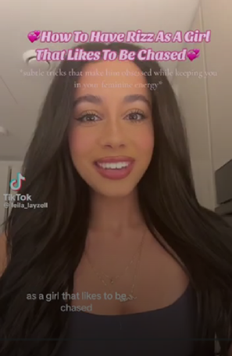
Why do Gen Z guys confidently drop a “bet” while girls jokingly flex their “Rizz”? We could just say that it’s because we live in an age where language spreads through trends and group chats. However, slang is more than just a way of sounding cool; it’s a tool for performing identity. This blog post aims to explore how Gen Z women and men (ages 18-25) who regularly use smartphones and are active on TikTok differ in their use of slang words and how it might reflect broader traditional gendered communication patterns. We ask: Do Gen Z women and men use slang differently in their communication, and are these slangs a form of gendered communication? We hypothesize that Gen Z slang reflects broader gendered communication patterns, with certain terms showing traditionally feminine or masculine traits. At the same time, we emphasize that communication is fluid and inclusive. This blog will provide insights into how emerging slang trends reflect deeper attitudes about gender, with the influence of the media.

[expander_maker id=”1″ more=”Read more” less=”Read less”]

Introduction and Background

Generation Z (“Gen Z”) is often seen as the generation that is constantly challenging traditional norms, especially when it comes to how they speak. Over the past couple of years, TikTok has been a cultural dominant, where slang spreads rapidly and often carries deeper meanings about identity, relationships, and culture. Prior research has explored gender differences in communication; however, they have mostly focused on face-to-face or text-based interactions. We believe that far less is known about how gendered language plays out in fast-moving, algorithm-driven spaces such as TikTok. Hence, what led us to conduct this research, our target group consists of Gen Z women and men ages 18-25 who are active users on TikTok. We specifically selected TikTok due to its platform population hosting more Gen Z individuals than others, and due to the constant exchange of slang on its platform. Common linguistic features of Gen Z include shortened words and abbreviations such as “sus”, for suspicious. Other linguistic features present include gendered slang phrases that reinforce traditional gender expectations, such as the terms “girl boss”, “I’m just a girl”, “sigma male”, etc.

Some academic sources we view to be relevant to our topic include Van Herk’s “What is Sociolinguistics?”, which focuses on differences between gender interactions and communication. Herk explains that gendered language is not natural but performed, since gender is a social construct. He also points out that women most commonly use hedges, fillers, tag questions, uptalk, etc, that reflect differences in the way women and men communicate. In comparison, men tend to be more assertive and interruptive. This source helps us understand the roots of gendered communication so we can then compare it to modern slang use and its relation to gender. Another source we are closely looking into is, “The Social Significance of Slang” by Alice Damirjian. This article argues that slang use is deeply tied to identity formation, group boundaries, and social cohesion. While it doesn’t focus on the meaning of slang words, it instead explores how words are used and in what context. This method is similar to what we intend to do in our research paper, and why we viewed this source as a vital informative piece.

Additionally, A.M. Blackstone’s “Gender Roles and Society” article explores how gender roles are learned and reinforced through socialization and institutions. This citation we included since it helps us support our hypothesis that Gen Z slang may reflect gendered communication patterns. Blackstone’s sociological framework on gender and identity is a great source that guides our research and analysis, based on empirical evidence rather than assumptions. Overall, these studies have helped us inform our hypothesis that argues that while slang is fluid and not fully tied to gender, slang use still echoes traditional gender norms.

Methods

Our study investigates how Gen Z men and women use slang on TikTok and whether this reflects broader gendered communication patterns. To explore this, we will collect slang terms through a survey and then analyze how those terms are used in TikTok videos using a fresh account to eliminate algorithmic bias. The survey will be hosted on Google Forms for ease of delivery and to ensure that we have access to necessary statistics. After this survey, we will examine the top videos for each slang word. The use of both individual and broad-scale analysis techniques allows our group to build a more nuanced understanding of the use of slang.

Once this stage of the research process has been completed, we will be aiming for 10 videos per slang term, which will offer us dozens of relevant examples through both the video itself and its comments. This number is a reasonable amount to reach, but it does not limit our understanding. We chose this two-prong data collection method to more accurately depict the results of this experiment and gain a deeper understanding of the language used.

Using thematic coding and discourse analysis, we will analyze tone, context, delivery, and nonverbal cues associated with each slang term, focusing on how language use relates to gender performance and identity. The discourse analyzed will be specifically the way that the different genders choose to interact with each other using the slang presented. Our guiding research questions include: Do men and women use the same slang terms differently? What patterns of gendered communication emerge through slang? And how do these trends reflect or challenge traditional gender norms? Based on existing sociolinguistic literature, we hypothesize that Gen Z slang use mirrors gendered communication tendencies, with women more likely to use slang that signals inclusivity and emotional connection (e.g., “slay”), and men more likely to use slang that emphasizes assertiveness or dominance (e.g., “let’s go”). However, given Gen Z’s fluid approach to identity and language, we also expect to find challenges to this norm.

Results and Analysis

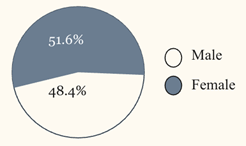
Our final pool of participants for the Google survey portion of data collection was 91 responses, with 51.6% male and 48.4% female respondents. We found that “bet” and “rizz” were the two most frequently used slang terms.  The term “rizz” was the most frequently used, with it being mentioned a total of 46 times between 17 women and 29 men. While “bet” came in second, with it being mentioned a total of 23 times between 11 women and 12 men.

Figure 1. Results from the Google Form Survey: Total Number of Respondents was 91

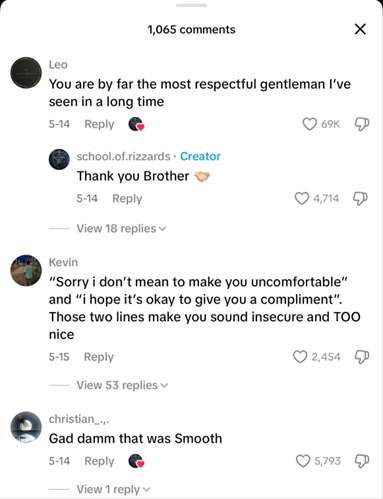
When analyzing the 10 male-coded videos for “rizz”, 8 out of 10 videos generated by male content creators were men demonstrating their “rizz”, by approaching women with a flirtatious attitude, with the goal of receiving the woman’s contact information. While 4 out of 10 videos captured men providing advice on how to have “rizz” or “rizz up” women. This suggests that men’s use of the term  “rizz” aligns with traditional masculine traits like assertiveness and confidence in social situations. It reflects Gen Z’s tendency to blur sincerity and parody, where young men both conform to and mock traditional courtship behavior.

Figure 2. Contextual Use of “Rizz” by Gender (Male: Flirtation, Confidence)

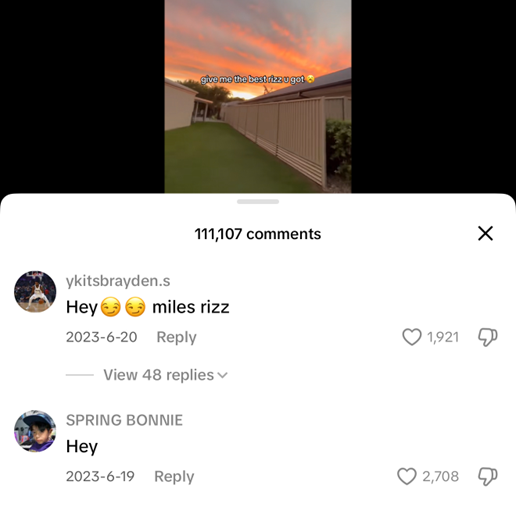
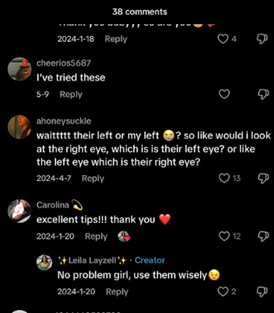
As for the female-coded videos for “rizz,” the results demonstrated that women most often used “rizz” for humor and romantic advice, sometimes expanding it beyond male-female contexts. The data suggests they intentionally adopt masculine slang to relate to men and navigate social dynamics, which reflects how gender norms shape communication even with shared slang. In addition, the data also showed how women resisted gendered dynamics by using “rizz” in a different manner than it was intended.

Figure 3: Contextual Use of “Rizz” (Female: Romantic Advice)

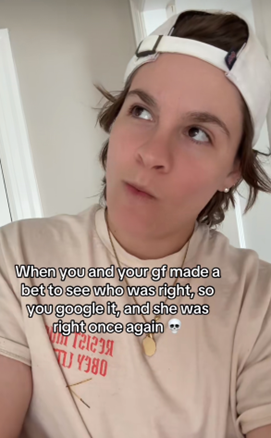
For the 10 male-coded videos with the slang term “bet,” we found that men most frequently demonstrated or recorded their use of “bet” to express agreement, acceptance, or commitment to a plan, e.g., responding “bet” when a friend proposes hanging out or making a wager. 5/10 videos analyzed showcased scenarios where “bet” was used to confirm plans or signal confidence in accepting challenges. This result suggests that men tend to use “bet” as a casual, assertive way, aligning with traditional masculine traits of confidence and decisiveness. It also reflects Gen Z’s conversational style, which blends casual affirmation with a sense of underlying confidence.

Figure 4. Contextual Use of “Bet” by Gender (Male: Agreement, Commitment, Confidence)

As for the 10 female-coded videos for the term “bet,” Our results showed that women most often used “bet” to express agreement, excitement, or playful sarcasm in casual conversations with friends. 3/10 videos analyzed women using “bet” in a lighthearted or humorous way. Showing enthusiasm or signaling they were on board with a plan.

Figure 5. Contextual Use of “Bet” by Gender (Female: Sarcasm, Excitement, Agreement)

Discussion and Conclusion

Our results show that there are distinct gendered patterns in the use of slang terms like “rizz” and “bet.” For the slang term “rizz,” men were more likely to demonstrate or embody the term, while women often used it mockingly or humorously. In the case of “bet,” men tended to use the term to affirm plans or accept challenges, reflecting direct engagement, whereas women used it more playfully or sarcastically. For both slang terms, men typically expressed traditionally masculine traits such as confidence, assertiveness, and decisiveness. In contrast, women exhibited traits like humor and irony as a way to challenge or resist the gender dynamics ingrained in the slang terms. These insights are particularly useful for scholars in sociolinguistics, digital media, and gender studies, as they highlight how informal language can reinforce, challenge, or reshape traditional gender roles. By looking at how terms like “rizz” and “bet” are used, we can gain a better understanding of how digital media reflects and reinforces ideas about traditional gender roles and communication. Our results could benefit researchers, educators, and media literacy advocates by shedding light on gendered communication patterns embedded in Gen Z slang. This insight can contribute to a broader conversation about how digital culture affects youth identity formation, peer dynamics, and societal expectations. Our research helps unpack the cultural significance of everyday language, positioning it as a key site for both reproducing and potentially resisting dominant gender ideologies.

References

Bibian Ugoala. “GENERATION Z’S LINGOS on TIKTOK: ANALYSIS of EMERGING LINGUISTIC STRUCTURES.” Journal of Language and Communication, vol. 11, no. 2, 30 Sept. 2024, pp. 211–224, www.researchgate.net/profile/Bibian-Ugoala/publication/384965246_GENERATION_Z, https://doi.org/10.47836/jlc.11.02.08.

Blackstone, A. (2003). Gender Roles and Society. https://digitalcommons.library.umaine.edu/cgi/viewcontent.cgi?params=/context/soc_facpub/article/1000/&path_info=Blackstone___Gender_Roles_and_Society.pdf

Damirjian, A. (2024). The social significance of slang. Mind & Language. https://doi.org/10.1111/mila.12530

Herk, G, V. (2018). What Is Sociolinguistics? (Linguistics in the World) 2nd Edition (1). India New Delhi: Wiley Blackwell.

Jahan, I. (2021). The impact of gendered language on our communication and perception across contexts and domains. Journal of Language and Linguistic Studies, 17(4), 3523-3534. https://www.jlls.org/index.php/jlls/article/view/5449

[/expander_maker]
Bruin Bios: Different Slang, Same Bruin Energy

Charlie Kratus, Julian Stassi, Evan Ludwig, Peter Tevonyan, Connor Dullinger

Starting college can be an exciting, but also an overwhelming time, especially when it comes to making friends. However, for many students, sharing their identity starts long before classes begin.

Ahead of setting foot on campus as Bruins, UCLA’s Class of 2029 is already creating their college identity online through Instagram. Newly admitted students post photos as well as a self-created caption. These short bios may seem insignificant, but they actually reveal a lot about themselves. They’re filled with a plethora of different slang, lowercase letters, and emojis.

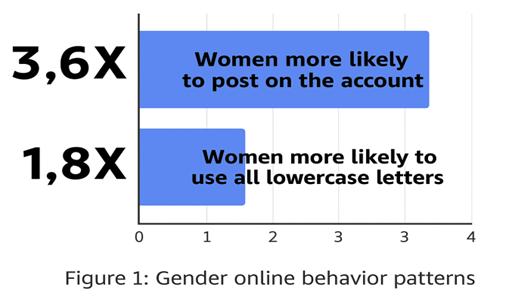
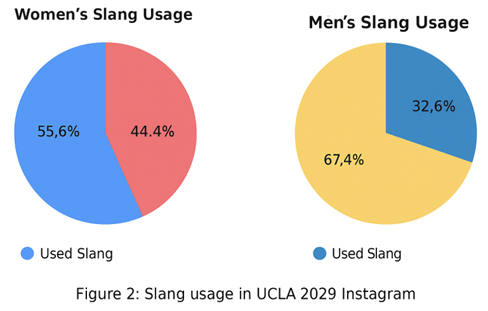
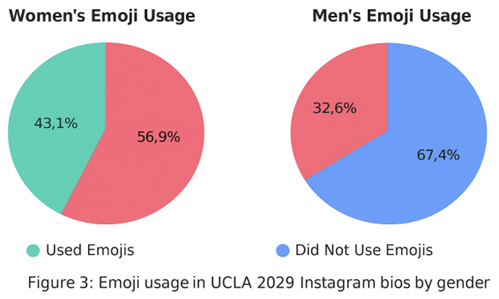
We wanted to look into how students use different types of language and slang to present themselves. We also observed whether patterns are connected to gender, major, location, or interest in Greek life. We saw clear gender-based patterns where women generally used more informal language. They were much more likely to include emojis, write in lowercase, and use slang than men. Those who identified as male tended to stick to more traditional grammar and formatting. We found that language isn’t just how students talk, it’s how they show who they are and where they fit in among different communities.

[expander_maker id=”1″ more=”Read more” less=”Read less”]

Introduction and Background

i) “Hey, my name’s Julian Stassi and I’m 1000% committed to UCLA! I’m from Sacramento, and majoring in Business-Economics. I love watching football, hanging with friends, and I’m a huge foodie. I’m looking for a roommate and planning to rush in the fall, so bang my line!”

These exact messages flood the UCLA Class Instagram page every single year. This is a space where thousands of recently admitted students introduce themselves to find roommates and friends, and it is a great way for students to start shaping their college identity before ever arriving on campus. These posts are more than just sharing majors or hometowns; they’re filled with unique sets of carefully chosen language that says something about how students want to be seen.

ii) These personal bios are filled with informal language, which makes them feel ​​personal and distinctive. While others can be more straightforward and formal. This made us question: Does gender influence tone or slang? How are North Campus majors different from STEM majors? What connections could be made between these new Bruins, and what does this say about them?

iii) We then analyzed the first 200 posts from the official UCLA 2029 account and closely looked at the diverse use of slang, grammar, and emoji use, and how language varies across gender, major, and location. Our project explores how even small stylistic and language choices reflect deeper identity performances and social positioning within online spaces. These posts are not just about introductions; they are shaping how students want to be perceived as they begin forming who they are on campus.

Methods

For this project, like previously mentioned, we conducted our quantitative analysis by going through the first 200 posts from the @ucla2029freshman class Instagram account – a social media account used for recruiting and engaging with incoming freshman students at UCLA – and analyzed a myriad of demographics from each post.

Our main goal from this cultivation of data was to analyze the topicof linguistic strategies used to engage prospective students and to comprehend how language choices reflect broader communicative goals in higher education and social media outreach. The method of data collection, a quantitative content analysis where we carefully recorded and studied language patterns in social media posts, focused on a 200 sample from the largerpopulation of the account and looked at gender (male/female), the opening style used (how they greet the people seeing their account, e.g., hello, hiii, hey, etc), any slang used (things like words in all caps, pls, wanna HMU, roomie, foodie, insta, etc), if there is a presence of emoji use, proper grammar and punctuation, if students listed their pronouns, if people used all lowercase or all uppercase, and their intended major (pre-med, humanities, STEM).

Since we examined different styles of speech, we also drew from the idea of language variation, which looks at how people’s language changes depending on their background, age, gender, or community involvement, as well as grammar, tone, and word choice (Bahtina, 2025).

Our data collection specifically focused on the first 200 posts chronologically available on the account at the time of data collection to ensure that we cultivated a large but manageable sample representing not only a multitude of academic disciplines but also genders, communication styles, and decisions. This approach allowed us to gather a wide variety of people at different stages of the student admission process and people from an abundance of different demographics, which helped ensure an accurate sample of the representation.

When reporting findings on gender in our study, the results were strictly based on the first 200 posts from the class account, and we did not assume a 50/50 gender split. This was because we wanted to limit any confounding variables and stay stable with our procedure and data collection, and it also revealed the prevalence of social media use and how it differs across gender.

Results and Analysis

After each group member cultivated data from the posts of the class of 2029 Instagram account we found the following findings: 43.1% of female students use emojis compared to only 32.6% of male students (Figure 2, 3), female business economic majors are 50% more likely to use slang compared to men, women are 1.8 times more likely than men to write in lowercase (Figure 1), and men in humanities adhere most strongly to formal digital norms. A key concept shown here is also the informalization of language, which posits that communication tendencies on social media tend to vary in regard to their casual and playful tone (Natsir et al., 222). This is evident in the use of emojis, lowercase letters, and slang in social media posts (Figure 1).

Figure 1

From this data we had several findings – what appears to be a casual introduction or captioning on an introductory Instagram post is often a strategic act of self-presentation that differs among each person depending on their own demographics and the image they want to illustrate to the people viewing their posts which could be future friends, roommates, classmates, or even project mates in a class setting like this. Simply put, the data shows the presence of gendered linguistic performance (Van Herk, 101). This refers to the idea that is not something we simply are but something we do, which relates to the evidence because it emphasizes the presence of linguistic performance and ways people perform. While we found relationships between gender and linguistic decisions and major and self-presentation, the relationship between gender and major was much more complex than a clear pattern.

Every individual use of emoji, lowercase letter, or slang word differs person to person (however, there are more common themes seen in some demographics than others) and demonstrates some aspect or other about a person. These posts on the Instagram account aren’t just digital information, but they have the power to reflect someone’s identity, culture, and origin. Aligning with the idea that emojis are a form of cultural expression. As Professor Junnifer Prough says, emojis clearly display layers of cultural communicative meaning, explaining that users use emojis to be understood and for belonging (Ted Talk by Freedman, 2019). When students post their introductory bios, they are engaging in a form of visual and linguistic identity making, whether they choose to or not.

Figure 2

Figure 3

These results and implications are imperative to helping illustrate how social norms shape larger themes across digital communications and reinforce the identity that language is performative even in the most casual of settings.

These students engage in what is known as “front stage” performances where they craft online personas that balance authenticity, approachability, and cultural fluency within the norms of the current contemporary society and how Gen Z acts in the current state of the social media culture. The agentive behavior is consistent with research that shows the use of social media to develop self-presented messages tailored to specific audiences, shaping their identity even before arriving on campus (DeAndrea et al., 2011).

Discussion and Conclusion

Our analysis of the UCLA Class of 2029 Instagram posts shows the language in Instagram posts as a form of digital identity construction. While captions appear to be informal, they actually reveal a choice that every single student makes in order to express themselves. They do this in order to, in some way, fit in or stand out. The use of emojis, punctuation, and slang in order to differentiate genders, majors, and regions shows that language use is made purposefully. The pattern that was most clear to us was gender-based differences in tone and formatting of the posts. Female students, when compared to male students, overwhelmingly use an informal style of using emojis, lowercase, and slang. Males, on the other hand, were more likely to have proper grammar and tone. This is clear in the research with sociolinguistics showing women often are more linguistically innovative in language to build social standing than men, who look toward status-oriented forms of communication. The difference between majors was also an interesting point where humanities students had more flexible tones and relaxed language, while STEM students were direct. This shows how different disciplines socialize students into a variety of ways in which they communicate. These posts are not only explaining who they are or what they are excited for, but they also create a performance of sorts with the things they put within the text caption of their posts. The slang, punctuation, and emojis all say something about the way in which the students desire to be seen as they matriculate.

References

Bahtina, D. (2025). 2A Variation in language. Communication 188B.

DeAndrea, David C., et al. “Serious Social Media: On the Use of Social Media for Improving
Students’ Adjustment to College.”
The Internet and Higher Education, vol. 15, no. 1,
2012, pp. 15–23. https://doi.org/10.1016/j.iheduc.2011.05.009.

Freedman, A. (2019, April 26). The culture of emoji. ??? | Alisa Freedman | TEDxUOregon. YouTube. https://www.youtube.com/watch?v=U1QpAUhnoWE

Natsir, Nur, et al. “The Impact of Language Changes Caused by Technology and Social Media.” Language Literacy: Journal of Linguistics, Literature, and Language Teaching, vol. 7, no. 1, 2023, pp. 220–28. https://pdfs.semanticscholar.org/9216/d49e850423f6d38e416694724061649445ec.pdf.

Van Herk, G. (2018). Gender. In What is sociolinguistics? (2nd ed., pp. 96–116). Wiley Blackwell.

Duggan, Maeve. (2013, September 12). It’s a woman’s (social media) world. https://www.pewresearch.org/short-reads/2013/09/12/its-a-womans-social-media-world/

[/expander_maker]
Performing the Self: Gestures in Context

Ahmani Guichard, Presley Liu, Isabella Rivera, Dru Stinson

“Hi! Welcome back to my channel,” the YouTuber begins, waving to the camera. She leans back and starts to talk about her day. Ten minutes pass. “Don’t forget to give this video a big thumbs up!” she grins, flashing raised thumbs. The vlog ends. In the polished, highly edited world of YouTube, each movement counts. Like aesthetically pleasing thumbnails and attention-grabbing titles, gestures can be intentional signals online. Whether taking viewers through “A Day in the Life” or “Landing an Internship,” these creators adjust their hands, faces, and posture due to context. This research highlights gestures across casual and serious content while exploring their influence on digital identity. Analyzing clips from publicly available videos/vlogs, the study examines seven categories of gestures: illustrators, emblems, adaptors, posture, hand openness, and head movement. The research dissects how undergraduate female YouTubers convey expressiveness through their nonverbal behavior. The results indicate that casual videos tend to feature more animated, spontaneous gestures. In contrast, those same creators are more composed, employing fewer gestures overall in formal content. By focusing on gestures, this research adds a new dimension to the sociolinguistic understanding of impression management and gendered norms in the digital realm.

[expander_maker id=”1″ more=”Read more” less=”Read less”]

Introduction and Background

Across digital spaces, content creators strive to present themselves effectively in various contexts. Over the past decade, the rise of young female vloggers has transformed YouTube from a video-sharing platform into a complex stage for influencer culture. These creators document life. Yet, they also navigate the pressures of visibility and social norms in a highly curated world. As the YouTuber phenomenon continues to grow, the importance of understanding how people perform their online identity is ever essential.

Previous research by Abdul Razak (2025) has focused on influencers’ linguistic patterns, such as the use of the word “like.” Other studies have concentrated on influencer actions (e.g., taking selfies) (Adidin, 2016). However, there is a limited understanding of how gestures overall may change based on context for female-identifying content creators. Drawing on Goffman’s (1959) concept of impression management, this project considers how vloggers may act as performers on a digital stage. Abidin’s (2016) theory of subversive frivolity reframes seemingly lighthearted content as sites of resistance, where femininity becomes a tool for navigating digital labor. Hence, this existing literature further legitimizes the inherent merits of our research focused on shifts across content by this group of young, female YouTubers who are often dismissed.

This study examines how undergraduate female YouTubers utilize nonverbal cues in their casual versus serious videos. This examination seeks to contradict the perception of this group as one-dimensional and hypothesizes that our sample changes their gestures to fit the situation — more expressiveness (a higher amount of hand gestures and more relaxed posture, head movements, and hand openness) in casual videos and less in serious ones.

Methods

We began our study by observing five female YouTubers based on their popularity, as we were interested in analyzing videos with high admiration. We noted creators who had verified statuses, a strong following, and a high number of views. We focused mainly on those with over ten thousand subscribers, which then led to a high viewer count on the videos we chose. Our selection included twenty videos total, with two casual and two serious videos per creator. This came out to four videos for each of the five creators. Each one was determined as casual if it involved low social or personal stakes, like “a day in the life,” while serious videos included high social or academic stakes, such as career planning. We randomly selected a five-minute clip to observe from each one with an online number generator (numbergenerator.org), to remove any sort of bias. We recorded data when the YouTuber had their face visible on the screen and spoke to the audience. With each clip, we examined multiple gesture categories due to their associations with expressiveness. These gestures were adaptors, illustrators, emblems, posture, hand openness, and head movements.

We then coded each clip by counting the raw numbers of illustrators, adaptors, and emblems we observed per clip. Illustrators are gestures that send a message, like pointing or placing a hand on your chest, as shown in Figure 1.

Figure 1: Example of Illustrator from Lihn Troung’s “A week in my life: college finals & christmas in the city // vlog 007”

Adaptors, on the other hand, involve self-touching behaviors like scratching or rubbing and are typically unconscious responses to adapt to one’s environment (Kelmaganbetova et al., 2023). Figure 2 shows an example of an adaptor from Lihn Troung’s videos where she tucks her hair behind her ear.

Figure 2: Example of Adaptor from Lihn Troung’s “A week in my life: college finals & christmas in the city // vlog 007”

Emblems are substitutes for words or phrases in communication, like the peace sign shown in Figure 3.

Figure 3: Example of Emblem from Lihn Troung’s “A week in my life: college finals & christmas in the city // vlog 007”

Our next step was to further observe and calculate each video’s expressiveness. We did this in terms of the creators’ posture, hand openness, and head movements throughout the videos. To code this step, we utilized a Likert scale to determine the levels of each gesture displayed by the creator. For instance, a video with relaxed posture would have a rating of 1 on the Likert scale, while a rating of 5 would indicate formal levels of posture throughout the video. The same was for hand openness where a 1 meant closed hand positions, and a 5 meant open. High levels of head movement received a rating of 5, while still head movements received a 1. We performed interrater testing as well, in order to ensure overall consistent results. This testing measured consistency by having more than one group member collect the data.

Results and Analysis

The data set partially lined up with our prediction. Our group’s hypothesis was that young women in undergraduate programs would have a significant difference in gestures between serious and casual content. Our data demonstrated some differences between serious and casual contents’ data. However, there seemed to be more variance between the person that had uploaded the videos themselves versus their actual content type. Something we noticed was that postures would be more “correct” or upright in serious videos in general. Meanwhile, casual videos often had slouchier or relaxed posture. The frames were another factor that typically depended on the type of video that was being seen. For example, shoulders up was the frame that was seen in serious videos. On the other hand, videos that were more casual typically had a less consistent frame. Throughout the videos there was also a difference between different creators. Lihn Truong was the only creator that we viewed that fit the prediction that nine or more illustrators would be visible in casual content. Helaine Zhao and Studyquill had less gestures when filming serious content. Some of the creators kept many of their video styles pretty consistently. Mikayla Mags would be an example of a creator that had high illustrators across video types. Mags also kept a similar posture throughout her videos. Other things that we noticed among videos were that some creators had lower gestures on the Likert scale despite a difference in content type. Lillian Zhang kept a formal style of video content and personality throughout. The patterns observed demonstrate how tone and individual creators overall have more variety rather than their content type. It can be connected to sociological themes such as gender and women trying to be perceived as likable by other people due to societal expectations to be kind and nurturing. This can potentially come across differently depending on the content creator and what they perceive to be according to standard. It is also important to note that this may be a subconscious decision to do so.

Figure 4 shows the gesture counts calculated for Lihn Troung’s videos, along with the Likert scale data for each one. As shown in her casual holiday vlog, she used 10 illustrators, 5 adaptors, and 4 emblems. We can see that her serious content showed more restrained posture, fewer gestures, and closed body language. For more detailed counts and results, see the data table linked at the bottom of this post.

Figure 4: Results from Lihn Troung’s Videos (Raw Counts and Likert Scale)

Video TitleYouTuberVlog typeIllustratorsAdaptorsEmblemsPostureHand OpennessHead Movements
A week in my life: college finals & christmas in the city // vlog 007Lihn TroungCasual1054555
another productive day in my life studying, coffee omakase, dance practice, & senior year memoriesLihn TroungCasual813444
why you need hobbies in 2024 // rediscovering my hobbies as a burned out college studentLihn TroungSerious613245
study with me for college finals (pomodoro method)Lihn TroungSerious647221

Regarding other overall trends, illustrators were the most frequently counted gesture. Casual vlogs showed higher amounts of adaptors and emblems; however illustrators actually appeared more frequently in serious videos. Yet, serious vlogs showed fewer hand gestures as depicted in Figure 5.

Figure 5: Relationship between Gesture Counts of Casual vs. Serious Videos

X-axis: Nonverbal Gesture

Y-axis: Number of Counts

Examining the data from the Likert scale included in Figure 6, casual videos had an average score of 4.4 for head movements while serious videos scored an average of 4.8, depicted variation in relaxed and expressive behavior. However, hand openness remained consistent across topics, contradicting part of our original hypothesis which predicted that hand openness would be more prevalent in casual content.

Figure 6: Average Ratings of Expressiveness using Likert Scale (1-5)

X-axis: Expressive Gesture

Y-axis: Rating

Thus, while variation occurred between YouTubers, with some like Linh Troung adhering to our hypothesis closely while others like Makayla Mags presented some contrasting data, overall, a distinction in gestures between causal versus serious content is visible.

Discussion and Conclusion

Overall, YouTubers in casual vlogs displayed more expressive behaviors — more adaptors and emblems, relaxed posture, and head movements. In contrast, serious vlogs tended to feature more restrained gestures yet a higher number of illustrators. Although these patterns largely supported our hypothesis and the results from previous literature, individual variation between vloggers and the counts for illustrators suggests the benefits of a further study.

Our sample size of five female undergraduate YouTubers is one limitation of our study. While this small group allowed for detailed coding, it curbs the generalizability of our results. Furthermore, although the structured coding scheme and interrater testing helped mitigate bias, gesture analysis inherently involves some degree of interpretation. Distinguishing between an illustrator and an adaptor can be context-dependent. Without direct input from the creators themselves, interpretations largely remain speculative — especially regarding intentionality. It is also uncertain how gender specifically shapes these behaviors. Future research could compare how gestures differ between a sample of male versus female YouTubers.

Although additional research may help us derive more concrete overall conclusions about our population, our study offers several benefits to the study of interpersonal communication and societal understanding of internet culture. Our research challenges stereotypes about female influencers by showcasing their context-sensitive nonverbal use. The shift in physical behavior depending on the topic can suggest acute awareness of audience expectations. These patterns contribute to our broader understanding of impression management as gestures take on a layered meaning. The openness adopted in casual vlogs reflects a negotiation of credibility. In serious videos, reducing gesturing and maintaining an upright posture aligns with traditional markers of authority, while in casual contexts, animated movement may serve to build rapport and relatability (Smith, 2017). Gestures become a coded method of exploring platform visibility, societal norms, and professional aspirations.

The findings point to a broader takeaway — nonverbal communication is a vital aspect of digital self-presentation. Although these gestures may be subtle, they wield significant implications for how we understand identity, labor, and gender in the age of influencers.

EXTENDED DATA TABLE + COUNTS

RECOMMENDED READING/VIEWING (RELEVANT INFO)

REFERENCES

Abdul Razak, N. (2025). The use of slang by Gen Z female influencers on Instagram and Twitter (X). International Journal of Research and Innovation in Social Science, 9(4), 1910–1917. https://rsisinternational.org/journals/ijriss/articles/the-use-of-slang-by-gen-z-female-influencers-on-instagram-and-twitter-x/

Abidin, C. (2016). “Aren’t these just young, rich women doing vain things online?”: Influencer selfies as subversive frivolity. Social Media + Society, 2(2), 1–17. https://doi.org/10.1177/2056305116641342

Goffman, E. (1959). The presentation of self in everyday life. Anchor Books. Retrieved from https://archive.org/details/presentationofs00goff

Kelmaganbetova, A., Mazhitayeva, S., Ayazbayeva, B., Khamzina, G., Ramazanova, Z., Rahymberlina, S., & Kadyrov, Z. (2023). The role of gestures in communication. Theory and Practice in Language Studies, 13(10), 2506–2513. https://doi.org/10.17507/tpls.1310.09

Number Generator. (n.d.). NumberGenerator.org. Retrieved June 10, 2025, from https://numbergenerator.org (https://numbergenerator.org/)

Smith, H. J., & Neff, M. (2017). Understanding the impact of animated gesture performance on personality perceptions. ACM Transactions on Graphics, 36(4), Article 128. https://doi.org/10.1145/3072959.3073697

[/expander_maker]
Navigating Bilingual Realities: Mandarin-English Code-Switching

Qianwei Tao, Yinlin Xie, Zhifei Lei, and Yifan Yin

What makes bilinguals switch between languages mid-sentence, seemingly effortlessly? This captivating phenomenon, called code-switching, reflects the adaptability of bilingual communication. In our study, we focused on Mandarin-English bilinguals to explore how mixed-language prompts and formality levels influence their linguistic choices. Through analyzing responses from 20 participants aged 18 to 25, we found an unexpected pattern: formal prompts, traditionally thought to discourage language mixing, elicited higher rates of code-switching compared to informal ones. This discovery challenges long-held assumptions and shows the nuanced relationship between language, social context, and communication. By exploring further the structured nature of formal prompts and their impact on bilingual expression, this study shows how bilinguals use code-switching as a tool for communication. These findings open a window into the interaction of language and context, offering new perspectives on how bilinguals navigate their communication.

[expander_maker id=”1″ more=”Read more” less=”Read less”]

Introduction and Background

Language functions as more than just a tool for communication; it mirrors our social and cognitive realities. For bilinguals, this reflection shows in the phenomenon of code-switching, specifically intra-sensational code-switching, the act of alternating between two languages within a single sentence. This dynamic process is influenced by numerous factors, including context and language dominance. Language dominance also determines how fluently individuals switch between languages, and this is defined as the relative proficiency or preference for one language over another (Deuchar, 2020). For example, research shows that bilinguals frequently code-switch into their dominant language in casual settings but adhere to monolingual norms in formal contexts (Muysken, 2000). This shows that code-switching is not only a linguistic skill but also a social strategy that allows bilinguals to adapt seamlessly to diverse social cues and contexts (Green, 1998). Regarding these ideas, our study addresses the main research question: How do mixed-language prompts and varying levels of formality influence code-switching behavior in Mandarin-English bilinguals?

Research has shown that the context of communication heavily influences code-switching behavior. Formal settings often promote monolingual language use, emphasizing precision and adherence to linguistic norms (Myers-Scotton, 1993). On the other hand, informal contexts allow greater flexibility, enabling bilinguals to switch languages more freely (Deuchar, 2020). However, existing studies have not sufficiently explored how bilinguals respond to formal prompts containing mixed-language elements (Deuchar, 2020). This gap in the literature leaves unanswered questions about the nuanced interplay between linguistic input and social contexts.

Mandarin-English bilinguals provide us with an especially intriguing population for examining this phenomenon in this study. These bilinguals frequently engage in code-switching due to its structural and cultural contrasts between Mandarin and English (Green & Wei, 2014). This study tests the hypothesis that informal prompts with mixed-language elements will elicit higher rates of code-switching compared to formal prompts. We predict that Mandarin-English bilinguals will demonstrate strategies for adapting their writing to fit in contextual demands, with their switching behavior shaped by the linguistic input they take. Though there is extensive existing research, gaps remain in understanding how linguistic input and contextual factors interact to shape bilingual communication. Existing studies have focused on informal contexts or monolingual prompts, leaving questions about formal settings and mixed-language input underexplored (Deuchar, 2020). Addressing these gaps provides an opportunity to deepen our understanding of bilingual communication as a nuanced and adaptive process. Code-switching is not merely a linguistic phenomenon but a sophisticated strategy for navigating complex communication landscapes. It highlights the adaptability of bilinguals in managing diverse linguistic and social demands, which offers valuable insights into the interplay of language, context, and culture.

Methods

This study examined how Mandarin-English bilinguals respond to linguistic prompts varying in level of code-switching and formality. We recruited 20 participants aged 18-25, all Mandarin-dominant bilinguals with English as their second language. Participants were selected based on their self-reported regular engagement in code-switching to ensure appropriate alignment with the experimental tasks. Participants completed linguistic tasks designed to analyze their code-switching behavior. The tasks involved responding to prompts that differed in two key aspects: language composition (monolingual prompts [CS-] versus mixed-language prompts [CS+]) and context (formal, semi-formal, and informal settings). These variables were chosen to explore how prompt design and contextual formality interact to influence code-switching patterns. This approach allowed us to observe intra-sentential code-switching, where participants alternated between Mandarin and English within a single sentence, one of the most cognitively demanding forms of code-switching (Green & Wei, 2014).

The data collection of the study focused on the frequency and type of code-switching, with responses categorized based on their linguistic composition and analyzed for patterns across different conditions. To describe intra-sentential code-switching, we utilized two categories other than Monolingual condition. One is multiple-word insertion, which involves inserting multiple words or phrases from one language into the grammatical structure of another language within a sentence (Muysken, 2000). We also incorporate the alternational code-switching that has more extensive switching within a single sentence, involving longer phrases or clauses (Dulm, 2007). This categorization allowed for a nuanced analysis of the participants’ code-switching behavior in response to the linguistic prompts. Participants are told that they can respond in any language they feel most natural to answer. The categorized prompt of the survey is indicated below:

Group 1: CS Level Condition

  1. Monolingual/Informal:
    • What’s the most random thing that’s happened to you this week?
  2. Alternational Code-switching/Informal:
  3. ○最近你发现啥新地方超好吃的, like legit worth recommending?
    1. ○(What new places have you discovered recently that are super delicious?)
  4. Multiple-word Insertion/Informal:
    1. 你最近有没有吃到什么literally超赞的地方, like那种vibe很chill而且超好吃的?
      1. (Have you eaten at any literally amazing places recently, like places with a chill vibe and super delicious food?)

Group 2: Formality Level Condition

  1. Formal Prompt/Mixed-language (CS+):
    1. 请分享一个 significant challenge in your academic journey and how you overcame it.
      1. (Please share a significant challenge in your academic journey and how you overcame it.)
  2. Semi-Formal Prompt/Mixed-language (CS+):
    1. 跟我们说说你最喜欢的hobby, and how it fits into your daily life.
      1. (Please tell us your favorite hobby, and how it fits into your daily life.)
  3. Informal Prompt/Mixed-language (CS+):
    1. 一个朋友发消息问你 “你周末打算干嘛? Any fun plans?” 你会怎么回答。
      1. (A friend texted you “What are you up to this weekend? Any fun plans? What would you reply? ”)

These categories align with the matrix language model and provide a clearer understanding of the extent of language mixing within a single sentence (Muysken, 2000; Dulm, 2007). Graphs summarizing the results were labeled with condition names, like “Figure 1 Code-Switching Frequency by Level of Code Switching” and “Figure 2: Code-Switching Frequency by Context Formality.” Also, graphs are titled as “Group 1: CS Level Condition”, and “Group 2: Formality Level Condition.” This ensured that findings were visually intuitive and accessible. We also framed our participant group as homogeneous in terms of their language dominance and bilingual proficiency to confirm group similarities. By aligning terminology with the matrix language model, we clarified “insertion” as the process of embedding words from one language into the grammatical structure of another (Muysken, 2000). Recruitment was conducted through social media platforms like Instagram and WeChat. A pre-survey assessed participants’ language dominance, proficiency, and code-switching habits. This survey included demographic questions and self-assessments of fluency and language usage patterns in formal and informal contexts. This streamlined methodology can effectively explore how linguistic prompts and context influence bilingual communication.

Results and Analysis

The experiment results are obtained from 20 participants, aged 18 years old to 25 years old. Male participants significantly dominate the sample, being 66.7%, while female participants take up to 33.3%. Most of the participants are currently enrolled in college or holding a bachelor’s degree. All participants share an advanced proficiency in their native language, Mandarin, and a moderate fluency in their second language, English. Based on the pre-survey scores, apparently there is a strong agreement among the participants that mixing languages is natural bilingual practice. They exhibit a tendency to mix languages more frequently in informal settings, such as being with family or friends. Meanwhile, they mix languages moderately in formal settings, usually for academic or professional purposes. They all show a high level of comfort using mixed language in online environments.

Survey 1 contains informal scenarios with three types of prompts: monolingual code-switching (CS-): e.g. “What’s the most random thing that’s happened to you this week?”; alternational code-switching (CS+) prompts: e.g. “最近你发现啥新地方超好吃的, like legit worth recommending? (What new places have you discovered recently that are super delicious?)”; multiple-word insertion prompts: e.g. “你最近有没有吃到什么literally超赞的地方, like那种 vibe很chill而且超好吃的? (Have you eaten at any literally amazing places recently, like places with a chill vibe and super delicious food?) ”. Results show that monolingual CS- prompts are the least likely to evoke code-switching responses (10%), and alternational CS+ ones are moderately likely to trigger code-switching (60%), yet multiple-word insertion ones are the most likely to prompt code-switching responses (70%).

In the graph below, the x-axis represents different levels of CS, while the y-axis represents the frequency of CS occurring in percentage. The overall graph shows a positive trend among the three types of prompts, indicating a correlation that the more insertions present within a sentence, the more likely it is for speakers to code-switch. These findings suggest that the structure and complexity of the prompt can be impactful to the frequency of code-switching. In informal contexts, prompts with more embedded English words facilitate code-switching more effectively.

Figure 1.Code-Switching Frequency by Level of Code Switching

Survey 2 focuses solely on CS+ prompts across formal, semi-formal, and informal contexts. Unexpectedly, formal prompts elicit a higher frequency of code-switching (60%) compared to semi-formal (30%) and informal (30%) contexts. In the graph below, the x-axis represents different levels of formality, whereas the y-axis represents the frequency of CS occurring in percentage. The graph exhibits a negative trend overall, suggesting that the less formal the setting is, the less likely speakers would code-switch. This reversal of the initial formality hypothesis indicates baseline behaviors among participants. To exemplify, a formal prompt such as “请分享一个 significant challenge in your academic journey and how you overcame it.

(Please share a significant challenge in your academic journey and how you overcame it.)”, contains structured content and professional diction, thus encouraging interactive engagement and bilingual expression. Conversely, informal prompts like “最近你发现啥新地方超好吃的, like legit worth recommending? (What new places have you discovered recently that are super delicious?)” triggers monolingual Mandarin responses with rare occurrences of code-switching. This implies that participants will regard informal prompts as less demanding compared to formal counterparts, thus less likely to code-switch.

Figure 2. Code-Switching Frequency by Context Formality

The higher likelihood to code-switching in formal contexts contradicts the hypothesis that informality would raise the chances of language mixing. There are a few plausible explanations for this unconventional phenomenon.

  1. Baseline Behavior: participants interpret informality as less linguistically demanding than formality, meaning that they might use L1 exclusively, rather than spending more cognitive effort to insert L2 components into casual conversations.
  2. Prompt Design: formal prompts consist of naturally embedded English components, increasing the likelihood of participants to incorporate English into their responses. It explains how code-switching behavior of participants heavily rely on the design of prompts.
  3. Perceived Social Norms: speakers tend to showcase their bilingual ability more frequently in formal settings because professionalism is commonly associated with an advanced bilingual proficiency. To align with this social perception, they are more likely to engage in code-switching to demonstrate their fluency and competence.

These findings offer valuable insights for the field of bilingualism and in particular, code-switching. However, further research is needed to examine how bilingual behaviors can be shaped by sociolinguistic and psycholinguistic factors, and whether these linguistic trends are consistent among bilinguals with varying degrees of proficiency, or with different language combinations.

Discussion and Conclusion

In conclusion, this study provides a deeper version of the relationship between contexts in bilingual communication based on previous research on code-switching in bilingual speakers, focusing on the code-switching behavior of Mandarin-English bilinguals. Surprisingly, the findings differ from traditional assumptions and the formal hypotheses: code-switching is more likely to occur for bilinguals when combined with mixed-language prompts (CS+) in formal contexts than in informal contexts. This untraditional result challenges the long-held view that the cognitive demands of processing mixed-language input and the structure and guidance in formal contexts actually encourage bilinguals to use code-switching strategically for expression and communication.

This encouragement would lead bilinguals to utilize code-switching as a tool for conscious and strategic communication, which is consistent with the theory that bilinguals adapt their language to specific contexts, and that prompts give specific language expressive demands to motivate bilinguals to higher attentional control to help them integrate the two languages for complex articulations. In addition, the structure and complexity of the prompts can be overwhelmingly significant in affecting the frequency of code-switching behaviors. Mixed-language prompts (CS+) consistently lead to code-switching expressions, which is consistent with Deuchar’s (2020) token modeling theory that prompts can motivate bilinguals to activate both languages simultaneously to communicate, making code-switching a natural and effective way of communicating, which proves the theory that code-switching is not a spontaneous or arbitrary process but rather a deliberate linguistic strategy used to carry out a specific conversational goal.

Although the study presents different challenges, certain limitations exist. The specific participant demographics and small sample size limit the results of the study to a great extent. Specific language choices are also a limitation, and different language choices in the same study could have led to variations in results. In the future, the choice of greater linguistic diversity, an unspecified participant population, and a larger sample size are key factors for obtaining further validation and more comprehensive experimental results. However, other factors, such as cultural diversity, language ability and individual differences, may also influence the results, which will require future researchers to make more careful choices about the conditions of their experiments.

Two Relevant Talk/Podcast

  1. TED Talk: “Code-Switching to Navigate the World Around Us” by Jaellin King

King (2019) explores how different languages can positively impact how people navigate their surroundings. She mainly discusses the importance of being fluent in more than one standard of language to communicate effectively within diverse communities in this TED Talk. This idea aligns with our study’s focus on how bilinguals respond to linguistic prompts in various contexts, particularly the formal, semi-formal, and informal settings examined in the research. King’s idea also aligns with Muyskens’ article, supporting that the patterns and frequency of code switching can be influenced by different context and cues (Muysken, 2000).

  • Podcast: “Code-switching as a School Strategy” by IDRA

This podcast episode delves into how code-switching can be used in educational settings to

create more inclusive environments for students. It discusses building an inclusive curriculum and how to use code-switching to better support students. This is related to Green’s article that Code-switching is used by bilinguals as a social strategy that allows them to navigate in different contexts (Green, 1998).

References

Deuchar, M. (2020). Code-switching in linguistics: A position paper. Languages, 5(2), 22. https://doi.org/10.3390/languages5020022

Dulm, O. V. (2007). The grammar of English-Afrikaans code switching: A feature checking account. LOT.

GREEN, D. W. (1998). Mental control of the bilingual lexico-semantic system. Bilingualism (Cambridge, England), 1(2), 67–81. https://doi.org/10.1017/S1366728998000133

Green, D. W., & Wei, L. (2014). A control process model of code-switching. Language, Cognition and Neuroscience, 29(4), 499-511.

Green, D. W., & Wei, L. (2014). A control process model of code-switching. Language, Cognition and Neuroscience, 29(4), 499–511. https://doi.org/10.1080/23273798.2014.882515

IDRA. (2019, July 1). Code-switching as a school strategy – Podcast episode 192. https://www.idra.org/resource-center/code-switching-as-a-school-strategy-podcast-episod e-192/

King, J. (2019, November). Code-switching to navigate the world around us [Video]. TEDx Conferences. https://www.ted.com/talks/jaellin_king_code_switching_to_navigate_the_world_around_ us

Muysken, P. (2000). Bilingual speech: A typology of code-mixing. Cambridge University Press. Myers-Scotton, C. (1993). Social motivations for codeswitching : evidence from Africa / Carol

Myers-Scotton. Oxford: Clarendon Press. Yow, W. Q., Tan, J. S. H., & Flynn, S. (2018). Code-switching as a marker of linguistic competence in bilingual children. Bilingualism: Language and Cognition, 21(5), 1075-1090. https://doi.org/10.1017/S1366728918000078

[/expander_maker]

Language of Liberty & Life: Persuasive Discourse in Presidential Statements About Abortion

Why is it that two presidents talking about the same issue can make it feel like we’re living in two completely different countries? This project analyses how President Trump and former President Biden rhetorically frame the issue of abortion. To one, abortion is about individual freedoms, rights and democratic choices, while to the other it is about morals, faith and American values. Focusing on six speeches, three per leader, that were presented between 2020 and 2024, we conducted a discourse analysis and focused on rhetorical appeals (ethos, pathos, logos), tone, emotional triggers and opposition framing. We found that President Trump tends to frame the issue as a moral crisis whereas Former President Biden tends to frame it as a constitutional one. Former President Biden tends to use double the (average) number of rhetorical appeals when compared to President Trump, however they both tend to refer to each other/the opposition almost the same amount. These patterns showed us how political speech is tailored not only be informative, but also to shape public opinion, showing how the rhetoric used can perpetuate a specific narrative and benefit the politician.

[expander_maker id=”1″ more=”Read more” less=”Read less”]

Introduction and Background

Persuasive rhetoric around the topic of abortion varies greatly between people, in this case, the variation addressed will be that of two prominent political figures: President Trump and   Former President Biden, both of whom use persuasive rhetoric to influence people’s opinions greatly, but differ greatly in how they address the public. While the initial objective of their statements may be to inform, they also work to persuade public opinion on various subjects in hopes to garner more voter support and donations.

There is a plethora of research analyzing how political leaders use persuasive rhetoric, particularly framing, emotional appeals, and identity-based language to shape public understanding of controversial ideas. Scholars like Lakoff (2004) have demonstrated how metaphors and framing have influenced voter perception around cultural topics. Similarly, scholars like Jamieson and Campbell (2001) have analyzed how presidential rhetoric uses pathos, ethos, and logos to construct political narratives. This tendency is consistent with Homolar and Scholz’s (2019) analysis of 74 Trump campaign speeches, which shows that crisis-laden, us-versus-them narratives create ontological insecurity and mobilize voter support.

In reference to reproductive rights, scholars like Medved and Rawlines (2000) and Ginsburg (1989) have explored how abortion is framed through competing moral, legal, and religious lenses. However, we have noticed a significant gap in recent work that compares the persuasive rhetorical strategies of former President Biden and President Trump specifically within the context of abortion rights.

Our objective was to fill that gap by asking: How do former President Biden and President Trump use persuasive language to frame abortion, and is it done emotionally, logically and/or by establishing their credibility to their audience? We wanted to understand how social identity and ideology can affect political communication, especially around issues as heavily debated as abortion.

Methods

We selected six public statements, three from each leader, delivered between 2020 and 2024. They were a mix of addresses, campaign speeches, and national statements.

Biden:

  • National address on the Dobbs decision (June 24, 2022)
    • Democratic National Committee speech on codifying Roe (October 18, 2022)
    • State of the Union (March 7, 2024)

Trump:

  • March for Life rally address (January 24, 2020)
    • Fox News interview responding to Dobbs (June 24, 2022)
    • Formal policy statement on abortion exceptions (April 8, 2024)

While the setting and occasion of each speech varied, we did not find a difference in the rhetorical strategies used across formats. This allowed for us to compare content collectively; we performed a manual discourse analysis focusing on three rhetorical appeals: ethos (credibility), pathos (emotion), and logos (logic) as described in Aristotelian rhetorical theory (Crowley & Hawhee, 2004). To code our data, we utilized a coding framework adapted from established methods in political communication research (Jamieson & Campbell, 2001; Charteris-Black 2014). Emotional appeals like personal stories or dramatic metaphors were marked as pathos while references to values or identity and personal experiences were considered ethos. We marked statements as logos if they were factual claims including a reference to the law or cause-and-effect reasoning. We proceeded to also look at how often they used these and the tone they employed when referring to their opposition. Once we had all of this information, we took the averages of the total numbers we were able to tally from observing ethos, pathos, and logos to compare which president uses rhetorical appeals more, or if one of them uses a specific rhetorical feature more than the other. Observing each candidate’s tone also played a key role in this analysis. We also counted how many times each candidate mentioned the other, whether negative or positive, in order to determine if one side mentioned the other more or not and try to see if that potential imbalance could tell us something about their overall persuasion style and technique.

Here are some examples of statements we heard:

Biden:

  • “And it was a constitutional principle upheld by justices appointed by Democrat and Republican Presidents alike.”
  • “The only sure way to protect a woman’s right to choose is for Congress to restore the protections of Roe v. Wade as federal law.”
  • “I grew up in a home where not a lot trickled down on my dad’s kitchen table.”

Trump:

  • “They are coming after me because I’m fighting for you”
  • “You know, it’s about helping women, not hurting women”
  • “Follow your heart, your religion, your faith,”

Results and Analysis

To analyze the information, we decided to summarize our results and convert them into tabs, color-coded schemes, and some bar charts so that our data would be easily recognizable for a non-initiated reader who wants to learn about the topic quickly. Our results found that in total, both President Trump and former President Biden used the most Pathos to connect with the emotions of their audience. However, former President Biden used it a total of 46 times whereas President Trump used it 25 times overall. This shows that former President Biden focuses more on appealing to the heart strings of his viewers. They both used mentions of opposition the least, making us believe that it did not affect either of their persuasion levels, since. In terms of ethos, pathos, and logos, President Trump used logos the least in total while Former President Biden used ethos the least in total but used all rhetorical features more than President Trump. This shows that Former President Biden relied more on legal or statistics-based reasoning (logos), whereas President Trump relied relatively more on personal credibility claims (ethos).

Table 1: Frequency of Rhetorical Features in Each President’s Speeches

Let’s Visualize It

Figure 1: Average Count of Rhetorical Device Use by Presidents

Figure 2: Bar Chart Showing Average Count of Opposition Mentions Used by Presidents

Discussion and Conclusion

Two takeaways from the results that are key factors in persuasion. First, both Presidents work the emotional angle, but Former President Biden does it twice as often as President Trump. Former President Biden speaks about kitchen-table stories and urgent pleas to be an active participant in American society and politics. President Trump still plays on pathos, but leans harder onto credibility, posturing as a guardian of faith and tradition. Second, their styles of framing are drastically different. For example, about abortion Former President Biden frames it as rights, privacy, and the rule of law. Whereas President Trump frames it as a fight to save an innocent life granted by God. This mirrors the partisan split across the nation, liberty language on the left while the right uses language aimed at morals.

Presidential framing influences the subsequent policy discourse. When Former President Biden emphasizes congressional action, he situates the argument within formal institutional mechanisms and encourages legislative engagement. President Trump characterizes abortion as a sacred mission, which reframes the debate to a doctrinal domain that resists policy compromise. Lexical analysis supports this distinction: Former President Biden’s address contains higher frequencies of rights-oriented and procedural terms, whereas President Trump’s statements prioritize morally and religiously coded vocabulary.

Context further adjusts these strategies. President Trump’s April 2024 policy statement includes exceptions for rape, incest and maternal health, indicating a calibrated appeal to moderate audiences. Conversely, Former President Biden’s June 2022 national address following Dobbs employs predominantly legal language, reducing emotive slogans to reach a broader viewership. These variations demonstrate that rhetorical choices are audience-contingent and strategically adaptive.

This project examined six prominent speeches; therefore, generalizability is limited, and manual coding introduces potential subjectivity. Future research should analyze a larger dataset and have a predetermined coding method to validate these patterns. The observed divergences illustrate how presidential rhetoric contributes to sustained polarization in public attitudes toward any issue for which policy is being produced.

References

Biden White House, (2022) Remarks by President Biden on the Supreme Court Decision to Overturn Roe v. Wade. National Archives and Records Administration, bidenwhitehouse.archives.gov/briefing-room/speeches-remarks/2022/06/24/remarks-by-president-biden-on-the-supreme-court-decision-to-overturn-roe-v-wade/

Biden, J. (2024). 2024 State of The Union Address by Joe Biden. The Joe Biden Whitehouse on YouTube. https://www.youtube.com/watch?v=nFVUPAEF-sw

Charteris-Black, J. (2014). Analysing political speeches: Rhetoric, discourse and metaphor. Palgrave Macmillan.

Crowley, S., & Hawhee, D. (2004). Ancient rhetorics for contemporary students (3rd ed.). Pearson/Longman.

Ginsburg, F. (1989). Contested lives: The abortion debate in an American community. University of California Press.

Homolar, A., & Scholz, R. (2019). The power of President Trump-speak: Populist crisis narratives and ontological security. Cambridge Review of International Affairs, 32(3), 344–364. https://doi.org/10.1080/09557571.2019.1575796

Jamieson, K. H., & Campbell, K. K. (2001). The interplay of influence: News, advertising, politics, and the mass media (5th ed.). Wadsworth.

Lakoff, G. (2004). Don’t think of an elephant!: Know your values and frame the debate. Chelsea Green Publishing.

Medved, C. E., & Rawlins, W. K. (2000). At the intersection of personal and political: Complicating abortion narratives. Women’s Studies in Communication, 23(2), 167–189.

Messerly, M., & Allison, N. (2024). Trump Says Abortion is Up to the States, Declines to Endorse National Limit, Politico. https://www.politico.com/news/2024/04/08/trump-says-abortion-is-up-to-the-states-declines-to-endorse-national-limit-00151022

National Archives and Records Administration. (2020). Remarks by President Trump at the 47th  Annual March for Life, National Archives and Records Administration, https://trumpwhitehouse.archives.gov/briefings-statements/remarks-president-trump-47th-annual-march-life/

Rev (2022) President Biden Addresses Democratic National Convention, https://www.rev.com/transcripts/president-biden-addresses-democratic-national-convention

TIME (2024). Read the Full Transcript of Donald Trump’s Interview with TIME, https://time.com/6972022/donald-trump-transcript-2024-election/

[/expander_maker]
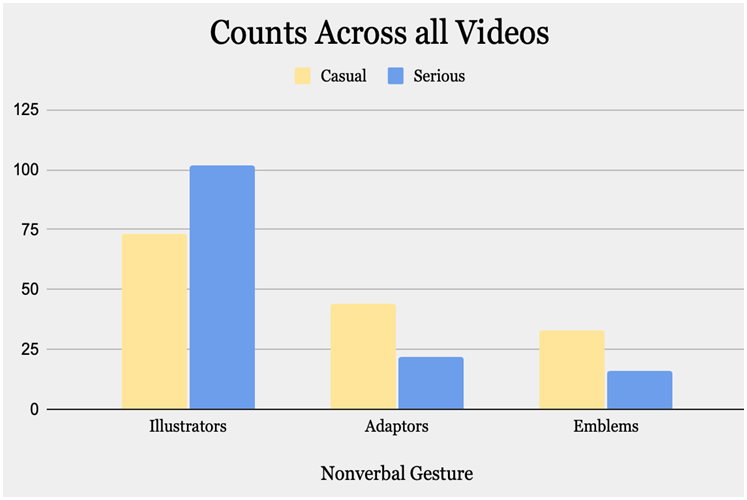
Scroll to Top