“Yeah” “Mhmm” “Right”: A gendered study on supportive overlap among a group of UCLA friends

Yasmine Choroomi

Have you ever heard people use words like “yeah”, “mhmm”, or “right” while you’re speaking to them in a conversation? This method of cooperative communication is called supportive overlap in linguistics and can be presented undetected in mundane conversations. Although such an interaction can take place in less than a second of conversation and is sometimes overlooked, it can be used to compare interactions between groups of people. I transcribed conversations between a group of friends at UCLA that consisted of two men and two women to see if we could find a gendered difference in their use of supportive overlap, or if this difference was due to another factor like relationships. I was curious as to whether differences in participants’ gender, or another factor such as their relationship to each other or even the type of conversation they are engaging in, affects their use of supportive overlap in a conversation.

[expander_maker id=”1″ more=”Read more” less=”Read less”]

Introduction: What are we studying?

Methods of cooperative communication are present in daily conversations and can be utilized to discuss linguistic differences in groups of people. It includes interjections such as “yeah”, “uh-huh”, and “okay” during a conversation not for the user to take over the conversation, but rather to show support (Tannen 1995). This concept is different from the traditional interruption, which requires the interrupter to talk over a speaker with the intention of terminating their turn speaking (Tannen 1994). The use of supportive overlap has cultural variations as well, as its use was detected more on the island of Antigua than a larger country like England (Tannen 1995). This device was also examined among a group of coworkers at lunch, and White 2003 noted that it was a common linguistic device used in enthusiastic conversation. One of the only studies that examined this supportive overlap in a gendered context is Coates (2003), who looked at the use of overlap among a group of women to determine it’s highly utilized in conversations between women. While previous literature looks at the presence of overlap in a variety of contexts, there remains a content gap regarding its appearance among a group of friends consisting of both genders. The following study serves to examine the relationship between supportive overlap and gender while simultaneously accounting for alternative factors such as conversation type and relationship. Supportive overlap is used primarily among women among a group of friends in order to show support during vulnerable parts of conversations while simultaneously portraying them as a supportive person.

Methods: How to Count the Uncountable

To probe the topic of gendered supportive overlap I audio recorded a group of friends with the same major at UCLA discussing three topics. The group is composed of two men and two women to observe if the difference is overlap is due to gender. I accounted for other variables that could explain the data outside gender, so the group consists of a couple as well.
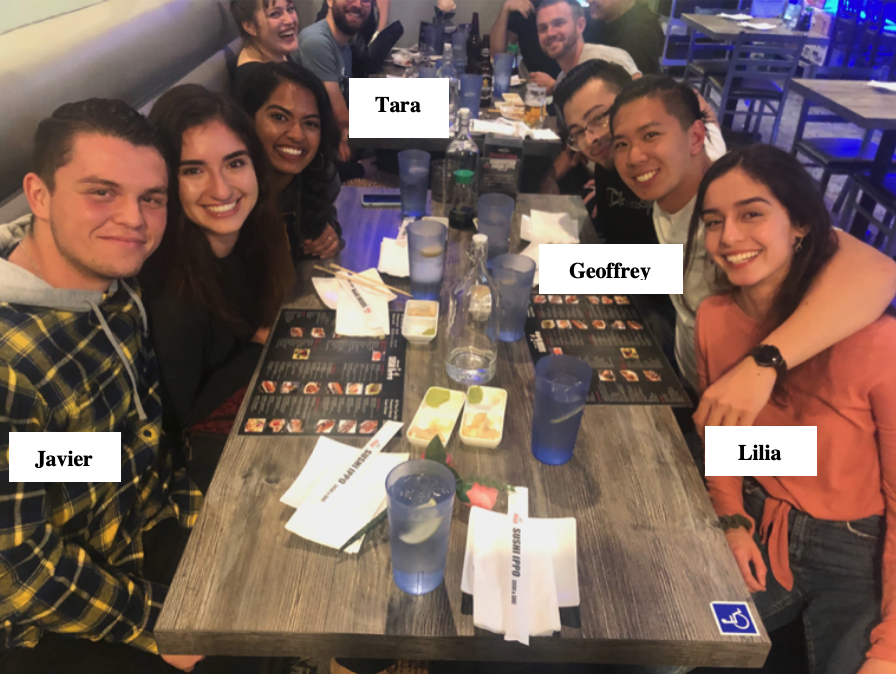
Figure 1: Participants involved (and labeled below)

I wanted to see if the familiarity within the group rather than gender accounts for this linguistic difference in speech. The group thus consists of a group of friends: Javier (male), Geoffrey (male), Tara (female), and Lilia (female). Javier and Lilia are a couple, while the rest of the group are all friends with each other.

Figure 2: UCLA’s campus where study was held

I created three situations for the group to discuss: a neutral case, a case more commonly discussed among men, and one among women. The neutral or control topic is one they are all comfortable with: physiology. The following conversation involves controversy in the makeup world, which tends to be a female dominated industry. The final conversation involves controversy among weightlifters, which tends to be a male-dominated discussion and more prevalent among their daily conversations than women. The CDC notes that only 20% of American college woman meet the strength training recommendations while 37% of college men do (CDC). The three questions were constructed as follows: 1. What is the hardest physiology class you have taken?, 2. You are weightlifting at the gym and see someone with incorrect form: what do you do?, 3. Do you think makeup is necessary in the workplace to appear presentable and why?

I collected both qualitative and quantitative data regarding supportive overlap from 6 minutes of each conversation. I counted the number of supportive overlaps based on Tannen’s definition used by each individual in terms of both their gender and relationships and transcribed the data.

Qualitative Analysis: Who Said What

The first case involves opinions on the hardest physiology class at UCLA. Prior to this interaction, Tara had already elicited that she believed the hardest physiology class at UCLA was Physiological Sciences 111A, while Lilia selected a different class entirely.
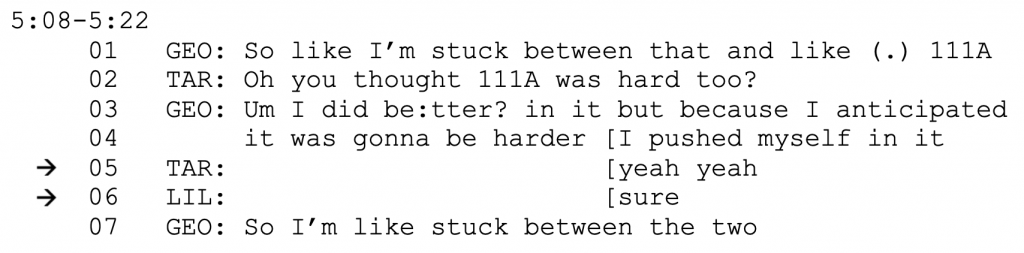
This case differs from the rest because it shows two women overlapping the speaker. Geoffrey shows a face-threatening act in lines 3 and 4 by explaining a class traditionally found difficult was easier for him, which can appear as bragging. We see his discomfort with the use of uptalk and elongation of the word “better”. Both Tara and Lilia overlap him with positive words to reassure him and show that his social standing is not in question.

The next case examines a conversation about makeup. This conversation arose when they reached a disagreement about the necessity of makeup in the workplace. The following interaction shows Tara’s explanation as to when she chooses to wear makeup.
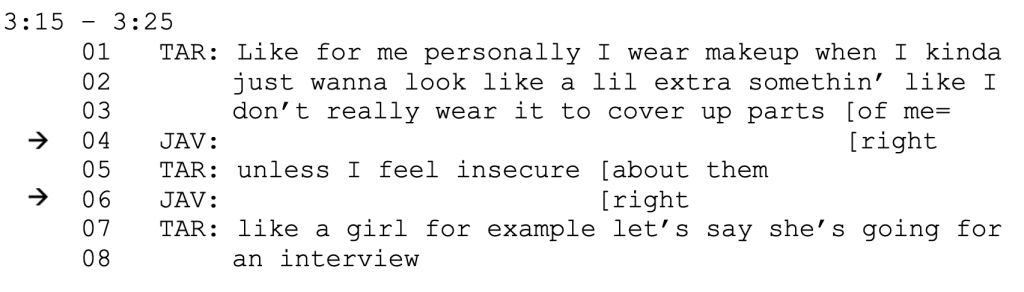
Tara’s anecdote was used to illustrate her experiences, which are not ones shared by Javier. She expresses vulnerability and thus a face-threatening act by discussing why she wears makeup. In lines 3 and 5, she explains how some wear makeup to “cover up parts” or when “[she] feel[s] insecure”. As a result, Javier says “right” in both lines 4 and 6 immediately following Tara’s displays of vulnerability to illustrate his support for his friend. Tara never previously showed hesitation in her speech, so the use of overlap shows attentiveness and encouragement. Additionally, the use of “right” rather than “sure” and “yeah” carries stronger weight and allows Javier to help alleviate the vulnerability displayed.

Quantitative Analysis: Tallying Up the Overlaps

Table 1: Overlap analyzed by gender: Table illustrates the numerical amount of overlap initiated in each conversation compared to who they were overlapping (the receiver) by gender.

In the first two conversations, women appeared to initiate more overlap and especially toward men (Table 1). In the third conversation, this trend seems to somewhat dampen. A possible explanation could be explained by the men’s lack of topic familiarity and desire to show support for their female friends. It can also be explained because by the end of the study, Lilia was less talkative due to pulling an all-nighter the evening before.

Table 2: Overlap analyzed by relationship: Table illustrates the numerical amount of overlap in each conversation within a couple versus between friends.

When analyzing the data in the context of a relationship, I found little to no overlap within a couple. One possible is the unnecessary need for the couple to use linguistic devices like overlap to show their support and attentiveness toward each other.

 Discussion: So what does this all mean?

Conversational analysis among UCLA friends offers evidence of some gendered and relationship difference in the use of supportive overlap during three controversial conversations. Upon further analysis of their conversations, supportive overlap is used to not only show support in a conversation but also to provide assurance during a vulnerable conversation or face-threatening act. Quantitative analysis of the data shows that in 2/3 conversations, women utilized supportive overlap far more than their male counterparts. When rearranging the data based on individuals’ relationship to each other, there is significantly more overlap between friends rather than the couple. While no previous data on such interactions occur, I believe further research on this topic could prove worthwhile.

So what can this all mean? In Ochs & Taylor (1995), we see that the stereotype that women are the more supportive gender was perpetuated by the use of introductions by mothers in dinnertime conversation. Although this study does not look at the use of introduction, this stereotype of women being the more supportive gender is also illustrated in the context of this group of friends in a similar manner, but through the use of cooperative overlap.

I propose more extensive future study to probe the gendered use of supportive overlap in the context of multiple variables.


References

Centers for Disease Control and Prevention. (n.d.). Retrieved from https://www.cdc.gov/nchs/data/nhis/earlyrelease/earlyrelease201212_07.pdf

Coates, J. (2003). Women Talk: Conversations Between Women Friends, London, Blackwell Publishers, 1996, 324 p. Clio, (11). doi: 10.4000/clio.228

Ochs, E & Taylor, C. (1995). The “Father Knows Best” Dynamic in Dinnertime Narrative.

Tannen, Deborah (1994). The relativity of linguistic strategies: rethinking power and solidarity in gender and dominance. In Gender and Discourse, ed. by Deborah Tannen, 19-52. Oxford University.

Tannen, D. (1995). Conversational style: analyzing talk among friends. Norwood, NJ: Ablex.

White, A. (2003). Women’s usage of specific linguistic functions in the context of casual conversation: analysis and discussion. University of Birminghan.


[/expander_maker]
A Contrastive Study of Greetings

Estonian, Russian Estonian and Anglo-American Politeness Strategies

Daria Bahtina, unpublished MA thesis

The notion of politeness has attracted extensive attention in the last decades. Theoreticians analyze various instances of communicative acts and create sophisticated networks in order to reveal the norms that govern human behavior. The concepts are constructed and later used to talk about everyday communication, which might be dangerous due to the fact that theory and practice, though similar in essence, might discuss same notions using different terminologies. This paper is aimed at finding greeting tendencies in a given society concentrating on both theory and its practical realizations. The subject of investigation is the greeting behavior among Estonian- and Russian-dominant speakers in Estonia. This specific group received little attention and the findings are believed to be useful for understanding the nature of politeness in this particular culture.

The research concentrates on greeting patterns recorded in the Tartu University Library. The main hypothesis is that Estonians are apt to omit greetings in situations when the vocative, or attention-getting, function of politeness is missing (the other function being politeness-expressing). Another hypothesis is derived from the statement that Estonians generally greet less than Anglo-Americans and Russians. Next, it is also hypothesized that Russian Estonians greet more often than authentic Estonians. To test that, the first part of the study is conducted in the form of participant observation. Finally, the hypothesis is set up that in actual interaction people tend to use fewer politeness strategies than they deem polite in externally evaluating the same situations presented to them. The experiment designed for this hypothesis is a body of evaluations collected from ordinary language users where they display not the expressive, but the categorizing form of politeness.

READ FULL MA THESIS HERE 

Complimenting Behavior among Speakers of English and Russian

Cross-Cultural Study of Politeness Strategies

Daria Bahtina, unpublished BA thesis

Human communication faces numerous inaccuracies and misunderstandings due to divergences between different systems. The origin might lie in the fact that the representatives of the groups belong to divergent discourse systems. It is not difficult to imagine why there might be tensions between people with Western and Eastern cultural backgrounds, seniors and juniors, men and women, superiors and subordinates.

The aim of the study is to investigate complimenting as one of the aspects reflecting strategies that vary culturally. According to anecdotal evidence, some groups of people give compliments generously as flattery, whilst others are reluctant to word even praise. This study will attempt to find out why this should be the case by comparing Americans, British and Russians. The aim of the study is to analyze complimenting behavior from a particular point of view, namely in the superior-subordinate situation.

The first part of the work introduces the main theoretical concepts pertinent to the study and gives a general overview of politeness strategies that are believed to be true more or less universally. In this, the study draws mainly from the works by Scollon and Scollon (1995) and Brown and Levinson (1987).

The following part is a comparison between the relevant cultures outlined through a discussion of works by the researchers who deal with American, British and Russian politeness behaviors. Finally, the analysis based on theory and a survey conducted by the author is presented in order to reveal the actual situation and contemporary shifting tendencies.

The originality of the study lies in the fact that previous research in the field of comparing these particular cultures in respect to their complimenting behavior is scanty and insufficient. On the basis of these factors this work might be presented as an attempt to raise the issue that should be dealt with more thoroughly.

FULL BA THESIS HERE

A Digital Take on Modern Model Minority: Not So Subtle Asian Traits

Subin Kim, Jihee Choi, Fiona Dai, Chris Ngo

This study investigates social implications of Asian Americans being stereotyped as a model minority. The notion of the model minority basically highlights only positive aspects and successes of a group, while ignoring or downplaying the negative aspects and characteristics. Many Asian Americans have been preconceived as “nerdy” which fits the stereotype of the model minority. To be more specific to this topic, we examined how the idea of the model minority is actually used in Asian Americans’ daily life through the most popular medium of social interaction among adolescents and young adults nowadays– social media. Based on the purpose for this study, data was collected from a Facebook group called Subtle Asian Traits which has more than 1.6 million members and is shared with diverse posts of the discourse styles mostly related to Asian cultures. The posts were then analyzed for content involving the concept of model minority, and divided into two categories. Between the two groups are those fitting the stereotype of model minority, and those in which involve school de-emphasis content and African American Vernacular English (AAVE) slang. Through analyzing this study, the model minority was considered to connect with positive outcomes and reduce some negative effects of discrimination.

[expander_maker id=”1″ more=”Read more” less=”Read less”]

Introduction

Society tends to categorize people based on certain traits and characteristics. These traits are shaped by an individual’s own background through ethnicity, culture, gender, and upbringing. Although most people know that individuals are varied in personality and traits, they tend to have preconceived notions about groups of people due to these categorizations, or stereotypes. Stereotype experiences are often associated with negative discrimination due to their conceptual overlap. However, we want to differentiate the two ideas in this study since previous research has found positive effects of certain stereotypes (Kiang, Witkow, and Thompson, 2015) and therefore stereotypes can be examined with or without negative discrimination. To further distinguish these two concepts, we will define negative discrimination as “biased actions or behaviors toward an individual due to his or her group membership” that are typically adverse based on Fishbein’s study on “Peer Prejudice and discrimination” (1996). Many studies in recent years have demonstrated the efficiency function of stereotypes which reduces one’s cognitive load (Sherman & Frost, 2000). That is, when one is dealing with cognitively demanding duty, such as multitasking, one can rely on stereotypes to save processing capacity and thus increase working efficiency.

We will focus on this stereotype often associated with Asians, the model minority image of Asians as diligent overachievers in this paper. The model minority image was formally identified over a half century ago (Peterson, 1966), and it still persists in social environment today. According to Poon, Squire, Kodama, Byrd, Chan, Manzano, Furr, and Bishundat (2015), the model minority is “a monolithically hardworking racial group whose high achievement undercuts claims of systemic racism made by other racially minoritized populations”. The idea of the model minority highlights the successes of the group, while ignoring or down playing the negative aspects and characteristics. In this specific case, Asians are typically seen as a “good” minority that succeeds and are considered “honorary whites”. It also lends itself regarding racism against Asians becoming normalized due to the fact that the traits of Asian stereotypes are considered desirable. Prior study has suggested that the model minority image of Asians could provoke unfair treatment from peers in the form of negative discrimination (Niwa, Way, & Hughes, 2014).

Due to model minority status highlighting academic success, Kiang et al. have examined the developmental implications of being stereotyped as model minority in Asian American adolescents (2015). The time period from adolescence to early adulthood is worth investigating because one goes through ethnic exploration and identity formation within this time frame and later become stable. Moreover, research has shown that over 99% of Asian adolescents have had at least one in which they perceived as being stereotyped as a model minority (Thompson & Kiang, 2010). Kiang et al. (2015) have measured perceived stereotypes and negative discrimination using self-report surveys, but no study has yet examined perceived model minority through the most popular medium of social interaction among adolescents and young adults nowadays ­– Facebook.

In this paper, we aim to investigate the implications behind Asian adolescents and young adults’ stereotypes and ethnic-based social interaction on social media by virtue of analyzing the model minority concept related posts on the Facebook group called Subtle Asian Traits. Kiang et al., (2015) have found that the model minority experience is connected to positive outcomes and can reduce some of the negative effects of discrimination on academic adjustment through the quantitative method. We will qualitatively test whether their findings still hold true in social media.

Background

We primarily collected data for this study on a Facebook group called Subtle Asian Traits. Facebook is one of the most widely used social networking services in the U.S. Facebook may be used to facilitate new relationships and maintain existing relationships according to Ellison, Steinfield, and Lampe’s study on Facebook “friends” (2007). Similarly, Facebook can be a great tool for groups with common characteristics to express their respective identities. For the same reason, a group of high school students who share the same ethnic identities–Asian Australians–formed the Subtle Asian Traits Facebook group one year ago with the intention of creating a platform for English speaking Asians to exchange their shared cultural experiences.

We wish to investigate the discourse style the population uses in the Facebook group. It has more than 1.6 million members and contains memes–humorous images, videos, microtexts, etc.–that are mostly related to Asian culture. In the group, the largest population was Chinese, followed by Vietnamese, Filipinos, Koreans and Taiwanese. In addition, the group is made of people from all Asian countries. This is including, but not limited to: Malaysia, Japan, Indonesia, Cambodia, Thailand and Hong Kong. The group’s population tend to be from a variety of places, but is mostly composed of Westernized Asians.

The stereotypes that people usually have for Asians is that they portray positive characteristics such as being nerdy and intelligent; however, every group or ethnicity cannot be defined by the same features or characteristics. Therefore, Asians cannot be considered that they conform to a “nerdy” and successful stereotypes. To break this discrimination, we will discuss how the newer generation of English speaking Asians are diverging from the model minority stereotype by creating a counter culture that tends to appropriate African American vernacular English (AAVE). According to the journal “Appropriation of African American slang by Asian American youth”, the author explains that non-African Americans have followed and imitated African American black culture and slang. It is shown that one’s identity is identified by the language and slang that he or she uses, not discriminated by race. Likewise, the group such as the Subtle Asian Trait were created to humorously refine negative images and change stereotypes.

Project Design

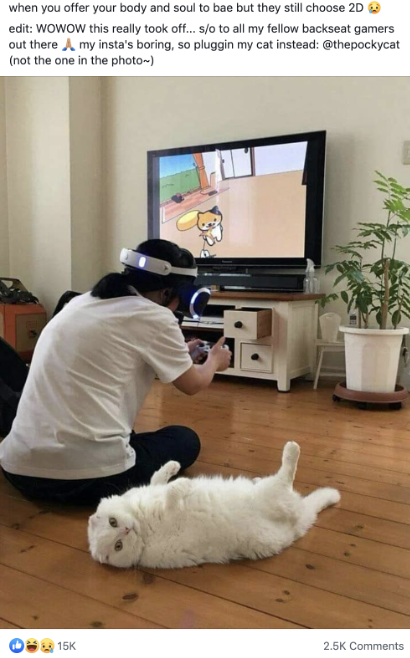
The data sample in this study consisted of fifty-six posts from the Subtle Asian Traits Facebook group. We first chose two categories of keywords: 1) academic related such as “study,” “exams”, and 2) AAVE slang, e.g., Finna, Bae, Plug, Finesse. Then we manually selected thirty posts for the academic related category and twenty-six posts for the AAVE category. Furthermore, because the average “likes”– a characteristic of the posts occurred from members’ agreement with the post within this Facebook group–was 1,000 to 2,500, we decided to only include those posts that had over 2,000 “likes” so that the posts we selected were able to represent what was popular in this 1.6 million member Facebook group.

Figure1: an example of a post from the Subtle Asian Traits Facebook group.

Results

The results for our data were divided into two groups. One group showed a tendency to match the characteristics of the model minority. The other group did not fit this mold, but instead showed signs of attempting to break free from it.

In one group, English-speaking Asians express difficulties and hardship about getting stressed when they study. They showed more empathy for their difficulties when involving Asian social content such as Doraemon, Soju, and Bangtan Boys. Some data is still focused on exam and studying, which shows doing well on exams is a popular topic within the group. In the other group, English-speaking Asians attempted to change stereotypes by emulating black culture and AAVE slang. One of the data showed empathy for a new culture using AAVE words such as ‘peeps’ and ‘twerking’. Furthermore, for example, people used AAVE ‘sup’ combing their language ‘wo’ which means ‘I’, so they could make AAVE word ‘wassup’ with their own meaning that ‘say hello to myself’. They tended to be more interested in content regarding partying and general school de-emphasis items. This stands in contrast to the current perception of the Asian model minority of nerdy, submissive, and rule abiding. Overall, our data showed that some of English-speaking Asians stuck to the concept of model minority, but the other tried to change and deviate their stereotypes.

Discussion and Conclusions

The results showed primarily two different distinct groups within Subtle Asian Traits. While these groups have some overlap, there is a significant voice and content difference. Our hypothesis mainly discussed only one of these groups, those conforming to the modern model minority stereotype. Within our research, however, we did encounter this counter group that seeks to diverge from previous notions thought about Asians. This split can be attributed to those forming groups based on shared stereotype-based interactions, and also those seeking to separate from previous ideals and instead relating to other ethnic groups.

For those breaking from the idea of the model minority, it can be seen that many seek identity within other minority groups. A previous study has shown that Asians borrowing AAVE slang terms are often an attempt to be the “Other Asian” and rely on stereotypes of other racial groups to construct an identity of their own (Reyes, 2005). This “Other Asian” changes the view of the Asian model minority and shifts the focus to a new perspective. The model minority is often a binary view that many individuals in this group find themselves forcibly conforming to. Rather than using AAVE to “act black” or as a different race, it can be argued that this new group uses slang to create their own identify, separate from any previous groups. While fashioning a new identity, however, those in this new subgroup can still visibly benefit from the positive outcomes of the model minority.

A previous study has shown that the effect of discrimination on Asian American adults’ distress varied depending on social context and the environment’s ethnic density (Syed & Juan, 2012). However, with the emergence of social media, such as Facebook and the prevalent usage of such platform among adolescents and young adults, we argue that the distress can be attenuated by sharing similar stereotyped-based social experience with each other on social media and thus creating a in-group sentiment. Additionally, Kiang et al. (2015) has suggested potential differences among Asians who reside in traditional settlement areas, such as Los Angeles or New York City, that have a long history of immigration and non-traditional ones that are emerging immigrant communities. Through the increasing popularity of social media usage, we believe that the regional differences will be diminished.

The model minority related posts have shown a system of camaraderie amongst the group users on Subtle Asian traits. As stated before, the model minority experience is oftentimes connected with positive outcomes and can actually reduce some of the negative effects of discrimination. Through the posts analyzed, the in-group sentiments created have shown a positive impact in which members relate to academically based posts. The posts show positive reinforcement towards the idea of high academic achievement, while also maintaining the positive aspects of the model minority stereotype.

Two new forms of Asian identity have emerged as a result of new age model minority. The two orientations have allowed for Asian youth and young adults to connect and establish new identities, while participating in their own new form of subculture. As it takes a discourse approach, social media allows for more analysis on the creation of new identities and formations of previous stereotypes and groups.


References

Ellison, N. B., Steinfield, C., & Lampe, C. (2007). The benefits of Facebook ‘‘friends’’: Social capital and college students’ use of online social network sites. Journal of Computer-Mediated Communication, 12(4), 2–3. Retrieved 24.11.19 from http://jcmc.indiana.edu/vol12/issue4/ellison.html

Fishbein, H. D. (1996). Peer prejudice and discrimination: Evolutionary, cultural, and     developmental dynamics. Boulder, CO: Westview Press.

Kiang, L., Witkow, M.R. & Thompson, T.L. J Youth Adolescence (2016) 45: 1366. https://doi.org/10.1007/s10964-015-0336-7

Niwa, E. Y., Way, N., & Hughes, D. L. (2014). Trajectories of ethnic– racial discrimination among ethnically diverse early adolescents: Associations with psychological and social adjustment. Child Development, 85, 2339–2354. doi:10.1111/cdev.12310.

Peterson, W. (1966). Success story: Japanese-American style. New York Times Magazine, 9, 20–43.

Poon, OiYan; Squire, Dian; Kodama, Corinne; Byrd, Ajani; Chan, Jason; Manzano, Lester; Furr, Sara; Bishundat, Devita (June 2016). “A Critical Review of the Model Minority Myth in Selected Literature on Asian Americans and Pacific Islanders in Higher Education”. Review of Educational Research. 86 (2): 469–502. doi:10.3102/0034654315612205. ISSN 0034-6543.

Reyes, A. (2005), Appropriation of African American slang by Asian American youth1. Journal of Sociolinguistics, 9: 509-532. doi:10.1111/j.1360-6441.2005.00304.x

Sherman, J. W., & Frost, L. A. (2000). On the Encoding of Stereotype-Relevant Information Under Cognitive Load. Personality and Social Psychology Bulletin, 26(1), 26–34. https://doi.org/10.1177/0146167200261003

Syed, M., & Juan, M. J. D. (2012). Discrimination and psychological distress: Examining the moderating role of social context in a nationally representative sample of Asian American adults. Asian American Journal of Psychology, 3, 104–120. doi:10. 1037/a0025275.

Thompson, T. L., & Kiang, L. (2010). The model minority stereotype: Adolescent experiences and links with adjustment. Asian American Journal of Psychology, 1(2), 119–128. doi:10.1037/a0019966.

[/expander_maker]
, ,

Emojis: The 21st Century’s Universal Form of Digital Communication

Elisha Daria, Julia Jacoby, Jocelyn Martinez

Since their inception in 1999, emojis have become essential to how we communicate. Utilizing the iconographetic communication model devised by Christina Margrit Siever (2019), our group wanted to examine and compare how people use emojis within a public sphere, such as Instagram or Twitter, versus a private one, such as SMS. We hypothesized that emojis used in a more public sphere would have a much more structured approach with primarily decorative or aesthetic purposes as a means of marketing a distinct online persona; for more private spheres, we hypothesized that emoji usage would be a lot more broad and relaxed, with more frequent usage overall and less standard forms or unspoken usage rules. Drawing our data from 48 high-school to college-aged individuals from Generation Z, we used a mixed methods approach in measuring intra-user variation from platform to platform. In doing so, we analyzed emoji frequency and usage patterns, and were able to see distinct differences in the ways in which our demographic used emojis to communicate. Our findings indicated that there was indeed an intra-user difference in emoji usage in public versus private spheres, but the ways in which these differences manifested came down to personal preference from user to user.

[expander_maker id=”1″ more=”Read more” less=”Read less”]

An Introduction to Our Study

In an increasingly digital world where technological literacy has become a necessary skill, emojis have become an invaluable aspect of digital communication in the twenty-first century. This study seeks to understand the ways in which we use emojis in the context of iconographetic communication in our day-to-day lives (Siever, 2019). From one-on-one conversations with a close friend via text, to an open-ended public conversation initiated by a single Tweet, our team wanted to measure and observe intra-user variation in public versus private spheres. In doing so, we hoped to see the motivations, methods, and reasoning behind the use—or omission—of specific kinds of emojis in daily digital interactions. These practices are especially prevalent in individuals born from the years of 1995 to 2009, known as Generation Z. These individuals have grown up in the age of the smartphone, and play a crucial role in the dynamic nature of online trends. In analyzing high-school to college-aged Gen Z social media users, we hoped to get a look into the linguistic influences of the demographic at the forefront of digital branding.

A particularly interesting element of more public platforms such as Instagram and Twitter is the way in which the user is forced to find a balance between achieving mass appeal and maintaining some semblance of individuality and authentic self-expression. This results in versatile social media users who are skilled at accommodation to a wide audience while also creating and presenting a distinct online persona. By comparing and contrasting the patterns in emoji frequency and usage between platforms, we wanted to see how a public or private audience ultimately impacted the speaker’s choices. As the first study of its kind, we hoped to gain insight into the unspoken common practices that govern digital communication.

Understanding Iconographetic Communication & Gen Z

Utilizing the term coined by Christina Margrit Siever, we focused our study on instances of iconographetic communication (2019) among high school to college-aged social media users of Gen Z; in doing so, we were hoping to find trends in the digital communication practices of this demographic. On average, each member of Generation Z is exposed to thirteen hours of media a day, producing individuals who are “highly creative, constantly adaptive, and have a highly marketable digital mindset” (Vitalar, 2019). In tracing these users’ patterns of usage across SMS, Instagram, and Twitter, we were expecting to see some form of intra-speaker variation, with emojis used as sociolinguistic markers (Van Herk, 2018, p. 54, 120). This means that each individual would use emojis differently from platform to platform, subtly tailoring their specific iconographetic communication methods to fit their public or private sphere. Examples would include the use of certain prestige forms or targeted rhetoric, as well as the use of emojis for stylistics and aesthetics to create and promote a specific brand. Studies have shown that social media influencers use emojis as a means of adding appeal, enhancing and amplifying persuasive content, and encapsulating emotional appeals through marketing rhetoric (Ge & Gretzel, 2018). Tactics such as these are key for maintaining user engagement, which is an integral part of the social media experience for regular users as well.

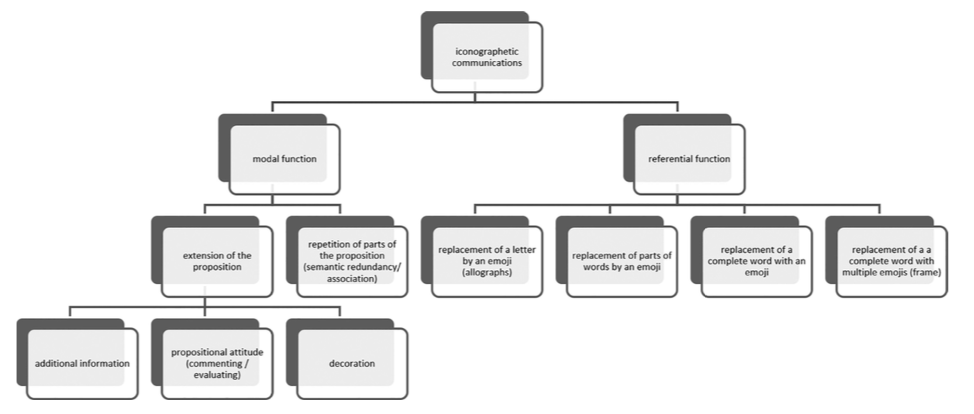
Siever’s iconographetic communication model was crucial to this study because it gave us a framework for viewing the ways in which emojis are used in communication. With “icono” derived from the Greek for “image” and “graphic” derived from the Greek for “writing,” iconographetic is a catch-all term that combines pictoral and typed characters and gives context to the unique linguistic function of emojis as typed images that convey sentiments worth a thousand words. Figure 1 shows Siever’s model in its entirety, with iconographetic communication branching into its modal and referential functions. The modal function describes an emoji’s ability to complement and modify written messages, while the referential function is used when an emoji replaces words or parts of words as an extension of the linguistic proposition (Siever, 2019, p. 130, 137). When coming up with our digital survey, we tailored our questions to fit either the modal or referential function, and also used this model in analyzing actual texts, Instagram posts, and Tweets submitted by one of our participants.

Figure 1. Functions of emoji in iconographetic communications (Siever, 2019, p.144)

How We Conducted Our Study

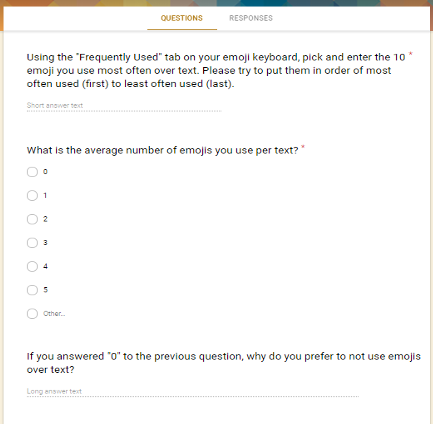
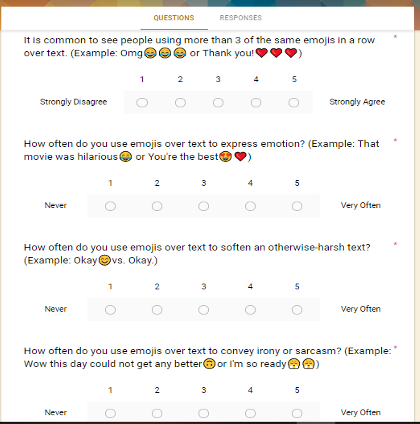
To conduct this research, our team used a mixed methods approach by collecting and analyzing both quantitative and qualitative data. We began our data collection by sending out a Google survey to forty-eight participants between the ages of fourteen and twenty-four. The survey consisted of three sets of questions regarding personal emoji usage within text messaging, Instagram, and Twitter. All participants were required to answer the text messaging portion first, then could choose to take either the Instagram or Twitter section—or both—depending on their personal usage habits. As seen on the right in Figure 2, our quantitative data was drawn from Likert scale questions on a scale from 1 to 5 (Likert, 1932, p.17), allowing us to create visualizations such as graphs and charts that helped us recognize emoji usage patterns. For qualitative data, we included short answer questions, as seen in the “short answer text” options of  Figure 2, allowing for individualized feedback. We then analyzed the information we received from these qualitative responses to pick out the themes and patterns we found amongst our participants. Utilizing Siever’s iconographetic communication model (2019), we analyzed both types of data with the objective of finding the differences in the way people use emojis to communicate meaning across different digital platforms.

Figure 2. Screenshots of our Google survey with qualitative and quantitative questions.

What We Found

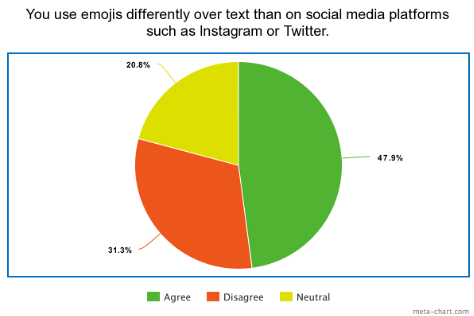
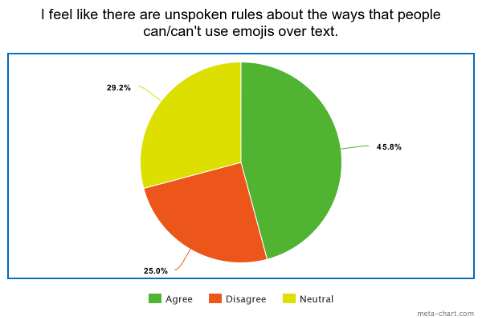
Figure 3. Survey responses about emoji use and unspoken rules over text messaging.

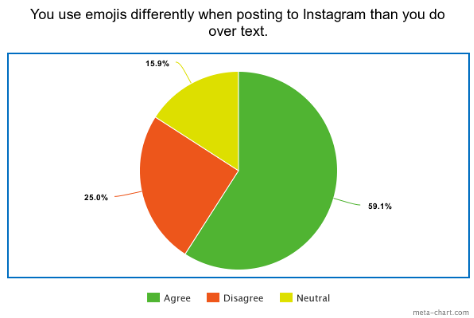
Taking a look at the results of the survey, the data showed that the majority of participants agreed that they use emojis differently in when texting versus social media (Figure 3). One person said, “On social media I try to keep it more trim and professional, to an extent, whereas with texting I’m more casual, so I use more emojis.” The majority also agreed that there were some unspoken rules about how emojis should be used within text messaging. When asked what some of those rules might be, another person said “Using emojis to convey tone of voice or mood of the conversation (e.g., hey 👋 vs. hey 😏).” Further proving our hypothesis specific to text messaging habits, we saw that a total of 81.3% of participants use 1 or more emojis per text, 79.5% per Instagram post, and 70% per tweet on average. This proves our hypothesis that private platforms have more frequent usage than public ones.

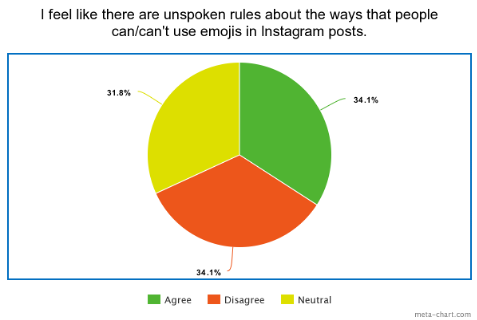
Figure 4. Survey responses about emoji use and unspoken rules over Instagram.

As for the social media portion, users of Instagram and Twitter agreed once again that their emoji use differed compared to texting (Figures 4 and 5). Some of the Instagram respondents said: “I use emojis mainly for aesthetic purposes for Instagram” and “You’re more conscious of how everyone else will perceive what you post instead of just one person.” About one third of respondents agreed on the existence of rules for using emojis in Instagram captions. Responses about unspoken rules varied and were dependent on each individual’s personal preference and self-expression.

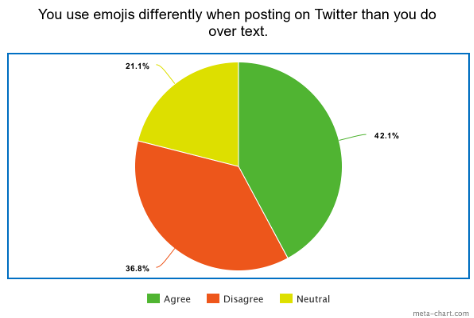
Figure 5. Survey responses about emoji use and unspoken rules over Twitter.

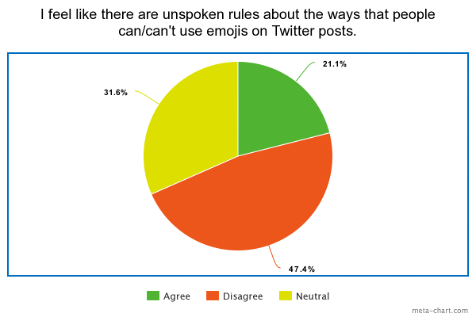
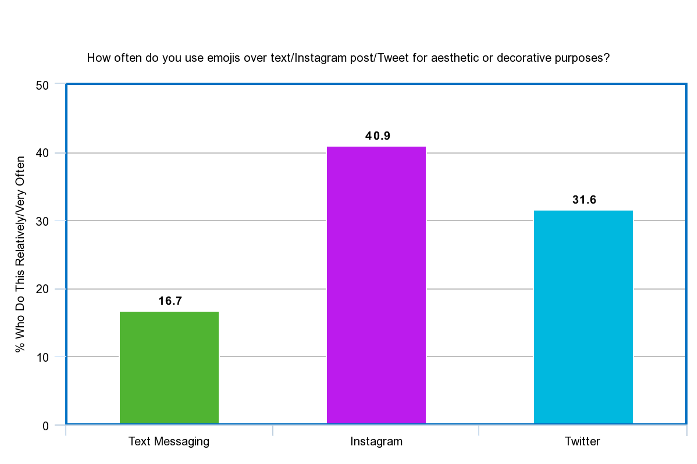
Similarly, many Twitter participants claimed to use emojis differently because within this platform, more people would be seeing their Tweets. However, almost half of the respondents did not believe there are unspoken rules for emoji usage within this platform (Figure 5). This may be due to the lack of respondents to the Twitter portion of the survey, which could have skewed our data. Nonetheless, this supports our idea that there is more structure and hidden rules to emoji usages within private communication than there is within public communication. Our hypothesis about aesthetic and decorative usage in public spheres was also proven correct. As seen in Figure 6, only 16.7% of participants said that they use decorative emojis in their texts, while Instagram and Twitter users use decorative emojis nearly twice as much (40.9% and 31.6%, respectively).

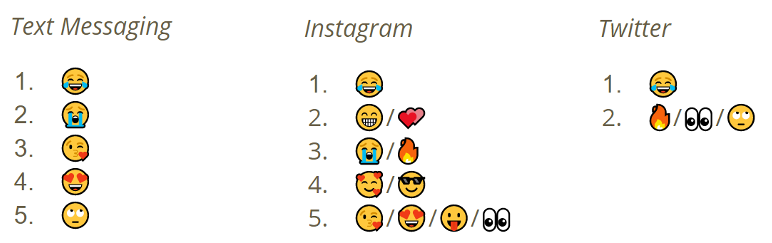
Figure 6. Survey responses regarding aesthetic/decorative use of emojis.To see which emojis are most common, we asked participants to list up to 10 of their most frequently used emojis. The laughing/crying emoji held the #1 spot across all three, but the rest of the rankings varied (Figure 7). This leads us to believe that the laughing/crying emoji expresses universal sentiments that are socially acceptable across all platforms, both public and private. Interestingly, the sideways glancing eyes emoji and fire emoji appeared in both Instagram and Twitter data, but not in the text messaging data. This implies the existence of standard forms for public platforms to express emotions specific to Twitter/Instagram culture.

Figure 7. Most frequently used emojis per platform.

This might have something to do with meme culture specifically, as these memes are often used to express sarcasm or a certain aesthetic online.

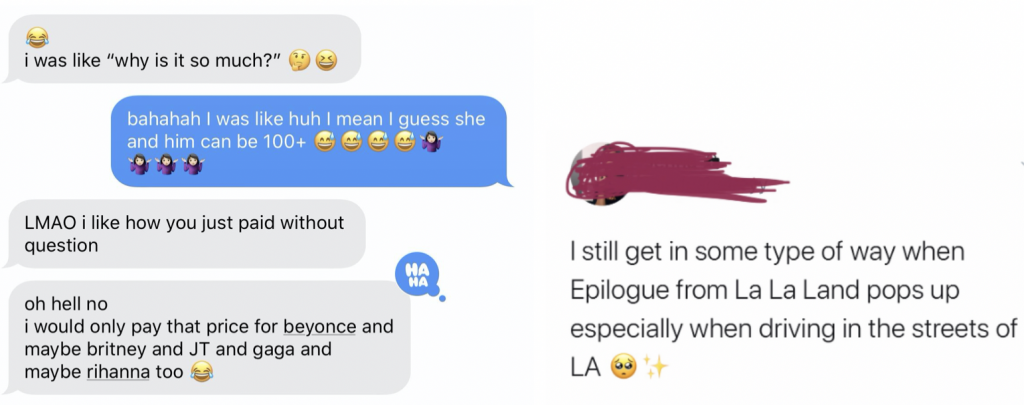
Figure 8. Left: Text containing example of propositional attitude. Right: Tweet containing example of decorative function.

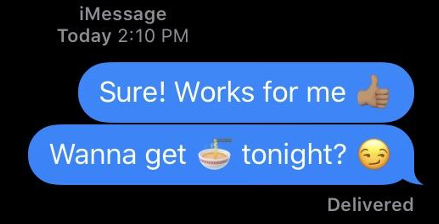
Lastly, we asked one participant who uses Twitter, Instagram, and text to provide us with screenshots of her personal emoji usage. We took these and compared each example of emoji use with the functions on Siever’s model (Figure 1). On the left of Figure 8, the emojis convey emotion to complement the content of her text. This is likely propositional attitude under modal function because the emojis add comment and evaluation to her stat‍ement. Also in Figure 8, ✨ is used to add aesthetic/decoration to text (modal function). Figure 9 shows an example of the much less common referential function, where an emoji takes the place of an entire part. Here, 🍜 replaces the word “ramen” in the sentence.

Figure 9: Text containing example of referential function.

Overall

The results from our survey support our hypothesis partially. The findings demonstrate that there is a difference in emoji usage between public and private forms of communication, as we had originally predicted. However, we found that there are more unspoken rules and structure with the usage of emojis when they are being used through private communication such as text messaging. We believe this is because the personal nature of text messages makes the user feel pressured to put more thought into the messages their emojis might send. Interestingly, our participants also indicated that they are more comfortable using emojis through text messages since they are not out for the whole world to see; this explains the higher frequency of emoji usage through text. Therefore, it appears that users are more comfortable using more emojis over text once they make sure they are using them in a way that ensures their message will be construed correctly. In contrast, on more public platforms, users choose to use more general emojis for descriptive or aesthetic purposes, with less frequent usage overall.


References

Bell, A. (1984). Language style as audience design. Language in Society, 13(2), 145–204.

Ge, J., & Gretzel, U. (2018). Emoji rhetoric: a social media influencer perspective. Journal of Marketing Management, 34(15-16), 1272–1295.

Herk, G. V. (2018). What is sociolinguistics? Hoboken, NJ: John Wiley & Sons, Inc.

Likert, R. (1932). A technique for the measurement of attitudes. Archives of Psychology, 22(140), 5–55.

Siever, C. M. (2019). ‘Iconographetic Communication’ in Digital Media. Emoticons, Kaomoji, and Emoji, 127–147.

Vitelar, A. (2019). Like Me: Generation Z and the Use of Social Media for Personal Branding. Management Dynamics in the Knowledge Economy, 7(2), 257–268. doi: 10.25019/MDKE/7.2.07

[/expander_maker]
Love Language: A Sociolinguistic Study on Bilingual Couples Talk

Yiran Li, Ekeme Ekanem, Mary Youngblood, and Nguyenova Dieu Anh – Shelly

Code-switching, where more than one language is integrated into speech, is extremely common amongst bilingual and multilingual speakers. Unfortunately, code-switching is often viewed by society as lazy or unintelligent, creating a negative stigma around speakers of non-standard language, which are often minority groups. This research analyzes the functions and contexts in which bilingual couples code-switch, focusing on the effects, if any, of their language backgrounds. To study this, we gathered data from 90-Day Fiance, a reality show centered around long-distance relationships. We looked at confrontational discussions to find instances of code-switching, comparing couples with same and different language backgrounds. Our results demonstrate the functionality of code-switching as well as its place within couples speech and confrontation, as couples may use code-switching to express certain feelings or to establish a connection. This study helps not only to end the stigma around code-switching but may also provide insight into communication for couples as a tool to strengthen relationships.

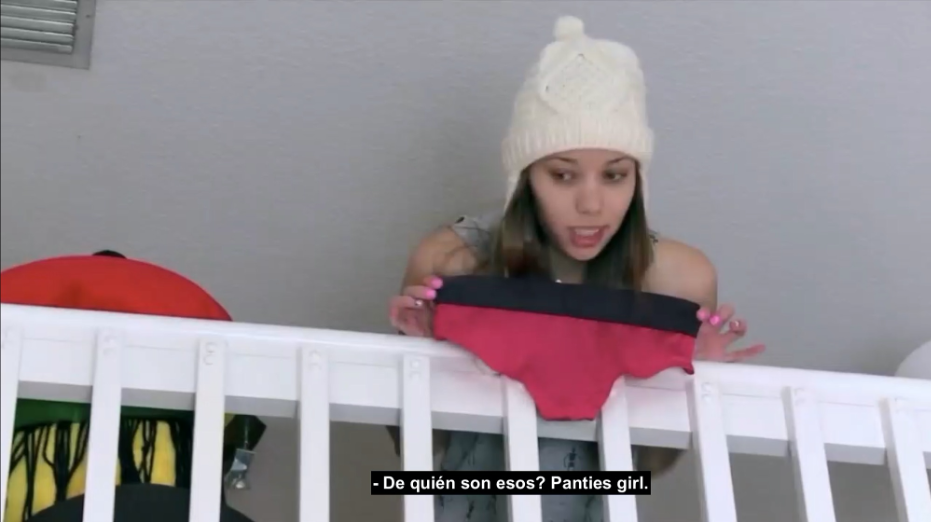
Carolina finds another woman’s underwear in Fernando’s closet. She asks him in Spanish, “Whose are these?” and starts the next sentence in English, “Panties girl”, meaning some other woman’s underwear.

[expander_maker id=”1″ more=”Read more” less=”Read less”]

Introduction

Code-switching is a linguistic phenomenon when a speaker switches from one language to another during a conversation. Specifically, we will focus on bilingual conversation. We will analyze two groups of bilingual couples: those who have similar language backgrounds, and those who have different language backgrounds communicating primarily in English as the dominant and common language between them.

The proposed outcome is that bilingual couples, with similar language backgrounds and English as their second language, are more likely to employ code-switching to convey a mood or perspective, while those with different language backgrounds are more likely to use code-switching as a communication strategy to build common understanding, such as borrowing (Van, 2012; Pietikainen, 2014).

Background

Code-switching has been proposed as a way to establish an identity (Piller, 2002). For example, De Fina (2007) looked at groups of Italian American men to reveal their code-switching patterns. De Fina found that the linguistic behaviors of an individual often influence those around them, so it may be that one partner may be influenced by the code-switching patterns of their partner. This theory was supported by Code switching in Mixed Couples that Code-switching has a specific reason for it. One of the reasons of code according to the findings was politeness. One of the partners would often accommodate to the other by switching the language. Some Code switching happens because of solidarity to establish a closer relationship. Lastly code-switching also shows confirmation (Dumaning 2015). Pietikainen also mentioned that lexical gap might be the reason for code switching. When a partner cannot successfully recall or produce the English word, they will sometimes use their partner’s first language (L1) instead of their L1 to ensure their partner understands (Pietikainen 2014).

Yodanis et al. (2007) studied the effects of bilingualism on couples’ relationships and found that having different native languages did not create more communication problems in couples with the same native languages. This suggests that these couples work harder and more effectively on their communication. The article ELF Couples and Automatic Code-Switching focuses on ELF couples and how code-switching influence their communication. The more common languages the couples shared the more they code-switched during their communication. Pietikainen found out that code-switching is automatic and unconscious and concluded that code-switching is the result of ELF couples’ relaxed atmosphere in their lives (Pietikainen 2014).

Methods

The methods used in this experiment were transcription analysis taken from clips of the popular show, 90-Day Fiancé. 90-Day Fiancé is a reality show that features Americans and their partners through their journey through the K-1 visa process (fiancé visa). 90-Day Fiancé follows couples during their first 90 days living together before they will be required to either get married or head back to their home country. We examined several bilingual couples from the show within two groups: different language background and the same language background Carolina and Fernando, Chantel and Pedro, and Devan and Jihoon. Carolina is a L1 Spanish speaker and acquiring English as her L2; her fiancé, Fernando, is a heritage Spanish speaker and also has native proficiency in English. Chantel is an American L1 English speaker and is Spanish as an L2; her partner, Pedro, is a Dominican L1 Spanish speaker, and acquiring English as his L2. Both Chantel and Pedro are acquiring their L2 to be able to communicate with each other, however, their language backgrounds are different, as they were not exposed to learning their L2 until after their relationship began. Devan is an American L1 English speaker and Jihoon is a Korean L1 English speaker who speaks very little English.

The clips analyzed were taken from moments of conflict and confrontation between the couples. For example, we use a clip from featuring Carolina confronting Fernando about a pair of women’s underwear she found in Fernando’s closet. Once a clip was selected, the dialogue was recorded, and the code-switching was marked and translated. Once properly transcribed, the code-switching events were categorized and compared with the results from the other couples (Piller 2002).

Results

We found that Carolina and Fernando were more likely to use code-switching as a way to convey their mood or perspective as well as stylistic purposes (such as comedy), when faced with confrontation. Their similar language backgrounds allow them to navigate communication in both languages while code-switching. Contrastingly, Devan and Jihoon used code-switching sparingly.

Devan:     Ok, get out.

Jihoon:    Yeah, sorry.

Jihoon:    피곤한다 피곤해

           Pigonhanda  pigonhae

           Frustrated  (very) frustrated.

In this exchange between Devan and Jihoon, the code-switching event happens after a long pause (about 2 seconds) after his initial phrase. Devan does not understand this utterance as she does not speak Korean and Jihoon knows this as he says it. It is not a continuation of the conversation he was having with Devan, but more of a mumbled expression to himself.

In Carolina and Fernando’s case, Carolina uses Spanish and English within the same phrases, as shown below.

Carolina: Fernando!

Carolina: What is this?

Fernando: uh?

Carolina: Sube. 

          Come up (the stairs)

Carolina: De quién son esos? Panties girl. De quién son?

          Whose are these?                Whose are (these)?

Fernando: Did you find ‘em in my closet?

Carolina: In your closet.

Fernando: I- That has nothing- That’s nothing from recent. That’s 

old, old. I’m serious.


[/expander_maker]
May I Speak Now? Examining Gendered Turn-Taking in Televised Debates

Daniel Li, Jennifer Moon, Ming Liang, Minh-Khoa Tran

The present text explores turn-taking by focusing on two prominent models which describe gender differences in communication — the dominance model and the difference model. The idea of deep interruptions is also employed in this study to better measure turn taking during interactions. We are focusing on inter-gender and same-gender interaction by observing talk show hosts engaging in turn-taking with their guests. Our goal is to determine whether or not there is a statistically significant difference between the number of interruptions utilized by men and women during debates in talk shows. Our empirical study analyzes the difference in the average number of interruptions per minute from men and women by using four thirty second clips. Overall, we found that men and women do not differ in terms of the frequency of interruptions but hosts tend to interrupt guests more. It was unexpected that without extensively interrupting, men still try to maintain power and discredit the female speaker through facial expressions or gestures.

[expander_maker id=”1″ more=”Read more” less=”Read less”]

Introduction

A lively debate on television is always fun to spectate. When the discussion gets heated, it appears as if power shifts at a moments notice — whoever’s speaking at the time seems persuasive and commanding. Sometimes the structure starts to break down, and the speakers begin interrupting each other in a bid for more speaking time.

Research on turn-taking in conversations has been conducted before. In this blog post, we hope to contribute to the scientific literature on turn-taking by investigating what sort of impact gender may have on the dynamic between talk show hosts and their guests. We’re curious to find out whether or not there is a statistical difference between the frequency of interruptions in mixed gender debates when compared to single gender debates on live television. We are also interested in whether the host and guest relationship will have any impact on the frequency of interruptions and if this plays any role in the dynamic between men and women. 

Background Information

There have been numerous studies and established theories about the power dynamic between men and women, and how this manifests itself in spoken language. We expect that the frequency of interruption between men and women will be explained by one of the three major models.

In Deborah Tannen’s difference model, men and women are members of their own distinct culture. This separation between male and female culture means that women and men will take noticeably different approaches to verbal communication (Tannen 1990). These cultures aren’t intrinsically bad or good. Women’s culture isn’t inferior to men’s culture, and it follows that their speech isn’t inferior to men’s speech. Deborah Tannen suggests that the clash of disparate cultures poses problems for respectful and equal communication.

Robin Lakoff proposed a dominance model which asserts that men and women’s unequal places in society’s power structure results in necessarily different communication styles, including how people of different gender are expected to speak and are spoken of (Lakoff 1973). Lakoff suggests that real-world imbalances and inequities will be reflected by linguistic imbalances. These two models both suggest that women and men tend to have distinct speech style and the higher social status of men makes it more likely for men to interrupt in interactions than women.

A very crucial idea that will be utilized in our study is deep interruption, which is an interruption that starts “two or more syllables before or after the last syllable of a place where you’d expect to switch speakers” (West & Zimmerman 1983).  West and Zimmerman predict that men are more likely than women to employ deep interruptions. In other words, it is more likely that men would forcefully change the subject of discourse to their desired topic regardless of the previous speaker’s intention.

However, despite the fact that males have been hypothesized to employ interruptions for domination and control, James and Clarke had very contradictory findings; they found an absence of significant differences in the amount of interruptions between women and men (James & Clarke 1993). Therefore, our first hypothesis is that men and women will average a similar number of interruptions per minute towards the other speaker. We also predict that hosts will tend to interrupt more than guests because of power dynamics between hosts and guests.

Methods

To collect data on turn-taking, we first needed to choose clips of debates to analyze. To make sure that we cover each relevant permutation of genders and speakers, we found four video clips. We have two video clips where the genders are the same (man-man, woman-woman). Then we have two more video clips where the genders are different (man-woman, woman-man). We needed two separate gender video clips to see if their status as host or guest on the show would significantly change our results.

Once we gathered our clips, we transcribed a climactic point in the debate where we found the most interruptions occurring. For each clip, we transcribed 30 seconds of debate. We transcribed a video with a man host and man guest which included Piers Morgan and Ben Shapiro. For the woman host and the man guest, we chose a clip with Cathy Newman and Jordan Peterson. For the man host and woman guest, we chose a clip with Tucker Carlson and Cathy Areu. Finally, for the woman host and woman guest, we chose a clip with Poppy Harlow and Janet Porter.

To transcribe the various videos, we used a transcription method of conversation analysis that included turn-taking markers to clearly indicate the turn of the speaker. This also showed whether the host or guest interrupted each other and if the interruptions occurred, we could see at what point the interruption was made during the speaker’s turn. We were also able to see if men had indeed interrupted women more, or if the level of interruptions were similar from both sides. Through this transcription process, we counted token instances of deep interruptions that were made by each speaker. Once the analysis of the deep interruptions was completed, we were able to collect our metrics and form a conclusion based on the amount of deep interruptions that occurred.

Results

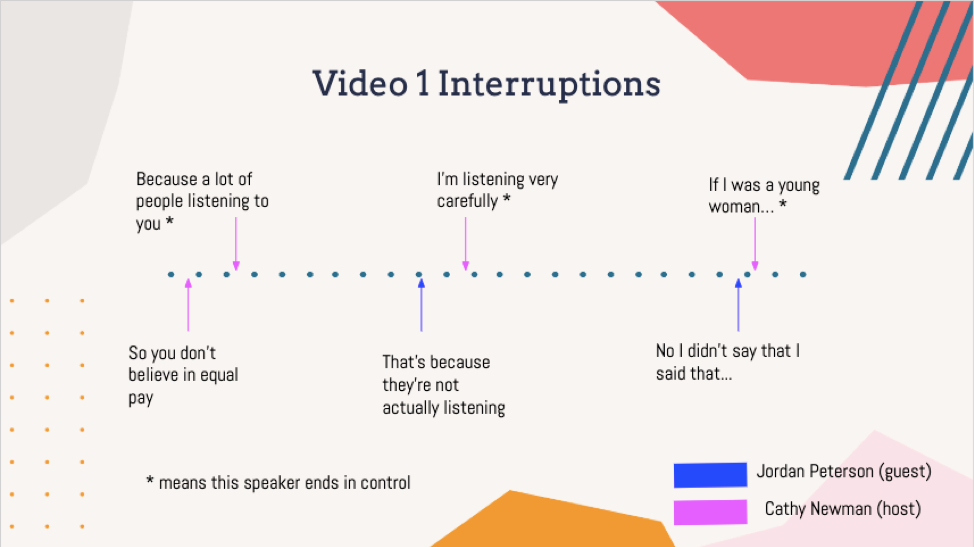
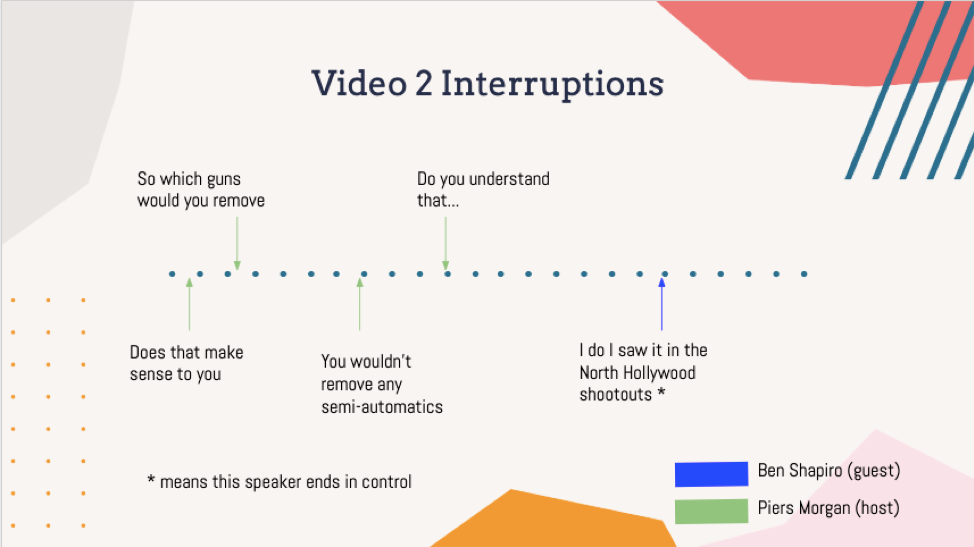
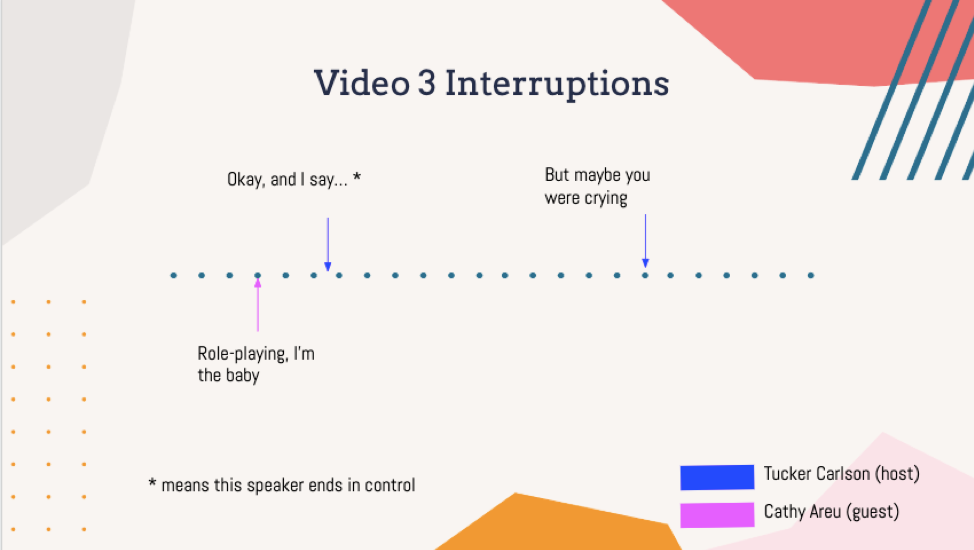
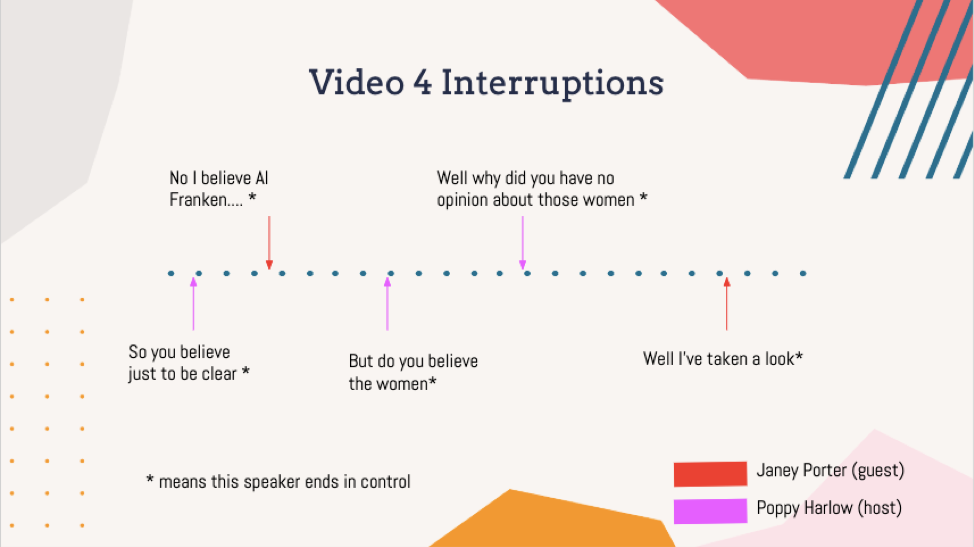
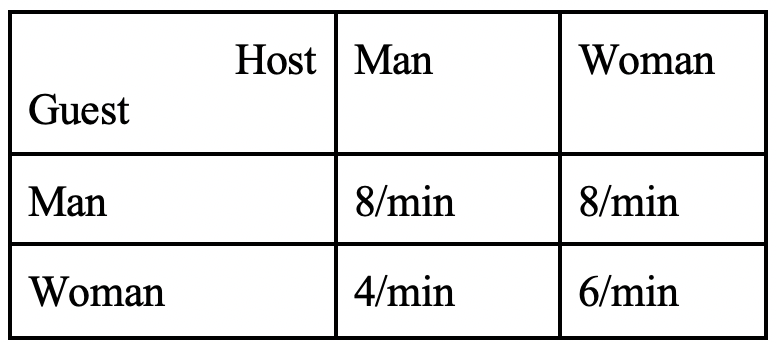
To help visualize our results, we plotted interruptions onto a rough timeline. The reasoning for these visual aids was to help us in our qualitative analyses of the clips. The timeline of interruptions helps to capture the flow of conversation and which ideas the most fiery clashes were centered around. Placing them onto a linear timeline also made it clearer which side of the debate was responsible for most of the interruptions. Here are the visualizations for all four of the clips that we analyzed, were time flows from left to right and only the interruptions are marked on the timeline. We have collated our results from the collection of token instances of deep interruption in Table 1.1 and 1.2 that count up these instances of interruption as a function of interruptions per minute.

Figure 1: Rough Timeline of Interruptions in Video 1.
Figure 2: Rough Timeline of Interruptions in Video 2.
Figure 3: Rough Timeline of Interruptions in Video 3.
Figure 4: Rough Timeline of Interruptions in Video 4.
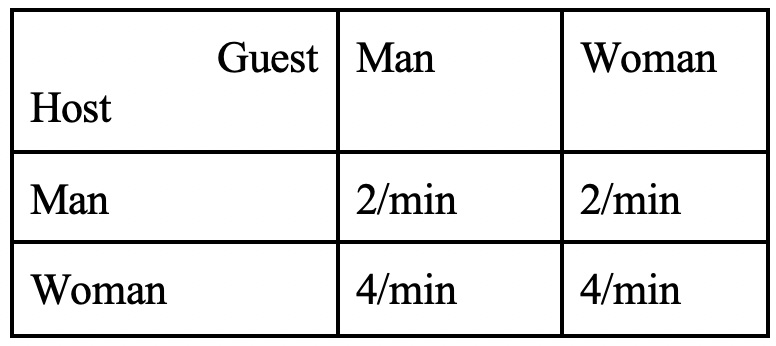
Table 1.1 Interruptions per minute from host to guest.
Table 2.2 Interruptions per minute from guest to host.


To summarize, men as hosts interrupted their man guests 8 times per minute and their woman guests 4 times per minute. Women interrupted their man guests 8 times per minute and their woman guests 6 times per minute. Men as guests interrupted their man hosts 2 times per minute and their woman hosts 4 times per minute and women interrupted their man hosts 2 times per minute and their woman hosts 4 times per minute.

Discussion and Conclusion

To touch once more on the focus of this study, we are primarily interested in two dimensions of power in a verbal exchange, the gendered differences between men’s and women’s place in society and social normative expectations, and the dynamic between a host and their guest specifically in the arena of debate talk show. Our predictions based on our original hypothesis following the seminal work of James and Clarke in 1993 stated that we were expecting to not find a significant difference between the rate of interruption from man to woman and woman to man. Our results from analysis of these four clips support this hypothesis, wherein as hosts, people interrupt their guests the same number of times per minute regardless of the guest or host’s gender. In fact, both men and women are less likely as hosts to interrupt their women guests than their man guests, specifically men interrupt their women guests half as often as they interrupt men. However, this is not to say that they were showing their women guests more respect by interrupting less often, rather in these situations the man host controlled the conversation with the woman guest nonverbally.

Qualitative analysis of the accompanying videos show that when a man host is not interrupting a woman verbally he is still displaying physical behaviors that express disbelief or disinterest, which still disrupts the flow of conversation albeit less explicitly. Further, as guests, both men and women interrupt their hosts at very similar rates as well. However, in this situation, both men and women as guests interrupt women hosts more often than they do man hosts (twice as often). To analyze this particular facet of the study we first have to discuss our two big foci of power — man/woman and host/guest. It appears that the more salient dimension of power when it comes to producing significant differences in the rate of interruption is actually host/guest dynamics. As hosts, both men and women produce four times as many interruptions per minute in same gendered interactions.

From here we turn back to our original finding that men and women interrupt at similar rates. While as hosts men and women interrupt their man guests more often than they do their woman guests. As guests they interrupt their woman hosts at twice the rate they do their men hosts.  If this host guest dynamic is the most important consideration, this statistic suggests that as the guest and weaker in the dynamic both women and men consider a woman host to hold less power over the course of the debate than a man host as evidenced by their greater willingness to interrupt their host when she is a woman. These observations are preliminary and speculative however and would require much more rigorous control over the interactions including but not limited to: combing through a much greater amount of raw data, controlling for having the same person acting as both guest and host, and developing better accounting methods for nonverbal interruptions.


References

Block, D. (2002). Language and Gender and SLA. Quaderns De Filologia: Estudis Lingüístics, VII, 49–73.

Hoey, E. M. & Kendrick, K. H. (2017). Conversation Analysis. In A. M. B. de Groot & P. Hagoort (Eds.), Research Methods in Psycholinguistics: A Practical Guide (pp. 151 -173). Wiley-Blackwell

James, D. & Clarke, S (1993). Women, Men, and Interruptions: A Critical Review. Critical Reviews of the Literature, 231-279.

Kendall, S., & Tannen, D. (2015). Gender and Language in the Workplace. Gender and Discourse Gender and Discourse, 81–105. doi: 10.4135/9781446250204.n5

Lakoff, R. (1973). Language and Woman’s Place. Language in Society, 2, 45–80.

Tannen, D. (2012). Turn-Taking and Intercultural Discourse and Communication. The Handbook of Intercultural Discourse and Communication, 135–157. doi: 10.1002/9781118247273.ch8

West, C., & Zimmerman, D. (1987). Doing Gender. Gender and Society, 1(2), 125-151. Retrieved from http://www.jstor.org/stable/189945

[/expander_maker]
Gen Z, Slang, and Stuff

Anonymous author, Daniela Vega, Giselle Chan,  Yuxiao Li

This study provides an analysis on the use of general extenders within Generation Z (Gen Z) online discourse. Utilizing qualitative analysis methods on social media dialogue (e.g. Youtube comments, Tweets, Spotify playlists, etc.) allows us to demonstrate how Gen Z members have created a new general extender (i.e. “and idk”). Where previous research studies on general extenders were narrowed to in-person discourse and interactions, this study examines the language pattern in the larger context of the internet across different social media discourse facilitators. It was a new context we were interested in providing research for because Gen Z is the first generation to grow up with the mass media culture, brought to them by the aforementioned social media outlets. Aptly so, Gen Z has created this new form of general extenders to expand their lexical inventory and engage in online discourse, as a pragmatic tool to index their emotions and stances. The interesting sociolinguistics findings on Gen Z and the use of general extenders are reflected on how this particular generation is constantly creating new slang terms (e.g. and idk), which builds intragenerational unity (with mutuals) but also causes intergenerational confusion (with the baby boomer generation referred to as the boomers); nonetheless, nuanced research is complicated with the lack of a corpus focusing on online discourse.

[expander_maker id=”1″ more=”Read more” less=”Read less”]

Introduction

Slang fosters in-group relationships and creates a recognizable framework of social discourse structure to identify fellow group members with. Slang is known to change regularly, generation to generation, and trend to trend. Currently, technological advances have played a huge role in the development of new stylistics in language and the creation of new lexical items. It is a language phenomenon that has been studied to showcase sociolinguistics impacts. Here we are also looking for the sociolinguistic impact, but on the focus of general extenders found in the Generation Z (Gen Z) every-day internet discourse stylistics. The speaking style of our target population, Gen Z, employs Internet slang in computer-mediated discourse, especially through videos on social media websites like YouTube, Twitter, and TikTok. We are looking to examine how they utilize it with intergenerational and intragenerational group members. We are hoping to understand if it is used to separate themselves from other groups or if there is a new development in general extenders with the same functions as previous research has defined. 

Background Information

There is previous research on the text messaging stylistics of Gen Z. There is also research on previous generations creating new slang. We will be following up these research focuses with the use of a specific linguistic event, the general extender (GE). GEs are phrases added to the end of a sentence indicating the previous word is part of a set, extending its meaning. For example, when being asked, “What did you find at the tide pools?”, one could respond by saying, “I found starfish, sea urchins, sea anemones, and stuff.” The “and stuff” is the GE, signifying the previous items were part of a larger set, in this case, of sea creatures. Researchers Tagliamonte and Denis analyzed these types of phrases and verified them to have important functions in spoken language. Those functions include referring to a set of the previous word, creating vagueness, sending a signal of unsureness, or creating solidarity between speakers. GEs can also be used to mark the end of a speaker’s turn or indicate that the previous word could become a topic of the conversation.

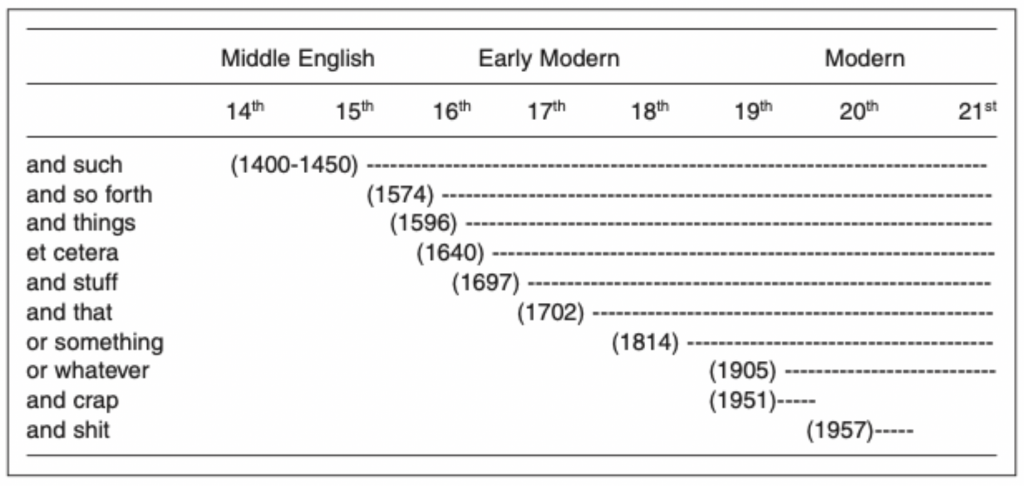
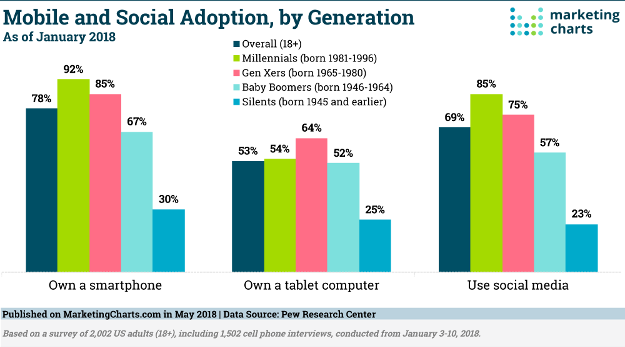
Common GEs used by previous generations include “and stuff” and “and things.” The oldest uses of general extenders date back to the 14th century with the GE, “and such” (Tagliamonte/Denis). GE use and types further develop with new additions appearing in 1957 with “and shit”. This includes general extender particles like “and that kind of thing” (see Figure 1).  We saw no other data on recent GEs in the late twentieth century or the current twenty first century. We are interested to find any new GEs and if possible, how they are coined and popularized by Gen Z. If there is a continuance in use of GEs from a previous generation, we will be documenting occurrences. When referring to Gen Z, we refer to individuals who are currently between 4 and 24 years old, born between 1995 and 2015. Gen Z constitutes an estimated 70 million of the population of the United States as of 2019. In looking at their screen time behavior, Gen Z watch about 68 videos per day across 5 social media platforms, including Snapchat, TikTok, Twitter, Facebook, and YouTube. This social behavior is new because of the invention of technology but does relate to multiple age groups. Gen Z, millennials (ages 18-34), and Generation Xers (ages 35-54) use social media more than baby boomers (ages 55 or more) (see Figure 2.). However, social media use is the highest in Gen Z than in other generations. This gives them the highest opportunity to host dialogue between themselves on Twitter, Facebook, YouTube, and TikTok.

Figure 1


Figure 2

Methodology

Using the qualitative method, Conversational Analysis (CA) for this study, we observe how Gen Z uses slang and GEs in their online conversations. Applied frequently in Sociology and Sociolinguistics to study social interactions, CA allowed us to analyze, compare, and document instances of GEs. The data used in our transcribed CAs were collected mostly from YouTube and Twitter, which have the highest Gen Z activity. Twitter caused difficulties because without category subjects to search for to find GE use, we were forced to scroll and read many tweets, hoping for an occurrence of a GE. We were able to search for the keywords of GEs like “and stuff”, which led to some results. We watched the most viewed YouTube videos from the popular Gen Z YouTube personalities (YouTubers) like James Charles and Kylie Jenner to begin a lexical choice analysis. When identifying the new GE, we returned to both Twitter and YouTube to search the phrase to find more instances and examples that supported our evaluation.

Results

We continuously saw a continued use of GEs including “and shit”, “and stuff, “and things”, and “or whatever”. These are continued in use from even the early 1600s. We did not witness an “and so forth” from the 1500s in a Tweet, YouTube video, YouTube comment, or TikTok made by a Gen Z community member or influential personality. We conclude because online discourse is not formal, the use of a Shakespearean aged GE would not be expected.  These previously identified GEs are not used to separate themselves from a generation but as a normal stylistic feature all generations use. We found no unique change in use for already established and identified GEs.

Through our CA data collection efforts we have successfully identified a new GE, “and idk”. This new GE is a fascinating finding sociolinguistically because it is a hybrid of already established linguistic phenomena and recently developed Internet-related acronyms. In looking at the function of “and idk,” we see it follows the same patterns of previous GEs. It continues to successfully indicate that words in the clause are part of larger set.

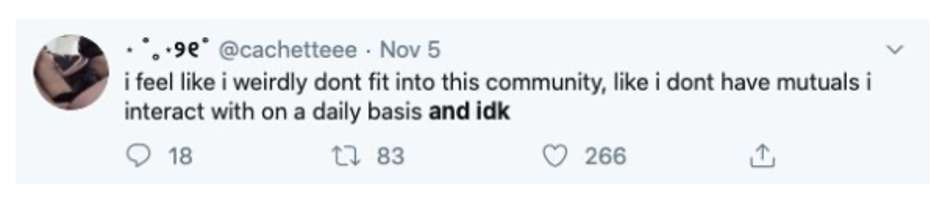
However, “and idk” deviates in the sense that it encodes pragmatic meaning. It contributes sentiments of vulnerability, insecurity and disconnect (see Figure 3.) In this example of “and idk”, we see it is identifying the users’ response to her lack of Twitter followers to interact with. Overall, our results serve as an expansion on previous research for GE, and we ultimately want more linguists to join in on this conversation of navigating the sociolinguistic landscape of the Internet to gain a more nuanced understanding of Gen Z-related discourse.

Figure 3. Screenshots of one of our tweets.

Discussion & Conclusion

We found GE uses allows any generation to be identified as the current younger generation because they are more typically found in informal speech. Social media discourse has allowed for changes in communication to facilitate the speed of communication speed online. While the use of the same tone you would have with friends and your in-group is also preferred because of the opportunity of anonymity and profile curation online. The research on general extenders does not include the increase, decrease, or appearance of usage at certain ages. However, we speculate if there should be research done on this, there could be identified a transition period between ages where GE use appears. We expect the GEs we identified to be added to a timeline representing its introduction, like the one we included in our research. We would hope there could be a timeline more specific for each GE within every time period, such as our focus here on Gen Z and social media. We would be interested in seeing the peaks and heights of use within the generation and the time periods where the GEs manifest. Thanks to archiving efforts for internet dialogue such as the Library of Congress Twitter Archive, the availability of data has increased. This type of data collection will allow for even further detailed research and we expect further sociolinguistic analysis.


References

A.O., Abusa’Aleek. (2015). Internet Linguistics: A Linguistic Analysis of Electronic Discourse as a New Variety of Language. International Journal of English Linguistics. 5.10.5539/ijel.v5n1p135.

Cheshire, J. (2007, April 17). Discourse variation, grammaticalisation and stuff like that. Retrieved from https://onlinelibrary.wiley.com/doi/10.1111/j.1467-9841.2007.00317.x.

Cox, Toby. (2019, July 2). How Different Generations Use Social Media. from The State of Tech. Retrieved from https://themanifest.com/social-media/how-different-generations-use-social-media

D.W. Maurer. (2013, August 16). Slang. Encyclopædia Britannica, inc. Retrieved from https://www.britann ica.com/topic/slang

Levey, & Stephen. (2012, March 1). General Extenders and Grammaticalization: Insights from London Preadolescents. Retrieved from https://academic.oup.com/applij/article/33/3/257/220662.

Sue. (1970, January 1). Young people’s language and stuff like that. Retrieved from http://linguistics-research-digest.blogspot.com/2011/10/young-peoples-language-and-stuff-like.html.

[/expander_maker]
, , , , , ,

Bilingualism in TV: When and why does code-switching happen?

Zoe Willoughby, Anton Nogin, Isaiah Sandoval, Maria Becerra

As bilingualism becomes increasingly prevalent in a wider variety of television shows, sociolinguistic analysis of what code-switching entails and why it is used becomes even more important to look at. We delve into an analysis of the shows Dora the Explorer and One Day at a Time to explore what types of code-switching are used for audiences of different ages. We hypothesized each show would differ in its most frequent type of code-switching – metaphorical or situational – because of the different language complexity levels depending on each intended age group. However, we realized these labels may not be as clear as expected. As we analyzed the data, some instances could fit under both of those categories or did not fit under either. Since the language use was more complex in One Day at a Time, so was the categorization of the reasons why code-switching was used. We ultimately determined cut-and-dry labels such as “situational” and “metaphorical” are not sufficient enough to classify why people code-switch. In order to recognize code-switching as a tool used to demonstrate language mastery and not convenience, our analysis of the results looks to offer possible solutions to further classify these instances of code-switching in TV shows.

[expander_maker id=”1″ more=”Read more” less=”Read less”]

What’s this all about?

Along with the growing bilingual population in the United States, there has been a shift in the way bilingualism is represented in the media, especially in television shows (Grosjean 2018). In this study, we wanted to look at the layers of language complexity of bilingual speakers through bilingual shows. Given bilinguals might have another layer to add to the technicality of their speech – code-switching – it is important to see how the media portrays that. Code-switching itself has layers of complexity when it comes to explaining why a speaker might do so.

Bilingual shows are becoming more mainstream for viewers of a wider age range, producing shows such as Dora the Explorer (DE) and One Day at a Time (ODT), the two shows we focus on in this study. We used these two shows as a lens through which we viewed the reasoning behind why bilinguals might use code-switching and the context in which these switches occur. By distinguishing between the two intended age groups for each show, we decided to focus on the different types of code-switching that may be more specific to each age group: metaphorical (using code-switching as a resource to enhance meaning) and situational (using code-switching depending on topic or other speaker) (Van Herk 2018, pgs. 151-152).

We hypothesized situational code-switching would be more frequent in DE, the show for younger audiences, and metaphorical code-switching would be more frequent in ODT, the show for older audiences. After analysis, we proved this true but found that classifying reasons for code-switching would require more categories to encompass its complexity.

What’s the context?

Our research focuses on bilingual television shows, specifically ones whose characters code-switch (CS) between Spanish and English. Despite incorrect assumptions that bilingualism always means total proficiency in two languages, this neglects to acknowledge the complexity of language use for those who are multilingual (Grosjean 1994). This definition is unclear, but CS helps to show bilingualism and is indicative of a speaker’s command over the language they are speaking (Bullock & Toribio 2009).

The types of code-switching used in these shows are our central linguistic variables. Metaphorical CS is a resource used to supplement the meaning of a certain word or phrase by tapping into the associations with a certain language (Woolard 2004). Situational CS occurs when a speaker uses a different language for a certain conversation topic or with a certain speaker (Gumperz 1977). Situational CS tends to occur intersentential (within a sentence) and metaphorical CS tends to occur intrasentential (over multiple sentences), and since intrasentential CS is linked with a better mastery of a language, metaphorical CS is implied to be a sign of that as well (Bullock & Toribio 2009).

How did we go about it?          

In the first three episodes of each show’s first season, we recorded each instance in which the speakers switched from English, the main language of each show, to Spanish, the secondary language. Each show has a different age recommendation, and Common Sense Media, an advocacy group that reviews the appropriateness of media for families and children, stated that Dora the Explorer (DE) is intended for audiences ages three and up, and One Day at a Time (ODT) is intended for audiences ages 12 and up (Herman 2004, Slaton 2016).

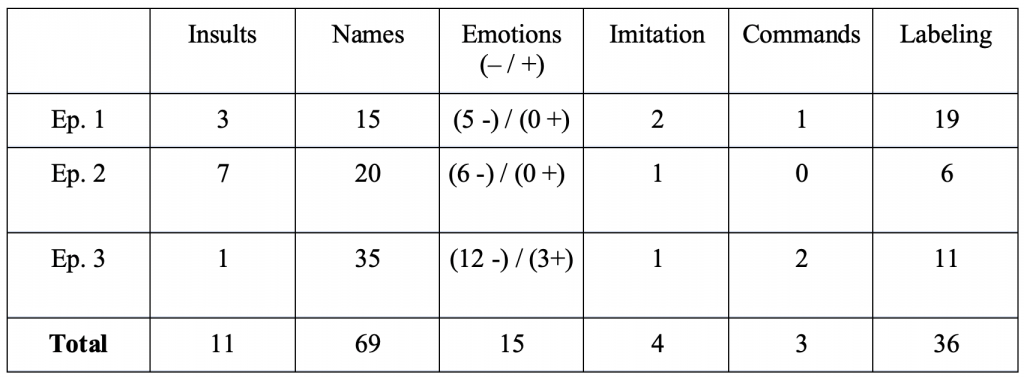
Our first step in collecting the data was to keep a running list of each instance of code-switching that occurred in each show. Along with the timestamp of the occurrence, we also included a brief description of the context in which we found the example. Once each instance was recorded from all of the episodes, we created six categories that grouped the different contexts in which CS happened. These contexts included insults, names (character called by relationship name), emotions, imitation (copying what someone else said in a different manner), commands, and labeling (calling certain things with their corresponding names in one language).

Originally, we planned to use these contexts to help us divide the CS occurrences into situational and metaphorical explanations, but this proved much more complex than expected. In order to compensate for the lack of coverage the explanations of situational and metaphorical CS gave, we created additional categorizations, which included lexical gaps (when speakers use words in one language that cannot be directly translated with the same weight), overlaps (combine multiple explanations), and exceptions (where CS did not serve as significant of a sociolinguistic purpose).

What did we find?

As we had predicted, there were more instances of situational CS in DE than there were in ODT, and there were more instances of metaphorical CS in ODT than there were in DE. For example, in ODT episode two (18:05 – 18:20), Penelope (in bold) is talking to her coworkers and boss in the office (none speak Spanish):

But maybe you didn’t hear because you were on your phone like now  
Uh, what?  

Yo voy a matar a este hombre    [I am going to kill this man]

Huh, what does that mean?

I am just thinking about lunch.

In this example, Penelope is angry at the situation at her work and chooses to switch to Spanish to express her anger. This is a metaphorical instance because Penelope is trying to create distance between her and her coworkers.

On the other hand, DE provides clear instances of situational CS. For example, in episode two, when Dora met with Baby Blue Bird (who is monolingual), she has to switch over to Spanish to be able to communicate with him (Dora in bold):

Where do you live baby bird?

¿Que?              [What?]

Oh, Baby Bluebird speaks Spanish         (at the audience)  

¿Donde vives?      [Where do you live?]

This example is situational CS because one of the speakers is only able to understand Spanish. Therefore, the situation calls for Dora to switch over to Spanish to be able to communicate.

Our hypothesis was based on the fact that DE would have less complex language usage and that ODT would have more complex language usage because of their respective intended audiences. This observation was confirmed when collecting data. We have summarized the contexts of CS for each of the shows per episode in Table 1.1 and Table 1.2 below.

Table 1.1 Contexts of CS in ODT
Table 1.2 Contexts of CS in DE

From observing the contexts of CS for both shows, it is noticeable that ODT has more complexity in CS than DE. Because of the lower level of language complexity, DE has no instances of insults, emotions or imitations, meaning that classifying the reasons for CS for ODT was not as clear as for DE. In some cases, a given instance of CS did not fall neatly into metaphorical or into situational. This is when we resorted to our additional categories of why a speaker might code-switch: lexical gap, an overlap, or not clear enough for any category (exception). For example, in ODT episode one, the grandma says:

You need to do something about this little sinvergüenza

[You need to do something about this little ___________]

In this case, the word “sinvergüenza,” refers to a person who is not ashamed of doing something that is seen as shameful. However, there is no direct translation in English that has the same meaning, and therefore we have labeled it as a lexical gap.

Another example of the categories we have created is in ODT episode three when the grandma says:

She thinks she’s tan fancy because her four grandsons are altar boys. Guataca.

[She thinks she’s so fancy because her four grandsons are altar boys. _______]

Here, the grandma is using an insult in Spanish. This word has no direct translation to English so we have labeled it as a lexical gap. However, it is also an instance where the speaker (the grandma) is trying to create distance between her and the person she is insulting, therefore it is metaphorical CS. Since this CS instance has aspects of both lexical gaps and metaphorical CS, we labeled it an overlap.

Sometimes we couldn’t fit the CS instances into any of the categories because there seemed to be no significant sociolinguistic purpose. An example of this is when Dora repeats a word in Spanish and English a few times to teach a new word, which we labeled as repetition. Another instance is mixing, which is done often by the grandma in ODT. To clarify, we defined mixing to be when a word is used in a different language (usually intrasentential) but can be directly translated into English; CS might have happened just out of convenience. For example, in one episode, the grandma says “café con leche” which translates directly to “coffee with milk.” Also, when calling someone by their relationship name in Spanish, such as “mami” or “abuelita,” there is little to no sociolinguistic meaning behind it (we labeled this naming). Imagine this: If CS did not happen in any of these examples, would it make a sociolinguistic difference? In these cases, the speakers chose to CS for a reason that can’t be explained by sociolinguistics. In other words, the sociolinguistic difference was not enough to warrant another category.

What does this all mean?

If we only look at the scope of our hypothesis, then we proved the main points: There is more metaphorical CS in ODT, and more situational CS in DE, both suitable for each show’s recommended age group. However, the hypothesis itself did not allow us to take into account the other types of language use related to CS that came up in data collection and analysis. In every instance, whether it be a simple word or phrase repetition in DE, or more dynamic instances of CS in ODT, the words or phrases from Spanish utilized in English (or vice versa) were grammatically sound, even if they had no direct equivalent in the other language. This phenomenon shows that bilingual individuals who utilize CS are, at the very least, capable in both languages. Characters in both shows were able to switch seamlessly from one language to the other, maintaining grammaticality and conversation flow at the same time. What this means is that depending on a speaker’s frequency of CS usage, CS itself could act as a marker of high proficiency in, or even mastery of two languages.

Our hypothesis and initial conclusion stemmed from the narrow definitions of CS provided in our class textbook. The textbook provided context and examples for how metaphorical or situational CS each functioned in an interaction. However, it presumes these categories are limited by where in the phrase or sentence the CS instance occurs. The book defines situational CS as only occurring from one sentence to the other, and metaphorical CS as occurring within a single sentence (Van Herk 2018, pg. 151-152). Although the book connects language proficiency and emotional states to CS usage, it uses narrow descriptions for the phenomenon itself.

The textbook also assumes metaphorical and situational CS are the only two categories of CS worth noting. While the textbook works to dispel language myths by defining the sociolinguistic reasons for CS, it could confuse readers that there might only be two main reasons, just like it did for us. To that end, the exceptions and overlaps from our data are defined as such because we couldn’t place them in either category. It’s up to readers like you to go back and define these instances however you see fit.

What’s next?

Since there is a wide variety of other bilingual media out there (reality TV, movies, podcasts, etc.), more data could be collected to find different examples of diverse bilingual speech patterns. We could even compare media across time periods to measure frequencies of CS across several years or decades. This all ties back into one observation – that bilingual individuals are being engaged with in mass media and are being positively validated.


References

Bullock, B., & Toribio, A. (2009). Themes in the study of code-switching. In B. Bullock & A. Toribio (Eds.), The Cambridge Handbook of Linguistic Code-switching (Cambridge Handbooks in Language and Linguistics, pp. 1-18). Cambridge: Cambridge University Press. doi:10.1017/CBO9780511576331.002.

Grosjean F. (2018). Psychology Today, The Amazing Rise of Bilingualism in the United States. https://www.psychologytoday.com/us/blog/life-bilingual/201809/the-amazing-rise-bilingualism-in-the-united-states.

Grosjean, F. (1994). Individual bilingualism. The encyclopedia of language and linguistics, 3, 1656-1660. http://www.signwriting.org/forums/swlist/archive2/message/6760/Indiv%20bilm.rtf.

Gumperz, J. J. (1977). The Sociolinguistic Significance of Conversational Code-Switching. RELC Journal, 8(2), 1–34. https://doi.org/10.1177/003368827700800201.

Herman, J. (2004, December 14). Dora the Explorer – TV Review. Retrieved from https://www.commonsensemedia.org/tv-reviews/dora-the-explorer.

Slaton, J. (2016, December 19). One Day at a Time – TV Review. Retrieved from https://www.commonsensemedia.org/tv-reviews/one-day-at-a-time-0.

Van Herk, G. (2018). Multilingualism. In Gerard Van Herk (Ed.): What is sociolinguistics? (2nd edition: pp. 146 – 157). Hoboken, NJ: John Wiley & Sons, Inc.

Van Herk, G. (2018). Glossary. In Gerard Van Herk (Ed.): What is sociolinguistics? (2nd edition: pp. 220 – 237). Hoboken, NJ: John Wiley & Sons, Inc.

Woolard, K.A. (2004). Codeswitching. In A. Duranti (Eds). A Companion to Linguistic Anthropology (pp.73-94). Oxford, Blackwell. https://onlinelibrary.wiley.com/doi/pdf/10.1002/9780470996522#page=92.

[/expander_maker]
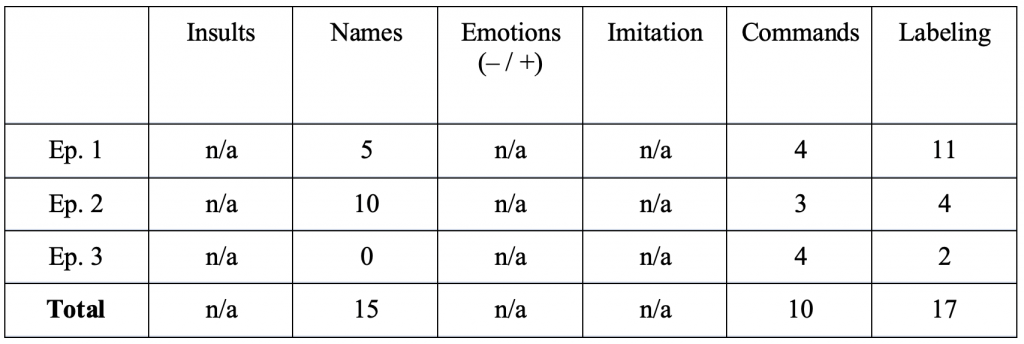
Dorothy wants to know: How can television influence language development?

Looking at Child-Directed Speech on Sesame Street

Tania Aguilar, Alex Ferguson, Thomas Gerard, Matthew Pham

In today’s highly advanced and technological world, access to media through the Internet is not a challenge for any age group. Most children have their eyes constantly glued to a screen, whether that be a television, tablet, computer, or mobile device. Children are able to view their favorite television shows at any time of the day on their preferred social media platform. The days of having to sit in front of the t.v. at a specific time or using a VCR to record missed shows are a thing of the past. However, does an increase in accessibility and viewing time correlate to cognitive and language development among youths? This pilot study dissects episodes from the well-loved television show, Sesame Street, to analyze 9 features of child-directed speech strategically placed in the show to incite learning. Our data and results exhibit extensive use of Child-Directed Speech strategies to maintain (i) child engagement, and (ii) nurture child language development, all while avoiding certain features that diverge from the acquisition of Standard American English. This study examines the effectiveness of techniques and tactics employed by Sesame Street so that future research may compare other children’s television shows such as Blue’s Clues, Clifford the Big Red Dog, Arthur, and Dragon Tales to further explore the influence in language acquisition and development.

[expander_maker id=”1″ more=”Read more” less=”Read less”]

Introduction

Children watch more television than ever. With new reports suggesting that children ages 2-5 spend up to 32 hours a week in front of a screen (Debczak, 2019), it only makes sense that television would have some effect on language development for these young minds. The “Peppa Pig Effect” recently made news when American parents found their children who watch the show speaking with a slight British accent and using certain British English terms (Debczak 2019). Sociolinguistically, as we are building our own identity, we are often influenced by the people around us. Ultimately, we learn how to express ourselves in order to fit in with those we like and aspire to be like (Podesva, 2011). The children watching television do the same by emulating the speech of characters from the shows they often enjoy, like Peppa Pig.

Figure 1: Peppa Pig phenomenon

See also: “Peppa Pig Is Corrupting America’s Youth” jokingly rants Stephen Colbert

While television is often cast in a negative light in child development, television may actually present a good opportunity to play a positive role in a child’s language development– particularly through a program’s use of Child-Directed Speech paired with high-quality nurturing language-development activities. Since television is a presence in many children’s daily lives, it is essential that we explore the qualities of a well-done implementation of Child-Directed Speech (CDS) in children’s television to simultaneously engage the viewer and encourage language development. By evaluating Sesame Streets use of Child-Directed Speech, we hope to find out whether the show exhibits the traits of a program that would be successful in aiding child language development.

Background Information

Created in 1969 by former documentarian Joan Ganz Cooney, Sesame Street was intended to be not only entertaining but educational as a children’s show. The show was created with the aim of helping lower-income 3-5 year-olds without access to preschool prepare for kindergarten, with the hope that the show’s bright colors and catchy songs would help viewers ultimately advance their speech and language (“Sesame Street” Debuts, 2009). The years leading up to a child’s beginning of school is a critical part of their language development. A child is developing in response to various stimuli (American Speech-Language-Hearing Association). This 5-year span results in varied experiences and therefore variations in the quality of language exposure, which in turn affects pronunciation, communication, and comprehension abilities (American Speech-Language-Hearing Association).

See also: Is my child on track linguistically? Take this quiz from the NIH!

The use of Child-Directed Speech is shown to aid in bonding with parents or caregivers, but also in language development in infants and toddlers (Green et al., 2010). CDS is a nonstandard form of natural speech when talking to infants or toddlers, is often slower, with more pauses and repetition, higher in pitch, more melodic and exaggerated, and may use simpler words than found in generic adult speech (Grin, 2016). Child Directed Speech also contributes to vocabulary development– recent studies have pinpointed key elements of CDS that are more likely to influence children’s word learning abilities: the use of the same words in adjacent sentences, the use of isolated words, and discourse continuity (Schachner & Hannon 2011).

Methods

In order to explore whether Sesame Street specifically exhibits positive language development traits through its Child-Directed Speech, we analyzed two selected episodes of Sesame Street: “Elmo’s Pretend School” (2006) and “Earth Day” (2019). These recent episodes have carried the traditional educational style of Sesame Street, therefore exemplifying ideologies and methodologies Sesame Street values in its teachings. We specifically analyzed conversations in lesson-based contexts and recorded the methods used to teach that lesson with a focus on 9 features of CDS: diminutives, 3rd person usage, simplified vocabulary, questions, exaggerated intonation, repetition, clear turn-taking, slowed pacing, and music. Most data was collected through simple manual transcription, however for certain features we recorded exchanges with formal conversation analysis techniques as well as the acoustic software Praat.

We aim to understand how Sesame Street uses Children-Directed Speech to keep children engaged and how the quality of it can possibly affect children’s speech as well. In order to measure the quality of CDS, we analyzed based on the methods used in “Specific Structural Features of Child-Directed Speech Support Young Children’s Word Learning,” by Jessica Feigenbaum Schwab. We focused on the prosody of CDS to examine how it engages the viewers while also looking out for repetition, slowed pacing, turn-taking and more to determine the quality of CDS. Sesame Street was created with the intention to help children develop communication skills, so we expect to find many high-quality instances of Child-Directed Speech– meaning a prominent use of CDS with high frequency of the foci listed above.

Results

After collecting our data, we were initially surprised to find that not all 9 aspects of CDS were present in our excerpts of Sesame Street. We’ll break down each one here:

Diminutives are words that are changed or affixed to make them appear small, cute, or reduce their meaning, or to put that in diminutives, appear “itsy-bitsy,” “cutesy,” and “meaningful-ish” (Merriam Webster, 2019). Despite being very common in parent-child speech, we observed that Sesame Street characters use no diminutives, likely because the writers would not want to introduce children to words outside of the Standard American English lexicon.

The use of the 3rd Person is marked when a speaker refers to themselves without personal pronouns like “I” and “me”. Sesame Street uses the 3rd person fairly often, especially with their star character Elmo who exclusively refers to himself in the 3rd person. You’ll never catch Elmo saying the pronoun “I,” though many other puppets might.

Figure 2: Transcript of conversation between 2 well-known Sesame Street characters, Elmo and Big Bird.


Speakers using Exaggerated Intonation will raise and lower the pitch of their voice greatly within a single sentence to emphasize keywords. In Figure 3, we have an example spectrogram of Grover asking the rhetorical question: “Did you know that in some places, children ride camels to school?” The blue line shows his wild variation in pitch!

Figure 3: Spectrogram of phrase “Did you know that in some places, children ride camels to school?” Audio file attached below.

Most CDS uses very Simplified Vocabulary, but in our observations, Sesame Street doesn’t shy away from using some pretty hefty words! We caught Grover using words that most adults would rarely use including “plethora,” “myriad,” and “kit and caboodle.”

Repetition is incredibly common in CDS and in Sesame Street. In the show, we observed puppets overwhelmingly repeating or over contextualizing new words to help viewers learn their meaning. The video below showcases the introduction of new vocabulary, stethoscope, via repetition.

With CDS, speakers will often try to engage the listener with Questions. Big Bird likes to ask the viewer questions to invite them to practice their speaking skills.

Conversations will often adopt Slowed Pacing between adults and children so that children can clearly hear the boundaries between different sounds, words, and phrases. When introducing new vocabulary, Elmo, for example, likes to sound words out: It’s not just a “pediatrician”; it’s a “pe-di-a-trician” (see the video clip below)! Some characters, however, talk quicker than even most adults.

In every conversation, the roles of speaker and listener will switch off in what we call Turn-Taking. Sesame Street characters will have extra long pauses between utterances to give other puppets or the viewer time to respond, just like CDS use would predict!

Finally, Music and rhythmic speech are other clear ways that CDS tries to get the attention of children and also acts as a way of creating more solid memories. In Sesame Street, it’s rare to get through an entire segment without a puppet bursting into a musical number about the lesson they just learned.

Out of all 9 of these CDS features, diminutives and simplified vocabulary are the only ones we never found continued evidence of. Furthermore, the use of the 3rd person and slowed pacing were only consistent features for a select population of muppet characters. Otherwise, the other 5 features are heavily employed throughout the show to help foster an engaging language-learning experience.

Figure 5: Overview of 9 child-directed speech features employed in Sesame Street.


Discussion and Conclusions

Looking at an overview of the observations, we were able to find a general pattern that could explain why certain features were or weren’t used. Since the primary goal of Sesame Street is to prepare children for kindergarten, we found that the show often sacrifices certain CDS features that could possibly hinder a child’s development of standard language conventions used in school. Diminutives are out because if children use these very personal words in school, their teachers and peers may not understand what they’re referencing. Not using an overly simplified vocabulary also exposes children to situations where they don’t know what a particular word means, something that often happens in early schooling. The techniques Sesame Street does use tend to be more about supporting understanding of new concepts by making speech extra clear. The use of CDS is able to maintain a child’s engagement while also exemplifying nurturing language development activities, therefore we expect the show to have a positive impact on children’s language development in this context.

As for further use of our research, we plan to conduct similar analyses on similar television programs including Blue’s Clues, Clifford the Big Red Dog, Arthur, and Dragon Tales to establish a comparison matrix. By investigating the varying uses of Child-Directed Speech in each, we hope to find which television shows do a good job of fostering language development…and which ones fall flat.

See also: Ready to read? 11 shows to improve your child’s literacy. You’ll never guess what #7 is!


References

American Speech-Language-Hearing Association. (n.d.). Speech, Language, and Hearing Services for Children: A Smart Investment. Retrieved from https://www.asha.org/uploadedFiles/Speech-Language-Hearing-Services-for-Children.pdf

Debczak, M. (2019, February 13). The Peppa Effect: U.S. Kids Who Watch Peppa Pig Are Developing Slight British Accents. Retrieved from https://www.mentalfloss.com/article/574050/peppa-effect-kids-developing-british-accents-peppa-pig.

Diminutive. In The Merriam-Webster.com Dictionary. Retrieved December 9, 2019, from https://www.merriam-webster.com/dictionary/diminutive

Ferguson, A., Pham, M., Gerard, T., & Aguilar, T. (2019). PROJECT PROPOSAL.

Green, J. R., Nip, I. S. B., Wilson, E. M., Mefferd, A., & Yunusova, Y. (2010). LIP MOVEMENT EXAGGERATIONS DURING INFANT DIRECTED SPEECH. Special Education and Communication Disorders Faculty Publications. Retrieved from http://digitalcommons.unl.edu/cgi/viewcontent.cgi?article=1053&context=specedfacpub

GRIN Verlag. (2016). Child-directed speech and its role in language acquisition. Munich.

McDonough P. TV viewing among kids at an eight-year high. Nielsenwire. October 26, 2009. Available at: http://blog.nielsen.com/nielsenwire/media_entertainment/tv-viewing-among-kids-at-an-eight-year-high/. Accessed 11 November 2009.

Podesva, R. J. (2011). The California Vowel Shift And Gay Identity. American Speech, 86(1), 32–51. doi: 10.1215/00031283-1277501

Schachner, A., & Hannon, E. E. (2011). Infant-directed speech drives social preferences in 5-month-old infants. Developmental Psychology, 47(1), 19–25. https://doi.org/10.1037/a0020740

Schwab, J. F. (2018). Specific structural features of child-directed speech support young children’s word learning (Order No. 10813697). Available from ProQuest Dissertations & Theses A&I; ProQuest Dissertations & Theses Global. (2057297773). Retrieved from https://search.proquest.com/docview/2057297773?accountid=14512

“Sesame Street” Debuts. (2009, November 24). Retrieved from https://www.history.com/this-day-in-history/sesame-street-debuts.

Speech and Language Services in Schools. (n.d.). Retrieved from https://www.asha.org/public/speech/development/Speech-and-Language-Services-in-Schools/.

ROWE, M. (2008). Child-directed speech: Relation to socioeconomic status, knowledge of child development and child vocabulary skill. Journal of Child Language, 35(1), 185-205. doi:10.1017/S0305000907008343
https://www.cambridge.org/core/journals/journal-of-child-language/article/childdirected-speech-relation-to-socioeconomic-status-knowledge-of-child-development-and-child-vocabulary-skill/9A6AE54D0489EECB7F665B04DC61D365

[/expander_maker]

Scroll to Top