Media

Gender Bias in Celebrity Interview Questions: Topic Study at the Oscars 2023

Sofia Duffy, Lauren Nemeh, Audrey Tseng, Venus Vu

Red carpet interviews at award shows are often a hot topic that circulates on the internet and are viewed by millions of people. This being said, the quality and nature of what is said in the interviews can wildly influence the viewers. Previous research and social movements have shown that female celebrities who participate in these interviews are more likely to receive questions and comments related to their appearance compared to their male counterparts. With this in mind, we aimed to investigate gender bias in celebrity interviews through analyzing interview clips of the 2023 Oscars red carpet interviews. Specifically, we examined if there were differences in the theme of questions asked (word choice) and the quality of interviewers’ voice (tone) when interviewing male celebrities versus female celebrities.

[expander_maker id=”1″ more=”Read more” less=”Read less”]

Introduction

Celebrity interviews on the red carpet hold a prominent position within the fabric of award shows, captivating global audiences as they eagerly seek glimpses into the lives of their beloved stars. However, within this realm, a disconcerting disparity often emerges in the nature of questions posed to male and female celebrities, serving as a reflection of deep-seated gender biases and the perpetuation of societal expectations. In our study, we set our sights on the precise queries directed at celebrities during the 2023 Oscars, embarking on an investigation to unravel the discrepancies in how interviewers engage with male and female celebrity interviewees. Through a meticulous analysis of interviewers’ word choice and tone, our objective is to cultivate a comprehensive understanding of the pervasive gender biases that permeate these high-profile interactions. In doing so, we aim to unearth patterns that mirror societal gender biases and shed light on the implicit biases harbored by the interviewers themselves. By undertaking this critical exploration of language use in celebrity interviews, we contribute to the ongoing discourse surrounding gender equality in the realm of entertainment and challenge the perpetuation of gender stereotypes on the illustrious red carpet.

Background

Celebrities hold a unique position in society due to their high-profile status and influence. The media coverage they receive significantly shapes public perceptions, particularly among impressionable children and teenagers who often look up to their favorite stars. Red carpet events are particularly important because they are televised occasions with substantial social significance. Among these events, the red carpet at the Oscars stands out as the most prestigious. Celebrities are asked a series of questions, and these interactions are recorded and broadcasted worldwide. 

A study from 1956, “Age and Sex in the Interview” by Benny et al., offers valuable insights into the intersectional relationship between age and sex. Their analysis focuses on responses and utilizes post-interview surveys to gauge participants’ perspectives. Their research reveals a consistent pattern of communication inhibitions between individuals of the same age but different sexes, particularly among young men and young women. These findings underscore the complexity of interview interactions and the influence of societal expectations. 

The Oscars red-carpet pre-show in question, with its apparent glamor and spontaneity, hides a reality that is heavily scripted and choreographed, where questions and reporters are carefully selected to meet industry demands and viewer expectations. Beneath the glamor of red-carpet lies a troubling tradition of objectifying the female body as a spectacle. Over the years, women have been typecast as the sole consumers of topics involving beauty and fashion, influenced by the rise of the beauty industry and photography (Lundén, 2021, p. 212). This has perpetuated a questionable tradition of objectification, reinforcing societal beliefs about gender roles. The red carpet has become a platform where women’s appearances are harshly criticized, focusing on mean-spirited evaluations of their bodies rather than celebrating their talent and accomplishments. Additionally, while women often bear the brunt of fashion-related questions, this does not exempt men from scrutiny. Fashion discourse has expanded to include men, but the discernible imbalance in how men and women are judged persists. 

However, the emergence of the #askhermore movement in 2015 reflects a growing resistance to the recurring practice of asking women the superficial “what are you wearing” question on the red carpet. The movement encourages reporters to delve deeper and ask female celebrities more substantial questions beyond their clothing choices. In our research, we will concentrate on the questions asked to both male and female celebrities, shedding light on patterns that mirror societal gender biases and expected gender performance.

In the context of award shows, red carpet celebrity interviews hold great significance as they attract thousands of viewers seeking insights into the inner lives of these celebrities. However, the quality of questions posed to male and female celebrities differs significantly, with women often subjected to shallower inquiries about their appearance rather than their careers. The central focus of our research is to investigate the disparities in the treatment of male and female celebrity interviewees during the 2023 Oscars. Specifically, we aim to analyze the word choice and tone utilized by interviewers in their interactions with these individuals. By examining these linguistic aspects, we seek to gain a deeper understanding of the gender biases that manifest in celebrity interviews. Our research question revolves around whether interviewers hold implicit gender biases, leading to a tendency to ask female celebrities more superficial questions compared to their male counterparts. Through this inquiry, we aim to contribute to the broader conversation on gender equality within the entertainment industry and challenge the perpetuation of gender stereotypes on the red carpet.  

Project Design

For our data sample, we selected 16 video clips from the 2023 Oscars red carpet. Since we are focusing on the gender difference of the celebrity, we selected 8 interview clips where the interviewee is a male celebrity and 8 interview clips where the interviewee is a female celebrity. To reach our sample size, we gathered video clips from three media sources: Extra TV, Vanity Fair, and E! News.  In total, we analyzed 49 minutes and 53 seconds of interviews. The time varied from interview to interview, from an interview that was 41 seconds long to one that was 4 minutes and 49 seconds. We aimed to analyze whether there are differences in the interviewer’s tone and word choice based on the gender of the celebrities being interviewed. To do so, we first transcribed everything that was said by the interviewers. We omitted what the celebrities said to better focus on the style of the questions and comments and color coded the content according to these following categories:

  • Word Choice (categorizing questions/comments according to theme)
    • Red: career related questions/comments (e.g. film projects, experience working with co-stars)
    • Blue: personal related questions/comments (e.g. family, love life)
    • Green: fashion related questions/comments (e.g. outfit, makeup)
  • Tone (categorizing questions/comments according to quality of interviewer’s speech)
    • Yellow: serious tone
    • Purple: playful tone

For the purpose of our study, we treated each categorization as mutually exclusive. Next, we counted how many instances each category was used in each interview and added them up according to the gender of the celebrity. We compared the number of instances between the two genders to see if there was any relationship between them. We also placed our transcripts into a word counter in an attempt to see if any significant words were used more or less in one gender over the other. In our collection and analysis of the data, we disregarded the gender of the interviewer as we solely wanted to focus on the gender of the celebrity in relation to the type of question asked.

Based on previous knowledge, we hypothesized that:

  1. Female celebrities will be asked more questions related to their personal life and fashion.
  2. Male celebrities will be asked more questions related to their career.
  3. Interviewers will use a more playful tone when interviewing female celebrities.
  4. Interviewers will use a more serious tone when interviewing male celebrities.

Data and Results

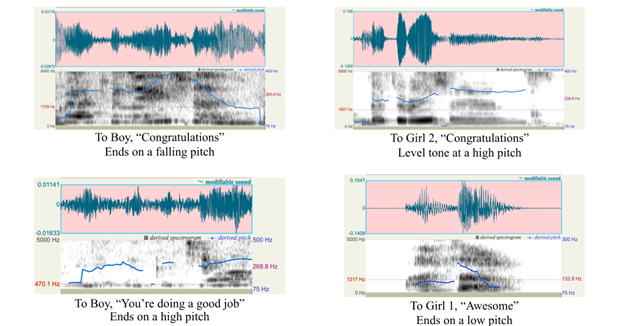
Before discussing the findings of our study, here are some examples of the types of questions/comments interviewers asked and how we categorized them. Each example is pulled from a different celebrity interview.
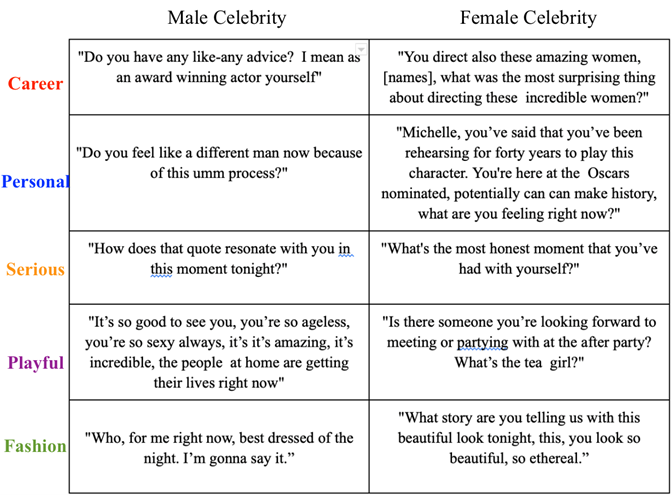
Figure 1: Examples of questions/comments asked to celebrity interviewees, categorized based on both gender and tone and word choice. Each question/comment is pulled from a different celebrity interview.

Here are our findings, separated into two bar charts. One chart is organized based on questions/comments that were categorized for tone, and the other is organized based on questions/comments that were categorized for word choice.
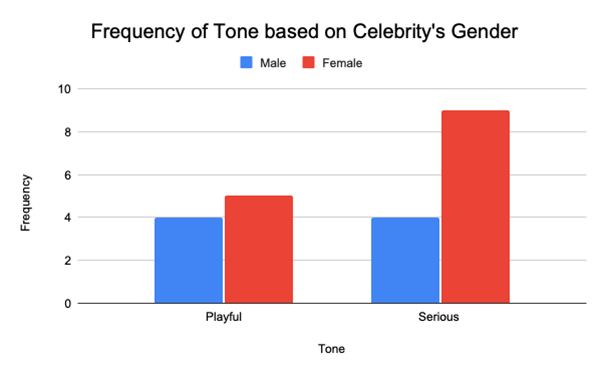
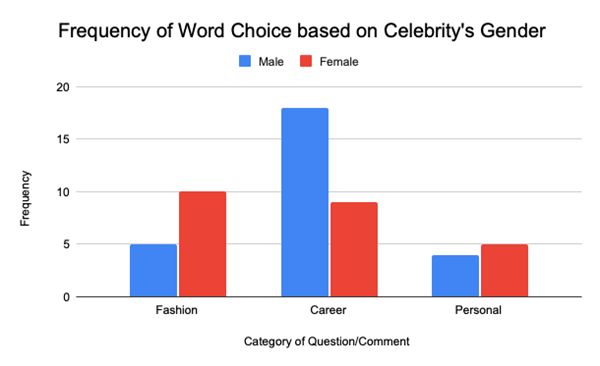
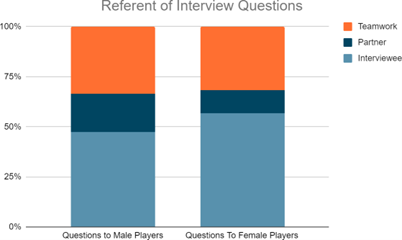
Figure 2: Bar chart representing data, with interviewer’s tone on the x-axis and total frequency in 16 interviews on the y-axis. Categorized based on celebrity’s gender.
Figure 3: Bar chart representing data, with interviewer’s word choice on the x-axis and total frequency in 16 interviews on the y-axis. Categorized based on celebrity’s gender.

In terms of word choice categorization, female celebrities were asked twice as much about fashion compared to men, as we recorded 10 instances for women compared to 5 for men. Male celebrities were asked career related questions twice as much as women, as we recorded 18 instances for men compared to 9 for women. We originally predicted that female celebrities would be asked more questions related to their personal life, which was proven to be incorrect as the results were roughly equivalent. Women were asked five personal questions compared to four for men.

In terms of tone, we found that women were asked twice as many questions in a serious tone compared to men (9 vs 4). However, we originally predicted that interviewers would use a more serious tone when interviewing male celebrities. We also found that male and female celebrities were spoken to in a playful tone at roughly the same frequency, with 20 instances for men compared to 18 for women.

When we put the data into a word counter, which we separated by the gender of the celebrity, we did not find any significance in the density of words used for male versus female celebrities.

Discussion and Conclusion

As we previously discussed, while we did find slight differences in the types of questions that were asked to the male versus female celebrities in our data recording, our data was not all-revealing nor conclusive. While we did find that men were asked more career-related questions whereas women were asked more fashion-related questions, we are not able to use our data to conclude that this is true for red carpet interview events in general. Our data consisted of 8 male celebrity interviews and 8 female celebrity interviews, which is not a complete representative of red carpet interviews as a whole. Further research could be done looking at a variety of different events. It would be interesting to see how/ if the results change depending on if it is a music awards event, premiere event, awards event, small event, etc. Each red carpet could be researched as an independent study, to then later compare the data. This comparison would offer insight into how the different events influence the types of questions being asked to male versus female celebrities. Alternatively, a study could be done by taking a set amount of interviews from each red carpet in order to have an accurate data sample of red carpets as a whole. This would offer insight into the trends of the questions male celebrities versus female celebrities are being asked on red carpets as a whole. Moreover, in our study we only analyzed the questions that were asked to the celebrities and did not take into account their responses. Future studies could benefit from also analyzing the responses.

It is also important to note that for the purpose of our study, we approached gender in a binary way through only analyzing the interviews of female and male celebrities. However, gender is not binary, and there is plentiful research that could be done on how transgender, non-binary, and other identifying celebrities are approached by interviewers on red carpets. In particular, we believe that it would be insightful to research and analyze the red-carpet interviews of transgender celebrities before and after transitioning to see if there are any differences in the questions that the same individual is asked. One of our male celebrities, Austin Butler had an interesting response to being asked a fashion question about his tuxedo. He responded with “What story am I telling you? I mean this Saint Laurent and I don’t know what story I’m telling you,” (Butler, 2023). This response, and others, offer insight into the history and the “why” matters of the questions that are asked on red carpets and therefore would be a useful data addition to a project like ours.

In addition to what we have already mentioned, in reflecting back on our project we have identified some factors that could improve our research. First, we did not account for the length of the interviews we were analyzing. Therefore, if there are three career-related questions in a 2 minute video, and none in a 30 second interview, it would be an inaccurate comparison. In future studies, we would better control the interview lengths. Additionally, we did not control who the interviewer was. Reflecting back, we realize that the motive and employer of the interviewer could play a large role in the types of questions that are asked. In future studies, we would definitely control who the interviewer is. Doing so would also open up an opportunity for more research through analyzing and comparing the types of questions that interviewers from different companies and magazines ask. It is evident that our research serves as a good starting point and reference for future studies.

References

Benney, M., Riesman, D., & Star, S. A. (1956). Age and Sex in the Interview. American Journal of Sociology, 62(2), 143–152. http://www.jstor.org/stable/2773344

Brownlow, S., Rosamond, J.A. & Parker, J.A. (2003). Gender-Linked Linguistic Behavior in Television Interviews. Sex Roles, 49, 121-132.  https://doi.org/10.1023/A:1024404812972

ExtraTV. (2023, March 12). Angela Bassett’s Kids Say Mom DESERVES Oscar Win (Exclusive). Youtube [Video]. https://www.youtube.com/watch?v=iM_bBHk-1HM

ExtraTV. (2023, March 12) Oscars 2023: Brendan Fraser Brings His Sons to the Red Carpet (Exclusive). Youtube [Video]. https://www.youtube.com/watch?v=dad48BVyR2A&ab_channel=extratv

ExtraTV. (2023, March 12) Oscars 2023: Colin Farrell’s Son Henry Says He’s a NICE Dad (Exclusive). Youtube [Video]. https://www.youtube.com/watch?v=WZRN4i0mIoo&ab_channel=extratv

ExtraTV. (2023, March 12) Oscars 2023: Miles Teller on Possibility of MORE ‘Top Gun’ Movies (Exclusive). Youtube [Video]. https://www.youtube.com/watch?v=BJMNzyb5Jtk&ab_channel=extratv

E! News. (2023, March 12). Oscars 2023: MUST-SEE Read Carpet Moments | E! News. Youtube [Video]. https://www.youtube.com/watch?v=-bu4OPD1PCM

Lawson, C. E., & Draper, J. (2021). Working the red carpet: a framework for analysing celebrities’ red carpet labour. Celebrity Studies, 12(4), 635-648. https://doi.org/10.1080/19392397.2020.1750969

Lundén, E. C. (2021). Twilight of the Idols. In Fashion on the Red Carpet: A History of the Oscars, Fashion and Globalization, 207–226. Edinburgh University Press. http://www.jstor.org/stable/10.3366/j.ctv1vtz84g.15

Mohammed, M. M., & Kadum, S. A. (2016). A Discoursal Analysis of Gender Differences in Selected English TV Interviews. Journal of the College of Languages (JCL), (34), 1-14. https://jcolang.uobaghdad.edu.iq/index.php/JCL/article/view/19

Nathanson, E. (2021). Aging on and off the red carpet: Joan Rivers, celebrity culture and postfeminist television. Celebrity Studies, 12(1), 51-66.  https://doi.org/10.1080/19392397.2019.1608839

Vanity Fair. (2023, March 12). After the Awards with Vanity Fair. Youtube [Video].  https://www.youtube.com/watch?v=ncn7h59Ko-U

Wang, H. C. (2009). Language and ideology: gender stereotypes of female and male artists in Taiwanese tabloids. Discourse & Society 20 (6), 747-774. https://www.jstor.org/stable/42889296

[/expander_maker]
, , , , ,

Pitch Level of Female Characters in East Asian Media

Hannah Shin, Emily Matsuda, Cindy Xiaoxuan Wang

The idea of femininity is often grounded to common elements such as being tender, sweet, and obedient (Lee et al., 2002). This study aimed to test the relationship between one’s level of pitch and the aforementioned characteristics– specifically the role of East Asian media in promoting gender stereotypes through the implementation of various pitch levels. In order to address this question, we conducted a pitch analysis of female fictional characters in popular East Asian shows by obtaining the average fundamental frequency of a speech string through Praat (Boersma & Weenink, 2023). Unlike the hypothesis that higher pitch would correlate with the character’s degree of femininity, we found no significant difference in the average F0 value of stereotypically “feminine” and stereotypically “masculine” female characters. This finding suggests that pitch level alone does not override other non-linguistic and linguistic factors that altogether contribute to the perception of a “feminine” persona.

[expander_maker id=”1″ more=”Read more” less=”Read less”]

Introduction and Background

One’s style of speech serves as a unique indicator of their personality, gender, mood, age, and perhaps even their occupation. Even if we were to talk to someone over the phone, we would be able to learn a lot about the speaker’s identity due to this tight connection between speech and persona. This made us ask the question of: to what extent does one’s pitch level correspond to the speaker’s personality and perceived femininity? By analyzing fictional female characters in East Asian media, we attempted to identify the role that pitch level plays in reinforcing or rejecting gender stereotypes.

It is important to note that the average pitch level of East Asian females tends to differ from Western populations— hence the reason why we made within-group speech comparisons. For instance, Japanese women have higher pitches than Dutch women due to “the association of high pitch with attributes of physical and psychological powerlessness in the Dutch and Japanese cultures” (Van, 1995, p. 253). Additionally, Van (1995) reported that women with higher pitch are idealized and preferred by the general public in Japan, as high pitch level is correlated with many favorable social characteristics (Klofstad et al., 2012).

In East Asian culture, femininity is often associated with characteristics such as: being tender, sweet, obedient, and careful, while masculinity is described as having leadership, being confident, brave, ambitious, independent, and physically strong (Lee et al., 2002). For instance, characters designed to be “traditionally feminine” will exhibit submissive qualities as mentioned above, and pitch level may be adjusted to highlight their identities (Collins, 2011). We therefore hypothesized that female characters with a stereotypic “feminine” personality would produce higher pitch speech sounds on average than female characters who are depicted to be less “feminine.”

Although previous studies have revealed that sociocultural factors lead to a discrepancy between the speech of East Asian women and Western women, and a preference for high pitch in general, not many studies specifically investigate the role of East Asian media —specifically with regards to the use of specific linguistic styles in character portrayal— in perpetuating corresponding gender stereotypes. That is why our study aimed to address the significance of a female character’s speech style in East Asian media.

Methodology

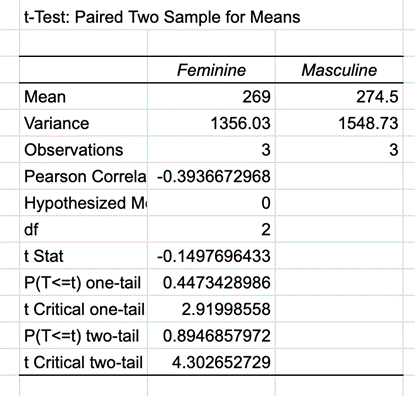
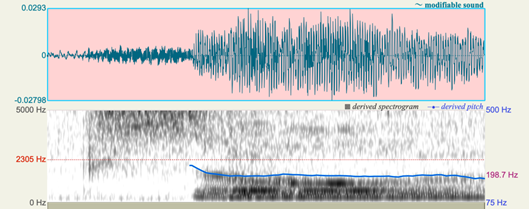
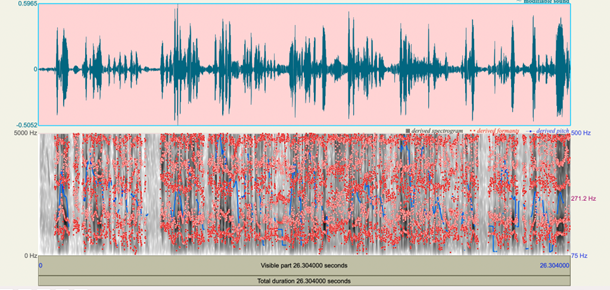
To examine the variations of pitch levels among female characters in East Asian media, we conducted a quantitative analysis on the data obtained from audio clips, with the help of Praat. Specifically, two polarizing female characters were chosen from each of the following shows from different East Asian countries: iPartment (Chinese), Shitsuren Chocolatier (Japanese), and Secret Garden (Korean), leading to a total sample of 6 characters. Comparatively “feminine” and “masculine” characters were selected based on the aforementioned characteristics of masculinity and femininity (Lee et al., 2002). For each character, we obtained a 30-second continuous speech sample during a neutral conversation to avoid any highly emotional conversations, such as arguments and crying scenes. We utilized Praat (Boersma & Weenink, 2023) to measure the average, maximum, and minimum F0 levels of each character’s speech samples (Figure 1). We then compared our data and conducted an independent t-test (Table 2) to examine if the results of the comparison of average pitch levels for “feminine” vs “masculine” female characters were significantly different– indicated by a p-value of 0.05 or lower.

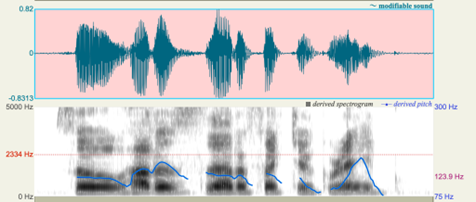
Figure 1: Example of character spectrogram through Praat (Gil Ra Im)

Results and Analysis

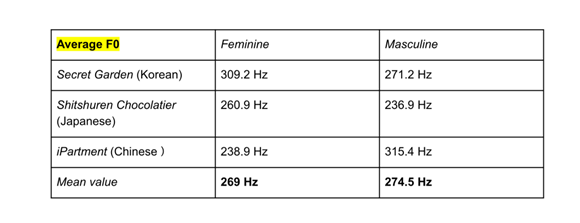
With respect to within-group comparisons, the Korean TV show Secret Garden showed results consistent with our hypothesis. The traditionally “feminine” character Ah-Young had an average F0 of 309.2 hertz, while the “masculine” character had an average F0 value of 271.2 hertz. Thus, the average F0 values obtained from this TV show provided positive evidence for our initial hypothesis that high pitch largely contributes to formulating a traditionally feminine persona. It is also important to note that the maximum and minimum F0 values possessed by the Korean feminine characters were highly similar, with the numerical difference between their maximum F0 values only being 19.8 Hz, and their minimum F0 values only differing by 4.5 Hz.

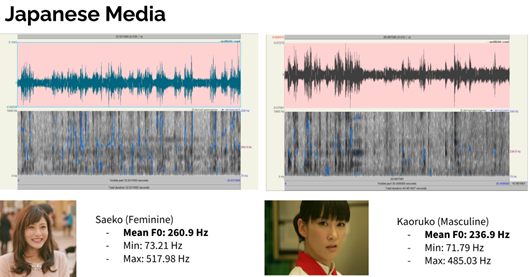
For the Japanese TV show, the stereotypically “feminine” character also had a higher average pitch than the “masculine” counterpart. Saeko, the traditionally “girly” female lead, had a mean F0 of 260.9 Hz while Kaoruko had an average pitch of 236.9 Hz. The two characters’ minimum and maximum pitch values highly aligned with one another as well, with the difference between their maximum values being 32.95 Hz and the difference between their minimum values being only 1.42 Hz. Such closely overlapping values in the minimum and maximum pitch range throughout the speech sample indicate that despite differences in average pitch level, people utilize their whole vocal range during regular day-to-day speech.

Although the data from the Korean and Japanese shows were in favor of our hypothesis, the Chinese show, iPartment, demonstrates results that suggested otherwise. The masculine character surprisingly exhibited a higher average pitch throughout her speech; specifically, the mean F0 value for the masculine character YiFei was 315.4 Hz, which is considered to be conventionally high. In comparison, the feminine character, Nuolan, had a lower average F0 of 236.9 Hz, which was significantly lower than the F0 of YiFei.

Table 1: Comparison of Average Pitch Levels

Lastly, in order to test for the statistical significance for any observed pitch differences, we conducted an independent t-test of the average value of the feminine and masculine characters’ pitch levels. The average pitch level of all stereotypically “feminine” characters was 269 Hz, while the average pitch level for the stereotypically “masculine” characters came out to 274.5 Hz. The t-test suggested that there was no statistically significant difference between these two values, as the p-value came out to p= 0.45. These findings, therefore, were insufficient in leading us to accept the initial hypothesis that the average pitch level of female characters plays a critical role in portraying a stereotypically feminine, girly persona in East Asian media.

Table 2: Independent T-Test (Feminine vs. Masculine)

Discussion and Conclusion

The sample as a whole did not support the hypothesis, as the average pitch level did not significantly differ between feminine and masculine female characters. Although we were able to observe within-group differences for the South Korean and Japanese media, we were unable to identify the predicted pattern of higher pitch in feminine characters within the Chinese drama. This suggests that pitch isn’t the only factor that contributes to one’s feminine persona– there are possible non-linguistic factors, such as appearance (ex. short hair, fashion), occupation, etc. in play that interact to achieve specific characteristics in the media. For instance, other non-linguistic similarities found within the feminine characters was their similar sense of fashion. They dressed themselves in softer colors, more feminine accessories, and wore more skirts and dresses compared to the masculine characters who had a more gender-neutral haircut, dressed in darker clothing, and largely wore pants. It is also important to note that the “masculine” female character in Secret Garden had a nontraditional occupation as a stuntwoman. Her role as a stuntwoman displayed characteristics that were previously identified as being primarily masculine: brave, ambitious, independent, and physically strong (Lee et al., 2002), which could have been a more salient factor in the portrayal of gender norms.

Additionally, it is highly likely that the impressions of masculinity and femininity differ between the three East Asian countries. Although East Asian countries may share common values and practices, there are several invariants: one of them is the link between gender norms and education level. In particular, Chinese culture often correlates masculinity with the possession of a PhD degree (Shanghai Star, 2005). In China, even a third gender type besides men and women has been proposed specifically for females with a PhD degree– this is due to the traditional belief that women are physically and mentally weaker than men, which results in unequal perceptions behind the cognitive capabilities of men and women. In comparison, such prejudiced thoughts regarding gender stereotypes and education are not as prominent in Japan and Korea. This finding above suggests that there are subtle differences in gender beliefs within East Asian culture, which might contribute to why we were not able to observe a static trend in the linguistic style of feminine female characters in media.

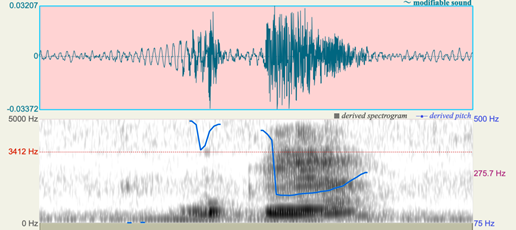
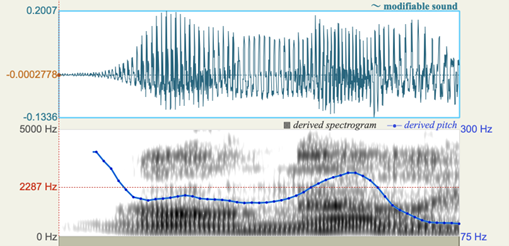
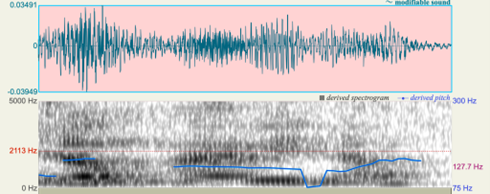
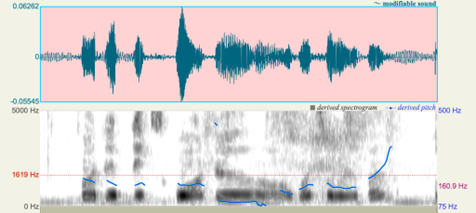
Figure 2: Characters from Shitsuren Chocolatier and their corresponding pitch analysis

Other linguistic factors that contribute to one’s persona could be the speaker’s word-choice, pitch contour, etc.– specifically in the Korean drama Secret Garden, the feminine female lead Ah-Young would often include a word-final nasal sound “ㅇ” that is associated with a playful, cute tone in Korean culture. For instance, she would add the “ㅇ” sound to the end of a neutral phrase “그랬어?” [kɨlɛs͈ʌ], creating an ungrammatical yet stylistic production “그랬엉?” [kɨlɛs͈ʌŋ]. Comparatively, the masculine female lead Ra-Im spoke in a more strict, direct, blunt tone throughout the drama, with the absence of a word-final nasal sound.

Some limitations of this study include the possibility of interference from background noise and thus an inconsistency in speech sample quality. Also, the speech samples were rather short, which might be insufficient in catering to all the variations in the stories’ settings and changes in characters’ personalities and corresponding degrees of femininity (if any occurred). In the future, the research could be improved by including an analysis of several media sources within one culture, instead of one representative film. Additionally, a longer speech sample that encodes the pitch variance throughout the entirety of the drama would lead to a more accurate analysis. Lastly, the speech sample could be cleaned up to minimize “noise.” This could be achieved by feeding the audio clip through a software that isolates linguistic sounds (aka speech sounds) with nonlinguistic ones, or by adjusting the level of the background noise on a higher-quality audio file.

Throughout this research, we heavily emphasized how the use of pitch levels is relevant in Chinese, Japanese, and Korean media to portray both feminine and masculine characteristics. However, it is important to note that a particular language is spoken differently depending on which linguistic community the speaker belongs to within a single country as well. For instance, an existing article regarding the pitch levels of female speech in two different Chinese villages — Jiuying Village and Taoyuan Village — explores how a specific language can be utilized and spoken differently depending on which linguistic community the speaker belongs to (Deutsch et al., 2009). Moreover, it was concluded by the authors that “the overall pitch level of a speaker’s voice is influenced by a mental representation that is acquired through exposure to the speech of others” (Deutsch et al., 2009), indicating that the speaker’s experience and lifestyle in a specific linguistic community affects their tones and pitches in the long run. For future research, focusing on a specific language and comparing how that language is spoken differently in various linguistic communities (hence the emergence and progression of regional dialects) may be beneficial for in depth analysis of a specific language.

It is also plausible that women’s voices are gradually getting deeper overall. The article published by BBC explores how social transformation is mirrored to our speech style, “women today speak at a deeper pitch than their mothers or grandmothers would have done, thanks to changing power dynamics between men and women.” (Robson, 2022). Since the expectations and social norms are changing over time, it is reasonable that our speech style is adjusting to them. To extend upon this research, we could investigate recent shows (past 5 years) from East Asian countries, as our focused media was relatively old and failed to capture the social norms in today’s society.

Altogether, this study revealed that our speech style and persona potentially have a bi-directional relationship, especially with the strong presence of the media in our day to day lives. It allowed us to consider the broad questions of: “What makes us perceive a certain character as feminine versus masculine? Could this factor potentially be linguistic in nature?” Despite not obtaining significant cross-cultural findings, the research uncovered a possibility of Korean and Japanese media implementing high pitch to portray femininity, and the potential for future research that reflect each country’s distinct position surrounding the notion of gender and in-depth analysis of the role of regional dialects in shaping persona.

References

Boersma, P., & Weenink, D. (2023). Praat: doing phonetics by computer [Computer program]. Version 6.3.10, retrieved 3 May 2023 from http://www.praat.org/

Collins, R. L. (2011). Content analysis of gender roles in media: Where are we now and where should we go? Sex Roles, 64(3-4), 290–298. https://doi.org/10.1007/s11199-010-9929-5

Deutsch, D., Le, J., Shen, J., & Henthorn, T. (2009). The pitch levels of female speech in two Chinese villages. The Journal of the Acoustical Society of America, 125(5). https://doi.org/10.1121/1.3113892

Klofstad, C. A., Anderson, R. C., & Peters, S. (2012). Sounds like a winner: Voice pitch influences perception of leadership capacity in both men and women. Proceedings of the Royal Society B: Biological Sciences, 279(1738), 2698–2704. https://doi.org/10.1098/rspb.2012.0311

Krahé, B., & Papakonstantinou, L. (2019). Speaking like a man: Women’s pitch as a cue for gender stereotyping. Sex Roles, 82(1-2), 94–101. https://doi.org/10.1007/s11199-019-01041-z

Lee, B. S., Kim, M. A., & Koh, H. J. (2002). Development of Korean gender role identity inventory. Journal of Korean Academy of Nursing, 32(3), 373-383. https://doi.org/10.4040/jkan.2002.32.3.373

Robson, D. (2022, February 25). The reasons why women’s voices are deeper today. BBC Worklife. https://www.bbc.com/worklife/article/20180612-the-reasons-why-womens-voices-are-deeper-today

Shanghai Star. (2005, March 4). Women PhDs the 3rd type of people besides men, women? China Daily. https://www.chinadaily.com.cn/english/doc/2005-03/04/content_421834.htm

van Bezooijen, R. (1995). Sociocultural aspects of pitch differences between Japanese and Dutch women. Language and Speech, 38(3), 253–265. https://doi.org/10.1177/002383099503800303

[/expander_maker]

, , , ,

Impassioned Speech: ¿Lo has visto?

Nikki Lee, Kiara Mares, Jamie Seals, Ally Shirman

In everyday conversations, bilingual speakers frequently code-switch between their languages. With our modern society, we can see this becoming prevalent in media during emotional scenes with bilingual characters; specifically in movies and TV shows. In this study, we investigated three different shows and movies with bilingual actors who use their heritage language as a part of their character to see whether there is a correlation with code-switching in highly emotional situations. We chose three sources to gather this data that have at least one bilingual main character; Jane the Virgin (2014), Everything Everywhere All At Once (2022), and Modern Family (2009). For each source, we analyzed around 120 minutes to have an equal amount of data. Analysis of this data found that code-switching during emotional scenes did occur, but was more prevalent in more recent media. The study helps to show that code-switching is becoming more representative for bilingual speakers in modern media.

[expander_maker id=”1″ more=”Read more” less=”Read less”]

Introduction and Background

Entertainment media heavily relies on creating a connection between the viewers and the characters and themes presented. The characters in media are often the biggest attraction because of their relatability. Thus, the representation of characters with different backgrounds, including gender, ethnicity, age, socioeconomic status, etc. is very powerful in shaping viewer and societal perceptions. Characters rely heavily on language and emotion to give away key details and shape who they are and what their role is. This is especially evident in American entertainment media with actors who play ethnic characters, with cultures other than dominant U.S. culture. Bilingualism and code-switching are some of the biggest tools used to portray identity within these characters’ roles. This makes their heritage language use very strategic and intentional for character depiction. Recognizing the power of media and how it aims to reflect real-life ideas, our project focuses on where entertainment media uses second languages, and how it intersects with emotion to reflect ideas about a language or a character.

Our project focuses specifically on bilingual actors within entertainment media who use their heritage language as part of their character. We want to investigate when this heritage language is used and if it is associated with highly emotional scenes or situations. Research on language and emotion in real-life scenarios has indicated that language use and choice can be influenced by emotions that we correlate with that language. Looking specifically at American media, our goal is to observe whether or not heritage language use occurs in more emotional situations than non-emotional scenes, and identify if there are emotions that occur more often in a heritage or dominant language. This project will be focusing on language contexts, both positive and negative, and then observing what language it occurs in. Based on our own experiences with code-mixing, media depictions, and language perceptions, we hypothesize that in highly emotional situations, characters will code-switch to their heritage language, other than English. We predict that the characters are written to represent real-life bilingual speakers to deepen their character and the media. Many viewers may find this relatable or can connect with the cultural identity of both languages being presented – which could contribute to further media representations.

Gaps in Research

Though bilingual speakers often use one language in specific settings, and the other in other settings (e.g. heritage language at home and in informal contexts, and dominant language in formal settings like work, especially if that second language is the standard language of their country), they also often use both languages at once (Ferguson, 1959). This most commonly happens when speaking to other bilingual people, but it does happen elsewhere as well. This use of both languages at once is referred to most commonly as code-switching, where interlocutors will use both languages at their disposal within the same utterances, often without consciously making the decision to do so. Though there are many ways and uses of communicating via multiple languages at once, a prominent trigger for code-switching comes from emotionally arousing situations. One study found that, through direct observation of participants in a high-stress problem-solving task, people code-switched more frequently when expressing negative emotions. Specifically, participants switched to their heritage language to express these negative feelings rather than using the dominant language (Williams, Srinivasan, Liu, Lee, Zhou, 2020). We anticipate that our study will recognize some of the same characteristics of code-switching and plan to focus on a character, then identify the number of situations in which this occurs.

Additionally, in these highly arousing emotional situations, it is more likely that speakers use their first language to react, rather than their second language. We see this in the study conducted by Ariana Mohammadi titled, “Swearing in a second language: the role of emotions and perceptions.” Additionally, a study conducted by Shahrzad Mahootian covers these emotional situations in their study and they state, …the list of evocative switches was “more meaningful” in Spanish, that they carried “more emotional power,” (“emotional statements will be said in Spanish. English is not sufficient”) that they were used to “create solidarity,” that they were “much stronger” when said in Spanish (Mahootian 2005). This study helps to show how speakers would be more motivated to code-switch in order to convey their words more effectively between themselves and their listeners. As we have shown, there has been a good amount of research done on the connections between code-switching and heritage language use with emotion but this research has not been carried over to the media. There has not been research done specifically on character use of code-switching and heritage language use and the emotion of their character or scene. We hope to fill this gap with our research in this project and we can anticipate that the media we have chosen for our study will be able to reflect these previous findings.

Methods

To understand whether code-switching occurs in half or more emotional instances in media, we used three sources that each include at least one bilingual main character and are from the 21st century. Specifically, Jane the Virgin (2014), Everything Everywhere All At Once (2022), and Modern Family (2009).

From left to right: Jane the Virgin (2014), Everything Everywhere All At Once (2022), Modern Family (2009)

Additionally, we made sure that all three of these sources’ bilingual characters’ heritage languages were relevant to the characters themselves, but not a dominant focus for the storylines. All bilingual characters were interacting in a space where their heritage language is not the dominant language (which is English in all three sources).

We analyzed roughly 120 minutes of each source to ensure that the amount of data we collected from each would be equal, based on the length of Everything Everywhere All at Once. (We looked at three Jane the Virgin episodes (each ~40 minutes), and 6 Modern Family episodes (each ~20 minutes)).

We noted (coded) each instance of an emotional scene in each source, as well as instances of code-switching within these emotional scenes. This would allow us to calculate a ratio (number of code-switching instances in emotional scenes divided by the total number of emotional scenes), and thus a percentage, to understand how accurate our hypothesis is.

Before coding each source, we defined what “emotional” meant to ensure that each researcher was coding via the same guidelines. Highly emotional instances could come in the form of:

  • Voice: raised voice, yelling, screaming, whimper
  • Exaggerated body language
  • Clearly emotional facial expressions that last (e.g. no microexpressions)
  • Crying

Results

Everything Everywhere All At Once

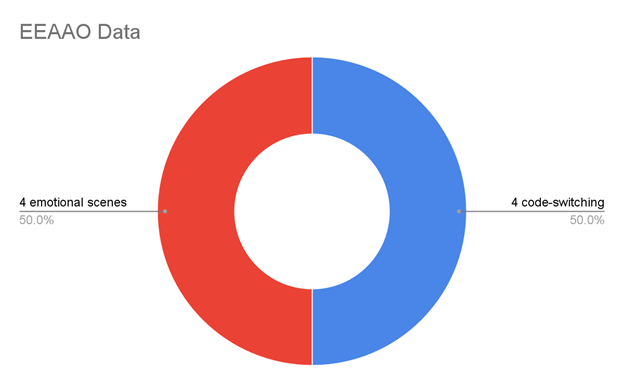
4 code-switching instances in 8 total emotional scenes → 50% code-switching

Jane the Virgin

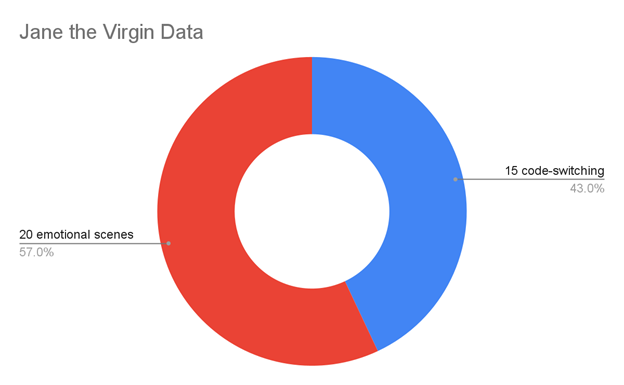
15 code-switching instances in 35 total emotional scenes → 43% code-switching

Modern Family

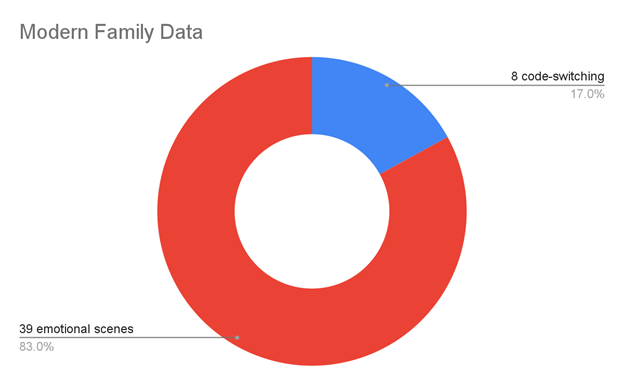
8 code-switching instances in 47 total emotional scenes → 17% code-switching

Combined: 27/90 → 30% of all emotional scenes across the three sources included code-switching.

Everything Everywhere All At Once was the only source to meet the hypothesis that at least half of the emotional scenes would include code-switching. However, it is important to note that there was quite a bit of diversity in how many instances of emotional scenes there were per source. Everything Everywhere All At Once only included eight, likely because it has deep themes compared to the sitcom-like shows, and the scenes are generally longer. Modern Family, on the other hand, is fast-paced (only 20 minutes per episode) and includes generally more exaggerated characters, leading to their behaviors being more exaggerated and emotional as well. This is reflected in the 47 total emotional scenes, compared to the eight from the movie.

However, even though Modern Family had the most emotional scenes, it had the lowest ratio (17%) – this is likely because there is only one bilingual character (Gloria), giving her fewer opportunities and reasons to code-switch (e.g. code-switching out of instinct when stepping on a Lego, versus code-switching to communicate an idea to someone who also speaks English and Spanish that she wouldn’t otherwise be able to explain).

Visual Media

Patterns and Analysis

Results of our study did not exactly align with our data but did highlight some interesting patterns. There were three particular patterns that were recurring in the data and had a similar basis to previous research in the realm of bilingualism in the media.

The first pattern observed from our data was the use of bilingual code-switching for reference terms. In all three of the media forms, characters code-switched when referring to another character they were close to or comfortable with. In Jane the Virgin, this was observed with the consistent referral to Jane’s grandmother as “abuela,” even when the rest of the sentence was in English. ‘Gloria’ in Modern Family also did this frequently when referring to her husband with terms of endearment such as “mi amor” (season 9, episode 3) and when referring to Haley’s children as “mis niños” (season 11, episode 6). This pattern touched on previous research that found that heritage language is used when speakers are more comfortable, which would make sense for using with family (Cho, 2015).

Modern Family Phil makes Gloria cry

Another pattern observed was use of bilingual code-switching as a form of addressing certain audiences. During scenes where characters were in the presence of other bilingual characters, or when they wanted to speak to someone directly, sometimes to the extent of using language to be private. This example was seen in Everything Everywhere All At Once when ‘Evelyn’ is standing up to ‘Gong Gong’ and switches between languages to focus on different scenarios, despite him understanding each of the languages. Evelyn chooses to code switch from Cantonese, English, and finally Mandarin to allow the listeners of that scene, her daughter and husband, to better understand her feelings. Other scenes like in Jane the Virgin used code-switching to Spanish to make sure the police didn’t understand their plan of action while he was in the room. This pattern is reflective of previous research that concluded that negative languages are more typically expressed in the heritage language, which could explain why it was used to exclude someone from a conversation (Williams, Srinivasan, Liu, Lee, Zhou, 2020).

Everything Everywhere All At Once (2022) – Evelyn Stands Up To Gong Gong | HD

Jane the Virgin used code-switching to Spanish

Finally, we observed bilingual code-switching as an indicator of urgency. Characters who were experiencing a sense of urgency and trying to communicate this hurry used code-switching to do so. This example can be seen in Everything Everywhere All At Once when Evelyn is dealing with multiple stressful situations while her family members are adding to that stress, which makes her frantic. The audience can see her emotions overflow as she code switches from Mandarin to English in order to fully express her frustration in that situation. Given that urgency could be related to other feelings, such as stress and desperation, this observation came closest with our hypothesis.

Despite the shows having different content matter, being different genres and having different amounts of bilingual characters (and thus different instances of code-switching), these were patterns that overlapped in at least two of the three media examples used. The patterns occurred in various examples throughout each of the shows and seemed to be consistent parts of the character and their role in the plot. Each of the patterns identified was relevant in various instances throughout the shows and highlighted some real-life uses for code–switching and bilingualism. Although it wasn’t what we were expecting, it definitely taught us a lot about what to expect for bilingualism in both media and everyday life.

Limitations

Within our study, there were some limitations that potentially contributed to the results being different than our predictions, but definitely impacted the process. In relation to content, our project primarily focused on three media examples. Had we used more than two shows and one film, our results may have had more range in code-switching and examples of bilingualism. Essentially, a wider range in media examples would have been more beneficial for getting a wider scope of media examples. This connects with the second limitation: variation within the media content examples. Modern Family definitely had more “feel-good,” positive moments which is different from Jane the Virgin which dealt with heavier themes and was more of a drama. While this variation was definitely better for maximizing examples of bilingual code-switching, the lack of consistent storylines and genres didn’t allow for the same amount of opportunities for code-switching during impassioned speech. Instead, the variation in content and storylines would have made code-switching more of a chance occurrence than a predictable feature.

Finally, perhaps the most impactful limitation in our research project was that most characters were the only bilingual characters in the show. This was specifically the case for Modern Family, where ‘Gloria’ was the only character who spoke Spanish and didn’t have any other main character to speak it with. In Jane the Virgin, even though ‘Jane’ and ‘Xiomara’ were Spanish-English bilinguals, they would respond in English and ‘Abuela’ was the only one who spoke Spanish the entire time. Each of these limitations could have contributed to the results and for future studies would be important to avoid.

Future Study

Considering the limitations previously mentioned and in collaboration with the patterns mentioned, a refined, future study would certainly involve a wider range of media for observation. For standardization purposes, it would be important for shows to be produced and based in the US, be from the same range of years (as in our example, the last two decades/the 21st century), and have the same amount of minutes watched, but this new study would focus on shows with more bilingual characters. Considering these elements and our previous interest in bilingualism and code-switching in the media, further research conducted could be based upon media that covers different backgrounds to be more inclusive towards the American audience. We can see a trend of this from big companies, like Disney, who have produced movies like Encanto and Turning Red. With this trend of inclusivity, there is a high possibility of representation for bilingual speakers in future media. In turn, this would allow for more possible studies to look into the instances of code-switching during emotional scenes.

Conclusion

This analysis of bilingualism in media is a good first step for better understanding how bilingual and multicultural people are represented through TV, specifically to American, English-dominant audiences. However, no broad conclusions can be drawn from this study alone; without a large sample size, we may have missed important themes and patterns on the representation of code-switching from real life, or the patterns that we did find may not appear to the same degree on a larger scale.

A larger sample size, both in terms of the amount of minutes analyzed for each source, and the amount of diverse sources chosen, should be used to create a clearer picture of how writers choose to represent bilingual characters’ language use in media.

Despite the limitations and potential to make this study broader, this introductory analysis still has shown how some patterns of code-switching (proven to be common via research studies mentioned earlier) in real life are accurately represented in media as well. As the representation of multicultural and multilingual people in the United States is being more and more encouraged in American media, the more we are actually seeing it. As in Everything Everywhere All At Once – the most recent, and most diverse, media source used in this study, it was the one source that did meet our hypothesis (50% code-switching in emotional scenes).

As screenwriters continue to portray a more accurate representation of the diversity in the United States, the more we should expect to see multi-language dialogue, filled with code-switching in these shows and movies. In future studies, a specific focus on the function of code-switching by bilingual characters, both in and out of emotional contexts, could give even more insight into how multilingual and multicultural people are represented in older media versus current media. Some examples of code-switching (and code-mixing) functions include keeping conversations private from others, raising the status of the agent who is speaking, making side comments or humorous remarks, emphasizing what is being said, or reiterating something (Gumperz, 1982). Taking this approach and categorizing the linguistic reasons for code-switching would be a great potential first step for understanding where United States media companies are at in terms of true representation of the diversity in this country.

References

Cho, G. (2015). “Perspectives vs. Reality of Heritage Language Development Voices from Second-Generation Korean-American High School Students.” https://files.eric.ed.gov/fulltext/EJ1065385.pdf

Ferguson, C. A. (1959). “Diglossia” WORD, vol. 15, no. 2, pp 325-340., https://doi.org/10.1080/00437956.1959.11659702

Gumperz. (1982). Conversational code switching. Discourse Strategies, 59–99.

https://doi.org/10.1017/cbo9780511611834.006

Lee, J. S. (2010, April 23). The Korean Language in America: The Role of Cultural Identity in Heritage Language Learning. Taylor & Francis Online. Retrieved February 5, 2023, from https://www.tandfonline.com/doi/abs/10.1080/07908310208666638

Mahootian, S. (2005). Linguistic change and social meaning: Codeswitching in the media. International Journal of Bilingualism, 9(3-4), 361-375.

Mohammadi, A. N. (2020). Swearing in a second language: the role of emotions and perceptions. Taylor and Francis Online. https://www.tandfonline.com/doi/full/10.1080/01434632.2020.1755293

Williams A, Srinivasan M, Liu C, Lee P, Zhou Q. Why do bilinguals code-switch when emotional? Insights from immigrant parent-child interactions. Emotion. 2020 Aug;20(5):830-841. doi: 10.1037/emo0000568. Epub 2019 Mar 14. PMID: 30869940; PMCID: PMC6745004

[/expander_maker]

, , ,

Do you Entiendes?

Roni Grushkevich, Iffet Dogan, Isaac Verdugo, Nandana Suresh

The following research on receptive multilingualism seeks to observe if exposure to popular Spanish singing artists of various dialects impact Spanish heritage and non-Spanish heritage speakers’ ability to comprehend their song’s lyrics. 8 participants (4 native Spanish speakers, 2 romance language speakers, and 2 individuals who learned Spanish in school) were given a combination of a C-test and song test via Google survey. The C-test was administered to standardize the level of basic Spanish comprehension across the participants. 3 separate song tests were made for each of the following Spanish singing artists of different Spanish dialects: Vicente Fernandez (Mexican), Bad Bunny (Puerto Rican), and Shakira (Columbian), containing their most popular song. Out of the 8 participants, only 25% of them stated to have relied on their romance language in order to comprehend Spanish. Direct translations were uncommon, however, interpretations of the music were accurate. The results from the study suggest that heritage Spanish speakers were able to comprehend more than their non-heritage counterparts.

[expander_maker id=”1″ more=”Read more” less=”Read less”]

Introduction and Background

Can exposure to various dialects within the context of music impact a Spanish speaker’s ability to comprehend lyrics of a dialect they can not necessarily speak? As widely known global sensations, Bad Bunny, Vicente Fernandez, and Shakira are enjoyed by speakers of various languages. These artists, Bad Bunny originating from Puerto Rico, Vicente Fernandez from Mexico, and Shakira from Columbia, sing in various dialects of Spanish and have the potential to subliminally impact non Spanish heritage and Spanish heritage speaker’s ability to comprehend Spanish from exposure alone. This phenomenon relates to receptive multilingualism, which refers to a mode of interaction wherein people can use a language or language variety that the person with whom they are communicating does not speak, without compromising any understanding between both parties, and without the use of any additional lingua franca (Rehbein et al. 2011). This essentially means that people who have been exposed to a particular language can develop the ability to understand it, without necessarily being able to speak it. This phenomenon allows for different, varied modes of communication, especially between speakers of similar languages and dialects, who may be able to understand each other while not speaking each others’ mother tongues. Similar research on this topic has revealed mixed findings. A study by Gooskens & Heeringa (2014), found that Norwegian speakers, who tend to be more exposed to different dialects of Norwegian, were better at translating texts in other Scandinavian languages than Danish speakers. In Sloboda & Nábělková (2013), the researchers found that in online spaces, there were mixed results on whether Slovak is intelligible to Czech speakers. The following research differs from existing findings as it focuses on receptive multilingualism within the context of music, focusing on heritage and non-heritage Spanish speakers specifically. We predict that through receptive multilingualism, Spanish heritage speakers will have the highest comprehension of song lyrics of various dialects; however, non-heritage speakers will have some level of comprehension through learned Spanish or familiarity with Spanish.

From left to right: Shakira, Bad Bunny, Vicente Fernández

Methods

Our participants were composed of both heritage Spanish speakers and non-heritage Spanish speakers. Participants were not asked to report their age or other demographic information. All of our participants are based in Los Angeles, California and were UCLA students. We got our participants by asking individuals who we know meet the requirements and asking individuals enrolled in a UCLA Italian course. We ended up having 8 participants (4 heritage Spanish speakers, 2 romance language speakers, and 2 individuals that learned Spanish in school). Non-native Spanish speakers were asked to report if they had received formal education in Spanish and if they did not speak Spanish, what Romance language they did speak.

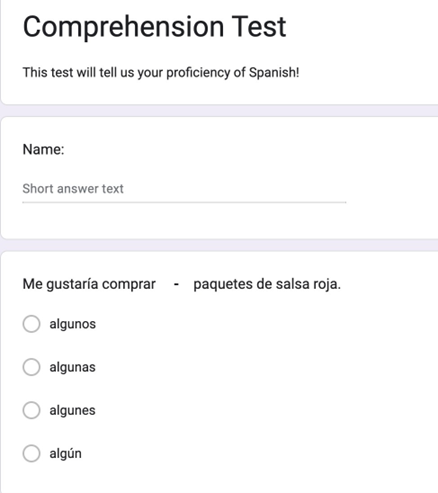
We were able to conduct our study via C-test and song test, both of which were presented to the participants online in one survey. A C-test is a tool to measure language proficiency and this shows us where the participant’s levels of proficiency in Spanish is placed. We used the C-test from an online source (One to One Spanish). We chose to have this C-test in Spanish because it would allow us to compare our participants although they all come from different backgrounds. The entire C-test is multiple choice but we asked each participant to explain what skills they used to answer the questions.

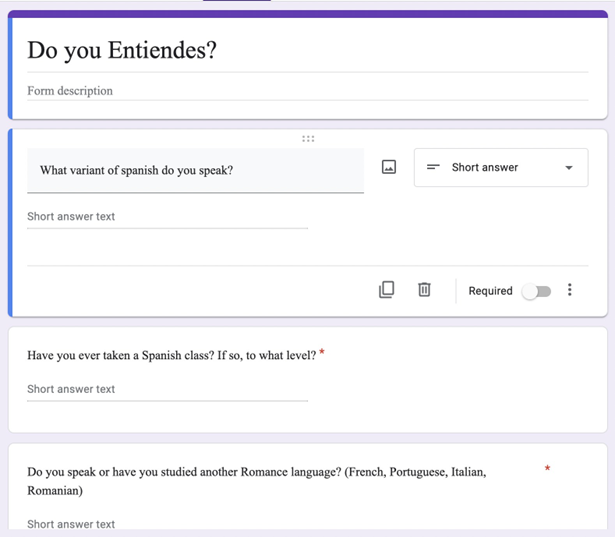
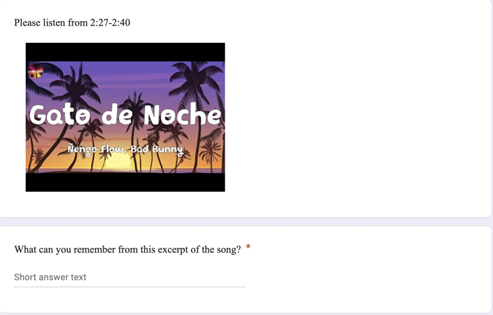
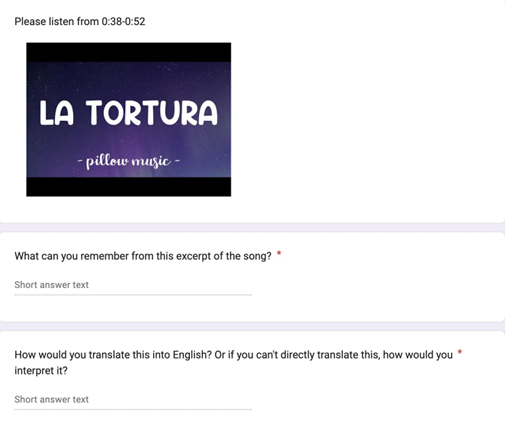
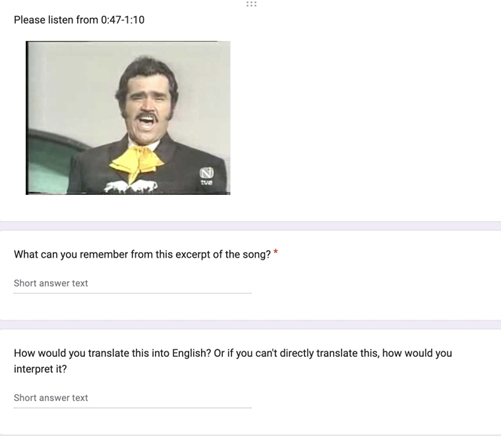
The second part of the Google survey consisted of a set of questions that revolved around a song by one of the Spanish language artists, Vicente Fernandez, Bad Bunny, and Shakira. The participant was given a survey with one of the artists that does not sing in the variation of Spanish that they are privy to in the case that they are one of the heritage speakers of that variation. For example, a heritage Mexican-Spanish speaker was not given Vicente Fernandez as their musical artist to interpret. Moreover, each participant was pre-screened and elaborated on which type of Spanish they are familiar with/speak in order to select the song from an artist who sings in a variation of Spanish they’re unfamiliar with. The survey asked questions like what variation of Spanish they speak, if they have ever taken a Spanish-language class, if they have studied another romance language and to what level. Upon answering these questions, the participant listened to a section of the song they were given. Upon listening to the section of the song, the survey asked participants what they remember hearing from the song and followed up with asking the participant how they would translate what they heard into English and if they could not do so, how would they interpret what they heard. Lastly, they were asked how they came to this interpretation. We anticipated word chunks to be an important element in the analysis because of the similarities some words have with a similar romance language which would contribute to the receptive multilingualism. We evaluated the amount of word chunks that they were able to register in each survey. We accounted for the amount of word chunks they input as well as the frequency of entire sentences they input among the three different songs.

Results / Analysis

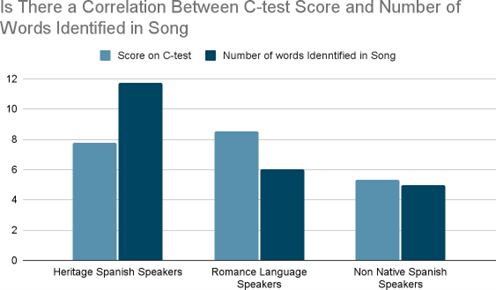
Based on our results, it is clear that our participants scored fairly well on the C-test. Out of nine questions, we were able to compare participants’ comprehension of Spanish in comparison to each other. As shown by Figure 1, the heritage Spanish speakers and romance language speakers performed better on average in comparison to the non-native Spanish speakers. This is something that we predicted when creating our study. This could be due to the fact that the heritage and romance speakers have more background with Spanish and have better knowledge to apply when taking the C-test. It is important to note that the non-heritage Spanish speakers scored exactly where we predicted they would. With some prior knowledge in Spanish, averaging a 5.5/9 on the C-test is fairly high.

Figure 1 aims to see if there is a correlation between the score participants got on the C-test and the number of words/chunks they identified in the second part of the Google survey when listening to the song. It is clear that heritage Spanish speakers performed the best at identifying words/chunks out of the song they heard. One surprising thing we do see in the graph is that the romance language speakers did much better on the C-test portion in comparison to the music component. This could be due to the fact that the C-test relies more on recall because it is multiple choice. This means that romance language speakers see the options listed which could help them reach the right answer. However, when needing to write chunks/words they remember, it is a much harder task that requires more knowledge of Spanish.

Overall, Figure 1 proves the fact that the performance on C-test is highly correlated to the way participants performed on the song test.

Figure 1. Shows correlation between the score participants got on their C-test and how well they performed on the second part of the Google survey.

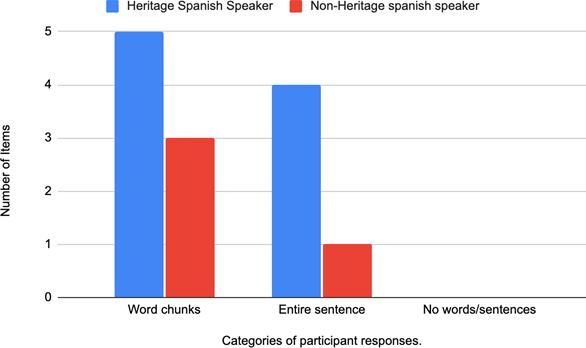
Below is a column chart that displays the amount of participants that were able to register word chunks, entire sentences, and no sentences or word chunks. The heritage Spanish speakers were able to register more word chunks and entire sentences than their non-heritage counterparts.

Figure 2. Column chart with participant’s results.

The excerpts from each song were less than 15 seconds each and displayed roughly three whole sentences. Vicente Fernández’s Volver Volver included the lyrics “Nos dejamos hace tiempo pero me llegó el momento de perder. Tú tenías mucha razón le hago caso al corazón y me muero por volver.” Our two participants that were given the song Volver,Volver comprehended a good amount of lyrics that they were able to translate into small pieces of information like word chunks. Their knowledge of pop-culture and their respective romance language backgrounds were able to assist them in their interpretations of the song and lyrics. Bad Bunny’s Gato de noche exhibited the following lyrics from the excerpt “Tú ere’ mi loca y hoy te toca la terapia si no se lo meto le da rabia puedo tener más de veinte pero tú ere’ mi bichota, tú ere’ mi sicaria tanto’ pece’ en el mar”. Three heritage Spanish-speakers were able to register the entirety of the song excerpt; however, they did not register every word. Their knowledge in Spanish and the use of context clues based off of that knowledge was able to assist them in their interpretation of the song. The one non-heritage Spanish speaker that was given the Bad Bunny excerpt registered a few word chunks but did not succeed in translating the excerpt entirely. They did mention that their romance language assisted them in their interpretation and therefore led to their response aligning with what the lyrics entailed.

Shakira’s La Tortura was given to two participants, both of whom are heritage-Spanish speakers. The following lyrics were exhibited in the excerpt: “Ay amor me duele tanto, me duele tanto. Que tú fueres sin decir a dónde ay amor fue una tortura perderte.” The two participants had very accurate translations of the excerpt as well as the amount of word chunks and sentences they were able to register. Both of them translated the lyrics and their interpretation of the excerpt was accurate. They stated that their background in Spanish was the main reason for their accurate responses. Out of the eight participants, only 25% of them stated to have relied on their romance language in order to comprehend Spanish. Direct translations were uncommon, however, interpretations of the music were accurate.

The findings of the data suggest that heritage Spanish speakers were able to comprehend more than their non-heritage counterparts. Given that we received eight responses, it is not clear whether or not the findings reflect this on a macro level.

Discussion and Conclusions

Overall, while our C-test results were mixed, there certainly was a positive correlation between one’s prior exposure to Spanish and the amount of words they were able to translate during the music component of this experiment. This shows that, for the romance language speakers and non-native Spanish speakers, the prior exposure that they may have had to Spanish or another romance language probably did help them translate the song lyrics that were given to them, especially when we consider the fact that, even though many of the non-native Spanish speakers were not able to perfectly translate the lyrics, a large proportion of them were still able to accurately understand the meaning of the song lyrics. In essence, while they may not have been able to understand the meaning of each individual word, they may have been able to use what they did know, in conjunction with context clues, to make an educated guess as to what the general meaning of the lyrics were.

As it turns out, this is a strategy that many of our participants reported that they were able to follow, in that they described being able to recognize some of the more “important” content words (nouns, verbs, adjectives, and adverbs), and use them to their advantage. These words happened to be those that were either well known to non-Spanish speakers, such as loca, or those that share a similar form to their counterparts in English or other romance languages. From there, they described being able to use context clues to help them derive the meaning of the surrounding word chunk. Aside from this, there were some non-linguistic aspects of each song that may have somewhat aided the participants in their translations, in that features like tone, rhythm, tempo, etc. may have helped them identify the mood, and likely subject matter of the song. we did not see this described in our data enough, though, to make any concrete conclusions surrounding this.

However, when discussing this experiment, it is important to consider factors such as formal education that may have skewed our data—many of our non-native Spanish speakers had taken Spanish to quite a high level in the past, which can explain the relatively high proficiency that was found in their C-test results, and may have boosted their ability in the song lyric task as well. This is not necessarily a bad thing, since it doesn’t disprove that receptive multilingualism is the underlying mechanism in their success in these tasks. In terms of better understanding the strength of receptive multilingualism, though, we would probably have wanted to include participants who had less, but still some, exposure to Spanish. In this way, we would have been able to draw stronger conclusions from the data we collected—if people who had a very basic level of formal exposure to Spanish were still able to understand the meaning of the song lyrics, while likely performing poorly on the C-test, it would ultimately mean that their receptive capabilities were the main reason as to why they were able to understand the lyrics.

Additionally, only two out of the three videos we used to present the songs to the participants contained closed captions, which definitely showed in our data. We noticed that while most participants were able to understand the lyrics of the songs that contained closed captions, the participants that were assigned to the song that did not have closed captions struggled considerably with recognizing words and translating lyrics as a whole. This is not particularly surprising—while many words may share written forms between English, Spanish, and other Romance languages, they don’t necessarily sound similar. Because of this, when participants were forced to rely purely upon auditory stimuli during the music component, they may not have recognized some words that they would have recognized if they had access to closed captions while listening. In terms of receptive multilingualism, this indicates that people’s receptive abilities are stronger when they have both audio and visual input, as opposed to just audio input, as it makes it easier to make connections between the words in the received language and their counterparts in their native languages.

While we cannot make any claims about whether this makes it easier to then learn these words in the received language, perhaps, in the future, doing something like adding closed captions to all songs would help people understand their lyrics, even if they don’t speak the language that the song is sung in. Thus, receptive multilingualism can be a powerful tool in understanding non-native languages especially when considering songs and other forms of media, because we have various amounts of ways in which we can present information to listeners to aid their understanding of the material, no matter what their background may be.

Appendix

Comprehension Test

Survey Inquiry

Song Test A: Bad Bunny
Song Test B: Shakira
Song Test C: Vicente Fernandez


References

Bahtina-Jantsikene, D. (2013). Mind Your Languages: Lingua Receptiva in Estonian-Russian Communication. LOT. http://www.lotpublications.nl/Documents/338_fulltext.pdf

Bulatović, S., Schüppert, A. & Gooskens, C. (2019). Receptive multilingualism versus ELF: How well do Slovenes understand Croatian compared to Croatian speakers’ English? . Journal of English as a Lingua Franca, 8(1), 37-65. https://doi.org/10.1515/jelf-2019-2005

Gooskens, C. & Heeringa, W. (2014). The role of dialect exposure in receptive multilingualism. Applied Linguistics Review, 5(1), 247-271. https://doi.org/10.1515/applirev-2014-0011

Rehbein, J., ten Thije, J. D., & Verschik, A. (2012). Lingua receptiva (LaRa) – remarks on the quintessence of receptive multilingualism. International Journal of Bilingualism, 16(3), 248–264. https://doi.org/10.1177/1367006911426466

Sağın-Şimşek, Ç., & König, W. (2012). Receptive multilingualism and language understanding: Intelligibility of Azerbaijani to Turkish speakers. International Journal of Bilingualism, 16(3), 315–331. https://doi.org/10.1177/1367006911426449

Sloboda, M. & Nábělková, M. (2013) Receptive multilingualism in ‘monolingual’ media: managing the presence of Slovak on Czech websites, International Journal of Multilingualism, 10:2, 196-213, DOI: 10.1080/14790718.2013.789523

Spanish Quiz – Prueba de Español – B1. Free Spanish quiz B1 – Intermediate Low level. (n.d.). https://121spanish.com/spanish-quiz-B1

Verschik, A. (2012). Practising receptive multilingualism: Estonian–Finnish communication in Tallinn. International Journal of Bilingualism, 16(3), 265–286. https://doi.org/10.1177/1367006911426465

Weiss, Gretchen. (2021) The Effect of Music Instruction on Bilingual Early Language Acquisition. [Master’s thesis, California State University]. https://scholarworks.calstate.edu/downloads/1j92gd72g#:~:text=Children’s%20songs%20 and%20chants%20taught,and%20reinforcement%20by%20the%20family.

[/expander_maker]

, , , ,

Code-Switching Habits of BTS

Sylvia Le, Lien Joy Campbell, Jose Orozco, Noah SS

Do you know BTS? – If you answered no, where have you been? In the past five years Korean pop music (K-pop) has undergone a global explosion. Built into the successful business model of K-pop is the central idea of English as a Lingua Franca. While several studies throughout the years have focused on code combinations in lyrics, our study addresses specifically code-switching in a less structured environment: interviews. We elected to focus on the “biggest boy band in the world” and, arguably, the most well-known and culturally recognizable act in the international K-pop industry, BTS. The central question driving us was: does code-switching correlate to the success of BTS? In this study, we focused on interviews from three parts of BTS’s career and analyzed them for the structure, type, and cause of code-switching, while also comparing the frequency to their album sales and streams. We found that while language as a tool for international growth may be tangible, it is perhaps not as productively used as we assumed.

[expander_maker id=”1″ more=”Read more” less=”Read less”]

Background

Oftentimes, musicians and artists have found language to be a barrier between them and larger, global audiences. As artists, they are responsible for their audience connecting with their work, as well as their audience connecting with them as artists – and the way we use language in conversation has a huge impact on other people’s perception of us. So, the language in which an artist communicates can play a huge role in the reception of their work and the way they connect with fans and audiences. Recently, this has been a distinct element of modern music, where global streaming and social media connection is at an all-time high. In particular, K-Pop groups have found an increasingly English-speaking audience.

Recognizing this, we chose to investigate more deeply whether K-Pop groups have relied more on code-switching when interacting with their audience. Specifically, we wanted to analyze how K-Pop groups have used English, incorporating it into their interviews, music, and public persona, to garner a wider audience, as according to Ahn (2021), English is one of the main factors associated with the success of K-pop on the world stage.

Code-switching, for our purposes, may be defined as the practice of alternating between two or more languages or varieties of language in conversation.

While plenty of K-Pop groups have, over the years, made serious international inroads, it is arguable that none have achieved as much success as the boy band Bangtan Sonyeondan, BTS. They debuted in 2013 producing and performing hardcore hip-hop music and enjoyed their first breakthrough and commercial success in 2015, after the release of HYYH, a Youth series demonstrating their evolving musical style. Alongside the shift in music, they began using “more elaborate storylines” and “multi-layered narratives” to create the BTS Universe. HYYH was aimed at the Chinese market, but after the Chinese government closed its market to K-pop in 2016 due to the THAAD crisis, BTS was one of the first K-pop bands to actively aim at the US market, the largest and most influential in the world. Now, BTS is widely regarded as the biggest boy band in the world (Parc & Kim, 2020).

Given the established desirability of the US market from Shin and Kim (2013) and an understanding of the growing power of English as lingua franca in Asia from Kirkpatrick (2010), we chose to study instances specifically of BTS’ English/Korean code-switching.

Methodology

Several studies have focused on the use of code-switching in the actual performance and songs of K-Pop. We believed that studying English in interviews would be more casual and supplement previous lyric research. We were inspired by a study conducted by Octaviani and Yamin (2020) on the triggers of code-switching in the TV show, The Immigration, and a thesis conducted by Luthfiyani (2014) based on code-switching in the TV show, The After School Club.

Our data took the form of BTS’ interviews given to English-speaking international press/media. The selection of these was based on the popularity of the interviews as well as their chronological position in BTS’s career. Exempting their hiatus years, we split BTS’ career into three parts. We analyzed the two most viewed international interviews, via YouTube, from the beginning (2013-2015), the middle (2016-2018), and the most recent part of their career (2019-2021).

As BTS present themselves as a group and to account for variance in Korean/English proficiency, we elected to analyze them as a group rather than on an individual basis. Instances of single word assent, echoing, and “noise” were not counted as instances of switching, as they generally contributed to the sound texture of the interviews rather than content.

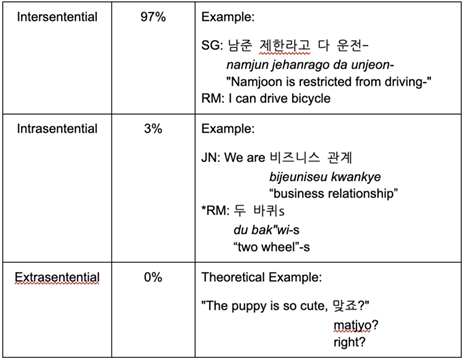
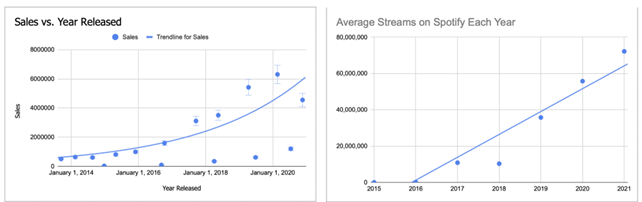
We then analyzed BTS’s rate of codeswitching and compared this to their album sales and song streams. We also categorized the switching as intrasentential, intersentential, and extrasentential as originally introduced by Poplack (1980). We additionally analyzed the type of code-switching in relation to Blom and Gumperz (1972) and Yohena’s (2003) categorizations: situational and metaphorical code-switching. Situational code-switching is based in situations where the speakers find that they speak one language in one situation and another in a different situation with no topic change. Metaphorical code-switching happens when there is a topic change (formal to informal, official to personal, serious to humorous, and politeness to solidarity). Finally, we analyzed the contextual motivations for code-switching using the frame of functions laid out by Holmes (2013).

We predicted that the frequency of code-switching would increase in reflection of their international career growth, and that their code-switching would grow in contextual complexity in relation to growing exposure to international environments. We further predicted that the contexts of code-switching would display more metaphorical use, too, as an indicator of their growing international group identity.

Results and Analysis

Before presenting our results, there are some confounders and limitations from our study that must be addressed. One limitation was our small sample size. This was a case study done for only one band and due to time limitations, we analyzed a small number of interviews. The conductors of this research are not native Korean speakers, so some of the code-switching analysis was aided by outlet provided subtitles, which could lead to mistakes due to cultural differences in the language and phrases that are used during Korean code-switching. Finally, band-wide analysis lacks granular specificity. It is difficult to draw causational lines in band-data, there being many extraneous variables, so although our study deduces a correlation, we cannot conclude causation.

We began our analysis by looking at the structures in which code-switching occurred. We found that there was an overwhelming preference for intersentential code-switching, see Figure 1.

Figure 1: Table illustrating structural types of code-switching and the rate at which they appear in the data. Also included are example sentences from the data, exempting the theoretical example. Additionally of note is the singular instance of a word level/morpheme mix with the Korean NP and English plural morpheme -s

Interestingly, most intersentential examples were the result of turn-taking by the speaker. This points to the conclusion that most code-switching occurred independently and did not involve grammatical combinatorial structures. Typically, code-switching preferentially occurs intrasententially, as Koban (2013) confirmed with English/Turkish bilinguals. However, in this case, perhaps the semi-structured nature of interviews produces a preference for providing “complete” answers resulting in standalone sentence switches. Additionally, intersentential switching may be more accessible as they could have time to prep and foresight into normal interview questions.

In terms of the total lack of extrasentential switching observed, there are two primary possible causes. The first is that this form of switching – most often found in the form of tag questions – likely is more common in contact situations, as well as in situations where the languages occur in a more balanced distribution and particularly productive phrases remain active across both languages, which, due to the language imbalance observed in BTS, is less likely. The second possible cause is the interview format, which is not conducive to the use of tag questions.

We next compared the rate of code-switching that BTS engaged in throughout their career in relation to their album sales and streams. Firstly, we found that BTS’ popularity grew exponentially over the years we studied. We compared their sales over time and the amount of their streams of Spotify over time and both showed a clear increase, as shown in Figure 2.

Figure 2: BTS’ record sales over per release as well as their average streams on Spotify per year

This was directly proportional to another criteria we considered that calculated the amount of English utterances the group produced per minute. There was a similar exponential increase with 1.13/min. in their Early era, 1.40/min. in their Mid era, and 2.06/min. in their Recent era, shown in Figure 3. This increase was directly proportional with the impact of their music and, therefore, their brand, strongly suggesting that their use of code-switching is related to their popularity and global exposure.

Figure 3: English utterances per minute across the three time periods as well as the frequency 1/s of the code switches across the time periods

Additionally, we looked at the styles of code-switching that the band engaged in utilizing the framework of situational and metaphoric switching. The data samples found in Figures 4 and 5 are examples of these switches.

Figure 4: An example of situational code-switching note that RM uses a switch to English to recenter the interview’s social context on the interview and transition to the next question [BTS Answer the Web’s Most Searched Questions: 2:50 – 2:54]
Figure 5: An example of metaphoric code-switching. Note that RM transitions more strongly than in figure (4) in social position from fellow to leader and on-screen translator to repair the socially awkward/non-answer by V, and to create distance between himself and V’s display [BTS Chats to Andy Trieu at SBS PopAsia HQ: 2:52 – 3:08]
Interestingly, the two examples are relatively similar. The defining feature between these two are the stances conveyed. In the situational switch, RM is stopping the Korean conversation to transition the conversation to a new topic and it is directed at the members to refocus them. In comparison, the metaphoric switch conveys both emotional distance from V, as well as a shift in his attention and language goal from being a team-member to the leader, so there is a social position change conveyed as well. Additionally, Jin acknowledges RM’s switch, displaying solidarity by making a joke also in English, targeting V’s “weird behavior.”

In our comparison of situational vs. metaphoric switching over their career, we found that there was a strong preference for situational code-switching, as seen in Figure 6.

Figure 6: The percentage of use for both metaphoric and situational code-switching in relation to BTS’ early career, mid career, and late career. Interestingly there was no metaphoric switching found in their mid career

Our data shows a general preference for situational switching overall and unexpectedly very little change in metaphoric switching. Metaphoric switching remained consistently low, even dipping to 0% in their mid-career. However, this may be due to the interviews that were analyzed for this period. This was unexpected, however, metaphoric switching is more indicative of a speaker’s internal world, or how they situate themselves in a social interaction, which lends itself to more advanced multilingual speech – this may require a higher English proficiency to be used strategically than many BTS members currently possess. This can be corroborated by the fact that many of the metaphoric switches observed were performed by RM, who is fluent in English, and the most balanced and practiced bilingual of the group.

The final aspect of code-switching that we analyzed was Holmes’ influencing factors, which can be defined as

  1. Participant: motivated by a change in the participants or goal receiver of utterance
  2. Solidarity: signaling shared group membership
  3. Social Context: motivated by a change in the social dimension of conversation
  4. Topic: motivated when a specific topic is more accessible in one language

The data samples found in Figure 7-Figure 10 provide examples of these different influencing factors.

Figure 7: An example in which RM code-switches as the goal receiver of the sentences changes from James Corden to the rest of his members. [BTS Carpool Karaoke: 8:01 – 8:05]
Figure 8: Suga, recognizing V’s struggles, switches to Korean to show solidarity with V as a fellow Korean speaker and member. [BTS Reveal Their Hidden Talents, Impersonate Each Other, and Reveal Their Celebrity Crushes to Andy Trieu: 2:14 – 2:20]
Figure 9: J-Hope switches to Korean to say his favorite song on the album, after joking with the puppies about the title track; it is a reaction to the socially more formal question. Interestingly this triggers the other members to switch to Korean and continue joking. (Jin’s comment is a play on words that sounds like the shortened version of the title RM uses to confirm with J-Hope) [BTS Plays With Puppies While Answering Fan Questions: 1:49 – 1:57]
Figure 10: Unlike the last example in Figure 7, where RM’s translation and subliminal signal that a switch to Korean is fine, the conversation continues in English, as some members have specific nicknames. This is a topic that they are more comfortable discussing in English [BTS Carpool Karaoke: 5:15 – 5:36]
In our analysis of our data, we found that complexity actually decreased somewhat from their early career to their mid/recent career as seen in Figure 11.

Figure 11: Comparisons in the different influencing factors that affected BTS’ code-switching throughout their career

Moreover, the complexity of code-switching exhibited in their mid and recent careers did not show the same distribution of influencing factors – with notable shifts in the prominence of Social Context and Participants. This could be due to the style of interviews, as well as growing sensitivity to interacting with English-speaking interviewers/hosts. However, the decrease in overall complexity from their early career points to a relatively consistent pattern of code-switching in terms of broad contextual influence.

Discussions and Conclusions

In recent years K-Pop has undergone a surge in popularity and groups like BTS have begun to code-switch more to relate with fans. With English being a lingua franca, we analyzed the code-switching between Korean to English from BTS. Some unexpected findings were that metaphorical switching did not increase as they began to grow. Originally, we thought that metaphorical switching would increase, but this was not the case. BTS displayed a preference for situational switching and there was little change in their metaphorical usage. We also believed that their code-switching would grow in complexity as they gained greater exposure to international environments, but this was not the case as per our research. This data is significant because it provided a greater insight into code-switching and how L2 language learners switch more in a certain style than others. It may also demonstrate that outside pressure to use an L2 language – in this case English – may not have as much effect on the actual surfacing of this language in use.

We found that most intersentential examples were member-by-member, which suggested that code-switching in this case was a standalone feature in the languages. We typically have seen new language learners start from intrasentential code-switching. This could be true for some learners, but perhaps intersentential sentences are sometimes simpler in structure and less complex. They are used in isolation, so it is easier to remember, and these types of sentences are used in everyday conversations so they are easier to pick up. So, complex mixing may be less frequent amongst BTS due to this reason, as more complicated structures require more advanced knowledge of the language. Such limited access to L2 can shape a language learner’s usage of metaphoric language as well, since it requires more proficiency in the language. Learners may struggle to use and understand metaphorics efficiently as they cannot comprehend the nuances such as with cultural references or ties. Since BTS is a Korean group, the cultural aspects of code-switching also bring in further struggles when attempting to switch to English, predominantly American English.

In conclusion, the code-switching for BTS was mainly intersentential, as the data demonstrated. There were clear preferences for intersentential code-switching over other types. We believe that this was due to the fact that the group is not very proficient in English. Based on the data that we collected, BTS code-switching has stayed relatively constant throughout the years, further illustrating the fact that they had a preference for the type of switching they use. Generally speaking, groups code-switch with friends and family when they are most comfortable. These groups may also code-switch to impress others or to send a different perception of themselves to a larger audience. Having the group code switch amongst themselves could have helped gain further attraction among fans. Meanwhile, code-switching would have also been used to convey their English skills, as it is an important language to learn in the fields of business and music.

There was an increase in overall code-switching as the group grew in international popularity. This makes sense, as they have to spread to keep up with demand. Due to this, corporations tend to gravitate to these markets where they can capitalize the most. From this standpoint, it makes sense as to why groups like BTS code switch to English rather than another language, or why their prevalence is so large among English-speaking nations and across the world. However, with the rising popularity of K-pop and Korean culture internationally, too, there has been a spike in Korean language and culture studies, so perhaps there will be a lessening of overt pressure to perform multilingualism in the future. Overall, it appears that the usage of English has aided BTS’ popularity; however, it may not be as definitively related to their success in the international music industry as we assumed.

While there were certain limitations to our study, as mentioned previously, in the larger phenomena of linguistics and bilingualism with its relation to code-switching, the data and analysis we had created could be important for future work. Future research could focus on the effects of code-switching on BTS’ audience and their reactions to it rather than how often they code-switch and why, encompassing whether or not the perception of code-switching amongst fans enhances or detracts from their appreciation of the music. On a similar note, we could also analyze the cultural implications of code-switching and how it impacts Korean culture on a global scale. This data can help future researchers better understand code-switching and its impacts on an audience relating to global sales, popularity, and positive outlook.

References

Ahn, H. (2021). English and K-pop: The case of BTS 1. English in East and South Asia, 212-225.

Blom, Jan-Petter, and John Gumperz. (1972). “Social Meaning in Linguistic Structures: Code Switching in Northern Norway.” In: John Gumperz and Del Hymes (eds.): Directions in Sociolinguistics:Sociolinguistics: The Ethnography Communication, 407-434.

Holmes, J. (2013). An Introduction to Sociolinguistics (4th ed.). Routledge. https://doi.org/10.4324/9781315833057

Kirkpatrick, A. (2011). English as an Asian lingua franca and the multilingual model of ELT. Language Teaching, 44(2), 212-224. DOI:10.1017/S0261444810000145

Koban, D. (2013). Intra-sentential and Inter-sentential Code-switching in Turkish-English Bilinguals in New York City, U.S. Procedia – Social and Behavioral Sciences, 70, 1174–1179. doi:10.1016/j.sbspro.2013.01.173

Luthfiyani, F. (2014). Code-switching and Code Mixing on Korean Television Music Show After School Club (thesis). UIN Syarif Hidayatullah Jakarta: Fakultas Adab dan Humaniora, Jakarta.

Nilep, C. (2006). “Code-switching” in Sociocultural Linguistics. Colorado Research in Linguistics, 19. https://doi.org/10.25810/hnq4-jv62

Octaviani, Andita Dyah & Yamin, Haruki Manik Ayu. (2020, July 30). The Rise of English Among K- Pop Idols: Language Varieties in The Immigration. Proceedings of the International University Symposium on Humanities and Arts (INUSHARTS 2019), 117-121. DOI: 10.2991/assehr.k.200729.023

Parc, J., & Kim, Y. (2020). Analyzing the reasons for the global popularity of BTS: A new approach from a business perspective. Journal of International Business and Economy, 21(1), 15-36.

Poplack, S. (1980). Sometimes I’ll start a sentence in Spanish y termino en Español: Toward a typology of CS. Linguistics 18, 581-618.

Shin, S.I. & Kim, L. (2013). Organizing K-Pop: Emergence and Market Making of Large Korean Entertainment Houses, 1980–2010. East Asia 30, 255–272. DOI: 10.1007/s12140-013-9200-0

Yohena, S. O. (2003). Metaphorical code-switching revisited. (Vol. 38, pp. 138–158). essay, Ferris University.

[/expander_maker]

, , ,

Code-switching and Conversation Consistency: How Bilingual Speakers Code-switch to Communicate Effectively

Danbi Jang, Louise Chen, Katherine Escobar, Alena Hong

Bilingual speakers code-switch for conversation consistency. Code-switching is more effective when describing cultural words with only that language and when both speakers are in an argument situation because code-switching increases conversation compatibility. Our research looked at the Kim’s Convenience Season 1 show and analyzed the Korean-Canadian bilingual family code-switching pattern. We analyzed Kim’s family’s conversation and found that intra-sentential code-switching is the most frequent type. Additionally, we realized that the function of each code-switching frequently happens for expressing identity, objectification, interjection, and clarifying repetition. The results showed that bilingual code-switching is necessary and efficient between two bilingual speakers when they intend to create connections with each other or solve problems. As a result, code-switching creates smoother conversations for bilingual speakers so they rather naturally mix two languages than only talking in one.

[expander_maker id=”1″ more=”Read more” less=”Read less”]

Introduction and Background

If you are a bilingual speaker, you must code-switch at least once. Bilingual communities frequently use code-switching. It has become a powerful communication tool for expressing and developing language skills. Code-switching is the process in which a bilingual (or multilingual) person alternates between two (or more) different languages in a bilingual (or multilingual) communication environment. There are several reasons bilinguals do code-switching. According to past research by Stępkowska (2022), bilingual people may demonstrate dissimilar verbal behavior in their two languages. Interlocutors perceive languages differently depending on their language in a given context. Additionally, attitudes toward languages permeate daily life and impact communication patterns within the couple (ibid.). Based on past research, we were curious whether bilingual speakers are more compatible than speakers who do not code-switch. According to another research, code-switching gives “a built-in sensibility that conversational regularities are both content-independent and context-sensitive” (Dumanig et al., 2015). Therefore, our research question is how bilingual speakers code-switch to communicate effectively. We mainly focused on Korean-Canadian bilingual speakers’ families and close friends, as well as investigated how Korean-English bilingual speakers code-switch to communicate effectively in complicated discussion situations and daily life.

Methods

We mainly collected data from the show Kim’s Convenience, season 1. We observed code-switching in bilingual speakers, how frequently they switched, and what purpose and function the code-switch served to communicate with other bilingual speakers in conversations. We attempted to provide transcriptions of specific examples of code-switching. We analyzed the type of code-switching primarily in categories of Inter-sentential, Intra-sentential, and Extra-sentential code-switching. We defined Inter-sentential code-switching as the language switch done at sentence boundaries, like sentences before, in the middle, or after another sentence. In our data, we have mostly seen this type of code-switching in fluent bilingual speakers. Intra-sentential code-switching is done within the sentences, with no pauses or interruptions to indicate a shift. The speakers in the show usually switched this type when they called Korean appellations, or greetings within part of the sentence. Finally, we found extra-sentential code-switching, which is switching a slang or a single word from one language to another (ESEN, 2022). In addition, we defined culturally related words or phrases such as 갈비찜(galbi-jjim) and those expressing feelings and interjections as extra-sentential code-switching.

Furthermore, we investigated the functions and purpose of code-switching and how the speakers resolved their disputes and communicated well based on the context of conversations. We classified the functions of code-switching into four which are interjections, objectification, clarifying repetition, and expressing identity. Then, we focused on examining when the bilingual speakers use code-switching to communicate more effectively in the conversation. Also, we quantified whether the data retrieved from the show conveyed more compatibility and resulted in conflicts resolved by observing any frequent types of code-switching and different functions of code-switching in speech patterns of the show. We hypothesized that code-switching plays a different role in each context, helping promote effective communication.

Results and Analysis

From the data we collected, we observed that code-switching is a highly-efficient communication tool for the Korean-English bilingual Kim’s family. At the same time, there are several talks taking place in between the monolingual speaker and the bilingual speaker. In the same way that code-switching helps bilinguals solve problems more easily and quickly in situations where there might be an argument, misunderstandings tend to last longer and occur more frequently in monolinguals because they cannot do code-switching. For instance, in episode 7 from 18:15-19:13, there is a good example of a monolingual and bilingual argument about Taekwondo and Hapkido that doesn’t go smoothly. Here we include a shortened version of the script.

Mr. Kim:  wah you know 태권도(Taekwondo)?

Customer:  Not really but I’m a big fan.

Mr. Kim:  They have 태권도 (Taekwondo) in Africa?

Customer:  oh yeah! Somalia won silver at the 2003 international open.

Mr.Kim:  wow impressive! You don’t look Somalian.

Customer:  No I’m not. This is just a Taekwondo fact.

Mr. Kim:  태권도(Taekwondo) is Korean.

Customer:  I know.

Mr. Kim:  I am a Korean

Customer:  I know.

Mr. Kim:  합기도(Hapkido) is Korean too!

Customer:  Hapkido?

Mr. Kim:  Yea but the much better fight style! Choi he invited 합기도(Hapkido) while serve in the military in Japan.

Customer:  So.. in a way it could also be considered as Japanese martial art.

Mr.Kim:  No! (angry face) You joking me?

Customer:  no… I just meant… Taekwondo was invented by Korean too?

Mr.Kim:  Of course Korean!

Customer:  I didn’t realize Korean was that strong!

In this case, Mr. Kim and the monolingual customer have a small fight because the customer does not truly know about Taekwondo or Hapkido, but he thinks he does. So, the original topic was to discuss a group of children learning Taekwondo, but due to the misunderstanding, Mr. Kim needs to expand more about Taekwondo and Hapkido knowledge. In a way, it implies that there is a higher chance for monolingual speakers to have misunderstanding or misapprehension thus reducing the consistency of the conversation. When the same situation happens on two bilingual speakers, they don’t need to stop and explain the content of their code-switching. According to Brezjanovic-Shogren (2002), code-switching “establishes a connection between the contributions of the participants thus making the conversation coherent. Considering participants are always “talking about something”, focusing on the “description of the topic” will answer directly what is the topic of the conversation.” This suggests that code-switching helps speakers stay on a certain topic and creates consistency for the conversation. Thus, there is a positive relationship between code-switching and communication.

There are three types of code-switching, intra-sentential, inter-sentential, and extra-sentential. To our surprise, intra-sentential is far more numerous than the other two types (See Fig.1). This is because inserting another language phrases or words is more natural and simple than whole sentences. A significant number of these intra-sentential data come from Korean appellations, such as 아빠(Dad), 엄마(Mom), 아줌마(Auntie). The transformation of the titles into Korean reflects the function of code-switching in expressing identity and establishing connection. Prihatin (2018) proves that code-switching occurs to express identity when an individual wishes to express solidarity with a social group. According to the statistics (See Fig.2), this function is the most common one, accounting for 77.7 percent. There are also three other major roles of code-switching, namely, objectification (11.5%), interjection (7.4%), and clarifying repetition (3.4%). Code-switching uses for objectification can quickly help speakers get a more concrete image in their mind about the topic. Because this function is often present on culturally relevant code-switching, it can often be classified as the extra-sentential type. For example, Mr. Kim says Korean 합기도 (Hapkido) instead of English pronunciation Hapkido in episode 7 where the conversation takes place between him and his bilingual daughter, Janet. Because Hapkido is a Korean traditional activity, Mr. Kim wants Janet to quickly recall what 합기도(Hapkido) is and all the information related to it. This is where the advantage of code-switching comes in. Sometimes people code-switch to interrupt someone, this is the function called Interjection, doing so helps get attention or start a new topic. In other cases, code-switching is able to emphasize or reaffirm the topic when the speaker does clarifying repetition (See Appendix).

Fig. 1. Frequency of each type of code-switching in Kim’s Convenience
Season 1


Fig. 2. Percentage of each function of code-switching in Kim’s Convenience, Season 1

Discussion and Conclusions

The findings from our study contributed to our understanding of interpersonal communication, more so how to make communication more effective through the use of code-switching. Our data suggests that code-switching occurs as a way to fulfill a purpose in communication such as expressing identity through the ability to relate to cultural values and strengthen relationship bonds. Additionally, through other functions such as objectification, repetition, and interjections, it improves communication by clearing any misunderstanding for phrases that do not translate well into the dominant language. In a similar field of research, Helena Merschdorf presented a TED Talk about the paradox of intercultural communication. Her studies suggest that there are invisible understandings, where biases from our primary language and culture can cause misunderstandings and misconstrue due to societal norm differences (Merschodorf, 2022). In the case of Kim’s Convenience, we found that code-switching occurred to address these societal differences. As the show was based in Canada, the respectful terms don’t translate with the same cultural significance so characters would code switch in order to express their Korean identity, avoiding an invisible understanding of potential disrespect or disregard for their Korean heritage. For example, in episode 8, the context surrounds a neighborhood pastor for Koreans, though all are welcome. The pastor is very close with the Kims as he is a frequent patron at the convenience store, but because he takes advantage of his important and influential role at the church, he believes he can get away with taking gum without needing to pay anything. The Kims are obviously worried because the continual free gum will begin to add up once rent is due, or Pastor Choi could begin to take something of greater value should he get comfortable not paying. Mrs. Kim did not want to let this continue, so she code switches and says “목사님 (Moksanim) I think we cannot…” (E8, 20:41). The purpose of this code switch was to express their Korean identity by using a formality to show respect to Pastor Choi despite telling him something that he probably would not like to hear. Because the formality does not translate in English, the code-switch in this instance eliminates a misunderstanding of disrespect as Mrs. Kim did not want to let the pastor continue misunderstanding their kindness for generosity.

Originally, our focus was to explore if code-switching would make communication more effective in couples that are in an argument. What we ended up studying was the types of code-switches and the instances in which they occur. By isolating four different purposes for the code-switch, we unveiled that by serving one of those purposes, code-switching was used to prevent miscommunication or to find a way to clarify true meaning despite a language barrier. As Merschodorf (2022) suggested, a way to prevent misunderstandings is to take into account the different linguistic knowledge from other cultures before communicating. By doing so it would prevent any marginalization or discriminatory language. This could be done through “pidgin” languages such as Konglish or Spanglish, where combining two languages that were stripped to the simplest forms, may serve as a means to accommodate both parties in a conversation in a way that keeps all cultural identities intact. Though marginalization can be perceived as a phenomenon usually concerned with targeting an individual’s identity, excluding someone through unfamiliar words and phrases without considering their needs can also be a form of marginalizing. Code-switching can then resolve this issue by allowing speakers to clarify what their true intending may be in an inclusive manner. This could be seen in episode 9 of Kim’s Convenience, where this episode follows interactions between Pastor Nina and Mrs. Kim. Mrs. Kim was dealing with embarrassment over her son’s Jung intimate relations with someone from the church, so when Pastor Nina said she heard something about Mrs. Kim, her mind was worried that there was gossip about how sexually active her son is though Pastor Nina was talking about 갈비찜, the meat dish galbi-jjim (E9, 10:03). Her attempt to code switch was to affirm and create a closer relationship with one of her church regulars, Mrs. Kim, by relating to her culture and being inclusive of the Korean language. Additionally, she asks Mrs. Kim if her pronunciation was correct, showing that she is eliminating an egocentric bias of assuming she was correct, and actively seeks feedback from Mrs. Kim as she recognizes that she is unfamiliar with Korean linguistic culture. Overall, our findings uncover that code-switching in a broader context serves to prevent misunderstandings as a result of a language barrier, through the fulfillment of communication purposes such as expressing identity, objectification, repetition for clarification, and interjections for emphasis. Without such purposes in mind, perhaps code-switching might not have an influence on the quality of communication between speakers as misunderstandings could occur without the clarification and inclusivity that code-switching can elucidate.

References

Brezjanovic-Shogren, J. (2002). ANALYSIS OF CODE-SWITCHING AND CODE-MIXING AMONG BILINGUAL CHILDREN: TWO CASE STUDIES OF SERBIAN-ENGLISH LANGUAGE INTERACTION. Wichita State University, 1-82. https://soar.wichita.edu/bitstream/handle/10057/5051/t11060_Brezjanovic%20Shogren.pdf?sequence=3&isAllowed=y

Choi, I., Kohler, R., White, K., dirs. Kim’s Convenience. 2016; Ottawa, Ont.: Canadian Broadcasting Corporation (CBC). Netflix. https://www.netflix.com/browse?jbv=80199128

Choi, I., Kohler, R., White, K., writers. Kim’s Convenience. Season 1, episode 7, “Hapkido.” Directed by Dawn Wilkinson, featuring Paul Sun-Hyung Lee. Aired November 22, 2016, in Canadian Broadcasting Corporation (CBC). https://www.netflix.com/watch/80236367?trackId=14170289&tctx=2%2C0%2Cb8235341-19ea-4083-9317-21b3f05687f2-7917841%2CNES_EDA12732B35623D7FB1CFDD00F5D6A-B9F225DDE3A711-4A0417714B_p_1679516526251%2C%2C%2C%2C%2C80199128%2CVideo%3A80199128

Choi, I., Kohler, R., White, K., writers. Kim’s Convenience. Season 1, episode 8, “Service.” Directed by James Genn, featuring Paul Sun-Hyung Lee, Jean Yoon, and Hiro Kanagawa. Aired November 29, 2016, in Canadian Broadcasting Corporation (CBC). https://www.netflix.com/watch/80236368?trackId=14170289&tctx=2%2C0%2Cb8235341-19ea-4083-9317-21b3f05687f2-7917841%2CNES_EDA12732B35623D7FB1CFDD00F5D6A-B9F225DDE3A711-4A0417714B_p_1679516526251%2C%2C%2C%2C%2C80199128%2CVideo%3A80199128

Choi, I., White, K., writers. Kim’s Convenience. Season 1, episode 9, “Best Before.” Directed by James Genn, featuring Jean Yoon and Amanda Brugel. Aired December 6, 2016, in Canadian Broadcasting Corporation (CBC). https://www.netflix.com/watch/80236369?trackId=14170289

ESEN, S. (2022). Code switching: Definition, types, and examples – owlcation. Code Switching: Definition, Types, and Examples. https://owlcation.com/humanities/Code-Switching-Definition-Types-and-Examples-of-Code-Switching

Merschodorf, H. (2022, June 17). The Surprising Paradox of Intercultural Communication [Video]. TED. https://www.ted.com/talks/helena_merschdorf_the_surprising_paradox_of_intercultural_communication?utm_campaign=tedspread&utm_medium=referral&utm_source=tedcomshare

Pietikäinen, K.,S. (2014). ELF couples and automatic code-switching. Journal of English as a Lingua Franca, 3(1), 1-26. https://doi.org/10.1515/jelf-2014-000

Prihatin, Y. (2018). CODE SWITCHING USED BY ENGLISH DEPARTMENT STUDENTS OF PANCASAKTI UNIVERSITY ON FACEBOOK. View of code switching used by English department students of Pancasakti University on facebook. https://journal.peradaban.ac.id/index.php/jdpbi/article/view/358/287

Yun, S. (2009). The socializing role of codes and code -switching among Korean children in the U.S (Order No. 3356438). Available from Linguistics and Language Behavior Abstracts (LLBA). (305085390).https://www.proquest.com/dissertations-theses/socializing-role-codes-code-switching-among/docview/305085390/se-2

[/expander_maker]

, , ,

How Do Gender Stereotypes from 1973 Hold Up in Modern Media?

Griffin Gamble, Shayan Karmaly, Rahul Reddy, and Michael Zhan

Our team was interested in looking at some speech features that were found primarily in women’s speech in a famous study by Robin Lakoff in 1973. We wanted to see if Lakoff’s findings were still prevalent in today’s media. In our study, we followed two characters, Robin Scherbatsky and Barney Stinson, in the TV show How I Met Your Mother. When analyzing their various conversations with friends throughout the show, we focused on two of the many speech features that Lakoff initially identified – tag questions and intensifiers. We separated their conversations into two social contexts – single-gender and mixed-gender conversations. We were curious to see if the frequency of the speech features would increase or decrease depending on the type of social situation that Robin and Barney were in. In addition, we were interested in the overall frequency of tag questions and intensifiers in Robin’s speech versus Barney’s speech because, according to Lakoff, these speech features should be more prominent in female speech (1973). We found that Barney had more tag questions and intensifiers per line than Robin, but in single-gender situations, Robin had significantly more intensifiers per line.

[expander_maker id=”1″ more=”Read more” less=”Read less”]

Introduction and Background

Our research hoped to answer the following questions: Are tag questions and intensifiers still predominantly found in women’s speech more than in men’s speech? Does the gender of the speaker’s conversation partners play a role in how often speakers will use tag questions and intensifiers? One of the reasons that we are interested in both these questions and revisiting Lakoff’s findings is that since 1973, there have been many changes to gender norms as well as the ways that people represent themselves. In general, people are a lot more tolerant and accepting of differences, so we predict it could be the case that the gender stereotypes in language have changed as well.

While we initially planned on getting live recordings of UCLA students in different social contexts, we quickly realized that this would be difficult to accomplish within the ten weeks allotted for this study. It would also be placing a large burden on the participant as they would need to record themselves as they went about their already busy day. Because of this difficulty, we shifted gears toward analyzing TV show characters. It ended up working out because one of the research methods that Lakoff (1973) used in her initial study was observing the media, so we decided to do the same with the show How I Met Your Mother.

From left to right: Barney Stinson (Neil Patrick Harris), Robin Scherbatsky (Cobie Smulders), Ted Mosby (Bob Saget), Lily Aldrin (Alyson Hannigan), Marshall Eriksen (Jason Segel)

The show is a rom-com about five friends who live their lives and navigate the social setting of New York. We chose this show because it’s only been eight years since the show finished and the main cast all exhibit male and female gender stereotypes. Specifically, the two characters we followed are Robin and Barney because while they both exhibit typical stereotypes for their gender, they also often portray stereotypical gender norms of the opposite gender.

Methods

We analyzed six episodes of How I Met Your Mother which totaled two hours of footage and 559 lines from our two characters combined. We specifically picked episodes that Robin and Barney were featured in so they would have more lines and we could collect more data from them. When watching the episodes and reading the transcripts, we noted each time Robin or Barney used either of the two speech features. We wrote down the speech feature that was used, the character that said it, and whether it was a single-gender or mixed-gender situation. For each episode, we created a separate section on our spreadsheet for inputting the data and an area sectioned off for calculating the total counts.

It is important to note that not all tag questions are equal and they may not share the same function to portray the speaker as having less authority or power (Cameron 76). While you can use a tag question as a self-lowering device by giving your interlocutor the floor to respond to your statement, you can also use a tag question as an aggressive tool. For example, “You aren’t all that great, are you?” That said, all the tag questions in our data were of the hedging type. Here is an example from Robin, “If you’re going to be this disgusting, we’re not watching this, okay?”

Robin Scherbatsky (Cobie Smulders), looking shocked

Results/Analysis

So what exactly were our findings? Overall, we analyzed six episodes totaling two hours of footage and our findings were different from what we expected to find based on existing research. In (Seigler & Seigler, 1976, p. 169) and (Kramer, 1977, p. 159) both studies found that gender stereotypes in speech aligned with Lakoff’s theory. Keep in mind, these studies were focused on the perceptions of speech, not what each gender actually says in real life. We expected to find that the speech characteristics that were once associated primarily with women’s speech can now be found equally in both male and female speech, and are no longer strong indicators of the gender of the speaker. This was our hypothesis. Below, I will go into details including visualizations that display what we ended up analyzing.

Our data consisted of two different social contexts for analysis. Specifically, we looked at mixed-gender situations (where there was at least one male and one female in a social setting) and at single-gender situations (where there was only one gender in a social setting). For the purposes of the experiment, the genders will refer to non-trans males and females who identify as the gender that they were born with. Now, let’s look at the data:

Table 1 – Number of Tag Questions

As we can see in Table 1, we examined situations in which Robin and Barney are in mixed-gender and single-gender lines for the purposes of the tag questions. For this, we tried to choose episodes where we thought the two characters would have an equal number of lines in this context and to our convenience, they did for the mixed-gender situations, but NOT for the single-gender ones. So, while Robin and Barney have nearly the same number of total mixed-gender lines, Barney had 31.5% more tag questions. On the other hand, Robin led this category in single-gender situations!

Table 2 – Number of Intensifiers (Per Line)

Similarly, when looking at Table 2, we can see that Barney had 34.5% more intensifiers and from the raw data, it would actually seem as if Barney is the winner in both categories, however, when we equalize the data (as shown in the graph), Robin has more intensifiers per line in the single-gender situations. The tricky part of this table is that it shows the analysis per line rather than the total amount. We decided not to go with raw numbers so that it is not confusing to look at the total speaking time, but rather easier to look at the date per line. This average is more precise since it allows us to equalize the data for both Barney and Robin. And if we look more specifically at the single-gender situations, Robin actually has roughly half of Barney’s lines. Overall though, the single-gender data is pretty sparse; therefore, we can conclude that it’s not super conclusive of anything.

Discussion and Conclusions

The conclusion that can be drawn from our analysis and findings is that Lakoff’s speech features that were stereotypically and data-backed as either higher for men or women no longer hold true in modern times. We can see from our data that speech features that were shown in Lakoff’s research as higher for women such as tag questions and intensifiers were actually around the same for Barney and Robin. In some cases, they were even higher for the male focus of the study, Barney. Although we were not able to find much data for single-gender situations, from the evidence that we do have we can conclude that modern-day society has moved into a third-wave sociolinguistics lens that puts much more emphasis on the individual when compared to the past. After taking into consideration the time gap between the gender stereotypes of 1973 and the stereotypes of today in 2022, we can see that our hypothesis did indeed hold true where these outdated assumptions on stereotypical speech features can no longer be linked to a single gender. This makes sense as we now live in a much more gender-fluid and accepting society than in the past where everyone was strictly grouped as masculine and feminine and deviating from the norm was shunned by most. Some high-quality TED talks that reinforce these ideas are “Language around Gender and Identity Evolves” presented by Archie Crowley and “How Language Shapes the Way We Think” presented by Lera Boroditsky. The first TED talk by Archie delves into how language is ever-changing and a powerful tool to allow people to identify themselves and find something that makes them feel comfortable. In the second TED talk, Lera uses scientifically backed data to prove that language does indeed shape the way we think and how we have over 7,000 cognitive universes, each linked with a language as each language gives the user a unique way of viewing the world and is very impactful in shaping the way we view the things around us without us even knowing. Both presentations talk about language being a powerful tool for self-expression and tie into our appeal that language should not be confined to preconceived notions of gender schema as it might have been in the past. Language should be something that brings people closer together instead of a weapon that further alienates people. If there were more time, we would have liked to expand upon our research by analyzing real people instead of just fictional TV characters and comparing the results. We also realize that analyzing real people would mean we would also need to account for external influencing factors such as race, occupation, geographical origin, etc.

While we began looking at how speaker agency can play a role in changing one’s speech through single and mixed-gender situations, it would be valuable in a future study to analyze different types of conversations. For example, an argumentative conversation may have significantly fewer self-lowering tag questions while it might have more intensifiers to help get the point across. Podesva’s (2011) study could be used as inspiration for a framework for how to conduct a study involving participants that move through discrete social contexts.

References

Cameron, D., McAlinden, F., & O’Leary, K. (1988). Lakoff in context: The social and linguistic functions of tag questions. Women in their speech communities, 74, 93.

How language shapes the way we think | Lera Boroditsky. (May 2, 2018). https://www.youtube.com/watch?v=RKK7wGAYP6k

Kramer, C. (1977). Perceptions of Female and Male Speech. Language and Speech, 20(2), 151–161. https://doi.org/10.1177/002383097702000207

Lakoff, R. (1973). Language and Woman’s Place. Language in Society, 2(1), 45–80. http://www.jstor.org/stable/4166707

Language around gender and identity evolves (And always has) | Archie Crowley. (April 16, 2021). https://www.youtube.com/watch?v=XguYZXUChhY

Podesva, R. J. (2011). The California Vowel Shift and Gay Identity. American Speech, 86(1), 32–51. https://doi.org/10.1215/00031283-1277501

Siegler, D. M., & Siegler, R. S. (1976). Stereotypes of Males’ and Females’ Speech. Psychological Reports, 39(1), 167–170. https://doi.org/10.2466/pr0.1976.39.1.167

[/expander_maker]

, , , , ,

(Ap)parent Gender: Gendered Language and its Use in Asian American Parenting

Kara Chu, Iffet Dogan, Jay Iyengar, and Alisara Koomthong

The following research seeks to observe linguistic variability in the way Asian immigrant parents speak to their Asian American sons compared to their daughters. Participants for the study include two female participants and one male participant who recorded phone calls with their parents sharing both good news and bad news. The phone calls were analyzed for linguistic variability through word choice and intonation use by the participants’ parents. In addition to data collection, scenes from television shows that represent Asian American family dynamics were analyzed to find possible linguistic variability in the way parents spoke to their daughters in comparison to their sons. This research aimed to uncover the use of gendered language within the cultural norms of Asian American parent-child relationships. More positive language and lower tonal variability were found with the parents of the boy, while more practical language and higher tonal variability were generally found with the parents of the girls.

[expander_maker id=”1″ more=”Read more” less=”Read less”]

Introduction

Children are known to absorb cultural linguistic expectations and gender norms imposed on them from interactions with their parents and caregivers. We are seeking to explore the common gender differences that children of Asian immigrant parents experience when speaking to their parents. By analyzing the parents’ supportive phrases, negative phrases, tone, and pitch in varying situations, we will look at the difference in language use towards sons versus daughters. Research has shown that mothers talk more and use more supportive language with their daughters than with their sons (Leaper et al., 1998). We hypothesize that our findings will align with existing gender research, and we aim to go one step further by viewing the data with a cultural lens to examine the intersection between how gender and culture may affect the children’s self identity.

Background

Asian families hail from a wide variety of cultures on the Asian continent, many of which are rooted in patriarchy. These customs have resulted in internalized misogyny within many Asian American families, leading to a distinct difference in the way they treat sons versus daughters. Fong (1997) addresses how Asian American women are in “the midst of conflicting values, identity crises, consciousness raising” all while developing their sense of womanhood (92). Asian Americans are subject to harmful stereotypes, which often include the rhetoric that Asian American women are submissive and incompetent compared to men. This is why we find it valuable to study if there are any linguistic markers that would help us understand how this difference in expectations is communicated to children. We are seeking to observe not only the linguistic variation in the way Asian women are spoken to in comparison to men, but also to make connections about whether that inflicts an altered self-image for Asian American women.

Methods

For our methodology, we wanted to recruit men and women from Asian-American family households that speak English with their parents. Due to our specific demographic, we could only find three Asian-American participants in their 20s: two women and one man. Initially, we had one more male participant, but he decided to drop out at the last minute. Each participant gave out their versions of good news and bad news (i.e. aced an exam, dropped out of school) that aligned with their lives, which enabled them to steer the conversation freely and have our results be as natural as possible. After obtaining all the participants’ and their parents’ consent to be recorded, we collected the recordings of their conversations of them delivering their news and getting their parents’ reactions. One of our female participants presented fake good and bad news while the male and the second female participants’ news were true. Only our male participant had both of his parents in the conversation while the rest interacted with either their mother or their father.

In order to support our data, we examined scenes from television shows relevant to our experiment: Never Have I Ever and Kim’s Convenience. It provided us insight into how media portrays the relationship between parents and their children in an Asian-Western household. In Never Have I Ever, the scene we chose was when the mother assumed the worst in Devi (her daughter) after Devi’s classmate said “Well you know Devi. She is a real firecracker.” In Kim’s Convenience, we used two scenes: the first was an interaction between the daughter and her parents and the second was between the mother and the son. Both were delivering the bad news to the parents and we were able to find a significant difference in how they were treated.

Results

1. Word Choice

We began by analyzing word choices used by the parents in response to good and bad news. All words have tones, and individuals make choices to use certain words/tones to convey more meaning than literal definition (Bakhtin, 1982). When certain tones are repeated in conversation with a specific individual it can begin to have an effect on their mood and lead to longer-term consequences. A study by Richter et al. (2010) provides more support for this by analyzing MRI scans of individuals when certain tone-words are spoken to them, noting that brains react differently to words with different moods and the subjects’ emotions can be changed by language itself (Richter et al., 2010). When parents apply this approach to their children, consistent usage of certain language can have long-lasting effects on development.

Our first subject’s (a girl) parent was less congratulatory than the other parents and seemed to place high expectations on his child:

Figure 1. [8:58-9:10]

06  KID: I like kept messing up my interview questions and they were like asking me things and just the structure was really weird so like I think I did really bad

07  PAR: Oh no (.) You always do so well

He uses comparative statements in response to the bad news: “you always do so well.” He also focuses on areas where the student’s grades may be falling rather than offering comfort. Even in response to good news, he begins with a question, as if doubting the ability of her child to succeed:

Figure 2. [6:53-7:07]

01  KID: You know the um homework I was doing earlier today? I got a hundred percent(.) My grade came back already

02  PAR: You wait you got a hundred percent what?

03  KID: On the homework I was just doing

04  PAR: Awesome;

05  KID: Yeah

The congratulatory “awesome” that the parent offers is the only positive word choice in the entire conversation. Even so, our analysis of tone points towards the positivity of such a statement being muffled at best. At other points in our first subject’s conversation, he focuses on how much his child’s success will be affected, rather than mollifying her emotions. Regardless, it appears he still has the best interests of his child at heart.

Our second subject’s (a girl) parent took a similar tone. Instead of positive language use, when speaking to her child, she stays within the bounds of advice and hedging:

Figure 3. [2:41-2:56]

01 KID: It’s just really embarrassing

02 (2.1)

03 PAR: Then you talk to your advisor ask that fo:r advice that what you to do some things it is out of your control you can’t do anything (.) don’t stress for that

She is more concerned with her child’s actions and success than her well-being, and uses direct language (the ‘command’ to talk to her advisor) to ensure that happens. In response to good news, she uses the words “not bad”:

Figure 4. [4:48-5:01]

04  PAR: How-how many hou:rs does he require you to help [him?]

05  KID: [three] hours a week

06 PAR: OH not bad

07 KID: Yeah (.) yeah

08 PAR: That’s good

And in response to the student’s worries, she offers advice and stresses the idea of working hard. Girl 2’s parent is practical and expects independence from her child, and uses her language to communicate that to her daughter. She continues in the conversation to use neutral or negative language, even in positive reactions, implying through her “negative” reaction to her daughter that what she is doping should not be thought of positively; only that it is expected behavior.

On the other hand, our male subject’s parents do provide some practical advice, but we note a lot more positive language in their interactions. When presented with good news, the boy’s parents’ language and tone are happy, with audible laughter and multiple positive statements:

Figure 5. [0:00 – 0:30]

01  KID: Good news is that I got an A on my environmental econ midterm

02  DAD: Oh [very nice] (1.5) [yeah]

03  MOM:     [mmm:::]        [congratulations!]

04  MOM&DAD:(inaudible)<<laughing>>

05  MOM: Good job!

06  KID: Thank you.

07  MOM: <<laughing>>

And perhaps even more interesting, when confronted with bad news about his budget, the parents continue to use words like “thank you for letting us know” and place trust in his ability to handle his business, telling him to keep track of his own budget:

Figure 6. [0:42-1:01]

08  KID: ‘Ca-’cause like I feel like–it feels like I’m spending too much but I’m like–I . should probably keep track of my budget better (0.1) [so:] (0.2) we’ll see

09  MOM&DAD: [Oh:]

10  DAD: You stay within your budget?

11  KID: Well–I–I need to be better about that. [So we’ll see]

12  DAD: [Oh okay]

13  DAD: Well, thank you for letting us know about [that]. So, you know,

14  MOM: [yes]

15  DAD: Keep track of your budget(1.2)and how much you spent.

We do not have enough data to tell whether these are truly differences between treatment of girl/boy children or simply differences in parent personality, as we know parent gender in addition to having one parent versus two parents present can affect the conversation. However, there are minute trends in word choice that differentiate the two genders. The boy’s parents are more positive about his accomplishments and more trusting of his faults, while the girls’ parents take a more high-expectation position and are more neutral about their efforts.

2. Intonation

In addition to evaluating word choice, we also put the recordings into a speech analysis software called Praat to analyze pitch and intonation. According to previous research, intonation, which is the change in pitch, is a really important part of communicating a speaker’s emotions and their attitude towards the listener (Wells, 2006). Their pitch will differ depending on what emotion the speaker is conveying.

The first thing we looked at was the parents’ initial short one-word response to the child’s piece of bad news. For the boy, it was “Sooo,” and for the girls it was “Oh no” and “Okay?” as seen in Figures 7 – 9. These spectrograms show the strength of certain frequencies as a speaker talks. Their pitch is indicated by the blue line. We used a pitch range of 75 to 300 Hz for male speakers and 75 to 500 Hz for female speakers, as females have a higher speaking pitch. We found pretty consistently that the parents of the girls had higher tonal variability, meaning their pitch changed a lot, while the parents of the boy had low tonal variability. However, we acknowledge that the content of the speech can have an effect on the speaker’s pitch which can make it hard to compare one to one.

Figure 7. To Boy, “Sooo” – Low tonal variability
Figure 8. To Girl 2, “Okay” – High tonal variability
Figure 9. To Girl 1, “Oh no” – High tonal variability

All the parents asked their kids a question after hearing the bad news. For the boy, one question his parent asked was “you don’t have enough?” which has a low tonal variation, as seen in Figure 10. He doesn’t increase pitch at the end which you would normally expect from a question, especially a yes or no question.

Figure 10. To Boy, “You don’t have enough?” – Low tonal variability

On the other hand, you can see the parent of Girl 1 varied a lot in intonation in Figure 11 during the question, “So how does that affect your grade?”. Girl 2’s parent’s pitch didn’t change as much throughout the sentence, but a big pitch increase is seen at the end of the yes or no question “If you fail, can you retake the class for the next quarter or whatsoever?” in Figure  12. This expresses itself much more like a question as opposed to the boy’s parent, whose question ends on a level pitch similar to a statement.

Figure 11. To Girl 1, “So how does that affect your grade?” – High tonal variability
Figure 12. To Girl 2, “…for the next quarter or whatsoever?” – Ends on rising pitch

This difference in parents’ tonal variation for questions is consistent with the parents’ tonal variation in their one word responses. For responses to bad news, the parents of daughters used more tonal variability than the parents of the son.

However, for the responses to the good news, we couldn’t find a clear difference between the boy and the girls. For both, the parents said congratulations, which for the boy has more variety and ends on a falling tone while for the girl has a level tone at a high pitch. We looked at another congratulatory phrase from the parents, and you can see variety for both the boy and girls. We believe this could mean that parents react to good news similarly regardless of gender pitchwise.

Figure 13. Varied pitches for parent responses to good news

3. Media

Media plays a large role in reflecting the dynamics between Asian American parents and their children. One example of this is Devi from the show Never Have I Ever.

B: well you know Devi (.) she’s a real firecracker.

N: Oh no :: what did she do?

In this particular scene, Devi’s classmate Ben refers to her as a “firecracker” to which her mother, Nalini immediately assumes the worst and jumps to the conclusion that Devi did something wrong. In general with Devi’s character, in the midst of developing into womanhood and growing up, she is constantly given these types of negative reinforcement about her personality traits that are commonly misconstrued as “unladylike”. She is outspoken and expressive and often reprimanded for being that way, as this particular scene represents. Media representations such as the show Never Have I Ever are reflective of these kinds of parent-child relationships and interactions that many Asian American women face in real life.

In Kim’s Convenience, Jung is the oldest and the only son of the family where high expectations were placed on him. He told his mother that he applied for a new position in a car rental company that has higher pay and responsibilities, however, his mother interpreted it negatively.

Jung: Assistant manager, Umma. And it’s a good job. It’s got more pay, benefits, and more responsibility.

Umma: So does doctor or judge or (1.2) website design!

The mother’s response was a clear indication that she was not satisfied with her son’s choice. She wanted him to choose a career that is more reputable, such as a doctor, a judge, or a website designer. It is a portrayal of Asian parents’ ideas of what is best for their children by setting high standards for them to follow.

Janet is the youngest and only daughter of the family. In comparison to Jung, she has fewer responsibilities and lower expectations than him other than to be obedient. In Season 1, Episode 10, Janet’s friend revealed to her parents that she got a job without their approval.

Umma: Janet, you get job?

Gerald: At the car rental store. She starts tomorrow.

Umma: At Handy Car Rental?

Janet: Yeah

Umma:(1.6)*sigh* N(h)o, Janet. You work here. You tell them it’s

   mistake. Tell her, Appa

Appa: You know what’s a big mistake? Pork rind. Never sell. Look.

[5:39-5:48]


Janet: I need the job, Umma. How else am I going to earn any actual money?

Umma: We work something out. Right, Appa?

Appa: And what’s the deal with the wine gum? Not wine, not gum.

In this scene, both parents were dismissive of her but in different manners. The mother was trying to reassure her that she did not need a different job because she is already working at their family’s store and was persistent for her daughter to stay. The father, on the other hand, reacted by not responding to her news. Instead, he decided to change the topic as if it did not matter to him. It’s a representation of how parents would have low expectations from their daughter in this scene but try to influence her to be compliant with them. Her individuality can only be accepted if it aligns with their concept of what is best for her.

Conclusion

We found that hedging was used by parents of both boys and girls, but that girls’ parents used it significantly more. The parents of our male subject also spent a lot of time reacting to and understanding his problem, while the girl’s parents tended to offer more vague advice and “close off” subjects as soon as they were done offering their piece on the subject, before moving on to the next subject unless the child brought it up again. For both genders, the parents provided serious advice, but the advice for the boy was more direct when it was given while the girls’ parents provided mostly vaguer advice to their children, often having to do with working harder or being more resolute in the face of challenges. When presented with issues in the students’ lives, the girls’ parents were significantly more negative or neutral in speech, and placed far higher expectations through their word choice when reacting to bad news, while the boy’s parents were hopeful and positive in tone, implying a sense of trust in their child’s ability to fix his issue. Intonation varied less for the boy’s parents than it did for the girls’ parents, and the girls’ parents’ intonation varied the most especially when reacting to bad news.

The data has not supported pre-existing research studies on this topic and our hypothesis that more supportive and positive language would be used with the girls. While we were able to dissect and analyze the data that gave some clear distinctions between sons and daughters, the obstacle of finding participants does not allow us to give a definite conclusion or correlation from our small sample and apply it to the general public. There are several factors as to why we cannot definitively conclude that gender is the sole cause of the linguistic differences. For instance, parents may have more progressive views that are from Western or American culture instead of their heritage and/or not speaking the inherited language with their children. Another contributor includes the level of closeness and comfort. The data would have been stronger if we included various levels of connection between parents and their children to observe any similarities and differences in their language. If we have the opportunity to conduct this experiment again, we would take more time on the recruiting process as that was our main issue. Additionally, we would want both parents present when interacting with our participants so everything is more consistent. Regardless, our study provides an often-forgotten insight to the relationships between Asian American students and their families, and through such understanding, we can only hope to foster more thoughtful and egalitarian approaches to parenting children.

References

Bakhtin, M. M., & Holquist, M. (2000). The dialogic imagination: Four essays. University of Texas Press.

Fong, Lina Y. S. (1997). Asian-American Women: An Understudied Minority. The Journal of Sociology & Social Welfare, 24(1), pp. 7.

Leaper, C., Anderson, K. J., & Sanders, P. (1998). Moderators of gender effects on parents’ talk to their children: A meta-analysis. Developmental Psychology, 34(1), 3–27.

Wells, J. C. (2006). English Intonation PB and Audio CD: An Introduction. Cambridge: Cambridge University Press.

Richter, M., Eck, J., Straube, T., Miltner, W. H. R., & Weiss, T. (2010). Do words hurt? brain activation during the processing of pain-related words. Pain, 148(2), 198–205.                              https://doi.org/10.1016/j.pain.2009.08.009

[/expander_maker]

, , , ,

The Use of Gendered Language in Interviews of Male and Female Athletes

Julia Offerman, Isabelle Sandback, Samantha Morgan, and Niki Agarwal

Societal viewpoints regarding sports can be partially attributed to gender bias in sports commentating and interviews. This is true even for tennis, which has become very gender-inclusive in terms of media coverage, as well as respect for female athletes. Still, many studies have found biases in language used for male and female tennis players—but have not examined interviews or interview questions. In this study, we analyzed six post-game interviews of mixed doubles tennis players to ascertain if there was a difference in questions directed to female and male tennis players. We observed the proportion of emotional and practical questions directed to each, as well as the proportion of questions regarding the interviewee themself, their partner, or teamwork for each player. We found that the women were asked significantly more emotional questions than their male counterparts, but that both were asked relatively similar percentages of interviewee-partner-teamwork questions. This study has important implications for language, respect, and gender-inclusivity surrounding tennis and women’s sports, as well as interview protocol between men and women interviewees in other fields. These metrics analyzed could be used in these other cases, and ideally, the differences should be mitigated in order to promote equality in interviews.

[expander_maker id=”1″ more=”Read more” less=”Read less”]

Background

Although media coverage of tennis has been more gender-inclusive than other sports, biases are still present in the language used by interviewers when interacting with male versus female tennis players. In our study, we analyzed the post-match interviews of mixed-doubles teams, which consisted of one female player and one male player, to see if word choice and question type display any gendered bias. This allowed us to test the hypothesis that gender-based bias found in broadcasting also extends to in-person interviews with the athletes.

Gendered language in tennis has served as the subject of several studies. Though the definition of gender may be fluid depending on context and background, tennis itself has established a gender line between male and female that we used as our baseline. Previous studies, such as Messner and Jensen (1993), have compared the broadcasts of men’s and women’s tennis matches because they are usually held at the same venue and given equal amounts of coverage.

Articles reporting on the 2015 Australian Open were analyzed for “gender-specific descriptors” in a 2016 study conducted by Adrian Yip (2016). It was found that “stereotypical beliefs about females were largely reinforced in mediated gender representations,” and specifically focused on the disproportional discussion of women’s appearance, mental-weakness, and other stereotypical female traits (Yip, 2016). The 2015 Australian Open media coverage was additionally analyzed by the International Review for the Sociology of Sport, and strong gendered differences in how announcers “created spectacle” and described athletes during the live matches were found (Quayle et al., 2019). Commentators were again analyzed during the 2018 US Open and found that they reported emotionality more frequently with female athletes (Gerbasi, 2019).

Despite the focus on bias in sports media coverage, no studies have looked at how gender bias shows up in press conferences and interviews. Interactions with the players deserve their own focus since reporters are not describing the athletes or offering their own commentary, which therefore makes it more difficult to identify examples of stereotypes or biased language.

Overall, we expect that female athletes will be asked more emotional-coded questions and males will be asked more practical-coded questions. In addition, we hypothesize that women will be asked more questions about their partner than men will be asked about their partner, and that women will be asked more questions about teamwork in general. If we see these differences, we can determine that there may be bias in the question choice when directed towards female and male athletes.

Methods

For our study, we looked at post-match interviews from Grand Slam tennis tournaments and decided to focus exclusively on mixed-doubles teams. Since a mixed-doubles pair includes one female and one male athlete who are both being interviewed about the same match, gender is isolated as a difference between the players; therefore, the differences in the questions posed to each athlete could be indicative of gender biases. We chose to analyze 6 formal interviews of players that were successful (had each won major tournaments before both in individual and doubles events) and well-known within the tennis world. The interviews totaled 71 minutes for analysis. Additionally, we chose to disregard the gender of the interviewers because the questions seemed to be highly scripted and therefore not indicative of the interviewers’ personal biases. After an initial scan, we conducted two waves of analysis: one that marked the subject of the question (i.e. emotional versus practical) and one that marked the referent of the question.

For the first part, we defined “emotional questions” as questions that either are meant to elicit an emotional reaction or ask about the player’s feelings. We looked for keywords or question topics that indicate emotions, specifically focusing on—but not limited to—the following list of keywords and concepts: therapy, emotional wellbeing, “feel,” personal life, emotional reaction to the results of the match, “happy” instead of “satisfied,” support. We used this framework in order to tally and average the number of emotional questions directed towards the female and male athletes.

An example of an emotional question is the following, posed to Serena Williams at the 2019 Wimbledon Tournament:

(1) “You said you had gone to see a therapist after the-dealing with the uh US Open incident, can you just talk about that process-what it did for you and how maybe it has affected you going forward?” – Question to Serena Williams in the Second Round Mixed Doubles Press Conference Wimbledon 2019 (0:16)

This targets both personal life and therapy, making the question emotional. Other times, the lexical choices indicated gender biases—competition related for the male player and emotional/psychological interaction for the female—such as in the following questions:

(2) “Were you surprised at how well you came together, you really seemed to have excellent chemistry this week?” – Question to Martina Hingis in the Mixed Doubles Finals Press Conference Australian Open 2015 (5:55)

(3) “How is the mixed doubles helping mentally and physically your, you know, your ambition to get back to singles?” – Question to Andy Murray in the Mixed Doubles Second Round Press Conference Wimbledon 2019 (6:38)

(4) “How did it feel to hit so many return winners against Martin?” – Question to Serena in the Second Round Mixed Doubles Press Conference Wimbledon 2019 (9:17)

In the second round of analysis, we tracked each question’s referent by sorting them into three possible categories: questions referring to the interviewee, questions referring to the interviewee’s partner, and questions referring to teamwork. We marked questions as referring to the interviewee when they asked about the player’s personal life, mental health, individual match play, opinions on larger news stories, etc., such as in the following question:

(5) “Andy, on TV you said that uh once Wimbledon finishes, hopefully on Sunday, you’re gonna practice a bit more singles? Does that mean you’ve made your decision about if you’ll go to the US Open or you will try the US swing as a singles player?” – Question to Andy Murray in the Second Round Mixed Doubles Press Conference Wimbledon 2019 (0:48)

Questions were marked as referring to the interviewee’s partner when players were asked about the other’s personality, habits, or style of play, such as in this example:

(6) “What is it about playing with Jamie that is so good for you?” – Question to Bethany Mattek-Sands in the Mixed Doubles Final Post-Match Interview US Open 2019 (2:29)

Finally, questions were marked as referring to teamwork when players were specifically asked about their partnership or future plans to play together. For instance:

(7) “You said on court that you only sort of teamed up again in the last couple weeks, was there ever a chance that you weren’t going to play together?” – Question to Neal Skupski in the Mixed Doubles Final Press Conference Wimbledon 2022 (11:42)

We conducted a paired t-test for each set of averages in order to determine the statistical significance of our results.

Results

On average, male tennis players were asked 58.33% of questions and females 41.67%, which was not significantly different (p-value=0.16).

Of the questions asked to the male partner, 35.83% were emotional-based and 64.33% to the female partner. This gives a two-tailed p-value of 0.006, which is very significant. Out of the total emotional questions, the female partner was asked 64.5% of the questions on average, with a p-value of 0.04, also significant.

Figure 1: The average percentage of questions that are emotional-based asked to the male and female tennis players; the percentage is the number of emotional questions divided by total questions asked to each partner.

Of the questions asked to the male, 51.4% referred to themselves, 17.7% referred to their partner, and 30.9% referred to teamwork. Of the questions asked to the female, 54.6% referred to themselves, 14.8% referred to their partner, and 30.6% referred to teamwork. The p-value between these two groups is over 0.9, indicating that there is no significant difference between the questions for male and female tennis players regarding if the question is about themselves, their partner, or teamwork.

Figure 2: The average percentage of questions asked about the interviewee, partner, and teamwork to each gender. The averages are comparable for each group; the percentages are taken out of total questions asked.

Discussion

Overall, the study indicated that there were some significant differences in the questions directed at male and female tennis players, but certain aspects were more likely to be gender specific than others. Based on the data, we can accept our hypothesis that female tennis players tend to be asked more emotion-based questions than male tennis players on average. We cannot, however, accept our hypothesis that female tennis players are asked more questions about their partner than male tennis players are, as the proportions are similar. This could indicate that emotional versus practical questions could be a metric for examining gender bias in sports interviews, but interviewee-centered versus partner-centered versus teamwork-centered may not be—at least, for mixed doubles tennis.

This has several implications not only for current perceptions of men’s and women’s sports, but for future actions that should be taken in order to mitigate gender bias in sports interviews. Based on the current understanding, interviewers direct more emotional questions towards female tennis players, which can undermine their competitive and athletic ability. If equal respect is going to be given to male and female athletes, the proportion of emotional and practical questions should be comparable for both genders—and this must be done deliberately. Though emotional aspects can be relevant in an interview or discussion with athletes, the priority should likely be the competitive aspects to establish any athlete’s prowess as paramount. “Gender Inequality in Sports: Women Face a Double Bind” from the publication The Hilltop Monitor, talks about a running hashtag back in 2015 called “#CoverTheAthlete.” This hashtag was created in order for people to highlight how male and female athletes were interviewed online and in the news, or, more importantly, how females were asked questions not related to their skill or game, but ones about personal life, looks, emotions, and how they felt about the male-side of sports. The author’s hypothesis was to see if there was a link between these interview differences and female athletes’ pay. Women are paid incredibly lower versions of their male-counterparts’ salaries. “The Women’s National Basketball Association (WNBA) had a 2018 salary cap of $110,000 while the National Basketball Association (NBA) minimum salary was $582,186” (Porth 2019). The blog argues that gendered language and lower pay go hand in hand; if female athletes are going to be interviewed like their games do not matter, then their games will matter less to people, resulting in less revenue. Does the request “can you give us a twirl” sound like what an interviewer would ask to a serious, skilled player? It might be why women’s sports are seen as less serious than men’s.

Furthermore, tennis is a sport in which female athletes are seen as relatively equivalent to their male counterparts when compared to athletes in other sports. This suggests that the disparity could be even greater in other sports, underscoring a need for studies such as these to explore the way gender bias presents itself. The emotional and practical question metric could be applicable in these cases as well, and the necessity for similarity in questions directed to athletes of different genders in order to promote equal respect is key. Further differences in interview questions between men and women may be present in other industries and fields, which is another area for future development.

In order to truly determine if gender biases were present in these interviews, we specifically needed to limit the scope of this study to focus on quantifiable and qualifiable differences in the questions asked to male and female athletes. However, each athlete has multiple other aspects of their identities that could affect how they are perceived, such as race and age. There are intersections between said identities that may play an additional role in the choice of questions directed to them. Broadening the extent of this study could help account for some of these intersections. In addition, a longer study with more interviews would be ideal in order to further solidify the relationships noted.

There are efforts that can be made to help reduce the biases held regarding women’s sports in general, which can be considered a possible cause of the difference in questions posed in interviews. The International Women’s Day campaign offers a few ways that individuals can combat biases in women’s sports. Encouraging young women and girls and supporting them in sports can help instill equitable perceptions at a young age. Additionally, closing the gender gap in sports salaries will improve the legitimacy of women in the field. One of the easiest ways anybody can make a difference is simply supporting professional sports in any way, from attending a game to buying merchandise (“Support female athletes”). Supporting women and being aware of the stereotypes reflected in their sports interviews will contribute to the effort in improving gender inequities. This study, among many others, has revealed evidence of gender biases and awareness of this prejudice can allow for progress towards eliminating it.

References

AK. (2016, June 4). Martina Hingis and Leander Paes seal career grand slams at French Open. https://www.youtube.com/watch?v=D8Fh-fF8Zek

Australian Open TV. (2015, February 1). Martina Hingis and Leander Paes press conference—Australian Open 2015. https://www.youtube.com/watch?v=cAPoYiZHzeU

Cooky, & Messner, M. A. (2018). No slam dunk: gender, sport and the unevenness of social change / Cheryl Cooky and Michael A. Messner. Rutgers University Press. https://muse.jhu.edu/chapter/2124054

Gerbasi, A. (2019). Game, Set, and Match: A Content Analysis on the Commentating of Tennis Broadcasters for the 2018 US Open Championship Weekend. [Master’s thesis, East Tennessee State University]. ProQuest, https://dc.etsu.edu/etd/3575

Messner, Duncan, M. C., & Jensen, K. (1993). Separating the Men from the Girls: The Gendered Language of Televised Sports. Gender & Society, 7(1), 121–137. https://doi.org/10.1177/089124393007001007

Porth, M. C. (2019). Gender Inequality in Sports: Women face a double bind – The Hilltop Monitor. Retrieved December 8, 2022, from https://hilltopmonitor.jewell.edu/gender-inequality-in-sports-the-double-bind-women-face/

Quayle, M., Wurm, A., Barnes, H., Barr, T., Beal, E., Fallon, M., Flynn, R., McGrath, D., McKenna, R., Mernagh, D., Pilch, M., Ryan, E., Wall, P., Walsh, S., & Wei, R. (2019). Stereotyping by omission and commission: Creating distinctive gendered spectacles in the televised coverage of the 2015 Australian Open men’s and women’s tennis singles semi-finals and finals. International Review for the Sociology of Sport, 54(1), 3–21. https://doi.org/10.1177/1012690217701889

Support female athletes worldwide and help #breakthebias in women’s Sport. International Women’s Day. Retrieved December 7, 2022, from https://www.internationalwomensday.com/Missions/17255/Support-female-athletes-worldwide-and-help-BreakTheBias-in-women-s-sport

US Open Tennis Championships. (2019, September 7). Mixed Doubles Final—Ceremony and Post Game Interview | US Open 2019. https://www.youtube.com/watch?v=QMDNRmO1cyY

Wimbledon. (2019a, July 9). Andy Murray & Serena Williams Second Round Mixed Doubles Press Conference Wimbledon 2019. https://www.youtube.com/watch?v=cqckd0HxyWY

Wimbledon. (2019b, July 10). Andy Murray & Serena Williams Third Round Press Conference Wimbledon 2019. https://www.youtube.com/watch?v=o_AD9GhiFNA

Wimbledon. (2022, July 8). Neal Skupski and Desirae Krawczyk Final Press Conference | Wimbledon 2022. https://www.youtube.com/watch?v=DamI3-8RWjU

Yip, A. (2018). Deuce or advantage? Examining gender bias in online coverage of professional tennis. International Review for the Sociology of Sport, 53(5), 517–532. https://doi.org/10.1177/1012690216671020

[/expander_maker]

, , , ,

Long-Term Implications of Accent Representation in Children’s Media

Roni Grushkevich, Claire Lim, Kendall Vanderwouw, Daniel Zhou

Who is the most memorable villain you remember from your childhood era? We hypothesize that most individuals will remember a villain portrayed with a heavy accent. This is due to the phenomenon of othering and the idea that children will have a hard time connecting with a character that sounds different from them and the standard variety. We will use the childhood show, Phineas and Ferb, to see if this is true. Through the conduction of a survey, analyzing voice recordings in Praat, and doing sound analysis from an episode of Phineas and Ferb we will be able to see the phenomenon of othering. In Praat, we proved this phenomenon by showing that Dr. Doofenshmirtz, the antagonist, has a lower /æ/ F1 formant than Phineas and a native American English speaker. Additionally, analyzing the Hail Doofania episode, we were able to prove that Doofenshmirtz pronounced 6 sounds differently from a native American English speaker. All this proves the idea that villains are portrayed differently with negative attributes on children’s TV shows.

[expander_maker id=”1″ more=”Read more” less=”Read less”]

Introduction/Background

Our group proposes to do research on the effects of villainization in children’s shows, which has possible long-term implications on people’s perceptions of membership in their ingroup. This membership perception can be encapsulated by the phenomenon of othering. Othering is a process in which a more powerful and/or influential group reinforces differences and authority over another (Williams & Korn, 2017). Hence, our project aims to look at whether adoption of othering by children’s shows’ producers for villainous characters influences the audience’s perceptions of who is “good” (ingroup) and who is “bad” (outgroup).

Previous studies conducted by sociolinguists Calvin Gidney and Julie Dobrow (1998) indicated most foreign accented villains in children’s shows were exclusively European such as German, British, and Russian. These accents in particular are often characterized with high arrogance, intelligence, and socioeconomic status while low on friendliness, pleasantness, and honesty (Shah, 2019). These sentiments towards European accents may be reflective of World War II, Revolutionary War, and Cold War hostilities that dominated media/propaganda during the time.

We choose to look at the children’s show Phineas and Ferb, where the main antagonist, Dr. Doofenshmirtz, is portrayed with an exaggerated foreign accent. Heroes typically speak in the standard dialect and embody idealistic standards (Dobrow & Gidney, 1998), which holds true for the show’s protagonists, Phineas and Ferb. Through these differences in speech patterns, nonstandard accents become associated with “otherness” and antagonism (Constable, 2021).

Specifically, we will examine the phonetic production of vowels by accented English-speaking villains. When villains “mispronounce” English vowels, it is an obvious symbol of their communicative differences. That said, Dr. Doofenshmirtz is a great character to analyze as he does not speak the standard variety like most viewers. In addition, we plan to explore another linguistic variable that distinguishes Doofenshmirtz’s speech from the American standard.

Survey

To supplement the studies we will be citing, we also found it important to explore the existence of accented villains within the media we consumed as children and the types of accents they adopt. To do this, we constructed a preliminary survey prompting college-aged students (aged 18 to 24) to name “the most memorable villain from the movies/shows [they] watched as a child (age 2-10).” In the second iteration of the survey, participants were asked if they distinctly recall the villain expressing an accent coupled with any overall impressions they had of the villain. The survey was shared amongst UCLA students and other college friends, as long as all participants fell within the age range.

Figure 1

The results of the survey demonstrated a strong prevalence of foreign accents in the villains chosen, evidenced by Figure 1. Out of 38 total responses, 23 responses were accented villains. Not only was a clear statistical significance demonstrated of the trend, but actually a majority of the villain choices were associated with foreign accents. Given the breadth of types of respondents coming from California to Uganda to Singapore accompanied by the complete autonomy of selection of the villain, the survey results highlight the abundance of accented villains in popular media.

Figure 2

In addition, the values from Figure 2 present an interesting observation regarding the variety and uniqueness of villain selections. In total there were only 24 unique villains chosen. Of those 24 villains, only 10 were actually accented. The disparity between the number of accented villains and number of accented responses is explained by the incredibly high number of repeat selections of villains that are accented. For instance, Ursula (who adopts a condescending British accent) from The Little Mermaid was listed five times and Dr. Doofenshmirtz was repeated four times. In fact, of the 14 duplicate responses, 12 contained accented villains. This informs on the consolidation of popular children’s media; most children consume much of the same television shows and movies (Disney).

Another interesting note revolves around the traits that stand out or make the villain memorable. The comments on the impressions of the villain fell into two camps: “scary”/“intimidating” or “cool”/“respectable”. Not a single comment mentioned how the villain sounds or their voice. The “othering” of the villains through accented speech takes an implicit or passive effect on the viewer rather than being the focal point. The viewer then subconsciously categorizes the character in the out group. These observations and key takeaways from the survey helped propel the main research portion of the study and guided the choice of Dr. Heinz Doofenshmirtz as the character to analyze. 

Methods

Our main goal in collecting data was to show that Doofenshmirtz follows German pronunciation patterns when speaking English. His nonstandard speech is meant to “other” him from the protagonists, determining his characterization as “bad.” Therefore, our data took a two-pronged approach: first, we used the spectrogram software Praat to analyze sound files of subjects speaking. This way, we could look at Doofenshmirtz’s articulatory properties and point to which features distinguish him as German-sounding. Then, we sent speakers of English to watch an episode of the show and comment on which non-standard features they heard him using. Between these two methods, we gained an understanding of both how Doofenshmirtz speaks and how English-speakers perceive his speech.

When researching in Praat, we looked at the vowels /i/ and /æ/. /i/ exists in both English and German, so we expected no statistical difference in the articulation of a German versus English speaker. On the other hand, the /æ/ sound exists in English but not German. In English, German-speakers tend to replace this sound with the higher vowel /ɛ/, which is easier to produce based on its presence in the German language.

We used samples from four subjects in Praat, two German-accented speakers and two “standard” American speakers. Our “baseline” German accent came from a 50-year-old native speaker who grew up in Düsseldorf but now lives in California. We were particularly interested to see how his speech compared to the German-accented Doofenshmirtz (who, intriguingly enough, was voiced by an American actor). We also took a sample from an 18-year-old native Californian, who we determined to have “standard” vowel production. Finally, we compared her speech to the pronunciation of the show’s protagonist, Phinneas (who was also voiced by an American actor, but was intended to have “standard” production).  We wanted to ensure that our samples were comparable, so our first three subjects all produced Doofenshmirtz’s catchphrase: “Curse you, Perry the Platypus!” (/i/ is found in the word /ˈperi /, while /æ/ is prominent in /ˈplætəpəs/). Although no samples existed of Phinneas saying this sentence, we located a similar sentence where he still said both words in proximity.

Our other group of data came from observing Doofenshmirtz’s speech throughout an episode. Inherently, the sounds of the German language differ from those of English. Some sounds feel tricky or unnatural to non-native speakers. Speakers often replace an English sound with a similar foreign counterpart they know how to produce, just as how a German speaker might replace /æ/ with the /ɛ/ sound of their native language. Often, it is this sound substitution that creates the phenomenon of an accent. For our project, we wanted to see how American individuals perceived Doofenshmirtz’s so-called accent. We asked two college-aged subjects to watch Season 1, Episode 26 – “Out of Toon / Hail Doofania” and explain how his speech compares to the substitutions we’d expect of a German-speaker.

Results/Analysis

Praat

In Praat, we used the “View & Edit” feature to analyze something called formants (lines on a spectrogram that indicate a concentration of energy). For this project, we were mainly concerned with the first formant (F1), which shows vowel height. We found that all of our subjects had similar F1 formants for the vowel /i/. Since this sound exists in both languages, non-native speakers made no substitutions when speaking English. Our Hz values ranged from 376.7 to 460, meaning there was less than a 100-Hz difference between how the two most differently accented speakers produced the vowel. Therefore, the data showed no trends in production variations for Germans and Americans in /i/.

On the other hand, the data showed interesting patterns when it came to /æ/. We predicted that German speakers would have a lower F1 value than English-speakers (due to the fact that /ɛ/ has a lower F1 than /æ/). Overall, we found this to be true. Our authentic German subject had the lowest F1 of the group at 714.1. Likewise, our highest formant value came from “standard” speaker Phineas at 1239. Interestingly, the dubbed voices had a much higher average F1 formant, which we hypothesized had something to do with the nature of the audio files. If we separate our samples by this type of audio file (real speakers vs dubbed speakers), we find that German speakers’ formants are 100-150 Hz lower than those of American speakers. This indicates that they do, in fact, produce ash more similar to /ɛ/.

Figure 3

Sound Analysis

We paid attention to foreign-sounding allophones, compared to a Californian English speaker’s pronunciation, in Hail Doofania. We only analyzed Dr. Doofenshmirtz’s speech and ignored any pronunciation deviations in his song.

In his speech, we identified 6 sounds that were pronounced differently from how a Californian English speaker would pronounce the sounds. The most frequently occurring deviations were his pronunciation of the alveolar approximant ([ɹ]) and voiced postalveolar affricate ([dʒ]). 23 of the 34 deviations were [ɹ] and 6 deviations were [dʒ]. We identified pronunciation deviations just from hearing and our personal judgments given the time and resource constraints of this project.

We looked at the German International Phonetic Alphabet (IPA) sounds to see if the allophones used by Dr. Doofenshmirtz were from the German sound repository. We proposed that his mispronunciation of English allophones was because he was borrowing German sounds to pronounce English sounds. But, the sounds that Dr. Doofenshmirtz used were actually not found in the German IPA

As the allophones used by German speakers for the different analyzed sounds were not what Dr. Doofenshmirtz used, we came up with 2 possible explanations to account for Dr. Doofenshmirtz’s different pronunciations.

First, we suggest that the producers might have wanted to distance Dr. Doofenshmirtz from a German identity. Perhaps they wanted Dr. Doofenshmirtz to have some accent aspects which alluded to a German identity but not have the character be too strongly associated with a German identity. Podesva (2011) posits that the creation of an identity or a “persona” utilizes several linguistic features, and different components of a linguistic feature are adopted depending on the context the speaker is in. This suggests that a bricolage of linguistic features are used to construct an identity. For Dr. Doofenshmirtz, this means that his identity as an individual from Drusselstein (a fictional East European country) was not solely reliant on his accent but on other features too. Hence, it is possible that the show’s producers did not use the German allophones to pronounce the different Californian English sounds to index Dr. Doofenshmirtz’s heritage, but utilized other linguistic and non-linguistic features to do so.

Second, it could be because Dr. Doofenshmirtz is voiced by Dan Povenmire, a native Californian English speaker. Thus, Dr. Doofenshmirtz’s mispronunciation could stem from how a Californian English speaker perceives a German accent to sound like and not how an actual German accent sounds like.

Interestingly, we found that our German speaker pronounced the sounds we studied, in the same way that Californian English speakers do. We attribute this to his exposure to the Californian English accent and was able to distinguish the different allophones and use them according to the context he was in.

Discussion and Conclusions

We looked at the amount of time Dr. Doofenshmirtz spoke in Hail Doofania to gauge the significance of his accent’s contribution to his identity. Dr. Doofenshmirtz had 112 seconds of speech time in the 9 minute and 11 second episode (551 seconds). This equates to about 20% of the episode. As such, Doofenshmirtz has only 20% of the episode to leave an impression on the audience, making it crucial for the producers to adopt several indices to create Doofenshmirtz’s character as an “evil scientist”. The identified indices were: his accent, his clothing (lab coat), the content of his speech (his plans to take over the Tri-state Area) and actions (fighting with Perry the Platypus).

We felt that some younger audience members might be too young to comprehend the sinister nature of Dr. Doofenshmirtz’s plans and might instead rely on auditory and visual cues (his accent and attire & fight scenes, respectively) to index Dr. Doofenshmirtz as a villain. By extension, we think that it is possible for these auditory and visual cues to lay the groundwork for associations that these child audiences make with someone who is “bad” and in an outgroup.

Given that it is more likely for children to come across speakers of different accents than people dressed in lab coats in their everyday lives, we believe that it is possible for them to consequently (because of cartoon villains having accents) associate people with accents as members of an outgroup. This demonstrates how accented villains are part of the phenomenon of othering and can influence children’s perception of “good” and “bad”.

We believe that the results we obtained through Praat were very useful. They supported our findings and proved that accented speakers sound different from the standard. We wish we had more time to obtain and analyze more data. On the other hand, the survey results were not very helpful. We were not able to come to any conclusions through the survey results, but we definitely feel that the survey pushed us in the right direction.

One of the most important takeaways that we believe show producers should know is that they must be mindful of the stereotypes they create or reinforce in their audience. These shows have long term implications that heavily influence individuals.


References

Constable, E. (2021, March 17). Dear Disney, stop teaching kids that foreign accents are evil. LHS Epic. https://lhsepic.com/9602/opinion/dear-disney-stop-teaching-kids-that-foreign-accents-are-evil/

Dobrow, J. R., & Gidney, C. L. (1998). The Good, the Bad, and the Foreign: The Use of Dialect in Children’s Animated Television. The Annals of the American Academy of Political and Social Science, 557, 105-119. JSTOR. https://www.jstor.org/stable/1049446

Flege, J. E., Bohn, O.-S., & Jang, S. (1997). Effects of experience on non-native speakers’ production and perception of English vowels. Journal of Phonetics, 24(4), 437-470. ScienceDirect. https://doi.org/10.1006/jpho.1997.0052

Paquette-Smith, M., Buckler, H., White, K. S., Choi, J., & Johnson, E. K. (2019). The Effect of Accent Exposure on Children’s Sociolinguistic Evaluation of Peers. Developmental Psychology, 5(4), 809-822. American Psychological Association. https://psycnet.apa.org/doi/10.1037/dev0000659

Phineas and Ferb Wiki. (n.d.). Drusselstein | Phineas and Ferb Wiki | Fandom. Phineas and Ferb Wiki. https://phineasandferb.fandom.com/wiki/Drusselstein

Shah, A. P. (2019). Why are Certain Accents Judged the Way they are? Decoding Qualitative Patterns of Accent Bias. Advances in Language and Literary Studies, 10(3), 128-139. Australian International Academic Centre PTY.LTD. https://doi.org/10.7575/aiac.alls.v.10n.3p.128

Sharma, M. (2016). CHAPTER SEVEN: Disney and the Ethnic Other: A Semiotic Analysis of American Identity. In Teaching with Disney (pp. 95-107). Peter Lang AG. Williams, M. G., & Korn, J. (2017). Othering and Fear: Cultural Values and Hiro’s Race in Thomas & Friends’ Hero of the Rails. Journal of Communication Inquiry, 41(1), 22-41. SAGE. 10.1177/0196859916656836

[/expander_maker]
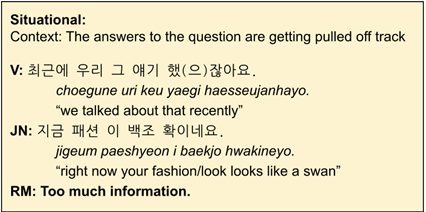
, , ,
Scroll to Top