Media

“Of course, right” and “I was just asking to ask”: Women’s Relationship With Cooperative Language and Their Perception

Zoe Curran, Emmeline Hutchinson, Rylee Mangan, Kamiron Werking-Volk

Why do we like Elle Woods from Legally Blonde? Why do we dislike Miranda Priestly from The Devil Wears Prada? Of course, part of it is because that is who the movie tells us to like and dislike, but is another aspect of that how they use language?

Based on existing knowledge that men and women use communication differently, taking divergent paths to accomplish tasks, we sought to determine how these variations distinctly affect men and women. We focused specifically on the effects on women and how their language use changes their perception. Are they the heroine or the villain? Are they the sweetheart or the b*tch? Our study examined the representation of women in the media and explored the implications of cooperative conversational styles on a woman’s perceived image.

We predicted that the way women in movies use language to facilitate, or inhibit, conversation contributes to their perception in aspects that do not affect men. Based on scenic analysis and tracking of key features, we found a correlation between the characters’ use of cooperative linguistic features and their representation in the film that may be integrated into everyday life.

[expander_maker id=”1″ more=”Read more” less=”Read less”]

Introduction and Background

Did you know that women are 33% more likely to be interrupted when speaking with men? And that men speak almost twice as often as women in formal conversation? As an all-female research group, we wanted to explore why we were being cut off in some conversations and completely ignored in others (read more about this topic here). Previous findings state that females utilize conversational styles that foster connection and community, while males utilize styles that attempt to strengthen their independence and dominance over the discussion’s topics (Ersoy, 2008). We do understand that men and women converse differently, but why did it seem like our communicative style was inferior when it is an attempt to be more engaging?

An explanation to this unbalanced communication might be women’s more active use of minimal encouragers, nonverbal gestures, and agreements that are intended to facilitate conversation but as we experienced, can yield opposite results. We geared our research towards understanding the implications of what we have termed Cooperative Conversation Linguistic Features (henceforth, CCLFs). CCLFs are a collection of words, phrases, and nonverbal gestures that promote a cooperative speaking style to encourage a conversational partner. These features help balance the conversation by allowing the speaker to continue talking. However, a woman’s increased use of these features can render them as a less-dominant speaker who might be inferred as subordinate and less powerful. To determine if there is a relationship between CCLFs and the speaker’s perceived identity we studied how women and their control, or lack of, the conversation affects their image and in an essence their likeability.

We studied samples of both same-sex and cross-sex conversation groups in popular media. Although movies are not perfect depictions of real life, stereotypes are often constructed from visible patterns of behavior and actions of real people (Kubrak, 2020). Media characters exaggerate the usage and effect of these linguistic features in a manner that can be studied effectively. We hypothesized that female characters’ increased usage of CCLFs will be associated with perceptions of decreased power, confidence and intelligence. We believed it would also be associated with increased likability in the eyes of the audience and/or their conversational counterparts.

Methods

High-stakes conversations between female and male counterparts in contemporary films where there was either a negotiation, conflict or high-profile discussion were analyzed. Our chosen films included The Devil Wears Prada, The Proposal, Erin Brockovich, Fargo, Legally Blonde, and The Social Network. Eight female characters from a total of six films were examined and individually identified as cooperative or uncooperative roles. These characters included iconic figures such as Elle Woods, the protagonist in Legally Blonde, who was coded as highly cooperative, versus Miranda Priestly, the antagonist in The Devil Wears Prada, coded as highly uncooperative.

We counted the number of CCLFs and uncooperative actions (henceforth, UAs) displayed by female characters. CCLFs included minimal encouragers and cooperative overlap, which we defined as words or phrases that serve to promote intimacy, support the conversational partner and indicate encouragement. Another CCLF of interest was cooperative nonverbal cues like making consistent eye contact, nodding, leaning in and making supportive hand gestures. Our last CCLF was facilitating questions, which we defined as any question that served to stimulate conversation, support the conversational topic or encourage the conversational partner. In order to have a full picture of how cooperative vs noncooperative characters are constructed in film, we also documented the number of UAs. These were defined as verbal and nonverbal communication that was disruptive or uncooperative in nature, such as changing the conversational topic, not responding, disruptive interruptions, lack of eye contact, walking away, or arguing with the counterpart’s motives or ideas. We adopted many of these features from Selma Ersoy’s work on collaborative versus competitive communication styles (2008) and added other components we felt assisted or inhibited conversation from our own experiences and the experiences of peers.

Read more about the difference between cooperative overlap and interrupting here!

Quantitative methods were used to calculate the frequency of CCLFs and UAs for each character. Qualitative methods were used to evaluate any unique features of the specific conversational styles of the characters and to make note of how the character of interest was perceived by other characters in the scene.

Results and Analysis

Perhaps unsurprisingly, we noticed a dramatic disparity between the ‘cooperative’ and ‘uncooperative’ groups. Across the board, the women in the cooperative group used the CCLFs at a greater rate. These women also used the uncooperative actions at a substantially lower rate than the uncooperative group: the cooperative group only using them three times in all of their scenes. Much differently, the women in the uncooperative group frequently used the UAs at a total of 17 times. Additionally, the women in the uncooperative group rarely used CCLFs to foster cooperative conversation. Only one uncooperative character used these features at all, for a total of three uses.

Since we were watching movie scenes of various lengths to collect data, we found it important to ensure that the scene length was not skewing our information. To avoid this misrepresentation, we converted the number of features used to the rate the characters used them. This information was calculated as the specific feature usage per minute. We found that Erica Albright and Marge Gunderson were standouts in their high rate of CCLF use at approximately 8 and 7 per minute respectively. Simply put, Erica would use a CCLF every seven and a half seconds in a conversation, and Marge every eight and a half seconds (find our example scene with Erica here). The women in the uncooperative group had a much lower use of CCLF’s per minute, with all but one character using 0 per minute.
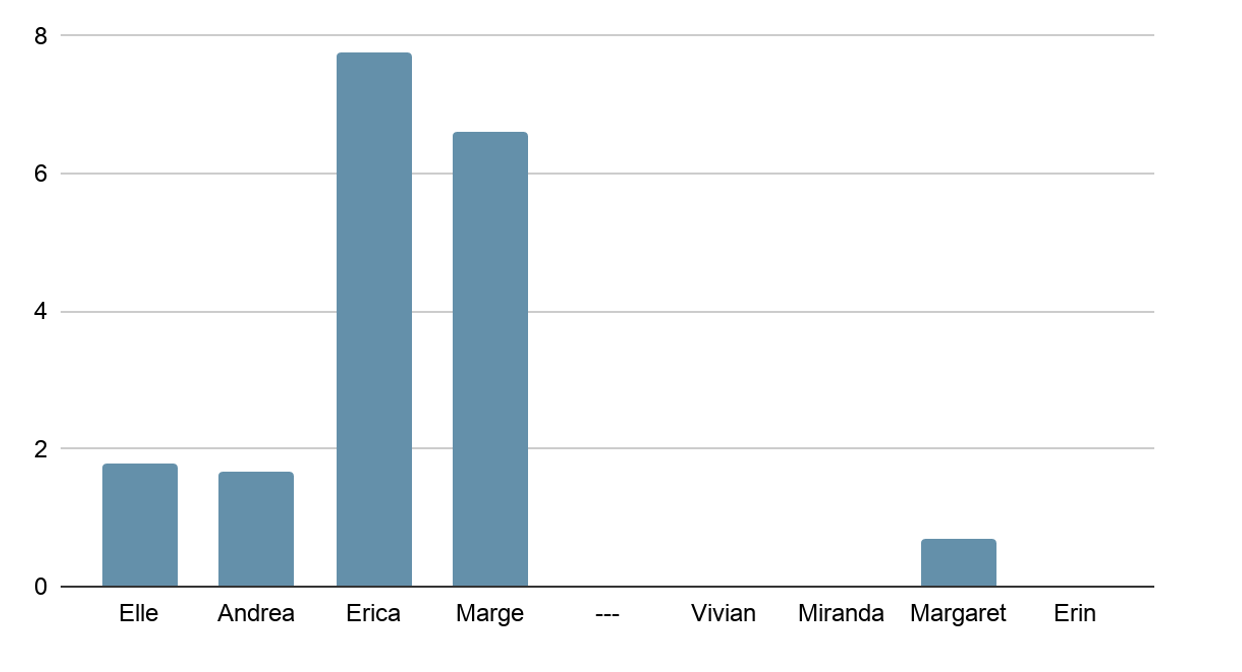
Figure 1: Characters’ CCLF Use Per Minute. The x-axis includes the women involved in the study separated by an empty column “—”. The separation indicates the distinct groupings of these women in the cooperative (left) and uncooperative (right) groups. The y-axis measures the CCLFs used per minute by the women. The women in the cooperative group overall used CCLFs at a higher rate per minute.

We also converted the uncooperative actions to a use per minute rating and found that characters such as Vivian and Erin (uncooperative group members) had the highest rates of use at approximately three and two per minute respectively.
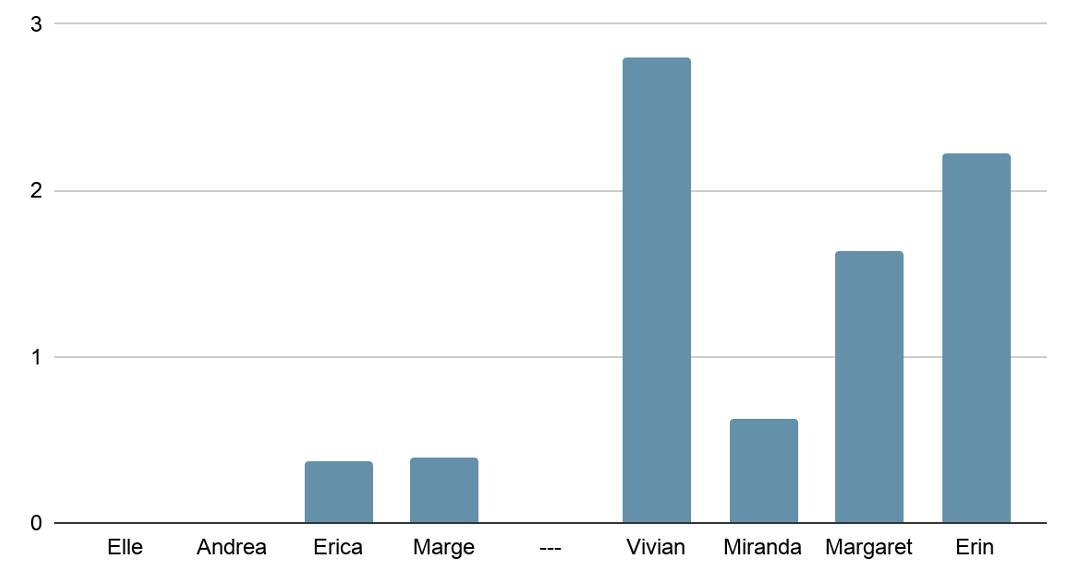
Figure 2: The Characters’ Rates of Uncooperative Action Usage per Minute. The x-axis includes the women involved in the study separated by an empty column “—”. The separation indicates the distinct groupings of these women in the cooperative (left) and uncooperative (right) groups. The y-axis measures the UAs used per minute. The women in the cooperative group used UAs much less frequently than the women in the uncooperative group.

Overall, our data showed that the cooperative group had a higher rate of CCLF use than the uncooperative group, comparing an average of 4.5 features per minute to 0.175 features per minute.
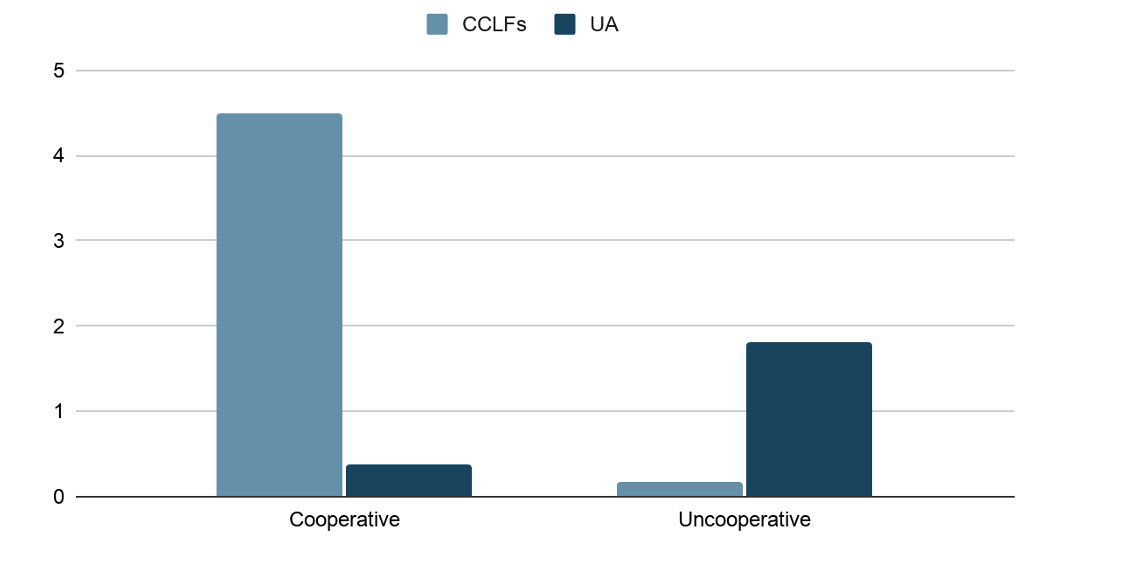
Figure 3: The Average Use of CCLFs and Uncooperative Actions (UA) by the Cooperative and Uncooperative Groups. The x-axis shows the two categories of women in our study: cooperative and uncooperative, and the y-axis indicates the number of features used per minute by the groups. The units of measurement are the number of features used per minute. The cooperative group used a dramatically higher frequency of CCLF features than the uncooperative (4.5 per minute vs 0.175 per minute). Also, the cooperative group had a lower rate of Uncooperative Action use compared to the uncooperative group (0.38 per minute vs 1.82 per minute).

The opposite was found with the uncooperative actions, with the cooperative group using them much less frequently at an average rate of 0.38 per minute, compared to the uncooperative at 1.82 per minute. These stark differences can be more clearly described as the cooperative group using CCLFs at a rate 26 times that of the uncooperative group, and using UAs at a rate about 5 times less than the uncooperative group.

Discussion and Conclusions

As for how the use of CCLFs and UAs relates to perception of the character we noticed a common connection between the use of CCLFs among characters that the audience is supposed to like, the people we are supposed to root for, as well as a connection between the characters who used more UAs and their positions as villains in the narrative.

To paint a clearer picture let’s look at the movie Legally Blonde. Elle, a character from our cooperative group is the hero of the movie, while Vivian from the uncooperative group is one of the main antagonists. We as an audience are not supposed to side with Vivian until she changes her ways and becomes friends with Elle. (See our example scenes with Elle and Vivian). This is not a motif isolated to Legally Blonde since the same can be seen in The Proposal. Sandra Bullocks’ character Margaret Tate is called a “witch” and a “monster” by her peers, sending a clear signal to audiences on what to think of her character. It is not until her character’s journey to her relationship with the male lead, Andrew Paxton, and her becoming somewhat nicer that she gets praise and a happy ending.

In our sample these same motifs simply did not exist for men. A prime example of this being Mark Zuckerberg in The Social Network, a character that practices disruptive communication. He is offstandish and objectively unkind in the opening scene and throughout the movie, adopting many of the UAs we identified, but at the end of the movie he is still praised. The audience sympathizes with Mark and despite his flaws he is not given a redemption arc in his movie, he is simply allowed to exist. The male characters we observed did not have to be perfect or traditionally nice to be liked. We believe that this may reflect a broader standard that women are held to in the real world. Our research speaks to how movies shape us and give us hints about who we are supposed to be.

For more insights on how movies shape us, watch this TEDTalk.

Although our study stuck to a relatively strict gender binary and focused on white, middle to upper class, straight coded characters, we feel it brings up valid questions about the perception of women and what standard women are held to both in media and in real life.


References and Used Sources

Borresen, Kelsey. “How To Know If You’re An Interrupter Or A ‘Cooperative Overlapper’.” HuffPost, HuffPost, 4 Mar. 2021, www.huffpost.com/entry/interrupting-or-cooperative-overlapping_l_603e8ae9c5b601179ec0ff4e.

Ersoy, S. (2008). Men compete, women collaborate. Kristianstad University: Language and Gender. http://www.diva-portal.org/smash/get/diva2:231309/FULLTEXT01.pdf

Fincher, D. (2010). The Social Network. Columbia Pictures.

Kubrak, T. (2020). Impact of Films: Changes in Young People’s Attitudes after Watching a Movie. Behavioral Sciences, 10(5). https://doi.org/10.3390/bs10050086

Luketic, R. (2001). Legally Blonde. Metro-Goldwyn-Mayer & Marc Platt Productions.

Stokes, C. (2012, November). How movies teach manhood. https://www.ted.com/talks/colin_stokes_how_movies_teach_manhood

Susan Chira. (2017, June). The Universal Phenomenon of Men Interrupting Women—The New York Times. Retrieved March 17, 2021, from https://www.nytimes.com/2017/06/14/business/women-sexism-work-huffington-kamala-harris.html

[/expander_maker]
, , , ,

Heroines in K-Dramas are Now Changing: How and Why?

Dowon Yoon

When we think of K-Dramas, we can easily think of the Cinderella story: a poor heroine meets an extremely rich hero and becomes a modern princess. A famous screenwriter named Eunsook Kim always fascinates numerous viewers by entertainingly telling this kind of story. When I looked into her most famous works, Lovers in Paris (2004) and Goblin (2016), I discovered that the speech patterns of heroines have changed over time even though the setting of the Cinderella story remains the same. I analyzed dialogues from two dramas, and the analysis showed that a heroine from recent drama Goblin speaks in a more dominant way than a heroine from the older drama Lovers in Pairs. It shows that Kim reflects the change in women’s speech behavior in her script. This reflection is very important because it is a mirror of the time which demonstrate the change in women’s speech behavior in the real world.

[expander_maker id=”1″ more=”Read more” less=”Read less”]

Different social roles for males and females create different essential ways of thinking, and eventually, they lead to the difference in pronunciation, sentence constructions, and many other linguistic components. According to Lakoff (2004), the speech patterns of men are naturally more dominant than women. Based on women’s usage of tag questions to get confirmation and assurance by male’s opinion, he argues that women are subordinate to men during the conversation. On top of the theory of Lakoff, Men and women are expected to use a different style of language in Korean culture. For instance, because of the influence of patriarchal culture, females use more polite language than males, but the expectation towards femininity underlies behind it.

However, by comparing two different K-Dramas, Lovers in Paris (2004) and Goblin (2016), I observed that a heroine Euntak from the Goblin has dominant speech style just like men while a heroine Taeyoung from the Lovers in Paris still uses the traditional subordinate speech style of women. This is important because the change of speech patterns of two heroines may reflects women from the real world also use the dominant speech style in today’s society and the differences between men and women’s speech behavior may reduced in these days.

To demonstrate that the differences between dominant speech style of men and subordinate speech style of women are now reduced in these days, I compared and contrasted dialogues of Taeyoung from Lovers in Paris (2004) and Euntak from Goblin (2016). They are in a similar situation where they both had to depend on extremely wealthy heroes, so it is very interesting to see the difference in their speech behavior.

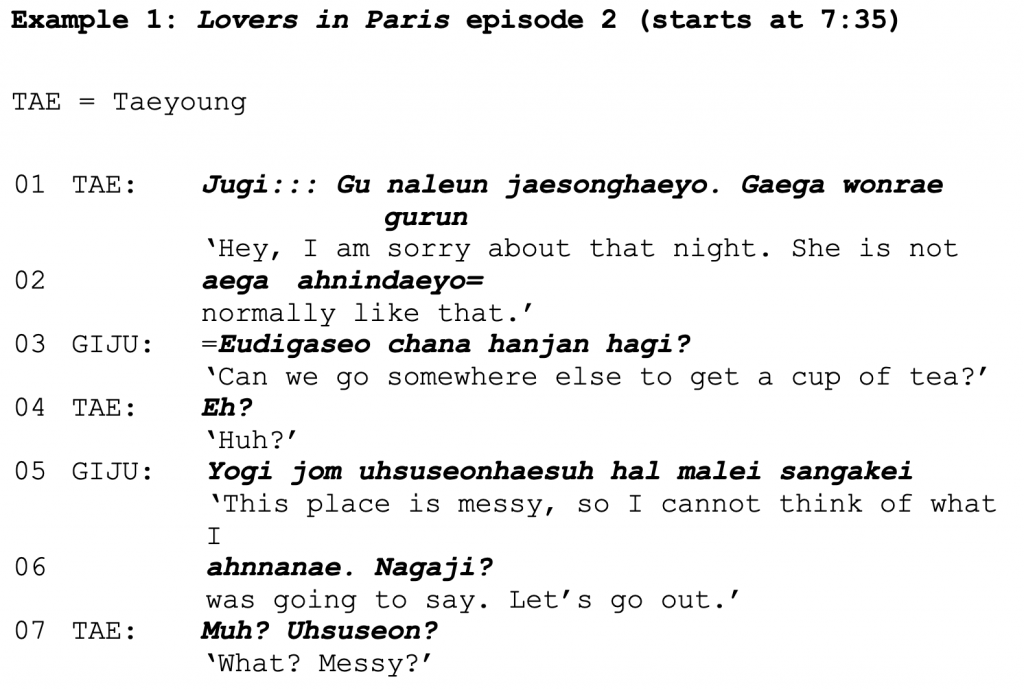
By comparing two dialogues, I realized that Taeyoung tends to be interrupted by the hero during a conversation, while Euntak tends to interrupt the hero more. According to Sohn (2006), interruptions and overlappings can be a signal of power since they are primarily viewed as impolite behavior and “powerful people are more likely to feel warranted to interrupt powerless people than vice versa.” In the dialogue from episode 2 of Lovers in Paris, Giju, the rich hero in this drama, comes to Taeyoung’s house as a surprise after they meet at the bar by coincidence (Korean in bold italics):

In this dialogue, they do not communicate with each other, but just says what they want to say. In this unilateral conversation, Giju simply conveys what he wants to do and does not pay attention to what Taeyoung says as he interrupts while she is still talking at line 2. He is very dominant and leads the whole situation by almost demanding her to head out for a cafe. Meanwhile, Taeyoung is completely and helplessly led by Giju in the conversation as Giju keeps brings up what she did not expect at all. Lines 3 and 5, she reacts by saying, “Huh?” and “What?”, which shows that she is very surprised by what Giju brings up and the only thing that she can do is reacting to it. Although Giju interrupts her and even tries to take her outside her house, she never interrupts him and asks what he is going to talk about nor try to continue what she was going to say.

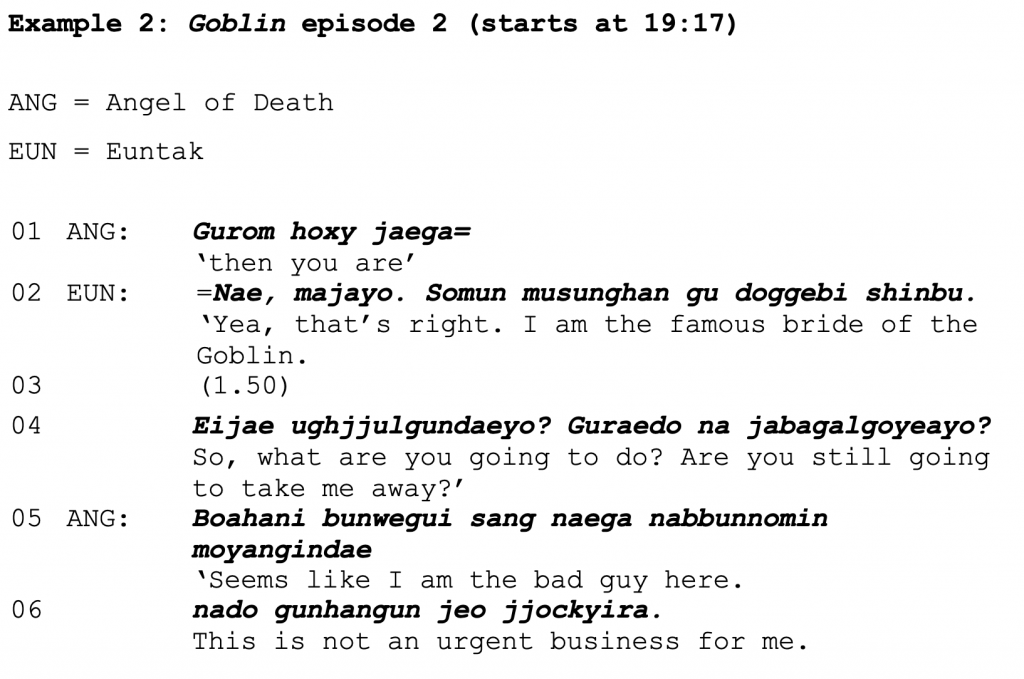
However, if we look into the dialogue of Angel of Death and Euntak in Goblin, we can observe that the heroine Euntak is not subordinate to the male character like Taeyoung in Lovers in Paris. In this conversation, Euntak meets the Angel of Death while she is with the Goblin, the rich hero in this drama. Euntak is scared of the Angel because she thinks that the angel came to take her to the afterlife.’

In this dialogue, Euntak interrupts the angel and leads the conversation by asking back to him at line 4. Even in the situation where her life is threatened, she bravely stands against the angel. Although she was with the Goblin, she did not depend on him. According to Sohn (2006), women tend to avoid interruptions and overlapping. In other words, Euntak’s speech style is dominant just like traditional men.

Through comparing two dialogues, we found an interesting change in the usage of interruptions by heroines, which shows that Eunsook Kim made a change in the speech behavior of heroines; they used to have the subordinate speech style, but they now use more dominant speech style. In the script, she may reflect that women’s speech behavior has changed over time. Whether her dramas are a mirror of the time or viewers get influenced by her drama, it is worth looking back at our speech behavior and think about which speech style we want to use for our daily conversation.

References

Kim, E. (Writer), & Lee, E. (Director). (2016). Chapter 2 [Television series episode]. Goblin. Seoul: tvN.

Kim, E. (Writer), & Shin, W. (Director). (2004). Chapter 2 [Television series episode]. In Moon, J. (Executive producer), Lovers in Paris. Seoul: SBS.

Lakoff, R. (2004). Language and Woman’s Place: Text and Commentaries. Oxford University Press.

Sohn, H. (2006). Korean Language in Culture And Society. University of Hawaii Press.

[/expander_maker]

, ,

Media Depictions of African Americans in Incidents of White-on-Black Violence

Faith Ngo, Madyllen Kung, Melissa Aguirre, Sabrina Huang

Racial inequalities have been a fundamental aspect of the underlying fabric of the United States since its conception almost 250 years ago. From brutal incidents of racialized violence to educational disparities that have continually oppressed communities of color, inequities rooted in the throngs of racism have persisted and accumulated over time. An example of such racial inequities is violent incidents in which white police officers shoot and kill unarmed African American individuals. Proof that discriminatory biases still exist today, these events have become fuel for groundbreaking social movements that are centered on uplifting the voices of oppressed communities and challenging hegemonic ideologies. 

Over the last ten weeks, we have learned about the vital role language plays in constructing and maintaining identity. Through stereotypes and “otherizing,” which have amplified the perceived differences between social groups and intensified the already vast racial boundaries, language can codify and perpetuate discriminatory biases.

As we started our project, we asked ourselves, would articles dehumanize African Americans or would they place blame on the white police officer? Would race be a salient aspect? Would there be a notable difference in the styles of language across different social identities? Or would we find a difference between various news outlets?

[expander_maker id=”1″ more=”Read more” less=”Read less”]

INTRODUCTION

Language is a powerful tool that can be used to construct our understanding of the world or perpetuate traditional beliefs. As tensions between African Americans and White Americans continue to grow, it is important to recognize the ways in which language can reaffirm discriminatory biases.

With this in mind, we decided to focus specifically on the linguistic elements news articles utilize to cover incidents of white-on-black violence. In addition to being widely accessible to the public, such articles play an important role in either reaffirming or challenging prejudicial stereotypes.

This led us to our research question: In situations of white-on-black violence, how do different news outlets utilize linguistic elements to depict and characterize African American individuals as archetypes of widely-held stereotypes?

BACKGROUND

Research has shown that the media routinely associates African Americans with criminality. News outlets disproportionately report on criminal incidents which involve African American suspects in comparison to white suspects, especially if the incident involves violence (Oliver, 2013). The overrepresentation of African Americans in incidents of crime creates a stark dichotomy between the portrayal of black and white Americans by news outlets. While violent crimes perpetrated by African Americans are widely reported on, violent incidents involving white suspects are largely ignored (Johnson and Dixon, 2008). In addition to the racial disparities apparent in coverage of crime, studies have shown that specific language is used to dehumanize African Americans regardless of their role as the perpetrator or suspect. The use of “micro-insults” in descriptions of African Americans can implicitly link them with social categories that are historically viewed as “inferior” to normative social groups (Smiley and Fakunle, 2015). On the other hand, the use of “micro-invalidations” can trivialize the experiences of black individuals (Smiley and Fakunle, 2015). Such language can have alarming effects in priming audience members towards internalizing negative stereotypes of black individuals and potentially acting upon those implicit biases (Oliver, 2013). The actions which result from biases produced and maintained by mainstream news outlets — “racial microaggressions” — form the foundation of discriminatory structures that continually relegate African Americans to the bottom of the social hierarchy (Kulaszewicz, 2015).

METHODOLOGY

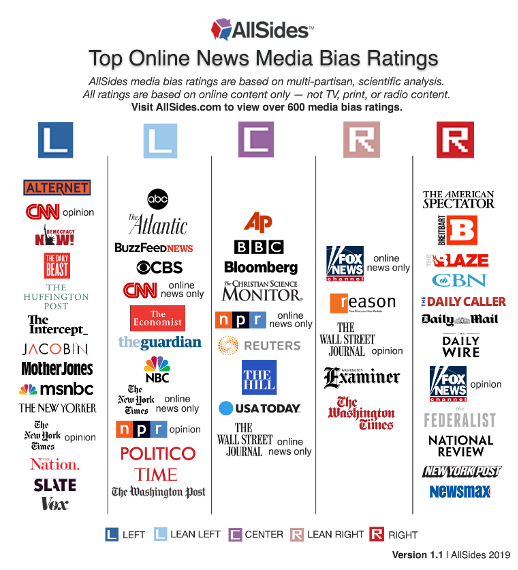
Since the manner in which white-on-black violence is depicted largely depends on the political affiliation of the reporting news source, our methodology was designed to account for a range of varying political viewpoints. Each researcher selected two liberal sources, two conservative sources, and one moderate source based on the AllSides Top Online News Media Bias Ratings chart (Figure 1). These five articles of varying political affiliations were used to analyze the following individuals: Tamir Rice, Tanisha Anderson, Trayvon Martin, and Eric Gardner. We selected these individuals because they are figures who are representative of White-on-Black incidents of violence in the United States.

Figure 1: AllSides Top Online News Media Bias Ratings We used this chart to find articles that aligned with a political orientation. One article was selected from each column from the news outlets listed in this chart. Source: https://www.allsides.com/media-bias/media-bias-chart

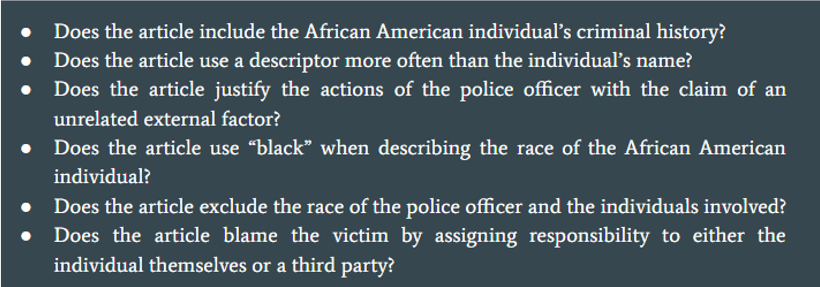
After the articles were chosen, a Total Point System was employed to evaluate the salience of race in the article through explicit references of race. The point system was designed to ask one question: to what extent did the article make race a conspicuous and contributing factor in the white-on-black incident? The following are the six criteria of the system: 

It is important to note that an article that scored six out of six points does not necessarily indicate that it is more racially biased.

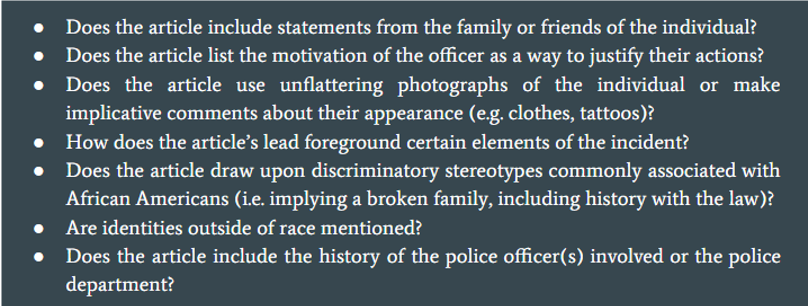
Since language also has an implicit function, the second part of our analysis involved a Guiding Question system to account for indirect references to race that could not be captured by the point system. The following are the seven criteria used in this system: 

The assessment of articles using the Guiding Question system provides insight into the discreet manner victims and assailants are framed. These questions illustrate how the language of articles can indirectly position individuals as a particular actor in larger racial narratives (this is often referred to as “interpellation”). 

RESULTS

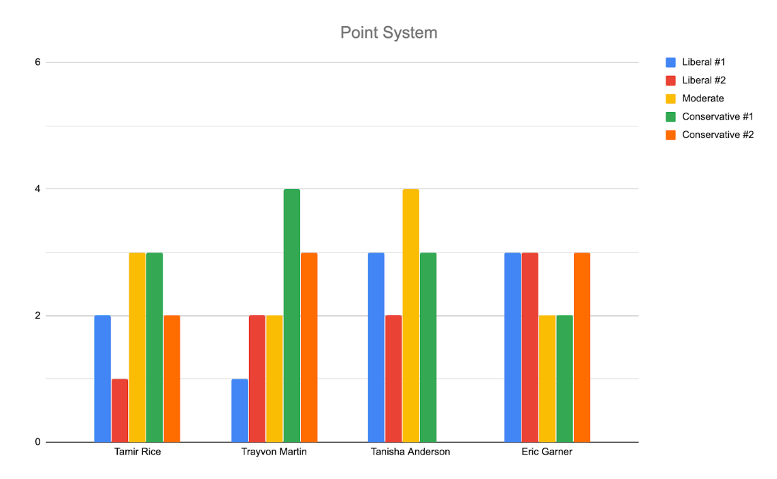
Figure 2: Point totals between various news outlets across the four individuals This bar graph depicts the varying point totals of articles which cover the deaths of Tamir Rice, Trayvon Martin, Tanisha Anderson, and Eric Garner. The different colors depict the political alignment of the articles selected.

As Figure 2 shows, point totals varied across articles which covered the deaths of our sample of individuals. We found articles on Tanisha Anderson and Trayvon Martin to have disproportionately high point totals because of their existence at the intersection of multiple oppressed identities. While Anderson had a mental disability that was commonly referred to, Martin’s appearance at the time of his death was a salient component of several articles. 

Foregrounding in the lede

In our quantitative analysis of selected news articles, we focused on the journalist’s word choice throughout the article and how such words evoke a reaction from readers (Jakobson’s “conative function” of language). However, special attention was paid to the first sentence of the article, which is often referred to as the “lede”. This sentence encapsulates the who, what, where, why, and when of the situation or topic in question and helps to set the tone for the remainder of the article. Due to the position of the lede at the beginning of the article, information included here can be utilized to foreground certain elements. 

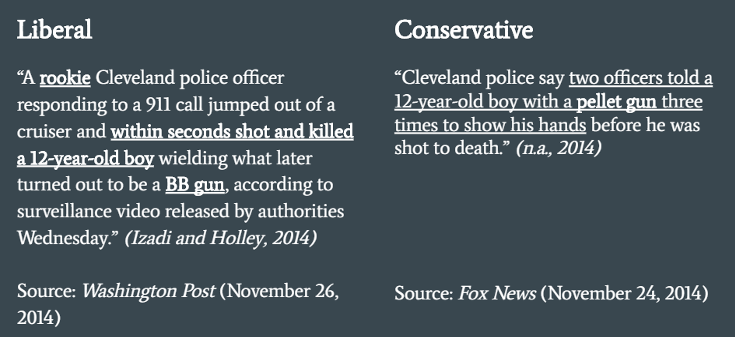
Figure 3: An example of foregrounding in the lede The ledes included in this figure are from two articles which covered the murder of Tamir Rice. Bolded and underlined words highlight the noticeable differences between each.

Across the four individuals we studied, we observed that there were noticeable differences in language use. Liberal news outlets typically included language which positioned the African American individual as the “victim”, while conservative news outlets utilized language which portrayed the police officer(s) and their actions as reasonable. Information that supported each agenda was included in the lede, while information that undermined such portrayals was either excluded or backgrounded. 

Differences in point totals between conservative and liberal news articles

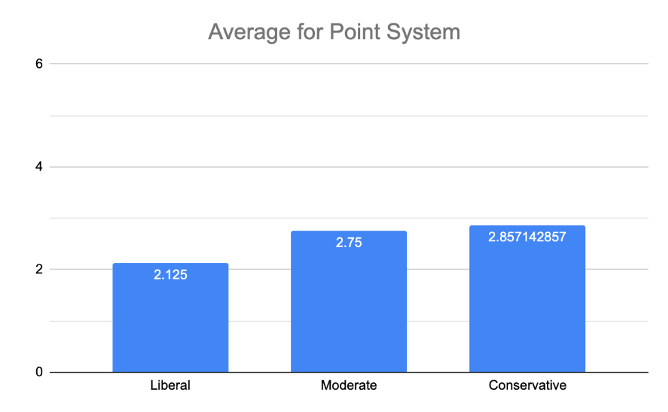
Our research also found differences in average point totals between conservative and liberal news articles (Figure 4). Although these differences were not large, it appears that conservative articles have lower point totals and conservative articles have higher point totals. Meanwhile, moderate sources had point totals that fell between the scores of liberal and conservative news outlets. However, these average point totals fell closer to those of conservative sources. 

Figure 4: Average point totals of liberal, moderate, and conservative news outlets.

Differences in guiding questions

We also found stark differences in answers obtained by way of our guiding questions. Across the twenty articles we studied, conservative articles utilized a greater degree of language that reinforced common stereotypes associated with African Americans. Conservative sources often drew upon the individual’s criminal history or appearance (e.g. wearing a hoodie) as a subtle way of shaping the individual’s character. If the officer was mentioned, it was to justify his/her actions in some way. Conversely, liberal sources often focused on the motivations of the officer and their judgment errors in interpreting the situation. The results demonstrate that in general race was made more salient in conservative sources that liberal sources as an inherent contributing factor to the situation.

DISCUSSION AND CONCLUSIONS

Our results reveal that there is a stark and noticeable difference in the language use between conservative and liberal news outlets. While liberal publications use language to position African Americans as “victims”, conservative publications position them as the “assailant” or “instigator”. Such information draws attention to the detrimental role journalism plays in furthering and reinforcing stereotypes that support the criminality of African Americans. 

There were several limitations to our research, however. One noticeable limitation is the assumption that the political alignment of a news outlet directly corresponds with its article’s attitude towards race. There are numerous factors that may play a role in the way national publications depict race that we unfortunately did not account for in this project. Other limitations include differences in publication times (which impact how much information is available to journalists and, by extension, what particular elements are salient) and personal biases.

Regardless, our results offer insight into the way African Americans are both implicitly and explicitly discriminated against. Such biases underscore the role language can play in shaping public perceptions and encouraging prejudicial actions. It also reveals ways in which we can uproot social stereotypes surrounding historically marginalized groups and tackle harmful racial disparities. 


REFERENCES

Johnson, K. A., & Dixon, T. L. (2008). Change and the illusion of change: Evolving portrayals of crime news and blacks in a major market. The Howard Journal of Communications, 19(2), 125-143. doi:http://dx.doi.org/10.1080/10646170801990979

Kulaszewicz, Kassia E.. (2015). Racism and the Media: A Textual Analysis. Retrieved from Sophia, the St. Catherine University repository website: https://sophia.stkate.edu/msw_papers/477

Oliver, M. (2003). African American Men as “Criminal and Dangerous”: Implications of Media Portrayals of Crime on the “Criminalization” of African American Men. Journal of African American Studies, 7(2), 3-18. Retrieved from http://www.jstor.org/stable/41819017

Smiley, C.J. & Fakunle, D. (2016) From “brute” to “thug”: The demonization and criminalization of unarmed Black male victims in America, Journal of Human Behavior in the Social Environment, 26:3-4, 350-366, DOI: 10.1080/10911359.2015.1129256

 [/expander_maker]

, , , ,

I Am Who You Are Not: Insults in Films

Anthony Waller, Avery Robinson, Nicole Rasmussen, Jun Jie Li

Creativity and complexity are not often two factors that are considered when we insult; we typically go to our personal shelf of offensive phrases and let our selections do their damage. When we look at high school oriented films, however, we see that insults are a means of identity negotiation and employ creative and complex techniques that serve to compound the effect and project a strategic process of identity projection and negotiation. In this article, we will be examining how films act as a social mirror by reflecting a description of contemporary teenage culture. Specifically, we will be considering two factors that we believe to have had a significant impact on the motivation of portrayals: gender and time. Looking at several classic selections that spans the decades of the 80’s through the 00’s, we utilized a nexus and inductive approach in isolating specific linguistic elements of insults that appear most salient to our research. We conducted a series of comparative analyses of creativity and complexity parameters and extrapolated a loose correlation between gendered insults and the passage of time. From there, we will be discussing some implications of this correlation and how insulting is a process of identity prioritization and constructivism through self-isolation.

[expander_maker id=”1″ more=”Read more” less=”Read less”]

Introduction: How We Offend

For our research, we will be investigating the depiction of insults in teenagers as portrayed in films of high school settings from the 1980s, 1990s, and 2000s. Specifically, we want to take a look at how the complexity and creativity, as defined below, of insult formation are expressed across gender boundaries, and how the mechanism of that formation has evolved over the decades. Based on our preliminary observations, we are expecting to see depictions of greater structural complexity and communicative creativity in females characters over males. We also believe that there will be an inverse proportional relationship between the integration of elaboration in insult formation and the time period.

Background

Film can often provide valuable insights into how an era sees itself (Kalinak, 2010). Its choices shed light on realities and stereotypes, and insults and derogatory language natural entry points for analysis. Insults and derogatory language have two important, interdependent functions: the attack and distancing of the other and the defense and reassertion of the self. Teenagers are at a critical stage of self-discovery, and these functions offer insight into their views of self (Goffman, 1971). Choices in insult delivery will show the teenager’s prioritization in their identity expression, therefore by analyzing teenagers’ conspicuous insult expression, we can learn a great deal of what adults think of their successors.

The basis of our first hypothesis rests on Lakoff’s features of women’s speech. According to Lakoff, women are expected to use super-polite forms e.g. indirect language or euphemisms, and avoid swear words (Mooney & Evans, 2015). Therefore, if women want to insult someone, they would need to be more creative in order to get their point across while still adhering to the conventions of what is acceptable for women to say.

Our reasoning for predicting a general decline in complexity and creativity as we get closer to the current time is due to the improvement in technology and the emergence of “text speak,” “meme culture,” and the general notion that teenage speech has become more coded and somewhat less markedly intelligent (Brinkley, 2013, Dijk, 2016). Teenagers have found ways to say more with a lot less and to make a greater use of the referential creativity (see below).

Methods: Nexus and Induction

For our research, we will be utilizing a nexus and inductive approach; we will be drawing conclusions based on data and observations that we make in teenage films. Below we have six films, two from each of the three decades of our research parameter, that we believe will be illustrative of the teenage perception:

1980’s: The Breakfast Club, Ferris Bueller’s Day Off

1990’s: Clueless, 10 Things I Hate About You

2000’s: Mean Girls, The Princess Diaries

As we watch these films, we will be observing and taking notes of specific instances of derogatory language use by teenagers, as well as creativity and complexity levels. One way we have found to quantify these measures is to check if an insult actually contains an insult or a derogatory word, or whether it contains a series of words, reliant on references and word plays, constructed to make an insult. Additionally, we will analyze word choices in terms of commonality of use, with the thought in mind that less common words constitute a more creative insult. Once we have our data on creative versus non-creative insults, we will be able to form a ratio. We will compare the ratio between men and women in the movies, between the different decades, and between men and women differences in different decades. Further methods of analysis will include measurements of length, as well as comparisons of the types of references made across our parameters. As we have mentioned previously, we predict that insult use is more creative among women, and that insult use has become less creative since the 1980s.

Definitions / Parameters

Complexity: a function of length, diction, syntax.

Length: number of words in an insult or an insult group

Diction: word choice (common/uncommon)

Syntax: construction; whether the insult is formed in a non-declarative, complex way

Creativity: a measure of tone, reference, and blatant insult word choice

Tone: insults delivered through the use of tone or body language

Reference: use of references that are contextually significant in making the meaning of an insult apparent. This can fall into two main categories:

Cultural: An appeal to cultural, epistemic domains, such as arts and history, that are predominantly apparent to the individuals.

Social: An appeal to social norms, an attempted outing of the individual from the social hierarchy from an identity perspective.

Presence of blatant insult word: whether one insults with a pre-established jab or creates the pointedness themselves.

Results: Correlations

Our data from the 1980s is from Ferris Bueller’s Day Off and The Breakfast Club. The combined data from the two films tells us that the average word length per female insult is 5.71, and for males is 12.54. 46% of the insults were syntactically significant, and only 5.6% of those which were syntactically significant were from females. Social and cultural references were 19% and 14%, respectively, with females contributing 0% to both categories. 14% of the insults included uncommon and notable lexicon, but again with 0% contribution from females. In 5% of the data we saw insults delivered through tone, all attributed to male insults.

Our data from the 1990s films Clueless and 10 Things I Hate About You were 64% female. The average word length for a female-given insult is 8.84 words, and for males it was 8.54 words. 46% of the insults given were syntactically significant, and 78% of these are attributed to females. Only 15% of insulted included uncommon word choice, and about 44% of these were given by women. In regards to references, females made up around 80% of all cultural referenced insults, 50% of socially referenced insults. 27% of the insults were delivered through the use of tone, and 88% of those were female-delivered.

Our data from the 2000s derives from Mean Girls and Princess Diaries. From these films, 94% of the insults were from females. The average female word length was 6.45, and the average male word length is 9. 46% of the total insults were syntactically significant, and 93% of those were from women. In regards to references, 6% of the insults included cultural references and 13% included social references; all of these are attributed to females. 21% of the insults contained uncommon word choice, 93% from females. In regards to insults delivered through tone, 15% of the total insults employed this method and 80% is due to females. Finally, 66% of the insults contained an actual insult word, with 95% of that being from females.

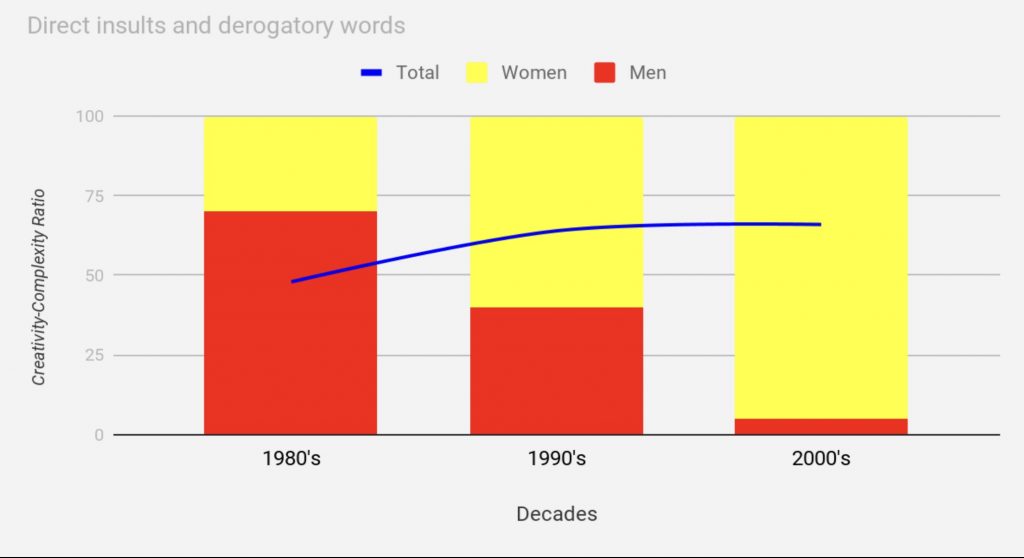
Figure 1: Direct Insults and Derogatory Words Over Time.

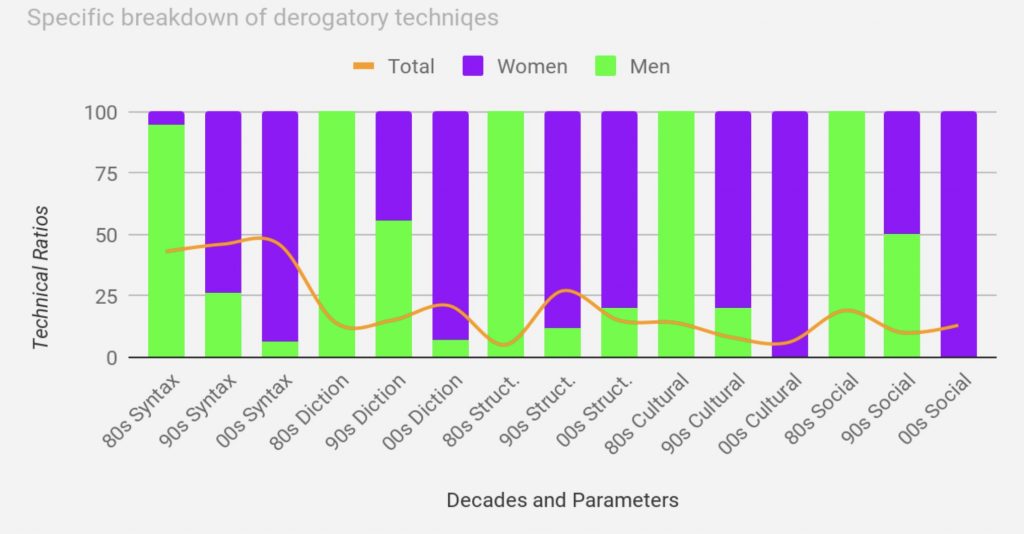
Our data from the 80s show us that males employed much more complex and creative insults than females at the time. Going into the 90s, the trend shifts, and the majority of our data point to women being a bit more creative and complex in their insult use than their male counterparts. Finally, in the 2000s, we see a drastic change in our results with women demonstrating much higher levels of insult creativity and complexity than men. We were off from our original predictions.  We see from our data that insults, among females, increased in complexity and creativity. Additionally, we do not see a decrease in general creativity as we moved through the decades.

Figure 2: Breakdown of Derogatory Techniques Across Decades – Syntax, Diction, Structure, Cultural and Social References.

Discussion and conclusions: Why We Offend

First, from a pragmatic perspective, why do teenagers feel the need to beat around the bush in insults? At first glance it seems rather counterintuitive, but as we have seen, they serve important linguistic functions. For one, creative and complex insults can inflict a greater amount of damage by constructing a vehicle in which the insult can be delivered in more deceptive and cognitively disorienting way. It can also be viewed as a “flex” of intellectual superiority, or as a way to make the insult less refutable, as a retort would necessitate an equal level of craftsmanship (Goffman, 1971).

But why do we insult? What do we have to gain in insulting others? From our observations, it appears to be a practice of identity projection, of a more aggressive degree, because it is forceful definition of the self via an equally forceful definition of the other. In other words, along the same line of “who am I if not myself?,” it appears that the teenage response is merely “I am not you.” This seems to suggest that identity is only salient, or more radically, only existent, through expression and a process of negotiation and prioritization with the other. Insults serve as a way to categorize and define oneself against others (Marsden, 2009).


References

Brinkley, A., & McGraw-Hill Education (Firm). (2013). American history : Connecting with the past (Twelve edition, Updated. Updated AP ed.). New York, NY: McGraw-Hill Education.

Dijk, C. V. (2016). The Influence of Texting Language on Grammar and Executive Functions in Primary School Children. Retrieved from https://www.ncbi.nlm.nih.gov/pmc/articles/PMC4816572/

Goffman, E. (1971). Relations in public: Microstudies of the public order. New York: Basic Books.

Kalinak, K. M. (2010). Film music a very short introduction. Oxford: Oxford University Press, USA.

Marsden, E. (2009). What the Fuck? An Analysis of Swearing in Casual Conversation. Retrieved from https://www.academia.edu/3871040/What_the_Fuck_An_Analysis_of_Swearing_in_Casual_Conversation

Mooney & Evans (2015) Language and Gender. In Language, Society and Power (pp. 108-131). London: Routledge.

[/expander_maker]

, , ,
Scroll to Top