gender

“I like going to the bitch”: Konglish (Korean-English) and Perception

Chen Chang, Jennifer Eom, Kanghyun Lee, Lavinia Lee, Cynthia Ortiz

“I can make the PowerPoint, but, uhmm…can you do the oral presentation for me?”

Due to pronunciation unfamiliarities in the English language, ESL (English as Second Language) speakers may sometimes develop apprehensiveness and insecurities towards their oral speaking skills. This is not an intrinsic response but rather an extrinsic consequence — people in the United States tend to perceive ESL speakers as less credible and less intelligent compared to standard American-accented English speakers. As the number of Korean international students in the United States increases over time, it is observed that some of the Korean ESL speakers are facing such discrimination as well. Hence, this project contains two parts of survey to serve the purpose of collecting and analyzing data relating to how Korean ESL speakers in the United States are being perceived; as well as to demonstrate the difference in credibility and intelligence level that “having an accent” can cause. Although this research project may be conducted on a relatively small scale and there exist some limitations and potential biases; the results may come out to be less significant than it is projected to be — there is little difference between a native speaker and a Korean ESL speaker in terms of perceived intelligence level and credibility; however, the scale of such inequity currently happening in this society is inevitably, very substantial.

[expander_maker id=”1″ more=”Read more” less=”Read less”]

Introduction

The U.S. is a concoction of many distinct cultures and languages as a result of settlement by non-natives and international students (Wharton University of Pennsylvania, 2017). There are also a variety of different English accents found in the U.S as a result of the people all over the world that are learning English. As of fall 2018, the percentage of public school students in the United States who were English as a second language speakers was 10.2 percent or 5.0 million students (National Center for Education Statistics). However, this does not mean that the U.S is free from prejudice and bias.

Sometimes accented speeches are harder to process and understand. When people are perceiving accented speech, they encounter difficulties that will reduce the “processing fluency”, as reported by Lev-Ari et al. (2010). Yet instead of simply perceiving the accented speech as harder to understand, people tend to perceive it as less truthful. One of the major groups of speakers affected by this is Korean speakers who grew up in a Korean-speaking environment. They tend to speak Korean-accented English due to not having been as exposed to standardized English (Linguistic Society of America). And so, the ESL Korean speakers could be perceived as less credible and intelligent, simply because they struggle with pronouncing some sounds in English and causing native speakers to have a harder time processing their speech.

The present study seeks to better understand how Korean ESL speakers who have Korean-accented pronunciation may be treated differently than standard American English speakers. This study explores whether listeners will perceive Korean accented English speakers as less favorable when compared to standard American accented English speakers.

Background

In Rickford & King’s (2016) study, a leading prosecution witness who spoke in African American Vernacular Accent (AAVE) had her crucial testimony dismissed. What led to this is that her speech was deemed incomprehensible and not credible. Unfortunately, this is not an unfamiliar experience for many people, including ESL Korean speakers. There are more than 81,000 Korean students studying in the United States, which accounts for 7% of the US’s international students population as stated by the United States Homeland Security (2015). Any non-native English speaker could face prejudice and unfair experiences in our society due to certain linguistic features that ESL speakers have (Lippi-Green, 2012). 

How was this study designed?

This research project focused on two parts: how non-English speakers are perceived socially about their intelligence level and credibility, and the perception of English speakers on Korean ESLs. The research was done by Google survey, and since our group members are all UCLA students, the participants were recruited on the campus. The survey was in two parts. The first part of the survey is generally asking the participants’ demographics and any experiences of racial discrimination. In the second part of the survey, the first thing that we did was ask their pre-existing bias about specific jobs’ credibilities and intelligence levels. To collect these data, we used the Likert scale to rate how they feel about teachers, lawyers, and doctors generally about their credibility/ intelligence level should be. Then we asked the participants to listen to three different recordings of reading English scripts by three different accents: Native English speaker, Korean ESL speaker who has a lot of Korean accent in it, and the third speaker who is fluent in English, has an American-ish accent, but have trouble pronouncing certain words. After listening to each recording, they were asked to rate how likely they would hire each recording’s voice as their teacher, lawyer, or a doctor. We selected these job fields because teachers, lawyers, and doctors are known to have high-intelligent, high credibility. The ratings were done on an interval scale of 1 (less likely) to 5 (most likely), and the ratings were done only after they listened to each recording.

Results & Analysis
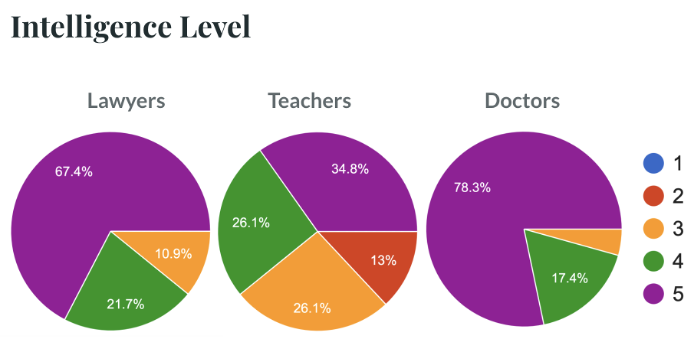
Table 1
Table 2

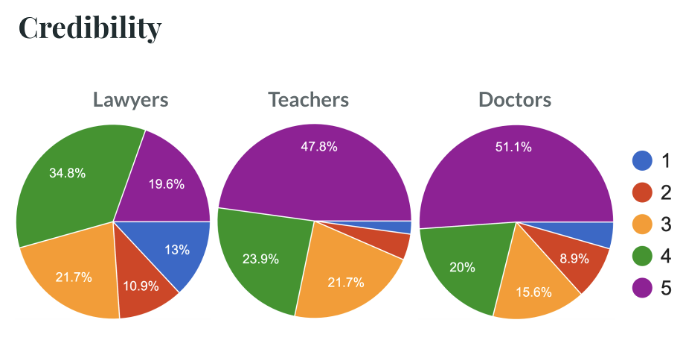
From Table 1 and 2, we can see that most participants agree that the three professions—lawyers, teachers, and doctors— intelligence level and credibility lie between 4 or 5 on the Likert scale, which indicates that they agree the intelligence level and credibility of these professions are relatively high.

The data were run with two major systems: ANOVA and Post Hoc test. ANOVA gave an idea of whether there is a significant relationship between all three speakers, whereas the Post Hoc test compared each individual relationship between the three speakers. The following tables demonstrated the results of the ANOVA test as well as the Post Hoc test in terms of intelligence level and credibility. Note that speaker 1 represents the native speaker, speaker 2 represents the Korean accented speaker, and speaker 3 indicates the 3rd speaker.
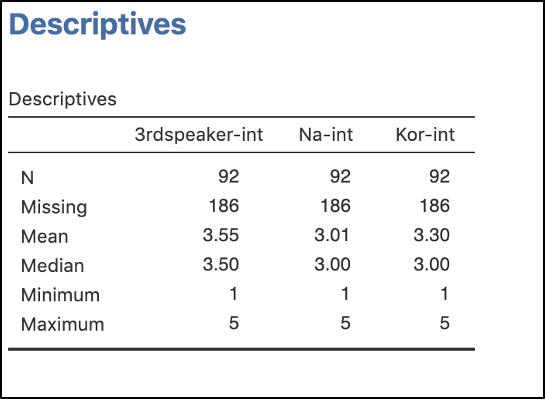
Table 3

The means of intelligence level of the three speakers are presented in Table 1. The native speaker has a mean of M = 3.01, the Korean accented speaker has a mean of M = 3.30, and the 3rd speaker has a mean of M = 3.55.
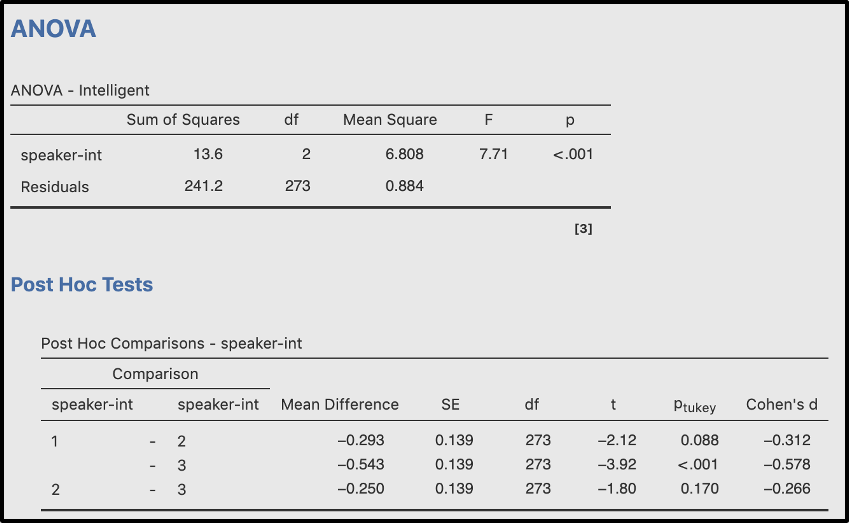
Table 4

According to Table 1, the ANOVA test in terms of intelligence level demonstrated a p-value of less than o.oo1. It is known that a p-value less than 0.05 rejects the null hypothesis and indicates that it is statistically significant. Since we found statistically significant results by computing the ANOVA, we also ran a Post Hoc test to determine where the differences come from. The Post Hoc test suggested the mean differences of intelligence level between a native speaker and a Korean-accented speaker being 0.293; between a native speaker and 3 being 0.543; and between Korean-accented speaker and 3 being 0.250. The largest difference in means occurred between a native speaker and 3rd speaker with a native speaker mean of M=​​3.01 and a 3rd speaker mean of M=3.55 words. Although we found a significant relationship among the three speakers, the data does not support our hypothesis as we hypothesized that the Korean accented speaker’s intelligence level will be rated as the lowest, but the results suggest that the native speaker is rated as the lowest.
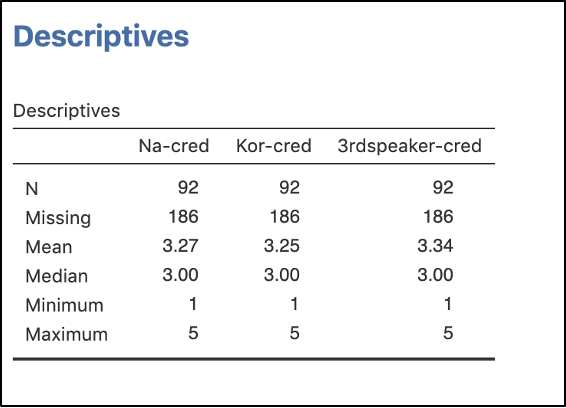
Table 5

The means of credibility of the three speakers are presented in Table 3. The native speaker has a mean of M = 3.27, the Korean accented speaker has a mean of M = 3.25, and the 3rd speaker has a mean of M = 3.34.
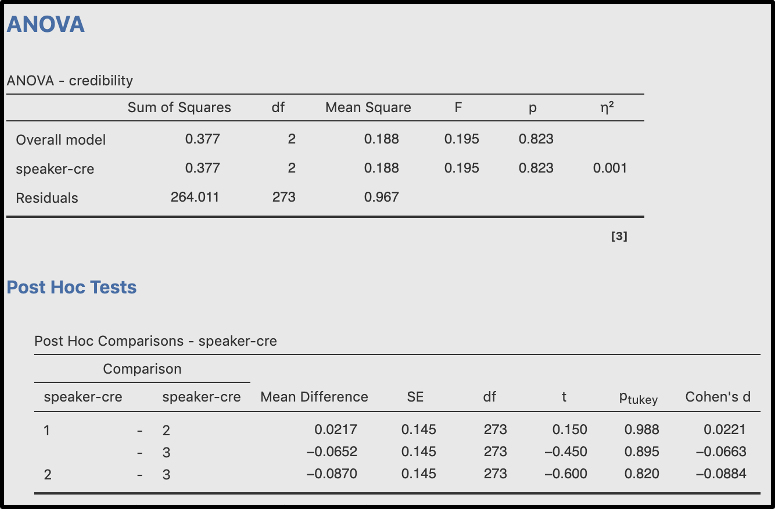
Table 6

Although in terms of credibility, the Korean accented speaker has the lowest rating compared to others, the ANOVA test in Table 2 demonstrated a p-value of p > o.05, which indicates that there are no significant differences. This result shows that the rate of credibility among the three speakers is similar, and thus reject our hypothesis that the Korean accented speaker will be perceived as less credible.

The results contradict our hypothesis. Our results suggest that Korean accented speakers are not perceived as less favorable in terms of both intelligence level and credibility.

Discussion

This research aimed to investigate how non-English speaking Koreans perceive socially and how others’ perspectives were. The ratings of credibilities and intelligence level were not as expected, and we are assuming that is due to the slower speaking pace that the native speaker recorded in the recording. Moreover, the ratings of Korean ESL speakers were not as expected and disconfirmed our hypothesis, which was that Korean ESL speakers were often treated less credible and less intelligent. However, there was a significant main effect on the intelligence level ratings between the three speakers. The third speaker with an American-ish accent was rated highest among other speakers, suggesting a third variable of speaking pace since the third speaker spoke at a fast speaking speed.

There are some more limitations in the study, such as gender bias—we only used voice recordings of male speakers. So we might want to include female recordings to avoid gender bias. Secondly, there might be a participant bias, meaning participants might assume what our study was about and rate accordingly. We also see some tendencies in the job fields; for instance, teachers were not rated as expected in the pre-rating survey. They were rated not highly enough than our expectation on both credibility and intelligence level. Since the recording was quite long, there might be selective attrition. Participants might feel bored and drop out during the experiment and rate every Likert scale as 3, which is neutral. Lastly, the sample size used was very small. Most participants were UCLA liberal arts students, and most of them were our friends who are also Korean ESL speakers. Since the participants are our friends, they could recognize our voice recordings during the experiment, which could affect the ratings. Moreover, since the sample size was small and limited, the study cannot generalize all Korean ESL students. We hope further research will consider speaking pace for future directions—for example, the relation of speaking speed and one’s perception. Or removing the slow speaking rate and making all the recording speakers talk about the same speaking pace. Moreover, to investigate further, we suggest using a Latin square counterbalanced 2×2 factorial design to see the interaction between gender and accented speech in the perception of credibility and intelligence level. So the first Independent variable would be gender (male, female), and the second Independent variable would be the accent with two levels: accented speech and non-accented speech. Further research would need more diverse participants in age and demographic. And hoping the further study could research other East Asian ESL speakers, not only limited to Korean ESL speakers.

References

English Language Learners in Public Schools. National Center for Education Statistics. (n.d.). Retrieved November 12, 2021, from https://nces.ed.gov/programs/coe/indicator/cgf.

FAQ: Why Do Some People Have an Accent? Linguistic Society of America. (n.d.).

Retrieved November 12, 2021, from https://www.linguisticsociety.org/resource/faq-why-do-some-people-have-accent.

Lev-Ari, S., & Keysar, B. (2010, June 25). Why don’t we believe non-native speakers? the influence of accent on credibility. Journal of Experimental Social Psychology. Retrieved November 12, 2021, from https://www.sciencedirect.com/science/article/pii/S0022103110001459

Lippi-Green, R. (2012). English with an accent: Language, ideology and discrimination in the United States. Routledge.

Rickford, J.R., & King, S. (2016). Language and linguistics on trial: Hearing Rachel Jeantel  (and other vernacular speakers) in the courtroom and beyond. Language 92(4), 948-988. Doi: 10.1353/lan.2016.0078.

‘speaking American’: Regions, accents and the subtleties of language. Knowledge@Wharton. (2017, January 18). Retrieved November 12, 2021, from https://knowledge.wharton.upenn.edu/article/speaking-american-regions-accents-and-thesubtletis-of-language/.

[/expander_maker]
 

Males and Females, Are We Really That Socially Different? An Exploration of Same-Sex Friendship Dynamics

Shirley Yao, Sabrina Meyn, Viktoria Hovhannisyan

The friendship dynamics that males and females form with the same-sex differ in how they bond homosocially: either vertical or horizontal. Homosocial bonds are those that are non-romantic social bonds between those of the same-sex. Historically, these two types of homosocialities are used to regulate how people perform gender. Vertical homosociality, also known as hierarchical homosociality, is relationally tied to males, and horizontal homosociality with females. Vertical is centered on building power socially, whilst horizontal captures non-profitable aspects of social bonds. Research has shown that heterosexual males tend to be hypersensitive to their sexuality being misinterpreted in homosocial contexts, whilst females are presumed not to be. This has been previously attributed to female homosocial bonds being defined as desexualized relations and their intimate relations as being friendly or as a sexual display for the heterosexual male gaze. However, in the literature there is room to explore female’s friendship and social dynamics and obtain updated information on male homosocial friendship dynamics by comparison. Using a comprehensive questionnaire that aimed to gather data on participant’s homosocial friendship dynamics, we found that both females and males exercise homosociality similarly.

*Disclaimer: Gender and sex are not interchangeable terms, as gender refers to something people do or perform socially, and sex is what you are biologically. The participants in this study identified their sex as either being male or female.

[expander_maker id=”1″ more=”Read more” less=”Read less”]

Introduction and Background

From “bros” to “babes,” males and females tend to have different friendship dynamics. The topics of sex, friendships, and homosociality has been widely studied. Homosociality is a phenomenon between people of the same-sex with a “nonsexual attraction” to each other (Bird, 1996, p. 121). Through a study to determine the type of homosociality practiced between males and females, we aim to better understand the friendship dynamics across sex. Specifically, our target population includes straight males and straight females in college who form close-knit homosocial circles, tracking homosocial situations where homosexual intentions may be incorrectly perceived within friendships.

Historically, homosociality comes in two strokes: vertical (hierarchical) and horizontal. Vertical homosociality is “a means of strengthening power and of creating close homosocial bonds to maintain and defend hegemony” and as a result, it has strong ties with hegemonic masculinity (Hammarén & Johansson, 2014, p. 1,5). Hegemony is related to structural social power dynamics. Hegemonic masculinity is built on an archaic conception of masculinity rooted in institutionalized practices that value males and devalue females (Bird, 1996, p. 1-2, Rose, 1985, p. 63-4). Horizontal homosociality is defined as being built on “emotional closeness, intimacy, and a nonprofitable form of friendship” and has strong ties to female homosociality (Hammarén & Johansson, 2014, p. 1,5). Most studies conducted that explore homosociality are focused on heterosexual males. There is little research on female homosociality, especially those that do not have a heteronormative foundation (Sanders, 2015, p. 887). In addition, data on male homosociality is outdated. Rose (1985) performed a study on cross-sex and same-sex preferences in homosocial bonds (p. 83). It was found that males and females have the same expectations in same-sex friendships, while expecting less help and loyalty in cross-sex or heterosocial friendships (Rose, 1985, p. 63). Friendship formation and maintenance were found to differ for same-sex and cross-sex friendships between the sexes as well (Rose, 1985, p. 63). Bird (1996) claims gender is relational – where a person will perform gender in accordance with either vertical or horizontal homosociality (p. 122). Bird (1996) also identified how hegemonically masculine ideals are perceived as being the socially ideal form of masculinity (celebrates emotional detachment, competition, and the sexual objectification of females) (p. 121). Studies have found that homosexual people can have their own language, especially specific vocabulary words (Kulick, 2000, p. 243). We will review data on the usage of homosexually charged nicknames between the sexes in results.

This study is a step towards more representational and up-to-date data on both male and female homosocial tendencies and in particular, friendship dynamics. Based on previous research, the foreground expectation is for the data to show that gender is relational, where, a person’s sex will predict the type of homosociality present in their friendship dynamics. In particular, males will overcompensate for their fear of being perceived incorrectly as having homosexual intentions, projecting an overly masculine persona and using linguistic features to create social distance. Comparatively, females will embrace the idea of receiving incorrect perceptions. They will prioritize emotional closeness in their friendships, and exhibit no particular linguistic behaviors different from their everyday conversations.

Methods

To test our hypothesis we gathered data from ​​16 college students, ages 17 to 25, which included 8 females and 8 males, 14 straight and 2 bisexual. We asked them to fill out a questionnaire that was designed to test their beliefs, lexicon, and conversational content as it relates to their homosocial friendships. We used multiple choice, short answer, checking boxes, and rating comfort levels on Google Forms to collect information from anonymous participants. The survey included five parts aiming to gather: ​​biographical information, ideological beliefs (to test for horizontal or vertical beliefs), short answer questions directed towards the conversational content, a section directed towards investigating a person’s lexicon to see what phrases and nicknames are used to create or lessen social distance and a section directed towards investigating reactions to inappropriate/appropriate language use or behavior. Vertical answers emphasize emotional detachment, sexual objectification of females, sport, competition, and deny horizontal things such as gossip, feelings, etc.

Examples – An example of a question that was asked is the following: “friendships are important to my social standing” this question was intended to answer with either “yes” or “no.” A yes or affirmative to a vertically loaded question would result in adding a point to a person’s vertical homosociality score, and a negative would add a point to a person’s horizontal homosociality score, and vice versa for horizontally loaded questions. Examples of horizontally loaded questions would be: “being emotionally close to my friends is important to me” or “intimacy is important to my friendships.” In the short answer sections, horizontally loaded answers would receive a point per question, and same for vertically loaded responses. Comfortability scores over 5 for a particular type of question would result in a point being added as well depending on the question category.

Results and Analysis

Results

DEMOGRAPHICS

16 participants ages 17 to 25, 8 female, 8 male, 14 Straight, 2 Bisexual

IDEOLOGICAL

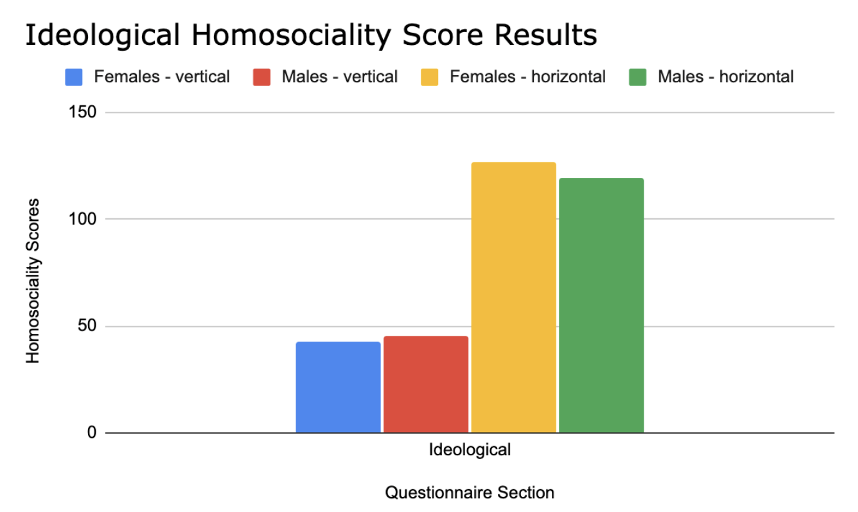
We found that both females and males are ideologically more horizontally homosocial leaning.

Examples of questions included: if friendships were important to social standing, maintaining the patriarchy, if it was acceptable to use friends as a means to an end, if they observed people in their homosocial circles discuss, disparage, or use the opposite sex to gain social status, as well as if they individually believed it was acceptable to do so. About ½ of participants observed this happen, but ¾ of the responses said they felt it was unacceptable. Surprisingly, over 90% said it was false that friends should not have romantic feelings for one another and friends should not have feelings in general for each other, and that it was true that being emotionally close was important.

Figure 1: Ideological Homosociality Scores: Comparing Males and Females
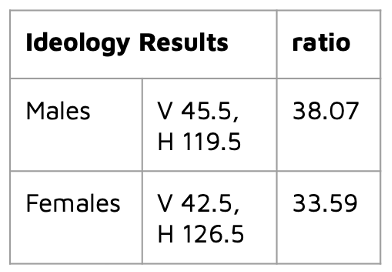
Table 1: Ideological Homosociality Scores- Ratio of Vertical Scores to Horizontal Scores

FEAR OF MISINTERPRETATION OF SEXUALITY

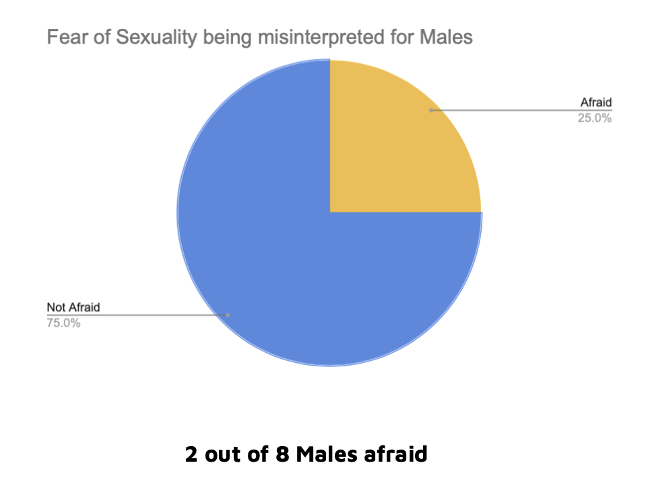
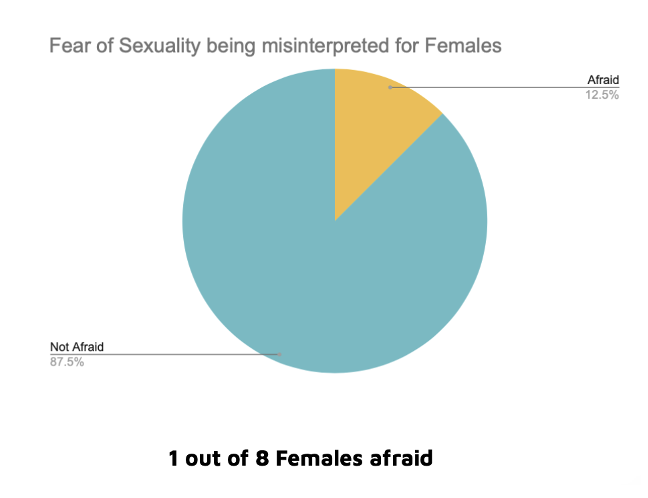
Ideologically speaking, 25% of the males surveyed are afraid of their sexuality being misinterpreted, and 12.5% of females are afraid of their sexuality being misinterpreted.

Figure 2: Fear of Misinterpretation of Sexuality by Males
Figure 3: Fear of Misinterpretation of Sexuality by Females

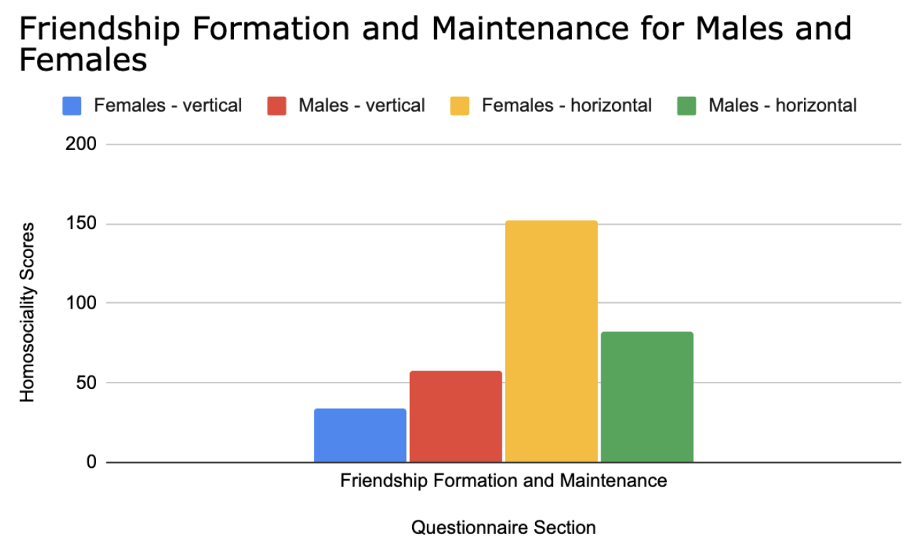
FRIENDSHIP FORMATION AND MAINTENANCE

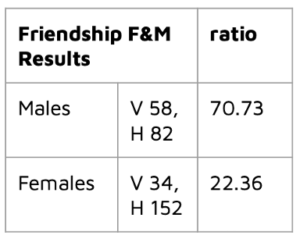
Similar to the results of the Rose study, friendship formation and maintenance differed between the sexes. The homosociality scores for both males and females were overwhelmingly more horizontally leaning, but females were approximately 85.36% more horizontally homosocial than males.

Figure 4: Friendship Formation and Maintenance Homosociality Scores: Comparing Males and Females


Table 2: Friendship Formation and Maintenance Homosociality Scores – Ratio of Vertical Scores to Horizontal Scores

NICKNAMES

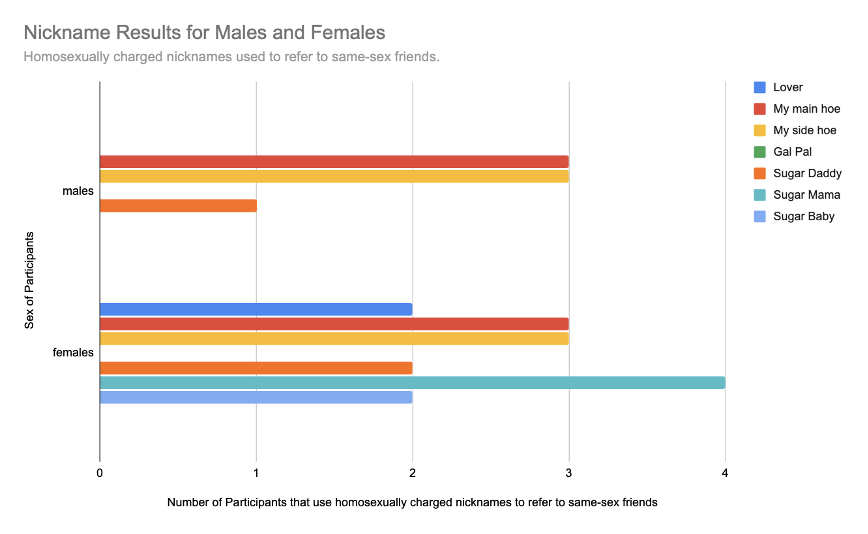
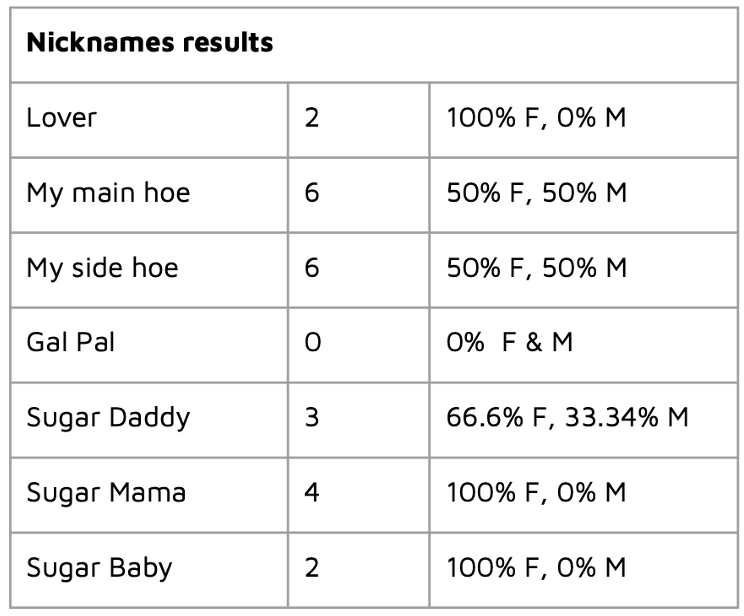
Although a percentage of males and females who are afraid of their sexuality being misinterpreted, we found females use more homosexually charged nicknames and pet names than males by approximately 39.13%.

Figure 5: Usage of Homosexually Charged Nicknames: Comparing Males and Females


Table 3: Usage of Homosexually Charged Nicknames: Comparing Males and Females

CONVERSATIONS (appropriate vs. inappropriate topics)

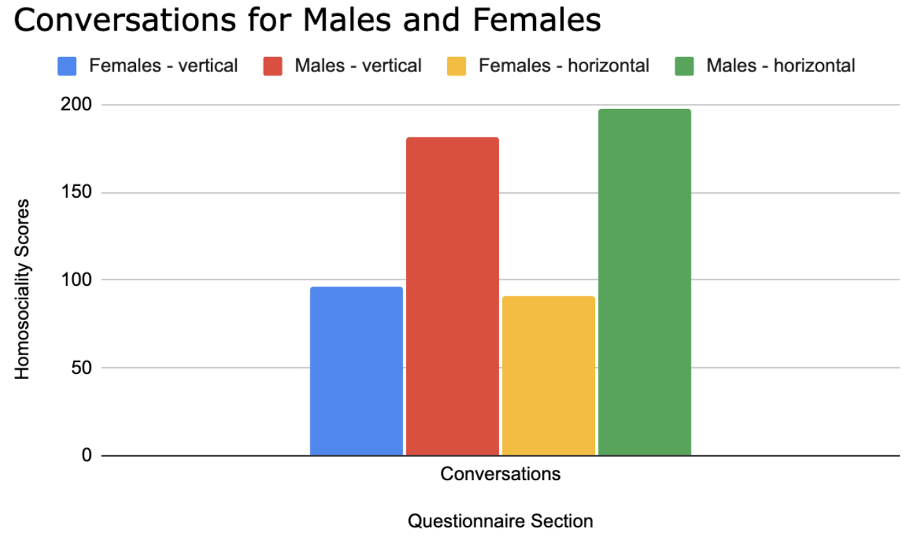
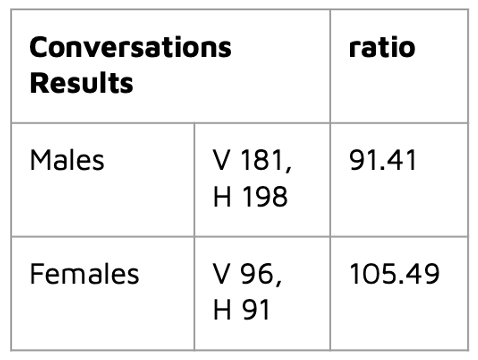
We found that both females and males are a combination of vertical and horizontal, and marginally lean one way or the other.

Examples – For conversations participants rated their comfortability and indicated if they did talk about a range of topics with their same-sex friends that ranged from: school, business, social status, sexual activities, sexual conquests or accomplishments, to test for vertical homosociality, to topics which do not make for a profitable exchange like gossip, feelings, saying “I love you,” worries, morals, etc. We also asked about topics they do not think are acceptable to be discussed with their same-sex friends and the responses ranged from nothing being off limits, to family drama, insecurities, sexual life, politics, religion, weight, romantic relationships, etc.

Figure 6: Conversations Homosociality Scores: Comparing Males and Females
Table 4: Conversation Homosociality Scores – Ratio of Vertical Scores to Horizontal Scores

REACTIONS  (to inappropriate topics and/or actions)

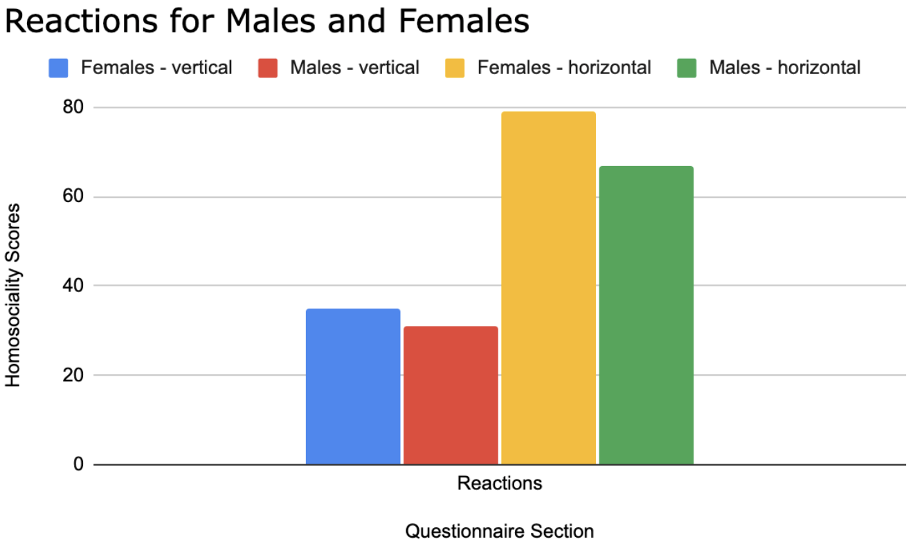
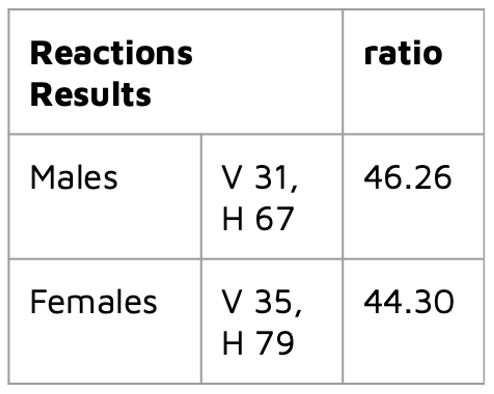
Here we were looking for their reactions to various topics and actions that would lead to a misinterpretation of their sexuality. We found that both males and females have horizontal homosocial tendencies in reaction to behavior which may be perceived as having homosexual intentions.

Examples – We asked participants to rate comfortability, and express what they might be met with or observe if any of the following topics or actions would come up: compliments, hugging, kissing friends, cuddling with friends, holding hands, platonic feelings for same-sex friend, romantic feelings for same-sex friend, actions/words which are perceived as having homosexual undertones, actions/words which may be perceived as having homosexual undertones, saying “I love you” to your same-sex friend.

Figure 7: Reactions (to inappropriate topics/actions) Homosociality Scores: Comparing Males and Females


Table 5: Reactions (to inappropriate topics/actions) Homosociality Scores – Ratio of Vertical Scores to Horizontal Scores

OVERALL MALE HOMOSOCIALITY SCORES

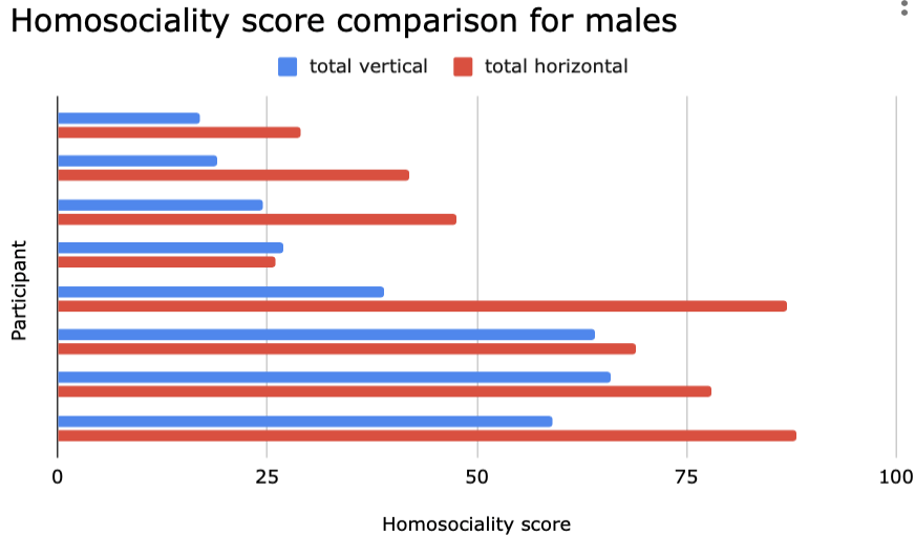
The majority of our male participants had horizontally leaning homosociality scores, while only one male participant was more vertical leaning by 1pt (approximately 0.037%).

Figure 8: Homosociality Scores: Comparing Male Participants

OVERALL FEMALE HOMOSOCIALITY SCORES

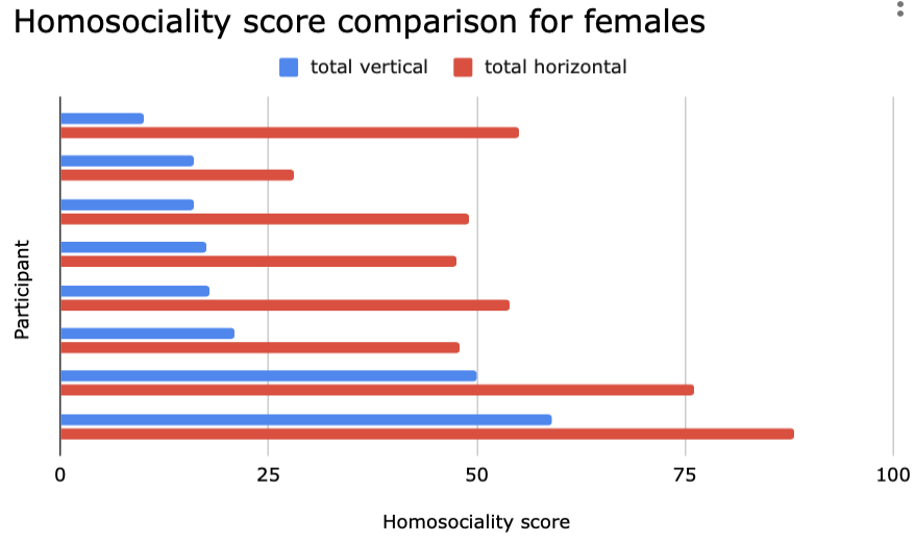
All of our female participants scored more horizontally leaning homosociality scores.

Figure 9: Homosociality Scores: Comparing Female Participants

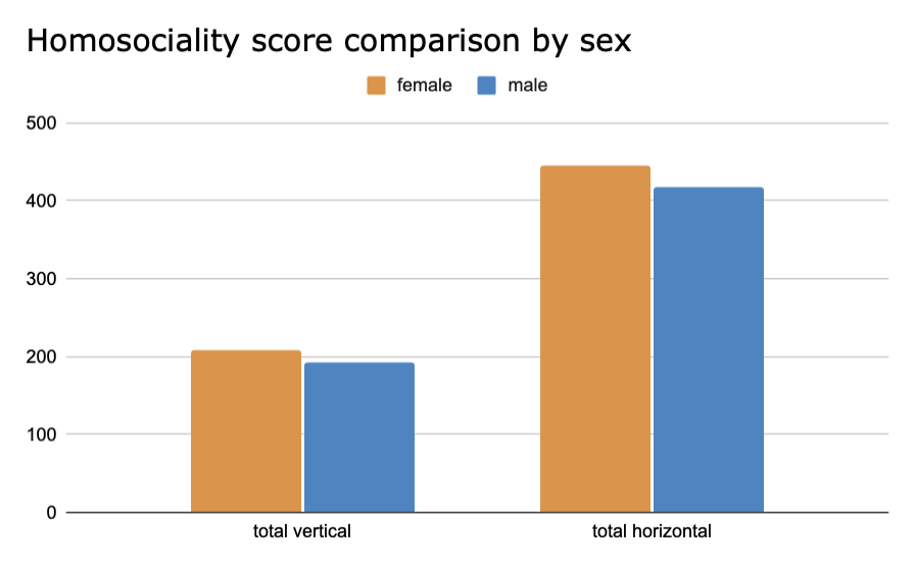
OVERALL HOMOSOCIALITY SCORE COMPARISON: MALES VS. FEMALES

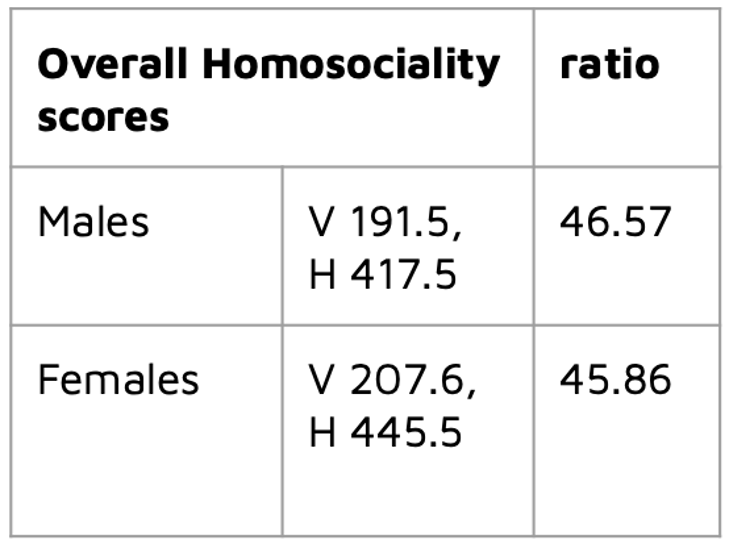
Overall, females and males were found to be overwhelmingly horizontally leaning, with a combination of vertical and horizontal homosocial tendencies and beliefs. Their overall vertical scores are also similar, with females scoring approximately 8.4% more vertical than males, and 6.7% more horizontal than males, with a minimal overall margin of difference of 0.71.

Figure 10: Homosociality Scores: Comparing Males and Females
Table 6: Males and Females Overall Homosociality Scores – Ratio of Vertical Scores to Horizontal Scores

Our results show that both females and males have a combination of vertical and horizontal homosocial tendencies and beliefs, with an overwhelming slant towards horizontal homosociality. What this means is that the homosocial tendencies of females and males are similar. Since they were found to be a combination, this means that females and males don’t just correspond to one kind of homosociality over the other. This disproves the idea that gender and homosociality are strictly relational since males did not score strictly vertically, and females did not score strictly horizontally.

Discussion and Conclusion

Discussion

While sex does not determine the type of homosocial friendship present, it plays a factor in understanding different interactions within homosocial friendships. With no significant statistical difference between vertical and horizontal scores, gender is overall not relational, meaning horizontal and vertical homosociality scores do not reflect the predicted homosociality of males and females. In fact, both sexes have a relatively higher horizontal score compared to their vertical scores in total.

However, when looking into each of the four topics individually, observations about the different friendship dynamics arise – with areas worthy of further exploration. The most distinct difference occurs in the area of friendship formation and maintenance. With ratio score comparisons of 70.73 and 22.36, males and females are strikingly different when it comes to building and sustaining homosocial friendships. Comparatively, females are more likely to form and maintain friendships horizontally than males – using intimacy and closeness as their powers to reach out and establish connections. In the real world, males tend to strengthen relationships by participating in activities together, and females tend to do so by sharing feelings and talking about various things. Linguistically, females are also more likely to use linguistic features that are indicative of intimacy and closeness, reflecting horizontal homosociality through their everyday conversations. Through the use of specific lexicon such as the homosexually charged pet names of “sugar mama” and “sugar baby,” females are unafraid – and even embrace – the idea of their sexuality being incorrectly perceived.

Ideologically speaking, most males and females have similar ideological beliefs about homosocial friendships, with nearly identical ratios between their ideological vertical and horizontal scores. As the sample is composed of college and high school students, it is understandable for many to have a similar group mindset to find social circles and fit in. The COVID-19 pandemic may have exacerbated the isolation anxiety for many to feel eager to belong. The societal norm also values honesty and friendships and paints betrayals and loneliness as traits that should be avoided. The topic of conversational content also reveals similarity between males and females. Though females have lower vertical and horizontal scores compared to those of males respectively, the ratio between the two is still similar across sex, meaning males and females have similar shares of vertical and horizontal conversations. Looking into conversational content linguistically, many responses include talking about school and friends, regardless of gender, mainly because of the social setting within colleges to define conversational topics. It is interesting to note that females are more likely to talk about males, whereas males have a higher tendency to talk about careers and the future – further demonstrating the foundation of female homosexuality to be rooted on the exchange of intimate facts and truth compared to male homosexuality.

Last but not least, the examination of reactions to incorrect perceptions between males and females also prompt similar homosociality scores. However, as predicted, males are relatively more likely to be afraid of receiving incorrect perceptions regarding sexuality. Interestingly, 12.5% of the females surveyed are afraid of being perceived incorrectly in terms of sexuality – a higher percentage than expected. While reasons behind this relatively surprising number need further investigation, it is worth noting that the sample is small and localized.

Conclusion

In conclusion, the study establishes a step towards understanding both male and female homosociality. Despite its limited participant tool, the small localized sample creates an in-depth and cohesive look under a college setting, recognizing specific characteristics and linguistic features in context to better understand homosocial friendship dynamics. Furthermore, the four particular areas reflect the fundamental concepts between vertical and horizontal homosociality. For example, females are more likely to form friendships horizontally and use lexicon reflective of emotional closeness compared to males, providing specific observations worthy of analyzing between the two genders.

The study needs further investigations to capture the essence of homosociality between sexes. One future direction is to acquire larger sample sizes for a more holistic understanding of homosocial friendship dynamics. It includes surveying a much bigger and more inclusive target population. Expanding the survey pool to more college participants can help further research the underlying patterns that a smaller sample size may fail to show. A more diverse target population should also be considered, such as surveying varying ages and occupations across different generations of gender. Different age groups may prompt different responses to incorrect perceptions of sexuality, taking into consideration the context under which they grew up and the societal ideals toward homosexuality at that time. Both of these paths of research are worth exploring for the future, whether to dig deep into the college setting or to grow to a broader population.

Another future direction of this research is to expand the sexuality of the pool of participants. This research aimed to study heterosexual male and female participants within homosocial friend groups. However, studying homosexual males versus heterosexual males or homosexual females versus heterosexual females can lead to new directions. When participants are all of one sexuality within a homosocial friend group, how would their responses differ compared to when participants are of varying sexualities? Would those in friend groups with varying sexualities be comparatively more accepting and inclusive? Would more lexicon related to homosexuality be used without fear? These questions open up new paths of research, further honing down on the topic of sexuality in terms of homosociality and sex. Whether it’s the “bros” or the “babes,” male and female homosocial friendship dynamics are densely packed. While the overall homosocial friendship dynamics for males and females in this study reveal no significant difference, their relative scores and specific responses establish the distinction between how males and females perceive, build and maintain intimacy linguistically.

References

BIRD, S. R. (1996). Welcome to the Men’s Club: Homosociality and the Maintenance of Hegemonic Masculinity. Gender & Society, 10(2), 120–132. https://doi.org/10.1177/089124396010002002

Hammarén, N., & Johansson, T. (2014). Homosociality: In Between Power and Intimacy. SAGE Open, 4(1), 215824401351805–. https://doi.org/10.1177/2158244013518057

Kulick, D. (2000). GAY AND LESBIAN LANGUAGE. Annual Review of Anthropology, 29(1), 243–285. https://doi.org/10.1146/annurev.anthro.29.1.243

Rose, S. M. (1985). Same- and cross-sex friendships and the psychology of homosociality. Sex Roles, 12(1-2), 63–74. https://doi.org/10.1007/BF00288037

Sanders, K. (2015). Mean girls, homosociality and football: an education on social and power dynamics between girls and women. Gender and Education, 27(7), 887–908. https://doi.org/10.1080/09540253.2015.1096921

[/expander_maker]

, , ,

Different Ways that Male and Female Streamers Behave on Valorant Streams

Kevin Kim, Kota Tsukamoto, Guorang Zhang, Cindy Zheng

For our experiment, we analyzed Twitch streamers playing Valorant. Twitch, or Twitch.TV, is an online streaming platform popular among gamers. Valorant is a popular first-person shooter (FPS) game created by Riot Games in 2020. Valorant, as of 2021, has an estimated 12 million players, peaking at 15 million in July (Dexerto 2021). The game has a diverse range of players in various regions of the world. Contrary to other FPS games that are very heavily male-dominated, Riot Games has made an effort to increase the number of women in Valorant, resulting in 30-40% of Valorant players being women (VentureBeat 2021). Furthermore, Riot Games has even implemented an all females league as well as pro esports teams such as Cloud9 (known as C9 White) who recruited women for their Valorant teams earlier this year (PC Gamer 2021).

The experiment examined both male and female streamers to compare their vocabulary choices- while the study can incorporate more genders than just male and female, due to the demographic of streamers being mostly male or female, as well as time constraints, we only focused on those two genders.

One particular feature that we analyzed was the amount of provocative language that is done by streamers. The usage of swearing from male or female streamers was recorded in particular situations such as dying, insulting, and having disagreements with another player. We were aware of language most commonly used by gamers such as frags, ace, bait, boosted, clutch, flank, etc that could be more commonly used by one gender than the other (Çakır 2021).

[expander_maker id=”1″ more=”Read more” less=”Read less”]

Streamers in our research

This experiment revolved around three male streamers and three female streamers. The three male streamers who were analyzed were: AverageJonas, itsRyanHiga, and Ethos and the three female streamers are Kyedae, Ploo, Tiffae. These six streamers were chosen due to their popularity/recognition, skills, and various personalities.

 The male streamers are around 30 years old, and the females are around 20. They are mostly all of white or East Asian descent and are English speakers. To be more specific, AverageJonas is a 32-year-old Norwegian English-speaking streamer, itsRyanHiga is a 31-year-old Japanese American English-speaking streamer, and Ethos is of unknown age and is an Asian American English speaking streamer. Kyedae is a 19-year-old Japanese Canadian English-speaking streamer, Ploo is a 22-year-old Asian American English-speaking streamer, and Tiffae is a 27-year-old Taiwanese English-speaking streamer.

What we already know

Based on gender stereotypes, men are perceived to be louder, more aggressive, and curse and insult more, and also since gaming is seen as a “male-dominant” space, we also thought gaming terms would be more male-gendered as well. Because of that, we decided to analyze vocabulary reactions to certain game events by gender.

We also analyzed the vocabulary differences by comparing streamers in an all-male team and a mixed-gender team. Previous research states that men in an all-male friend group played into male stereotypes in their group interactions more than those who had their girlfriend or female friend in their groups (Cameron 1997). In our experiment, we thought that these previous findings could suggest that female streamers may also feel pressure to conform to their male teammates and speak in a more stereotypically male manner, so that was an aspect we decided to look at.

We decided to analyze streamer and fan interactions between genders. Previous research stated that women communicate to build relationships, so we thought we would see that when observing how streamers interact with their viewer’s donations (Van Herk, 2012).

Methods

For the experiment, we watched six streamers for key vocabulary words in their speech and their chat interactions. The streamer’s vocabulary choices were analyzed when they reacted to these three events: donations from fans, winning a game, and losing a game. The reactions to those events were grouped by event and gender- for example, one group would be “Vocabulary in reaction to winning a game from a male streamer.” Then the groups would be compared across the same event and against opposite genders. An example comparison would be comparing reactions to winning by male streamers against responses to winning by female streamers. We watched each streamer stream for an average of 2 to 3 hours in total.

While we were watching the stream, we noted down some vocabulary and phrases used by the streamer. Then we sorted phrases between each scenario and compared the differences. After we sorted the words and phrases, we looked at the difference between streamers and gender. We also decided to analyze our overall results of vocabulary choice based on the gender of the streamer’s teammates.

Thesis

We found a clearer divide in the vocabulary when we compared streamers that played with all-male team and streamers that played in a mixed-gender team. Through our results, we can conclude that while there were differences in a streamer’s vocabulary due to the streamer’s gender, the main differences relied more on the gender of their teammates. Streamers with all-male teammates used more gaming-specific terms, insults, and cursed more. But as for the streamer’s own gender, we found that females were more likely to negatively refer to themselves in the face of a negative event, while males would blame the game and enemy team. We also found that females were more likely to initiate and maintain friendly interactions with their viewers and team.

Results / Analysis

Win reactions based on streamer’s own gender

To start off, we compared the vocabulary that females used when they won a game versus the vocabulary used by males when they won a game.

Female wins

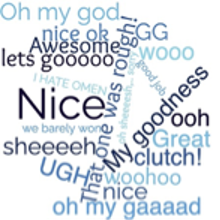
As you can see from the word cloud generated from the data across the three female streamers, we identified that female streamers didn’t use any swear words in the situation of a win. Female streamers tended to comment on the win as the group’s achievement, using phrases that begin with the subject “we”. Two out of the three streamers used different variations of the phrase “oh my god” which is commonly associated with the regional marker of valley girls. Male wins

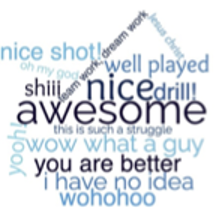
Looking at the result of the male streamers, we saw that male streamers would swear after a win. One of the male streamers, Ryan Higa used the Sh-word after a win. Overall, when commenting on a win, the male streamers tend to phrase the comment as talking about the game and not how well they played as a group(we).

Through these word clouds, we can see that there’s gendered language – the females kept their female gender identity through speech reminiscent of valley girls, despite being in a male-dominated space, and males, true to our hypothesis, used more crude language.

Loss reactions based on streamer’s own gender

Next, we analyzed the reactions of losses by females and by males.

Female loss

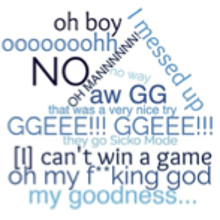
The word cloud on the right shows the utterances of the female streamers when facing the scenario of a loss. Unlike the result from utterances after wins, we saw swear words. The F-word was used in the phrase “oh my f**king god”. Another commonality noticed between the female streamers is that they tend to address the loss of the team as their responsibility, using the subject “I” when commenting on the loss, for example, “I messed up” or “I can’t win a game”.  Female streamers also used encouraging phrases such as “that was a very nice try” to show support towards teammates.

Male loss

The male players also used swear words after a loss, for example, the F-word was used in the phrases. In general, they form their phrases without criticizing the loss as their responsibility or their team’s responsibility. Instead, they use phrases that begin with “that”, “they” or “this girl” to address the game or the other team/team member. 

The main difference between female reactions to losses and male reactions was not what we expected- we saw both genders swear (but males to a greater degree). The biggest difference was actually the target of negative or aggressive language. The females tended to blame themselves for the loss and put themselves as the target of any negative descriptors or words. Males would blame the game or the enemy team. We also saw that females, to further put the blame solely on themselves, would congratulate their teammates.

Donations / subscriptions interactions based on streamer’s own gender

We then looked at reactions from females and males to donations and subscriptions by their fans. We mainly looked at the manner in which the streamers interacted with their fans, and we found that all-male streamers used the same phrase for all their donations and subscriptions: Thank you XXX (viewer’s name) for the donation/subscription. Two of the female streamers also used this format; however, one of the female streamers interacted with the audience by asking about their life and would reciprocate the viewer telling her “Peace and love” by saying “Peace and love” back. This indicates that female streamers demonstrate a rapport style and make an effort to build relationships in their communicative behavior. This agrees with Deborah Tannen’s claims, suggesting that women are more likely to use language to build and maintain relationships while men are more likely to use language to communicate factual information (Van Herk, 2012).

Overall vocabulary results based on teammate’s gender:

While we conducted our research, we noticed that there seemed to be a divide in gendered terms not by the gender of the streamer, but by the gender of the teammates that the streamer played with. We aggregated our vocabulary results and split them by the gender of their teammates, resulting in the bar chart below.

Streamers playing with all-male gamers said many more swear words (f*** words, sh** in particular) and gamer terms (frags, bait, camp, pick, etc), while streamers playing with a mixed-gender team did not say any swear words from our analysis and fewer gamer terms. This is due to in particular how male streamers feel the need to act more masculine and also use more common lexical entries when with other male teammates only. However, when female streamers were with female gamers or mixed gendered teammates, they tend to overall be calmer and use more relaxed language.

Another difference that was noticed was the patterns that male streamers and female streamers exhibit during the same scenarios were unexpected. For example, when male streamers and female streamers make the call-out that the enemies were attacking the B site, Kyedae says “They’re going B, right?” and Ethos says “They’re going B, they’re going B.” Kyedae said this scenario to a teammate in more of a questioning, unsure manner even though the enemies were clearly rushing B site. Ethos, however, said his callouts in a confident, command-like manner. Furthermore, what was interesting was that even if the call-out was wrong, female streamers tend to speak in a safer question-like manner, but male streamers spoke in confident manners then apologize when they were wrong.

Conclusion

Since we analyzed male and female speech in a heavily male-dominant space, we believe that our findings could apply to other male-dominant spaces. We looked at references to a similarly male-dominated industry- the sports entertainment industry. In Eastman & Billings (2000), they found that the tone used by commentators when describing male athletic wins was “enthusiastic…but derogatory” towards women’s athletic wins. This seems to relate to our findings that female streamers were more negative towards themselves and could suggest a larger connection to how derogatory attitudes towards women’s achievements in male-dominated spaces prevails and can even permeate to the women themselves. Also considering that E-Sports is still an emerging field, it’s plausible to say that the previous biases that existed in older male-dominated industries like the sports entertainment one examined in Eastman & Billings have been long established and continue to reappear today.

As for future directions, we looked mainly at the gender of streamers and controlled on popularity, the game played, and the scenarios reacted to. But through our study, we found that there were a lot more factors that could be confounding. For example, the players had varying skill levels that could have swayed our results, so we could better control for that. Another factor we saw was the gender of the teammates our streamers played with. We saw a stronger correlation between the gender of the teammates and gendered lexical entries. It would be an interesting follow-up study to analyze the interactions of an all-female team such as Cloud9 White, versus an all-male team’s interactions.


References

Çakır, G. (2021, March 5). Twitch slang and common terms explained. Dot Esports. Retrieved November 12, 2021, from https://dotesports.com/streaming/news/twitch-slang-and-common-terms-explained

Cameron, D. (1998). Performing gender identity. Language and gender: A reader.

Clayton, N. (2021, February 24). Valorant wants more women and ‘minority genders’ competing at its highest levels. pcgamer. Retrieved November 12, 2021, from https://www.pcgamer.com/valorant-wants-more-women-and-minority-genders-competing-at-its-highest-levels/

Eastman, S.T., & Billings, A.C. (2000). Sportscasting and sports reporting: The power of gender bias. Journal of Sport and Social Issues, 24, (2), 192-213

How many people play valorant? player count tracker (2021). Dexerto. (2021, October 4).         Retrieved November 12, 2021, from    https://www.dexerto.com/valorant/how-many-people-play-valorant-player-count-tracker-2021-1668158/.

Messner, M.A., Duncan, M.C., & Jenson, K. (1993). Separating the men from girls: The gendered language of televised sports. Gender and Society, 7 (1), 121-137

Nakandala, S. (2016, November 22). Gendered Conversation in a Social Game-Streaming Platform. Gender Conversation in a Social Game-Streaming Platform . Retrieved from https://www.researchgate.net/profile/Supun-Nakandala/publication/310611118_Gendered_Conversation_in_a_Social_Game-Streaming_Platform/links/5839c31808aef00f3bfbbbf1/Gendered-Conversation-in-a-Social-Game-Streaming-Platform.pdf.

Pellicone, A. J. (2017, May 6). The game of performing play: Understanding streaming as Cultural Production. Retrieved November 12, 2021, from http://library.usc.edu.ph/ACM/CHI%202017/1proc/p4863.pdf

Takahashi, D. (2021, June 14). How riot games will ensure that Valorant’s esports stars include women. VentureBeat. Retrieved November 12, 2021, from https://venturebeat.com/2021/06/14/how-riot-games-wants-to-ensure-that-valorants-esports-stars-include-women/

Van Herk, G. (2012). What is sociolinguistics? (Vol. 6). John Wiley & Sons.

[/expander_maker]

Beyond the Binary: Analyzing Vocal Pitch of Non-Binary Celebrities

Megan Fu, Rowan Konstanzer, Erin Kwak, and Kimberly Gaona

Examining the speech of nonbinary individuals allows a better understanding of how different speech acoustic features such as vocal pitch, quality, and tempo are used to help construct gender identity. By investigating the speech acoustic features of non-binary celebrities, this study investigates whether coming out would cause their vocal pitch, tempo, and quality to be more divergent from cis-female and cis-male speakers. This was done by analyzing the celebrities’ pitches in their neutral interviews both before and after they publicly came out. It was hypothesized that the nonbinary individuals’ pitches would fall between the cis-female and cis-male pitches based on prior studies and research. Though this was supported by the data, a concrete conclusion was unable to be found as the differences were minor. However, an important takeaway was that a person’s pitch did not necessarily correlate with their gender identity and that there can and should be more research that includes the nonbinary community.

[expander_maker id=”1″ more=”Read more” less=”Read less”]

Key Words:

  • Non-binary (or genderqueer): an umbrella term for gender identities that are neither male nor female‍, and identities that are outside the gender binary which fall under the LGBTQ+ community.
  • Cisgender: a person whose gender identity is the same as their sex assigned at birth.
  • Vocal Pitch: the low and high frequencies of a sound. Vocal pitch is determined by the degree of tension in the vocal folds of the larynx, which itself is influenced by complex and nonlinear interactions among the laryngeal muscles.

Introduction + Background:

Where there is a plethora of research regarding the vocal pitch ranges of cis-women and cis-men, there is inadequate research on the vocal pitch of non-binary individuals. We noticed this lack of information and decided to attempt to fill it. It is important to note that there are some studies that have delved into the concept of vocal pitch differences in non-binary individuals, but none that we could find that was exclusively devoted to the fact.

Using the findings from similar studies, most notably Bradley and Schmid’s 2019 study on non-binary vocal pitch and speech patterning, we were able to piece together what we thought we could expect from the results of our study. As was found in Bradley and Schmid’s study, “the non-binary group of participants had an average F0 in between the cis-men and cis-women and had intonation not patterning like the cis-women nor the cis-men—instead patterning with a mixture of both feminine and masculine traits” (Bradley & Schmid, 2019, p. 2688). While this study also looked into the vocal frequencies of cis-men, cis-women, and non-binary peoples, it focused more on the speech patterning of those individuals.

From this study and others, we were able to derive that we should expect a similar result from our research. Based on this, we hypothesized that the vocal pitch of non-binary individuals will fall somewhere in between the average F0 of women and the average F0 of men. More specifically, in the individuals that we chose to examine, the assigned female at birth (afab) individuals’ vocal pitches will deepen/lower after coming out and the assigned male at birth (amab) individuals’ vocal pitches will rise after coming out.

Methods:

In order to test our hypothesis, we chose to examine six individuals who identify as non-binary. The individuals we chose to look at where the following celebrities: Sam Smith (AMAB), Nico Tortorella (AMAB), Jonathan Van Ness (AMAB), Amandla Stenberg (AFAB), Brigette Lundy-Paine (AFAB), and Demi Lovato (AFAB). We chose to examine these celebrities because there is heavy documentation before and after they have come out, making a more thorough analysis possible. However, it is important to note that all of the chosen individuals identify as queer and that Sam Smith is British. This could have had an effect on the results and was kept in mind while conducting our research. Other confounding variables included anxiety level, heightened emotion (based on topic sensitivity), sexuality, interview setting, and level of professionalism. Thus, interviews about neutral topics were chosen, such as albums, hair, skincare routine, and TV shows. Examples of non-neutral topics that were avoided as much as possible were those about them coming out, trauma, and politics.

Two interviews before coming out and two interviews afterward were chosen for each celebrity and analyzed. After cutting the videos to exclude other speakers, audience reactions, and sound effects, the interviews were uploaded to Praat to observe the average, minimum, and maximum pitches. The minimum and maximum pitches were checked to ensure that they were from the actual subjects and not the host, audience, background music, or any other disturbances. Because there were two interviews each, the averages of the findings were utilized to compare the pitch data before and after coming out with each individual and with each other. This information was also compared to the average pitches of cisgender individuals from outside research.

Results/Analysis:

The following table and graph showcase a summary of our main findings.

Figure 1 illustrates the vocal pitches (in Hertz) of the six celebrities before and after coming out as non-binary in comparison to the female and male cisgender averages (Pépiot, 2014, p. 305). **Note that the cisgender averages do not exhibit any change before versus after.

Figure 1: Average Vocal pitches (Hz) of celebrities before and after coming out.

Figure 2 depicts the same data as Figure 1 but in the form of a scatter plot so one can better visualize the change in pitch of each celebrity and see them compared against one another plus the cisgender controls. The horizontal or x-axis shows the name of the celebrities. The y-axis or the vertical axis shows the frequencies in Hertz.

Figure 2: Scatter plot, vocal pitches of celebrities.

Although all the celebrities exhibited some degree of change in vocal pitch, the difference was insignificant across all six individuals (the dots for most of them are overlapping). To summarize, two out of the three assigned-male-at-birth celebrities had a (slightly) higher pitch after coming out, and two out of the three assigned-female-at-birth celebrities had a (slightly) lower pitch after coming out. Even though these findings support our original hypothesis. However, the difference for each person was only a matter of <10 Hertz. For reference, with each jump in octave, the Hertz doubles. Therefore, a difference of 5 Hertz is negligible and would be indistinguishable to the human ear. Because of this minute difference in the celebrities’ vocal pitch before versus after coming out, we would say our findings were ultimately inconclusive.

We can attribute this to many different confounding variables. First, non-binary is an umbrella term so all the individuals we analyzed could fall very differently on the broad spectrum of gender identity. Because non-binary people vary in how they express their gender (or lack thereof), this could account for why the celebrities did not exhibit much change in vocal pitch after coming out. Moreover, we only analyzed six celebrities and took a small sampling of their speech patterns which limits the scope of our conclusions. Therefore, due to the small data set and population, it would be unwise to make any generalizations about the community as a whole based on these six individuals alone. Although we opted to look at celebrities’ interviews in order to get their natural speech patterns rather than elicited ones, being in a formal interview setting could have altered their pitches alone. Even though we aimed to keep the subject matter of the interviews neutral, we could not account for the individual’s mood or emotions that particular day which also could have altered their pitch. The passage of time between each set of interviews could have also had an effect on their pitch—especially considering these celebrities are on the younger side (Gen-Z and millennials), their voices could have simply matured in the time between each interview. Lastly, it is also important to note that all of the celebrities we analyzed identify as queer. Therefore, their sexual orientations could have also been a contributing factor to any deviations from the cisgender averages.

Discussions and Conclusions:

Even though we could not fully confirm our hypothesis or make any concrete conclusions there are still some worthwhile takeaways from our findings. Most importantly, one cannot make assumptions about vocal pitch based on someone’s gender expression alone. Just because someone has a higher vocal pitch does not mean they need to present more feminine or align themselves with a female identity. The same goes for a lower pitch not necessitating a masculine identity. In summary, our findings matter as they support the idea that vocal pitch is not an accurate marker of gender identity. In addition, these results combat preconceived stereotypes about the connection between vocal pitch and gender identity.

Due to the limited scope of our research, some possible future directions we thought of include doing a long-term study following non-binary individuals on their coming out journey and closely documenting any changes in pitch. Another version of this study could entail analyzing a larger population or data pool such as college students and collecting data firsthand so the environment can be more controlled since there were external factors we could not control such as background noise and interference in the celebrity interviews.

By looking at the speech acoustic features of non-binary celebrities in their interviews before versus after coming out, we were able to see analyze how their vocal pitches diverged from cis-female and cis-male speakers. Notably, researching vocal pitch differences plays a role in understanding human interaction and expression. The voice serves as a mode of personal expression for one’s identity: “the voice is a form of communication in which people form relationships with one another, show vulnerability, and show geographical linguistic features” (Mills et al., 2017, pg. 13). With this in mind, creating a study analyzing the non-binary community helps create a better understanding of the LGBTQ+ community’s expression of identity through speech acoustic features.

Through our findings, we hope to provide greater insight into the non-binary community and serve as a starting point in seeing how gender norms also play an important role in pitch production rather than assuming biology is the sole reason. Overall, we believe our research still has a purpose in opening the floor to more linguistic research into the non-binary community which often gets overlooked or glossed over.

Further Reading and Watching:

 Vocal Branding: How Your Voice Shapes Your Communication Image — The voice is one of the most important factors for creating a social group, an image of oneself, and your perception of others. The different aspects of vocal pitch such as intensity, inflection, rate, frequency, and quality can say a lot about a person’s current emotional state such as being angry, sad, embarrassed, anxious, confident, happy, and so on. This is called a voice brand and helps describe a person’s personality or overall persona.

Queer Speech: Real or Not? – Languaged Life — In this blog post, you can read more about language as an identifier for sexuality. In this blog post, Dao et. al explore if there’s a difference between queer and straight women’s speech or if it is just a stereotype.

From Uptalk to Vocal Fry, Women Are Prolific Language Innovators — In this podcast, the hosts of Spectacular Vernacular engage with recent vocal trends for English speakers and how women are driving this change. Listen to find out more about the connection between communication, perception, and identity.

Watch Do I Sound Gay? | Prime Video — This 2014 documentary directed and starring David Thorpe explores the link between vocal quality and perceived sexual orientation. While entertaining, the film also explores the existence and accuracy of stereotypes about the speech patterns of homosexual men.


References:

Bucholtz, M., & Hall, K. (2005). Identity and interaction: A sociocultural linguistic approach. Discourse Studies 7: 585–614.

Butler, J. (1988). Performative acts and gender constitution: An essay in phenomenology and feminist theory. Feminist Theory Reader, 519–531. https://doi.org/10.4324/9781315680675-71

Erwan, P.  (2014). Male and female speech: a study of mean f0, f0 range, phonation type and speech rate in Parisian French and American English speakers. Speech Prosody 7, 305-309.

Gratton, C. (2016). “Resisting the Gender Binary: The Use of (ING) in the Construction of Non-binary Transgender Identities,” University of Pennsylvania Working Papers in Linguistics: 22(2) , Article 7.

Gratton, C. (2015). “Recreating gender”: The linguistic construction of Non-binary Gender Identities. Poster presented at the LSA Institute 2015: University of Chicago. Work in progress.

Mills, M., & Stoneham, G. (2017). The Voice Book for Trans and Non-Binary People: A Practical Guide to Creating and Sustaining Authentic Voice and Communication. https://books.google.com/books?id=N9rADQAAQBAJ

Schmid, M., & Bradley, E. (2019). Vocal pitch and intonation characteristics of those who are gender non-binary. 2019 International Congress of Phonetic Sciences. https://doi.org/10.13140/RG.2.2.17233.68961

[/expander_maker]

, , ,

“Pussy!”: Gendered Insults While Video Gaming

Nisha Porchezhiyan

The present article is a research study about the use of gendered insults while playing Super Smash Bros and Mario Kart. This study consisted of three players, one female and two male playing both of the games and analyzing their conversations to see which gender used “pussy” as an insult more often and what types of triggers each gender had for the word. This paper argues that men use the word “pussy” as an insult more than women while playing video games, typically as either retaliation for when their character gets hit in the game or as a generic insult that is not caused by any action in the game. On the contrary, women typically use “pussy” as an insult only when another player calls them that insult. The results of the study support the thesis and the results align with the conclusions of previous researchers. The data collected implies that the high male frequency of “pussy” might reinforce gender stereotypes where women are seen as weaker than men, because they use female genitalia as an insult for being weaker.

[expander_maker id=”1″ more=”Read more” less=”Read less”]

Video Gaming and Swearing

Video gaming is a culture that uses excessive swearing among the players, acting as a means of communication where the use of gendered insults is common. Gendered insults are derogatory words about females or female genitalia, such as “pussy,” “whore,” “sissy,” etc. This study will focus on the use of the word “pussy” while playing the video games Super Smash Bros and Mario Kart. Super Smash Bros is a fighting game where players’ characters battle on a stage, known as the map. Mario Kart is a racing game where players’ characters race each other around the map, or the racetrack. I used a sample of Arizona State college students and transcribed their conversations while playing these games; this type of research will help me explore the distribution of the word “pussy” based on the gender identities of the speakers and the different triggers each gender has when they use “pussy” as an insult. While both genders use “pussy” as an insult, men use it more often than women while playing the Mario Kart and Super Smash Bros and with different triggers for the word: women use it only when they get called a “pussy” by another player, while men use it when their character gets hit/falls off the map, or as a general insult without anything happening in the game.


What research was done before?

Beginning with gendered insults, feminist social constructionist theory argues that using gendered insults and sexual language about females shows male sexual power over women because of the objectification of women (Murnen, 2006). The author argues that men use gendered insults more than women, while women use them less often. What Murnen argued was similar to the results I found in my research with college student gamers, a group that reinforces social stereotypes with the high frequency of swear words, known as “flaming” other players. “Flaming” is insulting a friend as a joke or a tease, with no ill intent behind the insult. This is why most insults said during video games are not meant to be personal insults, but just friendly commentary among friends (Elliot, 2013). The insults used during video games act as a means of communication among the players; video game players use excessive swearing which reinforces stereotypes because players often do not think before speaking while playing video games (Finnegan, 2019).

Specifically, on gendered insults while video gaming, the use of excessive swearing can contribute to gender norm regulation, leading to the frequent use of gendered insults in regular societal discourse (Felmlee, 2019). While this is a broad statement and the findings of this research cannot be extrapolated that extremely, my research does build on the basis of Felmlee’s work.

How was this study designed?

This research project focused on the use of the word “pussy” while playing Mario Kart and Super Smash Bros on the Nintendo Switch. Because I only had three controllers, the sample size was three people: one African American/Portuguese male, one white female, and one white male. The participants knew their conversations during the game would be recorded, but they did not know what I was specifically looking for. For the Mario Kart video game, the participants played Bell Cup, which all three of them decided to be the hardest cup (set of four races). This was chosen because harder games would aggravate the players more, leading to a higher frequency of gendered insults used. For the Super Smash Bros video game, the participants played three rounds (one battle) and the participants were given the flexibility of choosing their own character. All of the games the participants played were recorded from which I pulled excerpts and transcribed to be used as data.

What were the results?

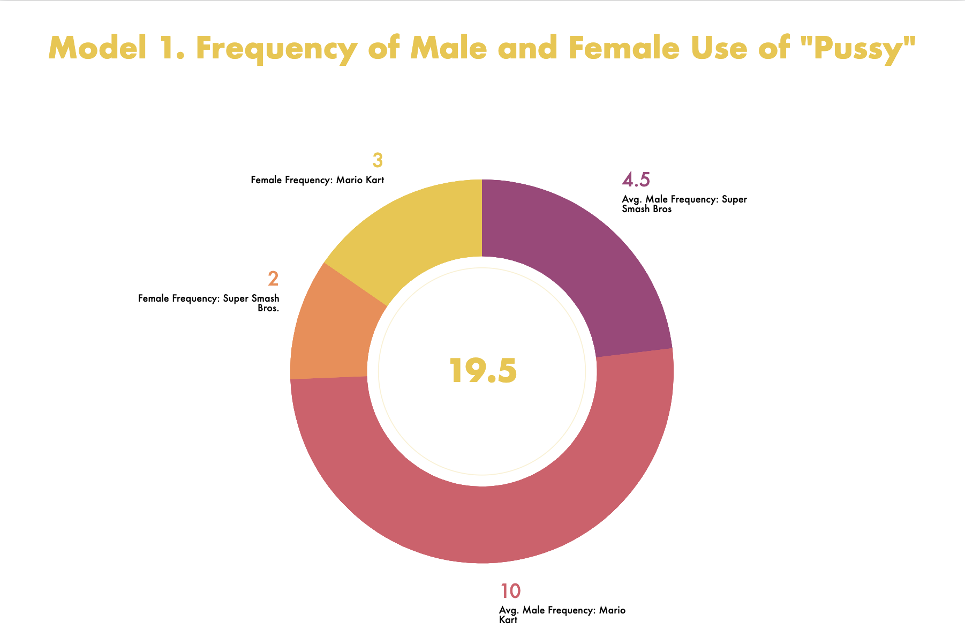
By tallying the frequency of the word “pussy” as an insult, I was able to create a pie chart to visualize the frequency of the male use of “pussy” and the female use. Because there were two males and one female in my study, I averaged the male frequency. As seen in Model 1, the total average male frequency was 14.5 uses of “pussy” and the total female frequency was 5 uses of “pussy.”

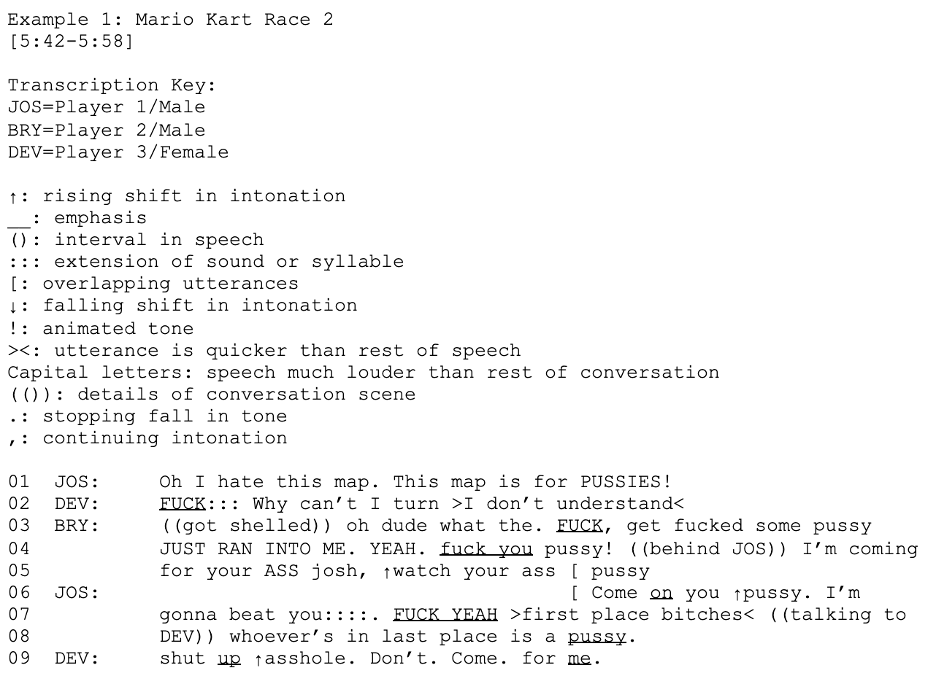
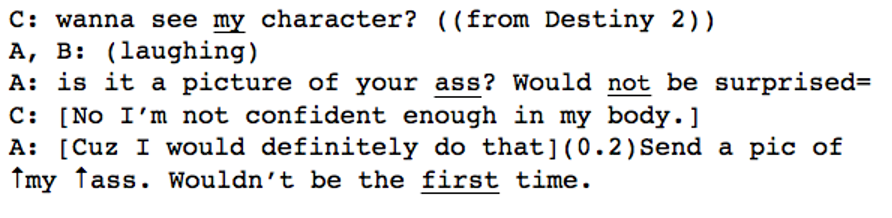
Example 1 is an excerpt from the second race in Mario Kart where “pussy” was used six times. In lines 4,5 BRY (male) gets hit by JOS (male) and calls him a “pussy,” but the other four occurrences of the word were used even though no action occurred in the game (lines 1,3,6,8). This data supports the thesis that for males there are two triggers of “pussy,” either when a character gets hit or when nothing happens in the game. In line 8, JOS calls DEV (female) a “pussy” but she responds by calling him an “asshole” instead.

What do the results mean?

Looking at the pie chart from Model 1, male players used “pussy” at a higher frequency than the female player, supporting my thesis than men are more likely to use the word “pussy” as an insult compared to women. This supports the findings of Murnen’s research and might imply that male use of the word “pussy” is higher because of their positioning in society with more power due to gender stereotypes (Murnen, 2006).

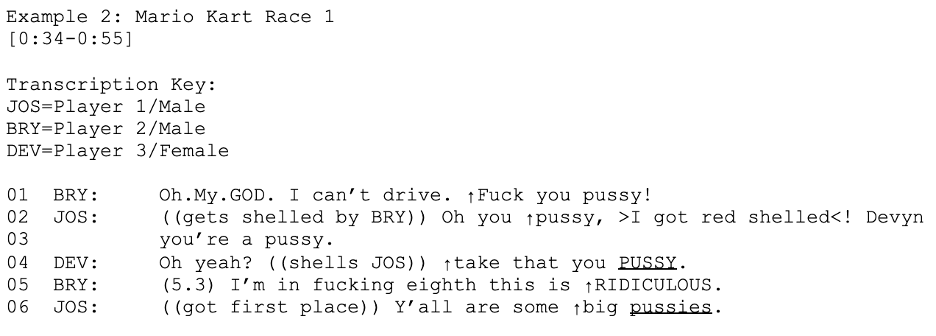
The transcripts from Examples 1 and 2 support my thesis that male use of the word “pussy” has two different triggers, either when their character gets hit or without any action occurring in the game. Moreover, as seen in Example 2, the female player (DEV) only used the word “pussy” after another player called her a “pussy,” but throughout the entire set of games, she never used the word first. This could be because she did not want to use gendered insults due to their sexist nature but might have wanted to fit in with the group which consisted mostly of men. This is supported by Example 1 where DEV opted to use the gender-neutral insult “asshole” instead of “pussy” which might imply that women are inclined to swearing, but do not want to reinforce gender norms and the objectification of females and female genitalia. This contradicts the findings of Ashwell’s research who argues that gendered insults are so problematic because they lack a gender-neutral alternative (Ashwell, 2016).

Ultimately, the research supported my thesis that men use “pussy” as an insult while video gaming at a higher frequency than women, and how women only use “pussy” after they are called the insult.

Some limitations of this study is that the sample size used was very small and cannot be generalizable for the entire population of college-level video gamers. Moreover, there were more males than females in the study, but ideally there should have been an equal amount. The study should also have focused on other types of gendered insults to be able to provide a conclusion on gendered insults as a whole.

Based on these results, for future research, I recommend looking into socio-political beliefs of the participants and whether there is a correlation between their political views and their use of gendered insults.


References

Ashwell, L. (2016). Gendered Slurs. Social Theory and Practice, 42(2), 228-239. Retrieved February 8, 2021, from http://www.jstor.org/stable/24871341

Elliot, T. P. (2012). Flaming and gaming – computer-mediated-communication and toxic disinhibition. University of Twente (student thesis).

Felmlee, D., Inara Rodis, P., & Zhang, A. (2019). Sexist Slurs: Reinforcing Feminine Stereotypes Online. Sex Roles. doi:https://doi.org/10.1007/s11199-019-01095-z

Finnegan, J. (2019). Bad language and Bro-up Cooperation in Co-sit gaming. Approaches to Videogame Discourse Lexis, Interaction, Textuality.

Francesca, Thaliakr, Rachel, Robert, Youredoingamazing, Jc, Rose, K. (2018, April 12). Everyday misogyny: 122 subtly sexist words about women (and what to do about them). Retrieved March 18, 2021, from http://sacraparental.com/2016/05/14/everyday-misogyny-122-subtly-sexist-words-women/

Murnen, S. K. (2006). Gender and the use of sexually degrading language. Psychology of Women Quarterly. doi:https://doi.org/10.1111/j.1471-6402.2000.tb00214.x

[/expander_maker]

, , ,

Reading is Fundamental: The Role of Ritual Insults in Ru Paul’s Drag Race

Olivia Heiner

Insults are sometimes regarded as negative or impolite; however, they can also be a playful ritual among various communities.  Consider, for example, the exaggerated “Yo Mama” jokes told between young school children.  Such insults are entertaining, performative, and unlikely to cause much harm.

This article explores the practice of mock ritual insults in the drag queen community, where such insults are referred to as “reads”.  In particular, this study looks at conversations from episodes of Ru Paul’s Drag Race—a reality television show where drag queens compete against each other—in order to analyze the content and linguistic aspects of reads.  Like other communities who practice ritual insults, queens display wit and humor in their reads.  Unlike insults in other male communities, however, reads use drag language and focus on content that is particularly relevant to the gendered performance of drag; this includes high pitched voice, feminine pronouns and addresses, as well as insults focused on fashion, makeup, and physical characteristics.  Despite the fact that reads usually involve insults against real traits in the addressee, surrounding queens and addressees usually respond to reads in a positive manner. This demonstrates how reading is a playful practice that not only entertains queens, but also helps them build a “thicker skin” against the real, non-playful criticism that they experience as a marginalized group.

[expander_maker id=”1″ more=”Read more” less=”Read less”]

Background on Ritual Insults in the Drag Community

The drag queen community is comprised of people (mostly gay men or other members of the LGBTQ+ community) who portray an exaggerated feminine gender performance, usually on a stage.  Ritual insults are common in the drag community, so much so that they have their own name: reading.  An explanation of reading is given by Dorian Corey in a documentary film about the 1980’s drag scene, Paris is Burning (1990).  Corey describes reading as “the real art form of insult”, which often involves finding a flaw in someone and exaggerating it in a way that makes people laugh. 

The witty and clever nature of reads in the drag community is similar to ritual insult practices in other communities, such as games of “the dozens” in black communities or “Yo Mama” jokes told amongst school children (Abrahams, 1962; Eckert & McConnel-Ginnet, 2013).  The differences, however, are what give us insights into the distinctive characteristics of drag culture.  One difference is the truthful nature of reads in drag, which contrasts ritual insults in other communities that are usually not grounded in facts.  The truthfulness of reads is important, because it functions as a way to build thicker skin against non-playful verbal attacks from the straight community (McKinnon, 2017).  In terms of linguistic delivery, drag queen language often involves a blend of African American language, female language, gay men’s English, and Southern U.S. English (Bruun 2018).  This distinguishes reads from insults in other male communities, which typically involve hetero-masculine language and content.  This article provides a discussion of how these distinctive elements of drag insults are used in Ru Paul’s Drag Race.

Methods

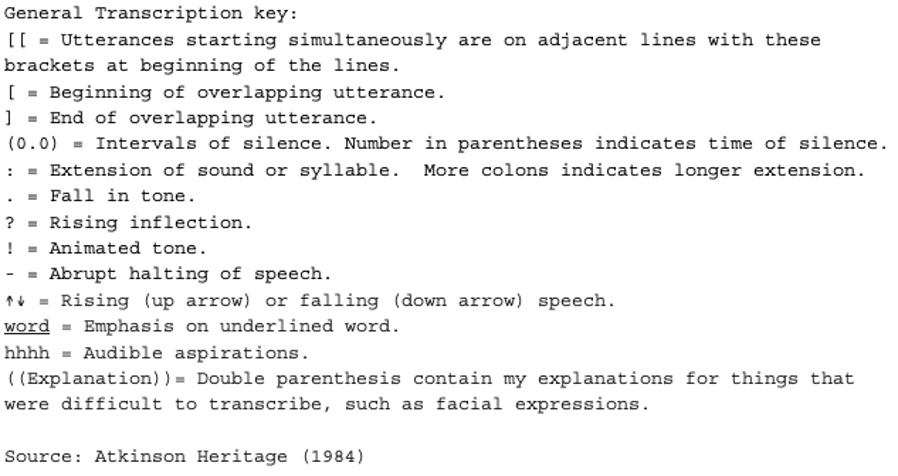
While studying reads in Ru Paul’s Drag Race, I gathered data from various settings in the show, such as challenges, runway events, and conversations in the work room.  The biggest source of reads in the show was in the Reading Challenge, where each queen is given the floor (one at a time) to read the other queens.  The queen with the “best” reads wins the challenge (usually the queen whose reads receives the most laughter).  While watching the reading challenge, I took note of the subject of each read, such as fashion or physical traits, and any relevant linguistic content, such as wordplay and gendered pronouns.  I also categorized each read as unsuccessful or successful, where a successful read was one that elicited a positive response, such as audible laughter, from a majority of the present queens;  unsuccessful reads were those that are met with negative or quiet responses. The transcript notation used for data collection is given at the end of the article.

Results and Analysis

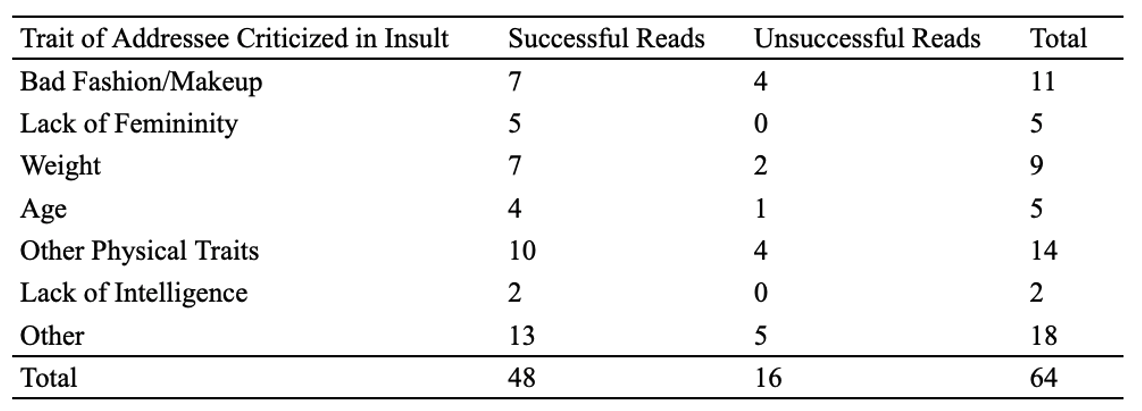
The content of reads varied, but they mostly revolved around performative aspects of femininity.  Table 1 tallies the number of reads in various categories, as well as the number of successful/unsuccessful reads in each category.

Table 1: Number of Successful and Unsuccessful Reads by Category of Insult. “Other Physical Traits” refers to physical traits not included in the first four listed categories. The last category labelled “Other” refers to insults that were either uninterpretable or that required contextual knowledge the author was unaware of.

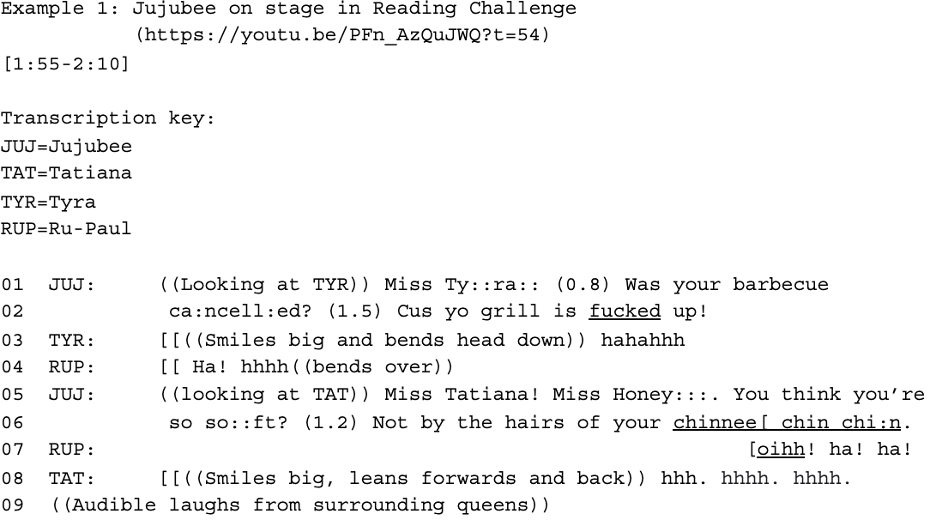
A representative example of a successful reading is Jujubee’s reads of Tyra and Tatiana in one of the Reading Challenges:

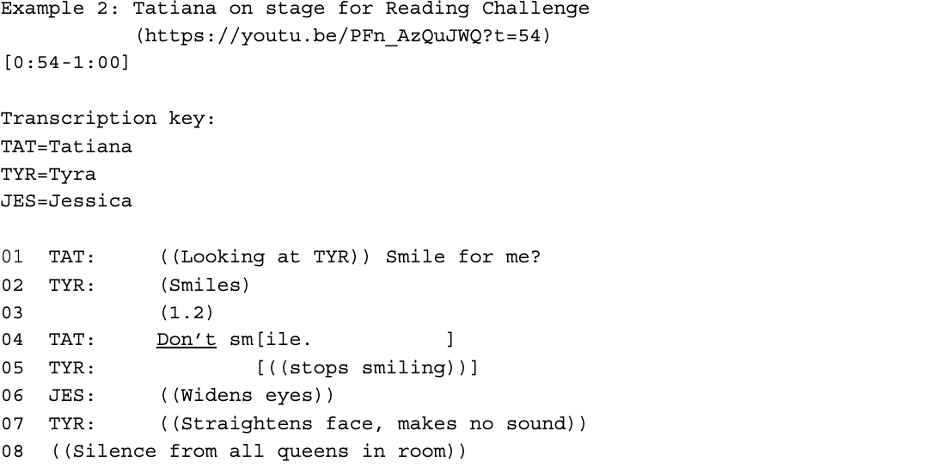
The laughs and smiles from the other queens in response to Jujubee’s reads indicate how successful her reads were.  They involved cleverness, feminine addresses (Miss Honey), and attacked physical traits and lack of femininity in the addressees.  The topic of reads, however, isn’t always enough to make a successful read.  Consider Tatiana’s read of Tyra’s teeth:

In this example, the topic of Tatiana’s read is the same as Jujubee’s read of Tyra; they both criticize Tyra’s teeth.  However, Tatiana’s read fell flat and was categorized as unsuccessful.  Why was it unsuccessful? While Jujubee’s read was performative, exaggerated, and clever, Tatiana’s read was short, involved no wordplay, and lacked the “drag language” that was present in Jujubee’s insults.  Thus, the linguistic delivery of reads is just as important as the subject of reads in determining a read’s success.

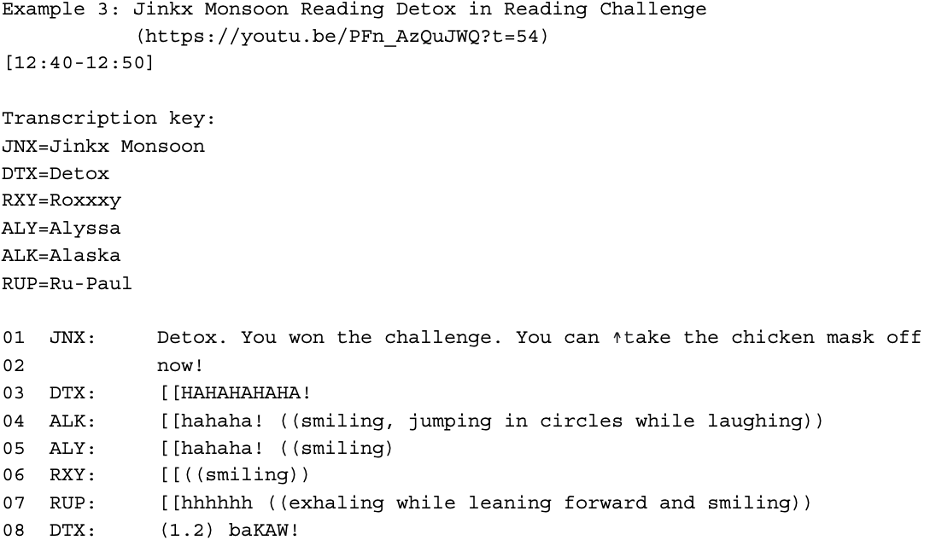
While Tatiana and Jujubee’s examples show the two extremes of unsuccessful and successful reads, it should be noted that a majority of reads were successful.  Most successful reads involved laughter not just from surrounding queens, but also from the queen being insulted.  This held true even when reads contained personal insults that the most people might be self-conscious of, such as being overweight or having unattractive facial features.  One example of this is Detox’s response when being read by Jinkx Monsoon:

In this example, Jinkx was insulting Detox’s real face, comparing it to a chicken.  Instead of showing offense from Jinkx’s comment, however, Detox laughed loudly with the other queens and even joined in on the joke by responding with a chicken sound (line 08).  This highlights the playful nature of reading, even when it involves personal insults directed at real traits in the addressee.

Discussion and Conclusion

From this collected data, it is clear that ritual mock insults have a distinctive form in the drag community.  The reliance on humor and wit is similar to other communities who practice ritual insults; the other linguistic aspects and topics of reads, however, reflect ways in which the drag community is unique from other primarily male communities.  What counts as a valid insult in any community reveals what is relevant to that community, and the reads in this article showed how portraying stereotypically feminine traits and minimizing masculine presentation is important to drag queens.  Reads revealed femininity through the subjects they focused on (fashion, makeup, physical traits) and through an exaggerated use of feminine language (high pitch voice, feminine pronouns).  In terms of how reads are perceived, most received positive responses from surrounding queens and from the addressee being insulted, even when they focused on actual flaws in the addressee.  Reads are a playful part of drag, and being able to both successfully deliver and gracefully accept insults in the form of reading is vital to thriving as a drag queen.


Further Reading and Watching

If you are interested in learning about or watching ritual insults in other communities and in drag, the following resources are useful:

Dozens is Oral Legacy Rooted in Survival

Drag Race Reading Challenge Compilation

Dorian Corey Explains Reading in Paris is Burning

Ru Paul’s Drag Race: Guide to Giving Shade


Transcript Notation


References

Abrahams, R. (1962). Playing the dozens. ​The Journal of American Folklore,​ ​75(​ 297), 209-220. doi:10.2307/537723.

Atkinson, & Heritage. (1984). Transcription  Notation.

Bruun, M. (2018). “As We’ve Seen in This Season, Anything Can Happen, So Don’t Fuck It Up” – Impoliteness in Rupaul’s Drag Race Season 9. ​University of Eastern Finland Philosophical Faculty, School of Humanities, Foreign Languages and Translation Studies.​

Drag Race: All Stars. Season 2​ [Television series]. (2016). LOGO.

Eckert, P., & McConnell-Ginet, S. (2003). ​Language and gender​. Cambridge: Cambridge University Press.

Every Reading Challenge (Compilation Part 1) The Library is Open RuPaul’s Drag Race.​ (2018, December 15). [Video]. YouTube. https://www.youtube.com/watch?v=PFn_AzQuJWQ

Labov, William. (2009). Rules for ritual insults. doi:10.1007/978-1-349-92299-4_42.

Livingston, J. (1990). Paris Is Burning. Off White Productions Inc.

McKinnon, S. (2017). Building a thick skin for each other. Journal of Language and Sexuality 6:1, 90–127. doi:10.1075/jls.6.1.04mck.

Simmons, N. (2014). Speaking Like a Queen in RuPaul’s Drag Race: Towards a Speech Code of American Drag Queens. Sexuality & Culture, 18(3), 630–648. https://doi.org/10.1007/s12119-013-9213-2

Taylor, V., & Rupp, L. (2004). Chicks with Dicks, Men in Dresses. Journal of Homosexuality, 46:3-4, 113-133. doi: 10.1300/J082v46n03_07


[/expander_maker]

, , ,

¡Échale ganas, mija!: How Latina Immigrant Mothers Use Word Choice to Assert Their Expectations

Catherine Guzman, Joan Kim, Kiara Mares, Yadira Marquez, Flor Ramirez

College enrollment and graduation rate from Latinos has increased during the last decade. Latinas[1] went from being 17% of graduates in 2000 to 30% in 2017. Latina mothers have played an important role in the success of Latinas by either providing motivation or pressuring them. Latina daughters may also face more pressure to understand the role that family dynamics and cultural roles play in their education and professional life, and it is our goal to show what factors influence the expectations of immigrant Latina mothers as well as how they communicate this to their children. We analyze word choice such as pauses and filler words, positive and negative word connotation, achievement remarks and associations, and levels of details to understand what factors influence what is expected of Latina daughters. Through the analysis of interviews of two Latina mothers with their older and younger daughters, we expect to find a positive correlation between the different levels of educational expectations based on birth order and expect the older daughter to have more responsibility and expectations of success.

Figure 1: Educated Latina Art Print from oayon1313

[1] Latina: a woman or girl of Latin American origin or descent

[expander_maker id=”1″ more=”Read more” less=”Read less”]

In its everyday use, language is constantly changing. It adapts to best fit the current needs of a society and reflect what is culturally relevant. When analyzed correctly, language is a record of a culture – relating norms, cultural roles, dynamics, etc.

Take a look at the following quote:

“The father, what he wanted was that his daughter leave the house dressed in white and that was his goal” (Perez, excerpt 8).

Without further context, this excerpt allows for some insight as to what gender roles and familial expectations characterized this speaker’s community. Here, there is an emphasis on community and culture, because the speaker’s expectations have been determined by the interactions within their own community, which in turn, is reflected in their use of language.

This is not a new take on language and can be tied back to symbolic interactionism. This theory posits that meaning is constructed through everyday interactions and conversations (“Symbolic Interactionism Theory”, 2014). In other words, much of what we come to value, identify with, expect, draw meaning from, etc., was learned through our interactions with others within our community.

This is the framework that formed the basis of the present study. With a focus on word choice, our interest was with Latina immigrant mothers, women who grew up within Latin American norms and expectations, then found themselves having to immerse themselves into a new culture and unfamiliar social contexts (often resulting in conflicting interactions).

According to prior research, Latina immigrant mothers’ perceptions of education are impacted by interactions in both American and Latin America social contexts. To illustrate, in Mexican culture, women are often expected to prioritize familial obligations over their education (Perez, 2009). In addition, women in Mexico are expected to be most involved in their children’s lives, while in the U.S., it is common for both mother and father to work (resulting in comparatively less involvement) (Perez, 2009). Overall, prior findings support the assertion that immigrant women often form judgements from experiences and meaning created during early-life interactions (Perez, 2009).

With the intention of seeing how these findings manifested within an immigrant mother’s direct interactions with their children, we were looking to explore the following: What factors influence the expectations of immigrant Latina mothers? How do they communicate this to their children?

The study’s analysis was collected via informal interviews with two Latina immigrant mothers. Mother 1 is from Jalisco, Mexico. She immigrated to the U.S. 41 years ago, at age 8. Her two daughters are 19 and 16 years old. Mother 2 is from Oaxaca, Mexico. She immigrated to the U.S. 30 years ago, at age 16. She has two daughters, ages 19 and 23.

We hypothesized that Latina immigrant mothers have higher expectations for their older daughters. These expectations take the form of expecting the daughters to attain a higher education. We further hypothesized that Latina immigrant mothers would demonstrate these ideals through word choice, specifically, through the use of more positively correlated words and less fillers when being interviewed about their daughters’ educational goals.

In order to investigate our hypothesis, we had each daughter interview their respective mothers- mother 1 was interviewed by her oldest and youngest daughter and mother 2 was interviewed by her oldest and youngest daughter. The younger and older daughters each asked their mother the same series of ten questions (see the list of questions below), but they interviewed their mothers on different days and asked the questions in different orders. Each of the younger daughters asked the interview questions on the first day, and, then, a few days later the older daughters interviewed their mothers.

Figure 2: Interview Questions

We recorded these interviews in order to be able to transcribe them so that we could make note of the following nuances in the mothers’ speech patterns: pauses, filler words, connotative word choice, levels of detail and any phrases that may allude back to gendered expectations. For the purpose of our research, we took pauses longer than two seconds into consideration; we did not analyze one second or less than one second pauses because we interpreted them as the mothers taking a moment to formulate their thoughts. We analyzed pauses longer than two seconds as an indicator of hesitancy on the mothers’ behalf about how they should respond to the question that was posed to them. We counted all the instances of filler words such as “Ah,” “Ahm,” “Uh,” “Uhm,” “Eh,” “Ehm,” and “Mmm ”as markers of hesitancy when preceded or followed by a pause as well.

We also used the context of the mothers speech to determine what pauses or fillers the mothers used to give themselves time to think and what pauses or fillers the mothers used when hesitant about how to deliver their responses. In addition to that, we also focused on words such as “orgullosa,” meaning proud,” or “gusta,” meaning “like,” as samples of connotative word choice in order to quantify how approving or disapproving the mother was in her response. We noted the amount of detail mothers went into in their responses for each question from the interview with their youngest daughter and cross referenced it with the length of their response from the interview with their oldest daughter. We made note of this, in order to determine if going into more or less detail with one daughter or the other had any implications in regards to their expectations for each daughter. While doing all of that, we also analyzed the data for any instances of references to gendered expectations the mothers brought up to draw conclusions about how well the educational expectations the mothers held for their daughters aligned with gendered expectations that are typical of Latinx culture.

Before we discuss our results, click this link: Latina Mothers in order to hear the audio.

The word choices in the recorded interactions were meant to indicate hesitancy or show intention in the responses, with a special focus on the answers from the mother. Filler words and phrases were tallied specifically with consideration that it might mean there was more difficulty finding a word, alluding that mothers felt the need to be more intentional with their responses. While there was a very large contrast between the amount of them the mothers used, the results indicated that amongst them both, they used more filler words with their older daughters. Specifically Mother 2 used 17 filler words with her youngest daughter and 23 with her oldest daughter. Similarly, Mother 1 used 2 filler words with her youngest daughter and 4 with her older daughter. This observation was especially interesting, given that in both cases the older daughters interviewed their mothers after the younger ones had so despite having already been primed 2 days prior, there was still more use of filler words with older daughters.

Pauses had the opposite results. When tallying we counted pauses above two seconds, and found that both mothers used more pauses when communicating with their younger daughters. In this case the mothers used a similar amount of pauses despite the location varying. Mother 2 used 16 pauses with the younger daughter, compared to just 13 pauses with the older one. Mother 1 used 13 pauses with the younger daughter and 12 pauses with the older daughter. Analyzing pauses was done with the intention of considering their hesitation when answering questions in a certain way. Overall this analysis indicated that when speaking with their younger daughters, the mothers used more pauses for their younger daughters. This could signify that the word choice required more thought and was more selective. However, it is also important to recognize that this length in pauses could be attributed to the younger daughters interviewing their mother first.

Table 1: Interview’s Pause Analysis

The next part of the analysis consisted of finding words that held strong positive or negative connotations. We immediately noticed that there were not any explicit words that had negative meaning or were used to allude to something in a negative light. On the other hand, we were pleasantly surprised with the amount of words with positive meaning. Although they were used in varying contexts, both mothers expressed about the same amount of positive words. Most of these words overlapped in all conversations, with some of the most recurrent being orgullosa” meaning ‘proud’, “exitosa” meaning ‘successful’, and “gusta” meaning ‘liking/liked’. Each word was interpreted as approval of their accomplishments or what they’re doing academically. These positive words were evenly spread among all interviews and didn’t indicate any biases for stricter expectations with one or the other daughters. One interaction that exemplified the role of maternal figures in setting expectations, was Mother 1’s response to the question “What do you think about my goals compared to the cultural expectations you grew up with?”. She responded with, “Esta buena pregunta para tus abuelas”, ‘this is a good question for your grandmothers’ possibly implying that expectations for women are set by the women that raised them.

Finally, our study analyzed the level of detail provided in the responses. The purpose of taking detail into consideration was to see if the mother was involved more with one daughter than the other or if the mother felt the need to explain her responses because of a more demanding expectation to either of her daughters. While the answers varied in length, there was an increased length in the responses for the older daughters from both mothers. This again could indicate that mothers feel the need to reinforce specific goals and expectations more thoroughly to their older daughters.

However, in studying this we observed other responses that supported our hypothesis that Latina immigrant mothers held higher expectations for their elder daughters in comparison to their younger daughters. The first question being “How do you feel about my career choices?” where Mother 1 explains to both daughters that she is content in their choices. However, she then goes on to note that her older daughter’s aspirations are rather competitive and she wants to see them all the way through. This was in contrast with her response to her younger daughter where she suggested a career in Broadway, which is much more difficult to land a secure spot in. This response perhaps shows that the mother wants her older daughter to be more secure in her career choice, followed by the expectations of being in a stable job — expectations not found in the interview with her younger daughter.

In summary, our study found that with the cases given, we were able to find some indications of older daughters being held to a higher career standard. Such instances were found in word choices analyses regarding careers and education. Specifically, we were able to find patterns of correlating pauses and filler words, and were even able to find patterns of expressing more detailed answers to older daughters. However, due to certain limitations (to be specified in subsequent paragraphs), it is clear that these findings are not substantial enough for a definitive conclusion. 

Our research would benefit from further research to argue for a more solid conclusion. Additional exploration and analysis on our test subjects and methods could provide more substantial evidence for whether or not Latina immigrant mothers have higher expectations for their first eldest daughters compared to the youngest.

Our research limitations consisted of a few things. First, out of the interest of time, our interviewees were only allowed ten questions to ask their mothers. These questions did not include follow up questions, which would have greatly expanded on certain ideas. For example, one instance that could have benefitted from more explanations from both responses is to the question “How involved do you think you were and are in my school life and extra curricular activities?”.

Table 2: Older Sister Conversation (highlighted part shows the level of detail given by the mother when answering the question)


Table 3: Younger Sister Conversation (the mother’s response is shorter compared to her response to the older daughter)

To expand, one mother replied with “..un ~ochenta y cinco~ por ciento posiblemente” ‘possibly 85 percent’  for both daughters. This mother only expands briefly when talking to her older daughter, ranging her involvement between elementary school and high school. However, one way to have gained more qualitative data would have been to ask specifically in what ways this mother came to the conclusion of 80 percent.

The other mother responded with “I am very involved in the activities and studies of my daughters”  for the younger daughter and “Very, very much in school” for the older daughter. Similar to the previous mother, a follow up question of asking “How so?” or “In what ways?” could have provided more data to compare to with the first mother, in regards to what these two mothers did to stay involved.

Moreover, our study only used two mothers, therefore, our work should be considered as a case study rather than extensive research. It is only a small representation of the Latina motherhood community. On a similar note, with only two mothers, it was difficult to compare and draw conclusive statements. However, if there were more resources, subjects, and time allowed, these limitations could be reduced.

These findings may contribute to a larger phenomenon on who maintains such expectations in a Latina community, as well as connecting to as far as how this affects a woman’s social identity in her aspirations. 


References

Aviles, G. (2019, November 20). More Latinas have college degrees, but they’re still making less than white males. NBCNews.com. https://www.nbcnews.com/news/latino/more-latinas-have-college-degrees-they-re-still-making-three-n1087101

Clark, H. H., & Fox Tree, J. E. (2002, February 27). Using uh and um in spontaneous speaking. Retrieved from http://www.columbia.edu/~rmk7/HC/HC_Readings/Clark_Fox.pdf

Crosnoe, R., Ansari, A., Purtell, K. M., & Wu, N. (2016). Latin American Immigration, Maternal Education, and Approaches to Managing Children’s Schooling in the United States. Journal of marriage and the family, 78(1), 60–74. https://doi.org/10.1111/jomf.12250

Field research. (n.d.). Retrieved May 11, 2021, from https://www.researchconnections.org/childcare/datamethods/fieldresearch.jsp

Mendoza-Denton, N. (2008) “THAT’S THE WHOLE THING [tɪŋ]!”: DISCOURSE MARKERS AND TEENAGE SPEECH. In J. McIntosh (Ed.), Homegirls (pp. 265-291). Wiley.

Perez, A. (2009). Understanding Attitudes about Education within two Cultural Contexts: Comparing the Perceptions and Expectations of Mexican Mothers in the Greater Los Angeles Area to their Cohort in Mexico. Graduate Studies At California Lutheran  University.

Symbolic Interactionism Theory. Communication Theory. (2014). Retrieved May 2021, from https://www.communicationtheory.org/symbolic-interactionism-theory/.


[/expander_maker]
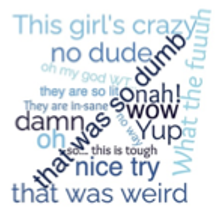
To: Perceived Female Recipient
Subject: Examining Nonbinary Identities in Email

Cc: Kyna Horten, Phoebe Morales, Lukas Weinbach

What if I told you that the way you write your emails is a dead giveaway of your gender identity? What if I told you there is a way to make this less obvious? If you want to learn more about Gendered Language, keep reading! What we know so far: Research parses variations in speech into ‘powerful’ language and ‘powerless’ language, or ‘men’s language’ and ‘women’s language. ‘What research has not considered yet: For centuries, men and women have had gender roles to perform which influence their speech behaviors; however, there is no social gender for people outside of the binary to perform, perhaps as a result of the idea that biological sex runs on a binary (which it doesn’t). In recent years, the options for social gender are changing from a binary to include those outside the traditional man/woman dynamic. Bathrooms, passports, and titles (mrs./ms., mr., mx.) are beginning to accommodate genders outside of the binary. Still, there are no set stereotypes, roles, or expectations for genderless people. We wanted to investigate how individuals identifying as agender perform language when writing emails.

[expander_maker id=”1″ more=”Read more” less=”Read less”]

For our study, we chose a convenience sample of three participants. The target demographic were nonbinary English-speakers in the Millennial/Gen Z age-range. One participant was assigned-female-at-birth and part of the cisgender control group. The other two participants were agender, and this group was a mix of assigned-female-at-birth and assigned-male-at-birth. Each participant provided at least six formal email threads for analysis. At least three of these were addressed to male recipients while the other half were addressed to female recipients. All recipients held a position of power over the participants. Before examining the emails, we produced a codebook full of key words and markers which signify powerless language. Here are a few examples of markers we coded:

Code Description of code
HEDGING (HD) [sort of, kind of, I guess, it seems]
ITALICS (IT) [so, very, totally, quite, really, !] Emphasis.
QUESTION INTONATION (QI) question intonation in declarative context

[I was wondering if… ?]

THANK (TY) [thanks, thank you] expressing gratitude
PLEASE (PLS) [please]
APOLOGY (SRY) [sorry]
EMBEDDING (EB) [hope, wanted, wondering]
EMOTES (EMO) emojis, emoticons [haha, lol]
ACCOUNTABILITY (ACC) taking responsibility for a certain outcome, admitting fault
APPEASING (APP)


[hope you’re well] making social small talk to prepare for request; elevating recipient or denigrating oneself to appease them.

We tallied these codes to calculate the average frequency of powerless markers for every X amount of words in each message.

Gerard Van Herk’s What is Sociolinguistics? (2017) provides concepts of gender identity, performance, and practice. Herk asserts that “in cross-gender interactions we can expect to see the greatest gender effect,” therefore, we analyzed cross-gender interactions to help gauge the effect of perceived gender.

All data were coded twice, once by each of the researchers who did not compose said text. After coding was completed, we compared our findings in order to determine percent agreement of coding and in order to confirm that our coding system is well-defined and useful. Below are some example emails which we coded and analyzed as part of our data pool. The first is written by our assigned-female cisgender participant addressed to a female recipient, and the second is written by our assigned-male agender participant addressed to a male recipient. All names and sensitive information have been anonymized.

Figure 1. An email by assigned-female cisgender participant addressed to a female recipient.
Figure 2. An email by assigned-male agender participant addressed to a male recipient.

We found in our results that there is a notable increase in powerless markers in cross-gender interactions, according to assigned gender at birth. Below is a table summarizing the average frequency of powerless language towards female and male recipients for each participant:

ANONYMIZED NAMES AMANDA

(AGENDER, AFAB)

DAPHNE

(CIS, AFAB)

ERIK

(AGENDER, AMAB)

FEMALE RECIPIENT 31.7 14.1 10.4
MALE RECIPIENT 11.8 11.2 13.4

We can see that gender identity had little, if any, effect on speech in emails. Regardless of identity, cross-gender interactions according to assigned gender at birth still produced more exaggerated use of powerless language, just as Van Herk predicted. As researchers, we expected that our agender participants, Amanda and Erik, would not conform to binary patterns. We predicted that their average frequency of powerless markers per message would be roughly the same across differently gendered recipients. Instead, our actual results imply that binary socialization, upbringing, and external perception impact the way that nonbinary people navigate the world. These results have many practical applications for the LGBTQ+ community. Some nonbinary people may be okay with presenting in a way that aligns with their assigned gender at birth; however, others may desire to present a different image. Perhaps agender and other nonbinary individuals can use this research to consciously move towards less gendered speech, if they so desire. Furthermore, individuals wishing to present as more masculine or more feminine may also use this research to alter their speech so that it better aligns with their identity.

However, it is also important to note that these cross-gender disparities are potentially social constructs. Powerless language is not inherently feminine or masculine, but we associate these qualities with gender performativity.

If a person is in a position of less power, they are inclined to use more polite language. This is not necessarily powerless language in itself. In fact, it can be powerful language in its own right, as the speaker or writer implements manipulative tactics in request-making. For those in a lower position, polite language is more likely to produce results.

There are several interesting topics for further research. As mentioned above, upbringing may have a significant impact on cross-gender language. Patriarchal, matriarchal, and neutral households may produce differing attitudes towards the power dynamic of men and women. So, depending on a person’s upbringing, they may use either more or less powerless language when speaking to different genders.

The sociolinguistic study of gendered language is said to have started with Lakoff’s early studies and eventually his book “Language and Woman’s Place” (1975). Since then, the study of language and gender has developed greatly. Lakoff’s Research has been referenced and expanded upon many times, but generally focuses on a binary view of gender, and non-binary topics are under researched fields of study. Although both gender identities and social genders outside of the binary have always existed, the term ‘agender,’ “denoting or relating to a person who does not identify themselves [sic] as having a particular gender” (Google Definitions), was first coined on the internet in the year 2000 (Them). Our own research is extremely limited, examining a small pool of data from a convenience sample of three participants, only two of which are agender. We did not study other nonbinary identities outside of agender, nor did we study binary transgender people. Further research may reveal more patterns or nuances which escaped our own research.


References

Brown, P., & Levinson, S. C. (2007). Politeness: Some universals in language usage. In Politeness: Some universals in language usage (pp. 61-83). Cambridge: Cambridge Univ. Press.

Cameron, D. (2010). Performing Gender Identity Young Men’s Talk and the Construction of Heterosexual Masculinity. In 1367818629 1000231388 D. Kulick (Author), Language and sexuality. Cambridge: Cambridge University Press. http://dx.doi.org/10.1017/CBO9780511791178

Herk, V. G. (2018). What is sociolinguistics? In What is sociolinguistics? (pp. 86-100). Hoboken, NJ: John Wiley &amp; Sons.

Myers, Kristen. (2012). Cowboy Up!. ResearchGate. www.researchgate.net/publication/276215982_Cowboy_Up.

O’Barr, William M., and Bowman K. Atkins. ‘Women’s Language’ or ‘Powerless Language’? Women and Language in Literature and Society, by Sally McConnel-Ginet (1980). New York: Praeger, pp. 93–110.

Silverstein, M. (1976). Shifters, Linguistic Categories, and Cultural Description. In 1367858396 1000257581 K. H. Basso &amp; 1367858397 1000257581 H. A. Selby (Authors), Meaning in anthropology (pp. 11-55).

Them. (2018). What Does It Mean to Be Agender? Them., Them. www.them.us/story/inqueery-agender.

[/expander_maker]
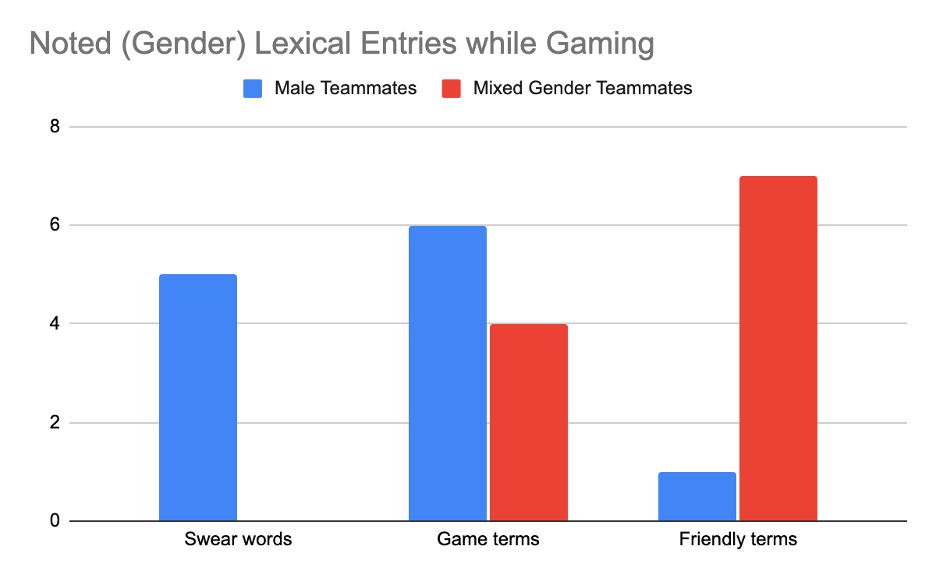
“Ladies and Gentlemen, Please Forgive Me Because…” I am a Catfish: Analysis of Gender Masking Techniques in The Circle

Karen Landeros, Gianelli Liguidliguid, Anna Kondratyeva, Jose Urrutia, Mariana Martin

On the Internet, no one knows you’re a dog…or a catfish. Or do they? On the reality TV show The Circle, contestants are not allowed to interact face to face—instead, they must communicate solely through a voice-activated “Circle Chat.” The anonymity of the show’s format allows contestants to “catfish” as individuals they perceive to be more attractive or likely to be popular, creating a fascinating environment to explore the perceived relationship between language and identity. This study will analyze the digital language devices, flirting habits, and text conversations sent by the contestants themselves to study if gendered language conventions exist and are followed in The Circle. Our research centers around Seaburn, a male contestant, who masks their gender identity by portraying the role of “Rebecca,” a shy, female contestant. We argue that Seaburn/Rebecca constructs their speech using stereotypically gendered language devices and concepts to effectively play the role of a woman. Our analysis highlights which features of online speech are considered to be feminine or masculine, with a specific focus on flirting, and gives insight on how prior knowledge of gendered language impacts how individuals mask their identity online.

[expander_maker id=”1″ more=”Read more” less=”Read less”]

Introduction

In our research, we were most interested in researching how contestants who catfish as another gender use linguistic features stereotypically associated with the opposite gender to mask their identity. Gender identity is often characterized by the linguistic patterns one makes use of, and a wide body of existing studies have explored the relationship between language and gender (Lakoff, 1973; Maharaj, 1995; Tannen, 2007). In an influential study, West and Zimmerman (1987) propose that gender is constructed through interactions and that individuals are continually involved in “doing gender.” A catfish would essentially take this idea of “doing gender” to the extreme, behaving and speaking entirely according to stereotypes about what a person of the opposite gender would do or say. The controlled, anonymous environment of The Circle creates a perfect setting to explore how online chat can be used to embody these gender stereotypes and expectations.

Men and women do not speak the same way online, although the ways in which they differ may contradict expectations. For instance, in an analysis of written speech on Facebook, women were “unsurprisingly” found to be warm and polite, but were also more assertive than men (Park et al., 2016). In another study, females were found to be more supportive, agreeable, and emotionally expressive than males in online discussion forums (Guiller & Durndell, 2007). With regards to specific devices used in online speech, females were more likely to use emojis and acronyms, while men were more likely to use hashtags in order to deliver information (Bamman et al., 2014; Ye et al., 2017).

Building off these existing patterns, we also examine the effect of flirting on online interactions. Studies have shown that there is indeed a difference in the flirting techniques used by men and women, which apply regardless of sexual orientation (Clark et al., 2021). For instance, men are more likely to initiate flirting than women (Whitty, 2004). By examining the characteristics of how catfish speak online, both while flirting and throughout the show, we explore how societal definitions of gender influence how individuals adopting false identities construct gender identity and roles within conversations.

Methods

Target Population

The target population of this study included the 14 contestants of The Circle. Our focus is on Seaburn, aka “Rebecca”, because he is the only catfisher in the season who is playing a different gender role. The other catfishers are simply masking as “hotter” versions of themselves.

Methodology

For our study, we utilized quantitative and qualitative data. The former was a preliminary data collection that involved collecting the frequency of emojis, hashtags, and acronyms used in any conversations with at least two interlocutors. This was done in order to see if any patterns of gendered language exist in The Circle. For qualitative data collection, we watched episodes of The Circle to seek out flirtatious conversations between any contestants and then chose a handful of text conversations to transcribe and further analyze. We then examined quantitative factors in flirting such as the gender of the initiator and proportion of sexual content.

Results/Analysis

Data Interpretation

We further stratified the data we collected from the linguistic device frequencies into two different charts. One type of chart highlights the number of occurrences per device between females and males. The other type of chart we created separates the proportioned data into three bars: catfisher, non-catfisher, and “Rebecca,” emphasizing the differences between Rebecca’s language as compared to both catfishers and non-catfishers in the show.

Emojis

In The Circle, emojis are used more often by males than females, as seen in Figure 1. This contradicts prior research on females being more likely to use emoticons than males (Parkins, 2012). Throughout the show, women tended to use emojis more often in same-gender conversations, while males used emojis more frequently in mixed-gender conversations for the purpose of being seen as more expressive by their female peers. The higher emoji usage by men may be a product of the prevalence of mixed and intimate conversations in The Circle, with men being more likely to use more “feminine” speech styles in these environments (Hilte et al., 2020).

Table 1: Percentage of the female and male contestants that use emojis

Noticeably, as seen in Table 2, Rebecca used emojis significantly less often than both the other catfishers and non-catfishers. This may have fueled other contestants’ suspicions about her “robotic” and overly formal speech.

Table 2: Proportioned average of emoji usage by non-catfishers, catfishers, and “Rebecca”

Hashtags

In online speech, hashtags are used for more than passing on information—they can also convey important emotions to others. In Table 3, we see that males on The Circle use hashtags more frequently than females. Since hashtags also serve as expressive forms (e.g. #YeahBuddy, #paesan), the data falls in line with previous literature that characterizes men’s speech to be more informative than females (Tannen, 2007).

Table 3: Percentage of the female and male contestants that use hashtagsphoto

As evidenced by Table 4, there was no significant difference between non-catfishers’ and catfishers’ hashtag usage. However, “Rebecca” used hashtags more than both their catfishing and non-catfishing peers. By using a significantly larger number of hashtags than the average contestant, “Rebecca” is still adhering to the “male” norm that men use substandard versions of language more than females (Holmes, 1992). Thus, as devices like hashtags are found to be more prevalent in male speech, Rebecca’s frequency of hashtag usage detracts from their success in masking their gender identity.

Table 4: Average occurrences of hashtag usage by non-catfishers, catfishers, and “Rebecca”

Acronyms

In The Circle, as shown in Table 5 acronyms are often used by females. This falls in line with previous literature, which suggests that acronyms can often serve as female markers in online communications (Bamman et al., 2014).

Table 5: Percentage of the female and male contestants that use acronyms

Since acronyms are an example of a nonstandard device of language, this analysis highlights how innovative female language can be in The Circle. Moreover, the data helped us further understand how the instances of acronyms usage may relate to how females typically act as facilitators in language (Tannen, 2007). For example, within the show there have been instances where the acronym “lol” has served as both a drive to alleviate tension as well as as a transitional phrase to facilitate a conversation by introducing a new topic.

In Table 6, we can see that “Rebecca” utilizes acronyms significantly more often than other contestants. This comparison led us to believe that “Rebecca” associated acronyms with female speech, and purposefully chose to use acronyms throughout their conversations in The Circle.

Table 6: Average occurrences of acronyms usage by non-catfishers, catfishers, and “Rebecca”

From the data shown above, we can see that gendered language in The Circle showed some deviations from stereotyped speech. We presume that “Rebecca” employed some markers of female speech based on preconceived notions of what females speak like online, but occasionally failed to adhere to the reality of female speech and mask their identity.

Flirting

The data on flirting (see Tables 7-10 under “Extended Tables”) showed that conversations by non-catfish were far more likely to be sexual in nature. One possible explanation for this is that the catfish did not feel as comfortable being sexual when portraying fake identities, though they did engage in flirting conversations to advance their status in the competition. With regards to flirting initiation, we saw that Rebecca initiated flirting much more often than a typical non-catfish woman, which falls in line with previous literature that shows that men are more likely to initiate flirting (Whitty, 2004). This suggests that “Rebecca” is still following some male flirting norms despite portraying a woman, potentially contributing to the other contestants’ suspicions about her.

Conversation Analysis

We analyzed three conversations in detail, but for this blog post we will be focusing on two. The first conversation that we analyzed occurred during Season 1 Episode 3, between Shubham (a non-catfisher) and “Rebecca” (a catfisher).

Example 1: a conversation between a non-catfisher and a catfisher flirting with linguistic devices

We found that “Rebecca” initiated the flirting first. In most instances (see Table 10), we found that men would first initiate flirting. However in this case, “Rebecca” flirted first in three of out of the four conversations they participated in (see Table 9). Another thing we noted was that “Rebecca” purposefully added the pet name hun at the end of her “Good morning” text. In the episode, Seaburn comments aloud that hun gives a more flirtatious aspect to the message. “Rebecca” also utilized the wink emoji (😉) at the end of this interaction to maintain this flirty atmosphere; this indicates that Seaburn made an effort to use more online emotionally-expressive language devices that are often associated with women (Parkins, 2012).

Below is our second example. Catfisher Alex is a heterosexual male catfishing as another heterosexual male named “Adam.” The second catfisher is the focus of our study, “Rebecca”.

Example 2. A conversation showing two catfishers flirting using varied speech styles

When looking at the structure of the conversation, there appears to be an imbalance of turn taking. In the first part of the conversation, “Rebecca” was successful in the use of OMG in the conversation, reflecting previous findings on females being more likely to use emojis (Whitty, 2004). At the end of the conversation, however, we see “Rebecca” use a pick up line which did not ultimately work in their favor, as “men are more likely than women to initiate flirting online” (Whitty, 2004). Due to this gender-masking flaw of initiating a pick up line in the conversation, catfisher Alex became suspicious of Rebecca’s true identity after the conversation. Overall, this conversation proved to be unsuccessful.

Discussion

Ultimately, “Rebecca” was not successful in their attempts to portray a woman through text-based online conversations. Rebecca did use some online language patterns associated with female speech, such as a high number of acronyms, but still spurred suspicions from 5 out of the 6 other remaining contestants by the end of the show. We believe that this could be partially attributed to the fact Rebecca used more hashtags and less emojis than the average female contestant, showing a discrepancy from typical female speech on the show. This discrepancy was also evidenced by her tendency to initiate flirting conversations, deviating from the behavior of other female contestants.

When explaining why they felt Rebecca was “fishy,” contestants named factors such as her over-the-top emotionality, her insincere “shy-girl” persona, and her strangely stilted, formal language (to which a lack of emojis likely contributed to). In addition to not adhering to the realistic patterns of female speech, Rebecca may have put misplaced emphasis on traits stereotypically associated with being feminine, such as shyness or emotionality, which was perceived as inauthentic by the other contestants.

Additionally, we saw no significant difference between the use of emojis, hashtags, and acronyms between catfish who were portraying the same gender and non catfish. This suggests that within the show, catfishers who portray same-gender identities of someone who is more attractive or desirable than themselves do not significantly shift their language in the process. “Rebecca’s” language patterns thus cannot be attributed to the mere fact of changing her identity, but to the fact that “Rebecca” portrayed a different gender in the process.

In our discussion of our results, we must also acknowledge some key limitations of our research. Because this is a reality TV show, the show’s content is highly edited (and possibly even scripted) by producers to create a coherent narrative or to feature the most exciting moments of the series. Furthermore, since the contestants were being constantly filmed, they were also likely to filter their speech. Because the contestants’ speech is filtered, edited, and constructed to fit the needs of reality TV, we do not know if the speech patterns we have access to truly reflect the way that they would speak online.

Another approach to our research relates to concepts shared by actor Joseph Gordon-Levitt in a TedTalk about how social media has ruined our creativity. Instead of striving to collaborate with others and learn from them, Gordon-Levitt says that we see everyone as competition and only want tangible proof of the attention we get (e.g., Instagram followers). Within The Circle, instead of saying that Rebecca adhered to inaccurate stereotypes of female speech, another approach could be to say that Rebecca simply lacked creativity in how to use language due to the competitive nature of the show and the need to get positive attention from others.

In terms of directions for future research, we think that a promising avenue could be exploring catfishers’ language use in text-based conversations. Because The Circle is voice-activated and auto-corrects the contestants’ speech and spelling, the show’s format does not allow for either ordinary spelling mistakes or purposeful alternative spelling (for example, writing “luv” instead of “love”). Exploring how gendered linguistic features are shown through text conversations can further address similar questions, such as which gender is more likely to engage in intentional misspellings, or how spelling errors impact flirting success.


Tables Extended

Table 7: Percentage of sexual vs. nonsexual content in flirting conversations with catfishers (including Rebecca)
Table 8: Percentage of sexual vs. nonsexual content in flirting conversations with non-catfishers
Table 9: Percentage of instances flirting was initiated by Rebecca
Table 10: Proportion of flirting conversations initiated by both non-catfish men and non-catfish women


References:

Bamman, D., Eisenstein, J., & Schnoebelen, T. (2014). Gender identity and lexical variation in social media. Journal of Sociolinguistics, 18(2), 135–160. https://doi.org/10.1111/josl.12080

Bryne, S., Harcourt, T., Lambert, S., Lilley, D., Price, S., Fenster, C., Foster, R., & Ireland, T. (Executive Producers). (2020). The Circle [TV Series]. Studio Lambert; Motion Content Group; Netflix.

Clark, J., Oswald, F., & Pedersen, C. L. (2021). Flirting with gender: The complexity of gender in flirting behavior. Sexuality & Culture. doi:10.1007/s12119-021-09843-8

Guiller, J., & Durndell, A. (2007). Students’ linguistic behaviour in online discussion groups: Does gender matter? Computers in Human Behavior, 23(5), 2240-2255. doi:10.1016/j.chb.2006.03.004

Hilte, L., Vandekerckhove, R., & Daelemans, W. (2020). Linguistic Accommodation in Teenagers’ Social Media Writing: Convergence Patterns in Mixed-gender Conversations. Journal of Quantitative Linguistics, 1–28. https://doi.org/10.1080/09296174.2020.1807853

Holmes, J. (1992). Women’s talk in public contexts. Discourse & Society, 3(2), 131-150. http://www.jstor.org/stable/42887783

Lakoff, R. (1973). Language and woman’s place. Language in Society, 2(1), 45–80. https://web.stanford.edu/class/linguist156/Lakoff_1973.pdf

Maharaj, Z. (1995). A Social Theory of Gender: Connell’s “Gender and Power”. Feminist Review, (49), 50-65. doi:10.2307/1395325

Park, G., Yaden, D. B., Schwartz, H. A., Kern, M. L., Eichstaedt, J. C., Kosinski, M.,  Seligman, M. E. (2016). Women are warmer but no less assertive than men: Gender and language on facebook. PLOS ONE, 11(5). doi:10.1371/journal.pone.0155885

Parkins, R. (2012). Gender and Emotional Expressiveness: An Analysis of Prosodic Features in Emotional Expression. Griffith Working Papers in Pragmatics and Intercultural Communication, 5(1), 46-54.

Tannen, D. (2007). You just don’t understand: Women and men in conversation. HarperCollins Publishers.

TED. (2019, September 12). How craving attention makes you less creative | Joseph Gordon-Levitt [Video]. YouTube. https://www.youtube.com/watch?v=3VTsIju1dLI

West, C., & Zimmerman, D. H. (1987). Doing gender. Gender and Society, 1(2), 125-151. doi:http://www.jstor.org/stable/189945

Whitty, M.T. (2004). Cyber-flirting: An examination of men’s and women’s flirting behaviour  both offline and on the Internet. Behaviour Change, 21(2), 115-126.

Ye, Z., Hashim, N. H., Baghirov, F., & Murphy, J. (2017). Gender Differences in Instagram Hashtag Use. Journal of Hospitality Marketing & Management, 27(4), 386–404. https://doi.org/10.1080/19368623.2018.1382415

[/expander_maker]
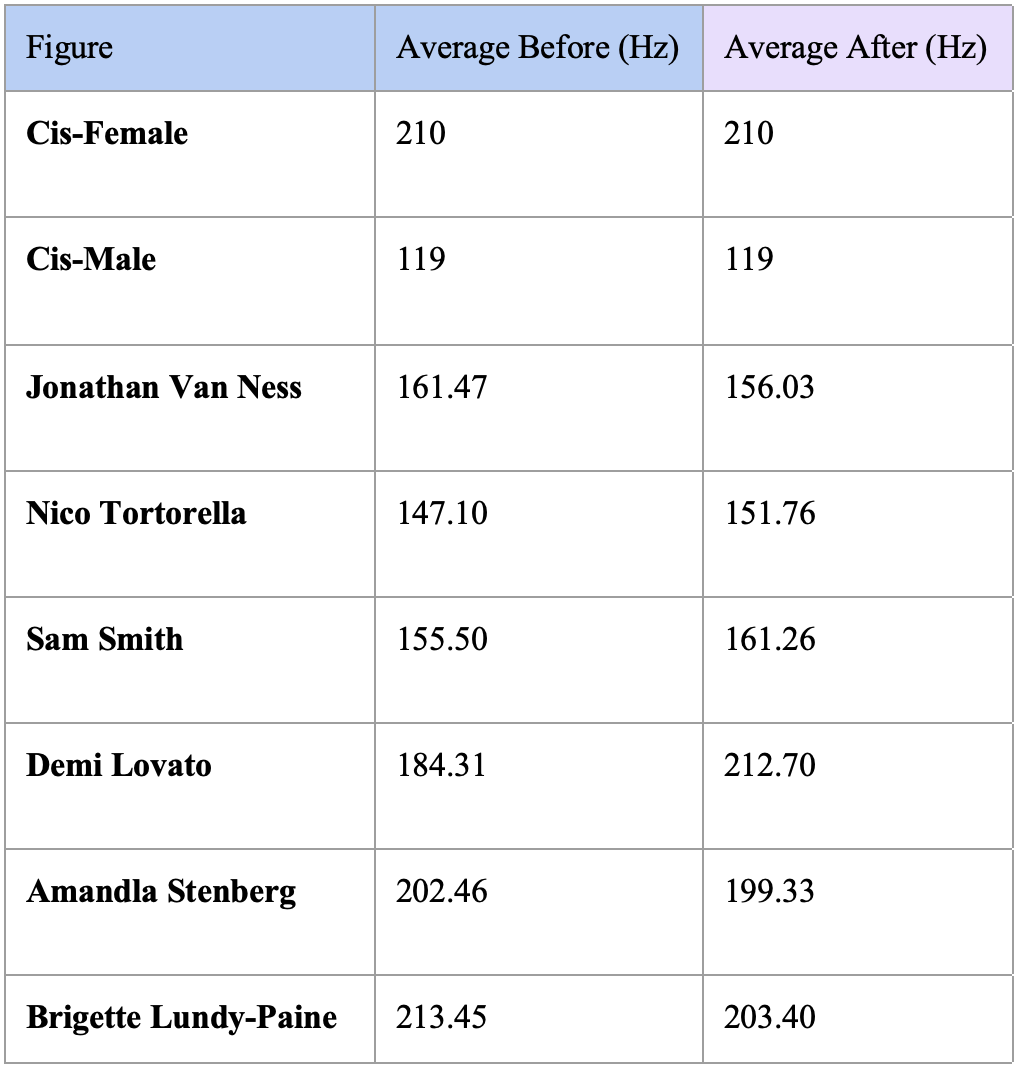


, , , ,

Fellas, is it really gay to express affection for your homies?

Joseph Anderson, Jason Luna, Ethan Perkins, Helia Woo

An increasing and alarming number of cishet men performing purportedly homosexual behavior can be seen on social media. Current research suggests there is also a decrease in homophobia and homohysteria. Our study aims to explore how changes in support of homosexuality have also changed the language of homosocial relationships. In this context, homohysteria is defined as the heterosexual’s fear of being thought gay when performing gender atypical behaviors. Homophobia is defined as attitudes and behaviors that demonstrate intolerance of sexual acts, identities, morality, and the rights of homosexuals. To test our hypothesis that cisgender heterosexual (cishet) men will use language commonly indexed and correlated with the language of women and homosexual men when interacting in homosocial conversations with close friends, we analyzed 40 TikTok videos which featured cishet men in homosocial environments, and recorded five 30–40-minute conversations that took place either in person or online via Zoom and Discord. We found that cishet men, when in a comfortable setting with other cishet men, seem to use linguistic patterns that are typically indexed with cishet women and gay men. These results suggest that our hypothesis is true, despite our limited data.

[expander_maker id=”1″ more=”Read more” less=”Read less”]

Intro

Like many of our peers, our nights are filled with casually staring at the screen of our phones, scrolling for hours through an endless number of TikTok videos. Yet, after watching some cute puppy videos, hilarious scripted comedy, and some fantastic lip-syncs, we noticed a common theme of the videos in between: TikToks of two allegedly straight men, going in for a kiss, only for the camera to cut out right before their lips would touch. The most puzzling part: the #nohomo and #homiesexual tags underneath.

In recent years, contemporary pop culture seems to have an obsession with homosexuality — just without the part that requires anyone involved to actually identify as non-heterosexual. Like the TikToks mentioned above, various other social platforms, such as YouTube and Instagram, seem to be becoming home to male influencers engaging in “gay” behaviors with other men, despite neither party involved actually identifying as part of the LGBTQ+ community. From the iconic “Two bros sitting in a hot tub” Vine (Figure 1, re-uploaded to YouTube here), to recent online discourse about men keeping their socks on during sex acts with other men to keep it “no homo” (Figure 2), performative homosexuality seems to always be played for comedic effect. However, with the emergence of the phenomenon of men “playing gay” online in conjunction with the introduction of words like “homiesexual,” we were curious as to the ways in which language played a role in homosocial relationships, or the relationships between cisgender heterosexual males.

Figure 1. A famous Vine where the user zooms in on two men, distanced in a hot tub, while singing “Two bros sitting in a hot tub five feet apart ‘cuz they’re not gay.”


Figure 2. A TikTok creator lies in bed cuddling with three of his close male friends until they become uncomfortable when they notice they don’t have socks on. (@chrisp118 on TikTok)

Background

Current literature identifies three phenomena — homophobia, homohysteria, and queerbaiting — as core to the emergence of the identity of the homiesexual, which, according to the NYT involves “straight men who go beyond bromance and display nonsexual signs of physical affection.”

  1. Homophobia is an umbrella term for all attitudes and behaviors that demonstrate intolerance of sexual acts, identities, morality, and the rights of homosexuals (McCormack & Anderson, 2014).
  2. Homohysteria involves the heterosexual male fear of being thought gay when performing gender atypical behaviors (McCormack, 2011).
  3. Queerbaiting and gaybait are the deliberate insertion of homoerotic subtext in order to court a queer following without actualizing the subtext (Brennan, 2018).

Primarily, research on the subject centers on how increases in the acceptance of homosexuality and decreases in homophobia and homohysteria have led to new interpretations of what it means to be a cishet male (McCormack & Anderson, 2010; McCormack, 2011). However, this interpretation of the construction of the cishet male identity focuses on the concept of “bromance” and conversational dyads rather than group relationships among men and lacks discussion of specific linguistic properties (Robinson et al, 2018). Still though, other literature discusses the stereotype of male conversation being emotionally closed and unaffectionate (Sargent, 2013, Roberts et al, 2017).

Our research aims to fill the gap between the identification of these cultural phenomena and the analysis of specific linguistic forms and explore how changes in support of homosexuality have also changed homosocial relationships. There is a dearth of research on the speech of straight men because the speech of straight men is commonly perceived as the norm to be compared against when investigating minority speech. Cameron (2014) comments that this might be because the foundations of the monolith that is straight speech include a massive, diverse group of individuals, meaning that it would be hard to identify straight men as a singular community of practice. In fact, heterosexuality could be seen as an unmarked sexual identity because it is society’s default and no one has to “come out” as straight.

Additionally, in the same speech, Cameron states that this lack of research may be due to the fact that advocating for more research on heterosexuality could be seen as hostile to the larger purpose of the study of language as activism meant to advocate for minority communities.

However, to understand the gender performance and gender identities and what place that has in the social landscape, especially for minorities, it is essential that we study all groups, including heterosexual men, in order to ascertain whether something is actually specific or actual indexical of certain identities.

There has also been some study of the concept of “sounding gay” and the idea that non-heterosexual men, specifically homosexual men, often index the speech of heterosexual men in order to seem “straight passing” (Gaudio, 1994). Though, again, not much work has been done to understand how straight individuals might index non-straight language.

So, after recognizing the phenomenon of cishet men possibly becoming more comfortable with non-traditional performances of masculinity, sexuality, and gender, we wanted to uncover if these beliefs might also be influencing the language of cishet men.

Hypothesis

We hypothesize that cisgender, heterosexual (cishet) men will use language commonly indexed and correlated with the language of women and homosexual men when interacting in homosocial conversations with close friends.

This language may include:

  • compliments on attractiveness
  • calling one another pet names
  • raising pitch and using falsetto
  • hedging
  • pausing

Methods

In order to shed light on this phenomenon, our research entailed two components: (1) a content analysis from popular social media clips and (2) conversational analysis of interactions among friend groups involving at least two cishet men.

1. Content Analysis:

We analyzed 40 TikTok videos from compilation videos on YouTube with titles such as “straight guys being gay guys” or from the TikTok tags “#nohomo” or #homiesexual”. This analysis was performed to reveal preliminary insights into what behaviors we might be searching for during real-life conversations. Primarily, we analyzed conversation sequencing, diction, and body language.

2. Conversational Analysis:

Subsequently, we recorded five 30 – 40 minute conversations either online (through Discord or Zoom) or in-person in groups of 3 to 5 people including the recorder. Participants were told that at some point during the conversation, the researcher would begin recording. Sometimes the participants would be informed when the recording would start and other times they would not.

Results and Analysis

TikTok Data

Observations of the TikToks included the following:

  • escalation, competition, one-upping (e.g., “gay chicken”)
  • mirroring couple-like behavior (e.g., using pet names, intimate physical behavior, a man engaging in activities with another man that he’s only done with his girlfriend)
  • signals of discomfort after initiating gay behavior
  • comedic effect created through heteronormativity
  • comedic effect created through homohysteria
  • comments about each other’s bodies
  • dropping the gay act in the presence of a third party
  • use of a third party (girlfriend or other audience) to signal that gayness is not serious
  • hypersexualization of gayness (e.g., horniness or making sexual advances being the foremost marker of gayness)
  • making advances at the expense of the other man’s comfort
  • gayness being ingrained in heterosexual male friendships
  • use of the phrase “no homo” to ward off homosexuality

Findings from the TikToks can be grouped into three categories: homohysteria and heteronormativity, gender roles and misconceptions about homosexuality, and the spectrum, or lack thereof, of male intimacy.

Homohysteria and heteronormativity

Typically, comedy involves surprise—a subversion of expectations. TikTok creators relied on the concept of heteronormativity, the assumption that everyone is straight, as well as the normalization of homohysteria to create a comedic effect. Cishet men also played up homohysteria for humor by acting gay or hinting at one another’s gayness, while simultaneously expressing discomfort.

Heteronormativity also manifested itself more subtly in other ways: men filmed gay TikToks in front of their girlfriends, reinforcing the norm of heterosexual hegemony by using the idea of gay couples as a joke (Figure 3). When calling other men by pet names, men occasionally used names typically associated with women, such as “baby girl,” once again reinforcing the norm that a couple consists of one man and one woman (Figure 4).

Figure 3. Two boys flirt with each other right before one of their girlfriends catches them from the backseat. (@elijah.samaha on TikTok)


Figure 4. A friend of a TikTok creator calls him “baby girl,” then makes him laugh by giving his justifications for the pet name. The captions read, “But if it made you hornay it also worked” and “Uncontrollable laughter*”. (@jonnickerson on TikTok)

Gender roles and misconceptions of homosexuality

Other TikToks revealed the gender norms prevalent between male relationships, as well as a clear misinterpretation of homosexuality by cishet men. Cishet men, in acting gay, often joked that their girlfriends wouldn’t “find out” ignoring morality (of cheating on a signficant other) in favor of producing a humorous effect (Figure 3). They also hypersexualized gayness; many interactions involved words such as “horny,” “sexy,” and words relating to the sexual organs, and behaviors such as moaning or eating a sausage. This hypersexualization often blurred the line of comfort for those on the receiving end of a straight man’s gay advances—many men were confused and/or uncomfortable, as evidenced by their facial expressions or verbal reactions, even though they did not resist (Figure 5).

These behaviors signal misconceptions, often harmful, about male homosexuality—that homosexuality is inherently more sexual or less ethical than heterosexuality. However, because of the comedic nature of such behaviors, it is also implied that many of these men are aware of their misconceptions and deliberately play on them to heighten the humorous effect. They also signal an adherence to gender norms, as we will discuss further in the conclusion.

Figure 5. A TikTok creator making unexpected advances towards a friend, resulting in initial surprise or disapproval. (@grahamnation_ on TikTok)

Extremes on the spectrum of male intimacy

Cishet men showed a tendency to either avoid any intimacy, or show it at an extreme level. In particular, men frequently said “no homo” to immediately eliminate any assumptions of legitimate homosexuality. On the other end of the spectrum, they often played “gay chicken” (in which they continued to act more and more gay until one person finally cracked) or tried to one-up each other in acts of gayness. In some situations, men did not necessarily try to compete with the other, but refused to show weakness by stepping away from their advances (Figure 6). These competition-centered interactions are likely attempts in asserting dominance and subordinating one another.

Figure 6. One man comes closer and closer to another, who stands still but suppresses his laughter. (@alexwillis1 on TikTok)


Discord Calls / In-Person Recordings Data

For the online Discord recordings, as well as the in-person recording, interactions were able to be placed in a few categories. Each interaction is numbered based on the order in which we are presenting them, rather than the order in which they were recorded. Firstly, many interactions could be considered compliments, both innocent (not inherently sexual) and explicit (sexual in nature). Figures 7.1 and 7.2 below show examples of innocent compliments, in which participants A and C compliment each other’s hair.

Conversation Analysis Transcription Key

Innocent Compliments

Figure 7.1. Transcript of first compliment about hair.
Figure 7.2. Transcript of second compliment about hair.

Physical Touching

In Figure 8.1 below, we can see another example of a compliment; however, A’s compliment of B’s physical appearance also includes physical touching. Here, as is shown in the ((double parentheses)), A touches B’s abdomen and chest while complimenting him. There were other instances of physical touching, such as the interaction in Figure 8.2, in which A slapped B’s buttocks.

Figure 8.1. Transcript of compliment about body, and physical touching.
Figure 8.2. Transcript of intimate physical touching.

Explicit Compliments

Other compliments given from one participant to another were explicitly sexual, such as the below interaction in Figure 9.

Figure 9. Transcript of a sexually-charged compliment.

In Figure 9, A and C were referring to participant B’s male character from the video game Destiny 2, with A referencing a specific meme in the last line.

Pet Names

A pet name was only recorded in one interaction, seen below in Figure 10, in which A referred to B as his “lil piss baby.”

Figure 10. Transcript of a pet name.

Other Flirtatious Interactions

Additional flirtatious behavior was recorded, including the interaction in Figure 11. For some context, A and B were comparing video game characters from Destiny 2, when C offered to show his character, jokingly, since he did not play the game.

Figure 11. Transcript of a flirtatious interaction.

Intonation

When it came to intonation changes (as illustrated in the figures by the up or down arrows), the pitch of the participants’ voices seemed to raise when mentioning a body part in a sexual manner. This is seen in Figure 9, when C mentioned “bulge,” as well as in Figure 11, when A mentioned “my ass.” Additionally, intonation rose when A and C were complementing each other in Figures 7.1 and 7.2. A’s intonation also significantly rose when calling B by a pet name, as shown in Figure 10.

Hedging

Finally, we looked at hedging, or filler words that mitigate or downplay the severity or seriousness of a statement. The most common hedges found in our data were “you know,” “I mean,” and “I don’t know, but.” An example of the hedge “you know” can be seen in Figure 8.1, after A complimented C. Additional hedges included “might” and “really,” as shown below in Figure 12, where A hedged his opinion on the TV show “The Office.”

Figure 12. Transcript of an instance of hedging.


Discussions and Conclusions

Our data and analysis support our hypothesis. Cisgender and heterosexual men, in interactions with other cisgender and heterosexual men, tend to use linguistic patterns indexed with gay men or straight women; these patterns include higher intonation and hedging. In addition, cishet men use flirtatious speech in these homosocial environments, such as compliments, pet names, and sexually-charged comments, many of which were observed with higher intonation. An important note to make, however, is that despite similarities in speech patterns, many of the behaviors cishet men exhibit in homosocial settings are not indexed with gay men or straight women. For instance, the hypersexualized actions cishet men engage with seem to be exclusive to cishet men.

The main conclusion we can draw from our findings is that despite decreasing levels of homophobia and shifting views on non-traditional forms of masculinity, sexuality, and gender, heteronormativity and gender norms remain prevalent. As explained in the analysis section, cishet men’s “gay act” relies on heteronormativity to create humor in the first place. Gender norms can explain the ubiquity of confusing or unwanted advances towards other men: it is likely that men expect other men to show less “fragility” and therefore “take it like a man,” as the saying goes. The convention of male dominance also may explain the competitive aspect of acting gay. Furthermore, the dissonance between the two extremes of male interaction (overly intimate or not intimate at all) implies once more the pervasiveness of gender roles and stereotypes, as men are expected to be less affectionate and more emotionally closed-off. Thus, although cishet men know how to index gay or non-cishet male identities, as indicated by their shifted speech patterns, they are still heavily influenced by larger outside forces that suggest our views have yet to fully break away from the heterosexual and patriarchal norms.

Additional Reading / Viewing

Everyone Is Gay on TikTok (New York Times)

The Evolution Of Queerbaiting: From Queercoding to Queercatching (YouTube – Rowan Ellis)

Project Presentation (Anderson, Luna, Perkins, Woo)


References

Brennan, Joseph. “Introduction: Queerbaiting.” The Journal of Fandom Studies 6.2 (2018): 105-113.

Cameron, D. (2014). Straight talking: the sociolinguistics of heterosexuality. Langage et société, (2), 75-93.

Gaudio, R. P. (1994). Sounding gay: Pitch properties in the speech of gay and straight men. American speech, 69(1), 30-57.

McCormack, M. (2011) Mapping the Terrain of Homosexually-Themed Language, Journal of Homosexuality, 58:5, 664-679, DOI: 10.1080/00918369.2011.563665

McCormack, M. (2011). The declining significance of homohysteria for male students in three sixth forms in the south of England. British Educational Research Journal, 37(2), 337-353.

McCormack, M., & Anderson, E. (2014). The influence of declining homophobia on men’s gender in the United States: An argument for the study of homohysteria. Sex Roles, 71(3), 109-120.

McCormack, M., & Anderson, E. (2010) The re-production of homosexually-themed discourse in educationally-based organised sport, Culture, Health & Sexuality, 12:8, 913-927, DOI: 10.1080/13691058.2010.511271

Roberts, S., Anderson, E., & Magrath, R. (2017), Continuity, change and complexity inthe performance of masculinity among elite young footballers in England. The British Journal of Sociology, 68: 336-357. https://doi.org/10.1111/1468-4446.12237

Robinson, S., Anderson, E., & White, A. (2018). The bromance: Undergraduate male friendships and the expansion of contemporary homosocial boundaries. Sex Roles, 78(1), 94-106.

Sargent, D. (2013). American masculinity and homosocial behavior in the bromance era.

[/expander_maker]
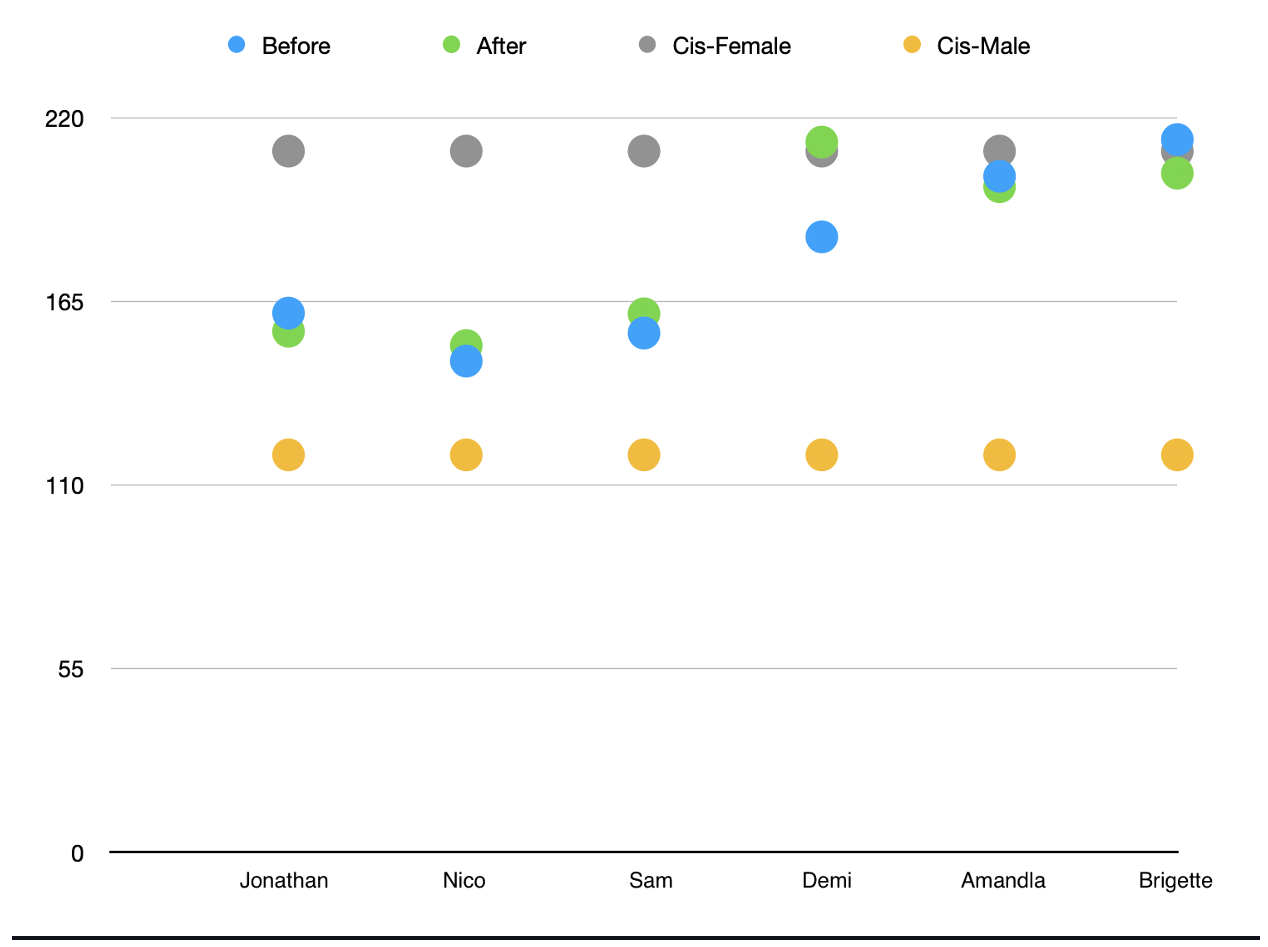
, , ,
Scroll to Top