gender

Texting in Romantic Relationships: “I lvoe u” and Other Typographical Errors

Danbi Jang, Tomoe Murata, Mayu Yamamoto, Gale Nickels

This research study investigates how young men and women in relationships react toward typos and seeks to identify any differences. Based on previous research findings, we hypothesized that women are more likely to retype typos compared to men since men have been shown to communicate primarily for practicality, while women have been shown to put more social importance on texting. An alternative hypothesis we investigated was that as the intimacy levels and mutual understanding increase within the relationship, both partners prefer to leave typos uncorrected. To test these hypotheses, participants were asked to fill out a survey, asking about the length of the texting and relationship periods, how close they think they are with their partner, and what they prefer to do when they make typos. They were also asked to share screenshots of typos where they misspelled a word. The results indicated that women had a higher rate of correcting typos than men, which supported our hypothesis; however, the difference was not substantial enough to make a conclusion. We did find, however, that intimacy levels had a much stronger correlation with typo correction likelihood. Thus, the main finding of our study is that intimacy is the best factor in predicting whether the person corrects or leaves typos in relationship-based text messaging, not gender.

[expander_maker id=”1″ more=”Read more” less=”Read less”]

Introduction

There is no doubt that texting is the dominant form of written communication of our age. Depending on who you ask, by comparison, emailing and letter-writing seem formal at best, and antiquated at worst. Young adults between 18 and 24 are estimated to send about 110 texts per day (Smith, 2019), which is reflected in endless pop culture references to mobile phones and SMS. For instance, Lana Del Rey in “Take Me to Paris” sings, “Text me when you get home safely,” summarizing one of many social rituals that have arisen from text communication. Texting is a key daily ritual in most communities all over the world.

However, unlike face-to-face communication, texting achieves something unique: documentation. The recipient of a text can take a screenshot and collect ‘receipts’ at any moment, so it is more important than ever that the social face a text communicates is exactly as intended. Another example of this in the music industry is presented by Drake in “H.Y.F.R:” “…That’s when I text (sic.) her and told her I love her, then right after texted and told her I’m faded,” demonstrating how accountability in texting can be circumvented by claiming lack of sobriety and other means. So, texting conveys many layers of nuance and social significance that might not be apparent at first glance. However, texts are shot back and forth so quickly that a problem often arises: typos. They can usually be quickly remedied by retyping the offending word with an asterisk appended, but even the act of correcting a typo holds implications. For instance, leaving a typo can be perceived as comedic or aloof, while retyping it might convey earnestness or carefulness. This led us to question if certain people are more likely to correct or leave typos depending on their individual traits. Specifically, we targeted the groups that are thought to text each other most frequently: couples.

When discussing romantic dynamics, gender is often a key focus of previous research. In the past, it has been shown that in text messages, females tend to emphasize visibility while males emphasize utility (Ilie et al., 2002). This indicated that women are inclined to organize their messages in such a way that their meaning and intentions are best conveyed. Another research study found that women have been seen to use texts as a means of promoting and maintaining social relationships at a higher level than men (Aning & Yaa, 2022). If it is true that women tend to place more emotional and social importance on texting than men, this may be a reason for them to take errors more seriously and cause them to retype. Thus, we hypothesized that women are more likely to retype or correct mistakes than men when they make a typographical error in a text message.

However, we found it important to explore possibilities outside of gendered explanations as well. Our alternative hypothesis is that as the level of intimacy within a relationship increases over time, both partners correct less frequently. We predict this may be the case as over time, couples might have a better understanding of each other’s texting style, leading to a higher threshold for typos needing clarification. Also, as the relationship progresses, couples have had time to adjust and feel more comfortable within the relationship. Thus, we approached addressing these two hypotheses with a specific question in mind: Is gender a good predictor of typo correction in texts between couples?

Methods

To investigate those hypotheses, we targeted a population consisting of men and women in their early 20s who are in a romantic relationship. Another criterion was that they text their partners in Standard American English every day; however, it was not a requirement that English be their first language. We specified the age as 20s and the language as Standard American English to narrow our population to Generation Z and Millenials, as these are the groups that have had the most exposure to digital communication in their lifetimes. Additionally, this research study chose to target heterosexual, gender-conforming couples. This limitation might have been a source of selection bias; thus, we recognize that the patterns we find within these pairings may not translate when extrapolated to couples outside of this binary. Exploring outside of this subpopulation with regard to romantic texting trends may be an interesting candidate for future research.

We recruited the participants by posting the survey on the UCLA Linguistics Discord server, Instagram stories, and Slack chats with students at UCLA. The way of gathering responses on listed social media is considered to be the most effective since our targeted population is the young generation. For the data collection, we utilized a multi-faceted strategy similar to that which is employed by Wagner et al. (2022). The total data set we collected included 22 responses: 10 from males and 12 from females. First, participants were given a survey that collected information about the length and nature of the relationship, as well as open-ended questions about their reactions to their typos. Next, they were asked to submit one or more screenshots where they made a non-grammatical spelling mistake, corrected or otherwise, as shown in Fig 1. We defined a typo in this research as an unintentional misspelled word, not a grammatical typo. Intentional errors for the sake of showing cuteness or aloofness towards their partner were also excluded. It is possible that the nature of the messages could have affected the content of our data. That is, participants might have excluded typos that were particularly embarrassing, which might lead to biased data; however, for the purposes of this study, we considered this to be potentially beneficial for targeting the social aspect of typo correction instead of the practicality aspect.

Particularly embarrassing typos may include big spelling mistakes that are incomprehensible and thus must be corrected for the message to be understood. If these sorts of typos are less likely to occur, we speculated that the collected data might be of better quality. Thus, the omission of embarrassing responses was not mitigated in the data collection process.
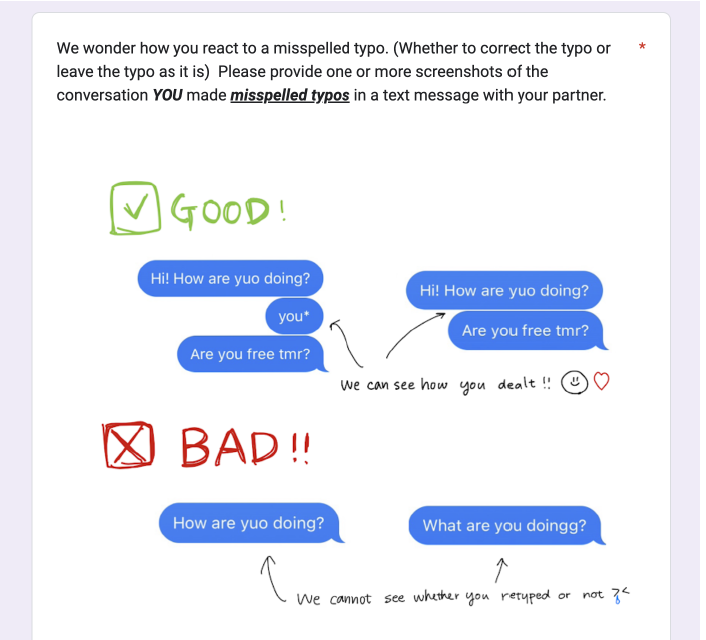
Figure 1: Submission Screen for the Screen Shots of Typos

Results & Analysis

From our 22 participants, we collected a total of 25 screenshots: 14 from women and 11 from men. Two excerpts of these screenshots from our data are shown in Figures 2.1 and 2.2.


Figure 2.1: No error correction
Figure 2.2: Error correction


In addition, since all respondents indicated they are texting in standard English, all responses are included in the analysis. The participant responses to each question varied widely, suggesting a diverse range of intimacy and familiarity levels within our participant pool. Participants ranged from 11 to 96 months of knowing their partner, 6 to 96 months of dating, and 3 to 96 months of texting.

First, to test our first hypothesis that women are more likely to retype or correct errors than men, we began by analyzing the responses of each gender.
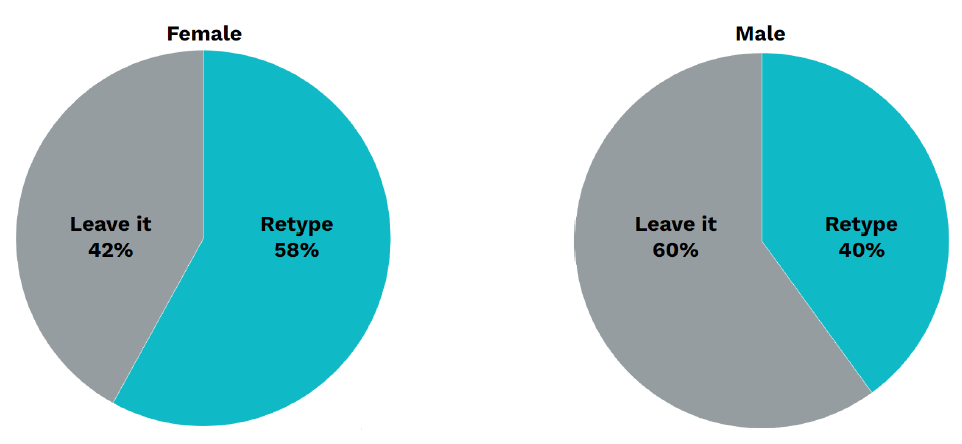
Figure 3: Rounded down after the decimal

Figure 3 above shows the percentages of responses to the question about whether or not to correct the typos in the survey for males and females, respectively. As the figure shows, 58% of women correct typographical errors, while 40% of men do so, suggesting that women are more likely to correct typographical errors and seemingly supporting our hypothesis. However, given that the difference between the gender is only 18% and that more than 40% of women leave misspelled words as is, it may not be sufficient to conclude that it is a strong predictor. Thus, we decided to test whether intimacy level is a good predictor, as predicted by our second hypothesis.

To test whether the more intimate one feels, the less likely one is to correct a typo in a message; we obtained correlation coefficients. Because the period of knowing each other, dating, or texting may be more strongly correlated with typo correction than the intimacy with the partner, they were also included as variables in addition to intimacy. The correlation coefficient between gender and typo correction is also calculated. For the analysis of the correlation values, a positive value signifies that an increase in one variable increases the other variable, and if the value is negative, an increase in one variable decreases the other variable. Furthermore, the closer a value is to positive or negative 1, the stronger the correlation is.
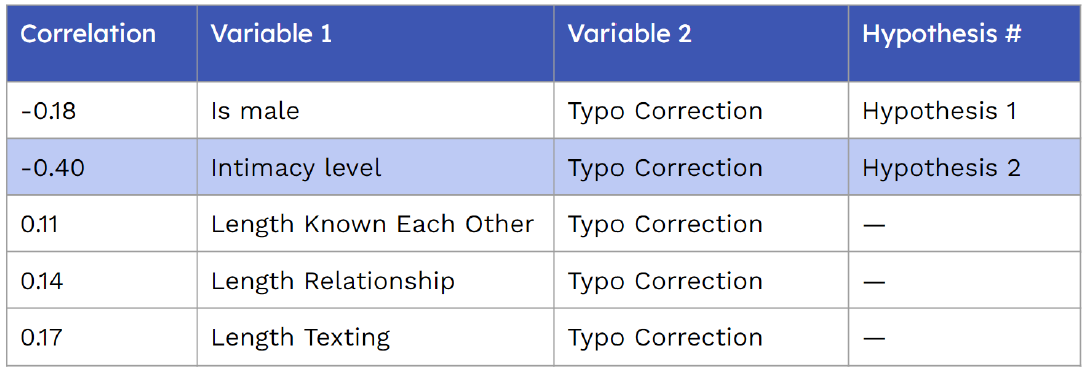
Figure 4: Correlation coefficients of each variable to typographical correction

Figure 4 summarizes the correlation coefficients of each variable to typographical correction. First, a moderate negative correlation with a coefficient of -0.4 was identified between self-reported intimacy levels and the likelihood of correcting typographical errors. In other words, as intimacy increases, the likelihood of correcting typos decreases or vice versa, which supports our second hypothesis. Now, our remaining question, whether gender is a valid predictor of the likelihood of correcting typos, turned out to be largely uncorrelated since the coefficient is -0.18, although these two are indeed negatively correlated and better predictors than the length of the relationship, period of texting, and how long it’s been since they met each other.

Discussion and conclusions

After finding the correlation coefficients for our variables, we saw that gender was not actually a very good predictor of the likelihood of correcting typos. While it was a stronger predictor than the length of the relationship and how long it has been since they met each other, it is still very weak.

So, we concluded that our second hypothesis, that intimacy would be a better predictor of typo correction likelihood, was better supported. We found a moderate negative correlation between self-reported intimacy levels and the likelihood of correcting typos. That is, the more intimate a partner rated their relationship, the less likely they were to correct a typo. This finding makes sense in the context of prior research, which has shown that as romantic relationships develop, linguistic behaviors become more similar between couples. So, this could suggest that time allows for an increased understanding of language between partners and conversations that reflect a common outlook (Brinberg & Ram, 2021). The relationship between self-reported intimacy and the correction observed in our study suggests that the need for clarification over typos may have decreased as a result of an increased understanding of each other’s language.

Furthermore, these findings show us that the subtleties and subconscious behaviors we exhibit around our romantic partners are not static. The way we text in a relationship likely has much more to do with the person we are texting and how comfortable we are than any one personality trait. Also, thinking back to the findings of previous studies, our results suggest that the “rules of texting” that Wagner et al. proposed (2022) might not apply accurately to longer-term couples, as our findings imply that the implicit social behaviors that Wagner et al.’s rules define might change as intimacy levels grow.


References

Aning, E., & Bediako, Y. A. (2022). Gender differences in Short Message Service texts among Sandwich students: a Sociolinguistic Analysis. IOSR Journal Of Humanities And Social Science, 27(1), 48–56.

Brinberg, M., & Ram, N. (2021). Do new romantic couples use more similar language over time? Evidence from intensive longitudinal text messages. Journal of Communication, 71(3), 454–477. https://doi.org/10.1093/joc/jqab012

Ilie, V., Van Slyke, C., Green, G., & Lou, H. (2005). Gender differences in perceptions and use of communication technologies. Information Resources Management Journal, 18(3), 13–31. https://doi.org/10.4018/irmj.2005070102

Smith, A. (2019). How americans use text messaging. Pew Research Center: Internet, Science & Tech. https://www.pewresearch.org/internet/2011/09/19 /how-americans-use-text-messaging/

Wagner, T., Punyanunt-Carter, N., & McCarthy, E. (2022). Rules, reciprocity, and emojis: An exploratory study on flirtatious texting with romantic partners. Southern Communication Journal, 1–15. https://doi.org/10.1080/1041794x.2022.2108889

[/expander_maker]
Is the Gender-Neutral Spanish Movement Gaining Steam? We surveyed 122 individuals to find out what they think.

Jakob Franco, Juan Salcedo, Krystal Quinto, T. Singh

Our research group entered this project seeking to gain clarity on the continued reception of a controversial topic within modern Spanish, the use of gender-neutral suffixes for some traditionally gendered nouns and pronouns. Perhaps most famously within the United States, the term “Latinx” has become a cultural lightning rod in relation to ongoing debates about the progression of social activism (Higa & Dunham, 2022). However, the Spanish language community is far from a monolith, with grassroots movements in multiple Latin-American countries seeking to make the grammatical change as well (Lankes, 2022). We began our research then seeking to assess the rates of use for these terms, particularly in informal settings, as well as to directly gauge opinions on the subject through a variety of survey methods. Ultimately, we also wanted to assess trends within the backgrounds of those who did or did not use these terms to see if these rates correlated with sociodemographic data or opinions on other social issues. Our data provided a nuanced picture that both confirmed many of our predictions about the backgrounds of our research participants, especially in regard to age and political affiliation, but confounded others. The data bore out a fairly strong consensus against adopting the gender-neutral suffixes.

[expander_maker id=”1″ more=”Read more” less=”Read less”]

Introduction & Background

In recent years, the topic of gender neutrality within the Spanish Language has been a major point of contention as well as the terms used to describe Latin American communities. Spanish is a gendered language currently with a masculine default, but some individuals have proposed alternatives such as replacing the masculine suffix -o for neutral terms with an -x or -e. Proponents of such a change argue it would help promote inclusivity and challenge embedded patriarchal norms while opponents suggest it is unnecessary or even harmful to the preservation of Spanish as a whole. This topic has been the focus of much controversy to the point where gender-neutral Spanish was entirely banned by the government of Argentina (Lankes, 2022). This podcast from Vocal Fries elaborates on the history of gender neutral Spanish in Argentina and its recent controversy: (Gillon & Figueroa, 2018). The goal of this study was to investigate individual attitudes towards gender-neutral Spanish as well as gather input on the actual use of gender-neutral Spanish. This was achieved through a survey of 122 individuals of varying backgrounds and an analysis of Spanish meme accounts in social media. We hypothesized that older individuals and individuals on the right of the political spectrum would be more likely to have negative attitudes towards gender-neutral Spanish and its use. In the following section, we will take a deep dive into the two methodologies that served as the backbone of this research project.

Methodology

Survey

We created a survey using Google Forms, consisting of four separate sections. The first section consisted of collecting background information on the respondents such as their age, education level, gender identity, political ideology, social media usage, etc. The second section inquired about their language background and familiarity with Spanish and gender-neutral Spanish. The third section used the likert scale to assess different opinions on gender-neutral Spanish. In this section, respondents were provided with five different statements and were then asked to state whether they agreed or disagreed with the statement on a 1-5 scale. Finally, the respondents were provided with a text-entry box with no limit and were encouraged to share their thoughts on gender-neutral Spanish. This was done in order to collect more detailed opinions on this nuanced matter in order to ensure that opinions outside the scope of the survey questions would be accounted for. The survey we created and utilized for this study can be found in Appendix A of this paper.

This survey was distributed across two different social media platforms: Instagram and Reddit. The majority of the respondents came from Reddit where this survey managed to gain some traction. Additionally, less than 5% of the respondents were friends and family members whom the survey was distributed to as well. In total, we collected 122 responses to our survey.

Memes

We set about finding memes relevant to our survey respondents as well as within the online Spanish community as a whole. As such, we looked for Spanish language meme accounts on these platforms which had at least 10,000 followers, were active within the last month, and were Latin American based. This last parameter helped limit the scope of Spanish varieties we encountered and reflected the background of our survey respondents more closely. We ultimately found 20 accounts across the aforementioned platforms which met our criteria. Then for each of these accounts, we analyzed the first 20 posts of theirs that contained nouns or pronouns which referred to individuals of an unspecified gender. These are the types of words which would be traditionally gendered as masculine that proponents of “Lenguaje Inclusivo” (or Inclusive Language in English) argue should be altered to include a gender-neutral suffix. We then took note of the appearance of gendered or neutral suffixes in these select posts for each account. We classified loan words that fit the same use case within a separate category as well. Qualitatively, we also took notes on the general content of the accounts to help with later comparisons in relation to their rates of gender-neutral suffix usage.

Results & Analysis

Survey

The overall response to the survey was overwhelmingly negative with respondents being quite upset that this survey was even being conducted in the first place. This resulted in our respondents being very vocal in stating their opinions and many even left very detailed thoughts on the matter in the text-entry section. The data we collected was analyzed in two different ways: firstly, Google Forms provides statistics for each question; it generates graphs and charts for each question and provides a percentage breakdown for the responses to each question. Secondly, we downloaded and exported all of the responses into an excel spreadsheet, which we then filtered for various different factors in order to find correlations in the data. In the following few sections, the results will be broken down and discussed section by section:

Section 1: Background Information

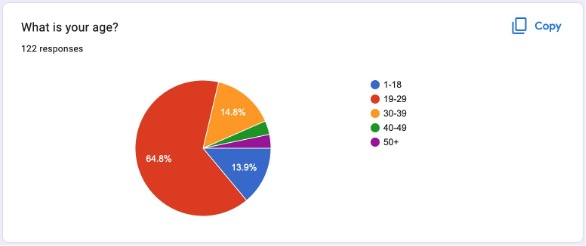
64.8 % of our respondents were aged 19-29. This was followed by 30-39 year-olds who comprised 14.8% of respondents. Following closely behind this age group, were 1-18 year-olds who made up 13.9% of respondents. 40 and up respondents were in the minority. 57.4% of our respondents were male, while 33.6% were female. The rest were comprised of non-binary individuals and those that preferred not to answer. The education levels were varied, but the majority of respondents had a higher education background of some sort. When it came to political ideology, almost 50% of respondents identified as either left or far left, while 26.4% self-identified as centrists/moderates. We had initially predicted that right-leaning individuals would be more likely to oppose gender-neutral Spanish, while left-leaning individuals would be more in favor of it. This turned out to not be the case at all; our data analysis revealed that out of 68 left-leaning respondents, 40 respondents had a strongly negative or negative opinion towards gender-neutral Spanish – a staggering 58.8%. In comparison, exactly 50% of individuals who self-identified as right-leaning had a strongly negative or negative opinion towards gender-neutral Spanish. In other words, left-leaning individuals were actually 8.8% more likely to be in opposition to gender-neutral Spanish, completely in contrast to what we had originally hypothesized. This will be discussed further in later sections.

Figure 1: Age breakdown of survey respondents

Section 2: Language Background & Familiarity with Gender-Neutral Spanish & Terminology

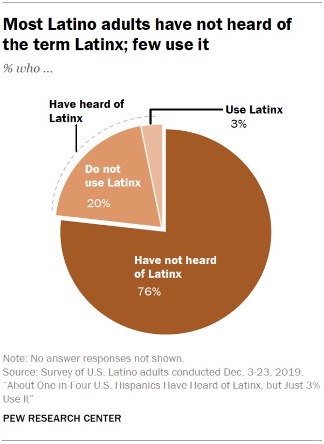
A total of 91.8% of our respondents were Spanish speakers with more than 75% identifying as intermediate and up in fluency. 25.4% of these speakers self-identified as being native Spanish speakers. However, given that only 27.9% of the respondents said that Spanish was their first language growing up, approximately 6 of these respondents were most likely heritage speakers. When it came to having heard of gender-neutral Spanish, 73% of respondents said they’d heard of the term and 82% said they’d heard of the term “Latinx”. 12.3% had heard of gender-neutral Spanish and 9% “Latinx”, but weren’t sure what these terms meant. Out of all of our respondents, only 23% said they’d used gender-neutral Spanish, while 77% claimed to never have used it. Those that did use it, primarily used it on social media. Finally, 50% of all respondents said they had a strongly negative opinion of gender-neutral Spanish, while only 9.8% said they had a strongly positive opinion.

Figure 2: Percentage of individuals who have heard term “Latinx”

Section 3: Statement Assessment

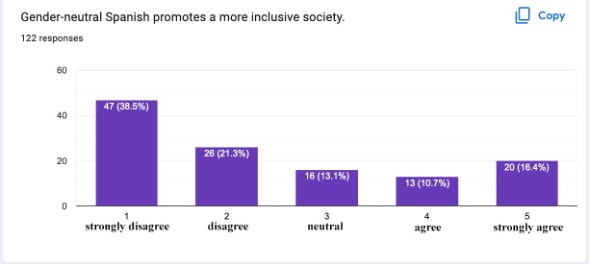
In this section, respondents were provided with 5 different statements relating to gender-neutral Spanish and its usage and were then asked to assess whether they strongly disagreed with the statement (a rating of 1), or strongly agreed with it (a rating of 5). A rating of 2 was “disagree”, 3 was “neutral”, and 4 was “agree”. 73.8% of respondents expressed that they did not believe that regular gendered Spanish promotes harmful stereotypes that favor one gender over the other. 54.1% of respondents actually felt that gender-neutral Spanish is degrading to the original language and culture. 69.7% disagreed with the sentiment that it’s easy to make the switch to using gender-neutral Spanish. 69.6% of respondents expressed that they would not prefer to speak a gender-neutral version of Spanish over gendered Spanish.

Figure 3: Survey respondent opinion breakdown on whether gender-neutral Spanish promotes a more inclusive society

The sentiments expressed in the fourth section of the survey will be discussed in the discussion section.

Memes

Our data for the meme pages largely lined up with that of our survey responses discussed above but with some key divergence. Only three out of the 20 accounts we looked at, or 15%, ever used gender neutral suffixes in their posts. Of these three accounts, two used exclusively gender neutral suffixes and the last one used the gender neutral terms twice as often as gendered forms. This suggests individuals will generally commit to using the neutral form almost exclusively if they use it at all with the large majority of individuals never doing so.

Interestingly, the two accounts which used gender neutral loanwords from English never used a neutral suffixed Spanish.

While we could not collect substantial demographic information about the administrators of the social media accounts themselves due to their predominantly anonymous nature. However, we could look at the content of their posts to see if certain subject matter correlated with a greater likelihood to use gender neutral suffixes. We found that two of the accounts which used gender neutral suffixes engaged in political discussions supporting left politics within their meme posts such as @pelaeldiente on Instagram. While our survey suggests that the political left holds even worse opinions of gender neutral suffixes than the right, the meme accounts suggest they are more likely to include it in their language.

Discussion

Today, the US recognizes people who are non-binary as an official gender option on a federal level. Inclusivity is a term that can be difficult to define, but Díaz et al. (2022) define an inclusive language as, “’Inclusive’ of many (disenfranchised) communities across the intersections of gender-orientation, race, ethnicity, ability, religion, age, social class, etc. For this reason, many scholars have committed to advocacy of gender nonconforming communities, particularly, trans and non-binary subjects, prefer the use of the term “non-binary” (lenguaje no binario) or “gender neutral” language…” (p. 4). However, Real Academia Española does not acknowledge more than two genders in the language. The adoption of gender neutral Spanish would need the support of a large swath of Spanish speakers at all levels of society to take hold and our data suggests this coalition remains a distant possibility at the moment. Additionally, ethical concerns regarding this topic remain as well with Salinas (2020) writing “Latinx might be unpronounceable for some people of Latin American descent” (p. 153). Perhaps there is a way to become more inclusive, but Salinas argues to take into consideration whether the people of that region can even pronounce Latinx, as it does not follow morphological or phonemic rules of the language.

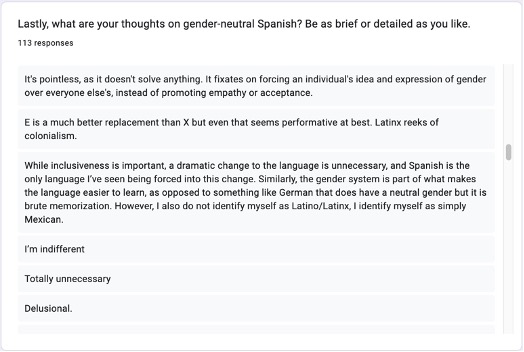
In the fourth section of the survey, respondents were given the opportunity to express their thoughts on gender-neutral Spanish and the pervading sentiment was that gender-neutral Spanish is “a push by white academics onto a culture who doesn’t want it,” and that it is nothing but another attempt at linguistic imperialism. One respondent said, “As a latino, I find latinx to be one of the worst things to come out of academia and is a barrier to having the broader latino community embrace progressive ideas.” Yet another respondent said, “‘Latinx’ is a colonialist, classist solution dreamt up by white people speaking on behalf of minorities.” Many respondents also questioned why there’s so much focus on incorporating gender-neutrality into Spanish when the same is not true for other gendered languages such as French. Proponents of gender-neutral Spanish expressed concerns over the suffix “x” and expressed a need for better alternatives that make more phonological sense for Spanish speakers.  You can watch this tik-tok to hear more opinions on this divisive subject.

Figure 4: Survey respondents’ long-form opinions on gender-neutral Spanish

Examining the responses of non-binary individuals to the survey reveals that even this community remains divided on the subject. Of the 6 non-binary respondents to the survey, they were evenly divided in holding positive or negative views of gender-neutral Spanish and most do not use it in their everyday lives. This spread of opinions does not provide a clear mandate in favor of gender-neutral Spanish but also shows a higher level of support than among the general population. Some scholars such as Bonnin and Coronel (2021) argue, “The use of gender-neutral forms, and even of languages with less gendered grammar, helps women to overcome stereotyped gender roles and develop as active agents in institutions” (p.1). However, this sentiment only holds true if the change itself is received well by the populations it attempts to support and not as a performative intrusion. Further research into the role gendered language plays in gender roles and stereotypes within society remains necessary, especially to assess how these opinions continue to shift over time.

Conclusion

Overall, the question of whether the Spanish language, and perhaps other gendered languages, may function, or merely be accepted, as a more gender-inclusive language remains inconclusive. As the data from our surveys demonstrates, attitudes towards changing the Spanish language to be gender-neutral remain resistant and largely skeptical of whether it is even necessary. Surprisingly, negative attitudes towards the topic arose regardless of demographic, contrary to our hypothesis that individuals with political ideologies that are more left-leaning would be more likely to gravitate towards gender-inclusive language which would seemingly aid in neutralizing harmful gender stereotypes. It seems that other concerns were voiced by survey participants that justified moving away from changing the language in its entirety, from concerns that terms like “Latinx” could be viewed as a form of linguistic imperialism and thoughts that for the language to change the culture must change first. Our research done in social media reflects similar perspectives with gender-neutral Spanish suffixes being utilized by only three of the social media accounts we studied. So although the world seems to be progressing towards being more gender-inclusive, feelings towards language change are passionate and as of now, at least in the Spanish language, the majority of speakers are not inclined to change the language, especially if they aren’t the ones deciding the changes.

References

Bonnin, J. E., & Coronel, A. A. (2021). Attitudes toward gender-neutral Spanish: Acceptability and adoptability. Frontiers in Sociology, 6. https://doi.org/10.3389/fsoc.2021.629616

Diaz, A. R., Mejía, G., & Villamizar, A. G. (2022). Gender neutral and non-binary language practices in the Spanish language classroom: Tensions between disciplinary and societal changes. L2 Journal, 14(3). https://doi.org/10.5070/l214356302

Ehrlich, S., & King, R. (1992). Gender-based language reform and the social construction of meaning. Discourse & Society, 3(2), 151–166. http://www.jstor.org/stable/42887784

Galvez, A. (2022). The Journey to a Consensus of Gender-Neutral Language in Spanish: Does -x

Really Mark the Spot? . Journal of the Student Personnel Association at Indiana University,

48–56. Retrieved from https://scholarworks.iu.edu/journals/index.php/jiuspa/article/view/34412

Gillon, K. & Figueroa, M. (1 October 2018) “TODOS/TODAS/TODES ADDENDUM” In Vocal Fries. https://vocalfriespod.com/2018/10/01/episode-30-todos-todas-todes-addendum/.

Gong, Y. (2016). Online discourse of masculinities in transnational football fandom: Chinese Arsenal fans’ talk around ‘gaofushuai’ and ‘diaosi.’ Discourse & Society, 27(1), 20–37. https://www.jstor.org/stable/26376413

Higa, J., & Dunham, M. (n.d.). Can linguistic innovations bridge the gender divide?: Inclusive language in contemporary Spanish social media. UVM ScholarWorks. Retrieved October 28, 2022, from https://scholarworks.uvm.edu/src/2019/program/153/

Tavits, M. & Pérez, E. O. (2019). Language influences mass opinion toward gender and LGBT equality. Proceedings of the National Academy of Sciences 116(34): 16781-16786. Salinas, C. (2020). The complexity of the “X” in latinx: How latinx/A/O students relate to, identify with, and understand the term latinx. Journal of Hispanic Higher Education, 19 (2),

149–168. From https://doi.org/10.1080/15348431.2017.1390464

Lankes, A. (2022, July 20). In Argentina, one of the world’s first bans on gender-neutral language. The New York Times. Retrieved December 9, 2022, from

https://www.nytimes.com/2022/07/20/world/americas/argentina-gender-neutral-spanish.html

[/expander_maker]
How Social Commentary Became a Place for Gendered Norm Subversion

Sylvia Hopkins

Content/Trigger Warning: This article discusses sexual assault

Social commentary has become much more common and impactful to everyday people and their lives. In current times, social commentary is mostly used in social justice spaces with the intent of raising awareness, educating people, or calling out people and institutions for problematic behavior. In the past, only academics and media broadcasters were able to social commentate on a large scale. Traditionally, social commentary was largely limited to class-privileged and college-educated people who were overwhelmingly white and male. The rise of the internet and social media has allowed people who would not have previously had the resources to share their ideas to now be able to broadcast their ideas to thousands, if not millions of people. Because of this new-found accessibility, there has been a huge increase in marginalized people creating and engaging in social commentary. The recent increases in accessibility are not only good for diversity, but also for subverting gender norms.

[expander_maker id=”1″ more=”Read more” less=”Read less”]

Introduction and Background

According to common gender norms, girls and women are expected to soften their language and avoid being direct, and to not employ harsh rhetoric. In contrast, boys and men are allowed and expected to not not soften their language, to be direct, and use harsh rhetoric. But these trends are not being seen in social commentary; female social commentators are routinely using harsh rhetoric and being direct with their wordage and their messaging, all while male social commentators are doing the opposite, they are regularly using soft and indirect rhetoric.

Social commentary is not something that has drawn the attention of many researchers, and the works that exist on it primarily deal with the potential political consequences and mass spread of misinformation. Gender and linguistics in social commentary spaces has not been properly researched, this project aims to fill in some of the gaps and provide understanding by analyzing videos from social commentators.

Methods

The design of this project was to transcribe four total YouTube videos from different social commentators, two female and two male, about the same topic and cross-analyze them. The common topic for this project was a sexual assault scene Bridgerton, a show that recently came out on Netflix, it was chosen because it was recent and stirred lots of pushback, criticism, and commentary. The sexual assault scene details Daphne sexually assaulting her husband, Simon, in an attempt to become pregnant. This scene was considered disturbing by a mass audience and all social commentators in this sample also found it disturbing. Cross analysis was based on the use of cursing, euphemisms, and dysphemisms.

The three linguistic features that were analyzed in this project are word choice (curse words), as well as euphemisms and dysphemisms. The use of curse words is relevant because cursing is considered in most spaces and contexts to be socially unpleasant and harsh. Cursing is something that men are not regularly punished for or discouraged from doing, while women are often told that cursing is not “lady-like”. Aditi Sharma explores the gendered double standards for cursing in her article Why Do Women Have Such Limited Swear Words To Ab(Use)? Euphemisms and dysphemisms are relevant because when someone uses an euphemism, they are trying to be less harsh and soften their words, while with dysphemisms, they are trying to make their words harsher for rhetorical effect.

Results

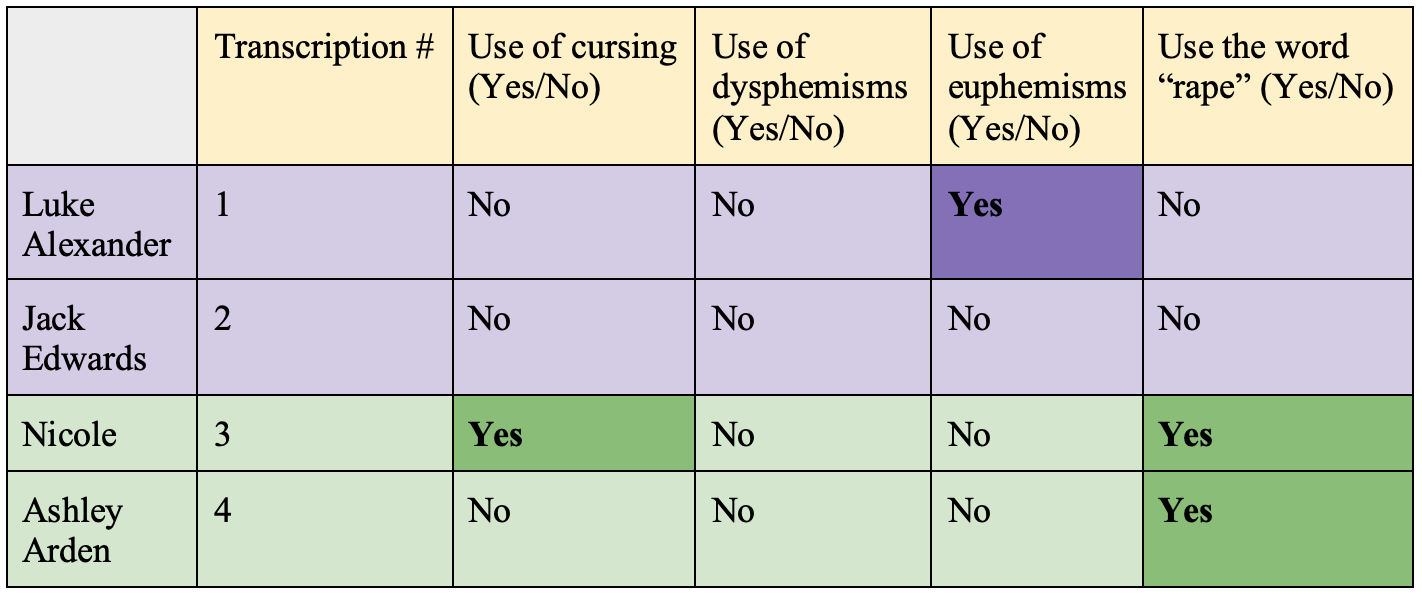
Transcriptions 1 and 2 both came from male commentators, Luke Alexander and Jack Edwards. Neither of them used cursing or dysphemisms, and one of them (Luke Alexander) used an euphemism. Neither of them used the word “rape”, Luke Alexander instead spelled out “R-A-P-E” to avoid saying “rape” or “sexual assault”. In contrast, neither of the female commentators used euphemisms and both of them used the word “rape” directly instead of using a euphemism or spelling it out like Alexander.

Thumbnail image from Luke Alexander’s (Example 1) YouTube Video

Transcriptions 3 and 4 came from female commentators, Nicole a.k.a. “A Seventeenth Grade Nothing” and Ashley Arden. As stated before they did not use euphemisms and both referred to sexual assault directly by saying “rape”. Nicole is the only commentator in this sample that curses. Ashley Arden’s states that this scene is “ugliest scene I’ve ever watched in a teen show”. Both Nicole’s and Ashley Arden’s commentaries are blunt and direct, neither of them use any linguistic feature to soften their tone, wordage, or message. This is the opposite for Luke Alexander and Jack Edwards, neither of them use the word “rape” and neither of them use dysphemisms.

Discussion

Each of the commentators are norm-breakers. Luke Alexander, Nicole, and Jack Edwards in relation to cursing. Nicole for her cursing, Alexander and Edwards for their complete lack of cursing. In Example 3, Nicole curses, this makes her a norm-breaker because it is considered socially unacceptable in many contexts for women to curse. Contrasting Nicole, neither of the male commentators use cursing, which makes them also norm-breakers in most non-formal settings, it is considered appropriate, and often expected for men to curse. Luke Alexander, Nicole, and Ashley Arden are norm-breakers with respect to euphemisms.  Luke Alexander uses a euphemism when he refers to semen as “children juice” and spelling out rape instead of saying it directly. This goes against gendered norms because men are expected to use direct language when communicating, therefore to not use euphemisms. Neither Nicole nor Ashley Arden use euphemisms, which makes them both norm-breakers for not using euphemisms to soften their language, which is something women are expected to do. When women use direct language they can be labeled as “aggressive” or “masculine”.

Conclusion

The purpose of this research was to see if social commentary has created a space for people to subvert gendered linguistic norms and if so, what does it mean for society as a whole. The answer put simply is yes, people of different genders are shown to subvert gender norms, this was shown through looking at the use of cursing, euphemisms, and dysphemisms. This has significant meaning for society, because while gender norms, not just ones dealing with language, are being moved away from, they are still very present and often harm people.

The internet made the ability to social commentate so much more accessible than it had ever been, and this accessibility gave diversity, it gave voices that were not being listened to a way to be heard on a mass scale. Accessibility also gave women and men the ability to communicate to mass audiences in ways that violate gender norms, which is not only significant for the commentators themselves, but also the people that watch them. When people see people that mirror their identities subverting gender norms it gives a sort of permission to the viewer to do the same. This subversion of gender norms can allow people to express themselves more authentically without being punished or ridiculed. While having gender norms is not inherently evil, they are largely oppressive and tie into larger patterns of violence. When people violate gender norms, they can be subject to violence; there are countless examples of this, some of which are women being killed for being rude to men, men who engage in femininity are often the victims of hate-crimes, women being murdered in honor killings, and many more. Subverting gender norms with linguistics is subverting gender norms as a whole, and doing so makes society freer and safer.

References

Crespo-Fernández, E. (n.d.). Sex in Language: Euphemistic and Dysphemistic Metaphors in Internet forums. Bloomsbury Publishing. Retrieved February 6, 2021, from https://books.google.com/books?hl=en&lr=&id=iInaCQAAQBAJ&oi=fnd&pg=PP1&d=Dysphemism+gender&ots=JeoliQi9La&sig=lTkW2xCP0sZu2YZzWv498Q8IgNY#v=nepage&q=Dysphemism%20gender&f=false

Definitions for social commentary. (n.d.). Retrieved February 21, 2021, from https://www.definitions.net/definition/social+commentary

Info & Stats For Journalists. (2015). National Sexual Violence Resource Center

Kimmons, R., & Veletsianos, G. (2016). Education scholars’ evolving uses of twitter as a conference backchannel and social commentary platform [Abstract]. British Education Research Association, 47(3), 445-464.

Lapadat, J. C., & Lindsay, A. C. (1999). Transcription in Research and Practice: From Standardization of Technique to Interpretive Positionings. Sage Journal.

Orlando, E., & Saab, A. (2020). Slurs, Stereotypes and Insults. Springer Link, 599-621.

Popa-Wyatt, M. (2020). Reclamation: Taking Back Control of Words. Brill, 97(1), 159-176.

Rape culture & statistics. (2014, June 07). Retrieved March 8, 2021, from

Rape Culture & Statistics

Sharma, A. (n.d.). Why do women have such limited swear words to ab(use)? Retrieved March, 2021, from https://www.bingedaily.in/article/women-swear-words-sexist-patriarchy

Swanson, S. C., & Szymanski. (n.d.). From pain to power: An exploration of activism, the #Metoo movement, and healing from sexual assault trauma. Journal of Counseling  Psychology.

[/expander_maker]


“Like…my whole face is just crooked!”: Self-Deprecation in Actors and Actresses

Sapna Ramappa

Why and how do people use self-deprecation? Do people use it to “fish for compliments” or just seem more relatable? This article highlights the prevalence and utilization of self-deprecating language among actors and actresses in interviews on late-night talk shows. Interviews with four female celebrities and four male celebrities on The Ellen Degeneres Show and The Tonight Show Starring Jimmy Fallon were analyzed in order to discern any potential gender differences in the intentions and execution of self-deprecation that celebrities employ. Accounts of self-deprecation were sorted into categories of self-deprecation (physical appearance, professional/intellectual competence, personality traits, and behavior) and pitch alterations (higher or lower pitches). Ultimately, this study found that the use of self-deprecation is not as gendered as previously thought, which could illuminate how being a public figure in an industry that is quick to scrutinize one’s physical appearance and performance can influence the ways in which people perceive themselves and speak about themselves.

[expander_maker id=”1″ more=”Read more” less=”Read less”]

Introduction and Background:

Just as self-affirmation can inspire individuals to strive for healthy and positive behaviors, self-deprecating language can potentially also affect the ways that we perceive ourselves and others (Epton & Harris, 2008). Self-deprecating humor is a valuable tool employed by comedians to show humility and lightheartedness (Speer, 2019). But who tends to use this form of humor more often and for what purpose? 

In previous studies, female comedians have been found to use self-satire more often than their male peers (Russell, 2002). This humor serves as a non-threatening way to make the comedian more “acceptable” and “appropriate” by placing herself as the joke itself. However, self-deprecation is not just limited to making fun of one’s physical appearance. People use self-deprecating humor directed at their behaviors, personality traits, intellectual/professional abilities, social status, success, or physical appearance (Greengross & Miller, 2008). However, there are no existing studies that reveal gender differences in the categories of self-deprecation use. The findings of this project can provide more insight on how men and women are socialized to behave and view aspects of their own identity. 

Men and women may also differ in the ways that they use self-deprecating humor; male speakers have been found to use a higher pitched voice when using humor and female speakers have been found to use a lower pitched voice when compared to their normal voices (Purandare & Litman, 2006). This study, which analyzed the use of self-deprecation in male and female celebrities on late-night television interviews, suggests that there are no significant gender differences in how often celebrities use self-deprecation and the “professional/intellectual competencies” and “physical attractiveness” categories. However, there are gender differences in the “behaviors” and “personality traits” categories and the ways the celebrities use pitch changes.

Methods:

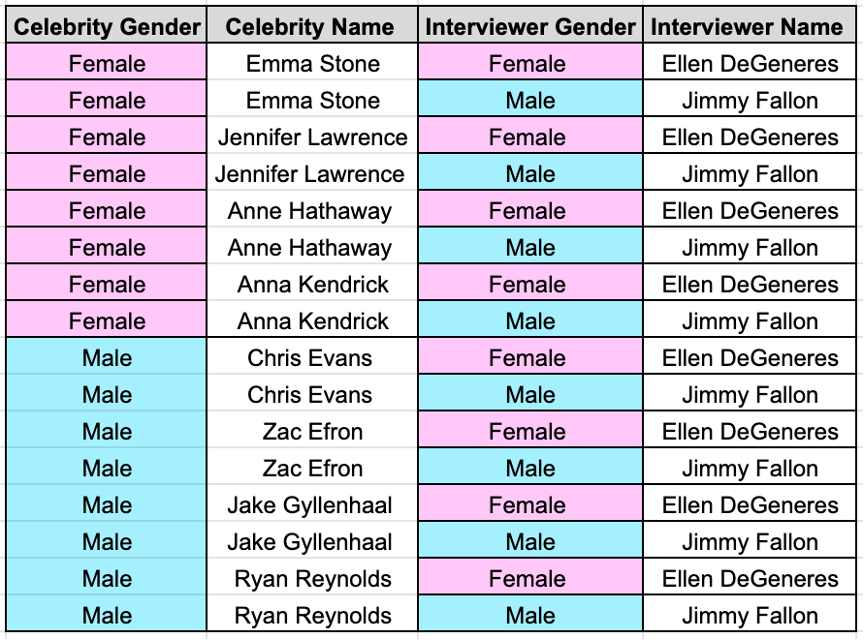
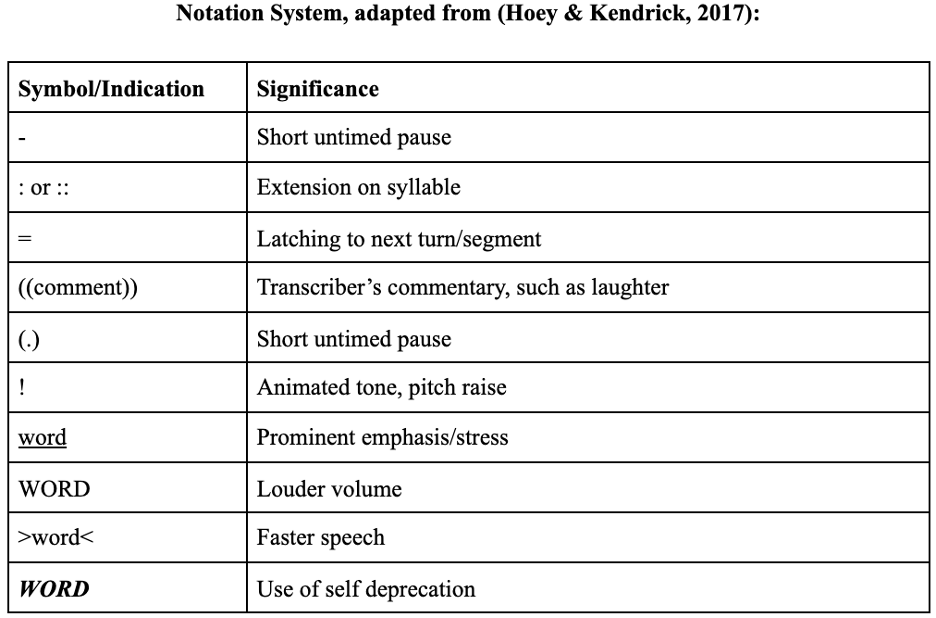
This study analyzed interviews with male and female celebrities on two late-night talk shows, The Ellen DeGeneres Show and The Tonight Show Starring Jimmy Fallon. The female actresses analyzed were Jennifer Lawrence, Emma Stone, Anne Hathaway, and Anna Kendrick, and the male actors analyzed were Chris Evans, Zac Efron, Jake Gyllenhaal, and Ryan Reynolds, for a total of 16 interviews. The study looked at celebrity gender, interviewer gender, the count of self-deprecating humor used, the category of self-deprecation, and the presence and/or type of pitch change used in self-deprecating humor. Self-deprecation accounts were identified and categorized if the celebrities used any negative statements towards themselves with regards to the four categories: “behaviors”, “personality traits”, “professional/intellectual competencies”, or “physical attractiveness”. Pitch changes were identified if the celebrities used a drastic and extremely noticeable higher or lower pitch while using self-deprecating language. Frequencies of self-deprecation were then calculated to compare self-deprecation in relation to celebrity interviewee gender, categories of self-deprecation, and pitch changes.

Table 1: The different combinations of variables looked at in 16 interviews.

Results and Analysis:

Frequencies/Counts of Self-Deprecating Humor: 

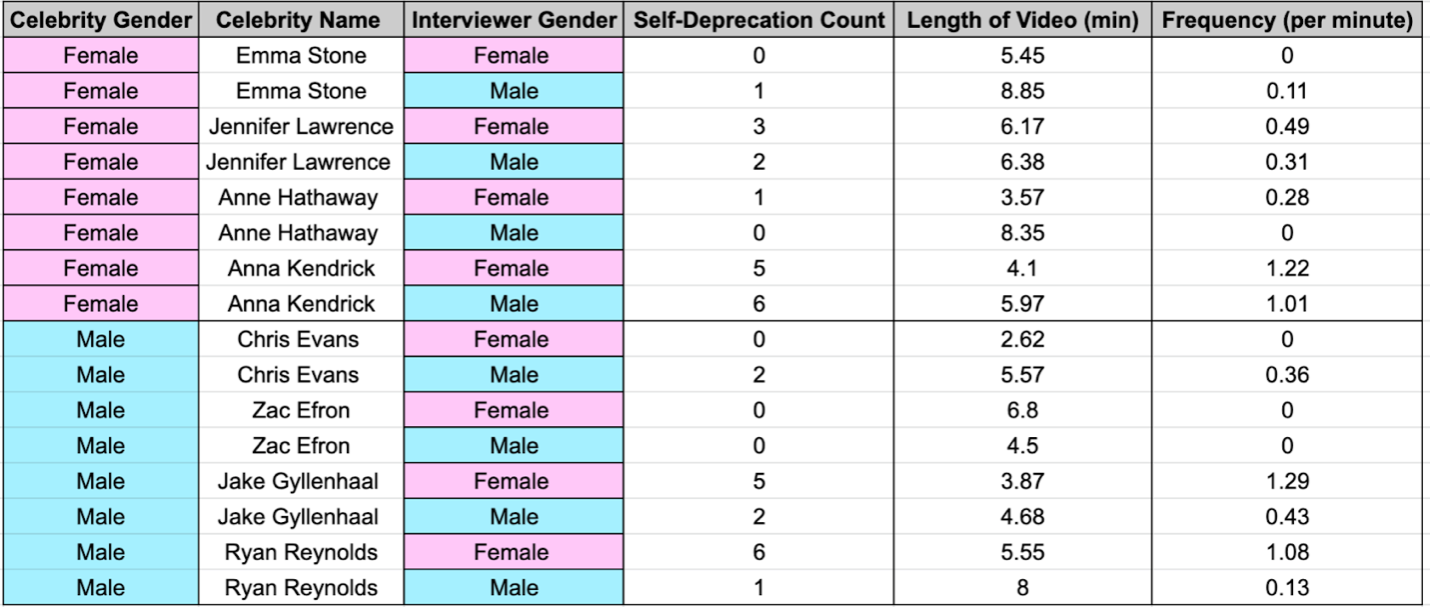
Table 2: The count of self-deprecation used in each interview, the length of each interview, and the calculated frequency in self-deprecation count per minute.
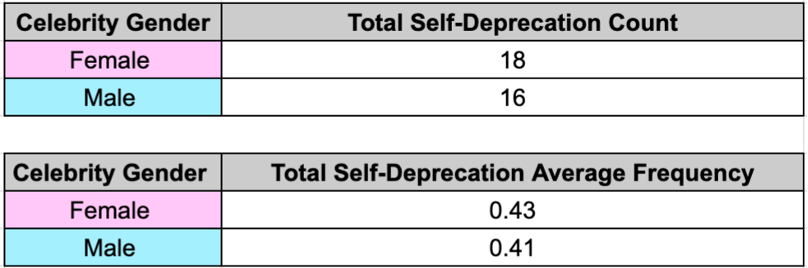
Table 3: The total count and average frequency of self-deprecation in male and female celebrities.

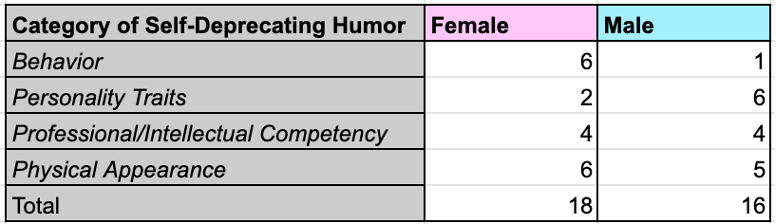
Throughout all interviews, female celebrities used 18 accounts of self-deprecation with an average frequency of 0.43/minute and male celebrities used 16 accounts with an average frequency of 0.41/minute. The frequency difference between female and male celebrities was 0.02, which indicates that there is no significant gender difference here. 

Categorizations of Self-Deprecating Humor: 

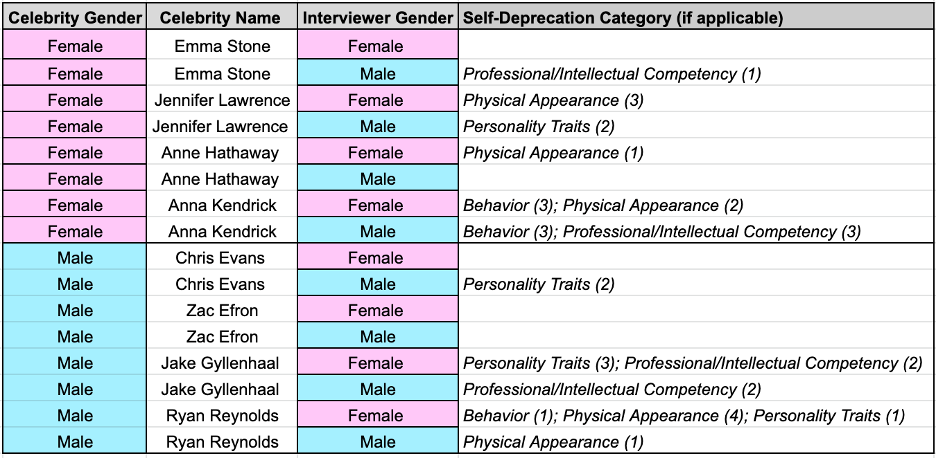
Table 4: The count and category of self-deprecation used in each interview.
Table 5: The breakdown of self-deprecation categories in all male and female celebrity interviews.

The evidence shows that there is no significant gender difference in the “professional/intellectual competence” and “physical appearance” categories, but there are gender differences in the “behavior” and “personality traits” categories. Women use more self-deprecation about their behaviors and men use more self-deprecation for their personality traits. 

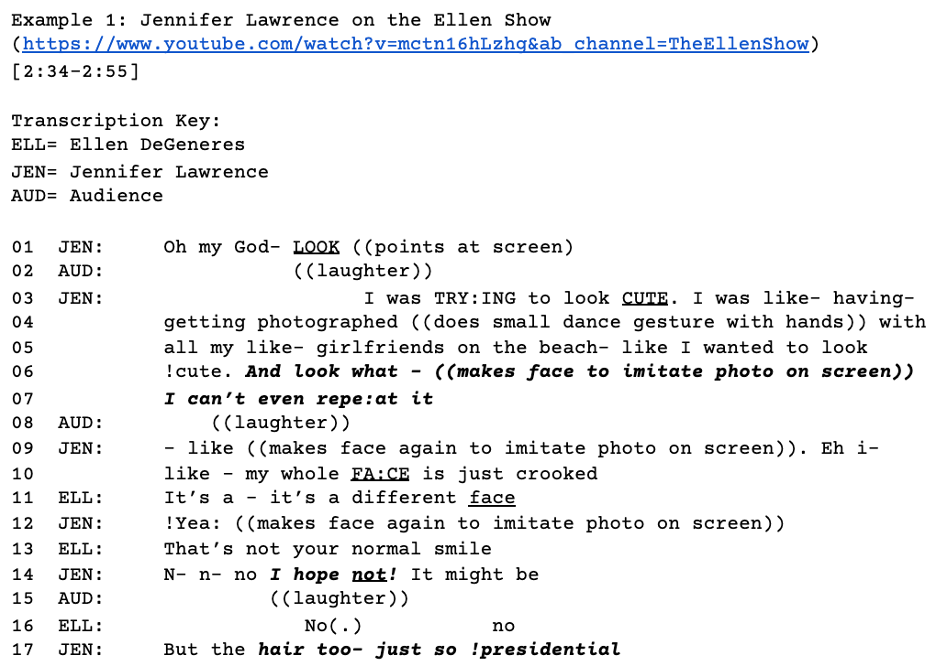
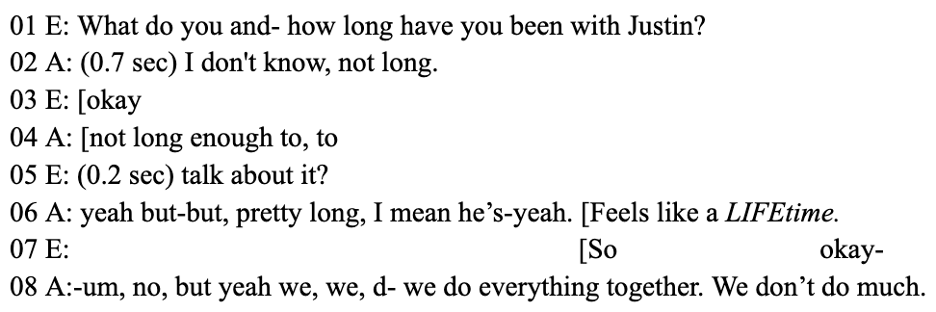
Example 1: Jennifer Lawrence with Ellen DeGeneres (Category: Physical Appearance)

This is a clear example of self-deprecation in the “physical appearance” category: Jennifer Lawrence makes fun of her appearance (specifically her face, her smile, and her hair) on a specific photo in Lines 6-7, Line 14, and Line 17.

Pitch Change Used for Self-Deprecating Humor: 

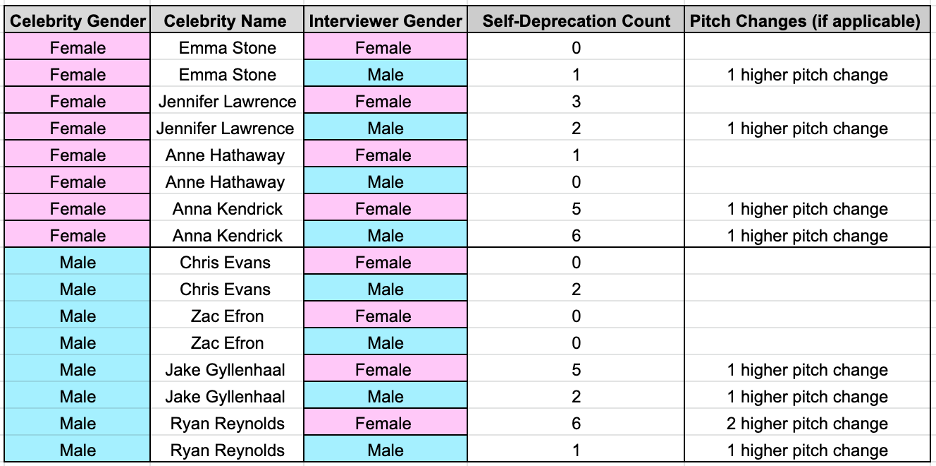
Table 6: The count and pitch change (either higher or lower) used in each interview.

Both female and male interviewees only utilized higher pitch changes when evoking self-deprecating humor.

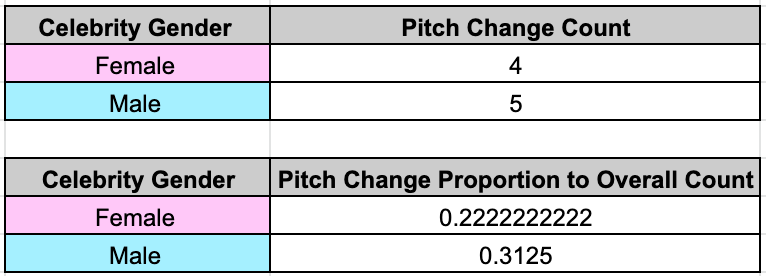
Table 7: The count of pitch changes and the proportion of pitch changes out of the overall self-deprecation count.

Though the pitch change count looks similar in female (4) and male interviewees (5), male celebrities used higher pitch changes in 31% of self-deprecation accounts whereas female celebrities only used higher pitch changes in 22% of the time.

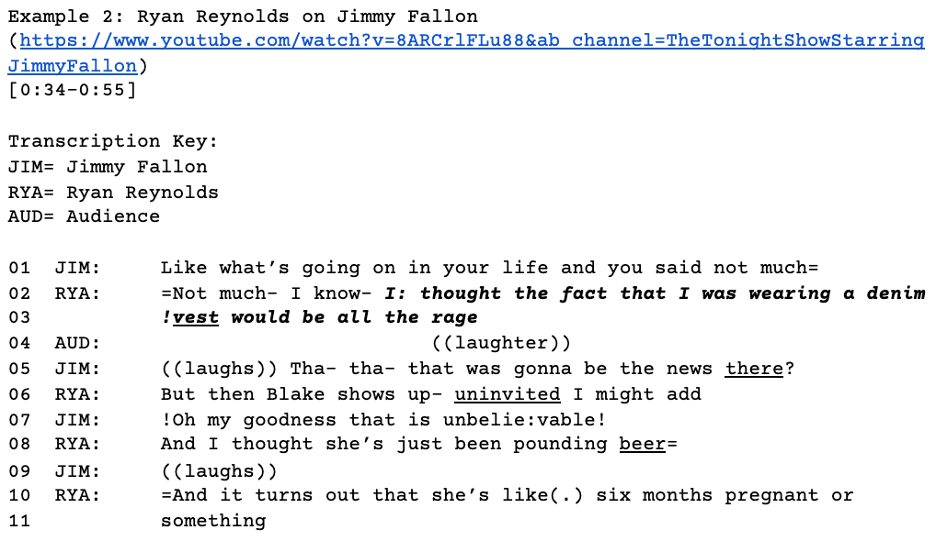
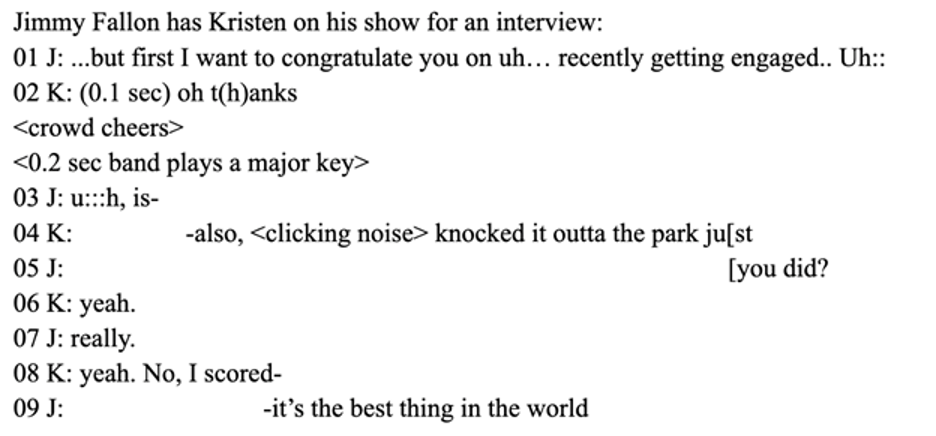
Example 2: Ryan Reynolds and Jimmy Fallon (higher pitch change, Line 2-3)

In this example, Ryan Reynolds uses an animated voice and higher pitch when saying the word “vest”, to make fun of what he was wearing.

Discussion and Conclusions:

The study did not find significant gender differences in the frequency of self-deprecation used in this sample of actors and actresses. Additionally, men and women both used similar amounts of self-deprecation when speaking about their professional/intellectual success and their physical appearance. There are several reasons why this may be. 

This study solely analyzed self-deprecation used by actors and actresses, so their career path (given the cut-throat nature of Hollywood) may create an environment where they place a lot of value in how they look and how they perform, thus impacting how they speak about themselves. Celebrities are placed to a near superhuman standard of beauty and their physical appearance is often on display for the public to openly criticize, so celebrities may be more inclined to point out their own flaws before the public does so. The use of self-deprecation in the “professional/intellectual” category may be more gender-neutral, considering that all celebrities want to achieve success. Additionally, because these interviews are used to humanize celebrities, self-deprecation may be used to help establish rapport between the guests, interviewers, and celebrities; this tool can help them come across as relatable, humble, and likeable. Though there were gender differences in the “personality traits” and “behavior” categories, it is unclear whether these categories are too similar to be separated or if there are actual gender differences in the use of “behavior” as a constructed aspect of identity and “personality traits” as an essential aspect of identity. Due to potential differences in the topics of the interviews themselves, it must be noted that certain interviewees may have had more opportunities to use self-deprecating humor, which could skew the results.

When assessing pitch changes, the study found that they were used quite sparingly among men and women (the proportion of pitch changes used in all accounts of self-deprecation was 22% in women and 31% in men). However, all of the pitch changes across genders were higher pitch changes, which contradicts earlier findings that showed that women switch to a lower pitch when using humor (Purandare & Litman, 2006). Because the subjects studied are professional actors and actresses, they may not be modulating their pitch as much in an interview setting when compared to their normal discussions or while acting.

Ultimately, the similarities between male and female celebrities in the frequency and in the “physical appearance” and “professional/intellectual competency” categories of self-deprecation indicate that male and female celebrities have similar aspects of their identities that they choose to self-criticize. These analyses can provide greater insight on what it means to be a public figure in an industry that places enormous importance on success and physical appearance.


References:

[/expander_maker]
 

, , , ,

The Gendered Life of Five-Year Olds: How Language Perpetuates Gender Conformity in Children

Brandon, Dianely, Giselle, Rukhsar, and Victoria

The objective of this study was to analyze the initiation of gendered language compliance during child development by focusing on the production of language in English-speaking five-year-old children. We hypothesized that boys are more likely to display linguistic features associated with men in their language in comparison to girls conforming to features related to their gender. We examined conversations between five-year-old boys and girls from the television series The Secret Life of Five Year Olds for our research. Considering that there wasn’t quantitative data involved in this study, our conversational analysis approach provides insightful language distinctions between the boys and girls: the boys had higher rates of interruptions/utterances and were more assertive in general. In contrast, the girls were less blunt and downplayed their criticism. Our hypothesis was supported to some degree; boys will play into gendered language, but so will girls. This study is significant because it allows parents and society to hold more self-awareness in the unconscious gender norms they are enforcing onto their children at a young age.

[expander_maker id=”1″ more=”Read more” less=”Read less”]

Introduction

It is widely accepted that social perceptions of gender usually influence language.

Many studies have been done on gender and language regarding children. Still, the direct correlational role that the embedded gender association in language has on gender identity development within children appears underexplored in literature. Our objective with this study was to analyze the initiation of gendered language compliance during child development by focusing on language production in English-speaking five-year-old children. Our research involved examining conversations between five-year-old boys and girls from the television series The Secret Life of Five Year Olds. We focused on linguistic components such as intensifier adverbs, imperatives, and gender-specific categories of adjectives, as these have provided insights in past research about gender norm reproductions and deviations. We emphasize these specific linguistic features because we felt as though they help address and mold the gender stereotypes and expectations for the children. We hypothesize that boys are more likely to display linguistic features associated with men in their language than girls conforming to their respective gender.

Background

Our proposal aims to understand the relationship that language has with children and their socialization of gender conformity. We chose English-speaking five-year-olds for our research as previous research has shown that by age five, the linguistic capabilities of children are adult-like. Children in the age range of six to ten have solidified their schemas about gender and social norms, so we felt as though studying the age just before this range may allow us to understand the progression and perhaps find intervention methods. According to Owen and Padron (2015), several linguistic features have been specific to each gender. In their study, Owen and Padron observed intensifier adverbs, imperatives, and adjectives in the language of toy advertisements and found substantial evidence on how gender is differentiated through language. These are the linguistic features we chose to examine in our research.

Methods

Figure 1 – The Secret Life of Five-Year Olds: Jack and Sienna (promo picture).

To search for the linguistic elements of intensifier adverbs, imperatives, gender-specific categories of adjectives, and turn-taking in the language of five-year-old children, we applied conversational analysis, as a theoretical framework, to a British documentary called The Secret Life of Five-Year Olds (see Figure 1). By selecting various clips that were available on YouTube of children’s playtime interactions and interviews, we analyzed natural conversations between the same and opposite gender.

Transcription software programs, such as Otter.ai, were used to transcribe some of the clips initially; however, each one was also manually transcribed using the Jefferson Transcription System to ensure accuracy and included as many linguistic details as possible can be derived. Figure 2 denotes the transcription notation we used for the purposes of our study. To analyze the data, we used a qualitative approach, namely that we situated the presence of the linguistic element we sought for in a social context to derive its meaning about gender conformity. The data and results outlined in the following section elaborate our findings and interpretations.

Figure 2.   Jefferson Transcription System

[word]        overlapping talk

><; <>        quickened or slowed down speech

↑↓            rise or drop in intonation

=             latching or continuation of speech with no pause

(.)           slight pause of no particular length

(1.4)         pause of a particular length

WORD          loud or shouted words

wo:rd         stretched sound

word          rise in volume or emphasis

((word))      comments or descriptions

Results & Analysis

To study intensifier usage, analysis was done on a clip of an experiment designed to provoke a strong reaction: lemonade spiked with salt. The documentary crew attempted to gauge the children’s empathy, but the intent to produce an intense response made it an ideal source of intensifying language.

According to Owen and Padron, “[adult] females used intensifiers […] more frequently than did males.” (2015, p. 70). However, this is not in line with the behavior of the children in the clip analyzed. The boys reacted very strongly to the salted lemonade, complaining, oddly enough, that it was too sweet: “it’s disgusting”; “it’s way too sweet”; “I’m gonna be sick tonight,”; etc. (Figure 3). Conversely, the girls used much less strident language when reacting negatively, and rather than using intensifiers, were prone to using downtoners and hedges: “a teeny bit too much lemon”; “even though I liked it”; “I loved it but”; etc. (Figure 4):

Figure 3. An excerpted transcript of the boys’ reactions to the salty lemonade

1 ELI Uhh- >no< that is disgusting

2 OBS What^ you don’t like it ?

3 ELI it’s too swe:et

4 HAR >it’s way too sweet and I’m gonna be sick tonight<

5 OLI I can’t have any more [that is disgusting]

6 ELI                       [I’m not having any] 

7     more that’s disgusting
Figure 4. A similar excerpt, of the girls' reactions to the salty lemonade

1 SIE it was a tee::ny bit too much lemon

2 ALI I lo::ved the lemon insi:de it ,

3 SIE I think it’s (.) incredible but >I don’t like the lemon

4     in it< I loved it- I loved it [oka^y] ,

5 ALI                               [I loved it]

6 TIA ((shouting)) I LOVED IT BUT I DIDN’T LIKE THE LEMON IN IT

A longitudinal study of word-type acquisition in children aged 3–10, conducted by the Child Language Data Exchange System (CHILDES) in 1987, provides some enlightening context. Among the 85 children analyzed for this aspect of the study, intensifier use was either equal or slightly skewed in favor of usage by males before the age of 5. Between the ages of 5 and 10, intensifier use gradually shifted to be slightly skewed in favor of female children, although again not by a significant margin (Schweinberger 2016, sl. 8). When considered in the context of Owen & Padron’s study, this indicates that the gendered division of intensifier use begins only at or after the age of the children in the analyzed video. Therefore, it would be reasonable to conclude that this pattern of gendered language use either a) requires more socialization and b) is less heavily socially emphasized than other gendered language divisions observed in children’s speech at this age.

It is also worth noting that, while the language usage in this clip contradicts the findings of other research papers, it does not contradict the test the filmmakers were running: namely, if there was a gendered difference in whether the children would attempt to cushion their analyses to spare the caretaker’s feelings. In this aspect, the children behaved as expected, with the girls softening their negative reactions where the boys did not. Adding on to the previous potential conclusion, it may be that the societal expectation that women have to ‘be nice’ either takes precedence over the socialization of intensifiers, or that the former occurs earlier in life than the latter.

Deborah Tannen states there are power imbalances in language (1990, pg. 81). She notes that there is a battle for dominance in language where men often interrupt and overlap. According to Tannen’s difference, speech model females have a different culture to male speech structure. This can explain how girls and boys follow different linguistic rules. Interruptions can be shown in two manners: the first to show the listener is excited about the content and the other as a means to purposefully take the role of speaker (Tannen, 1994. p.54). Turn-to-talk is a conversation procedure where the listener intuitively or is indicated to reply in the conversation; this can be done using lexical markers like question and answer. We compared how both genders use turn-taking and interruptions differently. The following data set can be found in season one, episode three of The Secret Life of Five Year Olds on YouTube.

Figure 5 - Season 1 ep 3 (Timestamp 18:12-18:31)

A:Alfie G:George CT:Caretaker


15 A:  That’s not a planet? it’s a, star

16 CT: >What do you guys↑ know about the sun<

17 G:  ITS MADE OF LAVA

18 A:  =No↑ the sun’s not made out of lava it’s made out of

       Gas you billy bummox

19 G:  =No its made of la::va:

20 A:  I looked at books and it said it’s made of gas you 

       big lummox

21 G: They- They’re wrong↑ it’s made [out of la:va]

22 A: [no gas]

In the following conversation between Alfie and George we see multiple pieces of overlap and some interruption. Alfie begins by using overlap which can be signaled by the “[ ]” symbol. Alfie corrects George but follows his statement with an insult. We can see that this begins a competition between the two. They fight back and forth, overlapping each other similarly as when two siblings fight. However, in this instance, we see that overlap is used as a mode to be the last speaker. In turn-taking, the last speaker at the end of an argument can be seen as a “winner.” Each boy competes to “win” the conversation thus proving and establishing their hierarchical rank at the top.

Figure 6- Season 1 ep 3 (Timestamp 17:41-17:53)

E:Ellie A:Alfie


6 E:  What’s↑ another, way that you can get the rolling disease

7 A:  Ehh

8 E:  Touching the grass↑

9 A:  Oh- Oh I-↑((know)) picking the grass

10 E: Okay↑ pick (.) pick (.) pick (.)

11 A: YAY↑

12 E: Cowa:bunga? (h) This is so much fun

Ellie uses many characteristics in this interaction with Alfie found in Figure 6. First, we see Ellie asking Alfie questions; she uses elision to elicit a response from Alfie as a means to keep him engaged in their conversation (Goffman, 1976, p. 265). When she does not hear a response from Alfie, she tries to give him an example. Alfie replies with what he thinks should be the answer, and Ellie immediately agrees. She goes as far as physically picking the grass to show Alfie her support for his answer. In the difference model approach, Tannen and Shari Kendal state that girls follow turn-taking rituals higher than males, who dominate the conversation and speak more often (1983, pg. 83). Throughout the entire episode, we see that Alfie is the main participant in their daily activities and often takes the main speaker role.

Discussion & Conclusion

This study builds upon previous studies revolving around children conforming to their gender and linguistic elements. Our conversational analysis confirms our hypothesis that boys are quite prominent in displaying linguistic features that are concerning masculinity enforced towards males. Girls are also conforming to the soft-spoken and less dominant persona that’s enforced within females. The footage from The Secret Life of 5 Year-Olds supports our hypothesis as it exemplifies how boys stick to the masculine persona that boys are labeled. From analyzing the transcripts, we’ve seen how boys were more likely to speak and interrupt in comparison to the girls. The lemonade video specifically showed how the boys used harsh intensifiers while the girls were less strident when criticizing the lemonade. The interaction between Alfie and George represents how males have the tendency to come up top in the conversation to assert their stance. Overall, there were no drastic surprises as the boys and girls acted according to their respective stereotypical gender.

Exploring the depths of these 5-year-olds’ linguistic mannerisms allows us as a society, especially parents, to become more cognizant of the unconscious bias norms that are enforced upon children in modern western culture. Gaining more insight into these matters provides parents better guidance to incorporate a gender-neutral standing when raising their children. With today’s progressiveness on gender neutrality, it’s essential to know how influential reinforcing gendered language can be on children’s use of the stereotypical linguistic elements as gendered language can play a big role in shaping our identity and assertiveness in society. Further research can help us understand the level of magnitude gendered language has on children. Perhaps even by studying the growth of the children’s speech as they grow into adults, we can see the effect gendered language can have on them as adults and in their working environments.


References

Goffman, E., 1976. Replies and Responses in Language in Society 5.3, 257-314

Owen, P. R., & Padron, M. (2015, June 1). The Language of Toys: Gendered Language in Toy Advertisements. Digital Collections at Texas State University. Retrieved April 29, 2022, from https://digital.library.txstate.edu/handle/10877/12878

Schweinberger, M. (2016, March 31 – April 2). On the acquisition of intensifier constructions. 17. Norddeutsches Linguistisches Kolloquium (17. NLK). Hamburg; Germany. Retrieved from https://www.academia.edu/77407086/On_the_acquisition_of_intensifier_constructions.

Tannen, D. (1990). You just don’t understand: Women and Men in Conversation. New York, NY: Morrow.

Tannen, D. (1994). Gender and Discourse. New York: Oxford University Press.

[/expander_maker]
Does Saying ‘Fuck’ During a Conversation Mean You’re Less Friendly, Less Smart, and Less Honest? Yup.

Brooke Lim

The fact of the matter is, we have all at some point said a casual ‘bitch’ or ‘fuck’ during a conversation with both new and old friends. But does that make the other person in the conversation look at us under a new light? Profanity is a crucial part of our society’s language expression, even having a grammatical structure of its own (Bergen, 2016). With only a handful of exceptions, across time and most cultures, use of language that has been seen as profane has been discouraged by a bulk of the living society. Whether it is being chastised for saying ‘shit’ at the dinner table by your mom or being given detention by your teacher for saying ‘motherfucker’ during class, many have experienced being overtly and even covertly reprimanded for their use of obscenities.

[expander_maker id=”1″ more=”Read more” less=”Read less”]

Introduction and Background

First impressions are shaped by a myriad of superficial ideals. Whether it is the way someone presents themself physically (Willis & Todorov, 2006), how they are described by others (Asch, 1952), or even the way one shakes another person’s hand. These opinions are established based on mostly shallow facts. Similar to physical appearance, language use can also determine what particular opinions are formed.

This research proposal mainly intended to gain insight into how word choice influences judgment when used during social situations by examining if it alters one’s impression formation. The main goal was to better understand the attitude people have about profane words by assessing the reactions the general public has to curse words.

A couple of studies have already been done on the relationship between profanity use and  speaker perception, the most notable, in my opinion, being ‘Language Choice Matters: When Profanity Affects How People Are Judged’ (DeFrank & Kahlbaugh, 2018.) To very briefly summarize, the study found that there is indeed a link between profanity use and poorer perceptions against the speaker. Additionally, it was also found that those use profanities were generally seen as nonconforming, less intelligent, and less friendly. However, it disregarded the speaker’s gender when examining the influence profane language has when used during conversations and the disparities that may come with it.

In addition to what DeFrank and Kahlbaugh have researched, I would also like to explore the relationship, or maybe the lack of a relationship between profanity use and speaker perception and how different gender identities might also shape judgment.

My first hypothesis was that overall impressions against the speaker using profane language will be the poorest amongst the other speakers. I also hypothesized that participants that are regularly exposed to profanities (whether they use them or hear them), are more likely to form impressions that are neutral to the speakers using obscenities. Lastly, I hypothesized that female participants will rate male speakers with more poor/negative ratings compared to female speakers. The main question I intended on answering with this study was, ‘Does using profane language change the way one is perceived by others?’ I also aimed to answer a subset of questions, ‘Does regular exposure to profane language skew one’s ability to form a negative opinion against users of profanities ?’ and ‘Is there a general consensus that male speakers using profane language will be rated poorer compared to their female counterparts?’

Methods

I used an online survey which was sent out through text and social media. Participants were asked to evaluate the vulgarity of 6 (Fuck, Bitch, Shit, Asshole/Ass, Motherfucker, Pussy) of the most commonly used swear words in California using Likert-type scales ranging from 1 (not vulgar) to 10 (extremely vulgar.) I chose to omit slurs.

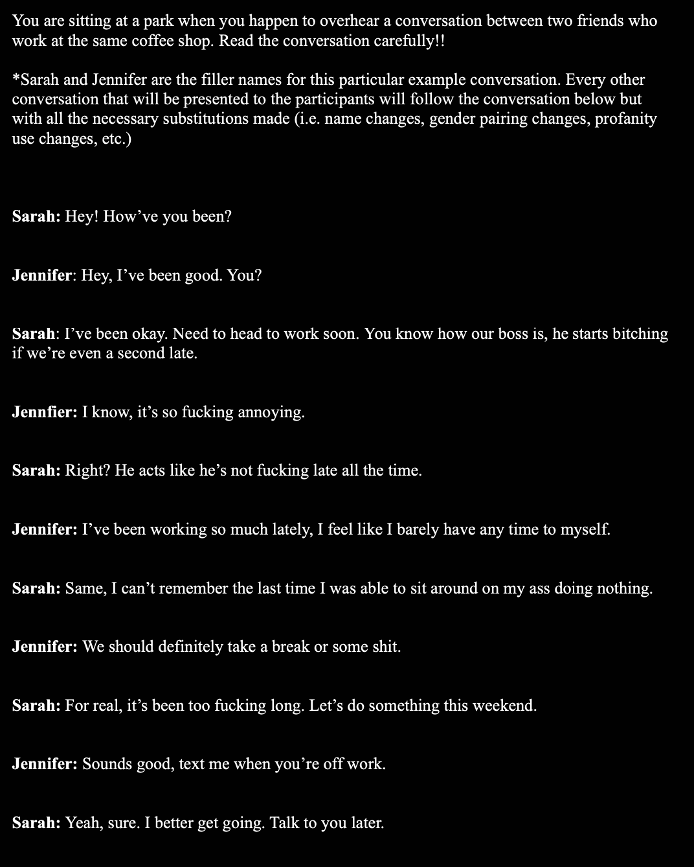
Participants were also asked how frequently they use and hear profanities. Afterwards, participants were presented with a set of conversations, all being slightly altered versions of the same conversation with and without the use of profanity alongside substitutions for their more ‘inoffensive’ counterparts. The speakers were paired as follows: male/female, male/male, and female/female. Also included were certain conditions where no speaker is using profanity, one speaker is using profanity, and two speakers are using profanity. Each of the aforementioned conditions occurred in all of the previously mentioned speaker gender pairings. To circumvent any variables, the core content of the conversations remained strictly consistent. The ONLY variable that was adjusted was whether there is or there is not profane language being used. Additionally, the conversations a participant interacted with were randomly decided through an online random number generator.  Participants were then asked to rate a speaker on trustworthiness, intelligence, and friendliness. The conversation below was presented to the participants.

Using Google Forms, I was able to collect voluntary response samples from my target population (18 – 25 year old non-religious native US California English speakers.) A total of 138 responses were received. 37 responses from males and 101 responses from females. Collecting the data through an online survey was the most reliable way to address my RQ. Creating controlled contexts was easier, and so was operationalizing the responses I received.

Results and Analysis

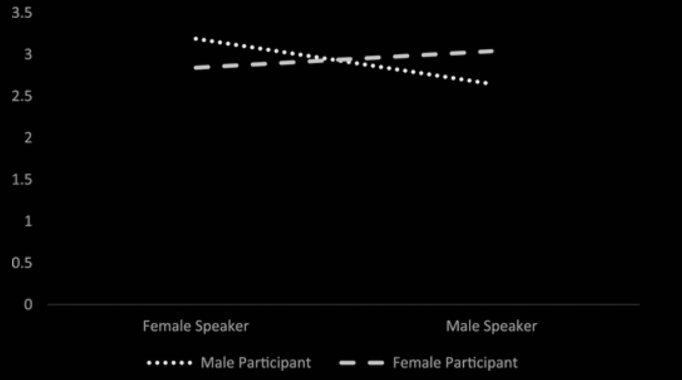
Figure 1: Female VS Male Participants Offensiveness Rating

On average, male participants saw female speakers. Female participants saw male speakers were more offensive in context than they rated male ale speakers as more offensive in context than did female speakers.

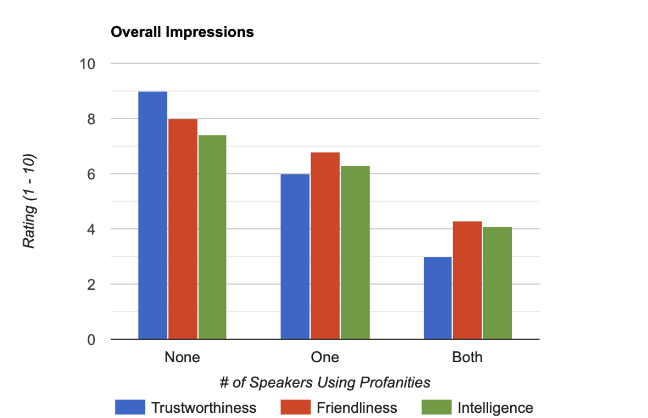
Figure 2: Overall Impressions Between Number of Profane Language Users

On a (1 – 10) scale, ratings were generally higher when none of the speakers were using profanities, and significantly lower when both speakers used profane language (independent of gender).

I recorded and analyzed the level of exposure to profanities on a daily basis as well as the frequency at which the conversation speakers were being rated on a scale of 1 – 10. Additionally, I recorded and analyzed the frequency of female participants rating male speakers more offensive than female speakers and vice versa.

Discussion and Conclusion

The use of obscenities DID result in less favorable impression ratings of the speaker in overall impression on intelligence, trustworthiness, and friendliness (See Figure 2). There was no evidence that regular exposure to obscenities meant neutral impressions against profane language users would be formed. Female participants saw male speakers more offensive in context than they did with female speakers and the same goes for male participants seeing female speakers as more offensive (See Figure 1).

Profanity use leads to poorer impression ratings, independent of the speaker’s gender. Profanity creates the perception of vulgarity, which in turn leads to the impression of reduced trustworthiness, sociability, and intelligence, no matter the gender.

Just a little extra random fun fact that came out of my survey’s data that I couldn’t fit into my presentation! The word that was found to be most vulgar amongst the participants of my survey was ‘bitch.’ If I’m allowed to speculate, I believe this could be due to the word ‘bitch’ having a derogatory connotation towards women specifically, and I had a lot more female participants, more than half, make up the study pool. Furthermore, I also found a pattern in which female participants rated ‘bitch’ and ‘bastard’ more offensive than the male participants in the study, which may reinforce my earlier speculation. But of course there is no true evidence behind what I’ve said, but I think future research about this topic would lead to some interesting results.

The limited male responses from the data collected leads some results to be interpreted with caution! Future research could examine the specific categories of profanity to determine if words from different categories differ in their power. Implications from this study and future research can help with understanding how language choices affect the way people are judged.

Similarly, another study conducted by Paradise, Cohl, Zweig (1980), found that, no matter the gender of profane language speakers, the act itself, the use of obscenities, led to impressions of reduced competence and less positive overall impressions.

I believe that these findings as well as my study’s data are indispensable in garnering a much deeper understanding of how one’s presentation of self and how someone chooses what words to say affects perception in ways that are fully unknown.

The words someone chooses to use will not only leave an emotional impact (which could be another topic for the future), but also a potentially long-lasting impression that may be difficult to alter. It is important to understand what image language projects and to understand that word choice/language choices DO matter.


References

Asch, S. E. (1952). Social Psychology. Social Psychology. https://doi.org/10.1037/10025-000

Bergen, B. (2016). What the f: What swearing reveals about our language, our brains, and ourselves. New York, NY: Basic Books.

DeFrank, M., & Kahlbaugh, P. (2018). Language choice matters: When profanity affects how       people are judged. Journal of Language and Social Psychology, 38(1), 126–141. https://doi.org/10.1177/0261927×18758143

Paradise, L. V., Cohl, B., Zweig, J. (1980). Effects of profane language and physical attractiveness on perceptions of counselor behavior. Journal of Counseling Psychology, 27, 620-624.

Willis, J., & Todorov, A. (2006). First Impressions. Psychological Science, 17(7), 592–598. https://doi.org/10.1111/j.1467-9280.2006.01750.x

[/expander_maker]

Love at First Voice

Jasmine Beroukhim, Nicole Palleja, Marydith Macabale, and Jaee Shin

Netflix’s hit dating show, Love is Blind has captured the attention of millions of viewers for its original take and format. In the show the contestants are separated by gender, and converse with one another through pods where a wall separates them from seeing each other. The show reimagines dating by erasing material aspects of a contestant’s identity right down to the sound of their voice. Throughout the show noticeable shifts in voice were apparent, and while it is well documented that humans have an innate capacity to shift styles through their voices, little research has been completed on how vocal changes are expressed in the discourse of reality dating shows.  Our study focused on the implications of vocal modulations in the context of reality television to investigate how an individual’s voice can contribute to the shaping of identity. In discussing this topic, we are interested in how the human voice can be used to influence perception and how women’s voices may reflect their perceived gender roles. We believe it is crucial to better understand the power of the human voice in leveraging perceptions and the societal and cultural reasons why a woman’s voice may change when speaking to a potential partner.

[expander_maker id=”1″ more=”Read more” less=”Read less”]

Introduction and Background

Our research focused on the first episode from Love is Blind which featured Jessica Batton, a 34-year-old white woman from Chicago, who works as a Regional Manager.  The public coined her iconic voice as a “sexy baby voice,” but the “sexy baby voice” was only apparent when she spoke to potential matches and disappeared when she relayed her experience in camera confessional interviews. “Sexy baby voice” according to linguists is achieved by raising your pitch and engaging in upspeak where the phrase ends with a rising pitch. Through our analysis we labeled Jessica’s two voices as “sexy baby voice” and her “professional voice.” In order to concretely measure the changes of her vocal modulation our study utilized the linguistic tool, PRAAT by inputting voice recordings from the show and comparing Jessica’s “sexy baby voice” used in the pods versus her “professional voice” utilized in the individual camera confessionals. Furthermore, we used conversational analysis to juxtapose her dual voices and to deepen our understanding of Jessica and determine if her pitch use fluctuated in accordance to the subject of her discussion. By creating a transcript between Jessica and her potential partner, we were able to illustrate the nuanced changes described through PRAAT and what the speaker was indexing through her vocal modulation.

Hypothesis
We expect Jessica to employ a higher vocal pitch when she is interacting with a male suitor, in the pods versus utilizing lower vocal pitch, consistent with a professional speaking voice, during her individual, camera confessionals. We expected our research findings to be consistent with our hypothesis in accordance with Jessica’s fluctuating voice pitch depending on her contextual setting and how such use of varying vocal pitches are reflective of her attempt to index two different identities in her personal and professional life.

Methodology/Project Design

We chose to limit our primary data collection to Season 1, Episode 1, entitled Is Love Blind as Jessica garnered the most screen time compared to other episodes later in the season, as she navigated the complexities of finding true love between two potential partners: Barnett and Mark. This case study was particularly notable to use because her modulating voice samples, according to professional or personal context, would provide us with substantial material to analyze throughout the episode. In our research, we collected a total of four samples and chose samples where a dramatic change in voice was evident Another reason for choosing these four samples was their back-to-back nature. Jessica used her professional voice when giving an interview and then used her “sexy baby voice” moments later when entering the pod. We then put the four samples into PRATT, which allowed us to draw conclusions about formant values, pitch, and intensity, when speaking to future relationship prospects versus one-on-one camera confessional. We then created a transcript of each of the 4 samples and used conversational analysis methodologies. We then collected 12 additional samples that we ran through PRATT with the purpose of observing her pitch formants. The subject content of the vocal samples was not analyzed. We watched the relevant episode, recorded Jessica’s speech, transcribed her voice samples into PRATT, created a transcript, and subsequently analyzed her pitch patterns in relation to what she was saying. By carefully analyzing the linguistic features of Jessica’s voice, we were able to deepen our understanding of Jessica as a social being as she indexed construction of her identity when speaking to relationship prospects versus addressing the camera directly in individual confessionals. 

Literature Review: Woman’s Vocal modulation in Dating Context

Helen Sautason, an English and Linguistic Professor at York St. John University in London offers insight into why a woman’s voice may change when speaking to a potential partner. In Sautason’s words, “the speaker will put themselves in a position where they sound less powerful because they have a belief that men find that attractive, and they don’t want (men) to feel threatened. There’s always been a value placed on girlish femininity” (Dazed, 2020, p. 2). Additionally, in a study entitled, “Voice Pitch Modulation in Human Mate Choice,” thirty adult men and women were observed in real time speed-dating events; their vocal patterns were analyzed for pitch changes. What was concluded from this study was that “women spoke in a higher-pitched and less monotone voice on speed dates with men they chose as potential mates.” The authors of the research observed that “the trade-off implied by this dichotomy suggests that women may volitionally raise their voice pitch to signal youth and femininity but lower their pitch in contexts where they wish to be taken seriously, or to indicate intimacy to a listener” (Pisanski et al., 2018, p. 2). As we examine our focus episode, we see that this observation is evident.  

Data Analysis: Pitch Formants

The differences in frequencies translate directly to pitch differentiation. A lower frequency indicates a lower pitch, while a higher frequency indicates a higher pitch. Figure 1 is a visual representation of Jessica’s first on-screen confessional where she introduces herself as a contestant on the show for the first time. Here she used her professional voice which produced a low F1 frequency of 606Hz. 

Figure 1: Professional Voice

Figure 2 is a visual representation of Jessica’s first time in the pods where she meets Barnett.  Here she used her sexy which produced a high F1 frequency of 1069Hz. 

Figure 2: Sexy-Baby Voice (Barnett)

Her use of two different voices and varying pitches is a direct attempt to index two different identities. There is a juxtaposition of two “first moments” that are happening within the context of Jessica’s introduction as an on-screen character to the world. Excerpt 1 provides a direct transcription of what Jessica says in her camera confessional, where her F1 produced a frequency of 606Hz (line 1).

Excerpt 1: Jessica’s First Confessional Interview “Professional Voice” 

[6:38- 7:00]

1 Jess: My name is Jessica Batton I'm from Rock Falls Illinois

2       <I’ve had> a rigid set of: standards I would only date a

3       guy between 1 to 5 years older I would only date (0.1)

4       athletes because I’m really athletic

Here, the audience is led to believe that Jessica is an established and serious woman looking for a mature relationship, to fit the bill of her desired qualities of a man, which is consistent with her use of a lower pitch voice register. The second introduction of Jessica portrays a different picture of her identity to Barnett, which contrasts sharply with her introduction to the world; a direct transcription of what Jessica says in the pods can be found in Excerpt 2 where her F1 produced a frequency of 1069Hz (line 8). 

Excerpt 2: Jessica’s Initial Pod Meeting “Sexy Baby Voice”

[6:38- 7:00]

1 Jess: But  I’m 34 years old and I may not find someone based

2       on:: the criteria that I’ve::: put in place for myself

3       I’m ready to start a family and::  I want to have:::

4       the most perfect marriage

5 Mark: What’s your name,

6 Jess: I’m Jessica_

7 Mark: Jessica_  Nice to meet you Jessica  I’m Mark 

8 Jess: Nice to meet you  Mark ?

Suddenly, she is bubbly, girlish, and demure, consistent with her use of the high pitch, feminine, sexy-baby voice register. It is implied that Jessica’s use of the sexy baby voice serves her the purpose of portraying herself as a likable woman that should be seen as desirable to the male gaze, or in this case, the male ear. Shortly after Jessica’s sexy baby voice driven interaction with Barnett, it appears that her high-pitched voice had captivated the attention of Barnett who comments on how nice her voice sounds. 

Similarly, the initial meeting between Jessica and Mark, her second potential romantic partner on the show, merited our attention and examination as it was another unique instance of Jessica’s voice modulation. Before meeting Mark Jessica gave a camera confessional discussing her past dating. When analyzing the F1 formant frequencies of her “professional voice,” in her camera confessional her F1 frequency produced a value of: 607Hz. The visual representation of her formants can be found in Figure 3. 

Figure 3: Professional Voice

Minutes after Jessica’s camera confessional Jessica enters the pods where Jessica leverages her “sexy-baby” voice. In the pods, her pitch had increased and produced a value of 810Hz, a drastic difference in pitch from her interview frequency of 607Hz. The visual representation of her formants can be seen in Figure 4.

Figure 4: Sexy-Baby Voice (Mark)

Excerpt 3 provides a transcription of Jessica’s use of her professional voice, which produced a low F1 of 607Hz (lines 1-4). 

Excerpt 3: Jessica’s Confessional Interview “Professional Voice” 

[30:23-30:30]

1 Jess:  There’s never been a time in my life (.) when I’ve been

2        able to really (0.1) focus solely on finding love_

3        here in the experiment (0.1) you spend every second  

4        of every minute searching for your soul mate

Jessica’s statement pushes the perception of Jessica’s social identity as a professional “working woman”’ who does not have time to spare to be dating. In the study, “Voice Pitch Modulation In Human Mate Choice”, the authors explain the common perception of women who have a lower-pitched voice as “consistently judged as more dominant, competent and mature, and as better leaders than women with a higher voice pitch” (Pisanski et al., 2018, p. 2). It is therefore not a coincidence that Jessica uses her “professional voice” emulating a pitch drop when speaking about her personal life and lack of time to engage in dating.

Excerpt 4  provides a direct transcription of Jessica’s conversations with Mark, where her sexy baby voice was used frequently, and produced a high F1 frequency of 810Hz.

Excerpt 4: Jessica’s Pod Meeting “Sexy Baby Voice”

[31:26- 32:11]

1 Mark:  holy shit we’re the same fucking person (.) and it's 

2        like (.) I want to raise my kids with religion

3        Christianity you know because that’s how I was raised 

4 Jess:  yeah

5 Mark:  and you know (.) I have a tattoo on my ribs (.) like  

6        it’s a cross with my parents initials on the top and

7        bottom (.) my sister and brother on an empty plaque

8 Jess:  wow 

9 Mark:  so when I have kids I can initial their names on it  

10       (.) and Psalm 19:14 going across it

11 Jess:  °I love that (.) that makes me so happy 

12 Mark:  (( laughs)) 

13        (0.2)

14 Mark:  how many kids do you want?

15 Jess:  three

16 Mark:  three (,) ? I'm down

17 Jess:  ok

18 Mark:  I want two boys and a girl

19 Jess:  I like that ,

20 Mark:  my face hurts

21 Jess:  why ?

22 Mark:  I’m smiling a lot

23 Jess:  you are?

24 Mark:  maybe

25 Jess:  that makes me so happy

Throughout the conversation, her replies were short and affirmative of Mark’s feelings and sentiments about religion and the number of children they desire. A study titled “New Zealand Women Are Good to Talk to: An Analysis of Politeness Strategies In Interaction” explains that American women are supportive and cooperative conversationalists; they act as an ideal and responsive audience – usually to men.” (Holmes, 1993, p. 92) The idea that women often act as “an ideal and responsive audience” to men, might explain the use of Jessica’s “sexy baby voice” in this interaction with Mark and the need to protect his ego.  There exists a contrast between Jessica’s dual identities because with her professional voice, we interpret her as a head strong working woman, versus with her sexy baby voice we tend to perceive her as flirty, and submissive “dumb blonde” archetype (refer to Figure 5 for an image of Jessica). 

Figure 5: Jessica Batton

For the purposes of confirming our hypothesis, we collected further data reinforcing Jessica’s consistent use of vocal modulations in response to alternating scenarios. The data presented in Figure 6 is a series of F1 frequencies that reaffirm Jessica’s use of higher pitch in her romantic interactions and lower pitch in her on-screen camera confessionals while reflecting on her life experiences.

Figure 6: Jessica’s pitch variation in two contexts throughout one show episode


Conclusions

There have been numerous studies conducted on voice modulation in various settings and even dating simulations, however, the objective of our study is to fill the gap in the body of research in the context of reality dating television, analyzing how individuals use their voices as a means of connecting with a potential partner who cannot physically see them.

In Love is Blind, we found that Jessica Batton deliberately altered her voice in order to make her sound more attractive to potential suitors, and that her sexy baby voice contrasted sharply with the pitch frequency she used when speaking directly to the camera. Therefore, based on Jessica’s varying voice modulation patterns in response to differentiated social contexts, we reaffirm the notion that voice can be used as a tool to construct and index an identity in specific social environments.  When completing our case study, we were cognizant of the limitations, more so, that a reality television show can easily manipulate an image of a woman through the editing of the production team  Our research was also limited as we only conducted a case study and did not analyze if this applied to others on the show, and did not analyze other episodes to mark if there was a change. In light of this, although our study does not definitively establish that women change their voice in the situational context of all reality dating television, it is one glaring instance of the degree to which shifting vocal modulation can affect the external perception of a person’s identity. 


References

Dazed. (2020, March 9).  Investigating the ‘sexy baby voice’ phenomenon. Dazed.
https://www.dazeddigital.com/life-culture/article/48255/1/investigating-the-sexy-baby-voice-phenomenon-love-isblind#:~:text=The%20’sexy%20baby%20voice’%20typically,s
mall%20body%20size%20(sigh).

Guardian News and Media. (2020, February 26).  What is ‘sexy baby voice’? We spoke to a sociologist to find out more. The Guardian. https://www.theguardian.com/lifeandstyle/2020/feb/26/what-is-sexy-baby-voicesociolo gist

Holmes, J. (2002, July 3).  New Zealand women are good to talk to: An analysis of politeness strategies in interaction. Journal of Pragmatics. Retrieved May 16, 2022, from
https://www.sciencedirect.com/science/article/pii/0378216693900784

Hughes, S. M., & Puts, D. A. (2021, November 1).  Vocal modulation in human mating and competition. Philosophical Transactions of the Royal Society B: Biological Sciences. Retrieved May 16, 2022, from https://royalsocietypublishing.org/doi/pdf/10.1098/rstb.2020.0388

Pisanski, K., Plachetka , J., Gmiterek , M., & Reby, D. (2018, December 18).  Voice pitch modulation in human mate choice.  Proceedings. Biological sciences. Retrieved May 16, 2022, from https://pubmed.ncbi.nlm.nih.gov/30963886/#:~:text=Within%2Dindividual%20analyses%20indicated%20that,a%20mutual%20preference%20(matches)

Zurbriggen, E. L., & Morgan, E. M. (2006, January).  Who wants to marry a millionaire? reality  dating television programs, attitudes toward sex, and sexual behaviors – sex roles. SpringerLink. Retrieved May 16, 2022, from
https://link.springer.com/article/10.1007/s11199-005-8865-2


[/expander_maker]
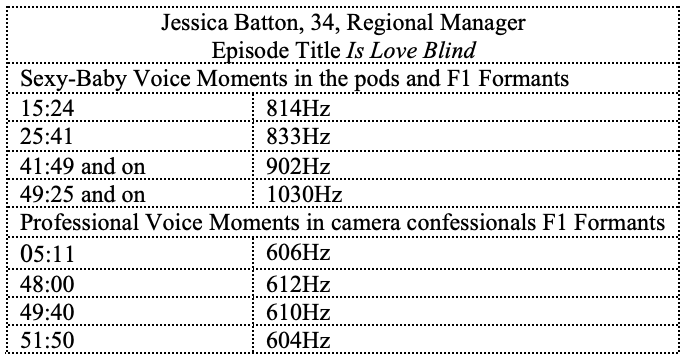
Is Gen Z Lingo Just Butchered AAVE? How Internet Culture Contributes to Appropriation

Rae Cristal, Xin Liu, Jasmine Shao, Megan Ye

In their recent skit called “Gen Z Hospital,” SNL put on a show depicting the quirky lives of an average “zoomer”, filled with internet-related troubles. At one point, the distinctly white actress Heidi Gardner utters: “If he keeps leaving us on read, he’s gonna catch these hands on gang.” How did Gen Z lingo become so distinctly African American? One consequence of the internet age is the fast-spreading of linguistic style, forms and vernaculars, and African American Vernacular English (AAVE) seems to be one of the bigger targets of this phenomenon. A problem with this is that those who use AAVE do so inappropriately and with syntactic error. Taking a language that one does not speak and using it without appreciation and knowledge is the basis of appropriation, and many Gen Z speakers are engaging in this, often without realizing that, far more than just netspeak, the forms they are appropriating belong to a full-fledged community of speakers, with grammatical rules and cultural nuances.

[expander_maker id=”1″ more=”Read more” less=”Read less”]

Introduction and Background

Language has the power to reinforce harmful racial stereotypes and to determine how marginalized groups navigate American society. These groups whose speech differs from standardized English, specifically Black communities, are viewed as lacking grammar and speaking a less sophisticated language. Despite these misinformed perceptions of AAVE, many people on social media platforms, including Twitter and TikTok, appropriate AAVE words, phrases, and stylings, claiming these features as part of Internet speech. Such phenomenon continues, despite attempts from actual AAVE speakers to denounce its harmfulness:

Figure 1: Twitter user explains how AAVE is an English variant

Previous studies have researched AAVE appropriation by non-speakers on modern usage; although the analysis is limited, these papers provide a framework for why and how people with different genders and sexualities appropriate AAVE. Elaine Chun did a case study on an individual Korean-American male and his usage of AAVE “slang,” theorizing that he used it to index a hypermasculine persona and separate himself from European Americans (Chun, 2001). Due to the lack of material on the LGBTQ+ community’s utilization of AAVE, we speculated that LGBTQ+ members also used it to disassociate themselves from the white mainstream and to appear hip and nonconformist. To further explore AAVE and the personas it indexes, Ilbury argues that online spaces use the orthographic representations of AAVE to embody a “Sassy Queen” persona, which relies on stereotypes of Black women (Ilbury, 2020). Furthermore, non-Black speakers perform similar stereotype-based persona construction when they “borrow” African American Language to participate in hip hop or urban youth style. Through media representation and the marketability of “Black cool,” which is the culmination of all the desirable features of Blackness: trendiness, resilience, and eloquence, many young people and influencers use AAVE to index this stereotype based on white imagination (Roth Gordan et al., 2020). Corporate companies recognize the benefits of profiting from this perceived coolness, exploiting AAVE in their marketing campaigns and their partnerships with young influencers. These articles assist us in understanding the social and financial motivations of non-Black people’s usage of AAVE and why they take on specific personas.

In light of the existing literature, we conducted a sociolinguistic study of non-Black Gen Z members by comparing their use of language in humorous and non-humourous contexts to identify how they utilize AAVE lexicon and accent to index a “funny” or “cool” persona. Also, due to the lack of research regarding the LGBTQ+ community’s usage of AAVE and the intersection of gender, our study analyzed the frequency of these linguistic features in social media influencers’ speech, particularly those who fit these categories. Overall, the usage of AAVE that became popularized through the Internet varies depending on gender, sexuality, and context. Methods We watched videos from eight non-Black, American, Gen Z influencers on YouTube and TikTok and recorded the instances in which they employed a lexical item or grammatical construction borrowed from AAVE.

Methods

We watched videos from eight non-Black, American, Gen Z influencers on YouTube and TikTok and recorded the instances in which they employed a lexical item or grammatical construction borrowed from AAVE. Our numerical analysis was based on a simple counting method. While it seems that counting a singular “instance” of grammar would be impossible in a traditional linguistic sense, this was possible because the influencers did not use any full grammatical constructions, but rather just one word in to imitate an AAVE grammatical style; e.g., “be” as in “[subject] be [verb]ing.” To determine what words and phrases were instances of AAVE, we referenced this guide, which was created by a group of Black people and non-black people of color with the intent to reduce appropriation in online communities. For words with multiple indexical meanings (such as “bitch” as a slur for women or “ain’t” as part of Southern dialect), we took their context into account to assess whether they were appropriated from AAVE. The eight influencers we examined were:

These influencers are a small group of the most popular internet users, and should not be considered a representative sample of all influencers of internet users. Rather, we intend for their selection to be a series of eight case studies examining intraspeaker differences in AAVE use. When watching the videos, we separated their content into two contexts for comparative purposes:

Non-humorous: Any segment of video or full video centered around the promotion of a product or service, such as a promotion of the influencer’s merch or a brand sponsorship

Humorous: Any other segment of video, because even those who are not solely comedy YouTubers are known to include humor in their content

We considered commercial content like sponsored segments, brand collaboration videos, and formal interviews non-humorous because influencers tend to act “professional” and remove the informal, humorous aspects of their speech in promotional contexts. If their use of AAVE is significantly higher in humorous contexts, we can assume that their use of AAVE is tied to the indexing of humor, rather than a reflection of their natural speech variety. For the LGBTQ+ speakers, usage of AAVE mostly was characterized by borrowed lexical terms that indexed sass and cheekiness. Here is an example of how we recorded and examined AAVE use. This is transcribed from a Nikita Dragun video titled “REACTING TO MY BOY VIDEOS!!”:

● [0:58] “tea” (used to describe drama and not the drink) 

● [2:13] “clock it the house honey,” 

● [3:08] “shook,” 

● [7:08] “unclockable” (derived from clock), 

● [7:31] “thick” (referring to a person’s figure and not literal thickness). 

● Total: 5 in 10 min

This is transcribed from a Bretman Rock video titled “Hugging for the first time? Catching up with my Sister”:

● [01:11-01:24] I just know they’re bomb though. I just know they’re bomb_ (bomb meaning cool/great, extremely positive connotations) we have two dishes of broth--uhm; they’re both seafood broth one is spicy and one is mild and I believe this one is kimchi. We have udon Chinese CABbage enoki mushrooms up. In. this. BITCH. (imitating AAVE grammatical structures) 

● [01:57-2:17] SIS. (used to refer to friends/peers, not literally speaker’s sister, although in this case she is) whatchu been up to? (grammatical structures) PERIOD! (used to mean “and that’s that,” a marker of finality—online may be spelled “periodt”) and we gon keep doing you. (grammatical structure) Purr. (used to express approval/satisfaction) um YEAH BITCH you’re twenty ONE we can have drinking videos now. Period. 

● [02:55-03:02] she got FUCKT! (lexical feature, -t suffix replacing -ed) UP!Perio;d that’s all that matters_ NEW age; new DICK. purr! 

● [03:37-03:39] this bitch been telling everybody (using the habitual be, e.g. is, are, am) 

● [04:15-04:17] yeah you don’t deserve. Period.

● [04:34-04:41] the thing IS she ain’t even done like celebrating her birthday (grammatical structure) yet what the <<slurred, quick>fuck’re you gonna do in LA bitch this bitch is gonna stay in my apartment 

● [04:54-05:01] bitch I always be telling you tips and tricks but you don’t even listen so it’s like you know what some people just wants to learn on their own and that’s fine 
● Total: 14 instances in 5 minutes 
● Overall, Bretman Rock’s usage tends toward leaning heavily on the “sassy Black woman” stereotype as a persona. He overutilizes—at times randomly and incorrectly— “periodt” and more commonly puts on a persona when he is interacting with women and LGBTQ+ individuals.

As for the Non-LGBTQ+ speakers, their usage of AAVE varied. Males usually used borrowed grammatical forms and lexical terms. Here’s an excerpt from Ricegum’s video titled “Meeting My Online Crush For The First Time!”:

● [00:43] - [0:45] Yo so listen, but you can’t even be sliding into dms in Tik Toks (invariant be usage) 
● [00:58] - [01:02] She’s finna just appear. It’s finna just be magic (borrowed term) 
● [05:33] - [05:35] But you don’t be hittin’ those other dudes back? 
● Overall, Ricegum ports an overall blaccent and overutilized penultimate consonant deletion. 
● Total: 10 instances in 8 minutes

For female users, their usage of AAVE varied based on their humor. In particular, one of the influencers showed signs of self-awareness and utilizes it ironically. On the other hand, Brittany Broski uses lexicon to index a sassy persona. Here’s an example from Brittany’s video titled
“Deep Diving My Angry 2013 Tumbler”:

● [0:52]-[0:58] This whole idea of stan culture on Twitter really was like the thing at the time. If you didn’t have a stan account 
● [1:00]-[1:04] So this was my stan account in high school because I never had a One Direction Twitter 
● [3:50]-[3:54] Oh my god I loved this bitch I ate this shit up 
● [4:57]-[5:00] I genuinely was like real mean don’t wear pink, swag 
● [8:44]-[8:48] Another boyfriend Harry post wow period, period 
● Total: 11 instances in 11 minutes

Results and Analysis

Figure 2: Instances of AAVE usage per minute for each target sample, distinguishing usage in humorous contexts versus non-humorous contexts.

Discussion and Conclusions

Most of the influencers examined here have significant differences (see Figure 1) in AAVE usage between humorous and non-humorous contexts, which confirms our hypothesis that influencers choose to change their styles for social benefits. Sexuality and gender expression also appear to have an effect on the instances of AAVE usage. LGBTQ+ influencers, especially men, tended to use AAVE to index a “sassy” persona, based on the stereotype of the “sassy Black woman.” On the other hand, non-LGBTQ+ men tended to use AAVE to index a “tough” or “masculine” persona, based on the cultural masculinization of Black people. Influencers use AAVE to index a funny, sassy, or edgy persona because of cultural stereotypes around Black people and their language. These stereotypes date back to minstrelsy in which Black people were treated as entertainment tools for white people. Today, this derogatory cultural lineage lives on in the appropriation of Black people’s language as an entertainment tool for non-Black people. These public figures’ influence leads to further spread of these speech patterns, indexed in these ways, without acknowledgement of the source and the price paid by Black people who have native fluency in AAVE. Influencers of this caliber have great potential to impact their audience, and carelessly using AAVE without acknowledging its origins will propagate the idea that AAVE is simply netspeak, which leads to the broader population of Non-Black Gen Z speakers using incorrect forms, or completely disregarding the cultural implications of knowing the language:

Figure 3: TikTok user borrows vocabulary term “chile” and misuses it.
Figure 4: Twitter user misuses the verb “go,” usually preceding adjective.
Figure 5: Twitter user misuses the invariant “be,” meant to be used before a verb to indicate habitual actions.

People tend to feel inappropriate when they incorrectly use grammar in a language they do not speak or are just beginning to learn. However, that does not appear to be the case for when non-speakers of AAVE misuse its grammar. This further contributes to the myth that AAVE is not, in fact, seen as a legitimate vernacular language of its own, and helps fuel extreme cases where people actively discredit AAVE entirely:

Figure 6: Reddit user’s derogatory opinion on the African American Vernacular English.

It is not inherently bad that the internet is shortening gaps between different cultures and as a consequence, languages. However it is the due diligence of every responsible internet user to ensure that they are not just passively absorbing all the information that is available to them and mindlessly replicating them. When the majority uses (and misuses) the language spoken by a minority only to express particular ideas, they, at best, contribute to the viewpoint that the variant is not legitimate, and at worst, reaffirm the racist ideologies that exist to oppress Black people (see Figure 5). When Black people use AAVE, people assume that they don’t know Standard English. However, when non-Black people use AAVE, people assume that it’s a choice—one to appeal to humor. These double standards further propagate racism towards Black people and devaluation of African American Vernacular.


References

Chun, E. W. (2001). The Construction of White, Black, and Korean American Identities through African American Vernacular English. Journal of Linguistic Anthropology, 11(1), 52–64. https://doi.org/10.1525/jlin.2001.11.1.52

Davis, Chloe. “The Language of Ballroom.” The Gay & Lesbian Review, 9 Mar. 2021, https://glreview.org/the-language-of-ballroom/

Eberhardt, M., & Freeman, K. (2015). ‘First things first, I’m the realest’: Linguistic appropriation, white privilege, and the hip-hop persona of Iggy Azalea. Journal of Sociolinguistics, 19(3), 303–327. https://doi.org/10.1111/josl.12128

Ilbury, C. (2020). “Sassy Queens”: Stylistic orthographic variation in Twitter and the enregisterment of AAVE. Journal of Sociolinguistics, 24(2), 245–264. https://doi.org/10.1111/josl.12366

Roth-Gordon, J., Harris, J., & Zamora, S. (2020). Producing white comfort through “corporate cool”: Linguistic appropriation, social media, and @BrandsSayingBae. International Journal of the Sociology of Language, 2020(265), 107–128. https://doi.org/10.1515/ijsl-2020-2105

[/expander_maker]
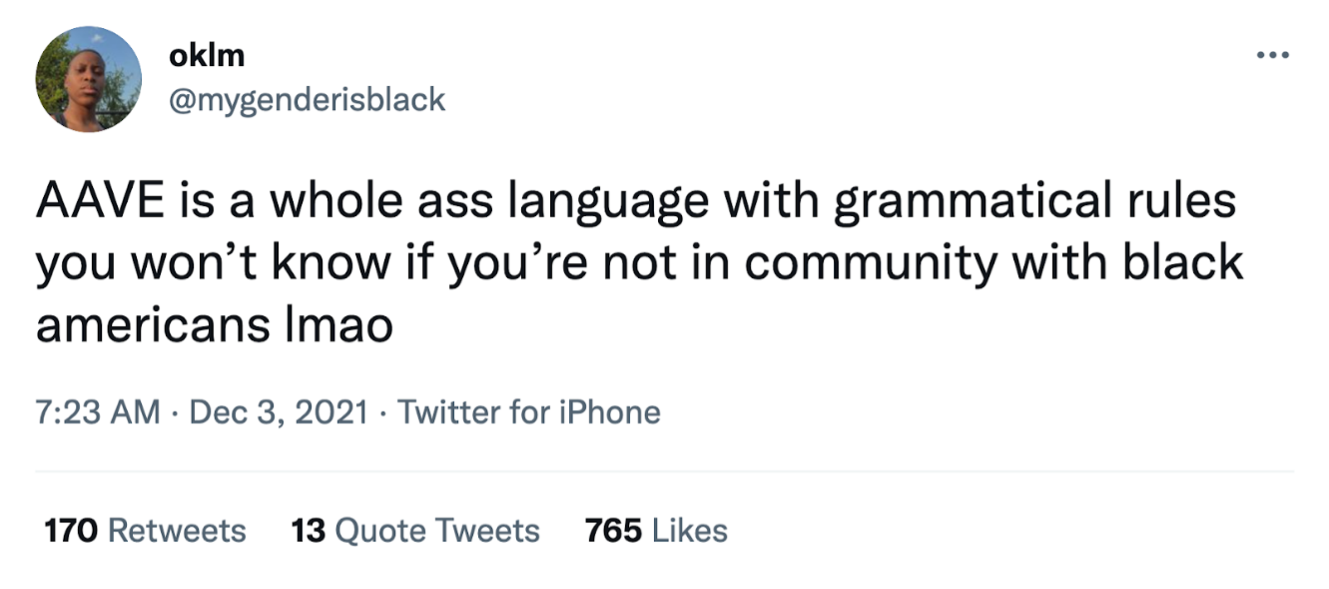
“It’s just a game”: Toxic Triggers in the Competitive FPS Valorant

David Vuong, Emma Tosaya, Jane Heathcote, Kai Garcia

If you have ever played an online game, of any variety, chances are you have run into a toxic player or two. Online gaming has a long, deep rooted history of toxicity, often attributed to many games’ violent or competitive natures. However, toxicity can stem from a variety of sources, from racism to sexism to even a player’s enjoyment of toxic environments. This article aims to find the link between toxic nature and the online first-person shooter (FPS) Valorant. From the moment it was announced, Valorant was one of the most anticipated game releases of 2020. With its release coinciding with the COVID-19 quarantine, its popularity received a drastic boost, giving it a uniquely diverse player base – including a rising number of female FPS players. Focusing specifically on female-received toxicity, randomly selected interactions between players will be analyzed based on word choice and context to study in-game triggers for toxicity.

[expander_maker id=”1″ more=”Read more” less=”Read less”]

Introduction

For those unfamiliar with the game, Valorant is a team based tactical shooter game, played online in teams of five. Each player is assigned a rank based on skill level (which ranges from lowest at Iron 1 to highest at Radiant) as displayed in Figure 1, and an account level (which indicates how much an individual has played the game on a particular account) as displayed in Figure 2.

Figure 1 – Valorant ranks
Figure 2 – Valorant account levels

The small team sizes and hierarchical structure create easy situations to call out fellow players, and the fast-paced and competitive gameplay leads to frequent incidents of toxic behavior. Performance based toxicity is made even easier thanks to the format of in-game statistics (see Fig. 3). Players have access to both their own and the opposing team’s statistics for a particular game. Each individual player’s username is displayed next to an image of the agent they have chosen and rank, followed by KDA count (kills, deaths, and assists to kills), loadout indicating what kind of weapon they are using, and credits showing each player’s current money. All of this information is necessary for knowledgeable gameplay but makes it easy to target a specific player – such as the person with the least kills.

Figure 3 – Valorant in-game loadout menu

Riot, the developer of Valorant, has made several attempts to quash performance-based rank toxicity. Visible ranks were removed in game, meaning the rank information found next to the agent image in Figure 3 were removed. Despite these attempts, there has been no real success or documented decrease in rank toxicity.  A recent survey created by the Anti-Defamation League found that 89% of young gamers between the ages of 13 and 17 had experienced a disruptive, negative encounter in Valorant during the past six months (ADL, 2021). Toxicity in Valorant has become an expected part of the game, despite the fact that such “deviance” in games has the consequence of driving off new players and supports a reputation of toxicity (Shores et al., 2014).

In this study, we wanted to dig deeper into the linguistic phenomenon involved in this toxicity and explore how a player’s word choice and lexicon give insight into why they might feed into such a toxic environment. Analyzing the context and frequency of these toxic statements is important to better understand the triggers of toxicity in a community that is intended to promote teamwork. By looking at audio recordings and chat transcripts from a variety of sources, we predicted that gameplay-based comments would be the most common form of toxicity, but that other categories such as gender or race would have a key role in players’ decisions to make these comments.

Methods

There were two parts to our study: interaction analysis and community familiarity.

Part 1: Interaction Analysis:

Using a variety of open-source mediums, we collected random clips of toxic in-game encounters on YouTube, Twitch, and TikTok. Twitch is a platform in which people can stream their gameplay live to a virtual audience, and TikTok is a platform in which users can submit small one-minute clips or compilations. Using Twitch’s Valorant category, TikTok’s search function utilizing hashtags, and requesting clips from anonymous individuals, we analyzed 10 randomly selected clips of female Valorant players. As the demographic of Valorant players is overwhelmingly male, and considering sexism was one of our categories, we decided to focus specifically on female directed toxicity to avoid any skews in data. We looked for two instances of female-received toxicity in a single clip, which we called the primary and secondary interactions. The primary interaction was considered the first identifiable toxicity aimed at the female player after she had spoken, and the secondary was considered to be the second instance of toxicity. After creating transcripts for these interactions, we placed them into one of four categories based on the toxic word choice employed: sexism, profanity, performance, or racism. For example, an interaction where a male teammate referred to the female gamer’s bad play as a “woman moment” was placed in the “sexism” category. The primary and secondary interaction could be either the same or different forms of toxicity, and some even contained multiple types of toxicity in a singular interaction (ex. performance-based primary, sexist secondary). In the instances where there was more than one category documented, all categories noted were considered when compiling the final data.

Part 2: Community Familiarity

We also wanted to see how familiar the toxic Valorant jargon was to people outside the community of practice, as well as their thoughts and impressions on the nature of the negative interaction. To do this, we created a familiarity survey to send to several non-Valorant players. The survey consisted of one of our interaction transcripts and analysis questions. A total of 5 participants were shown the transcript – 4 female and 1 non-binary. We asked the participants to describe the nature of the interaction and to elaborate on the potential thought processes of both the female and male gamers.

The questions were kept as general as possible, and both the questions and transcript were sent via text so as to not incur any bias towards a specific category of toxicity. The first question asked was simply, “How would you describe this interaction?”. The following two questions focused on what the participants thought each of the player’s take on the interaction was, essentially asking if the participant viewed the interactions in the same way that our data collection did: sexist, racist, performance based, or straight profanity-based toxicity.

Analysis

Please note that the following video and data does include offensive language.

The video found below contains a clip from our randomly selected subjects who experienced toxicity in game.

https://youtu.be/pON7BYP6wAk

The continuing excerpt shows an example of how the project categorized terminology and phrases to collect data on types of toxicity. It is also the specific excerpt provided to subjects outside of the Valorant community for familiarity testing.

The excerpt opens with a question from the female player, targeted to her fellow teammates and related to the general game strategy. The primary toxic interaction occurs in Line 6, when the male player questions the female player’s ability to perform a game-related task (hold a site against the enemy team). The game terminology within this line flags it as performance-based toxicity according to our categorization methods. After the female player calls out his toxicity (Lines 7-8), there is a brief pause (1.2 seconds, Line 9) before he insults her and her abilities again in Line 10. This is the secondary interaction and is another example of a performance-based toxic comment.

Although the interaction continues past this point, we focused on the primary and secondary interaction, since we are only interested in the beginning trigger to the overall toxic encounter. Using the same methods as demonstrated above, we analyzed the other randomly gathered video clips and accumulated our final results.

Results

Overall, the most frequent type of toxicity encountered at the beginning of a negative interaction was performance-based insults, which aligns with our hypothesis. Figure 4 indicates that this performance toxicity appeared first in half of the videos we analyzed, followed by gender-based discrimination at 30% and general profanity directed towards the female player found in the remaining 20%.

Figure 4 – Primary interactions: type of toxicity, by frequency

Performance was even more relevant in the secondary interaction, making up 54.5% of the comments, as seen in Figure 5. Once again, gender-based toxicity and general profanity made up the rest of the encounters studied, although both categories combined make up less than half of the interactions recorded.

Figure 5 – Secondary interactions: type of toxicity, by frequency

No encounters of racist toxicity were documented as the immediate trigger for negative encounters, even though racism remains a known issue in Valorant. We did find instances of spoken racial slurs in the videos analyzed; however, as they were not the first or second instance of toxic comments, they were not included in our analysis.

After sending the example transcript to individuals outside of the Valorant community, we were able to analyze their answers and determine if they also regarded comments as negative. As demonstrated in Figure 6, all five individuals described the interaction using words with negative connotations. When asked about the potential thought processes behind the male player’s triggered toxicity, the most common themes were gender-based stereotypes and frustration/defensiveness over game performance. This aligns with the results of our data analysis and demonstrates that individuals outside the community view game toxicity as negative.

Figure 6 – Subject responses to familiarity survey

Discussion and Conclusions

As stated above in the results section, most of the toxic comments were classified as performance-based toxicity. However, contrary to the initial hypothesis, the trigger for these particular cases of toxicity cannot simply be defined by their lexical counterparts. In the end, most of the clips collected were of toxic players who were underperforming themselves, while the receiver of toxicity was outperforming the toxic player. This suggested that the trigger for toxicity was not simply related to low performance, but other factors beyond gameplay that were playing a key role in toxic behavior. Additionally, when the comments were transcribed as part of our survey questionnaire, the participants analyzing the conversations stated that the interaction was extremely negative and had misogynistic undertones. Not only was the toxicity understandable to persons outside of the community of speech, but the responses also suggest that the survey participants believed the toxicity triggers extended beyond surface level word choice. With that in mind, we can view these comments not only as an indication of performance toxicity, but rather a demonstration of sexism as the underlying trigger for in-game toxicity.

As also noted in the results above, this project did not yield any data on racism. Despite this fact, further studies could focus on racial discrimination as a trigger to toxicity within Valorant. As there is no way to determine a player’s race in Valorant except from their voice, a different data collection method would need to be employed to study racism in-game. Possible future studies could have subjects who speak African American Vernacular English or subjects with non-standard American accents volunteer clips of their toxic interactions, instead of having a female only subject demographic. Previous research (Buyukozturk, 2016) has found that one of the major contributors to racial gaming toxicity is the obscured nature of online interaction. Toxic gamers can draw stereotype-laden conclusions about a player based solely on their voice, and they may express their toxicity more readily than they would in real life because they feel safe hidden behind a digital avatar. It would be interesting to analyze the word choice and context of racist gaming encounters and compare them to documented examples of in-person racist speech.

For other future analysis, a much larger data sample would be needed to back the current findings. A larger data set would provide not only more conclusive results but would help expand the scope of toxic behaviors beyond our focused categories (sexism, profanity, performance and racism). As Valorant is still a relatively newer game (less than 2 years old), there is much more research that could be done to help explain toxic trends. The broader implications of these findings could extend to other phenomena in society as well, such as the reasons behind toxicity towards female colleagues in male dominated work environments. Studying the triggers of this deviance has the potential to increase awareness towards harassment and general toxicity prevalent in all aspects of life.


References

Anti-Defamation League. (2021, September 15). Most U.S. Teens Experienced Harassment When Gaming Online, ADL Survey Finds. https://www.adl.org/news/press-releases/most-us-teens-experienced-harassment-when-gaming-online-adl-survey-finds

Beres, N.A., Frommel, J., Reid, E., Mandryk, R.L., & Klarkowski, M. (2021). Don’t You Know That You’re Toxic: Normalization of Toxicity in Online Gaming. Proceedings of the 2021 CHI conference on Human Factors in Computing Systems.

Buyukozturk, B. (2016). Race, Gender, and Deviance in Xbox Live: Theoretical Perspectives from the Virtual Margins. Sociology of Race and Ethnicity, 2(3), 387–398. https://doi.org/10.1177/2332649216645529

Cook C. L. (2019). Between a troll and a hard place: the demand framework’s answer to one of gaming’s biggest problems. Media Commun. 7 176–185. 10.17645/mac.v7i4.2347

Kowert R. (2020). Dark Participation in Games. Frontiers in psychology, 11, 598947. https://doi.org/10.3389/fpsyg.2020.598947

Shores, K., He, Y., Swanenburg, K.L., Kraut, R.E., & Riedl, J. (2014). The identification of deviance and its impact on retention in a multiplayer game. Proceedings of the 17th ACM conference on Computer supported cooperative work & social computing. https://dl.acm.org/doi/10.1145/2531602.2531724

[/expander_maker]
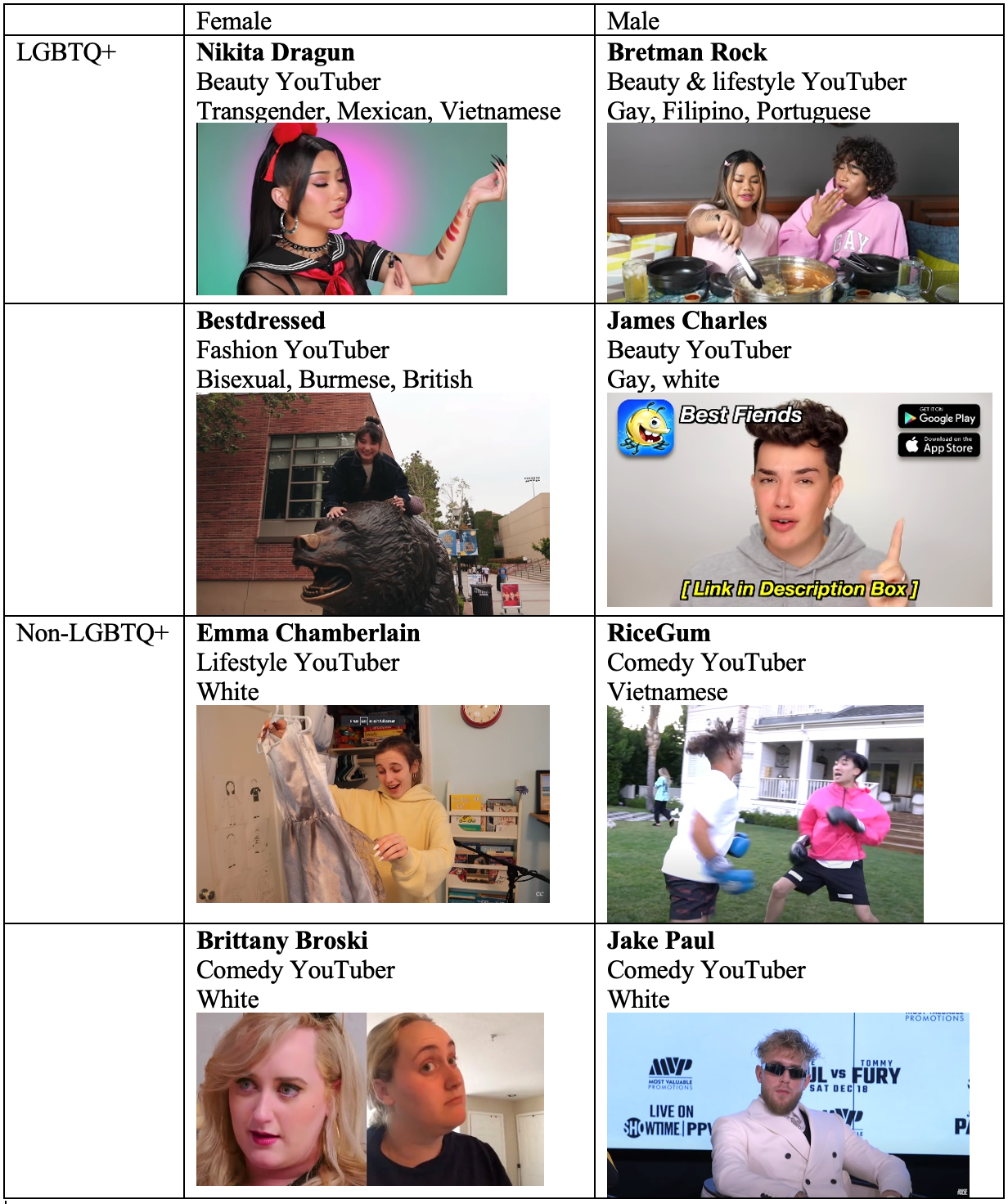


, , , , ,

THE GAY PONDER: Closeted Sapphic Celebrities Deciding How To Talk About Their Private Lives

Kayla Cardoso, Van Hofmaister, Jamie Jiang, Clarissa Sie, Rainey Williams

In 2016 a 1979 interview with Jodie Foster resurfaced on the internet and instantly took hold in the meme community. When asked about a potential boyfriend, Jodie smirks, licks her lips, and raises her eyebrows in a manner that gives the impression she knows something that her interviewer does not. The label [gay silence] was given to this instance and it has become a part of gay culture and  the LGBT community as an identifying feature of closeted individuals. With this in mind, our study takes a sociolinguistic approach to analyzing and examining the idea of a sapphic/lesbian code. Coded sapphic speech is not well studied in sociolinguistics, and while the community itself is able to identify markers of such, there has been little to no substantial research on identifying features present in sapphic language. In analyzing the speech and body language of sapphic celebrities, we seek to provide evidence and tools to identify linguistic markers.

[expander_maker id=”1″ more=”Read more” less=”Read less”]

Introduction and Background

If you’re a particularly online or memelord-y queer person, you might have seen the “gay silence” meme by now. A young Jodie Foster, who now publicly identifies as lesbian, stares off-camera at her interviewer with a slight knowing smile and a strained look in her eyes. The subtitles characterize her contribution to the conversation as “gay silence.”

The image comes from a 1979 interview with 17-year-old Jodie Foster on the Macneil/Lehrer Report. Clips of the interview resurfaced a couple years ago and caught the attention of the sapphic community (“sapphic” is an inclusive term referring to any person, woman or otherwise, who identifies as lesbian). In the clip, Foster answers awkward questions about the kind of boyfriend she would like and the qualities in actresses that “turns” her on.

Foster is generally seen as early lesbian “icon”. One YouTube comment about the interview jokes: “Jodie Foster founded Lesbianism. She’s like the final boss”. Another viewer writes: “the gay energy in this is immaculate.” Most viewers point out Foster’s subtle subversion of the heternormative questions. Another commenter points out how young Foster’s mannerisms match contemporary codes of lesbianism – “Every mannerism she has is now lesbian code. Funny, right? (Way of sitting, way of taking the cup of tea, way of talking).”

Coded sapphic speech is not well studied in sociolinguistics. While the community itself is able to identify lesbian markers, as demonstrated by the commenters above, there has been very little empirical research on those markers in language. One commentary by April Jackson published in a feminist journal called “Bringing Lesbian Language Out of the Closet” claims lesbians do not have a collective public language. Nothing in the literature we found could support this claim, but the literature pool is already small. Most studies on sapphic speech are conducted on lesbian acoustic features under the stereotype-driven fallacy that gay women are the acoustic mirror of gay men, otherwise known as “Gender Inversion Theory” (Kachel 2017).

Our study aims to fill this gap with a thorough study of “out” sapphic speech. Specifically, we provide two case studies, lesbian and sapphic icons Jodie Foster and Kristen Stewart, characterizing the way sapphic celebrities speak about love, family, and sexuality before and after coming out.

Methods and Transcription Notation

Our hypothesis was that these women will behave differently depending on if they know the interviewer – and by extension, the greater audience – is aware of their identity or not.

With particular interest given to observing lesbian speech in environments where responses are elicited by another individual in regard to matters of romance, personality, and private life, we performed conversation analysis on queer women Jodie Foster and Kristen Stewart from the existing canon of interviews in the public record. We analyzed interviews on a scale of “outness” – before publicly coming out, in more “out” settings, and after publicly coming out – in order to draw comparisons and see if different aspects of their employed speech changed after they perceived members of their audience as aware of their identity.

Using conversation analytic methods, that data was examined for prosodic changes, i.e. hesitations, silences, breathiness, emphasis, and volume fluctuations. Particular attention was paid to: potential pauses[1] between utterances (the question and the intended response), employment of gendered versus gender-neutral words, and perhaps instances where the subject avoids the topic altogether. Furthermore, although more paralinguistic than overtly linguistic in nature, physical movements and posturing of the body in response to different questions allowed further insight into an interviewee’s response. Comparing this with later interviews where a given celebrity’s identity is public knowledge gave us an idea of whether or not these linguistic and paralinguistic choices were simply personality quirks. 

[1] In conversational analysis, a pause conveys meaning. The amount of time after an utterance is spoken may reflect different attitudes in a speaker. Such length after a pause can be interpreted as a few things, including hesitancy, disagreement, lack of interest, or that the speaker is having a hard time thinking of how to respond. We will be actively taking note of the length of any pauses within interviews in order to gauge how the speaker might be feeling in response to some interview questions.

Special attention was given to the interviewer’s demeanor, attitude, and in what context the celebrity was being asked these questions, as well as the content of the questions being asked, and whether those questions became more invasive once an interviewer knows they are asking someone who is lesbian. We tested for the possibility that our subjects were simply exhibiting discomfort while answering personal romantic questions, no matter their sexuality. As a method of control, the study includes conversation analysis on Brooke Shields and Amanda Seyfried; two heterosexual women who are contemporaries with Jodie Foster and Kristen Stewart respectively.

Transcription Notation:

  • [Overlap Bracket: Left brackets mark the point at which the current talk is overlapped by other talk.
  • Stressed Syllables: Underlined letters are used to indicate an emphasis on a word.
  • ° Low Volume: A degree sign indicates that talk it precedes is low in volume
  • Silence: Numbers in parentheses mark silences in seconds and tenths of seconds
  • Increased Volume: Upper case indicates increased volume.
  • Breathiness: An (h) indicates plosive aspiration, which could result from events such as breathiness, laugher, or crying
  • Noticeable Pauses: A period between two parentheses is used to indicate (short) pauses.

Results and Analysis

Brooke Shields

In order to have a point of comparison to Jodie Foster (one might say, hetero to Jodi’s homo), we chose to do conversational analysis on acclaimed actor and model Brooke Sheilds. Shields has been in the public eye as a famous figure her entire life, given her assimilation into the acting and model industry from a very young age (Shields was doing model jobs as an infant). Shields was also considered a very attractive individual, and given the subject matter she starred in (one example being the controversial–and in this writer’s opinion, very gross–film “Pretty Baby”) became a “sex symbol” in her teenage years.

This mindset of the public in regard to Shields led to her interviews being riddled with topics circulating towards: sex, men, crushes, boys, and other sexually or romantically charged vocabulary.

Given the frequency of such words as well, it provides viewers a good point of reference to how Shields would respond to questions that were deemed more harmless (crushes) to those that are more inappropriate (sex). For our study in particular, having interviews where the interviewer had the pre-existing mindset that Shields is someone her fans “desired” is a good control for Foster’s behavior. This way, we  can look into similarities and differences with regards to how invasive a question is without any distinction made between sexuality. Sometimes the things people are asked, point blank, make them uncomfortable.

The first conversational analysis performed was on an interview in 1981 by the interviewer Bobbie Wygant (who also interviewed Foster two years prior). In the interview Wygant asked Shields many questions about sex, rather than the plot of the film she was in at the time. Wygant  asked things like whether or not she thought that young girls are able to have sexual relationships, later leading to her question to Sheilds, herself, about whether she could handle a sexual relationship or not. Shields at the time was 15 and seated between two of her adult male co-stars in the film “Endless Love”.

Some of the aspects of Shields’ response that were particularly noteworthy was her use of laughter towards the beginning of the interview, as well as the significant pauses she evokes after Wygant asks her the invasive question. Shields also stutters slightly, and has more pauses as she gathers her thoughts together in order to construct what people in the comments of the interview called “classy” or “graceful” despite the question’s probing content . Overall, the biggest instance of perceived discomfort for Shields’ responses to questions was found in this interview where the topic itself was something deeply personal and invasive to ask anyone.

The second interview of import was conducted by Bill Boggs around a similar time in Shields’ life. Contrary to the Wygant interview, Boggs interview doesn’t explicitly ask Shields about sexual relationships, some of it is implied however. At one point in the interview Boggs asks Shields about her ability to make men feel “comfortable” with her. He even compares her ability to “thirty five year old women” he knows who aren’t capable of the same thing. Such a question, to an observer, seems off, especially considering the comparison between fully grown adult women and Shields, who was only a teenager at the time.

Similar to the previous interview there is evidence that Shields uses laughter as a response to a question that has some degree of romantically charged backing. In the later part of the interview Boggs asks Shields about the difficulty of not getting a crush on her male counterpart in a film.

Shields doesn’t hesitate to use masculine pronouns to refer to the recipient of her hypothetical crush, and although she does include a pause, it is more similar to her gathering her thoughts than being read as uncomfortable as it was in the first interview example (comparing a 0.5 second pause to the 0.8 or solid 1.0 seconds in the interview with Wygant). The only instance in which there is some aspect of her response that could portray uncomfort is when she mumbles the word “man,” however this is much more likely to be attributed to the fact that she was still a teenager at the time and her co-stars were more often than not older than her by a decently large margin.

Shields also has open body language in her interviews, where she smiles back at the interviewer, nods or shakes her head, and most noticeably laughs as a response to various questions.

Jodie Foster

Results from conversational analysis on Jodie Foster stood out from conclusions we drew on her heterosexual contemporary, Brooke Shields, in four ways:

(1) Foster used “the gay silence” when closeted;

(2) Foster used gender-nonspecific terms when closeted;

(3) Foster played with gender roles more often in a more “out” setting than in a closeted one;

(4) Foster was a more supportive and intimate conversation partner in an “out” setting.

In the interviews we analyzed discussing romance and sexuality, Shields responds to interviewers using laughter 50% of the time. By contrast, Foster used “the gay silence”. In a 1979 interview with Bobbie Wygan, Foster responded to heteronormative questions about her love life with several pregnant pauses.

Foster’s silences came to an average of 0.49 seconds overall, twice using a 0.8-second silence during clips from the 1979 interview. Her longest silence occurred after the interviewer asked an awkwardly phrased question – what qualities in a female actress “turns” Foster “on” – a total of 1.3 seconds. This is the longest silence of any interviewed subject in our research.

Foster also used gender non-specific terms when closeted and avoided giving pronouns to potential romantic partners. In Example 1, Foster expresses a desire to date “somebody who understood my business” when the interviewer specifically asked about a “fella.”

We classified an interview with fellow closeted lesbian Rosie O’Donnell as a slightly more “out” setting than other interviews, even though the public was still largely unaware of her sexuality. The brash show host with a deliberately comedic style, O’Donnell played with gendered language and perceived gender roles during her conversation with Foster, prompting the same subversive gendered language in Foster.

Robin Lakoff (1973) hypothesized that “women’s language” (WL) incorporated more color vocabulary than non-WL. The performance and nonperformance of WL in this interview highlights how queer women subvert gender in liminal “out” spaces. In Example 3, O’Donnell prompts audience laughter by drawing an exaggerated distinction between “butterscotch” and “cream” clothing. She appropriates highly feminine language (pointing out shades of difference in clothing colors) while highlighting her less prestigious New York accent (perceived as “rough” and “lower class” and therefore masculine). The joke results in a clash between feminine language and masculine presentation.

Foster responds by rejecting the feminine language and instead adopting a masculine disinterest in the color difference. She turns away from O’Donnell to look at the audience before ironically saying, “now that we have that straight.” This presents another clash in gender presentation and therefore subversion of gendered language.

We analyzed another “out” setting in which Foster comfortably indexed her queer identity in an interview. In 2014, Foster presented the “Glamour Woman Of The Year” prize to transgender icon and friend Laverne Cox. This was only a year after Foster publicly “came out” in the public sphere. Foster and Cox’s interview with Katie Couric after the awards ceremony displays Foster’s intimacy and vulnerability while speaking about her family and the state of queer liberation in 2014.

Foster speaks quietly and slowly, with heavy and personal emphasis, while speaking about the progression of LGBTQIA+ liberation. In the next cut, Foster indexes her intimate friendship with Cox as well as her solidarity with Cox’s experiences through supportive interruption (Tannen, 1993). Foster cuts in with a positive response (chuckling in line 04) and affirms Cox’s experiences. Cox, in turn, acknowledges the support in line 05.

Contrast this interaction with a far more disastrous interview from 2007 in which a straight male interviewer made an inappropriate joke about Foster’s lesbianism. In that interview, we found Foster speaking in extremely high pitch, laughing, stuttering, and backing away from engaging with her interviewer on several topics of conversation. In the next appearance Foster made on the show, the interviewer joked that Foster didn’t like him; perhaps alluding to her uncomfortable retreat from their last interview. 

Amanda Seyfried

Amanda Seyfried was chosen as Kristen Stewart’s heterosexual counterpart because of her similar exposure to fame. Amanda’s breakout roles in Mean Girls (2004) and Mama Mia (2008) lead to a surge of interviews in the young actress’s life, just as Stewart’s breakout role in Twilight (2008) spawned a plethora of interviews. Seyfried’s dating activity has always been accessible to the public, whether that be through social media posts from the actress herself or public interviews. In our chosen interview Seyfried is being interviewed by Ellen on daytime television, with the topic of conversation being Seyfried’s recent vacation with then boyfriend Justin.

After Ellen’s initial question of how long she has been with Justin, Seyfried pauses and is unsure of her answer. She continues to build on her thoughts and answers Ellen’s question fully with sincerity across lines 04-08. When Seyfried says in line 06 that it feels like a LIFEtime, she make a contrast between the short time they’ve been together and the potential romantic exaggeration of saying “lifetime,” making the line come out as almost a mocking joke, but her follow-up with sincerity, saying they “do everything together” in line 08 confirms the truthful tone of her latter statement.

Kristen Stewart

Kristen Stewart is an actress who has stated that she has never felt truly “closeted” – in the sense that she never attempted to hide her attraction to women, and even before any official statements about her sexuality, or public appearances with female/nonbinary partners, she has shown obvious interest in women. When analyzing her speech, it’s important to keep this in mind, because it may inform interpretations of her answers to certain questions.

Stewart is an interesting subject to study, particularly because of her strong presence in the public eye as a romantic lead in Twilight. Conveniently, during filming of the Twilight series, she also appears as Joan Jett in The Runaways, where she has an on-screen romance with female co-star, Dakota Fanning. Comparing her reactions to prying questions in context of both Twilight and The Runaways gives us a way of judging her comfort level without confounding variables such as age or level of fame, since they take place in the same timeframe.

Stewart is a person who has been classified as shy, guarded, or introverted, mostly in response to questions about her romantic life, and such discomfort can be seen in several interviews where an interviewer will ask her about her relationship with Twilight co-star, Robert Pattinson. In one interview, an interviewer questions Kristen on filming a particular kissing scene with Pattinson.

Previously fluid and casual, Stewart begins to stutter, use filler words, and make speech errors, as well as take significant pauses in her speech. Most notably, she also avoids the question entirely, choosing instead to mark on the filming process and vampirism as a concept, rather than her chemistry with Pattinson. Similar reactions can be found in several other interviews on the same subject, where solicitations of romantic involvement with Pattinson are met with stuttering and subject avoidance. In one interview with Oprah, the host even remarks on Stewart’s publicly-known coyness on the subject, directing the question to Pattinson himself only for him to similarly dodge the question, albeit in a more humorous and comfortable way.

Alternatively, Stewart’s shyness did not seem to extend with her onscreen romance with Fanning, and in interviews with similar questioning, responded with confidence, humor, and ease.

Rather than avoid the subject, she leans into it and encourages more conversation. When questioned about the “best kisser” in the context of her Twilight love triangle, she responds with “Dakota” in several different instances. This lack of trepidation is consistent among a number of interviews, with and without Fanning next to her.

Later in her life, Stewart began making her romantic involvement with women more public, and announced an engagement with her fiancée, Dylan Meyer. The same ease, confidence, and positive language can be observed when she talks about Meyer in an interview with Jimmy Fallon.

She no longer stutters, she uses objectively positive language discussing her partner, and has an open and relaxed posture. Additionally, Kristen in line 02 begins to laugh as she says “thanks” causing a break in her voice. This is her first observed initiation of laughter, possibly displaying increased confidence (compared to previous interviews where she only mimics laughter after someone else has initiated it).

Discussion + Conclusions 

This study rebukes previous literature that claims sapphic people do not index their identities in their speech or that sapphic mannerisms should be mirrored counterparts of gay mannerisms. Our study of famous sapphic celebrities and “icons”, juxtaposed with their heterosexual contemporaries, show us that those sapphic individuals speak very differently in “out” settings than in “closeted” settings (whether they are completely closeted, in the presence of other sapphic people without being out to a larger audience, or completely out and discussing matters of love and sexuality). They exhibited a marked difference in comfort level, gender role performance or subversion, and positive or more intimate interlocutory behaviors.

Our results show that Foster in “out” settings, unlike her contemporary Shields, tends to subvert gender roles more often in interviews. Additionally, “out” Foster acts more supportive towards LGBTQIA+ interlocutors than towards heterosexual interlocutors. “Out” Foster speaks personally and intimately about matters of queer liberation, whereas closeted Foster becomes greatly uncomfortable and withdrawn when confronted with the question of her sexuality.

Additionally, unlike Shields (who used laughter as a frequent form of response), closeted Foster tends to display discomfort about probing personal questions with the “gay silence,” a knowing silence that avoids an admission of homosexuality but also tends not to display overt heterosexual enthusiasm.

Amanda Seyfried’s playful but overall sincere comments on her current partner can be compared to a closeted Kristen Stewart’s reaction to questions about heterosexual romantic scenes with long silences and avoidant interlocutory behaviors. Contrasting these behaviors with “out” Kristen Stewart’s speech, we find a marked positivity and confidence, given her newfound laughter initiation and active gesturing (“knocking” it out of the park) when speaking on subjects engaging in her sexuality.

Our research adds to Kachel 2017’s work by further providing evidence that Sapphic speech cannot be indexed in the binary of heterosexual women vs. homosexual women. Rather, our results show that the psychological states and conscious identifications of these individuals (awareness of interlocutors’ sexuality, awareness of audience’s knowledge about their sexuality, comfort level with indexing non-normative gender or sexuality identities) are much more important factors in whether or not sapphic speech surfaces.

This research also marks one of the first uses of CA in individual case studies to examine the use of Sapphic speech. We recommend that further research follow our direction of case studies and examine larger corpuses of data from one Sapphic subject in “out” and closeted settings to corroborate our findings about gender performance, “gay silence”, and comfort level. Additionally, we recommend further conversation analysis studies performed on sapphic individuals’ conversations within the sapphic community and compare those results with sapphic-heterosexual conversations. Finally, we recommend more robust research into the sapphic community’s online language to better understand how sapphic speech may have developed in recent years.

Additional References 

We have included an assortment of different links below used to draw conclusions and make connections between our research topic and other sources. The type of links vary from articles from pop culture media, to youtube links of different interviews conducted with celebrities.

Vice – Lesbian Culture Has Had a Major Update

(an article briefing “additions” to lesbian culture form the year 2018)


Interviews (including the interviews where conversational analysis was done and those where it wasn’t)

Jodie Foster

Famous Jodie interviews

https://www.youtube.com/watch?v=mqxkA46eIOI

https://www.youtube.com/watch?v=DiCwI4Xdvrk- https://www.youtube.com/watch?v=ct3UPiWPKS8


Jodie and gender

https://www.youtube.com/watch?v=X7p25iyvmsg&t=298s

https://www.youtube.com/watch?v=aTmjZf2NH3c

https://www.youtube.com/watch?v=ity8XVVSdI0

https://www.youtube.com/watch?v=kQQrlGjeHIM


Jodie and sexuality

https://www.youtube.com/watch?v=-NqLsPfEras

https://youtu.be/243NYLOn6WE?t=122


Kristen Stewart

Heterosexual Interactions and “Chemistry”

https://www.youtube.com/watch?v=sE0fPDIKGD8

https://www.youtube.com/watch?v=NhlS_TikKXE

https://www.youtube.com/watch?v=fREjpeShur0


On Sexuality

https://www.youtube.com/watch?v=GUMHSDzLBy4


Discussing Engagement

https://youtu.be/P7jsmfpF82M

https://www.youtube.com/watch?v=ItTWGCJGTeA


Homosexual Indications

https://www.youtube.com/watch?v=ZxvrV5UH2NE

https://www.youtube.com/watch?v=nU6gCC3DTCc


Amanda Seyfried

About her boyfriend

https://www.youtube.com/watch?v=-GSou1Dk0hc


On her Marriage and Homelife

https://www.youtube.com/watch?v=TbRtVJYUADs


Brooke Shields

On matters of sex and sexuality

https://www.youtube.com/watch?v=J31pcI3ZgN4&ab_channel=MervGriffinShow

https://www.youtube.com/watch?v=o6ge0xcs_jc&ab_channel=CristinaP

https://www.youtube.com/watch?v=aTSSBJ6xyi4&ab_channel=TheDianeRehmShow


Romance

https://youtu.be/IjrVzyJEq3Y?t=659

https://www.youtube.com/watch?v=3QWQ4gN3j4E&ab_channel=WatchWhatHappensLivewithAndyCohen

https://www.youtube.com/watch?v=htnMcHxr-Dw&ab_channel=MichaelMYoung


On Motherhood

https://www.youtube.com/watch?v=A9j2ZPcSCR4&ab_channel=BobbleheadConan


References

Clayman, Steven and Virginia Gill  (2012).  “Conversation Analysis.”  In James P. Gee and Michael Handford, (Eds.)  The Routledge Handbook of Discourse Analysis. London, Routledge: 120-134.

jackson, april. (1994). Semantic Space: Bringing Lesbian Language Out of the Closet. Off Our Backs, 24(10), 13–13.

Jacobs, G. (1996). Lesbian and Gay Male Language Use: A Critical Review of the Literature. American Speech, 71(1), 49. doi:10.2307/455469

Jones, L. (2018). ‘I’m not proud, I’m just gay’: Lesbian and gay youths’ discursive negotiation of otherness. Journal of Sociolinguistics, 22(1), 55-76. doi:10.1111/josl.12271

Kachel, S., Simpson, A. P., & Steffens, M. C. (2017). Acoustic correlates of sexual orientation and gender-role self-concept in women’s speech. The Journal of the Acoustical Society of America, 141(6), 4793-4809. doi:10.1121/1.4988684

Kulick, D. (2000). Gay and Lesbian Language. Annual Review of Anthropology, 29(1), 243-285. doi:10.1146/annurev.anthro.29.1.243

Lakoff, R. (1973). Language and women’s place.Language in Society, 2, 45–80.

Shrikant, N. (2014). “It’s like, ‘I’ve never met a lesbian before!’”. Pragmatics. Quarterly Publication of the International Pragmatics Association (IPrA) Pragmatics / Quarterly Publication of the International Pragmatics Association (IPrA) Pragmatics, 24(4), 799-818. doi:10.1075/prag.24.4.06shr

Sidnell, Jack (2013). “Basic Conversation Analytic Methods.” In Sidnell and Stivers, Handbook of Conversation Analysis, pp. 77-99.

Tannen, D. (Ed.). (1993). Gender and conversational interaction. Oxford University Press.

[/expander_maker]
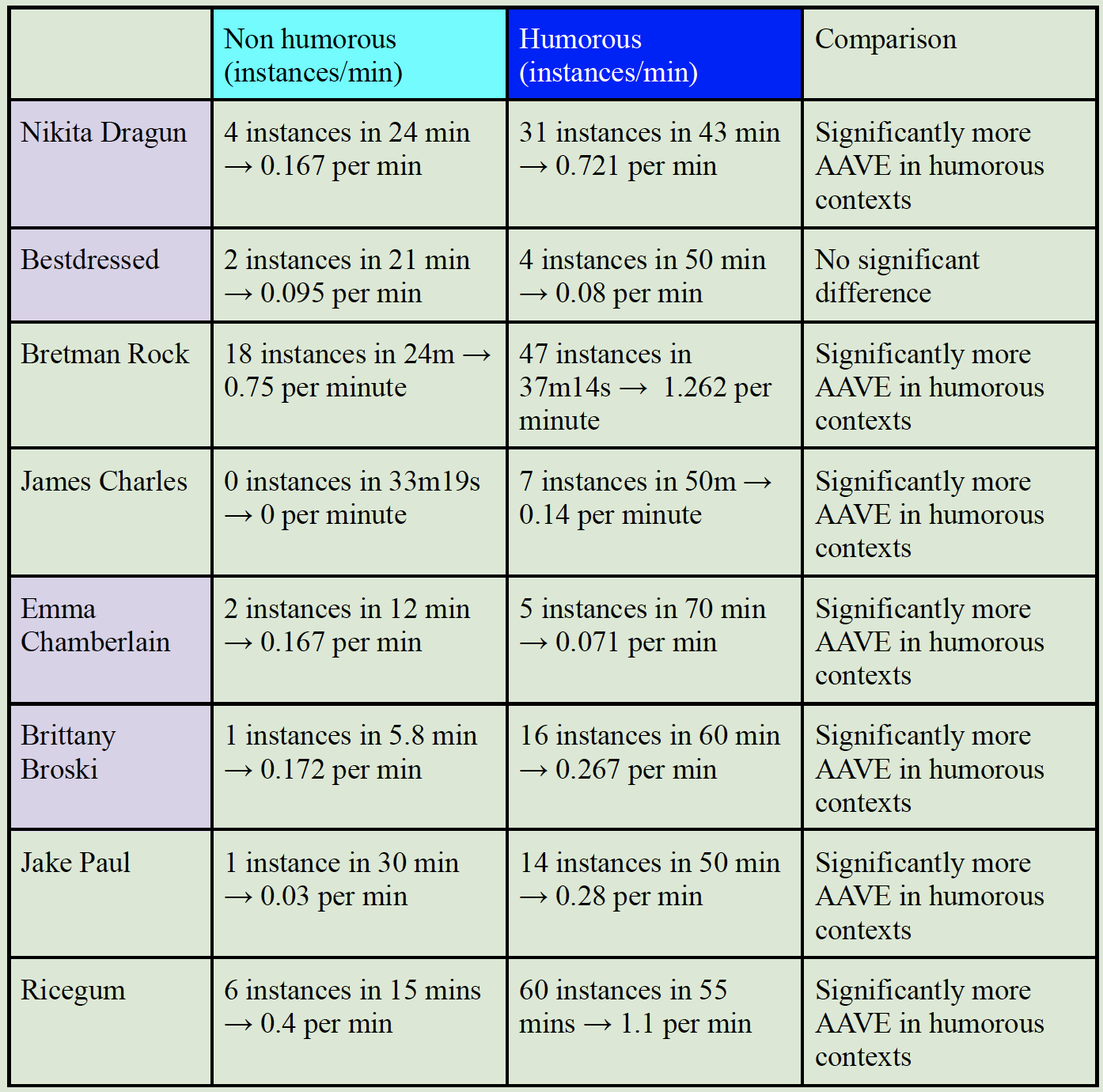
, , ,
Scroll to Top