Ying Hu, Natasha Hughes, Irene Oh, Emily Usami
Language has been a way for people to communicate with one another, allowing individuals to feel a sense of community and belonging. With that, slang has since evolved into a derivative of language that evolves with the generations as a form of conveyance, along with the tools in each generation offering a nuanced wave of how slang progresses. So how do we quantify such an ever-changing way of communication? Our research aims to answer these questions by measuring and comparing the spread of slang among Generation Alpha and Generation X, specifically, how long it takes for this new slang to be adopted and understood. We found that, on average, it generally took Generation Alpha longer to understand their slang but faster to start using the slang after being exposed to it for the first time, compared to Generation X. Additionally, we linguistically analyzed the differences in the slang between both generations and found that Generation X’s slang was easier to decipher and were derived from non-slang terms with similar meaning, while Generation Alpha’s slang was more arbitrarily introduced, particularly through viral content.
Keywords: Slang, social media, Generation Alpha, and Generation X
[expander_maker id=”1″ more=”Read more” less=”Read less”]
Introduction and background
Slang is informal phrases, usually adopted by the youth (Wirasasti et al., 2025). For Generation Alpha, their access to the newest forms of technology and algorithm-driven social media extrapolates the reach of slang (Fatmasari et al., 2025). However, this raises the question of whether people adopt slang as quickly as they are exposed to it.
Technology has been a revolutionary tool in how we communicate, hence we took the generation who grew up with social media and new technology, and compared it with the generation who grew up without social media and older technology. Technology during the time of Generation X consisted of TV and radio, whereas Generation Alpha has technology connected to the global internet via social media (I. Hyderabad & M. Hyderabad, 2025). Some articles also mentioned that shorter, condensed video formats on social media, as well as their algorithms, tended to propagate slang rapidly (I. Hyderabad & M. Hyderabad, 2025; Fatmasari et al., 2025). Additionally, Generation Alpha’s slang derives from visual aspects, creativity, body/facial involvement, and informality compared to Generation X’s slang (Putri et al., 2025). Another study observed that, unlike Generation Z’s slang, Generation Alpha’s slang typically does not enhance daily conversation (Paoleti & Mujahidah, 2025). Though there are studies on Generation Alpha’s slang globally, very few have studied Generation X’s slang terms.
Our project aims to address these research gaps by expanding the information around the relationship between social media and Generation Alpha’s slang terms and usage trends, while adding a new dimension: a comparison to Generation X’s slang trends during their teenage years. This was done through comparing slang terms and spread between English-speaking Generation Alpha (born between 2010-2024) and Generation X (born between 1965-1980) in the United States. Since Generation X did not have social media during their teenage years, we hypothesize a slower spread of their process in slang learning and usage. We also expect to see Generation Alpha’s slang being more random and lacking meaning, since it’s supposedly not used to enhance daily conversation.
Methods
Data was collected in two ways: responses from participants and online video observations, consisting of eight participants representing Generation Alpha (n = 4) or Generation X (n = 4). From the Generation Alpha participants, one participant was an adult who worked closely with Generation Alpha. Interviews were conducted with participants, and their answers were recorded by our team through Google Form surveys. The questions for Gen X participants were asked in the context of their slang experience in their teenage years to ensure consistency and reduce the potential confounding variable of age-related effects on slang usage. Participants were asked about four types of questions:
1. The types of media they used to learn their slang.
2. The average time it took them to understand the slang after first hearing it.*
3. The average time it took them to start using the slang after first exposure to it.*
4. Examples of the slang they used/use.
*Questions 2 and 3 were asked to quantify the spread of slang, and they were created based on Everett Rogers’ Diffusion of Innovation Theory, which explains the adoption of slang and its spread in communities through different sequential stages: knowledge, persuasion, decision, implementation, and confirmation (Wirasasti et al., 2025). Our questions focus on the knowledge and decision stages. The former refers to when an individual learns about the slang term, while the latter stage refers to when the individual decides whether or not they will use the slang term (Wirasasti et al., 2025). For these questions, a few participants reported a time-range answer (containing multiple times, such as days to weeks) when it came to understanding and acquiring slang, so we used an average of the time range for data analysis.
Results/Analysis
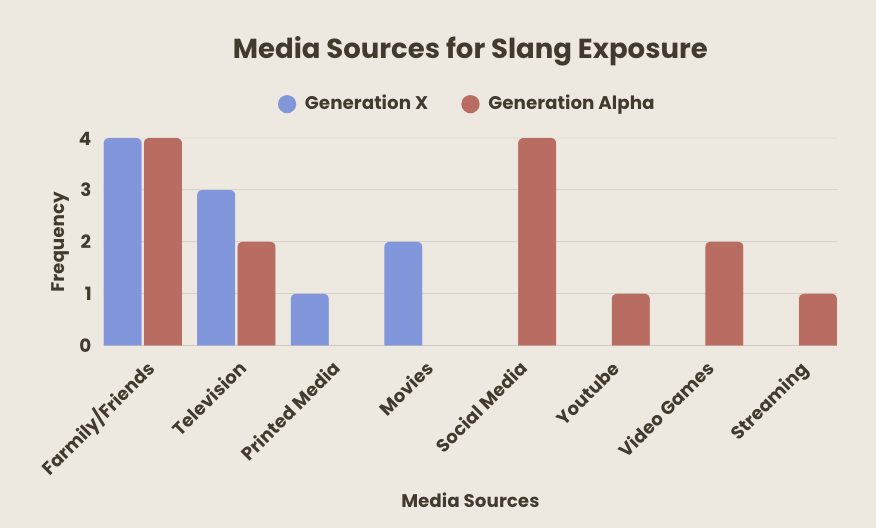
Fig. 1: Graph depicting the sources where both generations first heard of slang terms. The X-axis shows reported sources for slang, while the Y-axis depicts participants’ responses, with the blue bars corresponding to Generation X and the red to Generation Alpha.
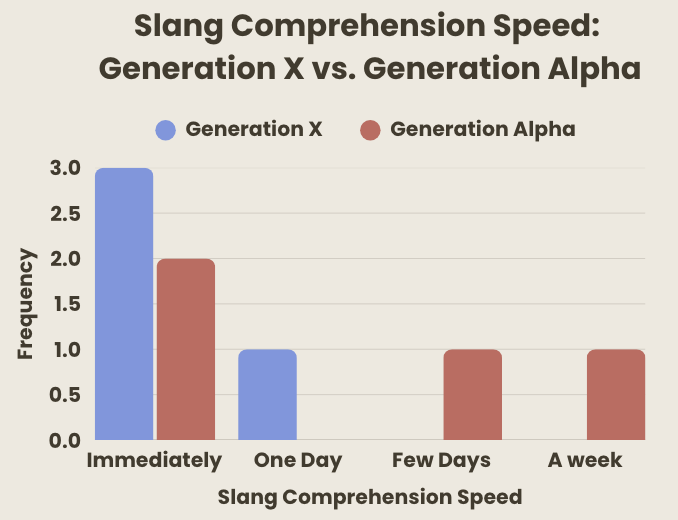
Fig. 2: Graph depicting how fast each generation understood slang after first hearing it. The X-axis corresponds to the time that it took, and the Y-axis corresponds to participant response frequency.
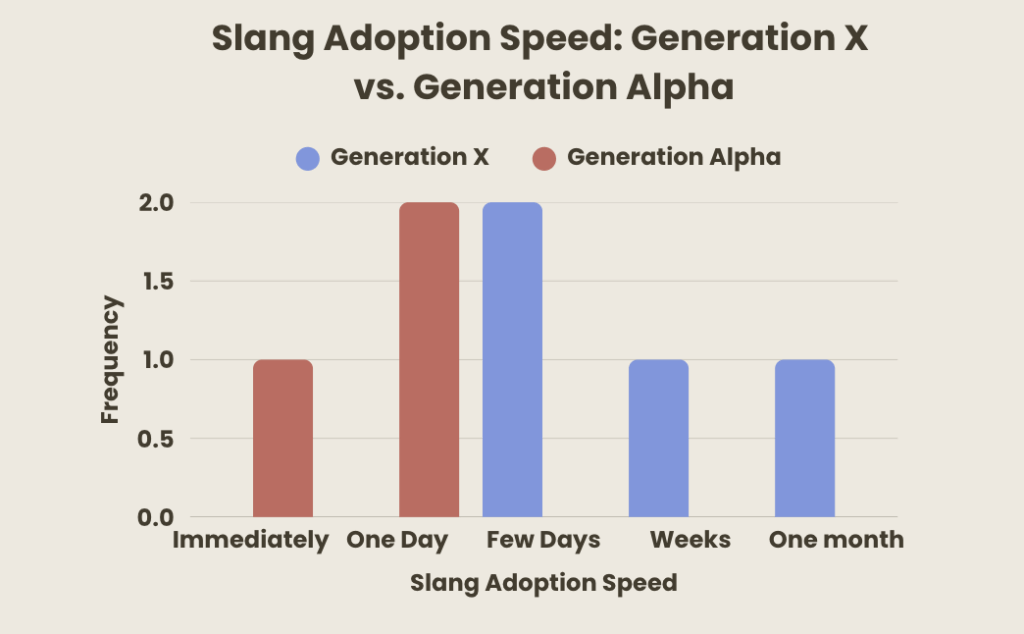
Fig. 3: Graph depicting how fast participants used slang after hearing it for the first time. The X-axis corresponds to a unit of time, and the Y-axis records the participant response frequency.
Figure 1 shows that slang acquisition primarily came from social media for Generation Alpha, and traditional media for Generation X. Previous literature affirms this and the significant impact of social media on Generation Alpha’s slang terms (I. Hyderabad & M. Hyderabad, 2025). According to Figure 3, on average, our Generation Alpha participants used slang faster than Generation X, with a positive correlation to social media. This also aligns with previous literature, possibly indicating that the faster slang spreads, the faster it will be used (Wirasasti et al. 2025). In the interview, one Generation Alpha participant mentioned that slang trends can vary week to week, and new terms can arise weekly or monthly.
Surprisingly, Figure 2 shows a weaker correlation between social media use and the time it took for an individual to understand slang, as Generation Alpha participants reported differing time ranges that it took for them to understand slang. However, Generation X reported that they understood slang within a day. This trend may be explained by analyzing the linguistic differences in examples of slang from both generations presented in Figures 4 and 5. Through our participants’ responses and video observations, we observed that the meaning (semantics) behind Generation X’s slang terms tends to be more direct. Focusing on the morphology of the slang, we noticed Generation X’s slang derived from similar-meaning non-slang words, facilitating the understanding of the slang’s definition. Examples from Figure 4 include “rad” (derived from radical) and “dudette” (derived from dude). On the other hand, Gen Alpha’s slang terms (Figure 5) are more creative and abstract, such as “67,” “sigma,” and “ohio.” It appears as if their slang was more structured randomly, with a random combination of numbers or letters, rather than logically-formed words, since a good amount of Generation Alpha slang, according to our participants, is from online memes. Their slang seemed to focus more on the positive and negative connotations of the term rather than having a definite meaning. One Generation Alpha participant mentioned Italian brainrot terms that “don’t normally make sense but are funny” as an example. In fact, the participant working with Generation Alpha claimed in the interview that individuals of Generation Alpha sometimes start using slang without really understanding it. Despite the linguistic differences, we noticed that some of our slang examples from both generations were acronym-based (“IYKYK” and “PK”).
| Generation X Slang | Definition (from interviews or video observations) |
| Rad | Short for radical – used to mean cool |
| Gnarly | From surfer culture, versatile word used for something extreme, used in both positive (like for something impressive) and negative contexts (something difficult or gross) Used in the movie Fast Times at Ridgemont High (1982) |
| Bod | Referring to “body” in the movie Valley Girl (1983) |
| Hunk | Used in the movie Valley Girl (1983) to refer to hot, shirtless men on the beach |
| Yes way | A way to emphasise yes |
| Dudette | Referring to a girl (related to “dude” for boys) |
| PK | Short for “Player Kill” – used when you are competing against someone or on television two people competing against one another |
| Rad | Short for radical – used to mean cool |
| To the max | To the highest degree possible, often used negatively alongside “grody” (something gross or unappealing): “grody to the max” |
Fig. 4: Slang examples for Generation X from interviews and video observations
| Generation Alpha Slang | Definition (from interviews or video observations) |
| 67 | Various responses: Participant A: Used when someone does something insane or impressive Participant B: Used when the number comes up, rarely used in a sentence Participant C: No specific meaning |
| Sigma | Various responses: Participant A: “like what the heck but dramatic” Participant B: No specific meaning, but usually refers to something good |
| Yap | Talking too much. Non-stop blabbering. |
| Ohio | Used when someone is acting weird. “It’s lowkey an insult to say they’re from Ohio” |
| IFYKYK | Short for “if you know you know” → self explanatory |
Fig. 5: Slang examples for Generation Alpha from interviews and video observations
Discussions/Conclusions
Due to time and availability constraints, our research had some limitations:
1. Because of our small sample size, we cannot conclusively draw a relationship between cause and effect in research conclusions.
2. The responses from our adult participant working with Generation Alpha were based on personal observations rather than in-group knowledge of slang use within the generation.
3. The surveys limit our ability to follow up on Generation Alpha’s answers, which may also cause discrepancies.
Despite the research limitations, our study contributes to sociolinguistic research as it opens the door to further research into exploring how these linguistic and slang patterns may be representative of larger cultural phenomena created by modern globalized media. Our research also collected data on Generation X, their slang, and its connection to technology, which was missing in our literature review, thus suggesting a large gap when it comes to the study of sociolinguistics in older generations. Additionally, through our findings of patterns in the link between technology and slang, it is possible that our findings could also aid the prediction of future slang trends, as technology will continue to advance and change along a trajectory that may reflect on slang.
References/Citations
Fatmasari, A. P., Wardhani, T., Roronias, N. a. A., Oemara, R. P., & Nasywan, F. A. (2025). The influence of TikTok social media on the emergence of Slang language used by Gen Alpha. Kirana., 2(3), 100–106. https://doi.org/10.61579/kirana.v2i3.318
Hyderabad, I., & Hyderabad, R. M. (n.d.). Aclanthology. The Evolution of Gen Alpha Slang: Linguistic Patterns and AI Translation Challenges. https://aclanthology.org/2025.acl-srw.43.pdf
MGM. (2021, August 12). Valley Girl (1983) | “What a hunk” beach scene [Video]. YouTube. https://www.youtube.com/watch?v=yX-ccJlvEPU
Paoleti, V. D., & Mujahidah, N. F. Z. (2025). Youth Language Uncovered: Meta-synthetic Insights Into Gen Z and Gen Alpha Slang. English Review: Journal of English Education,13(1), 9-16. https://doi.org/10.25134/erjee.v13i1.11425
Putri, B. K. B. P., Soraya, N., & Rosalinah, Y. (2025). Sociolinguistic Perspective on Digital Communication: Understanding Gen Alpha language use in TikTok. Golden Ratio of Data in Summary, 5(1), 44–48. https://doi.org/10.52970/grdis.v5i1.886
Sqwuade. (2014, September 21). Jeff Spicoli – Fast Times at Ridgemont High – Gnarly [Video]. Youtube. https://www.youtube.com/watch?v=kW0mi0L83Ek
Wirasasti, S. V., Al Husna, G. T., Alfariz, M. F., Satrio, M., Febriyana, R., & Bangun, S. Z. (2025). The influence of social media on the use of ‘slang words’ among alpha generation. Quantum Journal of Social Sciences and Humanities, 6(SI2), 45-55. https://doi.org/10.55197/qjssh.v6si2.991
[/expander_maker]