Lindsey Byun, Katie Chang, Kelly Cheung, William Udo
On linguistically diverse campuses and locations such as the University of California, Los Angeles (UCLA), bilingual students regularly move between languages as they navigate academic, social, and cultural spaces. Our research explores how code-switching functions not simply as a linguistic phenomenon but as a social practice through which speakers express identity and manage relationships across contexts. Drawing on survey data from bilingual and heritage speakers at UCLA, we examine how often students engage in code-switching, the environments in which it occurs, and how speakers perceive the relationship between language choice and personal identity. Our research also takes into consideration how factors like comfort level, perceived judgement, and social setting influence when and why students switch languages. Previous research has shown that code-switching is often stigmatized despite being a widespread and meaningful communicative strategy (Ali, 2023). Building on this work, we investigate whether similar patterns emerge among bilingual college students navigating multilingual environments. Our findings suggest that code-switching is closely tied to feelings of belonging, in-group solidarity, and identity expression, highlighting how language choices reflect the complex social dynamics of multilingual university communities.
Keywords: Code-switching, bilingual speakers, heritage speakers, identity, language ideology, linguistic anthropology
[expander_maker id=”1″ more=”Read more” less=”Read less”]
Introduction and background
Code-switching, the practice of alternating between two or more languages within a conversation, is a common communicative strategy among bilingual speakers. Rather than being random or accidental, patterns of code-switching are often shaped by social context, relationships between speakers, and the meanings speakers wish to convey (Liu, 2018). In multilingual environments such as universities, students frequently shift between languages when interacting with different audiences, including classmates, friends, family members, or coworkers. These shifts can serve multiple purposes, from expressing cultural identity to signaling social belonging or navigating different social expectations. This research focuses on bilingual and heritage speakers at UCLA, a campus characterized by significant linguistic and cultural diversity. Many students at UCLA grow up speaking multiple languages or dialects and regularly move between them in everyday interactions. As a result, the university provides a valuable setting for examining how code-switching operates within multilingual communities and how language choices reflect broader social dynamics. Our research asks: What social, situational, and linguistic factors lead bilingual students at UCLA to code-switch, and how do they use code-switching to manage social identity across different contexts?
Within many communities, however, code-switching is often frowned upon. Heritage speakers – individuals raised in households where a non-dominant language is spoken but educated primarily in an English dominant environment – are frequently told that mixing languages reflects the lack of fluency. These attitudes reflect broader language ideologies that privilege monolingual norms and treat bilingual language practices as deviations from a standard (Ali, 2023). Yet empirical research suggests that code-switching serves important communicative and social functions. For instance, speakers may switch languages to fill lexical gaps, quote others, emphasize emotional expression, or signal group membership. Ali’s (2023) study of heritage Spanish speakers found that participants engaged in codeswitching frequently across social contexts, even when they personally expressed negative attitudes toward the practice. This disconnect shines light on the tension between language ideologies and actual linguistic behavior.
Other research has explored the cognitive and interactional dimensions of code-switching. Hofweber, Marinis, and Treffers-Daller (2020) propose that different types of code-switching engage distinct cognitive control mechanisms. Their dual-control framework draws a line between alternational switching, in which speakers move clearly between languages, and dense code-switching, where languages are heavily mixed within the same utterance. These distinctions suggest that code-switching patterns are not only socially meaningful but also cognitively structured.
In everyday interactions, code-switching isn’t just about managing two linguistic systems but also about responding to social cues and relationships as well. The same speaker could possibly shift differently depending on the space they are in or the people they are interacting with, implicating that these patterns are shaped as much by social awareness as they are by cognitive processes. This makes it pretty important to look beyond structure and consider how code-switching is experienced by speakers themselves, particularly in environments where identity and belonging are constantly being negotiated.
Building on this literature, our research investigates how code-switching relates to identity among bilingual and heritage speakers at UCLA. Specifically, we explore whether speakers who code-switch more often report a stronger connection between language use and identity, and whether social environments, like friend groups, classrooms, or professional settings, shape speakers’ comfort levels when they’re switching languages. By comparing patterns across bilingual and heritage speakers, this research strives to better understand how multilingual students use language as an outlet for expressing belonging, navigating social expectations, and negotiating identity in university settings.
Methods
To go into how code-switching relates to identity and social context, we collected survey data from bilingual and heritage speakers at UCLA. UCLA provides a particularly relevant setting for this research because of its diversity, where many students are regularly navigating multiple languages across different environments. Participants were recruited from the UCLA student community and self-identified as either bilingual speakers or heritage speakers of a language besides English.
Data were collected through a structured online questionnaire designed to capture both language background and patterns of language use across different contexts. The survey included questions about participants’ linguistic backgrounds, including the languages they speak, their self-identified language status (bilingual or heritage speaker), and their perceived proficiency in each language. Participants were also asked about how frequently they engage in code-switching and the types of situations in which switching occurs, such as conversations with friends, family members, or classmates.
To better understand the relationship between language use and identity, the questionnaire also measured participants’ comfort levels when code-switching across different environments. Respondents rated their comfort levels in various contexts using Likert-scale responses (e.g., from “very uncomfortable” to “very comfortable”). Additional questions asked participants whether they perceived social judgement when mixing languages and whether they felt that their language use was connected to their personal or cultural identity.
The survey therefore focused on several observable elements of communication: the frequency of code-switching, the social contexts in which switching occurs, participants’ perceived comfort levels, and their perceptions of identity and social evaluation. These variables allowed us to examine how linguistic behavior and social experience interact in multilingual environments.
After data collection, responses were analyzed using descriptive analysis. We examined correlations between code-switching frequency, comfort levels, and identity-related responses, and compared patterns across bilingual and heritage speakers. By identifying similarities and differences across these groups, the analysis strived to reveal how social context and linguistic background influence when and why students code-switch.
Results/analysis
To explore and analyze the relationship between code-switching and cultural identity among bilingual and heritage speakers, these charts were created to assist visualizing the correlations across four key components.
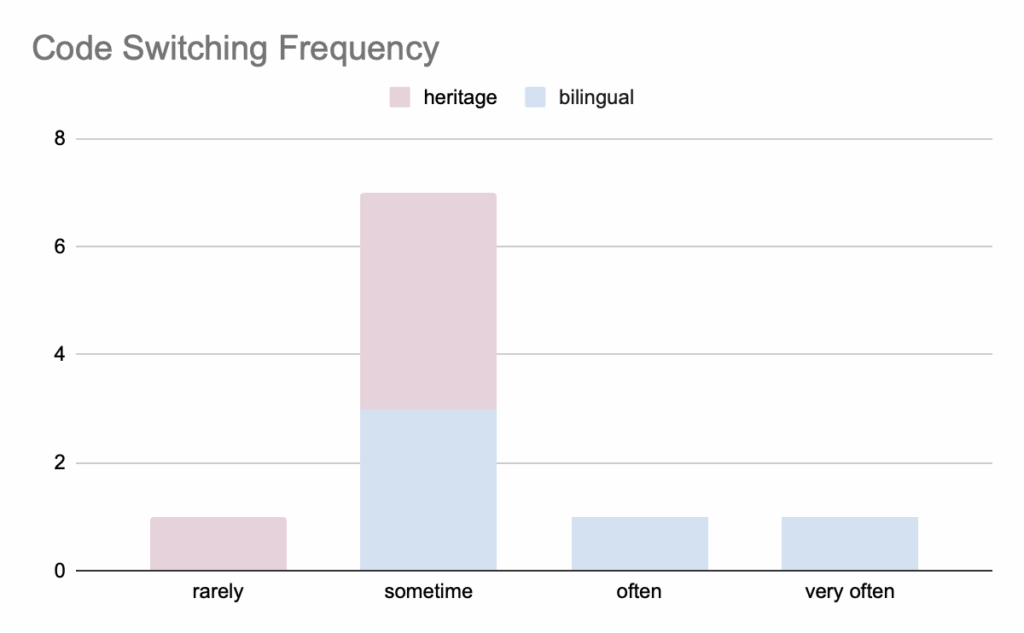
Figure 1 shows how often participants switch between languages. Most answered “sometimes” regardless of whether they identified as heritage and bilingual speakers. This suggests that code-switching is best understood as a situational social strategy. The distribution hints that frequency of the second language usage is higher among bilingual speakers compared to heritage speakers, although the overall pattern remains similar across both groups.
<Figure 1. Code Switching Frequency>
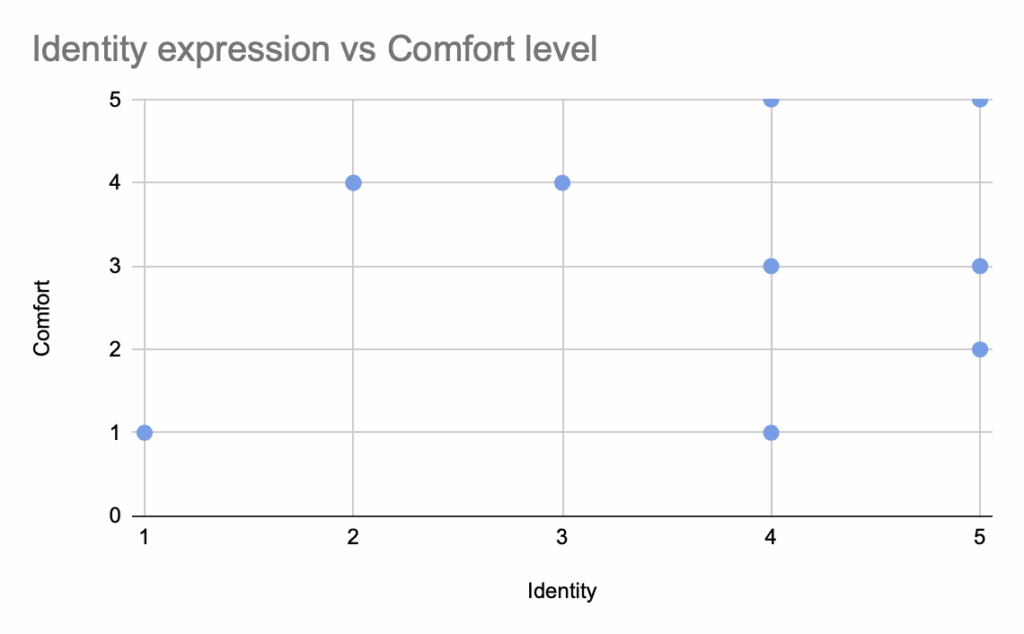
The relationship between identity and communication is shown in Figure 2 – Identity expression vs. Comfort level. This graph is to examine whether participants who see code-switching as part of their identity also feel comfortable using it. Each point represents a participant’s response, the overall pattern suggests that stronger identity alignment tends to be associated with higher level of comfort, especially in bilingual speakers.
<Figure 2. Identity expression vs Comfort level>
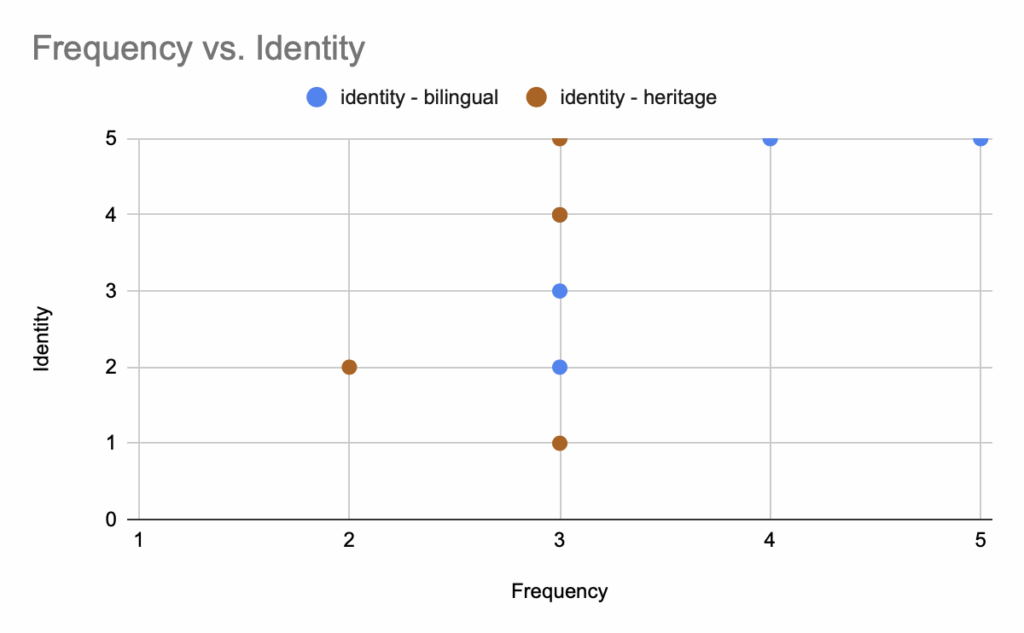
A similar correlation is observed in Figure 3. Frequency vs. Identity graph, which compares how often participants code-switch and how strongly they associate it with their identity. Participants who reported higher frequency of code-switching generally showed moderate to high identity scores. The relationship between frequency and identity suggests that individuals who code-switch more frequently may also view it as a meaningful part of their identity but further investigation is needed as the spread suggests that frequency is not the sole thing that determines the identity.
<Figure 3. Frequency vs. Identity>
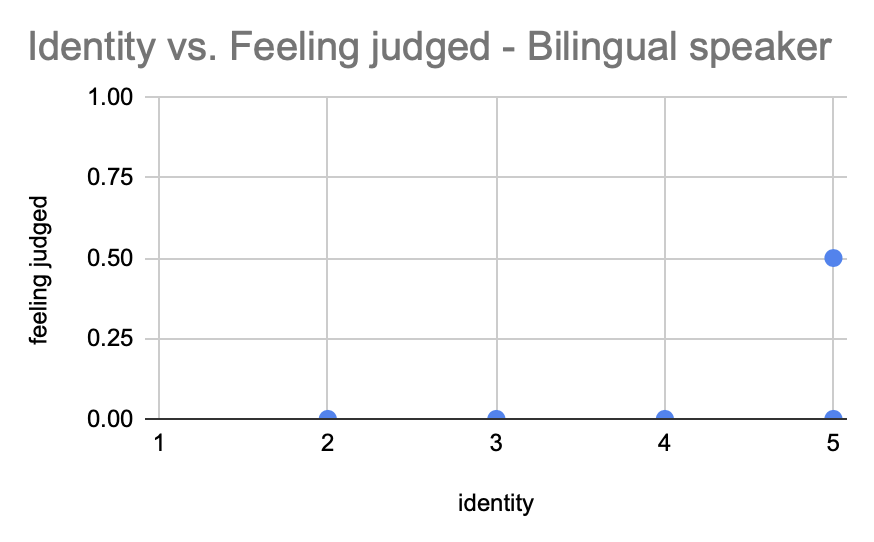
Figure 4 – Identity vs Feeling Judged is to explore the correlation between identity and experiences in social judgment. The y-axis is the scale of perceived judgement: 0 = not judged, 0.5 = sometimes, and 1 = yes. Bilingual and heritage speakers show different distributions. Bilingual speakers largely cluster around “not judged”, while heritage speakers show a more dispersed pattern. The difference suggests that linguistic background may shape social experience, likely due to differing expectations on their language ability in addition to how code-switching relates to cultural identity and the role of language ideology and social attitudes.
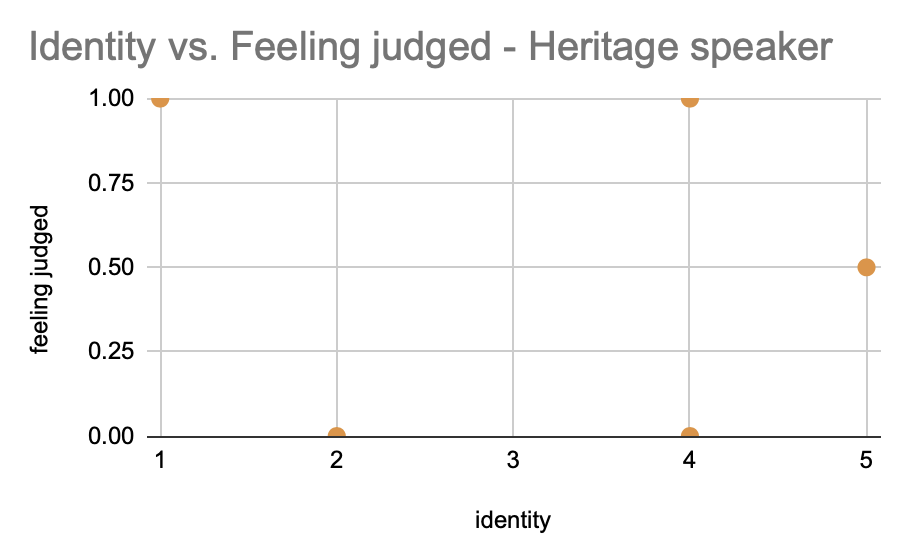
<Figure 4 & 5. Identity vs. Feeling judged – Bilingual and Heritage speakers>
These results and analysis point to a broader conclusion that code-switching operates at the intersection of linguistic ability, identity, communication, and social perception. Code-switching is beyond linguistic behavior, but a more complex social practice shaped by community, context, and the speaker’s relationship to their languages and identity. The findings demonstrate how code-switching and identity are deeply interconnected, and further influenced by other factors such as comfort and how speakers are perceived by others.
Discussion and conclusions
Our findings show that code-switching among bilingual and heritage speakers at UCLA is a socially meaningful and context-dependent practice, challenging the idea that it is a reflection of language ability.
Based on our data, participants who viewed code-switching as part of their identity also reported high comfort levels, especially in familiar group settings such as with friends and family. Our results demonstrate a strong association among code-switching, identity, and comfort levels. As languages provide unique mediums for expression and communication, code-switching can serve as a way to express belonging and shared cultural identity. However, most participants also reported that they code-switch only “sometimes.” Depending on their comfort level in a given circumstance, code-switching is not always freely expressed. Instead, individuals may adjust their language use based on their comfort level to the audience and perceived environment.
We also found that the relationship between code-switching frequency and identity was not consistent for all participants. Although higher frequency in code-switching was associated with stronger alignment with identity, other factors such as personal experience and social environment played an important role. The differences in perceived judgement experienced by bilingual and heritage speakers suggest that language ideologies influence how comfortable individuals feel when using multiple languages. For some participants, particularly those in multilingual environments, code-switching tends to be a more comfortable and natural way of speaking, due to individuals’ exposure to changing speech patterns across languages. On the other hand, predominantly monolingual environments may be less familiar with how each language presents different ways of communicating identity and meanings—an ability inherent to code-switching. As a result, these speakers may experience more resistance, including judgement and negative attitudes towards the practice of code-switching.
Overall, our findings support the idea that code-switching is a communicative strategy for conveying social identity and navigating between different social contexts. However, it is important to note that these conclusions are based on self reported data. While our study primarily reflects participants’ perceptions and investigates their correlation between code-switching frequency and environment, these findings are specific to our study’s participants and do not fully capture how code-switching happens or how it is used in real world interactions. Future research can incorporate observational or conversational data to better capture how code-switching occurs in practice.
Recognizing code-switching as a strategic and expressive form of communication also has significant implications beyond this study. In educational settings, this suggests that encouraging multilingualism, rather than prioritizing the use of a single language, can strengthen students’ communication skills and sense of identity. By respecting individuals for who they are, recognizing code-switching allows educators to better support students through more inclusive learning environments. For the broader public, this recognition can deepen awareness of how social relationships and identity are closely linked to an individual’s language use. Therefore, reframing code-switching as a skill, rather than a deficiency, can promote inclusive attitudes toward linguistic diversity. Ultimately, our study shows that code-switching is a useful communication tool that reflects identity, relationships, and linguistic adaptability.
Bibliography
Ali, F., (2023) “Code-Switching Among Heritage Spanish Speakers: Attitudes, Practices, and Pedagogical Implications”, Critical Multilingualism Studies 10(1), 1-35.
Hofweber, J., Marinis, T., & Treffers-Daller, J. (2020). How different code-switching types modulate bilinguals’ executive functions: A dual control mode perspective. Bilingualism (Cambridge, England), 23(4), 909–925. https://doi.org/10.1017/S1366728919000804
Liu, H. (2018). Intra-speaker variation in Chinese–English code-switching: The interaction between cognitive and contextual factors. The International Journal of Bilingualism : Cross-Disciplinary, Cross-Linguistic Studies of Language Behavior, 22(6), 740–762. https://doi.org/10.1177/1367006917698586
Olson, D.J. (2024). Bilingual Language Dominance and Code-switching Patterns. Heritage Language Journal.
Sharma, Devyani, and John R. Rickford. 2009. AAVE/Creole Copula Absence: A Critique of the Imperfect Learning Hypothesis. Journal of Pidgin and Creole Languages 24(1): 53–90. Accessed July 9, 2025.
[/expander_maker]