Tiffany Cho, Dana Greenberg, Yitao Li, Bea Roxas, Chloe Sylva
Have you ever made a TikTok reference to a friend or acquaintance that instantly created a bond through the shared recognition of a reference? Alternatively, have you ever been met with confusion or judgment when people don’t understand your reference? In the digital age, social media often has a negative reputation for creating a culture that alienates individuals from their communities. We wanted to push back against this stereotype by exploring how social media, particularly TikTok, actually creates an ideal hub for generating an online community solely through references and shared jokes. Even though social media deviates from the traditional modes of communication, it pioneers a new era of community building and a core pillar of the modern digital age.
Keywords: Social media, TikTok, online culture, digital age, communication, algorithm
[expander_maker id=”1″ more=”Read more” less=”Read less”]
Introduction and Background
In present-day society, increased social media usage has completely transformed language. Through digital platforms, language spreads rapidly and develops new meanings due to a shared online culture. On social media apps, especially TikTok, memes and short phrases are integrated into videos and comment sections, becoming a means of communication for users. Although outsiders may find it difficult to understand this online culture, those who understand it significantly value it. As TikTok has tremendously expanded with the number of individuals utilizing the platform daily, the purpose of the comment sections has changed. Comment sections have become spaces where users bond with one another, as users share reaction images and humorous phrases that are regularly circulated in the app. The comment sections act as an inside joke, allowing strangers to connect with one another and form communities through a shared understanding of modern-day language and references.
Indexical meaning, the idea that language can indicate identity, shared knowledge, and social affiliation beyond its literal meaning, explains this phenomenon. For example, phrases such as “It’s giving…” or “Wait, I’m actually cooking” typically originate in a specific context. However, as they spread across TikTok, they take on a broader social meaning. When a user sees the phrase outside of the original content and understands the meaning, it signifies that they belong to the shared online cultural community. Zappavigna (2011) finds this concept to be true in his research. In his article, he illustrates how a shared understanding of language leads to the formation of loose online communities. Moreover, further research on Gen-Z language underscores the idea that shared language on TikTok establishes social bonds and a common digital identity. This process is strengthened by TikTok’s algorithm, as personalized feeds are created based on each user.
Our project focuses on the intersection of TikTok comments and the formation of online communities among strangers. In particular, we examine whether different comments, such as relatable sayings, popular phrases, or reaction photos, lead to more engagement than others. From this research, we hope to understand how “instant inside jokes” function in digital spaces and what they reveal about users and language as a whole.
Method
We explored which comment types seem to outperform others in increasing engagement and strengthening online communities. Our study investigates how certain types of TikTok comments generate engagement and function as “instant inside jokes” among users who do not know each other. By analyzing 100 TikTok videos and their top comments, our research categorizes comments into types such as funny/witty statements, relatable observations, reaction photos, and popular phrases. Engagement was measured through the combined like and reply count of the comment (its “engagement ratio”) to the total number of comments and likes the video received. Our findings suggest that TikTok comment sections rely on quick, culturally recognizable linguistic signals that allow users to participate in shared humor and identity expression, constructing fleeting but meaningful online connections, or “instant inside jokes.”
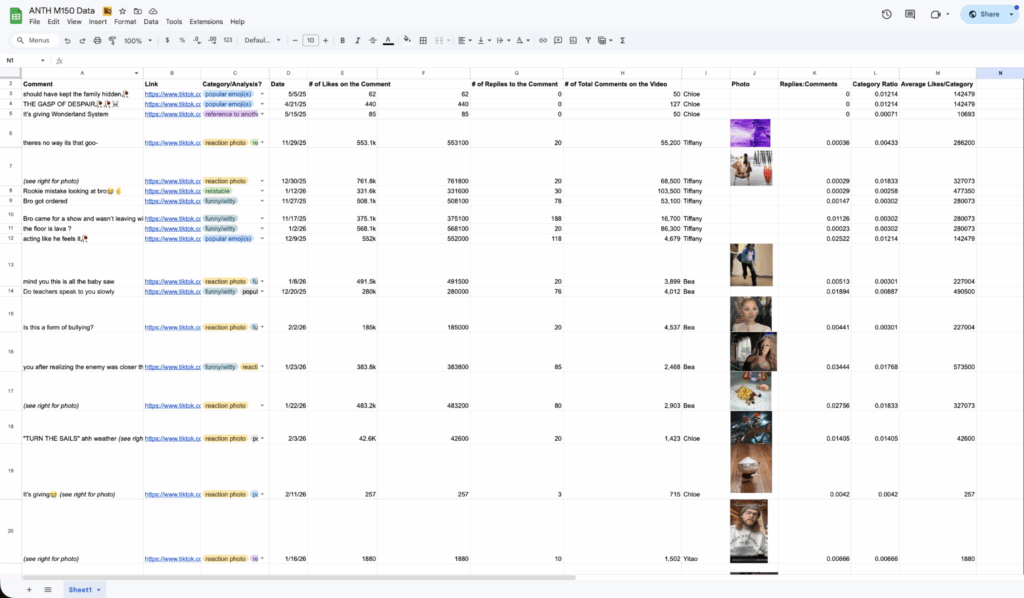
A look into our data spreadsheet of 100 Tik Tok videos’ top comments
Results and Analysis
Level of engagement was determined by average likes per category and average reply ratio per category. To calculate these variables, comments were separated by category or category combination (e.g. “Reaction Photo” and “Funny/Witty”). For the average likes per category variable, an Excel function summed the total likes across top comments within each category and divided by the total number of TikToks in that category. Higher averages indicated higher engagement with the category. To compute the average reply ratio per category variable, an Excel function summed the total number of replies to the top comment for TikToks in each category and divided by the average of total comments per TikTok in that category. Higher reply ratios signified that a larger percentage of the comment section engaged in the respective category.
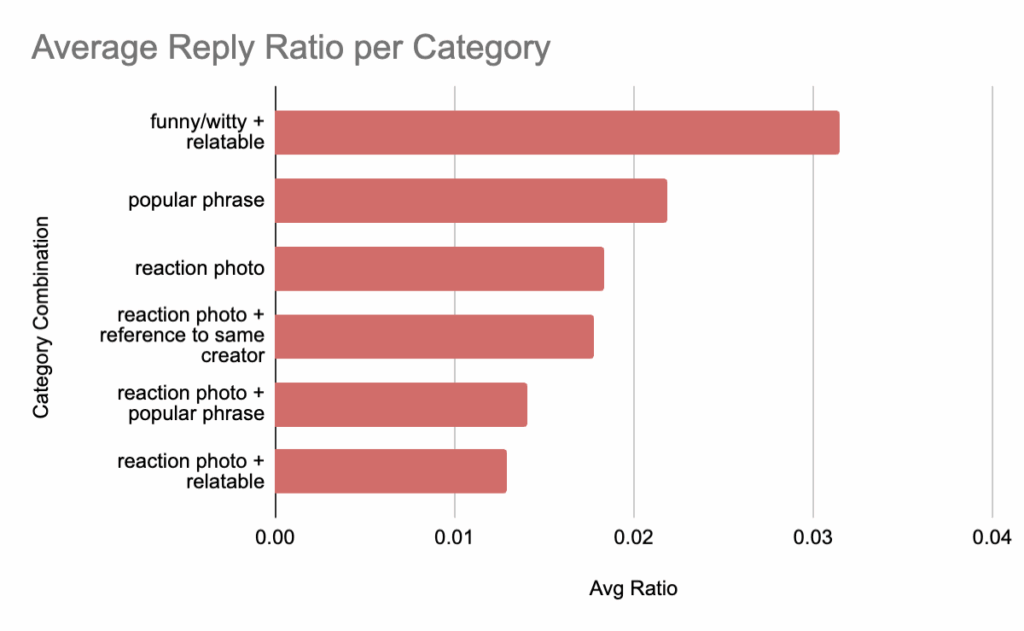
Figure 1. Category Reply Ratios
These analyses were applied to 100 TikTok videos (see Figure 1), and the results demonstrated that content categorized as Funny/Witty and Relatable generated the most engagement. On average, 3.2% of the comment section replied to the most popular comment. Popular phrases also generated a significant amount of engagement, with an average of 2.2% of the comment section replying to the most popular comment. When used to supplement text, reaction photos also generated a high number of replies. Specifically, this occurred when used in conjunction with text referencing videos made by the same creator (1.77%), popular phrases (1.4%), and relatable statements (1.29%). For example, the comment “I turn into her when a man raises his voice in the slightest,” a funny/witty and relatable statement responding to a video about internet star Bhad Bhabie as the creator’s “alter ego,” which generated replies from 7.7% of the comment section.
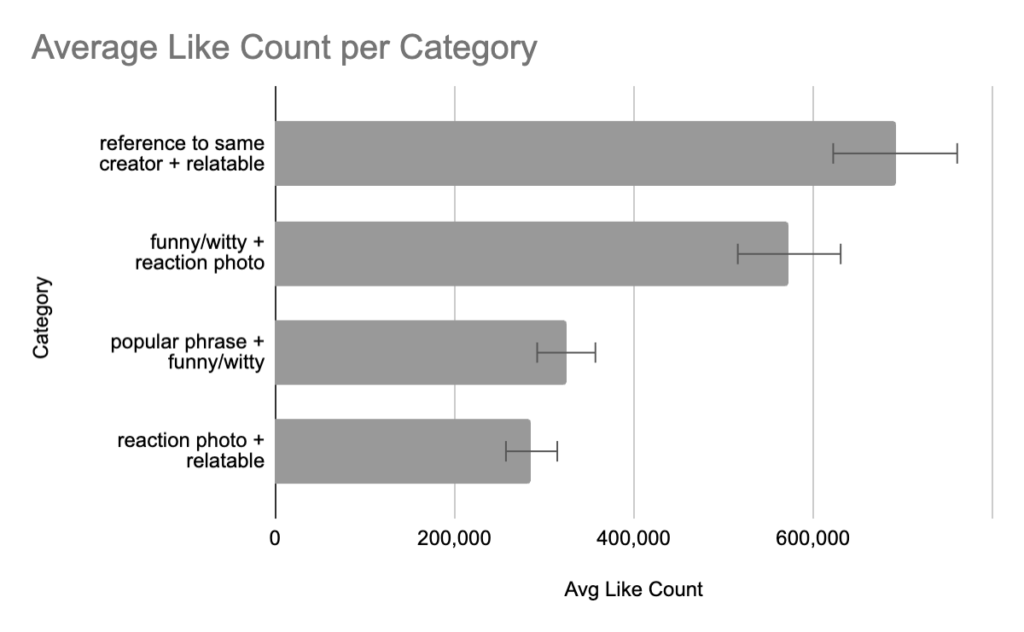
Figure 2. Category Like Counts
General trends concerning like count included higher average for relatable TikTok comments that referenced the creator posting the video (691.7k likes), as well as comments that paired a funny/witty statement along with a reaction photo (488k likes). In one example, the relatable comment “THE SMARTEST MOVE EVER WHAT,” posted in response to a couple playing a game, generated 1.3 million likes. Reaction photos were also shown to generate engagement, with the one image of Vlad from Hotel Transylvania generating 1.1 million likes, likely due to the character’s widespread recognition and its use in explaining complex emotions or opinions.
Discussion
The findings from our analysis highlight how TikTok comment sections function as dynamic spaces for rapid community formation, challenging the common stereotype that social media primarily alienates or isolates individuals. Instead, our results suggest that TikTok fosters a unique kind of social interaction rooted in shared language practices, where users feel an immediate sense of belonging through “instant inside jokes”. The high engagement levels associated with funny/witty and relatable comments, which saw 3.2% of the comment section replying to the top comment, show that humor and shared experiences are central to this connection. These comments act as signals of cultural awareness, allowing strangers to recognize each other as part of the same digital in-group.
This phenomenon connects closely to the concept of indexical meaning, where language indicates social affiliation beyond its literal definition. When users engage with phrases, formats, or reaction images widely recognized on the app, they are not just responding to content; they are performing their membership within a broader digital community. For example, the highest average like counts (691.7k) were tied to relatable comments referencing the creator. This suggests that engagement increases significantly when users feel included in something familiar, whether a recurring joke, a known personality, or a recognizable pattern. In this way, TikTok comments become a space where meaning is actively created and negotiated rather than simply consumed.
The strong performance of combined comment types, such as reaction photos paired with witty or relatable text, highlights the multimodal nature of communication on the platform. Users draw from both visual and linguistic tools to strengthen emotional impact. Reaction images, such as the widely recognized character Vlad from Hotel Transylvania (which generated 1.1 million likes), function as a shorthand for complex emotions. By supplementing text with these culturally recognizable images, users make it easier for others to understand and respond, contributing to the “engagement ratio” and the rapid spread of shared jokes.
At the same time, these “instant” communities are often short-lived. The fast pace of TikTok means that trends and phrases change quickly, requiring users to stay constantly engaged to remain “in the know”. While those who understand the culture significantly value it, this creates a potential downside where outsiders may find it difficult to navigate the references. Consequently, the same linguistic signals that build community also create boundaries between those who possess the shared knowledge and those who do not. Our study demonstrates that TikTok comment sections are active environments where culture and connection are constantly being generated. Through humor, relatability, and shared references, users form fleeting but meaningful online connections that reflect a new era of community building in the digital age.
References
Eghtesadi, M., & Florea, A. (2021). Examining TikTok’s potential for community-engaged digital knowledge mobilization with equity-seeking groups. Journal of Medical Internet Research.
Jose, A. I., Yuyun Nurulaen, & Toneng Listiani. (2025). Exploring Slang Words on Social Media TikTok in 2024. Linguistics and Elt Journal, 13(1), 208. https://doi.org/10.31764/leltj.v13i1.31704
Maddox, Jessica, and Fiona Gill. Assembling “Sides” of TikTok: Examining Community, Culture, and Interface through a BookTok Case Study. Social Media + Society, vol. 9, no. 4, 2023, https://doi.org/10.1177/20563051231213565
Nurhayati, Iis Kurnia, and Aliyya Rahma Putri. Exploring Cyberculture: A Virtual Ethnographic Perspective on Generation Z Slang on TikTok. Jurnal Sosioteknologi, vol. 23, no. 3, 2024, pp. 400–415, https://doi.org/10.5614/sostek.itbj.2024.23.3.8
Situmorang, Johana Tri Lovely, et al. “The Influence Of Slang Use On Teenagers’ Communication Patterns On Social Media.” Journal of Learning and Teaching, Sept. 2024, pp. 61–65. ejournal.reysha.org, https://doi.org/10.70692/jmkzty54.
Ugoala, Bibian. Generation Z’s Lingos on TikTok: Analysis of Emerging Linguistic Structures. Journal of Language and Communication, vol. 11, no. 2, Sept. 2024, pp. 211–224. https://doi.org/10.47836/jlc.11.02.08
Zappavigna, M. (2011). Ambient affiliation: A linguistic perspective on Twitter. New Media & Society, 13(5), 788–806. https://doi.org/10.1177/1461444810385097
[/expander_maker]