Exploring Hegemonic Language: Its Impact on Insults in Media, Rap Battles, and Lyricism

Isabella Chaves, Amee Davis, Amanda Layfield, Anna Lytz, Nina Grilli

This study delves into the investigation of the intersection of gendered language, hegemonic masculinity, homophobia, and social class structures found in hip-hop lyrics. Inspired by the insights of linguistic anthropologist H. Samy Alim, we explore the manifestation of “lyrical freedom” as both oppressive and liberating within the genre. Our research analyzes data from live rap battles and pre-recorded songs which allows us to understand the strategic use of language used to dominate one’s opponent. We highlight examples such as 21 Savage’s controversial lyricism in the “XXL Freshmen Cypher ” and A$AP Rocky’s use of homophobia and classism in rap battles. Our research ultimately displays how the word choice and phrases used within these examples are misogynistic and homophobic, a routinely found element in hip-hop culture. We too discovered an emergence of classist language in these spaces. Through this interdisciplinary approach, we aimed to evaluate the complex interplay between linguistic expression, cultural identity, and social power dynamics within the hip-hop community.

[expander_maker id=”1″ more=”Read more” less=”Read less”]

Introduction and Background

Linguistic Anthropologist H. Samy Alim once stated, “Lyrical freedom is both oppressive and liberating” (Alim, 2023). Our research is inspired by Alim, whose work is centered on lyrical analysis with a specific focus on Black language and hip-hop culture. More specifically, we are inspired by his work on the cis-heteropatriarchy1. Our research centers around the use of words and phrases in hip-hop and their role in perpetuating oppressive language.

Our study employed a multifaceted approach to investigate the effects of hegemonic language2 in hip-hop culture. Firstly, we conducted an in-depth examination of impromptu rap battles, where we observed live performances to analyze the spontaneous use of language. This allowed us to capture the raw, unfiltered expressions of rappers in real-time settings, providing valuable insights into the prevalence and nature of hegemonic language. Secondly, we undertook a comprehensive analysis of contrived lyrics from pre-recorded hip-hop songs. By scrutinizing the choices made by rappers in their lyrics, we aimed to understand the patterns and trends in the use of misogynistic and homophobic language. Specifically, we focused on prominent examples such as the “XXL Freshman Cypher,” a renowned platform for emerging rap talents, to gather insights into the stylistic variations prevalent in hip-hop culture.

Within the landscape of hip-hop culture, one notable phenomenon is the cipher—a gathering where rappers engage in spontaneous performances over a shared beat, surrounded by other rappers. The cipher produces a unique call-and-response environment. The setting of ciphers as a performance both enables and protects rappers in perpetuating oppressive remarks, specifically sexism and homophobia. Sexism in lyricism is a rather common phenomenon used to be successful in the hip-hop community and involves “putting one’s opponent into a female passive role,” (Dundes et al. 1970). Our team proceeded to investigate different data sets of lyrics, both improvised and pre-recorded, to see how sexism and homophobia are weaponized.

Methods

In examining impromptu rap battles and contrived lyrics, we conducted a thorough literature review to contextualize our research findings. We synthesized insights from diverse sources, such as studies by linguistic anthropologists such as H. Samy Alim. His work on hip-hop cultures and language politics informed our theoretical framework. For instance, Alim’s study, “Global linguistic flows: Hip hop cultures, youth identities, and the politics of language” (2009), provided valuable perspectives on the cultural dynamics found within hip-hop language. Our data from impromptu rap battles, contrived lyrics, and scholarly literature, seeks to provide a nuanced understanding of the impact of hegemonic language in hip-hop culture.

Results and Analysis

First, the research focused on oppressive language within impromptu rap battles by analyzing, “XXL Freshmen Cypher”. These performances are notorious for hosting up-and-coming rappers to display their talent. In 2016, 21 Savage took to his part and freestyled, “Pulled up on your bitch, she suck my dick, and then you kiss her,” to which Lil Uzi Vert immediately reacts with “Goddamn” (XXL, 2016, 02:43). 21 Savage’s line appears to be a homophobic diss, mocking the woman’s partner for “technically” kissing 21 Savage’s genitals. The swift positive reactions from other rappers allowed 21 Savage to continue his verse, albeit without revisiting the subject of homophobia and inadvertently perpetuating misogyny.
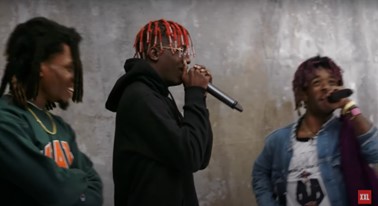
Denzel Curry, Lil Yacthy, and Lil Uzi Vert’s reactions to 21 Savage’s line (XXL, 2016, 02:44).

Through further exploration of homophobic and misogynistic word use, this example provides us insight into the strategies used to be successful in a hip-hop battle: “Okay, let’s start out with Deray, ‘cause he’s gay. Fuck that. Let’s talk about his dreads. He got those on eBay” (D-Wreck, et. al., 2013, 16:51). We can see how Rocky utilizes strategies such as homophobia and classism to make his opponent inferior. A line as simple as “let’s start out with Deray, ‘cause he’s gay,” elicits a positive response from the audience highlighting the success of using oppressive language. Homophobia is consistently weaponized to put one into a superior position thus insinuating that being gay is inferior. Rocky’s comment regarding Deray getting his dreads on eBay also suggests an element of classism. It seems that buying a potentially second-hand or cheaper item is framed with negative connotations. Another lyrical device used in rap battles is the assimilation with expensive items and its association with dominance. Overall, we can see in this example how A$AP Rocky attempts to emasculate his opponent and reinforce his status through homophobic and classist language.

It is apparent that these themes are used in lyrical hip-hop just as often as in rap battles. Moreover, their use is employed purposefully in both cases: to boost their status as well as put others down. For example, a lyric from Lil Wayne’s aptly named “Gonorrhea” reads “Life’s a bitch, naw, better yet a dumb broad” (Wayne, L, 2010, 00:55). This line demonstrates misogynistic language, taking a common phrase and using it to demean women by stating, “dumb broad”. This is but one instance of a common pattern in hip hop in which word choice is key in the development and maintenance of an idea of one’s “higher status”. Ultimately, this device and use of gendered language found within lyrics about contracting a venereal disease from a woman is used to reinforce the notion that Lil Wayne is better than the peripheral women in his life.

Discussion and Conclusion

The prevalent use of oppressive language within hip-hop songs and impromptu freestyle battles suggests how artists can establish a sense of dominance through oppressive language. The language not only embodies a quest for victory but upholds existing power structures. In cases where gendered and homophobic language is weaponized, we are able to see the reinforcement of the cis-heteropatriarchy—functioning to frame femininity and homosexuality as non-normative behavior. With those who use hegemonic and oppressive language in these spaces generally being cisgender straight men, achieving dominance can be seen as authenticating one’s masculinity. Therefore, through our sample of data, we are able to see themes such as misogyny, homophobia, and classism present in hip-hop culture. These themes ultimately manifest in oppressive ways through the use of hegemonic language which uphold notions of existing hierarchies.

Footnotes

1 An ideological system that naturalizes normative views of what it means to ‘look’ and ‘act’ like a ‘straight’ man and marginalizes women, femininity, and all gender non-conforming bodies that challenge the gender binary, i.e., how cis-heteropatriarchal structures are formed and maintained (Alim 2018).

2 An umbrella term meant to encompass language that frames another individual as inferior, while reinforcing the others status in a social context e.g. sexist, homophobic, and classist language.

References

Alim, H. S., Ibrahim, A., & Pennycook, A. (2009). That’s All Concept; It’s Nothing Real: Reality and Lyrical Meaning in Rap. Global linguistic flows: Hip hop cultures, youth identities, and the politics of language. (pp. 195-212). Routledge.

Alim, H. S., Lee, J., Carris, L. M., & Williams, Q. E. (2018). Linguistic creativity and the production of cisheteropatriarchy: A comparative analysis of improvised rap battles in Los Angeles and Cape Town. Language Sciences, 65, 58–69. https://doi.org/10.1016/j.langsci.2017.02.004

Dundes, A., Leach, J. W., & Özkök, B. (1970). The Strategy of Turkish Boys’ Verbal Dueling Rhymes. The Journal of American Folklore, 83(329), 325–349. https://doi.org/10.2307/538809

D-Wreck, DJ. Hodges, M. (Producers). (2013). A$AP Rocky [Video]. PlutoTV. https://pluto.tv/en/on-demand/series/5d4c7f8a93192d923dce9f0b/season/5/episode/5d4c7 f8d93192d923dce9f9d?utm_medium=textsearch&utm_source=google

Kearny, Christine. “Guns and Drugs? Some Rappers Inflate Hustler Image.” Reuters, June 5, 2009. https://www.reuters.com/article/uk-rap-image/guns-and-drugs-some-rappers-inflate- hustler-image-idUKTRE55404G20090605.

Wayne, L. (2010). Gonorrhea [Song]. On I Am Not A Human Being [Album]. Cash Money Records Inc. https://www.youtube.com/watch?v=XBQwlYWcUBc

XXL. (2016, July 6). Kodak Black, 21 Savage, Lil Uzi Vert, Lil Yachty & Denzel Curry’s 2016 XXL Freshmen Cypher [Video]. YouTube. https://www.youtube.com/watch?v=U_IbIMUbh-k

[/expander_maker]
, , ,

Do Students Hold Their Professors to a Certain Standard?

Madison Atiabi, Araceli Valladares, Sean Freilich, Antoinette Alfaro, Brandon Elkington

Knowledge production in the global context has enabled an unprecedented ability to share information in the modern age. Because of this, International Universities like UCLA serve as a hotbed for intellectual progress over a backdrop of movements for inclusivity and representation in educational institutions. While recognizing elements of language associated with ethnicity such as accents is a sensitive topic, it is an undeniable element that comes into play when analyzing the perceptions that students hold of their professors. Even though we initially invested in how accents affect academic outcomes, this study has instead developed an understanding of subconscious biases and expectations within the academic setting that demonstrate a contradictory notion of judgment versus inclusivity. While clearly expressed to varying degrees of appreciation for different language practices, the individual word choice illustrates an intent to perform academically that is not only a standard to be upheld by professors, but to an extent to students as well.

[expander_maker id=”1″ more=”Read more” less=”Read less”]

Introduction

The development and ability to share information in the modern world is faster than ever and there has been an emphasis on developing scholarship around the diverse perspectives that come together within the global context. While there are undeniable benefits towards the development of scholarship by including international perspectives, there are a number of challenges that arise when centered around communication between speakers with different linguistic backgrounds. In attempts to understand how students perceive different elements of language, a handful of studies and experiments have been conducted as a means to better understand what incites the most favorable repertoire between students and professors. As “language is an important and necessary medium of communication,” (Kuo 2011) differences in pronunciation, intonation, rhythm, and word choice may lead to miscommunications or misinterpretations of information which can have a devastating impact in an academic setting where clear communication is crucial to success. Since how people speak demonstrates many notions of group belonging, elements of language such as accents tend to elicit stereotypical perceptions that can influence the perceptions of professors as less credible (Alexandra 2015). Considering that a student’s perception of their professors as the ambassadors of the university can have an impact on a student’s learning outcomes (Gill 1994), it is important to understand the various ways that accents and language choices such as the use of slang affect students’ perceptions of their professors. Therefore, the University of California, Los Angeles (UCLA), as an international institute provides a diverse cultural background to deepen our understanding of how accents and slang shape communication dynamics, social interactions, and language attitudes between professors and students.

Methods

When initially proposing this study, we intended to collect a variety of qualitative and quantitative data through a series of interviews, observations, and a survey as means to gather in-depth insights into how language affected the relationship between professors and students. Our original hypotheses centered around the notion that a professor’s accent would be recognized as a challenge in a student’s ability to comprehend the course material and build connections with their professors. However, in the process of developing the proposal, we acknowledged the potential for biases in the responses to our questions considering the academic nature of the project. As such, we conducted five 20-minute interviews with other UCLA students (four undergraduate and one graduate) that we had less formal relationships with hopes of receiving more open and honest responses to our lines of questioning considering the sensitivity of acknowledging a difference in language typically associated with difference in culture. As such, the interview questions focused on concerns regarding accents and the use of slang in the classroom setting and how they affect student’s perceptions of their professors and whether or not they have an expectation of a “standard” language for their professors.

 For consideration, below are the questions that were asked during the interview:

  1. Have you ever had a professor with a strong accent?
  2. How do you feel this has affected your ability to comprehend the course materials? Please elaborate.
  3. How do you feel that this has affected your interactions with your professors?
    1.  How has it affected your sense of community in the classroom?
    2. How has it affected your connectedness to the course materials?
  4. What kind of language use do you expect from your professors in a classroom setting? Do you think there is a “standard” for how professors should speak to their students?
  5. How do you feel when a professor uses slang or a younger language?
    1. How does it affect the relationship with the professor?
    2. Do these language choices affect your sense of immediacy with your professor?
    3. Does the use of slang make your professor seem less credible?
  6. Can you think of any other ways your professors build a sense of community or contribute to your education through their language?
    1. Do any other positive or negative effects of a professor’s language choices come to mind?
    2. Do the ways that your professor chooses to convey certain ideas affect your education?
  7. What changes could professors make in their language choices to improve their interactions with students?

Results and Analysis

Accents and Academics

While our respective interviews yielded varied responses due to the intimate nature of the process, there were a few constants that emerged within them. For instance, as predicted, there was an almost universal recognition that accents contributed to certain challenges within the classroom. In some cases, students revealed they had trouble understanding the course material despite efforts of professors to ensure comprehension; one student, Angel, expressed disinterest with sentiments like “I just want this lecture to end faster,” or “I’ll talk to the TA.” This reveals insight beyond our initial hypothesis; the spirit of inclusivity that is present in universities may directly contribute to the disconnect between students and professors to a degree that impacts a student’s willingness to engage with a course. Similarly, despite appreciating the beauty of different cultures coming together, Evan noted in his interview that “it was awkward and a little embarrassing to have to keep asking the same question because their strong accent made it hard for me to understand what they were saying.” Consequently, in response, it was common for students to seek more time with their TA as a solution to address issues with comprehension in lectures.

Slang Use

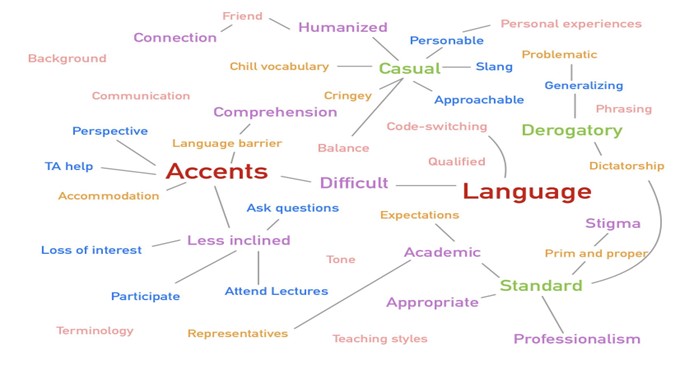
On the other hand, in discussions about slang use and “standard” language practices of professors, there was a surface-level appreciation for professors’ attempts to connect through slang-use and a general positive reaction. However, what a few of our interviewees argued to be more important was the use of genuine language as opposed to language that caters to a professor’s perception of what students may want to hear. Similar to the study by Martin, Weber, and Burant, the students we interviewed appeared to be able to recognize the subtleties of slang use and distinguish them from the subtexts of their uses (1997). For example, Jessica expressed that it was “cringy” when professors end up “overdoing it while trying to be relatable” because it comes off as inauthentic and pandering. Nonetheless, our interviewees expressed a general support for the use of slang words and “younger” language in the classroom. But in doing so, the words that they used represented a potentially larger concern surrounding language use in academic settings.

Unconscious Biases

When asked about whether she had any expectations for a “standard” language from her professors, Anna responded, “I don’t think slang would come in the way of teaching. Professionalism could be… um… what I’m trying to say is I don’t think language really affects the way the material is taught, and I don’t think slang should be penalized or looked down upon in the classroom setting.” While her response initially shows an understanding and support for less restrictions on language, the expression of the contrary as professionalism followed by a subtle retraction indicates a subconscious level of decorum that is to be expected from professors and the university as a whole. While our interviews only represent a minute sample of students at UCLA, the results indicate a wide range of responses that demonstrate similar notions of underlying pressures to maintain certain values.

Figure 1: Common and uncommon words found throughout the five interviews

Discussion and Conclusions

Our study and its findings contribute valuable insight into our understanding of students’ perceptions and expectations of their professors within academic settings. By investigating whether students hold their professors to a certain standard and coupling our empirical findings with existing literature, our study allows for researchers to formulate testable predictions or hypotheses on the nature of student-professor relationships in the future.

Our findings not only revealed diversity in linguistic and academic standards amongst students, but also suggested a potential for underlying biases inherent within academic settings. Our research highlights the extensive influence of academic norms and expectations on linguistic practices, suggesting an unconscious pressure on both students and professors to conform to behaviors typically perceived as “professional.” Such findings emphasize the importance of working towards building inclusive learning environments that embrace linguistic diversity while also encouraging authenticity and cultural sensitivity.

This study ultimately enhances our understanding of the complex interplay between language and identity within the academic realm, inviting future discourse and exploration that would enhance student-professor relationships. By acknowledging the dynamic experiences uncovered through our research, students, professors, and institutions alike can begin to strive for an educational environment that yields successful outcomes for individuals from diverse backgrounds.

References

Gill, M. M. (1994). Accent and stereotypes: Their effect on perceptions of teachers and lecture comprehension. Journal of Applied Communication Research, 22(4), 348–361. https://doi.org/10.1080/00909889409365409

Kozlowski, Alexandra (2015). The Influence of Accents on Social Perception. Inkblot, 12-16.

Kuo, Ya-Hui. (2011). Language Challenges Faced by International Graduate Students in the United States. Journal of International Students. 1(2). ISSN: 2162-3104.

Martin, M. M., Weber, K., & Burant, P. A. (1997). Students’ Perceptions of a Teacher’s Use of Slang and Verbal Aggressiveness in a Lecture: An Experiment.

Orelus, P. W. (2020). Other People’s English Accents Matter: Challenging Standard English Accent Hegemony https://files.eric.ed.gov/fulltext/EJ1246799.pdf

 [/expander_maker]
, , , ,

Are You Seeing What I’m Seeing?: The Impact of Relative Authority on Information Interpretation

Annabelle Jeon, Seamus Kim, Ani Abramian, Liam Fink

We’ve all celebrated Thanksgiving or some other special occasion when people from opposite sides of the aisle come together to celebrate an obligatory meal in the name of family—and chaos ensues. The estranged uncle is spouting conspiracy theories and someone’s aunt is convinced that raising taxes will be the downfall of the economy. As amusing as this hypothetical scenario is, growing polarization is a very real issue that contributes to increased social fragmentation and wider political turmoil. This study aimed to investigate the source of polarization—specifically as a result of differing interpretations of the same information due to different positions of power. Our sample consisted of students and police officers at the University of California, Los Angeles (UCLA), all of whom were instructed to watch the same video of a protest in Belarus and interviewed to gauge and compare their linguistic behavior. Our results suggest that differences in power do indeed contribute to different interpretations and subsequently different linguistic behavior as those in power, the police officers, showed a markedly neutral and indifferent response in contrast to those without, the students, who demonstrated a clearly supportive response when given the same information.

[expander_maker id=”1″ more=”Read more” less=”Read less”]

Introduction and Background

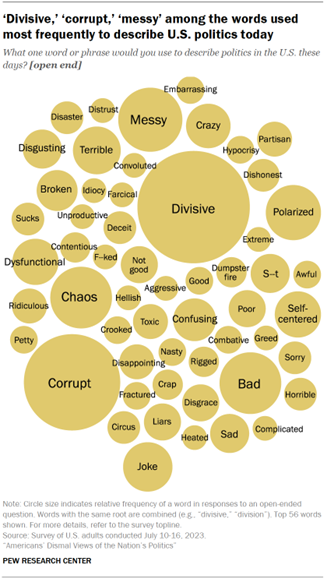
There is a common sentiment that Americans are becoming increasingly polarized (Figure 1, Pew, 2023). Across the political spectrum, many identify the foremost culprit as: misinformation. While there is a growing body of research that points to dangerous levels of misinformation in our current digital age, to attribute polarization solely to misinformation is an oversimplification (Vasist et al., 2023). As information systems researcher Stahl points out, there is no singular “truth” (2006). We each carry with us implicit biases that paint the way we process information. Influenced by his research, we opted to study how divergence arises from people interpreting the same information differently due to identity-based idiosyncrasies.

Figure 1: As shown in this figure, according to a mass survey distributed by Pew Research Center, many Americans describe U.S. Politics as “divisive”, “messy”, and “polarized”.

Our design was influenced by Kahan et al. (2012), which asked subjects of various political beliefs whether the police acted lawfully or not after watching a video of an ambiguous protest to investigate the potential influence of ‘cultural cognition’ on perceptions of legally consequential facts. Since positions of power have been shown to play a significant role in shaping linguistic behavior in social settings, we decided to use relative authority as a factor of interpretative divergence—and—linguistic behavior as a measure for participants’ interpretations (Danescu-Niculescu-Mizil et al. 2012).

Thus, we investigated how UCLA students and UCLA police officers interpreted an ambiguous protest scenario, hypothesizing that officers would use more critical language while students would use more positive terms, despite receiving the same information.

Methods

We employed a qualitative interview design to investigate how relative authority (being a student versus being a police officer) might correlate with differences in interpretation of the same video, as evidenced by linguistic behavior. We interviewed 6 participants–3 UCLA students and 3 UCPD officers–in-person. First, we asked about their age, ethnicity, gender, rank/year, and political leaning to account for potential both inter- and intra-group differences due to factors beyond position of authority. Then, the interviewer provided a single sentence of context for the video, describing it as a factory strike over stagnant wages in Belarus. The participants then viewed a ten second clip of the strike and were asked at least four questions:

  1. How would you characterize the people striking?
  2. How would you characterize the overall atmosphere of the protest?
  3. What do you believe is the primary motivation behind the protest?
  4. What impact do you think the protest has on the local community?

Interviews were to be 10-15 minutes long to provide enough data for rigorous linguistic analysis. In case responses ran under, interviewers were instructed to ask follow-up questions for each primary question, including:

  1. What from the video are you basing this perspective on?
  2. How do you think people with opposite political beliefs from you would respond to this question?

The questions were designed to elicit elaboration beyond the immediate facts of the video (there are people; they’re carrying signs; etc.), without insinuating any particular interpretation.

We analyzed transcriptions of their responses for diction (buzzwords, specific phrasings, etc.) to identify any notable patterns in linguistic behavior, which were then compared to reveal potential intra- and inter-group differences in the interpretation of the scenario. Finally, the findings were situated within a larger societal context to contribute to ongoing discussions of the relationship between information and perspective. 

Results and Analysis

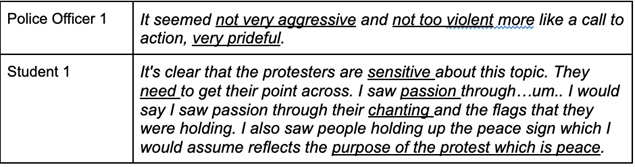
We engaged in two levels of analysis, starting with an examination of each transcript for keywords and phrases, patterns in descriptions, and other notable features. Below is a short excerpt from one of the responses collected.

Figure 2: Comparison of responses between police officer 1 and student 1 when asked to characterize the overall atmosphere of the protest. [underlined words/segments reflect features that we noted as relevant diction for analysis]:
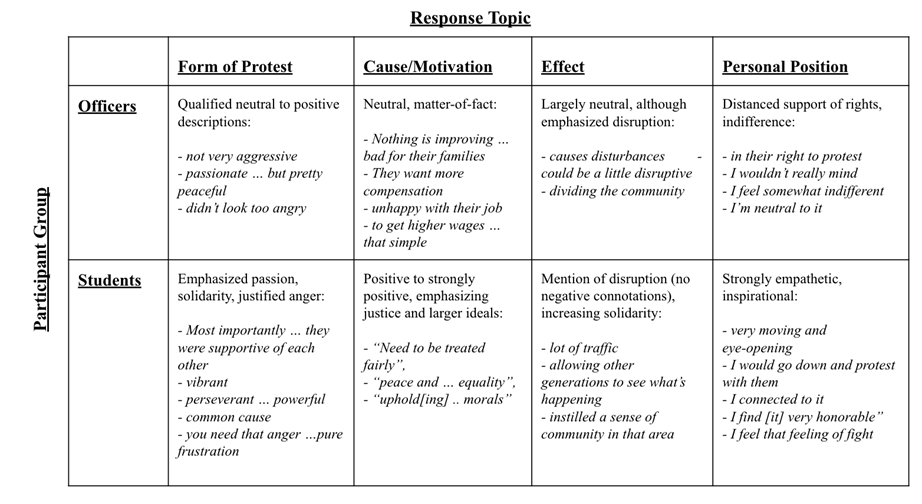
Second, we compared our analyses of the transcripts to yield insights about both within-group (student or police officer) and between-group commonalities and differences. To organize our findings, we organized extracts and our resulting insights into four categories/topics of interpretation:

Figure 3: Summarized responses of each group based on the four categories

Our data revealed that all participants shared a relatively positive view of protests. Though the difference in results were not as significant and explicit as expected, there were still clear linguistic differences. In contrast to students, who emphasized overt and immediate solidarity from the start, stating that the protestors were “supportive of each other” and “perseverant”, police officers were more hesitant in their responses, describing the protests as “passionate… but pretty peaceful” and “not very aggressive” before expressing mild approval.

The officers also mentioned that the protest could “cause disturbances” and “be a little disruptive” when asked about the possible impact on the community. Meanwhile, students continued to express support, characterizing the protests as a communal movement for the greater good. One student even expressed personal willingness to join, citing reasons such as fair wages, drawing from their own protest experiences. To summarize, all three students demonstrated clear patterns of empathetic identification with the protestors, while the officers exhibited a more distant, moderate sense of support.

Discussion and Conclusions

Our data reveals notable linguistic patterns amongst the police officers that differ from those of the students, strongly suggesting differences in the interpretation of the same scenario, which moderately aligns with our hypothesis. It’s important to note, however, that while the students used clearly positive diction to express support, the police officers were implicitly critical rather than using outright critical diction in describing the protestors. In sum, the discursive behavior of the students in comparison to the police officers suggested that the students by default held the protest in a positive regard, while the officers determined that the protest was generally acceptable but only because it met certain criteria (non-aggressive, minimal disruption, within scope of rights, etc.). Furthermore, our results align with that of Karjus’ study, which demonstrated a strong correlation between linguistic differences and American political polarization as each political faction constructs their own linguistic echo chamber of shared narratives of certain words and phrases, reinforcing their beliefs and causing further division (2023).

An unexpected challenge in gathering and analyzing our data was the consistently brief responses from officers, which were about a quarter to half as long as those from students. This reduced data volume may decrease confidence in our findings regarding police perspectives. However, the brevity could also suggest neutrality or indifference, reflecting a lack of strong opinion. Another plausible explanation: because of their stronger authority relative to the student, the officers felt less inclined to answer as thoroughly as the students. In this way, our positionality as students may have also affected the results of this study, a reminder of the elusive nature of the ecological validity that we anthropologists continue to seek.

This study contributes to research on communicative divergence and polarization by highlighting the role of relative authority/power in shaping differing views, even when information is controlled for. We urge future studies to explore additional factors such as socioeconomic status, ethnic/cultural background, and region, which may also influence divergent interpretations. Understanding these factors is crucial for modifying approaches to cooperation and peaceful resolution to combat polarization. Rather than focusing solely on ‘the facts,’ advocates must acknowledge and align with the underlying principles driving diverse interpretations.

References

Danescu-Niculescu-Mizil, C., Lee, L., Pang, B., & Kleinberg, J. (2012, April). Echoes of Power: Language Effects and Power Differences in Social Interaction PDF. Ithaca; Cornell University Department of Computer Science. https://www.cs.cornell.edu/~cristian/Echoes_of_power_files/echoes_of_power.pdf

Kahan, D. M., Hoffman, D. A., Braman, D., Evans, D., & Rachlinski, J. J. (2012). “They Saw a Protest”: Cognitive Illiberalism and the Speechconduct Distinction. Stanford Law Review, 64(4), 851–906. http://www.jstor.org/stable/41511108

Karjus, A., & Cuskley, C. (2023, September 4). Evolving linguistic divergence on Polarizing Social Media. arXiv.org. https://arxiv.org/abs/2309.01659

Pew Research Center. (2023). Americans’ feelings about politics, polarization and the tone of political discourse. https://www.pewresearch.org/politics/2023/09/19/americans-feelings-about-politics-polarization-and-the-tone-of-political-discourse/

Stahl, B. C. (2006). On the difference or equality of information, misinformation, and disinformation: A critical research perspective. Informing Science, 9, 83.

Vasist, P. N., Chatterjee, D., & Krishnan, S. (2023). The Polarizing Impact of Political Disinformation and Hate Speech: A Cross-country Configural Narrative. Information systems frontiers: a journal of research and innovation, 1–26. Advance online publication. https://doi.org/10.1007/s10796-023-10390-w

 [/expander_maker]
, , , ,

Uncovering Gendered Dynamics: A Comparative Analysis of Interactions Between Customers and Service Industry Workers

Elizabeth Truong, Naomi Crandall, Zoe Jespersgaard, Jennifer Ma, Victoria Yu

In contemporary society, coffee shops act as significant social hubs, facilitating interactions between service workers and customers that reflect broader gender dynamics. This research investigates the nuances of gendered interactions within coffee shops, focusing on American college students in the Westwood neighborhood of Los Angeles. The study aims to understand how gender influences various aspects of service worker-customer interactions, including word choice, politeness, and conversational patterns. Based on the hypothesis posited, which suggests that female-presenting customers are more likely to exhibit politeness towards service workers compared to their male-presenting counterparts, the research examines data collected through non-participant covert observation and conversation analysis. The findings reveal significant gender differences, with female-presenting individuals demonstrating more polite behaviors such as hedging and the use of politeness markers compared to their male-presenting counterparts. Female-female interactions were characterized by longer discussions and more pleasantries, while male-male interactions tended to be more direct. Overall, the study contributes to our understanding of gender dynamics in public spaces and underscores the importance of recognizing and addressing these dynamics for fostering inclusive environments.

[expander_maker id=”1″ more=”Read more” less=”Read less”]

Introduction

Within modern society, coffee shops serve as social hubs, offering an ideal setting for individuals looking for a quick respite as well as providing us with critical information regarding the nuances of gendered interactions between service workers and customers. Interactions between service industry workers and customers play a key role in shaping the experiences within public spaces, revealing broader societal norms and dynamics. In this research paper, we investigate how the dynamics of service worker-customer interactions in coffee shops are impacted by gender, specifically focusing on various aspects such as word choice, personability, and politeness. This paper is focused on studying these interactions between the demographic of American college students, with data collection taking place in coffee shops in Westwood Village, close to the campus of the University of California Los Angeles. By analyzing these factors, we aim to contribute to the understanding of gender dynamics within service interactions, uncovering any patterns or disparities present. Our hypothesis posits that female-presenting customers are more likely to exhibit politeness towards service workers compared to their male-presenting counterparts. Additionally, we anticipate greater deviations from the conventional ordering process when the gender presentation of the customer aligns with that of the service worker.

Background

In observing service encounters, we see various linguistic properties which are present in communicative patterns, contributing to the dynamics of interaction. Some specific examples include politeness strategies, turn-taking patterns, gestures, and lexical choices. Politeness theory, developed by linguists Brown and Levinson is quite in-depth, and the following video made by the University of Vienna does a great job of simplifying some of its more complex aspects: https://youtu.be/e-B-kJi0Rek. Speakers often use politeness strategies to maintain positive social relations. The desire to be perceived as kind or polite is an example of a term known as positive face (Brown and Levinson 2006). As many people wish to be accepted and liked by others, we expect most customers to utilize positive face techniques such as smiling or engaging with the server in conversation outside of their order. This can involve using polite language, such as “please” and “thank you,” or softening directives and requests. In addition, conversations typically follow turn-taking patterns, where speakers take turns to contribute to the interaction. Signals such as pauses, intonation, or body language help regulate conversation flow and indicate when it is appropriate to speak. Moreover, nonverbal cues like facial expressions, gestures, and body language are also important. They complement verbal communication and may convey sincerity, friendliness, or authority. Lastly, the selection of words and phrases reflects cultural norms, social roles, and individual identities. Lexical choices can influence identity, social status, or group membership, contributing to the overall tone and meaning of the interaction.

Similarly, the data samples we have gathered closely align with these linguistic properties and patterns seen in other service encounters. A previous study, which looked at female politeness towards other females versus towards males, found that gender played a pivotal role in the presence of politeness. The authors found that females were more likely than males to speak politely to others, especially when speaking with other females (Keikhaie and Mozaffari 2015). Across the interactions in our research, both baristas and customers use polite greetings, express gratitude, and use personalized terms to address each party, fostering a friendly and welcoming atmosphere. Turn-taking patterns were also observed, with participants getting a chance to speak and respond. Additionally, positive body language, such as smiling and maintaining eye contact, contributes to a positive customer experience by maintaining an informal and relaxed environment. Overall, the data illustrates the importance of these linguistic elements in effective communication during service encounters.

Methods

The methods we used for data collection were non-participant covert observation and conversation analysis. We opted for non-participant covert observation of the interactions between the customer and barista in order to understand the social reality and implicit features of the interactions. With the participants not knowing that they are being observed, it ensures that the data is the most accurate and unbiased as it can be. We will also be analyzing the conversations we observe to investigate and gain more insight into the deeper meaning of the words and actions throughout the interactions.

To guide this research, our general research question is, do levels of politeness differ in server-customer interactions based on gender? Within this question, we also have some more specific focuses. They are as follows: How do different genders express and navigate face-saving and face-affirming behaviors through mechanisms such as hedging and politeness markers?; Do levels of intimacy and politeness differ in same-gender interactions as compared to different-gender interactions?; Are male or female-identifying people treated with more politeness?; Do male or female-identifying people use more politeness markers? Our general hypothesis is that females will use more face-saving behaviors and be less direct when ordering and interacting with customers.

Results

In order to gain a more complete understanding of the gendered relationships between customers and service workers, we collected data from different coffee shops in the Westwood neighborhood of Los Angeles, California. The coffee shops that we collected data from include Alfred Coffee, Starbucks, Ministry of Coffee, and Stereoscope in Hollywood. Our general hypothesis for our research was that females would use more face-saving behaviors and be less direct when ordering and interacting with customers. Based on our data samples taken from various coffee shops, it can be seen that females are more likely to initiate an interaction and use pleasantries during a service encounter. After analyzing the 17 conversational samples that we have collected thus far, we were able to group some behaviors that we felt applied to our hypothesis. The following categories are presented below, accompanied by examples derived from the dataset.

Hedging

The data revealed distinct gendered differences in the interactions between customers and service industry workers. Our observations consistently indicated hedging behavior among female customers, evidenced by the frequent use of words such as “um” and employing indirect language when placing orders. Female customers had the tendency to substitute “could” for “can” during these brief interactions. Additionally, the hedging term “just” was more prevalent in the speech of female customers within the dataset. Furthermore, female customers exhibited greater pauses or displayed hesitance while placing their orders.

Introductory Greetings

Across all data sets, we found that female service industry workers were more likely to ask the customer how they were doing in addition to giving a standard greeting. Additionally, the data show that although both male and female baristas will initiate the interaction between them and their customers, females are more likely to ask about a customer’s well-being as part of the introductory greeting.

Politeness Markers

The data show that the majority of the time, female customers were significantly more likely to say “please” while making their requests. Additionally, we found that across all the data sets, there was less smiling involved in male-to-male interactions. One data set found that the male barista solely smiled at female customers, maintaining a neutral expression for male customers.

We found that female customers are more likely to respond politely and provide detailed information about their order, contrasting with the male customer’s direct and concise style.

Volume

Based on the observed data, both the customers and service industry workers maintained a consistent volume level throughout the majority of their interactions, with subtle variations in assertiveness, such as a female barista taking a slightly more assertive tone during certain interactions. Across all data sets, we found that the volume of female speakers in both roles was lower than that of their male counterparts. We also found that female customers tended to end their sentences with a higher pitch, while male customers kept their tone and volume consistent throughout the entire interaction.

Length of Discussion

Across all data sets, the longest discussions that took place were in female-female interactions while the shortest interactions tended to be in male-male interactions, with very few pleasantries.

We observed a consistent pattern between these interactions with the deviations occurring primarily in female-female interactions. One deviation that we recorded was a female barista complimenting a female customer’s sweater. Additionally, we recorded a sense of friendliness and camaraderie when a female barista made a mistake when taking an order from a female customer and the two laughed together. Across all the interactions, the male-male interactions required significantly less clarification of their orders. We were able to conclude that longer interactions are likely characterized by the female customer providing detailed information about their order. Male customers usually order without much elaboration, thus leading to shorter and more direct interactions.

Discussion

The data show that there are significant gender differences in the interactions between service industry workers and customers. The results of this study show that there were gendered differences in hedging, introductory greetings, politeness markers, volume, and discussion length. Female customers were significantly more likely to exhibit hedging behaviors than their male counterparts, demonstrating hesitation and less confidence in the interaction overall. While male customers rarely demonstrated hedging behavior and tended to have a more dominant approach to the conversation, especially when speaking to a female barista. Additionally, the data show that although both gendered service industry employees provided some sort of greeting, female service industry workers were significantly more likely to ask the customer about their well-being in addition to providing a standard greeting.

While surveying politeness markers, the data show that female-presenting customers were more likely to utilize polite terms such as “please” and “thank you” than male-presenting customers. Additionally, our study found that female-presenting customers were more likely to respond politely and provide more detailed information regarding their order while male-presenting customers tended to adopt a more concise and direct approach. Across all data sets, we found that there were fewer non-verbal politeness cues such as smiling in male-male interactions. Previous studies have produced similar results that show females interacting with other females will utilize polite behavior more often than their male counterparts. The authors explain that this may be because women are more conscious of rejection and stigma and therefore put in more effort to be perceived in a positive way (Keikhaie and Mozaffari 2015). In our research, the male-presenting customers had the tendency to adopt a more dominant and less friendly approach to these interactions, highlighting their perception of their importance and role within this particular community.

In terms of volume, our data show very little variation. Both gender identities maintained a consistent volume throughout their interactions, however, female-presenting customers and service workers utilized a lower volume overall, ending their sentences with a higher pitch. Alternatively, while studying conversation length, we found that female-female interactions were significantly longer than male-male interactions. This variation is due to the use of more pleasantries in female-female interactions as well as the absence of these pleasantries and the more direct tone used in male-male interactions.

While our study is able to successfully identify gender differences in hedging, the presence of introductory greetings, politeness markers, volume, and discussion length, it is important to note that our research is primarily focused on the Los Angeles neighborhood of Westwood. Although the individuals who visit local Westwood establishments possess very diverse backgrounds and gender identities, this is not the case in all communities across the United States. Different communities may have differing opinions on gender identities and thus have drastically different interactions based on their community’s view on gender identities. In order to gain a more complete understanding of how these interactions between service industry workers and customers vary by gender, more research must be done examining broader geographical areas. By expanding the geographic range of this study, we will be able to come to a more concrete understanding of the different practices and patterns utilized between different genders in service industry interactions.

Conclusion

After conducting a thorough literature review as well as completing data collection such as observations and conversation analyses, we found that female-presenting customers and service industry workers were significantly more likely to utilize polite behaviors than their male-presenting counterparts. The data show clear patterned differences between these service industry interactions in the categories of hedging, the presence of introductory greetings, politeness markers, volume, and the length of the interaction. In each of these categories, the female-presenting customers and service industry workers utilize more polite approaches when addressing each other and members of the opposite gender. These results provide valuable information regarding not only the gender roles within service industry interactions but also the underlying social norms and dynamics within a public sphere.

References

Brown, P., & Levinson, S. C. (2006.). Politeness: Some Universals in Language Usage. In The Discourse Reader (2nd ed., pp. 311–323). Routledge: Taylor & Francis Group.

Forseth, U. (2005). Gender matters? Exploring how gender is negotiated in service encounters. Gender, Work & Organization, 12(5), 440–459. https://doi.org/10.1111/j.1468-0432.2005.00283.x

Gibson, E. K. (2014, May 27). Would you like manners with that? A study of gender, polite questions, and the fast‐food industry. Academia.edu. https://www.academia.edu/4031180/E._K._GIBSON_-_A_study_of_gender_polite_questions_and_the_fast_food_industry

Hultgren, A. K. (2017). New perspectives on language and gender: Linguistic prescription and compliance in Call Centres. Language in Society, 46(5), 671–695. https://doi.org/10.1017/s0047404517000574

Keikhaie, Y., & Mozaffari, Z. (2015). A Socio-linguistic Survey on Females’ Politeness Strategies in the Same Gender and in the Cross-Gender Relationship. Iranian Journal of Applied Language Studies, 5(2), 51-82. doi: 10.22111/ijals.2015.1877

Schnabel, Lukas. “Politeness in Linguistics: An Overview.” YouTube, uploaded by Lukas Schnabel, 23 June 2019, https://youtu.be/e-B-kJi0Rek

Taylor, J. L. (n.d.). I Need a Coffee: Pragmalinguistic Variation of Starbucks Service Encounter Requests According to Interaction Modality. Indiana University. https://scholarworks.iu.edu/journals/index.php/iulcwp/article/download/26219/31840/61913

West, C. (1993). Reconceptualizing gender in physician-patient relationships. Social Science & Medicine, 36(1), 57–66. https://doi.org/10.1016/0277-9536(93)90305-n

 [/expander_maker]
, , , ,

Pero Like… The Prevalence of Spanglish Use in Instagram Over the Course of a Six Year Time Span (from 2018 – 2024)

Alayla Navarro, Apoorva Gunti, Jester Mediano, Kaitlin Carlos, Steven Arias

Through social media, the exercise of language has never been more documented. Online communication in the Anthropocene is commonplace in many parts of the world, expanding the prevalence of language mixing, such as Spanglish. This can be brought on by different factors. Our research aims to track how over time, Spanglish became a relatively common way of speaking in social media apps like Instagram. We present data analyzing three different social media accounts on Instagram that employ the use of Spanglish vocabulary, exhibiting a positive correlation of Spanglish use over time. The analysis is done on the Instagram comments under posts targeting the Hispanic community. The comments were randomly chosen and manually examined, where we looked at whether the comment had Spanish/Spanglish and what the comments meant. The increase was documented over the time period of 2018-2024, where Instagram users utilized Spanglish the least in 2018 and the most in 2024. We also expand on this idea and analyze the prevalence of both Spanglish and the use of Spanish in an English-language dominated social media platform, such as Instagram, where the latter saw a larger increase over the time period we documented.

[expander_maker id=”1″ more=”Read more” less=”Read less”]

Introduction and Background

Because of different factors like stigmatization, languages like Spanish have constantly been derided in the United States. Up until recently, the use of Spanish has been a point of contention. Through rising acceptance of Spanish in popular media such as TV shows, movies, and through the popularization of Spanish-speaking artists, Spanish itself has made its way into mainstream acceptance in the United States. This phenomena can also be seen in social media like Instagram where comedic accounts like meme pages whose main language is Spanish is followed by hundreds of thousands of people. Through those social media pages, the use of Spanglish also became increasingly common as the acceptance of Spanish slowly became accepted. By tracking comments and responses from those Spanish meme pages on Instagram ranging from 2018 all the way to 2024, we aim to see how the use of hybrid language increased over time.

Methods

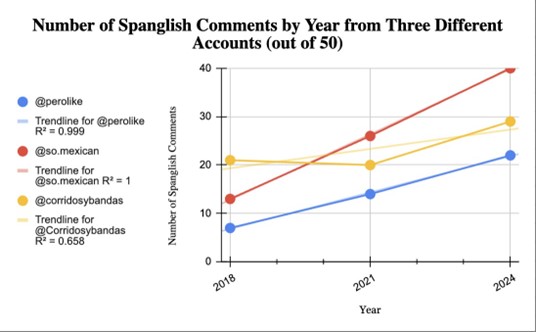
The project design sought to examine the frequency of hybrid language use and code-switching among online bilingual Spanish and English-speaking individuals over time. The expressions to be analyzed were sourced from the comments sections of three Instagram accounts that foreground Latin American culture, have large follower bases, and have posted consistently for the time span this study examines: perolike, so.mexican, and corridoybandas.

From these accounts, three posts from 2018-19, 2021, and 2024 were taken from each. 50 comments were selected as impartially as possible from those 9 posts, and collated into tables that marked expressions as either fully English, or as having some presence of Spanglish or Spanish. After investigating the increasing or decreasing prevalence of Spanglish use with these comments over the span of 6 years, expressions were then translated and interpreted to determine how users authenticate or negate aspects of culture and personal identity.

Results

After compiling Instagram comments and categorizing them, we created tables tracking the change in frequency of the use of Spanish and Spanglish on Instagram comments over the time period of 2018 to 2024, shown in figures one and two. Figure one has data in tally form and figure two has data in percentage form.

Figure 1: Use of Spanish and Spanglish comments on Instagram account by tally (out of 50)
Figure 2: Use of Spanish and Spanglish comments on Instagram account by percentage

We then used this data to create a graph, in which all three Instagram accounts show a positive correlation over time, indicating an increase in the use of Spanglish within the comment sections of these accounts. Figure three shows this graph.

Figure 3: Number of Spanglish comments by year from three different accounts (out of 50)

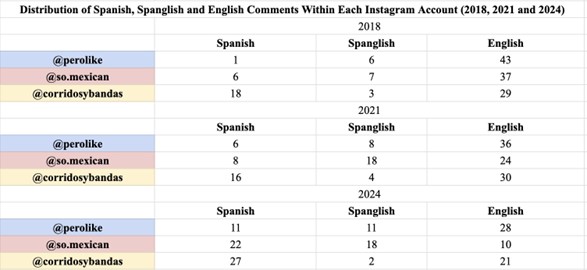
We also went further and analyzed the prevalence of Spanglish and Spanish. We separated these two categories specifically to understand and categorize hybrid-language use versus the use of a different language in an English-predominant social media platform. A table of data distributing Spanish, Spanglish, and English Comments between the three Instagram accounts, separated by year, is listed below in figure four.

Figure 4: Distribution of Spanish, Spanglish, and English comments within each Instagram account (2018, 2021, and 2024)

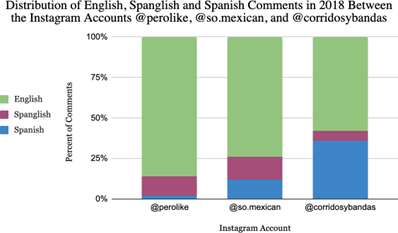
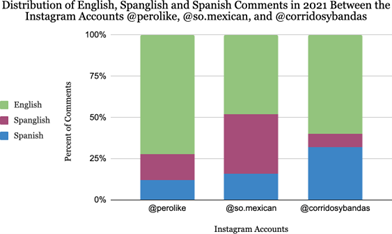
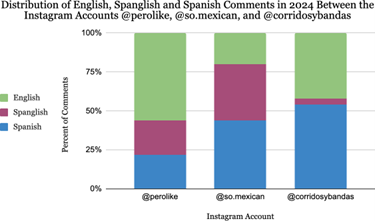
We took this data table and transformed the data into a column chart, as listed below in figures five, six, and seven.

Figure 5: Distribution of Spanish, Spanglish, and English comments within each Instagram account (2018)
Figure 6: Distribution of Spanish, Spanglish, and English comments within each Instagram account (2021)
Figure 7: Distribution of Spanish, Spanglish, and English comments within each Instagram account (2024)

Based on these distributions, although the use of both Spanglish and Spanish generally have increased, the use of Spanish has increased at a greater rate than Spanglish. This increase is specifically highlighted with the @corridosybandas Instagram account.

Discussion

According to Crooks (2004), new communication technologies, such as social media platforms like Instagram, have influenced the formation of linguistic and social identities from its users, allowing for shifts and adaptations of the language. To further expand on past literature findings, we identify Spanglish as an indexical tool used to assert a sense of belonging with a twist. Our findings indicate that within the Spanish-speaking culture, Spanglish users exploit Spanish’s emergent language development and constant linguistic varieties it possesses at the user’s convenience, with intention (Wentker and Schneider, 2022). This is seen during 2018-2019 in comments of the account @so.mexican where the use of Spanglish was low and was predominantly English. This is similar to the finding by Maliani (2021), where 43% of Indonesian bilingual speakers inserted English words in their tweets. Although this article explored the different forms of code mixing, our research took this trend to the next level by looking into the context of which these words were used. Our research identified a trend where users consistently chose Spanish word insertions that referred to cultural traditions or types of relations used by that community. For example, the use of “la dieta”, “otro taco” (“the diet” “another taco”) from the commenter indicated that users have experienced this cultural concept of risking your diet for tacos, a deeply desired food by people within this community. This asserts belonging within the community by relating to an experience shared by other members.

Another form of word insertion commonly found was the use of relational words translated into Spanish, such as “Tio,” “Tia,” and “Mami”, respectively translating to “uncle”and “aunt”, and the slang word for “beautiful girl”. We can conclude, with these insertions, that this Spanglish use was intentional, with the goal of connecting to the community and identifying as a member themselves.

A second finding expanding beyond current literature is the user’s demonstration of their own Spanglish ideologies and how they express these expectations when someone does not follow them. From past literature, we have understood the following: code-switching is intentional and asserts sense of belonging, social media allows for adaptation and variation of language, code-switching differs from face-to-face and online uses, and non-native English speakers have increasingly opted to use their native language within online platforms (Crooks, 2004; Dailey-O’Cain, 2017; Maliani, 2021; Wentker and Schneider, 2022). In 2021, users critiqued a post on their use of Spanglish, which stated “When todos andan muriendo de frio but tienes tu cobija de tigre” (translating to: “when everyone is dying from the cold but you have your tiger blanket”). The commenters corrected the post by sharing what Spanglish is and described their “improper use” of it as “forced” and “dumb.” This demonstrates how in addition to social media allowing for Spanglish users of varying levels to be confident in using Spanglish more frequently, those who consider themselves experts in this language can inform and correct other users through social media platforms as well. This adds to past literature because it opens up a new door for a different view on Spanglish. With this finding, we can have a small piece to the bigger picture of Spanglish use. We can now look further and ask ourselves, what is Spanglish from the perspective of fluent Spanglish users, what ideologies and expectations do they have in terms of Spanglish linguistics and how might this perspective change depending on the region in which this speaker resides?

Conclusion

In conclusion, the normalization and usage of Spanglish, a hybrid language that incorporates elements from both English and Spanish, has increased and become relevant in digital spaces like social media. Despite Spanglish’s contested history, it serves as a means of cultural affiliation and experience for many in the Mexican and Latin American communities. Although the research contains limitations, such as not knowing the location of users, the results are indicative that an increase in usage and frequency has occurred.

References

Cook, S. E. (2004). New Technologies and Language Change: Toward an Anthropology of Linguistic Frontiers. Annual Review of Anthropology, 33, 103-115. https://www.jstor.org/stable/25064847

Dailey-O’Cain, Jennifer. “Language Ideologies, Multilingualism, and Social Media.” Trans-National English in Social Media Communities, edited by Jennifer Dailey-O’Cain, Palgrave Macmillan UK, 2017, pp. 23–60. Springer Link, https://doi.org/10.1057/978-1-137-50615-3_2.

Maliani, P. (2021, August). Code mixing as language style in communication through Social Mediatwitter.Researchgate. https://www.researchgate.net/publication/357686277_CODE_MIXING_AS_LANGUAG E_STYLE_IN_COMMUNICATION_THROUGH_SOCIAL_MEDIA_TWITTER

Piasente, J. (2013). Looking for identity in a multicultural world: The Case of Spanglish in the United States.

Wentker, M., & Schneider, C. (2022). And she be like ‘tenemos frijoles en la casa’: Code-switching and identity construction on YouTube. Languages, 7(3), 219. https://doi.org/10.3390/ languages7030219

 [/expander_maker]
, , , ,

Bilingual Investigation

Hana Almony, Lauren Campsey, Hannah Her, Ariana Cheng, Madeline Flood

In everyday discourse, language is influential in how we speak and engage with others. Specifically, looking at bilingual native Spanish, second language English speakers was explored in this study because the question we sought to answer was does an individual’s native language have an influence on a second language? To investigate this question, we hypothesized that it indeed does, and the language that one speaks will impact responses to the same interview questions in both Spanish and English. In conducting this research, agents of socialization were considered because the participants were native Spanish speakers with English as a second language so interview questions were geared towards the significance of language in relation to identity and self-expression. Moreover, this relates to the idea of linguistic relativity as this shows that one’s particular language use is correlated with one’s perception and idea of reality. In this study, linguistic relativity was evident when analyzing bilingual female individual participants in which we found similarities and differences in responses of each respective language. The goal of this study is to inform about the effects of language use through the modality of bilingual speakers and how language choice through one’s thinking may connect to specific conversations and everyday discourse.

[expander_maker id=”1″ more=”Read more” less=”Read less”]

Introduction and Background

Have you ever thought about how the language you speak affects the way you view the world around you? By understanding how language functions within society we can have a greater understanding of how impactful linguistic practices can be. For our project we chose to view bilingualism and how modality can affect perception. More specifically, in the context of native Spanish speakers with English as their second language. To investigate this hypothesis we used points of reference from Claire Kramsch’s Language and Culture and Nick Riemer’s book called Routledge Handbook of Semantics. Riemer’s book is a collection of the works of many leading scholars and academics from around the world. Both Kramsch and Reimer provide an overview of entire linguistic subjects and sub-disciplines. We focused on chapters such as modality, participant roles, and linguistic relativity in order to gain meaning and conceptualization. We also read articles from the Linguistic Society of America such as “Language and Thought” and “Linguistics in Everyday Life” to gain a greater understanding of linguistic theories in order to apply them to our research. We looked specifically at linguistic relativity to answer our question on how language can influence perception and the way we think paired with bilingual studies to help analyze differences within Spanish-English speakers.

Methods

To gather our data, we were able to interview five female individuals in the UCLA community who are native speakers of Spanish and also learned English as a second language. The setup of the interview was semi-structured and in-person with audio-recording for each participant. Two separate interviews were conducted by a bilingual group member, consisting of the same set of 10 questions in English and Spanish. Questions varied from how being bilingual affects communication and expression and how they use it in their daily lives. We also had controls in our study to limit variability throughout the interviews. The controls are the same set of interview questions in both English and Spanish, one interviewer to maintain the same personality and comfortability throughout the interviews, the same gender combination of a female interviewer and female participant for similar interaction types, having the participants bilingual in those two languages only, and maintaining similar environment conditions (time of day, public, and approximate number of people around). After the audio files finished processing, each version was manually transcribed by each group member and compared to see any similarities or differences in results. We looked into various aspects of modality in bilingualism and how it affects conversations and word choice. In relation to our hypothesis, the comparison between each interview was very surprising.

Results and Analysis

Throughout our interviews, we found that there were many similarities and differences in the participants’ responses. Though we were expecting differences specifically between each participant’s English and Spanish answers, we learned that the language didn’t completely dictate how the participants expressed themselves. The responses in general in both Spanish and English were very similar, if not the same, in both languages. The participants also all agreed that they spoke with an accent in English and Spanish, reflecting the influence on each language. The participants’ linguistic identities have pieces of English and Spanish – they are aware of their link to each of these languages and cultures, creating a consciousness in their pronunciations. We also noticed that when answering questions in Spanish, there were more pauses – these pauses did not have a specific pattern and differed between the participants, indicating that this has to do with their thought process in word choice. The participants shared that they mainly spoke Spanish with their family members and occasionally with friends depending on the environment. This language-specific context shows that they associate their linguistic identity with English for most of their communication, hence the pausing had more to do with comfortability with the language than for cultural reasons. Another way the interviews differed was the length and detail within answers in Spanish compared to English. According to Reimer (2016), a language can influence what or how much information is shared by the speaker. This was apparent when analyzing the different answers for each language. The English responses were more engaging and personal compared to in Spanish, signifying a linguistic influence over word choice and sentence length.

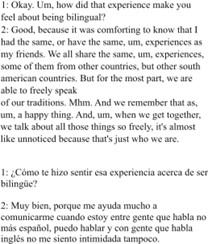
Figure 1: Sample responses in English and Spanish for the interview question “Happiness to me is …”
Figure 2: Sample responses in English and Spanish for the interview question “When did you start speaking Spanish and when did you start learning English?”

The examples above show the main findings of our study. Figure 1 highlights our last interview question, “Happiness to me is …” All of the participants’ answers had to do with love for someone – in this example, family. This depicts how the answer to this particular question was the same in both languages, reflecting that the individual shares the same values and thoughts in both languages. The lack of detail was prominent in many other questions as seen in Figure 2, asking the question, “When did you start speaking Spanish and when did you start learning English?” Though the general answer was similar, the participant went into more detail about their childhood when answering in English. The concept of linguistic relativity, though not in the traditional sense, was prominent in our study – the participants were all L2-English Native Spanish speakers and through their answers, we can see how, outside of family, English is the more spoken language, creating a sense of normalcy and identity within the English language.

Discussion and Conclusions

Within a conversation, the particular language an individual is speaking in can influence how they express themselves and this can largely be attributed to how culture and language are so intertwined (Kramsch, 2014). With this connection in mind, we hypothesized that L2-English Native Spanish speakers will have different responses to the same questions depending on the language that they are speaking in. Though our assumption was that there would be vastly different responses, in reality, the degree of the linguistic relativity of the responses was not as high as anticipated. The data revealed that participants had very similar responses in both languages, but the Spanish responses were shorter and less detailed than the English responses. We observed agents of socialization when analyzing our interviews as L2-English Native Spanish speakers had a deeper connection to their family structure. We learned that these specific participants have mainly tied Spanish to family members and situations. The connection between language and their background creates strong cultural bonds within the community. There were limitations in our study that may have contributed to our results. There were a total of five participants. This is a relatively small sample size. If a similar experiment were to be done in the future, the results would be more accurate with a larger sample size for a greater range in human variability to produce a more precise conclusion. These participants, though native Spanish speakers, have grown up and lived in the United States for a majority of their lives – we did not take into consideration the role of cultural assimilation, reflecting the likelihood that their answers in both languages would be very similar. This raises the question of how the participants relate to Spanish. The results of our study have taught us the role of language in our thought process and communication and the importance of being more aware and mindful in our everyday interactions as our language choice can contribute to how others feel in the conversation.

References

Aneta Pavlenko, Blackledge, A., Piller, I., & Teutsch-Dwyer, M. (2001). Multilingualism, Second Language Learning, and Gender. Berlin, New York De Gruyter Mouton.

Becker, K. R. (1997). Spanish/English Bilingual Codeswitching: A Syncretic Model. Bilingual Review / La Revista Bilingüe, 22(1), 3–30. http://www.jstor.org/stable/25745367

Bohman, T. M., Bedore, L. M., Peña, E. D., Mendez-Perez, A., & Gillam, R. B. (2010). What you hear and what you say: language performance in Spanish–English bilinguals.

International Journal of Bilingual Education and Bilingualism, 13(3), 325–344. https://doi.org/10.1080/13670050903342019

Comrie, B. (2012). Language and Thought | Linguistic Society of America. Linguisticsociety.org. https://www.linguisticsociety.org/resource/language-and-thought

Jacqueline Toribio, Almeida. “Code‐Switching among us latinos.” The Handbook of Hispanic Sociolinguistics, 4 Feb. 2011, pp. 530–552, https://doi.org/10.1002/9781444393446.ch25.

Jesús-Ortiz, E., & Calvo-Ferrer, J. R. (2023, November 25). His or Her? Errors in Possessive Determiners Made by L2-English Native Spanish Speakers. Languages, 8(4), 1-16. https://doi.org/10.3390/languages8040278

Kanno, Y. (2003). Negotiating bilingual and bicultural identities: Japanese returnees betwixt two worlds. L. Erlbaum.

Kramsch, C. (2014). Language and Culture. AILA Review, 27(1), 30–55. https://doi.org/10.1075/aila.27.02kra

Linguistics in Everyday Life | Linguistic Society of America. (n.d.). Www.linguisticsociety.org. Retrieved March 16, 2024, from https://www.linguisticsociety.org/content/linguistics-everyday-life#Domain

Niño-MurciaM. (2009). Bilingualism and identity: Spanish at the crossroads with other languages. Benjamins.

Ramírez, D. (2003). L1 regression in Spanish-English bilinguals. In Selected proceedings of the first workshop on Spanish sociolinguistics (pp. 89-95). Somerville: Cascadilla Proceedings Project.

Riemer, N. (2019). The Routledge handbook of semantics. Milton Park, Abingdon New York, Ny Routledge.

Slobin, D. (1996). Social interaction, Social Context, and Language. Psychology Press.

 [/expander_maker]
, , , ,

Fluency Ideologies Amongst Undergraduate Bi- and Multilinguals

Kendall Vanderwouw, Rachel Liu, Julia Tran, Nessa Laxamana, Thalia Rothman

UCLA is an incredibly diverse institution, with over 5,000 international students and 100 nations being represented. It is no surprise, then, that they boast a variety of cultural and linguistic backgrounds. From this wealth of information, we sought to explore fluency ideologies amongst bi- and multilingual undergraduates, aged 18 to 22. Through this course and personal experiences, it’s become evident that the definition of fluency is in constant flux. A largely self-defined term, fluency could encompass everything from native-level repertoire to conversational proficiency. Thus, we aimed to investigate whether linguistic background impacted self-perception of fluency.

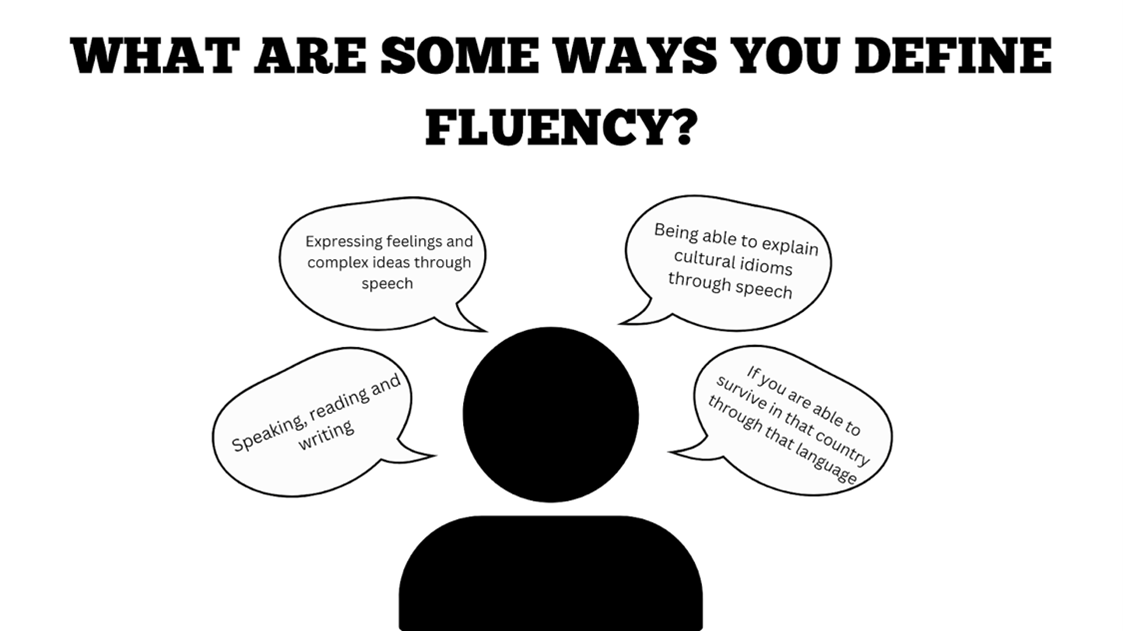
We engaged in semi-structured interviews with 30 undergraduates to explore this phenomenon and its implications amongst different languages. As we dove deeper, however, we observed little variation in how different languages defined fluency. Rather, most participants revealed similar definitions, centering around, “the ability to express feelings and complex ideas.” Instead, participants expressed a positive relationship between self-perceived fluency and a sense of familial or cultural connection. This finding and others ultimately led us to a new research question that targeted whether an individual’s fluency in a language, upbringing, environment, and cultural background can influence linguistic identity.

[expander_maker id=”1″ more=”Read more” less=”Read less”]

Introduction and Background

Our research began with questions regarding linguistic identity and fluency. Why do definitions of fluency fluctuate? Are definitions of fluency influenced by our linguistic backgrounds? What is the role of fluency in our cultural lives? Our participant pool represented a variety of cultural and linguistic backgrounds with which to answer these questions. This unique context provided a near-direct perspective into the context of language acquisition since many students had recently left backgrounds of language learning or were still in proximity to them, such as high school and familial environments.

We examined these curiosities through a series of interviews, taking an ethnographic approach to gain a more holistic understanding of the perspectives of our participants. After consolidating interview data, our research focus pivoted in a slightly different direction, one that looked at how a variety of factors—including fluency—can influence one’s linguistic identity. Our central research question was finalized as such:

Does an individual’s fluency in a language, upbringing, environment, and cultural background influence their linguistic identity?

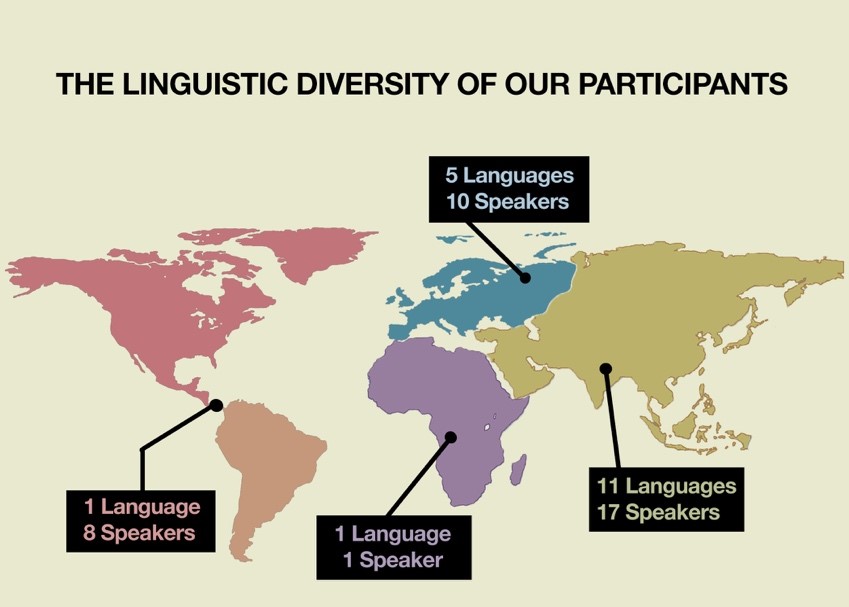
Overall, our project ultimately represented a variety of linguistic backgrounds and cultural identities, with 18 languages spoken by 30 different speakers. This is visually represented in Figure 1, created by one of our group members to illustrate the linguistic diversity of our participants.

Figure 1: Tran, J. (2024). A map illustrating the linguistic and cultural spread of our participants

 To garner a more in-depth understanding of our topic and to examine the current state of research, we engaged with readings regarding fluency ideologies as well as bi- and multi-lingual experiences. Such research provided context that informed our later analyses and conclusions.

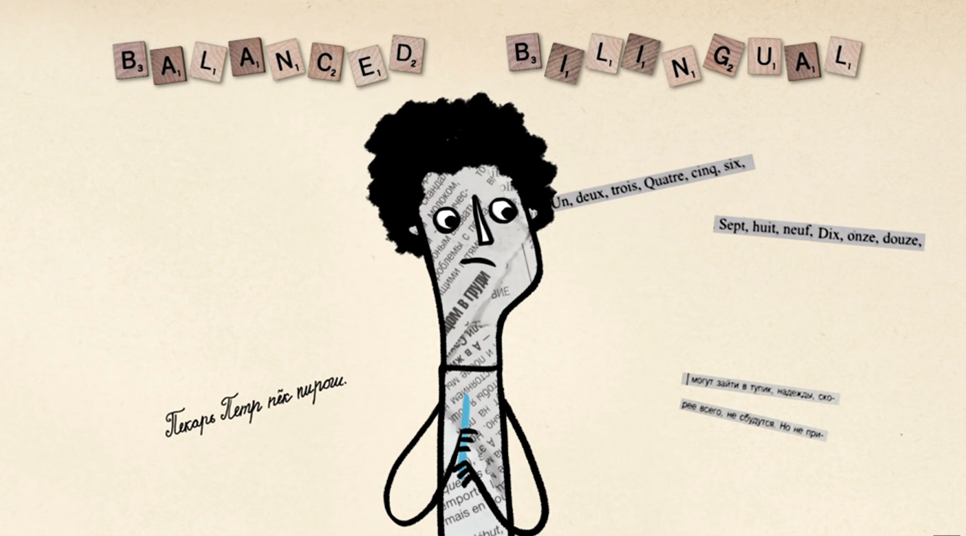
For example, we found in several articles (Zubrzycki 2019; King 2013) that self-perceived fluency had the potential to give rise to shame or embarrassment in being unable to match the proficiency of others who may be exhibiting native-level fluency. Such ideologies create the daunting expectation that fluency necessitates a native-level mastery of a language. In addition to these academic sources, we found similar ideologies being proliferated through less formal means, such as YouTube videos. One video from Ted-Ed discussed the benefits of bilingualism to our brains, and in doing so put forth the concept of a “balanced bilingual,” which they describe as an individual who has equal proficiency in their languages. The video puts this idea forth, however, in order to make the point that the majority of bi- and multi-lingual speakers use their languages in different proportions and in varying scenarios. We found that videos such as this help to contribute towards a less stringent narrative of fluency that could lessen the shame caused by self-comparison to native speakers. 

Figure 2; Ted-Ed. (2015). A screenshot from the Ted-Ed video discussing bilingualism and how it may affect an individual’s brain.

This left our group wondering whether such ideologies would be found amongst our participants, and what factors would lead to the formation of the expectation to be natively fluent. Overall, these initial investigations revealed to us that there are certainly links between linguistic identity and fluency self-perception. Our goal through this project was to contribute to this existing pool of knowledge and to provide a voice for our participants to express their unique ideologies.

Methods

Using semi-structured interviews, comprising of 12 standardized questions, we decided to take an ethnographic approach to our data collection. Through this process, we searched for self-perceptions of fluency, past language acquisition environments, as well as any current language ideologies regarding themselves. This methodology was deliberately chosen in order to produce consistent, qualitative data while also providing room for our participants to elaborate upon concepts and topics of their choosing. When permission was granted, we recorded the interviews for the purpose of deeper analysis as well as direct quoting in our project. Our participant pool were undergraduate college students, aged 18 to 22 years old.

Some of the questions that we asked were as follows: “In what circumstances / how often do you use this (these) language(s)?”, “How do you define being “fluent” in a language?”, and “Was it important to your parents/community that you were fluent in this language? What about you?”

Results and Analysis

Our data provided us with different viewpoints and ideologies regarding bilingualism and multilingualism. However, 60% of our participants defined fluency as the ability to express feelings and complex ideas, beyond the introductory phase in the language they speak. Some participants were more descriptive, stating that the ability to speak about specific things, such as the country’s government system, or even cultural idioms or slang. Some were less specific, stating that if you can get by in daily scenarios, you are fluent. 

Figure 3; Laxamana, Nessa. (2024). A graphic showcasing how our participants defined fluency.

We also were able to discover different values that our participants held knowing their other language(s). 77% of our participants stated that they used their language to communicate with their family members, which is why they were able to become fluent in their language. This shows that language serves as a communication between different generations of people, for example between grandkids and grandparents.

Figure 4; Laxamana, Nessa. (2024). A pie chart illustrating when and where our participants use their non-dominant languages.

We interviewed those born in and outside the U.S., and one interviewee stated that being fluent in that language makes them feel more connected to their culture as seen in EX. 1. However, the variation in answers slightly differed between those born in different countries and those born in the U.S. For those born outside the U.S., they stated that their fluency in the language was a way to connect them back home. For those born in the U.S., they stated that fluency in the language was influential in how connected to their culture/mother tongue.

EX. 1

Discussion and Conclusion

At the center of our research was an investigation into the factors that make up and influence linguistic identity. We ultimately align our definition of linguistic identity with a reading from our initial research (Dressler 2014, p. 43), which argues that “linguistic identity can be expressed in terms of expertise (i.e. linguistic competence), affiliation (formal or informal connections), or inheritance (familial connections).” None of these factors were considered to be mutually exclusive in our research. As previously exemplified, the linguistic identities of our participants were commonly observed to be in line with more than one of the pathways mentioned above. Most importantly, our research brought about more understanding of how people’s various reasons for their language fluency are intertwined largely with their understanding of culture and belonging. Language and communication with others are important to keeping cultures and traditions alive, it serves as a sense of cultural connection for most. With our findings, we discovered an insight into how language fluency, ideology, and culture intertwine with one another.

References

Dressler, R. (2015). Exploring Linguistic Identity in Young Multilingual Learners. TESL Canada Journal32 (1), 42. https://doi.org/10.18806/tesl.v32i1.1198

King, K. A. (2013). A Tale of Three Sisters: Language Ideologies, Identities, and Negotiations in a Bilingual, Transnational Family. International Multilingual Research Journal, 7(1), 49–65. https://doi.org/10.1080/19313152.2013.746800

Ted-Ed. (2015, June 23). The benefits of a bilingual brain – Mia Nacamulli [Video]. YouTube. https://www.youtube.com/watch?v=MMmOLN5zBLY

Zubrzycki, K. (2019). Am I perfect enough to be a true bilingual? Monolingual bias in the lay perception and self-perception of bi- and multilinguals . International Review of Applied Linguistics in Language Teaching, 57(4), 447-495. https://doi.org/10.1515/iral-2016-0095

 [/expander_maker]

, , , , , ,

Language Proficiency’s Impact on Healthcare Quality for Marginalized Patients: A Physician-Patient Communication Perspective

Lilian Nguyen, Rebecca Kim, Lillian Thai, Ysabella Ballesteros-Barajas, Andrea Romero

Our study investigates language barriers’ impact on patient-physician relationships among marginalized racial and ethnic communities in Southern California. We aim to understand how limited English proficiency affects healthcare access and quality for non-native English speakers. This exploration is crucial in identifying and addressing disparities in healthcare settings, particularly how language barriers intensify existing challenges. We hypothesize that disparities in language proficiency significantly influence the quality of care received by ethnically marginalized patients. Our research highlights ongoing societal norms in America, which disproportionately affect immigrants. We emphasize the necessity of addressing healthcare disparities for ethnically marginalized communities, advocating for enhanced resources and support. Analysis of data patterns reveals the profound impact of limited English proficiency on patient understanding and comfort in medical settings. Additionally, we identify the added responsibilities shouldered by non-English patients and the minimization of patient-physician interaction in the US healthcare system. In conclusion, our findings underscore the urgency of improving communication and understanding between patients and providers. This entails training healthcare providers in cultural competency and ensuring multilingual health materials’ availability. By addressing language barriers, we can strive towards a more equitable healthcare system that meets the diverse needs of all patients.

[expander_maker id=”1″ more=”Read more” less=”Read less”]

Introduction and Background

Our study explores the intricacies of patient-doctor relationships, with a specific focus on the ramifications of language barriers among individuals from marginalized racial and ethnic communities in California. Our objective is to comprehend how language proficiency, particularly among non-native English speakers, impacts their interactions with healthcare providers and their ability to access healthcare resources. This research holds significance in unveiling the challenges faced by these communities in healthcare settings, particularly how language barriers may exacerbate these challenges. Furthermore, we aim to explore the influence of language on the quality of care. Our hypothesis suggests that disparities in language proficiency between physicians and patients from ethnically marginalized communities significantly influence the quality of healthcare received. We seek to address the question: “Does language proficiency between physicians and patients from ethnically marginalized communities impact the quality of care?”

The ongoing Eurocentric-centric societal norms in America, profoundly affecting immigrants and refugees who have migrated to the country since the 20th century (Batlova 2018), have sparked discussions on the interpersonal and intrapersonal repercussions within marginalized communities. During this period, many immigrant groups encountered social and economic marginalization in American society, leading to their disconnection from the healthcare system (Anderson 2019). Our research endeavors to explore these effects within the framework of the US healthcare landscape, dissecting how the experiences of minority groups may differ from those of predominant communities through the analysis of language usage and conversations. Healthcare holds paramount importance for the living conditions of these burgeoning populations, as unequal access to adequate resources may jeopardize their overall well-being (Hsueh 2021). Previous studies have indicated physician bias as a limiting factor in physician-patient understanding, thus fueling ethnic disparities within healthcare settings.

Additionally, minority populations, including Hispanic, Black, and Asian communities, are expected to account for 40% of the US population by 2035 and 47% by 2050 (Cooper 2003). Therefore, as minority populations in America continue to grow (Cooper 2003), it becomes increasingly imperative to strive towards enhancing their quality of care by addressing potential barriers to access.

Hence, this research aims to further emphasize the correlations between English language proficiency and the quality of care in physician-patient relationships in America. Paying attention to recurrent themes in word choices used by participants will aid in highlighting how one’s ethnic identity may contribute to communication barriers (Irvine 2020). The selection of words by our participants when responding to questions regarding their relationship with their primary healthcare provider remains crucial in understanding their healthcare experiences and evaluating the quality of care they receive. This is because self-reported health status is imperative in raising awareness of vulnerable minority communities and their access to quality healthcare (Gandhi 2020). Analyzing recurrent themes in word choices will, therefore, offer a more nuanced insight into how ethnic identity influences communication barriers.

Methods

Our study investigates the impact of language barriers on patient-doctor relationships within marginalized communities, focusing on healthcare quality, resource access, and patient vulnerability. Employing a mixed-methods approach, we utilize surveys and structured interviews to gather data from individuals across diverse marginalized racial and ethnic backgrounds with varying English proficiency levels. The survey involves five participants from the target population, while in-depth interviews are conducted with another group of five individuals. Both methodologies are guided by specific formulated questions. Data collection occurs via online platforms for surveys and virtual or in-person settings for interviews, ensuring demographic diversity. Sampling aims to encompass individuals from various marginalized racial and ethnic backgrounds with differing English proficiency levels. Quantitative survey data is analyzed using Google Forms, while qualitative interview data is scrutinized for analysis.

Results

Figure 1: Patient satisfaction with medical provider’s explanation of healthcare treatment (i.e. medications, procedures, diagnosis).
Figure 2: Patient trust levels based on primary care physician’s native language fluency
Figure 3: Influence of Language Proficiency and Patient-Physician Interaction on Immigrant Patient Perceptions of Healthcare Quality.

Discussion and Conclusions

Upon analyzing our data, we have uncovered several underlying patterns (Figure 3).

Participants were tasked with evaluating their comprehension of the information and instructions provided by their medical providers. A notable observation was made by several participants who, while generally able to understand this information, encountered challenges in comprehending medical terminology that they are only familiar with in their native language (Figure 1). Consequently, our findings indicate a strong positive correlation between limited English proficiency and difficulties in understanding medical information. This correlation is particularly significant for immigrant patients who already face additional social and cultural barriers, such as cultural assimilation. Speaking in their native language with their primary care physician fosters a sense of familiarity and comfort (Figure 2). Additionally, ethnically marginalized patients who communicate in their native language with their physician feel more at ease expressing themselves and discussing sensitive health issues without fear of misunderstanding or judgment.

Moreover, we explored the ways in which patients may assume extra responsibility or seek support regarding their medical care. While some participants reported not assuming any additional responsibility, others mentioned making efforts to learn English to communicate with their English-speaking doctors or relying on family members for support during medical visits. This highlights the burden placed on non-English patients to bridge communication gaps with their physicians.

Furthermore, our study reveals a significant finding regarding the minimization of patient-physician interaction in the US healthcare system (Figure 3). Despite acknowledging advancements and modernity in US medicine compared to their countries, our data indicates a minimization of interaction and bonding. This may be attributed to factors such as limited appointment times, a national physician shortage, minimal physician cultural sensitivity, and an overarching focus on efficiency over personalized care (Silver 2019). Consequently, ethnically marginalized patients may feel disconnected from their healthcare providers, perceiving a lack of empathy and understanding during medical encounters.

In conclusion, our study underscores the necessity for additional resources and support for marginalized communities with limited English proficiency to achieve the same level of quality communication and care as native English speakers. Moreover, our research highlights significant health disparities among ethnically marginalized communities with limited English proficiency. This emphasizes the importance of addressing these disparities and implementing improvements in the healthcare system. Immigrants, in particular, face the challenge of mastering language, culture, and healthcare protocols to engage with providers and comprehend health information (Radl-Karimi 2020). Healthcare providers must receive training in cultural competency, health literacy, and patient education techniques. Additionally, ensuring the availability of health materials in multiple languages and formats tailored for low-literacy populations is crucial. Our study also reveals that participants sought assistance in understanding medical instructions when provided with written reference materials after their visits. By enhancing communication and understanding between patients and providers, we can strive towards a more equitable healthcare system that caters to the diverse needs of all patients.

References

Anderson, K. M., & Olson, S. (2019). Immigration as a Social Determinant of Health Proceedings of a Workshop. National Academies Press.

Batalova, J., & Alperin, E. (2018, September 13). Vietnamese immigrants in the United States. Migration Policy Institute. https://www.migrationpolicy.org/article/vietnamese-immigrants-united-states-5

Cooper, L. A., & Roter, D. L. (1970, January 1). Patient-provider Communication: The Effect of Race and Ethnicity on Process and Outcomes of Healthcare. Unequal Treatment: Confronting Racial and Ethnic Disparities in Health Care. https://www.ncbi.nlm.nih.gov/books/NBK220354/

Gandhi, K., Lim, E., Davis, J., & Chen, J. J. (2020, January). Racial-ethnic disparities in self-reported health status among US adults adjusted for sociodemographics and multimorbidities, National Health and Nutrition Examination Survey 2011-2014. Ethnicity & health, 25(1), 65-78. https://pubmed.ncbi.nlm.nih.gov/29092622/

Hsueh, L., Hirsh, A. T., & Stewart, J. C. (2019, July 10). Patient–provider Language Concordance and Health Outcomes: A Systematic Review, Evidence Map, and Research Agenda. Medical Care Research and Review, 78(1), 3-23. https://journals.sagepub.com/doi/10.1177/1077558719860708

Irvine, F. E., Roberts G. W., Jones, P., Spencer L. H., Baker C. R., & Williams C. (2006, January 31). Communicative Sensitivity in the Bilingual Healthcare Setting: A Qualitative Study of Language Awareness. Journal of Advanced Nursing, 53(4), 422-434. https://onlinelibrary.wiley.com/doi/10.1111/j.1365-2648.2006.03733.x

Radl-Karimi, C., Nicolaisen, A., Sodemann, M., Batalden, P., & von Plessen, C. (2020). Under what circumstances can immigrant patients and healthcare professionals co-produce health? – An Interpretive Scoping Review. International journal of qualitative studies on health and well-being, 15(1), 1838052. https://doi.org/10.1080/17482631.2020.1838052.

Silver, J. K., Bean, A. C., Slocum, C., Poorman, J. A., Tenforde, A., Blauwet, C. A., Kirch, R. A., Parekh, R., Amonoo, H. L., Zafonte, R., & Osterbur, D. (2019). Physician Workforce Disparities and Patient Care: A Narrative Review. Health equity, 3(1), 360–377. https://doi.org/10.1089/heq.2019.0040.

 [/expander_maker]
, , ,

Gender Effect in Discourse: The Gender Dynamics in Language Use Within Service Encounters At Trader Joe’s

Denise Yanez, Natalie Leon, Diana Rinza, Maya Araujo, Zoe Klein

As customers navigate the bustling aisles of the grocery store, you finish and make your way to the checkout line. Ahead of you, a young woman, approximately your age is greeting customers with a welcoming smile. She is wearing a Hawaiian shirt that distinguishes her as a Trader Joe’s employee. When you get to her, she immediately greets you and asks about your day. She seems genuinely interested and even shares her favorite products for lunch. The adjacent cashier is an older man who rings up customers with a professional smile and a brief “Have a nice day.” Despite keeping it simple, he demonstrates the positive qualities attributed to a traditional Trader Joe’s employee. The following article will center around the interactions between customers and employees and how they differ based on a cashier’s gender expression. Research suggests a correlation between age and gender regarding these interactions. For this study, we each went to a Trader Joe’s and recorded our interactions with a male cashier and a female cashier. We concluded that while it appears that young female cashiers prefer to engage in conversational interactions, older male cashiers use a more traditional communication style when interacting with customers.

[expander_maker id=”1″ more=”Read more” less=”Read less”]

Introduction and Background

Trader Joe’s is a grocery store chain known for its friendly environment, including the cashiers’ tendency to initiate interactions between customers and employees. However, the purpose of our research is to determine whether or not these interactions differ based on a cashier’s gender expression. Prior research on gender-expression’s effect on customer service interactions shows mixed results. In a study comparing politeness between male and female fast-food employees (Gibson, 2009), it was found that cashiers were more polite to a member of the opposite sex than they were to someone of their own sex. This finding differs, however, from the results of another service-industry study (Otterbing, 2021), which highlights how shoppers prefer to interact with employees whose gender is congruent with their own. Due to these inconsistent findings, we hypothesize that there will not be a difference in types of interactions based on gender. There are strict rules and a code of conduct in a service-industry workplace, which may dictate the way an employee is allowed to interact with customers. Since Trader Joe’s employees are known for their positive interactions with their customers, we assume that they are trained to adhere to a non-gendered pattern of speech for the sake of courtesy and politeness. Of course, we are aware that there are several factors that may influence interactions, as demonstrated in a recent study comparing how millennial and Gen-Z employees perceive feedback from their managers and customers (Moore, 2023). Thus, we also hypothesize that there may be other factors that will influence interactions besides gender.

Methods

Our team conducted an observable study to investigate the conversational practices of male and female cashiers at Trader Joe’s. Our research methodology involved interviewing and recording two cashiers, a male and a female, to observe their conversational skills and how they initiated conversations with customers. We utilized our cellular devices to record the interactions of these cashiers with customers and recorded the duration of their conversations. Our team members participated in recording conversations at different locations of Trader Joe’s, including the Westwood branch, and at various times of the day to ensure the highest quality results. Our primary objective was to verify the hypothesis that gender expression influences communication and other factors that might affect the interaction.

We analyzed the conversations that took place at the Trader Joe’s checkout lines and examined the relationship between gender and the tendency to speak more when engaging with customers. We observed several elements of communication, such as the amount of silence, which helped us to understand the willingness of the cashiers to engage in conversations with customers and their overall engagement. However, we did not find any compelling evidence to support our hypothesis that gender plays a significant role in the interactions between cashiers and customers.

We acknowledge that some technical factors, such as the location and time of the recording, might have influenced our results. Nevertheless, the findings from our study provide valuable insights into the conversational practices of cashiers at Trader Joe’s and the role that gender plays in communication with customers.

Results and Analysis

Food service industries must often balance between serving as much customers as possible, while maintaining customer satisfaction. This is usually influenced by the store’s business and the amount of products a customer purchases. Therefore, as part of our analysis, we incorporated a quantitative and qualitative component, wherein duration of each interaction could not be used as a determinant. What we did measure, however, was the amount of seconds of silence and words each interaction produced. Raise your hand if you have ever heard the concept “chatty Kathy”.

Why is it never a “vocal Victor? Perhas because the tendency to talk too much is usually a stereotype is that associated with women. Our research demonstrates that this could be a myth, results showed that both sexes had similar amounts of silence. Male cashiers totaled 124 seconds of silence and female cashiers were at 121. Hardly a difference at all! Sure, ringing groceries requires concentration and silence is probably not the best measure, so we decided to tally the amount of words expressed by the cashiers. Once again, the difference between both sexes was not very significant. Women used 341 words, while men expressed a total of 317. But what about the content of the conversation? We found that cashiers on both sides of the gender spectrum were just as likely to stick to the predictable greetings, offerings of bags, and announcement of grand totals as they were to ask about your day, comment on the nice necklace that one of our researchers was wearing, or offer a lollipop for the sake of sweetening your day. Therefore, our research did not garner any compelling results to indicate that gender played a role in the interactions with the researchers. At least not a significant one.

Discussion and Conclusions

The conclusion of any project provides an opportunity for the researcher to reflect on their methodology and identify areas for improvement. After conducting our investigation, our group determined that our study may have been flawed by various unknown factors. Variables such as the gender expression of the customer potentially leading to gender bias from the employee and the positionality of the researcher—how our observations affect our analysis relative to our own presentations, perspectives, and beliefs—both affected how we analyzed our findings. Because the sample size was small, our data cannot accurately represent each and every Trader Joe’s employee at a given location, only the stores this study conducted research at. With these limitations in mind, the next step to furthering this study should encompass a methodology that better addresses such issues or any other potential limiting factors.

References

Gibson, E.K (2009). Would you like manners with that? A study of gender, polite questions and the fast-food industry. Griffith Working Papers in Pragmatics and Intercultural Communication 2, 1: 1-17.

Karrebæk, M. S., Riley, K. C., & Cavanaugh, J.R. (2018). Food and language: Production, Consumption, and circulation of meaning and value. Annual Review of Anthropology, 47, 17-32.

Moore, K. (2023). The Millenial/Zer Need for Feedback: Four Reasons Why and How to Give It. In Generation Why: How Boomers Can Lead and Learn from Millennials and Gen Z (pp. 111-128). McGill-Queen’s University Press. https://doi.org/10.2307/jj.3078925.13

Otterbing, T., Bhatnagar, R., Samuelsson, P., & Borau, S. (2021). Positive Gender Congruency Effects on Shopper Responses: Field Evidence from a Gender Egalitarian Culture. Journal of Retailing and Consumer Services, 63, 102738. https://doi.org/10.1016/j.jretconser.2021.102738

Wang, S., Beatty, S. E., & Liu, J. (2012). Employees’ Decision Making in the Face of Customers’ Fuzzy Return Requests. Journal of Marketing, 76(6), 69-86. http://www.jstor.org/stable/41714520

 [/expander_maker]
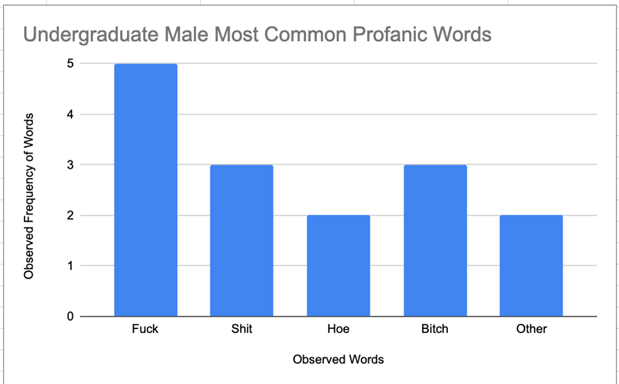
, ,

Profanity Amongst Undergraduate Students

Jesus Nocelotl, Fernanda Madrazo

For most people, college can be a difficult and exciting journey within one’s life. The new experience of living on your own, independence and responsibility of forming your own decisions, and for many, the chance to make and begin new meaningful friendships. Oftentimes, in communities that foster a sense of group identity and culture, such as college, and especially for young adults, the formation of friendships and relationships starts with interaction and language between individuals. Language is an essential aspect of our everyday lives, proven to be an effective way of communicating with others and a tool for forming relationships through shared experiences and identity.

The importance of social interactions in a college aged environment is of great significance, as many young adults see college as a new chapter within their life and an opportunity to form new bonds. Especially in the age of social media, college students often resort and feel the need for social and group identities to create friendships. One of the most commonly observed uses of language in college environments is the use of profanity to communicate between individuals. Profanity is commonly used in conversation as a measure to emphasize meaning, common slang, or a sense of group identity. For our group’s research project, undergraduate students and their prevalent use of expressing profanity in active conversation was used to analyze deeper meanings between language and social identity. Throughout our findings, we observed the most commonly used phrases and made relevant connections to age, group identity, and especially gender identity, to support and provide deeper meaning to the importance of language, young adult life, and college environment.

[expander_maker id=”1″ more=”Read more” less=”Read less”]

Introduction and Background

In observed profanity used in conversation, the choice and diction are influenced by the people engaging in conversation and present scenarios. For our research proposal, our group was interested in evaluating how prolific profanity is present in conversation by fellow undergraduate students at UCLA. When deciding on a target population, our group thought that fellow undergraduates would be a good target since we are more likely to relate to and understand undergraduates and their profane word usage. In addition to common relation, it is observed that college-aged students would be most likely to engage in active conversation using slang and profanity1, which would help gather more information and more culturally and generationally relevant profane words. Profane words are of special interest as they often carry more emphasis and meaning within American youth culture, and are especially observed when trying to “fit in” a certain group. Although much can be inferred on the significance of profanity to “fit in”, not much research is conducted on undergraduates’ frequency of profanity in relationship to observed gender groups. Since not much has been researched on the relationship between gender identity and profanity prevalence in college environments, our group decided to shift focus to explore this interesting topic. For our group’s initial hypothesis, we believed that through our findings, we would expect to see undergraduate males engaging in high volumes/cases of profanity within active conversation compared to their female counterparts. Our initial hypothesis was structured around gender roles and through our own shared experiences as young adult undergraduates, where males are often seen as casually expressing profanity and females are more likely to be reserved and professional in their profane word choices.

Methods

To gather information about this research topic, our group decided to conduct an online survey that would be accessible to the target population via social media. The survey was mostly focused on the topic of profanity, and asked what were the most common swear words individuals used and allowed them to elaborate on the scenario where they would be most comfortable using their selected word. Since the survey was already targeted to undergraduate students and required general information such as gender and undergraduate grade level, we included the opportunity for individuals to provide more information if they felt comfortable. Further elaboration included but was not limited to: gender identity, group membership, and race. This elaboration was important to the research project, as it allowed us to understand where profanity and relation sentiment could be applied to, such as Sororities, Fraternities, and group and social identity.

Results and Analysis

Figure 1: Data table displaying the observed frequency of profane word choices submitted by male undergraduate students of varying identities. Information and word columns obtained from our group’s undergraduate survey

The results of our survey yielded a varied spread of words that students self-identified as their most commonly used. As indicated in Figure 1, “fuck” was the most frequently used word, but “bitch” and “hoe” were not too far behind, with 5 and 3 people identifying it, respectively. However, the most surprising aspect of the survey came in the results of the questions where students explained what each word meant to them. Male respondents most commonly ranked “fuck” as their most used word, and said they used it with friends as a catch-all to mean many different things. However, male-identifying respondents also explained that they believed that the words “bitch” and “hoe” were related to and connotated women. For example, “A female” or “a rude person, usually a woman tbh. like when my boss is being a pain, “shes such a bitch”’ were two responses given by men who completed the survey. The majority of men who completed the survey answered in similar ways, saying that the meaning they gave to these words align with the original view which centered around patriarchal and misogynistic views on gender roles.

Figure 2: Data table displaying the observed frequency of profane word choices submitted by female undergraduate students of varying identities. Information and word columns obtained from our group’s undergraduate survey

On the other hand, Figure 2 demonstrates that female-identifying respondents use the words “bitch” and “hoe” more frequently than other swear words. Overwhelmingly, the meaning ascribed to these words is positive. For example, respondents said, “just means like “girlll”, or “bitch is either a positive or a negative thing. my best friend is my bitch (positive)… i rarely use it in the negative context. it can also be a positive general exclamation of support, like if a friend does something they’re proud of or wears a nice outfit and i want to show encouragement.” Women use these words in the context of friendship, endearment, or as a way to show sisterhood. They have redefined what the words mean and reframed them in a positive way that uplifts and supports other women, instead of denigrating them as men might intend the words for.

Discussion

The results of the research we conducted were fairly surprising to us. We expected there to be a difference in usage of profanity between genders, but the questions that we asked as follow-up in the survey were very enlightening. We discussed the results in a comparison to racial slurs that have been reclaimed throughout history. Racial minorities used slurs that were originally demeaning to them, and now use them in a context that expresses solidarity, unity, respect, and understanding within their own communities. The results that we obtained from our research could point toward a similar trend in college students when it comes to words which typically denote negative attitudes toward women. The female culture in college and in young people is reclaiming the meanings of these words in a similar fashion in order to empower women and reframe traditionally gendered views. We would like to see this research continued on a much broader scale, encompassing students in different regions of the United States, and also expanding toward different age groups. Further research can be done to expand understanding on how changing gender roles can be reflected in individual meaning given to the words in common vocabularies.

References

Güvendir, E. (2015, March 16). Why are males inclined to use strong swear words more than females? an evolutionary explanation based on male intergroup aggressiveness. Language Sciences. https://www.sciencedirect.com/science/article/abs/pii/S0388000115000194

Howard University News Service, Haynes, A., NewsVision, H. U., Miles, P., Thomas, V., Steib, A., Alabi, N., Pierre, A., & Harris, T. (2010, January 31). Profanity among college students. Howard University News Service. https://hunewsservice.com/news/profanity-among-college-students/

National University of Ukraine on Physical Education and Sport, Babushko, S., Solovei, L. (2019). What Makes University Students Swear. Borys Grinchenko Kyiv University of Ukraine. https://files.eric.ed.gov/fulltext/EJ1305437.pdf

The University of Mississippi Undergraduate Research Journal, Knirnschild, J. (2019) “The Gender Differences in Perceived Obscenity of Vulgar, Profane, and Derogatory – Language Usage among U.S. University Students,” The University of Mississippi Undergraduate Research Journal: Vol 3, Article 4 /https://egrove.olemiss.edu/cgi/v iewcontent.cgiarticle=1050&context=umurjournal#:~:text=Men%20have%20been%20found%20to,with%20women%20being%20scrutinized%20more

Wong, S. C., Teh, P. L., & Cheng, C.-B. (2020). How Different Genders Use Profanity on Twitter? International Conference on Compute and Data Analysis. https://doi.org/10.1145/3388142.3388145

 [/expander_maker]
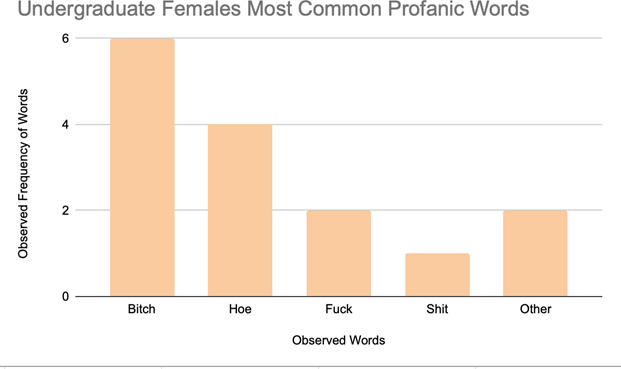
, ,
Scroll to Top