Sociolinguistics

this is our linguistics project…lol

Max Orroth, Arielle Gordon, Jillian Litke

We’ve all heard of the acronym lol, short for “laugh out loud”, and have used it in more than one context. Lol differs from other internet-born acronyms, like ROTFL, as it has become widespread across social platforms all over the world and has maintained a role in American English vernacular to this day. Some use it to “soften the blow” of a harsh statement. For others, it is tacked onto the end of a sentence to convey sarcasm or passive-aggressiveness, but does that mean its meaning has changed over time? Our study analyzed a series of tweets from Twitter to determine if the use of lol has increased in passive-aggressive contexts from 2008-2022. We also categorized where lol appeared in the tweet, such as the beginning of it, the middle, or the end to help determine the true meaning or intent of the tweet.

[expander_maker id=”1″ more=”Read more” less=”Read less”]

Introduction

How does the three-letter acronym lol manage to make its way into so many of our online conversations, even those that aren’t inherently funny? Lol is one of the first internet terms to become popularized and has been in use for a while, thus the acronym finds itself in a myriad of situations, each with an abundance of meanings, making it somewhat of a linguistic chameleon. Is lol being used more commonly in a passive-aggressive sense than its original meaning? How does this .com-era defining acronym persist through the years, picking up new meanings and uses as it travels around the globe via our interconnected home, the internet? This is what we wanted to investigate– whether passive-aggressive uses of lol have risen in popularity in the past 15 years. Prior to our research, lol’s role as a lexical item has been studied from many different angles. Authors Tagliamonte and Denis (2008) identify the acronym as an interlocutor involvement signal, playing a similar role as “mmhmm” does in face-to-face conversation; denoting that the utterer is engaged in an exchange. Similarly, Varnhagen et al. (2010) found that lol is the pioneer of a new acronym-based lexicon arising from the internet. Markman (2017) also found lol to be a discourse marker, a lexical item that lets a conversation partner know when a statement is done over text. Schneebeli (2020) identifies how the acronym’s placement in a clause can shift its meaning and give statements a new meaning or mood when added. This prior research gives insight to the role lol plays in the syntax and flow of conversations, but, to our knowledge, no studies have chronicled the term’s evolution and shift in use over time. Given that both the internet and the acronym have evolved since its first use in 1989, we feel a current examination is missing from the literature on internet language. Looking at English speaking Twitter from 2008-2022, the salience of lol’s usage as a marker for passive aggression has increased, revealing a broader ability for internet slang to evolve much faster than in-person language due to an abundance of use, communication, the internet’s own growth, and humans finding more of a home online every day.

Methods

To test our hypothesis, we searched Twitter from 2008 to 2022 for tweets that used lol. We gathered 20 random tweets per year for a total of 300. To account for virality as a potential confounding variable, we grouped tweets by how many likes they received and made sure to select 5 tweets per group, per year. We had four engagement groups: Low (0-50 likes), Medium (50-300 likes), High (300-1000 likes), and Ultra-high (1000+ likes). After collecting data from Twitter, we then decided whether each tweet was passive-aggressive and whether lol was positioned clause-final, clause-initial, or somewhere else. To determine whether a tweet used lol to be passive-aggressive we looked at multiple criteria, including lol not signifying its original meaning (“laugh out loud”), whether the tweet conveyed a rude or negative sentiment, whether it targeted a person or situation, or if removing lol lessened the tweet’s attack. Sometimes, we could also look at replies or quote tweets to get more information about the context of each tweet to solidify our decision. 

Results

We found that since 2008, English speaking Twitter users have been steadily increasing their use of lol to be passive-aggressive (Figure 1). Using Google-Sheets built-in capabilities, we calculated a Pearson’s r of 0.767, indicating a moderate-strong positive correlation between the frequency of passive-aggressive lols and the year it was tweeted. Our data showed that passive-aggressive lols peaked in 2016 (50%) and 2021 (55%).  
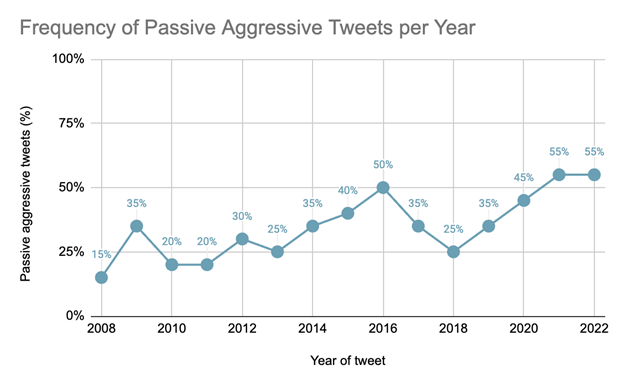
Figure 1: Frequency of passive-aggressive tweets across each year studied (2008-2022)

On clause placement, we found that slightly more tweets had lol at clause-final (~41%) than clause-initial (~34%), with about 25% of tweets placing lol in a location indeterminable as final or initial (Figure 2). 
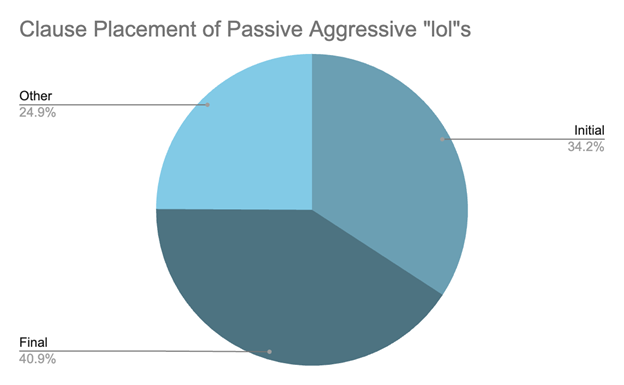
Figure 2: Breakdown of clause placement of lol across all tweets gathered

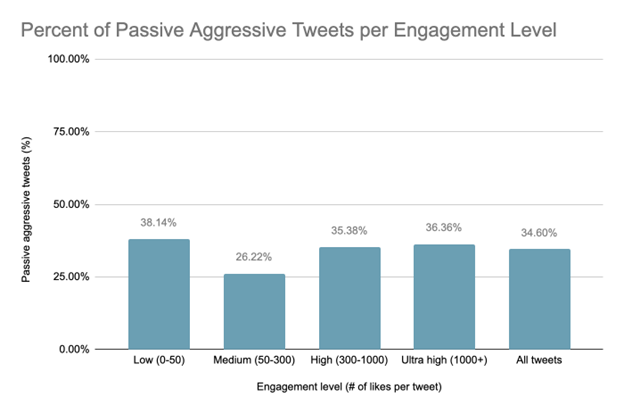
Overall, out of the 300 tweets analyzed, 34.6% were determined to be passive-aggressive uses of lol (Figure 3). For all but one group, we did not find any significant deviation from this number when tweets were grouped in their engagement groups across all years. Among tweets in the Medium group (50-100 likes), 28.6% were determined to be passive-aggressive uses of lol

Figure 3: Frequency of passive-aggressive tweets among engagement groups and all tweets

Discussion and Conclusion

Due to our data displaying a moderate-strong positive correlation, we concluded that the use of lol to convey passive-aggressiveness increased from 2008-2022. We observed peaks of passive-aggressive tweets during 2016 and 2021. While we are unsure why those peaks occurred during those years, we hypothesize that it was due to political and social turmoil in America. 2016 was when Donald Trump was elected president, and that divided our nation. 2021 was also when COVID evolved into Omicron, and America was again divided on whether wearing a mask was an infringement of our rights. Such factors could influence the use of passive-aggressive lols, and this trend might be an area for future research. We also analyzed the clause placement of passive-aggressive lols and found that the majority appeared clause-finally at 40.9%. Clause-initial lols appeared at 34.2%, and the rest were considered in the ‘other’ category in which the acronym was embedded in the clause. This supports previous research in which clause-initial lol tends to serve as a discourse structuring lexical item such as an immediate reaction whereas clause-finally typically suggests a more aggressive demeanor (Schneebeli, 2020). Finally, we analyzed the passive-aggressive lols per engagement level of the tweet to determine if one engagement group had significantly more or less passive-aggressive tweets, and we observed that there were significantly less tweets in the medium group. However, we do believe that that is an outlier since the rest of the cohorts are in the mid-30 % in regard to passive-aggressive tweets.

There were certainly limitations that should be considered alongside our findings. Due to the time constraints within which the research was conducted, only 20 tweets were found per year studied. Ideally, our findings would be derived from a broader sample, and even include other languages aside from English. Constraining the time frame even more, the advanced search feature on Twitter would only display tweets from September to December of each year, potentially creating a bias towards tensions and events during the Fall and Winter months such as elections, holidays, and harsh weather. Additionally, Twitter search would not allow us to filter tweets by the country of origin, only language. Though the site is most popular amongst American users, there is no way to know if the tweet authors were from the United States, the United Kingdom, Australia, or some other English-speaking individual. Lastly, our study was looking at passive aggression; though one can typically read tension through a screen, since we were not present for all the interactions or posts, we cannot say for certain if the tweet was delivered in an aggressive way. Despite our systematic approach to determining whether a tweet was aggressive, it is impossible to know the tweet authors’ true intentions behind their posts. We cannot say how these limitations affected our data and results but would be curious to have the study done on a larger scale, including multiple languages, and over a larger period. 

Nevertheless, lol’s modality is an example of how the internet can accelerate language evolution. Since the term’s creation with the rest of Instant Messaging language, it’s since taken on countless other meanings in addition to signaling passive aggression. This process, which might normally take decades to accomplish, is now achieved in 20 years. This is partly due to the unprecedented availability of other people’s discourse on the internet and online platforms like Twitter. One could read hundreds of tweets every day and the same tweet could be seen by hundreds of thousands of people. This level of contact between speakers catalyzes the creation of slang words and evolution of other terms like lol. Additionally, Twitter’s characteristics as a social media platform encourages widespread adoption of new language forms. Given that it’s mainly discourse-based, users look to the language of other tweets to inform how they should adapt their own language. This emulation of linguistic behaviors can drive language evolution, like we’ve seen with passive-aggressive lols. Although we did not study other internet language acronyms (ROTFL, lmao, etc.), we noticed anecdotally that lol seems particularly susceptible to being adopted for other uses beyond its literal meaning. Perhaps the term’s shortness, broad meaning, and ease to type into a phone screen have allowed it to garner such an expedited evolution. Future research might investigate what makes lol such a linguistic chameleon and why it has remained relevant in cultural discourse to a greater extent than many other IM language creations that evolved at the same time. 

Aside from the explicit findings, our study offers broader implications to the field of sociolinguistics. We were able to identify a few studies on lol, but not nearly as many as expected considering the popularity of the term. This study contributes to this burgeoning sector of the field. Lol’s breadth of uses offer a plethora of research topics — we could conduct this study with an entirely different meaning of the term and find something new and relevant to report. In general, there is a deficit in studies of online language use. Nowadays, a message can be sent from Japan to Canada in a matter of seconds, and on Twitter you can see hundreds of tweets from all around the world with a simple scroll of your thumb. As the world grows more dependent on the internet and humans increasingly engage in online communication, studies of this nature are of the utmost importance for the future of sociolinguistics. Lastly, this research topic came from phenomena we have noticed in our day to daytime spent on social media and engaging in digitally based conversations. Sociolinguistics as a field studies language use and the social implications behind it; this study gives validity to anecdotal experiences as a legitimate course of study and provides a deeper understanding of the terms we use daily.

References

Markman, K. M. (2017, October 30). Exploring the Pragmatic Functions of the Acronym LOL in Instant Messenger Conversations, doi: https://doi.org/10.31235/osf.io/3du86.

Sloan, L., Morgan, J., Burnap, P., & Williams, M. (2015). Who tweets? Deriving the demographic characteristics of age, occupation and social class from Twitter user meta-data. PLoS One, 10(3), doi: https://doi.org/10.1371/journal.pone.0115545.

Schneebeli, C. (2020). Where lol is: function and position of lol used as a discourse marker in YouTube comments. Discours. Revue de linguistique, psycholinguistique et informatique. A journal of linguistics, psycholinguistics and computational linguistics, 27.

Tagliamonte, S. A. & Denis, D. (2008). Linguistic Ruin? LOL! Instant Messaging and Teen Language. American Speech, 83(1), 3-34.

Varnhagen, C.K., McFall, G.P., Pugh, N., Routledge, L., Sumida-MacDonald, H. & Kwong, T.E. (2010). lol: new language and spelling in instant messaging. Reading and Writing 23, 719–733.

[/expander_maker]
, , ,

Turning the Tables: Do Discourse Particles Catalyze Conversational Turn-Taking?

Alex Chen, Dhanya Charan, Madurya Suresh, Yutong Shi

Discourse particles are often used in conversations to facilitate turn-taking. This process may be independent of the epistemic authority, or confidence level, of the speaker. Discourse particles may be used significantly as a turn-taking mechanism, but no more by confident speakers than unconfident speakers. A study was conducted on pairs of UCLA undergraduate students, aged 18 to 22, who had an established friendship of over three months but under three years. Their majors were used to sort them into confident and unconfident roles. After investigation, it was found that discourse markers are not significantly used to signal turn-taking. Furthermore, speakers in both the confident and unconfident roles use discourse particles much to the same extent. This suggests that discourse particles may not play as pivotal a role as formerly accepted in turn-taking and conversation, yet are virtually ubiquitous in speech – although, perhaps they maintain some yet undiscovered function.

[expander_maker id=”1″ more=”Read more” less=”Read less”]

Introduction and Background

Conversational turn-taking is a fascinating process that allows individuals to actively engage in conversations and share their ideas. In our study, we delve into the intriguing world of discourse particles and their potential role in facilitating turn-taking in English conversations.

Previous research has emphasized the significance of turn-taking, revealing that people spend an average of three hours a day engaged in conversations (Levinson & Torreira, 2015). Discourse particles play a multifaceted role in the English language, serving various functions such as indicating shifts in turns, transitioning between topics, expressing agreement or disagreement, and signaling the closure of a conversation (Zimmerman, 2019). The contexts in which these discourse markers appear show trends, such as “you know” often conveying hesitation; this also suggests the semantic significance of discourse markers (Farahani & Ghane, 2022). However, the specific role of discourse particles in turn-taking, as well as their connection with confidence levels, have not received comprehensive attention in previous studies, which presents an intriguing problem that we seek to address. Understanding the influence of confidence levels on turn-taking is crucial as it directly impacts the dynamics and balance of conversational interactions. Previous research suggests that a speaker’s level of confidence, which reflects their epistemic authority, can shape their linguistic choices and influence how they initiate and conclude conversational sequences (Mondada, 2013). By comparing the initiation of turn-taking between speakers with varying levels of confidence, we can gain valuable insights into the intricate relationship between confidence and conversational dynamics.

Our research problem focuses on investigating the role of discourse particles in conversational turn-taking and exploring the influence of confidence levels on their usage. Specifically, our study aims to compare the initiation of turn-taking between a speaker who is more knowledgeable and confident and a speaker who is less knowledgeable and less confident. We hypothesize that regardless of their confidence level, both speakers will rely heavily on discourse particles to facilitate the smooth transition between turns. In other words, discourse particles serve as significant tools for turn-taking in both confident and less confident roles.

Through our research, we aim to enhance our comprehension of how discourse particles function in facilitating smooth transitions between speakers. By investigating the connection between confidence levels and the utilization of discourse particles during turn-taking, we aspire to uncover the subtle intricacies of conversational interactions and establish a foundation for more effective and engaging conversations.

Methods

The target population is undergraduate UCLA students, aged 18 – 22 (UCLA, 2020). We recruited in pairs and selected two pairs of native English-speaking students of different majors and the same gender, with an established friendship of at least 3 months, but not more than 3 years. We selected topics based on the students’ majors, allowing one student to be more confident about the topic than the other. The students were also asked how confident they felt in the topic before and after each conversation in order for us to confirm this. The participants then engaged in a conversation with differing confidence levels on the subject. Lastly, we provided a post-participation survey to keep track of all metadata. The data collection method was based on transcribed audio recordings of the conversations between participants. The transcripts were analyzed for the frequency of discourse markers used, as well as the number of turn-taking initiations made by each participant. We used a one sample one-tailed and two sample two-tailed t-test to analyze the data. The one-tailed t-test allowed us to determine if there is a statistically significant usage of discourse markers used to initiate turn-taking in either role, and similarly, the two-tailed t-test allowed us to determine if there is a statistically significant difference between the two roles’ usages of discourse markers to initiate turn-taking. The variables used in our statistical model are confidence level and number of discourse markers used; the frequency of discourse markers used by each participant was compared between the confident and unconfident roles.

Results

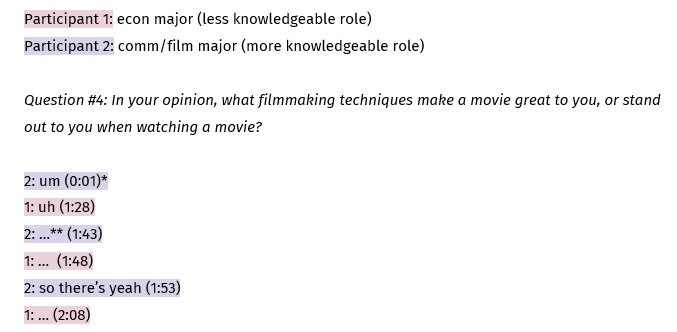
After conducting our participant studies, we selected 4 recordings from each round and transcribed them. Here is an example of part of our transcription for Round 1, Question #4, so you can get an idea of what the transcription process looked like:

Figure 1: Transcription excerpt from Round 1
*Timestamp from audio recordings
**Note that the “…” denotes a turn taken without the use of a discourse marker to begin the turn.

We didn’t take note of the content of each participant’s answers – we only tracked if they began their turn with a discourse particle, and if so, which discourse particle they used.

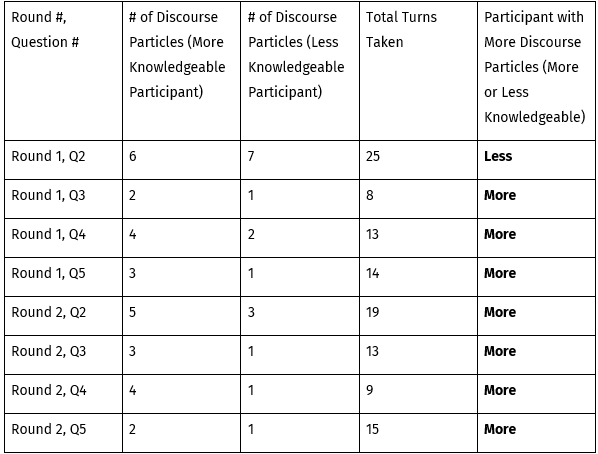
Our data yielded the following results:

Table: Tracking Number of Discourse Particles between Participants

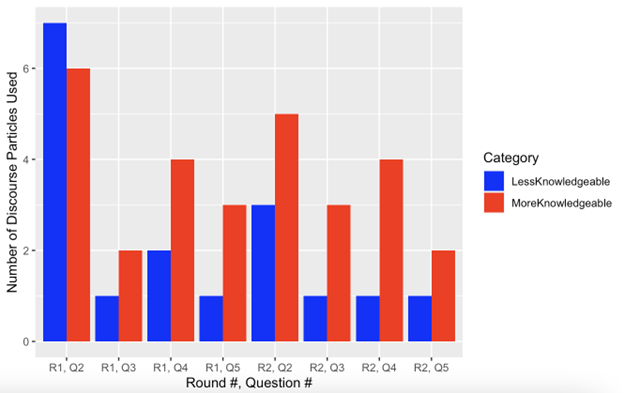
This bar graph showing the number of discourse particles used by each participant can help us visualize the results a bit better:

Figure 2: Comparing the number of discourse particles used between the less knowledgeable and more knowledgeable participant

Here, we can see that, overwhelmingly, the more knowledgeable participants in each question in each round used more discourse particles. However, the actual numbers of discourse particles used by each participant is the factor that we will be looking at to determine whether the use of discourse particles in relation to confidence/knowledge levels is actually significant. So, looking at just which participant used more discourse particles in a given conversation (the rightmost column) can be misleading.

Analysis

Just looking at the numbers, the answer to our questions is not immediately obvious. For this reason, we will use statistical analysis to arrive at a sound and statistically-backed conclusion.

The reason being, however, is first, we are not sure whether or not discourse particles have a significance in turn-taking, and we are not sure if confidence levels are a factor in discourse particle usage. For example, in one of the conversations, there were 13 discourse particles used to initiate turn-taking among 25 total turns taken. How can we tell if the usage of discourse particles is actually significant? Although 13 is larger than half of 25, we do not know if it is larger than 50% due to chance, or because discourse particles truly are a significant turn-taking method. For this reason, we have elected to use a One Sample Single Tailed t-test. This test will use our sample proportions and sample standard deviation and compare it to the baseline of 50%.

On the other hand, we are also not sure whether or not confidence level affects the usage of discourse particles in turn-taking. For example, in a different conversation, the more confident role used discourse particles to initiate turn-taking 3 times while the less confident role used discourse particles 1 time. We cannot conclude that being confident increases the usage of discourse particles just because 3 > 1 because this could also be due to chance. To arrive at a sound conclusion, we have elected to use a Two-Sample Two-tailed t-test. This will allow us to determine if the proportions of discourse particle usage between the confident and unconfident roles are significantly different, or if it is due to chance.

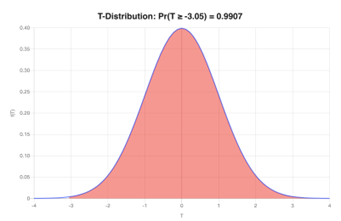
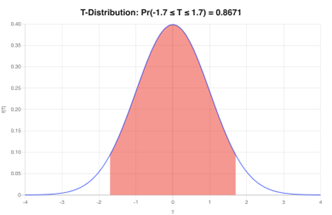
For the first test, we collected the number of turn takes initiated with discourse particles and compared it to the total number of turn takes. This ended up being 0.365. Then, we computed the standard deviation of the entire sample. With these numbers, we are able to calculate a t-score, which ended up being -3.05. This corresponds to a p-value of 0.99. What this p-value means is that given any random conversation, the probability of that conversation having 36.5% or more of the turn takes be initiated with discourse particles is 99%. Thus, the amount of discourse particles we saw being used is not statistically significant. If the p-value was below 5%, we would be able to confidently state that the ratio we found was not due to chance.

 This is the curve that shows our t-score distribution. The p-value corresponds to the red shaded area, which is almost all of the area under the curve.

Figure 3: Results from a one-sample single tailed t-test

For the second test, we collected the ratio of turn takes initiated with discourse particles compared to the total number of turn takes for each the confident and unconfident role. This came out to be 0.25 and 0.15 for the confident and unconfident roles, respectively. Then, we computed the standard deviation of ratios for each of these roles. Using these numbers, we calculated a t-score of 1.70, which corresponds to a p-value of 0.133. What this p-value means is that given any random conversation with a confident and unconfident role, there is a 13.3% chance that there will be a difference larger than the difference we saw in our data. Because the p-value is still somewhat large (larger than 0.05), we still cannot conclude that confidence plays a role in discourse marker usage in turn-taking.

This is the curve that shows our t-score distribution. The p-value corresponds to the white shaded area, which is a small portion of the area under the curve.

Figure 4: Results from a two-sampled two-tailed t-test

Discussion and Conclusion

Based on our results and statistical analysis, we draw two main conclusions:

  1. Discourse particles are insignificant when compared to all other turn-taking methods.
  2. No correlation was found between discourse particles usage and confidence level.

While our sample was random, it was still a very small sample. It could be interesting to explore how our results and analysis may or may not change with a larger random sample size.

An important thing to note is that although we found that discourse particles are not a significant turn-taking method, this is only true when comparing discourse particles to all other turn-taking methods collectively. This conclusion may not necessarily be true when comparing discourse particles to individual other turn-taking methods, such as asking questions.

Beyond the points of interest we explored, we made some observations about our data that could be intriguing to explore further in the future.

Firstly, studying what types of/which discourse particles the participants used could be interesting. We already know from previous research that a participant can use discourse particles, such as “oh” and “you know,” when turn-taking to convey their epistemic state in a conversation. We noticed from our data that, firstly, participants seemed to gravitate to certain discourse particles that were specific to them, no matter the situation. For example, in Round 1, one participant frequently used the discourse particle “uhh” to take their turn, no matter their epistemic state in the conversation. This, along with similar observations about other participants, suggests that choosing which discourse particle to use to engage in turn-taking could be personalized to the individual – or in other words, there are perhaps some discourse particles that people gravitate towards regardless of the situation. But, this is of course only a tentative hypothesis based on our observations.

Furthermore, we noticed that sometimes speakers would “copy” discourse particles from the other interlocutor. For example, one participant would use the discourse particle “yeah,” and the other participant would use “yeah” as well after, especially if the first participant spoke only briefly, and they would keep going back and forth using the same discourse particle. This happened a couple of notable times in our data. It also happened more frequently with discourse particles used for tokens of acknowledgment (which was not what we studied), rather than discourse particles used to begin a turn. Creating an empirical way to test this “copying” phenomenon we observed could be interesting as well.

All in all, based on our data analysis, we concluded that discourse particle usage when turn-taking and confidence level showed no correlation. Still, there’s more to explore within both our research question and the ones that came up through our observations.

When it comes to studying confidence level and methods of turn-taking, what we were really looking for was if there is something unconscious that listeners pick up on that makes a speaker “sound confident,” beyond the actual content of what the speaker is saying. By researching this further through a sociolinguistic framework, we hoped to gain a better understanding of the complex linguistic mechanisms of a regular conversation – mechanisms that we likely don’t take care to notice in our everyday lives!

References

Farahani, M. V., & Ghane Z. (2022). “Unpacking the Function(s) of Discourse Markers in Academic Spoken English: A Corpus-Based Study.” The Australian Journal of Language and Literacy, 45(1), 49-70. https://doi.org/10.1007/s44020-022-00005-3.

Konakahara, M. (2015). An analysis overlapping questions in casual ELF conversation: Cooperative or competitive contribution. Journal of Pragmatics, 84, 1-2. https://doi.org/10.1016/j.pragma.2015.04.014.

Levinson, S. C., & Torreira, F. (2015). Timing in turn-taking and its implications for processing models of language. Frontiers in Psychology, 6, 1-2. https://doi.org/10.3389/fpsyg.2015.00731.

Mondada, L. (2013). Displaying, Contesting and Negotiating Epistemic Authority in Social Interaction: Descriptions and Questions in Guided Visits. Discourse Studies, 15(5), 597–626. https://doi.org/10.1177/1461445613501577.

UCLA. (2020). Facts & Figures. https://www.ucla.edu/about/facts-and-figures.

Zimmermann, M. (2019). “15. Discourse Particles.” Semantics – Sentence and Information Structure, 511-544. https://doi.org/10.1515/9783110589863-015.

Extra Links

Why do we, like, hesitate when we, um, speak? – Lorenzo García-Amaya (https://www.youtube.com/watch?v=FsMWbVrjucg) 

Turn-Taking (https://socialcommunication.truman.edu/hidden-social-dimensions/turn-taking/)

[/expander_maker]


, ,

Roses are Red, Violets are Blue. You’re in Love with my Man? Guess my Voice Will Lower Too.

Kelly Eun, Isabelle Filen, Adeline Villarreal, Sylvia Le

Engaging in conversation with the man you like may lead you to feel all sorts of emotions. Maybe your heart starts racing, you find yourself laughing at every little thing he says, or you possibly say things you wouldn’t normally say. These are all very common character changes we may go through during these types of situations, but have you ever wondered if speaking to the man you like could also cause changes to your pitch? Our group conducted a sociolinguistic study in order to determine if a woman’s pitch altered while in conversation with a man of her interest, especially within the competitive environment of a dating show such as The Bachelor. With this objective in mind, the three longest running contestants were selected in order to analyze whether there was a possibility of pitch modulation while in one-on-one conversations with the bachelor. Praat was used to input data to find pitch means, as well as to discover if pitch change actually occurred.

[expander_maker id=”1″ more=”Read more” less=”Read less”]

Introduction and Background

Some of us may have a preconceived idea in regard to what happens to a woman’s voice when she talks to the man she likes, right? We could ask our friend, parent, or boyfriend to do an impression of a woman flirting with a guy and we would most likely hear something incredibly high-pitched and giddy with lots of giggling and hair twirling. This is a commonly held phenomenon in which a woman’s pitch raises in scenarios where she is interacting with a potential romantic partner (Re et al., 2012).

However, a study done in the UK (Pisanski et al., 2018) found that women on speed dates actually demonstrated a decrease in pitch value when the men they were interested in were in high demand, even highlighting how lower-pitched voices were more favorable than their higher-pitched counterparts. Why did they find a decrease in pitch? This is precisely what our group sought to uncover through our research, as we also asked ourselves…why?

To better understand typical traits associated with pitch, we discovered that higher-pitched voices are commonly indexed with fertility, youth, and femininity (Apicella and Fienberg, 2008)—all the traits men seem to absolutely swoon over, right? However, there might be some other traits men seem to be entranced by as well, such as sexual explicitness, seductiveness, dominance, and authority (Klofstad et al., 2012); such traits are also associated with a lower-pitched voice (Fraccaro et al., 2013).

Thus, we hypothesized that when we look at the average pitch values of our target population in our targeted scenario (which will be uncovered in our methodology discussion), the average pitch values of the contestants will be lower when they feel insecure of their position in the competition and higher when they feel more secure. The question we asked and pursued the answer to was the following: Does a lower pitch truly index the contestants’ desire and motive to assert their dominance through embodying a seductive, authoritative character who deserves not only a spot in the competition, but also the bachelor’s heart?

Methods

For our study, we first selected three women from Season 22 of The Bachelor (labeled as Contestants A, B, and C) who would remain for the longest duration, resulting in the selection of the winner, runner-up, and the “third place” contestant. We specifically chose these women because it allowed us to collect consistent data from the same three contestants throughout the whole season.

To analyze Contestants A, B, and C’s pitch across the entirety of Season 22, we divided the season into three stages: beginning (episodes 1-4), middle (episodes 5-7), and end (episodes 8-11). Pitch refers to the frequency of the sound waves made by a voice’s vibration. For instance, higher frequencies indicate higher pitch.

We then collected two utterances (e.g. brief comments) made by each of the three contestants per stage, for a total of 18 utterances (6 for each woman). To avoid the pitch being influenced by other voices, we only recorded utterances from one-on-one conversations between each of the contestants and the bachelor. The first utterance (Utterance A) was made by recording what the contestant had said before she received assurance from the bachelor, and the second (Utterance B) was made by recording what the contestant had said after. For the sake of this project, we not only considered comments such as “I like you too” or “I love you” as assurance from the bachelor, but we also took into consideration that a kiss could also be perceived as non-verbal assurance.

Afterwards, we separately inputted each utterance recording from each contestant and stage into Praat to determine if there was a change in pitch before and after Contestants A, B, and C received assurance from the bachelor. Praat is a software tool used in linguistic research to examine speech; in this specific study, we used it to analyze pitch. Rather than maximum pitch, the mean pitch values for Utterance A and Utterance B were used in order to account for possible pitch peaks and outliers that could arise and skew the pitch results. This would include a rise in pitch to indicate the end of a question or a potential fall of a declarative statement. So, utilizing the means of pitches provided a bigger picture.

Results and Analysis

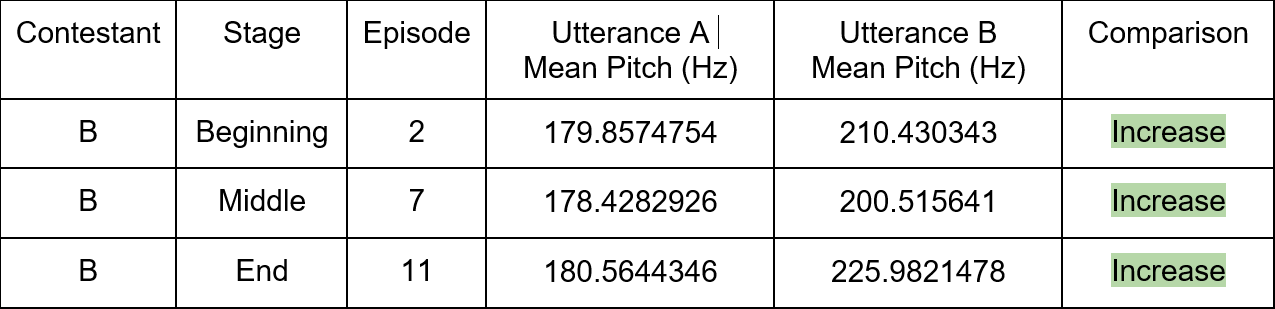
Throughout the course of Contestant B’s run on the show, our group found a consistent increase in pitch, as evident by the table below.

Table 1: Comparison of Contestant B’s Pitch Values

Our data for pitch mean is measured in hertz (Hz), the standardized unit of frequency equal to one cycle per second. Sound frequency is determined by how waves oscillate while they travel to our ears and when the oscillation of frequency waves is higher, we hear a higher pitch.

The table shows a positive difference between Utterance B Mean Pitch and Utterance A Mean Pitch in hertz in all three stages of the competition (beginning, middle, and end), indicating that the pitches of Contestant B became higher after assurance from the bachelor. Based on our background research, this likely indicates that Contestant B became more relaxed after assurance during her conversations with the bachelor.

Additional research was conducted to find that Contestant B was the eventual winner of Season 22 of The Bachelor, meaning that she was proposed to by the bachelor in the final episode. Our group predicts that this likely contributed as a factor for the increase in her pitch, as she was one of the frontrunners of the competition.

However, it is also important to note that it is difficult to make definite inferences about how Contestant B was feeling confidence-wise as the competition progressed. For example, it is possible that she could have felt more relaxed, knowing that there were less women competing against her; contrastingly, it is also possible that the stakes became higher for her, and she felt more possessive or competitive with the remaining women.

Another important factor in the data for Contestant B is that specifically in episodes 2 and 7, Contestant B received a rose during a date from the bachelor, which is a rare occurrence as roses are typically offered during elimination “Rose Ceremonies.” The offer of this rose in addition to the lead-up to it could also have had an effect on Contestant B’s confidence, further playing a part in her pitch raise as an indicator of her ease.

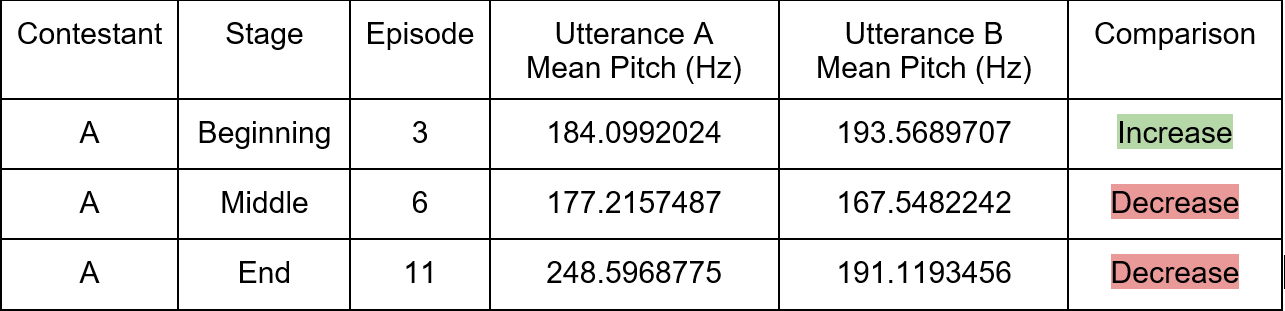
When it comes to Contestants A and C, both of these women demonstrated instances where the changes of their pitch decreased (i.e. their pitches before getting a response from the bachelor were higher than their pitches after), as opposed to the increase we were anticipating. Let’s first take a look at Contestant A, whose middle and end pitch means had a decreasing comparison.

Table 2: Comparison of Contestant A’s Pitch Values

Looking at Table 2, we can see how Contestant A’s beginning stage pitch comparison was in alignment with our hypothesis. When she started her one-on-one conversation from that segment of the episode, her Utterance A had the mean pitch of 184.0992024 Hz. After the bachelor chimed in, the mean pitch of her reply was higher than before at 193.5689707 Hz. We found that this could be due to Contestant A feeling reassured by what the bachelor had said, which could have further contributed to her feeling less concerned about her placement in the competition and not as worried about having to modulate her pitch or portray a sensual appeal.

Let’s now take a look at Contestant A’s middle stage pitch comparison, which contrasts the comparison result of her beginning stage. While she had begun the conversation from this segment with a mean pitch of 177.2157487 Hz, this dropped to a mean pitch of 167.5482242 Hz after the bachelor had his turn of speaking to her. With cases like this where the contestant’s pre-assurance mean pitch value is higher than their post-assurance value, it may have been because what the bachelor had said to the contestants contributed to their feelings of uncertainty with both their relationship and place in the competition. By responding to the bachelor with a lower-pitched voice, it would be more likely to project more authority, which could strengthen their relationship with the bachelor and assert their reason to remain on the show.

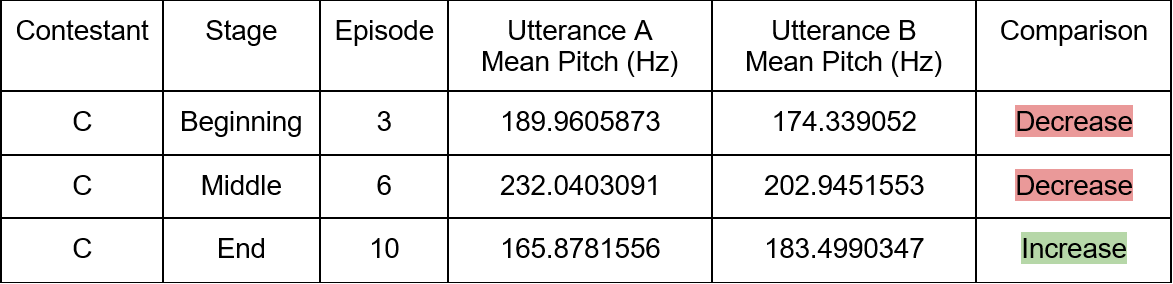
Moving onto Contestant C, we can see in Table 3 that she also had two of her three pitch mean comparisons being a decrease like Contestant A.

Table 3: Comparison of Contestant C’s Pitch Values

Interestingly enough, whereas Contestant A’s mean pitch comparisons throughout the stages went from an increase to two decreases, Contestant C’s progression was in the reverse order of Contestant A’s and went from two decreases to an eventual increase by the end of the season. This development could possibly be due to Contestant C gradually reaching a place in her relationship with the bachelor that solidified her confidence, while Contestant A may have felt more hesitation with hers. It is important to note that in all of these utterances, although we used our best judgment to decipher the scenarios and contestants’ reactions, there may have been other factors outside of the ones we targeted that contributed to the pitch outcomes of these women.

Discussion and Conclusion

Upon gathering and analyzing our results, our group was able to determine that while our data somewhat aligned with our aforementioned hypothesis, the results may not have been as consistent as we previously imagined. With the conclusion of our research, we then began to account for potential limitations to the big picture we desired to paint as a result of our findings.

For example, we encountered a scenario with Contestant A in the end stage of the competition where her pitch began high. According to the scope of our project, this should indicate that her confidence level was high. However, after receiving an assuring statement from the bachelor, her pitch actually dropped, meaning that she felt less confident by the end of the interaction. An example of this scenario is shown below in Figure 1.

Figure 1 – Contestant A’s End-Stage Interaction Documentation with the Bachelor from Episode 11.

To account for this limitation, we attempted to think outside the realm of our project and dig a little deeper as to what factors could have led to this particular utterance not aligning with our hypothesis, and we may have gotten our answer from looking into something almost all of us have probably done at least once in our lives: lied.

Let’s say your boyfriend made you upset and finally mustered up the courage to ask the dreaded question: “Are you okay?” You look him dead in the eyes, clearly not okay, and say something along the lines of “I’m fine” or “I’m just tired.” Now, are you really fine or just tired? Absolutely not, but for reasons unbeknownst to everyone but the universe itself, you evaded the truth. Similarly, this could have been what we saw in our data as well.

Therefore, even though we used our best judgment to select a scenario in which the contestant received verbal assurance, when we consider the limited scope of our sociolinguistic research, we may not have been able to account for the internal psychological factors that pertain to a woman’s verbal expression of having accepted that assurance. Thus, as we saw in Contestant A’s final utterance, we presumed that her response of “I’m as ready as I’ll ever be” indicated to the listener that she has been assured and is feeling ‘ready’ to meet the bachelor’s family for the first time. Ideally, this should have been accompanied by a higher pitch to index her confidence and security in the competition. However, we can now presume that Contestant A’s statement did not actually reflect what she was feeling inside and she may have felt as though she was nowhere near ‘ready’ to meet the bachelor’s parents, thus explaining why her confidence level and (consequently) the mean pitch were lower by the end of her utterance, which actually does align with our hypothesis! If we had not calculated the mean pitch of this utterance or discovered an unexpected decrease that misaligned with our hypothesis, we would have not been able to think beyond the realm of our research and propose an internal factor that may have impacted what we found in our results. So, what our group initially identified as a suspected failure may not have been a failure at all.

Furthermore, our group looked beyond the bindings of our research and constructed further possible iterations of our project that could be used to bridge the gaps in both previous research and our project on pitch modulation and its indexicality. These iterations could dive into many possible examinations of pitch modulation such as mental/physical well-being, age of the target population, the presence of vowel shifting, and even examining a scenario in which the woman contrarily is not interested in the man she is interacting with. The inclusion of all of these external and, as we know now, internal factors could certainly come together and paint a clear and concise picture of this phenomenon, as it is one that certainly cannot be attributed to just one definitive variable.

References

Apicella, C. L. & Feinberg, D. R. (2008) Voice pitch alters mate-choice-relevant perception in hunter-gatherers. Proceedings: Biological Sciences, 276(1659), 1077–1082. https://doi.org/10.1098/rspb.2008.1542

Fraccaro, P. J., O’Connor, J. J. M., Re, D. E., Jones, B. C., DeBruine, L. M., & Feinberg, D. R. (2013) Faking it: Deliberately altered voice pitch and vocal attractiveness. Animal Behaviour 85(1), 127–136. https://doi.org/10.1016/j.anbehav.2012.10.016

Klofstad, C. A., Anderson, R. C., & Peters, S. (2012) Sounds like a winner: Voice pitch influences perception of leadership capacity in both men and women. Proceedings: Biological Sciences, 279(1738), 2698–2704. http://www.jstor.org/stable/41549338

Pisanski, K., Oleszkiewicz, A., Plachetka, J., Gmiterek, M., & Reby, D. (2018) Voice pitch modulation in human mate choice. Proceedings: Biological Sciences, 285(1893), 20181634-20181634. https://doi.org/10.1098/rspb.2018.1634

Re, D.E., O’Connor, J. J. M., Bennett, P. J., & Feinberg, D. R. (2012) Preferences for very low and very high voice pitch in humans. PloS one, 7(3), 1-8. https://doi.org/10.1371/journal.pone.0032719

[/expander_maker]

, , ,

Speak of the Devil: How Popular Film Antagonists Use Language

Sarah Belew, Jacques Gueye, Kaley Phan, Boyi Zheng

In this study, we analyze the linguistic behavior of antagonists in psychological thriller movies in order to understand/index the features in their language that make them “creepy”. We chose 4 different films to view: Misery (1990), Silence of the Lamb (1991), The Lovely Bones (2009), and Gone Girl (2004). From these films, we analyze how abnormality is constructed using subtle linguistic behaviors of word choice, intonation, and sociolect. We theorize that abnormality in the character’s linguistic traits is rooted in deviation of their demographic’s language pattern and what is considered appropriate for social interaction, or “creepy.” As a result, we find that the antagonists are aligned in their sociolects, word choice patterns of calling the antagonist’s name with great frequency, and that female antagonists have a “(Rise)-Rise-Fall” pattern in prosody. These marked patterns come together to create vivid, memorable characters that are unmistakably creepy.

[expander_maker id=”1″ more=”Read more” less=”Read less”]

Introduction and Background

What is creepiness? McAndrew and Koehnke identified the study of creepiness as a major gap in the scientific literature (2016). Their study identified creepiness correlates, such as gender identity (“being male”), physical traits (“having greasy hair”), and behavioral patterns (“stood too close to your friend”), concluding that creepiness is detected when people perceive an ambiguity of threat, often interpreted as a sexual threat among female participants.

We are unsatisfied with this approach. By eliciting people’s understanding of creepiness, perhaps we receive nothing more than a “creepiness profiling” mechanism, echoing the findings of Implicit Association Test studies conducted on racial stereotypes (Oswald et al, 2013). Are certain racial groups perceived as possessing more ambiguity of threat? Can women ever be creepy? Since our social life is riddled with implicit biases, this strand of study demands a more experimental approach that challenges our biased perception. Scripted Fictional Content (SFC) has the transformative potential in understanding the depth of this human emotion. The four psychological thriller films that we watched for our studies, including Misery (1990), Silence of the Lamb (1991), The Lovely Bones (2009), and Gone Girl (2004) demonstrated that creepiness does not rely on stereotypes and non-normativity known to our daily life. The mismatch between language stereotypes, creepiness assumptions, and the language performance confirm that actors often combine verbal strategies that run counter to expectations of norms but are not abnormal in a caricatural sense. This confirms the third-wave sociolinguistic assumption of the speaker’s agency (Eckert, 2012, Bell and Gibson, 2011). Overall, we find that actors do not achieve creepiness by piecing together socially neutral elements in the context of the movie plot and the character, which come together to deliver the creep.

Methods

In this study, we use sociophonetic and behavioral patterns to describe the technique of character building. We examined over eight hours of audiovisual media to develop a corpus study, manually coding all the speech of antagonists for marked patterns. We also listen to the other characters to qualitatively compare, so that we may develop a sketch of each antagonist including sociophonetic and rhetorical strategies. For the quantitative analysis, we pick creepiness correlates in their coded context to establish a statistical distribution per film.

In conducting this pilot study, we take the third-wave linguistics assumption that speakers consciously use sociolinguistic elements. Since there is a gap in the literature, we only landed on prosody, register (word choices), and sociolect as our relevant variables after preliminary viewing. Many previous studies demonstrated that affective prosody allows great intra-speaker speech variety, and plays a critical role in emotion expression (Frick 1985). On the other hand, socio-prosody study of inter-speaker variation is a field at its early development (Holliday 2021). Nevertheless, the evidence in our corpus convinced us that creepiness correlates, such as the markedness of the (rise)-rise-fall prosody has both intra-speaker patterns (reserved for narrative manipulation), and inter-speaker patterns (indexing non-standard dialects, feminine speech).

For our most nuanced and productive variable, the (rise)-rise-fall pattern, we have provided an edited video clip for demonstration purposes. Our coding of this pattern has followed the following rule-of-thumb criteria: (1) well-defined rising accent (L+H*) followed by a falling accent (H+L*) and a low boundary tone (L%), often the result of emphasizing the penultimate word (Beckman & Ayers 1997)  (2) exclude rising in questions, unmarked rising in enumeration and long words (3) usually occurs toward the end of an utterance (4) characteristically violating the Strong-Weak alternation in modal rhythm (Kiparsky 2014).

Here is an edited clip from Gone Girl (2004), where Amy Dunne uttered 50 instances of characteristic (rising)-rising-falling speech in the course of a 7-minute monologue.

https://drive.google.com/file/d/1Tcc106ftXEQYeOe08oTVmTule9zlkP40/view?usp=share_link 

Results and Analysis

1. Word Frequency Analysis 

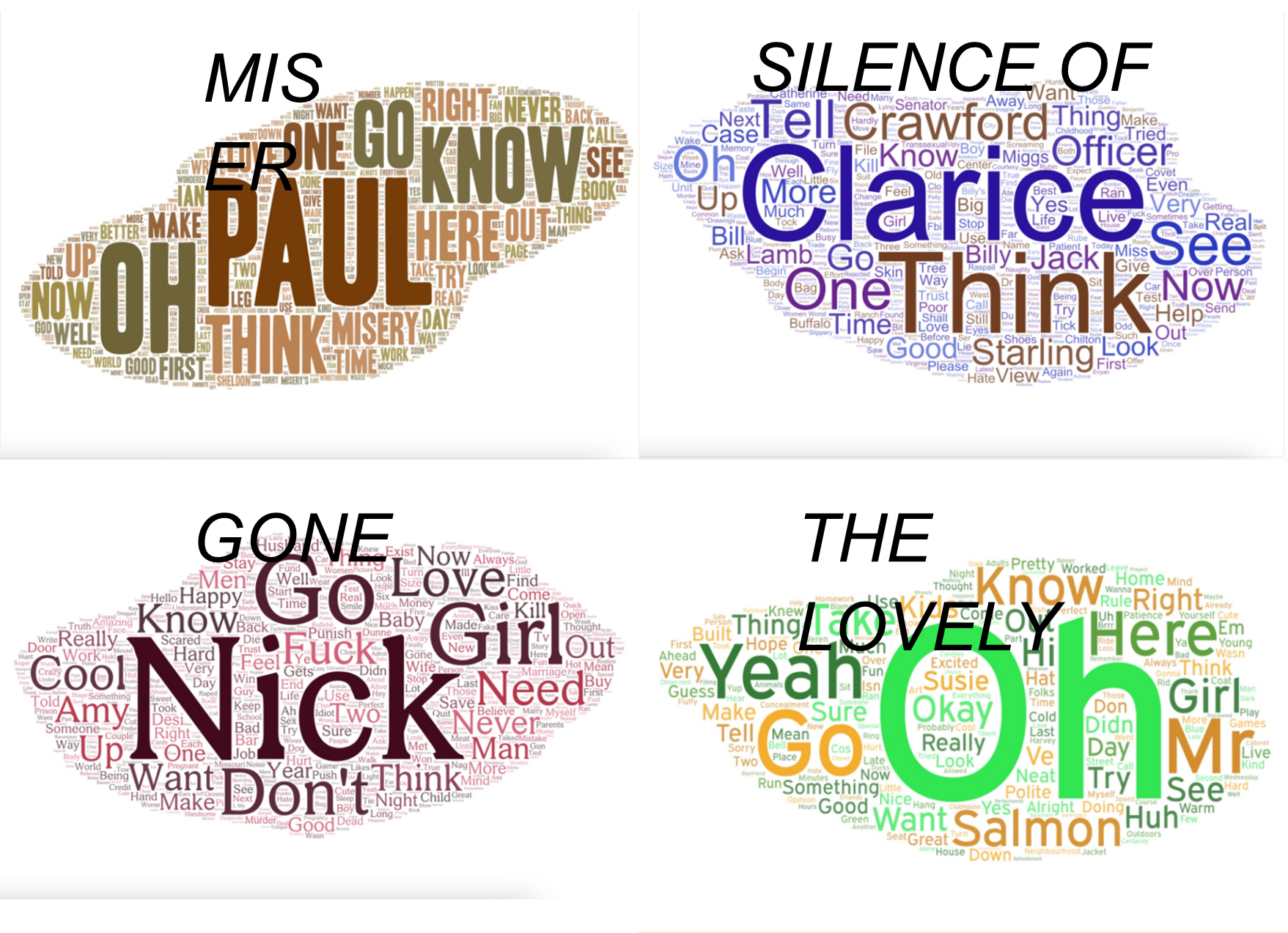
The following word clouds (Figure 1) visualize how antagonists in our corpus exhibited two discourse behaviors that made their interlocutor and the audience uncomfortable. Amy Dunne (Gone Girl), Anne Wilkes (Misery), and Hannibal Lector (Silence of the Lamb) all have the name of the protagonist as their most frequent item, showing their unhealthy obsession with them. They all engaged in extensive manipulation of the protagonists, calling them by name to draw their attention. This article by Michigan State University elaborates on some of the psychology behind using someone’s name, including manipulation. George Harvey (The Lovely Bones) is the only character that does not share this pattern, particularly because of a lack of dialogue between the two (although he does refer to the protagonist by her last name occasionally). The second behavior is the use of words that may appear manipulative. These words include “know”, “think”, “see”, etc. Under different contexts, these words are used in dialogue to guide the protagonist’s thinking and actions. For example, consider the following line in “Misery” by Annie:

ANNIE:  I know you didn’t mean it when you killed her, and now you’ll make it right.

In this context, the antagonist is telling the protagonist what she believes he is thinking, in a way that he has no choice but to accept. With the other high frequency words, it is common that the antagonist used it in the same way: to make controlling statements or pure assumptions. Phrases such as “you know”, “I think you” and “you see”, were very frequent ways that these words were being used.

Figure 1: Word Clouds for each Antagonist

2. Prestigious, Psychopathic Dialects and Rhetorics

In the three antagonist-centered psychological thrillers (excluding The Lovely Bones), we see antagonists being portrayed as highly intelligent, socially prestigious characters, only to be revealed as vile, manipulative psychopaths. They are Harvard-graduate writers, head nurses, and renowned psychologists, all having high social standing. Based on the story setting and the voice acting, we qualitatively judge Amy to have virtually no accent for her background in New York, and Anne Wilkes to leave a Mid-American housewife impression but no recognizable Bakersfield phonetic feature as well. Hannibal Lector, on the other hand, speaks with the highly prestigious Mid-Atlantic English, plus Hollywood Golden Age paralinguistic sound quality: consistent nasal leakage, strong twang (forte consonant articulation), drawl (prolonged vowels), seldomly enunciating rhotics. These patterns are close to Katherine Hepburn, credited as the actor that popularized this accent (Wang 2014). However, this style of speech has been long obsolete, and the decision to act in such an accent, combined with a strange melodic quality resembling Truman Capote, the actor Anthony Hopkins has truly created an uncanny accent.

On the level of rhetoric, all three of these antagonists use elaborate rhetorical strategies. Hannibal is known for his cruel puns (‘having a friend for dinner’, implying cannibalism). As a writer, Amy uses her rhyming puzzles and vulnerable writing style to play the innocent, bubble-headed victim of a domestic murder, leaving the world lamenting her disappearance and his husband being hated by everyone. Even Anne Wilkes, the least articulate of them, uttered rhymed lines in a confession of love for Paul, showing a mastery of poetics:

The rain, sometimes it gives me the blues./ When you first came here, I only loved the writer part of Paul Sheldon. But now I know I love the rest of him, too. / I know you don’t love me. Don’t say you do./…. You’ll never know the fear of losing someone like you… /That’s very kind of you, but I bet it is not altogether true.

George Harvey, the antagonist of The Lovely Bones, has to be analyzed as an exception. Being a protagonist-centered film, the picture showed him as a more marginalized, conventionally creepy character. His speech patterns always sound like an act, given that there is little exposure to the nuances and complexity of his persona. He uses underprivileged elements preferred by men, sometimes exhibiting free in~ing, /s/~/ʃ/ alternation (Hall-Lew et al, 2021, Labov, 1966). Conspicuously, the alternation seems to happen when he is confronted by somebody else and putting on pretension. If we accept this theory and suggest that George does not exhibit his authentic speech pattern, it does not pose a problem to our thesis.

3) Prosody Distributional Analysis in the Sociolect Context

In watching Gone Girl, Lovely Bones, and Misery, we find the distribution of the (Rise)-Rise-Falling pattern to be precisely patterned with three social factors: gender, region of origin, and positions of power.

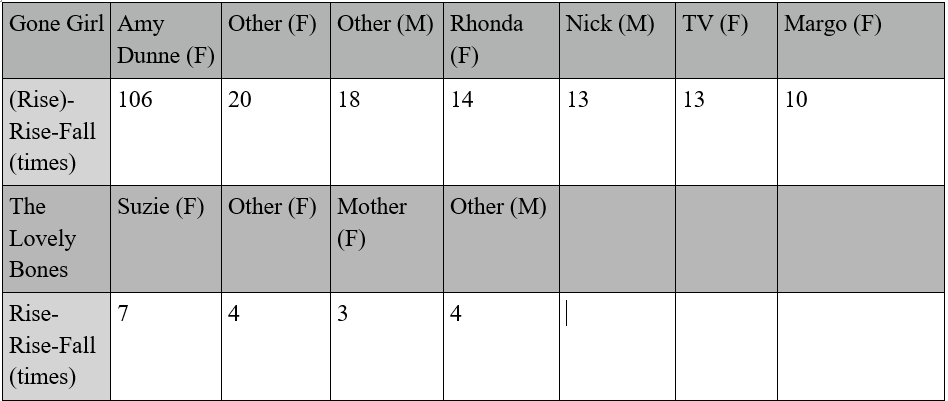
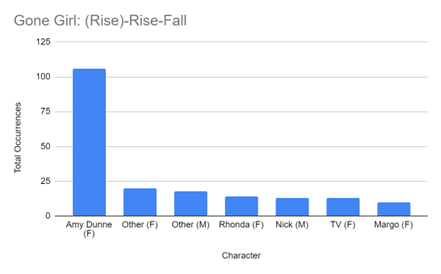
What first drew our attention was the clip played in the method section, in which Amy Dunne displayed an impressive array of the said pattern – contributing fifty out of 194 total occurrences of the pattern in the film within seven minutes. When we look at the setting of Gone Girl, in suburban Missouri, we can make sense of this pattern as a regionalism for most of the occurrences, since most characters, except for Nick, Amy, and Margo, display a non-standard accent. Perhaps due to the cultural marginality of the American Midwest, we do not find the renowned monophthong /o/ instead of /əʊ/ (‘b-oh-t’ for BOAT [boːt]), /æ/ heightened to be /e/ (‘behg’ for BAG [beg]), but instead recognize the vowel chain shift nascent to the American south (/a/ for /aɪ/, /ei/ for /ɪ/, and so on) (Labov et al, 2005). As in the previous analysis, the character Amy is designed as a native New Yorker with high social standing, often showing snobbery and resenting the simple life in the Missouri countryside. The (Rise)-Rise-Fall pattern feels quite out of place in her standard American repertoire of sounds, and we are inspired by the clip to say that the voice actors use this strategy to show a dominance over the narrative – for the first half of the film, she has set herself up as the narrator, but is later to be revealed as a psychopathic liar who is obsessed with manipulating herself and others. This agrees with the common perception of the prosody pattern- salient in TV announcements, radio shows, and advertisements. When the audience saw the run-away Amy put up the facade of a New Orlean housewife, she experienced another spike of (Rise)-Rise-Fall patterns, only that this time it is contextualized by a clear southern accent. This time, her interlocutor speaks with the same southern accent and similar rise-fall patterns. This gives us the final confirmation that the pattern we discovered is indeed marked and regionally conditioned.

The same findings are confirmed in Misery, even though a complete count of the relevant token has not been possible due to copyright reasons, we have an observation that exactly follows the above: Anne Wilkes speaks a normative accent, and only uses the (rise)-rise-fall pattern to fulfill the function of manipulation, infamous scenes such as the iconic “I’m your number one fan”. Otherwise, the same pattern only occurred in the conversation between two southern speakers, Sheriff Buster and his wife. 

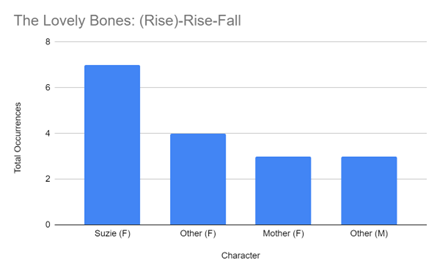
Should this prosody pattern also be found among male antagonists? We do not find this to be the case, but the statistics from the three films we coded (excluding Silence of the Lamb) all speak to the fact that (Rise)-Rise-Fall indexes female identity. In all three films, male utterances of the phrase make up less than 25% of the total tokens, and characters who consistently speak this way are all decidedly Southerners. The Lovely Bones showed the same consistent pattern, with the prosody of Suzie’s mom functioning as a signal for a controlling character who commands her children to follow rules – similar to the manipulative personalities we saw.

Table: Occurrences of the Rise-Rise-Fall pattern in Gone Girl and The Lovely Bones
Figure 2: The chart shows that Amy has the most occurrences of (Rise)-Rise-Fall of any other character by a wide margin.
Figure 3: The chart shows that Suzie has the most occurrences of (Rise)-Rise-Fall of any other character.

Discussion and Conclusion

Our research has yielded a small contribution to the understanding of the interactions between language and media, by providing insights into the intricate ways in which language and presentation can be used to create a sense of creepiness or psychopathy in characters. By exploring the techniques employed by the antagonists in the four films we analyzed, we have uncovered a diverse range of patterns that contribute to the development of creepy characters.

It is important to acknowledge that our study represents a small sample size and may not be generalizable to all media or contexts. However, with our final results, we can contribute to a deeper understanding of this popular media phenomenon. We hope that our research will provide further insights into this topic, as there is much more to be learned about the nature of language in the media and our relationship with both.

At the end of our project’s journey, our findings have uncovered the intricate ways in which language and presentation can be used to create a sense of creepiness or psychopathy in characters. The identification of common patterns in the techniques used in the four films we studied is a crucial step in the advancement of our understanding of this complex phenomenon.      

In conclusion, our research has provided valuable insights into the complex phenomenon of creepiness in the media. Our analysis of language and presentation techniques used to create creepy characters can contribute to a deeper understanding of human psychology and social behavior. Our study also highlights the importance of representation and diversity in media and has practical applications for filmmakers. We hope that our research will inspire further investigations into this fascinating area of study.

References

Bauman, R., & Briggs, C. L. (1990). Poetics and performances as critical perspectives on language and social life. Annual review of Anthropology, 19(1), 59-88.

Beckman, M. E., & Ayers, G. (1997). Guidelines for ToBI labeling. The OSU Research Foundation, 3(30), 255-309.

Bell, A., & Gibson, A. (2011). Staging language: An introduction to the sociolinguistics of performance. Journal of Sociolinguistics, 15(5), 555-572.

Buckland, W. (2021). Feminism, narrative, authorship: (Gone Girl and Orlando). In Narrative and Narration: Analyzing Cinematic Storytelling (pp. 65–80). Columbia University Press. http://www.jstor.org/stable/10.7312/buck18143.9

Cao, H., Beňuš, Š., Gur, R. C., Verma, R., & Nenkova, A. (2014). Prosodic cues for emotion: analysis with discrete characterization of intonation. Speech prosody (Urbana, Ill.), 2014, 130–134. https://doi.org/10.21437/SpeechProsody.2014-14

Clopper, C. G., & Smiljanic, R. (2011). Effects of gender and regional dialect on prosodic patterns in American English. Journal of phonetics, 39(2), 237-245.

Demme, J. (Director). (1991) The silence of the lambs [Film]. Strong Heart Productions.

Fincher, D. (Director). (2014). Gone girl [Film]. Twentieth Century Fox.

Jackson, P. (Director). (2009) The lovely bones [Film]. Dreamworks Pictures.

Jacquemet, M. (1999). Conflict. Journal of Linguistic Anthropology, 9(1/2), 42–45. http://www.jstor.org/stable/43102422

Holliday, N. (2021). Prosody and sociolinguistic variation in American Englishes. Annual review of linguistics, 7, 55-68.

Hall-Lew, L., Moore, E., & Podesva, R. (Eds.). (2021). Social meaning and linguistic variation: Theorizing the third wave. Cambridge: Cambridge University Press. doi:10.1017/9781108578684

Kiparsky, P., & Youmans, G. (2014). Rhythm and meter: Phonetics and phonology, Vol. 1. Academic Press.

Labov, W. (2006) The social stratification of English in New York City—Google Books. (n.d.). Retrieved June 19, 2023, from https://www.google.com/books/edition/The_Social_Stratification_of_English_in/bJdKY0mZWzwC?hl=en&gbpv=1&dq=william+labov+1966+social+stratification&pg=PA3&printsec=frontcover

Labov, W., Ash, S., & Boberg, C. (2008). The atlas of North American English: Phonetics, phonology and sound change. Walter de Gruyter.

Leistedt, S. J., & Linkowski, P. (2014). Psychopathy and the cinema: Fact or fiction? Journal of Forensic Sciences., 59(1), 167–174. https://doi.org/10.1111/1556-4029.12359

Reiner, R. (Director). (1990) Misery [Film]. Castle Rock Entertainment.

Schegloff, E. A., Jefferson, G., & Sacks, H. (1977). The preference for self-correction in the organization of repair in conversation. Language, 53(2), 361. https://doi.org/10.2307/413107

Langlotz, A. (2017). 17. Language and emotion in fiction. In 17. Language and emotion in fiction (pp. 515–552). De Gruyter Mouton. https://doi.org/10.1515/9783110431094-017

McAndrew, F. T., & Koehnke, S. S. (2016). On the nature of creepiness. New Ideas in Psychology, 43, 10–15. https://doi.org/10.1016/j.newideapsych.2016.03.003

Oswald, F. L., Mitchell, G., Blanton, H., Jaccard, J., & Tetlock, P. E. (2013). Predicting ethnic and racial discrimination: A meta-analysis of IAT criterion studies. Journal of Personality and Social Psychology, 105, 171–192. https://doi.org/10.1037/a0032734

Stephenson, V. L., Wickham, B. M., & Capezza, N. M. (2018). Psychological abuse in the context of social media. Violence and Gender, 5(3), 129–134. https://doi.org/10.1089/vio.2017.0061

Wang, C. (2014). A Sociophonetic analysis of American theater speech as exemplified by Katherine Hepburn’s filmography. https://scholarship.tricolib.brynmawr.edu/handle/10066/13761

Werner, V. (2022). Pop cultural linguistics. In Oxford Research Encyclopedia of Linguistics. https://doi.org/10.1093/acrefore/9780199384655.013.999

Wolter, Keely (2022) FULL INTERVIEW: Accent and dialect coach Keely Wolter talks about dat dere “Midwestern accent.”—YouTube. (n.d.). Retrieved June 19, 2023, from https://www.youtube.com/watch?v=vC4gyH4nhIw

[/expander_maker]

, , , ,

Gender Bias in Celebrity Interview Questions: Topic Study at the Oscars 2023

Sofia Duffy, Lauren Nemeh, Audrey Tseng, Venus Vu

Red carpet interviews at award shows are often a hot topic that circulates on the internet and are viewed by millions of people. This being said, the quality and nature of what is said in the interviews can wildly influence the viewers. Previous research and social movements have shown that female celebrities who participate in these interviews are more likely to receive questions and comments related to their appearance compared to their male counterparts. With this in mind, we aimed to investigate gender bias in celebrity interviews through analyzing interview clips of the 2023 Oscars red carpet interviews. Specifically, we examined if there were differences in the theme of questions asked (word choice) and the quality of interviewers’ voice (tone) when interviewing male celebrities versus female celebrities.

[expander_maker id=”1″ more=”Read more” less=”Read less”]

Introduction

Celebrity interviews on the red carpet hold a prominent position within the fabric of award shows, captivating global audiences as they eagerly seek glimpses into the lives of their beloved stars. However, within this realm, a disconcerting disparity often emerges in the nature of questions posed to male and female celebrities, serving as a reflection of deep-seated gender biases and the perpetuation of societal expectations. In our study, we set our sights on the precise queries directed at celebrities during the 2023 Oscars, embarking on an investigation to unravel the discrepancies in how interviewers engage with male and female celebrity interviewees. Through a meticulous analysis of interviewers’ word choice and tone, our objective is to cultivate a comprehensive understanding of the pervasive gender biases that permeate these high-profile interactions. In doing so, we aim to unearth patterns that mirror societal gender biases and shed light on the implicit biases harbored by the interviewers themselves. By undertaking this critical exploration of language use in celebrity interviews, we contribute to the ongoing discourse surrounding gender equality in the realm of entertainment and challenge the perpetuation of gender stereotypes on the illustrious red carpet.

Background

Celebrities hold a unique position in society due to their high-profile status and influence. The media coverage they receive significantly shapes public perceptions, particularly among impressionable children and teenagers who often look up to their favorite stars. Red carpet events are particularly important because they are televised occasions with substantial social significance. Among these events, the red carpet at the Oscars stands out as the most prestigious. Celebrities are asked a series of questions, and these interactions are recorded and broadcasted worldwide. 

A study from 1956, “Age and Sex in the Interview” by Benny et al., offers valuable insights into the intersectional relationship between age and sex. Their analysis focuses on responses and utilizes post-interview surveys to gauge participants’ perspectives. Their research reveals a consistent pattern of communication inhibitions between individuals of the same age but different sexes, particularly among young men and young women. These findings underscore the complexity of interview interactions and the influence of societal expectations. 

The Oscars red-carpet pre-show in question, with its apparent glamor and spontaneity, hides a reality that is heavily scripted and choreographed, where questions and reporters are carefully selected to meet industry demands and viewer expectations. Beneath the glamor of red-carpet lies a troubling tradition of objectifying the female body as a spectacle. Over the years, women have been typecast as the sole consumers of topics involving beauty and fashion, influenced by the rise of the beauty industry and photography (Lundén, 2021, p. 212). This has perpetuated a questionable tradition of objectification, reinforcing societal beliefs about gender roles. The red carpet has become a platform where women’s appearances are harshly criticized, focusing on mean-spirited evaluations of their bodies rather than celebrating their talent and accomplishments. Additionally, while women often bear the brunt of fashion-related questions, this does not exempt men from scrutiny. Fashion discourse has expanded to include men, but the discernible imbalance in how men and women are judged persists. 

However, the emergence of the #askhermore movement in 2015 reflects a growing resistance to the recurring practice of asking women the superficial “what are you wearing” question on the red carpet. The movement encourages reporters to delve deeper and ask female celebrities more substantial questions beyond their clothing choices. In our research, we will concentrate on the questions asked to both male and female celebrities, shedding light on patterns that mirror societal gender biases and expected gender performance.

In the context of award shows, red carpet celebrity interviews hold great significance as they attract thousands of viewers seeking insights into the inner lives of these celebrities. However, the quality of questions posed to male and female celebrities differs significantly, with women often subjected to shallower inquiries about their appearance rather than their careers. The central focus of our research is to investigate the disparities in the treatment of male and female celebrity interviewees during the 2023 Oscars. Specifically, we aim to analyze the word choice and tone utilized by interviewers in their interactions with these individuals. By examining these linguistic aspects, we seek to gain a deeper understanding of the gender biases that manifest in celebrity interviews. Our research question revolves around whether interviewers hold implicit gender biases, leading to a tendency to ask female celebrities more superficial questions compared to their male counterparts. Through this inquiry, we aim to contribute to the broader conversation on gender equality within the entertainment industry and challenge the perpetuation of gender stereotypes on the red carpet.  

Project Design

For our data sample, we selected 16 video clips from the 2023 Oscars red carpet. Since we are focusing on the gender difference of the celebrity, we selected 8 interview clips where the interviewee is a male celebrity and 8 interview clips where the interviewee is a female celebrity. To reach our sample size, we gathered video clips from three media sources: Extra TV, Vanity Fair, and E! News.  In total, we analyzed 49 minutes and 53 seconds of interviews. The time varied from interview to interview, from an interview that was 41 seconds long to one that was 4 minutes and 49 seconds. We aimed to analyze whether there are differences in the interviewer’s tone and word choice based on the gender of the celebrities being interviewed. To do so, we first transcribed everything that was said by the interviewers. We omitted what the celebrities said to better focus on the style of the questions and comments and color coded the content according to these following categories:

  • Word Choice (categorizing questions/comments according to theme)
    • Red: career related questions/comments (e.g. film projects, experience working with co-stars)
    • Blue: personal related questions/comments (e.g. family, love life)
    • Green: fashion related questions/comments (e.g. outfit, makeup)
  • Tone (categorizing questions/comments according to quality of interviewer’s speech)
    • Yellow: serious tone
    • Purple: playful tone

For the purpose of our study, we treated each categorization as mutually exclusive. Next, we counted how many instances each category was used in each interview and added them up according to the gender of the celebrity. We compared the number of instances between the two genders to see if there was any relationship between them. We also placed our transcripts into a word counter in an attempt to see if any significant words were used more or less in one gender over the other. In our collection and analysis of the data, we disregarded the gender of the interviewer as we solely wanted to focus on the gender of the celebrity in relation to the type of question asked.

Based on previous knowledge, we hypothesized that:

  1. Female celebrities will be asked more questions related to their personal life and fashion.
  2. Male celebrities will be asked more questions related to their career.
  3. Interviewers will use a more playful tone when interviewing female celebrities.
  4. Interviewers will use a more serious tone when interviewing male celebrities.

Data and Results

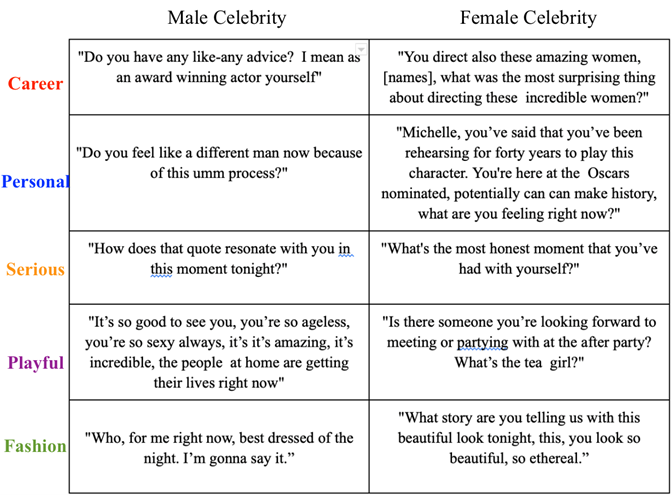
Before discussing the findings of our study, here are some examples of the types of questions/comments interviewers asked and how we categorized them. Each example is pulled from a different celebrity interview.

Figure 1: Examples of questions/comments asked to celebrity interviewees, categorized based on both gender and tone and word choice. Each question/comment is pulled from a different celebrity interview.

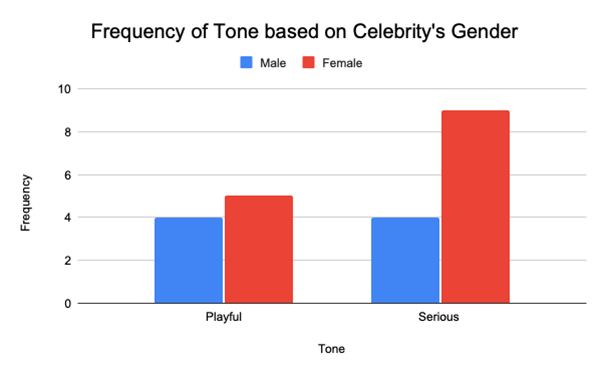
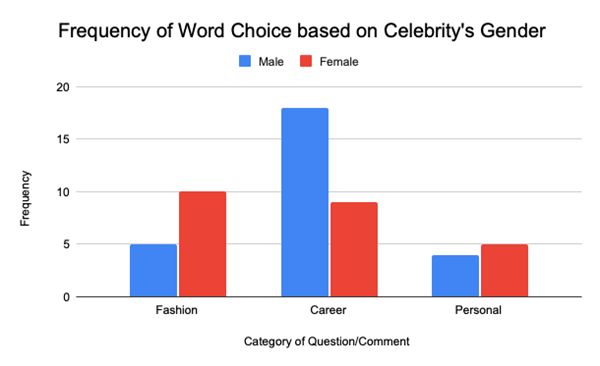
Here are our findings, separated into two bar charts. One chart is organized based on questions/comments that were categorized for tone, and the other is organized based on questions/comments that were categorized for word choice.

Figure 2: Bar chart representing data, with interviewer’s tone on the x-axis and total frequency in 16 interviews on the y-axis. Categorized based on celebrity’s gender.
Figure 3: Bar chart representing data, with interviewer’s word choice on the x-axis and total frequency in 16 interviews on the y-axis. Categorized based on celebrity’s gender.

In terms of word choice categorization, female celebrities were asked twice as much about fashion compared to men, as we recorded 10 instances for women compared to 5 for men. Male celebrities were asked career related questions twice as much as women, as we recorded 18 instances for men compared to 9 for women. We originally predicted that female celebrities would be asked more questions related to their personal life, which was proven to be incorrect as the results were roughly equivalent. Women were asked five personal questions compared to four for men.

In terms of tone, we found that women were asked twice as many questions in a serious tone compared to men (9 vs 4). However, we originally predicted that interviewers would use a more serious tone when interviewing male celebrities. We also found that male and female celebrities were spoken to in a playful tone at roughly the same frequency, with 20 instances for men compared to 18 for women.

When we put the data into a word counter, which we separated by the gender of the celebrity, we did not find any significance in the density of words used for male versus female celebrities.

Discussion and Conclusion

As we previously discussed, while we did find slight differences in the types of questions that were asked to the male versus female celebrities in our data recording, our data was not all-revealing nor conclusive. While we did find that men were asked more career-related questions whereas women were asked more fashion-related questions, we are not able to use our data to conclude that this is true for red carpet interview events in general. Our data consisted of 8 male celebrity interviews and 8 female celebrity interviews, which is not a complete representative of red carpet interviews as a whole. Further research could be done looking at a variety of different events. It would be interesting to see how/ if the results change depending on if it is a music awards event, premiere event, awards event, small event, etc. Each red carpet could be researched as an independent study, to then later compare the data. This comparison would offer insight into how the different events influence the types of questions being asked to male versus female celebrities. Alternatively, a study could be done by taking a set amount of interviews from each red carpet in order to have an accurate data sample of red carpets as a whole. This would offer insight into the trends of the questions male celebrities versus female celebrities are being asked on red carpets as a whole. Moreover, in our study we only analyzed the questions that were asked to the celebrities and did not take into account their responses. Future studies could benefit from also analyzing the responses.

It is also important to note that for the purpose of our study, we approached gender in a binary way through only analyzing the interviews of female and male celebrities. However, gender is not binary, and there is plentiful research that could be done on how transgender, non-binary, and other identifying celebrities are approached by interviewers on red carpets. In particular, we believe that it would be insightful to research and analyze the red-carpet interviews of transgender celebrities before and after transitioning to see if there are any differences in the questions that the same individual is asked. One of our male celebrities, Austin Butler had an interesting response to being asked a fashion question about his tuxedo. He responded with “What story am I telling you? I mean this Saint Laurent and I don’t know what story I’m telling you,” (Butler, 2023). This response, and others, offer insight into the history and the “why” matters of the questions that are asked on red carpets and therefore would be a useful data addition to a project like ours.

In addition to what we have already mentioned, in reflecting back on our project we have identified some factors that could improve our research. First, we did not account for the length of the interviews we were analyzing. Therefore, if there are three career-related questions in a 2 minute video, and none in a 30 second interview, it would be an inaccurate comparison. In future studies, we would better control the interview lengths. Additionally, we did not control who the interviewer was. Reflecting back, we realize that the motive and employer of the interviewer could play a large role in the types of questions that are asked. In future studies, we would definitely control who the interviewer is. Doing so would also open up an opportunity for more research through analyzing and comparing the types of questions that interviewers from different companies and magazines ask. It is evident that our research serves as a good starting point and reference for future studies.

References

Benney, M., Riesman, D., & Star, S. A. (1956). Age and Sex in the Interview. American Journal of Sociology, 62(2), 143–152. http://www.jstor.org/stable/2773344

Brownlow, S., Rosamond, J.A. & Parker, J.A. (2003). Gender-Linked Linguistic Behavior in Television Interviews. Sex Roles, 49, 121-132.  https://doi.org/10.1023/A:1024404812972

ExtraTV. (2023, March 12). Angela Bassett’s Kids Say Mom DESERVES Oscar Win (Exclusive). Youtube [Video]. https://www.youtube.com/watch?v=iM_bBHk-1HM

ExtraTV. (2023, March 12) Oscars 2023: Brendan Fraser Brings His Sons to the Red Carpet (Exclusive). Youtube [Video]. https://www.youtube.com/watch?v=dad48BVyR2A&ab_channel=extratv

ExtraTV. (2023, March 12) Oscars 2023: Colin Farrell’s Son Henry Says He’s a NICE Dad (Exclusive). Youtube [Video]. https://www.youtube.com/watch?v=WZRN4i0mIoo&ab_channel=extratv

ExtraTV. (2023, March 12) Oscars 2023: Miles Teller on Possibility of MORE ‘Top Gun’ Movies (Exclusive). Youtube [Video]. https://www.youtube.com/watch?v=BJMNzyb5Jtk&ab_channel=extratv

E! News. (2023, March 12). Oscars 2023: MUST-SEE Read Carpet Moments | E! News. Youtube [Video]. https://www.youtube.com/watch?v=-bu4OPD1PCM

Lawson, C. E., & Draper, J. (2021). Working the red carpet: a framework for analysing celebrities’ red carpet labour. Celebrity Studies, 12(4), 635-648. https://doi.org/10.1080/19392397.2020.1750969

Lundén, E. C. (2021). Twilight of the Idols. In Fashion on the Red Carpet: A History of the Oscars, Fashion and Globalization, 207–226. Edinburgh University Press. http://www.jstor.org/stable/10.3366/j.ctv1vtz84g.15

Mohammed, M. M., & Kadum, S. A. (2016). A Discoursal Analysis of Gender Differences in Selected English TV Interviews. Journal of the College of Languages (JCL), (34), 1-14. https://jcolang.uobaghdad.edu.iq/index.php/JCL/article/view/19

Nathanson, E. (2021). Aging on and off the red carpet: Joan Rivers, celebrity culture and postfeminist television. Celebrity Studies, 12(1), 51-66.  https://doi.org/10.1080/19392397.2019.1608839

Vanity Fair. (2023, March 12). After the Awards with Vanity Fair. Youtube [Video].  https://www.youtube.com/watch?v=ncn7h59Ko-U

Wang, H. C. (2009). Language and ideology: gender stereotypes of female and male artists in Taiwanese tabloids. Discourse & Society 20 (6), 747-774. https://www.jstor.org/stable/42889296

[/expander_maker]

, , , , ,

How Polite is Your Professor? A Gendered Analysis of Hedging as a Tool for Student Engagement at UCLA

Layla Hernandez, Yasleen Robinson, Charlotte Norris

Throughout their lectures, professors typically engage with their students. This process often requires the professors to implement certain linguistic devices in their speech that allow for them to sound less aggressive and threatening. These linguistic features include forms of hedging. Both male and female professors rely on hedges to further display politeness when interacting with their students. In this study, we focused on how professors utilize these hedge words in ways that promote themselves in ways that are more approachable and less authoritative. We hypothesized that female professors would utilize hedges more than their male professor counterparts. Specifically focusing on the frequency of the usage of hedge words, we analyzed four sociology professors from UCLA through recordings after attending their lectures. We carefully listened to each audio and transcribed them through Conversational Analysis (CA) to further allocate the number of hedges they used when speaking with their students. A detailed analysis revealed that male and female professors do not yield significant patterns in their uses of hedges. In fact, they used them very similarly in terms of frequency and style.

[expander_maker id=”1″ more=”Read more” less=”Read less”]

Introduction

For our project, we investigated the hedges that are used by both women and men professors during their interactions with their students during their lectures. More specifically, we aimed to highlight how the usage of these linguistic markers help to ease the declarative statements they share with their students. We hypothesize that the women professors will hedge more frequently throughout their discussions with their students because hedging is unequivocally involved and ingrained in women’s speech (Lakoff, 1972). We also hypothesize that both male and female professors will utilize hedging as a means to soften their assertive/strong statements to further promote interpersonal interaction and more inclusivity within the classroom.

Background

Professors and their approaches hold great influence over the success of their students. In this way, they consciously work to provide interpersonal interactions with their students while also actively working to supply a learning environment that is inclusive and welcoming (Van Petegem et al., 2005). This process typically requires the professors to employ linguistic strategies that portray them to be less threatening and aggressive through their choice of words (hedging). Hedges are words or utterances that serve to “reduce the force of a statement” (Wright & Hosman, 2009, p. 143). The professor’s reliance on hedge words prevents them from sounding or behaving like they know everything, rather it serves as a buffer that allows for a response or objection. In this way, professors create an open forum in which students feel comfortable probing or questioning the content they are teaching without fear of judgment. Our focus will also turn to the gendered patterns of hedging among men and women professors, specifically focusing on who uses hedges more frequently.

Methods

Our main focus included examining instances of hedging and their role in yielding the authority of professors in student-teacher interactions. We focused specifically on UCLA professors in the Sociology department to avoid linguistic variation that could occur due to variations in lecture content. We collected recordings from 4 different Sociology professors at UCLA which will include three males and 1 female. We collected our data through audio recordings after attending 4 different lectures, where we keyed in on student and professor interactions. We extracted our data from two interactions from each lecture. Where we then transcribed each exchange through Conversational Analysis (CA). Through this form of analysis, we highlighted the different hedges that both female and male professors use to soften their strong statements when speaking to their students. To achieve this, we looked at each transcript individually to identify patterns specific to each professor followed by a comparison between professors of the same gender and then across genders to look for any similarities or differences that are connected to larger gendered-language patterns. We also wanted to measure the frequency of how many times each hedge word was used by each professor. Thus, after transcribing we allocated the number of hedge words they included in their interactions.

Results and Analysis

Interestingly, our results indicated that there was not a significant pattern when comparing hedge use between female and male professors. Our initial hypothesis that women would produce more instances of hedging when interacting when students in comparison to male professors was completely in misalignment with our results. In contrast, we found that both genders utilize hedges in similar ways that would further elevate their statements from sounding too forceful or impolite. We also found that in terms of frequency, male and female professors depend on the practice of hedging similarly. There wasn’t a significant pattern that demonstrated that one gender utilized the linguistic device more than the other. If anything, it dispels the common notion that women rely on hedging more than men because we see that is not the case here, both genders rely on hedges almost equally. 

Figure 1: Professors’ Usage of Hedges During Student Interactions

Our first participant, professor 1, was unique because he was the only male as well as the only professor to demonstrate a wide and dependent use of hedging when interacting with his students. The bar graph above illustrates how professor 1 drastically differs from the other professors when examining their reliance on hedges during their interactions with their students. After completing professor 1’s (CA), we found that he accounted for a total number of 15 different instances of hedging. Each professor yielded some form of hedging, however, it seems that professor 1 superseded every other professor in terms of hedge use. After comparing him to the other professors that did not align with this pattern, we connected his use of hedging to his linguistic style and postulated that hedging may be a central linguistic feature in his everyday speech.

Figure 2: Transcription excerpt of Professor 1’s use of hedging

In the (CA) extracted from Professor 1’s (male) lecture, you can see a handful of the hedge words he used while engaging with his students. We classified his frequent use of the word “right” as a hedge word because we noticed that he would insert them right after finishing his strong and declarative statements. It was apparent that he depended on “right” as a means to establish an open forum that allowed for the student to respond or interject. We also interpreted his usage of “right” as a way to provoke silent agreement. This hedge word was especially important when interacting with other students as the professor relied on it with each interaction he made with his students. We also highlighted that the professor used the hedging phrase “I don’t think” several times as well. It was very clear to us that he depended on this phrase as a means of expressing uncertainty. This is an important practice because professors work to avoid behaving or sounding like they know everything because it leaves room for students to object, gauge, or comment on their statements.

In contrast, Professor 2, 3, and 4 all displayed significantly less instances of hedge use during their interactions in comparison to Professor 1. In contrast, professor 2 (female) and professor 3 (male) included hedge words 6 times whereas professor 3 (female) only displayed 5 instances of hedges when engaging with her student. Our findings indicated that both genders relied on hedges similarly, in terms of numbers and surrounding context. Each professor integrated some sort of hedge word in ways that lessened the force of their statement, signaled agreement, or expressed cautious uncertainty.

Figure 3: Transcription excerpt of Professor 3’s use of hedging

For instance, as depicted in the conversational analysis above professor 3 (female) sporadically included hedges like “sort of” and “you know” to soften her claims and statements. We concluded that she turned to this linguistic variable to display politeness and avoid authoritative brute force that would make her sound less approachable and more aggressive. This approach allowed for a fluid and authentic interaction when replying to an inquiry made by her student, one that didn’t involve the professor imploding information on the student but rather one that left room for doubt and allowed room for responses, objections, and even interjections.

Figure 4: Transcription excerpt of Professor 4’s use of hedging

Similarly, Professor 4 (male) employs the linguistic device to lessen the magnitude of his assertions. The (CA) above shows that he utilized the phrase “it’s like” on three different occasions to display some sort of indirectness. We deemed the phrase as an instance of hedging because he used it to ease his claims so that he didn’t sound overly forceful or assertive. We also derived the conclusion that he could be employing this device as a way to create an inviting forum for further commentary or inquiries. After gathering our observations, we found that each professor depended on hedges in ways that further display themselves along with their statements as more polite to steer clear from sounding rude or unapproachable. Some obviously more than others but regardless this linguistic variable enabled them to engage with their students in an authentic and less authoritative manner.        

Discussion and Conclusion

To conclude, our results revealed that both male and female professors utilize hedging to soften their statements. We found that professors exhibited hedging as a means to soften their statements to some degree in their speech. Professors 2, 3, and 4 used hedging in similar amounts and Professor 1 stood out as an outlier in his much more frequent use of hedging. This finding contradicts our hypothesis that female professors would hedge more frequently than men. It also contradicts Lakoff’s (1972) findings and his claim that hedging is an integral part of women’s speech, so much so that women hedge more frequently than men. If our findings had been in alignment with Lakoff (1972), we would have seen female professors hedge more frequently than male professors but that was not the case.

While we did not find noticeable differences in use of hedging on the basis of gender, further analysis of our data with a less specific focus on a particular linguistic variable could reveal patterns that are not visible when the scope is narrowed on one variable. Our study was faced with multiple limitations that may have affected the outcome. With a larger sample of professors and more time to analyze the data, patterns that couldn’t be found or generalized with such a small sample could emerge. Our teaching population was also limited to one subject (sociology) and one educational setting (large university). An analysis across subjects or in different educational settings that have different goals for students might have led to different results.

There are a few other explanations for our findings and directions that our study could be taken in. Perhaps there were no noticeable patterns across male and female professors because professors have different styles of engaging students during interactions. Professor 1 (male), who hedged noticeably more than his colleagues, may choose to engage his students in direct interaction through hedging while the other professors may choose other linguistic tools to achieve the same goal. It is also possible that these professors are not focused on creating an inclusive lecture through student interaction and instead attempt to foster engagement through other parts of their lecture, resulting in a lack of hedging in their speech. Maybe their focus is not on creating an inclusive environment and rather each professor has a unique goal in the classroom that further influences their style of communication.

Furthermore, our findings raise some important questions concerning gender dynamics in teaching and in other social contexts. The Lakoff (1972) study demonstrated that gendered linguistic patterns do exist in some social contexts, but our research did not find this pattern in one particular context of university teaching. Perhaps, our findings could influence or lead to further research that could investigate how gendered speech patterns that have been documented in some contexts (e.g. hedging) appear in other social contexts such as other professional environments, in conversations between established friends, or conversations between strangers.

References

Lakoff, Robin. (1972). Language and Woman’s Place. Language in Society, 2(1), pp. 45-80. http://www.jstor.org/stable/4166707?origin=JSTOR-pdf

Oliveira, A.W., Sadler, T.D., Suslak, D.F. (2007). The linguistic construction of expert identity in professor–student discussions of science. Cultural Studies of Science Education, 2, pp. 119-150. https://doi.org/10.1007/s11422-006-9039-4

Van Petegem, K., Creemers, B. P. M., Rossel, Y., & Aelterman, A. (2005). Relationships Between Teacher Characteristics, Interpersonal Teacher Behaviour and Teacher Wellbeing. The Journal of Classroom Interaction, 40(2), pp. 34–43. http://www.jstor.org/stable/23870662

John W. Wright II & Lawrence A. Hosman (1983). Language style and sex bias in the courtroom: The effects of male and female use of hedges and intensifiers on impression information. Southern Journal of Communication, 48(2), pp. 137-152. https://doi.org/10.1080/10417948309372559

Zakia, Anisa (2018) Pragmatic study on hedging as politeness strategy in online newspaper. Universitas Islam Negeri, pp. 13. https://repository.uinjkt.ac.id/dspace/handle/123456789/45815

[/expander_maker]

, ,

アンチ vs. Haters: How do Individualist Americans and Collectivist Japanese Net 民 Express Hate Online?

Kayenat Barak, Emily Moreira, Sae Tsunawaki, Karin Yamaoka

While social media has been a revolutionary tool for facilitating access to resources and information and connecting people globally, the power to hide behind anonymous platforms has also equipped many with the ability to spread hate online. Our project analyzes such hate comments written by Japanese and American audiences to gain insights into the sociocultural factors that shape the nature of online hostility. We chose four celebrities: one American female, one American male, one Japanese female, and one Japanese male, and used multiple social media platforms to collect a total of 120 comments. Upon categorizing these comments by type, tone, and directness, we found that there are no significant differences between comments targeted towards Japanese celebrities and American celebrities. This conclusion is fascinating, as it shows that values that characterize a certain culture, such as politeness and collectivism, and the linguistic barriers they may pose were not scientifically sound when it comes to the online world.

[expander_maker id=”1″ more=”Read more” less=”Read less”]

Introduction and Background

In today’s highly technological and globalized society, social media has quickly made itself a necessity in social relationships around the world, but the power to hide behind anonymous platforms has also equipped many with the ability to spread hate online. Ranging from cancel culture to haters, online hate culture has become so integrated to our society that it has manifested itself as an interesting sociolinguistic phenomenon. It is this precise overlap between sociolinguistics and online speech around that world that we wanted to research.

Our project compares hate comments targeted towards Japanese and American celebrities as a way to gain insight into the distinct sociocultural contexts and linguistic patterns that shape the expression of online hostility. Understanding the complexities of hate speech requires an exploration of its linguistic, cultural, and sociological dimensions. By comparing hate comments written by Japanese and American audiences, we can begin to understand the variations and similarities in the ever complex issue of online hostility. Given this context, our research question then is: How are written negative comments online directed towards popular entertainment public figures similar or different between Japanese and American speakers?

Defining hate comments becomes more intricate when we consider the linguistic, cultural, and sociological differences between Japanese and Standard American English.  Negative comments are extreme forms of “online incivility”, and they can be recognized and understood differently depending on various normative concepts and cultural backgrounds (Schmid et al., 2022). To establish a comprehensive framework of what is considered a “hate comment”, we will adopt the definition proposed by Alzarouni who writes, “those (online hate) directed to a person or a particular group to express intolerance for the individual or their ideology” (2022, p. 5). Japan’s culture emphasizes hierarchy, group harmony, and politeness which translates into a high language positionality and indirect speaking style. However, American culture promotes individualism which is expressed in the way Americans speak, such as the lack of structured high language and freedom to discuss social taboos. Additionally, resistance towards progressive ideas may be observed due to Japan’s more conservative socio-political structure (Feldman, 2023). Given the contrast in these two societies, we hypothesized that Japanese hate comments would center around comments that came as a result of maintaining the national status quo, such as promoting standardized beauty norms and criticizing mannerisms, whereas American hate comments would directly criticize celebrities based on the hater’s individual moral code rather than as a result of social constraints.

Methods

Establishing a way to test this hypothesis meant that we needed to test the frequency of our linguistic variables within a controlled environment. That being said, we collected 120 hate comments on Twitter, TikTok, and Instagram directed towards Japanese and American celebrities across 4 categories. These four categories test the correlation and frequency of hate between gender and race: Japanese male, Japanese female, American male, and American female. In order to find hate comments for these 4 categories, we collected online hate directed to our representative celebrities, Kuro-chan, Ryuchell, Timothée Chalamet, and Demi Lovato.

From left to right: Timothée Chalamet, Demi Lovato (American celebrities), Kuro-chan, and Ryuchell (Japanese celebrities)

We collected this data by choosing the 30 most interacted hate comments made in 2023 under social media posts made in the same year from the celebrities’ personal social accounts. Only comments written in Japanese and made by Japanese speakers were analyzed for our Japanese celebrities; conversely, only comments written in American English were analyzed for our American celebrities. From these 120 comments, we then analyzed frequency across three linguistic variables: type of identifiable hate, tonality, and toxicity. By identifiable hate, we wanted to categorize the hate comment in regards to what it directly criticized which we classified into 6 groups: appearance, gender identity/sexuality, private affairs, personal hatred, mockery, and violence. It is important to note that hate comments were not restricted to one category, rather they could be categorized under multiple if they fit the requirements. An example of this would be a comment made to Demi Lovato, “It’s the chin for me. 🤪” which was classified as both mockery and an appearance hating comment. In order to analyze tonality, comments could also be categorized into 4 major tonal groups: serious, comedic, pitiful, or neutral. Lastly, the variable of ‘toxicity’ stems from existing previous research conducted by Won Ik Cho and Jihyun Moon on Korean online hate comments. Cho and Moon define toxicity as 1) dependent on how hateful the speech is, and 2) its ability to influence either the victim or other commenters (2021, p. 4-5). In order to gauge toxicity, we adapted this concept to instead analyze the “directness/indirectness” of the hate comments. An example of an indirect comment would be, “lowk basic but ok” which was directed to Timothée Chalamet vs. a direct comment “気持ち悪いから目覚めんな🤢🤢🤢” (“I hope you never wake up because you are disgusting”) directed towards Kuro-chan. Through this methodology, our main goal was to count and compare the frequency of these different linguistic markers and see if there were any differences, similarities, or correlations across Japanese and American hate comments, and subsequently, global hate culture.

As a disclaimer, we wanted to acknowledge some expected fluctuations in types of online hate for each of our categories. At first, we aimed to pick noncontroversial, nationally, but not internationally, acclaimed celebrities of each country with approximately similar fame in each nation in order to minimize data alteration of any kind. However, this proved to be difficult as we were unable to find hate comments directed to popular Japanese male and female celebrities. The only hate comments we could find were made to already “controversial” Japanese celebrities. Kuro-chan is problematic for his online comedic persona which is perverted, misogynistic, and violent in nature. Ryuchell is scrutinized by the Japanese public for being a transgender woman. Given these factors, we assumed our data would be skewed and expected higher rates of violent comments directed towards Kuro-chan and more hate comments regarding gender identity directed towards Ryuchell. We also expected a higher rate of gender and sexuality hate comments directed towards Demi Lovato as well, as they are bisexual and nonbinary (she/they pronouns). Our predictions were proved partly true as our data reflects that only Ryuchell and Demi received comments in regards to their sexuality or gender identity, while neither Kuro-chan and Timothée received comments of that nature. However, the hate comments were still dispersed across several different categories.

Findings

Context

Figure 1: Aggregate counts of corresponding content categories for each comment

The data obtained from the context categories revealed both cross-cultural and cross-gender differences among the four celebrities. There were a few distinct findings we did not anticipate prior to the data collection, such as the high count of personal hatred comments toward the Japanese female celebrity as seen in Figure 1. This may come as a result of a widely disputed scandal Ryuchell was involved in last year. Yet, the discrepancy between Ryuchell and the Japanese male celebrity is still extremely wide. Timothée similarly was involved in controversy due to his dating rumors[1], but the comparable count of personal hatred comments to the American female celebrity may indicate that Japanese commenters are more harsh than Americans to controversial celebrities.

Other data that stands out in Figure 1 is the large count of insult/mockery comments targeted at the Japanese male celebrity. Again, we see a similar trend where there is a significant discrepancy between genders, rather than cross-culturally, in Japan and America. This can be explained by the general social media culture in Japan where trolling is considered a common and entertaining form of online conversation (Kaigo, 2017). Although internet trolling is seen in American online platforms as well, Japanese entertainment and comedy often involve dark humour. Another aspect of Japanese humor we see in comments and in many social conversations is “ohghiri” (大喜利), which are unique jokes that involved comedic takes on seemingly neutral or one-dimensional topics. Therefore, the combination of dark humor and ohghiri are commonly seen as a tactic of online trolling in Japan; especially when taking into account that the chosen Japanese male celebrity is a comedian, his haters may be influenced to convey their sentiments in a similar manner, perhaps as a way to mock his occupation.

Contrary to our initial hypothesis, our data showed that American celebrities received more appearance-related comments compared to their Japanese counterparts, with the aggregate count being 18 and 5, respectively. Additionally, appearance-related comments were more common for male celebrities compared to their female counterparts – almost 4 times as much for Japan, and twice as much for America. The discrepancy between genders may be attributed to the notion that commenting on a man’s appearance is less of a social taboo than commenting on a woman’s appearance. Since oftentimes women are subjects of strict beauty standards, perhaps this discourages individuals from criticizing women based on their appearance. Particularly for Timothée Chalamet, his occupation as an actor increases the frequency of hate comments regarding this appearance as attractiveness plays a significant role in his promotional activities.

Another finding that defied our hypothesis was that there were an equal number of hate comments targeting sexuality and gender identity for both Japanese celebrities and American celebrities. As we anticipated, such hate comments were exclusively directed at the female celebrities who were both members of the LGBTQ+ community. However, we assumed that a conservative society like Japan would avoid discussing topics relating to sexuality, while American progressivism meant that we expected Demi Lovato’s hate comments to be primarily about her sexuality. Surprisingly, we saw almost equal amounts of hate comments about sexuality and gender identity, where a Japanese female celebrity received 6 and the American counterpart received 7. This may be because social media permits anonymity which in turn allows commenters to code-switch and not adhere to their expected linguistic social restrictions. Japanese commenters, therefore, may feel less obligated to uphold social harmony online and express underlying opinions they would not say otherwise. Additionally, the nature of online platforms transcends cultural boundaries. The “international” online community lacks rigid cultural norms or taboos that regulate how certain topics should be treated or discussed. Therefore, Japanese commenters may be code-switching into the ‘online language’ or culture that allows them to engage in conversations that might be considered taboo in Japan.

Tone

Figure 2: Each comment attributed to the style of tone by celebrities

When looking at tonality, our results show that Japanese female celebrities received the most ‘serious’ tone comments. There were no drastic differences between Japan and America when looking at tonality, excluding the pity tonality. We expected for there to be a higher rate of pity-toned comments for Japanese celebrities than for American celebrities due to Japanese culture which emphasizes politeness and humility. However, contrary to our predictions, there were more pity-toned comments for Americans overall. This may be due to the ability to be vulnerable in America, where influencers and celebrities are often encouraged to be transparent to their audience. As American celebrities tend to appeal to the masses by relating to their humanity, when celebrities face setbacks they are in turn treated with the same humanity and pity.

Another explanation for the pity tonality could be the presence of negative politeness in American online culture, as many of the pity comments we counted displayed negative politeness. Commenters at times used indirect speech to display their discontent. By framing it as a suggestion rather than a comment, the hater aimed to preserve the other person’s autonomy and avoid sounding too forceful. We think individuals in America rely on negative politeness strategies to express their criticism and avoid confrontation due to “cancel culture”.

Toxicity/Directness

Figure 3: Comments for each celebrity separated into direct or indirect

In regards to toxicity, or directness as we refer to it in our study, we originally expected Japanese comments to be primarily indirect whereas American comments to be direct. This is based upon Japan’s high language and how it tends to place a greater emphasis on respect, politeness, and conformity, which in turn discourages individuals from expressing explicit or controversial opinions openly. In contrast, American culture generally emphasizes freedom of expression and individualism, which may lead to more direct comments being shared online. However, our results show that there was no particular pattern cross-culturally, but that a correlation did exist between genders. Overall, male celebrities tended to receive more direct comments than their female counterparts as displayed by our data.

We think that due to gender roles in both countries and views on women in Japan as submissive, they had more implicit comments. Also, it could be considered taboo to comment on a woman’s appearance directly since it can contribute to this objectification and reinforce harmful gender stereotypes. Society holds women to different standards than men when it comes to appearance and behavior and implicit comments could be used to imply those notions. Regarding the more explicit comments for Japanese male celebrities, Japanese fan culture could cause a certain devotion and obsession that can sometimes lead to more explicit or possessive comments being directed towards male celebrities.

Future Research

Due to this study’s time constraints, we cannot be certain of this idea, but a proposal for future research to test this would be to increase the sample size by collecting thousands of hate comments made to multiple celebrities within our four categories. Frequency of hate comments and their types should then be categorized and compared between not only Japan and America, but other countries around the world as well. Additionally, our findings showed that there was a stronger correlation between hate comments and gender vs. hate comments and race; thus, analyzing hate comments in accordance to both the gender of the commenter and the gender of the celebrity would also be interesting. Applying the concept of toxicity will provide insight as to whether or not speech tends to be harsher or softer when criticizing individuals of the same gender identity.

Conclusion

Ultimately, our findings showed that when categorized into types of identifiable hate, tonality, and toxicity, hate comments made by Japanese and American English speakers did not differ significantly from each other. This conclusion in particular is fascinating as it shows that the preconceived notions we had about polite vs. impolite society and linguistic barriers they may pose were not scientifically sound. In fact, it instead points that perhaps the online world may be a liminal space where culture, language, age, gender, and other sociolinguistic factors are broken down, creating instead a universal shared language and culture.

References

Alzarouni, E. (2022). Detection of Hateful Comments on Social Media Detection of Hateful Comments on Social Media. Rochester Institute of Technology. https://scholarworks.rit.edu/cgi/viewcontent.cgi?article=12308&context=theses

Cho, W. I., & Moon, J. (2021). How does the hate speech corpus concern sociolinguistic discussions? A case study on Korean online news comments. ACL Anthology. https://aclanthology.org/2021.nlp4dh-1.3/

Feldman, O. (2023). Challenging Etiquette: Insults, Sarcasm, and Irony in Japanese Politicians’ Discourse. 93–116. https://doi.org/10.1007/978-981-99-0467-9_5

Kaigo, M. (2017). The Japanese Internet Environment. Social Media and Civil Society in Japan, 1–35. https://doi.org/10.1007/978-981-10-5095-4_1

Schmid, U. K., Kümpel, A. S., & Rieger, D. (2022). How social media users perceive different forms of online hate speech: A qualitative multi-method study. New Media & Society, 146144482210911. https://doi.org/10.1177/14614448221091185

[/expander_maker]

, , , , ,

“American Slang” in Global Pop: The Adoption of AAVE by L2 English Speakers

Ashley Ghodsian, Maddie Kostant, Kat Escobar, Maxime Guerra

Much of the previous work that has studied African American Vernacular English (AAVE) has focused on either native speakers of AAVE or native speakers of Standard American English (SAE) who adopt certain language features of AAVE into their speech (a phenomenon known as “language crossing”). This study investigates the adoption of AAVE features into the language of individuals who speak English as a second language (hereafter, “L2”). We hypothesized that our L2 speakers would exhibit language crossing into AAVE in a manner similar to that of native SAE speakers’ crossing, but may have different (likely unconscious) motivations for doing so. Specifically, we expected that any language crossing into AAVE by our L2ers would not only be motivated by an attempt to index proximity to Blackness (as with non-Black, native SAE speakers) but also by a desired proximity to an international conception of “American-ness,” and that this indexicality would differ for men and women as has been observed for native AAVE speakers. We analyzed the English-language interviews of two fluent, L2 English-speaking hip-hop artists who sing in Spanish in order to understand both the rates at which and the act sequences in which they adopt features of AAVE, and found evidence in favor of our hypothesis.

[expander_maker id=”1″ more=”Read more” less=”Read less”]

Introduction and Background

The origin of hip-hop and rap stems from the oral practices of enslaved Africans that were brought over to the Americas. Its style of deliverance is meant to embody the roles of the storyteller and culture historian that resemble those in traditional African society (Álvarez-Mosquera, 2015). One of the most integral aspects of hip-hop is its use of AAVE to index African-American culture.

Given the level of prominence that hip-hop has attained in global popular culture, music, and language and its considerable exposure in global media (Tamasi & Antieau, 2014), non-Black hip-hop artists whose native variety of English is Standard American English often end up adopting and appropriating aspects of AAVE (Chun 2001). Rampton (2020) has coined this phenomenon “language crossing.” Language crossing occurs when speakers borrow features from dialects that do not “belong” to them and is particularly problematic when the language being “crossed” into is socially marginalized. Because hip-hop is so closely associated with African-American culture, non-Black artists are left to differentiate themselves from the social expectations of their own culture and reinforce their authenticity as hip-hop artists through the use of crossing into AAVE (Álvarez-Mosquera, 2015).

This study builds on all of the aforementioned previous research into language crossing by investigating the non-native use of AAVE in specific language communities with whom it had yet to be explored. Also notably, this study builds on the work done by Britt & Weldon (2015), who found that African-American women who natively speak AAVE use linguistic features more similar to those of SAE compared to their male counterparts. Exploring these gendered differences was also relevant to our project design.

As such, this project aimed to answer the following research questions: (1)  In what speech contexts and with what goals—conscious or otherwise—do non-Black hip-hop artists who are L2 English speakers adopt features of AAVE into their speech? And (2) How does said feature adoption vary depending on the speakers’ genders? As previously mentioned, L2 English speakers are a speech community whose potential appropriation of AAVE has yet to be investigated. We hypothesized that like non-Black native SAE speakers, our L2 speakers would exhibit language crossing into AAVE, but that they may have had different (again, likely unconscious) motivations for doing so. Namely, we expected that any language crossing into AAVE by our L2ers would not only be motivated by an attempt to index proximity to Blackness (as with non-Black, native SAE speakers) but also by a desired proximity to an international conception of “American-ness” altogether. Following Britt & Weldon’s findings, we also anticipated that this indexicality would differ for men and women, as it does for those who are native AAVE speakers.

Methods

As previously mentioned, we analyzed the English-language interviews of two fluent, L2 English-speaking hip-hop artists who sing in Spanish to investigate our claims: ​​J Balvin, a Colombian reggaeton artist, and Rosalía, a Spanish pop artist. Two interviews were analyzed for each artist, one in which they primarily discussed topics such as their global success and interactions with famous American celebrities, and one in which they focused on their cultural and/or family backgrounds. For both J Balvin and Rosalía, their “success” interviews were chosen to be The Tonight Show Starring Jimmy Fallon, a major American late-night talk show that both artists had attended, as a method of controlling for the interviewer. The “personal” interviews were harder to control for in the same way. J Balvin’s was hosted by the YouTube channel HardKnockTV and Rosalía’s was hosted by Billboard Music’s YouTube channel. Crucially, neither of the “personal” interviews was as nationally televised in the U.S. as the “success” interviews were, and they were both centered more around personal content.

For each interview, we noted each instance in which the artist adopted at least one phonological or morphosyntactic AAVE feature and observed the frequency with which they were adopted in relation to the speech context (e.g., establishing comradery with the interviewer, discussing their childhoods, etc.). Many of the features of AAVE that this study investigates have already been widely studied by linguists. As such, we primarily followed a list of features presented by Walters (1992), found in Figures 1 and 2 below, which includes AAVE phonological features as well as AAVE morphological and lexical features. In order to minimize possible confounds, any features of AAVE that overlapped with aspects of the speakers’ L2 English dialect coming from their L1 Spanish (e.g., dropping of a final ‘g’ in verbs ending in ‘-ing’) were not considered in our analysis.

Figure 1. AAVE Style (Walters 1992): AAVE Phonological Features
Figure 2. AAVE Style (Walters 1992): AAVE Morphological and Lexical Features

The results in the following section are analyzed both quantitatively and qualitatively. The quantitative analysis considers the features of AAVE used per minute by each artist (measuring by the rate of feature adoption as opposed to considering a net total measurement is motivated by the fact that each artist’s respective videos were not equal in duration), and the qualitative analysis explores select examples of AAVE usage and aims to explain them within the lens of the conversational contexts they were used in in order to relate them back to the research question and hypotheses. We counted each syntactic, phonological, and lexical feature as one (1) instance of AAVE. For example, in his “success” interview, J Balvin produced the sentence “Yo, give it up for his Spanish!” We counted the lexical item [yo] as one feature, and the phrase [give it up for] as a second.

Results

We found that both J Balvin and Rosalía adopted features of AAVE more frequently during their “success”-oriented videos than during their “personal” interviews. Specifically, J Balvin adopted AAVE features at a rate of 3.42 features per minute during the “success”-oriented interview, compared to 0.75 features per minute during his “personal” interview. Rosalía adopted AAVE at a rate of 0.78 features per minute during her “success” interview, compared to 0 features per minute for the “personal” interview.

J Balvin utilized AAVE features throughout his “success”-oriented interview. However, he only used AAVE a few times during his “personal” interview: once when establishing comradery with the interviewer, and once when he described moving to New York and the inspiration he drew from the city’s hip-hop culture. Examples from J Balvin’s “personal” and “success” interviews can be seen below. AAVE features are highlighted using bold font:

Personal

Talking about moving to New York

5:08: And that was the vibe that I was looking for.


Success

Talking about style for Guess magazine

4:09: You know, sort of Miami vibe

4:13: Shout-out to Miami.

Rosalía did not use AAVE features as frequently as J Balvin for both interview types. However, there was still a disparity between the results for her “personal” and “success” interviews: while she did adopt AAVE features in the “success” interviews when talking about her new album, “Motomami,” Rosalía did not adopt any AAVE features at all during her “personal” interview. An example from her “success” interview is shown below, again with AAVE features highlighted in bold:

Success

Talking about success of new album, “Motomami”

1:54: ‘Cause I feel like Motomami’s an energy.

Our quantitative results are illustrated in Figure 3 below:

Figure 3. Adoption of AAVE Features per Minute by Artist: J Balvin adopted features more frequently than Rosalía for both interview types, and both artists adopted features more frequently during the “success” oriented interviews.

Additionally, we did not count AAVE lexical items that have entered the Standard American English (SAE) lexicon such as “gonna,” “wanna,” and “you know” toward our tallied per-minute totals for each artist. This was a subjective decision that we made based on our prediction that the use of these terms is not generally used by SAE speakers to index social identity in the same way that strictly-AAVE terms are.

Discussion

As mentioned, J Balvin used AAVE features more frequently in both of his interview types than Rosalía did, and both of them adopted AAVE more frequently in their “success” interviews than in their “personal” interviews. These findings are in line with our hypothesis, which predicted that both artists would use aspects of AAVE in contexts for which they have an incentive to communicate their connection to an “American” identity. Additionally, the overall difference between J Balvin’s and Rosalía’s utilization of this variety is in line with Britt & Weldon’s (2015) observations of native AAVE speakers’ gendered differences. It is important to note that these are only numerical comparisons, and we cannot assert any statistical significance.

Fortunately, the “success”-oriented interviews for J Balvin and Rosalía covered similar topics, including friendship (with both the interviewer and U.S. celebrities), major performances and releases, fashion, and the artists’ success with English-speaking audiences. The “personal” interviews generally explored the artists’ childhoods and family backgrounds, the artistic inspirations they drew from their home cultures, and their immigration stories. The thematic similarities between the two “personal” interviews and the two “success” interviews, respectively, allowed us to analyze them together.

The fact that J Balvin used AAVE throughout his “success” interview, which only covered topics related to his success in the U.S., while he only used AAVE in the “personal” interview when discussing moving to New York provides evidence that he crosses into AAVE when trying to communicate his proximity to “American-ness.” Additionally, our findings that Rosalía did not use AAVE features as frequently as J Balvin for both interview types is in line with the aforementioned gendered differences observed among native AAVE speakers. However, this could also be due to the fact that Rosalía’s English is not as strong as J Balvin’s, and thus she may not be as confident in switching between English varieties. At the same time, there was still a disparity in the results for her “personal” and “success” interviews: while she did adopt AAVE features in the “success” interviews when talking about her new album, “Motomami,” Rosalía did not adopt any AAVE features during her “personal” interview. This may be because her “personal” interview did not cover any topics related to the U.S., and focused mainly on her inspiration from Spanish culture. Therefore, unlike in J Balvin’s interview, in which he talked about moving to the U.S. and New York’s hip-hop culture, Rosalía did not have any incentive to index proximity to “American-ness” based on the thematic components of her interview.

Conclusion

In conclusion, we found that both J Balvin and Rosalía adopt features of AAVE more frequently when they are talking about their international success and topics related to the United States. These results provide evidence that L2 English speakers adopt features of AAVE in order to index a connection to a global conception of “American-ness.” However, despite our study corroborating our hypothesis, there were several limitations: (a) Rosalía’s English is not as fluent as J Balvin’s; (b) we only worked with a small sample size; and (c) the categorization of act sequences and features is inevitably subjective (e.g., the way we differentiated topic types into “success” versus “personal”; ambiguous lexical items that we encountered such as “gonna,” “wanna,” and “you know” that are now a part of the Standard English lexicon). Additionally, it is worth noting that Rosalía and J Balvin are celebrities; their results are not necessarily representative of all L2 English speakers since they have a particularly strong incentive to connect to Americanness (it is essentially their job to do so if they want to break into the American market).

Finally, although we did observe a gendered difference in the frequency of adoption by J Balvin and Rosalía, the Britt & Weldon study that found gendered differences for native AAVE speakers measured this difference in terms of manner (primarily, phonetic), not in terms of frequency. However, since our study was forced to disregard much of the phonetic information from J Balvin’s and Rosalía’s interviews in order to minimize confounds with their L1 accents, we were unable to conduct a similar analysis. As such, we cannot definitively state that our results align with those of Britt & Weldon (2015).

In the end, our research suggests that L2 English speakers use AAVE features to communicate a connection to the “American identity,” and calls for a future, more robust experiment.

References

Álvarez-Mosquera, P. (2015). Underlining authenticity through the recreolization process in rap music: A case of an in-group answer to an identity threat. Sociolinguistic Studies, 9(1), 51.

Britt, E., & Weldon, T. L. (2015). African American English in the middle class.

Chun, E. W. (2001). The construction of white, black, and Korean American identities through African American Vernacular English. Journal of Linguistic Anthropology, 11(1), 52-64.

Rampton, B. (2020). Crossing. The International Encyclopedia of Linguistic Anthropology, 1-5.

Tamasi, S., & Antieau, L. (2014). Language and linguistic diversity in the US: An introduction. Routledge.

Walters, K. (1992). Supplementary materials for AFR 320/LIN 325: Black English. Master’s thesis, University of Texas at Austin.

[/expander_maker]
, , ,

Pitch Level of Female Characters in East Asian Media

Hannah Shin, Emily Matsuda, Cindy Xiaoxuan Wang

The idea of femininity is often grounded to common elements such as being tender, sweet, and obedient (Lee et al., 2002). This study aimed to test the relationship between one’s level of pitch and the aforementioned characteristics– specifically the role of East Asian media in promoting gender stereotypes through the implementation of various pitch levels. In order to address this question, we conducted a pitch analysis of female fictional characters in popular East Asian shows by obtaining the average fundamental frequency of a speech string through Praat (Boersma & Weenink, 2023). Unlike the hypothesis that higher pitch would correlate with the character’s degree of femininity, we found no significant difference in the average F0 value of stereotypically “feminine” and stereotypically “masculine” female characters. This finding suggests that pitch level alone does not override other non-linguistic and linguistic factors that altogether contribute to the perception of a “feminine” persona.

[expander_maker id=”1″ more=”Read more” less=”Read less”]

Introduction and Background

One’s style of speech serves as a unique indicator of their personality, gender, mood, age, and perhaps even their occupation. Even if we were to talk to someone over the phone, we would be able to learn a lot about the speaker’s identity due to this tight connection between speech and persona. This made us ask the question of: to what extent does one’s pitch level correspond to the speaker’s personality and perceived femininity? By analyzing fictional female characters in East Asian media, we attempted to identify the role that pitch level plays in reinforcing or rejecting gender stereotypes.

It is important to note that the average pitch level of East Asian females tends to differ from Western populations— hence the reason why we made within-group speech comparisons. For instance, Japanese women have higher pitches than Dutch women due to “the association of high pitch with attributes of physical and psychological powerlessness in the Dutch and Japanese cultures” (Van, 1995, p. 253). Additionally, Van (1995) reported that women with higher pitch are idealized and preferred by the general public in Japan, as high pitch level is correlated with many favorable social characteristics (Klofstad et al., 2012).

In East Asian culture, femininity is often associated with characteristics such as: being tender, sweet, obedient, and careful, while masculinity is described as having leadership, being confident, brave, ambitious, independent, and physically strong (Lee et al., 2002). For instance, characters designed to be “traditionally feminine” will exhibit submissive qualities as mentioned above, and pitch level may be adjusted to highlight their identities (Collins, 2011). We therefore hypothesized that female characters with a stereotypic “feminine” personality would produce higher pitch speech sounds on average than female characters who are depicted to be less “feminine.”

Although previous studies have revealed that sociocultural factors lead to a discrepancy between the speech of East Asian women and Western women, and a preference for high pitch in general, not many studies specifically investigate the role of East Asian media —specifically with regards to the use of specific linguistic styles in character portrayal— in perpetuating corresponding gender stereotypes. That is why our study aimed to address the significance of a female character’s speech style in East Asian media.

Methodology

To examine the variations of pitch levels among female characters in East Asian media, we conducted a quantitative analysis on the data obtained from audio clips, with the help of Praat. Specifically, two polarizing female characters were chosen from each of the following shows from different East Asian countries: iPartment (Chinese), Shitsuren Chocolatier (Japanese), and Secret Garden (Korean), leading to a total sample of 6 characters. Comparatively “feminine” and “masculine” characters were selected based on the aforementioned characteristics of masculinity and femininity (Lee et al., 2002). For each character, we obtained a 30-second continuous speech sample during a neutral conversation to avoid any highly emotional conversations, such as arguments and crying scenes. We utilized Praat (Boersma & Weenink, 2023) to measure the average, maximum, and minimum F0 levels of each character’s speech samples (Figure 1). We then compared our data and conducted an independent t-test (Table 2) to examine if the results of the comparison of average pitch levels for “feminine” vs “masculine” female characters were significantly different– indicated by a p-value of 0.05 or lower.

Figure 1: Example of character spectrogram through Praat (Gil Ra Im)

Results and Analysis

With respect to within-group comparisons, the Korean TV show Secret Garden showed results consistent with our hypothesis. The traditionally “feminine” character Ah-Young had an average F0 of 309.2 hertz, while the “masculine” character had an average F0 value of 271.2 hertz. Thus, the average F0 values obtained from this TV show provided positive evidence for our initial hypothesis that high pitch largely contributes to formulating a traditionally feminine persona. It is also important to note that the maximum and minimum F0 values possessed by the Korean feminine characters were highly similar, with the numerical difference between their maximum F0 values only being 19.8 Hz, and their minimum F0 values only differing by 4.5 Hz.

For the Japanese TV show, the stereotypically “feminine” character also had a higher average pitch than the “masculine” counterpart. Saeko, the traditionally “girly” female lead, had a mean F0 of 260.9 Hz while Kaoruko had an average pitch of 236.9 Hz. The two characters’ minimum and maximum pitch values highly aligned with one another as well, with the difference between their maximum values being 32.95 Hz and the difference between their minimum values being only 1.42 Hz. Such closely overlapping values in the minimum and maximum pitch range throughout the speech sample indicate that despite differences in average pitch level, people utilize their whole vocal range during regular day-to-day speech.

Although the data from the Korean and Japanese shows were in favor of our hypothesis, the Chinese show, iPartment, demonstrates results that suggested otherwise. The masculine character surprisingly exhibited a higher average pitch throughout her speech; specifically, the mean F0 value for the masculine character YiFei was 315.4 Hz, which is considered to be conventionally high. In comparison, the feminine character, Nuolan, had a lower average F0 of 236.9 Hz, which was significantly lower than the F0 of YiFei.

Table 1: Comparison of Average Pitch Levels

Lastly, in order to test for the statistical significance for any observed pitch differences, we conducted an independent t-test of the average value of the feminine and masculine characters’ pitch levels. The average pitch level of all stereotypically “feminine” characters was 269 Hz, while the average pitch level for the stereotypically “masculine” characters came out to 274.5 Hz. The t-test suggested that there was no statistically significant difference between these two values, as the p-value came out to p= 0.45. These findings, therefore, were insufficient in leading us to accept the initial hypothesis that the average pitch level of female characters plays a critical role in portraying a stereotypically feminine, girly persona in East Asian media.

Table 2: Independent T-Test (Feminine vs. Masculine)

Discussion and Conclusion

The sample as a whole did not support the hypothesis, as the average pitch level did not significantly differ between feminine and masculine female characters. Although we were able to observe within-group differences for the South Korean and Japanese media, we were unable to identify the predicted pattern of higher pitch in feminine characters within the Chinese drama. This suggests that pitch isn’t the only factor that contributes to one’s feminine persona– there are possible non-linguistic factors, such as appearance (ex. short hair, fashion), occupation, etc. in play that interact to achieve specific characteristics in the media. For instance, other non-linguistic similarities found within the feminine characters was their similar sense of fashion. They dressed themselves in softer colors, more feminine accessories, and wore more skirts and dresses compared to the masculine characters who had a more gender-neutral haircut, dressed in darker clothing, and largely wore pants. It is also important to note that the “masculine” female character in Secret Garden had a nontraditional occupation as a stuntwoman. Her role as a stuntwoman displayed characteristics that were previously identified as being primarily masculine: brave, ambitious, independent, and physically strong (Lee et al., 2002), which could have been a more salient factor in the portrayal of gender norms.

Additionally, it is highly likely that the impressions of masculinity and femininity differ between the three East Asian countries. Although East Asian countries may share common values and practices, there are several invariants: one of them is the link between gender norms and education level. In particular, Chinese culture often correlates masculinity with the possession of a PhD degree (Shanghai Star, 2005). In China, even a third gender type besides men and women has been proposed specifically for females with a PhD degree– this is due to the traditional belief that women are physically and mentally weaker than men, which results in unequal perceptions behind the cognitive capabilities of men and women. In comparison, such prejudiced thoughts regarding gender stereotypes and education are not as prominent in Japan and Korea. This finding above suggests that there are subtle differences in gender beliefs within East Asian culture, which might contribute to why we were not able to observe a static trend in the linguistic style of feminine female characters in media.

Figure 2: Characters from Shitsuren Chocolatier and their corresponding pitch analysis

Other linguistic factors that contribute to one’s persona could be the speaker’s word-choice, pitch contour, etc.– specifically in the Korean drama Secret Garden, the feminine female lead Ah-Young would often include a word-final nasal sound “ㅇ” that is associated with a playful, cute tone in Korean culture. For instance, she would add the “ㅇ” sound to the end of a neutral phrase “그랬어?” [kɨlɛs͈ʌ], creating an ungrammatical yet stylistic production “그랬엉?” [kɨlɛs͈ʌŋ]. Comparatively, the masculine female lead Ra-Im spoke in a more strict, direct, blunt tone throughout the drama, with the absence of a word-final nasal sound.

Some limitations of this study include the possibility of interference from background noise and thus an inconsistency in speech sample quality. Also, the speech samples were rather short, which might be insufficient in catering to all the variations in the stories’ settings and changes in characters’ personalities and corresponding degrees of femininity (if any occurred). In the future, the research could be improved by including an analysis of several media sources within one culture, instead of one representative film. Additionally, a longer speech sample that encodes the pitch variance throughout the entirety of the drama would lead to a more accurate analysis. Lastly, the speech sample could be cleaned up to minimize “noise.” This could be achieved by feeding the audio clip through a software that isolates linguistic sounds (aka speech sounds) with nonlinguistic ones, or by adjusting the level of the background noise on a higher-quality audio file.

Throughout this research, we heavily emphasized how the use of pitch levels is relevant in Chinese, Japanese, and Korean media to portray both feminine and masculine characteristics. However, it is important to note that a particular language is spoken differently depending on which linguistic community the speaker belongs to within a single country as well. For instance, an existing article regarding the pitch levels of female speech in two different Chinese villages — Jiuying Village and Taoyuan Village — explores how a specific language can be utilized and spoken differently depending on which linguistic community the speaker belongs to (Deutsch et al., 2009). Moreover, it was concluded by the authors that “the overall pitch level of a speaker’s voice is influenced by a mental representation that is acquired through exposure to the speech of others” (Deutsch et al., 2009), indicating that the speaker’s experience and lifestyle in a specific linguistic community affects their tones and pitches in the long run. For future research, focusing on a specific language and comparing how that language is spoken differently in various linguistic communities (hence the emergence and progression of regional dialects) may be beneficial for in depth analysis of a specific language.

It is also plausible that women’s voices are gradually getting deeper overall. The article published by BBC explores how social transformation is mirrored to our speech style, “women today speak at a deeper pitch than their mothers or grandmothers would have done, thanks to changing power dynamics between men and women.” (Robson, 2022). Since the expectations and social norms are changing over time, it is reasonable that our speech style is adjusting to them. To extend upon this research, we could investigate recent shows (past 5 years) from East Asian countries, as our focused media was relatively old and failed to capture the social norms in today’s society.

Altogether, this study revealed that our speech style and persona potentially have a bi-directional relationship, especially with the strong presence of the media in our day to day lives. It allowed us to consider the broad questions of: “What makes us perceive a certain character as feminine versus masculine? Could this factor potentially be linguistic in nature?” Despite not obtaining significant cross-cultural findings, the research uncovered a possibility of Korean and Japanese media implementing high pitch to portray femininity, and the potential for future research that reflect each country’s distinct position surrounding the notion of gender and in-depth analysis of the role of regional dialects in shaping persona.

References

Boersma, P., & Weenink, D. (2023). Praat: doing phonetics by computer [Computer program]. Version 6.3.10, retrieved 3 May 2023 from http://www.praat.org/

Collins, R. L. (2011). Content analysis of gender roles in media: Where are we now and where should we go? Sex Roles, 64(3-4), 290–298. https://doi.org/10.1007/s11199-010-9929-5

Deutsch, D., Le, J., Shen, J., & Henthorn, T. (2009). The pitch levels of female speech in two Chinese villages. The Journal of the Acoustical Society of America, 125(5). https://doi.org/10.1121/1.3113892

Klofstad, C. A., Anderson, R. C., & Peters, S. (2012). Sounds like a winner: Voice pitch influences perception of leadership capacity in both men and women. Proceedings of the Royal Society B: Biological Sciences, 279(1738), 2698–2704. https://doi.org/10.1098/rspb.2012.0311

Krahé, B., & Papakonstantinou, L. (2019). Speaking like a man: Women’s pitch as a cue for gender stereotyping. Sex Roles, 82(1-2), 94–101. https://doi.org/10.1007/s11199-019-01041-z

Lee, B. S., Kim, M. A., & Koh, H. J. (2002). Development of Korean gender role identity inventory. Journal of Korean Academy of Nursing, 32(3), 373-383. https://doi.org/10.4040/jkan.2002.32.3.373

Robson, D. (2022, February 25). The reasons why women’s voices are deeper today. BBC Worklife. https://www.bbc.com/worklife/article/20180612-the-reasons-why-womens-voices-are-deeper-today

Shanghai Star. (2005, March 4). Women PhDs the 3rd type of people besides men, women? China Daily. https://www.chinadaily.com.cn/english/doc/2005-03/04/content_421834.htm

van Bezooijen, R. (1995). Sociocultural aspects of pitch differences between Japanese and Dutch women. Language and Speech, 38(3), 253–265. https://doi.org/10.1177/002383099503800303

[/expander_maker]
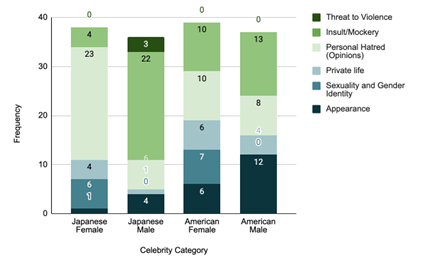
, , , ,

How Do Gender Stereotypes from 1973 Hold Up in Modern Media?

Griffin Gamble, Shayan Karmaly, Rahul Reddy, and Michael Zhan

Our team was interested in looking at some speech features that were found primarily in women’s speech in a famous study by Robin Lakoff in 1973. We wanted to see if Lakoff’s findings were still prevalent in today’s media. In our study, we followed two characters, Robin Scherbatsky and Barney Stinson, in the TV show How I Met Your Mother. When analyzing their various conversations with friends throughout the show, we focused on two of the many speech features that Lakoff initially identified – tag questions and intensifiers. We separated their conversations into two social contexts – single-gender and mixed-gender conversations. We were curious to see if the frequency of the speech features would increase or decrease depending on the type of social situation that Robin and Barney were in. In addition, we were interested in the overall frequency of tag questions and intensifiers in Robin’s speech versus Barney’s speech because, according to Lakoff, these speech features should be more prominent in female speech (1973). We found that Barney had more tag questions and intensifiers per line than Robin, but in single-gender situations, Robin had significantly more intensifiers per line.

[expander_maker id=”1″ more=”Read more” less=”Read less”]

Introduction and Background

Our research hoped to answer the following questions: Are tag questions and intensifiers still predominantly found in women’s speech more than in men’s speech? Does the gender of the speaker’s conversation partners play a role in how often speakers will use tag questions and intensifiers? One of the reasons that we are interested in both these questions and revisiting Lakoff’s findings is that since 1973, there have been many changes to gender norms as well as the ways that people represent themselves. In general, people are a lot more tolerant and accepting of differences, so we predict it could be the case that the gender stereotypes in language have changed as well.

While we initially planned on getting live recordings of UCLA students in different social contexts, we quickly realized that this would be difficult to accomplish within the ten weeks allotted for this study. It would also be placing a large burden on the participant as they would need to record themselves as they went about their already busy day. Because of this difficulty, we shifted gears toward analyzing TV show characters. It ended up working out because one of the research methods that Lakoff (1973) used in her initial study was observing the media, so we decided to do the same with the show How I Met Your Mother.

From left to right: Barney Stinson (Neil Patrick Harris), Robin Scherbatsky (Cobie Smulders), Ted Mosby (Bob Saget), Lily Aldrin (Alyson Hannigan), Marshall Eriksen (Jason Segel)

The show is a rom-com about five friends who live their lives and navigate the social setting of New York. We chose this show because it’s only been eight years since the show finished and the main cast all exhibit male and female gender stereotypes. Specifically, the two characters we followed are Robin and Barney because while they both exhibit typical stereotypes for their gender, they also often portray stereotypical gender norms of the opposite gender.

Methods

We analyzed six episodes of How I Met Your Mother which totaled two hours of footage and 559 lines from our two characters combined. We specifically picked episodes that Robin and Barney were featured in so they would have more lines and we could collect more data from them. When watching the episodes and reading the transcripts, we noted each time Robin or Barney used either of the two speech features. We wrote down the speech feature that was used, the character that said it, and whether it was a single-gender or mixed-gender situation. For each episode, we created a separate section on our spreadsheet for inputting the data and an area sectioned off for calculating the total counts.

It is important to note that not all tag questions are equal and they may not share the same function to portray the speaker as having less authority or power (Cameron 76). While you can use a tag question as a self-lowering device by giving your interlocutor the floor to respond to your statement, you can also use a tag question as an aggressive tool. For example, “You aren’t all that great, are you?” That said, all the tag questions in our data were of the hedging type. Here is an example from Robin, “If you’re going to be this disgusting, we’re not watching this, okay?”

Robin Scherbatsky (Cobie Smulders), looking shocked

Results/Analysis

So what exactly were our findings? Overall, we analyzed six episodes totaling two hours of footage and our findings were different from what we expected to find based on existing research. In (Seigler & Seigler, 1976, p. 169) and (Kramer, 1977, p. 159) both studies found that gender stereotypes in speech aligned with Lakoff’s theory. Keep in mind, these studies were focused on the perceptions of speech, not what each gender actually says in real life. We expected to find that the speech characteristics that were once associated primarily with women’s speech can now be found equally in both male and female speech, and are no longer strong indicators of the gender of the speaker. This was our hypothesis. Below, I will go into details including visualizations that display what we ended up analyzing.

Our data consisted of two different social contexts for analysis. Specifically, we looked at mixed-gender situations (where there was at least one male and one female in a social setting) and at single-gender situations (where there was only one gender in a social setting). For the purposes of the experiment, the genders will refer to non-trans males and females who identify as the gender that they were born with. Now, let’s look at the data:

Table 1 – Number of Tag Questions

As we can see in Table 1, we examined situations in which Robin and Barney are in mixed-gender and single-gender lines for the purposes of the tag questions. For this, we tried to choose episodes where we thought the two characters would have an equal number of lines in this context and to our convenience, they did for the mixed-gender situations, but NOT for the single-gender ones. So, while Robin and Barney have nearly the same number of total mixed-gender lines, Barney had 31.5% more tag questions. On the other hand, Robin led this category in single-gender situations!

Table 2 – Number of Intensifiers (Per Line)

Similarly, when looking at Table 2, we can see that Barney had 34.5% more intensifiers and from the raw data, it would actually seem as if Barney is the winner in both categories, however, when we equalize the data (as shown in the graph), Robin has more intensifiers per line in the single-gender situations. The tricky part of this table is that it shows the analysis per line rather than the total amount. We decided not to go with raw numbers so that it is not confusing to look at the total speaking time, but rather easier to look at the date per line. This average is more precise since it allows us to equalize the data for both Barney and Robin. And if we look more specifically at the single-gender situations, Robin actually has roughly half of Barney’s lines. Overall though, the single-gender data is pretty sparse; therefore, we can conclude that it’s not super conclusive of anything.

Discussion and Conclusions

The conclusion that can be drawn from our analysis and findings is that Lakoff’s speech features that were stereotypically and data-backed as either higher for men or women no longer hold true in modern times. We can see from our data that speech features that were shown in Lakoff’s research as higher for women such as tag questions and intensifiers were actually around the same for Barney and Robin. In some cases, they were even higher for the male focus of the study, Barney. Although we were not able to find much data for single-gender situations, from the evidence that we do have we can conclude that modern-day society has moved into a third-wave sociolinguistics lens that puts much more emphasis on the individual when compared to the past. After taking into consideration the time gap between the gender stereotypes of 1973 and the stereotypes of today in 2022, we can see that our hypothesis did indeed hold true where these outdated assumptions on stereotypical speech features can no longer be linked to a single gender. This makes sense as we now live in a much more gender-fluid and accepting society than in the past where everyone was strictly grouped as masculine and feminine and deviating from the norm was shunned by most. Some high-quality TED talks that reinforce these ideas are “Language around Gender and Identity Evolves” presented by Archie Crowley and “How Language Shapes the Way We Think” presented by Lera Boroditsky. The first TED talk by Archie delves into how language is ever-changing and a powerful tool to allow people to identify themselves and find something that makes them feel comfortable. In the second TED talk, Lera uses scientifically backed data to prove that language does indeed shape the way we think and how we have over 7,000 cognitive universes, each linked with a language as each language gives the user a unique way of viewing the world and is very impactful in shaping the way we view the things around us without us even knowing. Both presentations talk about language being a powerful tool for self-expression and tie into our appeal that language should not be confined to preconceived notions of gender schema as it might have been in the past. Language should be something that brings people closer together instead of a weapon that further alienates people. If there were more time, we would have liked to expand upon our research by analyzing real people instead of just fictional TV characters and comparing the results. We also realize that analyzing real people would mean we would also need to account for external influencing factors such as race, occupation, geographical origin, etc.

While we began looking at how speaker agency can play a role in changing one’s speech through single and mixed-gender situations, it would be valuable in a future study to analyze different types of conversations. For example, an argumentative conversation may have significantly fewer self-lowering tag questions while it might have more intensifiers to help get the point across. Podesva’s (2011) study could be used as inspiration for a framework for how to conduct a study involving participants that move through discrete social contexts.

References

Cameron, D., McAlinden, F., & O’Leary, K. (1988). Lakoff in context: The social and linguistic functions of tag questions. Women in their speech communities, 74, 93.

How language shapes the way we think | Lera Boroditsky. (May 2, 2018). https://www.youtube.com/watch?v=RKK7wGAYP6k

Kramer, C. (1977). Perceptions of Female and Male Speech. Language and Speech, 20(2), 151–161. https://doi.org/10.1177/002383097702000207

Lakoff, R. (1973). Language and Woman’s Place. Language in Society, 2(1), 45–80. http://www.jstor.org/stable/4166707

Language around gender and identity evolves (And always has) | Archie Crowley. (April 16, 2021). https://www.youtube.com/watch?v=XguYZXUChhY

Podesva, R. J. (2011). The California Vowel Shift and Gay Identity. American Speech, 86(1), 32–51. https://doi.org/10.1215/00031283-1277501

Siegler, D. M., & Siegler, R. S. (1976). Stereotypes of Males’ and Females’ Speech. Psychological Reports, 39(1), 167–170. https://doi.org/10.2466/pr0.1976.39.1.167

[/expander_maker]
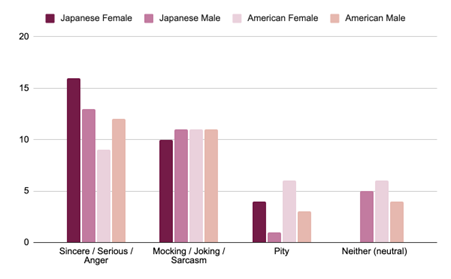
, , , , ,
Scroll to Top