Are some NBA slang terms too vague? Absolutely!
Isaac Verdugo, Riley Kwinn, Brendan Xiong, and Gustavo Gutierrez
NBA (National Basketball Association) slang is widely used by basketball fans all over the world. NBA slang is formed and developed with NBA history. It has unique features and functions that give NBA fans the opportunity to express their opinions about the game of basketball in creative ways. NBA slang reflects NBA culture. A sociolinguistic study of NBA slang helps people know more about NBA culture and fans of different teams. The following study discusses semantic change in NBA slang terminology within Los Angeles Lakers and Los Angeles Clippers communities of practice through discourse analysis. First, we selected four common NBA slang terms that are used in this sports league and provide their generic definitions. We then analyzed online basketball discourses to look for ways in which fans from both teams use the NBA slang terms that we are examining. Third, we used a corpus analysis toolkit, AntConc, which helped us find patterns of concordance within our data. We concluded by making generalizations about the use of our selected terms by Lakers and Clippers fans and determined trends through analysis.
In this study we sought to understand why NBA slang is used in online communities of practice. This helps identify connections within communities of practice because basketball fans are tight-knit, have frequent interaction, develop shared goals and knowledge about basketball, and create new NBA slang. Because many basketball fans use NBA slang to refer to a particular team and/or player, the meaning will vary depending on who you ask; some use older meanings from previous eras of the NBA, whereas others use newer meanings that fit today’s NBA style of play. By analyzing the use of four NBA slang terms (foul, skill, superteam, flagrant foul), it will help us understand how they have changed in meaning over time. Next, we will compare and contrast the usage between Lakers-Clippers fans. We chose these two teams specifically because they are from the city of Los Angeles and have drastically different histories; the Lakers are the most famous NBA franchise of all-time with 17 championships, whereas the Clippers have none (Los Angeles Clippers vs. Los Angeles Lakers, n.d.).
That being said, we attempted to answer the following question:
(1) What sorts of semantic change has NBA slang experienced within Lakers and Clippers communities of practice?
Background
Previous research in semantic change shows that words or real world entities change over time. More specifically, words change semantically and this change is reflected in the way words are being used (Wijaya & Yeniterzi, 2011, “Introduction” section). This linguistic aspect of semantic change also applies to NBA slang. For example, in the 20th century of the NBA, the NBA slang term Greatest of All Time or GOAT, was used to describe how successful a player and/or team was based on the number of championships they won. However, NBA fans have added new layers onto its meaning over time, such that basketball IQ, skillset, defensive rating, and other basketball qualities are relevant in the discussion of “Who’s the GOAT?” While the NBA uses generic definitions for NBA slang terms, it does not necessarily mean that fans will use that particular definition in every basketball context. Because of this, NBA slang terms are extremely nuanced, which is why the word GOAT highlights one of our goals to lay out differing traits of the four terms we will examine.
Another frequently used NBA slang term is skill. Skill in the NBA during the 1960s meant being able to run down the court efficiently, shoot the ball from close range, and defend. However, in the 1970s, skill was about playmaking abilities, too. One paper addressing a similar topic discussed the importance of player impact, “Berri tried to determine if Karl Malone or Michael Jordan was more valuable, and he found that Dennis Rodman was most valuable because of his rebounding ability” (Whitmoyer, 2019, p. 4). The significance of this quote shows that many teams prefer having a player who impacts the game of basketball in more than one aspect. Many believe that Michael Jordan is the best basketball player of all time, but Whitmoyer argues that Dennis Rodman is. This shows that there are different views about a player’s importance, which is part of what we will explore in our project.
Methodology
We analyzed the NBA slang terms on online basketball discourses such as Twitter, Reddit, and Instagram, where we collected 100 Lakers-Clippers samples relating to these terms for a total of 400 samples. Then, we used AntConc, a corpus analysis software that made it much easier to compare the surrounding environments of all the data samples for each term. Lastly, we made generalizations about the use of the NBA slang terms and determined trends in our data through analysis. This method allowed us to gather more samples and data from online discourses than we would have surveying/interviewing basketball fans with the amount of time we had for the project, and helped us address the question in our introduction by allowing us to identify common trends in a data set that would be far too large to analyze without the assistance of corpus linguistics software.
Results: Data Analysis
In Figure 1, we see a list of words that AntConc found that foul was commonly used within the same sentence, as flop appeared the most with a total of 73 samples.
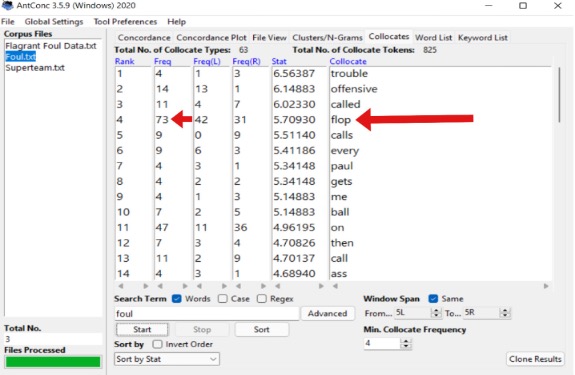
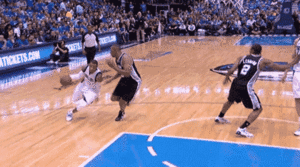
With this software, we were able to discover that foul has a new meaning added to it that can be used in more contexts than before with the use of flop. This concept is known as widening, which is a type of semantic change. Throughout the history of the NBA, the generic definition of foul has remained the same, referring to “illegal personal contact with an opponent and/or unsportsmanlike behavior” (How Fouling Works in Basketball: 6 Common Fouls Explained, 2020, para. 2), which can be seen in Figure 2.
However, the word foul has become too vague in today’s NBA that Lakers and Clippers fans have used a more specific word to describe the actions that opponents do to get the foul call in their favor — flop. A “flop” is an attempt to fool referees into calling undeserved fouls by exaggerating the effect of contact with an opposing player (Explanation of Anti-Flopping Rule, 2012, para. 2), which can be seen in Figure 3.
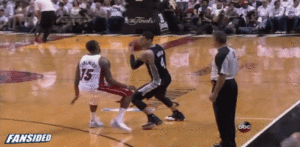
The use of flop for a non-foul changes the meaning of foul because opponents fall to the ground when contact is drawn, whether minimal or not. The act of flopping is changing the way the game of basketball is played since referees must distinguish between what is and isn’t a foul, which they tend to struggle with.
Both Lakers and Clippers fans use flop as a way to express their anger when they believe there wasn’t any illegal contact by the opponent, but referees think otherwise. This finding shows how the meaning of foul has been expanded by these fans because flopping is more common today than it was before in the NBA. Instead of fans saying “That was not a foul,” fans can now say “That was a flop,” when there was little or no physical contact by the opponent. This semantic change of the word foul allowed these fans to be more specific and provide a reasonable judgment about a certain basketball play, instead of giving a biased opinion with no context. Because there was a high frequency of data where the slang term foul was used with flop in the same sentence than without it, it suggests that they both go hand-in-hand when fans debate a foul call.
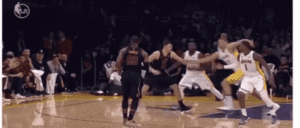
The second word we examined was skill. Skill is “the ability to do something well; expertise” (Oxford University Press (OUP), n.d.). In the 20th century of the NBA, skill was synonymous with players who could run down the court efficiently and score more than 15+ points on a regular basis. However, in today’s game skill is used in many other ways such as passing, as observed in Figure 4.
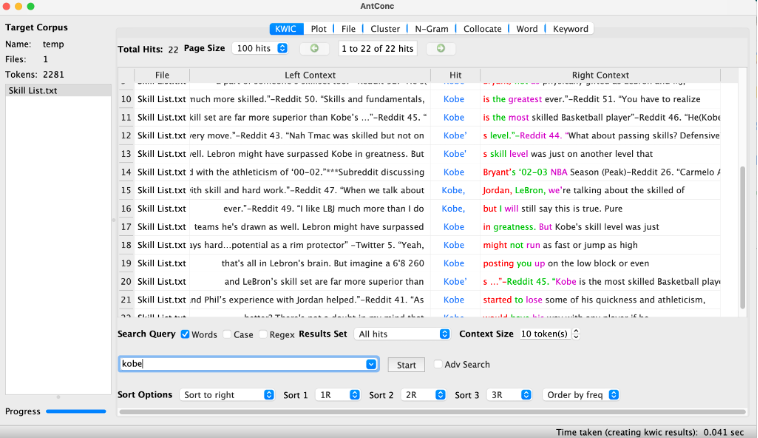
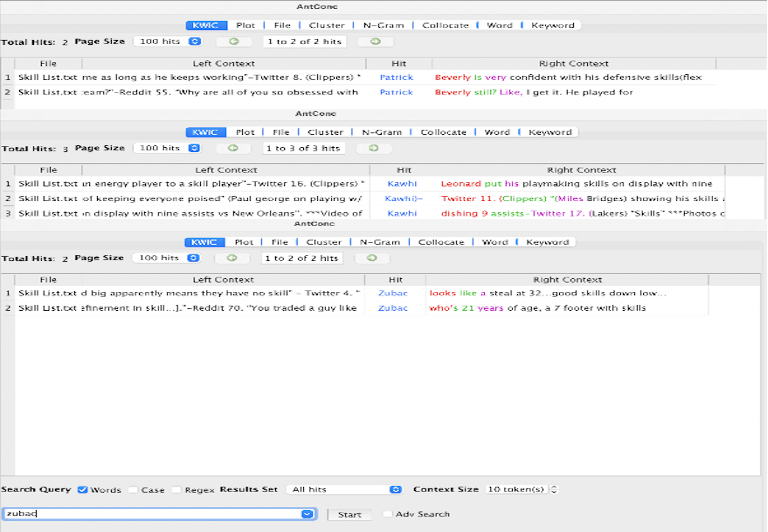
There are different connotations as to what skill implicates. According to the data via AntConc in Figure 5 and 6, skill was used the most within members of the Lakers community when discussing Kobe Bryant, an all-time great with elite footwork, shooting, post-moves, and defense that contributes to what skill means. Clippers fans most used skill in reference to flopping, identifying it as a ‘skill’, or point guard ‘skills’ which implies a specific attribute derived by a select group of positioned players. In the online discourse data, Kobe [Bryant] was mentioned most to embody skill because of his scoring ability, footwork, shooting, defense, basketball IQ, work ethic, and athleticism. Other players like Kawhi Leonard, Patrick Beverly, and Ivica Zubac were mentioned a combined 7 times in the data set, a stark contrast to Kobe Bryant’s 22.
The data suggests that semantically, skill has changed from what it was once meant over the last few decades among these communities of practice. Skill in basketball does in fact include scoring ability, but it also incorporates many other factors that make up a player’s complete value on the court (Locklin, 2021, para. 3). Skill no longer identifies a player who can run down the court efficiently and score 15+ a game but instead, is the marker for players who embody proficient attributes in all areas of the game.
The third word we examined was superteam. This term can be defined as “already established All-Star players coming together to a team to form a super team” (Urban Dictionary: Superteam (NBA), 2018). Many of the fans’ conversations from the data involved debates about the exact definition of the term. It was more commonly used as one word, rather than as two separate words, though there was no significant difference in its intended meaning; fans often responded to one variation with the other. Superteam seems less rooted in one literal definition, and more tied to the emotional idea of a “team that is unfairly good,” as the meaning seems to change depending on the context it’s used in. The people using superteam seemed more intent on winning debates than using the word “correctly.” The term has therefore seemed to experience a significant semantic widening such that its meaning changes depending on a) the people using it, and b) the greater context of which teams are performing well in the NBA.
Most of the data samples were gathered from Lakers fans since there has never been a Clippers team that was considered so good that it was unfair. The only instance superteam was used to describe the Clippers was when a fan claimed Kawhi Leonard, a current player on the Clippers, had “tried to make a superteam,” with the implication being that he had failed. The primary topics discussed in the data we gathered for this term were: 1) whether or not LeBron [James] had actually deserved the championship titles he had won after forming multiple ”superteams,” and 2) whether or not this year’s Lakers roster had in fact been a “superteam” despite not winning a championship nor making the playoffs in 2022, as can be seen in Figure 7.
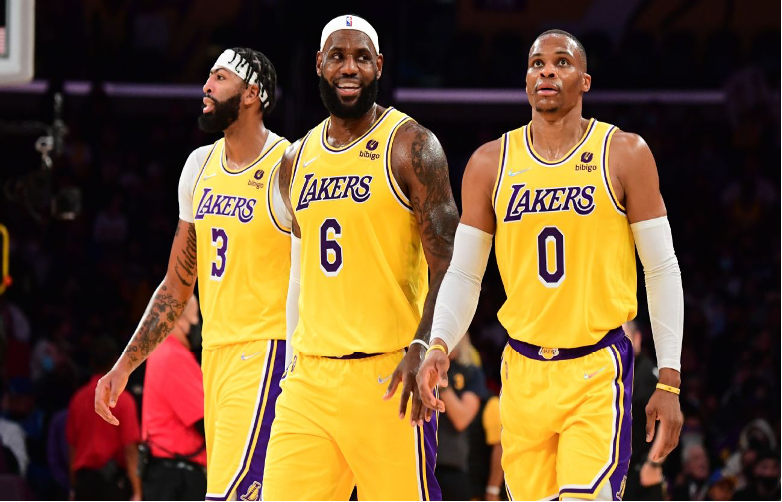
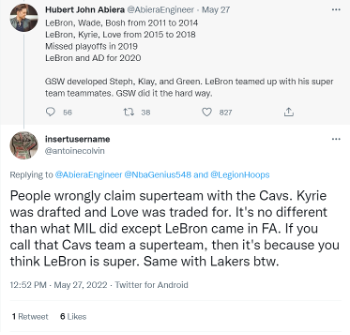
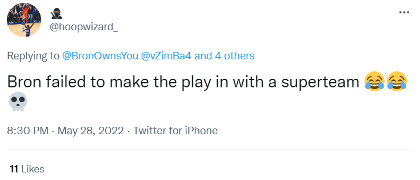
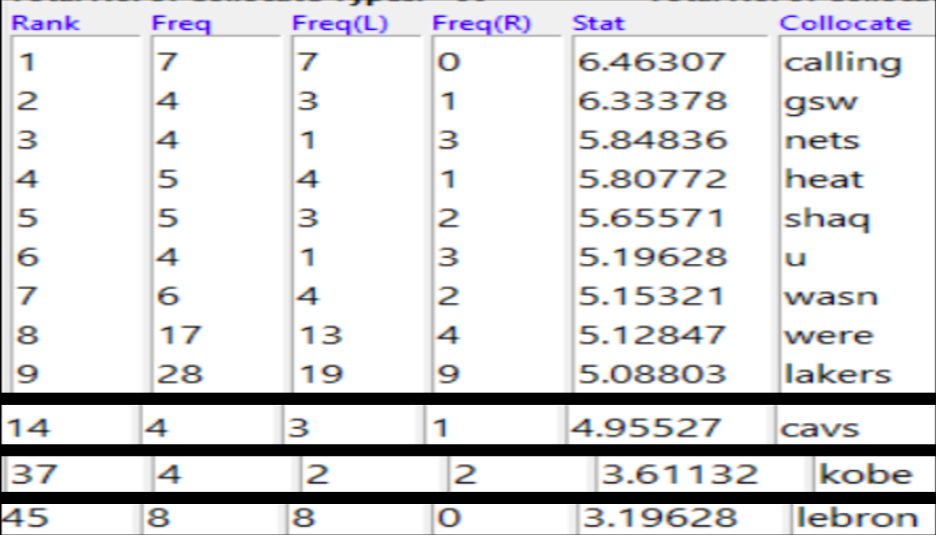
Unsurprisingly, the teams most commonly associated with superteam were either current or retired All-Star players from teams such as the Cavaliers, Warriors, Heat, Nets, and Lakers, as observed in Figure 10. The high frequency of Lakers relative to the other teams is due to the fact that most of these data are from Lakers’ fans’ discourse.
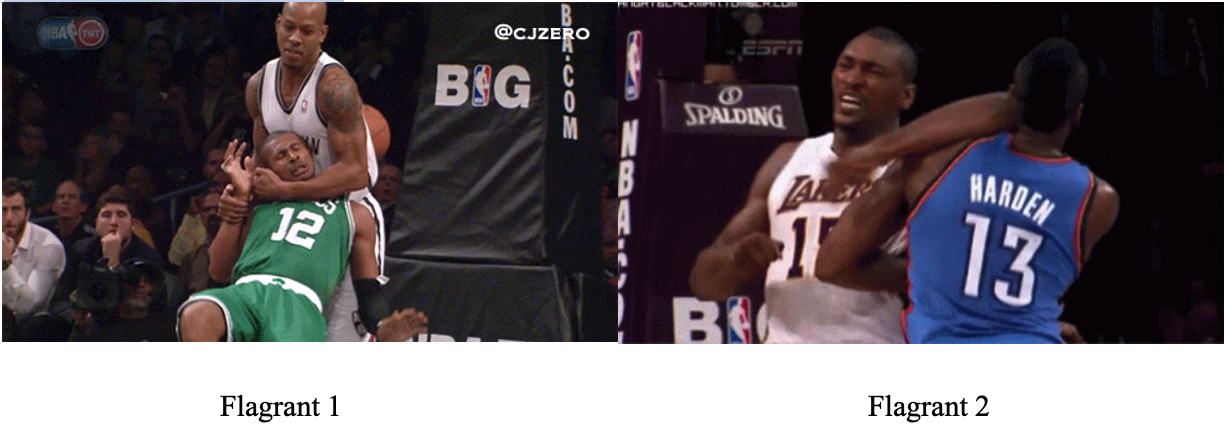
According to the official NBA website, a flagrant foul is excessive contact beyond a regular foul. There are two types, a Flagrant 1 is unnecessary contact against a player committed by an opponent, whereas a Flagrant 2 is unnecessary and excessive contact against a player (Flagrant Fouls, n.d.).
The main semantic change we found from Lakers and Clippers fans regarding this word is elevation, where one uplifts an utterance, and degeneration, where negative light is shone on a statement. Tweets by Lakers fans are uplifting, with one of them proclaiming that the Lakers are equals to every other team. The tweet from the Clippers fan is degenerated through its angry intonation. The Lakers tweet also has more likes, and popularity equates to less negativity as “fearful and negative tweets [have]…low virality” (Cheung‐Blunden et al., 2021, p. 19). The less popular Clippers fan tweet uses strong word choice through swearing.
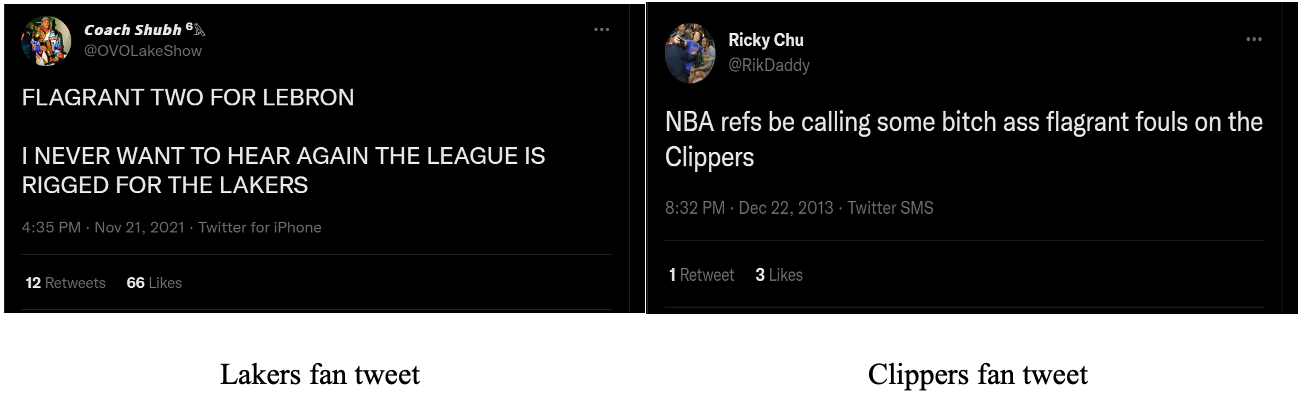
The primary cause for this difference is team status. The Lakers fan sounded less angry because of the history of his team, as he is comfortable with the prestige and numerous championship titles of the Lakers. The Clippers are not as well-known as the Lakers. Less prestigious teams have fewer fans because their teams are not as competitive as others. Therefore, the fans of such teams are very committed and passionate to be able to stick through team struggles. Furthermore, “high levels of identification with a sports team are positively related to fan display and verbal response” (Rocca & Vogl-Bauer, 1999, p. 244). The intense feeling for one’s team drives Clippers fans to use strong language.
Discussion
According to new research about American slang, there are unique features that influence it based on its originality (Zhou & Fan, 2013). Similarly, we learned that NBA slang is used because of its originality. NBA fans were creative with how they turned generic definitions of the NBA slang terms to more catchy and specific meanings. In addition, these new words and meanings are commonly used by NBA fans for the pleasure of being in fashion and appear to have a deep understanding about the game of basketball. When these fans use NBA slang terminology, it tends to validate their opinion about basketball because it is solely used by basketball fans.
One social factor that influences the use of NBA slang terms is social media. Social media has allowed NBA fans to discuss and share their opinions about basketball that reach millions of people, as can be seen in some figures above. A second social factor is basketball commentators because they enjoy commenting on live-basketball games using descriptive language, and find that NBA slang is more direct and simpler to use than the generic definitions.
An individual factor that influences NBA slang are peoples’ knowledge and skills about the game of basketball. Their knowledge and skills about the game of basketball lets them feel entitled to have a valid opinion about a particular team and/or player.
These findings support our thesis statement that both Lakers and Clippers fans would experience semantic change to NBA slang because of how much the NBA has evolved. More specifically, many NBA slang terms have been outdated, and it was expected that these fans would use different meanings to these slang terms to fit today’s NBA style of play.
Conclusion
Linguists can benefit from our research because they are interested in real world phenomena. As such, they are descriptive and study how people actually talk, where some use NBA slang as part of their everyday speech, and not prescriptive regarding how people “should” talk. Because linguists study semantics, our research allows for linguists to study more in-depth the role that NBA slang has for basketball fans to know what certain words mean, what makes them have more than one meaning, why those meanings exist, and others.
A possible future direction of our research would be for researchers to replicate this study on a much larger scale through ethnographic research to ensure that there is enough data gathered from both groups. Ethnographic research can improve this study because it involves observing a particular group and site over a long period of time, which could gather a large amount of data about the use of NBA slang at basketball games.
References
Cheung‐Blunden, V., Sonar, K. U., Zhou, E. A., & Tan, C. (2021). Foreign disinformation operation’s affective engagement: Valence versus discrete emotions as drivers of tweet popularity. Analyses of Social Issues and Public Policy, 21(1), 980–997. https://doi.org/10.1111/asap.12262
Explanation of Anti-Flopping Rule. (2012, October 5). NBA Official. Retrieved June 8, 2022, from https://official.nba.com/explanation-of-anti-flopping-rule/
Flagrant Fouls. (n.d.). NBA Official. Retrieved June 8, 2022, from https://official.nba.com/trigger/review-of-called-foul/
How Fouling Works in Basketball: 6 Common Fouls Explained. (2020, November 8). MasterClass. Retrieved June 8, 2022, from https://www.masterclass.com/articles/how-fouling-works-in-basketball#quiz-0
Locklin, W. (2021, July 15). What is “Skill” in NBA Basketball. The Wright Way Network. Retrieved June 8, 2022, from https://twsn.net/2021/07/what-is-skill-in-nba-basketball
Los Angeles Clippers vs. Los Angeles Lakers. (n.d.). Diffen. Retrieved June 8, 2022, from https://www.diffen.com/difference/Los_Angeles_Clippers_vs_Los_Angeles_Lakers
Oxford University Press (OUP). (n.d.). Skill. Lexico.Com. Retrieved June 8, 2022, from https://www.lexico.com/en/definition/skill
Rocca, K. A., & Vogl‐Bauer, S. (1999). Trait verbal aggression, sports fan identification, and perceptions of appropriate sports fan communication. Communication Research Reports, 16(3), 239–248. https://doi.org/10.1080/08824099909388723
Urban Dictionary: Superteam (NBA). (2018, May 28). Urban Dictionary. Retrieved June 8, 2022, from https://www.urbandictionary.com/define.php?term=Superteam%20%28NBA%29
Whitmoyer, E. (2019). Measuring Greatness in the NBA. Scholars Crossing. Retrieved June 8, 2022, from https://digitalcommons.liberty.edu/honors/845/
Wijaya, D. T., & Yeniterzi, R. (2011). Understanding semantic change of words over centuries. Proceedings of the 2011 International Workshop on DETecting and Exploiting Cultural diversiTy on the Social Web – DETECT ’11. https://doi.org/10.1145/2064448.2064475
Zhou, Y., & Fan, Y. (2013). A Sociolinguistic Study of American Slang. Theory and Practice in Language Studies, 3(12). https://doi.org/10.4304/tpls.3.12.2209-2213